• About

Seeking and Serving

~ seek and serve Christ in all persons

Seeking and Serving

Tag Archives: God

A child of God…

02 Wednesday Jul 2014

Posted by jandrewsweckerly in Uncategorized

≈ 1 Comment

Tags

children, church, family, God, parent, priest

I am a regular advocate for children in Church.  I think the practice shapes children at a young age and enlivens worship for the community.  Though distracting to some, the noise of children makes me feel like the church is alive and joyful.  That is why I always encourage parents with young children, because I know from experience that the noises of your own child sound ten times louder than they do to anyone else.  I also know that wrangling little ones can be frustrating some days and other days down-right impossible.  Many a parent has expressed to me that they are glad the sermons are posted online, since they often do not hear it when their little ones are particularly active.  I encourage parents to persevere and even make sure that Sunday School does not bleed into worship time so that our children can be present as gifts to the rest of the congregation.

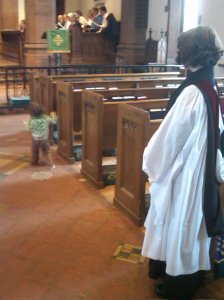
But every once in a while, my own daughter reminds me how my principles do not always coincide with the realities of experience.  This past Sunday, as we were serving communion, my daughter managed to sneak away from her dad, and kneeled next to another parishioner.  When I reverently offered her the host, she abruptly grabbed it from my hand and shoved it enthusiastically into her mouth.  As her parent, my immediate reaction was to be a little embarrassed and to wonder what the other parishioners must think of my parenting skills.  Despite a couple of chuckles, I squashed my embarrassment, and moved on to the next person at the rail.  Later that morning, during the final hymn, my daughter joined me in the aisle as I sang and waited to deliver the morning’s announcements.  As the hymn was wrapping up, she dropped my hand and started shaking her hips in the center aisle, dancing to the hymn with reckless abandon.  Again, my initial instinct was to fret over what parishioners might think about the kind of dancing I was teaching at home.

Later, as I was thinking about the two incidents, several things came to me.  One, I was once again reminded how hard it is to manage children in the context of formal worship.  I am so grateful to the parents who do it every week and who allow us to be blessed by their children.  Two, I realized how hyper aware I am of my role within the church and how that role has some serious implications for my family.  In my ordination vows, the bishop asked me, “Will you do your best to pattern your life and the life of your family in accordance with the teachings of Christ, so that you may be a wholesome example to your people?”  Sometimes, I think that question makes priests and their families feel like they have to be perfect – including in the pew on Sundays.  But what I realized was that my daughter was not shattering our “perfect” image.  She was inviting me to let go of pretenses and be real with our parish.  Being a parent, in fact being a human, is messy, and I do not need to pretend that I somehow have a better hold on being “not messy” simply because I am a priest.

Finally, what I realized on Sunday is that being a “wholesome example” means loving my child in the way that I love all our children at church.  When I could step back from the fact that my child was greedily grabbing Eucharist and dancing a little “inappropriately” in church, I could see the incidents totally differently.  When I could see my child as a child of God, I could see someone who was demonstrating how eager we all should be to receive Christ’s body at the table:  how our longing for Jesus sometimes is downright greedy and aggressive, and grabbing for the bread is a physical way of showing a passionate longing for Christ.  When I could see my child as a child of God, I could see someone who was moved by the Holy Spirit to joyfully dance before the Lord, not unlike David so many years before[i]:  someone who was actually inspired by the music being sung and played, not just dutifully and dispassionately singing the words.  I thought about how her body is a gift from God and how wonderful it was that she was using her body to praise God, even if my uptight-self resisted it.

One of the greatest reasons having children among our midst in church is because they help us get out of ourselves and our need to keep up appearances, and they help us to see the holy in new, exciting, and fresh ways.  So, please keep bringing those little ones.  We all need them to show us the face of Christ.  And for our parents, occasionally they might remind you how they are children of God as much as they are your children as well.

[i] 2 Samuel 6.16

Sermon – Genesis 22.1-14, P8, YA, June 29, 2014

02 Wednesday Jul 2014

Posted by jandrewsweckerly in Uncategorized

≈ Leave a comment

Tags

Abraham, binding, equality, God, hope, Isaac, sacrifice, Sermon, together, trust, uncomfortable, vulnerability

One of the great things about the lessons in the summer is that we often get these dramatic stories from the Old Testament.  Last week, we had Hagar and Ishmael’s story.  Today, we have the story of the binding of Isaac.  Both of these stories are the dramatic kind of stories that make us uncomfortable and certainly make many people say, “Well that’s the Old Testament God…not the God that I know.”  We cannot fathom who this God is that “tests” people, deliberately asking them to commit the most heinous of crimes – killing one’s own child.  We are perplexed by Abraham, who upon God’s instruction, simply goes to where God sends him, fully willing to commit this most horrible crime, all the while deceptively luring his child to death.  And poor Isaac – we question how God can expect this test of Abraham’s not to create lifelong psychological scars on Isaac.

The only way I could find my way out of this story this week was to reconsider each character in the text.  I started with God, whose test of Abraham feels more like torture.  I have never felt comfortable with the concept of a god who puts us through tests.  That kind of agency and intervention by God is counter to my understanding of who God is.  I do believe that Satan or the powers of evil regularly test us, and awful things simply happen at times.  But our God is a God who gives us free will – who allows us to make mistakes, but never actively manipulates us in a way that could be labeled as testing.  God does not send us cancer, or take our children, or leave us hungry.

So why does this story say that God “tests” Abraham.  Well, one clue is found in the first sentence.  The story begins with this sentence, “After these things God tested Abraham.”  “After these things,” is not just some transitional phrase like, “In other news…”  Those “things” the story refers to are not insignificant.  If you remember, Abraham has had a circuitous journey, and quite frankly, Abraham has not proved to be very trustworthy so far – constantly taking matters into his own hands, and making a mess of things.  Take, for example, those two times that Abraham’s wife Sarah ended up in a harem in Egypt and Canaan.  Both of those times Abraham lied about Sarah, saying she was his sister, simply to protect himself from being killed by a covetous king.  For a man who trusted God so much that he was willing to leave everything behind, Abraham clearly did not trust God fully enough to take care of Abraham and Sarah.  And so he concocted these horrible lies, forcing Sarah into an awful position – not once, but twice!  Then, of course, there was that time that Abraham did not believe that God would give him children.  So the untrusting Abraham and Sarah got impatient, and decided that Abraham should father a child with Sarah’s handmaid, Hagar.  That fiasco led Abraham’s beloved son being cast out into the wilderness, never to be seen again.  So “these things,” are not insignificant things.  Any of us in relationships with family, spouses, or intimate friends know that trusting someone who betrays your trust over and over again is difficult, if not impossible.

Meanwhile, God is making a pretty big leap of faith in the person of Abraham.  God has already witnessed failure after failure in God’s people – from Adam and Eve to Cain and Abel; from the cleansing of the earth with Noah to the return to sin at the tower of Babel.  And so God takes all that experience with broken covenants and this time attempts to enter into relationship with God’s people through the person of Abraham.  All will be blessed through this one person, the blessing passing through Abraham like a prism, “through which God’s blessing is to be diffused through the whole world.”[i]  So in taking on such a substantial risk, and in seeing Abraham falter many times, a time of testing does not sound so abhorrent after all.  In fact, we begin to see that God is making God’s self pretty vulnerable with Abraham.  And because God grants free will, God cannot know what choices Abraham will actually make.[ii]  The longing for assurance while in a vulnerable position is only natural – one we experience anytime we decide to put ourselves in vulnerable positions with others.

So after coming to some peace with God in this story, I began to pick apart Abraham.  Why does Abraham submit to this test?  He has taken matters into his own hands before, including arguing against killing all the Sodomites.  Why does he submit to God now?  In fact, when God commands Abraham to take Isaac up for sacrifice, Abraham does not protest at all.  The ancient rabbis tried to address this frustration by proposing a little embellishment.  Whenever the rabbis did not understand something in biblical text, they would create a little midrash, or imaginative expansion of the text, to help interpret the text.  So in their retelling of the Genesis story, they create a dialogue between God and Abraham.  In the original text we heard today, all we have are these words:  Take your son, your only son Isaac, whom you love, and go to the land of Moriah…  The midrash changes the story to read like this:  “Take your son,” God says.  “I have two sons,” Abraham replies.  “Your only one,” God says.  “This one is the only son of his mother, and this (other) one is the only son of his mother.”  “The one you love,” God clarifies.  “I love them both,” Abraham argues.  “Isaac,” God finally asserts.[iii]

What the midrash tries to do is highlight what might have been going on inside Abraham – something the story never tells us.  Just because Abraham obeys does not mean that he likes obeying.  We can also surmise some of Abraham’s conflicted feelings in other parts of the story.  We hear how torn he is by the ways that he responds to both God and Isaac.  When God calls upon Abraham, he replies, “Here I am.”  That age-old response to God, hineni, is Abraham’s way of showing deference to God.  But Abraham says those same words to Isaac when Isaac calls to him.  “Here I am, my son.”  You can almost hear the devastation in his voice.  But you also hear a deep sense of respect and love for his son – the same deep respect and love Abraham has for God.  Ultimately, what we see in Abraham is a deep trust that things might work out for the best.  When Isaac asks where the lamb is for the sacrifice, Abraham says, “God himself will provide the lamb for a burnt offering, my son.”  Some might read that as a white lie, told to placate an inquisitive son.  But I like to imagine that Abraham hoped against hope that God would in fact provide a lamb, instead of his son.  In fact, perhaps that is the only thing Abraham has left in this horrible story – a trust that God will act and save his son.

Finally, there is Isaac.  As I read this story this week, my immediate thought was, “Poor Isaac.  He has some serious therapy in his future!”  And perhaps that is true – that Isaac is the innocent lamb, deceived, and almost killed.  In fact, many scholars call this story, “The sacrifice of Isaac,” as opposed to “The binding of Isaac.”[iv]  But there is more to Isaac’s story than meets the eye.  In the story, two times the text says of Abraham and Isaac, “and the two of them walked together.”  We know enough about scripture to know that when something is repeated, that repetition is significant.  The text does not say, Abraham led Isaac or Abraham forced Isaac.  The text says the two walked together.  We do not know how much Isaac knows at this point, but the way that the two walk together suggests a certain equality – as if the two face this test together.  Though we imagine Isaac terrified under his father’s knife, perhaps Isaac allows himself to be bound, facing this test with is father, fully trusting as his father does that God will provide the lamb.

The artwork depicting this story varies widely.  There are frightened pictures of Isaac, anguished depictions of Abraham, and strong angels who forcefully grab Abraham’s raised arm before he can damage Isaac.  But my favorite depiction is one by Peggy Parker.[v]  Peggy’s woodcut shows a bound, but peaceful Isaac, curled up on the altar.  Abraham is lovingly and with grief looking over Isaac, a knife hidden behind his back.  And above them both is a large angel, wings spread widely, arms extended over them both, as if lovingly embracing the father and son.  What I like about Peggy’s rendering is that there is a sense that all three characters are vulnerable, all three characters are pained, and yet all three characters trust their vulnerability with one another.

This is our takeaway today.  This story is tough – I doubt that I will be using the story as a bedtime story anytime soon.  But this story also reveals how hard being in relationship with God is – not just for us and our loved ones, but for God too.  We are all trying to love and trust one another.  And just like in any other relationship, that love and trust is hard work.  But when we understand that each of us in this relationship, fully committing to being vulnerable and trusting each other, somehow we find the courage to take that first step.  And when we take those steps, we do not take them alone and we are not forced.  We take them together, equally sacrificing security in the trust of something much greater with our God.  Amen.

[i] Ellen F. Davis, Getting Involved with God: Rediscovering the Old Testament (Cambridge: Cowley Publications, 2001),60.

[ii] Ellen F. Davis, “Radical Trust,” July 26, 2011 as found at http://www.faithandleadership.com/sermons/ellen-f-davis-radical-trust on June 25, 2014.

[iii] Davis, Getting Involved, 55.

[iv] Kathryn Schifferdecker , “Commentary on Genesis 22.1-14,” as found on http://www.workingpreacher.org/ preaching. aspx?commentary_id=2138 on June 26, 2014

[v] http://www.margaretadamsparker.com/biblical/biblical_abraham.aspx as found on June 27, 2014.

The power of smell…

25 Wednesday Jun 2014

Posted by jandrewsweckerly in Uncategorized

≈ Leave a comment

Tags

church, God, holy, memory, power, scent, smell

Courtesy of http://cyndi-rose.com/2013/05/03/focus-on-what-is-right-not-on-what-is-wrong/

Courtesy of http://cyndi-rose.com/2013/05/03/focus-on-what-is-right-not-on-what-is-wrong/

Last week I was taking a walk for a bit of exercise on my day off.  I was trucking along when all of a sudden a fragrance hit me – the smell of honeysuckle.  I stuttered to a stop just so I could inhale the scent a little longer.  Honeysuckle is one of those scents that takes me back to a happy place in my childhood.  You see, every June when I was growing up, my family would travel to the mountains of North Carolina for the Annual Conference of the United Methodist Western North Carolina Conference.  The conference lasted a few days at the end of the week, but our family would go up on the Monday before and make the week our annual vacation.  Lake Junaluska holds many fond memories for me – canoeing on the Lake, crafts at the childcare center, swimming in the pool, feeding ducks, and in general enjoying the beauty of the property.  All those memories are triggered by the smell of honeysuckle, whose blooming always coincided with Annual Conference, forever connecting the smell with the memories.

Smell has a powerful way of connecting us to memories.  The smell of your favorite food that your mom used to make, the cologne or perfume of your first crush, the scent of baby oil, the aroma of coffee, or the smell of a campfire:  all of these smells have the ability to halt time for us and take us back to a place of warm, fond memories.  The scents conjure up people or places that made us happy and shaped our lives.  Though we rarely hold those memories actively in our everyday lives, a simple scent can bring a smile to our faces as those memories bubble up in our minds.

One of the things that I love about Episcopal Church is the way that the Church engages all the senses:  the sight of the cross, the touch of hands passing the peace, the sound of psalms being chanted, or the taste of communion.  Of course, as someone formed in “high church” worship, incense is the smell I associate with church.  When I was in seminary, I served in a church that used a lot of incense – I could smell it in my hair when I came home, I could smell it in my vestments when I put them on before services, and I could even sometimes smell it when the church was empty and dark, the incense still lingering in the walls.  Anytime I smell incense now, it has a calming effect on me.  Without thinking, I take a deep breath, and somehow am transported to memories of my experience with the holy – at churches, at monasteries, on retreat.  I have considered several times getting a home incense kit for devotions, just to help me connect to those memories.

Though many churches shy away from incense, what I like about incense is that the smell plants in our memories experiences with the holy.  Much like the fond memories of childhood, fond memories of church can help shape us and give us grounding throughout life.  The next time you are in church, I invite you to consider what smells might help ground you throughout the week.  Maybe it is the scent of holy wine, maybe the smell of extinguished candles, or maybe even the smell of weathered pages in a BCP or hymnal.  Whatever the scent, allow its power to reconnect you with God and transport you to a place where you knew God loved you and cared for you beyond measure.

Sermon – Genesis 21.8-21, P7, YA, June 22, 2014

25 Wednesday Jun 2014

Posted by jandrewsweckerly in Uncategorized

≈ Leave a comment

Tags

blessing, God, Hagar, hear, Ishmael, promise, relationship, see, Sermon, suffering, understand, wilderness

Alice sat on her bathroom floor crying.  The bathroom was the only place she felt like she could get a moment of privacy.  Her tears were the release she found for what felt like an impossible juncture.  Last summer things had been okay for Alice.  She was coping with her divorce, and managing to feed and care for her son on her own, despite the fact that her income from cleaning houses was so small.  She had managed to work out some government assistance that gave her enough cushion to keep food on the table and a roof over their heads.  Life was not easy, but life could be a lot worse.

But during the last year, her world began to fall apart.  After a work injury, Alice could not clean houses for months.  Being self-employed meant she had no one to fill in at her houses.  After several months, her customers all got new help.  Because she was not working, her government assistance began to lower.  The assistance programs required that clients work to receive assistance.  Alice could not clean houses because of her injury, and she did not have enough education to qualify for any other type of work.  As the money became more and more scarce, Alice began to fear for her son.  Her son was looking thinner and more sickly each day.  He did not understand what was happening, and his deserved frustration and led her to the bathroom to cry.  Things had gone from bad to worse as Alice feared they would have no food, no home, or that she could lose her son.  All that was left to do was to cry:  to cry tears of sorrow, to cry out to God for mercy.

Hagar knows Alice’s tears.  We remember that Hagar is the handmaid for Sarah, Abraham’s wife, whom Sarah had given to Abraham to take as a wife because Sarah was infertile.  Hagar resented this action, and has already suffered a great deal, grappling with her powerlessness and lack over control over her most private, personal space.  Today the text brings us forward a few years in Hagar’s family.  Hagar’s son Ishmael is growing into a young boy, and Sarah has finally conceived her own son.  The birth of Isaac is a joyous occasion that all of the family celebrates.  But just as Hagar has begun to reclaim her personhood, Hagar suffers again.  Sarah sees Ishmael – the son that reminds her of her infertility, who will not represent the blessed line of Abraham – playing with Isaac – her own son, whom she proudly bore and who will mark the blessedness of Abraham’s line.  Sarah turns to Abraham and tells him to send Hagar and Ishmael away.  Although Abraham is crushed by the idea, God supports Sarah’s decision.  For Hagar, the world is against her.  We hear no words from Hagar as Abraham loads water and bread on her shoulders, gives her Ishmael, and sends her out into the wilderness.

Hagar wanders in the desolate wilderness until she runs out of water.  Looking at her son, whose death she imagines is immanent, Hagar puts him under the shade of a bush and walks away.  She walks away and cries out to God.  She cannot watch the death of her son.  Not after all she has been through.  She cries out to God as her last resort.

The tough part of this story is figuring out why this is happening.  Why would Sarah condemn Hagar and Ishmael to death by having them driven out into the wilderness?  Why would God agree with Sarah, especially when Ishmael’s birth was Abraham and Sarah’s choice in the first place?  Why does Abraham give up his first son so easily, without a word to Hagar?  The grief in this passage feels overwhelming, and we are left pointing angry fingers in multiple directions.

Hagar’s wilderness moment is familiar to us today.  We have those times when we feel like everyone is against us, including God.  The wildernesses of our lives are those desolate, lonely, dark places of wandering.  The wilderness is a scary, stark place of solitude that takes us to the depths of our finitude and forces us into encounters with God.  In the wilderness, we experience God in a way that we cannot not experience God elsewhere.  In the dry desert of suffering, which is scorching by day and frigid by night, with little water, we experience a sense of nakedness and vulnerability that we try to mask in our everyday lives.

Despite the darkness in the Genesis text today, there is also incredible hope for the suffering.  The last third of the text we hear today is filled with God’s action for the afflicted.  First, God hears Ishmael.  The text says “And God heard the voice of the boy.”  This word “to hear” is important on many levels.  In the original Hebrew, Ishmael’s name means “God will hear.”[i]  Already, Ishmael’s name – God will hear – comes to fruition.  God hears Ishmael.  Further, the word “to hear” in Hebrew, shamah, connotes more than physical hearing.  As we have talked about before, “to hear” in Hebrew also means “to understand.”  God understands how Ishmael and Hagar cry out.  God hears and understands their pain.

The second action we encounter at the end of this passage is God making a promise.  The angel of God speaks to Hagar about Ishmael saying, “I will make a great nation of him.”  We know from scripture that God does not make promises lightly with God’s people.  God fulfills God’s promises.  If God says that God will make a great nation of Ishmael, Hagar knows to believe God.  No matter how dire things seem, God makes a promise, and God does not disappoint.

The third action we encounter is that God opens Hagar’s eyes.  The text says that “God opened her eyes and she saw a well of water.”  In the opening of Hagar’s eyes, God allows Hagar to perceive God’s presence and action in her suffering.  God lifts the blindness that suffering and desperation create.  God shows Hagar the gift of life that God provides in the well of water.  God’s gift is abundant, and God reveals the gift when Hagar cannot see.

The fourth and final action is that God is with Ishmael.  The text says, “God was with the boy.”  The verb “to be” is one of the most simple and basic of words.  When applied to God, “to be with” has great meaning.  The text says that in all Ishmael does, in all the experiences Ishmael has, in all that Ishmael’s journey entails, God is with him.  God does not abandon Ishmael.  God does not forget.  God is with him.

I am reminded of one of my favorite Gospel hymns.  The hymn is called “He’s an On Time God.”  The song talks about the ways that God always comes to our need just when we need God.  The refrain goes, “He may not come when you want Him, but He’ll be there right on time.  He’s an on-time God, oh yes He is.”  The song describes the Israelites who crossed the Red Sea just before the Sea collapsed on the Egyptians, the relief of Job’s suffering, and the feeding of the 5,000 by Jesus.  What I love about the song is the booming chorus of singers and the repeated affirmation that God is on time.  Of course, the theology of the song is a little trickier.  I think the song misses something by suggesting that God is not always with us.  But the song is on to something.  I might rephrase the refrain to be something like – suffering may not end when you want it, but you will realize God is with you in the suffering right on time.  In this way, God is an on-time God.

We may not understand God’s actions, or why we suffer, but God is with us.  Hagar is a great gift this week for reminding us about what our relationship with God is like.  Hagar reminds us that we have an active relationship with God.  Hagar shows us that we can cry out to God in our suffering.  Hagar demonstrates to us that God is not a far away god who is removed from our daily lives.  By crying out to God, we reveal our earthy, dynamic relationship with God.

Meanwhile, God’s actions toward Hagar show us that God has a reciprocal relationship with us.  God is active in our lives.  God hears us, understands us, and will act in our lives.  God is with us, all of the time, especially in our suffering.  When we enter into that relationship with God, crying out to God, we let go of notions of distance from God or personal control of our lives.  We allow God to open our eyes so that we can see God’s action in our lives.  By opening our eyes, God shows us the blessings God has for us.  God did not tell Hagar and does not tell us what our blessings will look like.  But there will be blessings.  God will open our eyes to reveal the bounty of blessing for us.  As we enter into that holy, vulnerable relationship with God, allowing our eyes to be opened, we see God’s blessings – right on time.  Amen.

[i] Gordon J. Wenham, Word Biblical Commentary, vol. 2 (Dallas: Word Books, 1994), 88.

A little help…

18 Wednesday Jun 2014

Posted by jandrewsweckerly in Uncategorized

≈ Leave a comment

Tags

control, God, help, humility, neighbor, parent, relationship, vulnerable

As a parent of two young children, I have had to readjust how I do about pretty much everything.  Grocery shopping is one of the trickiest.  My current method is to put my oldest in the shopping cart seat (luckily she is still small enough for that) and to put my youngest on my chest in a baby carrier.  This mostly allows my hands to be free for pushing the cart, getting items off the shelf and onto the belt, keeping up with my shopping list, and generally entertaining two kids while trying to accomplish the task at hand.  It works, but it also feels like trying to manage a tornado.  I am happy if I remember most everything on my list and get the groceries and family home safely.  But I can only imagine what this chaos looks like to outsiders; and truthfully, I have never taken a moment to observe how others see me.

Courtesy of http://healthland.time.com/tag/humility/

Courtesy of http://healthland.time.com/tag/humility/

So imagine my surprise this week as I was trying to keep my oldest in the cart and my youngest from crying on my chest while unloading our groceries into the car, when, out of the blue, a young woman appeared and asked me if I would like some help loading our car.  I really have no idea what direction she came from, how long she had watched me scrambling, or what made her approach me.  And I must admit, my first thought was to worry about a stranger seeing the other chaos that is my car trunk.  Dumbfounded by the offer, embarrassed by the knowledge that I must have really looked like I needed help, and humbled by the fact that I really could use some help, I hesitantly allowed her to help me.  Before I knew it, the car was loaded and she was gone.  As I got in the car, my brain was filled with questions.  Had I thanked her sufficiently?  Why didn’t I ask her name?  What was her story?  Why did she offer to help me?

But the question that lingered the most was, “Why was I so hesitant to receive her help?”  I have worked for several nonprofit agencies that help those in need.  I have often given lip service to how my children are not just raised by me, but raised by a village.  I often preach about the value of vulnerability within community.  And yet, my immediate reaction to a stranger offering to help me was to insist that I could do it on my own.

Of course, this is often my struggle with God too.  How often have I gone to God in prayer, and then immediately tried to take control again when I felt like I was sufficiently at peace?  How often have I complained to God about an issue and then refused help from someone who was likely sent by God in the first place?  How often have I been willing to wash others’ feet, but not allowed Jesus to wash mine?  My parking lot experience this week reminded me of how much my pride gets in the way of authentic, vulnerable, beautiful relationship with God and my neighbor.  It takes a tremendous amount of trust to allow that kind of intimacy.  But when I do, I continue to be amazed at the ways that both God and my neighbor really do rise to the occasion.

Sermon – Matthew 28.16-20, TS, YA, June 15, 2014

18 Wednesday Jun 2014

Posted by jandrewsweckerly in Uncategorized

≈ Leave a comment

Tags

church, community, disciples, God, heresy, Holy Spirit, Jesus, Trinity Sunday, triune

There have been many jokes around the Andrews-Weckerly household this week about why in the world I chose this Sunday, of all Sundays in the liturgical year, to return from maternity leave.  Trinity Sunday is sort of a dreaded Sunday for most preachers.  This is the Sunday that rectors give to seminarians, curates, and deacons because they feel overwhelmed by the prospect of preaching the doctrine of the Trinity in the pulpit – perhaps out of a fear of committing heresy or just out of a fear of producing a theologically correct, but pastorally unengaging sermon.  And trust me, the thought crossed my mind to let our beloved Deacon Anthony pinch hit today.

The truth is, we all struggle a bit with the Trinity, even if we do not realize that we struggle.  Think about your prayer life and whether you tend to favor one person of the Trinity in your petitions.  I know people who habitually pray to God, but somehow get tripped up on saying Jesus’ name in a prayer.  I know others who feel awkward praying to the Holy Spirit, not really sure what language to use.  Still, there are others who do not like the masculine images associated with God the Father, and so they are more likely to either pray to the Holy Spirit, or use feminine language for God.  And that is just our prayer life.  Have you ever tried explaining the Trinity to a four-year old?  Words like “coeternal” and “holy, undivided,” are difficult to explain to a kid who has learned the stories of the Bible, but does not quite know how to make sense of the fact that Jesus is both the Son of God and coeternal with God – or that the Holy Spirit descended upon Jesus like a dove, but is also the same God as God and Jesus.

Confused yet?  The good news is that you are not alone.  The Church took over a hundred years of debating to finally be able to articulate a coherent theology of the Trinity.  Theologians Arius and Athanasius debated long and hard over the persons of the Trinity, who they were, how they related to one another, and what the implications were for those theological conclusions.  Though we are quite used to the Creed we say every Sunday, and the use of the Trinity in blessings and other parts of the liturgy, those creeds and liturgies did not just develop overnight or without a great deal of arguing and prayerful consideration.

And yet, here we are today, celebrating Trinity Sunday and reading Jesus’ instruction to baptize in the name of the Father, and of the Son, and of the Holy Spirit.  Jesus’ instructions today are not just for the disciples – those instructions are for us too.  So how are we supposed to baptize in the name of the Father, Son, and Holy Ghost authentically if we do not even really understand or feel comfortable with the idea of the Trinity?  Does our lack of understanding matter?  The first answer is yes.  We do need a working understanding of the Trinity, because a fuller understanding of the breadth of God helps us to engage in fuller worship of and relationship with God.[i]  We cannot go out into the world without understanding that, “The same God who is God over us as God the Father and Creator, and God with and for us as the incarnate Word and Son, is also God in and among us as God the Holy Spirit.”[ii]  In fact, our God is so big, so strong, and so mighty that we take an entire Sunday, Trinity Sunday, to celebrate this awesome God who is relational, self-giving, and full of love.  So, yes, our lack of understanding about the Trinity matters.

But the gospel lesson today tells us something else too – our lack of understanding does not matter.  The lesson from Matthew begins, “The eleven disciples went to Galilee, to the mountain to which Jesus had directed them.  When they saw him, they worshiped him; but some doubted.”  This group of disciples – a group who is already down to eleven – in their final encounter with Jesus still have some doubts.  Though they worship, they still struggle with questions, uncertainty, and confusion.  Jesus even has to tell them, “All authority in heaven and earth has been given to me,” because he wants them to understand who he is in relation to the God they know and love – a fact that they clearly still do not fully comprehend.  To this shrinking group of confused, doubting, questioning disciples Jesus declares, “I am with you always, to the end of the age.”  Jesus trusts them to go and to make disciples and to baptize and to teach, even if they do not fully understand this Trinity business.  Jesus’ affirmation of the disciples even in the midst of their doubt is an incredible affirmation for us today too.

So if our understanding of the Trinity both matters and does not matter, how do we live into this ambiguity?  How do we faithfully live as disciples in this tension?  Well, the disciples tell us that too.  We live into the tension in community.  While I was on maternity leave, I gained a new appreciation for the value of community.  I watched this community from afar as you took on new responsibilities in my absence, as you ministered to one another, and as you shared the Good News, even when you did not realize that you were.  As you baptized a baby, buried a matriarch, and worshiped outside in God’s creation.  As you visited the sick, prayed for the weary, and fed the hungry.  As you taught our children, learned from one another, and walked the streets of Plainview as members of this church.  You did all of those things probably with a sense of the triune God, but also probably with a healthy dose of doubt as you worshiped and worked.

Many of you have asked me whether I missed being away from church during maternity leave.  Though there were certainly things that I enjoyed taking a break from, I realized palpably how much I missed our community of faith during Holy Week.  As I watched each day of Holy Week passing, I felt a sense of deep longing and absence.  I had not realized how strongly I am marked by the ritual and presence of this community.  Even when I struggle to define the Trinity, I have a community of faith that always gathers and makes meaning in my life.  Being absent from the community during that time was almost like losing an arm or being a foreigner in a foreign land.

This day that we celebrate is certainly about the creator, redeemer, and sustainer God that we sort-of know.  This day is also a day that we celebrate the wonderful gift of a community of faith with which to worship and doubt together in a beautiful dance before our triune God.  If you have not taken a moment recently to fully appreciate the gift of this community, I invite you to do that today.  If you have been so busy with renovation projects, running a ministry, or just trying to get to church, take a moment today to appreciate the gift of this community.  Or if you are relatively new to this community, or just do not feel like you have found your own ministry in this place, I invite you to take that next step, and to find a way to connect more deeply to the life and ministry here at St. Margaret’s.  I think you will find a wonderful set of companions who do not have “it” all figured out, but who worship in the midst of their doubt – and who have a triune God who is with them always, to the end of the age.  Amen.

[i] Stephen B. Boyd, “Theological Perspective,” Feasting on the Word, Yr. A., Vol. 3 (Louisville: Westminster John Knox Press, 2011), 46.

[ii] Steven P. Eason, “Pastoral Perspective,” Feasting on the Word, Yr. A., Vol. 3 (Louisville: Westminster John Knox Press, 2011), 46.

On prayer and parenting…

10 Thursday Apr 2014

Posted by jandrewsweckerly in Uncategorized

≈ Leave a comment

Tags

child, conversation, desperate, God, grace, Jesus, love, methods, parent, prayer, sustains

Courtesy of http://marklovefurniture.com/blog/2013/08/30/prayer-is/

Courtesy of http://marklovefurniture.com/blog/2013/08/30/prayer-is/

One of the more regular inquires I get as a priest is about how to pray.  The truth is there are so many different ways to pray – ranging from formal methods to totally unstructured methods – that our conversations usually have to include what they have tried already and some teaching about what other options are available.  I usually send the person off with a couple of new things to try and encourage them to let me know how it is going.

Since the arrival of my second child, I have been thinking a lot about prayer – or rather, I have been doing a lot of it.  I delivered my child by caesarean section, and I found myself really nervous going into the operating room.  I am not entirely sure why, but I as I sat behind that tall white sheet, with my lower body numb, waiting for the doctors to prep for surgery, I could feel my stress level rising.  That nervousness only heightened once the operation began.  And then, suddenly, before I was even conscious that I was doing it, I found myself praying the Trisagion.  The Trisagion is a prayer found in the Book of Common Prayer.  The words are, “Holy God, Holy and mighty, Holy Immortal One, Have mercy upon us.”  The prayer is traditionally sung or said three times.  I lost count of how many times I said the prayer, but it became a way for me to focus all my nervousness and give it back to God.  Later, I remember thinking about how many times I have taught about mantra prayers, and yet this might have been the first time I really “got” how mantra prayers can be a source of connection to God.

Later, about the time that my daughter was a week old, and I was stealing as much sleep as I could on the couch, I noticed that the blanket I had blindly found in the middle of the night was one that had been gifted to us.  It is a throw blanket with the Lord’s Prayer stitched on it.  As I looked at the words, I started praying the words.  I have always loved the Lord’s Prayer because I can pray it when I have nothing left.  When I am bone-tired, weary, or just feeling overwhelmed, those words have a power over me and whatever situation I find myself in.  It occurred to me, as that blanket was wrapped around my body, how I was metaphorically enveloped in prayer during this unique time.

But to be fully honest, much of my prayer life these last two weeks has included prayers of desperation.  “Please, dear God, let her fall asleep this time.”  “Sweet Jesus, help her to stop crying.”  In my mind, these are not what I have traditionally called prayers that “count.”  They are more calls of despair and bargaining, which is not really how I imagine things “work” with God.  But as I have thought about it this week, I think these are totally legitimate prayers.  Part of a healthy prayer life is an honest, vulnerable conversation with God.  My being honest about how sleep deprived and frustrated I might be at 2 a.m. is not unreasonable – and in fact, God already knows how I am feeling and what I need.  Though I would not argue that this kind of prayer is the only kind of prayer one should utilize in their relationship with God, I think these prayers open up a path to more honest conversation – and hopefully more honest listening to God.

As I think back to all those times I have “taught” others about prayer, these last couple of weeks have certainly shifted some of my thinking about prayer.  The beauty of prayer is that the variety of options is truly a gift to us, and there are certainly different times that different forms of prayer will sustain us.  Whether we pray beautiful, ancient prayers or we offer up desperate ramblings to God, our loving, gracious God is simply happy that we are there – for once remembering Who sustains us, feeds us, and gives us strength.  Thanks be to God!

Sermon – Genesis 12.1-4a, L2, YA, March 16, 2014

19 Wednesday Mar 2014

Posted by jandrewsweckerly in Uncategorized

≈ Leave a comment

Tags

Abram, blessing, challenge, go, God, hope, journey, Lent, pain, Sermon

I remember when I got accepted to Duke for my undergraduate education.  The invitation felt like a dream come true.  I was so ready to leave home and start my “adult” life, I was beyond thrilled to be able see Duke basketball games in person, I was eager to start my studies so that I could take on that big job, and I knew I would have a ton of fun.  As I packed my bags, I felt like the world was full of promise and hope and I just knew I was going to have an awesome college career.  And truthfully, my college experience was one of the best experience of my life on so many levels – one where I learned so much more than I expected, I made lifelong friends, I experienced my first sense of call to ministry, and I did in fact enjoy many a basketball game.  But that first year of college was nothing like the picture looking back now.  I had an awful freshman roommate, I struggled with the rigor of classes at first, I had a hard time finding a group of friends I really liked, there were multiple things I either tried out for our wanted to be invited into that I was not, and there were times that I wondered what in the world I was doing there.

As I listened to our Old Testament lesson today, I wondered how much Abram felt the same way about his own journey.  The very short passage from Genesis says, “The Lord said to Abram, ‘Go from your country and your kindred and your father’s house to the land that I will show you.  I will make of you a great nation, and I will bless you, and make your name great, so that you will be a blessing.  I will bless those who bless you, and the one who curses you I will curse; and in you all the families of the earth shall be blessed.’”  At first glance, Abram’s invitation sounds awesome!  He is invited on a journey with God and he is promised that God will bless him, will give him plenteous offspring and power, and that he will essentially be famous.  Who wouldn’t want to pack up their earthly belongings and hit the road with that kind of invitation?  The upcoming journey sounds like one full of promise, hope, and abundant joy.

Of course, there are a few slight indicators of how hard this journey might actually be.  First God tells Abram to leave his country, his kindred, and his father’s house – all without a map of where they will be going.  “In traditional societies the kin group is the source of identity, economic benefit, security, and protection.  To leave such a fundamental social network is to put a great deal at risk.”[i]  And then there is the text that we do not read today.  In the verses immediately preceding this text, we are told that Abram’s father has just died.  We all know what the death of a parent can do to a person, and can at least imagine the intense grief Abram is working under when he says yes to God.  And there is more that we do not read today.  The text immediately after where we stop also tells us that Abram is about 75 years old at this point.  So a man well beyond the prime of life, who is in the midst of grief, who has probably long sense lost hope of bearing any children should be able to guess that this journey would not be all roses and rainbows.

And in fact, we know that the journey is not as hope-filled as our lesson makes the journey out to be today.  This man whom God says will be blessed and be great hits all kinds of bumps along the way.  If you remember, Abram passes off his wife as his sister several times so as to avoid danger to himself.  When he still does not have any offspring, Sarai eventually convinces him to sleep with her handmaiden Hagar.  Though she bears him a son, Abram eventually casts Hagar and Ishmael out into the wilderness when his wife Sarai gets jealous.  And of course, we cannot forget that Abram is also forced to take his one son by Sarai, Isaac, up on a mountain to be sacrificed – believing all along that God intends for Abram to kill his only heir.  Sounds like a real journey of blessing, right?

That is the funny thing about journeys.  We are not often promised that our journeys will be blessed.  But even when we hope that they will be blessed, the blessing never comes immediately and is often masked by long intervals of pain and suffering.  We have lived that life here at St. Margaret’s.  Fifty years ago, God told the people of Plainview to, “Go.  Go from your current town, your church community, and the building you are familiar with to the land that I will show you.  I will make of you a great church, and I will bless you, and make your name great, so that you will be a blessing.”  At least, that is how the histories read about St. Margaret’s.  Full of hope and expectation, large groups of people gathered first in an American Legion Hall and then in a semi-completed church building.  It was a time of anticipation and promise, and the people went.  Of course, no one could know what the next fifty years would hold – a slew of clergy, some staying longer than others; church growth and church decline; building challenges and times of construction to fix old problems; new adventures like a church cemetery; painful arguments with severed relationships; new friendships that will last a lifetime; a young rector who is not only a woman, but who also gets pregnant while she serves.  When God said, “Go,” who would have ever guessed the journey would play out the way the journey has.

Sometimes our Lenten journeys have that same feel.  We fill ourselves with pancakes, and then the next day, kneel with resolve to take on some discipline.  We look forward to the blessings of Lent – the intimacy with God the journey will bring, the learning will we do, the peace we will gain, or even the couple of pounds we might lose.  And when we hear a story like the Old Testament lesson today, we feel pumped up and ready for an exciting journey.  We may even imagine God making similar promises to us:  You will be blessed in this Lenten journey.  And yet, if we think back to any Lent in the past, we might remember how difficult our discipline became by week four or five.  We might remember how that cool discipline we chose did not really turn out to be as great as we imagined.  And depending on how stable we were at the time, that sense of failure could have brought more of a sense of curse than blessing.

How do we know that blessing awaits and what do we do in the meantime?  What do we do when those days come – because they will – when we feel discouraged and lose that sense of promise and hope that God gives today?  If we look to Abram, we see that our only option is to go – to keep putting one foot in front of the other.  The lesson today says, “So Abram went, as the Lord had told him.”  The journey for Abram is risky, full of potholes, and ultimately full of some wild twists that might have turned Abram back at any point.  And yet, “Abram went.”  We are lucky enough to know that Abram becomes Abraham – the man that would eventually become a father of entire people – in fact of several faith traditions.  But Abraham never got to see the fullness of that blessing.  His life was more one of blessing in hindsight, not really an everyday blessing-fest.

In some ways, that is all we can do too.  God constantly calls us into a journey – whether during Lent or in whole phases of life.  God promises to bless us and love us along the way.  But we know the journey will be hard at times, and leave us feeling discouraged.  And when that happens, all we can do is put one foot in front of the other, and keep on going.  Of course, we have each other along the way, much like Abram had Lot.  In fact, the last words of today’s lesson are, “and Lot went with him.”  So whether you are in that blessed state of bliss, or you are already struggling in your steps, God still tells you to go.  Our response is difficult, intimidating, and profound, but also extremely simple.  We go, knowing God is with us.  Amen.


[i] Carol A. Newsom, “Exegetical Perspective,” Feasting on the Word, Yr. A., Vol. 2 (Louisville: Westminster John Knox Press, 2010), 53.

Homily – Deuteronomy 6.20-25, James Theodore Holly, March 13, 2013

19 Wednesday Mar 2014

Posted by jandrewsweckerly in Uncategorized

≈ Leave a comment

Tags

God, Haiti, homily, James Theodore Holly, love, Moses, story

Today we honor James Theodore Holly.  Holly was born a free African-American in Washington, D.C., in 1829.  Though he was baptized and confirmed in the Roman Catholic Church, he later became an Episcopalian.  Holly was ordained a deacon in 1855 and a priest in 1856.  He served as a rector in Connecticut and founded the Protestant Episcopal Society for Promoting the Extension of the Church among Colored People.  He was a friend of Frederick Douglass and worked with him on many projects.  In 1861, he left his job in Connecticut to lead a group of African-Americans to settle in Haiti.  In the first year, his mother, wife and two children died, but Holly stayed on with his two small sons.  In 1874, Holly was ordained the first Bishop of Haiti – making him the first black man to be a bishop in the Episcopal Church.  Bishop Holly served the Diocese of Haiti until his death in 1911.  Bishop Holly had a passion for the gospel and wanted to ensure that the Gospel was accessible to all.

Our Old Testament lesson today reminds me of what Bishop Holly’s ministry might have been like.  Moses talks to the Israelites and tells them their children will be someday asking them, “What is the meaning of the decrees and the statutes and the ordinances that the LORD our God has commanded you?”  In other words, “Why do we have to follow all these rules?”  And Moses tells the Israelites not to explain the rules, but to explain their history.  Moses sounds like an old grandpa, “Now let me tell you a little story …”  The children of Israel probably rolled their eyes, but what Moses is trying to remind them of is who the God is who gave those laws.  When you know that God is a loving God, who freed them from bondage and delivered them to the Promised Land, the rules just became a natural response.  So, luckily, the law is not followed “because I said so,” but because we know no other way to respond to the LORD who loves and cares for us so much.

That is the message Holly took to Haiti.  He wanted them to know how much God loved them.  That is the same message we share with those we encounter, too.  When someone challenges us about the hypocrisy of the church, the ways we do business, or the challenges we face, all we have to do is say, “Now let me tell you a little story …”  Your story may be Moses’ story; your story may be about a man named Jesus; or your story may just be about your walk with your loving God.  The point is to tell the story so that others might come to know God’s love, too.  Amen.

On the in-between…

14 Friday Mar 2014

Posted by jandrewsweckerly in Uncategorized

≈ Leave a comment

Tags

God, holy, pregnancy, ready, suffering, transform, waiting

As I approach my delivery date, many people have asked me whether I am ready.  I think they usually are asking one of two things (or both):  1) Have I accomplished everything I need to do to welcome the baby?, and/or 2) Am I ready to no longer be bearing the physical burden of pregnancy?  It is the second question that has me in a quandary lately.  In many ways, I am so ready to be done with the physical discomfort of these last weeks.  My body is constantly hurting, I cannot seem to get a good night’s sleep, I cannot find a good balance between not enough exercise and too much exercise, and the kicking in the womb lately takes my breath away.  So in that way, I feel so ready to be done with this part of the pregnancy.

But there is another part of me that is quite sad at the prospect of this pregnancy being over.  This is the last time my husband and I expect to be pregnant, and so this is the last time I will ever experience the miracle of having a baby kick me from the inside.  This is the last time I will see my body expand in ways I never imagined possible.  This is the last time that I will be able to enjoy the sacred moment of rubbing my belly and knowing the two of us are sharing in life.  So in that way, I am not at all ready for this to all be over.

Where I struggle is in finding the balance between the two.  More often I find myself wishing days away and complaining than I do soaking in every last moment of pregnancy.  Once I realized the pattern, I began to wonder how often I do that with God.  I pray for some trial to end, I pray to just get through something, or I pray for more knowledge and experience so that I can do better the next time.  The truth is, perhaps I could consider being more grateful for the trying, challenging, painful times, knowing they will transform me into something different and better.  Perhaps I could consider looking for those beacons of hope in the midst of darkness in life – the way suffering can bring me closer to others who suffer; the people God puts in my path who offer comfort – even if I am not good at receiving that comfort; the intimacy I experience with God in the tortured prayers of the experience.

Perhaps what I am talking about sounds trite – consider the silver lining, or when life gives you lemons, make lemonade.  But what I am slowly realizing is that God can sanctify those difficult times, transforming them and us into something entirely different.  But God requires of us many things – to be vulnerable, to be more critically observant, to expect God to be pointing to something small, but something really great.  I do not know if I will ever master this way of being, particularly in difficult times, but I appreciate the reminder this week.  And now, I’m off to go rub my belly and smile some more.

← Older posts
Newer posts →

Recent Posts

  • On Politics, Football, and Love…
  • On Sharing the Love…
  • Sermon – Micah 6.1-8, Matthew 5.1-12, EP4, YA, January 30, 2026
  • On Justice, Kindness, Humility, and the Messy Middle…
  • Feast of the Rev. Dr. Martin Luther King, Jr., January 18, 2026

Archives

  • February 2026
  • January 2026
  • December 2025
  • November 2025
  • October 2025
  • September 2025
  • August 2025
  • July 2025
  • June 2025
  • March 2025
  • February 2025
  • December 2024
  • November 2024
  • October 2024
  • September 2024
  • August 2024
  • July 2024
  • June 2024
  • May 2024
  • March 2024
  • February 2024
  • January 2024
  • December 2023
  • November 2023
  • October 2023
  • September 2023
  • August 2023
  • July 2023
  • June 2023
  • May 2023
  • March 2023
  • February 2023
  • January 2023
  • December 2022
  • November 2022
  • October 2022
  • June 2022
  • May 2022
  • January 2022
  • December 2021
  • November 2021
  • October 2021
  • September 2021
  • August 2021
  • June 2021
  • May 2021
  • April 2021
  • March 2021
  • February 2021
  • January 2021
  • December 2020
  • November 2020
  • October 2020
  • September 2020
  • August 2020
  • July 2020
  • June 2020
  • May 2020
  • April 2020
  • March 2020
  • February 2020
  • January 2020
  • December 2019
  • November 2019
  • October 2019
  • September 2019
  • August 2019
  • July 2019
  • June 2019
  • May 2019
  • April 2019
  • March 2019
  • February 2019
  • January 2019
  • December 2018
  • November 2018
  • October 2018
  • September 2018
  • August 2018
  • July 2018
  • June 2018
  • May 2018
  • April 2018
  • March 2018
  • February 2018
  • January 2018
  • December 2017
  • November 2017
  • October 2017
  • September 2017
  • August 2017
  • July 2017
  • June 2017
  • May 2017
  • April 2017
  • March 2017
  • February 2017
  • January 2017
  • December 2016
  • November 2016
  • October 2016
  • September 2016
  • August 2016
  • July 2016
  • June 2016
  • May 2016
  • April 2016
  • March 2016
  • February 2016
  • January 2016
  • December 2015
  • November 2015
  • October 2015
  • September 2015
  • August 2015
  • July 2015
  • June 2015
  • May 2015
  • April 2015
  • March 2015
  • February 2015
  • January 2015
  • December 2014
  • November 2014
  • October 2014
  • September 2014
  • August 2014
  • July 2014
  • June 2014
  • April 2014
  • March 2014
  • February 2014
  • January 2014
  • December 2013
  • November 2013
  • October 2013
  • September 2013
  • August 2013
  • July 2013
  • June 2013
  • May 2013
  • April 2013
  • March 2013
  • February 2013
  • January 2013
  • December 2012
  • November 2012
  • October 2012
  • September 2012

Categories

  • reflection
  • Sermons
  • Uncategorized

Meta

  • Create account
  • Log in
  • Entries feed
  • Comments feed
  • WordPress.com

Blog at WordPress.com.

  • Subscribe Subscribed
    • Seeking and Serving
    • Join 391 other subscribers
    • Already have a WordPress.com account? Log in now.
    • Seeking and Serving
    • Subscribe Subscribed
    • Sign up
    • Log in
    • Report this content
    • View site in Reader
    • Manage subscriptions
    • Collapse this bar
 

Loading Comments...