• About

Seeking and Serving

~ seek and serve Christ in all persons

Seeking and Serving

Tag Archives: God

A confession…

01 Wednesday May 2013

Posted by jandrewsweckerly in Uncategorized

≈ 1 Comment

Tags

church, conversation, fear, God, judge, meaningful, teens

One of the things I find fascinating about teenagers, especially as a priest, is how difficult it can sometimes be to have a deep conversation.  I do not know if it is the collar, if I am particularly uncool, or if my timing is off (I suppose right before a Sunday 8:30 am Eucharist might not be the best time!), but there are times when I get one-word answers or blank looks.  Even in our confirmation class this year, I found that the teens were willing to ask big questions, but my responses did not evoke much extended dialogue.

So imagine my pleasant surprise this Sunday to see how our confirmands led worship.  They read scripture, served as ushers and chalicists, prayed the prayers of the people, and preached with confidence.  I was particularly nervous about the sermon because the preacher did not seem to want much guidance from me in her preparation.  But her sermon blew me away.  I found myself nodding at her insightful words, wanting to say aloud, “Yes!”  Her words were prophetic, perceptive, and powerful.

After service on Sunday, my perspective shifted a bit.  First, I began to realize that the way I judge meaning may not be a true indicator of meaning.  Just because I feel like I am not getting the feedback I am looking for from a teen does not mean that something meaningful is not happening.

But second, and much more importantly, I think that teens are getting a bad rep from people like me.  The truth is that I know an equal amount of adults who are unable or unwilling to have deep, meaningful conversations.  We are all a bit guarded about the things that make us uncomfortable, and our faith is probably one of the biggest areas in our lives that make us feel uncomfortable – because we are not sure how to explain some of the things we believe, or we worry someone will point out some basic biblical or theological concept that we do not know.  In fact, one of the major reasons that adults give for not wanting to teach teens is that they are afraid the teens will ask a question that they don’t know how to answer.

multi-generationalIn order for us to have deeper, more meaningful, and more authentic conversations about our faith, our invitation today is to do a little more listening and a lot less judging.  Our invitation today is to let go of the fear we have of embarrassment and be honest about what we are still figuring out about the mystery of God.  Our invitation today is to remember that only through our collective sharing – from our three- to our thirteen- to our thirty- to our sixty-three-year-olds – will we begin to hear the fullness of God’s voice among us.

Finding joy in exhaustion…

24 Wednesday Apr 2013

Posted by jandrewsweckerly in Uncategorized

≈ Leave a comment

Tags

anxiety, change, emotional, exhaustion, God, spiritual, work

hands_teamThis month has been one of those months at church that has been super busy.  Three out of four Saturdays have had events, and Sundays have been full too.  That alone can be exhausting, as many of us have commiserated.  But I was thinking about it today, and the truth is that all of the things we are doing are a big deal.  I think that some of our exhaustion is not just because our weekends have been full, but that the things that have been filling our time are emotionally and spiritually significant.

Two weekends ago, our Vestry had our annual retreat.  During that time we were exploring our evangelism efforts here in Plainview and imagining how we might reinvent some of our space to welcome visitors.  Both think about going out into the community and rearranging our own house raised all sorts of apprehensions and anxieties.

Last weekend, we put the soil in our new Garden of Eatin’ – a Grow to Give garden that will allow us to feed our hungry neighbors this summer.  The work was fun, took a physical toll, and brought on a mixture of emotions.  Like any new project, this project has brought a whole host of conversation and at times, conflict.  So in some ways, seeing things moving was completely refreshing and life-giving.  But we still have a ways to go before emotions are completely settled.

Later that afternoon, we held our Annual High Tea.  What I loved about the event was that the attendees ranged widely – total strangers to our church, friends of parishioners, and then a good dose of parishioners.  Now if only we can be as bold to invite those folks on Sundays as we are to invite them to our tea, we would be heading in the right direction.  But thinking about that practice can bring anxiety too.

Finally, this coming weekend, we have two major events.  First six of our teens are being confirmed at the Cathedral.  Although this comes at the end of months of preparation, I really see this as a beginning for them.  They declare on that day that they are ready to take more intentional steps in their journey with God.  It is a declaration made without certainty, but faith that God will be with them along the way.

On Sunday, our confirmands will lead us in worship as they serve in various roles.  We will conclude that service with a parish wide conversation about our ministry and mission here in Plainview.  This is a conversation that parishes throughout the diocese are having.  I am excited to see where the conversation goes, but I know that even this conversation will lead to some tough questions and uncomfortable answers.

What makes me happy about all of this is that this is all good stuff.  That does not mean all of it is easy or does not make us spiritually or emotionally drained.  But if we are not feeling drained, then we are not letting this work really do what it needs to do among us.  So as tired as we are, I hope you can hang in there with me.  I think God is doing great things among us.

Sermon – Psalm 23, E4, YC, April 21, 2013

24 Wednesday Apr 2013

Posted by jandrewsweckerly in Uncategorized

≈ Leave a comment

Tags

Boston, death, God, hesed, images, King James Version, Psalm 23, Sermon, translation, valley

One of the most familiar pieces of scripture is the 23rd Psalm.  Today we hear the BCP version of the psalm, but most of us know the psalm in the King James Version.  In fact, the Prayer Book even has the King James Version printed within the Burial office because that translation is so familiar and comforting to us.  This is the psalm we turn to when we are steeped in anxiety.  This is the psalm we turn to when a loved one is facing serious illness.  This is the psalm we turn to when death finally comes.

I have been particularly grateful for this psalm this week.  This week has felt like a tremendous “valley of the shadow of death.”  We started the week with the horrible bombing in Boston.  Not only did we lose lives, and were many people horribly injured and maimed, but also something of the innocent joy of that sporting event was taken away.  But the week just kept getting worse.  After powerful testimonies from the Newtown families, the Senate still could not pass legislation around background checks for guns.  I know that gun control is a sensitive political topic, but for many people, the Senate’s not passing this bill felt like an acquiescence to the violence in our country.  Then just a day later, a horrible explosion happened in Texas, killing many.  After the past six months, which have included Hurricane Sandy and Newtown, this week makes our valley of the shadow of death seem more and more barren, and perhaps unending.

Of course that is only our own American valley of the shadow of death.  That valley does not include the hundreds of places around the world where bombings happen every day.  The American valley does not include the places where villages are ravaged by HIV/AIDS, where children are starving, and where violence threatens whole ethnic groups.  Just this week, the night one of the Boston bombers was killed, a bomb went off in Baghdad in a coffee shop, killing 27 people and injuring over 50.  If we really tracked the worldwide and domestic news everyday, we may not feel as though we are just walking in the valley of the shadow of death, but instead our entire world has been exiled to a permanent valley of darkness and death.

But the reason I have been so drawn to the 23rd Psalm this week has not only been because of the poignancy of the valley.  I have also been drawn to this psalm because of the richness of comfort, blessing, and peace in this psalm.  In fact, in some ways, the valley is mentioned in passing to highlight the ways that God cares for us so abundantly.  Frederick Buechner wrote about a worship service that happened immediately after September 11th, in which a speaker said, “At times like these, God is useless.”  Buechner writes, “When I first heard of it, it struck me as appalling, and then it struck me as very brave, and finally it struck me as true.  When horrors happen we can’t use God to make them unhappen any more than we can use a flood of light to put out a fire or Psalm 23 to find our way home in the dark.  All we can do is to draw closer to God and to each other as best we can, the way those stunned New Yorkers did, and to hope that, although God may well be useless when all hell breaks loose, there is nothing that happens, not even hell, where God is not present with us and for us.”[i]

This is why we are all drawn to this piece of scripture.  All that we want to believe about God, all that we hope is true about God, is found here in this brief psalm.  Our longing for words like these is why this psalm is so popular and prominent.  The 23rd Psalm is so well-know that the psalm has been called “an American secular icon,” because even people who do not attend church have come to know this psalm.[ii]  We all want a God who leads us beside still waters, who restores our souls, who takes away all fear, and who comforts us.

I think this is why so many artists and biblical scholars are drawn to this psalm.  Because this psalm captures for so many people not only who we believe God to be, but also who we desire God to be, many have been inspired to rephrase the language of this psalm to capture our imagination in new and fresh ways.  Probably the most familiar is the hymn “The King of Love my Shepherd Is.”  This hymn breathes air into the psalm, describing our God as a God, “whose goodness faileth never; I nothing lack if I am his.”  Just this week I stumbled on an a cappella version of the 23rd Psalm that uses feminine language to refer to God – “She makes me lie down in green meadows; beside the still waters she will lead.”[iii]  For those of us who struggle with the overly masculine language we have about God, this version of the psalm broke open the psalm yet again for me.  All of the things we hear about God in this psalm – one who comforts, cares, and cradles – are all stereotypically feminine qualities.  When God can be both feminine and masculine, then God truly is bigger and more whole.

But the one translation that really grabbed me this week is from the New Jerusalem Bible.  The verse that we typically recall as, “Surely goodness and mercy shall follow me all the days of my life,” in the New Jerusalem Bible is translated as, “kindness and faithful love pursue me every day of my life.”  The “mercy” or “faithful love” we hear translated is the hesed of God in Hebrew – God’s loving-kindness.  This is the kind of overflowing love, loyalty, and lavishness that God shares with God’s people.  In fact, when people show hesed, that loving-kindness is sometimes translated as “godly love.”  But what really grabbed me about this translation is that God’s hesed does not simply follow us in life.  God’s hesed pursues us in life.  God chases after us, actively, even frantically, attempting “to reach us with the gift of life and the resources which sustain life.”[iv]  We hear the strength of this verb because this is the same verb in scripture that is often used to describe what enemies do – they pursue.  So to use the strength of this word to describe what God does to us is to say that God ferociously desires and drives to give us God’s hesed.

Our invitation today is to allow these new images to work on us as we continue to journey with God, even in what feel like valleys of the shadow of death.  Even when we feel like God is useless or that darkness may overwhelm us, God’s love never fails, God’s motherly care is for us, and when we feel most abandoned by God, God is chasing us down to rain God’s hesed upon us.  This is the beauty of our spiritual journey – our words are ever trying to help us understand this God with whom we journey.  Our language will never fully capture God, but each new attempt awakens our journey and invites us into deeper connection.  Our blessing this Eastertide is the myriad voices that help us get just a little closer to God when we need God the most.  Amen.


[i] Frederick Buechner, Beyond Words, as found on http://www.frederickbuechner.com/content/weekly-sermon-illustrations-disaster.

[ii] J. Clinton McCann, Jr., “Preaching the Psalms: Psalm 23,” Journal for Preachers, vol. 31, no. 2, Lent 2008, 43.
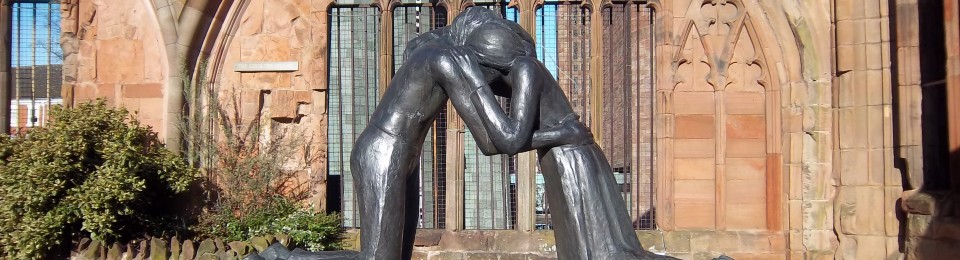

[iii] http://www.youtube.com/watch?v=91TbjlaS4kc.

[iv] McCann, 46.

A few of my favorite things…

10 Wednesday Apr 2013

Posted by jandrewsweckerly in Uncategorized

≈ Leave a comment

Tags

God, Holy Week, liturgy, pilgrimage, spiritual

AlleluiaBWWhen I went on a choral pilgrimage in England a couple of years ago, I remember finding that each day I had a new favorite sacred space.  Not once did we visit a place and I say, “Oh, well that one wasn’t as good as yesterday.”  They all blew me away, and I had such a hard time naming a favorite when I returned home.
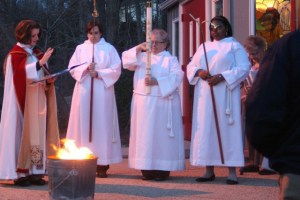
In some ways, Holy Week this year was like that for me.  Every liturgy of Holy Week brought its own unique gifts and made me feel like the next liturgy could not possibly top the one I had just experienced.  At St. Margaret’s, we began Holy Week a day early with our Cemetery Memorial Service on the Saturday before Palm Sunday.  I am always amazed at how our Cemetery manages to create a community of faith, despite the wide variety of Christian backgrounds present, and I am grateful for the honor of helping that community remember their loved ones every year.

The next day, on Palm Sunday, we began our second service at the Cemetery cross and processed our way into the church.  The sun was shining down on us, and our procession captured some of the joy of that day in Jerusalem for us.  It was the perfect setup for our Passion Narrative.

We came back together Monday night for compline.  I was amazed at how such a brief service could be so profoundly spiritual.  As we chanted “Jesus remember me,” I could hear the echoes of our Passion Narrative from the day before.  The next morning, I renewed my ordination vows with the clergy of our Diocese, and then came home for evensong led by our guitar group.  We hosted the local Lutheran church, and I loved the musical selections of our music leaders.  Their music brought a new flavor to Holy Week.

Wednesday, we headed over to the Lutheran church for a healing service.  There is something quite sacred about laying hands on both parishioners and complete strangers that is entirely humbling as a priest.  I really am so blessed to be entrusted with this ministry.  That same humility overwhelmed me during our footwashing service on Thursday.  The experience of both washing and having your feet washed is a profoundly intimate and sacred practice.  Leaving the church with the bare, stripped altar that night brought a deep quiet over me that lasted until Saturday.

Our Good Friday liturgy electrified the experience of silence.  Without music and adornments, the silence left us with nothing but ourselves to face.  Though we did not sing at that service, I could hear the words from that favorite hymn, “sometimes it causes me to tremble, tremble, tremble…”  That night, our confirmands led our Stations of the Cross service.  We used a devotional stations of the cross, and I was so proud of our confirmands.  Despite their initial nerves, they led as confident young adults, and invited us into deeper reflection on Jesus’ journey to death.

Saturday morning, we took a brief break from the solemnity of Holy Week, and welcomed tons of children to our campus for our Easter Egg hunt.  The laughter and enthusiasm of the children – whether with crafts, egg hunting, sack hopping, or simply running around – brought me back to why this life that Christ gives us is so precious.  Their energy brought me back to my favorite liturgy of all time – the Easter Vigil.  I cannot say enough about this service.  From hearing the haunting music and words of the Exultet, to listening to our salvation stories in darkness, to ringing in the alleluias, to feasting once again on the Eucharistic feast, that service is one of the most powerful service the Episcopal Church offers.

And after all of that, you might think Easter would be a let-down.  But looking at those much fuller pews just reminded me that no one can contain Easter joy.  Our alleluias are louder, and our hearts explode with love for Christ and one another.  There is no greater joy for us that day.

So you see, picking a favorite from Holy Week is actually quite difficult.  I think the difficulty in choosing a favorite is that each service captures an experience with God – and no one can rank or rate experiences with God.  They are all special in their unique ways, and would each suffice for spiritual strength for weeks.  So imagine my joy in experiencing them all in one week.  If going away for a pilgrimage is not an option for you, I invite you to consider using Holy Week as your spiritual pilgrimage next year.  I guarantee you, you won’t be able to pick a favorite!

Sermon – John 20.1-18, ED, YC, March 31, 2013

10 Wednesday Apr 2013

Posted by jandrewsweckerly in Uncategorized

≈ Leave a comment

Tags

darkness, Easter, expectation, expecting, God, Jesus, Mary Magdalene, Sermon

On that dark, damp, dreary morning, Mary Magdalene comes to the tomb expecting something.  Darkness clings to her like a cloak.  She was there at the foot of the cross two days ago.  She waited, hoping against hope that God would be victorious and Jesus would be miraculously saved.  And then she prayed that God would take Jesus faster, because despair was setting in and his suffering was overwhelming to witness.[i]  She cried so much that night, that her eyes ran dry.  After 48 hours of dazed despair, she drags her lifeless body through the darkness to tend to her beloved Jesus’ body.  Seeing his body one more time will only confirm her grief, but at least she has somewhere to go to mourn; at least his cold body will confirm his death, and begin a journey toward closure.  Mary Magdalene comes to that tomb in darkness expecting something.

We too come to church today expecting something.  Maybe we are expecting a word of joy, the release of the alleluias we have been holding in for weeks.  If we attended the myriad Holy Week services this week, maybe we are expecting a relief from all the darkness of the liturgies during these last holy days.  If we have not been to church in a long time, maybe we are uncertain as to what to expect.  We came here seeking something – some sort of connection, a sense of familiarity, or maybe a place that will accept us as we are, letting us take things as slowly as we need.  Or perhaps you were dragged to church today by a family member, and the most you are expecting is an hour of your time taken away – and that certainly feels like a period of darkness for you too.

If Mary came expecting one thing, what she gets is altogether different.  The absence of Jesus body puts her over the edge.  The first thing she does is run to get the disciples.  But even they only confirm the awful truth that keeps compounding.  Humiliating him, torturing him, and crucifying him were not enough.  Now they have taken his body too?  Having the disciples leave Mary Magdalene alone again starts the downward spiral that seems endless.  This is why she cannot see the angels in their glory – she only mutters a response to them and turns away from the tomb, her vision blurred by her tears again.  This is also why, when a man appears, she desperately begs the man to tell her where he has taken the body.  And then the unexpected happens – or at least perhaps what she had hoped might happen, but would never let herself say aloud.  Rabbouni!  Her teacher is back!

But Jesus only partially fills her expectations.  “Do not hold on to me,” Jesus says.  His words must have felt like a slap to Mary’s fragile self.  In the instant that she recognizes Jesus, a whole new set of expectations arrive.  Surely, they can flee to Galilee again and keep Jesus safe.  But Jesus changes things yet again; Mary Magdalene’s expectations cannot be fulfilled.  Things cannot return to normal.  What Jesus invites is not a return to the way things were, but to a way that is even better than the way things were; a way in which she can develop new expectations for her life in Christ.

When I graduated from college and relocated to Delaware, I was looking for a United Methodist church.  I had experienced a particular style of worship in my hometown, and was looking to replicate that experience.  After six months of frustrated looking, I stumbled into the Episcopal Cathedral.  Parts of my expectations were met – the Cathedral had one of the most diverse populations I had ever seen – racially, socioeconomically, ethnically, by household definitions, and by sexual orientation.  They were doing some incredible urban ministry, and seemed to have an inspiring commitment to the poor.  But the worship killed me.  It was so formal and the music was so uptight, that I wondered how such a progressive church could be so rigid.  I remember hearing an offertory anthem one Sunday that was so good that I said a very loud, “Amen!” at the end.  I realized right away that that was not what was expected of me.  Ultimately, after several Sundays, I decided that I would stay, but only temporarily.  When we moved again, I would just look for another United Methodist church.  But God had other expectations for my life.

That is the funny thing about expectations.  Both the realistic expectations Mary Magdalene has – the expectation to remain in bitter darkness – and the hopeful expectation Mary has – that everything could go back to normal – are not met.  But that does not mean that Jesus does not make a way out of the darkness.  We have heard from the very beginning of John’s gospel about Jesus and the light.  “The light shines in the darkness, and the darkness did not overcome it,” says John’s gospel[ii]  The later, John says, “Again Jesus spoke to them, saying, ‘I am the light of the world. Whoever follows me will never walk in darkness but will have the light of life.’”[iii]  Jesus, then, this light of the world, cannot meet the expectations of Mary; because Mary’s expectations are smaller than God’s.  Mary cannot go back to the way things were.  But the way things are going to be is infinitely better.  “God gives a new kind of life, a life that is still worth living, a new kind of aliveness toward God and the world…”[iv]

Mary’s interaction with Jesus invites us to consider our own expectations of this day.  If we came here today, only seeking joy without transformation, then our expectations might go unmet today.  If we came here expecting to rub out all the darkness of these last days, then our expectations will only be partially met today because we cannot celebrate the resurrection, without the cross ever with us.  If we came here as seekers, expecting to just sit in the pew and then go back to our lives, then our expectations might not be met either.  Once we learn that this room is full of seekers just like us, who want us to enrich their journey, this place cannot be seen in the same way.  Even for those of you who just hoped to survive this hour of forced worship will not have your expectations met.  Because even if you are not touched today by Christ’s light, those who brought you here are being touched by the light; your relationship with them will be changed because they are being changed.

So the polite Southerner in me wants to say, “I am so sorry we did not meet your expectations today.”  But at the end of the day, I am glad that our expectations are not met today.  God is doing bigger and better things than we can imagine.  Our job is to trust that the light of the world will lead the way into the new resurrection journey that awaits us.  Amen.


[i] Joan Gray, “Beyond Rescue,” Journal for Preachers, vol. 22, no. 3, Easter 1999, 51.

[ii] John 1.5

[iii] John 8.12

[iv] Gray, 52.

Sermon – Luke 24.1-12, EV, YC, March 30, 2013

10 Wednesday Apr 2013

Posted by jandrewsweckerly in Uncategorized

≈ Leave a comment

Tags

Easter Vigil, God, light, liturgy, Messiah, movie, salvation, Sermon, tomb

IMG_3202Our liturgy tonight operates a bit like a movie whose mode of telling stories is in flashbacks.  We start the movie with the scene we just heard.  Several women are gathered around the empty tomb, their mouths agape, and their minds racing.  And then, the flashbacks begin.
Mary the mother of James recalls that ancient story of creation.  That empty tomb reminds her of those words – tohu wabohu – the formless void.  She vaguely remembers what God said about creating humankind in God’s image.  And she hears those words repeated over and over again, “It was good; ki-tov”

Meanwhile, another woman flashes back to when humankind’s sinfulness so angered God that God flooded the earth.  For forty days, Noah knew the nothingness of that empty tomb in front her.  But she also remembers that covenant God made with Noah – that never again will there be a flood to destroy the earth.  Perhaps there is a rainbow in this tomb, and not only the watery floods that she sees.

Joanna looks into that empty tomb and remembers another time her people faced desperation.  She flashes back to the rushing Egyptians who have pinned her people to the Red Sea.  She remembers the panicked screams of her people toward Moses.  She remembers how God saved them then – how God created a way out of no way.  She wonders whether the empty tomb is not unlike that empty seabed – the one that the Israelites used to get to freedom.

Another woman stares into that vacant tomb and she remembers a different tomb.  She remembers the death and hopelessness of those bones in that valley – the thousands of devastated lives.  But then she remembers what God told Ezekiel.  She remembers the rattling of those bones coming together, and the way the breath of God, the ruah of God breathed life into those bones.  She wonders if she hears the faint ruah of God now coming out of that empty tomb.

But Mary Magdalene remembers a different story from Zephaniah.  She hears the words of that song in a fresh way today.  “Sing aloud, O daughter of Zion.”  Is this the day that God will save us?  Can her beloved Jesus be not missing, but raised?  Might Jesus be the one who will restore her fortunes?  She longs for God to be saying to her, “Rejoice and exult with all your heart, O daughter Jerusalem.”  “Please let this empty tomb be an occasion for rejoicing and not for more pain and suffering for my Lord,” Mary Magdalene prayers in her heart.

And then the movie brings us abruptly back to the empty tomb, the sound of silence like so many times before in their history.  The appearance of emptiness threatens their fragile, exhausted psyches.  Their unspoken memories fail to comfort them because they are unable to utter a word of remembrance and assurance to one another.

As outsiders watching this movie, as we watch those looking into the tomb, we begin to connect the various flashbacks.  The answers are there before the angels need to say a word.  God loves us and creates us in God’s image.  And we are not only good – but we are very good – wehineh-tov.  God promises to never destroy us again as God once did.  God promises liberation from oppression.  God promises restoration to our bodies and spirits.  God promises to bring us home.  God promises and God saves us time and again.  And now, with this Messiah who has finally arrived, God saves us once and for all.  What has felt like a defeat is now the reason to rejoice.  The smiles that spread across our faces are exact mirrors of the smiles that spread across the faces of those women at the tomb.  The smiles are smiles that happen as we connect the varied flashbacks, remembering our salvation history, and this final act of salvation through the death and resurrection of our Lord and Savior Jesus Christ.  That tomb is not a formless void, but the holy site where all our salvation narrative culminates.  That empty tomb is in fact not empty at all.  That tomb is full of life.  Tonight is a night for alleluias, for songs of joy, and for dancing.  The light shatters the darkness this night, and we celebrate the greatest victory of all time.  Alleluia! Christ is risen.  The Lord is risen indeed!!

Homily – Philippians 4.4-9, Thomas Ken, March 21, 2013

10 Wednesday Apr 2013

Posted by jandrewsweckerly in Uncategorized

≈ Leave a comment

Tags

God, homily, integrity, joy, song, Thomas Ken

Thomas Ken was the Bishop of Bath and Wells, and served as a priest and chaplain in the late 1600s.  His ministry was marked by his relationships to royalty.  His challenge was that he had a fierce sense of integrity – one that got him into trouble when he refused to condone poor behavior by royals.  His conscience meant that he had to step down from his see for a time, but he refused to let go of his morals.  Given the trials he faced – losing his jobs and being relocated for his opinions and actions, Ken was still able to hold on to his joy, writing many works and hymns – the most popular being our Doxology, “Praise God from whom all blessings flow.”

There are few of us who manage to maintain such a strong sense of integrity and such joy; we like to make things easier for everyone, avoiding conflict if possible.  And whether we are avoiding conflict or are standing our ground like Ken, we can get down in the dumps about our lot in life; this life God has “blessed” us with can make us feel not blessed at all.  The trials and burdens of life are just that, and we more often feel stooped over with the weight of the world than foot-loose and fancy-free.

But what our lessons and what Thomas Ken encourage us to do today is to hang on to joy.  In fact, our Epistle lesson, our Psalm, and Ken’s doxology point us toward joy through song.  From Philippians we hear, “Rejoice in the LORD always; again I will say, Rejoice.”  If you haven’t heard the gospel group Israel Houghton and New Breed sing this refrain, you don’t know the power of these words to revive a soul.  From Psalms we hear, “Taste and see that the LORD is good.”  I have sung these words from our LEVAS hymnal more times that I can count – but the words always bring a soulful smile to my heart.  And who hasn’t been moved by our doxology?  My family sings this at every Andrews gathering, and just the words bring back joyous memories from my childhood and adulthood.

Conflicts and challenges and trouble are inevitable, especially if we hold on to any sense of integrity.  But today we are invited to hold on to joy anyway.  Whether through the testimony of Ken, the words of Scripture, or the power of song, we are invited into the joy that only comes from God and is the only joy that can overcome adversity.  So come to the table – taste and see that the LORD is good.  Amen.

Sermon – John 12.1-8, L5, YC, March 17, 2013

20 Wednesday Mar 2013

Posted by jandrewsweckerly in Uncategorized

≈ 2 Comments

Tags

community, death, faith journey, God, Holy Week, Jesus, Judas, Lazarus, Mary, poor, Sermon, tension

With Holy Week only a week away, today’s Gospel lesson throws us into preparation for that significant week.  Six days before the Passover – six days before Jesus will sit down with his disciples for their last meal together – Jesus sits down for another significant meal.  Jesus returns to Bethany, to the home of the family he loves – the home of Martha, Mary, and Lazarus.  The foreshadowing is all there.  Lazarus, and the lingering smell of his once-dead body, is at the table as a vivid reminder of the death that awaits Jesus.  The two of them sharing table fellowship together both brings to mind the resurrection of Lazarus, and foreshadows a more important resurrection that is soon to come.  Even Mary is preparing us and Jesus for his death, as she uses costly perfume, nard that she has saved for the day of Jesus’ burial, to anoint Jesus now.  Death is heavy in the room.  What sounds like a simple reunion of friends is actually the foretaste of what is to come in a mere week.

So in the midst of this sacred, significant moment, what does Judas do?  Judas totally misses what is happening in the moment.  On one level, Judas is right.  That bottle of nard – a whole pound of fragrance – would have cost about $20,000 in today’s terms[i].  Judas has spent years with Jesus hearing nothing but Jesus’ preference for the poor.  We cannot fault Judas for seeing the potential good that the same bottle could have done for the poor.  But like any good church member, Judas gets stuck in the ways he has learned.  Judas takes a really good practice – Jesus’ passion for the poor – and makes that practice rigid and lifeless.  This valued practice blinds him to the other realities that are unfolding right before him.

We behave like Judas all of the time.  We too have ideas about what we should do and how that should be done.  Our reasoning might be very informed and, under normal circumstances, deeply rooted in our faith and tradition.  But sometimes we too are off base.  We miss the big picture.  When I went on my mission trip to Honduras, we spent an entire winter and spring preparing for the trip.  One of the many books we read was a book by a woman named Elvia Alvarado.  Elvia was a poor Honduran woman who saw much strife in her country and who slowly became an organizer and advocate for change.  But along the way she tells of many atrocities that happened in Honduras to the poor.  As I read the book, I became more and more outraged and incensed about what was happening to the Honduran poor – so outraged that I wanted to go and do something, to make a difference for the people who could not speak for themselves.  But in her concluding remarks, Elvia says something quite shocking.  Elvia asks every gringo reader (gringos being white people from the United States) not to come to Honduras to solve their problems.  In fact she tells the gringos to stay where we are.  She says that this work is the Hondurans’ work to do.  But what she does charge the gringos with is working on our own stuff.  She asks us to look at the systems in our own country that encourage oppression – governmental trade policies, manufacturing and farming practices, and our own purchasing patterns.  Elvia’s words to me were like a slap in the face.  Elvia basically said to me, “Don’t bring your savior mentality down here and think that you will save us all.  Instead, stay at home and work on the ways that you and your country are a part of the problem.”

Elvia’s words to me and all of us are not unlike Jesus words to Judas that night.  What Elvia taught me is that we do not always have the whole picture.  We may have learned a lot, we may have spent a great deal of time studying our faith or developing our relationship with Christ, and we may feel like we have a pretty good idea about what God calls us to do and be.  But what we forget in our confidence is that God is always on the move, always breaking into the world in new ways, and always opening up new paths for us.  The moment that we think we have God figured out – and particularly the moment that we start telling others what they should and should not do – is the moment that Jesus slaps us in the face with another reality.

So if we are not to be imitating Judas in this story from scripture, what do we glean from Mary’s actions?  I once heard a story about an experience at a stewardship conference whose theme was generosity.  When one of the presenters spoke about offering a gift directly to God, the clergy began to yawn.  The presenter then pulled a $100 bill from his wallet, set it on fire in an ashtray, and prayed, “Lord, I offer this gift to you, and you alone.”  The reaction was electric.  Clergy began to fidget in their chairs, whispering about the legality of burning currency, and murmuring about how they would happily take any more money he felt like burning.  In that nervous room, the speaker asked, “Do you not understand?  I am offering it to God, and that means it is going to cease to be useful for the rest of us.”[ii]

In many ways, Mary “wastes” her perfume on Jesus much like this presenter wasted that $100.  But Jesus does not see Mary’s gift as wasteful.  He declares the gift to be appropriate in that moment, and is gracious enough to receive the gift with gratitude.  He understands that the extravagant gift is rooted in Mary’s confidence in the boundless capacity of God’s love.  “Mary pours out her whole bottle of perfume without regret because she knows it is only a trifle compared to the magnitude of God’s love that she sees in the Messiah before her.  Mary knows that Lazarus will die again, and she knows that Jesus will die, but she believes with even greater passion that Jesus can bring victory over death.”[iii]

This tense interaction between Jesus, Mary, and Judas invites us into another kind of tension.  The story invites us to live into the tension of what we know about God and what is still unfolding.  We need to learn the “rules” or the “law” of this crazy life of faith.  But we also need to learn the “way of being.”  We need to learn when to focus on the details and when to see the big picture.  We need to learn when the time has come to “waste” an extravagance on another.  When Jesus says, “You always have the poor with you,” Jesus is not giving us an out for caring for the poor.  Instead Jesus invites us into a “both-and” tension.  Yes, we are to care for the poor.  That is living into the law of our life together.  And, we also need to have the presence of mind to see when something so significant is happening, such as losing our Savior to the cross, that we pause our other work.  This is the way of being in our life together.

Ultimately, we need both Judas and Mary for our faith journey today.  We need that person in our community who will always remind us of the laws that we live by and who will always remind us of the ways things should be done.  But we also need that person in our community who is the crazy one who will open up for us the lavish ways of God and who will remind us to let go of the law enough to see God’s bigger picture.  Without each person in our community, including those individuals who have not yet come to St. Margaret’s, we only have a portion of the community we need to fully embody the community of faith.  Without the “both” and the “and” we are incomplete.  Sometimes that means we will not agree.  The “boths” and the “ands” of our community will experience a tension so strong that we may hear Jesus shouting, “Leave her alone.”  But both the “boths” and the “ands” need each other.  Jesus gives us all value today, but Jesus also requires us to value one another.  Amen.


[i] George W. Stroup, “Theological Perspective,” Feasting on the Word, Yr. C, Vol. 2 (Louisville: Westminster John Knox Press, 2009), 142.

[ii] William G. Carter, “Pastoral Perspective,” Feasting on the Word, Yr. C, Vol. 2 (Louisville: Westminster John Knox Press, 2009), 142.

[iii] Beth Sanders, “Heaven Scent,” Christian Century, vol. 124, no. 5, March 6, 2007, 19.

Homily – John 4.31-38, James Theodore Holly, March 14, 2013

16 Saturday Mar 2013

Posted by jandrewsweckerly in Uncategorized

≈ Leave a comment

Tags

fear, God, harvest, homily, James Theodore Holly, Jesus, work

James Theodore Holly was born a free African-American in D.C. in 1829.  He became an Episcopal priest in 1856, serving as rector in New Haven.  In 1861, he resigned to take a group of African-Americans to settle in Haiti.  His wife, mother, and two children died the first year.  But Holly stayed on with two small sons, believing God was with him.  In 1874, Holly was consecrated as first bishop of Haiti, and the first black man raised to the office of bishop in the Episcopal Church.  During his tenure as bishop, he doubled the size of the diocese, established medical clinics, and took over the Diocese of the Dominican Republic in 1897.  He died in 1911.

In looking at the dates, Holly went to Haiti at the beginning of the Civil War in the U.S.  What a dramatic move; and then what a dramatic experience in Haiti!  Holly must have heard these words from Jesus in a unique way:  “Do you not say, ‘Four months more, then comes the harvest?’  But I tell you, look around you, and see how the fields are ripe for harvesting.”  Holly could have waited until the war was over; he could have bailed when so many in his family died; but he heard the urgency of Jesus’ call, he heard the demand to act now, no matter what.

I think too often we are afraid, paralyzed by fear or some strange sense that certain things have to be in place before we act (four more months, then we will act).  Just hearing our Lenten speaker from St. John’s talk about their church’s garden confirmed this truth.  Instead of months of planning, gathering data, negotiating opinions, he just jumped.  They fought a lot, people had to chip in to make it work, and they made mistakes.  But they also had a harvest to feed the poor, right here in Huntington.

As individuals, I wonder what work we are hindering because of our fears or concerns about propriety?  As a community, I wonder what work we are hindering because of our fears or concerns about propriety?  Our text and Holly’s witness encourage us to let go of our fears and anxieties and jump into the harvest.  Jesus reminds us that God has already sown the field, and has invited us to jump into the work God is doing.  We are the only ones in our way.  Our invitation is to jump.  Amen.

Be still…

15 Friday Mar 2013

Posted by jandrewsweckerly in Uncategorized

≈ Leave a comment

Tags

church, God, Lent, prayer, quiet, stillness

You may not know this about me, but I am not a natural when it comes to silence.  As an extrovert, silence feels like it should be filled.  When I lead worship that needs a silent moment, I often make myself take a couple of additional breaths before I break the silence, knowing that my own tolerance for silence is much lower than most people’s tolerance.  A couple of summers ago, I was a part of parish that covenanted to pray with scripture for twenty minutes a day for ninety days.  The idea was that a bulk of that twenty minutes was not meant to be spent talking or analyzing biblical scripture, but to be silent in the presence of God’s word, making room for God’s living Word to speak.  As you might imagine, the practice for me was brutally painful.  But I learned a lot about myself and my prayer life that summer, and changed many of my practices as a result of the experience.

That is why I am grateful for “Quiet Days.”  I am grateful for the many communities who have realized that the Church often needs to invite people to come to Church and just be.  Be quiet.  Be still.  Be with God.  Even if it is only for a few hours, the Church and other religious groups often offer mornings or days where people can stop being busy and really make space for God.  I first discovered Quiet Days in seminary, but they have been an active part of my ordained ministry ever since.  They are truly one of the Church’s greatest gifts to us.

This weekend, my own parish is offering a Lenten Quiet Day and I could not be more excited.  I am excited for all of the reasons I just described, but I am also excited because two parishioners offered to lead the meditations for our Quiet Day.  So not only do I get to be a part of a community that has invited everyone into a time of quiet with God, I too will be able to fully enjoy the quiet time with God, hearing how God is moving in through our parishioners’ meditations.  This Quiet Day has not become one more thing on my busy to-do list, but instead has become an invitation for me to come and be still with God.  I grateful to these parishioners who have offered up their gifts, and I hope that if you are nearby, you will join us too.  Come enjoy the gift of quiet in our otherwise busy, loud life.

← Older posts
Newer posts →

Recent Posts

  • On Faith, Wellness, and Reality…
  • Sermon – Matthew 22.15-22, P24, YA, October 18, 2026
  • On Hidden Blessings…
  • Sermon – Matthew 11.25-30, St. Francis Feast, YA, October 4, 2026
  • On New Clothes and Neighbors…

Archives

  • October 2026
  • September 2026
  • August 2026
  • July 2026
  • June 2026
  • May 2026
  • April 2026
  • February 2026
  • January 2026
  • December 2025
  • November 2025
  • October 2025
  • September 2025
  • August 2025
  • July 2025
  • June 2025
  • March 2025
  • February 2025
  • December 2024
  • November 2024
  • October 2024
  • September 2024
  • August 2024
  • July 2024
  • June 2024
  • May 2024
  • March 2024
  • February 2024
  • January 2024
  • December 2023
  • November 2023
  • October 2023
  • September 2023
  • August 2023
  • July 2023
  • June 2023
  • May 2023
  • March 2023
  • February 2023
  • January 2023
  • December 2022
  • November 2022
  • October 2022
  • June 2022
  • May 2022
  • January 2022
  • December 2021
  • November 2021
  • October 2021
  • September 2021
  • August 2021
  • June 2021
  • May 2021
  • April 2021
  • March 2021
  • February 2021
  • January 2021
  • December 2020
  • November 2020
  • October 2020
  • September 2020
  • August 2020
  • July 2020
  • June 2020
  • May 2020
  • April 2020
  • March 2020
  • February 2020
  • January 2020
  • December 2019
  • November 2019
  • October 2019
  • September 2019
  • August 2019
  • July 2019
  • June 2019
  • May 2019
  • April 2019
  • March 2019
  • February 2019
  • January 2019
  • December 2018
  • November 2018
  • October 2018
  • September 2018
  • August 2018
  • July 2018
  • June 2018
  • May 2018
  • April 2018
  • March 2018
  • February 2018
  • January 2018
  • December 2017
  • November 2017
  • October 2017
  • September 2017
  • August 2017
  • July 2017
  • June 2017
  • May 2017
  • April 2017
  • March 2017
  • February 2017
  • January 2017
  • December 2016
  • November 2016
  • October 2016
  • September 2016
  • August 2016
  • July 2016
  • June 2016
  • May 2016
  • April 2016
  • March 2016
  • February 2016
  • January 2016
  • December 2015
  • November 2015
  • October 2015
  • September 2015
  • August 2015
  • July 2015
  • June 2015
  • May 2015
  • April 2015
  • March 2015
  • February 2015
  • January 2015
  • December 2014
  • November 2014
  • October 2014
  • September 2014
  • August 2014
  • July 2014
  • June 2014
  • April 2014
  • March 2014
  • February 2014
  • January 2014
  • December 2013
  • November 2013
  • October 2013
  • September 2013
  • August 2013
  • July 2013
  • June 2013
  • May 2013
  • April 2013
  • March 2013
  • February 2013
  • January 2013
  • December 2012
  • November 2012
  • October 2012
  • September 2012

Categories

  • reflection
  • Sermons
  • Uncategorized

Meta

  • Create account
  • Log in
  • Entries feed
  • Comments feed
  • WordPress.com

Blog at WordPress.com.

  • Subscribe Subscribed
    Seeking and Serving
    Join 396 other subscribers

    Have a WordPress.com account? Log in now.

  • Seeking and Serving
    View site in Reader
    Manage subscriptionsSign upLog in
    Report this content
    Collapse this bar
Loading Comments...