• About

Seeking and Serving

~ seek and serve Christ in all persons

Seeking and Serving

Tag Archives: Good News

On Seeing Christ in the Chaos…

08 Wednesday Jan 2020

Posted by jandrewsweckerly in Uncategorized

≈ Leave a comment

Tags

chaos, control, expectations, God, Good News, gospel, holy, Holy Spirit, Jesus, mess, sacred, scripture, story

61002735_2362089520513961_2511345267203112960_o

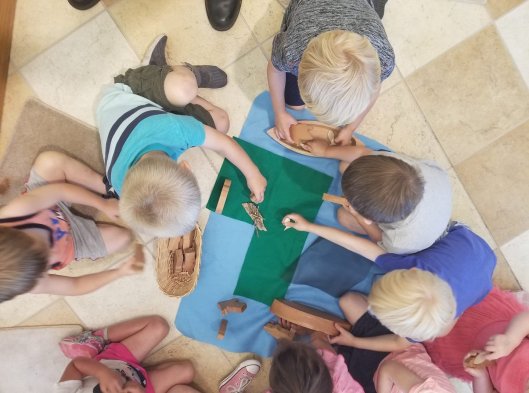
Photo Credit:  Charlie Bauer; reuse with permission only

Yesterday at the Godly Play class Hickory Neck offers at The Kensington School, we finally got to tell the Epiphany story – the story of the magi visiting the Christ Child.  As we reviewed the whole story of Advent and Christmas, out came all the figurines of prophets, Mary, Joseph, Jesus, Angels, Shepherds, various animals, and wise men.  Typically, the teacher tells the story quietly, using the figurines, and then we have the kids retell the story, taking turns with the figurines.  And because the class has become so large, we usually have two sets of figurines so we can break into groups.  I would never say the class is perfectly orderly, but it is much more measured than you might imagine with two- to five-year-olds.

But not yesterday.  I’m not sure whether we, the leaders, were off our game, or the kids were still hyped up from returning from break, but the retelling portion of class was utter chaos.  Taking turns fell apart, quiet redirecting failed miserably, and by the time we regrouped to close the class, there was a mass of wooden, sacred figures in a disordered pile.  As we were making our way out, I looked at the pile sadly, grateful that they were all made out of sturdy wood and nothing more destructible, but somewhat disappointed to see such a holy mess.

But as I was thinking about the mess today, I was thinking perhaps my sadness at the chaos was my own “stuff,” having nothing to do with the success of the class.  Too often, we like our Gospel stories neat and tidy.  Too often we tell familiar scriptural stories expecting them to teach specific lessons.  But when we are honest, we know that is not how the Good News works.  The Good News upends worlds, upends social order, and upends our expectations.  Engaging with Jesus is messy work, and sometimes, in the midst of trying to figure out our faith, we end up with a messy rubble in front of us.

I do not know what you are you struggling with today – what things you wish were under control but are actually a mess, or what things you have been expecting from God that just are not how you expected, or what chaos others are making in your life that makes you feel bereft.  What I can tell you is that Christ is there, maybe a bit mired in the chaos too, but there nonetheless.  And sometimes, the mess is just what you need to shake you up and see the movement of God in a new and fresh way.  I suspect things will not turn out as you expect, but then, the Holy Spirit rarely works in ways we expect.  Sending you prayers today, that you might see Christ in the chaos!

On Politics, Priests, and Prayer…

20 Wednesday Jun 2018

Posted by jandrewsweckerly in Uncategorized

≈ 4 Comments

Tags

American, Bible, Christian, communion, dignity, disciple, diversity, Episcopal Church, Eucharist, Good News, gospel, Jesus, policy, politics, prayer, priest, scripture, table

lightstock_99088_medium_david_needham

Photo credit:  https://www.lebanonfbc.org/ministries/power-prayer-pop

One of the hardest parts of being a priest is creating a community in which we can talk about the Gospel of Jesus Christ, hold widely varying political opinions, and yet still gather at the Eucharistic Table – elbow to elbow, as the imperfect, but beloved body of Christ, determined to stay in community.  I say that the work is difficult because I have seen how fragile this work really can be.  During my priestly formation at seminary, congregations and Dioceses were walking away from that common table over the issue of human sexuality.  Although I was proud of what the Episcopal Church did at the time, I also deeply mourned the loss of diversity at the Table – the creation of a more homogenous Church than a Church who was devoted to staying in the tension while honoring the Gospel.

Because of my high value of the uniting force of the Eucharistic Table, my priesthood has taken a slightly different shape than I might have imagined in my early twenties.  If you had asked me then about the primary role of the priest, I might have argued the role of prophet – decrying injustice and leading the people of faith to a more just world.  But as I aged, and as I served diverse parishes, I began to see the role of prophet is one of many roles, one that needs to be used judiciously so as not to alienate parishioners and create an exclusive community of like-minded people.  And so, my priesthood has been marked with great caution around politics.  While many of my colleagues will beat the drum for justice, I find myself trying to carefully walk with my diverse congregations as we discern together how to interpret politics in light of the Gospel – not in light of Democrats or Republicans, but in light of the witness of Jesus Christ.  That doesn’t mean I don’t have strong political opinions; it just means that I try to take focus off the politician or political issue of the moment and try to create disciples who can see and follow Christ.

That being said, this past week, the issue of what is happening to families seeking asylum on our southern border, and the separation of children from parents as a punitive, purportedly deterring action has shifted my normal practice – not because I changed my mind about politics and the Church, but because two agents of our government utilized Holy Scripture to justify those actions.  Here’s the thing:  if this were just another issue where we are divided about policy, where we had a debate about the extents to which we value national security over other values, I would have happily encouraged our parishioners to be faithful Christians in dialogue.  But when Attorney General Jeff Sessions invoked Holy Scripture to justify separating children from parents, he stepped into my area of authority, leaving me no other option but to speak.

Now I could layout a Biblical defense against the small portion of Romans 13 that Attorney General Sessions quoted, giving you the context of the chapter, giving you the verses immediately following what he quoted as a counter to his argument.  I could quote to you chapter and verse for countless other scripture lessons that tell us to love one another, respect the dignity of other human beings, care for the outcast and alien, tend the poor, and honor children.  I could also tell you about how that same bit of scripture was used to justify slavery, Nazis, or apartheid in South Africa.  But the problem with a scripture quoting war is that no one wins.  What is more important is what we know of the canon of Scripture:  that our God is a God of love, that Jesus walked the earth showing us how to be agents of love, healing, and grace, and that the Holy Spirit works through us today to keep spreading that love.

Knowing what I know about the Good News of God in Christ, in my baptismal identity as one who seeks and serves Christ in all persons, respecting the dignity of every human being, I cannot stand idly by or be silent when the Holy Scriptures of Christians are being used to justify political actions that are antithetical to our Christian identity.  As a priest, I invite you this week, especially when a governmental leader is invoking our faith, to reflect on how the Gospel of Christ is informing your view on this issue.  Not as a Republican and not as a Democrat, but as a follower of Christ.  Fortunately, prominent politicians on both sides of the aisle seem to be coming to agreement on this issue – a rarity these days – but also an example to Episcopalians who hold a high view of coming to the Eucharistic Table across our differences.  I am not saying we need to agree on this – in fact, I suspect we will not.  What I am asking is that you live into your identity as a disciple of Christ, as an agent of love, and then respond in conversation, in political advocacy, and in worship as one holding in tension both our American and Christian identities.  I support you in this difficult, hard work.  I love you as you struggle.  I welcome you to the Eucharistic Table.

On Peter, Paul, and Michael…

23 Wednesday May 2018

Posted by jandrewsweckerly in Uncategorized

≈ 1 Comment

Tags

church, disciple, Episcopal, Good News, Jesus, Jesus Movement, love, power, Presiding Bishop Michael Curry, Royal Wedding, Sermon

In seminary, each third-year student preaches a “senior sermon” in front of the entire seminary.  It’s a bit nerve-wracking because seminarians and priests are a pretty tough crowd.  Add that on top of professors who have molded you for three years, and the pressure is pretty intense.  I remember talking to a professor about my nerves and he assured me, “Well, you know what the old hymn says:  If you cannot preach like Peter, if you cannot pray like Paul, you can tell the love of Jesus and say, ‘He died for all.’”

That hymn to which he was referring is, “There is a Balm in Gilead,” which is the same hymn that Presiding Bishop Michael Curry quoted in his sermon at the Royal Wedding.  Of course, preaching after Bishop Curry the next day felt equally daunting.  Lord knows, I cannot preach like Peter, and I certainly cannot preach like Bishop Curry.  But as I was thinking about it, I think what people have loved so much about Bishop Curry’s preaching at the Royal Wedding is:  1) he was authentically himself (which is obviously a bit different culturally from those gathered in the royal family, but his authenticity was infectious), 2) he was passionate about the love of Jesus and its ability to change the world, and 3) he gave the world a glimpse of what is so awesome about the Episcopal Church – a Church who understands the radical power of love and brings together people from all walks of life to thoughtfully, willfully, beautifully engage in doing powerful work in the world through love.

What has been fascinating to me about Bishop Curry’s sermon and the way it has been described as “stealing the show,” is that Bishop Curry was just doing what the Episcopal Church does every Sunday, at every wedding, and at every funeral – we worship God in the beauty of holiness, we teach those gathered, and we equip them to go out into the world sharing the good news of God in Jesus Christ.  What Bishop Curry’s success does is embolden us to live into our identity as disciples of Christ and members of the Episcopal Church.  I suspect you have talked to someone about Bishop Curry’s sermon in the last few days.  How about instead of just marveling about Bishop Curry’s talent as a preacher, you use this event to talk to someone about how you are inspired to be a follower of Jesus?  Keep it authentic:  “He was awesome, wasn’t he?  He reminds me of my church and the amazing things we are doing to harness the power of love.  I’d love to show you!”

What Bishop Curry did on Saturday at the Royal Wedding was be himself – a member of the Jesus Movement, sharing the Good News of God in Christ.  Your invitation is to be yourself and do the same.  You may not preach like Peter, and you may not pray like Paul.  But you can tell the love of Jesus, and say, “He died for all.”  I can’t wait to hear about your adventures!!

17426137_10155645675302565_2278358373496741633_n

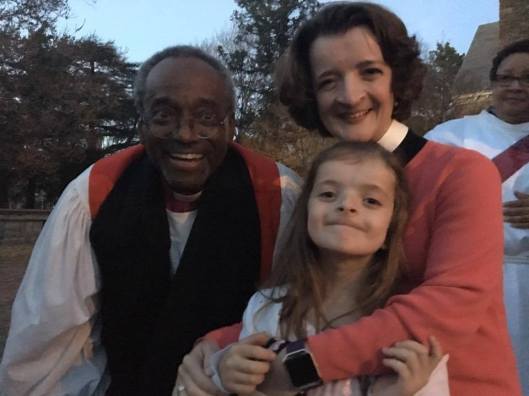
With Presiding Bishop Curry in 2017, Photo credit:  Jennifer Andrews-Weckerly (use only with permission)


Sermon – Mark 9.2-9, TRNS, YB, February 10, 2018

14 Wednesday Feb 2018

Posted by jandrewsweckerly in Sermons, Uncategorized

≈ Leave a comment

Tags

Christ, disciples, Epiphany, God, Good News, Jesus, Lent, Mark, Messiah, mountain, Sermon, Son of God, Suffering Servant, Transfiguration

A couple of months ago, we entered into a new liturgical year.  When Advent started, we began another year of discovery, this year focusing on Mark’s gospel and Mark’s depiction of who Jesus is and what that depiction means for our journey with Christ.  Back in December, we began the journey with the very first words of Mark – the first verse of the first chapter of Mark.  Mark says, “The beginning of the good news of Jesus Christ, the Son of God.”  Now, I never thought much of Mark 1.1.  The line, “The beginning of the good news of Jesus Christ, the Son of God,” has always sounded to me like, “Once upon a time…”  But we know that Mark is the shortest gospel, and that Mark is the tightest writer of Jesus’ story.  So, what I should have remembered is that Mark does not throw away words.  Mark would never introduce his gospel with “Once upon a time.”  As a writer who does not mince words, instead Mark tells us everything we need to know about Jesus in one simple sentence:  The beginning of the good news of Jesus Christ, the Son of God.

So what does Mark tell us, and why I am taking us back to the beginning when our assigned reading is about the Transfiguration?   Because we need Mark’s first words before we can understand anything as dramatic as the Transfiguration.  When Mark says, “The beginning of the good news of Jesus Christ, the Son of God,” Mark tells us right away who Jesus is:  Jesus is the Christ, and Jesus is the Son of God.[i]  Jesus is the Christ, and Jesus is the Son of God.  First, Mark tells us Jesus is the Christ:  the Messiah, the person the people of God had been awaiting, the victorious redeemer of the people, the mighty restorer of the kingdom of God.  Since that day in December when we heard this brief introduction by Mark, we have been celebrating the Messiah.  We heard of a mother, shepherds, and kings who reveal this truth to us – a Messiah is born.  Then, Jesus is baptized, and disciples follow him, and miracles happen.  In Mark’s gospel, when Jesus asks who the disciples say that Jesus is, Peter boldly proclaims, “You are the Messiah.”  Even today, as Jesus’ clothes turn dazzling white, and Elijah and Moses appear, we are filled with anticipation:  this is what we have been waiting for – Jesus the Messiah!!

And yet, somehow in the birth stories, and the epiphanies, and the dramatic healing stories, we forget the other half of Mark’s introduction:  The beginning of the good news of Jesus Christ, the Son of God.  You see, Mark needs us to know that Jesus is the Messiah, the Christ.  But Jesus is equally something else:  the Son of God.  Now the Son of God is not just an honorific title.  Mark tells us something powerful when Mark tells us Jesus is the Son of God.  If you remember, in a few chapters beyond our reading in Mark today, Jesus will tell that familiar parable of some wicked tenants – tenants who are entrusted with the Master’s vineyard, but who kill the son of the landowner when the landowner sends his son to collect the harvest.  The Son of God is not a title of honor so much as a reminder of what will happen to Jesus.  The Son of God is destined to lay down his life for the people of God.  Jesus is the suffering servant we hear about in Isaiah – the one who makes the ultimate sacrifice so that new life might come.

So what does any of this have to do with the Transfiguration?  Pretty much everything.  You see, in this victorious Messiah-like last epiphany moment before we head into Lent, when the disciples are so overwhelmed by the drama of their Messiah gathered with Moses and Elijah, God says something simple to the disciples, “This is my Son, the Beloved.”  You see, just days before the Transfiguration of Jesus, Peter had insightfully proclaimed that Jesus is the Messiah – the same thing that Mark proclaims from the beginning of Mark’s gospel.  But Peter forgot the other part of Mark’s introduction.  The beginning of the good news of Jesus Christ, the Son of God.  Jesus is both the Christ, the Messiah, and the Son of God, the suffering servant.  Jesus is always both.

I remember in my very first interview with the Commission on Ministry – the group who helps those discerning a call to ordained ministry – in that first interview, the Commission asked me this question:  Who is Jesus to you?  I remember at the time thinking what a weird question that was.  I mean, we have the whole of the New Testament that tells us who Jesus is.  But since I was sitting before a body of people who could determine my fate, I figured I had better come up with something better than, “That’s a weird question.”  And so I started to ramble on about the things that were enlivening my faith journey – Jesus’ preference for the poor, his passion for justice, and his call to being in community.  Not once did I remember Mark’s simple words – that Jesus is the Christ and the Son of God.  I did what Peter does today – what we all do in our faith journey.  I looked at Jesus and pulled out the stuff I liked:  the advocate for justice.  Peter pulls out what he likes:  the Christ, the victorious Messiah.  But what the Transfiguration today reminds of is that we can never pick and choose what we like about Jesus.  Jesus is always both the Christ, the Messiah, and the Son of God, the suffering servant.

So why does any of this matter?  Well, in part, this fundamental clarity about Jesus is important because we are at a fulcrum in Mark’s gospel.  We have journeyed with Jesus, experienced epiphanies, ascended the mountain and seen the radiance of our God.  All of that excitement could lead us to think we have arrived, that our victory has already come, that Christ is simply the Messiah. The temptation is for us to linger on the mountain, to stay with the Jesus who makes us feel good, who makes us feel powerful, who makes us feel victorious, who dazzles us with shiny clothes.  And in some ways, that is what today is all about.  We celebrate the Feast of the Transfiguration because we need to know Jesus is the Christ – the Messiah.

But as we begin Lent this week, we descend this mountain and walk our way to another mountain – the mountain of Calvary that reminds us of the other truth of Jesus:  that Jesus is the Son of God, sent to redeem us through the darkness of the cross.[ii]  Even on the mountain of Transfiguration, God reminds us of this truth.  God does not shout to the disciples, “Jesus is the Messiah!!”  Instead, God whispers the gentle reminder, “This is my Son, the beloved.”  Even God knows we will want to linger on the goodness of who Jesus is – the brilliance of a Messiah.  But as Mark tells us from the beginning:  The beginning of the good news of Jesus the Christ, the Son of God.  Jesus is both the Christ and the Son of God.

This week we will begin the long journey of Lent.  We will be reflecting on our relationship with Jesus, our failings and faults, and our gifts and goodness.  The work will feel hard and tedious at times, and on those days we are feeling particularly low, we may want to have Jesus the Christ stand up for us, and bring in a mighty victory.  But as we walk from today’s mountain to Good Friday’s mountain, we also hold in tension with Jesus the Christ, Jesus the Son of God.  In our weakness, we find a savior who is also weak.  In our dark days, we find a savior mired in darkness.  In our despairing, we find a savior lost in despair too.  Jesus’ identity as the Son of God gives us as much comfort as Jesus’ identity as the mighty Messiah.  When we hold all of who Jesus is in our hearts, we can be more tender with all of who we are.

I am eager to walk the Lenten walk with you.  I am eager to hear about your struggles and victories, your darkness and light.  I am eager to be surrounded by a community of people working through valley of two mountains so that we can come through the redemption of the resurrection.  Today’s Feast of the Transfiguration offers you sustenance for the valley, fuel for the work, fire for the renewal.  This is the beginning of the good news of Jesus the Christ, the son of God.  Amen.

[i] This understanding of Jesus’ identity was presented by Thomas P. Long at a lecture on February 9, 2018.

[ii] The idea of framing Lent between two mountains come from Rolf Jacobson, in the Sermon Brainwave podcast, “#585 –Transfiguration of Our Lord,” February 3, 2018, http://www.workingpreacher.org/brainwave.aspx?podcast_id=977, as found on February 7, 2018.

Sermon – Isaiah 40.1-11, Mark 1.1-8, A2, YB, December 10, 2017

13 Wednesday Dec 2017

Posted by jandrewsweckerly in Sermons, Uncategorized

≈ Leave a comment

Tags

Advent, busyness, change, God, Good News, Isaiah, Jesus, John the Baptist, manger, prepare, prophecy, repent, repentance, Sermon, way

This Advent, I have been sensing in myself a need to prepare for the Christ Child a little differently.  The busyness of life has me longing for a season of quiet reflection, of anti-consumerism, of less…well…busyness.  In some ways, the church has made accommodations for that desire.  The music in Advent is a bit more muted and quietly beautiful.  The offerings of yoga or even the Blue Christmas service make room for quiet meditation and reflection.  Even my Advent devotion this year of taking daily photos based on a provided word has forced me to look around more intentionally at life.  When I heard Isaiah’s words this week, “Prepare the way of the Lord,” my spirit had been hoping Isaiah’s preparation meant slowing down and creating an inner openness to the Holy Spirit.

Although I am sure Jesus would be all too happy to have me slow down a bit, my Advent longings may be a bit too passive for what Isaiah and John the Baptist are trying to accomplish.[i]  Of course, you can see where I may have gone astray.  Isaiah is speaking to a people in exile:  far from their homeland, oppressed by a foreign power, being forced to assume a foreign culture, God finally speaks a word of comfort to God’s people.  “Comfort, O Comfort my people,” says the Lord to Isaiah.  They are soothing words to a downtrodden people.  They are words of affection to an affection-starved nation.  They are healing words to a broken group of followers.  But those words of comfort are not followed by a cozy bed of meditation and contemplation.  Instead, those comforting words are followed by a call to action, “In the wilderness prepare the way of the Lord, make straight in the desert a highway for our God.”  God is about to do a new thing, but in order to do that new thing, the people of God must prepare the way through repentance.  Now I know we usually reserve repentance talk for Lent, but in this season of preparing for a new thing – of preparing for the Christ Child – the prophet tells the people of God they need repentant hearts.

One of the courses of study for parish priests and counselors is called family systems.  The study of family systems looks at human behavior through the lens of behavior within families, looking at ways families handle conflict, how they engage one another, and how they solve problems.  Patterns we learn in our families are taken into other systems.  One of the main lessons we learn from family systems is that you cannot change the behavior of others; you can only change your own behavior.  But changing your own behavior is not as easy as the change sounds.  Any of us who saw our mother behave like her mother, only to one day see that same behavior in ourselves realizes how hard changing our patterns can be.

When we talk about repentance, that is the kind of deep change we are talking about.  Repentance is not wallowing in guilt, feeling badly about something we said or did (or keep saying or doing).  Repentance is acknowledging our sinfulness and working to change our behavior.  The word “repent,” actually means to turn around; to turn away from sinful behavior and walk another way.  So when John the Baptist recalls Isaiah’s words, saying, “Prepare the way of the Lord,” he’s not saying, unpack your creches, put up the greens, and buy some presents.  Prepare the way of the Lord means making sure your heart is ready for the coming of the Christ Child – a feat you cannot accomplish if your heart is heavy with sin and regret.[ii]

Now do not get me wrong – I have pulled down the boxes of Christmas decorations, hung a wreath, and have purchased some gifts.  Those are honored traditions that bring us great joy, and I believe God wants us to be a people of joy.  But I suspect that if your heart is heavy-laden with the sins of life, or if you are so busy with the busyness of life that you have disconnected from God, your joy this year at the arrival of the Holy Child will not be as deep as your joy could be.

I have met many a church member who loathes the season of Lent for the focus on repentance.  I am sure they would be cringing today by the ways I am squashing Advent too.  But here is the reason why we have to talk about repentance today.  The gospel lesson we read from Mark contains the very first eight verses of Mark.  Mark introduces his gospel with these words, “The beginning of the good news of Jesus Christ, the Son of God.”  The reason John the Baptist is so excited, and is quoting Isaiah in our text today is that he knows what is coming is good news.  And so, when John quotes Isaiah with the words, “Prepare the way of the Lord,” he really means two things.  First, he means do the active work of preparing your heart for the Lord.  Not just the awesome, touchy-feely stuff of centering yourself or finding a quiet space, but the hard stuff of repentance.  And second, John means do the work of sharing the good news.  The work of Advent and the joy of Christmas is not just for us.  When your heart is bursting on Christmas Eve with joy because you did the tough work or repenting and returning to the Lord, don’t you want someone with which to share your joy?   One of the ways we prepare the way of the Lord is to share the good news of God in Christ with others.[iii]

Now I know what you are going to say, “Here she goes again, talking about inviting people to church.”  Or maybe you are thinking, “Yeah, but people who come on Christmas Eve usually only come once a year, so why bother?”  The good news about spreading the good news is that you are likely going to spread that good news in spite of yourself.  You see, when we do the work of repentance, of changing our hearts, minds, and hands to doing the work of God, a renewed spirit is kindled in us, and a deep joy burns in us.  The work of repentance creates in us a clean heart, and renews a right spirit within us.  And when we feel the love of God overwhelming us, we cannot help but let slip to our neighbor, “I know you have a church home, but I just want to share how awesome my experience at church has been lately.  If you ever want to come with me, I would be happy to bring you.”  Or when your friend is expressing his deep sadness and sense of loneliness, you find yourself saying, “I have been there.  But I have to tell you, every time I leave church, something about my encounter with God and community makes me feel less alone.”  Or when a stranger is ranting about how awful the church and Christians have been lately (which, we know some awful things are happening in the name of Christ lately), you find yourself saying, “I totally agree.  That is why I love my church so much – because they show me another way of witnessing to Christ.  I would love to show you sometime!”

I realize you may have been hoping for a word of comfort and permission to quietly prepare your heart for the Christ Child today.  Lord knows I have been longing for that this week too.  But turning my busyness into purposeful preparation:  for repentance and sharing the good news sounds much more fulfilling and life-giving.  The coming of the Christ Child, the fulfillment of the prophecy of Isaiah, is a life-altering event.  Today, the church prepares us for not arriving at the manger with check-lists done, gifts in hand, and arms full of stuff.  Instead, the church prepares us for arrive at the manger with open arms, free of the burdens that are weighing our spirits down, surrounded by others who have similarly prepared, and those who heard a good word from you, and wanted to drop their baggage at the manger too.  Come, prepare the way of the Lord.  Amen.

[i] Karoline Lewis, “Wilderness Preaching,” December 3, 2017, as found at http://www.workingpreacher.org/craft.aspx?post=5018 on December 6, 2017.

[ii] Martin B. Copenhaver, “Homiletical Perspective,” Feasting on the Word, Yr. B, Vol. 1 (Louisville:  Westminster John Knox Press, 2008), 47.

[iii] Richard F. Ward, “Homiletical Perspective,” Feasting on the Word, Yr. B, Vol. 1 (Louisville:  Westminster John Knox Press, 2008), 31.

Sermon – Matthew 13.1-9, 18-23, P10, YA, July 16, 2017

19 Wednesday Jul 2017

Posted by jandrewsweckerly in Sermons, Uncategorized

≈ Leave a comment

Tags

business, evangelism, extravagent, fear, fertile, Good News, Jesus, listen, parable, seed, soil, sow, sower

I don’t know about you, but this gospel lesson always makes me a little nervous.  As soon as I hear about the different types of soil where seed is sown, I start to get paranoid.  I think of the countless times when I did not understand what the kingdom of God was about, or what God was trying to teach me, and how the evil one started clouding my thoughts.  Or, I think about that those moments where I have been filled with new fervor for God, only to get distracted or anxious, and lose that sense of intimacy with God.  And the good Lord knows that I have been more than distracted by the cares of the world and the lures or preoccupation around money and lost touch with my faith.  Of course, by the time I get through that litany of doubt and self-loathing, I feel a sense of doom.  I will never work hard enough to be good soil!

The good news is this parable is not about me or you.  At least not in the way we think.  Whenever scholars talk about this text, the text is referred to as the parable of the sower – not the parable of the soils.[i]  By getting distracted by all of the ways we do not measure up or the ways in which our faith is sometimes shallow, unsophisticated, or self-centered, we miss the point altogether.  This is about the nature of Christ – the original sower of the Good News, and the expectations of how the disciples will be similar sowers.  To understand what that means, we need to let go of our anxiety about our soil, and hone in on the nature of the sower.  You see, the sower might recognize that three-fourths of soil is not fertile.  The sower even confesses that of fertile soil, the yield will be different – some hundred-fold, some sixty, and some thirty.

Being aware of this math, you would think the sower would develop a strategic plan, assessing how to maximize productivity, avoid burnout, and get the best return.  That is certainly how modern farmers would go about things.  I learned this week of a new machine produced by a major farming company that has perfected the art of planting seeds.  The planter slows down the seed through the use of a small puff of air.  That puff of air makes sure the seed does not roll where it should not, and perfectly lands where the farmer intends.  The machine is a genius development through science.  And that machine is nothing like the sower in Jesus’ parable.[ii]  Despite all the data – that three out of four seeds will fail to thrive, and of those seeds planted in good soil, the productivity will vary in size, the sower casts seeds in all of the soil.  The sower takes his time, his money, his knowledge and, based on our standards, wastes it.  The sower just throws seed everywhere, letting whatever happens happen.  The sower knows that each seed will do something – whether be feed for birds, or experience the joy of new faith, or even get close to growth before distraction.  But the sower does not care.  The sower seeds with abandon.  The sower sows with reckless extravagance.

I am not sure I am capable of sowing like the sower sows in this parable.  I think about Jesus encouraging his disciples to be recklessly extravagant sowers, and instead, I think my method would be a little more like what Barbara Brown Taylor imagines.  Her modern retelling of Jesus’ parable goes something like this:

“Once upon a time a sower went out to sow.  And as he sowed some seeds fell along the path, and the birds came along and devoured them.  So he put his seed pouch down and spent the next hour or so stringing aluminum foil all around his field.  He put up a fake owl he ordered form a garden catalog and, as an afterthought, he hung a couple of traps for the Japanese beetles.

Then he returned to his sowing, but he noticed some of the seeds were falling on rocky ground, so he put his seed pouch down again and went to fetch his wheelbarrow and shovel.  A couple of hours later he had dug up the rocks and was trying to think of something useful he could do with them when remembered his sowing and got back to it, but as soon as he did he ran right into a briar patch that was sure to strangle his little seedlings.  So he put his pouch down again and looked everywhere for the weed poison but finally decided just to pull the thorns up by hand, which meant that he had to go back inside and look everywhere for his gloves.

Now by the time he had the briars cleared it was getting dark, so the sower picked up his pouch and his tools and decided to call it a day.  That night he fell asleep in his chair reading a seed catalog, and when he woke the next morning he walked out into his field and found a big crow sitting on his fake owl.  He found rocks he had not found the day before and he found new little leaves on the roots of the briars that had broken off in his hands.”[iii]

This version does not work as well as Jesus’ parable.  In fact, this version captures our resistance to the kind of extravagance Jesus is promoting.  We like control, measured actions, and predictable results.  We like efficiency, productivity, and practicality.  Just look at any church that has been planted in the last twenty years.  The Diocese conducts a study, location is considered for months, research is done to ensure maximum yield before a new church is ever begun.  Or even look at our own evangelism efforts.  We are strategically considering neighborhoods that are near the church, where people may be looking for a church home, or how people may fit in with certain demographics before we spend capital on evangelism campaigns.  And all of those efforts are smart business.[iv]

But that is not the kind of business that the sower in the parable is about.  The sower is about throwing the Good News everywhere.  The implication for us is clear.  The sower’s example means that we too need to be extravagant with our sowing of the Good News.  We cannot look around our neighborhood and say, “I mean, he already has a church, or she clearly had a bad experience with the church, or we’re not even that close, so….”  We tend to wait for months to ask someone to even come to a movie or a fall festival, let alone church.  What if they say no?  What if they avoid us afterwards?  What if they assume we’re pushy?  What if they ask me a question I can’t answer?  We get so caught up in “what ifs” that we are like a sower standing frozen with our pouches.  Instead, Jesus’ sower is standing beside us whispering, “Go ahead.  Throw the seeds anyway.”  The sower not only tells us to not be afraid of talking to others about our faith and the Good News of God in Christ, the sower tells us that we should not care – not care if the soil is fertile or what the yield will be.  In knowing the yield will be limited to 25% of those approached, the sower says we should just throw that seed, that Good News all over the place, because ultimately, what the seed does, or how the soil is, is not our responsibility.  Our responsibility is to sow the seed.

The sower in our story encourages us to be another way.  The sower says, “Hey you, on the path, in the thorns, in the shallow soil, and in the succulent soil, I want to share something with you.  Hey you with birds, thorns, rocks, and nutrition creeping in, I want to spend some time with you even though it may be a total waste of time.  I want to listen to you, I want to reflect with you on where God is acting in your life, I want to tell you why I got up today and drug myself to this awesome place called Hickory Neck.”  I know the work sounds scary and even illogical.  I know even attempting to sow seeds may feel like a task you are just ill-equipped to do – or you may assume is the work of the clergy.  But let me leave you with this:  you came here today because this community means something to you.  You came here because you are fed here, challenged here, loved here.  Why wouldn’t you want to invite someone into that wonderful experience?  Why are you clutching onto a pouch of seeds that could mean new life for someone else?  Jesus has already warned us that the return will feel low.  But you never know when you are going to encounter that soil that produces not just thirty- or sixty-fold, but sometimes a hundred-fold.  In fact, scholars tell us that those numbers indicate an unimaginably large amount of productivity.  A good amount of produce would have been seven-fold.[v]  Jesus promises much more return!  We cannot control how our Good News will be received.  Our invitation is to be as illogically, recklessly, extravagantly gracious and loving sowers as our loving Lord who could not care less about the results.  So grab your seeds, and let’s go!

[i] Barbara Brown Taylor, The Seeds of Heaven: Sermons on the Gospel of Matthew (Louisville:  Westminster John Knox Press, 2004), 26.

[ii] Rolf Jacobson, “SB549 – Sixth Sunday after Pentecost (Ord. 15),” Sermon Brainwave Podcast, July 8, 2017, as found at http://www.workingpreacher.org/brainwave.aspx?podcast_id=911 on July 10, 2017.

[iii] Taylor, 28-29.

[iv] Theodore J. Wardlaw, “Homiletical Perspective,” Feasting on the Word, Yr. A, Vol. 3 (Louisville:  Westminster John Knox Press, 2011), 237.

[v] Talitha J. Arnold, “Pastoral Perspective,” Feasting on the Word, Yr. A, Vol. 3 (Louisville:  Westminster John Knox Press, 2011), 236.

On Baseball, Community, and Church…

12 Wednesday Jul 2017

Posted by jandrewsweckerly in Uncategorized

≈ Leave a comment

Tags

baseball, church, community, disciple, God, Good News, Little League, Lord, love, meaning, ritual, serve, support

baseball kids

Photo credit:  newprovidencepal.org/baseball/

This summer we have had the joy of supporting both a friend’s and a parishioner’s little league baseball teams.  Not having boys myself, it has been a long time since I watched a little league game.  In fact, after the first game we saw, I shared with my husband that I could not imagine giving up so much family time for one member’s extracurricular interest.  He understood my hesitation, but invited me to look around.  You see, with all those mornings, afternoons, and evenings at the baseball field; with the ritual of packing chairs, canopies, and ice chests; and with the repeated gathering of parents and siblings, slowly, slowly a community is formed.  Parents learn about each other’s lives, siblings convert boredom into adventures, and guests are quickly made to feel welcome with a shared chair, beverage, or joke.

What those teams, especially travelling teams, have done is create a community.  They have created a group of people who know each other’s stories, who share wins and losses together, and who slowly learn to talk more than just baseball – but life!  They have created a community where kids do not just have one set of parents – they have a whole community of moms, dads, and siblings.  They have created a community that revolves around ritual, memory-making, and maybe even meaning-making.  In many ways, those teams have created something similar to what Church creates.  Church too creates a multigenerational community – where every elder is a grandma, and every adult can parent children.  Church too creates a community where wins and losses are shared together, where stories are known, and companionship is created.  Church too revolves around ritual, memory-making, and meaning-making.

Church creates community, but uses that creation for a different purpose.  The community of Church nurtures, forms, offers comfort, and creates community, but almost as a side-benefit to the main work we do.  Our purpose is to shape disciples for sharing and living the Good News of God in Christ.  So, while we are loved and supported in the community, we are loved and supported so that we can go out into the world to love and support others.  While we share stories, wins, and loses, we also go out to listen to others’ stories, naming where we see God acting in their lives.  While we participate in ritual, making memories and meaning, that same ritual sends us out to love and serve the Lord in the world.  We may come for the community Church creates.  But we stay because that community demands we be much more.

Today I am grateful for our many communities.  In fact, I think we all need more than just Church communities to keep us grounded in the world God created.  But if you haven’t been to church in a while, I invite you to give it a try.  You may find even more than you were looking for!

Homily – Luke 2.15-21, Holy Name, YA, January 1, 2017

05 Thursday Jan 2017

Posted by jandrewsweckerly in Sermons, Uncategorized

≈ Leave a comment

Tags

alone, community, dependence, elders, Good News, Holy Name, homily, independence, Jesus, Joseph, Mary, need, share, shepherds

Our gospel today picks up where we left off a little over a week ago.  On Christmas Eve, we heard how Mary and Joseph journeyed to Bethlehem to be registered.  We learned of how there was no room for them in the inn, and how they ended up delivering little Jesus, the savior of the world, in a room designated for animals.  Exhausted, they placed him in a manger, in bands of cloth, making the best of an awful situation.  We also learned of some unsuspecting shepherds who experienced an angelic encounter.  An angel appeared to them in the fields and told them of the messiah who had been born, where they could find the messiah, and what they could look for – that manger and those bands of cloth.

Today we pick up where we left off.  The angels leave, and the shepherds decide to check out the story.  They visit with Mary and Joseph, confirm the story, and then share their experience with the tired couple.  We are told Mary treasures the words, but ponders them too.  She is clearly still figuring all this out.  Meanwhile, the shepherds go back to work, praising God.  And Mary and Joseph go back to work too – following the circumcision customs, but perhaps, more importantly, following through with what they were asked to do – naming Jesus as the Angel commanded.[i]

What I love about this story is that no one acts alone.  Mary gets the bizarre news of her pregnancy alone, but then her cousin Elizabeth affirms her and confirms the good news.  Shepherds are minding their business when the angels appear to them.  They could have stayed at home that night, but they go and share the news.  Mary and Joseph go on a scary journey that seems to be making one bad turn after another.  But then shepherds come and give them a good word.  Even the naming of Jesus takes place in community – at least a rabbi or priest comes and performs the naming right, knowingly or not, naming the child the same name the angel gave Mary – Jesus, or “Joshua, meaning salvation”[ii].

Going at things alone is part of our contemporary mindset.  We place a value on people being able to fend for themselves.  The number one goal of parents is to teach their children independence.  And Lord knows we hear a lot of, “I do it by myself!” at our house these days.  In and of itself, independence is not a bad thing.  We have gifts and talents of which God expects us to be good stewards.  But going at life alone can have the opposite effect of what we think.  By glorifying independence we forget the inherent dependence we all have.  If nothing else, we are certainly dependent upon our Lord and Savior, without whom nothing would be possible.  But Jesus teaches us that community is equally important.  Jesus was never a lone ranger in his ministry. He understood the people of faith to be a community – to need each other for learning and understanding.  Unlike what the world might have us believe, life is not all about independence.  Quite the opposite, we need each other in this crazy journey of faith – to learn from each other, to challenge each other, to support each other, and cheer each other on when we get weary.

As our children and I were reading our Advent and Christmas devotional this week, we learned about Simeon and Anna, whose story comes in the verses just following the passage we read today.  If you remember Simeon and Anna are elder members of the faith, living and working in the temple when Jesus is to be presented.  The devotional asked us what elderly people we know and what they teach us.  I was surprised to hear my seven-year old jump in with all sorts of idea about what our elders teach us.  She said that our elders have lived a lot longer and so they have a lot to teach us about the world.  She said they can help teach the children how to live and what they can do in the world.  When I asked the question about what our elders teach us, I had expected the standard, “I don’t know.”  Instead, I got a response that showed a great deal of insight into how much we need each other – young and old, rich and poor, male and female, liberal and conservative – if we are going to survive in this journey of faith and life.

All the parts of our Christmas story are a bit like a puzzle.  Each piece is important in its own right, but once you put the pieces together, the puzzle reveals something much more valuable.  Though the parts we hear about during Christmastide are some of our favorite parts, they are just pieces in the puzzle.  The story of Jesus would not be complete without angelic appearances, shared stories between cousins, and tired, weary people sharing good news together.  Mary would have nothing to treasure and ponder without the ragtag community that has gathered around her.

The same is true for us.  Our Christmas story is a beautiful story.  But unless we share the story in community, unless we share our story in community, we only get a partial glimpse into the good work Christ is doing in our lives.  We need each other to encourage and support each other in the faith journey.  We need each other to interpret God’s movement in our lives, and to teach us wisdom.  We need each other in those moments of treasuring and pondering our own story.  Today we give thanks for the tremendous community of faith who help us in our journeys toward Christ.  Thanks be to God!  Amen.

[i] Fred B. Craddock, Luke, Interpretation:  A Bible Commentary for Teaching and Preaching (Louisville:  John Knox Press, 1990), 36-37.

[ii] Craddock, 36.

Sermon – Philippians 1.3-11, A2, YC, December 6, 2015

11 Friday Dec 2015

Posted by jandrewsweckerly in Uncategorized

≈ Leave a comment

Tags

action, affirmation, community, faith, family, God, Good News, Jesus, letter, love, mission, overflow, Paul, Philippians, seeking, Sermon, serving, sharing

This sermon was given on the occasion of our Annual Meeting.

My dearest St. Margaret’s, “I thank my God every time I remember you, constantly praying with joy in every one of my prayers for all of you, because of your sharing in the gospel from the first day until now.  I am confident of this, that the one who began a good work among you will bring it to completion by the day of Jesus Christ.  It is right for me to think this way about all of you, because you hold me in your heart, for all of you share in God’s grace with me…For God is my witness, how I long for all of you with the compassion of Christ Jesus.”

If ever I were to write a love letter to St. Margaret’s, I would steal these words from Paul to the Philippians.  You see, Paul saw in the Philippians what I see in you:  a community of faith alive with the Holy Spirit, sharing the Good News of Christ Jesus in our community.  A little over four years ago, I became your rector.  You were bruised and battered, having not only survived a tumultuous relationship with your last rector, but also a strained relationship with an interim, as well as the absence of consistent leadership for over two years through the limits of a supply priest.  Having had years of struggle, I quickly came to realize that St. Margaret’s had some baggage.  But St. Margaret’s also had a sense of tenacity, determination, and a deep-rooted joy that could not be stifled.  You see, as Paul writes, I could see that over fifty years ago, “the one who began a good work among you [would] bring [that good work] to completion by the day of Jesus Christ.”  I knew God was not done with us yet.

And so, over time, I came to love each of you:  not the dreamy romantic love of love birds, but the kind of love that family has for each other.  That is what people usually describe as being so wonderful about St. Margaret’s:  that we are like family.  Now when I first heard that description, I got a little nervous.  I have served at too many funerals and weddings to know that every family has some drama.  Every family has a loud Uncle Carl, crazy Aunt Bessie, or overbearing Grandma Jones.  Every family has experienced sibling drama or tensions between parent and child.  Describing St. Margaret’s as being like a family made me wary.  I began to wonder who the loud uncle, the crazy aunt, or the overbearing grandma were in this community.  But over the years, I began to understand more fully why the description of St. Margaret’s as family works so well.  Don’t get me wrong, we have our loud uncles, crazy aunts, and overbearing grandmas – though I will never tell you who they are!  But like a family, we know each other.  We know each other’s foibles, quirks, and tendencies.  We know each other’s hurts, failures, and embarrassing moments.  We even know how to predict the reactions of each other to any given situation.  But also like family, we love each other anyway.  We love each other in the way that loving mothers, protective fathers, supporting sisters, and encouraging brothers can.  We love each other not despite our weaknesses but because of those weaknesses.  In fact, no matter how much we might annoy each other at times, those foibles, quirks, and tendencies are what we have come to love about one another.  In essence, we have come to see each other with the loving eyes that Christ has for each of us.  We have come to love like Paul.[i]  Somewhere deep in our hearts, we too pray, “I thank my God every time I remember you, constantly praying with joy in every one of my prayers for all of you.”

Paul gushes about the Philippians today:  about how much he loves them, how proud he is of their work to spread the Good News, and how he sees Christ moving and acting among them for good.  But Paul’s letter is not simply a letter of affirmation – a love letter for the Philippians to put under their pillows and pull out when they are feeling low.  Paul’s letter is more.  Paul’s letter comes with a charge.  “And this is my prayer, that your love may overflow more and more with knowledge and full insight to help you to determine what is best, so that in the day of Christ you may be pure and blameless, having produced the harvest of righteousness that comes through Jesus Christ for the glory and praise of God.”  Paul does not want the Philippians to keep this love to themselves.  He wants them to let their love overflow into action.[ii]

The more and more I read Paul’s charge this week, the more and more I began to see the mission of St. Margaret’s in his words.[iii]  Several years ago, St. Margaret’s took up a mantra.  We want to be a community of faith seeking Christ, serving Christ, and sharing Christ in our community and beyond.  First, we want to be a community seeking Christ – a community committed to learning more about this God we follow, and deepening our journey with Christ.  As Paul says, we want to build up knowledge and full insight to help us determine what is best.  And so that is a part of our work here.  We are teaching our children how to walk in the way of Christ.  We are studying God’s word and challenging one another to grow through prayer, reading, and reflection.  We are engaging in meaningful worship that inspires and delights us, and helps us to connect with our God.  We are a community of faith seeking Christ.

We are also a community of faith serving Christ.  As Paul says, we are letting our love overflow.  St. Margaret’s is a community that cares about others – not just those inside the doors, but outside the doors too.  I see that love in the ways that wallets open as soon as we learn of a need in our community.  I see that love when you think of others when grocery shopping for yourselves, adding in a few extra cans or boxes for people you have never met.  I see that love when we spread peanut butter and scoop jelly, praying that the recipient of that sandwich might know the love of Christ that you have known and be encouraged in their struggle.  Our love overflows into vegetable gardens, into grief support groups, and into the hearts and minds of those who long for love.  We are a community of faith serving Christ.

We are also a community of faith sharing Christ.  As Paul says, we are to let our love overflow so that it might produce a harvest.  What I have loved about this community is that although we are nervous about sharing the Good News – of evangelizing – we share the Good News anyway.  When you gush with friends about the meaningful thing that happened at church, when you tell a stranger about how your church is doing good work, or when you serve as an example of Christ-like love in the world, you are sharing the Good News.  We do that when we walk in the parade, we do that when we put our name on baseball jerseys, and we do that when we wear our St. Margaret’s shirts to the gym, grocery store, or shopping mall.  We are a community of faith sharing Christ.

We are a community of faith seeking Christ, serving Christ, and sharing Christ because the love, joy, and acceptance we have found inside these walls is not just for us.  Fifty-two years ago, God began a good work in us.  God planted the seeds of righteousness in this community, and today we are invited to harvest that work.  And Paul assures us, as he assured the Philippians years ago, that God will bring to completion the good work began in us.  All we have to do is let our love overflow – overflow from us, overflow from our beautiful, complicated relationships with one another, and overflow from our community out into the world.  So tuck that love letter under your pillow when you need affirmation and a reminder that you are doing the good work that God calls you to do.  But also pull out that love letter when you feel weary – when you need to be inspired to get back out there, to seek Christ, serve Christ, and share Christ.  God loves you with a deep affection; and God wants your love to overflow to others more and more.  Amen.

[i] Leander E. Keck, ed., New Interpreter’s Bible, vol. 11 (Nashville: Abingdon Press, 2000), 484.

[ii] Philip E. Campbell, “Exegetical Perspective,” Feasting on the Word, Yr. C, vol. 1 (Louisville:  Westminster John Knox Press, 2009), 39.

[iii] Edward Pillar, “Commentary on Philippians 1.3-11,” December 6, 2015 as found at  http://www.workingpreacher.org/preaching.aspx?commentary_id=2695 on December 3, 2015.

More…

25 Wednesday Nov 2015

Posted by jandrewsweckerly in Uncategorized

≈ 1 Comment

Tags

clergy, God, Good News, interfaith, Jesus, life, love, mercy, ministry, more, Thanksgiving, Transgender, wideness, witness, worship

Every once in a while, I have experiences in ministry when I think, “Well I never would have imagined that happening!”  I admit that the experience is rare.  There is not a lot that surprises me anymore in this line of work.  Though I am relatively young, I still feel like I have seen it all.

But that has not been the case this week.  This week I found myself in two situations I would have never anticipated.  On Sunday night, our parish hosted the Long Island Transgender Day of Remembrance.  I had no role in crafting the liturgy or planning the evening.  I simply offered our space and was asked to give an opening and closing prayer.  In fact, the planning committee warned me that this would not be like a “church service” – so I should not get my hopes up!  But as I sat in my pew, watching testimonial after testimonial, listening to over eighty names of those who were murdered because of their transgender identity, and hearing beautiful music about the wideness of God’s love and the call to love “the other” – I tell you, I experienced “Church.”  You see, Church is supposed to be about worshiping our God who shows mercy and compassion, who calls us to love the outcast and the oppressed, and who compels us to go out and witness the Good News of God in Christ.  Sunday night, I felt like the Good News came back inside and witnessed to me.

Plainview-Old Bethpage Interfaith Clergy, November 24, 2015

On Tuesday night, I participated in my fourth Plainview-Old Bethpage Interfaith Thanksgiving Service.  Every year I find the service moving. I am grateful for a holiday that we can all honor without fear of stepping on each other’s toes.  But as I sat there last night, I became acutely aware of my surroundings.  On my left sat the Mufti from the local Muslim community and on my right sat the priest from the local Roman Catholic parish.  It occurred to me in that moment that the Mufti usually only says prayers with men.  The women pray separately.  And yet, there we were, side by side, giving thanks to God.  It also occurred to me that although the priest has been warm and affirming, his Church does not recognize my ordination as appropriately apostolic – especially given my gender.  And yet, there we were, as equal leaders in our respective communities.  Despite having had long relationships with the fellow clergy leaders, this was the first time I realized how radical our relationships are – to sit next to each other despite profound differences – and yet still be able to praise, lead, and worship together.

Truthfully, I do not know what God is doing this week.  On a basic level, I suspect God is reminding me that I am not even close to having “seen it all.”  But on a deeper level, I also suspect that God is inviting me to go further, to delve deeper, and to see more widely.  Perhaps a disadvantage to my profession is a naïve sense that I have a hold on who this God is that we worship and serve.  This week, God has humbled me by reminding me that God is so much more. As I anticipate celebrating Eucharist on Thanksgiving Day, I expect to approach the Table with keener sense of wonder, gratitude, and awe for the ways in which God is so much more.  What a blessed gift this week has been.  Thanks be to God for being more than I could ask for or imagine!

← Older posts
Newer posts →

Recent Posts

  • On the Myth and Magic of Advent…
  • On Risking Failure and Facing Fear…
  • Sermon – Luke 23.33-43, P29, YC, November 23, 2025
  • On Inhabiting Gratitude…
  • Sermon – Luke 20.27-38, P27, YC, November 9, 2025

Archives

  • December 2025
  • November 2025
  • October 2025
  • September 2025
  • August 2025
  • July 2025
  • June 2025
  • March 2025
  • February 2025
  • December 2024
  • November 2024
  • October 2024
  • September 2024
  • August 2024
  • July 2024
  • June 2024
  • May 2024
  • March 2024
  • February 2024
  • January 2024
  • December 2023
  • November 2023
  • October 2023
  • September 2023
  • August 2023
  • July 2023
  • June 2023
  • May 2023
  • March 2023
  • February 2023
  • January 2023
  • December 2022
  • November 2022
  • October 2022
  • June 2022
  • May 2022
  • January 2022
  • December 2021
  • November 2021
  • October 2021
  • September 2021
  • August 2021
  • June 2021
  • May 2021
  • April 2021
  • March 2021
  • February 2021
  • January 2021
  • December 2020
  • November 2020
  • October 2020
  • September 2020
  • August 2020
  • July 2020
  • June 2020
  • May 2020
  • April 2020
  • March 2020
  • February 2020
  • January 2020
  • December 2019
  • November 2019
  • October 2019
  • September 2019
  • August 2019
  • July 2019
  • June 2019
  • May 2019
  • April 2019
  • March 2019
  • February 2019
  • January 2019
  • December 2018
  • November 2018
  • October 2018
  • September 2018
  • August 2018
  • July 2018
  • June 2018
  • May 2018
  • April 2018
  • March 2018
  • February 2018
  • January 2018
  • December 2017
  • November 2017
  • October 2017
  • September 2017
  • August 2017
  • July 2017
  • June 2017
  • May 2017
  • April 2017
  • March 2017
  • February 2017
  • January 2017
  • December 2016
  • November 2016
  • October 2016
  • September 2016
  • August 2016
  • July 2016
  • June 2016
  • May 2016
  • April 2016
  • March 2016
  • February 2016
  • January 2016
  • December 2015
  • November 2015
  • October 2015
  • September 2015
  • August 2015
  • July 2015
  • June 2015
  • May 2015
  • April 2015
  • March 2015
  • February 2015
  • January 2015
  • December 2014
  • November 2014
  • October 2014
  • September 2014
  • August 2014
  • July 2014
  • June 2014
  • April 2014
  • March 2014
  • February 2014
  • January 2014
  • December 2013
  • November 2013
  • October 2013
  • September 2013
  • August 2013
  • July 2013
  • June 2013
  • May 2013
  • April 2013
  • March 2013
  • February 2013
  • January 2013
  • December 2012
  • November 2012
  • October 2012
  • September 2012

Categories

  • reflection
  • Sermons
  • Uncategorized

Meta

  • Create account
  • Log in
  • Entries feed
  • Comments feed
  • WordPress.com

Blog at WordPress.com.

  • Subscribe Subscribed
    • Seeking and Serving
    • Join 394 other subscribers
    • Already have a WordPress.com account? Log in now.
    • Seeking and Serving
    • Subscribe Subscribed
    • Sign up
    • Log in
    • Report this content
    • View site in Reader
    • Manage subscriptions
    • Collapse this bar
 

Loading Comments...