• About

Seeking and Serving

~ seek and serve Christ in all persons

Seeking and Serving

Tag Archives: grace

Sermon – Jonah 3.10-4.11, Matthew 20.1-16, P20, YA, September 20, 2020

23 Wednesday Sep 2020

Posted by jandrewsweckerly in Sermons

≈ Leave a comment

Tags

anger, angry, emotions, God, grace, Jesus, Jonah, justice, laborers, mercy, parable, prophet, Sermon, steadfast love

Today, we hear some of the most fabulous stories in scripture.  The first is one of my favorites – the complete and utter temper tantrum of Jonah.  Jonah, the “anti-prophet”[i] who runs from God’s call so vigorously he risks an entire boat’s crew, and is swallowed and regurgitated by a large fish before doing what God tells him to do.  He finally goes to Nineveh, preaching the shortest, most reluctant sermon ever, and when the people repent and God relents from punishment, Jonah loses his mind.  Maybe Jonah hoped that Nineveh, home of the Assyrians who have battled and ruined the Northern empire of Israel, would finally get what they deserve.  Instead they get God’s mercy and grace.  Jonah is angry because he loathes the very nature of God – the God who is gracious, merciful, slow to anger, and abounding in steadfast love.  Jonah only wants that kind of God for himself – not for his people’s mortal enemies.  Jonah is angry.  In his tempter-tantrum-throwing words, “Angry enough to die!”

The characters in Matthew are not much different.  After laboring in the fields all day, as various workers are brought in from the marketplace, even up until the last hour, the day laborers are distributed their pay.  When the landowner gives those who worked an hour the same as those who worked all day – even though technically, the longest working laborers received exactly what the landowner promised – a living wage that can feed their families – the longest working laborers cannot see and praise the landowner’s generosity toward others.  No, they grumble – a pastime of God’s people from the beginning of time.[ii]  Everyone wants a gracious God – until that grace is extended in ways that violate our precarious notions of justice.  The problem, as once scholar submits, is “Justice and grace cannot be reconciled with one another.”  And yet, “they are both part of the character of God.”[iii]

Now I would love to stand here with you today and patronize these characters.  But those kinds of sentiments let us off all too easily.  If we have not acknowledged our own Jonah-like temper tantrums or our grumbled against God’s gracious mercy in the last six months, we are not paying attention.  Everything about our nation’s conversations right now are about justice, mercy, and grace:  conversations about race and privilege; anger at foreign countries where not only a pandemic originated, but where economic policies are cutting us off at the ankles; an election that has us so polarized we no longer see the humanity in our political enemies; an economy where the rich are either getting richer or are tending to their own, especially when related to the education of their children, while the poor are simply praying to keep their jobs and their homes where their kids are struggling to learn; where the death of an iconic judicial leader has us not just grieving, but taking up arms about the process of electing the next Supreme Court Justice before we’ve even uttered the words, “Rest in Peace.”  The list goes on and on, and I am sure at some point in the last six months we have all been “angry enough to die.”

I understand our emotions are raw right now.  Lord knows, I think every person in my household burst into tears about something this week.  Even the notion of singing the psalmist’s words today feels impossible when we think of “the other.”  But we have to remember when we say, “The Lord is gracious and merciful, slow to anger and abounding in steadfast love,”[iv] those words are for us too.  As much as Jonah runs, deceives, puts others in danger, resists God, half-heartedly does his work, stomps away from God, shows his anger, God keeps pursuing him.  Over and over, despite Jonah’s not deserving, God is gracious with him, full of mercy and steadfast love.  And despite the longest laborers’ grumbling, God provides them with their daily needs.  In God’s question to Jonah, “Is it right for you to be angry about the bush?” are a host of modern-day questions, articulated by a scholar.  She asks, “Could it be any more obvious that we — all of us, every single one of us — are wholly dependent on each other for our survival and well-being?  That the future of Creation itself depends on human beings recognizing our fundamental interconnectedness, and acting in concert for the good of all?  That what’s “fair” for me isn’t good enough if it leaves you in the darkness to die?  That my sense of “justice” is not just if it mocks the tender, weeping heart of God?  That the vineyards of this world thrive only when everyone — everyone — has a place of dignity and purpose within them?  That the time for all selfish and stingy notions of fairness is over?”[v]

I know today’s lessons are hard.  But when we allow ourselves to be fully consumed by God’s grace, mercy, and abundantly steadfast love, our hearts soften a bit – maybe just a tiny sliver.  That sliver is God’s gift to you this week – the gift that will enable us all to see we are all in this together.  God needs me, you, us, and them – however you are defining “them” this week.  God is not asking us to roll over and stop fighting for justice.  But God is inviting us to remember each other’s humanity while doing justice, loving mercy, and walking humbly with our God.  Today’s lessons remind us we can – we can see with the eyes of God’s grace, mercy, and love because we have experienced that same grace, mercy, and love.  When we start seeing with God’s eyes, we will be empowered to find a way forward despite ourselves.  Thanks be to God.


[i] C. Davis Hankins, “Exegetical Perspective,” Feasting on the Word, Year A, Vol. 4 (Louisville: Westminster John Knox Press, 2011), 75.

[ii] Kathryn D. Blanchard, “Theological Perspective,” Feasting on the Word, Year A, Vol. 4 (Louisville: Westminster John Knox Press, 2011), 94.

[iii] Lewis R. Donelson, “Exegetical Perspective,” Feasting on the Word, Year A, Vol. 4 (Louisville: Westminster John Knox Press, 2011), 97.

[iv] Psalm 145.8

[v] Debie Thomas, “On Fairness,” September 13, 2020, as found at https://www.journeywithjesus.net/lectionary-essays/current-essay?fbclid=IwAR1uTVaenGNYgJX-mpph8V_97k_S-kIWEbuuSMwkzJKLohX0XbYvuveEk9k on September 17, 2020.

On Grief, Fairies, and Grace…

17 Thursday Sep 2020

Posted by jandrewsweckerly in Uncategorized

≈ Leave a comment

Tags

abnormal, coping, fairy, feelings, gentle, God, grace, grief, light, lost, normal, pandemic, virus

Photo credit: https://childrengrieve.org/resources/about-childhood-grief

A dear friend of mine once talked about the experience of a “grief fairy.”  This fairy was the metaphorical way she explained how grief was not a simple, linear process from tragic event through grief to wholeness.  Instead, she imagined grief as a fairy who would, out of nowhere, lighten upon your shoulder and all of a sudden you went from fine, or at least managing, to not fine at all.

In some ways, I feel like this pandemic has become the same way.  We have begun to convince ourselves that we had our chance to be sad in the first few months of the virus, or even in these last six months.  But by now we should be adjusted, used to the “new normal,” and ready to get moving.  All the markers are there:  Summer has pretty much ended; the children are back to school – if not in person, certainly online; some employers are expecting workers to return to the workplace; churches kicked off their program years – even if they were missing the normal parish parties and picnics; and things like elections are rapidly approaching.  For all intents and purposes, we should be putting on our game faces and getting back to “normal.”

The problem is nothing is truly normal.  And every time we run into anything abnormal, we are reminded of our grief over what has been lost during this time.  We have become quite good at coping, to be sure, but somehow, that fairy keeps landing on our shoulder, reminding us of our grief in big and small ways:  when the kid’s back to school photos are missing pictures of the school bus; when a visit to someone sick is either not allowed, or has enough restrictions that we do not even bother; when the church year begins, but we’re still watching online; when we go to run a quick errand and realize we left our mask at home.   

My prayer for all of us is that we be a bit gentler – with each other, but especially with ourselves.  If you are feeling frustrated about your inability to keep your game face on, take the game face off and let yourself acknowledge the grief still lingering among us.  If you are surprised by a sudden surge of feelings about something seemingly small, remember that grief during this time is not linear, and that the fairy will keep on visiting.  If you are feeling alone in your ability to keep it all together, lean into your faith community to remember God’s grace for all of us.  We are all in this together.  We will have days of strength and days of weakness.  But God is present in all of it, always holding out the light to get us through the darkness. 

On New Songs…

29 Wednesday Jul 2020

Posted by jandrewsweckerly in Sermons, Uncategorized

≈ Leave a comment

Tags

God, grace, gracious, Holy Spirit, Jesus, light, Lord, love, moving, new song, praise, Psalm, reflection, Sermon, sing, suffering

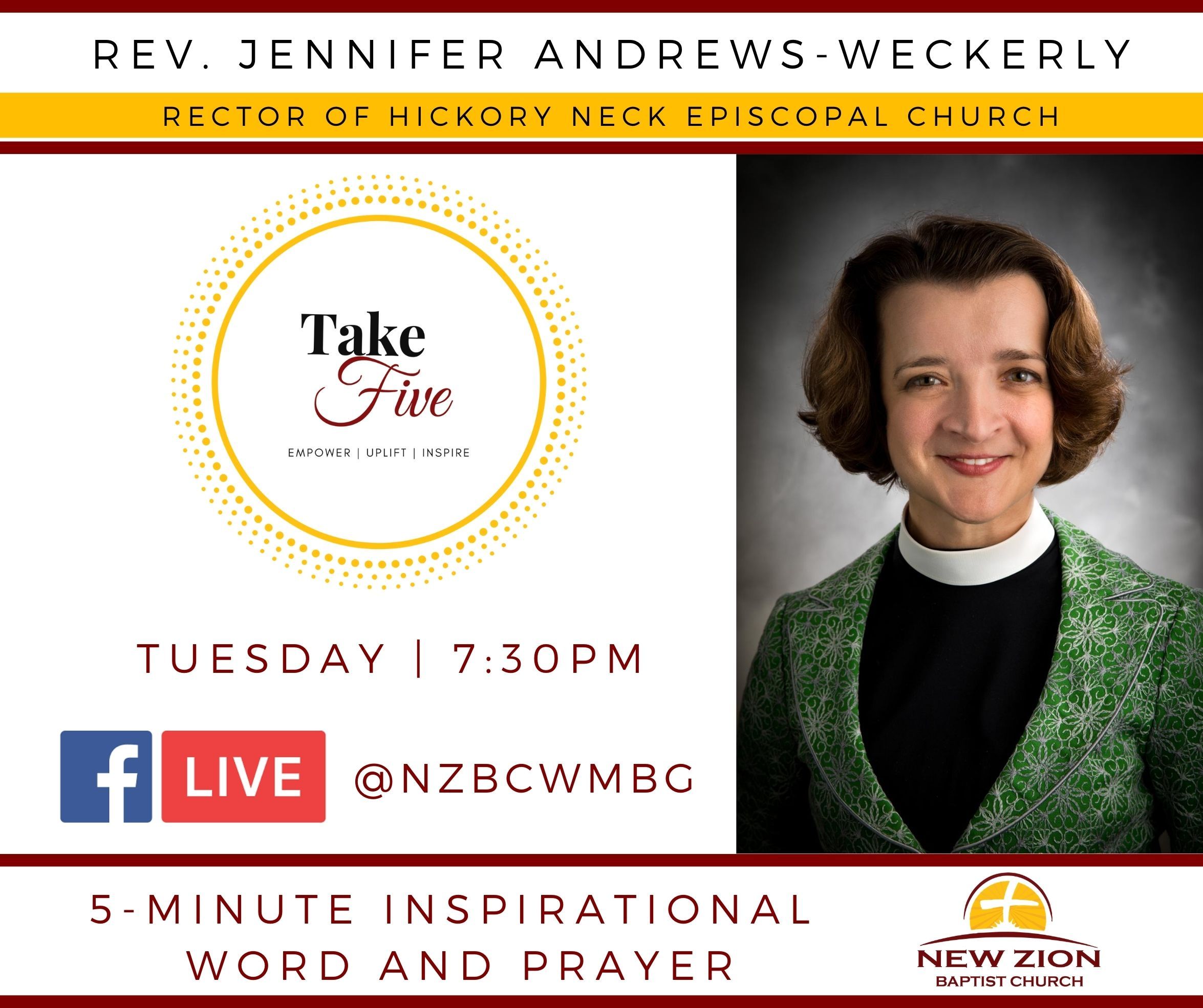
Take Five Speakers-Rev. Jennifer Andrews-WeckerlyThis reflection was offered through the livestream program called “Take Five” at New Zion Baptist Church on July 28, 2020.  This is the text from that talk.

Tonight we turn to Psalm 149, which says, “Praise the Lord.  Sing to the Lord a new song, his praise in the assembly of the saints.  Let Israel rejoice in their Maker; let the people of Zion be glad in their King.  Let them praise his name with dancing and make music to him with tambourine and harp.  For the Lord takes delight in his people; he crowns the humble with victory.  Let the saints rejoice in this honor and sing for joy on their beds.”

Now I know what you may be thinking.  Really?  You want us to talk about praising God?  We’ve got a worldwide pandemic, which our country is becoming one of the worst handlers of in the world, which disproportionately is affecting people of color, and has become so politicized that we are no longer worried about the sanctity of human life, but are instead arguing about rights and the ethics of sacrificing life for some contrived greater good.  Not only that, we are in a crucible around racism, that alternatively gives us great hope for change and makes us despondent about how far we really have to go.  Add to that the emotional, spiritual, financial, and physical toll of this time, a time when we seem incapable of respecting the dignity of every human being, and you want to talk about singing to the Lord a new song?

I don’t know about you, but when I am feeling the weight of the world, and when I am longing for a word from God, an old song is usually where I return.  Every once in a while, when I slow down enough not to just to pray to God, but to actually listen to God, those old timey hymns from my childhood come back.  Their words speak to my ache, or let me wallow in my despair.  They talk about sweet, sweet Spirits, and walks through garden alone with Jesus, and balms in Gilead.  When I talk to Jesus, I want an old song.

But that is not what the psalmist says.  We are not asked to recall the old songs; we are invited to sing a new song.  In fact, seven times in the psalms, we are invited to sing a new song to the Lord.  As a fellow pastor says, “New songs of praise are appropriate for new rescues and fresh manifestations of grace.  As long as God is gracious toward us, as long as he keeps showing us his power, and wowing us with his works, it is fitting that we not just sing old songs inspired by his past grace, but also that we sing new songs about his ever-streaming, never-ceasing grace.”[i]

In this time of utter upheaval, unrest, and unevenness, two things are happening.  One, God is still moving.  The Spirit’s movement may be hard to see or hear in the cacophony of noise.  But I know in talking to New Zion’s leadership, talking to the folks at Hickory Neck Church, and talking to our neighbors here in James City County, Jesus is still moving.  I know that you are finding moments of grace, even in the darkness of this time.  I know that you are seeing shreds of hope, even in what feels like the disappointing failures of our nation.  Two, despite how comforting those old songs are, I am guessing the Holy Spirit has whispering some new songs in your ear.  You may not be sure of the words, and you may be straining to hear the tune.  But in the depths of your heart, where we fear change and we harbor anxiety, we know that only a new song can help get us out of this mess.

So, here’s the good news.  We are not on our own to birth these new songs.  Psalm 40 says, “I waited patiently for the Lord; he turned to me and heard my cry.  He lifted me out of the slimy pit, out of the mud and mire; he set my feet on a rock and gave me a firm place to stand.  He put a new song in my mouth, a hymn of praise to our God.  Many will see and fear the Lord and put their trust in him.”  God put a new song in my mouth, says the psalmist.  Not I, out of my genius, wrote a new song.  Not, I worked hard and put in the time, and out of my labor created a new song.  Not, I listened to what others were singing and sang their songs.  No, the psalmist says, God put a new song in my mouth.  Our invitation tonight is to open ourselves to that new song.  Our invitation is to concede that during this time – a time unlike anything any of us has experienced – God is providing something new – new grace and new songs (which might be even better than that old favorite).  Our invitation tonight is to sing the new song God gives us out in the world – to trust in the wisdom of the words and notes Jesus is giving us and shout them out to a world that desperately needs to hear that new song.

Let us pray.  Holy and creative God, we know that you see our suffering and our cries.  We know that you see us patiently waiting on you to lift us up out of the mud and mire, to put us on a firm place to stand.  Help us to trust that you will put a new song in our mouths – a song to give voice to your ever-streaming, never-ceasing grace.  When we finally hear your new song, help us to sing that song – help us to praise your name with dancing, and make music with tambourine and harp.  Help us to remember that when we sing your new song, we shine your light into the world, helping your transformative, life-giving love take root, and disrupt the injustice of our day.  We praise you, Lord, and we bless you, and we sing a new song with you.  Amen.

[i] David Mathis, “Sing a New Song,” May 4, 2014, as found at https://www.desiringgod.org/articles/sing-a-new-song on July 27, 2020.

Sermon – Mt. 13.24-30, 36-43, P11, YA, July 19, 2020

22 Wednesday Jul 2020

Posted by jandrewsweckerly in Sermons, Uncategorized

≈ Leave a comment

Tags

disciples, evil, God, goodness, grace, Jesus, judgment, patient, Sermon, time, weed, wheat

The parable in our gospel lesson today is a story about weeds – actually, one weed in particular, called the darnel.  The darnel is a nasty weed, wrapping its roots around the roots of good wheat, totally indistinguishable from wheat until producing seed, and life-threatening if allowed to mix in with wheat once harvested.[i]  Jesus tells the disciples that this menacing, evil, life-threatening weed is metaphorically planted in the field of the world.  These evil weeds are planted, growing, and thriving side-by-side with the nutritious, filling, wholesome wheat, intimately intertwined, impossible to separate without destruction to both.  And this, Jesus tells the disciples, is our world.  In one short parable, we have the reality of the enemy or devil, the problem of evil in our lives, and an accounting or judgment at the end of life.  Happy Sunday, huh?

In order to find some hint of grace in this parable, we first have to explore the bad news.  The bad news in this parable is like a funnel of evil, which starts out with a wide, removed description of evil, and as the funnel narrows, the evil comes closer and closer to home.  At the wide mouth of the funnel, we find the evil of the world.  We see evil in the world everyday – as people are kidnapped, tortured, and murdered.  We see evil as people are denied basic human rights, work in sweatshops, and are forced to flee from their lands.  We see evil as people live without shelter, food, or medicines.  And although we recognize the outcomes of evil, we get uncomfortable identifying “evil” because we hope for some hint of goodness in everyone and, secretly, we know that we too sometimes participate in the world’s evils.

Our funnel narrows as the master’s field becomes defined as not only the world, but also our church community.  Here is where the notion of “evil” weeds becomes even more uncomfortable.  Jesus experienced evil in the midst of his community, as individuals constantly sought to kill him.  The early Church also experienced evil in the Church’s midst.  And the evil within the Church is still with us today.  There is no perfect church.  I love this parish and the beautiful ways we care for and love one another – but I cannot claim that we are perfectly good.  In fact, each us has at some point been like that nasty weed, capable of choking the nutrients and life-giving water out of true goodness among us – a reality that makes us uncomfortable, both with the idea of judging each other, and with the potential of being exposed ourselves.

Then comes the tightest, most compressed area of the funnel – the spout through which evil finally flows.  The field in which evil is planted is also the field of ourselves.  Paul articulated this evil in his letter to the Romans, “For I do not do the good I want, but the evil I do not want is what I do.”[ii]  Paul’s words perfectly capture the inner turmoil of being human.  Imagining the weeds and the wheat growing up together in our own beings is not difficult.  We are constantly an intertwined field of great deeds and hurtful wrongs.  We pray that the good seed will yield fruit and the weeds will eventually be burned, but we know both weed and wheat are inside of us.  And so, the funnel shows us that evil is in our world among us, in our faith community beside us, and in our very beings.

The grace is that the funnel also works in reverse.  Grace spews out of the same funnel.  When the servants ask the master about whether they should go ahead and pull out the weeds, the master tells them to wait, letting the two grow side by side, entangled and indistinguishable.  This waiting time is the grace for our own selves.  Recognizing that both good and evil are in ourselves, God gives us time:  time to continue to nurture the good; time to avoid killing the good in our efforts to kill the evil in ourselves; and time to allow God’s grace to work in and through us, so that the goodness in us might be gathered into that barn.  As God is patient with us, so we are to be patient with ourselves.

The same grace moves out of the funnel, out of ourselves, and into our Church.  God gives us time as a faith community too.  The gift of time gives us the opportunity to live into God’s grace – witnessing goodness to one another, so that the evil among us might be overwhelmed and eventually discarded.  The gift of time for the Church also allows us to make amends for those times when we are the agents of evil in the church, confessing our faults weekly, repenting and returning to goodness.  The gift of time for the church allows us to learn and grow in God’s goodness, to marvel in the mystery of God’s grace, and to prayerfully lift up the Church to God.  God is patient with the Church just as God is patient with each of us.

Finally, the funnel of goodness spills over into the world through the gift of time.  The gift of time allows us to work on spreading goodness in the world.  We have time to give one more meal to a hungry person, to comfort one more grieving person, to advocate one more time for a just society.  And we realize in this gift of time that we are not responsible for sorting out the weeds and the wheat.  God will do that.  We can only work to cultivate goodness in our lives, in our community, and in the world – and the rest is in God’s hands.

When we realize that each of us is some mixture of wheat and weed, of holy and unholy, of potentially fruitful and potentially destructive, we can then turn away from God’s work of judging, and turn toward our work of attending to that which increases the potential for holiness.[iii]  In other words, the grace for us in this parable is that we can leave the judgment to God, and do our work of promoting goodness in ourselves, in our community, and in the world.  This is our work.  Let anyone with ears listen!

[i] Talitha J. Arnold, “Pastoral Perspective,” Feasting on the Word, Year A, Vol. 3 (Louisville: Westminster John Knox Press, 2011), 260.

[ii] Romans 7.19

[iii] Gary Peluso-Verdend, “Theological Perspective,” Feasting on the Word, Year A, Vol. 3 (Louisville: Westminster John Knox Press, 2011), 264.

On Glimpses of Love…

20 Wednesday May 2020

Posted by jandrewsweckerly in Uncategorized

≈ Leave a comment

Tags

children, conflict, crisis, fight, fragile, frustration, God, grace, humanity, love, mercy, pandemic

822890

Photo credit:  https://www.dayspring.org.uk/Articles/490488/Dayspring_Church/Community/Sundays/Walking_in_the.aspx

It finally happened.  We had established a weekly routine for this bizarre time, and the kids seemed to have adjusted to the new rhythm.  But this week, something finally broke.  From sunrise to sunset the day was full of arguments, timeouts, tantrums, and tears.  For the life of me, I cannot recall the content of the conflict, but I am still recovering from the rollercoaster of emotions from that day.

Late that night, once the house was finally quiet, I tried to figure out what in the world had happened.  After my own frustration and fatigue began to settle down, a moment from the day percolated up in my mind.  During our midday quiet time, I was working diligently, trying to maximize my precious work time.  My older daughter had asked to quietly read beside me, and I had hesitantly agreed.  Soon, I realized her breathing had become regular and her booked had slipped down.  She was sleeping, something she never does midday at her age.  In that brief time, without her anger, arguments, and attitude, her peaceful face reminded me of how very fragile she is.  Just for a moment, I was able to remember that as much as our children are resilient, creative, and strong during the new reality this pandemic has created, our children are also frustrated, confused, and lost as they try to make meaning out of the chaos.  All of my anger about how the day had unfolded evaporated in that moment, and a wave of sympathy consumed me.  In seeing all of the “fight” leave my daughter’s body, I was able to see the fragile child left behind.

As I processed the day with a fellow parent that night, I began to wonder if that moment of insight is perhaps the way God sees all of us in this time.  We adults are struggling too – trying to make sense of this terrible time, trying to control the chaos enough to function, trying not to be overcome by the grief of all we have lost in this time.  Most days we succeed, being resilient, creative, and strong ourselves.  But we too have our days where we lose it – lose control over our carefully constructed hold on this new normal.  I imagine God journeys with us in those strong days and those weak days, overflowing with love for us – loving pride for the ways we are trying our best, and loving sympathy for the fragility of our humanity.  And although I only got a glimpse of that love on that rough day this week, that glimpse was just a tiny portion of the massive well of love God has for us.

I do not know what kind of week you are having.  I do not know what stressors are creating small chinks in your armor or big cracks in your façade.  I do not know whose burdens you are carrying in addition to your own.  Whether you are hitting your stride, or stumbling along the path, know that you are loved this week.  Know that God is right there with you, offering grace, mercy, and fortitude whenever you need it.  And if you have it within your capacity this week, or next, I invite you share that same love with those you encounter this week – whether with your family, the essential workers you encounter, or your neighbors.  Getting a glimpse of how God loves you makes it a lot easier to see others with God’s loving eyes.  And we could all use a dose of that love today.

On Grief, Grace, and God in a Pandemic…

30 Thursday Apr 2020

Posted by jandrewsweckerly in Uncategorized

≈ Leave a comment

Tags

cope, Coronavirus, emotion, freedom, God, grace, grief, Jesus, loss, lovingkindness, pandemic

istock-467983993

Photo credit:  https://www.timeshighereducation.com/student/blogs/how-deal-grief-while-university

This week, I hopped in the car to pick up an order of food from a local restaurant.  We’ve been trying to support our local businesses, and this has become a weekly treat.  On my drive there, I suddenly felt a sense of freedom.  I was totally alone in the car, I was blasting music only I like, and I was free from the confines of our home.  The whole trip was probably only 20 minutes round trip, and I have been out of the house many times, as I am the designated person to pick up necessities, but something about this particular drive was so gloriously freeing that the release of blissful emotion almost made me cry with longing.

As I thought about the drive later, I began to understand the surprising surge of emotion.  Intellectually, I know we as a world are suffering a tremendous amount of grief.  But I had not fully acknowledged my own grief – grief over seemingly small losses.  In my case, the loss of freedom to structure my day, create space without children around for contemplation or accomplishing work, to go about daily rituals (work, shopping, dropping off kids), or even the ability to just hop in the car and go wherever I want.  I suppose I had not acknowledged my grief because there is much bigger grief all around me – grief over the death of loved ones whose funerals are indefinitely postponed, grief over lost livelihoods and the threat of financial ruin, grief over the incapacitating of the body from this virus, grief over lost milestones, such as graduations, weddings, and baptisms.  In the face of such enormous grief, my feelings felt petty or unmerited.

I have counseled more families than I can count after a loved one has been lost.  We talk about how important having a funeral as soon as possible is so the grief process can begin.  With church members, we send a series of four books over the following year to help them as their grief evolves.  But in the midst of a pandemic, grief is a strange animal.  There are ways in which we are hesitant to acknowledge or give credence to our grief.  There are ways in which we stuff our grief because we are just trying to survive.  And there are ways in which our grief simply cannot be processed because of the elimination of our normal rituals.

All of that is to say, I hope that you can use this time to give yourself the same amount of grace and lovingkindness that our Lord gives us.  This time is unlike anything most of us have faced, and our normal coping mechanisms may not be sufficient.  And that is okay.  The good news is that Christ is walking with us in this time, holding our fragile selves together (and staying nearby with the fragility shatters).  Our invitation is to accept that tenderness for ourselves, and, when possible, extend that tenderness to others – our loved ones, our neighbors, and strangers.  As always, you are in my prayers.  Today I especially pray that you can feel God’s loving arms surrounding you on every side.

On Holy Week, Distance, and Hope…

08 Wednesday Apr 2020

Posted by jandrewsweckerly in Uncategorized

≈ Leave a comment

Tags

church, community, Coronavirus, creativity, different, digital, grace, grief, Holy Spirit, Holy Week, hope, intimate, physical, sacrament, technology, tradition

Digital Holy Week

Photo credit:  https://www.brownsvilleherald.com/news/business/the-latest-holy-week-ceremonies-closed-to-public-over-virus/image_b2f632ed-6243-5410-accd-34ccf4865671.html

I remember the first time I was a Rector and planning Holy Week.  I was debating about whether to use the reserve sacrament on Good Friday or not.  I spoke to a priest colleague, and he shared the philosophy of the Rector under which he was serving:  on Good Friday, not even the consolation of the Holy Meal is available to us.

When our staff at Hickory Neck first started talking about Holy Week, we were faced with a stark reality:  there was no way for us to celebrate Holy Week the way we traditionally do.  Sure, we could use technology, and sure, we could try to do parts of what we normally do, but so much of Holy Week is physical and intimate – from waving palms, to washing feet, to kissing crosses, to huddling together around a fire, to having water sprinkled around, to gathering close in the dark, to finally gathering in a huge celebration with large crowds, Easter egg hunts, pictures with friends, and brass instruments.  There just is not a way to create that same feel digitally.  And so, Holy Week would need to be different.

For those of you who know me, you know Holy Week is superlatively special to me – it is my favorite week of the year.  So, for a moment, I grieved that loss, adding it to the long list of things I am grieving during this pandemic.  But then I took a deep breath, made room for Holy Spirit as I relaxed my grip on what I falsely imagined was under my control, and let the creativity flow.  Before I knew it, we were trying evensong for Maundy Thursday – a service we experienced daily on a recent pilgrimage in England.  We were creating a simple, powerful Good Friday liturgy.  And, I was trying for the first time a liturgy I had barely noticed in the Prayer Book – a Holy Saturday liturgy.

Holy Week and Easter will not be the same this year.  But, in all honesty, nothing is the same in this season of life.  If our lives are so distinctly different these days, it makes sense that our liturgies would be different too, as liturgies reflect the life of the people.  Somehow, creating this alternative Holy Week has felt like the Church settling in alongside the community and walking in step with them (from a safe distance, of course!).  Somehow, recognizing grief, discomfort, and sadness has made room for creativity, hope, and grace.  Somehow, experiencing a daily life much more in line with the journey of Holy Week is making Holy Week viscerally palpable, and ultimately healing, life-giving, and strengthening.  We still have a long way to go with this virus and its impact, but I am especially grateful for the gift of Holy Week this year.

Sermon – John 9.1-41, L4, YA, March 22, 2020

27 Friday Mar 2020

Posted by jandrewsweckerly in Sermons, Uncategorized

≈ Leave a comment

Tags

blind man, cause and effect, comfort, Coronavirus, faith, God, good, grace, hope, Jesus, journey, light, questions, see, Sermon, sight, sin, suffering, theology

I must confess to you:  I have been dreading talking to you about this text all week.  The presence of cause and effect in this text is overwhelming.  The text says multiple times that the reason the blind man is blind from birth is because he sinned (and since it was from birth, there is the implication his parents sinned, and the blind man is being doubly punished and exists in double sin).  Those gathered insist that Jesus must be sinful too because he does not follow the law – he heals on the Sabbath, and he cannot possibly speak for or act for God as a sinner.  Jesus also says those gathered are sinners for they cannot see God.  Even at the beginning of John’s story, even Jesus says, “Neither this man nor his parents sinned; he was born blind so that God’s works might be revealed in him.”

I have not wanted to preach this text today because I do not at feel comfortable with the cause and effect nature of this text, especially what that cause and effect nature seems to imply about suffering.  Can Jesus really be saying this man was made blind so that God could be revealed?  Is this text saying God causes suffering – pain, disability, ostracizing from community, poverty so deep that only begging will ensure survival?  That concept is a huge hurdle for me because that is not at all my theology of suffering.  And I especially do not like hearing that theology of suffering this week – a week when we are watching the cases of Coronavirus creep up in our country and double in our county and have begun asking the same sorts of questions the people in this passage are asking:  Where is God in this?  Why is God allowing not only this terrible virus to happen, but the accompanying societal upheaval?  Is God causing this suffering for some greater good?  This kind of health crisis pulls at all of us and in our innermost, private places, and makes us wonder, even if we cannot say the words aloud, “Did God have something to do with this virus?”  Or sometimes we find ourselves not embarrassingly asking the question, but boldly shouting at God, “What in the world are you doing?  Why aren’t you here fixing this?  How could you do this?!?”  The absolute LAST passage I want to hear when we are asking these bone-deep theological, desperate questions is a text that seems to imply God causes suffering for God’s own glory.

That is why I am especially grateful for biblical scholars who can journey with us in interpreting scripture.  Biblical Scholar Rolf Jacobson took a look at that same verse that has been nagging me all week, “Neither this man nor his parents sinned; he was born blind so that God’s works might be revealed in him.”  Luckily Jacobson is better at Greek than me.  He explains that the writers of the New Revised Standard Version inserted text into the English translation that simply is just not there.  In the original Greek, the words “he was born blind,” are not there.  Instead of the text saying, “Neither this man nor his parents sinned; he was born blind so that God’s works might be revealed in him,” the text actually says, “Neither this man nor his parents sinned [period].  In order that God’s works might be revealed in him, we must work the works of him who sent me…”  According to Jacobson, Jesus is not saying the man was blind so God could be revealed.  Jesus is saying no one sinned.  But given the situation, God has given his disciples the opportunity to do something good to reveal God’s goodness.[i]  In other words, God does not cause suffering.  But God can use us in the midst of suffering for good.

I don’t know about you, but that has shifted my understanding of this text completely.  All of the arguing about who sinned, what laws you must follow to be holy, and who should be in or out are a distraction.  The same can be true of us.  When we start trying to logic our way through fault, or sin, or blame – even blame on God, we lose our way; we become blind like those gathered and arguing in our text today.  Instead, this text is inviting us to ask different questions.  Instead of whose sin caused this virus, we can ask, “How can I be a force for good in the midst of this virus?”  Instead of why God is doing this or allowing this to happen, we can ask, “Where are the opportunities to see God acting for good in the midst of suffering?”  Instead of where is God in this, we can ask, “Where am I finding moments of God’s grace in this?”  I am not arguing our questions and demands of God are not valid at this time.  In fact, I think our quiet doubt of and our raging anger at God are perfectly normal – and maybe even necessary for honest relationship with God.  What I am arguing is this text is not a reinforcement of our sense of darkness, but instead an invitation into light – an invitation to seeing when we may feel blinded.  My prayer this week is that we stumble into those moments of light this week – that we find those moments of grace upon grace that give us renewed comfort, hope, and faith.  May God bless you in the journey toward the light.  Amen.

[i] Rolf Jacobson, “Sermon Brainwave #713 – Fourth Sunday in Lent,” March 14, 2020, as found at http://www.workingpreacher.org/brainwave.aspx?podcast_id=1240, on March 19, 2020.

Sermon – Matthew 2.1-12, Isaiah 60.1-6, EP, YA, January 5, 2020

08 Wednesday Jan 2020

Posted by jandrewsweckerly in Sermons, Uncategorized

≈ Leave a comment

Tags

abundance, Bethlehem, Christ, control, Epiphany, God, grace, hide, ignore, incarnation, Jerusalem, light, love, magi, mystery, need, pageant, power, promise, Sermon

At our 9:00 am service today, we honor the feast of Epiphany with our annual Epiphany Pageant.  Every year I love watching the children and youth bring the Christmas story alive one more time.  Part of what makes the service special is hearing the story with fresh ears – not from a clergy person reading from the aisle like every other Sunday, but with a variety of voices narrating and enlivening the words, making the incarnation story more incarnate.  I love how the pageant keeps us in the Christmas moment one more week, and I love how the story brings all our Christmas characters under one roof, reminding us of the continual unfolding of the mystery of the incarnation.  Though there is something certainly endearing about the whole experience of a pageant, there is also something quite profound in a pageant too.

But what pageants can sometimes do is focus our attention so intently on the manger – on Jesus and his family – that we forget what happens outside the manger is just as important as what happens at the manger.  Even our beloved carol “We Three Kings,” draws us to the experience of the magi’s adoration in Bethlehem, without insight into what happens in Jerusalem.  This year, after hearing of registrations, of humble births, of angel choruses, of everyday shepherds spreading the Gospel, and of cosmic explanations of the incarnation, we turn our attention to Jerusalem.  Isaiah gives us some clue about where our attention is drawn.  “Arise, shine; for your light has come, and the glory of the LORD has risen upon you…Lift up your eyes and look around…”[i]  The instruction in Isaiah is not for Bethlehem, but the city of Jerusalem[ii] – the city where Jesus’ journey will end, the city for whom Jesus weeps, the city of eventual redemption and salvation.  There, Isaiah foretells of the incarnation, how the people of God are to reflect the light of Christ, and to pay attention to what is happening around them, to God incarnate.

Those words, “lift up your eyes and look around,” have been lingering with me this week.  Instead of looking deep into the scene at the manger or with the holy family, I am drawn by what is happening in Jerusalem.  Three things happen there.  One, we learn more about the magi.  The testimony of the magi is what most of us associate with Epiphany.  Foreigners set out on a quest, more attuned to the cosmic nature of the incarnation than the people of faith.  Their astrological findings do not simply fascinate them, but inspire action – a long, uncomfortable journey to see the incarnation for themselves.  As profound as their witness is, they are not able to complete the journey alone.  They stop in Jerusalem for guidance.  They know they are on the right path, they just cannot quite get to the proper place. And so, the magi stop and ask for help along the way.  They know something significant has happened, but they need guidance from people of faith to fully realize their journey.[iii]

The magi’s insightful question, “Where is the child who has been born king of the Jews?” is a question that brings in the second action.  The chief priests and scribes, the ultimate insiders of the faithful, those who hold the revelation of scripture and interpret scripture for the people of God, are given news that should be earth shattering.  When asked about the birth of the Messiah, the religious leaders recall what they know of the Messiah:  the Messiah is to be born of Bethlehem and is to shepherd and rule the people of God.  The religious leaders offer the key – the prophecy of scripture about the coming Messiah.  And yet, even though they have this scriptural foundation, they do not react to the news of the magi.  Even though these wise people profess this awaited Messiah has been born, the religious leaders do not drop everything.  They do not even ask to go with the Magi, just to check and see if this story might have something.  They may be versed in scripture, but their inaction shows that even insiders sometimes need outsiders to be faithful.[iv]

Finally, the third thing that happens are the actions of Herod.  Herod is probably the most fascinating to me.  He is wise too, even if he uses his wisdom for his own nefarious purposes.  Herod knows the announcement, even if from an outsider of a new king being born means his own kingship is threatened, and shows how fragile his rule is.[v]  But instead of acting impulsively, he manipulates those around him.  First, he calls in the religious leaders.  You see, Herod is not a Jew – in fact, he is a Roman, serving at the leisure of the kingdom.  But his subjects are Jewish, and so he is wise enough to seek their counsel on what a king, what a Messiah, might look like.  But instead of sending his religious leaders to check things out in Bethlehem, knowing they might discover a true king among them, he secretly sends the foreigners, hoping to manipulate them into doing the work of finding the king, knowing he will get news from them so he can kill this new king.  Herod is only worried about himself and his power, and he will do whatever is needed to maintain that power.

The foreign magi are so unfamiliar with the people of God, they do not initially understand the weight of their question about the new king.  The scribes and religious leaders are so buried in their scripture, and so keen to keep balance with secular power, they do not realize the messianic fulfillment right in front of them.  And Herod is so bent on keeping his power, he does not fully understand the power of God working all around him.  All three of these agents in our story need the words of Isaiah today – all three need to lift up their eyes and look around.

We are not unlike the characters in our story today.  How often are we so mired in our own power – as people of privilege and comfort, as Americans with power more globally, as members and advocates in this community – how often does a word about the movement of God, the promise of change, and the possibility of giving up some of our power to allow that fulfillment, make us just as nefarious as Herod – just as willing to manipulate the world around us?  Or how often have we steeped ourselves in scripture, scouring God’s Holy Word, longing for some sort of guidance or truth, not realizing truth is being spoken through another right to our faces?  Or how often have we been so intent on a mission, so focused on what we sense God calling us to do, we ignore the consequences of our actions, forget the power of our words?

Today’s scripture reading is certainly about the gift of the magi to us – the revelation of the incarnation, the insight of foreigners, and the abundance and homage the incarnation inspires.  But today’s scripture reading is also an invitation to consider our own response to that incarnation in the modern era, considering the ways in which we have not lifted our eyes and looked around.  Taking up Isaiah’s invitation to self-critique is important because there is also a promise in Isaiah.  You see, when we lift our eyes and look around, we acknowledge the narrowness in our lives, or we acknowledge the ways in which we are blind to our own power, or we discover the ways in which we even hide behind our faith, we are then able to see the promise in Isaiah.  Isaiah tells us to look around because glory of the LORD has risen upon us.  Isaiah says in verse five, “Nations shall come to your light, and kings to the brightness of your dawn.”  When we talk about shining our light on this holy hill here at Hickory Neck, this is what we mean.  The gift of the magi to us is not news that is frightening.  When we are not hoarding power or hiding behind our intellect or comfort zones, the news of the magi is news for rejoicing.  And that rejoicing is light that draws nations, and kings, and neighbors, and strangers, and family members, and friends.  The gift of the magi is the invitation to let go of the things that feel under our control, and embrace the thing in no way we control, but in every way brings us grace, love, and abundance.  That is the kind of living that shines light from this hill and brings others to Christ’s light.  That is the light offered to us today in the magi.  That is the kind of good news worthy of pageants and proclamation today.  Amen.

[i] Isaiah 60.1, 4a

[ii] Rolf Jacobson, “Sermon Brainwave #701 – Day of Epiphany,” December 29, 2019, as found at http://www.workingpreacher.org/brainwave.aspx?podcast_id=1216 on January 3, 2019.

[iii] R. Alan Culpepper, “Exegetical Perspective,” Feasting on the Word, Yr. A, Vol. 1 (Louisville:  Westminster John Knox Press, 2010), 217.

[iv] Culpepper, 217.

[v] Stanley Hauerwas, Matthew (Grand Rapids:  Brazos Press, 2006), 38-39.

On Festivals, Fitness, and Fun…

16 Wednesday Oct 2019

Posted by jandrewsweckerly in Uncategorized

≈ Leave a comment

Tags

church, community, faith, festival, fun, God, good, grace, joy, love, muscle memory, passion, spiritual

44247089_2050605094995740_7020791298546204672_n

Photo credit:  Charlie Bauer; permission required for reuse.

This week is one of my favorite weeks of the year.  This is the time when our church community transforms our property for our Annual Fall Festival.  Leading up to this week, there is a lot of organizing, delegating, preparing, and a fair amount of stress.  But this week, everything snaps into place.  The setup crew knows exactly what to breakdown and where it goes.  The Attic Treasures crew knows just what layout works and the room is magically converted to look like the same inviting space.  Later, our parking crew will come out and lay out where cars can park, tents will be erected, and all kinds of goods will be placed.  Having done the festival for nineteen years, we know the drill and seem to operate from muscle memory.

I love this week for several reasons.  One, I love seeing the community come together – both parishioners and neighbors alike, to make for a fun week of memories, laughter, and new experiences.  I love seeing people’s passion for helping others unfold in a way that is loving, affirming, and fun.  And I also love seeing people step up, taking on things that are a burden on their time, but doing so for the greater good.  The week truly is inspiring, and I love inviting the larger community into our joy.

This week – or perhaps next week after the dust has settled – I invite you to consider what other parts of your faith life might need to be flexed enough so that you have muscle memory around them as well.  Perhaps it is just making Sunday worship a part of your weekly experience with God – letting the routine of liturgy create a common pattern for you, while also seeing how the routine of liturgy creates surprising moments of grace and joy.  Maybe your muscle memory can form around inviting people to church.  I find the more I talk about a thing I am passionate about, the more talking about it becomes easy.  Or maybe your muscle memory will be around creating practices that feed your soul – our monthly book group, our yearly Women’s Retreat, a weekly Bible Study or Choir rehearsal.  If any of these practices create even a portion of the joy we experience during Fall Festival week, I expect you are in for a real treat.  I cannot wait to hear about it!


← Older posts
Newer posts →

Recent Posts

  • On Redefining Community…
  • On Parenting, Milestones, and Community…
  • Sermon – Acts 2.42-47, E4, YA, April 26, 2026
  • On Seasons of Discernment…
  • Sermon – Luke 24.13-35, E3, YA, April 19, 2026

Archives

  • May 2026
  • April 2026
  • February 2026
  • January 2026
  • December 2025
  • November 2025
  • October 2025
  • September 2025
  • August 2025
  • July 2025
  • June 2025
  • March 2025
  • February 2025
  • December 2024
  • November 2024
  • October 2024
  • September 2024
  • August 2024
  • July 2024
  • June 2024
  • May 2024
  • March 2024
  • February 2024
  • January 2024
  • December 2023
  • November 2023
  • October 2023
  • September 2023
  • August 2023
  • July 2023
  • June 2023
  • May 2023
  • March 2023
  • February 2023
  • January 2023
  • December 2022
  • November 2022
  • October 2022
  • June 2022
  • May 2022
  • January 2022
  • December 2021
  • November 2021
  • October 2021
  • September 2021
  • August 2021
  • June 2021
  • May 2021
  • April 2021
  • March 2021
  • February 2021
  • January 2021
  • December 2020
  • November 2020
  • October 2020
  • September 2020
  • August 2020
  • July 2020
  • June 2020
  • May 2020
  • April 2020
  • March 2020
  • February 2020
  • January 2020
  • December 2019
  • November 2019
  • October 2019
  • September 2019
  • August 2019
  • July 2019
  • June 2019
  • May 2019
  • April 2019
  • March 2019
  • February 2019
  • January 2019
  • December 2018
  • November 2018
  • October 2018
  • September 2018
  • August 2018
  • July 2018
  • June 2018
  • May 2018
  • April 2018
  • March 2018
  • February 2018
  • January 2018
  • December 2017
  • November 2017
  • October 2017
  • September 2017
  • August 2017
  • July 2017
  • June 2017
  • May 2017
  • April 2017
  • March 2017
  • February 2017
  • January 2017
  • December 2016
  • November 2016
  • October 2016
  • September 2016
  • August 2016
  • July 2016
  • June 2016
  • May 2016
  • April 2016
  • March 2016
  • February 2016
  • January 2016
  • December 2015
  • November 2015
  • October 2015
  • September 2015
  • August 2015
  • July 2015
  • June 2015
  • May 2015
  • April 2015
  • March 2015
  • February 2015
  • January 2015
  • December 2014
  • November 2014
  • October 2014
  • September 2014
  • August 2014
  • July 2014
  • June 2014
  • April 2014
  • March 2014
  • February 2014
  • January 2014
  • December 2013
  • November 2013
  • October 2013
  • September 2013
  • August 2013
  • July 2013
  • June 2013
  • May 2013
  • April 2013
  • March 2013
  • February 2013
  • January 2013
  • December 2012
  • November 2012
  • October 2012
  • September 2012

Categories

  • reflection
  • Sermons
  • Uncategorized

Meta

  • Create account
  • Log in
  • Entries feed
  • Comments feed
  • WordPress.com

Blog at WordPress.com.

  • Subscribe Subscribed
    • Seeking and Serving
    • Join 391 other subscribers
    • Already have a WordPress.com account? Log in now.
    • Seeking and Serving
    • Subscribe Subscribed
    • Sign up
    • Log in
    • Report this content
    • View site in Reader
    • Manage subscriptions
    • Collapse this bar

Loading Comments...