• About

Seeking and Serving

~ seek and serve Christ in all persons

Seeking and Serving

Tag Archives: Holy Spirit

On Barriers and Saying Yes…

05 Wednesday May 2021

Posted by jandrewsweckerly in reflection

≈ Leave a comment

Tags

abundance, baptism, connection, curiosity, discipleship, evangelism, faith, God, godparents, grace, Holy Spirit, Jesus, limits, liturgy, longing, sacred

Photo credit: https://aleteia.org/2020/03/30/how-laypeople-can-baptize-in-an-emergency/

On Sunday, we heard the story of the Philip and the Ethiopian eunuch.[i]  At one point in the story, the eunuch says, “What is to prevent me from being baptized?”  The question is simultaneously wonderful – how amazing to hear someone so inspired by the witness of Jesus that they want to baptized right away – and anxiety-making.  Episcopalians are very clear about our identity and our liturgical ways of doing things.  So certain is our identity, that I could imagine an Episcopalian responding to the eunuch, “Well, we need to sign you up for baptism class, and then find out when the next best baptismal feast day is on the liturgical calendar.  Once we get everything lined up, we’d be thrilled to schedule your baptism!”  Somehow, that response from Philip would not have made for such an enticing story about the power of evangelism and discipleship.

The eunuch’s words were ringing in my ears when I received a similar request recently.  One of our young parishioners lost her godfather to an unexpected death during COVID.  We were all devastated and grieved together.  But a few weeks ago, the family contacted me with a request.  They had already talked as a family about how her godfather would always be her godfather, even from heaven.  But they also wanted to appoint a new earthly godfather who could help their daughter grow in the life of faith.  And so, their question was, “Is there a way you can do that liturgically by Zoom?”

One answer could have been no; we do not have such a liturgy in our Prayer Book.  But the request was so pure and Spirit-led that I knew even a Prayer Book would not want to limit such grace and abundance.  And so, in consultation with some fellow clergy and liturgical resources, including the Book of Common Prayer, we cobbled together a beautiful liturgy.  We prayed for the godfather who had passed and the ways in which he would always be with us.  The godchild formally asked the godfather if he would be willing to be her earthly godfather.  We asked the normal questions we ask in a baptismal liturgy of the godfather, and then we all reaffirmed our Baptismal Covenant and prayed over the new “family” we had created – all via Zoom.  And although we were not in our beloved chapel, we created a profound, intimately sacred space together, where the Holy Spirit blessed us as a community.

When I think about those questions, “What is to prevent me from being baptized?” and “Can we designate a new godparent?” these are questions of curiosity and longing.  These are questions inspired by those seeking Christ and wanting a deeper connection to God.  If this pandemic has taught us anything, we have learned the ways in which the Holy Spirit is unbounded and can act – whether in a building, alongside a road, or online.  This week, I invite you to ponder what limits you have placed around your own connection to God – what barriers or rules have hindered your connection to the sacred.  How might you begin lessening your grip to allow room for encounters with the sacred?


[i] Acts 8.26-40

Sermon – Acts 8.26-40, E5, YB, May 2, 2021

05 Wednesday May 2021

Posted by jandrewsweckerly in Sermons

≈ Leave a comment

Tags

baptism, Ethiopian eunuch, God, Good News, guide, Holy Spirit, listen, patience, Philip, posture, proclaim, pursuit, question, response, Sermon

As we continue our journey of Eastertide, we continue to explore the consequences of the resurrection on our daily living.  This week, we turn to the Acts of the Apostles, and the vivid story between Philip and the Ethiopian eunuch.  What seems like a simple witness story, the apostle Philip teaching and converting the foreign eunuch, is not simple at all.  In fact, we learn from both characters, in very different ways, what posture toward God we should assume, what our responsibility to each other and the community of faith is, and what our response to the resurrection and one another can be.

Our first lesson from these two characters is what posture toward God we can assume.  Philip shows us the posture of responding to God, no matter what the instruction.  Philip is told by an angel of the Lord to go south.  There is no explanation about why he should go or what the itinerary will be, or why he should take the dangerous wilderness road.  Later, the Holy Spirit tells Philip to approach a quickly-moving chariot, containing a person of influence, who may reject this disheveled disciple.  Both times, Philip responds immediately, sprinting to follow the Spirit.  We see in Philip no complaining or whining to God.  Philip hears God’s word of instruction and Philip responds, no questions asked.

We also learn from the eunuch’s posture toward God.  The eunuch is a man of color, looking distinctly different from any Jew from Israel; he is a court official, a man of importance and wealth[i]; his sexual status has been altered, making him barred from the temple.[ii]  So this man, this unnamed eunuch, has both power and a lack of power.  But despite his exclusion from the temple, he is pursuing God.  And, despite his half-fulfilled experience in Jerusalem, he will not be deterred from seeking God.  This outsider by all other standards shows us the posture of constant, undeterred pursuit of God. 

After Philip and the eunuch teach us about the appropriate postures toward God, the pair teaches us about our responsibilities to one another and to the community of faith.  Philip teaches us of our responsibility to serve as guides to one another.[iii]  Imagine for a moment the best teacher you ever had.  Usually our best teachers are not didactic, but are more guides who are in the learning journey with us.  That is exactly what Philip offers when he sits beside the eunuch in the chariot.  He sits beside the foreign, castrated man, and treats him like an equal in the pursuit of following Jesus.  Philip teaches us that our work is to be guides with one another in this journey of growing to know God.

The eunuch teaches us a lot about our responsibilities toward one another too.  As a person of influence and power, the eunuch could have easily brushed off Philip, telling this dirty disciple to get away from his pristine chariot.  But instead, the eunuch is completely unafraid to ask questions.  He willingly admits he needs a guide, he wants to know how to interpret scripture, and he wants to know if he too can be baptized.  His willingness to question reveals a sense of humility and engagement, and a willingness to trust someone in the community to teach him.

After teaching us about the appropriate posture toward God, the responsibilities to one another and the community of faith, Philip and the eunuch finally teach us about what our work or response to God and one another can be.  Philip responds to God by proclaiming the good news.  This step is often the hardest for us.  When the time for proclaiming the gospel comes, we clam up, fear we are not qualified, or are afraid to come off as pushy or sanctimonious.  But Philip shares the good news by telling the eunuch about Jesus, sharing stories of Jesus’ historical ministry, his love for the poor, his death and resurrection, and then finally, how Jesus’ life can be seen in the whole of the salvation narrative.  Sharing the good news is simply a matter of telling a good story. 

Finally, the eunuch shows us the other requirement of faithful living – responding to the good news.  For the eunuch, he hears the good news, and he immediately responds by asking for baptism.  Our liturgy invites us into the same response every week.  We come together as a community; we hear the word of God – those stories that make up the whole of the good news; and we are sent out into the community – to love and serve the Lord.  Church is not just a place to come and feel good.  Church is also a place to be so filled that your enthusiasm for the good news that sends you out into the world with the work God has given you to do. 

This week, I invite you to take Philip and the Ethiopian eunuch with you out into the world.  Perhaps you will work on your willingness to be open to the voice of the Holy Spirit; perhaps you will allow yourself to say aloud those questions that you hide in the depths of your heart; perhaps you will share the holy stories of the faith with another; or perhaps you will patiently sit with someone who is struggling with their faith this week.  Like Philip and the eunuch, who boldly go down to those baptismal waters, we too hold one another’s hands as we leave this space, facing the challenges of this world together.  Amen.


[i] Paul W. Walaskay, “Exegetical Perspective,” Feasting on the Word, Year B, Vol. 2 (Louisville: Westminster John Knox Press, 2008), 457.

[ii] Walaskay, 457.

[iii] William Brosend, “Unless Someone Guides Me,” Christian Century, vol. 117, no. 15, May 10, 2000, 535.

On Glimpses of Togetherness…

03 Wednesday Mar 2021

Posted by jandrewsweckerly in reflection

≈ Leave a comment

Tags

absent, community, ecumenical, God, Holy Spirit, Jesus, Lent, pandemic, present, worship

Photo credit: Jennifer Andrews-Weckerly; reuse with permission only

This evening, we are gathering with our local ecumenical brothers and sisters in worship.  These Lenten gatherings happen every year, usually preceded by a simple supper before worshiping together.  One of the eight churches hosts and a preacher from another church offers the sermon.  The freewill offering supports a local nonprofit.  The evenings allow us to see the broader movement of Christ in our community, remind ourselves of the wideness of God’s mercy, and inspire a sense of community and fellowship.

Of course, in the midst of a pandemic, things look a little different.  Instead of seeing each other’s worship spaces, we are getting to see each other’s virtual worship spaces (Zoom, Facebook, YouTube, etc.).  Instead of seeing faces over a meal, we are feasting strictly on the Word of God.  In some ways, we could see the gatherings as “less than,” lacking all the things we love about community.  But for me, it has been a tremendous blessing to see how we are all in this together – all finding our own ways through technology, all seeking to be closer to Christ in the midst of this chaotic time.  Tonight, I am “preaching,” though technically, I prerecorded my sermon last week.  Our time of recording – with just three of us in the room, and two others on Zoom – was a tender invitation into the space where their community has been making it work for months. 

If you do not have plans tonight, or for the next several Wednesdays through Holy Week, consider yourself invited to virtual worship with the Upper James City County Ministerium.  On a basic level, it will give you a chance to pray, worship, and hear a good word each Wednesday.  On a deeper level, it may help you get out of your comfort zone with an unfamiliar style of worship or a theologically different perspective on scripture.  But on an even deeper level, it will remind you of how widely we are all connected during this strange, seemingly disconnected time.  It is my hope that you experience a glimpse into the magnitude of how the Holy Spirit is doing some incredible work during this time that can often feel absent of God.  You are invited to come and see a different perspective!

On Being Apart While Together…

24 Wednesday Feb 2021

Posted by jandrewsweckerly in reflection

≈ Leave a comment

Tags

alone, apart, Ash Wednesday, beautiful, dichotomy, experiment, God, Holy Spirit, Lent, lonely, pandemic, separated, together

Photo credit: https://www.indiatvnews.com/lifestyle/news-living-apart-together-the-new-relationship-trend-in-town-for-older-adults-380624

As a priest, especially a priest in a pandemic, you do not always know how the things you plan are going to go.  Most of the liturgical things we do are about 90 degrees off from what we “normally” do, and we just keep hoping they capture the spirit of the original liturgies.  I am blessed to serve an awesome congregation whose DNA is wired to be creative, playful, and experimental, so I always feel like we are in this together.  But I still find myself holding my breath a bit each time we try something unusual.

Ash Wednesday was no different.  We did our due diligence, made ample opportunity for parishioners and neighbors to get ashes for home use, and we figured out how to synchronize our ashes through livestreaming.  What I did not anticipate was what it would feel like to put ashes on my own head.  Even when I was a solo clergy person, I always had a parishioner put ashes on me after I put ashes on them.  But putting ashes on my own head felt very solitary – suddenly I was very aware of how separated we all are from one another – and how lonely that sometimes feels.

I pondered that reality for a few days before I remembered something else from Ash Wednesday.  We decided in the pandemic to still offer Ashes to Go – a drive through experience at our location.  As we distributed containers of ash, we gave people three options – “ash” themselves as we pray with them, take the ashes home and say a set of prayers we gave them, or take them home and watch our livestream and “ash” with us.  One family drove through and I gave the mom the three options.  She decided I should go ahead and pray as she put ashes on the foreheads of her two preschool children.  As I watched her work – this mom whose story I could all too easily imagine – the stress of parenting for almost a year in a pandemic, making hard decisions about childcare, juggling work, children, and family, trying to precariously hold it together.  Here she was, taking on the work of the spiritual nourishment of her kids too. 

And that is when I realized the truth.  We are very separated, often alone, and sometimes lonely in this pandemic.  But we are all feeling those things together.  When we gather online together, we are together in our apart-ness.  When we swing by the property for drive-through experiences, we are acknowledging our togetherness in our apart-ness.  When things remind us of our apart-ness, we are collectively reminded together.  It is a beautiful, awful dichotomy, only made better by the fact that we are, in fact, together in this.  This Lent, I invite you to pause to look around, and observe the small, sometimes tiny, reminders that we are in this together.  Even in our apart-ness, we are with each other in Spirit.  And the Spirit is enough to hold us together while apart until we can be physically together some day.

On New Year Hope…

06 Wednesday Jan 2021

Posted by jandrewsweckerly in Uncategorized

≈ Leave a comment

Tags

breathe, change, community, fortitude, goodness, Holy Spirit, hope, invitation, New Year, pandemic

Photo credit: https://www.health.harvard.edu/blog/hope-and-caution-during-infertility-treatment-2019102818130

I remember when the year 1999 rolled over into 2000.  It was a time a great hubbub.  There was a sense of enormity about the transition.  Prince’s song 1999 experienced a revival, most of the world was worried about the ability of our technology to transition to Y2K, and many feared there would be some sort of cosmological event.  As the minutes rolled down to seconds, there was a collective intake of breath that we held until the clocks moved to midnight.  In the end, the transition was fairly uneventful.  Technology kept functioning, no big events happened, and most of us realized it was just another New Year’s. 

I have felt a similar incongruence this New Year’s.  Having had such a tumultuous year – between the pandemic, civil unrest, and political upheaval – I think many of us had begun to believe that once we turned the calendar from 2020 to 2021, things would be better.  The virus spread would slow as vaccines were promisingly being rolled out and we would finally be able to turn our energy from crisis mode to dealing with long-term issues like race.  And we might even begin to see some political stability.  If we could just get 2020 to close, all would be well. 

But these first days of 2021 have felt a little like the first days of 2000.  Not much has changed.  Instead of feeling like the change in calendar year has made everything better, we are left with the reality that we are still in the same situation.  In fact, things are going to get worse before they get better, which is almost incomprehensible.    

As that reality has sunken in these last few days, I see two invitations before us.  The first invitation is to take a deep, steadying breath.  This is not a loud, exasperated sigh, but a calming, strengthening breath – a breathing in of the Holy Spirit as we face the continuation of this season.  The second invitation is to take a moment to reflect on all the coping mechanisms we have developed in these last ten months – whether it has been operating in a new way (like livestreaming worship, zooming formation, or drive-thru connection events), whether it has been making space for community when we feel isolated (like sending mail, emails, and texts to fellow parishioners, hosting far-flung friends on Zoom calls just for fun, or taking socially distanced walks with others), or whether it has been discovering pleasant surprises (like the new people who have connected to your community even when your doors are closed, the hilarity that can ensue with virtual Epiphany pageants, or the blessings of a property that can lead to things like an outdoor labyrinth).  I know these last months have felt overwhelmingly disastrous at times.  But taking some breaths and looking at the goodness that has happened in the mess is what is giving me hope and fortitude for this next year.  My prayer is that you might find that same hope today too!

On the Awkward and the Sacred…

14 Wednesday Oct 2020

Posted by jandrewsweckerly in Uncategorized

≈ Leave a comment

Tags

awkward, church, creative, gratitude, Holy Spirit, human, new, open, pandemic, sacred, tradition, virtual, worship, Zoom

Phot Credit: Jennifer Andrews-Weckerly; permission to reuse required

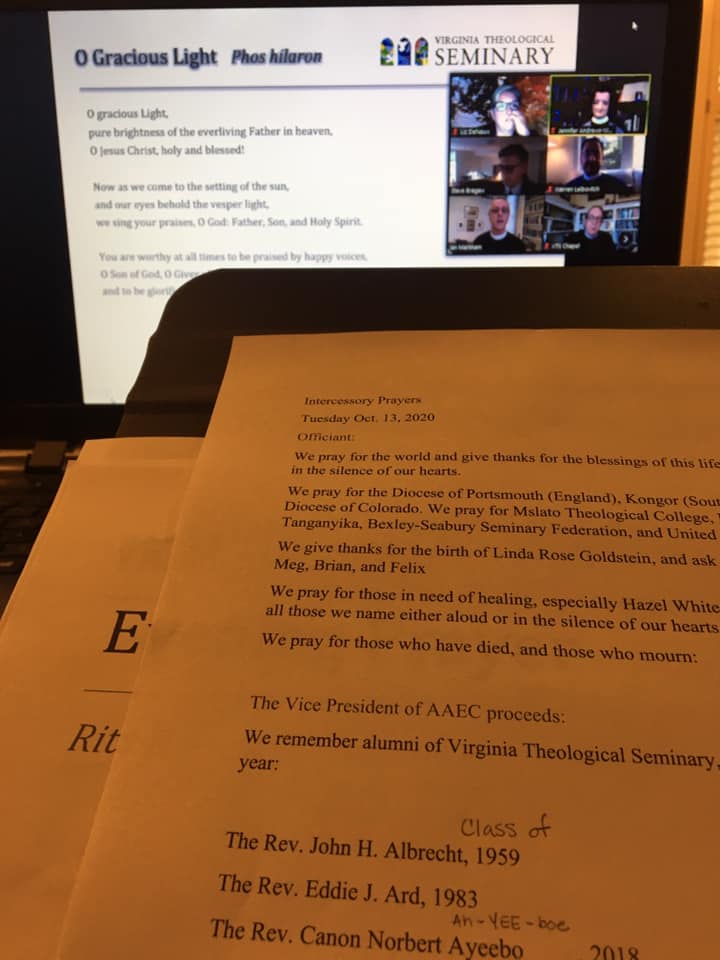
One of the disadvantages of leading virtual worship is that you do not get to participate in worship.  Of course, I can always go back and watch later, but I never get the “live” experience of watching prayers.  That all changed this week.  My seminary held their annual Convocation yesterday.  It was entirely virtual, with webinars, Zoom meetings, breakout rooms, and Zoom worship.  Our worship at Hickory Neck Church is via Facebook Live, so this was my first time worshiping with a community via Zoom, and I was curious to see how it would feel.

My initial response was dissatisfaction.  Although I could see there were about 50 people gathered, once slides were used on the shared screen, I could only see six people without constantly scrolling.  Although the sermon was close to my normal experiences with preaching, watching faces that seemed spaced out was a bit odd (Do the faces look that spaced out when I preach??).  And of course, when I joined in speaking the italicized words (those words “the people” are supposed to say), because we were all on mute, I felt like only the officiant and I were participating.

But that was just the initial reaction.  As I said more and more of the unison readings, I felt less and less awkward.  And even though I could only see a few faces, I loved knowing I was not alone in the worship experience.  And as I became less paranoid about what my own video screen was showing, I was able to relax into my chair, and transport myself to an imaginary pew.  The worship experience was not the same – but it was also familiar, human, holy, and lovely.

Looking back on that experience, I want to offer major kudos to all who are “making it work” with virtual church.  I know it is not the same.  I know it is hard staying positive when all you want is something more familiar.  I am so grateful for all of you who are sticking with it, making the awkward become sacred.  I hope that you are having moments of grace and blessing.  And I also hope you are noticing all the names (and faces if you’re Zooming) you do not recognize:  those folks who find it harder to harken the doors of the church than to hop on Facebook for worship – whether when you are live, or at 10:00 pm, as you watch the archived video while you ease off to sleep.   This may not be church as we have always known it.  But we are also fashioning something new, flexible, and creative, while rooting ourselves in the traditions we know and love that ground us.  This week, you have my gratitude for all the ways you are staying open to the Holy Spirit.  And if you have not found a place to experience the Spirit, I’ve got just the place for you!!

On God’s Humming…

05 Wednesday Aug 2020

Posted by jandrewsweckerly in Uncategorized

≈ 1 Comment

Tags

anxiety, calm, faith, giraffe, God, Holy Spirit, pandemic, peace, relax

giraffe

Photo credit:  https://dailyhive.com/seattle/zoom-call-animal-visitors

On vacation last week, my family and I visited a “safari park” – basically a drive-through petting zoo where you can roll down your window and feed the animals.  I confess, I was not looking forward to this part of our vacation adventures.  In general, animals make me a little nervous.  They are usually bigger than me, and I find them to be unpredictable and capable of causing harm, intentionally or not.  So, the idea of one of those, sometimes very large, animals poking its head in my safe space terrified me.  But I bit my tongue and took one for the team as we drove into the park.

It turned out most of the family had a good time on the safari, especially as we got further into the park.  But the anxiety in my gut never relaxed.  For a solid 30-45 minutes, I was on edge, trying to put on my “everything’s fine” face for the kids.  It was not until we made our way to the walking zoo section of the park and were feeding a giraffe that the tension in my body slowly eased.  The giraffe’s head was huge, but his eating was calm and collected.  And after all the lettuce was gone, he just hung out – not looking for more food.  My daughter, who is obsessed with giraffes, held a full nonverbal conversation with the giraffe, and even I found my muscles slowly relaxing as I gazed into his calm, soothing eyes.

Later, as we were reading about giraffes, I learned giraffes make a soothing humming-type noise inaudible to the human ear but meant to help them stay connected to their young and fellow giraffes.  Even though I did not hear the noise, I am convinced the giraffe must have been humming for us that day – sensing our anxiety, and longing to offer us a calming peace.

As we journey through this time of pandemic life, I am increasingly aware of the low (and sometimes high) level of anxiety within which we are all operating.  Over time, that anxiety wears on you – whether you find yourself snapping at someone, bursting into tears unexpectedly, or distancing from emotional connections.  In this time of ongoing anxiety, I have been thinking we all need a soothing sound that can help us let go of the tensions in our shoulders, relax the muscles in our jaw, and release the tightness in our chest.  For some of us that happens through yoga, through a phone call to a friend, or through watching a funny movie.  Lately, I have been wondering if God is not providing that soundless, soothing hum we have not acknowledged.  Perhaps God is placing people, animals, or encounters (even virtual ones) in our path that can help us let go of some of our anxiety, take a deep breath of the Spirit’s calming peace, and allow us to refocus on our faith – a faith which can feel adrift in the sea of closed church buildings, social distancing, and self-quarantines. My prayer for you is you hear God’s humming this week as we turn the page on another pandemic week.

On New Songs…

29 Wednesday Jul 2020

Posted by jandrewsweckerly in Sermons, Uncategorized

≈ Leave a comment

Tags

God, grace, gracious, Holy Spirit, Jesus, light, Lord, love, moving, new song, praise, Psalm, reflection, Sermon, sing, suffering

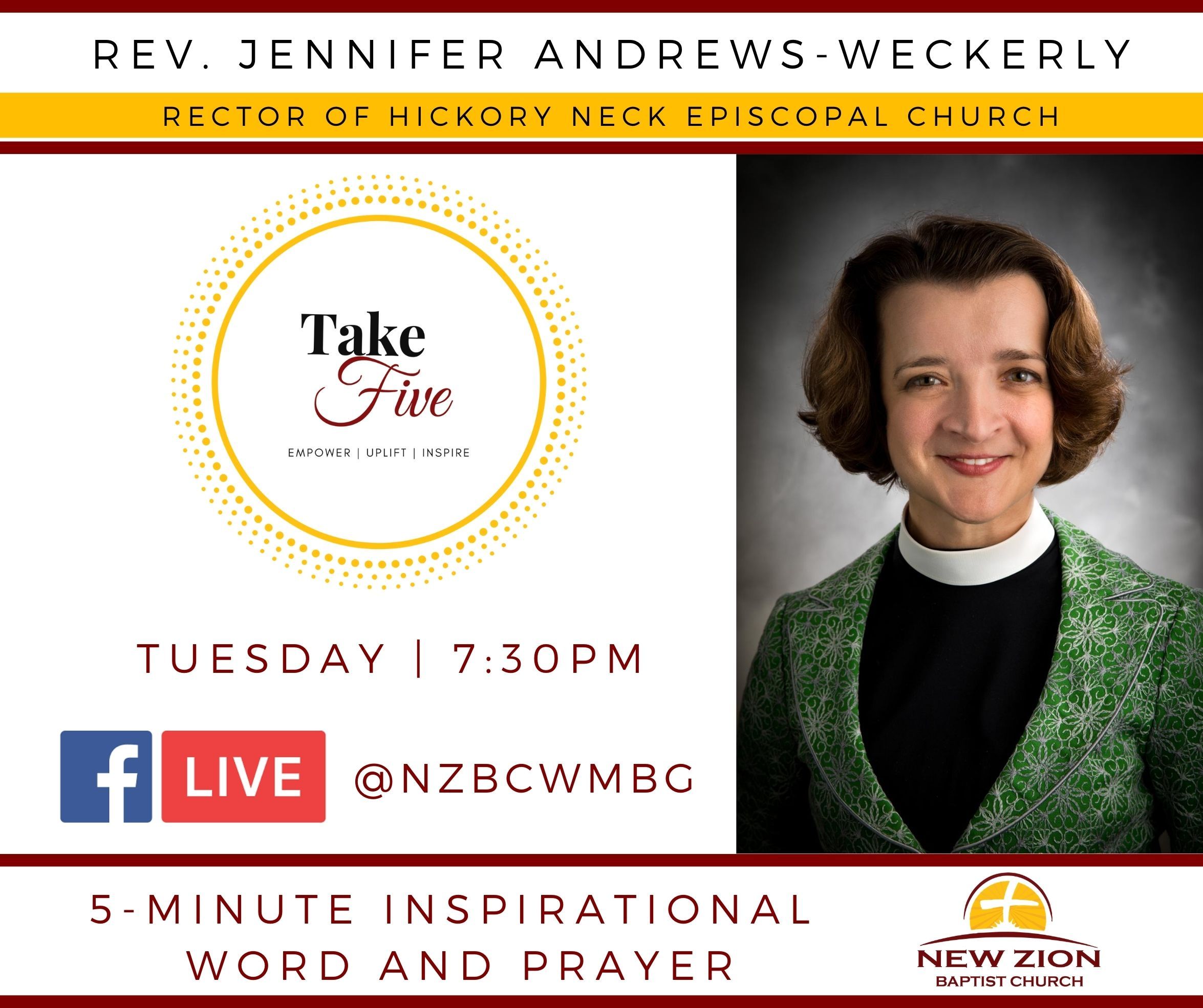
Take Five Speakers-Rev. Jennifer Andrews-WeckerlyThis reflection was offered through the livestream program called “Take Five” at New Zion Baptist Church on July 28, 2020.  This is the text from that talk.

Tonight we turn to Psalm 149, which says, “Praise the Lord.  Sing to the Lord a new song, his praise in the assembly of the saints.  Let Israel rejoice in their Maker; let the people of Zion be glad in their King.  Let them praise his name with dancing and make music to him with tambourine and harp.  For the Lord takes delight in his people; he crowns the humble with victory.  Let the saints rejoice in this honor and sing for joy on their beds.”

Now I know what you may be thinking.  Really?  You want us to talk about praising God?  We’ve got a worldwide pandemic, which our country is becoming one of the worst handlers of in the world, which disproportionately is affecting people of color, and has become so politicized that we are no longer worried about the sanctity of human life, but are instead arguing about rights and the ethics of sacrificing life for some contrived greater good.  Not only that, we are in a crucible around racism, that alternatively gives us great hope for change and makes us despondent about how far we really have to go.  Add to that the emotional, spiritual, financial, and physical toll of this time, a time when we seem incapable of respecting the dignity of every human being, and you want to talk about singing to the Lord a new song?

I don’t know about you, but when I am feeling the weight of the world, and when I am longing for a word from God, an old song is usually where I return.  Every once in a while, when I slow down enough not to just to pray to God, but to actually listen to God, those old timey hymns from my childhood come back.  Their words speak to my ache, or let me wallow in my despair.  They talk about sweet, sweet Spirits, and walks through garden alone with Jesus, and balms in Gilead.  When I talk to Jesus, I want an old song.

But that is not what the psalmist says.  We are not asked to recall the old songs; we are invited to sing a new song.  In fact, seven times in the psalms, we are invited to sing a new song to the Lord.  As a fellow pastor says, “New songs of praise are appropriate for new rescues and fresh manifestations of grace.  As long as God is gracious toward us, as long as he keeps showing us his power, and wowing us with his works, it is fitting that we not just sing old songs inspired by his past grace, but also that we sing new songs about his ever-streaming, never-ceasing grace.”[i]

In this time of utter upheaval, unrest, and unevenness, two things are happening.  One, God is still moving.  The Spirit’s movement may be hard to see or hear in the cacophony of noise.  But I know in talking to New Zion’s leadership, talking to the folks at Hickory Neck Church, and talking to our neighbors here in James City County, Jesus is still moving.  I know that you are finding moments of grace, even in the darkness of this time.  I know that you are seeing shreds of hope, even in what feels like the disappointing failures of our nation.  Two, despite how comforting those old songs are, I am guessing the Holy Spirit has whispering some new songs in your ear.  You may not be sure of the words, and you may be straining to hear the tune.  But in the depths of your heart, where we fear change and we harbor anxiety, we know that only a new song can help get us out of this mess.

So, here’s the good news.  We are not on our own to birth these new songs.  Psalm 40 says, “I waited patiently for the Lord; he turned to me and heard my cry.  He lifted me out of the slimy pit, out of the mud and mire; he set my feet on a rock and gave me a firm place to stand.  He put a new song in my mouth, a hymn of praise to our God.  Many will see and fear the Lord and put their trust in him.”  God put a new song in my mouth, says the psalmist.  Not I, out of my genius, wrote a new song.  Not, I worked hard and put in the time, and out of my labor created a new song.  Not, I listened to what others were singing and sang their songs.  No, the psalmist says, God put a new song in my mouth.  Our invitation tonight is to open ourselves to that new song.  Our invitation is to concede that during this time – a time unlike anything any of us has experienced – God is providing something new – new grace and new songs (which might be even better than that old favorite).  Our invitation tonight is to sing the new song God gives us out in the world – to trust in the wisdom of the words and notes Jesus is giving us and shout them out to a world that desperately needs to hear that new song.

Let us pray.  Holy and creative God, we know that you see our suffering and our cries.  We know that you see us patiently waiting on you to lift us up out of the mud and mire, to put us on a firm place to stand.  Help us to trust that you will put a new song in our mouths – a song to give voice to your ever-streaming, never-ceasing grace.  When we finally hear your new song, help us to sing that song – help us to praise your name with dancing, and make music with tambourine and harp.  Help us to remember that when we sing your new song, we shine your light into the world, helping your transformative, life-giving love take root, and disrupt the injustice of our day.  We praise you, Lord, and we bless you, and we sing a new song with you.  Amen.

[i] David Mathis, “Sing a New Song,” May 4, 2014, as found at https://www.desiringgod.org/articles/sing-a-new-song on July 27, 2020.

Sermon – Acts 1.6-14, E7, YA, May 24, 2020

02 Tuesday Jun 2020

Posted by jandrewsweckerly in Sermons, Uncategorized

≈ Leave a comment

Tags

ambiguity, Ascension, community, empowerment, God, Holy Spirit, Jesus, liminal time, Pentecost, pray, Sermon, waiting

Throughout this time of pandemic, I have struggled with Holy Scripture.  From not being able to wash feet and share in Christ’s last meal on Maundy Thursday, to ringing in the victory of Easter, to watching the disciples be able to touch Jesus or share in communion with him during his bodily appearances after the resurrection, each experience has felt like a stabbing reminder of what we do not have – that we cannot gather, we cannot touch, we cannot share that identity-making holy meal.  But today, as we continue to celebrate Jesus’ ascension, we have finally landed on the perfect Scriptural metaphor for these days.  Thanks be to God!

Of course, I say that not because today’s scripture lesson gives us answers about when we can expect a return to “normal,” (whatever that may mean now), or when this virus will be over, or even when we can safely return to church buildings.  Instead, what our text from Acts recognizes is the brutal truth of this time:  we are in a liminal time.

Now, we have talked about liminal time before.  Liminal time[i] is the time in which we are in the middle of a transition.  Native cultures experienced liminal time most famously in the journey to adulthood.  When young men or young women reached a certain age and maturity, they were sent away from their families and out into the wilderness for a time, a time when they are no longer children, and not yet adults.  Their identity is in flux, their purpose is ambiguous, and their life is on pause.  Liminal time is a time fraught with anxiety, frustration, and confusion.

That kind of transition is where we find our disciples today.  They have spent forty glorious days feeling the victory of Christ’s resurrection, being blessed with further teachings, and being comforted by Christ’s presence.  They are ready.  They confidently ask Jesus today, “Lord, is this the time when you will restore the kingdom to Israel?”  Jesus responds with a promise – that they will receive power when the Holy Spirit comes upon them, and they will be empowered to do their work of witnessing.  But for now, at this moment of climax, confidence, and courage, Jesus says, quite simply, “Wait.”

Now I know I said I was excited about this text because the text is so perfect for this time.  I say that not because this text finally answers all those questions of our liminal time – or even hints at when our anxiety, frustration, and confusion will end.  Instead, what I love about this text is that the text names the very frustrating reality of this time – a time in which we are not longer what we were (a community free to gather how and when we like, doing things like passing the peace, sharing a common cup, and congregating en masse), and yet, we are not yet what we will be – in fact, what we will be is even uncertain.  We are the disciples staring up at the sky, knowing Christ has gone to the father, but frozen in place, not really knowing what is next – waiting.

Karl Barth called the waiting between the Ascension and Pentecost, the days we are experiencing now, the “significant pause…a pause in which the church’s task is to wait and pray.”[ii]  Now, I know what you are thinking.  That’s our Good News?  I should wait and pray?  Telling us to wait and pray seems like a classic platitude, what we say when we do not know what to say.  Will Willimon explains, “Waiting, an onerous burden for us computerized and technically impatient moderns who live in an age of instant everything, is one of the tough tasks of the church.  Our waiting implies that the things which need doing in the world are beyond our ability to accomplish solely by our own effort, our programs and crusades.  Some other empowerment is needed, therefore the church waits and prays.”[iii]  Though the disciples are facing the “significant pause,” the promise of the empowering Spirit is a promise of hope, empowerment, and companionship.  Their waiting and prayer are not for personal comfort during this time of ambiguity, but for empowerment to be obedient.  Instead of praying out of self-pity, they are praying out of determined expectation.

That is our invitation today too – to pray and wait together.  We cannot cram into that Upper Room like the disciples do.  But we can gather – digitally in worship here, in Zoom gatherings, by phone, cards, emails, and texts, even drive-by Coffee Hours.  As David Lose reminds us, in this time of pandemic “God will be with us, comforting, celebrating with, strengthening, and accompanying us in and amid whatever may come.  And God will also be preparing us, preparing us to be God’s emissaries of good news, preparing us to comfort others, preparing us to work for peace, preparing us to live with less fear and more generosity, preparing us to look out for the rights of others, preparing us to strive for a more just community and world.”[iv]  I do not know about you, but I would much rather face the ambiguity of this liminal time with a community who can remind me of God’s promise, helping me see the work of the Spirit.  That is what we do when we pray and wait together.  Our invitation is to accept the gift of this community, gathered virtually for the foreseeable future, and to wait and pray with together.  Amen.

[i] Liminal time is a concept that has been developed by many scholars.  Arnold van Gennep, Victor W. Turner, and Gordon Lathrop all developed the idea of incorporating liminal time into liturgical practice.

[ii] William H. Willimon, Acts, Interpretation:  A Bible Commentary for Teaching and Preaching (Atlanta:  John Knox Press, 1988), 20.

[iii] Willimon, 21.

[iv] David Lose, “Easter 7A:  Important Interludes,” May 25, 2017, as found at http://www.davidlose.net/2017/05/easter-7-a-important-interludes/ on May 26, 2017.

Sermon – John 14.15-21, E6, YA, May 17, 2020

20 Wednesday May 2020

Posted by jandrewsweckerly in Sermons, Uncategorized

≈ Leave a comment

Tags

accompaniment, accompany, Advocate, apology, commandment, conditional, Coronavirus, Holy Spirit, Jesus, love, obey, pandemic, Sermon

We have been spending a lot more time together as a family since this pandemic began.  All that together time has meant moments of joy and laughter; but that time together has also meant a lot of correcting of behavior.  One would think by now, we have figured out how to perfectly love one another.  Instead, we have been working on perfecting apologies.  I never knew how much of our apologizing could show so little remorse.  There have been the angry, shouted, “I’m sorry!”s, there have been the resistant, mumbled, “I’m sorry”s, there have been the sarcastic, eye-rolling, “I’m sorry.”s  And parental requests for our children to “mean it” when they say, “I’m sorry,” are almost comical.  How can anyone expect anyone else to apologize by force, command, or as a condition for something else?

I think that is what is so strange about today’s lesson from John’s gospel.  Jesus says “If you love me, you will keep my commandments,” and “They who have my commandments and keep them are those who love me.”  The commandments Jesus is talking about are those instructions to love God, love self, love neighbor.  In John’s gospel, they are the only commandments Jesus gives.[i]  And who would protest such commandments?  Of course we should all want to love God, love self, and love neighbor.  But there is something strange about the way Jesus presents his command to us – if you love me, you must do these things.  If you love me, you must obey my way.  As lovely as love sounds, there is something that harkens to those forced apologies about our text today.  I am pretty sure Jesus is not asking us to love others with a sense of bitterness, resentment, or obligation – and certainly without shouts, mumbling, and eye-rolling.

I realize many of you may be thinking, “What’s so hard about loving others?  Why would I resist that?”  One of the things I appreciated about the beginning of this pandemic was the way we all pulled together.  People immediately worried about our elders being able to safely procure food and supplies; we pitched in to make sure the hungry were fed with free school lunches and restocked food banks; we sewed face masks and donated to charities to help protect the vulnerable.  Our collaboration, care, and support of one another was a breath of fresh air.  But we have not taken long to remember our demons.  As hard decisions have arisen about reopening businesses to buttress the economy, making cuts to make ends meet, or laying off employees to help businesses survive, we have reverted to our divided, vitriolic ways from before the pandemic, not only disagreeing, but attacking the character, intelligence, and dignity of one another.  So when we ask, “What’s so hard about loving others?” my response is, “This.  This is what is hard about loving others.”  As one scholar puts it, “It is NOT sufficient (or even meaningful) to profess love for Jesus while we hold ourselves apart from our fellow human beings.  To love Jesus is to love others.  All others.  The lover, the friend, the neighbor, the companion.  But also the alien, the stranger, the misfit, and the enemy.  The ones with whom we agree, and the ones with whom we emphatically disagree.  The ones we naturally like, and the ones we don’t.”[ii]  Our love of Jesus is only as authentic as our love of all others.

So how can we possibly love that way?  The good news is Jesus says we will have help.  Just as Jesus has been an advocate for his disciples – “guiding, teaching, reminding, abiding, witnessing, interceding, comforting,” so they will have the Holy Spirit.  “What they have known in Jesus, and fear losing in Jesus’ impending absence, they will always know in the promise of the [Holy Spirit].”[iii]  What Jesus promises today is big.  Now, I know some of us get a little uncomfortable talking about the Holy Spirit – either the Spirit’s presence just seems too amorphous to be of any value, or the Spirit seems to do weird, dramatic things that scare us more than comfort us.  But Jesus is not simply saying the Holy Spirit will be ambiguously hanging around when Jesus is gone.  The Holy Spirit will be, and is, accompanying us.  As scholar Karoline Lewis says, “Accompaniment is not simply having someone beside you.  Accompaniment is not a mere ministry of presence.  Accompaniment means active and assertive abiding—an abiding that enters into places of fear and discomfort, uncertainty, and troubled hearts, and speaks the truth freely.”[iv]

Now I don’t know about you, but that sounds like some really good news.  On those days when loving seems hard, when obeying Jesus’ command to love feels impossible, the Holy Spirit is here to accompany us, to walk with us in fear, discomfort, uncertainty, trouble, and guide us into lives of love.  The Spirit is with us to enable us to be agents of love even when we doubt we can.  That promise today makes the invitation to love as Christ has loved us not only doable, but desirable.  That promise today helps us loosen our grip on resentment, anger, and fear, and open our hands to love and collaboration.  That promise today makes obedience to love feel like a gift.  Thanks be to God.

[i] Debie Thomas, “Love and Obedience,” May 10, 2020, https://www.journeywithjesus.net/lectionary-essays/current-essay?id=2640, as found on May 15, 2020.

[ii] Thomas.

[iii] Karoline Lewis, “A Time for Accompaniment,” May 10, 2020, http://www.workingpreacher.org/craft.aspx?post=5433, as found on May 15, 2020.

[iv] Lewis.

← Older posts
Newer posts →

Recent Posts

  • On the Myth and Magic of Advent…
  • On Risking Failure and Facing Fear…
  • Sermon – Luke 23.33-43, P29, YC, November 23, 2025
  • On Inhabiting Gratitude…
  • Sermon – Luke 20.27-38, P27, YC, November 9, 2025

Archives

  • December 2025
  • November 2025
  • October 2025
  • September 2025
  • August 2025
  • July 2025
  • June 2025
  • March 2025
  • February 2025
  • December 2024
  • November 2024
  • October 2024
  • September 2024
  • August 2024
  • July 2024
  • June 2024
  • May 2024
  • March 2024
  • February 2024
  • January 2024
  • December 2023
  • November 2023
  • October 2023
  • September 2023
  • August 2023
  • July 2023
  • June 2023
  • May 2023
  • March 2023
  • February 2023
  • January 2023
  • December 2022
  • November 2022
  • October 2022
  • June 2022
  • May 2022
  • January 2022
  • December 2021
  • November 2021
  • October 2021
  • September 2021
  • August 2021
  • June 2021
  • May 2021
  • April 2021
  • March 2021
  • February 2021
  • January 2021
  • December 2020
  • November 2020
  • October 2020
  • September 2020
  • August 2020
  • July 2020
  • June 2020
  • May 2020
  • April 2020
  • March 2020
  • February 2020
  • January 2020
  • December 2019
  • November 2019
  • October 2019
  • September 2019
  • August 2019
  • July 2019
  • June 2019
  • May 2019
  • April 2019
  • March 2019
  • February 2019
  • January 2019
  • December 2018
  • November 2018
  • October 2018
  • September 2018
  • August 2018
  • July 2018
  • June 2018
  • May 2018
  • April 2018
  • March 2018
  • February 2018
  • January 2018
  • December 2017
  • November 2017
  • October 2017
  • September 2017
  • August 2017
  • July 2017
  • June 2017
  • May 2017
  • April 2017
  • March 2017
  • February 2017
  • January 2017
  • December 2016
  • November 2016
  • October 2016
  • September 2016
  • August 2016
  • July 2016
  • June 2016
  • May 2016
  • April 2016
  • March 2016
  • February 2016
  • January 2016
  • December 2015
  • November 2015
  • October 2015
  • September 2015
  • August 2015
  • July 2015
  • June 2015
  • May 2015
  • April 2015
  • March 2015
  • February 2015
  • January 2015
  • December 2014
  • November 2014
  • October 2014
  • September 2014
  • August 2014
  • July 2014
  • June 2014
  • April 2014
  • March 2014
  • February 2014
  • January 2014
  • December 2013
  • November 2013
  • October 2013
  • September 2013
  • August 2013
  • July 2013
  • June 2013
  • May 2013
  • April 2013
  • March 2013
  • February 2013
  • January 2013
  • December 2012
  • November 2012
  • October 2012
  • September 2012

Categories

  • reflection
  • Sermons
  • Uncategorized

Meta

  • Create account
  • Log in
  • Entries feed
  • Comments feed
  • WordPress.com

Blog at WordPress.com.

  • Subscribe Subscribed
    • Seeking and Serving
    • Join 394 other subscribers
    • Already have a WordPress.com account? Log in now.
    • Seeking and Serving
    • Subscribe Subscribed
    • Sign up
    • Log in
    • Report this content
    • View site in Reader
    • Manage subscriptions
    • Collapse this bar
 

Loading Comments...