• About

Seeking and Serving

~ seek and serve Christ in all persons

Seeking and Serving

Tag Archives: identity

Sermon – Matthew 22.1-14, Isaiah 25.1-9, Psalm 23, P23, YA, October 11, 2020

14 Wednesday Oct 2020

Posted by jandrewsweckerly in Sermons

≈ Leave a comment

Tags

discipleship, faith, feast, financial giving, garment, generosity, God, heavenly banquet, identity, Jesus, membership, Sermon, stewardship

The text we heard today from Isaiah is one of my favorites.  The text is commonly read at funerals because the text depicts the sumptuous heavenly feast:  a feast of rich food, a feast of well-aged wines, of rich food filled with marrow, of well-aged wines strained clear.  The vivid, lavish image of the heavenly banquet is enough to calm our anxieties about our loved ones, but is also a comfort to us as we ponder our own mortality, and the feast that awaits us with our God.  Of course, feasts are a part of our faith vernacular from our Jewish roots.[i]  When we receive communion, we talk about the meal as being a foretaste of the heavenly banquet.  For many of us, not receiving communion these last seven months have been particularly difficult because the act of feasting on Christ’s body and blood is a weekly ritual that offers us promise, encouragement, and joy.

But as I read our others texts today, I began to realize that perhaps our rosy image of the heavenly banquet is not quite complete.  In our beloved twenty-third Psalm today, one also read at funerals, there is a tiny unsettling line in an otherwise soothing psalm.  The psalm says, “You spread a table before me in the presence of those who trouble me,” or in our the much more familiar King James Version, “Thou preparest a table before me in the presence of mine enemies.”  Somehow that sumptuous feast becomes a little less satisfying knowing we have to share the feast with those who trouble us.  I can think of a lot of people right now that I have no desire to feast with in the life to come. 

And we cannot forget the wedding feast in our lesson from Matthew today.  As much as we like the allegory of all being welcomed at the king’s feast, where both “good and bad”[ii] are welcomed at God’s table, we are totally thrown by the king’s rejection of the man without proper clothing.  Our immediate reaction is condemnation:  surely if the king, if God, is inviting all in, something as superficial as what we wear should not lead to being cast out.  I mean, this is Hickory Neck after all – where bowties and jeans are equally welcome!  But before we get too bent out of shape, we need to realize Matthew is not talking about a literal wedding robe.  Matthew is talking about wearing the “baptismal garment of Christ, clothing oneself with the compassion, kindness, humility, meekness, and patience of one who belongs in the kingdom.”[iii]  You see, although the welcome is broad, as Thomas Long explains, “being a part of the Christian community should make a discernible difference in who we are and how we live…there should be a sense of awe and responsiveness about belonging to the church, belonging to the community of Christ, being a child of the kingdom of heaven.”[iv]

As a priest within the Episcopal Church, I talk to newcomers of all kinds of backgrounds.  The most common question I get from this varied group is, “How do I become a member of the church?”  This is a reasonable question, and in other traditions the answers are very simple.  But the Episcopal Church has a terrible track record with this sort of thing.  Technically, membership in our church means attending church at least three times a year.  Yep.  That is the only definition we have in writing.  I would argue our denominational lack of clarity around membership leads to a lack of investment and true belonging.  In a desire to make everyone feel welcome or create a rosy sense of belonging, we water down what being a person of faith really is.  In fact, Long argues, “to come into the church in response to the gracious, altogether unmerited invitation of Christ and then not conform one’s life to that mercy is to demonstrate spiritual narcissism so profound that one cannot tell the difference between the wedding feast of the Lamb of God and happy hour in a bus station bar.”[v]

Now I know that sounds harsh, much like Matthew’s story sounds harsh.  But as I have been thinking about the rosy feast of Isaiah this week, I realized I needed the feast of the twenty-third Psalm and Matthew too.  I need to remember that not only am I, in all my imperfections welcomed to the table, so are my enemies.  And not only are God’s arms widely open to me, God also expects something of me – for my life to have some recognizable response to the grace of God, for others to know we are Christians by our love, by our wedding garments of compassion, kindness, humility, meekness, and patience.

That is why at Hickory Neck, we try to be a bit clearer about membership – or more aptly, about discipleship.  Our newcomers learn quickly that being here means a few things:  being a member at Hickory Neck means coming to worship, to the feast, regularly enough to be fed and shaped in the life of faith; participating in formation and outreach to continue to grow, learn, and serve; to support the mission of the church with our time, our talent, and our treasure.  We do all of this because the welcome we receive here at Hickory Neck is not hollow – the sense of belonging we feel here is not simply for stuffing ourselves.  That is why our stewardship team invited us this month into a reflection about faith-filled generosity – not inviting us to give financially just because we should.  We are invited to financial generosity toward Hickory Neck because we have been generously, unconditionally welcomed to the feast, and we want to embrace the garment of Christ as a response to that generosity.  This week, as you reflect on the commitment cards and time and talent forms you received by mail, I invite you to reflect on your own experiences with the feast of God – the times when this table has been a lifeline, when Christ’s welcome has been a salve, and when the garment of Christ has been an honor rather than a burden.  I look forward to hearing your stories of faith-filled generosity at the feast this week!  Amen.


[i] Susan Grove Eastman, “Exegetical Perspective,” Feasting on the Word, Year A, Vol. 4 (Louisville: Westminster John Knox Press, 2011), 167.

[ii] Matthew 22.10

[iii] Thomas G. Long, Matthew (Louisville:  Westminster John Knox Press, 1997), 247.

[iv] Long, 247.

[v] Long, 248.
On Church, Community, and Crying…

01 Wednesday Apr 2020

Posted by jandrewsweckerly in Uncategorized

≈ Leave a comment

Tags

care, children, church, close, community, Coronavirus, crying, identity, love, parade, purpose, school, tears, village

91663272_10158735760542565_2455793223893778432_n

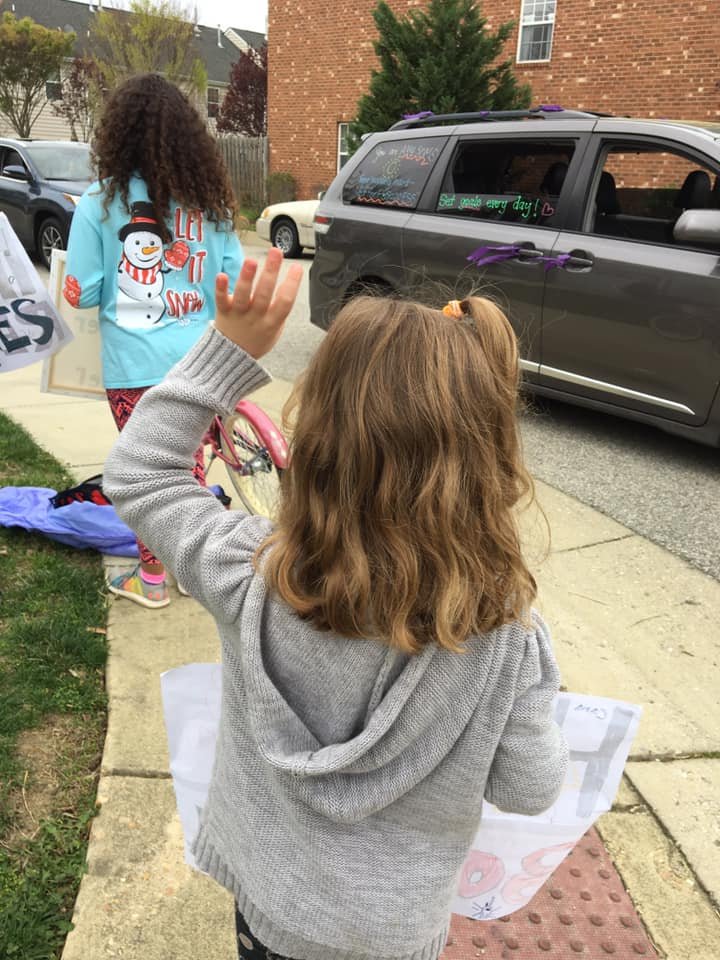
Photo credit:  Jennifer Andrews-Weckerly; use with permission only.

I had seen the pictures and videos in my news feed of teachers and schools “parading” in neighborhoods, saying hello to their students from their cars (keeping safe social distances).  The idea seemed nice enough, but I did not really think too much about the concept.  But when my children found out their elementary school would be doing the same, they jumped right in, making signs for their teachers.  We rearranged our daily schedule, and headed up to the now-unused bus stop in our neighborhood, and waited.

But it was not until I saw familiar face after familiar face – the principal, my fifth grader’s first, third, and current grade teachers; the art, computer, music, orchestra, librarian, and gym teachers; even the custodian – that I lost it.  Tears burst into my eyes, and although I could not stop smiling, I also could not stop crying.  The previous week, we had found out that due to the Coronavirus, our schools would be out for the remainder of the school year.  My fifth grader would not get to say goodbye to friends and one of the best teachers she has ever had, nor the community that has shaped her for the last four years.  My kindergartner would get no closure on her first year of school.  But here was that amazing community, coming to our neighborhood to say goodbye.

I think I burst into tears because I realized how very deeply important community is in our lives.  For the schools, our children are there five days a week, nine months of the year.  The school is a major part of the village that raises our children, teaches them, forms them into amazing citizens, and helps them find their sense of identity and purpose.  The staff and teachers at our school love our children and are a part of our family.  What this virus did was expose a huge part of our children’s lives and take it away from them.  The tears I could not stop that day were tears of gratitude, tears of blessing, tears of humility for the community I had not fully appreciated until that moment.

That is what has been so hard about having our church closed too.  We are making inroads for connection, surely.  But part of the reason we are doing that is because we know that Church is a vital community in our lives too.  Certainly, we are there because of our faith – or our desire to have faith.  But we are also at Church because the community feeds us, sustains us, and gives our lives a sense of purpose and identity.  When we cannot gather, we lose a huge part of our lives.  This week, it is my prayer that for those of you missing your church community, you will take advantage of the ways we are trying to maintain virtual connection during this time of disconnection.  We may not be able to exchange signs of the peace, offer hugs or high fives of affirmation, or kneel at the altar together.  But we can laugh at Virtual Coffee Hour, sing during livestream worship, and even cry during daily pop-up prayers.  Your community is still here, loving you and supporting you.  And we cannot wait to see you again!!

Sermon – Luke 2.1-14, CE, YA, December 24, 2019

08 Wednesday Jan 2020

Posted by jandrewsweckerly in Sermons, Uncategorized

≈ Leave a comment

Tags

Christmas, Christmas Eve, comfort, cozy, familiar, God, identity, incarnate, Jesus, love, Sermon, sharing, story

This December, my elder daughter and I are slowly finishing the last book in the Harry Potter series.  The process has taken us several years, since we usually only finish a few pages each night.  But each time we pick the book up, I can never tell who is more excited – her or me.  You see, I have read the series at least three times – once during a summer interning at a hospital, when I needed a brain break from the emotional labor, and twice while spending lots of time nursing, when I needed a brain break from a different kind of labor.  But reading the books with my daughter has been different.  Although I know what will happen, there have been parts of the seven books I forgot entirely.  As I have watched through her eyes, I had forgotten the range of emotions the books evoke, the anticipation the author builds, and the slew of questions that take ages to answer.  In rereading them with her, I have also seen bigger truths – some allegories and religious parallels that only sink in after multiple readings.  The whole experience has been so fun, I cannot wait to start all over again with our younger daughter!

I have been thinking about how our favorite books are often like that.  Though we have endless options of books to read, sometimes we will pick an old favorite to read again.  I think many of us will reread favorite books because we like the familiarity, like cozying up with old friend.  Some of us enjoy rereading books because we enjoy catching new tidbits we never caught before.  While others of us enjoy rereading books because there is some comfort in knowing how the story ends – of being certain about what will happen.  The same can be true for small children too.  I cannot tell you how many times I read Goodnight Moon over the years.  But I never minded because I totally understood the comfort my kids found in the familiarity of a known book; the comfort they sought in Goodnight Moon was the same comfort I sought in familiar books too.

In a lot of ways, that is what we are doing tonight.  We are telling a story we have heard over and over again – although tonight’s New Revised Standard Version may not sound as familiar as the old King James Version; even Charlie Brown’s friends knew that version.  Every year, every single Christmas Eve, we make our way to church – sometimes having fought over what to wear, when, where, and what to eat, or whether or not to open any gifts beforehand.  But we make our way here tonight because we know the ultimate reward is sitting here, in the quiet of night, listening to the story we hear every year of a powerful emperor imposing a tax; of a very pregnant Mary making her way to Bethlehem with her betrothed, Joseph; of Mary giving birth and putting the Christ Child in a manger because there is no room in the inn; of shepherds minding their business in the dark of night; of angels appearing announcing glorious news; and of a chorus of angels singing magnificent truth.  And our reactions are much like they are with any favorite book.  We find comfort in the story’s familiarity, we look for and sometimes hear tiny details we forgot or had not thought about before, and we find comfort in knowing how the story will end.  Glory to God in the highest, indeed!

But the main reason we tell this story year after year after year is not simply for the familiarity and comfort – though the Church wants us to experience that goodness too.  The main reason we tell this familiar story again tonight is because we need to remember who we are and who God is.  You see, what happened on that beautiful, special night, is God came in human form among us – came as Jesus Christ incarnate – because God loves us so very much.  God saw we were struggling to be good, to live as loving people made in God’s image, and God knew we needed Jesus to help us.  We learn in this story that God is awesome, God loves us and is faithful to God’s covenant even when we are not, and God does unimaginably incredible things for us.  This beloved, almost quaint, story is full of good news about who God is.

But this beloved, familiar story also tells us something about who we are.  This story tells us that whatever baggage we came in here with tonight, whatever we are struggling with on a weekly basis, whatever self-doubts we might have, we learn in this story that we are worthy of God’s love.  We learn in this story that no matter who we are – an esteemed king, feared among the people and wielding great power; a couple with nowhere to go, feeling unsure about the future; everyday workers going about their daily jobs, just trying to pay the bills; or a vulnerable baby, unaware of the dangers all around – no matter who we are, we are loved by God, and given the opportunity to have a relationship with God.  We also learn in this story a bit harder reality.  We learn in this story that being loved by God means sharing God’s love – of going to visit people who need visiting and need to know the love of God in their isolation and loneliness, of caring for people who have no place to go no matter what we judgments we make about how they got into their current situation, of taking on tasks that seem insurmountable but will help more people experience the love of God.  We find out a lot about ourselves tonight in this familiar story too.

I know each of us who has gathered here tonight came for a different reason.  Maybe you just like the music, or maybe someone made you come, or maybe you came out of habit, or maybe you came because you wanted some sense of comfort and familiarity.  Regardless of how you got here, the Church tonight tells us a story full of meaning.  We certainly tell this story tonight because this is safe place we can cozy up to the story and feel comforted in familiarity.  We tell this story because we need reminding who God is and who we are.  But we especially tell this story tonight because God wants us to go from this place and do something with all the love and comfort we receive tonight.  God wants us to share God’s love with those who need love the most – even to the people we sometimes do not like (actually, especially to the people we do not like).  God wants us tonight to remember who we are, and who God is, and then go out into the world, rejoicing, sharing the love of Christ, retelling the Christ Child’s story, and bringing Jesus’ story to life for others.  Who knows?  Maybe this will become your new favorite story you want to read over and over again!  Amen.

Homily – Luke 18.9-14, P25, YC, October 27, 2019

06 Wednesday Nov 2019

Posted by jandrewsweckerly in Sermons, Uncategorized

≈ Leave a comment

Tags

abundance, alongside, bad, community, good, identity, Jesus, light, love, ministry, parable, passionate, pray, shine, stewardship, walk

Today’s parable from Jesus is one of those short parables that seems pretty straightforward at first glance.  Jesus describes two men who go to the temple to pray.  One is a Pharisee – a law-abiding, God-fearing man who offers a prayer of thanksgiving, albeit one that is full of self-righteousness, comparing himself and his choices favorably against those of others – suggesting in a sense that others are outside of God’s favor and grace.  The other is a tax collector – a corrupt collaborator with the government who, full of shame, humbly confesses to God his sins.  Jesus tells us the tax collector, “went down to his home justified rather than the other.”

Our temptation is to hear this text and conclude something quite simple:  the Pharisee is bad and the tax collector is good; bragging about yourself is bad and being humble is good; being a faithful person who misjudges God’s abundance is bad and being a self-aware sinner is good.  The problem with reading the text in this black-and-white way is we miss little details.  With such a stark reading, we can find ourselves walking out of church today thinking, “Thank God I’m not like the Pharisee!”  And before we even notice, we realize we are praying the same prayer as the Pharisee from the parable!

But this week, I stumbled on a little translation difference that shifted this parable for me.  In verse 14, Jesus says, “I tell you, [the tax collector] went down to his home justified rather than the other…”  But scholar Matt Skinner argues the preposition, “rather than,” should be translated instead as “alongside.”  So, verse 14 becomes, “I tell you, [the tax collector] went down to his home justified alongside the other…”[i]  Skinner argues there is much more nuance in this parable than we often allow.  That both men are praying, both men have faults, and both go home justified in different ways.  Sure, the Pharisee limits the extent of God’s grace, and he is unaware of his sinfulness in such exclusion, but the tax collector is no innocent.  Both men go home justified alongside each other.

One of the things we have been celebrating this stewardship season is our identity.  When we say, “We are Hickory Neck!” we say we are a people who have raised over $170,000 for local charities, who have over 50 volunteers on a given Sunday, who support one another through spiritual offerings like Lectio Divina, Book Club, Bible Study, and Jam Sessions, who nurture children and young families, who welcome newcomers, who work hard, and who have fun.  We are all those things are more – I imagine each of us here has a mental picture about what we mean when we say, “We are Hickory Neck!”  One of those things is that we walk home justified alongside each other.

That is what I love about this community.  This is a community that is passionate about Jesus and take’s Christ’s light out into the world.  This is a community that is passionate about caring for one another – where all can feel loved and affirmed, and all can find a place to thrive.  This is a community that is passionate about serving our neighbors – those young families looking for a sense of belonging and affirmation, and those retirees looking for a new sense of home.  This is a community that is passionate about liturgy, music, having fun, sharing sorrows, honoring history, dreaming about future possibilities, and laughing – lots of laughing.  This is a community that is passionate about investing our individual resources into Hickory Neck so Hickory Neck can bless others as Hickory Neck has blessed us.  We are Hickory Neck!  We are a community who walks alongside each other.

But that’s just me.  I want to know what gets you excited about Hickory Neck.  I want to know what saying “We are Hickory Neck!” conjures in your mind.  At your tables is a list of ideas from our Stewardship Committee.  Reread those ideas, and then talk with the people at your table about what you think of that is not on the list.  Write them down as you talk, so the Stewardship Committee understands what is important to you as we support and fund ministry.  You have about five minutes to chat and make notes, and then we’ll regather with a word of prayer…

Let us pray.  God of abundance, we come to you as self-righteous, sinful followers, who regularly mess up.  But our heart is with you.  We want to be agents of your light and your love.  Help us to love you abundantly.  Help us to support your kingdom generously.  Help us to walk alongside one another, shining your light for others so they may give glory to you.  In the name of the Father, and the Son, and the Holy Spirit.  Amen.

[i] Matt Skinner, “Sermon Brainwave #686 – Twentieth Sunday after Pentecost (Ord. 30),” October 19, 2019, as found at https://www.workingpreacher.org/brainwave.aspx?podcast_id=1192 on October 23, 2019.

On Discernment…

25 Wednesday Sep 2019

Posted by jandrewsweckerly in Uncategorized

≈ Leave a comment

Tags

bishop, choose, Diocese, discernment, Episcopal, God, Holy Spirit, identity, politics, prayer, silence, space, trust

70764-shoes-direction-arrows-road-gettyimages-11361.1200w.tn

Photo credit:  https://www.ibelieve.com/faith/what-is-discernment-ways-grow-more-discerning.html

This past weekend, our Diocese elected its next bishop.  Having never served in a diocese that was electing a bishop, I was not entirely sure what to expect.  I had heard stories of clergy politicking for particular candidates, trying to sway their colleagues to vote a particular way.  I knew we have a diversity of perspectives in our Diocese and coming to consensus may be difficult.  And although I had spoken to many clergy colleagues about their discernment for the best bishop, I did not know nearly as many laity and what their discernment had been like.  By the time we gathered for the election, I felt anxious, hoping we could be civil, but dreading what might be a contentious process.

Instead, I found something quite different.  Some of the difference may have been the result of careful crafting.  We were seated in an auditorium, with a long center row.  Try as one might, getting up and down to talk to others between votes was not exactly easy.  Instead, many of us were left to pray on our own or consult the limited people around us.  Likewise, once the polling was closed, we were required to wait for the candidates to be notified of the results before we were; once the results were announced though, the leadership immediately had us vote again.  We had little ability to process the results of one ballot with others before voting again.  Further, before each vote, our chaplain read a prayer from the Book of Common Prayer.  And finally, there was absolutely no internet or WiFi in the room, forcing us away from technology and into a real sense of presence in the room.

Perhaps it was the rigid structure that guided our behavior, making the election different than I expected.  But I also suspect those gathered last weekend consciously chose a different path.  Instead of dividing into camps behind one of the six candidates, our laity and clergy seemed to embrace the election as a matter of prayerful discernment, not premeditated politicking.  Limited by the confines of the room, you could sense the powerful prayers emanating from each delegate – desperately trying to discern the Holy Spirit’s will.  The pacing of the ballots did two things.  One, there was ample time to prayerfully consider the name one just submitted electronically, before knowing what everyone else had just done; and two, there was a mandate to keep moving, to keep faithfully and rapidly calling on God for answers.  Even our chaplain seemed to root us in tradition.  By using the BCP instead of extemporaneous prayer, she minimized her and our influence on one another – instead, calling us back to the book the is such a marker of our identity.

You may already know about the dramatic turn of events toward the end of our election.  I suspect the prayerful process of discernment in which we were engaged in that space was also shared among the candidates, helping them to faithfully discern what they should do too.  Having walked through that experience so prayerfully, I wonder if there is not something for us all to learn from about the hard decisions of everyday life.  Perhaps we too could stand to:  root ourselves in prayer, trust those around us to be praying too, create environments around our discernment where are weakness are less able to thrive, return again and again to the beautiful words of prayer book, make space for silence when you do not know all there is to know, and, perhaps most importantly, trust the Holy Spirit to do great things in spite of us.  If you are in discernment about something in your life, know that you have my prayers.  I would love to hear your stories of how the Spirit is moving in your life too!

On Neighbors, Kindness, and Baptism…

10 Wednesday Jul 2019

Posted by jandrewsweckerly in Uncategorized

≈ Leave a comment

Tags

baptism, Christian, church, community, covenant, dignity, Episcopal Church, God, identity, Jesus, justice, kind, kindness, love, neighbor, welcome

wont-you-by-my-neighbor

Photo credit:  https://www.92y.org/event/won-t-you-be-my-neighbor

This weekend our parish’s Faith & Film offering was Won’t You Be my Neighbor, the documentary about Fred Rogers.  My daughter had never seen a documentary before, and I was a bit anxious about her attending for fear she would be bored or the film would be too advanced for her.  Ultimately, it was a risk I was willing to take because although though I knew she had never watched Mr. Rogers, I also knew she would appreciate his message.

But the true test came on the drive home.  As we were riding along, my daughter said, “You know what, Mom?  I think if Mr. Rogers were alive today, he would be a part of WMBGkind.”  Right then, I knew that she got it – that she had been paying attention to the witness of Mr. Rogers and his ministry of teaching children about the dignity of every human being.  That is what kindness is really all about – honoring and respecting the dignity of other human beings – no matter their age, race, ethnicity, gender, sexual identity, socioeconomic status, ability, or even their own ability to show kindness in return.

This Sunday, we are baptizing a baby into the household of God.  As part of that ritual, we will make promises about our own spiritual journey.  We will promise to gather regularly in Christian community, breaking bread and praying together; to resist evil, and repent when we fail; to proclaim the Word of God in word and deed; to seek and serve Christ, loving neighbors as ourselves; and to strive for justice and peace, respecting the dignity of every human being.  We promise to do what Christ asked us to do:  love God, love your neighbor, love yourself.

I love that my daughter is affirming her baptismal identity at Hickory Neck – whether she sees Christian witness through Mr. Rogers or through her Sunday School teachers.  I love that our younger children and older youth are learning how to live into their baptismal identity – whether through nursery care providers or youth group leaders.  And I love that our adults are still learning to live into their baptismal identities – through preaching, teaching, and our children’s witness.  At Hickory Neck, we are working across generations to keep loving God, loving our neighbors, and loving ourselves.  If you are in need of a community to help you claim that same identity and purpose, know that you are always welcome here – won’t you be our neighbor?

46040735_2084113391644910_120194659778560_o

Photo credit:  Hickory Neck Episcopal Church; permission to use required

Sermon – John 18.1-19.42, GF, YC, April 19, 2019

01 Wednesday May 2019

Posted by jandrewsweckerly in Sermons, Uncategorized

≈ Leave a comment

Tags

broken, community, cross, darkness, disciple, find, God, Good Friday, humanity, identity, incomplete, Jesus, lost, passion, prayer, Sermon, sin

When I was in college, I would occasionally find myself sitting in the back of the enormous Chapel.  Sometimes I do not even remember actively choosing to go inside the Chapel.  Somehow my body seemed to know I needed something before my brain did.  The cavernous, quiet building rarely had large crowds.  Or maybe my late-night study sessions meant I was there after everyone had left.  Regardless, I would find myself on a hard, wooden pew, just sitting there.  I am not sure I was there praying necessarily.  At least not in the traditional sense.  More often I was sitting there in desperation.  Sometimes I was at the end of a semester, completely overwhelmed and feeling incapable.  Other times, I was feeling a deep sense of loneliness, despite being surround by tons of friends and classmates.  Other times, I simply felt lost, not sure about my purpose or what in the world God was doing with my life – if God was even there at all.  But mostly, when I sat on those pews, surrounded by magnificent beauty and architecture, I felt a profound hole in my heart.  That Chapel was sometimes the only place I could go and be honest about my profoundly weak humanity.

I think worshiping on Good Friday is a little bit like that.  Unlike other times of worship, we do not usually come to this service looking for praise and joyful singing.  Instead, this day is a day where we willingly come to acknowledge and honor those parts of our lives where we feel a profound sense of brokenness, sinfulness, and incompleteness.  We read Scripture that speaks to our deepest pain and suffering.  We say prayers that address the fullness of need for ourselves and the world.  And we venerate the cross – staring at the object that brings into sharp focus our weakness and humanity, and our need for something bigger than ourselves.

On a day like today, I am grateful for John’s Passion Narrative.  All the Passion Narratives from the gospels tell a similar story – the last moments of Jesus’ time with the disciples, his trial and crucifixion, and his death.  And despite the fact that the story in all four gospels is heart-wrenching, something about John’s version digs deeper – shines a light into those dark places we prefer to keep hidden from the light of day.  But in John’s gospel, there is nowhere to hide.  We experience a deep sense of being bereft of our own sinfulness as the sins of those in our narrative mirror our own.  These are not just the common, everyday sins of life.  The sins of the characters today are the sins of denying our very own identity.

Often when we talk about Judas, we think of his failure as a thing he did to Jesus.  But Judas’ sin goes deeper than betrayal of Jesus.  Judas denies his very discipleship.  After all those years of following Jesus, trusting the salvific work of the Christ, believing and proclaiming Jesus’ Messiahship, Judas denies his discipleship by no longer following and instead trying to control the work of God.  You see, Judas follows Jesus because he believes Jesus is starting a political revolution – is becoming the conquering Messiah.  Jesus is not living into that identity as much as Judas wants, so Judas gives Jesus a push.[i]  But when Judas brings all of those soldiers to the intimate place where he discovered his identity as a disciple, we see how deep Judas’ sinfulness goes.  The garden had been a home for the disciples – where they had gathered regularly, in intimate community.  To bring those soldiers there – to the place that defined his own discipleship – is the marker not of an indiscretion, but of a complete denial of who he is.  In John’s gospel, the last appearance of Judas is not of remorse, or suicide, or judgment of Judas.  John simply says, Judas stands “with them.”  With them is not just a physical location; with them is a theological one.  By seeking to control Jesus, by walking away from relationship with Christ, and by standing against Jesus in the very place of intimate identity-making, Judas takes a new identity.  He denies his discipleship, and instead stands with them.[ii]  And as much as we might want to judge Judas, we all know that there have been times when we were fed up with God, and decided to take matters into our own hands.  The more we think we know better, the further we step away from following Christ, denying our own identity in Christ.  The more we seek control, the further we step away from our intimate relationship with Jesus, and instead stand with someone or something else.

Peter denies his identity in a slightly different way.  When we read John’s gospel, we can easily conflate John’s version with the versions from Matthew, Mark, and Luke.  In those gospels, Peter is asked whether he knows Jesus.  His response is he does not know the man.  But in John’s gospel, the question to Peter is different.  He is not asked if he knows Jesus, but whether he is Jesus’ disciple.  To say, “I am not,” is not just a denial of knowledge.  Peter is denying his very identity.  As Karoline Lewis asserts, “In the Gospel of John…Peter’s denial is not of Jesus but of his own discipleship.  …To deny discipleship is to deny one’s relationship with Jesus and the intimacy that makes Jesus and his followers virtually inseparable.  Peter does not deny Jesus, but denies being a disciple.”[iii]  Because we live in a time when we are rarely asked about our identity as people of God, we think of ourselves as immune to Peter’s temptation or somehow incapable of such identity denial.  And in some ways, we may be right:  our denial of identity is not usually as straightforward as Peter’s.  But that doesn’t mean we do not regularly reject our identity.  In small, everyday ways, we find ourselves making accommodations that fracture our intimacy with Christ – decisions that we can rationalize at the time, but when we look back realize have become of slow pattern of denying whose we really are.  And before long, we get so far from discipleship that no one even knows we are Christ’s disciple.

But the denials of identity are not just limited to Christ’s disciples.  Even the religious authorities lose themselves in their attempt to squash the Jesus movement.  The leaders of the faith community are so convinced that Jesus is wrong, they negotiate with a secular leader to get what they want.  And when Pilate, who knows what they want is wrong, pushes them to recognize they are wrong, the religious authorities say something that seems innocuous enough.  But saying, “We have no king but the emperor,” is the ultimate denial of their identity as a people of God.  The people of faith, who were once freed from a king over them, who journeyed forty years, claiming God as their king, who have an everlasting covenant with God, deny the covenant to get what they want.  By claiming the emperor, they deny their very identity.  The people of God, who are about to prepare the Passover feast – the feast that celebrates their release from Pharaoh, “embrace a latter-day Pharaoh whose overthrow the Passover is intended to celebrate.”[iv]  Although we like to demonize the chief priests, we too have pledged loyalties to things other than God.  Perhaps not as dramatically as the religious authorities, but we have all known those moments when a declaration slipped out of our mouths that we later come to realize was denial of everything we claim to be.

On this most holy of days, we can journey so far into the darkness of humanity, of the ways we deny our very own identity, that we can walk out of this beautiful historic chapel feeling lost – having received no encouragement for our bereft hearts.  But I do not think the point of Good Friday is to walk with us into the darkness without giving us a sliver of light to hold onto in these next hours.  Though our reading ends with the finality of Jesus in a tomb, where we are better left is at the foot of the cross.  At the foot of the cross is where we find identity again.  At the foot of the cross, we find a new community being formed.  Jesus gives his mother to the beloved disciple; and to the beloved disciple, he gives his mother.  In other words, Jesus creates a community of mutual care – a new family, a place of forming identity in Christ, even as Christ is departing.[v]  The very reason we gather in community on Good Friday is because we need this group gathered here – this group gathered at the foot of the cross – to bring us back from the denials of our identity, and help us reclaim whose we are.  Today is certainly a day for claiming how deep our own betrayal of God is, but today is also a day of claiming a community who can help us walk back.

I think that was what I was doing all those years ago in college as I sat on those cold, hard pews of the Chapel.  I knew I was lost, that my angst was not just the anxiety of tests and deadlines, but was a much deeper angst about identity.  And although that Chapel was mostly empty, that Chapel reminded me of all the times I had gathered in sacred spaces with the community of the faithful.  Even when the Chapel was empty, the Chapel was somehow a reminder of the mothers and brothers who gathered with me at the foot of the cross.  The only difference today is you do not have to imagine a community gathered with you at the cross.  We are right here with you.  We are struggling right along with you on this journey called discipleship.  Together, starting at the foot of the cross, we will find our way.  Amen.

[i] Jim Green Somerville, “Pastoral Perspective,” Feasting on the Word, Yr. C, vol. 2 (Louisville:  Westminster John Knox Press, 2009),300, 302.

[ii] Karoline M. Lewis, John (Minneapolis:  Fortress Press, 2014), 218-219.

[iii] Lewis, 222.

[iv] C. Clifton Black, “Theological Perspective,” Feasting on the Word, Yr. C, vol. 2 (Louisville:  Westminster John Knox Press, 2009),303.

[v][v] Lewis, 229.

Sermon – Luke 4.1-13, L1, YC, March 10, 2019

13 Wednesday Mar 2019

Posted by jandrewsweckerly in Sermons, Uncategorized

≈ Leave a comment

Tags

beloved, children of God, devil, disciplines, doubt, God, identity, Jesus, Lent, reclaim, relatable, Sermon, temptation, trust

After Ash Wednesday services this week, Father Charlie caught me in my office eating a peanut butter and jelly sandwich.  “Guess we’re not observing that whole fasting thing, huh?” he joked with me.  We then talked about how both of us struggle with fasting.  Prone to being what some call “hangry,” or in my case of low-blood sugar, even faint, neither of us is particularly good at fasting.  When I was finally diagnosed with having low-blood sugar many years ago, a great mystery was solved.  Upon hearing the news, all of my friends would, with relief, say, “Oh!  That explains soooo much!”  Only then did I discover my friends had been involved in a huge coping conspiracy.  Jennifer is acting weird or annoying or cranky – who has food?  I may even be the inspiration behind those Snickers commercials where cranky people are suddenly transformed back to their lovely selves as soon as they get the candy bar.

The trouble with people like me, or maybe even most of us, is that we hear the temptations of Jesus today and we immediately see ourselves in them.  We think about the times we have been hangry or desperate for food, and we know the difficulty of the devil’s temptation to turn stones into bread.  Or maybe we relate more to the temptation of the ego to be all powerful, or to temptation to test God, just to be sure we are secure in God’s protection.  Because the temptations in the gospel lesson are so relatable, we can almost too easily see ourselves in them and miss the point.  You see, the temptations of Jesus aren’t really about bread, power, and safety.  Just like the Lenten disciplines we take up are not really about chocolate, scripture reading, or prayer.  The temptations of Jesus are about something much deeper:  they are about identity.

In Luke’s gospel, Luke has already described Jesus’ baptism by John, when God declares, “You are my Son, the beloved; with you I am well pleased.”  Then, just before this passage, Luke articulates the genealogy of Christ, emphasizing the importance of who Jesus is based on his ancestors.  So, when Jesus goes into the wilderness, the devil is not actually trying to tempt Jesus with bread, power, and safety.  No, Jesus is being tempted to deny his identity.  As Karoline Lewis says, “the identity test for Jesus is not so much a test of who he is, but how he will live out his identity as Son of God.  The devil knows perfectly well who Jesus is.  The devil does not question who Jesus is, but tries to get Jesus to question who he is…”[i]

And that is a temptation we understand all too well.  “…temptation is not so often temptation toward something – usually portrayed as doing something you shouldn’t – but rather is usually the temptation away from something – namely, our relationship with God and the identity we receive in and through that relationship.  Too often Christians have focused on all the things we shouldn’t do, instead of pointing us to the gift and grace of our identity as children of God.”[ii]  In the end, the temptations Jesus faces could be anything.  They could certainly be “Bread, power, and safety.  But [the temptations] just as well might have been youth, beauty, and wealth.  Or confidence, fame, and security.”  The devil does not care about the content of the temptation.  The devil seeks “to shift our allegiance, trust, and confidence away from God and toward some substitute that promises a more secure identity.”[iii]

In part, that is why we take on disciplines during Lent.  We fast, pray, and study Scripture not because we need to imitate Jesus’ temptation.  We give up chocolate, coffee, or wine, or we take up kindness, fitness, or quiet not to simply push ourselves into new patterns.  We take on disciplines in Lent because we need to remind ourselves of our genealogy – to remind ourselves that we too are beloved children of God.  We know that when we claim that blessed status as beloved children of God, the devil will try to make us doubt the abundant, enduring, graceful love of God for each of us.  Because only when we doubt or forget our identity do we really fall into the temptations of this world.

No matter what our spiritual discipline, our invitation this Lent is to reclaim our identity.  Our invitation is to use these forty days to reaffirm, to recover, to reassert we are beloved children of God.  In yoga speak, when we have distracting thoughts, we are encouraged to acknowledge the thought, and then let the thought go.  Our invitation is to do the same this Lent.  As the devil puts distracting thoughts of inadequacy, unworthiness, and insecurity in our minds, we acknowledge them for what they are, and let them go.  Because we are beloved children of God.  Because when we boldly remind the devil that we are beloved children of God, we are empowered to remind others they are beloved too.  Together, affirmed in our identity, renewed in Christ’s love and light, we can do the real work of Lent – not just showing the world we are beloved children of God, but transforming that same world through our beloved status.  Amen.

[i] Karoline Lewis, “Identity Test,” March 3, 2019, as found at http://www.workingpreacher.org/craft.aspx?m=4377&post=5294 on March 7, 2019.

[ii] David Lose, “Lent 1C:  Identity Theft,” March 7, 2019, as found at http://www.davidlose.net/2019/03/lent-1-c-identity-theft/ on March 7, 2019.

[iii] Lose.

Holding on to Joy in Lent…

06 Wednesday Mar 2019

Posted by jandrewsweckerly in Uncategorized

≈ Leave a comment

Tags

Ash Wednesday, Christ, discipline, earthy, holy, identity, joy, kindness, Lent, life, light, love, repent, virtue

IMG_6748

Photo credit:  Jennifer Andrews-Weckerly; reuse only with permission

Last night I had one of the most fun Shrove Tuesday/Mardi Gras celebrations I have ever had.  We had a great crowd, there was a spirit of joy and celebration, the Kensington School hosted an awesome kids’ corner with fun activities, and best of all was the Hickory Neck Talent Show.  I have not laughed so hard and smiled so much in a long time.  I even woke up this morning with an uplifted spirit, the smile still lingering on my face.

While I am so grateful for that blessing, as a priest, it does make entering into Ash Wednesday a bit tricky.  Here I am still coming down from the high of last night, and now I need to enter into a worship service where I tell people to fast, to repent, and to remember their mortality.  It almost feels like emotional or spiritual whip-lash, and I have been struggling this morning to know how to help others with that same abrupt shift.

Where I have landed is that I think the best way to enter into Ash Wednesday and the season of Lent is with that same lingering sense of celebration.  You see, when you have experienced the highs of life, talking about the “lows” of life seems a bit more bearable.  Yes, we are mortal, and yes, we will return to the dust.  But while we are still mortal, we can make this life here on earth one of great joy and love – one of laughter, of community, of togetherness.

I wonder if this might be a way to enter Lent in a healthier way.  Instead of lamenting our sinful nature (and believe me, we do need to lament our sins), perhaps our Ashes today might remind of us the earthy nature of being humans and encourage us to strive for the ways we might live that earthy life in a more holy way.  I plan to do that today by entering into a season of kindness.  I am taking the joy from my community of faith last night and channeling it into forty days of kindness – where my repentance becomes a practice of demonstrating my identity – of living more faithfully the virtue of kindness.  What Lenten discipline are you taking up?  What might be a way for you to joyfully grasp onto this fleeting life and make it a witness to Christ’s light and love?  I can’t wait to hear all about it!!

Ash-Wednesday-1

Photo credit:  https://saintvincents.org/2019/02/25/ash-wednesday-march-6/

On Awkwardness and Grace…

27 Wednesday Feb 2019

Posted by jandrewsweckerly in Uncategorized

≈ Leave a comment

Tags

awkward, beauty, church, God, grace, guest, hard, homeless, identity, Jesus, love, privilege, purpose

handshake-2009195_640

Image credit:  https://rimland.org/tag/homeless/

This week our church is hosting our community’s Emergency Winter Shelter.  Every day for a week, from about 6:30 pm to about 8:30 am, we welcome up to twenty-five guests into our church.  This week is a banner week for our church community.  It is the week in the year where everything we say about discipleship and being witnesses for Christ’s love becomes a reality.  The week is so important that we try to engage parishioners of all ages, and we partner with other churches and local schools to make the week happen.  This is the week where we boldly proclaim our identity and live it with integrity.  This is the week where Christ can say about us, “I was hungry and you gave me food, I was thirsty and you gave me something to drink, I was a stranger and you welcomed me…”[i]

You would think with that kind of buildup, and that clear sense of purpose, every moment we are hosting our guests would be this beautiful, enlightened, perfect moment.  While there are certainly beautiful moments, what I noticed about our Winter Shelter week is that it is much more awkward that you might imagine.  Up to twenty-five individuals gather together, with unique stories that brought them to this moment of vulnerability and need, and they create a make-shift place of protection for few hours with about twenty volunteers who mostly do not need to worry about where the next meal is coming from or where they will rest their heads.  What do you talk about over a shared meal?  How do you connect with someone who is bone tired from working, hustling to get to the shelter, and worried about what is next?  How do you overcome the very obvious fact that the worlds you are both operating in are diametrically different?

The answers are not super glamorous.  When you invite yourself to sit at a table with homeless men and women, sometimes the conversation is superficial, and sometimes things are said that rock your world and remind you of how much privilege you really have.  When you long for a human connection with someone who is bone tired, sometimes the most you get is a smile; but more often what you get is a reality check about how brutal homelessness can be, and how many other awful things may be present in their lives.  And as you long to overcome the barriers of the two worlds you live in, part of what you have to do is let go of the idea that you can, remembering why Jesus once said it is harder for a person of wealth to get into the kingdom than a camel to fit through the eye of a needle.  Winter Shelter Week is hard and awkward because the experience forces us to examine our lives, acknowledge our privilege, and be honest about the amount of work we still have to do.

The good news in all the awkwardness and difficulty is that God’s grace is all around.  Providing shelter for a week matters.  Acknowledging the humanity of one another matters.  And that we are even trying matters.  God takes our best intentions, and our humbling week, and grants us moments of beauty:  from the almost five-year old who insists on saying goodnight to every guest before going home to bed – and the gracious responses of guests; to the teenager who has the courage to say an extemporaneous blessing over the food, when traditional prayers do not seem to work; to the community – both guests and hosts – who rallies together to protect the physical well-being of all the guests.  When Jesus talked about welcoming in strangers and feeding and quenching other’s thirst, he did not warn us how hard it would be.  I suspect he knew that the grace we would exchange in the mutual vulnerability would be reward enough.

[i] Matthew 25.35

← Older posts
Newer posts →

Recent Posts

  • On the Myth and Magic of Advent…
  • On Risking Failure and Facing Fear…
  • Sermon – Luke 23.33-43, P29, YC, November 23, 2025
  • On Inhabiting Gratitude…
  • Sermon – Luke 20.27-38, P27, YC, November 9, 2025

Archives

  • December 2025
  • November 2025
  • October 2025
  • September 2025
  • August 2025
  • July 2025
  • June 2025
  • March 2025
  • February 2025
  • December 2024
  • November 2024
  • October 2024
  • September 2024
  • August 2024
  • July 2024
  • June 2024
  • May 2024
  • March 2024
  • February 2024
  • January 2024
  • December 2023
  • November 2023
  • October 2023
  • September 2023
  • August 2023
  • July 2023
  • June 2023
  • May 2023
  • March 2023
  • February 2023
  • January 2023
  • December 2022
  • November 2022
  • October 2022
  • June 2022
  • May 2022
  • January 2022
  • December 2021
  • November 2021
  • October 2021
  • September 2021
  • August 2021
  • June 2021
  • May 2021
  • April 2021
  • March 2021
  • February 2021
  • January 2021
  • December 2020
  • November 2020
  • October 2020
  • September 2020
  • August 2020
  • July 2020
  • June 2020
  • May 2020
  • April 2020
  • March 2020
  • February 2020
  • January 2020
  • December 2019
  • November 2019
  • October 2019
  • September 2019
  • August 2019
  • July 2019
  • June 2019
  • May 2019
  • April 2019
  • March 2019
  • February 2019
  • January 2019
  • December 2018
  • November 2018
  • October 2018
  • September 2018
  • August 2018
  • July 2018
  • June 2018
  • May 2018
  • April 2018
  • March 2018
  • February 2018
  • January 2018
  • December 2017
  • November 2017
  • October 2017
  • September 2017
  • August 2017
  • July 2017
  • June 2017
  • May 2017
  • April 2017
  • March 2017
  • February 2017
  • January 2017
  • December 2016
  • November 2016
  • October 2016
  • September 2016
  • August 2016
  • July 2016
  • June 2016
  • May 2016
  • April 2016
  • March 2016
  • February 2016
  • January 2016
  • December 2015
  • November 2015
  • October 2015
  • September 2015
  • August 2015
  • July 2015
  • June 2015
  • May 2015
  • April 2015
  • March 2015
  • February 2015
  • January 2015
  • December 2014
  • November 2014
  • October 2014
  • September 2014
  • August 2014
  • July 2014
  • June 2014
  • April 2014
  • March 2014
  • February 2014
  • January 2014
  • December 2013
  • November 2013
  • October 2013
  • September 2013
  • August 2013
  • July 2013
  • June 2013
  • May 2013
  • April 2013
  • March 2013
  • February 2013
  • January 2013
  • December 2012
  • November 2012
  • October 2012
  • September 2012

Categories

  • reflection
  • Sermons
  • Uncategorized

Meta

  • Create account
  • Log in
  • Entries feed
  • Comments feed
  • WordPress.com

Blog at WordPress.com.

  • Subscribe Subscribed
    • Seeking and Serving
    • Join 394 other subscribers
    • Already have a WordPress.com account? Log in now.
    • Seeking and Serving
    • Subscribe Subscribed
    • Sign up
    • Log in
    • Report this content
    • View site in Reader
    • Manage subscriptions
    • Collapse this bar
 

Loading Comments...