• About

Seeking and Serving

~ seek and serve Christ in all persons

Seeking and Serving

Tag Archives: love

Sermon – Isaiah 1.1, 10-20, P14, YC, August 11, 2019

14 Wednesday Aug 2019

Posted by jandrewsweckerly in Sermons, Uncategorized

≈ Leave a comment

Tags

action, blame, change, do something, God, guilt, hypocritical, injustice, innocent, love, meaning, renewal, Sermon, serve, strength, worship

One of the topics in Confirmation Class is how the Episcopal Church interprets and talks about Holy Scripture.  Confirmands are often surprised to hear the labels “Old Testament” and “New Testament” are not helpful labels.  Instead of calling the first portion of Holy Scripture the “Old Testament,” we call that portion the “Hebrew Scriptures.”  We make that change for two reasons.  One, we want to remind ourselves that the Christian Scriptures do not eliminate the importance of the Hebrew Scriptures – as if the “new” testament makes the “old” testament obsolete.  Two, the use of the “old” can connote irrelevance.  Neither of those things being true, we try to reframe our language.

Today’s Hebrew Scripture reading is a classic example of how our language can taint our interaction with Scripture.  Many of us hear the words of Isaiah and the judgment of Israel’s worship, and we slip into “they” language.  They are being as sinful as Sodom and Gomorrah – the same people who “had pride, excess of food, and prosperous ease, but did not aid the poor and needy.”[i].  Their worship, their sacrifice of animals, is meaningless to God.  Their prayers will be ignored by God.  They have blood on their hands.  The shifting of audience is easy enough for us; not being a community that offers sacrifices anymore, this piece of Scripture really can feel like an “old” testament.

That’s why I like one scholar’s rereading of this passage.  He argues we need to reframe today’s passage in our modern context.  Instead of condemning ancient practices, he rereads the text for the modern church as God saying thus:  “I hate your worship.  Your prayers make me sick.  I loathe your music.  Your sermons are a sacrilege.  Who asked for your offerings?  Your Holy Communion stinks.  I want none of it.”[ii]  I do not know about you, but that rewording made this passage come alive in ways “old” texts never do.  Suddenly, God is not talking about them; God is talking about us – our worship, our actions, our behavior.  With new ears for this text, God is not criticizing outdated, foreign practices – God is criticizing the thing we are right in the midst of: our worship, our music, our prayers, our communion, this very sermon!

Hearing this passage as a modern reading shook me up this week.  All week I have been pondering our worship – the primary marker of our identity.  Does our communion stink?  As I thought about the sacred meal this week, I could imagine how communion could be so rote communion loses its meaning.  But then I began to think about my experience with communion.  As a priest, I receive communion two to three times on a Sunday – sometimes more.  Despite that repetition, something about the physicality of communion keeps communion fresh.  Sometimes the wafers are stale, making them hard to swallow; sometimes the bread is dry and crumbly, making a huge mess around the altar; sometimes, especially by 11:15, my breakfast is so far gone that eating communion feels like a desperate attempt to ease the rumbling in my empty stomach.  The same happens with the wine:  sometimes the wine burns going down; sometimes the wine soothes a dry throat; sometimes I wish I could take a long draw of wine to wash down the gluten-free wafer that is stuck in my teeth.  Those experiences may sound silly or trivial, but I find God in every one of them:  How often have I longed for God the way I long for food when I am hungry?  How often have I cursed the mess of life before realizing Jesus makes our life messy?  How often has something from church or a word from God nagged at me like a wafer that scraped my throat on the way down.

I like thinking about those physical-spiritual connections in Eucharist because they do what God is challenging us to do in Isaiah today.  God is not saying worship is inherently bad.  The sacrificing of animals, the prayers, the offerings were all thing the community of God had been instructed to do.  There are whole books of the Bible that laboriously detail how to do these things, thoughtfully making concessions for those lacking the resources to make the recommending offerings.  God is not saying God hates the festivals, is repelled by their sacrifices, and will ignore their prayers because God finds them archaic or brutal or wrong.  God’s fervent and harsh criticism of their worship is the hypocrisy of their worship.  In verse fifteen, God says, “I will not listen; your hands are full of blood.”  What God is pointing out is the irony of their worship. Here they are, their hands covered in the blood of the sacrificed animals – what should be a pure, sacred offering to God for the blessings of this life.  But what God sees is different blood:  their raised hands are not simply covered in the holy blood of sacrifice; their raised hands are covered in the blood of the oppressed, the orphan, the widow.  God, rather bluntly, says, “Do not come to me with the pretense of humility and righteousness when nothing about your life is righteous.  Do not come to me as though you are pure and sanctified, when I see you covered in the blood of the innocent you trampled on the way into the temple.”

In the aftermath of two more mass shootings last weekend, the cities of Dayton and El Paso gathered in vigil, in prayer, and in conversation.  In Dayton, the governor offered the kind of speech one usually offers in times such as these – a sense of condolence, an encouragement to come together in mutual support, an acknowledgment of grief.  But the residents of Dayton were not having that speech this week.  As the governor was speaking, someone in the crowd shouted, “Do something!”  The governor continued his speech, and two more voices cried out the same call, “Do something! Do something!”  The governor maintained his cool and kept going with his scripted speech, but within moments, the crowd was chanting in one voice, “Do something!” so loudly the governor’s speech was completely inaudible.  Perhaps reflecting the tenor of a nation who is emotionally exhausted by the repeated trauma of mass shootings, the people of Dayton broke.  No longer content to receive prayers and idle words, the people of Dayton demanded the governor do something to change their reality.

I think that is what God is really upset about in our scripture lesson today.  God is not bored by their worship or saying the acts of worship of the Israelites are inherently bad.  What God is saying is their worship is invalidated by their actions outside the temple.  The people of God cannot do evil, ignore injustice, forget the oppressed, shun the orphaned, and leave the widowed behind while still seeking refuge in God.  God wants us to do something.  In fact, in verse seventeen, God says, “Learn to do good.”  We can pray all we want, we can mourn mass violence, we can even criticize politicians about their lack of action.  But God is looking straight into our eyes today and saying, “I am glad you are here and I love you.  But you need to do something.”  And if we are unclear about what that something is, God tells us right here in Isaiah:  cease doing evil, do good, seek justice, rescue the oppressed, defend the orphan, plead for the widow.  When tragedy strikes, when the world feels like the world is falling apart, when we feel helpless or overwhelmed by the evil of this time, God says your worship of God is odious unless you are doing something.

Now I do not want you to leave today thinking this service is meaningless.  Quite the contrary, “worship is essential for us and requires of us an awed and candid engagement with God that is life giving, community transforming, and world altering.”[iii]  What would be meaningless is for you to go through the motions, or for you to seek solace only, and not strength; pardon only, and not renewal.  The prayers, your offering, our music, the sacred meal are meant to empower us to go out in the world and do something.  I know that can be scary.  I know you may be thinking, “well, I have very strong opinions about guns and what our country should be doing.”  But I also know the people I have spoken to on both sides of the issue do not want the slaughter of innocents.  To that, God offers us encouragement.  God says in verse eighteen, “Come now, let us argue it out.”  God does not want you to run away from the evil of the world, but to dive in and figure out a way to do something.  God wants you to engage because God knows you can.  In fact, God says, “though your sins are like scarlet, they shall be like snow; though they are red like crimson, they shall become like wool.”  God does not hate our worship; but God does not tolerate our worship when our worship is void of action – when we forget the dismissal of our deacon, to go in peace, to love and serve the Lord.  Today, God invites us to wash the blood of the innocent off our hands, and to go out and do something:  to go in peace, to love and serve the Lord.  Amen.

[i] Ezekiel 16.49.

[ii] Paul Simpson Duke, “Homiletical Perspective,” Feasting on the Word, Yr. C, Vol. 3 (Louisville: Westminster John Knox Press, 2010), 319.

[iii] Duke, 321.

On Jesus, Love, Me, and You…

17 Wednesday Jul 2019

Posted by jandrewsweckerly in Uncategorized

≈ 1 Comment

Tags

Christ, intergenerational, Jesus, Jesus Loves Me, love, meaning, ministry, neighbors, profound, relationship, Savior, simple, song, together, walk

Jesus-Loves-Me-this-I-Know

Photo credit:  https://mandjsquared.com/index.php/product/jesus-loves-me-this-i-know/

After welcoming The Kensington School, an independent child development center, on to the Hickory Neck property, the two communities have sought ways to enter into mutual relationship.  One of those efforts has been offering a voluntary Godly Play class for students of the school.  We began the class in the fall, and have had over 18 children registered for the class.  We recently changed the day of the week the class is offered, and so yesterday, I was finally able to join the class.  The children were full of life and wonder, and I loved to watch them engage in the story.  But probably one of my favorite parts was singing Jesus Loves Me with the children.  They clearly knew the words, and it was fun to sing such a familiar childhood song – so simple and, especially in these days, so profound.

My day carried on like any other adventurous day in ministry, and that afternoon, I celebrated Eucharist at a local retirement home.  We usually sing a few songs, and the chaplain always reminds me that familiar songs are important, as they bring up many fond memories for the residents.  So, without thinking, I chose two, and midway through the final song, I realized I had subconsciously chosen the very song I had sung early that morning – Jesus Loves Me.  The same feelings emerged, especially as many of the retirees in that space are in bodies that no longer do all the things they used to do.  But they can sing about the love of a Savior – that they, even in their weakened states, are loved.

I have been thinking about a couple of things since then.  Hickory Neck has been articulating its mission in Upper James City County, and one of the tenets of our mission is to engage in intergenerational ministry.  Knowing our unique setting – a community comprised predominantly of young families and a large retirement community – our parish seeks to minister to both, and in fact, we believe our ministry will be richer as both young and old walk together in Christ.  Yesterday’s convergence of three and four year-olds singing the same words as ninety-three and ninety-four year-olds made me hopeful about the potential of Hickory Neck’s ministry.

But yesterday’s experience also made me think about all of us in the middle – those of us who are twenty-three and twenty-four to sixty-three and sixty-four; those of us who are busily going about life, trying to do our part to make the world a better place, and trying to find meaning and joy in this world.  For those of us in the middle, I wonder if we might hear the words of a song that seems almost childishly simple as instead something profoundly important about ourselves and our neighbors.  Yes, Jesus loves me.  But, Jesus also loves you.  And, from what I know about Jesus, he especially loves those whom we would like to deem “other,” or as unworthy of God’s love.  Jesus loves them too.  Perhaps we in the middle can take a cue from those at the beginning and those near the end and remember the simple, profound words that can hold us together, and help us love better.

On Neighbors, Kindness, and Baptism…

10 Wednesday Jul 2019

Posted by jandrewsweckerly in Uncategorized

≈ Leave a comment

Tags

baptism, Christian, church, community, covenant, dignity, Episcopal Church, God, identity, Jesus, justice, kind, kindness, love, neighbor, welcome

wont-you-by-my-neighbor

Photo credit:  https://www.92y.org/event/won-t-you-be-my-neighbor

This weekend our parish’s Faith & Film offering was Won’t You Be my Neighbor, the documentary about Fred Rogers.  My daughter had never seen a documentary before, and I was a bit anxious about her attending for fear she would be bored or the film would be too advanced for her.  Ultimately, it was a risk I was willing to take because although though I knew she had never watched Mr. Rogers, I also knew she would appreciate his message.

But the true test came on the drive home.  As we were riding along, my daughter said, “You know what, Mom?  I think if Mr. Rogers were alive today, he would be a part of WMBGkind.”  Right then, I knew that she got it – that she had been paying attention to the witness of Mr. Rogers and his ministry of teaching children about the dignity of every human being.  That is what kindness is really all about – honoring and respecting the dignity of other human beings – no matter their age, race, ethnicity, gender, sexual identity, socioeconomic status, ability, or even their own ability to show kindness in return.

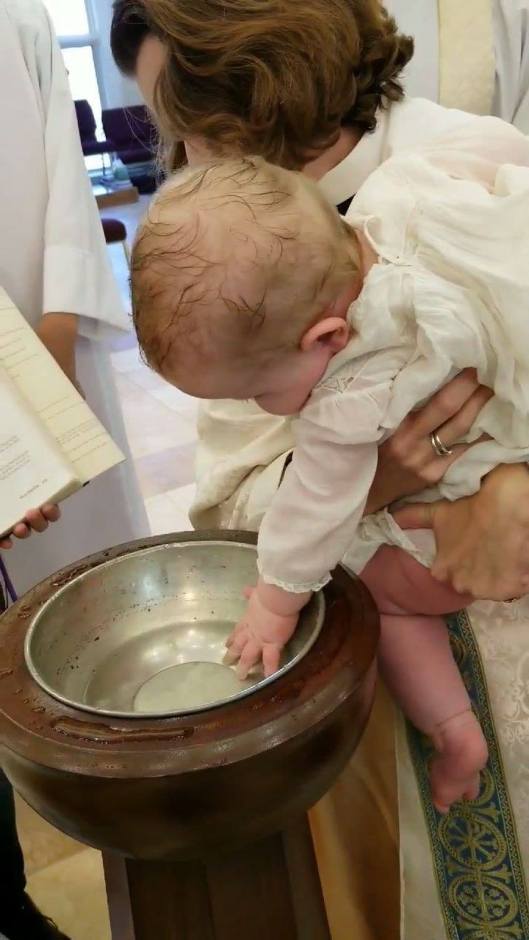
This Sunday, we are baptizing a baby into the household of God.  As part of that ritual, we will make promises about our own spiritual journey.  We will promise to gather regularly in Christian community, breaking bread and praying together; to resist evil, and repent when we fail; to proclaim the Word of God in word and deed; to seek and serve Christ, loving neighbors as ourselves; and to strive for justice and peace, respecting the dignity of every human being.  We promise to do what Christ asked us to do:  love God, love your neighbor, love yourself.

I love that my daughter is affirming her baptismal identity at Hickory Neck – whether she sees Christian witness through Mr. Rogers or through her Sunday School teachers.  I love that our younger children and older youth are learning how to live into their baptismal identity – whether through nursery care providers or youth group leaders.  And I love that our adults are still learning to live into their baptismal identities – through preaching, teaching, and our children’s witness.  At Hickory Neck, we are working across generations to keep loving God, loving our neighbors, and loving ourselves.  If you are in need of a community to help you claim that same identity and purpose, know that you are always welcome here – won’t you be our neighbor?

46040735_2084113391644910_120194659778560_o

Photo credit:  Hickory Neck Episcopal Church; permission to use required

Sermon – 1 Kings 19.1-15a, Luke 8.26-39, P7, YC, June 23, 2019

26 Wednesday Jun 2019

Posted by jandrewsweckerly in Sermons, Uncategorized

≈ Leave a comment

Tags

call, demons, faith, fear, God, goodness, grace, love, paralysis, release, scary, Sermon, trust

I remember when I was discerning one of my first calls to a parish, I heard a distinct word of encouragement from God that made me confident I should accept the call.  Or at least I thought I heard a distinct word from God.  Moments and days later, I began to doubt myself.  Maybe the words I heard in my head were my own.  Maybe I imagined the whole thing or, in hoping from a word of clarity, I made up the words myself.  And as soon as I began questioning what I heard, I started questioning the guidance of the words.  Either I was boldly following God’s distinct word to me or I was misguidedly making decisions based on an imagined experience.  Saying yes in that fog of doubt became one of the scariest experiences I have had.

That’s the funny thing about our relationship with God.  Most of the time when we talk about our relationship with God, we talk about the God of love.  But real, vulnerable, authentic experiences with God are scary too.  Whether we are trusting God through a major life crisis, we are taking a new path we are not certain is the right one, or someone challenges our life choices, following God in everyday life is scary.

We see that reality in two of our scripture readings today.  To understand why Jezebel wants to kill the prophet Elijah, we have to recall what happened in the previous chapters.  In an effort to proclaim the supremacy of Yahweh, Elijah challenges the god of Jezebel’s prophets to a duel of sorts.  All day long the prophets of Baal cry out to Baal to reign down fire on a sacrifice and are unable.  Elijah, fully confident in the power of Yahweh, immediately calls down fire, victorious over the prophets of Baal, and then proceeds to slaughter the whole lot.  But Jezebel’s answering threat on Elijah’s life sends him running.  No longer full of prophetic nerve[i], he runs to the wilderness, and asks God to take away his life.  Once so confident in the power of God, Elijah would rather cower in a corner and die.  Even when God’s voice come to him in a word of encouragement, Elijah can only see what is in front of him; in fact, he can only see the limited view he has, not the wider, sweeping view of God’s power to save.   Fear leads Elijah to paralysis.

Meanwhile the Gerasenes are equally scared.  They have developed a system for dealing with the possessed man of their village.  They know when to bind him and when to abandon him.  They know he is dangerous, and unclean, but they have figured out how to keep the town safe.  He is the identified patient of the town – the one who has the “real” problems.  By identifying the demoniac as the patient, no one else has to look at their own demons – the ways in which each of them are “vulnerable to forces that seek to take [them] over, to bind [their] mouths, to take away [their] true names, and to separate [them] from God and from each other.”[ii]  So, when Jesus casts out the impossible demons, and sends them to their death through their herd of swine, and the townspeople find the demoniac healed, clothed, and sitting in his right mind at the feet of Jesus, they do not celebrate or thank God for healing.  Instead they stand afraid of the power of God.  Now the demoniac is healed, they are afraid this Jesus will see their demons or challenge their feigned health.  In response, they do not ask for an explanation, but ask Jesus to leave.  Their fear leads to paralysis too.

To be fair, fear is a natural and sometimes necessary emotion.  Fear helps us develop a healthy sense of preservation.  Fear allows us to make necessarily cautious decisions.  Fear can keep us safe.  But fear can also lead to paralysis, and perhaps more importantly, to a lack of trust.  And when we are talking about God, a lack of trust evolving from fear gets us into trouble.  We start doubting the graciousness we know God intends for us.  We start avoiding the very work that will give us joy and fulfillment.  We start losing our sense of connection to God – who happily emboldens us when we allow God to do so.

We see in Elijah and the Gerasenes’ story the goodness that can happen when we work through our fear.  For Elijah, despite the fact he is terrified and despondent, convinced he would be better off dead, God provides food for him the wilderness – twice!  The angel of God feeds him with food so sustaining Elijah is able to make a forty-day journey.  And despite the fact that Elijah is so afraid he becomes convinced he is all alone in God’s work, God not only speaks to him, but opens up a vision of God’s work that is bigger than Elijah and extends well beyond his lifetime.[iii]  As Elijah slowly loosens his grip on fear, he opens himself up again to God’s guidance, protection, and confidence – even though the guidance, protection, and confidence had been present all along, hidden in the presence of gripping fear, but there nonetheless.

The same is true for the Gerasenes.  Despite the fact the townspeople are fearful of Jesus’ power, Jesus brings about healing anyway.  And knowing the people of Gerasene may continue to be fearful, Jesus has the former demoniac stay behind so he can testify to the salvific work of God.  As scholar Debie Thomas points out, “The story ends with Jesus commissioning the healed man to stay where he is and serve as the first missionary to his townspeople — the same townspeople who feared, shunned, trapped, and shackled him for years.”[iv]  Jesus does not scold, shun, or shame when he is asked to leave.  Jesus keeps holding out hope in the face of fear – Jesus holds hope that the townspeople might be healed like the demoniac is healed.  Jesus loves graciously and expects transformation in the face of hopeless fear.

One of the main tenants of practicing yoga is while you are practicing, you are to clear you mind of thoughts.  I am pretty sure every yoga instructor knows this is an impossible goal, because the other thing one learns in yoga is how to clear your mind once your mind becomes distracted – not if your mind becomes distracted.  There are all sorts of methods, but the primary instruction is to acknowledge the thought and then let the thought go.  In other words, when you catch yourself on the fifth thing on your to do list, you stop yourself by acknowledging you got off track, let the failure go, and try to clear you mind again.  There is no need for judgment, just acknowledgment and release.

That is our invitation today too.  Fear will always be with us.  No matter how strong we are in our faith life, we will sometimes be paralyzed by fear.  But if we can take a cue from yoga by pausing, taking a deep breath, acknowledging our failure in the face of fear, and trying again, perhaps we will be able to release the paralysis fear causes and step boldly back into the path God establishes for us.  Today’s lessons remind us there is encouragement for this work all around us.  There are angels that feed us when we want to give up the fight.  God speaks to us, reminding us how God is working at a much higher level, supporting us in ways we do not even realize we need.  God sends healed messengers to testify to us, to remind us of the ways in which we need healing more than those we have labeled as sick.  In breathing and letting go, we open our eyes in fresh ways to see God all around us acting for good.  And with each breath, and with each relaxing of our grip on fear, God washes over us with grace, kindness, compassion, and love.  Yes, letting go is scary.  But God shows us over and over again how when we let go of our fear, God is there with abundant, wonderful, powerful love.  Amen.

[i] Trevor Eppehimer, “Theological Perspective,” Feasting on the Word, Yr. C, Vol. 3 (Louisville: Westminster John Knox Press, 2010), 148.

[ii] Debie Thomas, “Legion,” June 16, 2019, as found at https://www.journeywithjesus.net/lectionary-essays/current-essay, on June 19, 2019.

[iii] Kathleen A. Robertson Farmer, “Theological Perspective,” Feasting on the Word, Yr. C, Vol. 3 (Louisville: Westminster John Knox Press, 2010), 151.

[iv] Thomas.

A Confession and a Call to Action…

07 Friday Jun 2019

Posted by jandrewsweckerly in Uncategorized

≈ Leave a comment

Tags

change, church, community, confess, God, grief, gun violence, indifference, inevitability, love, mass shooting, power, prayer, recommit, resignation

lightstock_110522_small_user_17564203

Photo credit:  https://www.firstchristianjax.com/event/prayer-vigil/

Over the weekend, a mass shooting happened in Virginia Beach.  Virginia Beach is less than an hour and a half away from Hickory Neck.  Some of our parishioners were colleagues with some of those killed.  There are many Episcopal Churches in Virginia Beach, and I know their priests have been working hard on pastoral care and preparing funerals.  Having a mass shooting so close to home, and certainly within our Diocese, has made this new reality of mass gun violence weightier and more tangible – as if the violence is making its way toward my personal sphere.

On Tuesday, our Bishop joined a worship service at an Episcopal parish in Virginia Beach.  As I thought about the service, I found myself wondering what liturgy they might be using, and how one even constructs a liturgy when you and your community is under such stress.  And then a dreadful thought occurred to me – one that is painful to confess.  I thought, “well, maybe I should develop a liturgy now when I’m not overcome with grief and counseling others, so the liturgy is easily modified for the situation.”

As soon as I had the thought, I crumpled in grief.  This is where I have come.  After years and years of devastating, massive amounts of death, countless pleas for us to change – change something, anything, and sermon after sermon preached about how we must do and be better, I have allowed myself to succumb to inevitability instead of demanding change.  This realization has been sitting with me all week, and it still brings me to tears when I recall my own sense of resignation.

This week, my prayer for us is a bit different.   My prayer for us is that we recommit to working for change.  My prayer is that we not let the sin of indifference or the sense of inevitability paralyze us from being agents of love and change.  My prayer is that we stop letting the sense of powerlessness take away our power.  I do not want to develop a “just in case” liturgy.  I don’t want to have to officiate over such a liturgy.  I want us all to acknowledge that we want to be better, and start doing the hard work of gathering diverse peoples to the table and finding a path forward.  Let’s be the Church – the Church our community needs.

O God, you made us in your own image and redeemed us through Jesus your Son: Look with compassion on the whole human family; take away the arrogance and hatred which infect our hearts; break down the walls that separate us; unite us in bonds of love; and work through our struggle and confusion to accomplish your purposes on earth; that, in your good time, all nations and races may serve you in harmony around your heavenly throne; through Jesus Christ our Lord. Amen.  (BCP, 815)

On Community, Connection, and Blessing…

16 Thursday May 2019

Posted by jandrewsweckerly in Uncategorized

≈ Leave a comment

Tags

blessing, community, connect, development, God, joy, kind, knowledge, lead, leader, love, people, small, Williamsburg

community-building-for-entrepreneurs

Photo credit:  https://innovationlabs.harvard.edu/events/community-building-entrepreneurs/

One of the things people say about Williamsburg is that it is a small town in the truest sense.  You cannot go too far without running into someone you know – or someone who knows you through someone else.  I find that reality to be true at church all the time.  Someone will come visit the church looking for a church home, and lo and behold, they realize they work (or worked) with a parishioner without realizing they attended Hickory Neck.  Or I will have coffee with a newcomer, and we realize we have friends and acquaintances in common.  In Williamsburg, there really is about two, if not one, degree of separation between most people.

In some ways, that is very good for a pastor.  One of the many things we learn about in seminary is how important it is for clergy to get out in the community, to get to know the people surrounding them – not with the intention of evangelism; more with the intention of being a leader who can authentically lead within their community.  That was one of the major reasons I applied to be in the LEAD Greater Williamsburg program.  The program is a community immersion program for emerging and existing leaders, who also do a community service project for the wider community.  As I approach graduation this week, I am especially grateful for this aspect of the program.

What LEAD taught me affirmed what I learned in seminary – it is so important to understand, know, and appreciate the community within which you do ministry.  As much as I thought I had gotten to know many people in Williamsburg, the monthly classes and my 28 fellow classmates helped me see that there are so many people, companies, and agencies that I did not know.  Maybe some people are okay with that lack of knowledge, but for me, working on that knowledge gap has not only helped me understand my own ministry better, it has helped me fall in love with the community even more.  I am overwhelmed by the diverse, myriad ways that greater Williamsburg residents work to make our community better.  This community is filled with incredible, inspirational people, and I surmise I have only scratched the surface.

Today, my reflection is two-fold.  One, I am filled with gratitude for the amazing opportunity of being in the LEAD program this past year.  Thanks to my classmates for an incredible year of making WMBGkind!!  The blessings abound – from knowledge, to leadership development, to friendships, to joy!  But two, I find myself wanting to connect more, and I would like to invite you to do the same.  Whether you are here in the Greater Williamsburg area, or even in your own hometown, think about someone you have wondered about or admired from afar, and ask them to coffee.  Get to know the people of your community – really know them:  their work, their home life, their fears, and their joys.  My guess is that the more you expand your connection to people in your community, the more you will see ways in which God is inviting you to bring blessing to your community!

On God and Spring…

20 Wednesday Mar 2019

Posted by jandrewsweckerly in Uncategorized

≈ Leave a comment

Tags

beauty, bloom, blossom, color, fresh, glory, God, joy, love, people, spring, surprise, trees, wonder

IMG_6943

Photo credit:  Jennifer Andrews-Weckerly; reuse only with permission

This year, spring has taken me a bit by surprise.  I am mostly surprised because we keep having cold bursts, and yet, the budding trees seem undeterred.  But what has also surprised me is how unprepared I have been for the emergence of color.  You see, in these brisk days, I had become accustomed to bare trees and the dormant brown of the season.  As the trees begin to blossom, though, I have been caught off guard.  I forgot how beautiful these trees can be in spring.  I forgot the soft yellows, purples, pinks, and whites of their blooms, and I had forgotten the beauty they possess.  Despite having watched these same trees blossom year after year, I still find myself surprised by their loveliness.

As I have been surprised by the beautiful emergence of spring this year, I began to wonder if I don’t do the same thing with the people around me.  Sometimes, I think we get so used to our loved ones that we forget to really see them.  We get used to the rote normalcy of life, and we get so accustomed to our routines, we sometimes fail to see the beautiful blooms of the people right in front of us.  We neglect to see the ways the people in our lives are changing and growing, and sparking new life, and we fail to see their blossoming beauty.  We fail to behold their beauty with the wonder it deserves.

I wonder who in your life has been blossoming without your notice.  I wonder whose blossoms are coming into glory and yet you have been too busy to notice.  I invite you this week to take a long look at your loved ones.  Look at them with fresh eyes, expecting to be wowed with something fresh and inspiring.  See them with the eyes of a new acquaintance instead of the eyes of someone who only sees the withered winter version.  And then, tell them what you see.  Share with your loved ones the beauty you see in them, the new life you see budding, and the ways in which their color gives joy to the world around them.

I suspect when you start to embrace this new way of seeing your loved ones you will see them as God sees them – as beautiful creations whose beauty reflects God’s glory.  You can share that gift too – the ways in which you see God’s glory reflected in them.  But beware!  Once you begin to see God’s beauty and glory in others, you might also begin to see it in yourself as well.  If you need a little help seeing the color blooming in yourself, let me know.  I’d be happy to help you see yourself as God sees you!

Holding on to Joy in Lent…

06 Wednesday Mar 2019

Posted by jandrewsweckerly in Uncategorized

≈ Leave a comment

Tags

Ash Wednesday, Christ, discipline, earthy, holy, identity, joy, kindness, Lent, life, light, love, repent, virtue

IMG_6748

Photo credit:  Jennifer Andrews-Weckerly; reuse only with permission

Last night I had one of the most fun Shrove Tuesday/Mardi Gras celebrations I have ever had.  We had a great crowd, there was a spirit of joy and celebration, the Kensington School hosted an awesome kids’ corner with fun activities, and best of all was the Hickory Neck Talent Show.  I have not laughed so hard and smiled so much in a long time.  I even woke up this morning with an uplifted spirit, the smile still lingering on my face.

While I am so grateful for that blessing, as a priest, it does make entering into Ash Wednesday a bit tricky.  Here I am still coming down from the high of last night, and now I need to enter into a worship service where I tell people to fast, to repent, and to remember their mortality.  It almost feels like emotional or spiritual whip-lash, and I have been struggling this morning to know how to help others with that same abrupt shift.

Where I have landed is that I think the best way to enter into Ash Wednesday and the season of Lent is with that same lingering sense of celebration.  You see, when you have experienced the highs of life, talking about the “lows” of life seems a bit more bearable.  Yes, we are mortal, and yes, we will return to the dust.  But while we are still mortal, we can make this life here on earth one of great joy and love – one of laughter, of community, of togetherness.

I wonder if this might be a way to enter Lent in a healthier way.  Instead of lamenting our sinful nature (and believe me, we do need to lament our sins), perhaps our Ashes today might remind of us the earthy nature of being humans and encourage us to strive for the ways we might live that earthy life in a more holy way.  I plan to do that today by entering into a season of kindness.  I am taking the joy from my community of faith last night and channeling it into forty days of kindness – where my repentance becomes a practice of demonstrating my identity – of living more faithfully the virtue of kindness.  What Lenten discipline are you taking up?  What might be a way for you to joyfully grasp onto this fleeting life and make it a witness to Christ’s light and love?  I can’t wait to hear all about it!!

Ash-Wednesday-1

Photo credit:  https://saintvincents.org/2019/02/25/ash-wednesday-march-6/

On Awkwardness and Grace…

27 Wednesday Feb 2019

Posted by jandrewsweckerly in Uncategorized

≈ Leave a comment

Tags

awkward, beauty, church, God, grace, guest, hard, homeless, identity, Jesus, love, privilege, purpose

handshake-2009195_640

Image credit:  https://rimland.org/tag/homeless/

This week our church is hosting our community’s Emergency Winter Shelter.  Every day for a week, from about 6:30 pm to about 8:30 am, we welcome up to twenty-five guests into our church.  This week is a banner week for our church community.  It is the week in the year where everything we say about discipleship and being witnesses for Christ’s love becomes a reality.  The week is so important that we try to engage parishioners of all ages, and we partner with other churches and local schools to make the week happen.  This is the week where we boldly proclaim our identity and live it with integrity.  This is the week where Christ can say about us, “I was hungry and you gave me food, I was thirsty and you gave me something to drink, I was a stranger and you welcomed me…”[i]

You would think with that kind of buildup, and that clear sense of purpose, every moment we are hosting our guests would be this beautiful, enlightened, perfect moment.  While there are certainly beautiful moments, what I noticed about our Winter Shelter week is that it is much more awkward that you might imagine.  Up to twenty-five individuals gather together, with unique stories that brought them to this moment of vulnerability and need, and they create a make-shift place of protection for few hours with about twenty volunteers who mostly do not need to worry about where the next meal is coming from or where they will rest their heads.  What do you talk about over a shared meal?  How do you connect with someone who is bone tired from working, hustling to get to the shelter, and worried about what is next?  How do you overcome the very obvious fact that the worlds you are both operating in are diametrically different?

The answers are not super glamorous.  When you invite yourself to sit at a table with homeless men and women, sometimes the conversation is superficial, and sometimes things are said that rock your world and remind you of how much privilege you really have.  When you long for a human connection with someone who is bone tired, sometimes the most you get is a smile; but more often what you get is a reality check about how brutal homelessness can be, and how many other awful things may be present in their lives.  And as you long to overcome the barriers of the two worlds you live in, part of what you have to do is let go of the idea that you can, remembering why Jesus once said it is harder for a person of wealth to get into the kingdom than a camel to fit through the eye of a needle.  Winter Shelter Week is hard and awkward because the experience forces us to examine our lives, acknowledge our privilege, and be honest about the amount of work we still have to do.

The good news in all the awkwardness and difficulty is that God’s grace is all around.  Providing shelter for a week matters.  Acknowledging the humanity of one another matters.  And that we are even trying matters.  God takes our best intentions, and our humbling week, and grants us moments of beauty:  from the almost five-year old who insists on saying goodnight to every guest before going home to bed – and the gracious responses of guests; to the teenager who has the courage to say an extemporaneous blessing over the food, when traditional prayers do not seem to work; to the community – both guests and hosts – who rallies together to protect the physical well-being of all the guests.  When Jesus talked about welcoming in strangers and feeding and quenching other’s thirst, he did not warn us how hard it would be.  I suspect he knew that the grace we would exchange in the mutual vulnerability would be reward enough.

[i] Matthew 25.35

Sermon – Luke 6.27-38, EP7, YC, February 24, 2019

27 Wednesday Feb 2019

Posted by jandrewsweckerly in Sermons, Uncategorized

≈ Leave a comment

Tags

change, commands, discipleship, God, hard, intentional, Jesus, kindness, love, loving kindness, mercy, Sermon, shelter, sickness, symptoms, system

Last week, we joined the entire community of Williamsburg in performing acts of kindness.  When we issued the charge two weeks ago to go out and perform three acts of kindness, the reactions were pretty wide-ranging at Hickory Neck.  Several parishioners addressed me with concern, “I have to do three?  Can’t I just do one act before next Sunday?”  Other parishioners took on the challenge with gusto – with several parishioners plotting out what they were going to do before they even got back to the parking lot.  While other parishioners noted during the week and the days afterwards how shockingly easy the challenge was.  “I felt silly writing down my acts of kindness.  I mean, I do acts of kindness every week,” shared one parishioner.

I am not sure which perspective was predominant, but I can tell you that Hickory Neck performed over 100 acts of kindness that week.  There were some simple acts:  holding doors for strangers, paying people compliments, and writing thank you notes.  Some were a little more labor intensive:  volunteering at a food pantry, helping out at your child’s school, going through your closet to donate clothes.  Others showed some real effort:  listening to a stranger who seemed to need a friend, making Valentines for the whole class – even the kids you do not like, visiting someone in the hospital – even though you hate hospitals.

Now I know several parishioners who thought our challenge was a bit silly or who felt uncomfortable with the idea of drawing attention to our own good works.  Surely we should just be doing acts of kindness every week.  But for those of you who jumped in with both feet, my hope is that you got a tiny glimpse into what can happen when you start living out kindness more intentionally:  your whole way of being starts to shift.  When you do acts of kindness, the more opportunities for additional kindness seem to appear.  The more you think about kindness, the more you start to notice kindness all around you.  And the more you engage in kindness, the more your whole demeanor shifts – from one of staying in your lane, attending to your daily routine, to lifting up you head and noticing how you can shift the community around you.

That seismic shift is what Jesus is talking about in Luke’s gospel today.  Many of us hear the instructions from Jesus as a list of commands or a checklist of duties:  love your enemies, do good to those who hate you, bless those who curse you, pray for those who abuse you; do not judge, do not condemn, forgive, and give.  If we look at today as a list of commands from Jesus, then we might as well consider this week as Week Two of an acts of kindness challenge – except this time, Jesus asks us to do acts of kindness for those to whom showing kindness is the hardest.  When we read Jesus’ words like a weighty list of to-do items, this gospel feels just that – full of weight and guilt with no promise of hope or encouragement.  And part of what Jesus is saying is just that:  showing kindness is actually pretty hard when we show kindness to those who are hardest to love.  We do not mind showing kindness to friends, and we do not even really mind showing kindness to strangers.  But asking us to show kindness to those who we actively dislike or to those who have hurt us?  Now Jesus is pushing us way out of our comfort zones!

At the beginning of February, the Greater Williamsburg area kicked off a commitment to becoming a community of kindness with a rallying event.  The former Mayor of Anaheim, California, Tom Tait, who had run on a campaign of kindness, was the keynote speaker.  Mayor Tait talked about his time on City Council in Anaheim, how part of his work felt like a game of whack-a-mole.  Each month, some crisis or community problem would arise – violence in the community, the prevalence of drugs, problems in the public schools.  And the City Council’s response felt like trying to whack at the problem to temporarily knock the problem out.  But those solutions never really made a deep impact.  What Mayor Tait saw was all those problems were like symptoms – symptoms of a city that was facing an internal sickness.  The only way to heal the internal sickness was to commit as a city to transform its entire way of operating.  Mayor Tait believed transformation would occur by committing to kindness.  To many, the idea sounded a little too pie-in-the-sky.  But once elected, Mayor Tait was forced to try to live out the reality of kindness.  With every decision, every major action, the community wondered together what would reflect kindness.  And slowly, the illness in the system began to heal.  Kindness was not a Band-Aid, but a system-altering antidote to a host of problems.

In a lot of ways, that is what Jesus is talking about today.  Yes, the things Jesus is talking about are commands – a list of ways to be kind, even to the persons to whom being kind is most difficult.  But Jesus is not just talking about commands.  As one scholar describes, “Jesus isn’t offering a set of simple rules by which to get by or get ahead in this world but is inviting us into a whole other world.  A world that is not about measuring and counting and weighing and competing and judging and paying back and hating and all the rest.  But instead is about love. Love for those who have loved you.  Love for those who haven’t.  Love even for those who have hated you.  That love gets expressed in all kinds of creative ways, but often come through by caring – extending care and compassion and help and comfort to those in need – and forgiveness – not paying back but instead releasing one’s claim on another and opening up a future where a relationship of …love is still possible.”[i]

What Jesus is doing is trying to, “inculcate, and illustrate, an attitude of heart, a lightness of spirit in the face of all that the world can throw at you.”  We are to assume this new way of being because “that’s what God is like.  God is generous to all people, generous…to a fault:  [God] provides good things for all to enjoy, the undeserving as well as the deserving.  [God] is astonishingly merciful…”  As N. T. Wright adds, “…this list of instructions is all about which God you believe in – and about the way of life that follows as a result.”[ii]  When we take Jesus seriously, and embrace this new way of being, the way of kindness that leads to love, life can be “exuberant, different, astonishing.  People [will] stare.”[iii]

In a lot of ways, what Jesus does to today is saying, “I see your week of kindness, and I raise you to life of loving-kindness.”  In other words, keep going.  Now, fortunately for us, Hickory Neck has set up the perfect set of circumstances for you to try on this new life of loving-kindness.  Tonight, we open our doors to strangers.  Tonight, we open our doors to some people we will find easy to love, and some people that will make us uncomfortable.  Tonight, we open our doors to some late nights, really early mornings, and hard labor.  But tonight, we also open our doors to a new way of being – a way of opening ourselves to live exuberantly, differently, astonishingly – to live like God.

Now I know one week (or even the one shift or duty you signed up for at the Winter Shelter, or even the financial contribution you made) may not change the world necessarily.  Jesus is talking about a seismic change in the way we live our lives every day.  But the Winter Shelter is a pretty good start.  And the good news for you, is Lent is coming, and we’ve set up all kinds of tools for you to embrace this way of loving-kindness.  Instead of a week of kindness, we have a whole 40-day kindness challenge.  We have a devotional set of readings that reflect on kindness, story, and scripture for forty days.  We will be studying kindness in scripture.  Hickory Neck has assembled the tools to help you not just try simple deeds for a week, or not just try the hard stuff of relationship with the homeless for a week – but instead to try on a new way of being – to take on the way of God.  Part of what Hickory Neck is all about is empowering discipleship – empowering you to go out into the world and live as faithful witnesses of Christ.  This is what discipleship is all about.  And Hickory Neck is here to help – to walk with you, to lift you up when you fall, to hold your hand in the hard parts, and to revel in the joy of watching love win.  We cannot wait to enter in to this most sacred time of loving-kindness with you!  Amen.

[i] David Lose, “Epiphany 7 C:  Command or Promise?” February 22, 2019, as found at http://www.davidlose.net/2019/02/epiphany-7-c-command-or-promise/ on February 22, 2019.

[ii] N.T. Wright, Luke for Everyone (Louisville:  Westminster John Knox Press, 2004), 73-74.

[iii] Wright, 74.

← Older posts
Newer posts →

Recent Posts

  • On Redefining Community…
  • On Parenting, Milestones, and Community…
  • Sermon – Acts 2.42-47, E4, YA, April 26, 2026
  • On Seasons of Discernment…
  • Sermon – Luke 24.13-35, E3, YA, April 19, 2026

Archives

  • May 2026
  • April 2026
  • February 2026
  • January 2026
  • December 2025
  • November 2025
  • October 2025
  • September 2025
  • August 2025
  • July 2025
  • June 2025
  • March 2025
  • February 2025
  • December 2024
  • November 2024
  • October 2024
  • September 2024
  • August 2024
  • July 2024
  • June 2024
  • May 2024
  • March 2024
  • February 2024
  • January 2024
  • December 2023
  • November 2023
  • October 2023
  • September 2023
  • August 2023
  • July 2023
  • June 2023
  • May 2023
  • March 2023
  • February 2023
  • January 2023
  • December 2022
  • November 2022
  • October 2022
  • June 2022
  • May 2022
  • January 2022
  • December 2021
  • November 2021
  • October 2021
  • September 2021
  • August 2021
  • June 2021
  • May 2021
  • April 2021
  • March 2021
  • February 2021
  • January 2021
  • December 2020
  • November 2020
  • October 2020
  • September 2020
  • August 2020
  • July 2020
  • June 2020
  • May 2020
  • April 2020
  • March 2020
  • February 2020
  • January 2020
  • December 2019
  • November 2019
  • October 2019
  • September 2019
  • August 2019
  • July 2019
  • June 2019
  • May 2019
  • April 2019
  • March 2019
  • February 2019
  • January 2019
  • December 2018
  • November 2018
  • October 2018
  • September 2018
  • August 2018
  • July 2018
  • June 2018
  • May 2018
  • April 2018
  • March 2018
  • February 2018
  • January 2018
  • December 2017
  • November 2017
  • October 2017
  • September 2017
  • August 2017
  • July 2017
  • June 2017
  • May 2017
  • April 2017
  • March 2017
  • February 2017
  • January 2017
  • December 2016
  • November 2016
  • October 2016
  • September 2016
  • August 2016
  • July 2016
  • June 2016
  • May 2016
  • April 2016
  • March 2016
  • February 2016
  • January 2016
  • December 2015
  • November 2015
  • October 2015
  • September 2015
  • August 2015
  • July 2015
  • June 2015
  • May 2015
  • April 2015
  • March 2015
  • February 2015
  • January 2015
  • December 2014
  • November 2014
  • October 2014
  • September 2014
  • August 2014
  • July 2014
  • June 2014
  • April 2014
  • March 2014
  • February 2014
  • January 2014
  • December 2013
  • November 2013
  • October 2013
  • September 2013
  • August 2013
  • July 2013
  • June 2013
  • May 2013
  • April 2013
  • March 2013
  • February 2013
  • January 2013
  • December 2012
  • November 2012
  • October 2012
  • September 2012

Categories

  • reflection
  • Sermons
  • Uncategorized

Meta

  • Create account
  • Log in
  • Entries feed
  • Comments feed
  • WordPress.com

Blog at WordPress.com.

  • Subscribe Subscribed
    • Seeking and Serving
    • Join 391 other subscribers
    • Already have a WordPress.com account? Log in now.
    • Seeking and Serving
    • Subscribe Subscribed
    • Sign up
    • Log in
    • Report this content
    • View site in Reader
    • Manage subscriptions
    • Collapse this bar

Loading Comments...