Several years ago, I encountered a mobile chapel at General Convention. The idea was that if people are being taken away from church on Sundays by sports, competitions, or other commitments, bring the church to them. The mobile chapel was set up so people could go in for personal prayer, but there was also a set time for the distribution of Eucharist with a priest. It was a creative expression of an ever evolving Church.
Travelers Chapel, Wall Drug in Wall, SD (reuse with permission)
On today’s leg of our sabbatical journey, I felt embraced by several other folks bringing church to me. The first encounter was at Wall Drug, the famous roadside attraction and tourist stop in Wall, South Dakota. Among the drug store, gift shops, stores, and restaurants is a “Travelers Chapel.” The Chapel is always open, offering a peaceful setting for prayer. Amidst the consumerism and loud animatronic singing, the Chapel is like an oasis for all of us passing through. Somehow, Wall Drug managed to bring church to me today.
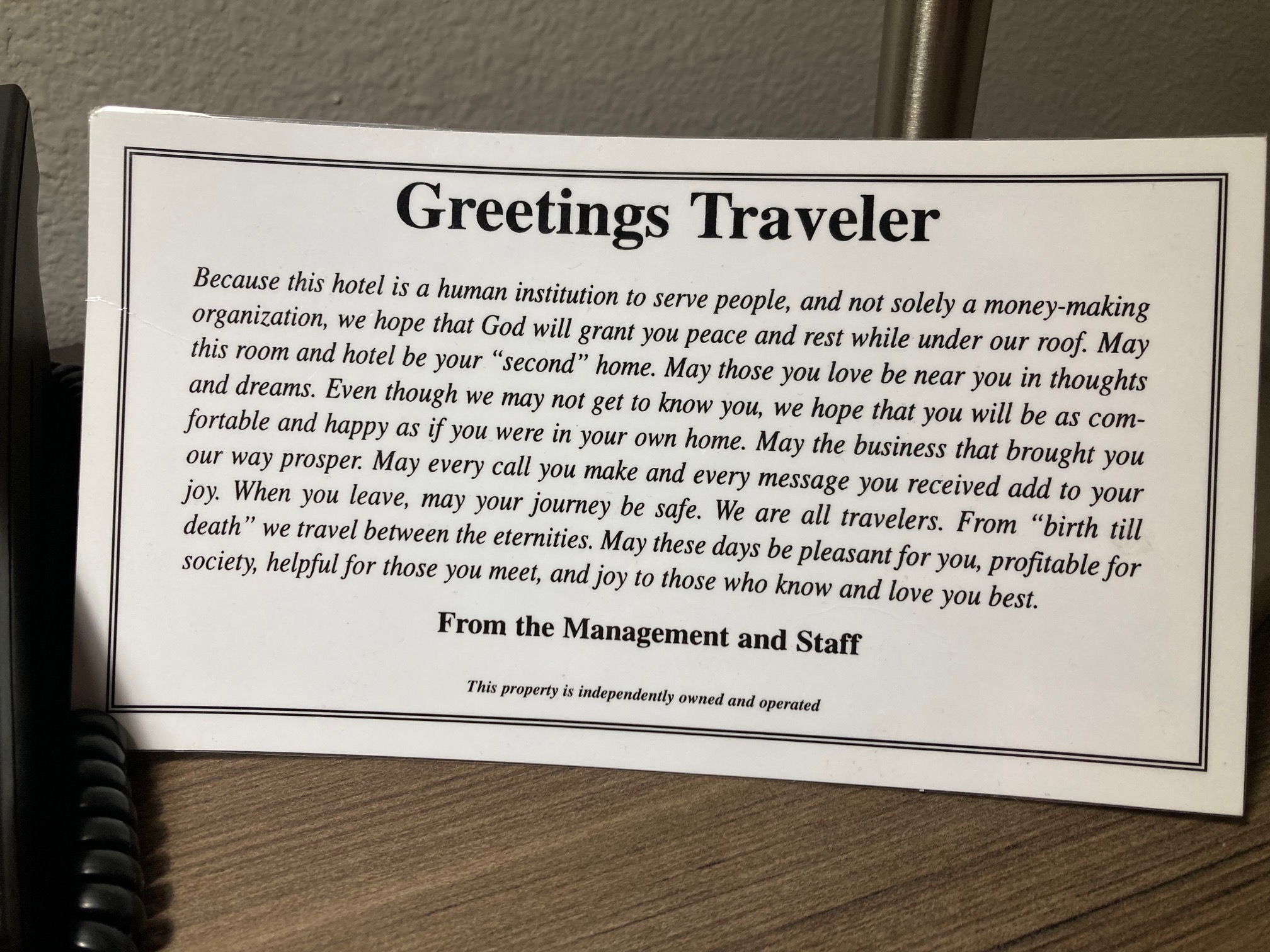
The second encounter came as we checked in at hotel tonight. A laminated card was left on the nightstand. The card is basically a greeting and blessing for all who stay at the hotel. I confess I have never received such a note at a secular hotel, and I was thoroughly humbled by the witness of love of the management and staff of this hotel. Once again, church found its way to me, this time at a Comfort Inn and Suites.
Hotel Note in Albert Lea, MN (reuse with permission)
Far too often I hear churchgoers complaining about how fewer people are making their way to church. Today I am reminded that our work is take church to others. Jesus was always commissioning people to go out and witness God’s love and redemption. Our work is no different. I wonder what unique way you might figure out how to be someone’s church today.
In case reading about and seeing pictures from our cross-country adventure make you think we are having a perfect trip with perfectly behaving family members, today reminded me how human we really are. When you are family, you know each other almost too well: you know what makes family members laugh and what embarrasses them, you know the quirks of each member and you know teasing is a form of love, you know how far you can push someone until they lose their cool. But because you love each other unconditionally, sometimes you push anyway. And when you are in each other’s presence 24/7 for ten days, apparently, the tenth day is when the pushing becomes almost inevitable.
Despite the dazzling green of Idaho’s countryside, the beautiful rivers of Wyoming, and the stunning mountains across three states, and although there were fun road trip games, stories shared, and conversations had, today I also lost my patience and my ability to exhibit mature parenting responses. Even with some downtime for all of us, I realized I was snapping too much, and my patience was brittle thin. What I needed was some unconditional love, and so, as I said goodnight to each family member, I asked for a hug. Despite having just been bickering not ten minutes earlier, each member to a person gave me a hug without protest. And suddenly the unease that had settled around me melted away.
Too often – with loved ones, with neighbors, with community leaders, and certainly in church – we forget to reset with love. I know not everyone is comfortable with physical touch, and I know the pandemic made us anxious about physical contact, but sometimes I think a hug might help us all reset some of the tension between us. In fact, I know some of us have been frustrated or angry for so long that we are not even sure what we were originally frustrated or angry about.
When I’m feeling frazzled, one of my favorite prayers is from Psalm 46.10, “Be still and know that I am God.” I love to pray those words repeatedly, each time, dropping the last word in the phrase. The first time I pray all eight words. Then I pray just seven, “Be still and know that I am.” And then six, and so on, until I just pray the word “be.” If a hug is not available to you today, or if you want to do your own self work on resetting with love, I commend Psalm 46.10. Between God’s invitation into stillness, and the stillness one finds in hugs, I pray you find some peace this day.
As a parent of young children, I often found that I mourned when certain stages ended. One of the harder transitions was when I was no longer physically able to manhandle my children. Before then, if a kid was refusing to move, or was throwing an epic tantrum, I could just swoop them up and manage their outburst physically. But once I could not long hold their weight or battle those strong little arms, I realized my parenting technique was going to need a dramatic change – I was going to have to give up some control and figure out how to help both of us verbally work through what was going on in the moment. Of course, that probably was the way I should have been parenting from the beginning, but sometimes a good swoop sure did feel good and gave me the illusion of control.
When I see images of Jesus the Good Shepherd – the biblical image we celebrate today – I find a similar sense of disappointment. If Jesus is the Good Shepherd, I am metaphorically that helpless, probably not too bright, albeit cuddly sheep draped over Jesus’ shoulders. That kind of image has always made me feel a little disempowered. But this week I stumbled on a Byzantine icon[i] of Jesus Christ the Good Shepherd which shifted things for me. Instead of a sheep draped over Jesus’ shoulders, the icon has a person draped over Jesus’ shoulders. Their eyes are closed, their body is limp, but Jesus, complete with the nail scars in his hands and feet, seems to effortlessly be carrying this person out of the wilderness. The image did not necessarily make me feel empowered, but the image did humanize this metaphor for me. I could easily imagine an adult who has been walking through the valley of the shadow of death, exhausted from suffering or grief. Or I could imagine a protective Jesus who has swooped someone out of harm’s way. And I can definitely imagine an adult who has worn themselves out with their own tantrum.
In John’s Gospel today, Jesus is shepherding the crowd through all those scenarios. You may remember back in Lent we got that long story from John’s gospel about the blind man Jesus heals, only to have the religious community freak out about Jesus healing on the sabbath and not believing the man had actually been blind in the first place. Well after the blind man proclaims his desire to follow Jesus, Jesus then turns back to the community of faith and offers this explanation of his healing the blind man. His teaching in John is actually much longer than what we hear today – in fact, Chapter 10 of John’s gospel is usually divided into three sections – all about the Good Shepherd – but a different section is appointed for each liturgical year. In year A, we get the “I am the gate,” or door, portion of Chapter 10. We are told that when we pass through the gate, the “good shepherd,” tends to us so that we will have life, and have life abundantly.
This passage is the “so what” of Easter. If you remember, people have been running around, demanding proof of Jesus’ resurrection, taking whole walks with Jesus before realizing who the resurrected Jesus is. And so, Eastertide is a celebration of the resurrection, and we spend seven weeks trying to figure out what resurrection means. The “so what” today then is that Jesus came, died, and rose again so that we might have life, and have that life abundantly. And if that abundant life means Jesus has to carry us out of trouble, hold us when we cannot walk on our own, or haul us over his shoulder when we are just too stubborn to accept his gift of abundant life, that is what Jesus the Good Shepherd will do. Jesus’ resurrection matters because his resurrection reminds us of the gift of abundant life.
But that story is only part one of our “so what” today. The rest of the “so what” of resurrection happens in our lesson from Acts today. Since Easter we have been reading in Acts about the beginnings of the church community. We have heard two parts of Peter’s sermon after the great day of Pentecost, where he gathers the first mega church of over 3000 people. Now we hear the “so what” of Jesus being the gate. You see, when Jesus becomes the gate, the door through which we pass into the protected sheepfold, you know what that gathering of the sheep looks like? We are not disempowered, limp bodies, lying under protection. When we pass through Jesus’ resurrection, we join a community – a community of action.[ii] The text from Acts says of that growing body, “They devoted themselves to the apostles’ teaching and fellowship, to the breaking of bread and the prayers.”[iii] As the community grows, they share in economic justice, sharing their wealth and caring for all equally. They spend time together, eating with glad, generous hearts, praising God, and tending to the goodwill of all. Jesus doesn’t just carry our limp, weary selves, and then deposit us into the world to try again. Jesus brings us into a fold – a community of study, fellowship, communion, and prayer.
That is the beginning of your “so what” of Easter today. We are an Easter people because Jesus gave his life so that we might have life and have that life abundantly. As Easter people we are gifted that abundantly life so that we can enter the sheepfold of faithful community. Your invitation today is hop off Jesus’ shoulders, walk through the gate of Jesus, and come into to a community of faith where we will study God’s word, develop meaningful relationships, come together around the common table, and pray. When we gather in that kind of community, when we are fed mentally, physically, and spiritually, then we fueled for the rest of the “so what” of Easter. Once nurtured in that generous, abundant community, we are led back out through the gate that is Jesus, better able to love and serve the Lord out in the world. Thanks be to God!
I have a friend who does one of the most unconscionable things in life: she flips to the end of every book and reads the ending first before going back to the beginning to start. When she first told me about this habit, I was mortified. How could you ruin the suspense, ignore the carefully crafted character development, and destroy the experience of imagination so callously? For her, the answer is simple. She needs to be assured that everything will turn out okay – the only way she can trust the journey the author will take her on is if she knows how the journey will end. Now I have certainly read my fair share of books whose ending made me furious, so I get her logic. But I have yet to be converted to her method, even by the bad endings.
Sometimes I think Easter Sunday is a bit like flipping to the end of the book. We want to know Jesus rises from the dead, forgives our sins, and restores us to the promise of eternal life. But that is not where the story starts today. We are told that Mary Magdalene and the other Mary go to see the tomb. These two women do not come to prepare the body with spices like in the other Gospel narratives. They just come to see the stone-cold reminder of death and lay down all that has been. In any death, there is a flurry of activity – the realization of pending death; the calling in of loved ones to say goodbye, or in the case of sudden death, the shocked gathering of grief; the funeral plans and details so complicated all your brain can do is make one decision at a time; and then the receiving of condolences and public marking of goodbye. But in any death, eventually everyone leaves, and the mourning are left doing what Mary Magdalene and Mary do – going to sit at the tomb with the stark reality of all that has happened.[i]
In some ways, that is our posture as a church today. If we participated in Holy Week at all, we walked the last meal of Jesus, his washing of feet, his agonizing prayers, his betrayal and denial, his torturous death, and the finality of his tomb. Of if we participated in Lent, we walked through the depths of our sinfulness, doing the hard work of repentance, even being reminded we are dust and to dust we shall return. Of if we go to church on a regular basis, we know that Jesus is just the final act of God in response to the ways the people of God broke their covenant with God again and again – ignoring prophets and sages, ignoring the sins of their ancestors, ignoring all the blessings and glimmers of hope from God and instead doing our own will, not God’s will.
Once you know that whole narrative, humbling dragging our baggage of misbehavior, misdeeds, misguided wills, then the story we hear today is not just a “and then they lived happily ever after” ending. Today’s story is profound, unbelievable, and, as the text says, literally earth-shattering. What God in Jesus does today is entirely undeserved, nothing we are remotely entitled to, and utterly full of love, forgiveness, and grace. When we carry the weight of that entire book we have been reading, then today’s text is the very reason we say alleluia over and over again today. Today’s text is the reason we make our way to this place, whether we have never been here before, are not entirely sure we want to be here, whether our faith journey has begun to be renewed here, or whether this place feels like home for us. Today’s text is the reason we have any hope at all in this conflicted, messy, seemly unsavable world.
But here is the funny thing about this beyond happily ever after ending: this is not the end. After the earth is literally shaken at its core, the appearance of an otherworldly angel, and even an encounter with the risen Christ, the story goes on. Mary Magdalene and the other Mary go witness to the other disciples. We are told they go with fear – even though both the angel and Jesus tell them to not be afraid. We are told they go with joy – because even though this new thing is terrifying, this new thing is terrifyingly joyful. We are told they run – run to share the best beginning they have ever heard.
That is our invitation today. In Christ’s death, we hear the best beginning we have ever heard. Knowing all that we know of the prelude, we know that this is terrifyingly joyful news. But this is news that we are invited not just to share, but to run and share. I do not know to whom you need to run to today. Maybe someone in your life needs this terrifyingly joyful reminder of resurrection. Maybe someone you have never met before is waiting for you to run into them. Or maybe you just need to run into your downtrodden self and remind yourself of this good news. When the clergy today says, “Let us go forth into the world rejoicing in the power of the Holy Spirit, alleluia, alleluia,” our response is not just a verbal one. Today we are invited to run and share the good news! Amen!
For the next four Sundays in Lent, our lectionary has us step away from the gospel of Matthew – the primary gospel for Year A in the lectionary – and take up the gospel of John. Each of these Sundays will be a study in story and character: today we read of Nicodemus, next week the Samaritan woman at the well, then the healed blind man, and finally the Lazarus story. What I love about the use of the Johannine stories this Lent is they are centered on characters – people – trying to figure out this whole Jesus thing. They are not passages like John’s flowery beginning: “In the beginning was the Word, and the Word was with God, and the Word was God…[i]”
Over the next four weeks, instead of pouring over John’s convoluted text, we will be using John’s stories and characters to help to illuminate that text. But like any story, we have to be careful about the lure of familiar stories. Today is no exception. Right away, John begins to tell us what we presume is everything we need to know. “There was a Pharisee named Nicodemus, a leader of the Jews. He came to Jesus by night..” Immediately, our brains start firing: this is going to be one of those stories of silly leaders who should know things, but clearly do not. And Nicodemus is sneaking in under the cover of night: clearly Nicodemus is embarrassed, unsure, and probably a bit shady. Two sentences in and we have this all figured out. Forget how Nicodemus is so dimwitted he can’t understand what Jesus means by being born again. We hear all the hints and triggers, and we’ve written the sermon before I said a word to you. Moral of the story: don’t be like Nicodemus; live in the light of Jesus, because God so loved the world. Done!
But when we live in a black and white world – or this case a day and night, or darkness and light, world – we miss all the gray where we reside in our faith journey. No doubt, Nicodemus visits Jesus from the shadows. But we have to remember, given Nicodemus’ position, approaching Jesus publicly would have been “difficult, perhaps even dangerous…in the bright light of day.”[ii] Truth be told, Nicodemus is not so different from any of us. Nicodemus is “a successful and self-confident man, he plays a leadership role in his community. He is spiritually open and curious, yet also rational. He approaches Jesus directly and tries to figure out Jesus’ actions and social networks. He is committed and curious enough that he makes an appointment to talk to Jesus face to face.” Now, he may not be ready to go public, and so he, “…makes the appointment in the middle of the night, when he can keep his faith secret, separated from the rest of his life. His imagination is caught by Jesus, but he wants to compartmentalize whatever faith he has.”[iii]
Knowing Nicodemus has compartmentalized his faith, and knowing he is a bit skeptical, and knowing, eventually, he really does not get what Jesus is saying, the text today invites us not to judge or belittle Nicodemus, but instead see ourselves in him. Before you get indignant about how maybe you have been born again through baptism, or how you can describe a moment when you were saved by proclaiming your belief in Jesus, I want you to remember one redeeming thing about Nicodemus today: He is curious. Nicodemus could have stayed even further in the shadows, he could have not approached Jesus at all, he could have said nothing when Jesus cryptically talks about being born from above. Instead, Nicodemus stays curious. Nicodemus may not be able to fully understand Jesus, but he follows his curiosity about Jesus. Our instinct may be to hear judgment about Nicodemus, but what our text wants us to hear is “God blesses the curious because they are ready to learn and experience something new.” The curious are blessed because “they can be truly born again.”[iv]
You may have heard John 3.16 today, listened to Nicodemus’ seeming failure, and thought you were going to be told to just believe today. Diana Butler Bass explains that the word “believe” in John 3.16 comes from the German word for “love.” To believe is not to hold an opinion.[v] In fact, believing is “not so much about what one does with one’s mind as about what one does with one’s heart and one’s life.”[vi] Your invitation today is not to avoid the patterns of Nicodemus, living in the light by just willing your mind to believe in Jesus. Your invitation is to follow Nicodemus on the path of curiosity that will lead you into the life of love. To help us on this journey toward curiosity and the life of love, I share this benediction:
Blessed are we in the tender place between curiosity and dread, We who wonder how to be whole, when dreams have disappeared and part of us with them, where mastery, control, determination, bootstrapping, and grit, are consigned to the realm of before (where most of the world lives), in the fever dream that promises infinite choices, unlimited progress, best life now.
Blessed are we in the after, forced into stories we never would have written. Far outside of answers to questions we even know to ask.
God, show us a glimmer of possibility in this new constraint, that small truths will be given back to us. We are held. We are safe. We are loved. We are loved. We are loved. Amen.[vii]
As our girls age, they take on more independence. Recently, that took the form of preparing Valentines to exchange with classmates. Our younger daughter had already done this for years, so she knew the drill. In fact, I came downstairs to find her packaging the Valentines kits we had procured. As she wrapped up, she explained to me she was leaving one Valentine undone for the new kid in her class. “I don’t know him well enough yet.” I asked her why that would prevent her from addressing a Valentine to him, and she explained how each person was receiving a personalized note from her. “Dear X, You are kind. Happy Valentine’s Day.” Or, “Dear Y, I like your laugh.” And another, “Dear Z, You are fun to play with.”
Yesterday, as she packaged up the completed Valentines, I asked her what she wrote for the new student. She settled on, “Dear W, I like how calm you are.” I sent her off to school in awe, wishing I could claim credit for the thoughtful, generous kid she has become, but knowing I could not claim credit for her Valentine kindness.
The more I thought about her notes, the more I thought how my daughter has internalized the loving eyes of God. Thinking of faults in others is easy. Somedays we can think of nothing but those faults. But thinking of goodness in each person is actually harder than it seems – especially for that coworker whose moods drive you crazy, that committee member who always stirs the pot in meetings, or that family member who is always criticizing you or your choices. I can attest to the fact that as lovely as my daughter’s notes were, she has registered complaints about almost every classmate of hers at some point in the school year.
Instead of dwelling on the glory (or lack) of romantic love in your life this February, I invite you instead to adopt the practice of daily love. Maybe you start with the people in your life who bring you joy. Let them know which of their attributes you really appreciate. But then try daily love with the hard ones in your life: the curmudgeon, the nagger, the expert in passive aggression. Even if you cannot immediately say the words aloud, challenge yourself to think of one lovely thing about that person. When you finally gain the courage, then find a way to share that loving regard – maybe aloud, maybe in a quick email or text, maybe in an old-fashioned card. I can’t wait to hear how the practice of daily loves starts shifting your eyesight!
As a teenager, in my rural southern United Methodist Church, our Sunday School class each week was an in-depth Bible Study of some book of the Bible. I have a distinct memory of one particular class where a condemning text arose about divorce. My Sunday School teacher herself was divorced and was happily and healthily remarried. I remember being aghast and indignant about the text, questioning my teacher about how divorce could be seen in such a condemning way, holding in my mind how beautiful my teacher’s current marriage was. Her response to me was a defeated admission of judgement for herself and her husband that would not be remedied.
Once upon a time, I might have told you that faulty biblical interpretation like this is what drove me from the Methodist church to the Episcopal Church. But the truth is, there have been many a times when Episcopalians do not fare much better. When confronted with gospel lessons like we have today from Matthew, most Episcopalians are more likely to either brush hard texts under the rug, or minimize and point you to something shiny, like “It’s all about love, so don’t worry about that pesky Biblical passage.”
Instead, today I invite us to acknowledge that Jesus’ words in Matthew’s gospel are hard. When Jesus tells us we cannot approach the altar without being reconciled in our broken relationships, or that our natural urges are so destructive we should gouge out our eyes, or that divorcing or lying are gravely dangerous offenses, we get nervous and even defensive. Where is that Jesus of love we like so much? Is not this a place where we claim all are welcome?
In order to understand scripture today – in a way that is neither defeatistly resigned nor superficially glossed over – the discomfort we may be feeling today is actually a good thing. The first thing you need to know about Jesus is that he was a skilled rhetorician. Much of what you hear today about ripping eyes out and cutting off hands are used not literally, but figuratively to point to something very important: the central importance of relationships in the community of the faithful.[i] Jesus wants to shock and provoke, to unsettle and destabilize, because he wants to invite a reorientation.[ii] I find theologian Stanley Hauerwas’ explanation the most helpful. He argues, “Jesus does not imply that we are to be free of either anger or lust; that is, he assumes that we are bodily beings. Rather he offers us membership in a community in which our bodies are formed in service to God and for one another so that our anger and our lust are transformed…Jesus is not recommending that we will our way free of lust and anger, but rather he is offering us membership in a people that is so compelling we are not invited to dwell on ourselves or our sinfulness…If we are a people committed to peace in a world of war, if we are a people committed to faithfulness in a world of distrust, then we will be consumed by a way to live that offers freedom from being dominated by anger or lust.”[iii]
Now I can tell you about how progressive Jesus words are about divorce since women were socially and economically marginalized by divorce at the time,[iv] or I could address anger, lying, or lust. But all of these four vignettes are meant to point our attention not to the salacious nature of Jesus’ words, but what Jesus is trying to do for us. Being a part of Hickory Neck or the wider body of Christ means our bodies are part of Christ’s body – that, as Dietrich Bonhoeffer suggests, we are so in communion with Jesus’ body that our infidelity is not just a sin against our own body, but against Jesus’ body.[v] We come here not just to reassure our own selves, and to find restoration for our souls, but also to be a part of something bigger. To become disciples, finding a purpose much bigger than our naturally self-centered ways, means becoming part of the larger body of Christ – a body that mends broken relationships, restores others to wholeness, and values the dignity of every human being.
The good news is that you do not join that body of discipleship alone. Everyone of us here is on the journey to being a different kind of human than the outside world would have us be. In fact, the reason we do this work together is we are better together than we ever could be on our own. We hold each other accountable, we keep working on reconciliation when we fail, we offer grace and love in our very humanness. The choice is ours. As Sirach aptly describes today, the choice is always before us – the choice of life or death, of fire or water. Our invitation today is to choose relationship – to choose the life of discipleship that joins us to the body of Christ, that roots us in the love of Christ, and enables our work of light in the world. We cannot do the work alone. Our invitation is to choose the love and light of Christ that we find his body, the Church, and in the relationships we find here. Amen.
[i] Ronald J. Allen, “Homiletical Perspective,” Feasting on the Word, Yr. A, Vol. 1 (Louisville: Westminster John Knox Press, 2010), 359.
[ii] Anna Case-Winters, Matthew. Belief: A Theological Commentary on the Bible (Louisville: Westminster John Knox Press, 2015), 84.
[iii] Stanley Hauerwas, Matthew: Brazos Theological Commentary on the Bible (Grand Rapids: Brazos Press, 2006), 69.
When our girls were very small, our favorite book was Goodnight Moon. We read that book so many times, I could have recited the book to you from memory. “In the great green room there was a telephone, and a red balloon, and a picture of – the cow jumping over the moon…” I read to our girls to calm them for bedtime, but truth be told, the cadence of a familiar book calmed me too. Reading Goodnight Moon for the hundredth time became like taking a deep, steadying breath.
The same thing happened to me this year as I heard tonight’s gospel. “In those days a decree went out from Emperor Augustus that all the world should be registered…” As I kept listening, I could feel my body physically relaxing, my breath slowing, and a sense of peace and comfort settling in me.
In all honesty, the reaction is a bit strange. Nothing about Luke’s birth narrative is all that soothing. Governments are forcibly moving people, accommodations are extremely cramped, childbirth in such conditions is anything but luxurious, we are transported to far off fields with the smells and discomforts of tending animals, and angels are sharing wonderful, terrible news, and mysteries are being introduced that delight and terrify.
So why in the world did my body have such a viscerally peaceful reaction to these familiar words despite the discomforting story? Because Christ’s birth happens in the middle of disruption, chaos, shame, and messiness is perhaps the reason why the story is so comforting. Our lives have been full of disruption, chaos, shame, and messiness these last few years. Whether it was the global upending of a pandemic, economic and political upheaval, the denigrating, objectifying, or persecuting of other humans, or something closer to home – like death, divorce, job loss, or even lost sense of purpose, there is something tremendously familiar and contemporary about this story. Of course, the government is causing disruption and chaos. Of course, Mary is laying her baby in a manger. Of course, strange, dirty men are interrupting an exhausted family in the middle of the night. “Of course!” is the exclamation we have all assumed of late.
The “Of course!” though is not why we are here and is certainly not why my body heaved a sigh of relief. What causes that relief is the “And…” of our scripture. And, God came among us in the form of a child. And, angels came and sang stunning songs of reassurance, promise, and deliverance. And, strangers became friends and praised and pondered this magnificent God. We came here burdened with our “Of course!”s. Maybe the cookies burned before you got here. Maybe there were some tempter tantrums in the car – or before you even got in the car. Maybe the storms are cancelling the plans of you or your loved ones.
And, you are here, hearing a familiar, reassuring story. And you are among others just like you – who long for peace, comfort, and joy. And you will be fed at the Eucharistic table, a food more glorious than the best roast beast! We are here for our “and…” tonight. But not just for our own sense of peace – we are here for the “and…” that God gives us to take out into the world. And, hearing the story of the Christ Child reminds us of our bountiful blessings. And, singing familiar songs reminds us of what really matters in life. And, having reconnected with a community of believers, we are given a chance to go back out into the world and be harbingers of peace, shepherds of joy, caregivers of love. That is the gift of this familiar story tonight. You will likely experience some “Of course!”s on the way home tonight or in the coming days. But now you have your, “And…”. Amen.
Photo credit: Hickory Neck Episcopal Church. Reuse with permission only.
This Christmas will be the first Christmas I am able to spend time with my husband’s family in five years. We used to travel there more regularly, but about the time we would have visited, the pandemic hit, and here we are years later returning to something that feels comfortingly familiar. I find a deep sense of relief knowing the familiar faces that will greet us, the warmer temperatures and beautiful landscape that will refresh us, the smells and tastes that will delight us, and the love and acceptance that will overwhelm us.
In some ways, I think attending church on Christmas Eve is a lot like that comforting familiar experience. We know the lessons we will hear, the songs we will sing, the greenery we will find, and the hospitality we will experience. In what has been a time of disorientation, suffering, grief, and struggle these last years, nothing feels as enticing as the promise of a warm, welcoming womb in which to gather.
What’s fascinating about the Christmas story and experience is that the first Christmas had little other than a womb in common with our modern experience. Mary and Joseph are likely still recovering from the rocky beginning to their relationship – nothing like an unorthodox pregnancy to bring on marital strain! Mary and Joseph also join hordes of their kin in being displaced by the government, only to find accommodations entirely unsuited for childbirth. Strangers of ill repute show up sharing stories quite unfathomable, inserting themselves into the chaos of that night. And Mary is left overwhelmed, trying to figure out what is happening to her life. Why, of all the stories we could hear, is this crazy, disorienting story the one we want to hear year after year?
I suppose, in part, we breathe in a comforting deep breath on Christmas Eve because no matter where our journey has taken us over the last year – or years – knowing the imperfection of that perfect night helps us bless and honor our own imperfection. Perhaps we revel in Christmas at church because we know that every year, no matter how off-track our lives have become, we have a place where we can go, a family with whom we can journey, and a Savior who is just as vulnerable as we are. This Christmas, I hope you know there is no imperfection in you that is not perfectly welcome at the Table. You are welcome here.
I have always loved stories and images of Mary and the Christ Child. Mary is revered around the world, a patron saint to many, an intercessor for others (just think of all the “Hail Mary”s said globally), and a spiritual companion to some. I remember in the Holy Land visiting a chapel honoring Mary, the mother of Jesus. The chapel commissioned artists from around the world to depict their unique cultural version of Mary and Child. The walls are lined with these floor-to-ceiling renderings of the sacred pair. I was so taken with the images that I now have my own collection of Mary and Child paintings in my office.
I also remember that same day in the Holy Land, after spending what felt like hours meditating with these stunning paintings, then going down the road to a chapel dedicated to Joseph. The chapel was much smaller, rather nondescript, and quite frankly, easily forgettable. The only real memorable thing about the chapel is how distinctly different the Joseph chapel is from the Mary chapel.
I am struck this year, particularly as we baptize little Melody, how glad I am that we get Joseph’s story this Advent as opposed to Mary’s. On baptism Sundays with children, we have two realities. The first reality is the adorable, belovedness of the child, the glossy photos with family and fonts, the perfect hopefulness of initiating a child of God into the family of faith. We often skim over the second reality. We will hear right at the beginning of the baptism some questions for the family about renouncing Satan, evil powers of the world, and sinful desires. I often joke with the family how inappropriate talking about evil seems at a child’s baptism until you remember those painful sleepless nights of new parenting. But the reason we talk about that second reality is because we are initiating someone into the life of faith, and for those of us who have been at the life of faith for a while, we know the life of faith is not all roses, glossy photos, and cake. There will be real struggles.
And that is why I love that we start off Melody’s journey with a story about Joseph. We are told Joseph is a righteous man. He is devoted to God and lives an ethical life. He represents reality number one of baptism. But then, Joseph is presented with reality number two. When he learns Mary is pregnant before their marriage is consummated, he has three options: the harsh one would be to have her publicly held responsible, most likely by stoning; the generous one he plans to choose of quietly divorcing her, which saves her life, but will leave her in poverty with child in tow; or the unheard of third one, especially for a righteous man, of marrying her anyway and living forever in scandal. As one scholar explains, “In choosing Joseph to be Jesus’s earthly father, God leads a righteous man with an impeccable reputation straight into doubt, shame, scandal, and controversy…[God] requires Joseph to embrace a mess he has not created, to love a woman whose story he doesn’t understand, to protect a baby he didn’t father, to accept an heir who is not his son. In other words, God’s messy plan of salvation requires Joseph – a quiet, cautious, status quo kind of guy – to choose precisely what he fears and dreads the most. The fraught, the complicated, the suspicious, and the inexplicable.”[i]
I would much rather Melody start her faith journey off with a story that lets her know, honestly and unequivocally, how messy this journey will be. We have a hint of that messiness in Matthew’s gospel from the beginning. In the verses before what we heard today, is a long list of Joseph’s forefathers: from Abraham, who almost kills his son Ishmael and twice risks the life and safety of his wife Sarah, to Jacob, the trickster who steals his inheritance and livelihood twice, to David, who steals another man’s wife and has her husband murdered, to Tamar, who pretends to be a sex worker, and Rahab who is one. The genealogy of Christ is a “long line of broken, imperfect, dishonorable, and scandalous people.” As Debie Thomas explains, “The perfect backdrop, I suppose, for God’s relentless work of restoration, healing, and hope.”[ii]
That’s what telling Joseph’s story does for Melody and all of us today. Joseph reminds us that our faith journey will be messy. Our faith journey will not take us where we think our journey will. Our faith journey will invite us to love people we never thought we could. Our faith journey will sometimes seem meaningless or small, like that Joseph’s chapel in the Holy Land. But as the angel tells Joseph, so the angel of the Lord tells us today, “Do not be afraid.” Do not be afraid of the messiness of this journey. Do not be afraid of going where society may deem too messy. Do not be afraid to love with abandon, even if your loving is not seen by the crowds, or recognized all over the world. When we come out of the waters of baptism, we walk right into the mess – because the mess of the world is where God is. And we want to be there too. Amen.
[i] Debie Thomas, Into the Mess & Other Jesus Stories: Reflections on the Life of Christ (Eugene, OR: Cascade Books, 2022), 12.