• About

Seeking and Serving

~ seek and serve Christ in all persons

Seeking and Serving

Tag Archives: messy

Sermon – John 15.9-17, Acts 10.44-48, E6, YB, May 5, 2024

08 Wednesday May 2024

Posted by jandrewsweckerly in Sermons

≈ Leave a comment

Tags

abide, boundaries, circular, hard, Jesus, John, love, messy, repetitive, sacred, Sermon, source, strength, transformative

When I was curate, I served with two other full-time priests.  That meant after about two years, I got used to our very different styles of preaching, but also some of the themes of our preaching.  I remember at one point, my Rector was preaching and I had the distinct thought, “Here we go again.  Another sermon about love!  Ugh!”  I remember being almost irritated thinking, surely there were other topics to preach about.

Sometimes I think we experience John’s gospel in the same way.  John’s gospel is repetitive and circular from the very beginning, “In the beginning was the Word, and the Word was with God, and the Word was God.  He was in the beginning with God.  All things came into being through him, and without him not one thing came into being.”[i]  But John is not the only one who is repetitive and circular – Jesus in John’s gospel is repetitive and circular too.  In the first five verses of John’s gospel today we heard the word “love” eight times.  “As the Father has loved me, so I have loved you; abide in my love.  If you keep my commandments, you will abide in my love, just as I have kept my Father’s commandments and abide in his love.”[ii]  And the funny thing about the gospel today is this is not the first time Jesus talks about love.  As I was reading verse 12, which says, “This is my commandment, that you love one another as I have loved you,” I immediately thought, “Oh, we must be reading the same text we read on Maundy Thursday!”  But you know what?  On Maundy Thursday, we read a passage from two chapters before what we heard today.  The words there are strikingly similar though.  On that night of washing feet, Jesus says, “I give you a new commandment, that you love one another.  Just as I have loved you, you also should love one another.”[iii]

So what is the deal with Jesus talking about love over and over again?  Scholar Karoline Lewis argues that you cannot summarize Jesus in one sentence, so of course we have lots of sentences – even if they are repetitive.[iv]  But I think there is something deeper here.  I think Jesus knew that we, as humans, easily distracted.  “Yeah, yeah, yeah Jesus, I got it.  Love my neighbor! Oh look at that shiny thing over there!”  But even more importantly, I think Jesus knew that love – loving neighbor, loving self, loving God, loving others as Jesus loved is not easy.  Loving as Jesus loves means loving people that others (and even sometimes ourselves) would rather hate.  Loving as Jesus loves means mingling with people that society calls unlovable, difficult, and even evil.  Loving as Jesus loves means seeing dignity and worth in every human being – even when they hurt us, say awful things, or are just so different that they make us uncomfortable.  All we have to do is think about what we have been hearing in the lessons from Acts last week and this week to know that loving means letting people into your circle that you had no intention of letting in – breaking those boundaries that Father Charles talked about last week.  For Peter and the early disciples, that meant Jesus was not just for the Jews, but for Jew and Gentile alike.  And not just as charity, but as a way that transformed the entire community of Jesus followers – such that we find Peter dining and staying with Gentiles – who definitely are not kosher and might even be holding fast to other gods while committing to Jesus. 

So how are we supposed to do this really hard work?  How are we supposed to pull together the strength to love as Jesus loves?  I found comfort in words from scholar Debie Thomas this week.  If you remember, last week we heard the verses from John right before our Gospel lesson today, where Jesus declares he is the vine and we are the branches – he is the vine that we are to abide in.  Debie Thomas says, “My problem is that I often treat Jesus as a role model, and then despair when I can’t live up to his high standards.  But abiding in something is not the same as emulating it.  In the vine-and-branches metaphor, Jesus’s love is not our example; it’s our source.  It’s where our love originates and deepens.  Where it replenishes itself.  In other words, if we don’t abide, we can’t love.  Jesus’s commandment to us is not that we wear ourselves out, trying to conjure love from our own easily depleted resources.  Rather, it’s that we abide in the holy place where divine love becomes possible.  That we make our home in Jesus’s love — the most abundant and inexhaustible love in existence.”[v]

Yes, we will continue to hear about loving others because love is the most important message of Jesus.  And yes, loving will feel nearly impossible at times.  But as Thomas reminds us, “As is so often the case in our lives as Christians, Jesus’s commandment leads us straight to paradox: we are called to action via rest.  Called to become love as we abide in love.  In other words, we will become what we attend to; we will give away what we take in.  The commandment — or better yet, the invitation — is to drink our fill of the Source, which is Christ, spill over to bless the world, and then return to the Source for a fresh in-filling.  This is our movement, our rhythm, our dance.  Over and over again.  This is where we begin and end and begin again.  ‘Love one another as I have loved you.’ ‘Abide in my love.’  These are finally not two separate actions.  They are one and the same.  One ‘impossible’ commandment to save the world.  It’s all about love.”[vi] 

That is our invitation today – to become love and to abide in love.  Perhaps in reverse order:  maybe we need to abide in Jesus’ love in order to know how to love.  But either way, we repetitively and circularly are invited to love – to love as Christ has loved.  Loving will be hard, loving will be messy, loving will be wearying.  But loving will also be beautiful, loving will life-giving, loving will be transformative – certainly of the other, but mostly of ourselves.  We can do that hard, messy, beautiful, sacred work by returning to the source of love and strength.  We can love as Jesus loves because Jesus first loved us.  Amen.


[i] John 1.1-3.

[ii] John 15.9-10.

[iii] John 13.34.

[iv] Karoline Lewis, as explained in the podcast “#963: Sixth Sunday of Easter – May 5, 2024” Sermon Brainwave, April 28, 2024, as found at https://www.workingpreacher.org/podcasts/963-sixth-sunday-of-easter-may-5-2024 on May 2, 2024

[v] Debie Thomas, “It’s All About Love,” May 2, 2021, as found at https://www.journeywithjesus.net/essays/3003-it-s-all-about-love on May 3, 2024.

[vi] Thomas.

Sermon – John 13.1-17, 31b-35, MT, YB, March 28, 2024

01 Wednesday May 2024

Posted by jandrewsweckerly in Sermons

≈ Leave a comment

Tags

disciples, footwashing, humbling, Jesus, love, Maundy Thursday, messy, Sermon, vulnerable, wash

Photo credit: https://lighthousesouthbay.org/resources/stories/maundy-thursday-family-worship-footwashing/

In my first year of seminary, we traveled to Burma for an Anglican Communion learning trip.  For a portion of the trip, we led an educational component for the theological students, which closed with a foot washing experience.  In my mind, the foot washing experience was so authentic:  those with empirically more power serving those with less; the leaders becoming servants; and certainly, the tangible re-creation of Jesus’ experience, since in Burma everyone wears those plastic flip flops, so their feet really are dusty in the ways that I imagine those disciples’ feet were.  The seven us of seminarians were feeling pretty good about ourselves – we were embodying the kind of love Jesus always talks about. 

But then something unexpected happened.  When we finished the last student, several students grabbed the arms of each us, and almost forcefully put us in the very chairs where we had been washing their feet – all with very little English to navigate the turning of the tables.  The role reversal felt all wrong – we were the ones who should be washing them, not them washing us.  Suddenly we were asked to be vulnerably touched, to humbly receive, and to ultimately right the balance of power between us.  The unplanned reversal left us shaken and uncomfortable, and a whole less sure of ourselves.

As I have been thinking about this Maundy Thursday service this week, that’s kind of what this service is:  messy.  Jesus, the one with power, lowers himself to the floor and washes the disciples’ feet – something not even servants would normally do, as they would simply provide the water for you to do the work yourself.  There are a few occasions where women might do this work, but certainly Jesus shouldn’t be stooping to women’s work.[i]  There is all kinds of messiness about the appropriateness of Jesus’ humble act that makes the disciples feel quite vulnerable.  But then there is the fact not only does Jesus do this humble, vulnerable act on his hands and knees, but also he does this for everyone, including Judas – his soon-to-be betrayer – and Peter – his soon-to-be denier.  Jesus washes the feet of the faithful follower and stumbling follower alike.  On the one hand, we can conceptualize how to humbly serve others – I imagine it gives us great satisfaction like we seminarians had in Burma.  But humbly serving those who literally betray you and shun you – that’s something else altogether.  All we have to do is imagine the politician who makes us the most angry, indignant, and rightly willing to protest.  And then imagine kneeling down and washing his or her feet – humbling yourself before them, willing yourself to tenderly touch the very human skin of your so-called enemy.

And so, by the end of this passage – where Jesus has argued his way through this lesson of foot washing, and as the verses that were edited out of our passage tonight would have told us, Judas leaves to betray Jesus, we are told a major kernel of truth – a command that this whole night is named for (Maundy literally means in Latin “command” or “mandate.”[ii]).  Jesus says, “I give you a new commandment, that you love one another.  Just as I have loved you, you also should love one another.  By this everyone will know that you are my disciples, if you have love for one another.”  Now we all LOVE to talk about this new commandment – we love to talk about love.  But those six words are the scary part of this commandment:  Just as I have loved you.  So that person who betrays us, denies us, works against goodness, who hurts us, who angers us – we are to love them just as much as the people we actually like.  Jesus is asking a lot tonight, folks. 

And so, in this service, in just a few minutes, we are going to do some messy things.  We are going to literally wash each other’s feet.  No matter how embarrassed we are by our imperfect feet, no matter how little we like being the recipient of care, no matter how much we might like the people in this room but we are not prepared to be really vulnerable with them – we will have the opportunity to both serve and be served tonight.  Then we will gather around the altar rail – with people we like and maybe people who frustrate us, with people who agree with our political opinions and people who really do not, with people we may not even really know all that well – and we will receive the blessed sacrament, elbow to elbow with everyone.  And then finally, we will watch as everything is taken away – the dishes from our feast, the adornments we love, the familiar things of comfort, even the light itself.  And the priest will scrub down the altar, with a sound that sounds like the scrubbing away of everything familiar and comforting. 

We do all these messy things because what Jesus asks of us is nothing short of messy.  “Just as I have loved you, you also should love one another.”  That is what we leave here tonight – on this Commandment Thursday – to go out in the world to do.  To love – to messily, vulnerably, frustratingly, painfully do.  To love – just as Jesus has messily, vulnerably, frustratingly, painfully loved us.  That command is what we hold on tomorrow as we allow Jesus to walk to the cross.  That command is what we hold on to through Saturday as he sits in tomb.  That command is what we hold onto when we mourn the entirety of his life – “the whole witness of the Word made flesh.”[iii]  That command is what we hold onto even when we joyously and fearfully celebrate what happens on Easter.  But that command is especially what we hold on to in the days and weeks to come – in this year of 2024 as we try to love – just as Jesus has loved us.  Jesus knows loving will be messy.  But Jesus gives us the messy gifts tonight to help us love anyway.  Amen.


[i] Mary Lousie Bringle, “Homiletical Perspective,” Feasting on the Word, Year B, Vol. 2 (Louisville: Westminster John Knox Press, 2008), 279.

[ii] James E. Lamkin, “Pastoral Perspective,” Feasting on the Word, Year B, Vol. 2 (Louisville: Westminster John Knox Press, 2008), 280.

[iii] Karoline M. Lewis, John:  Fortress Biblical Preaching Commentaries (Minneapolis:  Fortress Press, 2014), 179.

Sermon – Luke 2.1-20, CE, YB, December 24, 2023

03 Wednesday Jan 2024

Posted by jandrewsweckerly in Sermons

≈ Leave a comment

Tags

Bethlehem, chaos, Christmas, Christmas Eve, devastation, God, good, holy, Holy Land, incarnate, Jesus, Mary, messy, political, Sermon, silent

Sometimes on Christmas Eve, we hear a bunch of strange words.  And instead of paying too much attention to them, our minds simply get cued that Christmas has begun.  But those funny words [that Chloe read so beautifully] – of Emperors, registrations, censuses, some guy named Quirinius, a bunch of town names, something about the line of David, and of a pregnant woman who isn’t quite yet married – all those words matter.  They matter because they set the stage for the birth of the Christ Child.  We often think of that birth as this simplified, sacred moment, where everything gets really still.  We’ll even sing Silent Night tonight.  But nothing about that night was remotely silent.  Joseph and a very pregnant Mary have journeyed over 90 miles[i] by donkey and foot.  The Emperor has created political chaos by forcing people from their residences to their ancestral homes – all likely in an effort to extort more money from strained peoples.  Into that upheaval and manipulation, we find the Bread of Life being born in the town, Bethlehem, whose name means House of Bread, in a bed that was literally used to feed. 

This year, I am especially grateful for the reminder that Jesus was born into the chaos of political manipulation, suffering, and tension.  Over the last many weeks, we have all been watching as the Holy Land has yet again fallen into chaos – as leaders fight over land, disregard human dignity, and desecrate all that is holy.  The images have been horrific:  from children standing in long lines with makeshift bowls hoping for enough soup to stave off starvation for themselves and maybe a little for their parents; to hospitals and other places that should be safe zones being decimated; to the Lutheran Church in Bethlehem whose creche this year placed the baby Jesus in a pile of rubble.[ii]  And although we associate Christmas with shiny lights, joyous songs, and abundant food and blessings, the reality of that first Christmas was much more similar to Christmas in the Holy Land this year.

Just this week, I read that Christmas in Bethlehem is cancelled – the very place that welcomed Jesus into the manger has once again had to close its doors to the Holy Family.  As Sophia Lee reports, “Typically, Bethlehem—a Palestinian city of about 30,000 people in the Israeli-occupied West Bank—is jammed with more than 3 million visitors coming from all over the world to celebrate the birth of the Messiah.  Marching bands and carol singers and dancers and fireworks would fill the city with loud cheer and festive energy.  Thousands would pack the Church of the Nativity, golden lights would twinkle across Star Street, and a giant tree with a ruby star would illuminate Manger Square.  Instead, the streets are dark and hushed.”  Christian leaders in Bethlehem report, “It will be a silent night this Christmas—but it’ll still be a holy night… Stripping Christmas of all its extraneous decorations and Western traditions,” they say, “will help them focus on the true meaning of Christmas.”  One pastor explained, “…if you look at the real story of Christmas, it was a story of pure hardship.  But God didn’t leave Mary and Joseph.  And they didn’t leave God.”[iii]

For weeks, I have been feeling like we would have to forego everything good and holy about Christmas – that celebrating this Christmas just did not feel appropriate or respectful of the devastation in the very land we are celebrating.  But the clergy of the Holy Land are paving the way to our Christmas celebrations this year.  Truth be told, Christmas was never about shiny lights, boisterous parties, and lots of presents.  Christmas was and always has been about the miracle of the incarnation – God taking on human form in order to bring us redemption and salvation.  And when God does something, God never does that something half-way.  If God was going to become human, God was going to become incarnate in super fleshy ways – not in shiny, idealized human ways, but in raw, earthy, messy ways.  Jesus came among us – not to the polished versions of ourselves we present to the outside world, but to the real, gritty versions of ourselves who actually need an incarnate God.  And I cannot think of better news than that.  This Christmas, in the midst of censuses, registrations, and funnily named places; in the midst of bombings, bloodshed, and loss; in the midst of anxiety, loneliness, and dissatisfaction, Jesus comes among us.  Jesus does not leave Mary and Joseph.  Jesus does not leave Palestinian or Jew.  Jesus does not leave you or me.  And that is good news for a merry Christmas.  Amen.     


[i] Timothy L. Adkins-Jones, “Commentary on Luke 2:1-14 [15-20],” December 24, 2023, as found at https://www.workingpreacher.org/commentaries/revised-common-lectionary/christmas-eve-nativity-of-our-lord/commentary-on-luke-21-14-15-20-24 on December 20, 2023.

[ii] As found at https://www.facebook.com/christmaslutheranchurch on December 21, 2023.

[iii] Sophia Lee, “Bethlehem Cancels Christmas, But Local Pastors Still Expect a Holy Night,” Christianity Today, December 20, 2023, as found at https://www.christianitytoday.com/news/2023/december/bethlehem-cancel-christmas-christian-pastors-church-nativit.html on December 21, 2023.

Sermon – Matthew 1.18-25, A4, YA, December 18, 2022

21 Wednesday Dec 2022

Posted by jandrewsweckerly in Sermons

≈ Leave a comment

Tags

afriad, baptism, Christ Child, faith, God, Joseph, journey, love, Mary, messy, righteous, Sermon

I have always loved stories and images of Mary and the Christ Child.  Mary is revered around the world, a patron saint to many, an intercessor for others (just think of all the “Hail Mary”s said globally), and a spiritual companion to some.  I remember in the Holy Land visiting a chapel honoring Mary, the mother of Jesus.  The chapel commissioned artists from around the world to depict their unique cultural version of Mary and Child.  The walls are lined with these floor-to-ceiling renderings of the sacred pair.  I was so taken with the images that I now have my own collection of Mary and Child paintings in my office. 

I also remember that same day in the Holy Land, after spending what felt like hours meditating with these stunning paintings, then going down the road to a chapel dedicated to Joseph.  The chapel was much smaller, rather nondescript, and quite frankly, easily forgettable.  The only real memorable thing about the chapel is how distinctly different the Joseph chapel is from the Mary chapel. 

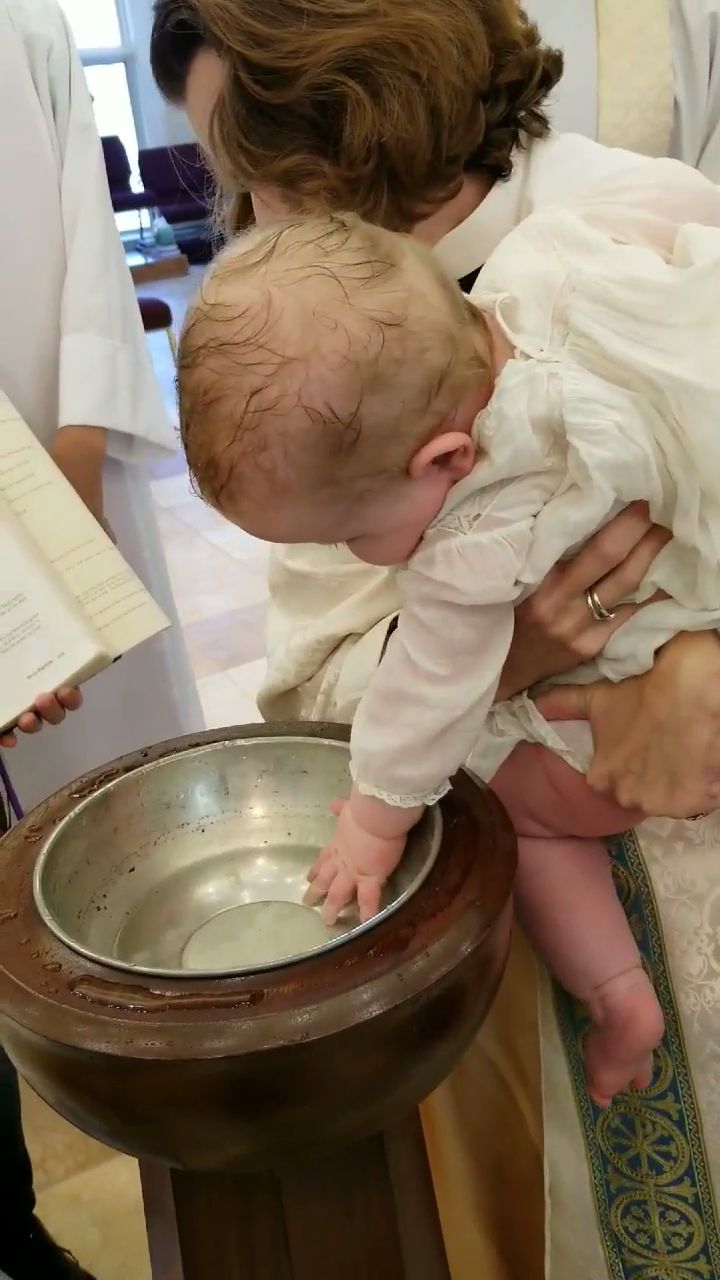
I am struck this year, particularly as we baptize little Melody, how glad I am that we get Joseph’s story this Advent as opposed to Mary’s.  On baptism Sundays with children, we have two realities.  The first reality is the adorable, belovedness of the child, the glossy photos with family and fonts, the perfect hopefulness of initiating a child of God into the family of faith.  We often skim over the second reality.  We will hear right at the beginning of the baptism some questions for the family about renouncing Satan, evil powers of the world, and sinful desires.  I often joke with the family how inappropriate talking about evil seems at a child’s baptism until you remember those painful sleepless nights of new parenting.  But the reason we talk about that second reality is because we are initiating someone into the life of faith, and for those of us who have been at the life of faith for a while, we know the life of faith is not all roses, glossy photos, and cake.  There will be real struggles.

And that is why I love that we start off Melody’s journey with a story about Joseph.  We are told Joseph is a righteous man.  He is devoted to God and lives an ethical life.  He represents reality number one of baptism.  But then, Joseph is presented with reality number two.  When he learns Mary is pregnant before their marriage is consummated, he has three options:  the harsh one would be to have her publicly held responsible, most likely by stoning; the generous one he plans to choose of quietly divorcing her, which saves her life, but will leave her in poverty with child in tow; or the unheard of third one, especially for a righteous man, of marrying her anyway and living forever in scandal.  As one scholar explains, “In choosing Joseph to be Jesus’s earthly father, God leads a righteous man with an impeccable reputation straight into doubt, shame, scandal, and controversy…[God] requires Joseph to embrace a mess he has not created, to love a woman whose story he doesn’t understand, to protect a baby he didn’t father, to accept an heir who is not his son.  In other words, God’s messy plan of salvation requires Joseph – a quiet, cautious, status quo kind of guy – to choose precisely what he fears and dreads the most.  The fraught, the complicated, the suspicious, and the inexplicable.”[i]

I would much rather Melody start her faith journey off with a story that lets her know, honestly and unequivocally, how messy this journey will be.  We have a hint of that messiness in Matthew’s gospel from the beginning.  In the verses before what we heard today, is a long list of Joseph’s forefathers: from Abraham, who almost kills his son Ishmael and twice risks the life and safety of his wife Sarah, to Jacob, the trickster who steals his inheritance and livelihood twice, to David, who steals another man’s wife and has her husband murdered, to Tamar, who pretends to be a sex worker, and Rahab who is one.  The genealogy of Christ is a “long line of broken, imperfect, dishonorable, and scandalous people.”  As Debie Thomas explains, “The perfect backdrop, I suppose, for God’s relentless work of restoration, healing, and hope.”[ii]

That’s what telling Joseph’s story does for Melody and all of us today.  Joseph reminds us that our faith journey will be messy.  Our faith journey will not take us where we think our journey will.  Our faith journey will invite us to love people we never thought we could.  Our faith journey will sometimes seem meaningless or small, like that Joseph’s chapel in the Holy Land.  But as the angel tells Joseph, so the angel of the Lord tells us today, “Do not be afraid.”  Do not be afraid of the messiness of this journey.  Do not be afraid of going where society may deem too messy.  Do not be afraid to love with abandon, even if your loving is not seen by the crowds, or recognized all over the world.  When we come out of the waters of baptism, we walk right into the mess – because the mess of the world is where God is.  And we want to be there too.  Amen.


[i] Debie Thomas, Into the Mess & Other Jesus Stories:  Reflections on the Life of Christ (Eugene, OR:  Cascade Books, 2022), 12.

[ii] Thomas, 13.

Sermon – Isaiah 58.9b-14, P16, YC, August 21, 2022

05 Wednesday Oct 2022

Posted by jandrewsweckerly in Sermons

≈ Leave a comment

Tags

baptism, church, community, darkness, Episcopal Church, faith, Jesus, journey, light, messy, salvation, Sermon, water

Last night, we baptized Becky Breshears in the waters of the Chickahominy River.  When most of us think of baptism, we imagine the baptism of an infant or child, someone for whom godparents make promises to raise in the life of the faith, much like we did with baby Olivia a few weeks ago.  The sacrament of baptism for a child is certainly considered being fully initiated into the family of Christ, but we make pronouncements and promises on behalf of the baptized.  And as the baptized grows up, we continue to shepherd and guide her, answer her questions, and help her claim her faith as her own.  There is an endearing, almost romantic, notion to baptism, full of idealism and hope. 

At least, that seems to be true in Episcopal Churches, where we quite primly and gently pour water from beautiful fonts over the heads of babies – the messiest part being if the water accidently runs into the baby’s eyes.  Of course, adult baptism is totally normal in our tradition too, we just do not do adult baptism as frequently.  When we do adult baptism, we become much more like other denominations, who have always understood baptism to be a mature proclamation of one’s own faith.  In some ways an adult baptism is more exciting because an adult baptism is not about something we hope and pray will develop into a faithful life, but adult baptism is the fully developed proclamation now – a set of pronouncements and promises on one’s own behalf.  An adult baptism is bold, dramatic, and, especially in instances like last night, much messier!

But adult baptism, especially in the Episcopal Church, are not about proclaiming one has her faith life all figured out – that she has some sense of earned clarity and certainty that has led her to baptism, as if baptism is the end of a journey of discernment.  Quite the opposite; baptism is a beginning for Episcopalians.  The baptized does not proclaim she knows all there is to know about faith and salvation.  Instead, the baptized claims that she is starting a new journey with Jesus, with a community of faith who walks with her.  And part of the act of baptism is giving the newly baptized tools to walk that journey.

That’s why I love the lesson from Isaiah today.  Instead of scripture capturing a moment (like a baptism), scripture today tells us what the baptized journey will be like.  Isaiah describes five things that are critical to the life of baptism.  First, the faithful will “remove the yoke from among you” – or in modern language, be an agent of economic liberation for the oppressed, not taking advantage of others.  Second, the faithful will refrain from “pointing the finger,” or take responsibility for one’s own actions, not accusing others but acting to change the self.  Third, the faithful will “refrain from speaking evil,” because “speech, when it is careless or deceitful, can be destructive and injurious.”[i]  Our words have power and are to be used for good.  Fourth, the faithful are to “offer food to the hungry.”  The life of the faithful is a life of self-sacrifice and sharing what we have learned to call our own.  And finally, we are to “satisfy the needs of the afflicted” – not just helping others or solving their problems but letting the disadvantaged “define their own needs and letting them set the criteria for deciding whether our help is effective.”[ii]

What the prophet Isaiah tells us is that as the faithful, we structure our lives differently than the secular, self-interested world might have us live.  That includes honoring even the sabbath – this holy day, not as just a day to go to church (though I hope you all will regularly – either in person or online), but also to be a day of honoring God through letting go of the self and focusing on the Lord and on the cares of those in need.   That’s why in our gospel lesson Jesus’ actions of healing others on the sabbath is so controversial – because Jesus reminds us the sabbath is a day of selflessness, healing, and giving glory to God.

Last night, Becky committed herself to that life, and we, as fellow baptized recommit ourselves this very day, to a life lived differently – a life lived in the light of Christ.  The prophet Isaiah tells us that when we live faithful lives, our light shall rise in the darkness, the Lord will guide us continually, will satisfy our needs in parched places, make our bones strong, and we shall be like a watered garden – a spring – whose waters never fail.  We shall be repairers of the breach, restorers of the streets to live in. 

Earlier I used the language of self-sacrifice.  What the Holy Spirit does in baptism and what the Church tries to continue to do on every sabbath is relocate the self from the center of our universe and place us firmly within a community of faith who cares for one another while placing God in the center of our universe.  When we take that step in baptism or renew the step our parents took for us, and in gathering in weekly worship (whether gathering in person or gathering virtually), we commit not to having this faith thing figured out – but just that we want to live a life where our parched places are always quenched through the living waters of baptism, and where our lives become bigger than they have ever been – where our lives shine the light of Christ in the darkness.  Amen.


[i] Jon L. Berquist, “Exegetical Perspective,” Feasting on the Word, Yr. C, Vol. 3, Supplement for P16 (Louisville: Westminster John Knox Press, 2010), 4.

[ii] Berquist, 4.

On Merry, Messy Christmases…

22 Wednesday Dec 2021

Posted by jandrewsweckerly in reflection

≈ Leave a comment

Tags

abundance, blessing, Christmas, horrible, Jesus, joyful, juxtaposition, merry, messy, perfect

Photo credit: https://myharvestchurch.ca/messy-christmas/

Christmas as a pastor is not really like Christmas for most people.  Just ask any preacher’s kid.  While their peers are taking long road trips, fun vacations, or at least doing fun activities like making gingerbread houses, going to the movies, or baking cookies, the fun in a pastor’s home does not really begin in earnest until all the church services are done – and after a requisite nap for said pastor. 

But that is just surface stuff.  The harder part for clergy is holding in tension the reality of Christmas.  The secular world would have you believe Christmas means perfectly decorated trees stuffed with tons of perfect presents, hearths dressed in elaborate greenery, family traditions that always bring joy, and gatherings around meals with people who are happy to be together. 

But clergy are the ones who hear throughout Advent about those dealing with health crises, those struggling with the pending death of a loved one, those whose marriages are crumbling, those struggling to make ends meet, and those who are in the fog of depression and anxiety.  Clergy are also the ones who celebrate weddings, the births of babies, the good grade on an exam, the new relationships or reconciled family member, and the unbounded joy of a child waiting to open gifts.  The juxtaposition of the messy, horribleness of life and the joyful, abundance of life is never sharper than at Christmas – where societal and personal expectations are high, and where reality never reaches perfection. 

The irony, though, is that the actual Christmas story is just about that – a juxtaposition of messy horribleness and joyful abundance:  where governments are oppressing the poor financially, where pregnancies are scandalous, where birthing rooms are inadequate; all while the poor receive good news, where the lowly birth the mighty, and where community and goodness is shared among strangers.  This year, still slogging through a long season of pandemic and political strife, I pray that you might see the Christmas story clear-eyed – taking off the rose-colored glasses, and seeing with fresh eyes the messy, ugly, beautiful story of Christmas.  Christmas blessings my friends!  I see you, I love you, and more importantly, so does Jesus.

On Baptisms, Babies, and Blessings…

16 Wednesday Jun 2021

Posted by jandrewsweckerly in reflection

≈ Leave a comment

Tags

absence, babies, baby, baptism, blessing, creation, family, God, loud, messy, mystery, pandemic, sacred, touch, vulnerability, wonder

Photo credit: Kim Edwards; reuse with permission only

I was never really a baby person:  I did not do much babysitting as an adolescent; except for my little brother, there were not a lot of babies around me growing up; and I was just never all that jazzed about babies.  They seemed delicate, loud, messy, and mysterious.  I never had maternal urges in early adulthood, and my friends found constant amusement in any scenario where the question arose about who should take care of a baby in a pinch – obviously, the baby should not come my way.  But the time my husband and I were engaged, we were not even sure we wanted to have children.

Then in my early thirties, a switch flipped and I realized, in fact, I did want children.  I still was not sure about other babies, but I was excited about my own.  But then a funny thing happened.  I was ordained a deacon when I was about seven months pregnant.  What I did not realize was once you are ordained, you handle babies a lot – in baptisms, in walking moms through pregnancies and births, and even in the receiving line at church.  Once I went through babyhood with my own daughter, and she was no longer at that lovely, innocent stage, I realized my vocation included mothering a lot of other babies.  It has become one of my favorite parts of ministry because it is a glimpse into the wonder and mystery of creation and the grandeur of our God.

So, you can imagine, when this pandemic hit, among the myriad reasons my heart hurt was not being able to interact with babies.  Our church had babies born during the pandemic and it killed me to not be able to welcome the baby at the hospital and give the baby and family their first blessing.  My heart ached to see baby photos on social media and know the babies were growing up without the church surrounding them in love.  But mostly, my arms palpably felt the absence of holding babies, swaying to keep them calm, and smelling their unique baby scent.

As we slowly come out of this pandemic, I am keenly aware of the privilege of holding babies again.  At a recent wedding I tentatively asked a guest, who I did not know, if they would like me to hold their baby to give them a break.  When they quickly passed me the baby, my face lit up.  Last Sunday, when I finally got to hold the baby we had prayed for all during her time in the womb, I was elated.   And as we approach two more baptisms this weekend, I could not be more excited to make those special connections – even though they are not really babies anymore!  One of the blessings of the rise in vaccinations is enjoying the sacred honor of touch, of experiencing vulnerability and innocence, and of redefining the boundaries of family.  This week I give thanks for the abundance of love and joy.  May you all find your own encounters with the holy this week!

Sermon – Matthew 18.21-35, Genesis 50.15-21, P19, YA, September 13, 2020

17 Thursday Sep 2020

Posted by jandrewsweckerly in Sermons

≈ Leave a comment

Tags

cross, defensive, forgiven, forgiveness, God, heal, Jesus, messy, Peter, reconciliation, Sermon, sins, time, unforgiveable

Forgiveness is a funny thing.  Forgiveness is at the heart of our gospel proclamation.  We regularly talk about how Jesus the Christ died for the forgiveness of our sins.  We spend six whole weeks in Lent repenting of our sins, making the long journey toward Good Friday and the empty tomb, where our sins are forgiven.  We want to be forgiven.  We admire others’ displays of forgiveness – retelling stories of victims who should never have to forgive, but somehow valiantly do.  We sometimes condescendingly tell others they should forgive.  We even ardently require our children to accept apologies, without really explaining what forgiveness is.  But when we are facing an injustice, an injury, an event that pierces our heart when remembered, and we are told to forgive, our immediately response is, “Whoa, now!”

Perhaps that reaction is at the heart of Peter’s inquiry today.  The disciples and Jesus have been talking about reconciliation within the community of faith when someone has harmed another.  At the end of that conversation, Peter wisely asks, “Yeah, but how many times do I actually need to forgive someone.  Seven times should be plenty right?  That’s a good, holy number.”  And Jesus says, “Seventy-seven times,” or as some translators say, seventy times seven.[i]  Whichever number we use, Jesus is not just setting some higher number to track; Jesus is saying forgiveness must be offered constantly, in an ongoing way.

The problem when we talk about forgiveness is we can think of endless examples of things that should be unforgiveable.  In our news streams this week, we saw conversations about institutional racism, stemming from the centuries-long practice of slavery in our country; we remembered the horror of September 11th and the thousands of people who died, were traumatized by, or whose health was permanently impacted by that event; we saw cases of abuse by spouses or those in positions of power.  And that is just on the meta-level.  In truth, even on the micro-level, we struggle.  We struggle with those instances where someone hurt us personally – the breaking of our trust or the hurtful things said and done by friends, family, or even strangers.  When we need to be the agents of forgiveness, somehow our gilded concept of forgiveness begins to crack.

Part of the problem is our definition of forgiveness.  When we talk about forgiveness, we forget to talk about what forgiveness is not.  Debie Thomas does an amazing job of walking us through what forgiveness is not.  Forgiveness is not denial:  pretending an offense does not matter, the wound does not hurt, we should just forget, or our merciful God cannot be angered or grieved.  Forgiveness is not a detour or shortcut:  forgiveness cannot be offered without repentance, discipline, and confession – there is no grace without the cross.  Forgiveness is also not synonymous with healing or reconciliation:  healing can take a long time and sometimes reconciliation is not possible – in this way, forgiveness is a beginning, not the end.  Finally, forgiveness is not quick and easy:  forgiveness is a non-linear, messy process, that takes time.[ii]

When we let down our defensiveness about forgiveness, we can see those same lessons in Holy Scripture today.  In our Old Testament lesson, Joseph’s brothers come to him after their father’s death, fearing Joseph will finally enact justified revenge for them selling him into slavery.  Now, Joseph has already forgiven the brothers before his father’s death – and is explicit about his forgiveness.  But the brothers know what we just talked about – forgiveness is not quick and easy.  They fear Joseph’s forgiveness has limits.  And in our Gospel lesson, when Jesus uses a parable to talk to Peter about forgiving seventy times seven, he does not tell a story about someone forgiving again and again.  Instead he tells the story of a man forgiven an unimaginable debt – one he could never have paid off in his lifetime, who then refuses to show forgiveness to another in a much smaller, manageable debt.  The parable highlights how forgiveness is not denial – how God is merciful, but can still be angered by our actions.

As one scholar reminds us, “Forgiveness is hard, really hard.  But the good news is that where God calls, God also equips.  God gives us in Christ the gift of forgiveness and helps us to share that gift with others.  And in doing so, God opens doors that are shut.  God opens a future that is shut.  By forgiving those who have sinned against us, we do not allow the past to dictate our future.  Forgiveness breaks the chains of anger and bitterness and frees us to live new lives.”[iii]  The hard work of forgiveness is no joke.  Forgiveness takes time, is hard, and is a winding path.  But the cross of Christ enables us to keep going, enables us claim love – not a love that relativizes evil or negates the justice that is also of God – but a love that can transform both the oppressor and the oppressed – can heal both us and them.  And Jesus tells us today that despite the fact forgiveness is hard, forgiveness is also work we can do through him.  Thanks be to God.


[i] Lewis R. Donelson, “Exegetical Perspective,” Feasting on the Word, Year A, Vol. 4 (Louisville: Westminster John Knox Press, 2011), 69.

[ii] Debie Thomas, “Unpacking Forgiveness,” September 6, 2020, as found at https://www.journeywithjesus.net/lectionary-essays/current-essay?fbclid=IwAR1uTVaenGNYgJX-mpph8V_97k_S-kIWEbuuSMwkzJKLohX0XbYvuveEk9k on September 11, 2020.

[iii] Kathryn M. Schifferdecker, “Forgiveness is at the Core,” Setpember 6, 2020, as found at http://www.workingpreacher.org/craft.aspx?post=5454 on September 11, 2020.

On Thanksgiving and Imperfection…

04 Wednesday Dec 2019

Posted by jandrewsweckerly in Uncategorized

≈ Leave a comment

Tags

God, gratitude, imperfect, love, messy, perfect, ritual, shadow, sinner, Thanksgiving, Thanksgiving Day

Norman Rockwell Thanksgiving

Photo credit:  https://www.saturdayeveningpost.com/collections/thanksgiving/

The last two weeks have been marked with rituals of thanksgiving:  a community ecumenical Thanksgiving service at the local Roman Catholic Church, Holy Eucharist on Thanksgiving Day at Hickory Neck, dinner and visiting with my dad, and, today, offering the benediction at the 400th anniversary of the first official English Thanksgiving in North America.  The rituals have all been tremendous blessings and ways to center and ground life in gratitude, a practice that can sometimes fall to the wayside in the busyness of life.

However, what has struck me about this season of gratitude is how imperfect it has been.  Often when we think of Thanksgiving Day, we immediately picture Norman Rockwell’s famous painting of the perfect meal.  But as I checked in with people and as I watched those around me, I realized nothing about this season of thanksgiving has been perfect.  I had parishioners who just welcomed a baby a few days before Thanksgiving Day and had resigned themselves to having Chinese so that no one would have to cook or stress about taking the newborn out.  I heard stories of family drama over the menu for the day.  My own family was coming off a few hospitalizations so resigned ourselves to dinner out – which then got foiled by a two-hour wait, with a wait staff that looked like they wanted to be home with their own families.  The music and collaboration of clergy was beautiful last week, but we hold in tension our denominational differences.  Even the anniversary celebration today is consciously honoring the ways in which the histories of American Indians, African-Americans, and English-Americans bring a shadow over our celebration.

As I have been pondering this imperfection, this disconnect between our ideal of perfected thanksgiving rituals and the reality of the messiness of life, I have actually found deep spiritual comfort.  Nothing about our lives is perfect.  We are all sinners, trying to be better versions of ourselves.  Even our offering of thanksgiving is imperfect.  But the love of God is perfect.  God sees our messiness and loves us anyway.  God sees the ways we hurt each other, the ways we argue, the ways we are rude or unkind, the ways that we cannot always honor our rituals, and God loves us anyway.  In fact, I sometimes wonder if God doesn’t prefer our imperfection, for in confessing our imperfection, we are fully honest, fully vulnerable, and fully trusting of God.  We bring our real selves to God, and it is there that we give the most heartfelt thanksgiving.  We feel, know, and experience God most powerfully in those moments of imperfection.

This week, I invite you to continue your practice of gratitude with God and one another.  In our thanksgiving, we are not just thanking one another for appearance’s sake, but we are thanking one another in fullness, in love, and in generosity.  Use this week to find people to thank – for the big things and the very tiny things.  My guess is we may all start working toward the perfection of God’s love with each act of thanksgiving.

Sermon – Matthew 1.18-25, A4, YA, December 18, 2016

21 Wednesday Dec 2016

Posted by jandrewsweckerly in Sermons, Uncategorized

≈ Leave a comment

Tags

ancestors, beautiful, call, calling, discernment, God, Jesus, Joseph, life, listen, messy, ordination, righteous, scary, Sermon

This week, I have been thinking a lot about callings.  Of course, with Charlie’s ordination to the priesthood this weekend, thinking about callings is not unusual.  I have always enjoyed ordinations – and not just because I am a priest.  I remember the first ordination I went to there were six people being ordained.  I only knew one of the six because she was our new assistant at the Cathedral.  But I remember being awed by the service.  The six ordinands seemed set apart.  As they processed down the aisle, wearing their simple albs, I remember wondering how they came to be called as priests, imagining they must have led a special life or be particularly holy.  I remember the swarms of clergy who gathered up front to lay hands on the new priests.  I remember how the new priests somehow seemed bathed in light that day – as if they had some special connection to the holy.

Having been through the ordination process myself, I look at ordinands a little differently today.  Instead of seeing perfectly pious priests processing, I see people who have come through a great ordeal.  I imagine the countless nights of struggling with God about why in the world they should become priests.  I imagine the stressful meetings with bishops, priests, and committees and the ambiguity about what would happen.  I imagine the exams, the sense of failure after messy pastoral visit, and the countless “no”s that come along in the process.  I no longer see perfectly coifed new priests, but instead see the haggard, raw, vulnerable people who have said, “yes,” to what promises to be a life of hard, beautiful, ugly, blessed days.   In that way, I do not see the ordained as all that different from the rest of us – a vulnerable group of people who are trying to figure out what in the world God wants us to do with our lives.

That is why I love that we hear Joseph’s story today.  Most of us think of Joseph as the stable, quiet figure in Jesus’ life.  He is present on the holy night of Jesus’ birth.  He protects Jesus from Herod by fleeing to Egypt.  He teaches Jesus a trade.  He accepts the mighty task of raising a child that is both his own and not his own.  In our minds, he is a righteous, quiet, solid man of faith.

While all of those things may be true, what they miss is the mess of his life behind the scenes. [i]  Joseph is a typical man of faith, righteously living his life, betrothed to a faithful, promising young woman.  He is quietly living his life when his world gets turned upside down.  His betrothed becomes pregnant, which must mean she has been unfaithful, and in Joseph’s time, that means his soon-to-be wife must either be stoned or divorced immediately.[ii]  Trying to overcome this tremendous disgrace and disappointment, Joseph discerns the best, most gracious path forward.  And just when he has settled what is next, God comes along, and flips his world upside-down again.  Now Joseph is supposed to not only believe that Mary is magically pregnant through the Holy Spirit, but he is also to stay with her and take the baby in as his own.  And based on scripture, we know once Jesus hits the teenage years, Joseph’s story disappears altogether.  Even though God calls Joseph to do this tremendous, hard, messy, but beautiful thing, Joseph does not get the spotlight for long.  He goes about his everyday life, living out his calling, relatively unnoticed by the world.

One of the things I have loved about mentoring people over the years is seeing just that same phenomenon.  Throughout our lives we have distinct seasons of discerning call.  Sometimes those moments are obvious:  graduating from school, trying to find a job, figuring out how to spend time in retirement.  The pattern seems to go a little like this:  we hit a point where we need to discern what God is calling us to do; we go through a process of discernment, sometimes formal, but usually informal; we make a decision and take the necessary steps to follow that path; and eventually we look back.  In looking back, we rarely find that the call we heard and answered leads us to where we expected or wanted.  Invariably, there are twists and turns we never could have anticipated.  Invariably, there are failures scattered throughout the successes.  Answering a call is never a simple, clean, or easy process.

Just this week, I was reading about a young man from North Carolina who happened to see a traveling ballet company at his church at age seven.  Four years later, he found himself practicing six days a week.  He eventually joined the New York City Ballet.  He says, “I’ve always seen ballet as my way of serving God.  I think it’s what God has called me to do.”[iii]  What I love about this young man’s story is that whether you are a ballet dancer, cabinet maker, housekeeper, or financial manager, at some point, God has called you to that work for a reason.  The ballet dancer admits he sacrificed a lot to follow his call.  I imagine he failed a lot before he succeeded.  And some day, his body will no longer be able to dance, and he will have to figure out what else God is calling him to do.  His story is the messy, beautiful, challenging story of call we all live.

And if we have never struggled with discerning our professional calling, we have certainly struggled to understand what God is doing in our personal lives.  Though we are approaching a season of joy and merriment, I know there are many of us who are facing medical diagnoses whose purpose we do not understand.  There those among us who are living in relationships – romantic, familial, or otherwise – that are at times loving, hurtful, confusing, and life-giving.  And there are those of us who feel lost, lonely, or restless, even though everything in our lives seems to be moving along well on the outside.  God is in the midst of the personal too – calling us, challenging us, and shaping us.

If we were ever unsure about God’s presence in our messy professional and personal calls, Joseph stands ready to remind us.  He too faces a medical diagnosis that changes his world – a pregnancy that he did not plan, or even participate in, that changes the course of his life forever.  He too faces a relationship that seems broken.  Even when he feels as though he is choosing a kind, compassionate, and righteous decision, God calls him to take another path.  Joseph too understood what feeling lost is like.  Just because an angel tells him to take in Mary and adopt the child as his own, I doubt that things are easy sailing at home, on that journey to Bethlehem, or even after Jesus’ birth.  Though Joseph is listening to God and following God’s call, he is never promised a simple, peaceful, happy life.

So why do we do it?  Why do we listen to God’s call for us if we have no guarantees of a happy, smooth, or peaceful life?  We follow God’s call because we have experienced that sense of dis-ease when we do not follow God’s call – that sense that we are not using all the gifts God has given us, or that discomfort that comes from trying to force what we “should” do in life with what God calls us to do in life.  We follow God’s call because we have experienced the tremendous grace that comes from answering God’s call.  Sure, the road is messy, and hard, and sometimes frustrating.  But the road is also full of beautiful surprises, wonderful accidents, and joyful confirmations that we are right where God wants us.  And we follow God’s call because we are part of a people who have always followed God’s call:  from Abraham, to Moses, to Esther, to Jonah, to Mary, to Joseph.  Our ancestors have taught us that when we say “yes,” God does indeed turn our lives upside down.  But our ancestors have also taught us that in the midst of that topsy-turvy turmoil is where we find out truest selves, where we meet the world’s deepest needs, and where we find ourselves in Christ’s light and love.  So, do not be afraid.  God is with us.  God is with you.  Amen.

[i] David Lose, “Matthew’s Version of the Incarnation,” December 17, 2013, as found at http://www.workingpreacher.org/craft.aspx?post=2961 on December 14, 2016.

[ii] Douglas R. A. Hare, “Exegetical Perspective,” Feasting on the Word, Yr. A, Vol. 1 (Louisville:  Westminster John Knox Press, 2010), 93.

[iii] Quote and story from Humans of New York, December 12, 2016, at http://www.humansofnewyork.com/post/154395391126/i-was-first-exposed-to-ballet-at-the-age-of-seven, as found on December 14, 2016.  Photo by Brandon Stanton.  Subject unnamed.

← Older posts

Recent Posts

  • On the Myth and Magic of Advent…
  • On Risking Failure and Facing Fear…
  • Sermon – Luke 23.33-43, P29, YC, November 23, 2025
  • On Inhabiting Gratitude…
  • Sermon – Luke 20.27-38, P27, YC, November 9, 2025

Archives

  • December 2025
  • November 2025
  • October 2025
  • September 2025
  • August 2025
  • July 2025
  • June 2025
  • March 2025
  • February 2025
  • December 2024
  • November 2024
  • October 2024
  • September 2024
  • August 2024
  • July 2024
  • June 2024
  • May 2024
  • March 2024
  • February 2024
  • January 2024
  • December 2023
  • November 2023
  • October 2023
  • September 2023
  • August 2023
  • July 2023
  • June 2023
  • May 2023
  • March 2023
  • February 2023
  • January 2023
  • December 2022
  • November 2022
  • October 2022
  • June 2022
  • May 2022
  • January 2022
  • December 2021
  • November 2021
  • October 2021
  • September 2021
  • August 2021
  • June 2021
  • May 2021
  • April 2021
  • March 2021
  • February 2021
  • January 2021
  • December 2020
  • November 2020
  • October 2020
  • September 2020
  • August 2020
  • July 2020
  • June 2020
  • May 2020
  • April 2020
  • March 2020
  • February 2020
  • January 2020
  • December 2019
  • November 2019
  • October 2019
  • September 2019
  • August 2019
  • July 2019
  • June 2019
  • May 2019
  • April 2019
  • March 2019
  • February 2019
  • January 2019
  • December 2018
  • November 2018
  • October 2018
  • September 2018
  • August 2018
  • July 2018
  • June 2018
  • May 2018
  • April 2018
  • March 2018
  • February 2018
  • January 2018
  • December 2017
  • November 2017
  • October 2017
  • September 2017
  • August 2017
  • July 2017
  • June 2017
  • May 2017
  • April 2017
  • March 2017
  • February 2017
  • January 2017
  • December 2016
  • November 2016
  • October 2016
  • September 2016
  • August 2016
  • July 2016
  • June 2016
  • May 2016
  • April 2016
  • March 2016
  • February 2016
  • January 2016
  • December 2015
  • November 2015
  • October 2015
  • September 2015
  • August 2015
  • July 2015
  • June 2015
  • May 2015
  • April 2015
  • March 2015
  • February 2015
  • January 2015
  • December 2014
  • November 2014
  • October 2014
  • September 2014
  • August 2014
  • July 2014
  • June 2014
  • April 2014
  • March 2014
  • February 2014
  • January 2014
  • December 2013
  • November 2013
  • October 2013
  • September 2013
  • August 2013
  • July 2013
  • June 2013
  • May 2013
  • April 2013
  • March 2013
  • February 2013
  • January 2013
  • December 2012
  • November 2012
  • October 2012
  • September 2012

Categories

  • reflection
  • Sermons
  • Uncategorized

Meta

  • Create account
  • Log in
  • Entries feed
  • Comments feed
  • WordPress.com

Blog at WordPress.com.

  • Subscribe Subscribed
    • Seeking and Serving
    • Join 394 other subscribers
    • Already have a WordPress.com account? Log in now.
    • Seeking and Serving
    • Subscribe Subscribed
    • Sign up
    • Log in
    • Report this content
    • View site in Reader
    • Manage subscriptions
    • Collapse this bar
 

Loading Comments...