• About

Seeking and Serving

~ seek and serve Christ in all persons

Seeking and Serving

Tag Archives: new

On Risking Failure and Facing Fear…

03 Wednesday Dec 2025

Posted by jandrewsweckerly in reflection

≈ Leave a comment

Tags

anxiety, challenge, failure, fear, God, growth, hesitant, Holy Spirit, invitations, Jesus, joy, new, risk, try, yes

Photo credit: https://stock.adobe.com/search?k=parachute+jump+plane

I was listening to a podcast this week that was talking about how, as they mature, adults have a harder time trying new things because they have a deeper understanding, and perhaps fear of, failure.  Children don’t have this same hesitancy.  They try new things, figure out what works and what doesn’t, and keep at it.  There is a freedom in their development that allows them not to hold back or be afraid, but to keep trying out new experiences and challenges.

As one of my daughters ages, she is heading into that in-between time where she doesn’t have the same innocent willingness to try and fail, and is starting to understand that failures or inadequacies are sometimes noticed by others negatively.  She is trying out a new extracurricular this fall, and hated the first session.  As we headed into the second session, she pulled out all the stops about why she shouldn’t have to go back:  she wasn’t good enough, people weren’t nice, she would bring down the group through her inexperience.  In a moment of weakness, I almost caved.  I know how big those feelings are.  I palpably remember the anxiety that kind of experience brings, and I wanted to protect her from that hurt. 

When she came out of the second practice, she was a different person.  She was smiling, had a lightness to her step, and a warmth about her.  “That was fun!” she said.  As I listened to her describe the session, I was overwhelmed with two realizations.  First, I realized how close I came to cutting off a growth experience – how she would have never had learned the feeling of what it means to push through fear and find joy.  And second, I realized I needed to take a long look at where I am cutting off growth experiences in my own life.  Masked with the label, “wisdom,” how often do I fail to risk?

I wonder what growth opportunities are being presented to you today.  It doesn’t have to be something big or dramatically different.  Part of creating an openness to growth means being open to the little invitations – talking to a stranger when that’s not something you would normally do, reaching out for support when you don’t like feeling dependent upon someone, saying yes to an invitation to something that is not at all in your comfort zone but you admittedly have never tried to know for sure.  Those yeses prepare us for the yeses the Holy Spirit desires in each of our lives.  Those invitations are often God’s quiet invitations into God’s joy.  Those experiences are often pathways to the incarnate Jesus in your life.  I can’t wait to hear what you say yes to this week!

Sermon – Matthew 5.17-19, UJCCM Ecumenical Service, March 26, 2025

18 Wednesday Jun 2025

Posted by jandrewsweckerly in Sermons

≈ Leave a comment

Tags

Christian, dignity, ecumencial, follow, Jesus, love, new, political, Sermon, subversive, witness

Several years ago, I was in a Bishop Search process.  Ordinarily, I do not recommend the process – in fact, I often actively discourage the process, because in our Episcopal tradition, the search is very public, exacting, and takes a toll on your parish, even when they are cheering you on and supporting you.  But if I enjoyed anything from the experience, I enjoyed the opportunity to take a wider look at the Church – a wider look at this endeavor we are all undertaking, called being Christian.  One of those defining identity moments happened in one of the public interviews.  A church member at one of the local churches said to me, “Our current bishop is very active politically.  Would you as a bishop continue that political activity, or would you focus on following Jesus?” 

Now we all know that the county our ecumenical group is situated in is decidedly “purple” politically.  I haven’t really asked your clergy about your individual churches, but I know Hickory Neck is also a very “purple” congregation – I often joke that if you took a look at the bumper stickers in our parking lot you would wonder how in the world we peacefully worship every Sunday.  In fact, my own church members have often heard me say that we don’t preach politics, we preach Jesus.

The trouble with that dichotomy is that although Jesus was not a democrat or a republican, he was inherently political.  He lived and breathed in a politically loaded time – something with which we are very familiar.  And although he may not align with our current political parties in the United States, his actions and words have political ramifications on how we live as Christians. 

Now why in the world, on this Wednesday right in the middle of Lent, in the middle of our beloved peacefully ecumenical gatherings would I bring up something divisive?  Well, I blame Jesus.  The gospel lesson we just heard from Matthew is only three verses long.  But in order to understand what is going on, we need to step back just a bit to recall where we are in Matthew’s gospel.  Chapter five of Matthew starts with the beatitudes, and is just the beginning of what we call the Sermon on the Mount – Jesus’ sort of treatise on how to be a Christian – or even more clearly, the answer to “What would Jesus do?”  So, Jesus sits down for an extra long sermon (or at least long for Episcopal standards – I know some of your traditions love a good 30-minute to hour-long sermon!).  He starts with those beloved beatitudes, letting us know where true blessing lies.  He then moves on to talk about being salt and light as disciples in the world.  And then he talks about the law in the portion we heard tonight.

Before we get too far, we have to remember that conversations about the law (not the Roman law, but the very law we heard about in Deuteronomy tonight) – conversations about the law needs to be very careful.  Many a scholar has tried to use this passage to argue the supersessionism of the Chrisitan Church over the Jewish people – as though by Jesus saying he came to fulfill the law that now Christians supersede the Jewish people as God’s chosen.  Jesus has been confusing followers for centuries by this statement – theologians as distinguished at Thomas Aquinas tried to separate the types of law, arguing that we need to follow the moral law, but not the juridical or ceremonial law of the Old Testament.[i]

That is not what Jesus is arguing in these three short verses.  Jesus never intended to bifurcate the faithful in such a way.  Just like Jesus was not saying be a republican or be a democrat, Jesus is saying be a person of faith.  In the verse following what we read today, Jesus says, “For I tell you, unless your righteousness exceeds that of the scribes and Pharisees, you will never enter the kingdom of heaven.”  Just like in our day, the faithful of Jesus’ day lived in a politically charged time.  As Stanley Hauerwas explains, “…too often Israel sought to be faithful in a manner that would not challenge the powers, and in particular the power of Rome.  The Pharisees quite understandably tried to observe the law without that observance being recognized as subversive to those who ruled them.”  Like in our day, they were not claiming a particular party, but claiming the faith.  Not preaching politics, but preaching Jesus.

But here’s the problem with that way of life – and quite frankly, the dichotomy that the person in that interview asked me about.  The kingdom of God cannot avoid being subversive.  We know this because Jesus was so subversive that he was crucified – because instead of “…violently overthrowing the old order Jesus creates a people capable of living in accordance with the new order in the old.”[ii]  What does that mean exactly?  Stanley Hauerwas tells us that fulfilling the law means creating a way of life that is unlike the world.  That way of life is voluntary:  you cannot be born into it, but can only join by repenting and freely pledging allegiance to its king (Jesus).  And the next generation is not automatically admitted – every member joins of their own volition.  Two, that way of life creates a mixed community:  racially, religiously, economically.  And finally, that way of life is, well, a new way of life.  Jesus, “…[gives] them a new way to deal with offenders – by forgiving them.  He [gives] them a new way to deal with violence – by suffering.  He [gives] them a new way to deal with money – by sharing it.  He [gives] them a new way to deal with problems of leadership – by drawing upon the gift of every member, even the most humble.  He [gives] them a new way to deal with a corrupt society – by building a new order, not smashing the old.  He [gives] them a new pattern of relationship between man and woman, between parent and child, between master and slave, in which [is] made concrete a radical new vision of what it means to be a human person…”[iii]

I do not know what your Lenten discipline has been this year.  Given the weight of the political environment, the anxiety floating around in the atmosphere, and the sense of radical challenge, doing things like giving up chocolate or screen time or meat has not felt, well, meaty enough for me this year.  I think part of the challenge has been the sober, somber nature of Lent has felt so congruent with the sober, somber nature of everyday living these days.  Perhaps why Lent feels so heavy is because I can see no way to answer that dichotomy of a question, “Will you be political or will you follow Jesus?” 

I do not think our invitation tonight is to leave this place planting our red or blue flags.  In fact, our invitation might just be carrying our purple flags out of this space while helping others see and experience Jesus.  The new way of life that Jesus laid out for us – of forgiving, suffering, sharing, empowering, building, relating – is not unique to one political party.  Our invitation is to support that new way of life through Jesus in all political parties – republican, democrat, independent, or whatever else you may be feeling tonight.  That new way of life is so subversive that members of your own party may challenge you, and like a Pharisee, you may want to be a Christian while not rocking the boat.  But following Jesus means rocking the boat.  Following Jesus means loving neighbors, caring for the less than, respecting the dignity of others.  Following Jesus means sometimes following him out of the boat into some scary, stormy waters.  But if we can sit together in this room – as Presbyterians, Methodists, Lutherans, Episcopalians, Baptists, Mennonites, Roman Catholics, and Disciples of Christ – surely we can step into those waters together outside of this room, witnessing another way…together.  Amen.


[i] Stanley Hauerwas, Matthew: Brazos Theological Commentary on the Bible (Grand Rapids:  Brazos Press, 2006), 65.

[ii] Hauerwas, 67.

[iii] Hauerwas, 67-68.

Sermon – Mark 6.1-13, P9, YB, July 7, 2024

17 Wednesday Jul 2024

Posted by jandrewsweckerly in Sermons

≈ Leave a comment

Tags

change, control, Episcopal Church, fresh, God, growth, Holy Spirit, Jesus, lane, limit, movement, new, Philadelphia Eleven, Sermon, uncomfortable

I realized recently that one of things I often say when I am asked how my family is doing is to offer a halfhearted compliment, “Everyone is staying in their lane.”   I think I started adopting that minimum standard, “staying in your lane,” because I have learned over the years how little control I have as a parent.  I may not be able to control what things my kids are interested in, I may not be able to control how well they perform in school, and I may not be able to control how they handle interpersonal relationships.  But if each family member is “staying in their lane,” then that means I have at least controlled their meddling with one another, their active misbehavior, or their making a scene anywhere else. 

That is what seems to be bothering the folks in Jesus’ hometown of Nazareth – Jesus is not staying in his lane.  At the beginning, there seems to be a modicum of respect for what Jesus is teaching in the synagogue – they compliment the wisdom he seems to have gained and the healing acts he has performed.  But the compliments end there.  Then the questions begin.  Where did he get this wisdom?  Isn’t he the carpenter’s son?  Isn’t he the son of Mary – a question dripping with criticism, as you would usually only refer to someone’s parentage through the father, not the mother.[i]  In other words, the people of Jesus’ hometown are basically saying, “Stay in your lane, Jesus!”

Passages like this can be so tempting for us.  We read about Jesus’ hometown and think, “Those silly folks from Nazareth!  They cannot see what God is doing right in front of them!”  As if “those” people and finger pointing is what the gospel calls for.  But when we start wagging our fingers at “those” people, we forget one kernel of truth about scripture:  we are always “those” people.”  Anytime something someone does in scripture makes us uncomfortable or sanctimonious, scripture is speaking straight to “us” not “those people.”  So, the people of Nazareth aren’t the only ones telling Jesus to stay in his lane.  We tell that to Jesus all the time.  When the Holy Spirit is calling us try a new ministry that feels daunting, we are tempted to tell Jesus to stay in his lane and let us do things our way.  When Jesus puts people in our lives that push us out of our comfort zones, we grumble to Jesus to stay in his lane and stop sending us prophets – I mean, annoying people.  When we hear that still, quiet voice speaking truth to us in places we like to keep in a box, we cut Jesus some nasty side-eye and tell Jesus to stay in his lane.

But as scholar Debie Thomas says, “The call of the Gospel is not a call to stand still.  It is a call to choose movement over stasis, change over security, growth over decay.”[ii]  Just last Sunday, we started a movie series about changemakers.  Last week, the film was The Philadelphia Eleven, the story of the unsanctioned ordination of the first eleven women in the Episcopal Church.  The vitriol of the bishops, clergy, and lay people who were opposed to those women’s ordination was shocking to the ears.  From the clergy person who stated with confidence, “Women can be anything they want – except a priest in God’s holy church.”  From the woman who lamented the ways those women had violated what God calls women to be and do in the world.  To the bishops held a public, scathing trial of the three male bishops who dared to ordain the first eleven.  The Philadelphia Eleven had waited time after time for the Episcopal Church to change – to chose growth, change, and movement instead of decay, security, and stasis.  And when the church refused to let these women out of their lane, the stepped out of their lane anyway.

Scholar Thomas concludes, “The scandal of the Incarnation is precisely that Jesus doesn’t stay in his lane.  God doesn’t limit God’s self to our small and stingy notions of the sacred.  God exceeds, God abounds, God transgresses, God transcends.  The lowly carpenter reveals himself as Lord.  The guy with the tainted birth story offers us salvation.  The hometown prophet tells us truths we’d rather not hear… [Jesus] will call out to us, nevertheless, daring us always to see and experience him anew.”[iii]  Our invitation today is let Jesus out of his lane in our life:  to not hold his lane as sacred, and to open ourselves to the ways his transgression of lanes is helping us to experience Jesus in new and fresh ways.  Maybe we do that in weekly worship, opening ourselves through song, prayer, and scripture to fresh experiences of God.  Maybe we come to the film series or Bible study this summer to see where God is exceeding, abounding, transgressing, and transcending.  Or maybe we let go of whatever boundary we are holding here at Hickory Neck to see what happens when we ask Jesus to please cross out of his lane.  The promise for us is a fresh experience of Jesus in our own day, time, and place.  Amen.


[i] Efrain Agosto, “Exegetical Perspective,” Feasting on the Word, Year B, Vol. 3 (Louisville:  Westminster John Knox Press, 2009), 215.

[ii] Debie Thomas, “Hometown Prophets,” June 27, 2021, as found at https://www.journeywithjesus.net/essays/3058-hometown-prophets on July 5, 2024.

[iii] Thomas.

On Celebrating Life, Death, and Movies…

04 Wednesday Oct 2023

Posted by jandrewsweckerly in reflection

≈ Leave a comment

Tags

bless, celebration, change, community, death, end, Episcopal Church, eternal life, finality, grace, growth, Holy Spirit, Jesus, joy, life, ministry, movies, new, past

Photo credit: https://www.cnn.com/2023/09/28/tech/netflix-dvd-rental-movies-ending/index.html

Well, it finally happened.  Netflix’s DVD business closed last Friday.  Now I recognize that acknowledging I still received DVDs from Netflix may make me seem old-fashioned.  Even a contemporary exclaimed recently, “Do people even have the equipment to play DVDs anymore?!?”  I took a good ribbing, but the truth is I love movies, and Netflix’s DVD business allowed me to watch movies that were not available via streaming services.  I was constantly finding new gems, and still had over 100 movies in my queue that I hoped to watch some day.

For those of us old-timers still watching DVDs, the closing of Netflix’s DVD branch has been tinged with nostalgia and a tiny bit of grief.  Over the course of 18 years, I watched 667 films, each story sparking my imagination, eliciting pleasure, sorrow, excitement, indignation, laughter, and hope.  Obviously there will be other ways for me to revel in the artistry of filmmaking, but there is a certain finality to the closing of this chapter. 

Despite my wistfulness, I commend Netflix for the way they have handled this change.  Instead of wallowing in grief, or attempting to apologize for market changes beyond their control, instead, they have handled this “death” with grace and joy.  Knowing the closing was coming, this year they used their iconic mailing envelopes to feature celebratory artwork honoring how a whole generation has been shaped by their service.  On the week of their closure, the sent a “gift” to every member – a summary of the highlights of our membership – what movies we had watched each year, milestones in our membership, and even the list of movies in our queue in case we want to find another way to see them.  Instead of a death, it has felt like a celebration of life.

In a lot of ways, it has reminded me of the ways the Episcopal Church approaches death.  When someone we love passes, we use the burial office to celebrate life – certainly the life of the one who has died, but especially the promise of eternal life promised in Jesus Christ.  But I’ve been thinking about it over this last week, and the Church honors “mini-deaths” all the time:  the ending of a ministry that is no longer needed or effectively utilized, the retirement of a ministry leader after a successful tenure, or the blessing of a parishioner or staff member who moves away from the community.  All those transitions can be hard because they make us remember fondly the ways ministry blessed us in the past.  But those transitions are also often the source of new life:  a new ministry we could never have imagined five years ago, a new leader whose fresh ideas opens up new opportunities, and new members who shape and mold us into a new community.

I wonder what things feel like they are dying in your life right now – what things you thought would always be there are undergoing change.  Where might the Holy Spirit be inviting you to see new shoots of growth in the midst of something withering on the vine?  How might those “mini-deaths,” be tremendous gifts to you or your community?  How might we take a cue from Netflix, and find ways to celebrate those endings with dignity and joy?  I am grateful for the ways a secular business is helping me see the sacred in our own life cycles.  Let’s celebrate together!

Sermon – John 9.1-41, L4, YA, March 19, 2023

29 Monday May 2023

Posted by jandrewsweckerly in Sermons

≈ Leave a comment

Tags

award, belief, blind man, confident, human, Jesus, journey, Lent, new, proud, repent, resist, Sermon, should

We are in the midst of award season.  Just last weekend, the Oscars grabbed our attention with surprising wins and disappointing losses.  This week College Basketball’s March Madness has us riveted again, with expected wins, surprising upsets, and underdogs to encourage.  Despite the vested interest I may have in some of these “award” events, I find myself most drawn to the human responses.  At the Oscars, and most award shows these days, they split the TV screen with the five nominees in order to help us capture the suspense and joy of the moment.  Later, in replays and online chatter, our attention gets redirected to those who do not receive awards:  were they gracious in their loss, do they visibly show their disappointment, or do they struggle to conceal their emotions?  The Big Tournament is not much different.  Every game could either be the last of the season or the last of a career for some students.  Like clockwork, players whose teams do not advance show a variety of emotions:  from the gracious loser who can genuinely say “good game,” to the victor, the player who looks angry about the loss – perhaps most angry at themselves, or the player who just breaks down in tears at a season or career suddenly gone. 

The worst part about the award season though is our reaction to those human responses.  We say things like, “She should have been happy to just be nominated,” or “Someone should have taught them about being a good sportsman?”  Our shift from understanding to a finger-pointing-should happens almost instantaneously.  Sadly, when we are given the vivid stories we have been given these last three weeks in John’s Gospel, we do the same thing in Scripture.  I can imagine the thoughts that were bouncing around in our heads during that long gospel lesson:  How could the disciples, of all people, assume someone sinned just because he is blind?  How dare those parents just abandon their son – they should have been leading the healing celebrations! And those hard-headed Pharisees?  They should relent with what Jesus is trying to show them.  Before we realize, we have turned into that Pharisee from Luke’s gospel who prays loudly, “God, I thank you that I am not like other people: thieves, rogues, adulterers, or even like this tax collector!”[i]

The challenge when we moralize this story about the blind man is that we tend to place ourselves dishonestly in the story.  Either, we relate most to the blind man, perhaps even recalling when God has brought about some transformation in our lives or when we have followed Jesus even when we were judged or outcast; or we read the story as an outsider looking in – as if this is a story unrelated to our own journey with Jesus.  In other words, this becomes a story about those people.  But John’s Gospel will not let us do either of those things today.  You see, John’s whole gospel is about belief.  Just two weeks ago we talked about belief when we read John 3.16 – whosoever believes in him.  But, according to scholar Karoline Lewis, “…believing in the Gospel of John is synonymous with relationship with Jesus.  To state that he believes in Jesus means that the formerly blind man is in relationship with Jesus.”  Lewis goes on to say, “When we say, ‘Lord, I believe,’ we are not only making a confession of faith but making a claim of the true presence of relationship with Jesus…To acknowledge belief as a relational category may very well transform much of how we think church and faith need to be.”[ii]

The Pharisees, the folks whom we are most like in this story, cannot be moved into this belief as relationship with Jesus.  They are confident in their own truth:  they follow the God of Moses, they know that no one but God heals on the sabbath, they know blindness is caused by sin (even the disciples agree with this one).  They resist God doing a new thing:  they demand to know Jesus’ origin, they grill the formerly blind man not once, but twice, and they even do a background check with this man’s parents.  They are proud:  when the formerly blind man asks if they might be asking so many questions because they want to follow Jesus too, and when Jesus suggests they are the blind ones, the people of faith scoff and hold their ground. 

Now, I know putting ourselves in the place of the Pharisees may feel a little too-Lent-y today.  We know we need to be repenting of our confidence in self alone, our hardhearted resistance, and our pride and vainglory.  But surely, we are not that bad, right?  Instead of assuring us that we are not, I want to assure us of something else.  The blind man’s journey to belief is just that.  At the beginning of our story today, he cannot see Jesus at all.  But he can hear Jesus and he does respond by going down and washing away the mud.  When he is first questioned by his neighbors, he honestly says he doesn’t know where this Jesus guy is.  When questioned by the religious authority about Jesus’ identity, he only slowly makes his way to belief by claiming Jesus must be a prophet.  When pushed even further, he reviews the truth of his experience, slowly realizing that maybe, just maybe, he is disciple of this stranger.  Finally, in his conversation with Jesus after being kicked out of the synagogue, he says, “I believe.”  Or in other words, “I have and want a relationship with you.”  The formerly blind man’s relationship is not immediate,[iii] he does not come to relationship confidently, and he struggles to understand.  But he does struggle.

Our invitation today is not to go home feeling guilty about our hardhearted, self-centered, pride and resistance.  Our invitation is to see and hear how God can transform our resistance to the new things Jesus is doing.  The journey will not be easy – we will have people question us – in fact, we may question ourselves.  We will not know the answers, we may be afraid, and we may be cutoff from what we thought was our place of belonging.  But what the formerly blind man reminds us today is that belief, relationship with Jesus, is a journey.  Amazing things will happen – my goodness, how amazing that a man blind from birth can find new life.  But new life really comes as we walk as disciples of Christ, following Jesus when those around us, and even we ourselves, resist.  Our invitation though is to keep listening, knowing that slowly, our blindness will be lifted too.  Thanks be to God!  Amen.


[i] Luke 18.11.

[ii] Karoline M. Lewis, John:  Fortress Biblical Preaching Commentaries (Minneapolis:  Fortress Press, 2014), 132.

[iii] Karoline M. Lewis, “Exegetical Perspective,” Feasting on the Word, Yr. A, Vol. 2 (Louisville:  Westminster John Knox Press, 2010), 119

On the Awkward and the Sacred…

14 Wednesday Oct 2020

Posted by jandrewsweckerly in Uncategorized

≈ Leave a comment

Tags

awkward, church, creative, gratitude, Holy Spirit, human, new, open, pandemic, sacred, tradition, virtual, worship, Zoom

Phot Credit: Jennifer Andrews-Weckerly; permission to reuse required

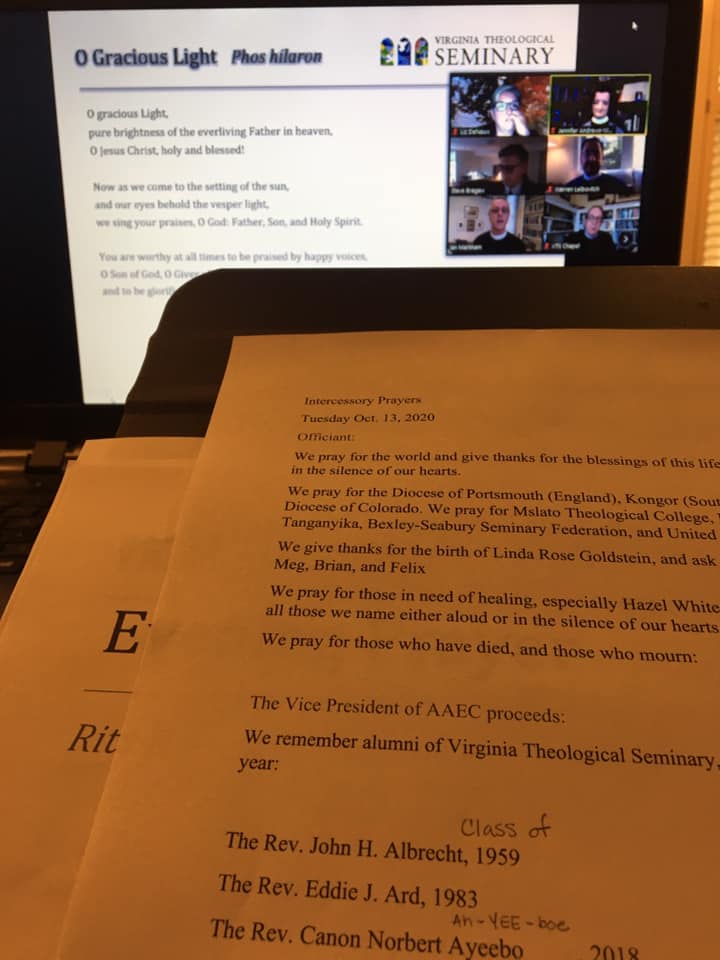
One of the disadvantages of leading virtual worship is that you do not get to participate in worship.  Of course, I can always go back and watch later, but I never get the “live” experience of watching prayers.  That all changed this week.  My seminary held their annual Convocation yesterday.  It was entirely virtual, with webinars, Zoom meetings, breakout rooms, and Zoom worship.  Our worship at Hickory Neck Church is via Facebook Live, so this was my first time worshiping with a community via Zoom, and I was curious to see how it would feel.

My initial response was dissatisfaction.  Although I could see there were about 50 people gathered, once slides were used on the shared screen, I could only see six people without constantly scrolling.  Although the sermon was close to my normal experiences with preaching, watching faces that seemed spaced out was a bit odd (Do the faces look that spaced out when I preach??).  And of course, when I joined in speaking the italicized words (those words “the people” are supposed to say), because we were all on mute, I felt like only the officiant and I were participating.

But that was just the initial reaction.  As I said more and more of the unison readings, I felt less and less awkward.  And even though I could only see a few faces, I loved knowing I was not alone in the worship experience.  And as I became less paranoid about what my own video screen was showing, I was able to relax into my chair, and transport myself to an imaginary pew.  The worship experience was not the same – but it was also familiar, human, holy, and lovely.

Looking back on that experience, I want to offer major kudos to all who are “making it work” with virtual church.  I know it is not the same.  I know it is hard staying positive when all you want is something more familiar.  I am so grateful for all of you who are sticking with it, making the awkward become sacred.  I hope that you are having moments of grace and blessing.  And I also hope you are noticing all the names (and faces if you’re Zooming) you do not recognize:  those folks who find it harder to harken the doors of the church than to hop on Facebook for worship – whether when you are live, or at 10:00 pm, as you watch the archived video while you ease off to sleep.   This may not be church as we have always known it.  But we are also fashioning something new, flexible, and creative, while rooting ourselves in the traditions we know and love that ground us.  This week, you have my gratitude for all the ways you are staying open to the Holy Spirit.  And if you have not found a place to experience the Spirit, I’ve got just the place for you!!

Sermon – Luke 2.1-20, CD, YA, December 25, 2019

08 Wednesday Jan 2020

Posted by jandrewsweckerly in Sermons, Uncategorized

≈ Leave a comment

Tags

amazing, Christ Child, Christmas, Christmas Eve, church, glorify, God, love, new, noise, praise, quiet, Sermon, silence, Silent Night, story

This past year I have been learning a lot about Godly Play, the program we use with our smallest children in Sunday School, and more recently, the program we use with the Kensington School too.  At first blush, the program is pretty simple:  we tell Bible stories, using simple props to engage the children visually, we let the children play with the story, and then we wonder about the story along the way.  But when we are telling the story with the Kensington School, we have about fifteen kids, ages two-and-a-half to five years old.  I do not know how much time you have spent with that age group recently, but what that means is working super hard to hold their attention.  Being the loud extrovert that I am, I assumed holding their attention would mean using a loud, commanding voice.  But I have discovered from our seasoned teachers that the opposite is true.  They lower their voices to a slow-paced, almost whisper, and they manage to keep the children on the edges of their seats – as if something amazing is going to happen if they listen really hard.

Oftentimes, when we think of Christmas, we imagine a similar pattern.  When we gather on Christmas Eve, we look forward to savoring the familiar story, imagining being able to hear a pin drop as the beloved story is told again.  Our favorite song on Christmas Eve is usually Silent Night.  The song lulls us to imagining Mary and Joseph blissfully enjoying a silent night of wonder.  But that holy night, and most Christmas Eve services, are anything but quiet.  Bethlehem is inundated with people coming in for the registration.  The fact that there is no room for Joseph and Mary tells us how crowded Bethlehem is.  But Mary and Joseph not only have to tend with homecoming revelers, they also have to contend with the animals over whose abode they have taken.  Add into the mix a screaming newborn, and the idea of a silent night is almost comical.

But Mary and Joseph get even more noise than that.  You see, nearby shepherds hear a cacophony of praise from the heavenly hosts in the middle of the night.  Their night has been anything but quiet too.  Instead of trying to get the animals and themselves back to sleep, they decide to go into town and see this thing which has come to pass.  And so, they spend the night, talking to Mary and Joseph, maybe taking turns trying to soothe the baby Jesus.  When they leave those rudimentary quarters, they leave town praising and glorifying God.  This is no silent night for the shepherds either.

I think that is why I enjoy our celebration on Christmas Day so much.  Silence is in short supply on Christmas Eve.  We sing carols, we hear the giddy laughter of children awaiting gifts, stockings, and cookies, and we chant the mass, singing our traditionally spoken words.  For those of us with small children, even the wee hours of the morning on Christmas Day are loud – filled with cries of elation, joy, and battery-operated toys.  But on Christmas Day, after a noisy night and morning, we make our way to church and find, perhaps for the first time, the silence for which we have been looking.  We do not sing carols.  We do not have to speak over the hubbub of full pews.  Instead we gather in relative quiet, and tell the old story again – but this time with a softness that cannot be found on Christmas Eve.

What I love about finding true silence on Christmas Day is that our morning is structured a lot like I imagine that first holy morning being structured.  Christmas Eve is full of noise – of animals, shepherds, angels, and crying babies.  But that next morning, the dust has settled.  Gone are the shepherds and angels.  The animals have calmed down after too many midnight guests.  I even imagine baby Jesus has given in to sleep, since most newborns get their nights and days reversed for the first few weeks.  Into this relative quiet is when I imagine Mary treasuring all those words and pondering them in her heart.  The night before is just too loud.  The exhausted, travel-weary, physically and emotionally spent Mary gets a moment in the morning to begin to process what God has done in and through her.  After the break of dawn, as the sun rises and the loud revelers and news deliverers have gone, she can have a quiet moment as she rocks or feeds baby Jesus and ponder in her heart this child at her breast.

I do not think that night is silent.  But I understand why our hymnodists would want to talk about silence.  I think that is why I prefer the hymn, “Let all mortal flesh keep silence.”  Instead of depicting a silent night, that hymn invites us to keep silence as a form of reverence.  The first verse says, “Let all mortal flesh keep silence, and with fear and trembling stand; ponder nothing earthly minded, for with blessing in his hand, Christ our God to earth descendeth, our full homage to demand.”  I like the hymn because that is the kind of pondering I imagine Mary does in her heart this morning.  Unlike most new mothers, I do not think she is worried about the impact of birth on her body or even about her humble surroundings.  I imagine her thoughts that morning are consumed with nothing earthly minded.  Instead, I imagine her heart is pondering the blessing of Christ our God descending on earth through her – and the enormity of the event drives her to pay silent homage as she gazes on Jesus’ precious face.

That is what the church invites us to do today as well.  We structure a morning for worship.  The dust of gift wrap, eggnog, and stocking stuffers is settling.  The noise of carols, singing choirs and priests, and antsy children in pews is fading.  The anxiety of preparing for the big event of this day is easing.  And all that is left is a moment to let our mortal flesh keep silent before the Christ Child.  This morning we take a moment to ponder nothing earthly minded, and instead join Mary as she ponders all that has happened in her heart.  We come to church on this holy morning to ponder the miracle of the Christ Child.  We honor the way in which God is ever trying to honor the covenant God has made with us – willing to go to the extreme of taking on human form to care for and preserve us.  Our God’s love knows no bounds.  Humbled by that knowledge, we come to pay God homage.

The question for us in our pondering is what we will do with that love.  Though we make space this morning for silence, we do not remain here all day.  Like any other Sunday, the clergy will dismiss us to go in peace, and serve the Lord.  Anytime we feast at Christ’s table, that is our charge:  to take whatever sustenance we have gained and to go out into the world to do the work that Christ has given us to do.  Certainly that may involve cooking, travel, or more gift giving.  But the news we ponder in our hearts today is much bigger than today.  Today we are commissioned to consider the impact of the birth of the Christ Child on our lives, what our response will be to the God who is so faithful to God’s covenant with us that God would take on human flesh to redeem us.  As our talented Godly Play teachers might pose, I wonder what new work God is crafting in our hearts.  Perhaps this morning, or for at least the next few minutes, you can let your mortal flesh keep silence and ponder with Mary.  And then go out with the shepherds, glorifying and praising God in your work.  Amen.


On Gifts and Giving…

23 Wednesday Jan 2019

Posted by jandrewsweckerly in Uncategorized

≈ Leave a comment

Tags

challenge, Christ, church, encounter, gifts, God, Holy Spirit, listen, ministry, new, passion, talent, time, volunteer

etno-garden-plitvice-lakes-team-building-ruke

Photo credit:  https://www.plitvice-etnogarden.com/team-building/

As every year of ordained ministry passes, I become more grateful for my work before ordination.  For about six years, I was the Director of Volunteer Services for a Habitat for Humanity affiliate in Delaware.  Coordinating over 2000 volunteers a year, a major part of my job was helping people find just the right volunteer position based on their gifts.  Most volunteers that came my way expected that volunteering at Habitat meant wielding a hammer.  And sometimes that was true.  But sometimes you were hanging drywall, or painting, or putting down flooring.  Sometimes you weren’t doing construction work at all.  Volunteers were needed in the office, partnering with families as they worked on their sweat equity hours and financial training classes, helping raise funds, and serving on the Board.  Sometimes the gifts of a person were a perfect match for what we needed, and sometimes volunteers wanted to try something totally out of their comfort zone.  Figuring that out took time, listening, and a little bit of experimenting.

The same is true in churches.  We all come to church with many gifts, and sometimes those gifts are just what is needed:  the elementary music teacher who takes on the pageant, the architect who takes on property management, the financial planner who serves on the endowment board.  But sometimes, church is where we want to find and use other gifts:  the engineer who is also great relating with kids, the military officer who is also great with technology, or the construction worker who is a fantastic listener and discernment partner.  And sometimes, the things we think we would never be able to do we discover we can do through service at church.

This week at Hickory Neck, we are spending some time discerning our gifts and how we might use them to build up the church.  For some, this is a time to renew our passion for a current ministry we serve, and rededicate ourselves to making that ministry more powerful.  For others, we need a break from serving in one capacity, and want to try something new.  For others, we have yet to commit to serving the church and are nervous to step forward.  What the church reminds us during this time of connection is each of us has gifts, and the church is better when we gift those talents and our time to the church.  The church knows that when we give of that time and talent, we get so much more back.  We learn, we grow, we make new friends, and we come closer to God.  Whether it’s picking up sticks on a cleanup day, making meals for the homebound or new parents, or editing a newsletter, in those activities we have holy encounters with Christ.

I cannot wait to hear how you will give of yourself this year at Hickory Neck.  I cannot wait to hear how you are challenging yourself, and listening to the whisper of the Holy Spirit.  I cannot wait to hear in the coming year the ways in which you bump into God, even in the most unlikely places.  When each of us tends to our gifts and our journey at Hickory Neck, the community as a whole benefits.  We all get a bit closer to God when we simply show up and use our gifts.  I look forward to hearing about your journey in time and talent this year!

Sermon – Daniel 3:14-20,24-28, John 8:31–42, Ecumenical Eucharist, March 21, 2018

23 Friday Mar 2018

Posted by jandrewsweckerly in Sermons, Uncategorized

≈ Leave a comment

Tags

Abednego, call, companions, discerning, ecumencial, faithful, God, Holy Spirit, Jesus, Meshack, new, Shadrach, trust

This sermon was preached at Our Saviour Lutheran Church in Norge, Virginia.  Each week in Lent, one of the churches from the Upper James City County Ministerium hosts a worship service and welcomes a guest preacher from another church.  It has been a wonderful experience in the exchange of worship, and has made all our church members feel more connected with the community.  

**********

One of my favorite gospel songs is a song called, Jesus Can Work It Out.  There are lots of versions of the song, but the basic tenet of the song is that whenever you have a problem that you cannot seem to solve, you can give the problem over to the Lord and the Lord will work the problem out.  In the version of the song in my iTunes, the lead singer talks about a variety of problems that she has had over her life that, as soon as she gave them over to the Lord, God worked the problems out.  In one example she talks about how she and the choir went on tour and when she came back home, she had a foreclosure notice.  Overcome with grief, she says she turned the situation over to the Lord and the Lord worked it out.

Now I love this song – mostly because not only does the song encourage me to trust God, but also because the song has a way of getting your toes tapping.  But every time I hear the part about the foreclosure, I cannot help thinking, “I mean, I get trusting the Lord, but I am pretty sure you knew you had not paid the mortgage before you decided to go on tour.  I mean there is trust and there is TRUST.”

That is what I think is so interesting about our two readings today.  They represent two different extremes when we talk about the role of trust in our relationship with God.  The first is the vivid and dramatic story of Shadrach, Meshach, and Abednego.  King Nebuchadnezzar has captured the three men and insists they worship his gods and his statue or face a fiery death.  When the three men refuse, the king has them thrown into the furnace, turned up seven times as high as normal.  But much to the king’s surprise, not only do the men survive, they seem to be dancing around in the flames with Yahweh.  When the men come out untouched by the flames, not even smelling of smoke, King Nebuchadnezzar concedes and decides to worship their God instead of his gods. This fantastic story is a story of how, even in the face of persecution and death, faithfulness, trust, and loyalty to our God will make you victorious, even in impossible situations.

Meanwhile, in our gospel text, the faithful are equally trusting of God, but in this instance, their trust and confidence is ill-placed.  You see, Jesus has gathered people who are following him and begins to talk about who he is in relation to God.  When Jesus starts talking about to whom the people belong, and that God is doing a new thing in Jesus Christ, the followers become obstinate.  “We are descendants of Abraham…Abraham is our father,” they protest  What is funny about this exchange between Jesus and the faithful is that on the surface, the faithful are doing the same thing Shadrach, Meshach, and Abednego do.  They are staying true to their God, despite the fact that this new teacher and prophet is asking them to see something new in what God is doing.  But in their case, we can see that Jesus does not see their faithfulness and trust as a virtue, but instead a hinderance to seeing the work of the Holy Spirit in something new.  Unlike Shadrach, Meshach, and Abednego’s story, this story seems to be about how we should hold tightly to what God has taught us, but not so tightly that we lose touch with when God is doing a new thing.  We are to be loyal and trusting, but also discerning and open.

I do not know about you, but I find myself lost in these lessons.  When am I supposed to be so faithful that I am willing to face death (or foreclosure on my mortgage), and when am I supposed to be so faithful that I am willing to abandon what I know about my God and my identity to follow a new way?  When I was figuring out my vocation as a priest, I struggled.  The first step was getting over the hurdle of saying yes to a call to ordained ministry at all.  You see, my dad was a United Methodist minister, and I had sworn that I would never go into the ministry.  But once I finally was able to say yes, then came the hard part.  You see, I was called in the context of the Episcopal Church.  But not only was my father a United Methodist Minister.  His father was a United Methodist Minister.  And my grandfather’s brothers were United Methodist Ministers, and my uncle was a United Methodist Chaplain, and my cousins were United Methodist ministers.  At Annual Conference every year, there was a whole Andrews section.  So what I was dreading was telling my grandmother that I was breaking ranks.  My grandmother is pretty intense.  As a former librarian and English teacher, I was actually pretty intimidated by her most of my childhood.  Eventually I gathered up my nerve and had a talk with her.  As soon as I told her the news she gave out a huff.  And then she leaned in toward me and said, “I was a Lutheran before I married your grandfather.  I never wanted to be a Methodist anyway!”

Here’s the thing about following God – when we follow God, we get confirmation along the way.  I do not think that Jesus was asking his followers to abandon Abraham and trust in him alone.  Instead, I think Jesus was reminding them that if Abraham was their father, they would actually follow Abraham’s example.  Instead of clinging to an old, stable identity, they needed to remember that the main thing Abraham was known for was abandoning his old life and going to a new, scary place, and following God.  Jesus is not mad at his followers because they are clinging to the past.  Jesus is mad at his followers because they are clinging to a distorted version of the past – they are clinging to security instead of remembering the past is what taught them that sometimes they need to get up, drop everything, and go.  Sometimes they need to take a risk and say no to a worldly power who wants them to abandon who they are and what they are called to be.  These two stories are not about examples of total trust versus a lack of trust.  The two stories remind us that trusting God will lead us to uncomfortable places, will challenge our sense that we know God best, and will sometimes make us dance.

Our collect or prayer appointed for this last Wednesday before we begin Holy Week says, “Almighty God our heavenly Father, renew in us the gifts of your mercy; increase our faith, strengthen our hope, enlighten our understanding, widen our charity, and make us ready to serve you; through Jesus Christ our Lord, who lives and reigns with you and the Holy Spirit, one God, for ever and ever. Amen.”  We leave this sacred place tonight, not with a sense that we need to dramatically follow Christ into the flames or be considered faithlessly unwilling to go where God calls us.  Instead, these stories remind us that we can always stand to increase our faith, strengthen our hope, enlighten our understanding, widen our charity, and be made ready to serve.  We all know we need that work because that is the work we have been doing all Lent – working on our faithful walk with Christ.  What these stories remind us of is we have companions along the way – companions who are bold and fearless, companions who have messed up, and companions who may not even go to our own church, but who know our same journey and our same God.  Christ renews us in his mercy tonight, so that we can keep saying yes to God.  Amen.

Getting on the Ride…

10 Wednesday Jan 2018

Posted by jandrewsweckerly in Uncategorized

≈ Leave a comment

Tags

adventure, change, community, dream, excitement, exciting, fear, God, Holy Spirit, inviting, ministry, new, ride, rollercoaster, thrill

the-dragon

Photo credit:  https://www.legoland.com/california/legoland-california/rides-and-attractions/park-areas/castle-hill/rides/the-dragon/

On our family vacation last week, we visited an amusement park.  My eight-year old was finally at the age where she could try some more ambitious, if not scary, rides.  Watching her experiment with her fear and curiosity was fascinating.  Before most rides, she was completely enthusiastic and daring.  But waiting in line seemed to rattle her confidence.  Several times, we almost bailed completely.  In fact, one of my favorite pictures of her was taken right before she boarded a particularly scary ride (one even I was too scared to try!).  In the picture, her eyes are like saucers and her eyebrows are raised as she clutches her father’s hand.  But for the rest of the trip, she raved about that particular ride and almost cried when she realized she could not ride the rollercoaster one more time.

I was thinking this week that adults are not that dissimilar from my daughter when it comes to something new and exciting.  There is a part of us that cannot wait to try something new, and there is a part of us that is terrified about the experience, imagining in our minds the countless things that could go wrong or that might happen.  As with any change, we have the option to get on the ride and experience the thrill of something new, or we have the option to play things safe, and step out of line.  I suspect there are times when getting out of the line is the best option.  But more often, I suspect we miss out on adventure and new life when we don’t just step onto the ride.  Too often we forget that we can get on the ride and still say, “I am glad I tried it.  And now I will never do that again!”

Last night, the James City County Board of Supervisors approved a special use permit for the Kensington School to put a second location on the property of Hickory Neck Episcopal Church.  Hickory Neck has been dreaming about creating a school on our property for about ten years.  We kept deferring the dream because we were not sure we could both build and run a school.  But this past year, the Holy Spirit intervened, and we discovered that the Kensington School was looking to open a second location in our neighborhood.  God seemed to be inviting us to finally step onto a thrilling, albeit a bit scary, ride.  We have been standing in line for a while, getting more and more excited about what God can do through Hickory Neck.  Last night, the Board’s approval was our last step before boarding the ride.

Like with any change, this new phase of ministry will be full of exciting, wonderful things we never expected, and some challenging, hard things we never expected.  Part of our work is trusting the same Holy Spirit that has been guiding us thus far will continue to guide and lighten our path.  Some of us may be wide-eyed, with eyebrows raised about what is coming next.  But I suspect in a year or so, most of us will be thrilled that we said yes to the Holy Spirit, and agreed to try to be a force for change for our community.  I am here, with you, Hickory Neck – holding your hand and ready for the adventure!

← Older posts

Recent Posts

  • On the Myth and Magic of Advent…
  • On Risking Failure and Facing Fear…
  • Sermon – Luke 23.33-43, P29, YC, November 23, 2025
  • On Inhabiting Gratitude…
  • Sermon – Luke 20.27-38, P27, YC, November 9, 2025

Archives

  • December 2025
  • November 2025
  • October 2025
  • September 2025
  • August 2025
  • July 2025
  • June 2025
  • March 2025
  • February 2025
  • December 2024
  • November 2024
  • October 2024
  • September 2024
  • August 2024
  • July 2024
  • June 2024
  • May 2024
  • March 2024
  • February 2024
  • January 2024
  • December 2023
  • November 2023
  • October 2023
  • September 2023
  • August 2023
  • July 2023
  • June 2023
  • May 2023
  • March 2023
  • February 2023
  • January 2023
  • December 2022
  • November 2022
  • October 2022
  • June 2022
  • May 2022
  • January 2022
  • December 2021
  • November 2021
  • October 2021
  • September 2021
  • August 2021
  • June 2021
  • May 2021
  • April 2021
  • March 2021
  • February 2021
  • January 2021
  • December 2020
  • November 2020
  • October 2020
  • September 2020
  • August 2020
  • July 2020
  • June 2020
  • May 2020
  • April 2020
  • March 2020
  • February 2020
  • January 2020
  • December 2019
  • November 2019
  • October 2019
  • September 2019
  • August 2019
  • July 2019
  • June 2019
  • May 2019
  • April 2019
  • March 2019
  • February 2019
  • January 2019
  • December 2018
  • November 2018
  • October 2018
  • September 2018
  • August 2018
  • July 2018
  • June 2018
  • May 2018
  • April 2018
  • March 2018
  • February 2018
  • January 2018
  • December 2017
  • November 2017
  • October 2017
  • September 2017
  • August 2017
  • July 2017
  • June 2017
  • May 2017
  • April 2017
  • March 2017
  • February 2017
  • January 2017
  • December 2016
  • November 2016
  • October 2016
  • September 2016
  • August 2016
  • July 2016
  • June 2016
  • May 2016
  • April 2016
  • March 2016
  • February 2016
  • January 2016
  • December 2015
  • November 2015
  • October 2015
  • September 2015
  • August 2015
  • July 2015
  • June 2015
  • May 2015
  • April 2015
  • March 2015
  • February 2015
  • January 2015
  • December 2014
  • November 2014
  • October 2014
  • September 2014
  • August 2014
  • July 2014
  • June 2014
  • April 2014
  • March 2014
  • February 2014
  • January 2014
  • December 2013
  • November 2013
  • October 2013
  • September 2013
  • August 2013
  • July 2013
  • June 2013
  • May 2013
  • April 2013
  • March 2013
  • February 2013
  • January 2013
  • December 2012
  • November 2012
  • October 2012
  • September 2012

Categories

  • reflection
  • Sermons
  • Uncategorized

Meta

  • Create account
  • Log in
  • Entries feed
  • Comments feed
  • WordPress.com

Blog at WordPress.com.

  • Subscribe Subscribed
    • Seeking and Serving
    • Join 394 other subscribers
    • Already have a WordPress.com account? Log in now.
    • Seeking and Serving
    • Subscribe Subscribed
    • Sign up
    • Log in
    • Report this content
    • View site in Reader
    • Manage subscriptions
    • Collapse this bar
 

Loading Comments...