• About

Seeking and Serving

~ seek and serve Christ in all persons

Seeking and Serving

Tag Archives: prayer

Sermon – John 17.20-26, E7, YC, June 1, 2025

18 Wednesday Jun 2025

Posted by jandrewsweckerly in Sermons

≈ Leave a comment

Tags

community, disciples, disunity, faith, gospel, Jesus, John, love, prayer, Sermon, unity

One of my favorite biblical scholars is Karoline Lewis.  She is one of the hosts of a preaching podcast I listen to, and through listening to her over the years I have found her to be insightful, funny, passionate, and deeply attuned to where the Word of God meets our daily lives.  Lewis is a New Testament scholar whose expertise is especially in the gospel of John.  In fact, her commentary on the Gospel of John is my go-to commentary anytime I am exploring John’s gospel.          

The irony in my deep appreciation for Karoline Lewis is that her passion and love for the gospel of John is almost in equal balance to my dislike for the gospel of John.  Where she finds deep beauty and meaning in John, I often find a jumble of words that are so repetitive and circular that I get lost.  Even when I have prepared a sermon for and studied a passage of John for the entire week, when I get to the moment of holding that gospel book and proclaiming John, I find myself second guessing myself, “Wait.  Didn’t I just read that sentence?  That sounds like what I just said a second ago – did I repeat a line?” 

Today’s gospel from John is a classic example.  We find ourselves at the end of Jesus’ farewell address to the disciples before his crucifixion and death, and within that address, at the end of his high priestly prayer.  In this prayer, Jesus prays several phrases in that typical Johannine circular language, “As you, Father, are in me and I am in you, may they also be in us…so that they maybe be one, as we are one, I in them and you in me, that they may become completely one..”  The good news is that Lewis and other scholars seem to agree that what Jesus is praying in his circular, convoluted way for is unity.  As scholar William Herzog suggests, “What matters most for John is that the experience of the indwelling remains available to the community, for the unity of the Johannine community is based not on dogma but on a communal experience of indwelling that is analogous to the relationship between Jesus and the Father.  This is what the community witnesses to the world.  Their mission is to keep this experience of faith alive in the community, so that they can offer it to a broken and fractured world.”[i]

Now, while unity is a theme we can get our heads around, unity is a practice we seldom live or experience.  Disunity is our lived experience.  One look at the deep, seemingly irreconcilable differences between political positions would be enough for any of us to understand how fantastical unity sounds.  But disunity is not just in the wider world.  Just this week in Discovery Class we were talking about how theological differences around the sacraments are what created the array of denominational differences within the Christian body – the reason why some of us are not welcome at the communion table in other denominations.  And that does not even address the differences of opinion the various churches hold on the role and place of women, LGBTQ members, and people of color.  But the lack of unity gets even closer to home right here at Hickory Neck.  I have long touted the unity of Hickory Neck across political and theological differences.  The unifying symbol of us of gathering together around the table has instilled in me a deep belief that if we can be one in communion, surely unity is possible in the world.  But even I, in the last six months have wondered if external pressures would prove that our unity is not as a strong as I think. 

That is why, for this one time in particular, I am grateful for John’s repetitive circular language.  Jesus’ final words of prayer today are, “I made your name known to them, and will make it known, so that the love with which you have loved me may be in them, and I in them.”  As one scholar says, “The last word is love.  Jesus does not call for doctrinal unity, organizational unity, or political unity.  So often, Christ’s prayer for his disciples has been used to sanctify those ends, and even to justify the harsh imposition of artificial unity.  Yet this prayer is for unity that grows out of the love of God, received and shared among his followers, leading to an experience of unity in love between Jesus and his followers, and with the one from whom Christ comes.  In moments of communion, surely the debates about the nature of God and humanity, the questions of whether divine grace or human will is the means of unity, all of these must fade away, leaving only the burning vision of a cross and the words, ‘For God so loved the world…’”[ii]

My fear that the unity I have witnessed at Hickory Neck would unravel was perhaps based on the idea that we could humanly will our unity to stay together.  But John’s gospel today reminds me that the only reason we are not unraveling is not because we have willed our unity, but because the love we have found in Jesus – the same triune love experienced within the three persons of the trinity – is what holds us together.  Jesus’ prayer today is not a prayer for those disciples who heard the prayer.  Jesus’ prayer today was for us – the future generations who would exist only through the love that the divine has given us – that circular, sometimes confusing, but ever convincing love in us and through us.  Our work is in that last part – that love going through us.  The love of Jesus for us in this prayer is not just for us – but is the gift that emanates through us out in the world.  As Lewis says of this prayer, “Jesus is no longer in the world.  The incarnation is over.  Jesus has been resurrected.  He ascended to the Father from whence he came.  But we are still in the world.  Jesus’ works are now in our hands, and Jesus is counting on us to be his presence in the wake of his absence.”[iii]  That charge would be daunting if not for Jesus’ prayer of promise – we can be that presence because the love that was in Jesus is now in us, breathing, transforming, and blessing the world through love.  Amen.


[i] William R. Herzog, II, “Exegetical Perspective,” Feasting on the Word, Yr. C, Vol. 2 (Louisville: Westminster John Knox Press, 2009), 545.

[ii] Peter J.B. Carman, “Theological Perspective, Feasting on the Word, Yr. C, Vol. 2 (Louisville: Westminster John Knox Press, 2009), 544.

[iii] Karoline M. Lewis, John:  Fortress Biblical Preaching Commentaries (Minneapolis:  Fortress Press, 2014),214.

Sermon – Matthew 6.1-6, 16-21, AW, YC, March 5, 2025

18 Wednesday Jun 2025

Posted by jandrewsweckerly in Sermons

≈ Leave a comment

Tags

alms, Ash Wednesday, both-and, community, confess, fasting, honest, Jesus, Lent, prayer, real, reconciliation, redemption, reflection, repentance, Sermon, sin, solo, vulnerable

If I were to say to you that there are two services that attract the most non-members each year, which two services would you guess?  Christmas and Easter?  In part, you could be right – there are definitely a lot of guests at Christmas and Easter.  But proportionately, when talking members and non-members, I notice we get more guests at Blue Christmas and Ash Wednesday – especially if we include Ashes to Go in our Ash Wednesday count. 

So what about Blue Christmas or Ash Wednesday is so appealing to someone who doesn’t regularly attend church?  Having just been a part of Ashes to Go in our parking lot with lots of guests, I think there is something very real, honest, and vulnerable about services on Ash Wednesday that do not always happen on a Sunday or especially on festivals like Christmas and Easter.  On Ash Wednesday, the church gives us permission to bring our real, broken, hurting, mortal selves to a space, to acknowledge our fragility and hurt, and to bless the fullness of our selves – the good, the bad, and the ugly. 

Now to some, this may feel a little too self-centered.  As we impose ashes, the choir will chant from Psalm 51 tonight:  “Wash me through and through from my wickedness and cleanse me from my sin.  For I know my transgressions, and my sin is ever before me.  Against you only have I sinned and done what is evil in your sight.  And so you are justified when you speak and upright in your judgment.”  Perhaps that is the appeal of this day – the opportunity to take a moment for the self and really ponder where we are with God and this life.  Those ashes will be grittily spread on my forehead, the penitence and fasting are my work to do, and death is mine alone to face.  Everything about today is about my own journey with God.

Stephen and I were just debating about this reality for Lent in general.  We are making plans for Holy Week and we have a service with gospel songs and meditations.  I was excited about the possibility of the service and Stephen quipped, “It’s a little self-centered, don’t you think?  What about worrying about others and the rest of the world?!?”  The truth is, the season of Lent that we start today and end on Good Friday is sort of a both-and experience.  This is a season we are called into self-examination and repentance.  AND, this is also a season where we examine the sinfulness in the world in which we are complicit.

That both-and experience is what Jesus was worried about in our gospel lesson today.  Jesus talks a great deal about personal piety and not showing off in front of others – to not to let others seeing you give alms, pray, or fast.  But as I studied Matthew again this year, I reread something that brought me up short.  All those warnings Jesus makes, “Beware of practicing your piety before others…whenever you give alms, do not sound a trumpet…when you pray, do not be like the hypocrites…whenever you fast, do not look dismal…”, all of those warnings are not in the singular.  They are actually in the plural.[i]  So the words are more like, beware of practicing you all’s piety.  Or maybe in southern speak, “when all ya’ll pray…” Jesus is not criticizing or singling out you or you or me.  Jesus is singling out the community of the faithful.

That may sound like semantics, but there is something quite dramatic about Jesus speaking in the plural versus the singular.  Every week in Sunday services, we confess our sins.  But we confess them communally.  Communal confession is an extraordinary event.  While we may feel lost or despondent about our inability to live in the light of Christ as individuals, when we communally confess, a room of voices is saying with you, “Me too!”

One of the things I grieved during the pandemic was our inability to gather in person.  I loved that we had and continue to have an online community – especially for our homebound, our busy members, or for those meeting Hickory Neck for the first time.  But our necessary isolation during the pandemic naturally led to a pattern of looking inward – sometimes so much so that we forgot we are not alone – that there is a whole community of faith who is walking this journey with us and struggling just as we are.  There is something quite powerful about listening to the voices of the 7-year-old next to the 77-year-old – the person who looks so put together next to the person who is clearly struggling – the dad with children next to the widow – all confessing together.  Week in and week out, those myriad voices remind us we are not alone.

Tonight’s service very much calls us into reflection and repentance.  But our invitation tonight as we enter Lent is to remember that the act of reconciliation and redemption does not only happen alone.  We all are invited into a holy Lent.  We all are invited into prayer, fasting, and alms giving.  We all are invited to remember we are dust.  In person, online, and hybrid together, we are not only invited into solo, parallel journeys.  But also, our journeys are strengthened and made possible through the companionship of community.  You are not alone.  We are in this together – all y’all.  And Jesus lights the way for us all.  Amen.


[i] Karoline Lewis, as described on the podcast, “Sermon Brainwave:  #889: Ash Wednesday –Rebroadcast from February 22, 2023,” February 25, 2025, as found at https://www.workingpreacher.org/podcasts/889-ash-wednesday-rebroadcast-from-february-22-2023 on March 4, 2025.

Sermon – Luke 9.28-43, TRS, YC, March 2, 2025

05 Wednesday Mar 2025

Posted by jandrewsweckerly in Sermons

≈ Leave a comment

Tags

Christian, church, division, Elijah, follow, formation, identity, Jesus, Lent, love, mission, Moses, prayer, Sermon, spiritual, Transfiguration

As I spend time with parishioners, staff, clergy leaders, and folks outside the community one common question keeps emerging, “What do we do?”  As we watch divisions deepen – something that seemed impossible given how deeply divided we already were, and as we watch a dismantling of how our country has operated for ages, and as we argue about what is best for our country, I have heard us asking, wondering, struggling with that question, “What do we do?”  The question is mirrored in the story of the transfiguration in Luke’s gospel today too.  Sleepy disciples who are supposed to be praying with Jesus on top of a mountain are jolted into alertness upon seeing Jesus in dazzling brightness, talking with long-gone Moses and Elijah, saying something about Jesus departing.  John and James are stunned into silence, but Peter answers his own question of “What do we do?” by proposing they build some dwellings – for surely remaining here in God’s glory is what he thought they should do.

Though we tease Peter about his not fully “getting it” when we wonder what we should do, I find myself mimicking Peter these days.  When I am asked, “What do we do?” my immediate and probably over-simplified answer is “follow Jesus” – not follow Republicans or follow Democrats; not follow supporters or follow opposers; not follow these Christians or follow those Christians.  Simply follow Jesus.  The problem with my answer of following Jesus is that the answer is so simple the answer leaves us with more questions than actual answers. 

That is why I am so grateful for Luke’s gospel today.  What this passage from Luke’s gospel does is tell us that following Jesus means, One, “…we must be clear about our identity;” two, be “resolute in our mission;” and three, be “intentional in our spiritual formation.”[i]  So, clear on our identity, focused on mission, and intentional about our spiritual formation.  Let’s dig in to this passage to find more clarity.

To follow Jesus, we need to be clear about our identity.  As scholar Jeffery Tribble argues, in Luke’s gospel, “The transfiguration bears witness to the identity of Jesus Christ.  By God’s action in the transformation itself and in the words of the voice of heaven, a theological statement is made.  Jesus Christ is declared to be the Chosen Son of God.  The disciples heard the declaration:  ‘Listen to him!’  The Christ event – his incarnation, passion, death, resurrection, ascension, gift of the Holy Spirit, and promised second coming – is the defining script for our local performances of the gospel.”[ii]

So what does that mean?  What is our identity here at Hickory Neck?  We define that identity using the acronym HNEC.  H stands for Hospitality:  We are committed to creating an environment where all experience an on-going sense of welcome, acceptance, and belonging.  Our hospitality is responsive to the unique needs of each generation, creating a community of mutuality, respect, dignity, and connection.  N stands for Nurture:  We are committed to nurturing the unique ministry of every individual so they can fully realize their baptismal covenant and participate in the life of the church, using their God-given gifts both within and outside the parish.  E stands for Engagement and Evangelism:  We are committed to responding to the needs of the wider community, sharing the love of Christ with our neighbors, and shining Christ’s light in the world.  And C stands for Curiosity:  While cherishing our particular history and Anglican identity, we are committed to being open to the movement of the Holy Spirit, being playful with one another and the wider community, while taking joy in one another.  So, our identity is about hospitality, nurture, engagement, and curiosity. 

So, being clear first about our identity, we must secondly be resolute in mission.  The transfiguration reveals the redemptive mission of Jesus Christ.  With Moses’ presence pointing to the exodus event and the communal responsibly to teach the statutes and ordinances, and with Elijah’s presence pointing to the end times, Jesus’ work of continued redemption is clear.  As Tribble says that “…in the transfiguration event Jesus is clear about his mission, which continues the redemptive work of God from the exodus through the end times.”[iii]

What about us, then?  Hickory Neck actually has a mission statement.  The mission statement reads, “We foster a loving, welcoming Christian Community with a uniquely intergenerational approach to worship, fellowship, and formation, helping us to develop a relationship with God and each other.  Nourished in community, we share the love of Christ Jesus by caring for each other, serving neighbors in need, and seeking justice and peace for all people.”  If I had to “make it plain,” I would use these eight words, “Love inside these walls, love outside these walls.”  When we are puzzling our way through what we should be doing in these profound times, our mission is simple:  love inside these walls and love outside these walls.  Now I know that sounds very pie in the sky – I have been known to roll my eyes a few times when someone says, “It’s all about love!”  But here’s the thing:  no matter what political or theological view you have, I can guarantee you that someone in this room disagrees with you.  How will you love them?  And when you are out in the world, all kinds of policies and moves are being made that may feel like they do not matter because they do not impact you directly – at least not yet.  How will you make sure that you and we as wider community are making sure love reigns?  There is a lot happening outside these walls that are done in the name of the redemptive Christ.  Your work is to discern which of those activities are actually following the identity and mission of the Jesus we are talking about this very day.

And that leads us to the third thing we invited to do to follow Jesus:  to be intentional in our spiritual formation.  I don’t know if you noticed, but Jesus took James, John, and Peter up that mountain not to heal, or to work, or even to witness the transfiguration.  Jesus brought them up to pray.  Whether in this passage or in the many verses to come, we know from holy scripture that “throughout his ministry Jesus was faithful in spiritual disciplines that would bring him into the presence of his Father.”[iv]

Tribble reminds us that “Professing faith in Christ in one thing, but living our Christian faith requires greater depth and breadth in our spiritual formation.”[v]  If we are in fact a congregation that doesn’t preach politics but instead preaches Jesus, then our work collectively is to know Jesus.  That means if you are not already in Bible Study, or reading scripture at home, or listening to a podcast about scripture, now is the time to dust off that book (or app) and get going.  That means if you are not one who is too comfortable with prayer, or only use prayer when you have an emergency, now is the time to start flexing your prayer muscles – whether you work your way through the Book of Common Prayer, whether you set aside daily time for prayer, or whether you start using those prayer beads, now is the time to step away with Jesus in prayer.  I remember reading about a conversation between His Holiness the Dalai Lama and Archbishop Desmond Tutu in which the two of them were competing about who got up the earliest for prayer.  Both of these deeply spiritual men knew that the only way they could do any good work was to deepen their spiritual formation.

The good news is that we are heading into a season in the church where all of this work is enriched, supported, and encouraged.  In the season of Lent, we are encouraged to be intentional about our spiritual formation.  In Lent we work to become very clear about our identity.  In Lent we become resolute in our mission.  If you are feeling that overwhelming sense of “What do I do?” in these times, the Church invites you to follow Jesus.  The Church invites you to be focused on identity, mission, and formation.  And this Church specifically creates the structure for you to do just that.  Your invitation is to join us!  Amen.


[i] Jeffery L. Tribble, Sr., “Pastoral Perspective,” Feasting on the Word, Yr. C, Vol. 1 (Louisville:  Westminster John Knox Press, 2009), 452.

[ii] Tribble, 452.

[iii] Tribble, 454.

[iv] Tribble, 454.

[v] Tribble, 456.

On Actively Remembering…

11 Wednesday Sep 2024

Posted by jandrewsweckerly in reflection

≈ 1 Comment

Tags

anniversary, Christ, darkness, light, love, memory, prayer, remember, September 11

Photo credit: https://www.history.navy.mil/browse-by-topic/wars-conflicts-and-operations/sept-11-attack.html

The anniversary of September 11, 2001 is always one that hits me in unexpected ways.  For those of us living at the time twenty-three years ago, our experiences that day are as varied as our humanity is varied.  Depending on how close you lived to the three crash sites, whether you lost a loved one or waited long days for them to be found, what your ethnicity is (as those of Middle Eastern heritage had very different experiences that day and in the weeks and months to follow), or what your philosophy of justice was, our reactions to, experiences of, and the aftermath of that tragic day affects us all differently.

Despite those deeply varying differences, one thing always seems to be consistent on this anniversary – we remember.  Maybe we spend time in prayer, or maybe we dedicate some time to silence, or maybe we take a long run, or maybe we burn off steam another way, but all of us in some way or fashion remember.  As you remember this year, I invite your reflection to be active.  There were countless people on that day who did something good for someone else – whether they helped someone out of a burning building, comforted a friend, searched through rubble, helped a stranger search for someone lost, made a meal for someone, or even made the ultimate sacrifice so that others might live.  Use those stories and those memories of goodness that punctuated a day of awfulness to be a force for goodness today – to be an agent of Christ’s love in a world that desperately needs love.  If you’re looking for motivation, you can find stories here.  If you’re looking for a prayer, you can try this resource. 

Even twenty-three years out, this day carries with it so much weight.  I can’t wait to hear what you do to lighten some of that burden for someone else or yourself.  Today we can be a part of shining Christ’s light in the darkness in our time.

On Stories and Wonder…

17 Wednesday Jul 2024

Posted by jandrewsweckerly in reflection

≈ Leave a comment

Tags

busyness, children, community, compassion, food insecurity, God, hunger, prayer, privilege, stories, story, summer, volunteer

Photo credit: Jennifer Andrews-Weckerly; use with permission only

This week my older daughter and I volunteered with a local agency that is providing weekday meals to children in our community experiencing food scarcity.  These are children who qualify for free lunch during the school year, but when school is out of session, lose their one steady source of food for most of the week.  On our volunteer day, we packed about 260 meals – including a protein-packed sandwich, juice, fruit, a salty snack, and a homemade cookie. 

As the smell of those freshly baked cookies wafted from the brown paper bags, I found myself wondering about the countless details of these children.  In that mass of children spread around our county, I wondered how they were getting the food from those drop-off points, knowing that many of their care providers likely work during the day.  I wondered if they took joy in the unknown contents of their bag, or if those five items felt rote for them after a summer of brown bags.  I wondered if they had siblings or friends also receiving bags and whether they traded food items like my kid does sometimes at school.  I wondered if a temporarily filled belly eased any emotional strain they may be experiencing without the socialization of school. 

Wondering about those 260 stories was an important reminder to me of how irregularly I see the world as God does and instead get lost in my own slice of the world.  As I juggle transportation of children, writing the next sermon, facilitating a church meeting, and planning meals, I totally lose the stories of those who struggle with those basic things I take for granted.  I think that is why I longed so much to know at least some of the stories of those children – so that I might more tangibly be mindful of the wideness of our community and those God loves that I have the privilege to be unconcerned about most days.

I wonder what stories you have been missing lately.  Who in your community have you forgotten – not out of malice or lack of generosity, but more out of the busyness of life?  Whose stories might help you see your family members and coworkers with a bit more compassion?  What stories might make you view politics a bit differently or impact where you give your time and resources?  My prayer for you is that you seek those stories this week – and that those stories find you.

On the Business of Church…

19 Wednesday Jun 2024

Posted by jandrewsweckerly in reflection

≈ Leave a comment

Tags

business, Episcopal Church, General Convention, God, good, governance, grace, Holy Spirit, Jesus, legislation, love, mission, prayer, purpose, vision

Photo credit: https://episcopalnewsservice.org/2020/11/20/80th-general-convention-postponed-to-july-2022-as-pandemic-disrupts-planning-of-triennial-gathering/

This weekend, Episcopalians will descend upon Louisville, Kentucky, for our General Convention.  The General Convention is the governing body of The Episcopal Church.  Every three years (or in this case, two years, due to a delayed GC during COVID), General Convention meets as a bicameral legislature that includes the House of Deputies and the House of Bishops, composed of deputies and bishops from each diocese.  In the House of Deputies, which includes elected lay and ordained deputies and alternates, over 1000 people will gather, and about 140 bishops will gather in the House of Bishops.  This year, we have a shortened Convention of six days of legislative sessions, covering everything from governance, justice issues, ecumenical and interfaith issues, evangelism and church vitality, liturgy, stewardship, formation, and mission.  In those six days, we will review over 275 pieces of legislation. 

Of course, General Convention is not all business.  It is a place of innovation and collaboration.  An exhibit hall of vendors is place of ideas, resources, and connection.  The legislative halls and common spaces are places of reunion with former seminary classmates, dioceses where one has served or worshiped before, and friends from professional connections.  It may be a chance to meet people in person that you have only known online, people you have admired the work of from afar, or a place to make new friends.  And then there are the opportunities to gather in worship in unfamiliar and familiar styles, the deep conversations and sharing of best practices, and the inspiration that can come from being steeped in the wideness of God’s church.

Ultimately, General Convention can be a place of great tension:  of trying to accomplish a great deal of business while honoring and developing relationships across difference, of challenging and trying to correct the failings of the Episcopal Church while learning and being inspired to renew our ministries, of taking a step back to clarify mission, purpose, and priorities while narrowing in and aligning decisions with that clarity.  Add in doing all that with over 1100 people, and that we get anything accomplished is a minor miracle.

Knowing all that, I invite your prayers for the Church as we gather:  that we root ourselves in God’s grace and power, that we ground ourselves in the love of Jesus and serve as faithful disciples, and that we undergird our work with the creative, life-giving, wise movement of the Holy Spirit.  And then ultimately, I invite your prayers that our work will mean something:  to the country church in rural America, to the beleaguered inner city church, to the bustling suburban church, and to churches whose primary languages are not English; to the churches who are shrinking and the churches who are thriving; to the person who is struggling with their faith, the person excited about a new ministry, to the person who is worried about the future of the church, and the person who is entirely unchurched.  We bring each of you with us in our prayers as we gather.  I hope you will surround us in prayer as well – that God is working for good in all of it.     

Of the Mind and of the Heart…

15 Friday Mar 2024

Posted by jandrewsweckerly in reflection

≈ Leave a comment

Tags

academic, change, children, emotional, faith, family, God, head, heart, Jesus, journey, joy, know, Lent, live, parenthood, prayer, sadness

Photo credit: https://www.everypixel.com/image-8567765057447502976

A couple of weekends ago, my husband and I found ourselves kids-free, walking the local downtown area.  As we strolled along, we observed other families – parents pushing strollers, parents supervising kids learning to ride their bicycles, parents pausing family walking for educational moments.  Watching the other families brought back a flood of memories of those stages of our lives – the fond, endearing moments as well as those moments when we felt like we might crack.  But what was not familiar was what we were experiencing that day:  the children having plans of their own, making choices to be with friends over being with their parents.

My husband and I used to work with families at our church who were going through those very changes:  the phase of life where the children’s primary influence shifts from parents to peers.  It is a good and natural phase, but one we observed was much harder for parents than for the children.  But teaching and knowing something is quite different from experiencing something – from watching your own children do the very thing you have taught other parents about.  That moment is the clarity that comes from taking an academic subject and having it become a very real, emotional subject.  Suddenly, I could see the future of the relationships with our children in a much more tangible way.  And there was some sadness, some joy, and lots of somethings in between.

As we make our way past the halfway mark of Lent and we see the approaching journey of Holy Week, I have been thinking a lot about the learned experience of faith and the felt experience of faith.  Often we Episcopalians are creatures of the mind – studying repentance and forgiveness, participating in liturgies that shape the penitential nature of Lent, and even talking to others to learn about their Lenten experiences.  But knowing about Lent can be quite different from living Lent – facing all those things we preferred to keep in the “academic” box and instead having to move them into the “lived” box. 

My prayer for you as your Lenten journey approaches the climax of Holy Week and Easter is that you let yourself feel all of it.  My prayer is that you allow that much more vulnerable version of yourself to gather next to Jesus and keep walking forward – as the imperfect person you are, accompanied by the perfection of the Savior who makes this journey possible.  I look forward to hearing how letting down those walls of self-protection and letting in the grace, love, and forgiveness of God shapes these last days of Lent.  Know that I walk with you!

Sermon – Mt. 6.1-6, 16-21, AW, YB, February 14, 2024

21 Wednesday Feb 2024

Posted by jandrewsweckerly in Sermons

≈ Leave a comment

Tags

alms giving, Ash Wednesday, church, corrupt, death, fasting, God, Jesus, Lent, life, love, prayer, reconnect, relationship, repentence, Sermon, Valentine's Day

This morning, I got a fun text from a friend.  “Happy Ash Valentine’s Day!” she exclaimed.  I have seen all sorts of humor about the confluence of Valentine’s Day and Ash Wednesday this year.  From questions about whether the clergy might be making the sign of a heart instead of the sign of a cross with our ashes tonight (sorry to disappoint those of you who were hoping that wasn’t just a rumor); to a meme from the National Church that says  “You can’t have VaLENTines with the LENT”; to actual candy conversation hearts that say “U R Dust,” “Ashes 2 Ashes,” or “Repent” instead of the traditional “Be Mine,” “True Love,” or “Kiss Me.”  Even my own daughter petulantly asked me, “Do we always have to celebrate Ash Wednesday on Valentine’s Day??”

Though the humor has been fun, what lurks under the surface is a discomfort with talking about death – especially on a day meant to be for celebrating the happiness of love.  But part of my job as a priest is to bring a certain sobriety about death to the world – no matter the day.  That is not to say that I am a party pooper or that I don’t like a good box of chocolates myself, but my role as a priest is to name the truth about what happens in death – earthly death and reunion with our Lord in eternal life.  In fact, the Church is one of the few places left in the world that openly and regularly talks about death.  In a world that encourages anti-aging treatments, who has desensitized us to death as we have moved away from an agrarian lifestyle, and whose medical advances have extended life much longer than before, we learn that death can be conquered and should be fought at all costs.

Pushing against this secular understanding of death, the Church gives us Ash Wednesday – even on Valentine’s Day.  The Church looks at our flailing efforts to preserve life and as we humbly come to the altar rail, rubs gritty ash on our heads and says, “Remember you are dust and to dust you shall return.”  There is no, “Don’t worry about death; you’ll be fine!”  Instead, those grave words, “Remember you are dust and to dust you shall return,” echo in our heads, haunting our thoughts.  Every year the Church reminds us of the finite amount of time we have on this earth – even on a day seems like we should be talking about love and life.

This is why I love Lent so much.  The Church dedicates forty days to a time where we cut to the chase and honestly assess our relationship with God.  We take a sobering look at our lives, a sobering look that could be reserved only for the time of death, and we discern what manifestation of sinfulness has pulled us away from God.  Our Prayer Book defines sin as “the seeking of our own will instead of the will of God, thus distorting our relationship with God, with other people, and with all creation.”[i]  Lent is the season when we focus on repentance from our sin – not just a feeling guilty about our sinfulness, but eagerly seeking ways to amend those relationships and turn back toward resurrection living.  What most people get only at the time of death, we are given every year at the time of Lent:  a time of sobering realignment. 

This is why we get Matthew’s gospel lesson on Ash Wednesday.  As we begin our sobering Lenten journey, the gospel lesson names disciplines and practices that can help us along the way.  Jesus names those ancient practices that have brought people back to God for ages – giving alms, praying, and fasting.  Each one of these practices has ways of bringing us closer to God by shaking up our normal routines.  Of course, any Lenten practice can have the same effect.  Giving up caffeine, reading a daily devotional, or reconnecting with nature are equally valid ways to shake up our routines enough to notice the ways in which we have become more self-centered than God-centered.  Although Jesus names the disciplines of alms giving, prayer, and fasting, the actual discipline itself is not the issue for Jesus.  The issue is our intentions in our practice. 

This is why we hear Jesus labeling so many people as hypocrites in our gospel lesson today.  Jesus is less concerned about what disciplines we assume and is more concerned about the authenticity behind those disciplines.  Jesus is not arguing that private acts are authentic and public ones are inauthentic by nature.  What matters is the desire and motivation behind these practices.  We have all seen this in action.  One of my favorite comediennes jokes about this very behavior in one of her shows.  She talks about how people sometimes use prayer requests as a means of gossip.  In one of her jokes, she has the gossiper of the church inviting people into a prayer circle so that they can pray for someone in the church who just got pregnant, even though the news was supposed to be private.  We all know the kind of hypocritical behavior Jesus is addressing.  This kind of behavior will never get us to the sobriety we need to right our relationship with God and others.

Of course, any kind of practice we take up this Lent can be corrupted.  The giving up of a particular kind of food can be more for weight loss than a connection to God.  The taking up of a volunteer activity can be to fulfill a requirement for something else.  Whatever we do this Lent, that deprivation or incorporation is meant to help us restore our relationship with God, other people, and all creation.  So, when we give up a food, instead of glorying in the fact that we lost a few pounds, we can see how that food has become an emotional crutch that keeps us from leaning on God and others.  When we take on a new prayer routine, we slowly begin to see how little time we give to God in our daily lives.  Whatever our practice, Jesus is concerned that authenticity be at the heart, so that we can more readily prepare for Good Friday and Easter.[ii] 

And so, in order to shake us out of our self-centered, sinful, distant ways, especially on a day for love, Ash Wednesday gives us death.  Ash Wednesday grittily, messily, publicly reminds us of our death, and then leaves us marked so that we can humbly enter a Lenten reconnection with God.  Ash Wednesday throws death in our faces so that we can wake up in a world that would have us keep striving for longevity of earthly life or superficial happiness instead of striving for intimacy with God here and now.  This Ash Wednesday, our ashes are the outward reminder of the sobering journey we now begin, because only when we consider our own death can we begin to see the resurrection glory that awaits us at Easter.  My prayer is that our journey this Lent is not one of painful guilt or loveless deprivation, but instead one of glorious reconnection with our creator, redeemer, and sustainer.  Amen.      


[i] BCP, 848.

[ii] Lori Brandt Hale, “Theological Perspective,” Feasting on the Word, Yr. C, Vol. 2 (Louisville: Westminster John Knox Press, 2009), 24.

On Not Really Being Alone…

16 Wednesday Aug 2023

Posted by jandrewsweckerly in reflection

≈ 1 Comment

Tags

alone, anxiety, challenges, companions, creation, curse, encourage, fear, friend, God, gratitude, panic, prayer, sabbatical, stranger, yes

Beehive Trail Iron Rungs, Acadia National Park (Photo credit: Elaine Ho; reuse with permission)

Last week, I finished up my sabbatical on a trip with college friends to Acadia National Park.  Having been friends for over 26 years, and having traveled together, domestically and abroad, we know each other well – each other’s habits, weaknesses, and strengths.  We know who is most likely to get up early for exercise, who you don’t talk to before they’ve had coffee, and who is a total chicken when it comes to anything adventure related.  That last one would be me.  But since we all know how tentative I am, we all know they will push me to try new adventures anyway, and I will say yes – even if I grumble, curse, and sometimes pray my way through the adventures.

This year’s adventure was hiking the Beehive Loop Trail – a trail with a steep mountain cliff, boulders, exposed ledges, and iron rungs.  We’ve done hikes before, and I’m relatively fit, but this was definitely a difficulty I have never tried and would certainly not have tried of my own volition.  But this is what we do, and so off I went.  I knew the trail was no joke when the first part of the “trail” was actually just a path of small boulders to navigate over.  As we made our way up, I could see the views were going to be amazing.  But I stopped when I got to the first real set of iron rungs.  After a few deep breaths, some encouraging words whispered in my ear, I grabbed the first rung.  As I scanned for where to place my feet, I could see worn footholds from thousands of hikers before me.  As we walked along ledges, the skinny tree trunks I used as handholds were smooth from those same thousands of hikers who had grabbed them before me.  When the hikers in front of us were moving slowly and we just had to stand on narrow ledges waiting for our turn, I hugged the rock cliff beside us. 

Nature’s handrails, Beehive Trail, Acadia National Park (Photo credit: Elizabeth Shows Caffey; reuse with permission)

During that hike, I slowly realized the reason I say yes to these challenging women is not because I’m avoiding conflict or caving to peer pressure.  I say yes because I am never alone in my yes.  Whether it is my amazing friend who refuses to bound ahead because she knows that if I slip or start to panic, she will catch me and encourage me ever so gently.  Whether it is the guidance of travelers before me who have left their wisdom behind.  Whether it is in God’s creation herself who stands strong when we need her.  So, as I mutter the reminder, “I love these women…” like it’s both a curse and a blessing, I am reminding myself I am not alone.  When I sigh in profound gratitude, “Thank you, tree,” I am reminding myself that God has not left me comfortless.  When I watch out-of-shape elders, and seemingly too young youngsters, being cheered on and reaching the top, I am reminded that none of us is alone. 

I wonder what challenges you are facing today that feel like a challenge you are facing alone.  I could have faced that mountain ledge or those crazy iron rungs and thought, “I am utterly alone in this.  Only I can take each step, ascend each level.  This is my battle to face.”  But just as I was never alone – and not just with my three other friends, but with countless generations of hikers, and centuries old formations of God’s creation, we are not alone in the challenges we face either.  How many times have we cried out to God for help, only to find a friend or stranger unexpectedly accompanying us?  Sometimes that worn foothold is hard to notice in the face of panic.  Sometimes the smoothness of that tree trunk is barely noticeable because we are gripping so hard or trying to move forward so quickly.  But God is with us, giving us companions for the journey.  We are not alone.

Sabbatical Journey…on Being the Church

03 Monday Jul 2023

Posted by jandrewsweckerly in reflection

≈ Leave a comment

Tags

blessing, church, God, Jesus, love, prayer, witness

Several years ago, I encountered a mobile chapel at General Convention.  The idea was that if people are being taken away from church on Sundays by sports, competitions, or other commitments, bring the church to them.  The mobile chapel was set up so people could go in for personal prayer, but there was also a set time for the distribution of Eucharist with a priest.  It was a creative expression of an ever evolving Church.

Travelers Chapel, Wall Drug in Wall, SD (reuse with permission)

On today’s leg of our sabbatical journey, I felt embraced by several other folks bringing church to me.  The first encounter was at Wall Drug, the famous roadside attraction and tourist stop in Wall, South Dakota.  Among the drug store, gift shops, stores, and restaurants is a “Travelers Chapel.”  The Chapel is always open, offering a peaceful setting for prayer.  Amidst the consumerism and loud animatronic singing, the Chapel is like an oasis for all of us passing through.  Somehow, Wall Drug managed to bring church to me today.

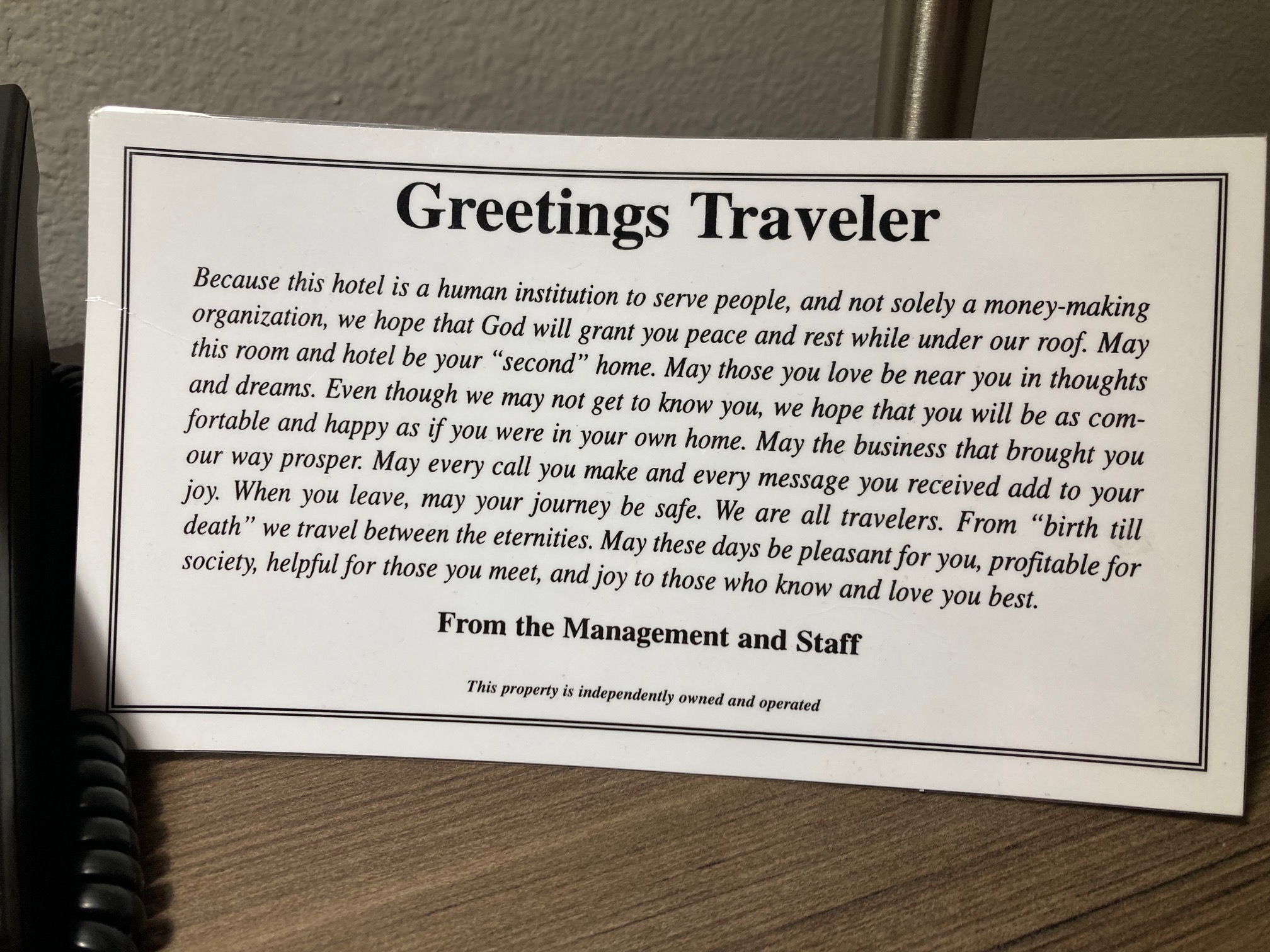
The second encounter came as we checked in at hotel tonight.  A laminated card was left on the nightstand.  The card is basically a greeting and blessing for all who stay at the hotel.  I confess I have never received such a note at a secular hotel, and I was thoroughly humbled by the witness of love of the management and staff of this hotel.  Once again, church found its way to me, this time at a Comfort Inn and Suites.

Hotel Note in Albert Lea, MN (reuse with permission)

Far too often I hear churchgoers complaining about how fewer people are making their way to church.  Today I am reminded that our work is take church to others.  Jesus was always commissioning people to go out and witness God’s love and redemption.  Our work is no different.  I wonder what unique way you might figure out how to be someone’s church today.

← Older posts

Recent Posts

  • On the Myth and Magic of Advent…
  • On Risking Failure and Facing Fear…
  • Sermon – Luke 23.33-43, P29, YC, November 23, 2025
  • On Inhabiting Gratitude…
  • Sermon – Luke 20.27-38, P27, YC, November 9, 2025

Archives

  • December 2025
  • November 2025
  • October 2025
  • September 2025
  • August 2025
  • July 2025
  • June 2025
  • March 2025
  • February 2025
  • December 2024
  • November 2024
  • October 2024
  • September 2024
  • August 2024
  • July 2024
  • June 2024
  • May 2024
  • March 2024
  • February 2024
  • January 2024
  • December 2023
  • November 2023
  • October 2023
  • September 2023
  • August 2023
  • July 2023
  • June 2023
  • May 2023
  • March 2023
  • February 2023
  • January 2023
  • December 2022
  • November 2022
  • October 2022
  • June 2022
  • May 2022
  • January 2022
  • December 2021
  • November 2021
  • October 2021
  • September 2021
  • August 2021
  • June 2021
  • May 2021
  • April 2021
  • March 2021
  • February 2021
  • January 2021
  • December 2020
  • November 2020
  • October 2020
  • September 2020
  • August 2020
  • July 2020
  • June 2020
  • May 2020
  • April 2020
  • March 2020
  • February 2020
  • January 2020
  • December 2019
  • November 2019
  • October 2019
  • September 2019
  • August 2019
  • July 2019
  • June 2019
  • May 2019
  • April 2019
  • March 2019
  • February 2019
  • January 2019
  • December 2018
  • November 2018
  • October 2018
  • September 2018
  • August 2018
  • July 2018
  • June 2018
  • May 2018
  • April 2018
  • March 2018
  • February 2018
  • January 2018
  • December 2017
  • November 2017
  • October 2017
  • September 2017
  • August 2017
  • July 2017
  • June 2017
  • May 2017
  • April 2017
  • March 2017
  • February 2017
  • January 2017
  • December 2016
  • November 2016
  • October 2016
  • September 2016
  • August 2016
  • July 2016
  • June 2016
  • May 2016
  • April 2016
  • March 2016
  • February 2016
  • January 2016
  • December 2015
  • November 2015
  • October 2015
  • September 2015
  • August 2015
  • July 2015
  • June 2015
  • May 2015
  • April 2015
  • March 2015
  • February 2015
  • January 2015
  • December 2014
  • November 2014
  • October 2014
  • September 2014
  • August 2014
  • July 2014
  • June 2014
  • April 2014
  • March 2014
  • February 2014
  • January 2014
  • December 2013
  • November 2013
  • October 2013
  • September 2013
  • August 2013
  • July 2013
  • June 2013
  • May 2013
  • April 2013
  • March 2013
  • February 2013
  • January 2013
  • December 2012
  • November 2012
  • October 2012
  • September 2012

Categories

  • reflection
  • Sermons
  • Uncategorized

Meta

  • Create account
  • Log in
  • Entries feed
  • Comments feed
  • WordPress.com

Blog at WordPress.com.

  • Subscribe Subscribed
    • Seeking and Serving
    • Join 394 other subscribers
    • Already have a WordPress.com account? Log in now.
    • Seeking and Serving
    • Subscribe Subscribed
    • Sign up
    • Log in
    • Report this content
    • View site in Reader
    • Manage subscriptions
    • Collapse this bar
 

Loading Comments...