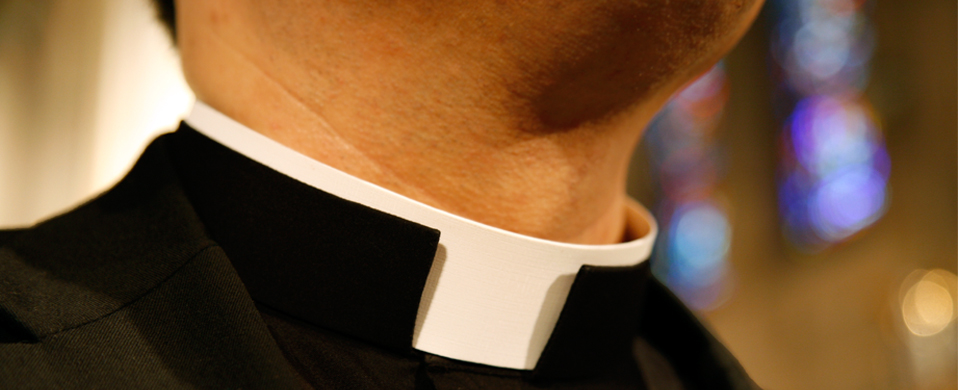
• About

Seeking and Serving

~ seek and serve Christ in all persons

Seeking and Serving

Tag Archives: priest

On the Blessing of No…

05 Wednesday Jun 2024

Posted by jandrewsweckerly in reflection

≈ Leave a comment

Tags

bishop, ego, faith, good, Holy Spirit, image of God, learning, lose, no, opportunity, priest, self-confidence, transform, win, yes

Photo credit: https://toledoparent.com/online-exclusives/learning-to-say-no/

For weeks my fourth grader has been talking about running for Student Body President.  I was admittedly proud of her gumption, but also wildly (and quietly) nervous on her behalf.  She is a genial, vibrant, beloved individual and I feared what losing an election at her age might do to her self-esteem.  But even with gentle warning, she was determined.  So, we worked on her speech and filled out the paperwork.  The “primary” involved whittling down a group of 12 students to three – no speeches or posters, just a raw “popularity contest” among the fourth graders.  Last night she returned home only a little disappointed that she had not been elected to the final ballot. 

I do not know why I doubted her capacity to maintain her self-confidence in the face of such a loss.  I have been modeling the same for her for years – sometimes you win and sometimes you lose.  Sometimes you get a yes, and sometimes you get a no.  These lessons have certainly happened verbally and in low-risk ways, like in card games.  But the lesson has been learned in big ways too – like a lost bishop’s election.  Though I loathed the very public nature of a bishop’s search, I do not think I fully understood the power of letting my girls watch me not only be nominated, but make very public presentations, and then not be elected.

Without realizing it, I have been teaching my girls the power of a good “no.”  Almost all the good things that have happened to me – jobs, schools, auditions – were preceded by a solid no.  The student government election I did not win, the audition where I did not make the cut, the job I really wanted and did not get.  Every single one of those no’s profoundly taught me something about myself I did not know, and every single one of those no’s led to another opportunity that could only open up because of the no that happened first. 

The experience of no’s can be brutal to the ego.  But I wouldn’t be the spouse, mother, priest, or human that I am today without all those no’s.  And now I know that learning was not just for me – it was for my children too.  And maybe those no’s have been for some of you as well.  I wonder what no’s you are facing these days.  I wonder what you have learned from the times you received a no.  I suspect the Holy Spirit has been transforming you so that when you get a yes, you come to that yes as your most powerful self – the self that was made in God’s image and is beautiful and beloved.

On Politics, Priests, and Prayer…

20 Wednesday Jun 2018

Posted by jandrewsweckerly in Uncategorized

≈ 4 Comments

Tags

American, Bible, Christian, communion, dignity, disciple, diversity, Episcopal Church, Eucharist, Good News, gospel, Jesus, policy, politics, prayer, priest, scripture, table

lightstock_99088_medium_david_needham

Photo credit:  https://www.lebanonfbc.org/ministries/power-prayer-pop

One of the hardest parts of being a priest is creating a community in which we can talk about the Gospel of Jesus Christ, hold widely varying political opinions, and yet still gather at the Eucharistic Table – elbow to elbow, as the imperfect, but beloved body of Christ, determined to stay in community.  I say that the work is difficult because I have seen how fragile this work really can be.  During my priestly formation at seminary, congregations and Dioceses were walking away from that common table over the issue of human sexuality.  Although I was proud of what the Episcopal Church did at the time, I also deeply mourned the loss of diversity at the Table – the creation of a more homogenous Church than a Church who was devoted to staying in the tension while honoring the Gospel.

Because of my high value of the uniting force of the Eucharistic Table, my priesthood has taken a slightly different shape than I might have imagined in my early twenties.  If you had asked me then about the primary role of the priest, I might have argued the role of prophet – decrying injustice and leading the people of faith to a more just world.  But as I aged, and as I served diverse parishes, I began to see the role of prophet is one of many roles, one that needs to be used judiciously so as not to alienate parishioners and create an exclusive community of like-minded people.  And so, my priesthood has been marked with great caution around politics.  While many of my colleagues will beat the drum for justice, I find myself trying to carefully walk with my diverse congregations as we discern together how to interpret politics in light of the Gospel – not in light of Democrats or Republicans, but in light of the witness of Jesus Christ.  That doesn’t mean I don’t have strong political opinions; it just means that I try to take focus off the politician or political issue of the moment and try to create disciples who can see and follow Christ.

That being said, this past week, the issue of what is happening to families seeking asylum on our southern border, and the separation of children from parents as a punitive, purportedly deterring action has shifted my normal practice – not because I changed my mind about politics and the Church, but because two agents of our government utilized Holy Scripture to justify those actions.  Here’s the thing:  if this were just another issue where we are divided about policy, where we had a debate about the extents to which we value national security over other values, I would have happily encouraged our parishioners to be faithful Christians in dialogue.  But when Attorney General Jeff Sessions invoked Holy Scripture to justify separating children from parents, he stepped into my area of authority, leaving me no other option but to speak.

Now I could layout a Biblical defense against the small portion of Romans 13 that Attorney General Sessions quoted, giving you the context of the chapter, giving you the verses immediately following what he quoted as a counter to his argument.  I could quote to you chapter and verse for countless other scripture lessons that tell us to love one another, respect the dignity of other human beings, care for the outcast and alien, tend the poor, and honor children.  I could also tell you about how that same bit of scripture was used to justify slavery, Nazis, or apartheid in South Africa.  But the problem with a scripture quoting war is that no one wins.  What is more important is what we know of the canon of Scripture:  that our God is a God of love, that Jesus walked the earth showing us how to be agents of love, healing, and grace, and that the Holy Spirit works through us today to keep spreading that love.

Knowing what I know about the Good News of God in Christ, in my baptismal identity as one who seeks and serves Christ in all persons, respecting the dignity of every human being, I cannot stand idly by or be silent when the Holy Scriptures of Christians are being used to justify political actions that are antithetical to our Christian identity.  As a priest, I invite you this week, especially when a governmental leader is invoking our faith, to reflect on how the Gospel of Christ is informing your view on this issue.  Not as a Republican and not as a Democrat, but as a follower of Christ.  Fortunately, prominent politicians on both sides of the aisle seem to be coming to agreement on this issue – a rarity these days – but also an example to Episcopalians who hold a high view of coming to the Eucharistic Table across our differences.  I am not saying we need to agree on this – in fact, I suspect we will not.  What I am asking is that you live into your identity as a disciple of Christ, as an agent of love, and then respond in conversation, in political advocacy, and in worship as one holding in tension both our American and Christian identities.  I support you in this difficult, hard work.  I love you as you struggle.  I welcome you to the Eucharistic Table.

On Being Called by Name…

14 Wednesday Mar 2018

Posted by jandrewsweckerly in Uncategorized

≈ Leave a comment

Tags

affirmed, baptism, call, church, Episcopal, God, identity, known, loved, name, nickname, pastor, priest, relatedness, role, tension

nametag

Photo credit:  blog.sweetcareersconsulting.com/2015/10/what-name-should-you-use-on-linkedin.html

In my line of work, my female colleagues are widely divided on what we should be called.  You see, for years in the Episcopal Church, the male priests were “Father so-and-so.”  In formal writing, it was “the Rev. so-and-so.”  But in the Episcopal Church, priests are not called “Rev. so-and-so” because the word reverend is an adjective, not a noun, and most Episcopalians cannot stand by grammatical errors.  Episcopalians also do not often use “Pastor so-and-so,” as it is considered too protestant.  So, that leaves Episcopalians in a bit of mess with titles for female priests.  Many have taken to calling women “Mother so-and-so,” to create a sense of parity between male and female priests.  But some women despise that address.  And so, female priests tend to be all over the map about what they prefer – from no title at all (simply using their name given at baptism) to Mother, to Reverend (conceding to the grammatical error for the sake of convenience), to Pastor.

So, when I was asked at my local yoga studio what I was called professionally, I had to chuckle.  I told them when I use a title, I prefer Mother Jennifer.  But that I answer to almost anything – Mother Jennifer, Rev. Jen, Pastor Jennifer, or just Jennifer.  But this past week, I added some new favorites.  A toddler in our parish was watching on online broadcast from church.  When her dad asked, “Do you know who that is?” she replied, “That’s Mama Church.”  Just last week, as our ecumenical brothers and sisters helped us host a winter shelter for the homeless in our community, a Roman Catholic volunteer was talking to my husband.  When she realized who he was she said, “Oh, your wife is that little spitfire thing!”

The funny thing is that despite our baptized names, I think we are all living into identities throughout life.  Sometimes we will only be known as our child’s parent – “Simone’s Mom.”  Sometimes we are known by our profession title – Doctor Smith, Nurse Johnson, Professor Green, Colonel Davis.  Sometimes we take on a funny nickname from a particular stage of life – I’ll let your memories recall a few of your own.  What we are called creates meaning, purpose, and identity throughout life.  And sometimes we have nicknames that we do not even know about – whether it’s “spitfire” or something else.

One of the things I love about church is that we work hard to know each other’s names:  sometimes the ones we are baptized with, but sometimes the funny, the serious, and the beloved names.  Those names can make us feel known, loved, and affirmed.  But mostly those names in church remind us that we are known by name by someone else:  our God.  I like to think God is able to hold all our names in tension:  the funny, yet embarrassing ones; the honorific ones; the ones that remind us of our call; the ones that reveal our relatedness.  God knows us better than any one name can contain, and yet I imagine loves every little nuance of our names.  I wonder what names in your life could stand to be let go, and which names invite you to be someone powerful and life-changing.

On Collars, Conversations, and Confessions…

14 Wednesday Sep 2016

Posted by jandrewsweckerly in Uncategorized

≈ Leave a comment

Tags

Christ, clergy, collar, conversation, faith, journey, pastor, prayer, priest, stranger

Last week, I stopped by a local doughnut shop to pick up treats for some of our church volunteers.  The staff needed to make a fresh pot of coffee, so I had to wait by the counter.  After a couple of minutes, the woman who had been helping me approached me and said, “Okay, settle a bet for us.  Are you a nun or a pastor?”

anglican-collar

Photo credit:  https://blackandwhiteandlivingincolor.com/2014/01/16/coffeehouse-musings-why-i-wear-my-anglican-collar-sometimes/

I get questions about my collar all the time.  Most people are not as courageous and will simply stare – usually with a furrowed brow of confusion.  Others will only confess that they always wondered what that “thing” was I wore when we finally get around to talking about our jobs.  Sometimes people will ask if the Roman Catholic Church started ordaining women (trust me – you would know if they had!).  Of course, my favorite experiences have been when I have been both in a collar and pregnant.  That really confuses people!

Once I finally confessed I was a “pastor” to the doughnut shop, one of the women working the drive-through said, “Oh good!  Can you pray for us?”  We had a great conversation after that, and I promised to keep them in my prayers for the rest of the day as I departed.  But as I left, I realized two things.  First, being a priest in my community is a tremendous blessing.  It allows me to have deep, intimate conversations with people a lot more quickly than you would with most strangers.  It allows me to not only be a pastor with my own parishioners, but everywhere I go in my collar.  It allows me to stretch the reach of the Church beyond the walls of our church.

But what I also realized when I left that shop is that talking about the need for prayer probably would not have happened had I not had on my collar.  I am constantly inviting my parishioners to have faith conversations outside the context of our community, but that day I realized how challenging that invitation can be.  A clergy collar is like an automatic ice breaker – it is an invitation for you to say, “Oh good!  Can you pray for us?!?”  But how do we break the ice without such tools?  How can I let the grocery clerk, the delivery man, or the construction worker know that I want to pray for them too – even when I am in my sweats?  How do we get beyond the perfunctory greetings and start having real conversations?  This week, I invite us all to consider how we might start such a journey toward authentic, meaningful conversations about the intersection of our individual journeys and the presence of Christ in our lives.  Know that I will be praying for us both as we figure it out!

Sermon – Jeremiah 1.4-10, P16, YC, August 21, 2016

07 Wednesday Sep 2016

Posted by jandrewsweckerly in Uncategorized

≈ Leave a comment

Tags

called, calling, church, God, Jeremiah, ministry, priest, prophet, Sermon, vocation

“What do you want to be when you grow up?”  I have lost count of how many times we have asked that question to our oldest daughter.  The answer varies widely depending on what phase she is in or what they have been talking about in school.  I confess that there have been times when I was disappointed when she changed her mind – “author and illustrator” was my favorite, though “engineer” was a pretty good one recently.  But my all-time favorite conversation about what she wanted to be when she grew up was actually a conversation about priesthood.  I asked her my typical question, “So have you decided what you want to be when you grow up?”  She replied thoughtfully, “I can’t decide.  There are too many options.”  Sympathetically I said, “I totally understand.  It took me years to decide what I wanted to be.”  And without a beat, she replied, with disgust, “And you decided to become a priest?!?”

The thing is, I do not think my daughter’s reaction is all that different than most people.  Very few people ever imagine themselves being ordained.  The vocation seems too foreign, to require some mysterious amount of holiness, or to just be too weird.  All of that makes sense to me – not everyone feels called to the priesthood.  But too often acknowledging we do not want to be a priest means that we stop using “call” language altogether.  Instead of being able to talk about what we feel called to do in life, we instead talk about what we want to be when we grow up.  A calling, a ministry, or even a vocation is something that clergy people do, not what we all do.

At least, that is what the secular world would have us believe.  The church says something a bit different.  Throughout our liturgies and Prayer Book, we talk about the ministry of all people.  Our Catechism defines the ministers of the Church as lay persons, bishops, priests, and deacons.  The Catechism further states that the ministry of lay persons is to represent Christ and his Church; to bear witness to him wherever they may be; and, according to the gifts given them, to carry on Christ’s work of reconciliation in the world; and to take their place in the life, worship, and governance of the Church.”[i]  In the baptismal covenant, we all promise to proclaim, by word and example, the Good News of God in Christ, to seek and serve Christ in all persons, and to strive for justice and peace.  Now some of you may argue that you do those things – just not as your daily work.  You are happy to be involved in church, but you do not see your life as a student, a secular worker, or a retiree as a vocation.

And stories like the one we hear in Jeremiah do not help us in this distinction.  You see, we hear Jeremiah’s call today like we hear the call of most prophets – and rightly so, since Jeremiah is so similar to other prophets.  Like Moses, Isaiah, and Ezekiel, Jeremiah balks at the idea that God may be calling him to do something.  Jeremiah protests that he is too young.  Similarly, Moses tried to argue he was unskilled, Isaiah that he was unworthy, and Ezekiel that he did not know what to say.[ii]  When God calls people to do big things, they often push back and seek an out.  In most cases, their fear is legitimate.  Being a prophet is often a thankless job – which can certainly lead to suffering, if not death.  But invariably, God reassures the person being called.  In Jeremiah’s case, God tells Jeremiah that he was born for this job.  “Before I formed you in the womb I knew you; and before you were born I consecrated you; I appointed you a prophet to the nations.”

All of that sounds nice. In fact, many of us love this verse from scripture because the verse gives us a sense of comfort, belonging, and affirmation – a sense that we are all known by God.[iii]  But what we forget is that in knowing Jeremiah so deeply, God also knows that Jeremiah will have to do a really hard job.  The touchy-feely part of the text starts to wane when we hear the part about being a prophet – especially a prophet who will need to fear others.  But here’s the real problem with Jeremiah’s call:  we do not think God similarly calls us.  Not even all priests see themselves as prophets.  Prophets, priests, deacons – those are jobs that other people do.  Those are not jobs we do.  We go to school everyday.  We are teachers, financial consultants, government workers, stay-at-home parents, or journalists.  We are retired and are done with the “job” part of our lives.  We hear stories like the call narratives of Jeremiah, Moses, Ezekiel, and Isaiah, and we can keep ourselves at a safe distance because those are the jobs that those people do.

But remember that catechism and baptismal covenant?  The truth is we are all called to something.  We all have a vocation.  That calling or vocation may be our jobs or what we do every day.  We may live out our vocation as a student when we stand up to a bully, play with the new kid who seems lonely, or help tutor the troublemaker clearly needs help.  We live out our vocations at work when we advocate for justice for our coworkers, when we offer an ear to a coworker who is struggling, or when we organize a volunteer day for our company.  We live out our vocations as retirees when we volunteer at the local homeless shelter, when we treat with dignity the workers we encounter who provide us services, and when we use our time to advocate for the poor.

But vocation is sometimes found outside of those typical confines.  Sometimes living into our vocation means calling that person who has been on our minds – only to discover how much they needed a word of encouragement.  Sometimes living into our vocation means helping the mom in front of us in the grocery store line who is clearly juggling children, groceries, and dealing with a cashier who has never handled food stamps or WIC benefits.  Sometimes living into our vocation means praising and giving thanks to a preschool teacher who just got chewed out by a parent who thinks their child is just fine (when you suspect the child is actually really hard for the teacher to manage).

This fall, we will be starting up an adult education series called Discovery Class.  The class is for newcomers and members alike, who want to learn more about our Episcopal Identity, the work of Hickory Neck, and how we can connect to a ministry.  In the final session, participants will take a survey to help us discern how our gifts might best tie in with a ministry at Hickory Neck.  The survey is a great resource because sometimes teachers are the best matches for Sunday School and Youth Group leadership.  But sometimes, best matches for Sunday School and Youth Group are retirees who have been around the block and get how hard the teenage years are.  Likewise, someone may have been may have been in construction or administration during their career, but really want to learn how to arrange flowers with the Flower Guild, or play with babies in the nursery.  Though many of us have vocations and callings out in the world, sometimes the church is another place where our vocations and callings feed us and others.

So if we are willing to agree that we all have a calling or vocation, recognizing that some vocations can change and evolve over time, how do we know if we are living into our calling?  The true test of a vocation might be something like this:  whatever in your life is the most intimidating, daunting, or even terrifying task (be it teaching teenagers, asking for money for church, or praying in front of a group), and yet, when you try doing that task gives you an odd sense of deep satisfaction and meaning, is probably your vocation.  Prophets would not go kicking and screaming if being a prophet was easy.  And yet, prophets would not say yes without the assurance that God is with them, empowering them to be God’s agents.[iv]

This fall, I hope we will all prayerfully consider what ministry God is calling us to do.  Paul says in his letter to the Ephesians, “I therefore, the prisoner in the Lord, beg you to lead a life worthy of the calling to which you have been called, …The gifts he gave were that some would be apostles, some prophets, some evangelists, some pastors and teachers, to equip the saints for the work of ministry, for building up the body of Christ, until all of us come to the unity of the faith and of the knowledge of the Son of God, to maturity, to the measure of the full stature of Christ.”[v]  Though Church is certainly meant to give us comfort and encouragement each week, Church is also the place that strengthens us and sends us out into the world to do the work Christ has given us to do.  One of my favorite church signs looked simple enough from the road – with the name of the church emblazed on front, as you drove into the parking lot.  But on the backside, as you were leaving church each week, the sign had a separate message.  The sign read, “Go in Peace to Love and Serve the Lord.”  That is our dismissal this and every week – to not just consume Church, but to use Church as our foundation to go out into the world to love and serve.  And our response is, as always, “Thanks be to God!”  Amen.

[i][i] BCP, 855.

[ii] Bruce C. Birch, “Exegetical Perspective,” Feasting on the Word, Yr. C, Vol. 3 (Louisville: Westminster John Knox Press, 2010), 367.

[iii] John t. DeBevoise, “Pastoral Perspective,” Feasting on the Word, Yr. C, Vol. 3 (Louisville: Westminster John Knox Press, 2010), 364.

[iv] Thomas R. Steagald, “Theological Perspective,” Feasting on the Word, Yr. C, Vol. 3 (Louisville: Westminster John Knox Press, 2010), 366, 368.

[v] Ephesians 4.1, 11-13.

Sermon – Mark 9.38-50, P21, YB, September 27, 2015

30 Wednesday Sep 2015

Posted by jandrewsweckerly in Uncategorized

≈ Leave a comment

Tags

barrier, boundaries, call, church, division, Episcopal, exclusivity, God, hospital, in, Jesus, out, prayer, priest, Roman Catholic, rules, sent, Sermon

“Are you the priest they sent?”  That was the question he asked me.  I was confused at first, but realized one of the nurses must have called an on-call priest.  I also knew from experience that if he was looking for the “priest they sent” he was not looking for me.  You see, I’m a priest, but I’m also a woman.  When people at hospitals are looking for priests, the majority of the time they mean a Roman Catholic priest.  But he seemed desperate, so I delicately said “No, I’m actually here to see a parishioner.”  But I stayed and talked to him a bit more about what was going on and whether the chaplain’s office had been called.  His wife joined us as we talked.  Then the inevitable question came.  She asked what church affiliation I had.  I told them I was a priest in the Episcopal Church, and that they were welcome to wait for a Catholic priest.  She insisted it didn’t matter – they just wanted a priest to say prayers.

Honestly, I was floored.  That had never happened to me.  Usually when I tell a Roman Catholic person that I am not a Roman Catholic priest, they reveal (subtly or not so subtly) that I am not the kind of priest they want.  And truthfully, I am totally fine with that.  I totally understand and would never assert any differently, especially to someone in crisis at the hospital.  We ended the conversation with the agreement that we would go to our separate rooms.  When I was done, if they still didn’t have their Roman Catholic priest, I would be happy to say prayers.  I went on to my visit, fully anticipating the “real” priest to show up for them while I was elsewhere.

That division among the Church, among the faithful of God, is not unique to Roman Catholics.  We all make boundaries and distinctions about who is in and who is out.  Episcopalians are only in full communion with the Evangelical Lutheran Church of America.  So if I ever wanted to have a United Methodist Minister or Presbyterian pastor celebrate Eucharist, I would not be allowed.  We also make rules around the communion rail.  Most Episcopal Churches say that all baptized Christians are welcome to the table – meaning if you have not been baptized, you should not receive.  Even to serve on Vestry we have boundaries.  All Vestry members have to be financial supporters of the parish, are expected to be present regularly in worship and parish events, and are asked to contribute to at least one ministry of the church.  If the Vestry member is unwilling to make those commitments, they cannot serve on Vestry.  We often think of Roman Catholics as having lots of boundaries – from no women at the altar, to no married clergy, to no communion unless you are Roman Catholic.  But the reality is that, as Episcopalians, we have an equal number of boundaries that keep people in and out of our community.

The good news is that we come by our exclusivity honestly.  In our gospel lesson from Mark today, we are told about an encounter between the disciples and Jesus.  John comes up to Jesus and says, “Teacher, we saw someone casting out demons in your name, and we tried to stop him, because he was not following us.”  John is so confident of his authority that he almost sounds like he is boasting to Jesus.  “Hey, Jesus, there’s some dude who is trying to do our work and he keeps using your name.  But don’t worry – we shut him down.”  You can almost imagine John expecting Jesus to give him a chug on the shoulder and say, “Good work, John!”  But that is not how the story unfolds.  Instead, Jesus says the total opposite, “Do not stop him; for no one who does a deed of power in my name will be able soon afterward to speak evil of me.  Whoever is not against us is for us.”  You can imagine the disciples’ confusion.  Jesus is constantly pulling them aside and only telling them how to interpret his parables.  When Jesus commissions people, he commissions the disciples, and no one else.  And although people are often following Jesus in droves, his crew, or his posse, is made up of the disciples.  In the disciples’ minds, Jesus is implicitly telling them that they are the insiders, with special privileges, and everyone else is an outsider.  The disciples are in; everyone else is out.  And anyone who tries to break those boundaries is going against the will of Jesus – and, ergo, the will of God.

Despite the fact that Jesus shuts down the notion of insiders and outsiders, the Christian community has been struggling with boundaries since Jesus’ death.  Who is a Christian?  Who can have communion?  What are the rules and what are the consequences of breaking the rules?  Now, boundaries are not necessarily bad.  Boundaries help us define who we are and what behavior is acceptable.  Boundaries help us uphold values and create meaning.  Boundaries can even help us make an informed choice about belonging to a community.[i]  Clearly Jesus created some boundaries.  When he says, “Whoever is not against us is for us,” he implies that there are people who are in fact against them.  Jesus himself creates a group of insiders and outsiders.  What Jesus is trying to communicate is not that boundaries are bad.  What Jesus is trying to communicate is that we are capable of getting so wrapped up in our boundaries that we exclude people from the love of Christ.  And nothing could be more harmful, or even sinful, than making someone feel that they are cut off from the love of Christ.

I had a friend who started going to therapy to help him cope with a spouse suffering from depression.  He imagined that the therapist would share her knowledge of persons suffering from depression and teach him some coping skills.  But after a lengthy explanation about what was wrong with his spouse, the first question the therapist asked was about him.  The therapist wanted to know what his issues were.  My friend interrupted, “No, no, no, I’m not here for me, I’m here to learn more about dealing with my spouse.”  The therapist wisely said, “Yes.  But before we get to your spouse, let’s talk about you.”  That therapist did what Jesus does with the disciples.  Jesus redirects the disciples concern about others by telling them to worry about their own problems – those hands, feet, and eyes that cause them to sin.  You see, Jesus is very clever.  What he realizes is that when the disciples start sorting through their own sinfulness, their own “stuff,” they do not have time to worry about boundaries and rules and barriers.[ii]  And when they let go of those boundaries, rules, and barriers, something incredible can happen – the love of God and the fellowship of Christ can grow and thrive.

By the time I finished my visit with my parishioner, the Catholic on-call priest had still not arrived.  I went into the room of the family and realized they needed more than a prayer.  They were going to be removing life support and wanted someone to offer the patient Last Rites.  I again reminded them that I was an Episcopal Priest.  The wife of the couple said, “It’s still Last Rites though, right?”  “Yes,” I replied.  “Okay, then.”  That was all.  Here I was bringing up boundaries again and again, and this person, who normally has even more boundaries than I do, insisted that I let go of my boundaries and help her family have an experience with God.  The first words the husband had asked me were, “Are you the priest they sent?”  My first answer was correct.  I was not.  But my answer was not complete.  I was not the priest that “they” sent.  But I was the priest that God sent.  You see, God has a call on me – and in fact God has a call on each person here.  God sends us everyday – to our workplaces, to our schools, to our friends, and to strangers.  Everyday we have the choice to get tangled up in boundaries and rules and limitations.  But we also have the choice to remember the ways that Jesus wants us to love God and love our neighbors.  Those are the only two boundaries Jesus really cares about anyway.

That is our invitation this week:  to consider how God is calling you and also to consider how you are getting in the way of God’s call.  The boundaries and the rules really are not as complicated as they sound.  If the Pope can say, “Who am I to judge?” surely we can start letting go and embracing love.  Then, the next time someone asks you, “Are you the person that was sent?” you can reply, “Yes.  Yes, I am.”  Amen.

[i] Harry B. Adams, “Pastoral Perspective,” Feasting on the Word, Yr. B, vol. 4 (Louisville:  Westminster John Knox Press, 2009), 116, 118.

[ii] Amy Oden, “Commentary on Mark 9.38-50,” September 30, 2012, as found at http://www.workingpreacher.org/preaching.aspx?commentary_id=1357 on September 25, 2015.

Homily – 2 Chronicles 20.20-21, Psalm 106.1-5, John Mason Neale, August 7, 2014

21 Thursday Aug 2014

Posted by jandrewsweckerly in Uncategorized

≈ Leave a comment

Tags

God, goodness, gratitude, happiness, homily, John Mason Neale, love, priest, thankfulness

Today we honor John Mason Neale, a priest of many talents.  He was a hymn writer, supplying our current hymnal with several original hymns and over 30 translations of Latin and Greek hymns.  His more familiar works include, “All glory, laud and honor,” and “Sing my tongue, the glorious battle,” from Palm Sunday and Good Friday, respectively.  He was a priest who actively supported the Oxford Movement, which sought to revive medieval liturgical forms.  He was also a humanitarian.  He founded the Sisterhood of St. Margaret for the relief of suffering women and girls.  Born in 1818, he died at the age of 46.  Though his life was short, it was full.  He took the gift of his years and gifted the church with beautiful liturgies, song, and service to the poor.

John seemed to embody in his life our Old Testament lessons today.  Second Chronicles says, “Give thanks to the Lord, for his steadfast love endures forever.”  Our Psalm says, “Give thanks to the Lord, for he is good, for his mercy endures forever.”  Our lessons encourage being rooted in thankfulness because the authors know how generous, loving and merciful God is.  Once one realizes that goodness, the only possible response is one of gratitude.  The things John did: revising liturgies, writing beautiful music, serving the poor – all bubbled up from a place of gratitude toward the Lord.

But how do we get to that place of gratitude?  The psalm says, “Happy are those who act with justice and always do what is right.”  Think back to the last time you made sandwiches with the interfaith group, helped grow produce for the poor, or simply gave money to the church in support of its ministry.  Do you remember how those experiences felt?  There is a happiness that comes when we love God’s people.  That kind of happiness helps us to better see goodness – to better see God.  And when we see God, our hearts are overwhelmed with gratitude.

John Mason Neale showed us what a heart filled with gratitude can accomplish.  Out of his gratitude flowed music, worship and service.  John invites us to enliven our lives with gratitude and enjoy the beauty that will flow from us.  So give thanks to the Lord, for his steadfast love endures forever.  Amen.

A child of God…

02 Wednesday Jul 2014

Posted by jandrewsweckerly in Uncategorized

≈ 1 Comment

Tags

children, church, family, God, parent, priest

I am a regular advocate for children in Church.  I think the practice shapes children at a young age and enlivens worship for the community.  Though distracting to some, the noise of children makes me feel like the church is alive and joyful.  That is why I always encourage parents with young children, because I know from experience that the noises of your own child sound ten times louder than they do to anyone else.  I also know that wrangling little ones can be frustrating some days and other days down-right impossible.  Many a parent has expressed to me that they are glad the sermons are posted online, since they often do not hear it when their little ones are particularly active.  I encourage parents to persevere and even make sure that Sunday School does not bleed into worship time so that our children can be present as gifts to the rest of the congregation.
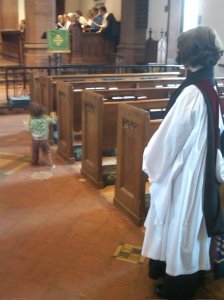
But every once in a while, my own daughter reminds me how my principles do not always coincide with the realities of experience.  This past Sunday, as we were serving communion, my daughter managed to sneak away from her dad, and kneeled next to another parishioner.  When I reverently offered her the host, she abruptly grabbed it from my hand and shoved it enthusiastically into her mouth.  As her parent, my immediate reaction was to be a little embarrassed and to wonder what the other parishioners must think of my parenting skills.  Despite a couple of chuckles, I squashed my embarrassment, and moved on to the next person at the rail.  Later that morning, during the final hymn, my daughter joined me in the aisle as I sang and waited to deliver the morning’s announcements.  As the hymn was wrapping up, she dropped my hand and started shaking her hips in the center aisle, dancing to the hymn with reckless abandon.  Again, my initial instinct was to fret over what parishioners might think about the kind of dancing I was teaching at home.

Later, as I was thinking about the two incidents, several things came to me.  One, I was once again reminded how hard it is to manage children in the context of formal worship.  I am so grateful to the parents who do it every week and who allow us to be blessed by their children.  Two, I realized how hyper aware I am of my role within the church and how that role has some serious implications for my family.  In my ordination vows, the bishop asked me, “Will you do your best to pattern your life and the life of your family in accordance with the teachings of Christ, so that you may be a wholesome example to your people?”  Sometimes, I think that question makes priests and their families feel like they have to be perfect – including in the pew on Sundays.  But what I realized was that my daughter was not shattering our “perfect” image.  She was inviting me to let go of pretenses and be real with our parish.  Being a parent, in fact being a human, is messy, and I do not need to pretend that I somehow have a better hold on being “not messy” simply because I am a priest.

Finally, what I realized on Sunday is that being a “wholesome example” means loving my child in the way that I love all our children at church.  When I could step back from the fact that my child was greedily grabbing Eucharist and dancing a little “inappropriately” in church, I could see the incidents totally differently.  When I could see my child as a child of God, I could see someone who was demonstrating how eager we all should be to receive Christ’s body at the table:  how our longing for Jesus sometimes is downright greedy and aggressive, and grabbing for the bread is a physical way of showing a passionate longing for Christ.  When I could see my child as a child of God, I could see someone who was moved by the Holy Spirit to joyfully dance before the Lord, not unlike David so many years before[i]:  someone who was actually inspired by the music being sung and played, not just dutifully and dispassionately singing the words.  I thought about how her body is a gift from God and how wonderful it was that she was using her body to praise God, even if my uptight-self resisted it.

One of the greatest reasons having children among our midst in church is because they help us get out of ourselves and our need to keep up appearances, and they help us to see the holy in new, exciting, and fresh ways.  So, please keep bringing those little ones.  We all need them to show us the face of Christ.  And for our parents, occasionally they might remind you how they are children of God as much as they are your children as well.

[i] 2 Samuel 6.16

On being dust…

06 Thursday Mar 2014

Posted by jandrewsweckerly in Uncategorized

≈ Leave a comment

Tags

Ash Wednesday, community, death, dust, God, humble, journey, priest

One of the gifts of being a clergy person is the moments of insight, intimacy, and holiness.  That gift is probably one of the primary things that keep me going, especially in the midst of weeks when the vocation feels more full of challenge than full of blessing.  The cool thing about the gift is that it often catches me unawares – I am busy just doing my job when all of sudden, wham!, God brings me to my knees with the enormity and privilege that this vocation is.

Courtesy of http://en.wikipedia.org/wiki/Ash_Wednesday

Courtesy of http://en.wikipedia.org/wiki/Ash_Wednesday

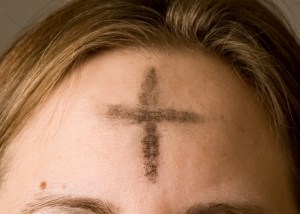
It happened yesterday as our church celebrated Ash Wednesday.  As my mind was distracted with my sermon, the choreography of the liturgy, and the elements of the altar, I suddenly found myself at the part of the liturgy where I spread ashes on each person’s forehead.  I had forgotten how incredible that moment is.  There I am, rubbing dirty, gritty ash on person’s forehead, reminding them of their mortality.  The experience is a visceral, fleshy one.  Some foreheads are covered with hair, some are oily after a day of work or activity, and some are polished and made up.  Some foreheads are smooth and non-anxious and others are lined with the wrinkles of age or stress.

But even more profound than the tangible piece is the emotional piece of the experience.  There is the woman who just celebrated 91 years of life.  I find myself wondering how many more years we will share moments like this.  There is the parishioner with whom I have shared laughs and tears, who is the prime of their lives, and whose death I cannot fathom.  And of course there are the children.  There is something profound about reminding a five-year old that they will someday die, whether they fully understand what is happening in the liturgy or not.

After everyone had received ashes, I turned to our acolyte and asked her to give me ashes as well.  In this time of growing life inside of me – as I have frequently fretted about the viability of my child outside the womb – I was reminded that neither my coming child nor I are spared from returning to dust someday.  Though that sounds like a grim thought, where it ultimately left me was convinced that no matter what happens, God is the firm foundation that I stand firmly upon, grounding me, keeping me humble, and reminding me of what really matters.

That is the other beauty of being a clergy person.  As much as I hope liturgies are meaningful to others, I find them equally meaningful to me.  Sometimes it is harder than others to worship while leading worship.  But this Ash Wednesday, the power and wonder of the liturgy and our God did not escape me.  I am grateful today for the powerful reminder of my humanity, the collective recognition of the fragility and preciousness of this life, and the blessing of a community who always gives me a healthy dose of perspective.

Homily – 1 Peter 5.1-4, George Herbert, February 27, 2014

06 Thursday Mar 2014

Posted by jandrewsweckerly in Uncategorized

≈ Leave a comment

Tags

call, faithful, George Herbert, God, homily, priest, service

Today we honor George Herbert, a priest and poet in the church.  Herbert was born in 1593 to a well-connected family in England.  Though he flirted with politics, he eventually turned to the church, becoming a priest age 33.  Two things are notable about Herbert.  First he is well-known for his poetry, some of which became hymns.  He influenced many other poets, as his poems moved people on issues of prayer and the spiritual life.  Herbert was also well known for his devotion and service to others.  His approach toward life and ministry inspired many.  In fact, his words, “Nothing is little in God’s service,” remind Christians again and again that everything in daily life, small or great, can be a means of serving and worshiping God.  When talking about his poetry, Herbert seemed to meld the two passions when he wrote about his poems as being “a picture of the many spiritual conflicts that have passed betwixt God and my soul, before I could submit mine to the will of Jesus my master, in whose service I have found perfect freedom.”

What Herbert reminds us of today is the sacred nature of all our calls.  Sometimes, we do not feel comfortable using “call” language for what we do on an everyday basis.  In fact, we read passages like the one from first Peter, and we presume that only clergy, or “elders,” have a call.  Though first Peter is talking about how a spiritual leader should lead, we cannot assume we are exempt from similar instructions.  In fact, I might argue that the call that each of you live out in the world is far greater than the call I live in my position.  You have the much together jobs of witnessing in everyday life without such clear markers of faith and devotion like a collar.  And you have the ability to reach way more people that I could ever hope to because unlike what many people assume about me, you are actually “normal.”

What first Peter and George Herbert would both like us to see is that all of us have kingdom work to do, and our aim is to do that work faithfully and with enthusiastic hearts.  Herbert only lived to be 40 years old, and yet one of the things we honor is the way in which he was a faithful, humble, enthusiastic priest – not a bishop, or martyr, or leader of some great movement.  He was just a parish priest who knew that nothing is little in God’s service.  As we celebrate his passion for everyday life and everyday call, we too are emboldened by knowing that fulfilling our calls is not “little” in God’s service.  Amen.

Recent Posts

  • On the Myth and Magic of Advent…
  • On Risking Failure and Facing Fear…
  • Sermon – Luke 23.33-43, P29, YC, November 23, 2025
  • On Inhabiting Gratitude…
  • Sermon – Luke 20.27-38, P27, YC, November 9, 2025

Archives

  • December 2025
  • November 2025
  • October 2025
  • September 2025
  • August 2025
  • July 2025
  • June 2025
  • March 2025
  • February 2025
  • December 2024
  • November 2024
  • October 2024
  • September 2024
  • August 2024
  • July 2024
  • June 2024
  • May 2024
  • March 2024
  • February 2024
  • January 2024
  • December 2023
  • November 2023
  • October 2023
  • September 2023
  • August 2023
  • July 2023
  • June 2023
  • May 2023
  • March 2023
  • February 2023
  • January 2023
  • December 2022
  • November 2022
  • October 2022
  • June 2022
  • May 2022
  • January 2022
  • December 2021
  • November 2021
  • October 2021
  • September 2021
  • August 2021
  • June 2021
  • May 2021
  • April 2021
  • March 2021
  • February 2021
  • January 2021
  • December 2020
  • November 2020
  • October 2020
  • September 2020
  • August 2020
  • July 2020
  • June 2020
  • May 2020
  • April 2020
  • March 2020
  • February 2020
  • January 2020
  • December 2019
  • November 2019
  • October 2019
  • September 2019
  • August 2019
  • July 2019
  • June 2019
  • May 2019
  • April 2019
  • March 2019
  • February 2019
  • January 2019
  • December 2018
  • November 2018
  • October 2018
  • September 2018
  • August 2018
  • July 2018
  • June 2018
  • May 2018
  • April 2018
  • March 2018
  • February 2018
  • January 2018
  • December 2017
  • November 2017
  • October 2017
  • September 2017
  • August 2017
  • July 2017
  • June 2017
  • May 2017
  • April 2017
  • March 2017
  • February 2017
  • January 2017
  • December 2016
  • November 2016
  • October 2016
  • September 2016
  • August 2016
  • July 2016
  • June 2016
  • May 2016
  • April 2016
  • March 2016
  • February 2016
  • January 2016
  • December 2015
  • November 2015
  • October 2015
  • September 2015
  • August 2015
  • July 2015
  • June 2015
  • May 2015
  • April 2015
  • March 2015
  • February 2015
  • January 2015
  • December 2014
  • November 2014
  • October 2014
  • September 2014
  • August 2014
  • July 2014
  • June 2014
  • April 2014
  • March 2014
  • February 2014
  • January 2014
  • December 2013
  • November 2013
  • October 2013
  • September 2013
  • August 2013
  • July 2013
  • June 2013
  • May 2013
  • April 2013
  • March 2013
  • February 2013
  • January 2013
  • December 2012
  • November 2012
  • October 2012
  • September 2012

Categories

  • reflection
  • Sermons
  • Uncategorized

Meta

  • Create account
  • Log in
  • Entries feed
  • Comments feed
  • WordPress.com

Blog at WordPress.com.

  • Subscribe Subscribed
    • Seeking and Serving
    • Join 394 other subscribers
    • Already have a WordPress.com account? Log in now.
    • Seeking and Serving
    • Subscribe Subscribed
    • Sign up
    • Log in
    • Report this content
    • View site in Reader
    • Manage subscriptions
    • Collapse this bar
 

Loading Comments...