• About

Seeking and Serving

~ seek and serve Christ in all persons

Seeking and Serving

Tag Archives: Savior

Sermon – Luke 24.1-12, EV, YC, April 19, 2025

18 Wednesday Jun 2025

Posted by jandrewsweckerly in Sermons

≈ Leave a comment

Tags

church, Easter Vigil, God, Jesus, love, salvation, Savior, Sermon, story

Tonight, we celebrate one of the most ancient, and in many traditions, the most important liturgies of the Church.  This is the festival of the resurrection of our Lord – despite what you may have learned about Easter Sunday.  Tonight is the night that we liturgically mark that shift from Lent and the Passion to our Lord and Savior’s Resurrection.  The church gives us this incredible gift tonight, and our job is to hearken back to an innocent sense of awe as we realize what God does through Jesus Christ.

Luckily the Church helps us hearken back to that innocent sense of awe through the structure of the liturgy.  I like to think the Church’s work in the Easter Vigil as being like that grandfather in the movie The Princess Bride, who visits his sick grandson to read him a fantastic tale.  In that movie, the grandson is skeptical – that in fact his grandfather might be planning to read him a boring or sappy story.  But the grandfather insists that this story is one of the greatest stories ever told – a story that his father read him, that he read to his son, and now, he would read to him, his grandson.

The Church is like that grandfather to us tonight, who gathers up the grandchildren around him, and says, “Let me tell you a story.  This story is greater than any other story you have ever heard.  This story is full of intrigue and surprise, full of the primal elements, full of drama and passion, and full of twists and turns you will not expect.  Do you want to hear the story?”  And before the grandfather can even begin, we, the grandchildren, are waiting with bated breath.

“Once upon a time, before there was time, or people, or even land or sky, the earth as we know the earth was a formless void – filled with watery chaos.  God created the world as we know the world, and proclaimed that creation, ‘good.’  Sometime later, that world fell into sin and God used water to cleanse the whole earth through flood.  To the one person God saved, God promised to never do such destruction again and made a covenant of protection.  Much later, the people of God were fleeing a horrible fate – an awful leader who had enslaved the people.  This time, God once again manipulated the water – both to save God’s people and to destroy those who wished to destroy God’s people.  On the other side of the sea, on dry land, the people rejoiced.  Later, the people fell away from God and although God was grieved, God spoke to the prophet Ezekiel.  God told Ezekiel to reassemble the dry bones of God’s people, and to breathe new life into them.  And the people lived again.  Much later, when the people had become dispersed and disheartened, God proclaimed new hope.  God proclaimed that God would gather God’s people again and would eliminate their despair.

“But after all of that – after creation and floods, after the division of the sea and the giving of new life to old bones, even after promising to save the people – after all of that, yet still the people of God lived in sin and in separation from God.  And, knowing no other way, God did something so unexpected, so wonderful that we could never repay God.  God sent God’s Son to live and breathe among us, to show us the way of faithful living and the way to eternal life.  And as if that were not enough, that same Son was betrayed by his friends, mocked and reviled, and killed on a cross.  That was a dark, painful time – darker and more painful than anything the people had known before.  And so, the people of God did the only thing they knew to do:  they mourned, they hid in fear, and a few brave women went to tend to this precious gift they had been given, making his death as sacred as they knew how. 

“But something amazing happened – something no one ever anticipated.  The Son of Man, the Prince of Peace, the Messiah, Jesus was not there.  And the disciples went from east to west, sharing the sacred and imperishable proclamation of eternal salvation.”

At the end of the film The Princess Bride, the grandfather finishes the book, and tells his grandson to go off to sleep.  The once skeptical grandson hesitantly addresses his grandfather, “Grandpa?  Maybe you could come over and read it again to me tomorrow?”  His grandfather smiles and responds, “As you wish.”  Those words are significant because in the story the grandfather tells, the main characters say, “As you wish,” as their code word for, “I love you.”  Tonight, we too hear the story of our salvation, the great sweeping of our history with our Lord, and the salvific work of our Savior Jesus Christ, and we too find ourselves strangely warmed, longing to perhaps hear the story again.  And to us, the Church says, “As you wish.”  Amen.
Sermon – Luke 2.1-20, CE, YC, December 24, 2024

12 Wednesday Feb 2025

Posted by jandrewsweckerly in Sermons

≈ Leave a comment

Tags

awe, Bethlehem, burdens, Christ Child, Christmas, dystopian, film, gift, hope, Jesus, Joseph, joy, light, Mary, Messiah, sacred, Savior, Sermon, unsteady

Every summer, we hold a film series at Hickory Neck.  This summer, one of the films was movie called Children of Men.  The film is a dystopian film situated in London about a time in the future when the world has become infertile.  The youngest human, aged 18 has just died, schools and playgrounds are abandoned, a pall of grief and depression hangs in the air, and the world has become violent, unpredictable, harsh – with massive detainment camps of refugees and rebels fighting the government militia and civilians alike.  Into this setting, we meet Theo, a man who has lost hope and purpose, and we meet a young woman of color who would normally be in one of those detainment camps, who is secretly carrying the first pregnancy in over 18 years.  Theo’s world is thrown into chaos as he tries to get the young mother to safety so that the child will be able to live freely. 

In a powerful scene near the end of the movie, the mother has birthed her child in a dingy, rat-infested, crumbling room, and Theo needs to get her and the child to the safe haven.  But the crumbling building is overrun with rebels and a battle ensues as the military shows up.  In the din of violence and noise, the baby cries out, and all activity ceases.  Rebels hold their fire as they watch in reverence as the baby is carried down the stairs of the building.  The soldiers outside call for a ceasefire as the high-pitched cries they have not heard in almost 20 years fill the air.  Rebels, civilians, and soldiers alike stand in awe, many reaching out just to touch the baby and mother.  The awed silence is so palpable that even movie watchers hold their breath at this miracle.

I imagine that night from our gospel lesson was a bit like that breath-holding moment in Children of Men.   We know that Mary and Joseph are going to be registered in Bethlehem, but what we can forget is that Mary and Joseph live in a time of occupation – where taxes are extorted, registrations can drive folks from their homes, where rebellion against the state leads to death.  The mass movement of people for the registration creates another layer of chaos, leaving people jockeying for shelter, especially a couple so close to birth, and whose pregnancy is of a dubious nature from the beginning.  Even in the peaceful countryside where shepherds are just doing their work, a chaos of shocking news, a chorus from angels, and the blinding light of the glory of the Lord is shining in their normally darkened pastoral setting. 

And then, just like in that battle scene in the film, the shepherds arrive where the holy family have made due, and a whispered conversation leads to a stillness that makes you hold your breath.  But this stillness is not just about the miracle of life – no this stillness is about so much more – about a savior, the Messiah, who has been promised for generations who finally is here; about a promised peace in a world that has no peace; about promises for justice that Mary has sung about with her cousin Elizabeth, and now seems to be a reality.  Mary is so overwhelmed by the enormity of the moment that all she can do is ponder the words of the shepherds in her heart.

What is so unsettling about the parallels in this secular, dystopian film and the ancient biblical story is not just their similarities.  What is most unsettling is their similarities to our own time.  Our political landscape is just as unstable, conflicted, and threatening.  Our economic, mental, and physical health is just as unsteady.  And for some of us, our home life is a place of even more strain.  In so many ways, having ourselves a merry little Christmas feels like a stretch.  In fact, the very reason we may be here tonight – besides a family member telling us we had to come – is that we long for that moment of awe – that quiet, tremendous, encouraging peace that can only be found at the site of the Christ Child.  We want a word, or a song, or a meal shared that will leave us something to treasure and ponder in our hearts too.

That is what Christmas does.  Coming here tonight is not going to solve all our problems or the world’s problems.  In that movie, as soon as the child is out of sight, bombs and gunfire ramp up dangerously again.  At that manger scene, Herod’s paranoid tyranny means Mary, Joseph, and Jesus will have to flee to Egypt for safety.  And come January, we will have a transition in power in our own country.  But tonight, in this sacred space, we enter into a time of unfiltered joy.  We recall what matters most – the Savior born in a manger whose eventual salvation will give us meaning and purpose.  We lean into those gathered with us tonight – those who are family and friends, those who are fellow church members, and even those whose names we do not know – we lean into one another in this safe space of sanctuary, where none of the darkness outside can touch us – even if only for an hour.  We lay down any burdens on our hearts at the altar as we share a holy meal, fortifying ourselves for what comes next.  And we glorify and praise God, like shepherds who have seen a great light, and whispered holy truths. 

Now unfortunately, that tremendous gift, that sacred life-giving balm, is not without a price.  The price, is that we must leave this place, enter back into the dark of night, and carry on with life back out in the world.  Our invitation is to carry whatever light, whatever hope, whatever small sliver of praise and glory we find this night, and gift it to someone else.  To be like Theo, who refuses to allow the glory of a mother’s child to suffer; to be like shepherds, who share the good news of a Messiah; to be like your neighbor in the chair (pew) beside you, who is already thinking of someone who needs the gift of hope and healing who cannot be here tonight, but whom your neighbor will be sure to gift some of that love and peace to tomorrow.  Christmas is the Church’s gift to you this night.  You are Jesus’s gift to someone else tomorrow.  Amen.

On the Perfectly Imperfect…

21 Wednesday Dec 2022

Posted by jandrewsweckerly in reflection

≈ Leave a comment

Tags

acceptance, Christmas, church, disoriented, family, imperfection, Jesus, love, perfect, Savior, welcome, womb

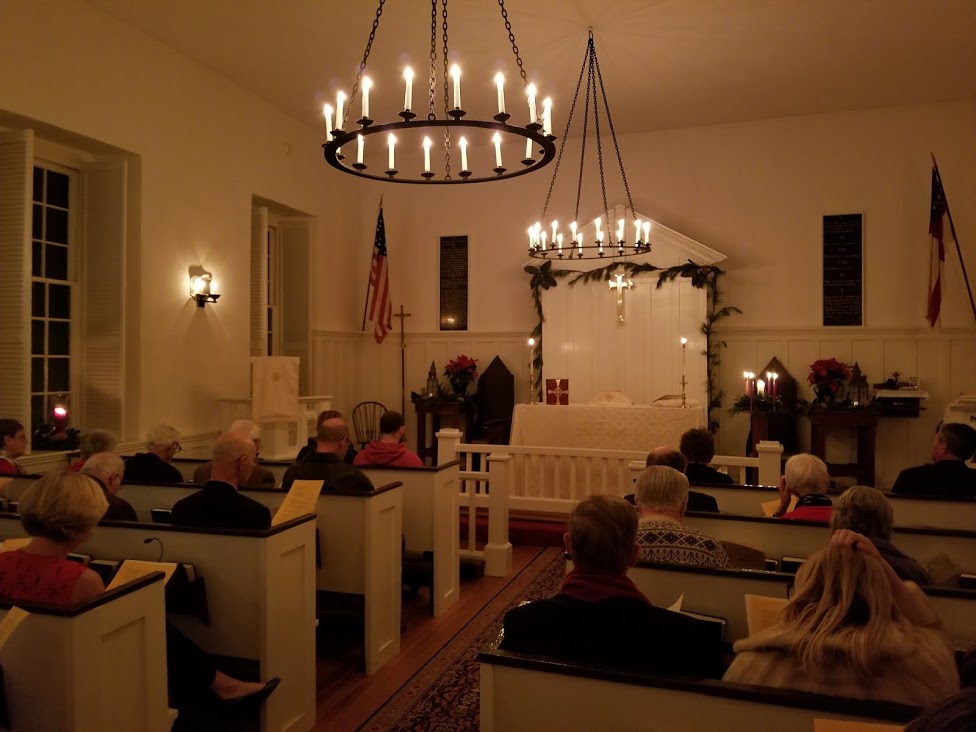
Photo credit: Hickory Neck Episcopal Church. Reuse with permission only.

This Christmas will be the first Christmas I am able to spend time with my husband’s family in five years.  We used to travel there more regularly, but about the time we would have visited, the pandemic hit, and here we are years later returning to something that feels comfortingly familiar.  I find a deep sense of relief knowing the familiar faces that will greet us, the warmer temperatures and beautiful landscape that will refresh us, the smells and tastes that will delight us, and the love and acceptance that will overwhelm us.

In some ways, I think attending church on Christmas Eve is a lot like that comforting familiar experience.  We know the lessons we will hear, the songs we will sing, the greenery we will find, and the hospitality we will experience.  In what has been a time of disorientation, suffering, grief, and struggle these last years, nothing feels as enticing as the promise of a warm, welcoming womb in which to gather.

What’s fascinating about the Christmas story and experience is that the first Christmas had little other than a womb in common with our modern experience.  Mary and Joseph are likely still recovering from the rocky beginning to their relationship – nothing like an unorthodox pregnancy to bring on marital strain!  Mary and Joseph also join hordes of their kin in being displaced by the government, only to find accommodations entirely unsuited for childbirth.  Strangers of ill repute show up sharing stories quite unfathomable, inserting themselves into the chaos of that night.  And Mary is left overwhelmed, trying to figure out what is happening to her life.  Why, of all the stories we could hear, is this crazy, disorienting story the one we want to hear year after year?

I suppose, in part, we breathe in a comforting deep breath on Christmas Eve because no matter where our journey has taken us over the last year – or years – knowing the imperfection of that perfect night helps us bless and honor our own imperfection.  Perhaps we revel in Christmas at church because we know that every year, no matter how off-track our lives have become, we have a place where we can go, a family with whom we can journey, and a Savior who is just as vulnerable as we are.  This Christmas, I hope you know there is no imperfection in you that is not perfectly welcome at the Table.  You are welcome here.

Sermon – Mark 9.30-37, P20, YB, September 19, 2021

29 Wednesday Sep 2021

Posted by jandrewsweckerly in Sermons

≈ Leave a comment

Tags

creative, design thinking, faith, fear, Five Whys, God, innovation, innovative, Jesus, Messiah, Peter, problem, relationship, Savior, seekers, Sermon, solving, stuck, thinking, truth, why

This spring I took a class on Design Thinking.  Technically speaking, “Design thinking is a non-linear, iterative process that teams use to understand users, challenge assumptions, redefine problems and create innovative solutions to prototype and test.”[i]  In layman’s terms, design thinking is a non-traditional way of getting to innovative idea.  Within design thinking are several methods to help people get out of their traditional ways of thinking.  One of my favorites is The Five Whys Method.  You start with a problem, and you ask why the problem is happening.  Then you look at the first “why?” and ask the question again.  Why is that answer happening.  And on and on until you get to the root of the issue[ii] – almost like peeling layers off an onion.  At first, the Five Whys feel a little silly.  But the more you play with the method, the faster you realize the problem you are looking at is not the actual problem.  And when you finally hit the right answer, you may be surprised by how uncomfortably honest the answer is.

 In our gospel lesson today, the disciples clearly have never heard of the Five Whys Method.  In fact, when Jesus, privately teaching the disciples, tells them he will be betrayed, killed, and will rise again on the third day, the disciples say nothing.  The text tells us they do not understand Jesus, and they are “afraid to ask him.”  They are afraid to ask why.  They are afraid to go beyond that first layer of the onion because they do not even like the layer in front of them.  We talked last week about how Peter tried to discourage Jesus from this same fate:  because a Messiah is not supposed to suffer and die – a Messiah is supposed to free them from oppressive power.[iii] 

We can understand their fear.  When taking that class on design thinking I practiced the method using a challenge we were facing at Hickory Neck.  To be honest, I do not even remember the actual presenting problem.  But what I do remember was getting the answer to the third why.  When I answered why to that third question, the answer took my breath away.  I was mortified and ashamed:  surely that was not the answer to the problem.  As I stood stunned at the words that had just come out of my mouth, and after some awkward silence, my partner asked me again, “Okay.  But why?”  As I shook off my paralysis and answered the fourth why, I started getting some more honest clarity.  By the time I got to the fifth why, I was sold on the method.  The method helped me name the thing I could not name just staring at presenting problem.

After the conversation with the disciples, Jesus introduces a child into the teaching with the disciples.  Scholars have many theories about the introduction.  Thousands of years ago, children were not regarded with honor.  As Sharon Ringe explains, “A child did not contribute much if anything to the economic value of a household or community, and a child could not do anything to enhance one’s position in the struggles for prestige or influence.  One would obtain no benefit from according to a child the hospitality or rituals of honor or respect that one might offer to someone of higher status…”[iv]  Most scholars agree Jesus does not introduce children because they are cute and to be loved (even if they are!).  But I wonder if Jesus, having known a few children, knew that children are particularly adept at asking, “why?”  Any of you who has known a preschooler has known the incessant way they can ask the question, “why?”  And as children age, the question does not stop:  the question just gets increasingly uncomfortable.  I think Jesus knew the disciples were stuck on their own conceptions of the Messiah and their role in the divine narrative, and Jesus wanted them to start probing why that narrative mattered to them.  Jesus wanted them to start peeling back the narratives, but saw they were afraid of truth.

That is our invitation today.  Our gospel scene is an invitation for us into deeper, more honest, more probing relationship with Jesus.  Instead of taking our relationship with Jesus at face value, instead of being afraid of hard questions, instead of being afraid of scary answers, our invitation today is to engage in our faith in the same way we engage in innovative thinking:  to keep asking the whys over and over again.  The good news is we have a community of seekers who can ask those whys with us and hold us in the uncomfortable answers until we get clarity.  The good news is we have tools to help overcome our fear and silence, and kids in our community who will keep us honest.  The good news is we have a Savior who is willing to engage with us in a brutally honest, yet radically salvific relationship.  Thanks be to God!  Amen.


[i] Teo Yu Siang, “Design Thinking,” Interaction Design Foundation, as found at https://www.interaction-design.org/literature/topics/design-thinking on September 18, 2021.

[ii] iSixSigma-Editorial, “Determine the Root Cause: 5 Whys,” as found at https://www.isixsigma.com/tools-templates/cause-effect/determine-root-cause-5-whys/ on September 18, 2021. 

[iii] N.T. Wright, Mark for Everyone (Louisville: Westminster John Knox Press, 2004), 122.

[iv] Sharon H. Ringe, “Exegetical Perspective,” Feasting on the Word, Year B, Vol. 4 (Louisville: Westminster John Knox Press, 2009), 97.

Sermon – Job 14.1-14, HS, YB, April 3, 2021

28 Wednesday Apr 2021

Posted by jandrewsweckerly in Sermons

≈ Leave a comment

Tags

Christian, church, community, disciples, drama, faith, Holy Saturday, hope, Jesus, Job, liturgy, pandemic, preparation, quiet, redemption, Savior, Sermon, silence, sorrow

Up until last year, I had not remembered that there was a liturgy in our Prayer Book for Holy Saturday.  I had always thought it was Maundy Thursday, Good Friday, Easter Vigil on Saturday night (which is basically just Easter), and then Easter Sunday.  But when the pandemic hit last year, we realized doing a virtual Easter Vigil just would not work – there is so much reading, singing, doing things by candlelight, and the drama of being huddled together that we had to let the Liturgy wait until we could gather again.  So instead, we turned to this tiny liturgy, whose entire content is listed on one page of the Book of Prayer Book.

Still in a pandemic a year later, I found myself curious about this liturgy we are entering once again.  The truth is, the earliest accounts of Holy Week observances had no liturgies for Holy Saturday, with the exception of private use of the daily office.[i]  Instead, this day has simply been known as the “quietest day of the Christian year.”[ii]  That the church has not always gathered on Holy Saturday and that Christians might see this day as a day of quiet makes a lot of sense.  The Church says so much this week – from our waving of palms last Sunday, to our gathering around the upper room table to wash feet and share bread, to devastating betrayals of Jesus, to the vivid walk toward the cross, to the finality of the closed tomb.  We almost need a day of quiet to let the drama sink in and wrap our heads around what this week means.

But I suspect if your life is anything like mine or most Americans, we are not sitting quietly in our homes from 3:00 pm on Friday until Easter morning.  Instead, we are filling the time with preparations – tending to all the things we did not do while we were attending church this week:  dying eggs, entertaining children, stuffing Easter baskets, prepping Easter day meals, cleaning the house, or just having fun.  There is nothing inherently wrong about those things, but this year, of all years, I am grateful for a Holy Saturday liturgy.  With this last year of suffering through a pandemic and reflecting on our broken humanity’s inability to eliminate racism or mend civil discourse, even with the rise of vaccines, I find our country is in a Holy Saturday kind of time.  We have been through a tumultuous experience and are not yet healed. 

That is why I like having Job as a companion today.  Job’s words are stark.  As Job sits in the ashes of his sorrows, having lost his children, his livelihood, and his support system, he describes the brutality of life.  He talks about how trees have hope – even when cut down, they can sprout again, and new life can be born out of death.  But not so with humans, he argues.  No, when their bodies lay in the ground, there is nothing but death.  Job captures the essence of this day.  There is a similar finality at the door of Jesus’ tomb this day.  All the hopes and dreams, all the joys and blessings, all the promises of new life are sealed away in a tomb.  And after such a violent death and the threat for those who followed Jesus, there is no wonder why the Church has considered this a quiet day.  Unlike the quiet waiting of Advent, when the church is brimming with expectation and bustling around in preparation for Christ’s birth, today is a day of silence devoid of restorative peacefulness.  As one scholar says, “The waiting of Advent is like having warm bread in the oven.  By contrast, the air of Holy Saturday smells more like stale smoke, as though something essential was burned the day before.”[iii]  As our lives are not yet pandemic free, and as threats of spikes in cases emerge, we know that kind of waiting all too well.

And yet, in the very last verse of today’s reading, the despondent Job says something totally counter to everything else he has said.  “If mortals die, will they live again?” Job asks.  For someone who has boldly proclaimed the finality of human death, his question is a question that only a person of faith can ask – a question that reveals the tiniest bit of hope still left in Job.  Job communicates in this question a truth we people of faith hold dear:  no matter how bad the suffering, no matter how prevalent the experience of dread and doom, no matter how deep the failures of humanity seem to run, there is always hope.  The disciples and community surrounding Jesus Christ do not know that hope yet.  But as followers of Christ 2000 years later, we now stake our entire identity on the risen savior. 

So yes, receive the gift of stale smoke this day.  Sit in ashes with Job and mourn all in your life that feels dead.  Take time in this busyness of life for some uneasy silence.  Name all those who have been lost due to disease and violence.  But keep asking the questions.  Hold on to the hope, however infinitesimally small that God can indeed redeem us – us as individuals, us as country, us as Church.  Holding the two in tension is difficult – we want to rush to Easter and forget all that has happened.  But letting the power of all that has happened speak to us today will allow us to know the astounding power of resurrection much more deeply tomorrow.  Job, Jesus, and this faith community here will pull up a chair and sit with you by the ashes until we can reap with tears of joy tomorrow.  Amen.


[i] William Joseph Danaher, Jr., “Theological Perspective,” Feasting on the Word, Yr. B, Vol. 2 (Louisville:  Westminster John Knox Press, 2008), 310.

[ii] Christina Braudaway-Bauman, “Pastoral Perspective,” Feasting on the Word, Yr. B, Vol. 2 (Louisville:  Westminster John Knox Press, 2008), 312.

[iii] Braudaway-Bauman, 312

The Pilgrim’s Way…Day 6

12 Wednesday Feb 2020

Posted by jandrewsweckerly in Uncategorized

≈ Leave a comment

Tags

Canterbury, Cathedral, disappointment, evensong, experience, God, joy, perfect, pilgrimage, plans, Savior, space, trust

84089251_2891907087532199_5560143380115095552_n

Photo credit:  Jennifer Andrews-Weckerly; reuse with permission only

Sixteen pilgrims from Hickory Neck Church traveled to England for 8 days of pilgrimage.  Our focus was on choral music, hearing Evensong or Choral Mass at a Cathedral, Minster, or college everyday.  This is the sixth entry, initially posted on our church Facebook page.  For those of you who do not follow us on Facebook, I am repeating the journey’s daily entries here.  Enjoy!

Canterbury

When spending over a year planning a pilgrimage for your parish, poring over plans, making amendments to itineraries, and crafting the best spiritual experience you can, you imagine, “There! I have created the perfect pilgrimage experience.” But as soon as you say the words, “I have created,” you have lost. Pilgrimages are not about what I create or even what I plan. Pilgrimages are certainly about working hard – before, during, and after. But pilgrimages are also about making space and then letting God take over.

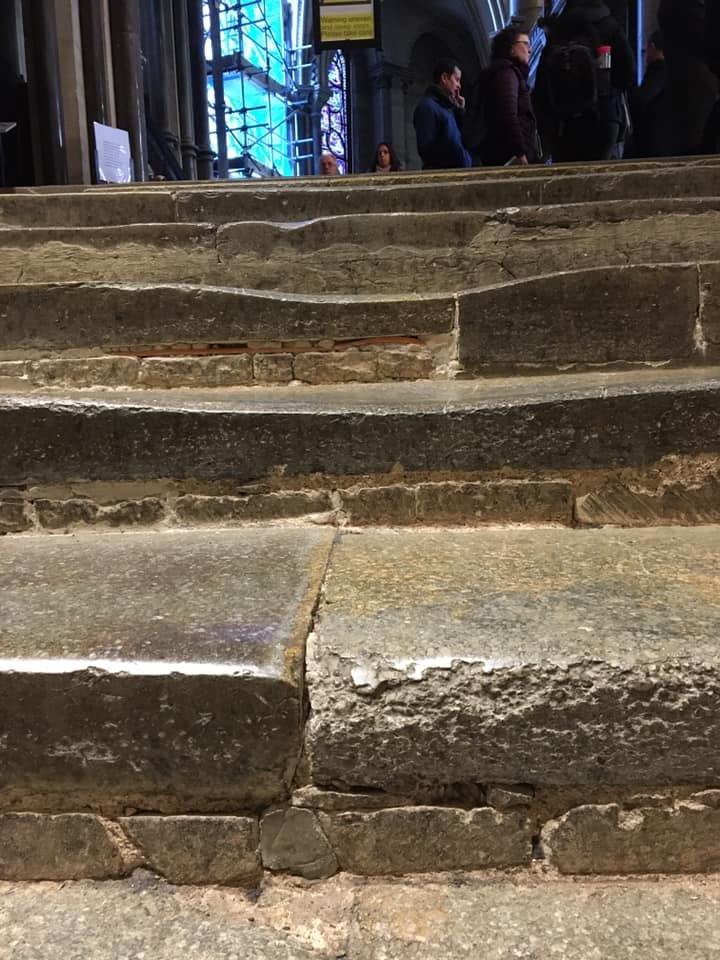
I was acutely aware of that today. All day I had been internally groaning because we were not going to hear the boys and the men singing at Evensong at Canterbury Cathedral. Instead it would just be the gentlemen. I had really wanted our pilgrims to hear the full sound with the boys, and knowing they would be absent felt like a huge disappointment. But as soon as the men opened their mouths, I was transported to another time – a time when Benedictine monks chanted prayers day after day, hour after hour. The simplicity and beauty of their sound made the enormity of fourteen hundred years of Evensongs unfurl before me, like the wafting of incense before my face, lingering in my hair. Suddenly a multitude of heavenly hosts surrounded me – pilgrims, monks, priests, common Christians, seekers, nonbelievers, the sick, the oppressed – all longing for something, all aching for God. And tonight I remembered, in addition to them, God is right here: always has been and always will be, no matter what plans I have made.

Tonight it is my hope that you can find it in yourself to trust a little less in your own hands and a lot more in the loving embrace of your Savior’s hands. I can’t wait to hear about your disappointment and your overwhelming joy!

86627611_2891906947532213_2676576335572238336_n

Photo credit:  Jennifer Andrews-Weckerly; reuse with permission only

On Jesus, Love, Me, and You…

17 Wednesday Jul 2019

Posted by jandrewsweckerly in Uncategorized

≈ 1 Comment

Tags

Christ, intergenerational, Jesus, Jesus Loves Me, love, meaning, ministry, neighbors, profound, relationship, Savior, simple, song, together, walk

Jesus-Loves-Me-this-I-Know

Photo credit:  https://mandjsquared.com/index.php/product/jesus-loves-me-this-i-know/

After welcoming The Kensington School, an independent child development center, on to the Hickory Neck property, the two communities have sought ways to enter into mutual relationship.  One of those efforts has been offering a voluntary Godly Play class for students of the school.  We began the class in the fall, and have had over 18 children registered for the class.  We recently changed the day of the week the class is offered, and so yesterday, I was finally able to join the class.  The children were full of life and wonder, and I loved to watch them engage in the story.  But probably one of my favorite parts was singing Jesus Loves Me with the children.  They clearly knew the words, and it was fun to sing such a familiar childhood song – so simple and, especially in these days, so profound.

My day carried on like any other adventurous day in ministry, and that afternoon, I celebrated Eucharist at a local retirement home.  We usually sing a few songs, and the chaplain always reminds me that familiar songs are important, as they bring up many fond memories for the residents.  So, without thinking, I chose two, and midway through the final song, I realized I had subconsciously chosen the very song I had sung early that morning – Jesus Loves Me.  The same feelings emerged, especially as many of the retirees in that space are in bodies that no longer do all the things they used to do.  But they can sing about the love of a Savior – that they, even in their weakened states, are loved.

I have been thinking about a couple of things since then.  Hickory Neck has been articulating its mission in Upper James City County, and one of the tenets of our mission is to engage in intergenerational ministry.  Knowing our unique setting – a community comprised predominantly of young families and a large retirement community – our parish seeks to minister to both, and in fact, we believe our ministry will be richer as both young and old walk together in Christ.  Yesterday’s convergence of three and four year-olds singing the same words as ninety-three and ninety-four year-olds made me hopeful about the potential of Hickory Neck’s ministry.

But yesterday’s experience also made me think about all of us in the middle – those of us who are twenty-three and twenty-four to sixty-three and sixty-four; those of us who are busily going about life, trying to do our part to make the world a better place, and trying to find meaning and joy in this world.  For those of us in the middle, I wonder if we might hear the words of a song that seems almost childishly simple as instead something profoundly important about ourselves and our neighbors.  Yes, Jesus loves me.  But, Jesus also loves you.  And, from what I know about Jesus, he especially loves those whom we would like to deem “other,” or as unworthy of God’s love.  Jesus loves them too.  Perhaps we in the middle can take a cue from those at the beginning and those near the end and remember the simple, profound words that can hold us together, and help us love better.

The Pilgrimage of Holy Week

13 Thursday Apr 2017

Posted by jandrewsweckerly in Uncategorized

≈ 1 Comment

Tags

Christ, church, God, Holy Week, Jesus, moments, pilgrimage, sacred, Savior, worship

17903433_10155696878822565_4685487522288081020_nIn Holy Week, I like to offer the parishes I serve a service for each night of the week.  It can be labor intensive, and people can feel overwhelmed by the idea of coming every night of a week for church (even if it is only once a year).  But, if you can make it through every night, you find yourself in the midst of a beautiful pilgrimage – an unfolding story and walk with our Savior, Jesus Christ.  This year, we are only three days in, but each night has given me little “God moments.”

On Holy Monday, my heart was warmed that our community was gathering “virtually” to celebrate compline (evening prayers).  We have been doing it all Lent, but it was a wonderful way to close my evening in my pajamas, knowing that others were on Facebook, praying together with our Curate.  On Holy Tuesday, as I sat in the silence of our Taize service, I was watching the flames of the many lit candles flicker.  Since I knew people had lit the candles with prayer intentions, I imagined each of those flames as a prayer, symbolizing the cares and concerns of each person in the room.  As our silence extended, I imagined the flames represented the prayers and concerns around the world, remembering how our Coptic Christian brothers and sisters must be hurting this week.  It was a powerful, transfixing image.  Then last night, on Holy Wednesday, during our healing prayers, two things happened.  First, my daughter came forward for prayers by me.  Her request was humbling, and the privilege of affirming her and praying with her in that space was incredible.  Second, another local pastor laid hands on me and prayed just the prayer I needed this week.  It was all I could do to hold back the tears.

So, I do not know what the next three days, the Triduum, hold.  But I can promise you there will be many more sacred moments.  If you have a church home, I encourage you to take advantage of their offerings for the rest of the week.  If you do not have a church home, and live in the Williamsburg area, know that you are most welcome.  You can find all our information on our website.  A continued blessed Holy Week for you.  As you ponder your own connection to church, I offer you this video as inspiration for your Holy Week pilgrimage to Lent.  Peace!

On Snow Globes and Other Deceptions…

21 Wednesday Dec 2016

Posted by jandrewsweckerly in Uncategorized

≈ Leave a comment

Tags

blessed, deception, encounter, need, prayer, pretend, protection, reality, Savior, snow globe

snow-globe-tree-with-snow

Photo credit:  www.balsamhill.com/Christmas-Tree-Musical-Snow-Globe-p/4000824.htm

When I was growing up, we used to have a Christmas snow globe.  If you wound it up, it would play a lovely Christmas carol.  But you could also shake the large globe and snow would delicately swirl around the Christmas tree.  Something about the snow globe was mesmerizing.  I would wind up the music, shake the globe, and just stare into the glass.  There was something so peaceful about that globe – like a perfect world inviting me in to the snowy calm.

Of course, there were no snow blowers, plows, or ice melt in the snow globe.  There were no grumpy people shoveling out sidewalks and cars before the snow gets too heavy or the snow turns to a thick layer of ice.  No one was slipping on ice, sliding into a car accident, or shivering without shelter.  No, the snow globe does not invite that kind of realism.  The snow globe only captures the magical moment of freshly fallen, untouched snow, and dreamy winter.

Too often, we choose to keep gazing at snow globes, or to create our own snow globes.  We stare into snow globes because the destruction, hate, and violence of the world have caused compassion fatigue.  We create our own snow globes to insulate ourselves from the outside world so that we do not have to encounter the other.  Today our church delivered holiday gifts for seven families who live in a large public housing development.  As soon as we parked our car to drop off the gifts, I knew we were not in our snow globe anymore.  As a priest, those in need often come to me.  Today, I stepped onto their territory and it was a helpful reminder of how insulated my world can be if I create a globe around it.

The funny thing is that once I stepped out of snow globe, I did not slip on the ice.  I did not feel a sense of burden or dread.  Instead, people greeted me – making sure that I saw them.  Instead, a resident saw my colleague’s clergy collar and asked him to pray with him.  His friend said, “Well, while you’re at it, can you pray for my daughter too?”  Before I knew it, six of us were holding hands in the middle of this housing development, praying for health, wholeness, and the birth of our Savior.  I don’t know about you, but that’s better than any snow globe I can create.  What snow globes have you been looking into or what snow globes have you inadvertently created?  Join me this week as we pull our gazes away from the world of pretend protection and into the world of blessed encounter.

Recent Posts

  • On the Myth and Magic of Advent…
  • On Risking Failure and Facing Fear…
  • Sermon – Luke 23.33-43, P29, YC, November 23, 2025
  • On Inhabiting Gratitude…
  • Sermon – Luke 20.27-38, P27, YC, November 9, 2025

Archives

  • December 2025
  • November 2025
  • October 2025
  • September 2025
  • August 2025
  • July 2025
  • June 2025
  • March 2025
  • February 2025
  • December 2024
  • November 2024
  • October 2024
  • September 2024
  • August 2024
  • July 2024
  • June 2024
  • May 2024
  • March 2024
  • February 2024
  • January 2024
  • December 2023
  • November 2023
  • October 2023
  • September 2023
  • August 2023
  • July 2023
  • June 2023
  • May 2023
  • March 2023
  • February 2023
  • January 2023
  • December 2022
  • November 2022
  • October 2022
  • June 2022
  • May 2022
  • January 2022
  • December 2021
  • November 2021
  • October 2021
  • September 2021
  • August 2021
  • June 2021
  • May 2021
  • April 2021
  • March 2021
  • February 2021
  • January 2021
  • December 2020
  • November 2020
  • October 2020
  • September 2020
  • August 2020
  • July 2020
  • June 2020
  • May 2020
  • April 2020
  • March 2020
  • February 2020
  • January 2020
  • December 2019
  • November 2019
  • October 2019
  • September 2019
  • August 2019
  • July 2019
  • June 2019
  • May 2019
  • April 2019
  • March 2019
  • February 2019
  • January 2019
  • December 2018
  • November 2018
  • October 2018
  • September 2018
  • August 2018
  • July 2018
  • June 2018
  • May 2018
  • April 2018
  • March 2018
  • February 2018
  • January 2018
  • December 2017
  • November 2017
  • October 2017
  • September 2017
  • August 2017
  • July 2017
  • June 2017
  • May 2017
  • April 2017
  • March 2017
  • February 2017
  • January 2017
  • December 2016
  • November 2016
  • October 2016
  • September 2016
  • August 2016
  • July 2016
  • June 2016
  • May 2016
  • April 2016
  • March 2016
  • February 2016
  • January 2016
  • December 2015
  • November 2015
  • October 2015
  • September 2015
  • August 2015
  • July 2015
  • June 2015
  • May 2015
  • April 2015
  • March 2015
  • February 2015
  • January 2015
  • December 2014
  • November 2014
  • October 2014
  • September 2014
  • August 2014
  • July 2014
  • June 2014
  • April 2014
  • March 2014
  • February 2014
  • January 2014
  • December 2013
  • November 2013
  • October 2013
  • September 2013
  • August 2013
  • July 2013
  • June 2013
  • May 2013
  • April 2013
  • March 2013
  • February 2013
  • January 2013
  • December 2012
  • November 2012
  • October 2012
  • September 2012

Categories

  • reflection
  • Sermons
  • Uncategorized

Meta

  • Create account
  • Log in
  • Entries feed
  • Comments feed
  • WordPress.com

Blog at WordPress.com.

  • Subscribe Subscribed
    • Seeking and Serving
    • Join 394 other subscribers
    • Already have a WordPress.com account? Log in now.
    • Seeking and Serving
    • Subscribe Subscribed
    • Sign up
    • Log in
    • Report this content
    • View site in Reader
    • Manage subscriptions
    • Collapse this bar
 

Loading Comments...