• About

Seeking and Serving

~ seek and serve Christ in all persons

Seeking and Serving

Tag Archives: sharing

Sermon – Acts 1.1-11, AS, YB, May 12, 2024

29 Wednesday May 2024

Posted by jandrewsweckerly in Sermons

≈ Leave a comment

Tags

Ascension, brokenness, church, community, healing, Holy Spirit, Jesus, kingdom of God, lifestyle, money, pivot, relationship, Sermon, sharing, stewardship

Our Stewardship Team gathered throughout the winter and spring and had some meaningful conversations about how we measure what matters in life.  We talked about how stewardship is more than money.  Stewardship is a lifestyle based on a relationship with Jesus Christ and fulfilling our baptismal covenant to provide and participate in the mission and ministry of Hickory Neck Episcopal Church to proclaim the Gospel in word and deed in order to change the world in which we live.  But we also talked about how things can get in the way of our faith journey:  our allegiances, our faith, our compassion, our use of money, our generosity, and our belief that God provides what is necessary for living out our lives.  And so, we agreed.  In order to help us navigate how to be faithful stewards, we would begin a preaching series over the next several months – looking at those challenges to our faith journey and what scripture has to say about them.  Today, the Stewardship team teed me up on this Ascension Sunday to talk about allegiances.

Now I do not know about you, but when I read the text about the Ascension from Acts, I did not really hear anything about stewardship.  Jesus did not lean over his shoulder as he was ascending to heaven and shout, “Don’t forget to tithe 10% to the Church!” So, what does the Ascension have to do with faithful living – with stewardship?  Well, to understand that notion, we have to take a big step back from the event of the Ascension.  You see, the Ascension is sort of a pivot moment in our lives.  Luke, the author of both the gospel of Luke and the Acts of the Apostles, understood history to be “divided into two ages:  the broken old world marked by Satan, idolatry, sin, injustice, exploitation, fractiousness, scarcity, enmity with nature, violence, and death.”  The renewed world where God restores all things to God’s purposes is “marked by true worship, forgiveness, justice, mutuality, community, abundance, blessing between nature and humankind, shalom, and life.”[i]  Jesus’ life and ministry was in witness against the broken world and a shepherding in of the renewed world.  In the process of ascending Jesus gives authority to the disciples to continue the work of the renewed world.  That’s why the whole rest of the book of the Acts of the Apostles will be about how the community of Jesus – the Church – will live:  sharing resources, supporting those in need, living as a community of abundance, mutuality, and justice.

This past Thursday’s Discovery Class was the session where the attendees teach the rest of class on given topics.  One set of our class members focused on the history of the early church in America.  They talked about how the church in the 1600s and 1700s was the governing body of the region – using their resources to care for widows and orphans, tending to those who fell on hard times, basically serving as the social services agency of the region.  Now, they also had clergy appointed by the governor and charged local residents a mandatory levy to help the Church pay for those expenses (an idea I imagine a certain treasurer of ours probably wouldn’t mind) – but for all intents and purposes, the early church of the Americas operated just like the early church in the Acts of the Apostles – living as a community sharing resources, supporting those in need, embracing abundance, mutuality, and justice.  In essence, a community who understood their allegiance to be to the kingdom of God and not to the kingdom of brokenness:  a community of faithful stewardship.

We are told in our reading from the Acts of the Apostles that as the disciples watch Jesus ascend to the heavens they stand there for a moment – frozen in time as their scrambled brains try to figure out what has just happened and what Jesus’ ascension means.  While they are standing there, looking at heaven, two men in white robes appear and ask them a simple question, “Why do you stand looking up toward heaven?”  In other words, God uses these men in white to tell the disciples, “Don’t just stand there – go be the church!  Jesus showed you the way to abundant, faithful stewardship.  Now go bring kingdom living to life!”

That is our invitation today too.  Now you may be thinking, “Yeah, but the Church has changed so much.  We are not the primary social services agency in town – we are not the place responsible for people’s physical, emotional, and spiritual well-being!”  But Jesus tells us today that we are.  That every single member of this community has a part to play – can contribute your financial resources, the gift of your skills and expertise, the offering of your time to make this church a modern expression of the kingdom of God here in Upper James City County.  On this Ascension Sunday, we can choose to carry on the work of Christ, to do our part to turn away from brokenness and be agents of healing and wholeness.  Where will we find the capacity to enliven that abundant life?  In our Eucharistic Prayer today we will pray, “And, that we might live no longer for ourselves, but for him who died and rose for us, he sent the Holy Spirit, his own first gift for those who believe, to complete his work in the world, and to bring to fulfillment the sanctification of all.”[ii]  Not only did Jesus give us the mission, Jesus also gives us the Holy Spirit – that gift we will celebrate next week – so that we might be the faithful stewards of God’s abundance, declaring our allegiance to living in the light – to being the agents of abundance God knows we can be.  Our invitation is stop looking up, and start looking around at the kingdom God has gifted us to tend.  Amen.


[i] Ronald J. Allen, “Considering the Text: Week One, Ascension Sunday, 12 May 2024”  Center for Faith and Giving, as found at centerforfaithandgiving.org, 2.

[ii] BCP, 374.

On Stories and Invitation…

11 Wednesday Jan 2023

Posted by jandrewsweckerly in reflection

≈ 1 Comment

Tags

church, faith, Harry Potter, Holy Spirit, invitation, journey, joy, meaning, sharing, story, storytelling

Photo credit: https://www.npr.org/2020/10/15/923962314/good-conversations-take-time-and-attention-heres-how-to-have-better-ones

Last night, my younger daughter and I started reading the first book in the Harry Potter series.  I love the series, although I found it later in life.  I never read them as a young adult.  I started them the summer I was serving as a chaplain in a hospital in my early thirties because I needed something to read that was not overly taxing on my emotionally drained self.  Later, I read them while breastfeeding my first child (I spent a lot of time on a pump!), and then again with my first child when she was old enough.  I could not wait to start the series again with my younger child.

But what has surprised me in restarting this adventure is this is not the first attempt.  Normally an avid reader, I thought my daughter would be excited about reading them with me.  And, given my super enthusiasm for the books (and her knowledge that her older sister and I enjoyed them so much), I thought she would be equally enthusiastic.  But every time I mentioned starting them, even making a point at age eight to tell her I though she was finally old enough to enjoy the privilege, she was only lukewarm about the experience.  We even tried this fall to start them, and she just was not that excited.  With a new set of books all her own being gifted at Christmas, I am hoping this is the attempt that will stick!

I have been thinking how much her journey with Harry Potter might be like others’ experiences with churchgoers who just know that you will love their church.  I recognize I cannot speak with authority about never being raised in the Church – although my faith journey has taken me through multiple denominations, I have never not felt a draw to the Church.  But having ministered to many people who are new to the Church or who are simply Church curious from a very guarded distance, I sense that even our most enthusiastic descriptions are not always compelling to someone who has never been a part of Church culture. 

Many people who have seen the Church decline over the years perhaps feel this is an inevitable reality.  I disagree.  I believe the power of shared stories, including shared stories of faith, remains important.  I am not at all advocating for pressured pitches that many of us have been scarred by (I grew up in a very conservative area and was asked if I was saved more times that I can count).  But being willing to share your faith story is as vital as being able to share about the most amazing food you ever tasted:  it’s an exchange in joy, an exchange in life, and exchange in meaning.  The other person may not be moved to start attending your church, but they might just be intrigued enough to keep listening.  Convincing people to come to our church is not our work.  Our work is simply to share our faith journey joy and invite others to come and see.  The rest is the work of the Holy Spirit and will come (or not!) in its own time. 

Sermon – Luke 2.1-14, CE, YA, December 24, 2019

08 Wednesday Jan 2020

Posted by jandrewsweckerly in Sermons, Uncategorized

≈ Leave a comment

Tags

Christmas, Christmas Eve, comfort, cozy, familiar, God, identity, incarnate, Jesus, love, Sermon, sharing, story

This December, my elder daughter and I are slowly finishing the last book in the Harry Potter series.  The process has taken us several years, since we usually only finish a few pages each night.  But each time we pick the book up, I can never tell who is more excited – her or me.  You see, I have read the series at least three times – once during a summer interning at a hospital, when I needed a brain break from the emotional labor, and twice while spending lots of time nursing, when I needed a brain break from a different kind of labor.  But reading the books with my daughter has been different.  Although I know what will happen, there have been parts of the seven books I forgot entirely.  As I have watched through her eyes, I had forgotten the range of emotions the books evoke, the anticipation the author builds, and the slew of questions that take ages to answer.  In rereading them with her, I have also seen bigger truths – some allegories and religious parallels that only sink in after multiple readings.  The whole experience has been so fun, I cannot wait to start all over again with our younger daughter!

I have been thinking about how our favorite books are often like that.  Though we have endless options of books to read, sometimes we will pick an old favorite to read again.  I think many of us will reread favorite books because we like the familiarity, like cozying up with old friend.  Some of us enjoy rereading books because we enjoy catching new tidbits we never caught before.  While others of us enjoy rereading books because there is some comfort in knowing how the story ends – of being certain about what will happen.  The same can be true for small children too.  I cannot tell you how many times I read Goodnight Moon over the years.  But I never minded because I totally understood the comfort my kids found in the familiarity of a known book; the comfort they sought in Goodnight Moon was the same comfort I sought in familiar books too.

In a lot of ways, that is what we are doing tonight.  We are telling a story we have heard over and over again – although tonight’s New Revised Standard Version may not sound as familiar as the old King James Version; even Charlie Brown’s friends knew that version.  Every year, every single Christmas Eve, we make our way to church – sometimes having fought over what to wear, when, where, and what to eat, or whether or not to open any gifts beforehand.  But we make our way here tonight because we know the ultimate reward is sitting here, in the quiet of night, listening to the story we hear every year of a powerful emperor imposing a tax; of a very pregnant Mary making her way to Bethlehem with her betrothed, Joseph; of Mary giving birth and putting the Christ Child in a manger because there is no room in the inn; of shepherds minding their business in the dark of night; of angels appearing announcing glorious news; and of a chorus of angels singing magnificent truth.  And our reactions are much like they are with any favorite book.  We find comfort in the story’s familiarity, we look for and sometimes hear tiny details we forgot or had not thought about before, and we find comfort in knowing how the story will end.  Glory to God in the highest, indeed!

But the main reason we tell this story year after year after year is not simply for the familiarity and comfort – though the Church wants us to experience that goodness too.  The main reason we tell this familiar story again tonight is because we need to remember who we are and who God is.  You see, what happened on that beautiful, special night, is God came in human form among us – came as Jesus Christ incarnate – because God loves us so very much.  God saw we were struggling to be good, to live as loving people made in God’s image, and God knew we needed Jesus to help us.  We learn in this story that God is awesome, God loves us and is faithful to God’s covenant even when we are not, and God does unimaginably incredible things for us.  This beloved, almost quaint, story is full of good news about who God is.

But this beloved, familiar story also tells us something about who we are.  This story tells us that whatever baggage we came in here with tonight, whatever we are struggling with on a weekly basis, whatever self-doubts we might have, we learn in this story that we are worthy of God’s love.  We learn in this story that no matter who we are – an esteemed king, feared among the people and wielding great power; a couple with nowhere to go, feeling unsure about the future; everyday workers going about their daily jobs, just trying to pay the bills; or a vulnerable baby, unaware of the dangers all around – no matter who we are, we are loved by God, and given the opportunity to have a relationship with God.  We also learn in this story a bit harder reality.  We learn in this story that being loved by God means sharing God’s love – of going to visit people who need visiting and need to know the love of God in their isolation and loneliness, of caring for people who have no place to go no matter what we judgments we make about how they got into their current situation, of taking on tasks that seem insurmountable but will help more people experience the love of God.  We find out a lot about ourselves tonight in this familiar story too.

I know each of us who has gathered here tonight came for a different reason.  Maybe you just like the music, or maybe someone made you come, or maybe you came out of habit, or maybe you came because you wanted some sense of comfort and familiarity.  Regardless of how you got here, the Church tonight tells us a story full of meaning.  We certainly tell this story tonight because this is safe place we can cozy up to the story and feel comforted in familiarity.  We tell this story because we need reminding who God is and who we are.  But we especially tell this story tonight because God wants us to go from this place and do something with all the love and comfort we receive tonight.  God wants us to share God’s love with those who need love the most – even to the people we sometimes do not like (actually, especially to the people we do not like).  God wants us tonight to remember who we are, and who God is, and then go out into the world, rejoicing, sharing the love of Christ, retelling the Christ Child’s story, and bringing Jesus’ story to life for others.  Who knows?  Maybe this will become your new favorite story you want to read over and over again!  Amen.

On Looking for Miracles…

24 Wednesday Jul 2019

Posted by jandrewsweckerly in Uncategorized

≈ Leave a comment

Tags

behavior, change, community, feeding, generosity, God, hoarding, miracle, prayer, security, selfishness, sharing, St. Peter, substance

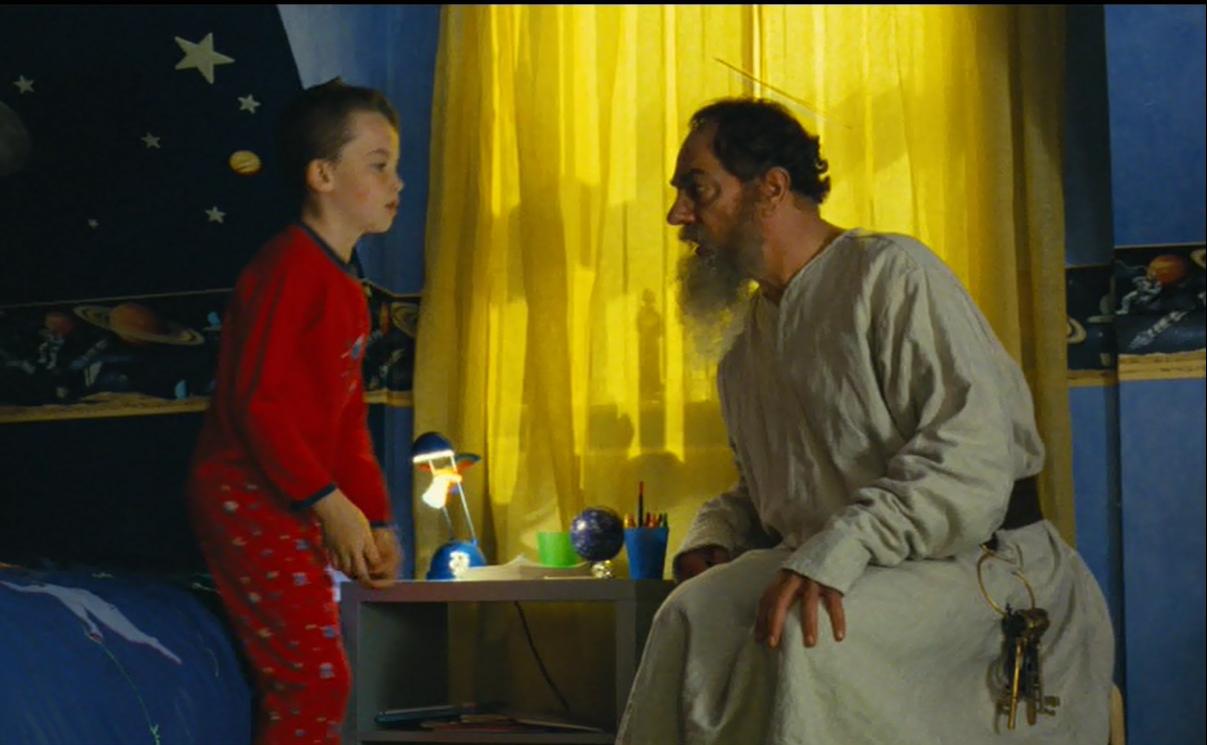
St. Peter

Photo Credit:  https://www.imdb.com/title/tt0366777/mediaviewer/rm1454393856

This past Sunday, our parish gathered to watch the film Millions (2004).  The film tells the story of two brothers who accidentally come into the possession of a bag with cash, and what they each want to do with the money.  The younger brother, still reeling from their mother’s death, regularly has visions of and conversations with saints, where he discusses the moral issues of how to handle the money.  My favorite scene is between the younger brother and St. Peter.  As St. Peter is talking to him about miracles, he tells him about the Feeding of the Five Thousand story.  But this Peter’s version is a little different than the one we all know.

In the film, Peter says what actually happened that day was not really a miracle.  A boy showed up with some sardines to share with the hungry crowd, and Jesus had the disciples pass them around.  But when each person received the plate, they did not take any, because they had been hiding a stash for themselves.  So, each person took their own stash out, and ate that food instead.  Some people even had a little extra, and so they added a small amount to the plate.  Peter argues there was no magic because the food did not actually multiply.  But as he talks the story through, he confesses perhaps a miracle did happen – the miracle of people sharing their food; the miracle of a once stingy people, hoarding their own food, to a tentatively generous people, willing to share.

What St. Peter was cheekily alluding to was a miracle not of substance, but of changed behavior.  Though the scene is meant to be playful, I have been thinking about that distinction ever since.  We are in a time of stingy hoarding; perhaps humans always are.  But in the face of our selfishness, I often find myself praying for a miracle – for God to act dramatically to change these awful patterns in our society.  But perhaps the miracle we need today is not a miracle of substance, but a miracle of changed behavior.  Perhaps we need little boys with plates of shared sardines to inspire us to let go of our own death grips on security, and open up our hands and hearts to generosity.   Perhaps when we open up, others will see works of miracle in our simple changes of behavior.

What are you hoarding this week on which you can loosen your grip?  Who are the children you have been ignoring who have something inspirational to share with you?  How might you slowly begin to let go of your posture of inward protection and look around your community to see who might need you and your open arms?  I invite you to be open to a miracle of changed behavior this week, and to let me know what ripple effects you see.  Maybe St. Peter is right about us, even today!

Sermon – Philippians 1.3-11, A2, YC, December 6, 2015

11 Friday Dec 2015

Posted by jandrewsweckerly in Uncategorized

≈ Leave a comment

Tags

action, affirmation, community, faith, family, God, Good News, Jesus, letter, love, mission, overflow, Paul, Philippians, seeking, Sermon, serving, sharing

This sermon was given on the occasion of our Annual Meeting.

My dearest St. Margaret’s, “I thank my God every time I remember you, constantly praying with joy in every one of my prayers for all of you, because of your sharing in the gospel from the first day until now.  I am confident of this, that the one who began a good work among you will bring it to completion by the day of Jesus Christ.  It is right for me to think this way about all of you, because you hold me in your heart, for all of you share in God’s grace with me…For God is my witness, how I long for all of you with the compassion of Christ Jesus.”

If ever I were to write a love letter to St. Margaret’s, I would steal these words from Paul to the Philippians.  You see, Paul saw in the Philippians what I see in you:  a community of faith alive with the Holy Spirit, sharing the Good News of Christ Jesus in our community.  A little over four years ago, I became your rector.  You were bruised and battered, having not only survived a tumultuous relationship with your last rector, but also a strained relationship with an interim, as well as the absence of consistent leadership for over two years through the limits of a supply priest.  Having had years of struggle, I quickly came to realize that St. Margaret’s had some baggage.  But St. Margaret’s also had a sense of tenacity, determination, and a deep-rooted joy that could not be stifled.  You see, as Paul writes, I could see that over fifty years ago, “the one who began a good work among you [would] bring [that good work] to completion by the day of Jesus Christ.”  I knew God was not done with us yet.

And so, over time, I came to love each of you:  not the dreamy romantic love of love birds, but the kind of love that family has for each other.  That is what people usually describe as being so wonderful about St. Margaret’s:  that we are like family.  Now when I first heard that description, I got a little nervous.  I have served at too many funerals and weddings to know that every family has some drama.  Every family has a loud Uncle Carl, crazy Aunt Bessie, or overbearing Grandma Jones.  Every family has experienced sibling drama or tensions between parent and child.  Describing St. Margaret’s as being like a family made me wary.  I began to wonder who the loud uncle, the crazy aunt, or the overbearing grandma were in this community.  But over the years, I began to understand more fully why the description of St. Margaret’s as family works so well.  Don’t get me wrong, we have our loud uncles, crazy aunts, and overbearing grandmas – though I will never tell you who they are!  But like a family, we know each other.  We know each other’s foibles, quirks, and tendencies.  We know each other’s hurts, failures, and embarrassing moments.  We even know how to predict the reactions of each other to any given situation.  But also like family, we love each other anyway.  We love each other in the way that loving mothers, protective fathers, supporting sisters, and encouraging brothers can.  We love each other not despite our weaknesses but because of those weaknesses.  In fact, no matter how much we might annoy each other at times, those foibles, quirks, and tendencies are what we have come to love about one another.  In essence, we have come to see each other with the loving eyes that Christ has for each of us.  We have come to love like Paul.[i]  Somewhere deep in our hearts, we too pray, “I thank my God every time I remember you, constantly praying with joy in every one of my prayers for all of you.”

Paul gushes about the Philippians today:  about how much he loves them, how proud he is of their work to spread the Good News, and how he sees Christ moving and acting among them for good.  But Paul’s letter is not simply a letter of affirmation – a love letter for the Philippians to put under their pillows and pull out when they are feeling low.  Paul’s letter is more.  Paul’s letter comes with a charge.  “And this is my prayer, that your love may overflow more and more with knowledge and full insight to help you to determine what is best, so that in the day of Christ you may be pure and blameless, having produced the harvest of righteousness that comes through Jesus Christ for the glory and praise of God.”  Paul does not want the Philippians to keep this love to themselves.  He wants them to let their love overflow into action.[ii]

The more and more I read Paul’s charge this week, the more and more I began to see the mission of St. Margaret’s in his words.[iii]  Several years ago, St. Margaret’s took up a mantra.  We want to be a community of faith seeking Christ, serving Christ, and sharing Christ in our community and beyond.  First, we want to be a community seeking Christ – a community committed to learning more about this God we follow, and deepening our journey with Christ.  As Paul says, we want to build up knowledge and full insight to help us determine what is best.  And so that is a part of our work here.  We are teaching our children how to walk in the way of Christ.  We are studying God’s word and challenging one another to grow through prayer, reading, and reflection.  We are engaging in meaningful worship that inspires and delights us, and helps us to connect with our God.  We are a community of faith seeking Christ.

We are also a community of faith serving Christ.  As Paul says, we are letting our love overflow.  St. Margaret’s is a community that cares about others – not just those inside the doors, but outside the doors too.  I see that love in the ways that wallets open as soon as we learn of a need in our community.  I see that love when you think of others when grocery shopping for yourselves, adding in a few extra cans or boxes for people you have never met.  I see that love when we spread peanut butter and scoop jelly, praying that the recipient of that sandwich might know the love of Christ that you have known and be encouraged in their struggle.  Our love overflows into vegetable gardens, into grief support groups, and into the hearts and minds of those who long for love.  We are a community of faith serving Christ.

We are also a community of faith sharing Christ.  As Paul says, we are to let our love overflow so that it might produce a harvest.  What I have loved about this community is that although we are nervous about sharing the Good News – of evangelizing – we share the Good News anyway.  When you gush with friends about the meaningful thing that happened at church, when you tell a stranger about how your church is doing good work, or when you serve as an example of Christ-like love in the world, you are sharing the Good News.  We do that when we walk in the parade, we do that when we put our name on baseball jerseys, and we do that when we wear our St. Margaret’s shirts to the gym, grocery store, or shopping mall.  We are a community of faith sharing Christ.

We are a community of faith seeking Christ, serving Christ, and sharing Christ because the love, joy, and acceptance we have found inside these walls is not just for us.  Fifty-two years ago, God began a good work in us.  God planted the seeds of righteousness in this community, and today we are invited to harvest that work.  And Paul assures us, as he assured the Philippians years ago, that God will bring to completion the good work began in us.  All we have to do is let our love overflow – overflow from us, overflow from our beautiful, complicated relationships with one another, and overflow from our community out into the world.  So tuck that love letter under your pillow when you need affirmation and a reminder that you are doing the good work that God calls you to do.  But also pull out that love letter when you feel weary – when you need to be inspired to get back out there, to seek Christ, serve Christ, and share Christ.  God loves you with a deep affection; and God wants your love to overflow to others more and more.  Amen.

[i] Leander E. Keck, ed., New Interpreter’s Bible, vol. 11 (Nashville: Abingdon Press, 2000), 484.

[ii] Philip E. Campbell, “Exegetical Perspective,” Feasting on the Word, Yr. C, vol. 1 (Louisville:  Westminster John Knox Press, 2009), 39.

[iii] Edward Pillar, “Commentary on Philippians 1.3-11,” December 6, 2015 as found at  http://www.workingpreacher.org/preaching.aspx?commentary_id=2695 on December 3, 2015.

Sermon – Luke 3.7-18, A3, YC, December 16, 2012

17 Monday Dec 2012

Posted by jandrewsweckerly in Uncategorized

≈ Leave a comment

Tags

Advent, God, Newtown, repentance, seeking, Sermon, serving, sharing, sin

I have been reeling since hearing the news of the shooting tragedy in Newtown, Connecticut on Friday.  The emotions alone are still raw.  The image of twenty-seven families losing a child or parent is heart-wrenching.  At a time when many of them were probably gearing up for the holidays, now they are planning funeral liturgies.  The image of hundreds of families gratefully greeting their children is tainted by what will be weeks if not years of therapy for innocence lost.  I know my own child is still recovering from fears from Hurricane Sandy – I can only imagine the fears these families will have to process.  The image of police officers and first responders flooding the scene, faithfully doing their jobs is marred by the probability that they too will need months and years to process the scene:  not with the eyes of professionals, but with the eyes of human beings.  As one FBI officer explained, although they are trained to do their jobs professionally, they are not unfeeling robots.

We too are left with a swirl of emotions.  I have felt deep sadness, confusion, shock, anger, and frustration.  With few answers to questions, we do not know who to blame or how to respond.  As you watch the news and follow social media, you can already hear the call to demonize guns, the mental health field, government, and the shooter.  In some ways, blaming someone or something would make the whole experience easier.  Otherwise, we are left bereft, feeling God’s absence or at least questioning God’s presence in suffering.

I wondered today, then if John the Baptist’s message this Advent was even relevant.  Perhaps we could turn somewhere else altogether today for solace.  But the more I thought about the gospel lesson, the more I realized John’s message of repentance is exactly what we need today.  On this “Stir Up Sunday,” John’s message of repentance stirs up in us our own culpability in the presence of sin in this world.  While I desire to point a finger at someone else for the sinfulness of the world, John the Baptist tells me, to look at my own sinfulness today.  John says, “Do not begin to say to yourselves, ‘We have Abraham as our ancestor’; for I tell you, God is able from these stones to raise up children of Abraham.”  In other words, do not let your redeemed status, your chosen status, let you get complacent about your sinfulness.  In today’s terms, do not let your identity as not being the shooter let you believe yourself to be free of sin.

As our confirmands prepare for confirmation this spring, they are working through a curriculum that keeps pointing them back to the Catechism.  In our Catechism are a series of questions I find helpful today.  Turn, if you will, with me to page 848 of your Prayer Books.  Here are the questions on sin:

What is sin?  Sin is the seeking of our own will instead of the will of God, thus distorting our relationship with God, with other people, and with all creation.  How does sin have power over us?  Sin has power over us because we lose our liberty when our relationship with God is distorted.  What is redemption?  Redemption is the act of God which sets us free from the power of evil, sin, and death.  How did God prepare us for redemption?  God sent the prophets (like John the Baptist!) to call us back to himself, to show us our need for redemption, and to announce the coming of the Messiah.  What is meant by the Messiah?  The Messiah is one sent by God to free us from the power of sin, so that with the help of God we may live in harmony with God, within ourselves, with our neighbors, and with all creation.

This Advent, and in light of this tragedy, we are all invited to reflect on how our sinfulness pulls us away from God, one another, and all creation.

As dark and disheartening as John’s message may feel today, our gospel lesson does not leave us without guidance.  Three times, in response to John’s call to repentance, different groups of people ask the same question, “What then should we do?”  That question has been echoing with me all week, especially after Friday.  What then should we do?  To each group in the text, John has different advice – advice that is specific to their lot in life.  To the crowds he says, “Whoever has two coats must share with anyone who has none; and whoever has food must do likewise.”  To the crowds, John gives them the work of justice.  They are to share their abundance with others.  This is their work of repentance.  To the tax collectors, John says, “Collect no more than the amount prescribed for you.”  Tax collectors were able to survive by charging more than the base tax – their comfort came from these overages.  John challenges this widely accepted practice with another call to justice.  The tax collectors are not to abuse their positions of power.  This is their work of repentance.  To the soldiers, John says, “Do not extort money from anyone by threats or false accusations, and be satisfied with your wages.”  The soldiers used violence and manipulation for their own personal gain.  John challenges them to rule with justice.  The soldiers are to care for the people, not abuse them.  This is their work of repentance.  For each person, John saw a unique way of living a repentant life based on the vocations and values of that specific individual.[i]

Asking the question, “What then should we do?” is where John tries to get us today.  At this time of year, when we receive the most requests for contributions to churches, nonprofits, and universities, opportunities abound for goodness.  In the wake of Hurricane Sandy, as we learn of our neighbors here in Plainview – students and teachers at the school just down Washington Avenue – who need our help, opportunities abound for goodness.  In the wake of national violence, as we make sense of suffering and pain and as we enter into authentic conversation with our neighbors, opportunities abound for goodness.

The opportunities for goodness, the answer to the question “What then shall we do?” are found in our baptismal covenant.  As we discussed last week at our Annual Meeting, I have been discerning with our Vestry about who St. Margaret’s is and what our work is to be about.  We have wondered together this past year about what is the message that we want to convey to others about our identity.  Out of that discernment has emerged three verbs:  seeking, serving, and sharing.  We are a community that is seeking a deeper relationship with Christ, where seekers can simply be seekers on the journey with us.  We are a community that is serving our neighbors, loving and caring for them.  And we are a community that is sharing the good news of St. Margaret’s and the Good News of Christ Jesus with our community.  In these three words, seeking, serving, and sharing, we are, as our baptismal covenant suggests, proclaiming by word and example the Good News of God in Christ and seeking and serving Christ in all persons, loving our neighbor as our selves.  So when we look at that question of “What then shall we do?” our answer is to be a people seeking, serving, and sharing.

Luckily, our lectionary does not give us with a strong challenge without some encouragement.  We hear the comforting words from another of God’s prophets, Zephaniah.  “Do not fear, O Zion; do not let your hands grow weak.  The LORD, your God, is in your midst…he will rejoice over you with gladness, he will renew you in his love; he will exult over you with loud singing.”  In the face of tragedy, God does not leave us without work to do.  As we repent of our sins, what we shall do is to seek, serve, and share.  But in case that work feels like work, God encourages us in the journey.  Do not fear.  Do not let your hands grow weak.  God will renew you in God’s love.  Our work is laid out before us – we can get out there, seeking, serving, and sharing, because God will renew us in love.  Amen.


[i] Kathy Beach-Verhey, “Homiletical Perspective,” Feasting on the Word, Yr. C, Vol. 1 (Louisville: Westminster John Knox Press, 2009),71.

Recent Posts

  • On the Myth and Magic of Advent…
  • On Risking Failure and Facing Fear…
  • Sermon – Luke 23.33-43, P29, YC, November 23, 2025
  • On Inhabiting Gratitude…
  • Sermon – Luke 20.27-38, P27, YC, November 9, 2025

Archives

  • December 2025
  • November 2025
  • October 2025
  • September 2025
  • August 2025
  • July 2025
  • June 2025
  • March 2025
  • February 2025
  • December 2024
  • November 2024
  • October 2024
  • September 2024
  • August 2024
  • July 2024
  • June 2024
  • May 2024
  • March 2024
  • February 2024
  • January 2024
  • December 2023
  • November 2023
  • October 2023
  • September 2023
  • August 2023
  • July 2023
  • June 2023
  • May 2023
  • March 2023
  • February 2023
  • January 2023
  • December 2022
  • November 2022
  • October 2022
  • June 2022
  • May 2022
  • January 2022
  • December 2021
  • November 2021
  • October 2021
  • September 2021
  • August 2021
  • June 2021
  • May 2021
  • April 2021
  • March 2021
  • February 2021
  • January 2021
  • December 2020
  • November 2020
  • October 2020
  • September 2020
  • August 2020
  • July 2020
  • June 2020
  • May 2020
  • April 2020
  • March 2020
  • February 2020
  • January 2020
  • December 2019
  • November 2019
  • October 2019
  • September 2019
  • August 2019
  • July 2019
  • June 2019
  • May 2019
  • April 2019
  • March 2019
  • February 2019
  • January 2019
  • December 2018
  • November 2018
  • October 2018
  • September 2018
  • August 2018
  • July 2018
  • June 2018
  • May 2018
  • April 2018
  • March 2018
  • February 2018
  • January 2018
  • December 2017
  • November 2017
  • October 2017
  • September 2017
  • August 2017
  • July 2017
  • June 2017
  • May 2017
  • April 2017
  • March 2017
  • February 2017
  • January 2017
  • December 2016
  • November 2016
  • October 2016
  • September 2016
  • August 2016
  • July 2016
  • June 2016
  • May 2016
  • April 2016
  • March 2016
  • February 2016
  • January 2016
  • December 2015
  • November 2015
  • October 2015
  • September 2015
  • August 2015
  • July 2015
  • June 2015
  • May 2015
  • April 2015
  • March 2015
  • February 2015
  • January 2015
  • December 2014
  • November 2014
  • October 2014
  • September 2014
  • August 2014
  • July 2014
  • June 2014
  • April 2014
  • March 2014
  • February 2014
  • January 2014
  • December 2013
  • November 2013
  • October 2013
  • September 2013
  • August 2013
  • July 2013
  • June 2013
  • May 2013
  • April 2013
  • March 2013
  • February 2013
  • January 2013
  • December 2012
  • November 2012
  • October 2012
  • September 2012

Categories

  • reflection
  • Sermons
  • Uncategorized

Meta

  • Create account
  • Log in
  • Entries feed
  • Comments feed
  • WordPress.com

Blog at WordPress.com.

  • Subscribe Subscribed
    • Seeking and Serving
    • Join 394 other subscribers
    • Already have a WordPress.com account? Log in now.
    • Seeking and Serving
    • Subscribe Subscribed
    • Sign up
    • Log in
    • Report this content
    • View site in Reader
    • Manage subscriptions
    • Collapse this bar
 

Loading Comments...