• About

Seeking and Serving

~ seek and serve Christ in all persons

Seeking and Serving

Tag Archives: story

Sermon – Luke 2.1-20, CD, YA, December 25, 2019

08 Wednesday Jan 2020

Posted by jandrewsweckerly in Sermons, Uncategorized

≈ Leave a comment

Tags

amazing, Christ Child, Christmas, Christmas Eve, church, glorify, God, love, new, noise, praise, quiet, Sermon, silence, Silent Night, story

This past year I have been learning a lot about Godly Play, the program we use with our smallest children in Sunday School, and more recently, the program we use with the Kensington School too.  At first blush, the program is pretty simple:  we tell Bible stories, using simple props to engage the children visually, we let the children play with the story, and then we wonder about the story along the way.  But when we are telling the story with the Kensington School, we have about fifteen kids, ages two-and-a-half to five years old.  I do not know how much time you have spent with that age group recently, but what that means is working super hard to hold their attention.  Being the loud extrovert that I am, I assumed holding their attention would mean using a loud, commanding voice.  But I have discovered from our seasoned teachers that the opposite is true.  They lower their voices to a slow-paced, almost whisper, and they manage to keep the children on the edges of their seats – as if something amazing is going to happen if they listen really hard.

Oftentimes, when we think of Christmas, we imagine a similar pattern.  When we gather on Christmas Eve, we look forward to savoring the familiar story, imagining being able to hear a pin drop as the beloved story is told again.  Our favorite song on Christmas Eve is usually Silent Night.  The song lulls us to imagining Mary and Joseph blissfully enjoying a silent night of wonder.  But that holy night, and most Christmas Eve services, are anything but quiet.  Bethlehem is inundated with people coming in for the registration.  The fact that there is no room for Joseph and Mary tells us how crowded Bethlehem is.  But Mary and Joseph not only have to tend with homecoming revelers, they also have to contend with the animals over whose abode they have taken.  Add into the mix a screaming newborn, and the idea of a silent night is almost comical.

But Mary and Joseph get even more noise than that.  You see, nearby shepherds hear a cacophony of praise from the heavenly hosts in the middle of the night.  Their night has been anything but quiet too.  Instead of trying to get the animals and themselves back to sleep, they decide to go into town and see this thing which has come to pass.  And so, they spend the night, talking to Mary and Joseph, maybe taking turns trying to soothe the baby Jesus.  When they leave those rudimentary quarters, they leave town praising and glorifying God.  This is no silent night for the shepherds either.

I think that is why I enjoy our celebration on Christmas Day so much.  Silence is in short supply on Christmas Eve.  We sing carols, we hear the giddy laughter of children awaiting gifts, stockings, and cookies, and we chant the mass, singing our traditionally spoken words.  For those of us with small children, even the wee hours of the morning on Christmas Day are loud – filled with cries of elation, joy, and battery-operated toys.  But on Christmas Day, after a noisy night and morning, we make our way to church and find, perhaps for the first time, the silence for which we have been looking.  We do not sing carols.  We do not have to speak over the hubbub of full pews.  Instead we gather in relative quiet, and tell the old story again – but this time with a softness that cannot be found on Christmas Eve.

What I love about finding true silence on Christmas Day is that our morning is structured a lot like I imagine that first holy morning being structured.  Christmas Eve is full of noise – of animals, shepherds, angels, and crying babies.  But that next morning, the dust has settled.  Gone are the shepherds and angels.  The animals have calmed down after too many midnight guests.  I even imagine baby Jesus has given in to sleep, since most newborns get their nights and days reversed for the first few weeks.  Into this relative quiet is when I imagine Mary treasuring all those words and pondering them in her heart.  The night before is just too loud.  The exhausted, travel-weary, physically and emotionally spent Mary gets a moment in the morning to begin to process what God has done in and through her.  After the break of dawn, as the sun rises and the loud revelers and news deliverers have gone, she can have a quiet moment as she rocks or feeds baby Jesus and ponder in her heart this child at her breast.

I do not think that night is silent.  But I understand why our hymnodists would want to talk about silence.  I think that is why I prefer the hymn, “Let all mortal flesh keep silence.”  Instead of depicting a silent night, that hymn invites us to keep silence as a form of reverence.  The first verse says, “Let all mortal flesh keep silence, and with fear and trembling stand; ponder nothing earthly minded, for with blessing in his hand, Christ our God to earth descendeth, our full homage to demand.”  I like the hymn because that is the kind of pondering I imagine Mary does in her heart this morning.  Unlike most new mothers, I do not think she is worried about the impact of birth on her body or even about her humble surroundings.  I imagine her thoughts that morning are consumed with nothing earthly minded.  Instead, I imagine her heart is pondering the blessing of Christ our God descending on earth through her – and the enormity of the event drives her to pay silent homage as she gazes on Jesus’ precious face.

That is what the church invites us to do today as well.  We structure a morning for worship.  The dust of gift wrap, eggnog, and stocking stuffers is settling.  The noise of carols, singing choirs and priests, and antsy children in pews is fading.  The anxiety of preparing for the big event of this day is easing.  And all that is left is a moment to let our mortal flesh keep silent before the Christ Child.  This morning we take a moment to ponder nothing earthly minded, and instead join Mary as she ponders all that has happened in her heart.  We come to church on this holy morning to ponder the miracle of the Christ Child.  We honor the way in which God is ever trying to honor the covenant God has made with us – willing to go to the extreme of taking on human form to care for and preserve us.  Our God’s love knows no bounds.  Humbled by that knowledge, we come to pay God homage.

The question for us in our pondering is what we will do with that love.  Though we make space this morning for silence, we do not remain here all day.  Like any other Sunday, the clergy will dismiss us to go in peace, and serve the Lord.  Anytime we feast at Christ’s table, that is our charge:  to take whatever sustenance we have gained and to go out into the world to do the work that Christ has given us to do.  Certainly that may involve cooking, travel, or more gift giving.  But the news we ponder in our hearts today is much bigger than today.  Today we are commissioned to consider the impact of the birth of the Christ Child on our lives, what our response will be to the God who is so faithful to God’s covenant with us that God would take on human flesh to redeem us.  As our talented Godly Play teachers might pose, I wonder what new work God is crafting in our hearts.  Perhaps this morning, or for at least the next few minutes, you can let your mortal flesh keep silence and ponder with Mary.  And then go out with the shepherds, glorifying and praising God in your work.  Amen.

 

Sermon – Luke 2.1-14, CE, YA, December 24, 2019

08 Wednesday Jan 2020

Posted by jandrewsweckerly in Sermons, Uncategorized

≈ Leave a comment

Tags

Christmas, Christmas Eve, comfort, cozy, familiar, God, identity, incarnate, Jesus, love, Sermon, sharing, story

This December, my elder daughter and I are slowly finishing the last book in the Harry Potter series.  The process has taken us several years, since we usually only finish a few pages each night.  But each time we pick the book up, I can never tell who is more excited – her or me.  You see, I have read the series at least three times – once during a summer interning at a hospital, when I needed a brain break from the emotional labor, and twice while spending lots of time nursing, when I needed a brain break from a different kind of labor.  But reading the books with my daughter has been different.  Although I know what will happen, there have been parts of the seven books I forgot entirely.  As I have watched through her eyes, I had forgotten the range of emotions the books evoke, the anticipation the author builds, and the slew of questions that take ages to answer.  In rereading them with her, I have also seen bigger truths – some allegories and religious parallels that only sink in after multiple readings.  The whole experience has been so fun, I cannot wait to start all over again with our younger daughter!

I have been thinking about how our favorite books are often like that.  Though we have endless options of books to read, sometimes we will pick an old favorite to read again.  I think many of us will reread favorite books because we like the familiarity, like cozying up with old friend.  Some of us enjoy rereading books because we enjoy catching new tidbits we never caught before.  While others of us enjoy rereading books because there is some comfort in knowing how the story ends – of being certain about what will happen.  The same can be true for small children too.  I cannot tell you how many times I read Goodnight Moon over the years.  But I never minded because I totally understood the comfort my kids found in the familiarity of a known book; the comfort they sought in Goodnight Moon was the same comfort I sought in familiar books too.

In a lot of ways, that is what we are doing tonight.  We are telling a story we have heard over and over again – although tonight’s New Revised Standard Version may not sound as familiar as the old King James Version; even Charlie Brown’s friends knew that version.  Every year, every single Christmas Eve, we make our way to church – sometimes having fought over what to wear, when, where, and what to eat, or whether or not to open any gifts beforehand.  But we make our way here tonight because we know the ultimate reward is sitting here, in the quiet of night, listening to the story we hear every year of a powerful emperor imposing a tax; of a very pregnant Mary making her way to Bethlehem with her betrothed, Joseph; of Mary giving birth and putting the Christ Child in a manger because there is no room in the inn; of shepherds minding their business in the dark of night; of angels appearing announcing glorious news; and of a chorus of angels singing magnificent truth.  And our reactions are much like they are with any favorite book.  We find comfort in the story’s familiarity, we look for and sometimes hear tiny details we forgot or had not thought about before, and we find comfort in knowing how the story will end.  Glory to God in the highest, indeed!

But the main reason we tell this story year after year after year is not simply for the familiarity and comfort – though the Church wants us to experience that goodness too.  The main reason we tell this familiar story again tonight is because we need to remember who we are and who God is.  You see, what happened on that beautiful, special night, is God came in human form among us – came as Jesus Christ incarnate – because God loves us so very much.  God saw we were struggling to be good, to live as loving people made in God’s image, and God knew we needed Jesus to help us.  We learn in this story that God is awesome, God loves us and is faithful to God’s covenant even when we are not, and God does unimaginably incredible things for us.  This beloved, almost quaint, story is full of good news about who God is.

But this beloved, familiar story also tells us something about who we are.  This story tells us that whatever baggage we came in here with tonight, whatever we are struggling with on a weekly basis, whatever self-doubts we might have, we learn in this story that we are worthy of God’s love.  We learn in this story that no matter who we are – an esteemed king, feared among the people and wielding great power; a couple with nowhere to go, feeling unsure about the future; everyday workers going about their daily jobs, just trying to pay the bills; or a vulnerable baby, unaware of the dangers all around – no matter who we are, we are loved by God, and given the opportunity to have a relationship with God.  We also learn in this story a bit harder reality.  We learn in this story that being loved by God means sharing God’s love – of going to visit people who need visiting and need to know the love of God in their isolation and loneliness, of caring for people who have no place to go no matter what we judgments we make about how they got into their current situation, of taking on tasks that seem insurmountable but will help more people experience the love of God.  We find out a lot about ourselves tonight in this familiar story too.

I know each of us who has gathered here tonight came for a different reason.  Maybe you just like the music, or maybe someone made you come, or maybe you came out of habit, or maybe you came because you wanted some sense of comfort and familiarity.  Regardless of how you got here, the Church tonight tells us a story full of meaning.  We certainly tell this story tonight because this is safe place we can cozy up to the story and feel comforted in familiarity.  We tell this story because we need reminding who God is and who we are.  But we especially tell this story tonight because God wants us to go from this place and do something with all the love and comfort we receive tonight.  God wants us to share God’s love with those who need love the most – even to the people we sometimes do not like (actually, especially to the people we do not like).  God wants us tonight to remember who we are, and who God is, and then go out into the world, rejoicing, sharing the love of Christ, retelling the Christ Child’s story, and bringing Jesus’ story to life for others.  Who knows?  Maybe this will become your new favorite story you want to read over and over again!  Amen.

On Stories, Remembering, and Healing…

11 Wednesday Sep 2019

Posted by jandrewsweckerly in Uncategorized

≈ Leave a comment

Tags

darkness, dignity, God, heal, honor, human being, intimacy, kindness, light, love, people, power, pryaer, reclaim, remember, respect, September 11, share, story

Story Corps

Photo credit:  https://storycorps.org/discover/september-11th/

Today marks the eighteenth anniversary of September 11, 2001 – a fateful day in the United States.  Even eighteen years later, this is a day where we as a country remember – remember where we were that day, remember the people who were touched by tragedy that day, remember how a single day could transform a nation and the world.  This day hangs heavy in our consciousness each year, the weight never quite lifting even with the passage of time.

I think part of why this day is so heavy for us as a people is because of the people this day touched.  Certainly, we could look at the death toll, and recall the names of the almost 3,000 people who died that day, most without the opportunity to say goodbye to their loved ones.  But September 11’s reach went beyond those who died.  The ripple of that day is mind-blowing:  those who were physically injured, those who were bereaved, those who were supposed to be in those buildings and somehow life’s circumstances kept them away, those whose health continues to be poor from living nearby or helping with the cleanup efforts, those who walked for hours fleeing danger, those who made hard decisions that day – some leading to life and some leading to death.

Four years after that fateful day, NPR’s StoryCorps launched their September 11th Initiative.  A program built around having people tell their stories, StoryCorps launched an effort to record the stories of that specific day – of the man who traded shifts that day and whose mentor died because he had volunteered to take his shift; of the man who consoled his wailing two-year old and had to wait four months before his wife’s body was finally identified; to the woman who sifted through bones and debris in a hanger months later, trying to help people find closure; to the airline employee who checked in the terrorists that day at the gate; the father who lost both sons, one a firefighter and one a police officer, in the line of duty that day.  Every story, every single one is gut-wrenching and tear-evoking.  And every one gives a tiny glimpse into the magnitude of the ripple effect this one day had on all of us.

This day, I invite you to honor September 11 with stories.  Talk to your neighbors, friends, and strangers about their experiences.  Listen to stories like the ones on StoryCorps.  Read whatever stories you can find.  When we engage in one another’s stories, we engage in honoring the dignity of every human being, something we pledge to do in our baptismal covenant.  We allow the depth of this day to do something to us.  And somewhere in that intimacy of story, we begin to hear an invitation – an invitation to honor life today.  Whether it is an act of kindness (maybe even the kindness of simply asking someone to tell their story), or whether it is a time of prayer to honor all that has been, or whether it is a commitment to reclaiming love so that hatred can never win in such a powerful way as it did that day.  May our stories help us connect to the cosmic story of a God who loves us and gives us light in the darkness.

On the Infertilities of Life…

31 Wednesday Jul 2019

Posted by jandrewsweckerly in Uncategorized

≈ Leave a comment

Tags

calling, church, community, God, healing, infertility, limitless, limits, meaning, share, spiritual, story, struggle

tree-of-life

Photo credit:  https://cbsipandpaint.com/event/tree-of-life/

One of things I am working on this summer is helping our parish leaders plan our fall Women’s Retreat.  In interviewing guest facilitators, one of the facilitators talked about the scriptural theme of infertility.  Having some amazing people in my life who are or have struggled with infertility over the years, I immediately connected with the idea.  But the facilitator expands the definition of infertility as being unable to do the thing you felt you were created to do.

As I have been thinking about this expanded definition of infertility, I have seen that spiritual struggle all around me.  Certainly, I have been aching for those who struggle with literal infertility, knowing what a crushing experience that can be.  But I have also seen that same sense of infertility happen vocationally for people who really thought they would end up in a certain career, only to find their restrictive geography, their family responsibilities, or their inability to take on the time or financial commitment needed to pursue their dream making them unable to do the thing they felt created to do.  As our diocese is looking at electing a new bishop, I am aware that all four of the current candidates have discerned they feel created to serve in this new role, and yet only one of them will be invited into that ministry.

But infertility strikes us in other ways too.  This week I was listening to Kate Bowler’s podcast Everything Happens, and she and her guest were talking about palliative care and mortality.  The two of them talked about how one of the disadvantages of our American culture is a sense of limitless – that we can do anything we want in life.  And what both of them has seen, as a person in recovery from cancer, and a palliative care doctor, is the falsehood, or even the sinfulness, of the notion of limitlessness.  When we think we can do anything our heart desires, we are inevitably disappointed when our bodies, our mortality, or other things outside our control, throw limits around our dreams.  Part of their work has been helping people work through the sense of infertility that comes from that experience, and helping them find hope, healing, and new meaning in life.

As I have been thinking about literal and figurative infertility, I have been wondering whether sharing those stories might be a part of the healing process.  Something about naming the struggle and sharing the journey has power to not only help you move toward invitations to new vocations, but also has the power to encourage others to name their infertilities, destigmatize them, and transform them into something else that can be lifegiving.  If you are looking for a safe place to do that, I invite you to join our community of faith – a place where wounded souls are heard, broken hearts are mended, and new paths are celebrated.  You are not alone.  We would be honored to walk with you.   I suspect we need you as much as you may need us.

Sermon – Luke 2.1-14, CE, YC, December 24, 2018

02 Wednesday Jan 2019

Posted by jandrewsweckerly in Sermons, Uncategorized

≈ Leave a comment

Tags

action, birth, Christmas, Christmas Eve, comfort, God, Grinch, imitate, incarnate, Jesus, kindness, lesson, movie, Sermon, story, teach

One of the things I love about Christmas are Christmas movies.  I know we all have our favorites, and some are related to our generation.  My two favorites are The Grinch Who Stole Christmas (the original, not the Jim Carey one) and Home Alone.  What is fun about Christmas movies is we watch them over and over again because we like something about their message.  The movies teach us something.

This year, I introduced my younger daughter to The Grinch Who Stole Christmas.  She was fascinated by the movie, asking all sorts of questions – why they play bad music when the Grinch is around, why he stole all their presents, and why he hits his dog.  But the question she asks most frequently has been about the Grinch’s heart.  For those of you not familiar with the story, the Grinch tries to ruin Christmas for Whoville by stealing all their presents, decorations, and feast items.  But when Whoville does not cry and wail about all that is lost, and instead returns to the town center to sing as a community, without their “stuff,” the Grinch’s heart is strangely warmed, growing three times the size the heart was.  My daughter keeps asking me about the Grinch’s growing heart, and her questions have allowed us to talk about what Christmas is really about, and why someone’s heart might grow.

Every year we watch our favorite Christmas movies and cartoons because we enjoy revisiting the lessons the movies teach us.  But what is interesting about those movies is, over time, the lesson the movie teaches us takes on new meaning.  We meet new Grinches over our lifetime – or sometimes we become them!  We get to know presumably creepy or scary neighbors who we eventually learn are beautiful human beings.  We experience Christmases where everything goes wrong, but we find joy in the unexpected.  We know part of what the story is teaching us, but as we age and mature, the movies speak to us in new and fresh ways.

We tell the story of Jesus’ birth every single Christmas for a similar reason.  We tell the same story every year because God did this amazing thing.  God is all powerful, and conceivably could do anything God wants – and has:  from kicking Adam and Eve out of the garden, to flooding the earth, to cursing generations for one person’s sins.   God can rule and govern and do anything God wants, and yet the one thing God does is become human.  God becoming incarnate is such an amazing thing that when we say the Creed, many people bow or genuflect during the part of the Creed that talks about God becoming incarnate from the Virgin Mary, being made man.  Becoming human is God’s ultimate expression of God’s lovingkindness, that hesed, we have been talking a lot about lately.  Becoming incarnate is the way God shows God’s love for us.

I am a part of group that is creating a kindness initiative in 2019 in the Greater Williamsburg area.  We will be encouraging the faith community, business community, local schools, and nonprofits to engage in acts of kindness, with the ultimate goal of making Greater Williamsburg the next community of kindness.  I like the initiative because I know doing acts of kindness helps me get a small glimpse into God’s lovingkindness; doing acts of kindness helps me honor God, and embody God to others.  When we talk about shining Christ’s light in the world, or being Jesus to others, we are often talking about doing acts of kindness.  The ultimate form of flattery or honoring someone else is when we do acts of kindness.  When we, as persons of faith, do acts of kindness, we honor God by imitating God’s lovingkindness.  Any of you who has a sibling knows that siblings often copy what we do.  How many times have you heard the complaint, “He’s copying me!” or “She’s keeps stealing my clothes.”?  The reasons our siblings do this, besides to annoy us, is because they want to be like us – they want to honor us by imitating us – just like we imitate God.  Of course, they would never admit that reality to your face, but the truth is, imitation is the best form of flattery.

Tonight, we tell the story of Mary and Joseph, of innkeepers and registrations, of shepherds and angels because we love the story.  The story makes us feel safe, loved, and reassured.  And sometimes we really need opportunities to feel good about life, ourselves, and our God.  But we also tell the story because the story is formative – the story shapes who we are and how we behave.  Over the years, different parts of the story touch us, and as we grow and change, the lesson grows and changes.  So we listen to the story to remember who we have been and who we are.  But we also listen to this familiar story to remind us of what we will do tomorrow.  This story invites us to share God’s lovingkindness like the shepherds.  This story invites us to ponder God’s amazing love like Mary.  This story invites us to sing loudly like the angels, shouting our love for God and the world like an army of kindness.  I cannot wait to learn what hearing the story this year leads you to do in the days, weeks, and months to come!  May this favored story not just be a story of comfort, but also a story of action.  Amen.

GC79: Everyday Evangelism…

12 Thursday Jul 2018

Posted by jandrewsweckerly in Uncategorized

≈ Leave a comment

Tags

conversation, evangelism, General Convention, God, Jesus, relationship, story, stranger

36759698_10157020460107565_1355952824961204224_o

Photo credit:  Jennifer Andrews-Weckerly (reuse only with permission)

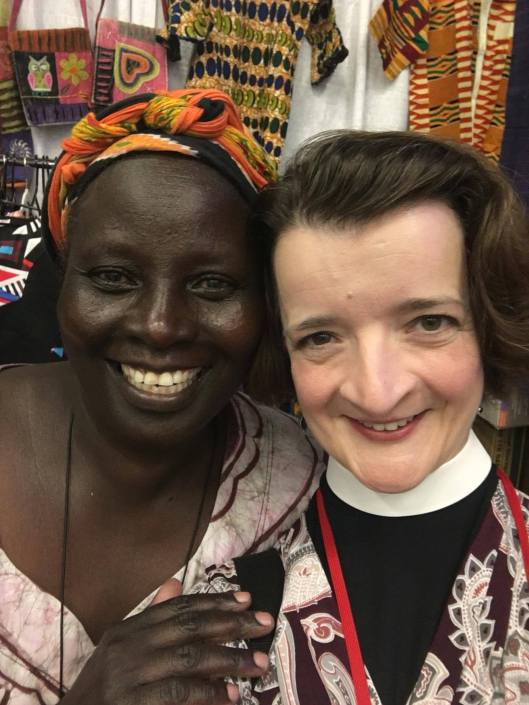
On my first day of General Convention, I had to start as a “visitor” until I could get my alternate name badge.  That meant I had some spare time to explore the exhibits in the Exhibit Hall.  I decided to grab lunch there, and after I made my purchase, I realized I didn’t know anyone in the eating area, and many of the tables were full of deputations or groups of friends.  There was a table with just one petite older woman of color.  I figured General Convention was partly about meeting the wider church, so I asked to join her.

We began the normal chitchat of the day – the weather, the food, etc.  I asked her where she was from and she said, “Arizona now, but I’m from Kenya.”  Well, you can imagine my excitement – one of my best friends from seminary is a female priest from Kenya.  We launched into a conversation about what brought her to the States, and before I knew it, we were deep in a conversation about the husband who left her for another woman, the kids he left her to manage, the impact of the divorce on her family, the hurtful things a priest said to her about the divorce, the way she has experienced racism – not just as a person of color, but as a woman from Africa.

After we grieved the hard stuff, and my apology about the sins of the church, she began to tell me about the good stuff:  the grandchildren she moved to Arizona to enjoy; the women she works with back in various countries in Africa to produce clothing that will feed their families; the school she is trying to help some of the women establish in their hometown.  She was at Convention to display and sell their wares.  She jokingly told me, “Yeah, I’m a little concerned.  The women gave me several items that are going to be way too small for anyone here to wear.”  I knew God had brought us together for a reason!  “Mary,” I exclaimed, “I guess that means I’m going to have to buy one of those smalls!”

Later that week, I dropped by new friend’s booth.  We embraced like old friends.  I could see the wrinkles of hurt and toil on her face more distinctly this time, but I could also see the twinkle of new relationship in her eyes.  I came away with a cute dress, but more importantly, I came away with a sense of kinship, of having connected with another human about the journey of life, and where God can work through us to do good.  When we talk about evangelism in the church, I always try to remind Hickory Neck that evangelism is about hearing people’s stories and naming God in them.  It is not easy work.  It will involve sitting down at tables with strangers and maybe even starting by talking about the weather.  But if you hang in there, you might just hear the story of how God is working through us all – and even find a new sister or brother in Christ along the way.

Sermon – Mark 5.21-43, P8, YB, July 1, 2018

04 Wednesday Jul 2018

Posted by jandrewsweckerly in Sermons, Uncategorized

≈ Leave a comment

Tags

connection, intimacy, Jairus, Jesus, Mark, need, power, relationship, Sermon, story, storytelling, woman

I once had a parishioner who was both the best and the worst storyteller.  He was the best because his stories were always fascinating, funny, and fantastic.  Not only did he have an intriguing life, he also just had a real gift for telling stories in ways that brought them to life in your mind’s eye.  But he was also not the best storyteller because he was easily distracted.  He would be in the middle of a story and then veer off course, “Which reminds me of the time…” he would say, and off he would go.  Sometimes he would go back to the other story, but you had to really pay attention to remind him of where he had started.  Sometimes the dropped ending on a story would come back to me days later and I would wonder, “I wonder what happened after he dropped that note to his secret love…”

Mark’s storytelling today is a bit like that parishioner’s way of telling stories.  After the fantastic stories of the calming of the sea, and the healing of a demon-possessed man, Mark tells us of Jesus’ next dramatic moment.  Jairus approaches Jesus and falls at Jesus’ feet, begging him to heal his dying twelve-year old daughter.  This whole event is a big deal because if you remember, many of the other synagogue leaders were suspicious of Jesus, and even plotting against him.  For a synagogue leader to approach Jesus for help is a huge break in rank.  Jesus goes with Jairus without comment, but before we can find out what happens, Mark basically says, “Speaking of which, there was this woman who approached Jesus without Jesus knowing.  You won’t believe what happened…”  And off Mark goes telling another fantastic story.

This time, we learn of a woman who is a total outcast.  She has been hemorrhaging for twelve years, she is destitute because she has spent all her money on doctors – to no avail, and let’s not forget she is a woman.  We can almost imagine the clandestine approach of this triple outcast weaving her way into the crowd just to touch Jesus’ garment.  To her credit, the simple touch works!  Now, the story really could end there, but Mark tells us something even more fascinating – Jesus stops dead in his tracks, demanding to know who touched him.  In a crowd of thousands, he wants to know which person touched him?!?  The woman comes forward for what should be a great castigation and humiliation.  Instead, her honesty and vulnerability open Jesus up to giving even more blessing.  Not only has her faith in him made her well, he offers her the peace, health, and wholeness that will allow her full integration back into society – a double gift!

Now the good news is that Mark is not as bad of a storyteller as my former parishioner.  Mark jumps back to Jairus’ story – but the news is bad.  The daughter has died!  Everyone thinks the cause is lost, but Jesus encourages Jairus to believe.  So off they go, but this time with only Peter, James, and John.  The gathered crowd mocks Jesus’ assertion that the girl is just sleeping.  But when the six of them go in, Jesus quite simply takes her by the hand, calls the girl to get up, and then asks them to give her some food – dying can really take a toll after all!

You might be shaking your head at Mark at this point, wondering if we can’t just focus on one of these stories – truly either is powerful enough on its own.  But Mark is not really like my former parishioner – he does not simply tell stories because he is good at telling stories, or because he likes to entertain guests.  In fact, Mark does this more than once in his gospel.  The biblical critics call this practice “intercalation,” but many people just call this a Markan sandwich.[i]  As N.T. Wright explains, by sandwiching the stories together, “The flavour of the outer story adds zest to the inner one; the taste of the inner one is meant in turn to permeate the outer one.”[ii]

So what do we learn about Jesus through Mark’s sandwiching these stories together?  Well, let’s start with how they are different.  Jairus is an insider – as a male synagogue leader, he is well-known and respected in the community, presumably with some power and influence.[iii]  Meanwhile, the bleeding woman is an outsider – a female, impure, impoverished outcast.[iv]  Jairus publicly invites Jesus to touch his dying daughter; the woman secretly touches Jesus’ cloak herself.  Jairus’ daughter is just a girl, but the woman has lived a longer life.  More interesting though is how the two stories are alike.  Both Jairus and the woman kneel before Jesus.  “Both victims of illness are female and ritually unclean, one as a result of death and one as a result of hemorrhage; both represent the significance of the number twelve in Jewish tradition (the twelve years of hemorrhage and the twelve-year old girl); and both are regarded as ‘daughters’ (the little girl being Jairus’s daughter and the woman who is addressed by Jesus as ‘Daughter’).  An act of touch restores both women to new life even as those surrounding them lack understanding.”[v]

Mark uses these two stories together because we need their differences and similarities to teach us something about Jesus and about ourselves.  We learn from Mark’s sandwich that Jesus is present with both the powerful and the powerless alike.  Both requests, despite the baggage both a synagogue leader and an impure woman bring, are honored by Jesus.  What we note though is Jesus tends the woman first.  Now some scholars might argue the pause in the story, and the death of the girl before Jesus gets there, are meant to build suspense.[vi]  But equally important is that Jesus stops for the person without power first[vii] – even taking precious time to not just heal her but demand to be in conversation and relationship with her.  He could have kept walking, knowing that his power had flowed out but staying the course with the good deed he was about to perform.  But instead, he stops everything, everyone, and demands a connection – one that leads not just to healing but total restoration within the community – shalom.[viii]  Jesus also shows us about the wideness of family.  A few weeks ago, we read the gospel lesson where Jesus questioned the crowd about who his mother and brothers and sister were.  Today he keeps expanding the circle.  The powerful and persecuting are his family; the most ostracized outcasts are his family; even the vulnerable children are his family.  Finally, Jesus teaches us that healing or the good works we do are meant to be within the context of relationship.  That Jesus tends the bleeding woman and the young girl is much less important than how he tends the two females.  Jesus’ help is not about an impersonal exchange – a few coins dropped in a hat or a check written to a charity – though those are necessary too.  Equally important to dropping a coin in a hat might be stopping to talk to the person asking for a handout.  In addition to contributing to a favorite charity, knowing the stories of specific clients is equally important.

What is hidden in these two tales about Jesus is the “flash of precious intimacy between two human beings who are socially very distant from each other.”  As one scholar explains, what Jesus brings alive for us today is “Our relationships – in the church, in friendships, and in marriage – are not just something extra added on to life for distraction and entertainment, as if we would be complete human beings in individual isolation.  Relationship, ‘touch,’ if you will, makes us human and whole.  As the contemporary Scottish philosopher John Macmurray once phrased it, ‘I need “you” in order to be myself.’”[ix]  What Jesus’ actions and Mark’s adept way at combining stories do today is invite us to consider not what we do, but how we do what we do.  Jesus invites us to slow down – to take those moments when someone’s pain is presented to us, and not just offer help, but stop long enough to make a connection – to develop intimacy with others.  “A teacher once remarked, ‘You know…my whole life I have been complaining that my work was constantly interrupted, until I discovered that my interruptions were my work.’”[x]  Jesus also invites us to care for everyone – rich, poor, young, and old – but he especially wants us to start with those most in need.  Finally, Jesus invites us today to see, really see, where people are, and to be a people of compassion, healing, and love.  Before you know it, you may be the one at coffee hour, veering off one story to tell yet another story, all highlighting the wonderful, lifegiving, challenging ways that stepping into relationship with others has changed your walk with Jesus.  I can’t wait to try to track your stories!  Amen.

[i] Karoline Lewis, “A Lesson from Mark,” June 25, 2018, as found at http://www.workingpreacher.org/craft.aspx?post=5184 on June 28, 2018.

[ii] N.T. Wright, Mark for Everyone (Louisville:  Westminster John Knox Press, 2004), 58.

[iii] Efrain Agosto, “Exegetical Perspective,” Feasting on the Word, Yr. B, Vol. 3 (Louisville:  Westminster John Knox Press, 2009), 189.

[iv] John R. Donahue, S.J. and Daniel J. Harrington, S.J., The Gospel of Mark, Sacra Pagina Series, vol. 2 (Collegeville:  The Liturgical Press, 2002), 174.

[v] Beverly Zink-Sawyer, “Homiletical Perspective,” Feasting on the Word, Yr. B, Vol. 3 (Louisville:  Westminster John Knox Press, 2009), 191.

[vi] Lamar Williamson, Jr., Mark, Interpretation:  A Bible Commentary for Teaching and Preaching (Louisville:  Westminster John Knox Press, 1983), 108.

[vii] Mark D. W. Edington, “Theological Perspective,” Feasting on the Word, Yr. B, Vol. 3 (Louisville:  Westminster John Knox Press, 2009), 192.

[viii] Williamson, 109.

[ix] Michael L. Lindvall, “Pastoral Perspective,” Feasting on the Word, Yr. B, Vol. 3 (Louisville:  Westminster John Knox Press, 2009), 192.

[x] Williamson, 112 (quoting Henri J.M. Nouwen, Reaching Out, p. 36).

On homes, humanity, and our hands…

17 Wednesday Jan 2018

Posted by jandrewsweckerly in Uncategorized

≈ Leave a comment

Tags

baptismal covenant, common, dehumanize, dignity, Habitat for Humanity, home, humanity, Jesus, light, other, poor, preferential, respect, story

Web_handsopen

Photo credit:  https://www.mncatholic.org/advocacy-areas/option-for-the-poor-and-vulnerable/

Yesterday, I attended the dedication of a Habitat for Humanity house for which our church had been a financial and volunteer sponsor.  As I watched the family celebrate, it struck me how everyone has a story.  Before becoming a priest, I worked at a Habitat affiliate in Delaware, and I remember that each homeowner’s story varied.  Some had grown up in poverty, and were the first to buy homes in their extended families; some had a health crisis that led to financial and housing problems; some were living in substandard conditions, while others had squeezed their entire families into a friend’s living room.  I do not know the full story of the Fletcher family, except that the matriarch has been working as a nurse for years, has three children, and could not afford to buy a home without Habitat.

What struck me about the Habitat event is how strong our common humanity is.  Get a new Habitat homeowner in the room with a wealthy, privileged person, and I suspect within ten minutes they will be sharing stories of their common humanity.  But get either of them outside of that room, and either person could be seen as an enemy:  someone who oppresses others and does not share their wealth or someone who does not work hard enough and relies too much on outside assistance.  Neither of these characterizations are fair – but we make them all the time.  We forget the story of each individual, and instead create categories that we can then use to generalize – to dehumanize.

I do not usually talk about politics on my blog, but our President’s recent characterization of other countries and their citizens, whom I love, has broken my heart.  The incident itself was not all that surprising.  What put me over the edge was how the comment was so brazenly said and affirmed by others, and how the comment highlighted the ways our country seems to have embraced the practice of dehumanizing others enough that they are able to say things that they would not otherwise say to another human if they were face-to-face.

Our Lord and Savior, Jesus Christ, advocated for a preferential option for the poor.  Time and again, Jesus took the stranger, the outcast, the downtrodden, and healed them, helped them, and loved them.  In fact, “the other,” is a recurring theme in scripture that invites us to examine our own modern designations of “insiders” and “outsiders.”  Our country’s current practice of demonizing and subjugating the “other” is an action in direct conflict with Holy Scripture and the Gospel of Jesus Christ.  We are not living into our baptismal covenant promises of respecting the dignity of every human being, and seeking and serving Christ in all persons.

This week, I invite you to examine our current treatment of the “other” – those for whom Jesus had a particular preference and priority.  Whether you need to spend some time in prayer, have a conversation with someone unlike you, volunteer some time with a charitable organization, write to your governmental representatives, or donate your money to an agency that can affect change – do something.  Do not let your light be hidden under a bushel.  And then share your story with me here, or with a friend on the journey.  I cannot wait to hear how the Holy Spirit uses you.

Sermon – Luke 2.1-14, CE, YB, December 24, 2017

10 Wednesday Jan 2018

Posted by jandrewsweckerly in Sermons, Uncategorized

≈ Leave a comment

Tags

chaos, Christmas Eve, church, God, holy, Holy Family, Jesus, life, love, manger, peace, silent, story, worship

Sometimes arriving at the manger on Christmas Eve feels a bit like just barely sliding into home plate.  When little ones are around, you have scurried about, making sure their tights and bowties are on, while trying to squeeze in one last family picture while everyone still looks nice.  By now, you have probably served or been served a meal, purchased and wrapped gifts, prepped or cooked food for tomorrow, sent out cards, decorated the house, and run countless errands.  And none of that includes the four hundred things that will be done in the next twenty-four hours.  Arriving here and semi-put together is a minor victory, with the promise of a peaceful, beautiful hour of worship, before preparing for the chaos to resume tomorrow.

The unfortunate thing is that the story of tonight is not all that much less chaotic.  Though we sing songs like Silent Night or Away in a Manger, or though we exchange cards with pastoral, peaceful settings, nothing about that night is silent.  And I am pretty sure the little Lord Jesus makes lots of cries.  The chaos of the holy family is not unlike the chaos in which we sometimes find ourselves.  Remembering how scandalous Mary’s pregnancy and relationship with Joseph are, the chaos continues as Emperor Augustus sends out a decree that forces a very pregnant, uncomfortable Mary away from her hometown to the crowded city of Bethlehem.  Before they can secure housing, Mary goes into labor.  Not only is she dealing with the drama of delivering a child for the first time ever, she is delivering without so much as the comfort of a home.  And then, just as they are trying to figure out nursing, and soothing, and the fear and wonder of parenting, along come some rowdy, likely filthy, shepherds, who have also not had a silent night.  In fact, they have heard the terrifying chorus of the heavenly host and been told a most preposterous story – so much so, they gather up their livestock and come to see.

With all the chaos of our own lives, and with all the mayhem of that holy night, why do we do it?  Why do we come to church at all?  Maybe we come to church on this night specifically because on this night, more than perhaps any night ever, we find the wonderful revelation that God can take the messy chaos of life and make our mess holy.  You see, as much as we love tonight’s beautiful story, what happens this night is beyond the chaos of registrations, no vacancies, angelic revelations, and messy encounters with strangers.  In order to understand the enormity of what is happening tonight, we broaden our scope.  Tonight’s event – the nativity of our Lord –  is the culmination of a much larger story.  The story started when there was no earth or humankind, when God formed the earth from the formless void.  When we first sinned against God and were cast out of the garden, to when we kept sinning and God flooded the world, to our deliverance from the hands of pharaoh and our arrival in the promised land, to our sinful desires for a king that led to the eventual confiscation of our land.  We are a people who have been oppressed so many times and rescued so many times we can barely count.  And in that rollercoaster of a relationship with our God, as we failed time and again, God, who never gives up and never cedes love, does something unheard of:  takes on human flesh, comes to us in the form of a vulnerable child, with the plan of redeeming us forever and granting us eternal life.

Maybe we come to church tonight because tonight is about God’s unending, undying, unfailing, uncompromising love for us.  Despite centuries of chaos, disobedience, and failures, God shows up tonight in a mighty way.  Despite the chaos of the times and of this night, God shows up among the outcast.  Despite the chaos of our own times, in our seeming inability to tend to those most outcast, God comes once more to redeem us.  We come to church tonight because we long to grasp the enormity of God’s love for us, the extents to which God will go for us, and the hope which only God can give to us.

But the news is even better than that.  I do not believe the beauty of tonight is in trying to find a holy moment, where God’s love speaks to us in an otherwise chaotic life.  In fact, you might not find that moment tonight because despite the fact that you were physically able to get here, your mind may still be somewhere else.  The good news is that is okay.  The deep, lasting peace of this night is not found in a single church service (though I must say, the service certainly helps).  The deep, lasting peace we are looking for comes from the reality that we do not find God’s love and peace in spite of the chaos of life.  Tonight teaches us that God hallows the chaos of life.

Based on our standards, God should have placed this precious child – the God incarnate – in the wealthiest, most well-guarded palace, where a person of great wealth could have given the baby everything the baby needed.  A person of power could have protected the child, brought honor to the child, raised the child up to assume the power of a Messiah.  If we had something so precious, we certainly would have worked to find the best of what we have to protect that preciousness.  And yet, God takes on flesh in an unmarried, inconsequential woman of little means.  God takes on flesh amidst the common people, being born in the lowliest of estates.  God takes on flesh and announces the news not to kings and rulers, but to shepherds – those disregarded by society as being of little import.  From the very beginning, the extraordinary thing God does is done in the midst of the ordinary – worse yet, among the marginalized and outcast.

God takes the mess of life:  our divisions, our stratifications by class, gender, and race, our subjugation of the poor, our inability to refrain from sin, our messes and chaos – and God makes our mess holy.  God sanctifies our chaos, reminding us that in the midst of chaos, God is present.   In the midst of chaos, God is doing a new thing through us.  In the midst of chaos, God is love and makes us agents of love.  I cannot promise that the chaos will not try to overtake you when you walk out the church door tonight.  But just like you will find small glimpses tonight of the overwhelming love God has for you, you can find God present in the chaos of life too.  God is continually breaking through, birthing in you Christ’s light and love, using you to make room in the world for the Christ child, using you to announce good news of great joy for all people.  If that doesn’t break though the chaos, I don’t know what will!  Amen.

On Sports, Story, and the Spirit…

19 Wednesday Jul 2017

Posted by jandrewsweckerly in Uncategorized

≈ Leave a comment

Tags

challenge, conversation, faith, faithful, fun, hope, Jesus, journey, movie, power, race, racial reconciliation, sports, story

banner-top-basketball-960x275-960x275

Photo credit:  coachcarter5.blogspot.com/p/plot-summary.html

This summer, our church was looking to do two things:  we wanted to offer a “light” educational series that adults could enjoy and we wanted to continue our conversation about racial reconciliation.  One might think those two goals do not go together.  But we were not to be deterred.  We settled on the option of watching movies that were about racial reconciliation.  Movies are certainly fun, but the topic still wasn’t capturing the “fun” or “light” criteria.  Then the idea hit us:  sports movies!  Sports movies allow us to be entertained, while sneaking in powerful stories of hope, challenge, and encouragement.

The model has worked even better than I suspected.  Our first two movies have been 42: The Jackie Robinson Story and The Blind Side.  The last two movies are Coach Carter and Invictus.  We were able to feature four sports:  baseball, football, basketball, and rugby.  Each week we have been able to cheer on teams, laugh at comical moments, and pause with discomfort when truth broke through.  Our conversations have been rich – each movie bringing up parallels in our own stories – about race, about respecting the dignity of every human being, and about our journey with faith.

I think what has made that work is each movie is based on a true story.  We did not make that connection when planning the film list, but it has been a powerful surprise.  Unlike a fictional film, which could be dismissed as romantic, overly simple, or unrealistic, these movies show us real people, trying to live faithful lives on and off the field.  Their stories have been encouraging us to do likewise – examine how we are living faithful lives on and off the field.  Ultimately, I think that is the only way we are going to make our way toward racial reconciliation:  sharing our stories and listening to others’ stories.  It would be easy to do otherwise; to keep our heads down and ignore what is happening in the world about us.  But these stories invite us into another way of being.

The invitation of our Faith and Film series this week is for us to find ways to engage outside of the theater.  Maybe you start by telling someone about this awesome movie you just saw.  Or if you are feeling more confident, maybe you simply talk to a friend or coworker – either of your race or another – and start with a confession, “I watched this movie and it has made me think about [insert your thoughts here].  What is your experience with that?”  Using the movie or your own story allows you to do what Jesus did all the time – engage people where they are through the power of story.  I believe reconciliation starts there:  one story at a time.

← Older posts
Newer posts →

Recent Posts

  • On Redefining Community…
  • On Parenting, Milestones, and Community…
  • Sermon – Acts 2.42-47, E4, YA, April 26, 2026
  • On Seasons of Discernment…
  • Sermon – Luke 24.13-35, E3, YA, April 19, 2026

Archives

  • May 2026
  • April 2026
  • February 2026
  • January 2026
  • December 2025
  • November 2025
  • October 2025
  • September 2025
  • August 2025
  • July 2025
  • June 2025
  • March 2025
  • February 2025
  • December 2024
  • November 2024
  • October 2024
  • September 2024
  • August 2024
  • July 2024
  • June 2024
  • May 2024
  • March 2024
  • February 2024
  • January 2024
  • December 2023
  • November 2023
  • October 2023
  • September 2023
  • August 2023
  • July 2023
  • June 2023
  • May 2023
  • March 2023
  • February 2023
  • January 2023
  • December 2022
  • November 2022
  • October 2022
  • June 2022
  • May 2022
  • January 2022
  • December 2021
  • November 2021
  • October 2021
  • September 2021
  • August 2021
  • June 2021
  • May 2021
  • April 2021
  • March 2021
  • February 2021
  • January 2021
  • December 2020
  • November 2020
  • October 2020
  • September 2020
  • August 2020
  • July 2020
  • June 2020
  • May 2020
  • April 2020
  • March 2020
  • February 2020
  • January 2020
  • December 2019
  • November 2019
  • October 2019
  • September 2019
  • August 2019
  • July 2019
  • June 2019
  • May 2019
  • April 2019
  • March 2019
  • February 2019
  • January 2019
  • December 2018
  • November 2018
  • October 2018
  • September 2018
  • August 2018
  • July 2018
  • June 2018
  • May 2018
  • April 2018
  • March 2018
  • February 2018
  • January 2018
  • December 2017
  • November 2017
  • October 2017
  • September 2017
  • August 2017
  • July 2017
  • June 2017
  • May 2017
  • April 2017
  • March 2017
  • February 2017
  • January 2017
  • December 2016
  • November 2016
  • October 2016
  • September 2016
  • August 2016
  • July 2016
  • June 2016
  • May 2016
  • April 2016
  • March 2016
  • February 2016
  • January 2016
  • December 2015
  • November 2015
  • October 2015
  • September 2015
  • August 2015
  • July 2015
  • June 2015
  • May 2015
  • April 2015
  • March 2015
  • February 2015
  • January 2015
  • December 2014
  • November 2014
  • October 2014
  • September 2014
  • August 2014
  • July 2014
  • June 2014
  • April 2014
  • March 2014
  • February 2014
  • January 2014
  • December 2013
  • November 2013
  • October 2013
  • September 2013
  • August 2013
  • July 2013
  • June 2013
  • May 2013
  • April 2013
  • March 2013
  • February 2013
  • January 2013
  • December 2012
  • November 2012
  • October 2012
  • September 2012

Categories

  • reflection
  • Sermons
  • Uncategorized

Meta

  • Create account
  • Log in
  • Entries feed
  • Comments feed
  • WordPress.com

Blog at WordPress.com.

  • Subscribe Subscribed
    • Seeking and Serving
    • Join 391 other subscribers
    • Already have a WordPress.com account? Log in now.
    • Seeking and Serving
    • Subscribe Subscribed
    • Sign up
    • Log in
    • Report this content
    • View site in Reader
    • Manage subscriptions
    • Collapse this bar

Loading Comments...