• About

Seeking and Serving

~ seek and serve Christ in all persons

Seeking and Serving

Tag Archives: trust

Sermon – Luke 13.31-35, Psalm 27, L2, YC, March 13, 2022

25 Wednesday May 2022

Posted by jandrewsweckerly in Sermons

≈ Leave a comment

Tags

confidence, defiant, hen, Jesus, lament, lectionary, lost, love, mistrust, Psalm, reliant, Sermon, theme, trust

When you listen to enough sermons in the Episcopal Church, you will eventually realize the preacher is using a set of lessons from what we call “the lectionary.” Unlike in other denominations, the Episcopal preacher doesn’t really get to go “off script” or preach a particular passage to promote an agenda.  And if you have visited other Episcopal Churches, you quickly learn that we all use the lectionary – whether you watch the broadcast of the National Cathedral or the broadcast of Hickory Neck, you will hear a sermon on the same scripture lessons.  But what you might not know is that within the lectionary there are two “tracks” – one where you read through the Old Testament in a semi-continuous way, and one where you jump around in the Old Testament to allow all the readings to have a similar theme as the Gospel.  Hickory Neck is currently following the thematic readings track.

What is interesting about that thematic track is you would think the Old Testament readings and Gospel would be similar.  But this week, the reality is quite the opposite.  In our Psalm today, we have the ideal follower of God.  The psalmist proclaims things like, “The Lord is my light and my salvation; whom shall I fear?” and the Lord will “hide me in his shelter in the day of trouble; he will conceal me under the cover of his tent; he will set me high on a rock,” and “Teach me your way, O Lord, and lead me on a level path” and finally, “I believe that I shall see the goodness of the Lord in the land of the living.”  The psalmist is a faithful follower of God, totally leaning into God for strength and protection, trusting in the Lord’s goodness, wanting to keep learning and being led.  The words of this psalm indicate a confidence in God, a trust in God’s protection, and reliance on the Lord.

And yet, everything in the Gospel text depicts followers of Jesus that are anything but confident, trusting, and reliant.  As Jesus makes his way to Jerusalem, we hear a lament so profound as to cause shame and a sense of failure.  Jesus says, “Jerusalem, Jerusalem, the city that kills the prophets and stones those who are sent to it!  How often have I desired to gather your children together as a hen gathers her brood under her wings, and you were not willing!”  As one scholar describes Jesus, “He longs and grieves for his lost and wandering children.  For the little ones who will not come home.  For the city that will not welcome its savior.  For the endangered multitudes who refuse to recognize the peril that awaits them.  His is the lamentation of long, thwarted, and helpless yearning — ‘How often have I desired to gather you.’”[i]

Jesus’ lamentation describes the very opposite of the followers in Psalm 27.  Whereas the psalmist has confidence, trust, and reliance, the followers of God in Jesus’ day are lost, mistrusting, and defiant.  In this thematic year of the lectionary, how do we hold these contradictory images in tension with one another?  The reality is the two are not all that different.  In fact, I wonder if our work this Lent is in confessing the ways in which we are those lost, mistrusting, defiant chicks, fighting against the care of our mothering God so that we can be the followers of Christ who can profess psalms with confidence, trust, and reliance. 

This week, I invite you to consider the ways in which you are running away from your protective mother hen Jesus.  How are you fighting against Jesus’ care, Jesus’ love, and Jesus’ grace?  Who in your life is offering you care, love, and grace that you are resisting:  maybe because you do not like to be vulnerable, or you do not like to admit your need, or you just do not like other people in your business?  That care, love, and grace is coming from all directions, and our invitation is to simply say yes – to let ourselves be gathered in by this community and those who love you.  And if that hurdle is just too high this week, perhaps your invitation is to read Psalm 27 every morning this week – and nights too if you need – maybe even singing the Taizé song, “The Lord is my light,” until the repetition convinces you – so that the words of Psalm 27 no longer feel aspirational and become truth.  That way, the next time someone needs you to gather them in, you will have a psalm you can share with the authenticity, grace, and love that has been shown to you this week.  Amen.


[i] Debie Thomas, “I Have Longed,” March 6, 2022, as found at https://www.journeywithjesus.net/lectionary-essays/current-essay?id=2944 on March 12, 2022.

Sermon – Mark 8.27-38, P19, YB, September 12, 2021

15 Wednesday Sep 2021

Posted by jandrewsweckerly in Sermons

≈ Leave a comment

Tags

control, cross, God, Jesus, Messiah, Peter, relationship, Sermon, suffering, trust, understanding

Our Gospel lesson today is pretty harsh.  We read with sympathetic ears for Peter:  partly because, objectively speaking, Jesus is being rude.  But we are also sympathetic because we can identify with Peter more than we might like to admit.  Peter has decided that he knows what being a Messiah is, that Jesus is that same Messiah, and that Jesus is not acting how he should.[i]  So he rebukes Jesus in front of everyone.  Peter’s desire to control Jesus makes sense.  His life has been out of control since the moment he left his boat to follow this crazy man.  Trying to control Jesus is the natural response of someone desperate for some normalcy.  For Peter, Jesus being the conquering Messiah will validate Peter’s decisions – but only if Jesus acts in accordance with the definition of a Messiah.  If Jesus starts redefining the concept of Messiah, Peter will be left floundering, his life spinning even further out of control than his life already feels.  Anyone who has been paying attention during this pandemic knows what having little control over life around you feels like.

One of my favorite book and film series is Harry Potter.  In the first movie, while trying to save the Sorcerer’s Stone, the main characters, Harry, Hermione, and Ron, fall into a pit.  At the bottom of the pit is a bed of vines that cushions their fall.  But they soon find that the vines are magical vines, which start weaving themselves around Harry and the others’ bodies.  The more they struggle, the tighter the vines wrap around their bodies.  Hermione remembers from class that the only way to escape one these plants is to totally relax your body – to surrender.  She relaxes, and her body sinks into the bed of vines, disappearing.  Harry and Ron freak out, but Hermione shouts from below that they just need to relax and they will reach the floor.  Harry listens to Hermione and relaxes his body and is also sucked in and released.  Ron, however, totally loses his cool.  He completely panics, and thrashes about so much that the vines wrap themselves around his screaming mouth.  After losing the battle of trying to convince Ron to relax, Hermione has to use a special spell to get the plant to release him. 

Sometimes I think our relationship with God is a lot like Ron’s relationship with that strange plant.  We are creatures who want to be in control.  We want to control how our careers develop, what our relationships will be like, our plans for retirement, and the timing of major life events.  Although we are rarely successful, we try to control other people too – our family members, our friends, our co-workers.  And most of all, we try to control God.  We see this desire most readily in our prayer lives – we ask God for things, we pray for specific solutions to our problems, and we get angry with God when things do not go our way.  We rarely say those words that Jesus says, “Not my will but yours be done.”[ii]  And even more rarely do we sit in prayer with God and just listen.  When we examine our relationship with God, we are more likely to find our hands grasping tightly for control than to find ourselves with open hands, willingly ceding control to God.[iii]

The unfortunate thing about our desperate need for control is that we miss what God is trying to do in our lives – just like Peter.  By being so controlling with Jesus, Peter is unable to really hear Jesus, and unable to understand the radically wonderful way that Jesus will not only redefine the concept of the Messiah, but will do so much more than the expected Messiah could do.  But that is not the scariest part.  The challenge for us today is not just the ceding of control; the challenge is when we finally cede control with Peter, there is more to the story.  In our gospel lesson, Jesus tells us that once we understand what a Messiah really is, we too must behave like a Messiah.  We too must follow the way of Christ – the way of the cross that leads to death.  That cross up there over our altar, the one that we hang everywhere, including around our necks, is not just a symbol for what Christ did for us.  That cross is a symbol for the life that we take up too.  The cross is not simply Jesus’ cross, but the cross is our cross. 

But, if we can trust Jesus, trust God, if we can relax our bodies in those tangled vines that are trying to squeeze the life out of us, we might just fall into the place where we need to be.  We might just realize that taking up our cross does not only lead to suffering; taking up our cross also leads to a glorious life of greater joy than we can imagine, and salvation beyond our wildest dreams, where death and suffering have no power over us.  When we move our hands from being tightly closed fists of control to open hands of trust and acceptance, we create space for God to rest in our hands, to show us the way.  The other side of those tangled vines of our desire for control is a glorious place.  All we have to do is let go and let God.  Amen.


[i] Martha L. Moore-Keish, “Theological Perspective,” Feasting on the Word, Yr. B, vol. 4 (Louisville: Westminster John Knox Press, 2009), 70.

[ii] Luke 22.42. 

[iii] Patrick J. Wilson, “Cross Culture,” Christian Century, vol. 111, no. 5, Feb. 16, 1994, 165.

Sermon – Acts 1.15-17, 21-26, E7, YB, May 16, 2021

26 Wednesday May 2021

Posted by jandrewsweckerly in Sermons

≈ Leave a comment

Tags

apostles, bishop, discernment, disciples, election, Episcopal, God, goodness, grace, Holy Spirit, Jesus, prayer, Sermon, trust, will

I have sometimes daydreamed about the experience of liturgical freedom:  picking and choosing the scripture for a given Sunday (particularly when I need to address a specific issue), praying an extemporaneous prayer on a Sunday to address a certain topic in the church, or drafting our own liturgical experience to address a particular need.  However, as crazy as the idea may sound, I more often find freedom within our Episcopal constraints than within the endless possibilities of what could be. 

This past week was a classic example.  Last Sunday, totally unaware of the announcement I would be making on Tuesday, Bob preached about the invitation of the Resurrection being an invitation into discernment – discernment about what each of us needs to do to bring about the kingdom here on earth.  On Tuesday night, our regularly scheduled Discover Class topic, which was scheduled months ago, was focused on the structure and leadership model of the Episcopal Church, including who bishops are and how they are elected.  Then today, we get this lesson from the Acts of the Apostles in which Peter and the other apostles are attempting to replace the twelfth spot Judas left open through his death.  All that daydreaming about constructing our spiritual experiences went out the window this week when I remembered the Holy Spirit does a much better job at constructing those experiences than I ever could!

To say that this portion of the Acts of the Apostles is a divine gift is not necessarily because we happen to be talking about a bishop’s election this week just as the apostles are talking about an election of sorts.  In fact, what the apostles are doing is the opposite of an election.  No one asks Matthias or Justus to go through an interview process or offer their vision of leadership for the next decade.  Instead, their criteria are pretty simple.  First, the replacement should be someone who knows Jesus personally.  Second, they want to honor their ancestral roots in the twelve tribes of Israel – eleven apostles will not suffice.[i]  Third, their decision is rooted in prayer.  And finally, their decision is based on trust in the will of God.  Nowadays, we might think the casting of lots is a little too random and could lead to a poor appointment of leadership – I mean when was the last time we selected a Rector, Warden, or Committee Chair by flipping a coin?  But according to New Testament scholar Kathy Grieb, the casting of lots is “an ancient biblical practice for determining God’s will…”[ii]

Hearing about all the coincidences in our last week, from talking about discernment, to the structure of the Episcopal Church, to the selection of the last apostle, may be intriguing or even amusing, but may also leave you asking, “So, what?  What does all of this have to do with me or my experience of Hickory Neck, or even more broadly, with Jesus?”  As I have reflected on these coincidences – or as Carl Jung referred to them as instances of “synchronicity” or “meaningful coincidence”[iii] – I see an invitation for all of us from Peter.  First is an invitation to recall our identity.  We are a community whose historic identity has been about weathering change – whether it was the identity crisis created by the Revolutionary War, the replacement of a faith community by schools and hospitals for over a century, to reclaiming and expanding our land to become a church again, to surviving a global pandemic.  The possibility of a change in clergy – a very small possibility at that – does not alter the fact that we are a community rooted in Jesus’ love, shining our light on this Holy Hill for almost three centuries.  Second is an invitation into prayer:  prayer for the Hickory Neck Community, prayer for your Rector, and prayer for the Diocese of Iowa and the other candidates.  Our hurt, our frustration, our fear, and our joy can be left at the feet of Christ in prayer.  When given the space, prayer can do much more than we can imagine.  And finally, our invitation this week is to trust in God.  We may not always like what God does – I am pretty sure the apostles would much rather have not been trying to figure out a leadership model in Jesus’ absence.  But we do know that God is faithful, and, in time, God leads us to goodness and grace.  I do not know where the next couple of months will lead us.  But I do know if we can stay rooted in our identity, in prayer, and in our faith in God, we will come out stronger disciples for Jesus, strengthened to take on whatever “meaningful coincidences” the Holy Spirit throws our way.  Amen.


[i] Noel Leo Erskine, “Theological Perspective,” Feasting on the Word, Year B, Vol. 2 (Louisville: Westminster John Knox Press, 2008), 528.

[ii] A. Katherine Grieb, “Exegetical Perspective,” Feasting on the Word, Year B, Vol. 2 (Louisville: Westminster John Knox Press, 2008), 531.

[iii] Carl G. Jung, Synchronicity: An Acausal Connecting Principle (Princeton:  Princeton University Press, 2012), 44, as cited at https://artsofthought.com/2020/05/30/carl-jung-synchronicity/ on May 14, 2021.

On Wanting to Go Back…

02 Tuesday Jun 2020

Posted by jandrewsweckerly in Uncategorized

≈ Leave a comment

Tags

ancestors, darkness, Egypt, faith, God, goodness, hard, help, Israelites, journey, lament, longing, pandemic, power, Promised Land, protest, romanticize, trust, wilderness

walkingdesert2_thumb

Photo credit:  http://www.livingintheshadowofhishand.com/2013/06/wandering-in-wilderness.html

The whole congregation of the Israelites complained against Moses and Aaron in the wilderness.    The Israelites said to them, “If only we had died by the hand of the Lord in the land of Egypt, when we sat by the fleshpots and ate our fill of bread; for you have brought us out into this wilderness to kill this whole assembly with hunger.”  (Exodus 16.2-3) 

The rabble among them had a strong craving; and the Israelites also wept again, and said, “If only we had meat to eat!  We remember the fish we used to eat in Egypt for nothing, the cucumbers, the melons, the leeks, the onions, and the garlic; but now our strength is dried up, and there is nothing at all but this manna to look at.”  (Numbers 11.4-6)


One of the cries we are prone to in these days is “I wish we could just go back to the way it was!”  I just did it myself in a sermon a few weeks ago, when I talked about how at the beginning of the pandemic, we were all chipping in and helping each other, but then slowly our demons had taken back over and we are becoming fractured and partisan again.  But we do it all the time.  The most famous may be our President’s campaign slogan, “Make American Great Again.”  I have heard the cry from former Senators and Congressmembers who have talked about the time when people worked “across the aisle” with compromise and collaboration.  As we have mourned social distancing and stay-at-home orders, this has especially become the cry of many of us in the Church.  And as violence rocks our country, many are asking protestors to quieten down and find other ways to make changes.

Of course, we are not alone in our lament and longing.  Our ancestors, the Israelites, were famous complainers in the wilderness, longing to go back to Egypt – the very place of their enslavement – because “at least they had food,” or they remember with longing the savory foods.  The hardness of the wilderness made them romanticize a life marked by brutality, oppression, and death.  Keeping an eye on the Promised Land was not so easy after years in the wilderness.

We are not unlike of ancestors.  In hoping to make America great again, we forget that any era of our history has been marked by darkness – whether the subjugation of the Indigenous peoples of this land, the enslavement, segregation, or oppression of African-Americans, the disenfranchisement and sexual subjugation of women, and on and on go the examples.  When we look at our current inability to work across party lines, we forget the ways in which women and people of color were wildly underrepresented in leadership – if represented at all!  Our current mourning of how Church used to be forgets the incredible ways technology has connected us to our neighbors, our extended community, and even strangers.   And both this pandemic and the protests about the treatment of persons of color are pulling back the curtains on disparities around wealth and opportunity for African-Americans.

What we learn from our biblical ancestors is that the wilderness is hard:  hunger, thirst, discomfort, and disagreements over power are real.  And yet, only in the wilderness did the faithful learn to trust God, to restructure leadership in shared ways, and find ways to govern themselves marked by justice and mercy.  As a person of privilege, I certainly have the option to turn off news coverage, wait this pandemic and the protests out, and stay ensconced in my place of power.  Or I can use this wilderness to learn, to be vulnerable, to use my power for goodness (or even better, cede some of my power), and to pray for God’s help on the journey.  It may be quite some time before we arrive at the Promised Land.  But we do not have to flee back to Egypt.


The Pilgrim’s Way…Day 6

12 Wednesday Feb 2020

Posted by jandrewsweckerly in Uncategorized

≈ Leave a comment

Tags

Canterbury, Cathedral, disappointment, evensong, experience, God, joy, perfect, pilgrimage, plans, Savior, space, trust

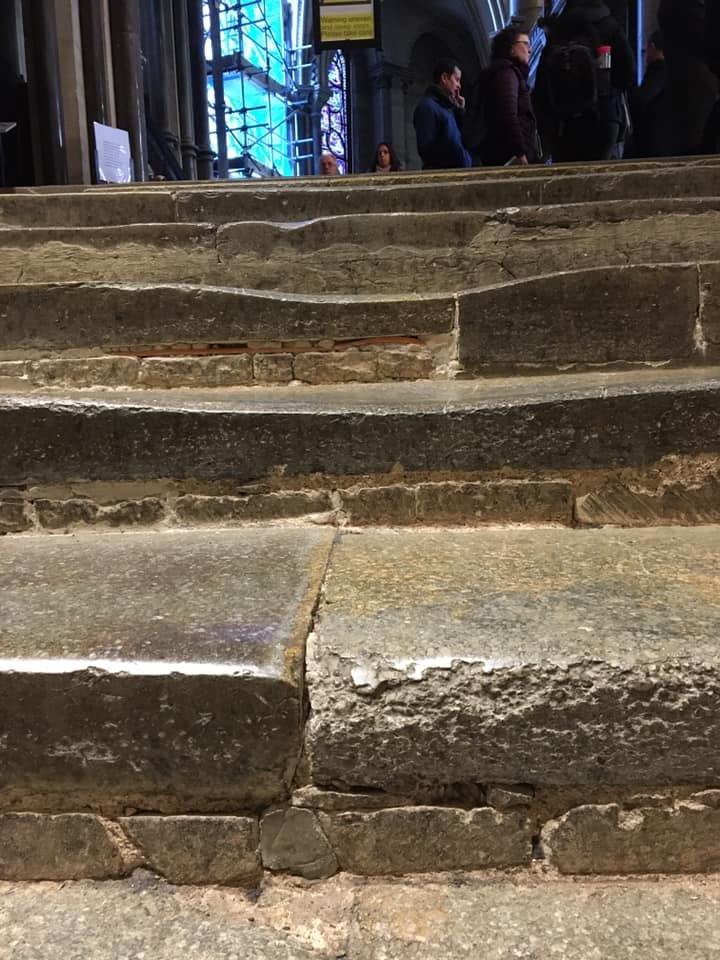
84089251_2891907087532199_5560143380115095552_n

Photo credit:  Jennifer Andrews-Weckerly; reuse with permission only

Sixteen pilgrims from Hickory Neck Church traveled to England for 8 days of pilgrimage.  Our focus was on choral music, hearing Evensong or Choral Mass at a Cathedral, Minster, or college everyday.  This is the sixth entry, initially posted on our church Facebook page.  For those of you who do not follow us on Facebook, I am repeating the journey’s daily entries here.  Enjoy!

Canterbury

When spending over a year planning a pilgrimage for your parish, poring over plans, making amendments to itineraries, and crafting the best spiritual experience you can, you imagine, “There! I have created the perfect pilgrimage experience.” But as soon as you say the words, “I have created,” you have lost. Pilgrimages are not about what I create or even what I plan. Pilgrimages are certainly about working hard – before, during, and after. But pilgrimages are also about making space and then letting God take over.

I was acutely aware of that today. All day I had been internally groaning because we were not going to hear the boys and the men singing at Evensong at Canterbury Cathedral. Instead it would just be the gentlemen. I had really wanted our pilgrims to hear the full sound with the boys, and knowing they would be absent felt like a huge disappointment. But as soon as the men opened their mouths, I was transported to another time – a time when Benedictine monks chanted prayers day after day, hour after hour. The simplicity and beauty of their sound made the enormity of fourteen hundred years of Evensongs unfurl before me, like the wafting of incense before my face, lingering in my hair. Suddenly a multitude of heavenly hosts surrounded me – pilgrims, monks, priests, common Christians, seekers, nonbelievers, the sick, the oppressed – all longing for something, all aching for God. And tonight I remembered, in addition to them, God is right here: always has been and always will be, no matter what plans I have made.

Tonight it is my hope that you can find it in yourself to trust a little less in your own hands and a lot more in the loving embrace of your Savior’s hands. I can’t wait to hear about your disappointment and your overwhelming joy!

86627611_2891906947532213_2676576335572238336_n

Photo credit:  Jennifer Andrews-Weckerly; reuse with permission only

Sermon – Matthew 3.13-17, E1, YA, January 12, 2020

22 Wednesday Jan 2020

Posted by jandrewsweckerly in Sermons, Uncategorized

≈ 1 Comment

Tags

Annual Meeting, bold, consent, courage, experimentation, fun, gifts, God, humility, Jesus, John, joy, playfulness, resistance, Sermon, trust

This sermon was delivered on the occasion of our Annual Meeting at Hickory Neck Episcopal Church.  

As I have been preparing for our Annual Meeting, I have been thinking how grateful I am to have John as our companion today as we look back at a year of ministry and look forward toward what is to come.  In general John is not my favorite character in scripture.  He always seems a bit extreme – sort of like that overly enthusiastic street corner preacher to whom you carefully give a wide berth and with whom you avoid eye contact for fear of having to explain how your understanding of Jesus is a bit different from theirs.  But today, I find resonance with John.

When Jesus asks John to baptize him, John’s immediate response is to resist.  John’s response is the classic, “But that’s not how we’ve always done it,” response.  This year, Hickory Neck had countless opportunities to respond like John.  When our Sunday School program elected to repurpose an unused classroom that had become storage because our Godly Play program had grown so much, we could have resisted the change and associated work involved.  When our Curate suggested we try out Ashes-to-Go on Ash Wednesday, we could have easily come up with myriad reasons why our property was not suited for such a program.  When our Praise Band decided to take a break from worship leadership and try Jam Sessions as a way to cultivate praise music in our community, we could have easily resisted their discernment and their creativity.  When the Kensington School offered to take over the children’s station at our Fall Festival, we could have easily gotten in the way or resisted their leadership.  When our Outreach Committee suggested we take on a week of the Winter Shelter by ourselves, separating from our long-time two-week sharing pattern with St. Martin’s, we could have resisted the change because we have never done Winter Shelter that way.  The opportunities to respond with John-like resistance have been overwhelmingly present over the last year.

Fortunately for us, Hickory Neck is a community who, like John works through innate human and communal tendencies toward resistance to change, and instead, embraces consent.  When John initially resists Jesus, Jesus comes back to John with an invitation to trust him.  John and Jesus engage in an open relationship of dialogue.  And, Matthew tells us, quite simply, “Then John consented.”  Matthew’s simplicity can belie how tremendous John’s consent is.  John’s consenting means letting go of control, letting go of the comfort of familiarity, letting go of the confidence that you are right and the other is wrong.  Those three little words, “Then he consented,” reveal John’s trust, John’s courage, and John’s humility.  John’s consent is not passive or weak.  John’s consent is bold!

That is what I have seen in Hickory Neck in this last year of ministry.  We have been bold!  When your Vestry formed this time last year, they took on a year-long process of visioning and strategic planning.  You will learn more about that process in the coming months, but I can tell you the Vestry has exhibited a lot of trust, courage, and humility as they looked at who we are and where we are going.  Hickory Neck has been bold in other areas too.  When our Parish Life team decided to resurrect the Shrove Tuesday Talent Show, I was uncertain how the Talent Show would go.  But we spent the night laughing, playing, and glorifying God in bold ways.  When the Kensington School invited us to teach Godly Play as an elective class, I was almost certain we would not have anyone sign up.  But out of 70 students, about a third of whom are ineligible due to age, we have over 20 students who regularly come to listen for God.  When our Musician decided to organize Evensongs, helping us prepare for a pilgrimage in England, I wondered whether many people would come to hear the traditional musical offering.  But when over 100 people, half of whom were visitors, attended, we saw how we are a community who can celebrate all kinds of music.  Or when we decided to totally transform this space for Flip Flop Mass, even the staff were not sure what we were doing.  But the joy and delight on worshippers faces afterwards taught us we had found something unique, meaningful, and fun.  Hickory Neck has been embracing bold responses to God all year long!

Part of our willingness to be bold this past year has been rooted in Hickory Neck’s identity and values.  As our Vestry articulated our values this year, one of those values was curiosity – an embracing of experimentation, playfulness, and joy.  That value, which is not common among churches, I assure you, creates in us an inherent ability to do what John does – to consent to Jesus, to the movement of the Spirit in what might be happening next.  That is why I am confident 2020 holds the promise of many more expressions of boldness.  After a successful year of offering a Godly Play class at the Kensington School here in Toano, the director has asked us to offer a Godly Play class at their Williamsburg location – a location that has around 250 kids as compared to the 70 kids here.  We will need to find about four more teachers to enable such an undertaking, but such boldness could mean sharing the good news not only with our immediate Upper James City County families, but families throughout our region.  As we face the departure of our curate later this month, a full-time clergy position that cannot be financially replaced due to pledging, we could choose fear, resistance, or despondency.  Instead, our Personnel Committee, Vestry, and Staff have been creatively trying to figure out a new staffing structure – a way to think about ministry differently, employing the gifts of the entire community to achieve something different, but equally life-giving that can facilitate the achievement of the strategic priorities our Vestry has articulated.  When our dream of bringing more childcare to our community was realized, a group of parishioners realized that not everyone could afford that childcare.  Instead of feeling frustrated or stymied, a group came together to form a Scholarship Committee to figure out how to make childcare accessible to our neighbors.  That group has boldly discerned the need to create a 501(c)3 nonprofit organization that can raise funds – and not just for children in our community needing care, but eventually, even for seniors needing help with care.  The process may take a while to coalesce, but the Committee is demonstrating to all of us how to live more boldly this year.

The reason John is able to consent comes out of his trust in Christ Jesus.  We know from Matthew’s Gospel that John is not always consistent in his trust.  Chapters later, as he sits in a jail cell, his trust in Jesus waivers.  But here today, at the banks of the River Jordan, John talks to Jesus about his misgivings, John articulates why he believes he knows what is best, and John takes into consideration the wisdom of another way from Jesus.  John chooses the boldness of the unknown path of Christ over the confidence of how things have always been.  John chooses the wisdom of the Spirit over his own long-accumulated wisdom.  John chooses to trust God is doing something new, and consents to going along for the ride.

The same is true for Hickory Neck.  Any of the boldness we are hoping to embrace this year is rooted in who we are:  a community anchored in deep, daily prayer, in meaningful, diverse worship, in varied forms of study and theological reflection, in life-giving, meaningful relationships with one another and the wider community, in the giving of care and support to those who need that care.  All of those activities, those things that shape who Hickory Neck is, create a foundation for us to have a deep enough relationship with Christ that when the Spirit invites us into something new, something seemingly out of our reach, something unlike the way we have done things, we have no problem looking into the eyes of Jesus, and consenting.  Now, being bold is not easy.  To be bold means we acknowledge we are leaving our comfort zones and a sense of security.  But when I look around our community – when I look at each of you and the gifts you bring to Hickory Neck and the ways God is working good through you, the idea of being bold with you isn’t so scary.  In fact, being bold is kind of exciting, invigorating, and fun.  I cannot wait to have more fun with you this coming year, and I am so grateful we have each other live into this new year of ministry.  God has great things in store for us, and I feel privileged to be able to stand with you as we consent to the movement of the Spirit together.  Amen.

On Discernment…

25 Wednesday Sep 2019

Posted by jandrewsweckerly in Uncategorized

≈ Leave a comment

Tags

bishop, choose, Diocese, discernment, Episcopal, God, Holy Spirit, identity, politics, prayer, silence, space, trust

70764-shoes-direction-arrows-road-gettyimages-11361.1200w.tn

Photo credit:  https://www.ibelieve.com/faith/what-is-discernment-ways-grow-more-discerning.html

This past weekend, our Diocese elected its next bishop.  Having never served in a diocese that was electing a bishop, I was not entirely sure what to expect.  I had heard stories of clergy politicking for particular candidates, trying to sway their colleagues to vote a particular way.  I knew we have a diversity of perspectives in our Diocese and coming to consensus may be difficult.  And although I had spoken to many clergy colleagues about their discernment for the best bishop, I did not know nearly as many laity and what their discernment had been like.  By the time we gathered for the election, I felt anxious, hoping we could be civil, but dreading what might be a contentious process.

Instead, I found something quite different.  Some of the difference may have been the result of careful crafting.  We were seated in an auditorium, with a long center row.  Try as one might, getting up and down to talk to others between votes was not exactly easy.  Instead, many of us were left to pray on our own or consult the limited people around us.  Likewise, once the polling was closed, we were required to wait for the candidates to be notified of the results before we were; once the results were announced though, the leadership immediately had us vote again.  We had little ability to process the results of one ballot with others before voting again.  Further, before each vote, our chaplain read a prayer from the Book of Common Prayer.  And finally, there was absolutely no internet or WiFi in the room, forcing us away from technology and into a real sense of presence in the room.

Perhaps it was the rigid structure that guided our behavior, making the election different than I expected.  But I also suspect those gathered last weekend consciously chose a different path.  Instead of dividing into camps behind one of the six candidates, our laity and clergy seemed to embrace the election as a matter of prayerful discernment, not premeditated politicking.  Limited by the confines of the room, you could sense the powerful prayers emanating from each delegate – desperately trying to discern the Holy Spirit’s will.  The pacing of the ballots did two things.  One, there was ample time to prayerfully consider the name one just submitted electronically, before knowing what everyone else had just done; and two, there was a mandate to keep moving, to keep faithfully and rapidly calling on God for answers.  Even our chaplain seemed to root us in tradition.  By using the BCP instead of extemporaneous prayer, she minimized her and our influence on one another – instead, calling us back to the book the is such a marker of our identity.

You may already know about the dramatic turn of events toward the end of our election.  I suspect the prayerful process of discernment in which we were engaged in that space was also shared among the candidates, helping them to faithfully discern what they should do too.  Having walked through that experience so prayerfully, I wonder if there is not something for us all to learn from about the hard decisions of everyday life.  Perhaps we too could stand to:  root ourselves in prayer, trust those around us to be praying too, create environments around our discernment where are weakness are less able to thrive, return again and again to the beautiful words of prayer book, make space for silence when you do not know all there is to know, and, perhaps most importantly, trust the Holy Spirit to do great things in spite of us.  If you are in discernment about something in your life, know that you have my prayers.  I would love to hear your stories of how the Spirit is moving in your life too!

Sermon – 1 Kings 19.1-15a, Luke 8.26-39, P7, YC, June 23, 2019

26 Wednesday Jun 2019

Posted by jandrewsweckerly in Sermons, Uncategorized

≈ Leave a comment

Tags

call, demons, faith, fear, God, goodness, grace, love, paralysis, release, scary, Sermon, trust

I remember when I was discerning one of my first calls to a parish, I heard a distinct word of encouragement from God that made me confident I should accept the call.  Or at least I thought I heard a distinct word from God.  Moments and days later, I began to doubt myself.  Maybe the words I heard in my head were my own.  Maybe I imagined the whole thing or, in hoping from a word of clarity, I made up the words myself.  And as soon as I began questioning what I heard, I started questioning the guidance of the words.  Either I was boldly following God’s distinct word to me or I was misguidedly making decisions based on an imagined experience.  Saying yes in that fog of doubt became one of the scariest experiences I have had.

That’s the funny thing about our relationship with God.  Most of the time when we talk about our relationship with God, we talk about the God of love.  But real, vulnerable, authentic experiences with God are scary too.  Whether we are trusting God through a major life crisis, we are taking a new path we are not certain is the right one, or someone challenges our life choices, following God in everyday life is scary.

We see that reality in two of our scripture readings today.  To understand why Jezebel wants to kill the prophet Elijah, we have to recall what happened in the previous chapters.  In an effort to proclaim the supremacy of Yahweh, Elijah challenges the god of Jezebel’s prophets to a duel of sorts.  All day long the prophets of Baal cry out to Baal to reign down fire on a sacrifice and are unable.  Elijah, fully confident in the power of Yahweh, immediately calls down fire, victorious over the prophets of Baal, and then proceeds to slaughter the whole lot.  But Jezebel’s answering threat on Elijah’s life sends him running.  No longer full of prophetic nerve[i], he runs to the wilderness, and asks God to take away his life.  Once so confident in the power of God, Elijah would rather cower in a corner and die.  Even when God’s voice come to him in a word of encouragement, Elijah can only see what is in front of him; in fact, he can only see the limited view he has, not the wider, sweeping view of God’s power to save.   Fear leads Elijah to paralysis.

Meanwhile the Gerasenes are equally scared.  They have developed a system for dealing with the possessed man of their village.  They know when to bind him and when to abandon him.  They know he is dangerous, and unclean, but they have figured out how to keep the town safe.  He is the identified patient of the town – the one who has the “real” problems.  By identifying the demoniac as the patient, no one else has to look at their own demons – the ways in which each of them are “vulnerable to forces that seek to take [them] over, to bind [their] mouths, to take away [their] true names, and to separate [them] from God and from each other.”[ii]  So, when Jesus casts out the impossible demons, and sends them to their death through their herd of swine, and the townspeople find the demoniac healed, clothed, and sitting in his right mind at the feet of Jesus, they do not celebrate or thank God for healing.  Instead they stand afraid of the power of God.  Now the demoniac is healed, they are afraid this Jesus will see their demons or challenge their feigned health.  In response, they do not ask for an explanation, but ask Jesus to leave.  Their fear leads to paralysis too.

To be fair, fear is a natural and sometimes necessary emotion.  Fear helps us develop a healthy sense of preservation.  Fear allows us to make necessarily cautious decisions.  Fear can keep us safe.  But fear can also lead to paralysis, and perhaps more importantly, to a lack of trust.  And when we are talking about God, a lack of trust evolving from fear gets us into trouble.  We start doubting the graciousness we know God intends for us.  We start avoiding the very work that will give us joy and fulfillment.  We start losing our sense of connection to God – who happily emboldens us when we allow God to do so.

We see in Elijah and the Gerasenes’ story the goodness that can happen when we work through our fear.  For Elijah, despite the fact he is terrified and despondent, convinced he would be better off dead, God provides food for him the wilderness – twice!  The angel of God feeds him with food so sustaining Elijah is able to make a forty-day journey.  And despite the fact that Elijah is so afraid he becomes convinced he is all alone in God’s work, God not only speaks to him, but opens up a vision of God’s work that is bigger than Elijah and extends well beyond his lifetime.[iii]  As Elijah slowly loosens his grip on fear, he opens himself up again to God’s guidance, protection, and confidence – even though the guidance, protection, and confidence had been present all along, hidden in the presence of gripping fear, but there nonetheless.

The same is true for the Gerasenes.  Despite the fact the townspeople are fearful of Jesus’ power, Jesus brings about healing anyway.  And knowing the people of Gerasene may continue to be fearful, Jesus has the former demoniac stay behind so he can testify to the salvific work of God.  As scholar Debie Thomas points out, “The story ends with Jesus commissioning the healed man to stay where he is and serve as the first missionary to his townspeople — the same townspeople who feared, shunned, trapped, and shackled him for years.”[iv]  Jesus does not scold, shun, or shame when he is asked to leave.  Jesus keeps holding out hope in the face of fear – Jesus holds hope that the townspeople might be healed like the demoniac is healed.  Jesus loves graciously and expects transformation in the face of hopeless fear.

One of the main tenants of practicing yoga is while you are practicing, you are to clear you mind of thoughts.  I am pretty sure every yoga instructor knows this is an impossible goal, because the other thing one learns in yoga is how to clear your mind once your mind becomes distracted – not if your mind becomes distracted.  There are all sorts of methods, but the primary instruction is to acknowledge the thought and then let the thought go.  In other words, when you catch yourself on the fifth thing on your to do list, you stop yourself by acknowledging you got off track, let the failure go, and try to clear you mind again.  There is no need for judgment, just acknowledgment and release.

That is our invitation today too.  Fear will always be with us.  No matter how strong we are in our faith life, we will sometimes be paralyzed by fear.  But if we can take a cue from yoga by pausing, taking a deep breath, acknowledging our failure in the face of fear, and trying again, perhaps we will be able to release the paralysis fear causes and step boldly back into the path God establishes for us.  Today’s lessons remind us there is encouragement for this work all around us.  There are angels that feed us when we want to give up the fight.  God speaks to us, reminding us how God is working at a much higher level, supporting us in ways we do not even realize we need.  God sends healed messengers to testify to us, to remind us of the ways in which we need healing more than those we have labeled as sick.  In breathing and letting go, we open our eyes in fresh ways to see God all around us acting for good.  And with each breath, and with each relaxing of our grip on fear, God washes over us with grace, kindness, compassion, and love.  Yes, letting go is scary.  But God shows us over and over again how when we let go of our fear, God is there with abundant, wonderful, powerful love.  Amen.

[i] Trevor Eppehimer, “Theological Perspective,” Feasting on the Word, Yr. C, Vol. 3 (Louisville: Westminster John Knox Press, 2010), 148.

[ii] Debie Thomas, “Legion,” June 16, 2019, as found at https://www.journeywithjesus.net/lectionary-essays/current-essay, on June 19, 2019.

[iii] Kathleen A. Robertson Farmer, “Theological Perspective,” Feasting on the Word, Yr. C, Vol. 3 (Louisville: Westminster John Knox Press, 2010), 151.

[iv] Thomas.

Sermon – Luke 4.1-13, L1, YC, March 10, 2019

13 Wednesday Mar 2019

Posted by jandrewsweckerly in Sermons, Uncategorized

≈ Leave a comment

Tags

beloved, children of God, devil, disciplines, doubt, God, identity, Jesus, Lent, reclaim, relatable, Sermon, temptation, trust

After Ash Wednesday services this week, Father Charlie caught me in my office eating a peanut butter and jelly sandwich.  “Guess we’re not observing that whole fasting thing, huh?” he joked with me.  We then talked about how both of us struggle with fasting.  Prone to being what some call “hangry,” or in my case of low-blood sugar, even faint, neither of us is particularly good at fasting.  When I was finally diagnosed with having low-blood sugar many years ago, a great mystery was solved.  Upon hearing the news, all of my friends would, with relief, say, “Oh!  That explains soooo much!”  Only then did I discover my friends had been involved in a huge coping conspiracy.  Jennifer is acting weird or annoying or cranky – who has food?  I may even be the inspiration behind those Snickers commercials where cranky people are suddenly transformed back to their lovely selves as soon as they get the candy bar.

The trouble with people like me, or maybe even most of us, is that we hear the temptations of Jesus today and we immediately see ourselves in them.  We think about the times we have been hangry or desperate for food, and we know the difficulty of the devil’s temptation to turn stones into bread.  Or maybe we relate more to the temptation of the ego to be all powerful, or to temptation to test God, just to be sure we are secure in God’s protection.  Because the temptations in the gospel lesson are so relatable, we can almost too easily see ourselves in them and miss the point.  You see, the temptations of Jesus aren’t really about bread, power, and safety.  Just like the Lenten disciplines we take up are not really about chocolate, scripture reading, or prayer.  The temptations of Jesus are about something much deeper:  they are about identity.

In Luke’s gospel, Luke has already described Jesus’ baptism by John, when God declares, “You are my Son, the beloved; with you I am well pleased.”  Then, just before this passage, Luke articulates the genealogy of Christ, emphasizing the importance of who Jesus is based on his ancestors.  So, when Jesus goes into the wilderness, the devil is not actually trying to tempt Jesus with bread, power, and safety.  No, Jesus is being tempted to deny his identity.  As Karoline Lewis says, “the identity test for Jesus is not so much a test of who he is, but how he will live out his identity as Son of God.  The devil knows perfectly well who Jesus is.  The devil does not question who Jesus is, but tries to get Jesus to question who he is…”[i]

And that is a temptation we understand all too well.  “…temptation is not so often temptation toward something – usually portrayed as doing something you shouldn’t – but rather is usually the temptation away from something – namely, our relationship with God and the identity we receive in and through that relationship.  Too often Christians have focused on all the things we shouldn’t do, instead of pointing us to the gift and grace of our identity as children of God.”[ii]  In the end, the temptations Jesus faces could be anything.  They could certainly be “Bread, power, and safety.  But [the temptations] just as well might have been youth, beauty, and wealth.  Or confidence, fame, and security.”  The devil does not care about the content of the temptation.  The devil seeks “to shift our allegiance, trust, and confidence away from God and toward some substitute that promises a more secure identity.”[iii]

In part, that is why we take on disciplines during Lent.  We fast, pray, and study Scripture not because we need to imitate Jesus’ temptation.  We give up chocolate, coffee, or wine, or we take up kindness, fitness, or quiet not to simply push ourselves into new patterns.  We take on disciplines in Lent because we need to remind ourselves of our genealogy – to remind ourselves that we too are beloved children of God.  We know that when we claim that blessed status as beloved children of God, the devil will try to make us doubt the abundant, enduring, graceful love of God for each of us.  Because only when we doubt or forget our identity do we really fall into the temptations of this world.

No matter what our spiritual discipline, our invitation this Lent is to reclaim our identity.  Our invitation is to use these forty days to reaffirm, to recover, to reassert we are beloved children of God.  In yoga speak, when we have distracting thoughts, we are encouraged to acknowledge the thought, and then let the thought go.  Our invitation is to do the same this Lent.  As the devil puts distracting thoughts of inadequacy, unworthiness, and insecurity in our minds, we acknowledge them for what they are, and let them go.  Because we are beloved children of God.  Because when we boldly remind the devil that we are beloved children of God, we are empowered to remind others they are beloved too.  Together, affirmed in our identity, renewed in Christ’s love and light, we can do the real work of Lent – not just showing the world we are beloved children of God, but transforming that same world through our beloved status.  Amen.

[i] Karoline Lewis, “Identity Test,” March 3, 2019, as found at http://www.workingpreacher.org/craft.aspx?m=4377&post=5294 on March 7, 2019.

[ii] David Lose, “Lent 1C:  Identity Theft,” March 7, 2019, as found at http://www.davidlose.net/2019/03/lent-1-c-identity-theft/ on March 7, 2019.

[iii] Lose.

Sermon – 1 Samuel 17.1a, 4-11, 19-23, 32-49, P7, YB, June 24, 2018

27 Wednesday Jun 2018

Posted by jandrewsweckerly in Sermons, Uncategorized

≈ Leave a comment

Tags

armor, bold, Christ, confident, cynical, David, disciple, dispassionate, Eucharist, faith, faithfulness, fear, God, Goliath, identity, love, politics, Sermon, skeptical, table, trust, underdog, vulnerable

This summer, our Faith and Film series is all about superheroes.  I was never a huge fan of superheroes growing up.  I liked Superman and Batman nominally, sported a pair of Wonder Woman Underoos as a kid, but in general wasn’t really into superheroes and certainly not into comic books.  But a few years ago, I stumbled into the film, The Avengers, and found myself curious about the back stories of all these superheroes.  That began a deep dive into multiple films, many of which you can see this summer.  The first one, Captain America, is a classic story of the little guy overcoming.  Steve Rogers, a literal little guy with a bad case of asthma, wants to enlist in the US Army during World War II so badly, but his health and height disqualify him.  Impressed by his tenacity, Steve gets recruited into an experimental program to be medically turned into a Super Soldier.  There begins his journey of the little man taking on the big man of Nazi Germany.

Most of us enjoy a good story of the little man overcoming.  That’s why the story of David and Goliath is so epic in our memory.  This little kid, totally untrained, completely unarmed (with the exception of some rocks and a sling), and certainly the underdog to the 9 feet 6 inches[i] of Goliath, David is the prototypical little man.  And yet, with the entire Philistine army staring them down, with a giant taunting them for forty days, and with the ominous threat of defeat, no one else is willing to step forward.  The giant, covered in over 126 pounds of armor, and holding huge weapons like the spear whose iron head weighs fifteen pounds[ii], utilizes his own brand of psychological warfare.[iii]  In the end, that dry river bed between the two armies is not just a valley of separation, but a “chasm of fear.”[iv]  And yet, somehow, the teenage shepherd boy steps forward to fight – the little man, the underdog, makes his move.

But unlike a typical underdog, David does not need science, or a lucky break, or some trick.  What David needs has nothing to do with him.  Instead, what he needs is God.  No one in the Israeli camp has mentioned God at this point in the story.  Saul has tried to overcome the chasm of fear with the promise of riches and even his own daughter’s hand in marriage.  And yet, the entire army of Israel can only see how mismatched they would be against the ultimate warrior.  But David sees things differently.  Having fought lions and bears to save his sheep, David knows he can fight Goliath too.  But not because he is a mighty warrior – but because Yahweh delivered David then too.  Even Saul, God’s formerly appointed king, has forgotten God.  But not David.  David is first to speak Yahweh’s name in almost forty verses of text.[v]  When David faces Goliath, he invokes God’s name, recalling with the name the entire memory of Yahweh’s deliverances of Israel in the past.  David knows that he does not need the conventions of human warfare, but only the God of Israel.[vi]

This week, I have been thinking what a ridiculous sermon that is:  all we need is God.  If all we needed was God, we wouldn’t be in such a political mess, totally unable to compromise, hear each other, and work for the common good.  If all we needed was God, that cancer diagnosis, that lost job, that lost pregnancy, or that lost relationship would not have felt so devastating.  If all we needed was God, we would have figured out a way to both secure our borders and humanely treat those fleeing injustice and seeking asylum.  In saying all we need is God, we sound like a bunch of hippies singing the great Beatles song, “All You Need is Love.”  As modern pragmatists, we know better – we know letting go and letting God is what you say – but not what you do.

So how do we turn ourselves from being skeptics, cynics, and dispassionates to seeing all we need is God?  Well, first we have to define a few things.  What is happening in David’s story should not be a surprise.  If you remember a few weeks ago, when the people broke their longstanding covenant with God, asking for a king like the other nations, God gave them Saul.  And Saul was just that – like the other nations, fighting battles with weapons of other nations.  So when David offers to fight, Saul does what a conventional leader would do – arm David with the conventions of war.  He tries to weigh down David with his armor, hoping against hope that there might be a modicum of protection against the Philistine.  Saul is a ruler like the other nations have.  The contrast between Saul and David then becomes a contrast between trusting conventional means and the means of God.[vii]  Saul has become ruled by fear instead of faith.

The way we pull ourselves out of being skeptical, cynical, or dispassionate is not by rallying behind the idea that we are the little man – the underdog David or Captain America, just waiting to be empowered by God.  The way we put to bed our skepticism, cynical thoughts, or dispassionate feelings about all the things in life overwhelming us is to recall the faithfulness of God.  When David says, “All you need is love,” he does not mean all you need is people giving hugs to one another.  What he means is, all you need is to remember the faithfulness of God – especially when we are not faithful at all!  In his speeches to Saul and Goliath, David is recalling the salvation narrative – the stories of God’s faithfulness for generations.  His trust is actually pretty bold too, considering the current king Saul’s appointment represents the breaking of covenant between God and the people.  But David trusts even a broken covenant can be overcome.  David claims his identity as a child of God and knows his identity is all he needs to fight the worst this world has to offer.

This past week, as politics and religion got dragged together in front of camera crews, I slowly began to realize that we are in a David moment.  We can keep doing what we have been doing – keeping our faith out of politics, putting politics in a box that we especially do not open on Sundays, or we can start realizing that we can never put our faith in a box.  The bond that we have as Episcopalians and especially within the hugely politically diverse community that is Hickory Neck is extremely fragile.  Our fragility is why I rarely talk about politics among the community.  I value our ability to come to the Eucharistic Table in spite of our difference over just about anything else.  But that high value on the common table can come at a cost – the cost is never talking about what being a people of God means – what being a disciple of Christ and being an American means.  In order to protect that common table, I have put on 126 pounds of brass armor, and taken up a spear whose head weighs fifteen pounds.  Instead, today David invites us to shed the ill-fitting armor, and just walk in the clothes God gave us (and maybe a few stones).

I am not saying once we shed man-made armor we will suddenly know what immigration policies are the best.  But what I am saying is until we take on God’s armor, until we recall all those times when God has delivered us, when God has turned chasms of fear into paths of faithfulness, until we remember that we have a distinct identity as children of God and disciples of Christ, we will not be able to take on the Goliath issues of our day.  Stripping down to David-like clothing, we are able sit down comfortably, to see each other more honestly, to be in relationship more authentically, to gather at this table – not just trying to avoid banging our heavy armor into each other, barely able to make eye contact because of our heavy helmets, but actually brushing the skin of elbows with one another, looking deeply into the eyes of the chalice bearer serving you Christ’s blood, and offering the hand of Christian friendship as we rise from the altar rail together.  We can do all those things because God is faithful.  We can do all those things because God has delivered us before.  We can do all those things because we are Christ’s disciples – and that is what we do through God.  We may be underdogs, and we may be vulnerable in a world that is happy to deploy psychological warfare, but we are united and empowered by the love of God.  Our invitation is to step trustingly, boldly, confidently into that love.  Amen.

[i] William P. Brown, “Exegetical Perspective,” Feasting on the Word, Supplemental Essays for Year B, Batch 2 (Louisville:  Westminster John Knox Press, 2012), 4.

[ii] Richard F. Ward, “Homiletical Perspective,” Feasting on the Word, Supplemental Essays for Year B, Batch 2 (Louisville:  Westminster John Knox Press, 2012), 4.

[iii] Walter Brueggemann, Interpretation:  A Biblical Commentary for Teaching and Preach, First and Second Samuel (Louisville:  John Knox Press, 1990), 131.

[iv] Ward, 2.

[v] Brueggemann, 130.

[vi] Brueggemann, 132.

[vii] Brueggemann, 131.

← Older posts
Newer posts →

Recent Posts

  • On Change and Bread…
  • Sermon – Exodus 14.19-31, P19, YA, September 13, 2026
  • On Realizing Dreams…
  • On Seeing the Kingdom…
  • Sermon – Exodus 3.1-15, P17, YA, August 30, 2026

Archives

  • September 2026
  • August 2026
  • July 2026
  • June 2026
  • May 2026
  • April 2026
  • February 2026
  • January 2026
  • December 2025
  • November 2025
  • October 2025
  • September 2025
  • August 2025
  • July 2025
  • June 2025
  • March 2025
  • February 2025
  • December 2024
  • November 2024
  • October 2024
  • September 2024
  • August 2024
  • July 2024
  • June 2024
  • May 2024
  • March 2024
  • February 2024
  • January 2024
  • December 2023
  • November 2023
  • October 2023
  • September 2023
  • August 2023
  • July 2023
  • June 2023
  • May 2023
  • March 2023
  • February 2023
  • January 2023
  • December 2022
  • November 2022
  • October 2022
  • June 2022
  • May 2022
  • January 2022
  • December 2021
  • November 2021
  • October 2021
  • September 2021
  • August 2021
  • June 2021
  • May 2021
  • April 2021
  • March 2021
  • February 2021
  • January 2021
  • December 2020
  • November 2020
  • October 2020
  • September 2020
  • August 2020
  • July 2020
  • June 2020
  • May 2020
  • April 2020
  • March 2020
  • February 2020
  • January 2020
  • December 2019
  • November 2019
  • October 2019
  • September 2019
  • August 2019
  • July 2019
  • June 2019
  • May 2019
  • April 2019
  • March 2019
  • February 2019
  • January 2019
  • December 2018
  • November 2018
  • October 2018
  • September 2018
  • August 2018
  • July 2018
  • June 2018
  • May 2018
  • April 2018
  • March 2018
  • February 2018
  • January 2018
  • December 2017
  • November 2017
  • October 2017
  • September 2017
  • August 2017
  • July 2017
  • June 2017
  • May 2017
  • April 2017
  • March 2017
  • February 2017
  • January 2017
  • December 2016
  • November 2016
  • October 2016
  • September 2016
  • August 2016
  • July 2016
  • June 2016
  • May 2016
  • April 2016
  • March 2016
  • February 2016
  • January 2016
  • December 2015
  • November 2015
  • October 2015
  • September 2015
  • August 2015
  • July 2015
  • June 2015
  • May 2015
  • April 2015
  • March 2015
  • February 2015
  • January 2015
  • December 2014
  • November 2014
  • October 2014
  • September 2014
  • August 2014
  • July 2014
  • June 2014
  • April 2014
  • March 2014
  • February 2014
  • January 2014
  • December 2013
  • November 2013
  • October 2013
  • September 2013
  • August 2013
  • July 2013
  • June 2013
  • May 2013
  • April 2013
  • March 2013
  • February 2013
  • January 2013
  • December 2012
  • November 2012
  • October 2012
  • September 2012

Categories

  • reflection
  • Sermons
  • Uncategorized

Meta

  • Create account
  • Log in
  • Entries feed
  • Comments feed
  • WordPress.com

Blog at WordPress.com.

  • Subscribe Subscribed
    Seeking and Serving
    Join 397 other subscribers

    Have a WordPress.com account? Log in now.

  • Seeking and Serving
    View site in Reader
    Manage subscriptionsSign upLog in
    Report this content
    Collapse this bar
Loading Comments...