• About

Seeking and Serving

~ seek and serve Christ in all persons

Seeking and Serving

Tag Archives: wilderness

On Being Tended in the Wilderness…

17 Wednesday Mar 2021

Posted by jandrewsweckerly in reflection

≈ Leave a comment

Tags

angels, change, community, faith, gathering, Jesus, pandemic, senses, tending, transformation, wilderness

Photo credit: https://www.markmallett.com/blog/the-desert-path/

This Sunday our church will regather in our building for the second time during this pandemic.  We will be masked, socially distanced, and observing all kinds of safety regulations.  In many ways it will not be the same.  The crowd will be much smaller than normal, we will not be able to hug or slide into a seat next to a dear friend (or soon-to-be friend).  We will not be able to sing, or kneel at the altar, or linger for conversation and coffee. 

But we will be back in a space so sacred that simply sitting in the chairs will bring a flood of memories and emotions.  We will be with people who have suffered through a long, hard year, just like us, and who are just as overwhelmed with gratitude as we are.  We will engage all the senses in worship:  hearing the word and music, seeing familiar and new sights, touching chairs we have not sat in for months, smelling the spring air floating across the room, and tasting the distinctive taste of a communion wafer. 

Five weeks ago, when we read the story of Jesus’ temptation in the wilderness at the beginning of Lent, I am not sure we fully understood Jesus’ experience.  We certainly have a whole new appreciation for the literal experience of wilderness – the deprivation, separation, and desperation.  But I am not sure we have ever fully understood what it means to be tended by angels and to reenter society.  For me, I always thought of Jesus having gone through an ordeal, but essentially leaving the wilderness the same, albeit a bit stronger, person.  But having just marked the one-year anniversary of this pandemic, I am now keenly aware that no one who enters the wilderness ever exits the wilderness the same person. 

Similarly, though I am thrilled to see some of my people on Sunday, and I am honored to offer angelic-like care after a year of suffering, I know that when we finally exit this pandemic, we will be changed community.  We will be a community with an increased capacity for empathy and justice.  We will be community who is not just open to experimentation and creativity, but who demands the kind of nimbleness that will always keep us open to the movement of the Spirit.  We will be a community who is less married to our buildings and more married to creating sacred spaces wherever we find them – online, in homes, in the community just outside our property.  We will be a community who knows all the goodness we have found inside this church community does not belong inside our community, but outside in the world with those who need it.  As we gather in this hybrid time, we are not returning to who we were.  We are pausing in the wilderness to be tended by the angels.  And then, slowly but surely, we will walk unknown paths together, a stronger, nimbler, more faithful community.   

On Refreshment in a Parched Land…

01 Wednesday Jul 2020

Posted by jandrewsweckerly in Uncategorized

≈ Leave a comment

Tags

care, comfort, communion, Coronavirus, grieve, Holy Eucharist, pandemic, parched, prayer, reassurance, refreshment, salve, wilderness

70038647_10158090008257565_6128712585278652416_n

Photo credit:  Jennifer Andrews-Weckerly; resuse with permission only.

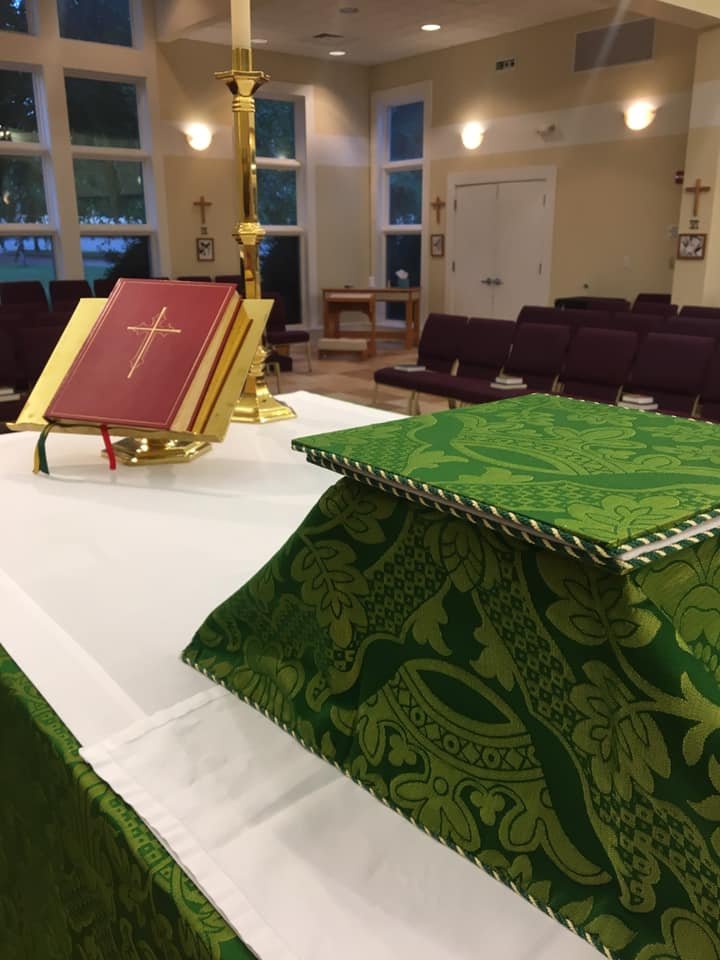
Over three months ago, when we closed our church’s doors because of the Coronavirus pandemic, we had to make some quick, difficult decisions.  We knew we wanted to offer a livestream service, but we also knew we did not feel comfortable consuming the holy meal without the community of faith gathered.  Fortunately, we have a rich traditional of prayers from our Book of Common Prayer, so we switched to Morning Prayer on Sundays.  In seminary, I attended Morning Prayer daily, so in some ways, the last many months has been like visiting an old friend.  As the officiant, I have often worn my seminary cross as a sign of gratitude for the formation I receive at Virginia Theological Seminary to be able to confidently officiate the service.

But as our diocese gave us permission to begin the regathering process, the liturgical team began to realize we had a conundrum.  For the limited number of people who would be able to gather in the space, would we keep offering Morning Prayer, or would we offer communion under the new guidelines?  If we offered communion to some, would those watching online feel left out if the livestream was different from the in-person offering?  So, like we often do at Hickory Neck, we decided to try an experiment.  We still did not want the altar party to consume on screen if no one else could consume with us.  But perhaps we could try an offering of “Spiritual Communion”:  a service identical to the familiar Holy Eucharist we normally celebrate, but with a special shared prayer instead of actual reception of the body and blood of Christ.

This past Sunday, we gave the experiment a go.  Shifting types of services is more complicated than it sounds, especially given the challenges of working with limited technology.  My brain was so jumbled with details that when we hit the livestream button, I had not processed the significance of the morning.  I put on vestments I have not worn in over three months – vestments I used to wear every week.  As the celebrant, I was saying words that I have said countless times in the last ten years.  It was only when I elevated the elements, recognizing the muscle memory of my body, that the power of what we were doing hit me.  Holy Eucharist is just one of the myriad things that have been taken away from us during this time of social distancing – one of the many comforts that I have grieved in these last months.  Despite the fact we were not actually receiving communion, despite the fact the room was still empty minus a camera, despite the fact a hundred little things were different, all of a sudden, I found myself overwhelmed with emotion.

Celebrating Spiritual Communion was not the same as celebrating Holy Eucharist.  But celebrating Spiritual Communion felt like a sip of water in a parched land.  It was not complete refreshment, but it was reassurance, comfort, and care.  It was an unexpected gift from the Holy Spirit in the wilderness of this pandemic.  I do not know what our community will decide to do going forward – whether we will keep Morning Prayer or Spiritual Communion, or some combination of the two.  In fact, I am hoping our parishioners and viewers will let us know their feedback.  This week I am just grateful for a community that is willing to experiment – to try, to fail, to learn, and to grow.  That commitment to playful creativity has always been a joy; during this pandemic it is salve to our open wounds.  Thanks be to God!  And thank you, Hickory Neck!

On Wanting to Go Back…

02 Tuesday Jun 2020

Posted by jandrewsweckerly in Uncategorized

≈ Leave a comment

Tags

ancestors, darkness, Egypt, faith, God, goodness, hard, help, Israelites, journey, lament, longing, pandemic, power, Promised Land, protest, romanticize, trust, wilderness

walkingdesert2_thumb

Photo credit:  http://www.livingintheshadowofhishand.com/2013/06/wandering-in-wilderness.html

The whole congregation of the Israelites complained against Moses and Aaron in the wilderness.    The Israelites said to them, “If only we had died by the hand of the Lord in the land of Egypt, when we sat by the fleshpots and ate our fill of bread; for you have brought us out into this wilderness to kill this whole assembly with hunger.”  (Exodus 16.2-3) 

The rabble among them had a strong craving; and the Israelites also wept again, and said, “If only we had meat to eat!  We remember the fish we used to eat in Egypt for nothing, the cucumbers, the melons, the leeks, the onions, and the garlic; but now our strength is dried up, and there is nothing at all but this manna to look at.”  (Numbers 11.4-6)


One of the cries we are prone to in these days is “I wish we could just go back to the way it was!”  I just did it myself in a sermon a few weeks ago, when I talked about how at the beginning of the pandemic, we were all chipping in and helping each other, but then slowly our demons had taken back over and we are becoming fractured and partisan again.  But we do it all the time.  The most famous may be our President’s campaign slogan, “Make American Great Again.”  I have heard the cry from former Senators and Congressmembers who have talked about the time when people worked “across the aisle” with compromise and collaboration.  As we have mourned social distancing and stay-at-home orders, this has especially become the cry of many of us in the Church.  And as violence rocks our country, many are asking protestors to quieten down and find other ways to make changes.

Of course, we are not alone in our lament and longing.  Our ancestors, the Israelites, were famous complainers in the wilderness, longing to go back to Egypt – the very place of their enslavement – because “at least they had food,” or they remember with longing the savory foods.  The hardness of the wilderness made them romanticize a life marked by brutality, oppression, and death.  Keeping an eye on the Promised Land was not so easy after years in the wilderness.

We are not unlike of ancestors.  In hoping to make America great again, we forget that any era of our history has been marked by darkness – whether the subjugation of the Indigenous peoples of this land, the enslavement, segregation, or oppression of African-Americans, the disenfranchisement and sexual subjugation of women, and on and on go the examples.  When we look at our current inability to work across party lines, we forget the ways in which women and people of color were wildly underrepresented in leadership – if represented at all!  Our current mourning of how Church used to be forgets the incredible ways technology has connected us to our neighbors, our extended community, and even strangers.   And both this pandemic and the protests about the treatment of persons of color are pulling back the curtains on disparities around wealth and opportunity for African-Americans.

What we learn from our biblical ancestors is that the wilderness is hard:  hunger, thirst, discomfort, and disagreements over power are real.  And yet, only in the wilderness did the faithful learn to trust God, to restructure leadership in shared ways, and find ways to govern themselves marked by justice and mercy.  As a person of privilege, I certainly have the option to turn off news coverage, wait this pandemic and the protests out, and stay ensconced in my place of power.  Or I can use this wilderness to learn, to be vulnerable, to use my power for goodness (or even better, cede some of my power), and to pray for God’s help on the journey.  It may be quite some time before we arrive at the Promised Land.  But we do not have to flee back to Egypt.


Sermon – Mark 6.30-34, 53-56, P11, YB, July 22, 2018

25 Wednesday Jul 2018

Posted by jandrewsweckerly in Sermons, Uncategorized

≈ Leave a comment

Tags

church, desert, disciples, Jesus, ministry, rejuvination, renew, rest, self-care, Sermon, soul, summer, wilderness

When I first read this gospel lesson today, I was pretty excited.  This text is the perfect summer gospel lesson.  Summer is that time when we slow down a bit, we play a little more, we relax a bit more.  The rhythms of life change a bit during the summer, whether we are tied to someone on a school calendar or not.  In fact, one of my favorite collects for summer matches this text perfectly.  The collect “For Good Use of Leisure,” goes like this, “O God, in the course of this busy life, give us times of refreshment and peace; and grant that we may so use our leisure to rebuild our bodies and renew our minds, that our spirits may be opened to the goodness of your creation; through Jesus Christ our Lord. Amen.”[i]

So when Jesus says to the disciples, “Come away to a deserted place all by yourselves and rest a while,” I feel a sense of relief and permission – permission to rest from my labors, perhaps even to use summer as a time to rejuvenate, sleep a little more, not work quite so hard on all those committees and deadlines.  When Jesus tells the hard-working disciples to come away and rest, his words become a word of comfort to our weary souls, his words help us envision a Jesus who cares about self-care, and his words even have us dreamily imagining a great desert getaway, perhaps mentally noting to google vacations to Palm Desert after church.

But before we get too excited about the introduction of our story, the rest of the story starts to invade our imaginations.  We are told that on the way to that desert getaway, the people hear about the disciples’ getaway and beat them to the other side of the shore and immediately start asking for more healing.  After more work for weary souls, we are told Jesus and the disciples try to escape again.  But this time, the crowds get even more vigorous – rushing forward to grab their blessings.  So much for a weekend of staying in our PJs and binge watching TV.  And so much for the supportive boss who promotes self-care.  Jesus changes his tune as soon as the crowds show up.  No rest for the weary today!

For those of you who have been following along with my blog posts, you know I have been chronicling my experiences at General Convention.  Day after day, something dramatic happened.  But in the jam-packed nine-day schedule, we were given a sabbath – Sunday morning to go wherever we wanted to church.  Sitting in the pews as a priest on a Sunday is glorious and rare gift, and I was particularly excited because I had an old friend that I was going to get to see in their home parish.  But a few weeks before General Convention started we got word that a priest was going to organize a trip and prayer vigil at a detention center for women seeking asylum in the United States – and would use our free Sunday for the event.  Now since today is Sunday and we are about to confess our sins together, I have to confess something to you that I would not normally tell anyone:  my initial reaction to this invitation was resentment.  Instead of getting to sleep in, visit church leisurely with a friend, and get some much needed sabbath time before going back into legislation, I was going to need to get up early, miss time with my friend, and stand in 100-degree Texas heat and feel passionate about yet another social justice issue.  I knew I should probably be excited for the unique experience, and I should probably be preparing a protest sign, and invite other locals to the event; but all I could think on the inside was, “but you promised we could rest a while!”

What I forgot and what the disciples miss are the details of Jesus’ invitation today.  Jesus does not say, “Come away with me to a resort, and get a spa treatment package with the bonus strawberries and champagne.”  Jesus says “come to a deserted place.”  Palm Desert, with its palm trees, mist sprayers to keep you cool, and sparkling swimming pools, is not what Jesus is talking about here. The desert is where Mark’s gospel starts – with John the Baptist eating locust and wild honey, with hardly any clothing for protection.  The desert is where Jesus goes to be tempted by the devil.  The desert is not where you go to escape and catch up on lost sleep.  The desert is where you go to wrestle your demons and find deeper connection to God.[ii]  The desert is a place of self-care:  not the resting, rejuvenating kind, not the binge-watching, escapism kind, but the hard, deep, soul-examining kind of work that is about taking care of the self – just without all the amenities.

When Jesus invites the disciples into the wilderness, he is inviting them to renew themselves for ministry – to reconnect with the initial passion hidden within them, the joy that came from first volunteering to be fishers of people, the thrill of personal invitation to make a difference in the world and see a new age dawning.  So Jesus says, “Want to get renewed about that Outreach Committee Meeting next week?  Go out and have a conversation with a homeless person or swing a hammer on a Habitat house before you go.  Want to stop crunching numbers for that big project?  Go visit with the family who hasn’t been able to eat a hot meal all summer.  Want to put down the newspaper to relieve your compassion fatigue?  Go to the local jail and start hearing the stories of addiction, poverty, and prejudice that keep people in those cells.”

The good news about my compassion fatigue at General Convention is the same friend with whom I had hoped to go to church wanted to go with me to the Detention Center instead of church.  I was fresh out of excuses to not go.  In the blazing Texas sun, with sunblock and extra water bottles, we schlepped her one-year old to the wilderness of Texas.  As soon as we spotted the cold, harsh, former prison walls that were now being used as a “residential facility,” I suspected Jesus was smirking with his “I told you so,” face.  As songs rose up from the crowd of over 1000 Episcopalians, my heart started aching for the stories I could imagine inside those stone walls.  As my friend’s child cooed and chattered, I imagined the women inside who wanted to be with their own babies.  As we prayed, I realized my selfish desire for rest would not have been sated with a brunch and a long nap.  What my soul needed was right there, in that brown, withered field in the hot summer sun.

I do not know what kind of wilderness place you need today.  I do not know where Jesus needs to guide you to help you find the kind of rest your soul needs.  I do not know what kind of deserted place you might be dreading today.  But I invite you to say yes.  I invite you to risk feeling more tired than rejuvenated.  I invite you to open yourself to the deep transformation that can only happen in a place of vulnerability.  The next time Jesus says to you, “Come away to a deserted place all by yourselves and rest a while,” just go.  I promise you will get the kind of rest your soul needs.  Amen.

[i] BCP, 825.

[ii] Karoline Lewis, “Letting Go,” July 15, 2018, as found at http://www.workingpreacher.org/craft.aspx?post=5198 on July 18, 2018.

Sermon – I Kings 19.1-15a, P7, YC, June 19, 2016

22 Wednesday Jun 2016

Posted by jandrewsweckerly in Sermons, Uncategorized

≈ Leave a comment

Tags

abandoned, body of Christ, comfort food, desensitized, done, Elijah, fight, food, go, God, healing, life, love, Orlando, peace, sacred, Sermon, serve, shooting, strength, tragedy, tree, wilderness

Last Sunday, after the parish picnic, I found out about the tragedy in Orlando.  When the youth and I gathered for Holy Eucharist that night, we lifted up our prayers for the victims and their families.  Being able to name the tragedy in the context of Eucharist was comforting, but by the time I got home and poured over news coverage, I found myself bereft.  I was not in shock, for this kind of tragedy has honestly become commonplace in our country.  I think I wanted to be in shock or at least surprised.  But instead, I felt a sense of familiarity and coldness.  I realized that my psyche has become desensitized to this sort of tragedy.  Instead of feeling sad, I just felt numb.  I felt powerless, with nothing to do but be resigned to the fact that this is the way our life is now.  Nothing can change.  Mass murder is normal – whether by a religious radical, a mentally unstable person, a racist, or a disillusioned teen.  Mass death is normal – whether LGBT brothers and sisters, people going to the movies, African-Americans worshiping, or children attending school.  All I could comprehend in my numbness was the fight, the outrage, and the compassion draining out of me.

The same thing happens to Elijah in our story today.  If you remember, a couple of weeks ago we heard about how Elijah has been putting Ahab’s practices to shame.  You see, in an effort to keep the political peace, King Ahab agreed to take a foreign wife, Jezebel, and worship her god, Baal, in addition to Yahweh.  The God of Israel is none too pleased, and so Elijah dramatically challenges the prophets of Baal to a duel.  Elijah is full of confidence, taunting, and dramatic flair.  And when Yahweh wins, Elijah slays the entire lot of Baal’s prophets.  But today, Jezebel proclaims she will avenge their deaths, and all of the fight leaves Elijah.  He runs into the wilderness until he cannot run any longer.  He crumbles under a tree, and proclaims that he is done.  He feels that he is all alone.  He asks God to take his life.

We all know the feeling that Elijah has.  Maybe we or a loved one has been fighting cancer.  We go for one last evaluation only to find that things have made a turn for the worse.  Or maybe we have been advocating for a particular political issue and the tide seems to be turning.  But a court decision is made or a vote is cast and the decision or vote does not go our way.  Or we think we have finally seen an addicted friend reach the end of his addictive behavior.  We are relieved to see healthy patterns until we get a late night call about how he has gotten into trouble again.  The fight leaves us.  We no longer feel a sense promise, victory, and confidence.  Instead the darkness settles over us like a fog, and we crumble under a tree and say, “Enough.  I am done, Lord.”

But something seemingly small happens to Elijah in his moment of despair.  The story goes, “Then Elijah lay down under the broom tree and fell asleep.  Suddenly an angel touched him and said to him, ‘Get up and eat.’  He looked, and there at his head was a cake baked on hot stones, and a jar of water. He ate and drank, and lay down again.  The angel of the Lord came a second time, touched him, and said, ‘Get up and eat, otherwise the journey will be too much for you.’  He got up, and ate and drank; then he went in the strength of that food forty days and forty nights to Horeb the mount of God.”  God gives Elijah food.  No words of encouragement, no pep talk about how things will get better.  God feeds Elijah in the wilderness, in a moment of despair, in a time of darkness.

There is a reason why we have something called “comfort food,” in our culture.  In fact, every culture has some version of comfort food.  Whether the food is a southern mom’s chicken and dumplings or a Jewish grandmother’s matzah ball soup; whether the food is Burmese mohingar, Vietnamese pho, or a New Mexican posole; or whether the comfort food is North Carolina, Memphis, or Texas barbeque, we all have food that brings us back to ourselves.  Somehow the taste of something familiar and rooted in our identity or a fond experience connects to our entire body in a visceral way.  The smell of the food, the flavors that are just right, the warmth filling our bellies, and the happy memories that flood our consciousness allows our entire body to relax.  Whatever has been ailing us – a sore throat, a homesickness, or a broken heart – can be wiped away by that simple, familiar, healing meal.

But comfort food does not just make you feel good.  Comfort food gives you strength:  mends your heart, heals your soul, and emboldens your spirit.  Elijah does not simply eat the food from God and wallow longer at the tree.  Elijah gets up.  He journeys for forty days on the strength from that bread.  His renewed spirit allows him to have a deep conversation with God, where he eventually finds out that he is in fact not alone.[i]  God has not abandoned him.  God has enabled other prophets to stand with him.  God is not done with Elijah yet.  Though God does not expect Elijah to go at it alone, God does expect Elijah to get back in there.[ii]

I am fully aware that we as a community are a diverse group of people with a wide range of political opinions.  My guess is that the violence of Orlando brought out a wide variety of responses to the event and the politicking that has happened since then.  But no matter how you feel about the shooter, the victims, or the instruments of the victims’ death, a week ago, 49 of our brothers and sisters died.  Life is sacred, and that sanctity was snuffed out last week.  And this is not the first time this has happened.  Though the stories behind the shooters, the motives behind the shootings, and the demographics of the victims are different each time, invariably, more life is desecrated.

We learn from Elijah’s story that God knows we need to mourn.  God knows we need to wallow for a time.  God knows that we may feel alone, or powerless, or just plain tired.  That is why God gives us trees in the wilderness.  But eventually, God will send us some comfort food – to soothe our aching heart certainly, but more importantly to strengthen us to continue the journey.  Because whether we feel like we have the inner strength or not, God is calling us to step out of the shade of the tree, and get back on the journey.[iii]

What that means for each of us here may be entirely different.  Certainly our work is to be grounded in prayer – prayers for the victims and their family members, prayers for the shooter, prayers for our nation as we sort out how we will govern ourselves, and prayers for us as we figure out how to be witnesses for Christ in the midst of the chaos.  But prayers are not all we are called to do.  We could do that under a tree or in a cave.  Instead, God sends us comfort food to heal our broken hearts, soothe our wearied souls, and embolden our spirits.

Today, and every Sunday, our comfort food, like Elijah’s, is also in the form of bread.  We call that bread the body of Christ.  That bread has power.  That bread has power to forgive our sinfulness and complicity with sin.  That bread has power to comfort our aches and sorrow.  That bread has the power to make us Christ’s body in the world, witnesses to the love that Jesus taught us about.  We know that our prayers and our consumption of Christ’s body does that for us because the very last thing we do – the very last thing we say – in our worship service is “Go in peace to love and serve the Lord.”  We do not say, “Have a good week.”  Or “Be at peace.”  We say “Go in peace to love and serve the Lord.”  How God will use us to love and serve the Lord in the world varies widely.  We all have a variety of vocations that take us to varied and sundry places.  But wherever we find ourselves, God has work for us to do.  Our work is to not only say, “Thanks be to God,” but to mean, “Thanks be to God.”  We thank God for our call to love and serve others.  We thank God for food for the journey.  We thank God for the ways that God does not leave us alone.  We thank God the ways that God will empower us and use us to be agents of love in the world.  So take a little more time today to pray and to mourn.  But then get ready to be sent out into the world to love and serve the Lord.  Thanks be to God.  Amen.

[i] Trevor Eppehimer, “Theological Perspective,” Feasting on the Word, Yr. C, Vol. 3 (Louisville: Westminster John Knox Press, 2010), 150.

[ii] Haywood Barringer Spangler, “Homiletical Perspective,” Feasting on the Word, Yr. C, Vol. 3 (Louisville: Westminster John Knox Press, 2010), 151.

[iii] Terrance E. Fretheim, “Commentary on 1 Kings 19:1-4[5-7]8-15a,” June 19, 2016 as found at http://www.workingpreacher.org/preaching.aspx?commentary_id=2876 on June 16, 2016.

Sermon – Luke 4.1-13, L1, YC, February 14, 2016

17 Wednesday Feb 2016

Posted by jandrewsweckerly in Sermons, Uncategorized

≈ 2 Comments

Tags

clergy, death, dependence, faithfulness, formation, God, Holy Spirit, hope, Lent, presence, Satan, Sermon, temptation, transition, wilderness

The irony of this being the first Sunday in Lent after the week we have had is not lost on me.  By now our parish should have received a letter from me explaining how I have accepted a call to a new position in Williamsburg, Virginia.  The letter has been met with a variety of reactions, from surprise to disappointment, from understanding to hurt, from confusion to anger.  But no matter what the initial reactions have been, the primary question from all has been, “What does that mean for St. Margaret’s now?”  That question and the news of coming change alone would have been enough for the week.  But then on Friday we lost one of the patriarchs of St. Margaret’s.  Though any death is hard, as a founding member and a perpetual evangelist, Chet will be deeply missed.  Given the week we have had, I cannot think of a better Sunday to talk about the wilderness.

In Luke’s gospel today, Jesus goes from the high of his baptism, where God proclaims Jesus’ identity as God’s son, out to the wilderness where he will be tempted for forty days by Satan.  The people of God are no strangers to the wilderness.  Before the people of Israel entered the land of promise in our Old Testament reading today, first they wandered for forty years in the wilderness.  Those years typify what a wilderness experience is all about:  confusion, fear, wariness, hunger, dissatisfaction, mourning, regret, anger, jealousy, and impatience.  In the wilderness, the people of Israel wondered why they had ever left Egypt, even though Egypt had been a place of slavery.  At least in Egypt they knew from where their next meal would come.  In the wilderness, the people of Israel whined about everything – a lack of food, a lack of water, a lack of direction.  They lost hope in God to provide for them so, in a moment of weakness, they had their priest construct a golden calf for them to worship.  They behaved so badly that a whole generation did not get the chance to see the promised land.  For Jesus, the wilderness is no different.  The wilderness is marked by scarcity and temptation.  Voices try to sway Jesus away from God.  And when Jesus was at his weakest, Satan himself came to tempt Jesus to take matters into his own hands instead of trusting God to stand with Jesus.

Of course, St. Margaret’s is no stranger to wilderness times.  Before we had parish status we went through several vicars, experiencing one transition after another.  When the twenty-year tenure of our first rector ended, many wondered how we would survive.  Clergy transitions can feel much like those wilderness moments for the Israelites.  On the one hand, transitions are full of promise as we imagine what new life a different clergy person might breathe into our community.  On the other hand, there are days when we glorify Egypt, when although our time in Egypt was not perfect and maybe had even become stale, at least we knew what to expect or had the stability of Father so-and-so.  Likewise, we have been through many parish deaths.  Each one hits us in a unique way, and each one makes us wonder what we will do without the person we have lost.  Who will be our warden, our treasurer, our coordinator of ushers, or our major donor?  How will we sing in the choir, laugh at coffee hour, or balance the budget without them?

That is the scary thing about the wilderness.  The wilderness tempts us into thinking and doing all sorts of things.  Although the three specific temptations of Jesus that Luke describes are certainly challenging, what is more unsettling is the underlying nature of temptation itself.  As one scholar argues, “…temptation is not so often temptation toward something – usually portrayed as doing something you shouldn’t – but rather is usually the temptation away from something – namely, our relationship with God and the identity we receive in and through that relationship.”[i]  What the wilderness has the chance to do is undermine our confidence in ourselves and in the community God made us to be.  That is what Satan is trying to do to Jesus:  erode Jesus’ confidence in his identity, in his security, and in his worthiness before God.  Satan did the same thing to the people of Israel for forty years, and Satan will do the same thing to St. Margaret’s if we let him.  Satan will try to erode our confidence that God is still acting and moving in this place and will continue to make this community a place of sacred encounter and experiences with God and God’s people.

As I was thinking about the wilderness of Lent, transition, and death, I kept coming back to the Holy Spirit.  You see, when Jesus goes into the wilderness, he does not go alone.  The text tells us that the Spirit led Jesus into the wilderness.  The Spirit does not just drop Jesus off to fend for himself.  “…the Spirit continues to abide with him, enabling him to grow stronger through this season.”[ii]  Being filled with and accompanied by the Holy Spirit is the only way one gets through the wilderness.[iii]  The Spirit stays with Jesus in the wilderness because being chosen and anointed for one’s mission is not enough.  Jesus must be tested, being led to places of hunger and despair.  Only then does he learn dependence on God, who graciously provides for all our needs in all of life’s seasons.[iv]  The Holy Spirit enables Jesus to journey through the wilderness so that Jesus can learn that lesson about dependence upon the Lord our God.  The Holy Spirit’s company allows Jesus to see the powerful presence and abundance of God in his deepest need.

Thinking about the Holy Spirit this week has shifted my energy.  Instead of thinking about the wilderness with a sense of dread and familiarity, instead of bracing myself for impact, and instead of erecting soaring walls of protection to keep pain out, I found myself asking a different set of questions.  Where have I experienced God’s faithfulness in the wilderness?  How has my relationship with God been transformed?  How strong are the temptations of returning to old ways – to ways of relying on myself?[v]  Somehow, shifting the questions from where has God been absent in the wilderness to where has God or the Holy Spirit been present in the wilderness gave me a sense of hope.  Instead of looking for the bad – the dreariness of Lent, the burden of transition, the grief of death – I found myself wanting to look for the good – the blessing of time set apart with God, the opportunity for new life and growth, the reminder of resurrection promised for us all.

I will not tell you that the next forty days or even forty weeks will be easy.  In fact, I know that many of those days and weeks will be very hard.  But having been through Lents, transitions, and deaths before, and having watched Jesus held up by the Spirit, I can tell you that we have all experienced God’s faithfulness in the wilderness.  Though none of us likes the wilderness, the wilderness is a necessary part of our formation in Christ – like the necessity of wildfires to restore health and wholeness to ecosystems.  Just like those fires can contribute to overall forest health, the wilderness can contribute to our overall spiritual health.  In these next forty days, I invite you to not turn inward toward fear, protection, and isolation.  I invite you to turn to one another for strength and companionship.  I invite you to come to me as we all process what this change means for St. Margaret’s.  But mostly, I invite you to remember the Holy Spirit who is keeping vigil with each one of us.  The wilderness of Lent this year may be more palpable than in years past.  But I invite you to hold on to the hope of God’s promise to be with you in the midst of the wilderness.  Amen.

[i] David Lose, “Lent 1 C: Identity Theft,” February 9, 2016, as found at http://www.davidlose.net/2016/02/lent-1-c-identity-theft/ on February 11, 2016.

[ii] Jeffery L. Tribble, Sr., “Pastoral Perspective,” Feasting on the Word, Yr. C, vol. 2 (Louisville:  Westminster John Knox Press, 2009), 44.

[iii] Karoline Lewis, “Filled With the Holy Spirit,” February 7, 2016 as found at http://www.workingpreacher.org/craft.aspx?post=4291 on February 11, 2016.

[iv] Tribble, 44.

[v] Kimberly M. Van Driel, “Homiletical Perspective,” Feasting on the Word, Yr. C, vol. 2 (Louisville:  Westminster John Knox Press, 2009), 47.

Sermon – Mark 1.9-15, L1, YB, February 22, 2015

25 Wednesday Feb 2015

Posted by jandrewsweckerly in Uncategorized

≈ 1 Comment

Tags

Ash Wednesday, church, death, honesty, Jesus, journey, Lent, penitence, pilgrimage, pilgrims, Sermon, sobering, wilderness

Lent is a funny season.  Lent gives us all these seemingly horrible things and calls them gifts.  We kick things off with a bang on Ash Wednesday.  We gather in the church and kneel before God while someone tells us that we are dust and to dust we shall return.  In other words, we come to church to be reminded that death is real, death is unavoidable, and death is coming.  With the exception of people facing severe illness or people beyond a certain age, death is not typically a part of our everyday conversations.  Rarely are you drinking a latte with a friend who casually says, “So you know we are going to die, right?  Maybe today, maybe tomorrow, but we will both die.”  That is because death for us is one of those conversations that we do not really like to entertain because death brings down the mood and makes us feel sad.  And yet, that is how we kick off the season of Lent.  “Happy Lent!  We’re all going to die!”

And if that were not sobering enough, the Church takes the next forty days reminding us of our brokenness, of our sinfulness, and of our failures.  We kneel more, confess more intentionally, and pray to reconnect with God.  The season seems to gather us up, place us sackcloth, and then let us wallow in our own sense of unworthiness.  Why in the world would any of us make a commitment to come to Church in Lent with the promise of such guilt and sobriety?

Actually, I think most of us have a love-hate relationship with the wilderness we find in Lent.  We do not want to do the hard work that Lent requires, and yet we also desperately long for a place that acknowledges the reality of all that is hidden behind our perfectly constructed masks, and invites us to just be still and present with our LORD.  In a world that Photoshops, creates whole lines of anti-aging products, and fights death tooth and nail, the church creates a season where we look at ourselves without enhancements and work towards contentment, peace, and even joy.  Lent is a season of honesty, “when the church reminds us of what our culture denies – that our days are limited, and that we’ve made a mess of things.”[i]

Of course, the church did not really invent Lent per se.  The people of God have been experiencing the same concept for years, most frequently in the wilderness.  We know the stories well:  Noah completing his forty days on a ship, floating in his own, albeit probably very loud, watery wilderness; the people of Israel wandering the desert wilderness for forty years; and, as we hear on this first Sunday in Lent, Jesus, led out to the wilderness by the Spirit for forty days immediately after his life-changing baptism.  Each of those experiences are full of Lenten themes:  being taken out of the comforts of life; wondering whether there will be relief from suffering, whether there is dry land, food in the desert, or Satan himself; and glimpses of hope, whether from an olive branch, manna from heaven, or tending angels.  These wilderness experiences, or Lenten-type journeys, pave the way for renewal and reinvention.

This winter, one of our Movies with Margaret features was called The Way.  In the film, a father and his adult son have become somewhat estranged.  The son decided to travel the world to find himself, and the father scoffs.  Months into his son’s travels, the father gets a call.  His son had decided to walk the Camino – the pilgrim’s path in France and Spain that pilgrims have been walking since the ninth century.  Unfortunately the son died while walking the Camino, and the father now needed to pick up the body.  While going through his son’s hiking pack, the father replays their last conversation – about how his Dad is too rigid and never travels anymore since his wife died.  Untrained and unprepared, the father straps on his son’s pack and begins to walk.  He confesses he has no idea why he is walking, but he walks anyway.

The movie goes on to document what might be described as the father’s own wilderness journey.  He deals with getting lost, trying to sleep in noisy hostels, not being able to get rid of talkative fellow pilgrims, losing his bag briefly in a river, getting arrested, and later having his bag stolen by a gypsy.  When he gets to the end of the journey, he takes his documents to the pilgrimage office to have the paperwork authorized and get a certificate of completion.  Before the official will sign his paperwork, he asks a question that stumps the father.  “What is your reason for walking the Way?”  The father stammers.  He cannot put into words why he grabbed his son’s bag and started walking.  Recalling the last fight he had with his son, the best he can come up with is, “I thought I needed to travel more.”

Mark does not give us many details about Jesus’ journey in the wilderness.  Unlike the other gospels, we do not hear the details of his encounter with Satan.  We do not really understand what happens with those wild beasts – whether they were friends of foes.  We hear about some angels at the end, but we do not know how much they are present.  All we really know is that Jesus is in a wilderness for forty days and that those days happen after he is baptized and proclaimed the beloved and before he can begin his earthly ministry.

We too start a wilderness experience today.  At the beginning of our liturgy we confessed many things.  We confessed blindness of heart, pride, vainglory, hypocrisy, envy, hatred, and malice.  We confessed our inordinate and sinful affections and our fear of dying suddenly and unprepared.  We confessed our loneliness, our suffering, and our ignorance.  And we prayed for our enemies.  The ashes from Ash Wednesday and their message of the inevitability of death still linger in our subconscious.  Like the father in The Way, we put all of those confessions and acknowledgments in a pack, put the pack on our back, and we begin to walk.  None of us knows what will happen on this forty-day journey.  We do not know how our Lenten disciplines will shape us, or what external factors will impact our lives.  But we begin the Lenten journey anyway.

The promise for us is refreshment at the end of the journey.  For me, that refreshment is the Easter Vigil.  At Easter Vigil, I put down my pack full of my forty days’ worth of experiences.  I hear the piercing words of the Exultet and the old stories of our salvation told in the darkness.  I watch candles flicker as we sing hymns.  And then I watch the church explode with light and the sound of bells.  We say the forbidden “A-word” after a forty-day hiatus.  We feast on the Eucharistic meal after fasting from that meal since Maundy Thursday.  And we rejoice in our risen Lord.

In the movie, The Way, the father reaches the end of the pilgrimage and has a sacred moment in the church at the Pilgrim’s mass.  He decides to keep journeying further to spread his son’s ashes into the sea.  And at the end of the film, we see him traveling to other places – finally taking up his son’s challenge to see more of the world.  That’s the funny thing about journeys.  They are not the end of the story.  Our Lenten journey will be a true pilgrim’s journey.  But our journey will not end at the Vigil.  Just like Jesus’ journey did not end with angels tending to him.  As Barbara Brown Taylor says, “Even after he left the wilderness, [Jesus] carried [the wilderness] inside him, and far from fleeing [the wilderness] later in his life he sought [the wilderness] out.  Without the wilderness he might not have been the same person.  Because of the wilderness he was not afraid of anything.”[ii]  We all need the wilderness to shape us and mold us.  Our Lenten pilgrimage will change us, both as individuals and as a community, because in the church, we do not journey alone.  Your fellow pilgrims are here in the pews beside you – perhaps to annoy you, or send you on a detour – but maybe also to bail you out of jail from time to time.  Together we are pilgrims on the way, being transformed for new life beyond Lent.  Amen.

[i] Dan Clendenin, “To See Death Daily,” posted February 16, 2015 at http://www.journeywithjesus.net/Essays/20150216JJ.shtml.

[ii] Barbara Brown Taylor, “Four Stops in the Wilderness,” Journal for Preachers, vol. 24, no. 2, Lent 2001, 4.

Sermon – Genesis 21.8-21, P7, YA, June 22, 2014

25 Wednesday Jun 2014

Posted by jandrewsweckerly in Uncategorized

≈ Leave a comment

Tags

blessing, God, Hagar, hear, Ishmael, promise, relationship, see, Sermon, suffering, understand, wilderness

Alice sat on her bathroom floor crying.  The bathroom was the only place she felt like she could get a moment of privacy.  Her tears were the release she found for what felt like an impossible juncture.  Last summer things had been okay for Alice.  She was coping with her divorce, and managing to feed and care for her son on her own, despite the fact that her income from cleaning houses was so small.  She had managed to work out some government assistance that gave her enough cushion to keep food on the table and a roof over their heads.  Life was not easy, but life could be a lot worse.

But during the last year, her world began to fall apart.  After a work injury, Alice could not clean houses for months.  Being self-employed meant she had no one to fill in at her houses.  After several months, her customers all got new help.  Because she was not working, her government assistance began to lower.  The assistance programs required that clients work to receive assistance.  Alice could not clean houses because of her injury, and she did not have enough education to qualify for any other type of work.  As the money became more and more scarce, Alice began to fear for her son.  Her son was looking thinner and more sickly each day.  He did not understand what was happening, and his deserved frustration and led her to the bathroom to cry.  Things had gone from bad to worse as Alice feared they would have no food, no home, or that she could lose her son.  All that was left to do was to cry:  to cry tears of sorrow, to cry out to God for mercy.

Hagar knows Alice’s tears.  We remember that Hagar is the handmaid for Sarah, Abraham’s wife, whom Sarah had given to Abraham to take as a wife because Sarah was infertile.  Hagar resented this action, and has already suffered a great deal, grappling with her powerlessness and lack over control over her most private, personal space.  Today the text brings us forward a few years in Hagar’s family.  Hagar’s son Ishmael is growing into a young boy, and Sarah has finally conceived her own son.  The birth of Isaac is a joyous occasion that all of the family celebrates.  But just as Hagar has begun to reclaim her personhood, Hagar suffers again.  Sarah sees Ishmael – the son that reminds her of her infertility, who will not represent the blessed line of Abraham – playing with Isaac – her own son, whom she proudly bore and who will mark the blessedness of Abraham’s line.  Sarah turns to Abraham and tells him to send Hagar and Ishmael away.  Although Abraham is crushed by the idea, God supports Sarah’s decision.  For Hagar, the world is against her.  We hear no words from Hagar as Abraham loads water and bread on her shoulders, gives her Ishmael, and sends her out into the wilderness.

Hagar wanders in the desolate wilderness until she runs out of water.  Looking at her son, whose death she imagines is immanent, Hagar puts him under the shade of a bush and walks away.  She walks away and cries out to God.  She cannot watch the death of her son.  Not after all she has been through.  She cries out to God as her last resort.

The tough part of this story is figuring out why this is happening.  Why would Sarah condemn Hagar and Ishmael to death by having them driven out into the wilderness?  Why would God agree with Sarah, especially when Ishmael’s birth was Abraham and Sarah’s choice in the first place?  Why does Abraham give up his first son so easily, without a word to Hagar?  The grief in this passage feels overwhelming, and we are left pointing angry fingers in multiple directions.

Hagar’s wilderness moment is familiar to us today.  We have those times when we feel like everyone is against us, including God.  The wildernesses of our lives are those desolate, lonely, dark places of wandering.  The wilderness is a scary, stark place of solitude that takes us to the depths of our finitude and forces us into encounters with God.  In the wilderness, we experience God in a way that we cannot not experience God elsewhere.  In the dry desert of suffering, which is scorching by day and frigid by night, with little water, we experience a sense of nakedness and vulnerability that we try to mask in our everyday lives.

Despite the darkness in the Genesis text today, there is also incredible hope for the suffering.  The last third of the text we hear today is filled with God’s action for the afflicted.  First, God hears Ishmael.  The text says “And God heard the voice of the boy.”  This word “to hear” is important on many levels.  In the original Hebrew, Ishmael’s name means “God will hear.”[i]  Already, Ishmael’s name – God will hear – comes to fruition.  God hears Ishmael.  Further, the word “to hear” in Hebrew, shamah, connotes more than physical hearing.  As we have talked about before, “to hear” in Hebrew also means “to understand.”  God understands how Ishmael and Hagar cry out.  God hears and understands their pain.

The second action we encounter at the end of this passage is God making a promise.  The angel of God speaks to Hagar about Ishmael saying, “I will make a great nation of him.”  We know from scripture that God does not make promises lightly with God’s people.  God fulfills God’s promises.  If God says that God will make a great nation of Ishmael, Hagar knows to believe God.  No matter how dire things seem, God makes a promise, and God does not disappoint.

The third action we encounter is that God opens Hagar’s eyes.  The text says that “God opened her eyes and she saw a well of water.”  In the opening of Hagar’s eyes, God allows Hagar to perceive God’s presence and action in her suffering.  God lifts the blindness that suffering and desperation create.  God shows Hagar the gift of life that God provides in the well of water.  God’s gift is abundant, and God reveals the gift when Hagar cannot see.

The fourth and final action is that God is with Ishmael.  The text says, “God was with the boy.”  The verb “to be” is one of the most simple and basic of words.  When applied to God, “to be with” has great meaning.  The text says that in all Ishmael does, in all the experiences Ishmael has, in all that Ishmael’s journey entails, God is with him.  God does not abandon Ishmael.  God does not forget.  God is with him.

I am reminded of one of my favorite Gospel hymns.  The hymn is called “He’s an On Time God.”  The song talks about the ways that God always comes to our need just when we need God.  The refrain goes, “He may not come when you want Him, but He’ll be there right on time.  He’s an on-time God, oh yes He is.”  The song describes the Israelites who crossed the Red Sea just before the Sea collapsed on the Egyptians, the relief of Job’s suffering, and the feeding of the 5,000 by Jesus.  What I love about the song is the booming chorus of singers and the repeated affirmation that God is on time.  Of course, the theology of the song is a little trickier.  I think the song misses something by suggesting that God is not always with us.  But the song is on to something.  I might rephrase the refrain to be something like – suffering may not end when you want it, but you will realize God is with you in the suffering right on time.  In this way, God is an on-time God.

We may not understand God’s actions, or why we suffer, but God is with us.  Hagar is a great gift this week for reminding us about what our relationship with God is like.  Hagar reminds us that we have an active relationship with God.  Hagar shows us that we can cry out to God in our suffering.  Hagar demonstrates to us that God is not a far away god who is removed from our daily lives.  By crying out to God, we reveal our earthy, dynamic relationship with God.

Meanwhile, God’s actions toward Hagar show us that God has a reciprocal relationship with us.  God is active in our lives.  God hears us, understands us, and will act in our lives.  God is with us, all of the time, especially in our suffering.  When we enter into that relationship with God, crying out to God, we let go of notions of distance from God or personal control of our lives.  We allow God to open our eyes so that we can see God’s action in our lives.  By opening our eyes, God shows us the blessings God has for us.  God did not tell Hagar and does not tell us what our blessings will look like.  But there will be blessings.  God will open our eyes to reveal the bounty of blessing for us.  As we enter into that holy, vulnerable relationship with God, allowing our eyes to be opened, we see God’s blessings – right on time.  Amen.

[i] Gordon J. Wenham, Word Biblical Commentary, vol. 2 (Dallas: Word Books, 1994), 88.

Sermon – Luke 3.1-6, A2, YC, December 9, 2012

12 Wednesday Dec 2012

Posted by jandrewsweckerly in Uncategorized

≈ Leave a comment

Tags

Advent, Annual Meeting, blessing, God, John the Baptist, spiritual journey, wilderness

I have been thinking about this sermon for weeks – the sermon to lead us into our Annual Meeting – the sermon to lead us into a time of celebration and inspiration.  But then I remembered that we are in Advent, stuck once again with John’s crazy witness of repentance.  Repentance is not quite the sexy message I was looking for to promote what has been a great year.  Who wants to tarry in the wilderness when we have good news to celebrate?

But the more I have thought about the wilderness this week, the more the wilderness seems to be the perfect place for us today.  The wilderness is a holy place in our scriptures.  The wilderness is the sacred place where our ancestors journeyed toward the Promised Land.  Many a scriptural figure has ended up in the wilderness with only God for company.  For the gospel of Luke, the wilderness is a key place of activity – where testing, prayer, withdrawal, and miracles happen.[i]  Many a spiritual Christian has fled to the wilderness over the centuries – a place where the quiet is deafening, and where one goes to strip away the distractions of life.

The wilderness is where we find John the Baptist today.  There is a stark contrast in where we find John and where the powerful men of the time are.  Luke details the leaders of the day:  Emperor Tiberius, Pontius Pilate in Judea, Herod in Galilee, Philip in Ituraea and Trachonitis, and Lysanias in Abilene.  These names are not just in the text to trip up the priest on Sunday.  Luke mentions these rulers and the towns that they rule so that we can understand the significance of where John the Baptist is.  The towns of the rulers are places of wealth and comfort.  Each of those leaders is treated with dignity and respect, lives in lavish homes, and is worshiped like a god.  But the word of God does not come from these posh places.  The word is spoken in the wilderness.  In the Greek, “wilderness” is translated as “solitary, lonely, desolate, and uninhabited.”  Here in the middle of nowhere – a place where people feel utterly alone and desolate is where the word of God is proclaimed.

So how could I possibly be excited about a journey into a stark, barren place on such a celebratory day as this?  Because St. Margaret’s went through its own wilderness journey not so long ago.  As a relationship with a priest was dissolved, tensions rose among parishioners, and many left our family, St. Margaret’s journeyed through what felt like a time of desolate wilderness.  Although I was not part of the St. Margaret’s family at that time, working through the healing process with you this past year has taught me a lot about what that wilderness time was like.  Many of you wondered if we would survive.  Some of you sat in the parking lot before Church, not sure if you could walk through those beautiful red doors one more time.  For many of you, the wounds from that desolate wilderness are tucked away in a box on the back shelf of your hearts, but the box seems to keep slipping off the shelf when you least expect.

The truth is, I am not sure if we are out of the wilderness time.  We still have some work to do here at St. Margaret’s and there are going to be times when we are not happy with each other (I know, that is hard to believe!).  But just because the wilderness is a place of solitude and desolation does not necessarily make the wilderness all bad.  The wilderness is where the people of God encounter God.  Abraham’s journey into the wilderness brought about a blessed covenantal relationship with God – with the gift of descendants as numerous as the stars.  The people of Israel’s journey through the wilderness brought them to the Promised Land.  And even when they were in the wilderness, they felt God with them – helping them find water from rocks, food in the form of manna and birds, and leadership to comfort and guide them.  Even John the Baptist, preaching repentance today from the wilderness, finds that his message in the wilderness is the herald of the Messiah, the one who finally brings about redemption.  The wilderness is not necessarily a bad place.  The wilderness is an intense place – an intense place of encounter with God, but not a bad place.

That is the tricky part about wildernesses.  When we are in the wilderness, we can feel lonely and despondent.  Jesus himself is thrown into the darkness of temptation when he goes into the wilderness for forty days.  But being in the wilderness does not cut us off from God.  Being in the wilderness cuts us off from the padding we use to cushion ourselves from pain; that same padding that can be a barrier between us and God.  When we are in the wilderness, there is no avoiding God.  The wilderness is like an empty locked room with only you and God.  In some ways, I think this is why we are encouraged to go on silent retreats at monasteries.  The few times I have been, the first day is always awkward.  I am such an extrovert, that the first day of silence kills me.  I want to talk, I want to engage others, and I want to keep my busy, active pace.  But when all you have is a cell, the worship space, and perhaps somewhere to walk quietly with your thoughts and prayers, things get clear much more quickly.  That padding is gone immediately and you are left with God to reconnect.

So unfortunately, John the Baptist is going to leave us in the wilderness for just a couple of more weeks of Advent.  But that is good news for us.  We have been through a time of experiencing the desolation of the wilderness.  That time was dark and painful for many of us and will never fully leave our consciousness.  But having come through that dark time, we can stay in the wilderness by choice.  Like Abraham who chose to take his small family into the wilderness for the promise of good things, we too choose to tarry in the wilderness this Advent.  We tarry here because we want to be closer to God.  We choose to journey through the wilderness because we need the guidance from the intimacy that only the wilderness can provide.  We claim the wilderness this Advent, and especially this day of our Annual Meeting because we want to be in a place where we can clearly hear God’s guidance for our future.

This year has already given us a taste of how wonderful the journey with God can be.  Although we have had some adjustments, joy has been the overwhelming experience of this past year.  From joyful liturgies, to the joy of new ministries, to the joy that each new parishioner has brought to our lives, we have much to celebrate.  If we have already seen this much joy this year, imagine what a little more intensive time with God can do for our spiritual journey in the year to come.  The promise is clear from John about what the time in the wilderness will bring:  Every valley shall be filled, and every mountain and hill shall be made low, and the crooked shall be made straight and the rough ways made smooth; and all flesh shall see the salvation of God.  So stay with me in the wilderness for a couple more weeks.  We may find that our time here leads to even more blessing and joy in the year to come.  Amen.


[i] Miriam J. Kamell, “Exegetical Perspective,” Feasting on the Word, Yr. C, Vol. 1 (Louisville: Westminster John Knox Press, 2009),47.

Recent Posts

  • On Sharing the Love…
  • Sermon – Micah 6.1-8, Matthew 5.1-12, EP4, YA, January 30, 2026
  • On Justice, Kindness, Humility, and the Messy Middle…
  • Feast of the Rev. Dr. Martin Luther King, Jr., January 18, 2026
  • On Peace, Love, and Conduits…

Archives

  • February 2026
  • January 2026
  • December 2025
  • November 2025
  • October 2025
  • September 2025
  • August 2025
  • July 2025
  • June 2025
  • March 2025
  • February 2025
  • December 2024
  • November 2024
  • October 2024
  • September 2024
  • August 2024
  • July 2024
  • June 2024
  • May 2024
  • March 2024
  • February 2024
  • January 2024
  • December 2023
  • November 2023
  • October 2023
  • September 2023
  • August 2023
  • July 2023
  • June 2023
  • May 2023
  • March 2023
  • February 2023
  • January 2023
  • December 2022
  • November 2022
  • October 2022
  • June 2022
  • May 2022
  • January 2022
  • December 2021
  • November 2021
  • October 2021
  • September 2021
  • August 2021
  • June 2021
  • May 2021
  • April 2021
  • March 2021
  • February 2021
  • January 2021
  • December 2020
  • November 2020
  • October 2020
  • September 2020
  • August 2020
  • July 2020
  • June 2020
  • May 2020
  • April 2020
  • March 2020
  • February 2020
  • January 2020
  • December 2019
  • November 2019
  • October 2019
  • September 2019
  • August 2019
  • July 2019
  • June 2019
  • May 2019
  • April 2019
  • March 2019
  • February 2019
  • January 2019
  • December 2018
  • November 2018
  • October 2018
  • September 2018
  • August 2018
  • July 2018
  • June 2018
  • May 2018
  • April 2018
  • March 2018
  • February 2018
  • January 2018
  • December 2017
  • November 2017
  • October 2017
  • September 2017
  • August 2017
  • July 2017
  • June 2017
  • May 2017
  • April 2017
  • March 2017
  • February 2017
  • January 2017
  • December 2016
  • November 2016
  • October 2016
  • September 2016
  • August 2016
  • July 2016
  • June 2016
  • May 2016
  • April 2016
  • March 2016
  • February 2016
  • January 2016
  • December 2015
  • November 2015
  • October 2015
  • September 2015
  • August 2015
  • July 2015
  • June 2015
  • May 2015
  • April 2015
  • March 2015
  • February 2015
  • January 2015
  • December 2014
  • November 2014
  • October 2014
  • September 2014
  • August 2014
  • July 2014
  • June 2014
  • April 2014
  • March 2014
  • February 2014
  • January 2014
  • December 2013
  • November 2013
  • October 2013
  • September 2013
  • August 2013
  • July 2013
  • June 2013
  • May 2013
  • April 2013
  • March 2013
  • February 2013
  • January 2013
  • December 2012
  • November 2012
  • October 2012
  • September 2012

Categories

  • reflection
  • Sermons
  • Uncategorized

Meta

  • Create account
  • Log in
  • Entries feed
  • Comments feed
  • WordPress.com

Blog at WordPress.com.

  • Subscribe Subscribed
    • Seeking and Serving
    • Join 395 other subscribers
    • Already have a WordPress.com account? Log in now.
    • Seeking and Serving
    • Subscribe Subscribed
    • Sign up
    • Log in
    • Report this content
    • View site in Reader
    • Manage subscriptions
    • Collapse this bar
 

Loading Comments...