• About

Seeking and Serving

~ seek and serve Christ in all persons

Seeking and Serving

Author Archives: jandrewsweckerly

On Grieving Together…

22 Wednesday Aug 2018

Posted by jandrewsweckerly in Uncategorized

≈ Leave a comment

Tags

community, companion, death, eternal life, God, grief, Jesus Christ, life, mortality, pastor, strength

elderly-woman-and-child-holding-hands-750

Photo credit:  https://www.everplans.com/articles/how-to-make-sure-your-legacy-lives-on-after-youre-gone

Grief is a funny thing.  We all experience it differently, respond to it differently, and let it impact us differently.  Sometimes we let grief do its work and then we are done; sometimes the grief sneaks up on us; and sometimes the grief never fades, a constant companion.  This week my grandmother passed away.  We knew this call would come soon.  I had taken my girls to see her months ago for a goodbye.  She had been in Hospice and had stopped eating.  But in the flurry of living – of clothes strewn about, water sloshing around, story-telling, cleaning, and brushing, the news of death was jarring.  For a moment I thought I would wait – share the news with the girls at a more appropriate time.  But then I remembered there is no appropriate time.  Death happens when it happens, and its companion, grief, comes as it will.

My initial work was helping my girls navigate their grief.  Upon receiving the news, my younger’s eyes got wide, and she was quick to assert that we needed to leave so that we could “take ‘Mee-maw’ to the hospital and take care of her.”  I tried to explain that it was too late, but she insisted that if we rushed, we could help her.  Once her disappointed face registered reality, she proclaimed, “Well, I’m not going to die!”  Then began a conversation about mortality and eternal life.  And a new level of grief began.

Meanwhile, the older child seemed to hold her thoughts and emotions at bay, being equally distracted by her sister’s reactions.  We talked about it briefly as I tucked her in, and she seemed okay.  The next morning, after I had dropped her off at camp and was heading back to my car, she ran back up to me and gave me a big hug and started crying.  “I’m sad about what happened yesterday.”  I honestly wasn’t sure what she was talking about until she explained her delayed reaction to Mee-maw’s death.  Time stood still as we grieved together.  A minute later, she was drying her face with the back of her hand and running to catch up with friends.

My own grief finally caught up with me as I watched an emotional movie later that night.  The truth is, my grandmother was a complicated woman.  She was the matriarch of the family who sometimes ruled with an iron first – even if you were only aware of her power subconsciously.  She was intimidatingly smart, held a wealth of knowledge in her mind, and could talk to any stranger.  I loved and respected her, and also saw her many flaws and the ways she hurt people.  She was not really a loving, doting grandmother, but a woman who held everyone to high standards and pushed us to be our best.  I was often afraid of the woman who insisted on the title “Grandmother Andrews.”  But in these last years, I loved seeing her humanity as a new generation of greatgrandchildren called her “Mee-maw.”

As I wade through grief this week, I welcome your prayers.  Even pastors need pastoring sometimes.  But also know that I am praying for you and the ways in which grief continues to be your companion:  for the grandparents, parents, spouses, and friends lost; for the marriages, jobs, and pregnancies lost; for the possibilities, dreams, and loves lost.  You especially have my prayers as grief reminds us all of our own mortality.  As you hold me, I also hold you in the promise of eternal life, a new reality in Christ Jesus.  May that grounding strengthen each of us as we stand together in the already and the not yet.

Almighty God, look with pity upon the sorrows of your servants.  Remember us, Lord, in mercy; nourish us with patience; comfort us with a sense of your goodness; lift up your countenance up us; and give us peace; through Jesus Christ our Lord.  Amen.  (BCP 467, amended)

Sermon – Ephesians 4.25-5.2, P14, YB, August 12, 2018

22 Wednesday Aug 2018

Posted by jandrewsweckerly in Sermons, Uncategorized

≈ Leave a comment

Tags

baptism, children, Christ, Christian, Ephesians, faith, formation, God, identity, imitators, improve, love, offering, Paul, Sermon, systems, vacation bible school

I used to LOVE Vacation Bible School when I was growing up.  As a preacher’s kid, of course that meant I went to VBS at my dad’s church.  But I loved Vacation Bible School more than that.  I would sign up for VBS at the Baptist Church, the Presbyterian Church, and the Lutheran Church, and would beg, “Can I go? Can I go?”  I have always joked that what I really like about VBS was the crafts.  But as I watched our own children in Vacation Bible School this week at Hickory Neck, I began to wonder if my crafts assessment was entirely true.  I liked the songs too.  And the snacks.  And the storytelling.  I liked the instant comradery and the games and laughter.  I liked the feeling of being loved by people who did not even know me.  VBS was the first – and probably only since I did not go to church with many Baptists – place where I was asked if I had accepted Jesus as my Lord and Savior; and if I had not, I could ask Jesus to come to me in that moment.  My eight-year-old self was not sure what the pastor meant, but I did know a strange warming of my heart that night.

On those hot, humid summer nights, with the cicadas chirping and the lightning bugs flashing, VBS accomplished for me what I talked about with the Baptismal family last weekend.  When we prepare a child and their family for baptism, we talk about how their primary role is to raise the child up in the faith – get them to church, talk about Jesus at home, pray together, and read the Bible stories.  The parents and godparents are not flying solo with the task of raising the child in the faith – we as a community pledged just last week that we would be active in raising Dallas up in the faith.

As I watched our children at Vacation Bible School this past week, I slowly began to realize that we were doing just that – raising children up in the faith.  We were teaching them to pray, to sing, to learn, to tactilely use their bodies to engage Jesus.  And sure, there were games and snacks and laughter and silliness.  But there were also children who walked over to their neighbor’s houses and delivered VBS registration forms, inviting them into Jesus’ love too.  There were children who remembered their neighbors with pets and tentatively rang doorbells to deliver pet treats they had made with their own hands.  There were children whose joyous songs in the Public Library later that day brought hope to a man who had lost hope.  When I was a child, I was lured by crafts and snacks and potato sack races; but I left with love, and hope, and mercy.  I left knowing deep in my soul who Jesus was and what being a Christian meant.

This week I have begun to wonder if we might need an adult version of VBS; if we might need a week of evenings where we just spend some time with Jesus among the community of the faithful.  Bishop Curry would call that a revival, and Episcopal Churches are doing revivals all around the country.  I am not sure what we call that week matters, but I am beginning to wonder if we need those summer nights because we have fallen away from the practices Paul articulates today in his epistle to the Ephesians.  Paul is quite clear.  If we are going to claim the moniker of Christian, then our lives need to be signposts.  We need to speak truth to one another.  We need to not let anger rule our lives.  We need to make new ways for thieves and sinners to not only repent, but be fully restored into the world as those who not only contribute their labor, but who are freed to give their money to the poor.  We need to take on kindness, tenderness, forgiveness.  We need to be imitators of God, beloved children of God, living in love.

We hear Paul’s words today and say to ourselves, “Yes, yes, the world needs more of that.”  But what we really mean is, “Yes, that lady two rows over needs to start doing that,” or “Yes, that guy on my committee needs to be that.”  But Paul is not talking to our neighbor.  He is talking to us.  He is talking each person in this room saying, “You…I need you to live in the life of love, to be an imitator of God, to be…to be a Christian.”  And that is where the squirming begins.  I hear Paul’s words about not letting the sun go down on your anger and I can tell you there have been many a night when I was just not done with my anger – I needed to let my anger burn off before I could speak a word of forgiveness or, more importantly, a word or apology.  I hear Paul’s words about thieves and I am not worried about thieves being gainfully employed so they can make charitable contributions – I need them to punished for what they took from me.  I hear Paul’s words telling me to imitate God and I am incredulous that I could ever achieve such holiness – I need to worry about all those other people who are not imitating God towards me!

This week, I attended a conference called the Global Leadership Summit.  Founded over 25 years ago, the conference is for all people, regardless of industry or position at work or home, looking to hone their leadership skills, to learn new techniques, and to refresh old learnings.  The Conference is held in Chicago, but through technology is live broadcasted all over the world, even to Williamsburg.  One of the things I took from the Summit was that my leadership improvement work was primarily about improving myself.  Craig Groeschel reminded us, “When the leader gets better, everyone gets better.”  His message is the same message we teach congregations and families through family systems work.  The only person you can improve in a system is yourself – even though you know for certain your brother Bob is the real problem.  System experts live by this understanding though because they have witnessed time and again when one person in the system gets better, he or she creates a ripple in the system – and almost magically, everyone else starts getting better.

The reason why we send our children to VBS or Sunday School or Children’s Chapel is because we want them to know, and love, and embody Christ.  We want them to be imitators of God, beloved children, who live in love, as Christ loved us.  But what we sometimes forget in helping our children grow in Christ is that we adults need to grow in Christ too – to become those imitators of God, beloved children, who live in love, as Christ loved us.  We like to bemoan the state of the world today – to look at how we are so divided and cannot seem to come together and we want to just give up on the world, or worse yet, we want to bury our heads in the sand and not come back up until things magically get better.  But what Paul says to us today is not to worry about everyone else.  Start working on yourself.  Now whether that means you need to go to a Leadership Summit, or join a Bible Study, or commit to coming to Church regularly, or maybe agree to help with VBS so you can absorb some of that joyful goodness – do something for your faith formation today.  Systems work teaches us that the only person we can change in a dysfunctional system is ourselves.  Paul looking at Ephesians or the United States in 2018 would same the same – work on yourself, imitate God, live in love, make your life like Christ’s – or as Paul says, “a fragrant offering and sacrifice to God.”

I know that Episcopalians are pretty divided about the use of incense.  I have always loved incense.  The parish I served in Alexandria used incense every Sunday.  I loved how the scent lingered in my hair and on my clothes after church.  Sometimes, I would bring my alb home, and when I opened the bag, the fragrance of incense wafted into the room.  Years later, on the occasions my other parishes used incense, I found the scent had a calming effect on my body.  That fragrance was my physical, tangible way of remembering that I was in the presence of God.

When Paul invites us to be a fragrant offering, he is inviting us to be that tangible reminder of God that lingers behind.  When we respect the dignity of every human being, our Christian fragrant offering lingers behind.  When we are kind, tenderhearted, and forgiving, our fragrant offering lingers behind.  When we seek to imitate God in our lives, even as others see us fail and try again and again, our fragrant offering lingers behind.  I am not saying our work on ourselves will be perfect right away – or even ever help us achieve that true fragrant offering.  But what Paul encourages us to do is try.  To put ourselves in places where we can grow in faith and love and mercy so that we can become those fragrant offerings that linger with others.  And Paul knows we can do that work because God is with us to enable us.  Our invitation today is to accept the challenge:  to not leave behind the foul odors of anger, judgment, and malice, but through our baptismal-life striving through our faithful work on ourselves, to leave behind the fragrant scent of God.  What happens after that is God’s work.  Amen.

On Seeing God in the Body…

08 Wednesday Aug 2018

Posted by jandrewsweckerly in Uncategorized

≈ Leave a comment

Tags

body, body of Christ, Christ, church, gift, God, ministry, play, vacation bible school, vocation, witness, work

IMG_2385

Photo credit:  Jennifer Andrews-Weckerly; reuse with permission only

One of the things I learned very early on in my priesthood is I cannot do all the work of the church.  The priest cannot be everywhere, at every event, leading every ministry.  And I have wholeheartedly come to believe that she should not try.  In doing so, the priest disables the ministry of the laity, and to be frank, never gets close to the glory of what can happen when everyone contributes their gifts in ministry to the work of the church.  When Paul talks about the Body of Christ being like parts of the body – where every hand, foot, elbow, and nose are needed to make the Body complete – Paul was talking about the leaders too.  The Body of Christ does not function without all the members.

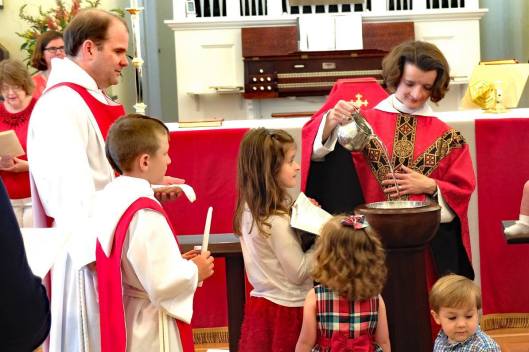
I have been reminded of this truth this week as I have watched our Vacation Bible School program in action.  Months of planning, organizing, imagining, and executing have come to fruition.  I was given 10 minutes this week for teaching and prayer.  The rest of the time – five days, 15 hours, 900 minutes – has been filled with adults, youth, and even children leading a wonderful week of reflection about where we see God, how we can be helpers in God’s mission, and how we can be God’s hands, changing the world.  It has been a glorious experience to watch fingers strumming guitars, adults comforting children, teens running little ones’ energy out, children holding hands, priests from neighboring churches teaching and praying, and, as I like to imagine, God smiling broadly as God hears us asking God to “kumbaya.”

Part of what is nice about this week is I get to see the work of the Body up close.  I get to see church members flexing their vocational gifts, teaching and showing our kids how much God loves them and how they are now empowered to love others.  But much like my contribution this week is just a small part of the whole, I realize Vacation Bible School week is just a small part of the larger whole.  Every week our parishioners – children, youth, and adults – are living out their vocations every day.  They are teaching children, building homes, healing bodies, fighting fires, studying for tests, and holding each other’s hands as faithful children of God.  There are holy moments every week, every day, every hour, every minute, where we live into the gifts God has given us, and show God’s love to others.  Our witness to Christ does not happen unless we are all doing are part as the Body of Christ.

I wonder where you are seeing God and the work of the Body of Christ today.  At home, at work, at play, we can all see God working through each other.  Our invitation this week is to look for that work, to be a part of that work in our own lives, and to witness where we see that work in others.  My suspicion is once we start doing that work, we will be smiling as God has been smiling this week!

On Raising Kids in the Faith…

01 Wednesday Aug 2018

Posted by jandrewsweckerly in Uncategorized

≈ Leave a comment

Tags

baptism, children, church, faith, formation, God, kids, questions, scripture, teach, teaching, vacation bible school

kids_SS

Photo credit:  http://livingwaterlutheran.us/

Last week, as we were driving to summer day-camp, my eight-year old was mid-stream with a story from the backseat when she abruptly jumped to another story she remembered.  Used to the constant chatter from my little ones, I barely noticed, but she exclaimed, “Oh my goodness!  I’m just like Mark!”  “What?” I asked, having no idea who this Mark was and what he had to do with either of her stories.  “You know, like Mark from the Bible, when he interrupts one story with another one.  Ha!”

As I struggled to stay focused on driving, my mouth fell open.  I was stunned.  You see, several weeks ago, I preached a sermon about Mark, explaining his “sandwiching technique,” – basically interrupting the telling of a story with another story, only to return to the original story.  You can read here about why he utilizes this literary technique.  I was shocked to know that my daughter actually remembered that detail from a sermon; honestly, I was a little surprised that she was listening at all, let alone remembering anything I said.  In my shock, I managed to stammer out, “Oh, you remember that?”  “Yeah.  Everyone thinks I don’t listen in church because I’m doing other things.  But I listen.”

Now I don’t expect children of all ages to grasp literary devices of Gospel writers, but what that conversation reminded me of is how often children are listening, and especially listening to what we have to say about God.  Many parents I talk to often worry about how to help their children learn about God, feeling a bit inadequate themselves for such a daunting task.  The advice I give them is simple:  bring them to church.  Let them experience as much of the liturgies as they can handle.  Let them go to Children’s Chapel and Sunday School as much as you can.  And when things like Vacation Bible School come up, as they do next week at Hickory Neck, take them.  The songs, the stories, the dialogue will slowly seep in, and the questions will surely pop up in the backseat of a car, at the dinner table, or before bed.  And if you are not sure about the answers, don’t worry.  You can always use the question as a “wondering moment,” asking questions and leaving things open for their imaginations (and the Holy Spirit!).

This Sunday we will baptize a baby at Hickory Neck, and his parents, godparents, and the parish will pledge to do the same – see that the child is raised up in the church.  We won’t have all the answers, and we may even stumble through trying to explain our faith (I could tell you countless stories about my own bumbling).  But in the end, each child’s journey feeds and enriches the journey of each of us.  Their questions inspire the adults to get into church too – to be steeped in the liturgy, to study scripture, to engage in conversation, to reflect on the presence of God in our lives.  The Church offers that tremendous gift to us every week.  Our invitation is to get ourselves there.

33076825_1843825552340363_5100443877848907776_o

Photo credit:  John Rothnie (permission required for reuse)

GC79: Kingdom Work

26 Thursday Jul 2018

Posted by jandrewsweckerly in Uncategorized

≈ Leave a comment

Tags

Episcopal Church, General Convention, God, heaven, hope, Jesus Christ, Kingdom, liberating, life-giving, loving, people

IMG_5342

Photo credit:  Ruth Beresford (reuse only with permission)

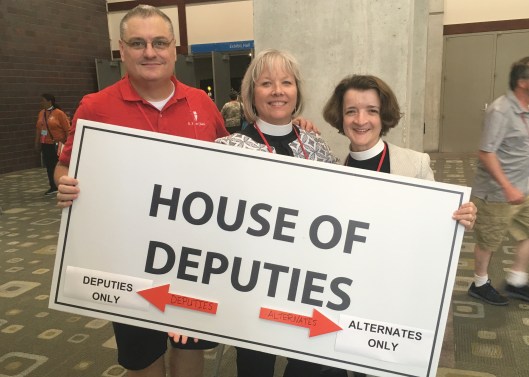
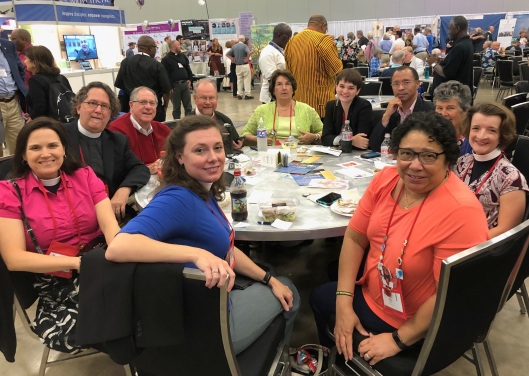
One of the questions I have received about General Convention is what it is like.  What you notice right away is General Convention’s impressive scale.  Every one of the 110 dioceses of the Episcopal Church is able to bring four clergy and four lay deputies.  They may also bring four alternate clergy and four alternate lay deputies.   In total, that’s over 800 people on the floor of the House of Deputies.  All bishops are also present, meeting in the House of Bishops.  Each diocese can have 1 – 3 bishops in place (Diocesan, Suffragan, and Assisting/Assistant).  Visitors from near and far can also attend, as well as media from dioceses, youth observers, and distinguished guests.  The Exhibit Hall also has an extraordinary number of staff and volunteers, and in addition to booths, the seminaries regularly bring in staff or faculty for seminary reunions.  Meanwhile, the entire Convention Center is run by massive amounts of volunteers – covering everything from check-in, monitoring the floor, helping with worship, to the exhibits.  Meanwhile, the ECW holds its annual triennium at the same time, which involves representatives, organizers, and volunteers.  Needless to say, Episcopalians take over the host city (this year coined as the Episcapocalypse).  Even Austin, Texas, which prides itself in being “weird,” I think was a little overwhelmed by our numbers.

IMG_1950

Photo credit:  Chris Girata (reuse only with permission)

What I particularly enjoyed was getting a taste of what it might be like to enter God’s heavenly kingdom.  People from all walks of my life were present at Convention.  There were people from my time in undergraduate campus ministry, my time working as a lay person, my time in seminary, my time as a curate, my first time as a rector, and my current position.  The joy of greeting one longtime friend or colleague after another was heartwarming.  It also reminded me of how incredibly blessed my life has been to be full of incredible people who have shaped, influenced, and sometimes directed my faith life.  God’s abundance was all around me in the faces of God’s children.

IMG_1885

Photo credit:  Hickman Alexandre (reuse only with permission)

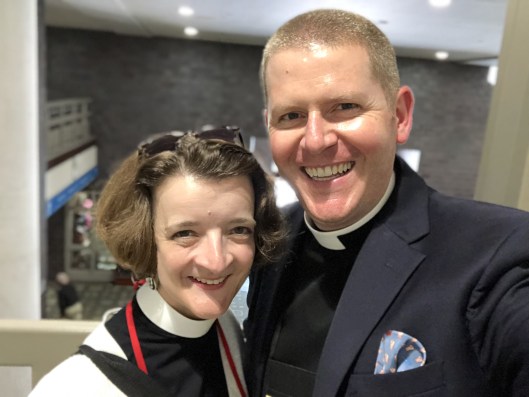
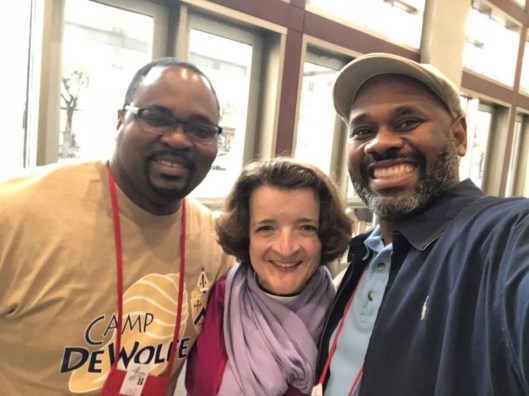
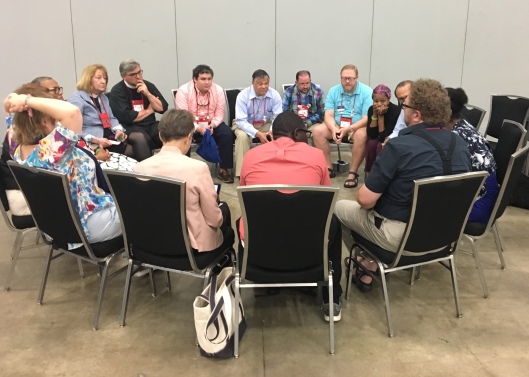
But you could not be at General Convention without meeting other people.  A conversation about something mundane would lead to the realization that we had friends in common.  Waiting in line for something would lead to a conversation about a shared passion.  People you have “met” online through vocational networking you could finally meet in person.  Suddenly, you realized you were making connections from all over the world.  The family of the Episcopal Church is deep and wide.  I leave General Convention feeling hopeful for the future of the Episcopal Church, knowing that it is full of passionate people, doing their part to create a loving, liberating, life-giving world through Jesus Christ.  Thanks be to God!

IMG_1749

Photo credit:  Ann Turner (reuse only with permission)

GC79: Respecting Dignity

25 Wednesday Jul 2018

Posted by jandrewsweckerly in Uncategorized

≈ Leave a comment

Tags

dignity, Episcopal Church, gender, General Convention, immigration, Jesus, language, outcast, race, respect, sexual orientation

IMG_1851

Photo credit:  Jennifer Andrews-Weckerly (permission for reuse)

One of the many takeaways from General Convention was the need to tend to those outside of the straight, white, male, able-bodied community.  There was a task force assembled before Convention to address issues raised by the #metoo movement.  Out of that group came many resolutions about sexual harassment and abuse, equality in payment and hiring, parenting accommodations, and eliminating bias in bishop searches.  Our African-American brothers and sisters also called for work on pay equity and broader issues, such as voter suppression.  Our foreign language speakers rallied for more translated liturgies and legislation, as well as increased interpreters throughout Convention.  Our disabled and deaf members lobbied for better accommodations during Convention.  Our LGBTQ members called for broader inclusion and more intentional expansive and inclusive language.  Our immigrant members also called for thoughtfulness about our ordination processes, noting that many dioceses are unwilling to consider entering into a formal discernment process with someone if their immigration status is not settled.

There are probably more issues I am forgetting, but what struck me about each of these movements is that they are not just General Convention issues or wider church issues.  These are issues for every parish.  At our own parish, we are struggling to provide hearing assistance to our hearing-impaired members due to lack of volunteers to run our sound system.  Having served on a Commission on Ministry (COM) in another diocese, I realize now how our restrictions around immigration could have limited the movement of the Holy Spirit.  Even the conversation about breastfeeding on the Convention floor made me realize that we all have work to do about making our worship spaces as welcoming as possible.  Having watched these issues unfold at General Convention, I am convinced that there are issues we are overlooking as well.

Jesus always struck me as someone who saw everyone – especially people that society, religious leaders, and even his disciples overlooked or dismissed.  He had a knack for seeing the marginalized, the oppressed, and those cast out or looked down upon.  He asked their stories, engaged them in conversation and relationship, he often restored them to health and status in the community.  He showed us what it means to respect the dignity of every human being.  When we reaffirm our baptismal covenant, or when we say, “The Episcopal Church Welcomes You,” how might we do a better job of bringing what we say in line with what we do?  General Convention’s work was a way of pointing us back to the work of Jesus.  How might Hickory Neck engage in this same work?  How might you engage in this same work in your everyday life?

Sermon – Mark 6.30-34, 53-56, P11, YB, July 22, 2018

25 Wednesday Jul 2018

Posted by jandrewsweckerly in Sermons, Uncategorized

≈ Leave a comment

Tags

church, desert, disciples, Jesus, ministry, rejuvination, renew, rest, self-care, Sermon, soul, summer, wilderness

When I first read this gospel lesson today, I was pretty excited.  This text is the perfect summer gospel lesson.  Summer is that time when we slow down a bit, we play a little more, we relax a bit more.  The rhythms of life change a bit during the summer, whether we are tied to someone on a school calendar or not.  In fact, one of my favorite collects for summer matches this text perfectly.  The collect “For Good Use of Leisure,” goes like this, “O God, in the course of this busy life, give us times of refreshment and peace; and grant that we may so use our leisure to rebuild our bodies and renew our minds, that our spirits may be opened to the goodness of your creation; through Jesus Christ our Lord. Amen.”[i]

So when Jesus says to the disciples, “Come away to a deserted place all by yourselves and rest a while,” I feel a sense of relief and permission – permission to rest from my labors, perhaps even to use summer as a time to rejuvenate, sleep a little more, not work quite so hard on all those committees and deadlines.  When Jesus tells the hard-working disciples to come away and rest, his words become a word of comfort to our weary souls, his words help us envision a Jesus who cares about self-care, and his words even have us dreamily imagining a great desert getaway, perhaps mentally noting to google vacations to Palm Desert after church.

But before we get too excited about the introduction of our story, the rest of the story starts to invade our imaginations.  We are told that on the way to that desert getaway, the people hear about the disciples’ getaway and beat them to the other side of the shore and immediately start asking for more healing.  After more work for weary souls, we are told Jesus and the disciples try to escape again.  But this time, the crowds get even more vigorous – rushing forward to grab their blessings.  So much for a weekend of staying in our PJs and binge watching TV.  And so much for the supportive boss who promotes self-care.  Jesus changes his tune as soon as the crowds show up.  No rest for the weary today!

For those of you who have been following along with my blog posts, you know I have been chronicling my experiences at General Convention.  Day after day, something dramatic happened.  But in the jam-packed nine-day schedule, we were given a sabbath – Sunday morning to go wherever we wanted to church.  Sitting in the pews as a priest on a Sunday is glorious and rare gift, and I was particularly excited because I had an old friend that I was going to get to see in their home parish.  But a few weeks before General Convention started we got word that a priest was going to organize a trip and prayer vigil at a detention center for women seeking asylum in the United States – and would use our free Sunday for the event.  Now since today is Sunday and we are about to confess our sins together, I have to confess something to you that I would not normally tell anyone:  my initial reaction to this invitation was resentment.  Instead of getting to sleep in, visit church leisurely with a friend, and get some much needed sabbath time before going back into legislation, I was going to need to get up early, miss time with my friend, and stand in 100-degree Texas heat and feel passionate about yet another social justice issue.  I knew I should probably be excited for the unique experience, and I should probably be preparing a protest sign, and invite other locals to the event; but all I could think on the inside was, “but you promised we could rest a while!”

What I forgot and what the disciples miss are the details of Jesus’ invitation today.  Jesus does not say, “Come away with me to a resort, and get a spa treatment package with the bonus strawberries and champagne.”  Jesus says “come to a deserted place.”  Palm Desert, with its palm trees, mist sprayers to keep you cool, and sparkling swimming pools, is not what Jesus is talking about here. The desert is where Mark’s gospel starts – with John the Baptist eating locust and wild honey, with hardly any clothing for protection.  The desert is where Jesus goes to be tempted by the devil.  The desert is not where you go to escape and catch up on lost sleep.  The desert is where you go to wrestle your demons and find deeper connection to God.[ii]  The desert is a place of self-care:  not the resting, rejuvenating kind, not the binge-watching, escapism kind, but the hard, deep, soul-examining kind of work that is about taking care of the self – just without all the amenities.

When Jesus invites the disciples into the wilderness, he is inviting them to renew themselves for ministry – to reconnect with the initial passion hidden within them, the joy that came from first volunteering to be fishers of people, the thrill of personal invitation to make a difference in the world and see a new age dawning.  So Jesus says, “Want to get renewed about that Outreach Committee Meeting next week?  Go out and have a conversation with a homeless person or swing a hammer on a Habitat house before you go.  Want to stop crunching numbers for that big project?  Go visit with the family who hasn’t been able to eat a hot meal all summer.  Want to put down the newspaper to relieve your compassion fatigue?  Go to the local jail and start hearing the stories of addiction, poverty, and prejudice that keep people in those cells.”

The good news about my compassion fatigue at General Convention is the same friend with whom I had hoped to go to church wanted to go with me to the Detention Center instead of church.  I was fresh out of excuses to not go.  In the blazing Texas sun, with sunblock and extra water bottles, we schlepped her one-year old to the wilderness of Texas.  As soon as we spotted the cold, harsh, former prison walls that were now being used as a “residential facility,” I suspected Jesus was smirking with his “I told you so,” face.  As songs rose up from the crowd of over 1000 Episcopalians, my heart started aching for the stories I could imagine inside those stone walls.  As my friend’s child cooed and chattered, I imagined the women inside who wanted to be with their own babies.  As we prayed, I realized my selfish desire for rest would not have been sated with a brunch and a long nap.  What my soul needed was right there, in that brown, withered field in the hot summer sun.

I do not know what kind of wilderness place you need today.  I do not know where Jesus needs to guide you to help you find the kind of rest your soul needs.  I do not know what kind of deserted place you might be dreading today.  But I invite you to say yes.  I invite you to risk feeling more tired than rejuvenated.  I invite you to open yourself to the deep transformation that can only happen in a place of vulnerability.  The next time Jesus says to you, “Come away to a deserted place all by yourselves and rest a while,” just go.  I promise you will get the kind of rest your soul needs.  Amen.

[i] BCP, 825.

[ii] Karoline Lewis, “Letting Go,” July 15, 2018, as found at http://www.workingpreacher.org/craft.aspx?post=5198 on July 18, 2018.

GC79: Reconciliation in Real Time

20 Friday Jul 2018

Posted by jandrewsweckerly in Uncategorized

≈ Leave a comment

Tags

anxiety, bishops, change, cheer, concern, Cuba, Episcopal Church, family, General Convention, God, home, House of Bishops, humbling, mercy, reconciliation, right, wrong

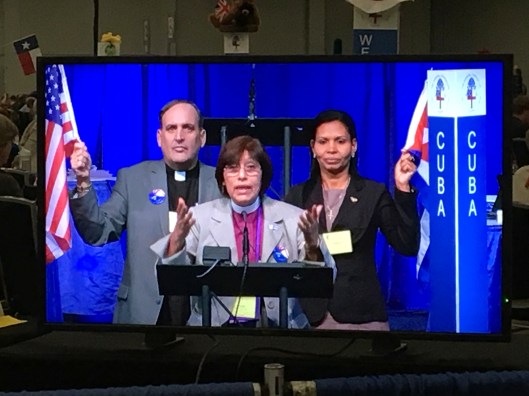
IMG_1927In 1966, in light of the Cuban Revolution and the political response of the United States, the House of Bishops voted to separate from the Diocese of Cuba from the Episcopal Church, leaving it an autonomous diocese without a provincial home.  The clergy scattered, some returning or immigrating to the US, but some who remained in Cuba were imprisoned, executed, or disappeared; priests lost their pensions, and they operated in isolation from the Church.  Cuba officially requested to be reaffiliated with the Episcopal Church and was given a list of requirements before admission.  As of GC79, all of those conditions had been met.  However, leading up to the resolution coming to the floor of both the Deputies and Bishops, there was controversy on what it would mean, how this admission might impact the admission of other Dioceses (or their exit), how to affirm already elected bishops (assuming they had not followed the current practices of approval for bishops in the Episcopal Church), among other concerns.  In other words, there was a desire to right the wrong done 52 years ago, but some anxiety about the implications of the decision.

As an alternate deputy, I had the leisure of observing either House.  On Tuesday, I happened to be observing the House of Bishops when resolution A238 came to the floor.  Each testimony pleaded for righting the wrong done by the House of Bishops in 1966.  Retired bishop Leo Frade from the Diocese of Southeast Florida spoke passionately about the resolution.  As a Cuban American who had been a part of the Church in Cuba, he got quite emotional in his plea for the bishops to do the right thing.  When it came time for the vote, the vote was a unanimous approval for readmittance.  The entire house – bishops and visitors – exploded.  Cheers and clapping filled the room, and the standing ovation lasted several minutes.  Unbeknownst to me, the Bishop of Cuba was present and was invited to approach the platform to address the House.  Bishop Curry embraced her.  The House broke into singing the Doxology.

Bishop Griselda Delgado’s speech was the most humbling.  Despite every reason to feel resentful or hurt, Bishop Delgado communicated nothing but forgiveness and reconciliation.  “We are family,” she insisted.  And although we severed the relationship so many years ago, she insisted, “Cuba never left.”  Her sentiments struck me as the exact way that God sees us.  When we reject God, God never leaves us.  When we abandon God, we do not abandon our familial ties with God.  Bishop Delgado’s profound sense of right relationship, reconciliation, and forgiveness brought the House to tears.  We did not deserve her mercy, and yet there she was, offering mercy.  When Bishop Delgado said, “The Holy Spirit is here,” I knew she was right.  In response, Presiding Bishop Curry said, “The Bishop may take her seat at Table 7.”  Those words were words of righting a wrong – fully, completely, unconditionally.

The experience the next day was equally powerful in the House of Deputies.  They too needed to approve the resolution, and it also passed unanimously.  Bishop Delgado spoke there too, but equally powerful was the triangular sign with the word, “Cuba” written on it.  It was processed to a table, and the deputies from Cuba were seated in the House of Deputies.  “Welcome home,” pronounced President Jennings.

What I loved about the approval of this resolution was seeing how legislation can powerfully effect change.  Sometimes, in the weeds of parliamentary procedure, and canonical revisions, one can wonder if all we are doing is navel gazing.  But on these days, we watched first-hand the commitment to change, the willingness to boldly repent, and the receiving of mercy.  Surely the presence of this Lord has been in this place!

GC79: Compassionate Compromise

19 Thursday Jul 2018

Posted by jandrewsweckerly in Uncategorized

≈ Leave a comment

Tags

Christ, compromise, Episcopal Church, General Convention, LGBTQ, marriage rites, protest, theology, traditional, witness

IMG_1818

Photo Credit:  Jennifer Andrews-Weckerly (reuse with permission)

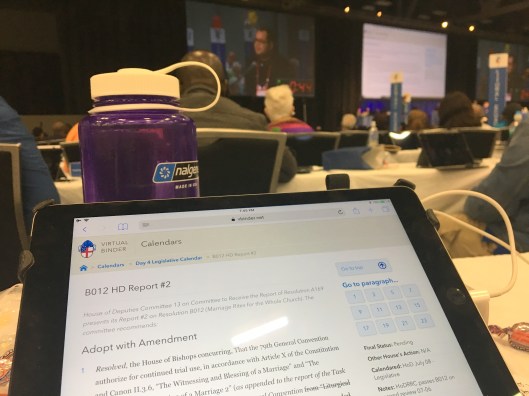
As an alternate to General Convention, I stood ready to fill in when deputies needed a break from the floor.  On the two sessions where I was able to serve as a Deputy, I was able to participate in the debate, revision, and voting on B012, entitled Marriage Rites for the Whole Church.  This resolution came to be because although we authorized marriage rites for same sex couples at the 78th General Convention, there was a provision that allowed bishops who hold a theological position that does not embrace marriage for same-sex couples to forbid his or her priests from conducting such rites.  This left the LGBTQ community in those dioceses unable to be married in their home parishes by their home priests, despite a change in the legal ability to do so.  This was deemed a compromise that could keep everyone at the table despite our theological differences.

However, given the protests of the LGBTQ community and their supporters, B012 proposed an option for priests and their parishes who wanted to conduct marriages for all despite their bishop’s protest to seek the oversight of another bishop in the Episcopal Church.  The resolution allowed for bishops and protesting churches and clergy to hold their ground, while also allowing dissenting clergy and parishes to minister to their community fully.  I talked about the testimonies and debate about this issue earlier.  The resolution was heavily edited as a result of that that testimony, and what came before the House of Deputies seemed like a well-crafted compromise.  But the debate on the floor indicated something quite different.  Our more traditional brothers and sisters felt their theology was being compromised, and many diocese in Province IX, including churches in foreign countries where same-sex marriage is still illegal, were threatening to break from the church.  It was a heart-wrenching debate, and our own deputation was even divided on what to do.

When the vote finally came, we voted by orders – so that the entire house could see how the lay and ordained voted.  As the minutes ticked by, my stomach turned.  I honestly did not know what would be the best outcome, and I feared for our path forward.  When the votes came in, they were overwhelmingly in favor of B012.  I am not sure what changed people’s minds, and I am not sure how people came to see that this was a good compromise.  My only reflection was that everyone was a bit unhappy, not fully getting what they wanted – which is the definition of a good compromise, if you ask me.

I do not know if the passage of B012 will have any negative impact in the future.  What I do know is that the process seemed to model something we have a hard time doing in the United States – compromise.  I have always said that if the Episcopal Church cannot model compromise, respect, and dignity, we cannot expect the world outside to do so.  The passage of B012 in both Houses made me feel like there might be hope for all of us to witness compassionate compromise through Christ to others.

GC79: On Needing Revival…

18 Wednesday Jul 2018

Posted by jandrewsweckerly in Uncategorized

≈ Leave a comment

Tags

Bible, Bishop Curry, church, Episcopal Church, General Convention, God, God's word, Holy Spirit, interpretation, liberation, love, ordination, protest, revival, role, scripture, women

This week, I continue with more reflections from the General Convention of the Episcopal Church.  Look for posts in the days to come that give some insight into the experiences of the week, the take-home lessons, the pondering questions still ruminating in me.  Thanks for following along!

On Saturday evening of General Convention, we were invited to a revival at a local church.  The revival was powerful and clearly moving to many in the crowd.  Of particular note was the Spanish translator hired to translate for Bishop Curry.  She was poised, animated, and seemed to feed off Bishop Curry’s energy.  I do not know how she did it, but the two of them really seemed to be preaching together – to be dancing in God’s word as they preached a message of love and life.  Even for someone whose Spanish is minimal, I found her translation and presence really made Bishop Curry’s sermon come alive in a new way.

But what has been staying with me about that evening was the protest outside the church.  Members of Westboro Baptist Church gathered to protest what the Episcopal Church has been doing; from their signs, I understand they are mostly upset about the ordination of women, and our inclusion of the LGBTQ community in ordained and married life.  In the course of my life, I have had many conversations about both of those issues, including people confronting me about my own ordination and my theological understanding about the expansiveness of God’s love for all.  Those conversations have sometimes been hard, hurtful, and even anger-inducing.  But ultimately, they were always conversations – things said to my face, debates had between people, disagreements had within the context of relationship.

So the sentiments of the protestors was not new to me (although some of the language used against female pastors would have made many clutch their pearls).  What was heartbreaking was seeing a preteen standing next to her mother with a sign that read, “No Women Preachers – 1 Tim. 2.12.”  I went back and reread 1 Timothy 12, and I confess, a good portion of the chapter is about wives submitting to their husbands, keeping silent, allowing their husbands to lead.  We’ll talk about that in another blog post.  But as I looked at the young girl, I remembered all the times I started asking hard questions about things I had read in the Bible that did not seem to make sense – that did not seem to jive with the wide embrace of God’s love.  I remembered the Sunday School teacher who encouraged us to read the Bible literally, condemning her own current marriage because she had once been divorced.  I remember feeling a sense of discomfort until I found liberation in the Episcopal Church – a church that taught me to ask hard questions, to be uncomfortable in the ambiguity, to be released from the bonds of literal biblical interpretation, and to read the Bible in a new way.

Holding all that in my mind, I grieved for this young woman.  I sorrowed for the mother standing next to her, teaching her to keep silent, and to disrespect every woman who believes God is empowering us with God’s word.  I lamented the hate being inculcated into this young girl.  I mourned the light being limited in her life.  As female preachers poured out of buses for the revival, I found myself wanting to whisper into her ear, “God’s love is bigger than the words in 1 Timothy.”  Holy Scripture has been used time and again to limit God’s love, grace, and mercy.  I am sure I am guilty of a similar sin in one way or another; perhaps even this blog post is an exercise in sinful presumption.  My prayer for all of us is that we have people whispering in our ears words of truth, reconciliation, and peace.  Let not the work of the Holy Spirit be extinguished in us.

IMG_1755

Photo credit:  Jennifer Andrews-Weckerly (permission needed for reuse)

← Older posts
Newer posts →

Recent Posts

  • On New Clothes and Neighbors…
  • Sermon – Matthew 20.1-16, P20, YA, September 20, 2026
  • On Change and Bread…
  • Sermon – Exodus 14.19-31, P19, YA, September 13, 2026
  • On Realizing Dreams…

Archives

  • September 2026
  • August 2026
  • July 2026
  • June 2026
  • May 2026
  • April 2026
  • February 2026
  • January 2026
  • December 2025
  • November 2025
  • October 2025
  • September 2025
  • August 2025
  • July 2025
  • June 2025
  • March 2025
  • February 2025
  • December 2024
  • November 2024
  • October 2024
  • September 2024
  • August 2024
  • July 2024
  • June 2024
  • May 2024
  • March 2024
  • February 2024
  • January 2024
  • December 2023
  • November 2023
  • October 2023
  • September 2023
  • August 2023
  • July 2023
  • June 2023
  • May 2023
  • March 2023
  • February 2023
  • January 2023
  • December 2022
  • November 2022
  • October 2022
  • June 2022
  • May 2022
  • January 2022
  • December 2021
  • November 2021
  • October 2021
  • September 2021
  • August 2021
  • June 2021
  • May 2021
  • April 2021
  • March 2021
  • February 2021
  • January 2021
  • December 2020
  • November 2020
  • October 2020
  • September 2020
  • August 2020
  • July 2020
  • June 2020
  • May 2020
  • April 2020
  • March 2020
  • February 2020
  • January 2020
  • December 2019
  • November 2019
  • October 2019
  • September 2019
  • August 2019
  • July 2019
  • June 2019
  • May 2019
  • April 2019
  • March 2019
  • February 2019
  • January 2019
  • December 2018
  • November 2018
  • October 2018
  • September 2018
  • August 2018
  • July 2018
  • June 2018
  • May 2018
  • April 2018
  • March 2018
  • February 2018
  • January 2018
  • December 2017
  • November 2017
  • October 2017
  • September 2017
  • August 2017
  • July 2017
  • June 2017
  • May 2017
  • April 2017
  • March 2017
  • February 2017
  • January 2017
  • December 2016
  • November 2016
  • October 2016
  • September 2016
  • August 2016
  • July 2016
  • June 2016
  • May 2016
  • April 2016
  • March 2016
  • February 2016
  • January 2016
  • December 2015
  • November 2015
  • October 2015
  • September 2015
  • August 2015
  • July 2015
  • June 2015
  • May 2015
  • April 2015
  • March 2015
  • February 2015
  • January 2015
  • December 2014
  • November 2014
  • October 2014
  • September 2014
  • August 2014
  • July 2014
  • June 2014
  • April 2014
  • March 2014
  • February 2014
  • January 2014
  • December 2013
  • November 2013
  • October 2013
  • September 2013
  • August 2013
  • July 2013
  • June 2013
  • May 2013
  • April 2013
  • March 2013
  • February 2013
  • January 2013
  • December 2012
  • November 2012
  • October 2012
  • September 2012

Categories

  • reflection
  • Sermons
  • Uncategorized

Meta

  • Create account
  • Log in
  • Entries feed
  • Comments feed
  • WordPress.com

Blog at WordPress.com.

  • Subscribe Subscribed
    Seeking and Serving
    Join 397 other subscribers

    Have a WordPress.com account? Log in now.

  • Seeking and Serving
    View site in Reader
    Manage subscriptionsSign upLog in
    Report this content
    Collapse this bar
Loading Comments...