Sermon – John 20.1-18, ED, YA, April 16, 2017

Tags

, , , , , , , , , , , , , , ,

Every generation has a baby name that is popular.  In my generation, that name was Jennifer.  As I was growing up, every grade had tons of Jennifers.  I became quite accustomed to the experience of eagerly looking up when someone called my name, only to be disappointed to see they were calling out to someone else.  The name was so common that by the time I got to college, I learned to ignore people calling out my name because more likely than not, they were not actually calling me.  They were calling one of the other twenty Jennifers nearby.  Although the practice helped me save face, the practice was a bit of a hindrance when someone actually was trying to get my attention.

The solution, of course, was a nickname – something to distinguish me from the sea of other Jennifers.  So in college, most of my buddies just started calling me “Andrews.”  It may sound silly, but having a name that was distinct, that when called, I knew I could answer, gave me a sense of belonging and identity.  When someone shouted, “Andrews” across the quad, I knew a friendly face would be looking for me when I raised my eyes.  Though seemingly simple, that nickname made me feel known, especially at a time when everyone is trying to figure out their new identity, where they belong, and who they will be.

I suspect that Mary was the common name in Jesus’ generation.  All we need to do is read through the New Testament to know that there are more Marys than we can count.  Sometimes I even have to look back when I come across a Mary to be sure I am thinking of the right one.  So when Jesus calls Mary Magdalene by name, I imagine there must have been some way she knows not only that this is Jesus, but also that he is talking to her.

Easter morning has been a rough morning for Mary.  She comes in the tomb before the first light of dawn has broken.  She is probably still a bit bleary eyed – that kind of haze one has in the days after a death of a beloved one.  She comes to halt before she gets all the way to the tomb though.  The stone that is supposed to be covering the tomb, protecting Jesus’ body, is gone.  Before even going in to assess the situation, Mary runs – runs hard to find the disciples, demanding that they get up and help her.  Two of them, the beloved disciple and Peter, sprint ahead of Mary.  She is too tired from her first run to keep up.  By the time she reaches the tomb, the two disciples are already stepping out of the tomb, Peter looking perplexed and the other disciple with an enigmatic smile.  And without so much as a word to her, they leave – just like they left Jesus on that fateful day.[i]  Mary, overcome with the memories of Jesus’ crucifixion and the continued emotion of this morning, breaks into tears.  When she finally checks inside the tomb herself, she not only sees two angels, she also has an encounter with a supposed gardener.  Frustrated by their insensitive questions, she exasperatedly asks the gardener to just tell her where the body is.

That is when the big news today happens.  The supposed gardener calls her by name.  Not the common name that everyone has.  The supposed gardener calls her by the name that only Jesus calls her.  The haze dissipates.  The tears halt.  The cloud of despair vanishes.  And she calls Jesus by the name that only a few call him, “Rabbouni!”  This is a tremendous moment in our text today.  In the flurry of running, and confusion, and questions, and tears, and despair, two people see each other crystal clearly.  Mary is called by her name – Jesus communicates to Mary that she is known, the she is beloved, that she has an identity and a purpose unique to her.  She is his sheep who knows and recognizes the voice of the shepherd – the Good Shepherd.[ii]  Her relief is palpable.  The return of her confidence is immediate.  Her sense of celebration is ready to explode!

When I was in high school, I had a summer where I attended both a short conference and then a long summer program.  Both were residential.  The conference was the Hugh O’Brian Youth Leadership conference, or HOBY for short.  I made a few fast friends, but was there just a few days.  A week or so later, I was off to a six-week residential program.  It was my first time staying away from home that long, and I was admittedly a bit nervous since no one else from my high school was going.  After I unloaded my bags, and was getting ready to say goodbye to my parents, someone behind my shouted, “Hey, HOBY!”  Without even looking at who it was, I knew I did not need to worry about belonging.  I was already known here.  I had a place here.  I could have a purpose for those six weeks.

We have all had those moments of clarity around identity, belonging, and purpose.  Whether we are returning to our home town after a long time away, whether we develop good friends at school or in a civic group, and whether that happens at a reunion, we all know the deep, profoundly affirming feeling that comes from being known.  For those of you with a church home, and especially for those of you who have found a home here at Hickory Neck, you most likely found that feeling here.  Perhaps the liturgy was what brought you a sense of identity – either the liturgy reminded you of a practice from your earlier life, or the liturgy offered something to you that you did not even know you were missing.  Perhaps a ministry at church brought you a sense of identity – those little sacred moments that come when you realize that you are actually really good at inspiring people to serve the world, making beautiful music, or teaching children about the love of God.  Or perhaps the community brought you a sense of identity – that first time when someone remembered your name or a part of your story, when someone came to you for expert advice, or when someone knew just by looking at you that you were hurting – and then offered to take you to lunch or coffee.  The church is a place where both Christ and the community call you by name.

Now I would love to tell you that the wonderfully affirming and life-giving feeling of being known is an end unto itself.  I would love to send you home on this beautiful Easter Day with simply a sense of love and affirmation.  And that is certainly part of the gift I am giving you today – to tell you that you can be known and loved here.  But something else happens to Mary at that tomb.  After that profound moment of affirmation, Jesus tells her to go and be a witness to the disciples.  Jesus always gives his beloved homework.  He is that teacher that even on a Friday will give you an assignment for the weekend!  But Mary does not see this as a burden.  Even though Jesus will not let her cling to him – cling to the way things used to be, Jesus’ affirmation this day propels her to go out and share the good news of the risen Lord with the disciples.  In this way, Jesus not only recognizes and honors her identity; Jesus also gives her purpose – a call.

That is your homework on this Easter Sunday.  I know you want to go eat those big Easter meals ,go find those Easter eggs, and find what Easter chocolate awaits at home.  But remember that while this place is a place that calls you by name and affirms your beautiful identity, this is also a place that commissions you to go out and share the good news.  That wonderful sense of affirmation is not for you to bottle up and keep for yourself.  That sense of affirmation is meant to embolden you to share that affirmation with others – to meet people where they are, to hear their stories, and to share how this day of resurrection, love, and affirmation is for them too.  In the same way that you have a vocation, a call on your life, you also are to affirm vocation and call in others.  So this week, as you bask in the warmth and beauty of this day, go out and share that good news with others.  Someone may be waiting for you to call them by name.  Amen.

[i] Richard B. Hays, “Do Not Cling to Me,” Christian Century, vol. 109, no. 10, March 18-25, 1992, 299.

[ii] Karoline M. Lewis, John:  Fortress Biblical Preaching Commentaries (Minneapolis:  Fortress Press, 2014), 241.
Sermon – John 18.1-19.42, GF, YA, April 14, 2017

Tags

, , , , , , , , , , , , , , , , ,

I have been thinking this week about how every year we read the same story of Jesus’ death.  Unlike the Christmas story that we eagerly anticipate hearing each year, this story seems like a masochistic practice of hearing the same devastating story over and over again.  And we do not just read this story on Good Friday.  In addition to John’s version of the passion narrative, we read one of the synoptic versions on Palm Sunday.  Twice in one week we relive the painful story, catching interesting variations.  But the ending is always the same:  death, finality, failure.  At least on Palm Sunday, we use various voices, making the story feel like a performance.  But today, one sole voice, tells the achingly raw story – a story we would rather skip, or soften, or cry out to the reader, “Please stop!”

In hearing the story this year, I was struck by the failures of three characters.  The first is probably the easiest culprit:  Judas.  In Mathew’s gospel there is at least a feigning of loyalty as Judas greets Jesus as “Rabbi,” and kisses his cheek.  But John does not play such games.  In John’s narrative, Judas is fully on the side of the persecutors.  He boldly brings and stands with the soldiers and police.  He does not greet Jesus, or apologize.  He is confident in his decision.  He stands proud, even as we now are able to see his profound failure.  His ignorance of the depth of his betrayal is almost worse than the actual betrayal.  His confidence that this is for the best, is the first crack in our hearts as we hear this painful story.

Then we have Peter – precious, passionate, pitiful Peter.  For all the times he gets things right, and all the endearing times he gets things wrong, today is just a spirit-crushing failure.  In Matthew’s gospel, Peter denies knowing Jesus.  In John’s gospel, Peter denies his discipleship – his very relationship with and dedication to the Messiah.  In the face of Jesus’ “I am,” claim[i] today, Peter’s claim is “I am not.”[ii]  For all the wonderful, powerful, sacrificial moments in Jesus today, Peter is shameful, cowardly, and self-serving.  Even after being warned that he will deny Christ, Peter denies Christ in spite of himself.  That cock’s crow is the second crack in our hearts as we hear this brutal story.

The third character today does not always get as much attention, but their failure is perhaps the worst.  Whereas Judas and Peter deny and betray a friend, the chief priests deny their very God.  They say seven words to Pilate today that should be more shocking than anything said.  “We have no king but the emperor.”  We often get distracted by their words, because we know that they are meant manipulate Pilate’s sense of authority.  But the chief priests, the religious, moral guides of the people of faith say today, “We have no king but the emperor.”  Of course, we have to think back to remember why this statement is so profoundly painful.  You see, once upon a time, God was the king of Israel.  The people worshiped Yahweh, and Yahweh alone.  But the people got greedy, and begged Yahweh for a king like the other nations.  And so God anointed kings through God’s prophets.  But the chief priests take their self-centered sinfulness a step further than our ancestors.  They deny God today.  Their claim to have no king but the emperor is treason against our God – blasphemy.  And with their claim, our heart lies cracked in two as we hear the rest of the awful story.

Of course, blaming Judas, Peter, and the chief priests would be an easy way to scapegoat our way out of this dark day.  There are even Christians who claim that the Jews crucified our Lord.  But we know the truth.  We know that we are the Jews.  We know that we are Judas and Peter and the chief priests.  We know that our heart fractures with each vignette because they remind us of times when we have stood on our soapboxes, certain of our moral claims, only to later look back and see whom we betrayed and trampled in the process.  We know that that our heart fractures because we are reminded of those times when we knew the right thing to do, said we were going to do the right thing, and then failed to do the right thing – over, and over, and over again.  We have heard that same cock crowing.  We know that our heart fractures because we have put other gods before our God.  Sure, the gods have varied:  money, power, security, ego.  But we have gotten so lost in our gods that we said and did things that would have inspired a gasp from anyone more faithful than ourselves.  The failures of Judas, Peter, and the chief priests are not just failures of those men, two thousand years ago.  The failures of Judas, Peter, and the chief priests are our failures.[iii]

I think that is why we tell this story year after year, twice a week from different gospels.  We tell this story over and over again because we fail over and over again.  Though the specific characters are important, the characters live and operate in us centuries later.  That is why the story is so compelling – not because we can gather together and wag our fingers at those people.  The story is compelling because the story is eerily close to our own sinfulness.  Part of the devastating nature of this story is how complicit we are in the story.  Though the powers of evil might want us to deny our culpability in this story, what is hardest about this story is how close to home the story really is.

Now, you I do not ever like to leave the pulpit without a word of hope, a reminder that risen Lord redeems us all.  But today, I encourage you not to rush to the empty tomb.  Take time to sit in our collective confession, to tarry on those things done and left undone which are separating you from God and one another.  Bring your failures or sense of failure to the cross and lay them there today.  Grieve the ways that you cannot help yourself, year after year, from sin and shame.  The whole season of Lent has been building up to this day.  The whole reason we took on those disciplines and came to church for confession was because we knew, ultimately, that this is where we keep tripping up:  in betrayal and denial of our very identity as beloved disciples and children of God.  We are the ones bombing others.  We are the ones racially profiling.  We are the ones denigrating women, the poor, and the oppressed.  We are the ones, century after century repeating the sins of the faithful.

Lay all that sinfulness at the cross today.  Whether you venerate the cross in the liturgy today, wear a cross around your neck, or pray with the cross on your prayer beads, the power of the cross is to absorb all those failures and to transform them into something worth living.  You can, and perhaps should, feel the powerful weight of your sinful patterns today.  But let them die at the foot of the cross with Jesus.  Lay them naked at the cross, for all the world to see.  There is relief in that confession, the depth of which you may not feel fully until our Easter proclamation.

[i] Susan E. Hylen, “Exegetical Perspective,” Feasting on the Word, Yr. A, Vol. 2 (Louisville:  Westminster John Knox Press, 2010), 299.

[ii] Karoline Lewis, John:  Fortress Biblical Preaching Commentaries (Minneapolis:  Fortress Press, 2014), 222.

[iii] Rolf Jacobson, Karoline Lewis, and Matt Skinner, “SB 535, Good Friday,” April 7, 2017, found at http://www.workingpreacher.org/brainwave.aspx?podcast_id=873 on April 8, 2017.

Homily – John 13.1-17, 31b-35, MT, YA, April 13, 2017

Tags

, , , , , , , , , , , , , , , ,

In 1984, the gay community in London was seeing a lot of violence and oppression by not only the police, but also the community.  In the midst of their own activism, one gay activist caught wind of the Coal Miners who were striking in Wales.  Upon watching the violence of the police against the strikers, the activist realized their suffering was not unlike his own, and that of the gay community.  And so, in an act of solidarity and love, he organized his gay community to raise funds to support the families of the striking miners.

But not everyone was on board.  You see, the miners worked in small towns in which many members of the gay community had once lived.  In those small communities, they had been bullied, taunted, and beaten.  And now someone was asking them to come to their aid.  Many in the gay community could not turn the other cheek.  Why should they return hatred with love?  And as the gay activists soon learned, their help would not be readily received.  Why should the gay community risk further rejection, shame, and violence to support an oppressed people who could not see their commonality?

Jesus shares a meal with his disciples as he has done on so many occasions.  Only on this night, he is among friend and foe.  He knows Judas is about to betray him.  He knows that Judas is about to put into motion a series of actions that cannot be stopped, that will lead to pain and suffering, and ultimately death.  Looking into Judas’ eyes, Jesus must have felt a betrayal so deep that he had to resist hatred as a human response.  “How could you?” would be an easy question for Jesus to ask in this intimate moment.

But Jesus does not do that. He does not challenge Judas or reprimand or even expose Judas in front of the others directly.  No, he takes off his outer robe, takes a bowl and a pitcher of water, and he washes the feet of everyone in that room – not just the feet of those whom he loves – which would have been a poignantly intimate moment anyway.  But as he makes his way down the table, he shifts his bowl under the dusty feet of Judas; feet as dirty as the rest of them.  He takes the feet of this betrayer of his trust and confidence, and he manages to love Judas as deeply as everyone else.  Tenderly, lovingly, he washes the feet of the enemy of the worst kind – an enemy who was once a friend.  Love in the face of betrayal.

This year, Jesus’ tenderness with Judas has been haunting me.  I do not know about you, but the last thing I want to do is tenderly, lovingly care for my enemy.  Society teaches me to have a strong defense, to protect myself, to avoid conflict.  The norm is not to kneel down before a betrayer of trust, to make oneself subservient, and lovingly treat someone who acts so hatefully.  Only a fool makes himself vulnerable before the enemy.  And yet, that is what Jesus does.  That is how he shows the depths of his love.  He does not use his power to thwart the enemy.  He restrains his power to bring the enemy in – always with the offering of love that can transform any heart.

Tonight, we will engage in the tradition of washing others’ feet.  Many of us get caught up the squeamishness of feet and the vulnerability such intimacy involves.  But something much bigger happens in foot washing than letting go of self-consciousness.  In foot washing we enter into the love of Christ:  washing the feet of those we know well and love; washing the feet of those we know only superficially; washing the feet of those who seem to have their lives totally together and those who we know are suffering; washing the feet of someone who has indeed offended you, and washing the feet of someone with whom you wish to reconcile.

But what we do literally here, we take out figuratively into the world.  Washing the feet of someone you know, or even someone you do not know well in church is one thing.  Washing the feet of the people who are not here is another thing entirely.  Though Jesus’ washed his disciples’ feet, the inclusion of Judas suggests that loving one another cannot be limited to the community of believers.[i]  All we have to do is imagine an actual enemy, someone who has betrayed our trust or offended our values, someone who oppresses the oppressed, and then we know how hard what Jesus does is tonight.  Tonight, some powerful feelings are set loose:  sorrow, loss, regret, even fear; but also some powerful feelings are set loose by Jesus:  commitment, conviction, and determination.  God lays aside everything tonight.[ii]  Enter into Christ’s love tonight through the example he sets for us.  Know that God will use the power of this act to change your heart.

A year after that bold move by the gay community in London in the 1980s, much had happened.  Horrible things were said, mean things were done, violence erupted, commitments were betrayed, and help was rejected.  But a year later, even after ultimately losing their cause, the mineworkers did something out of character.  Chapter after chapter of mineworkers loaded onto buses, came to London, and marched for gay rights with their new brothers and sisters.  God’s love has tremendous power.  Even if that love cannot transform the heart of a Judas, the witness of that love slowly breaks through and transforms communities.  Join us tonight as we start locally.  Know that God will use your small action here to do bigger work out in the world!  Amen.

[i] Susan E. Hylen, “Exegetical Perspective,” Feasting on the Word, Yr. A, Vol. 2 (Louisville:  Westminster John Knox Press, 2010), 275.

[ii] William F. Brosend, “Pastoral Perspective,” Feasting on the Word, Yr. A, Vol. 2 (Louisville:  Westminster John Knox Press, 2010), 276.

The Pilgrimage of Holy Week

Tags

, , , , , , , , ,

17903433_10155696878822565_4685487522288081020_nIn Holy Week, I like to offer the parishes I serve a service for each night of the week.  It can be labor intensive, and people can feel overwhelmed by the idea of coming every night of a week for church (even if it is only once a year).  But, if you can make it through every night, you find yourself in the midst of a beautiful pilgrimage – an unfolding story and walk with our Savior, Jesus Christ.  This year, we are only three days in, but each night has given me little “God moments.”

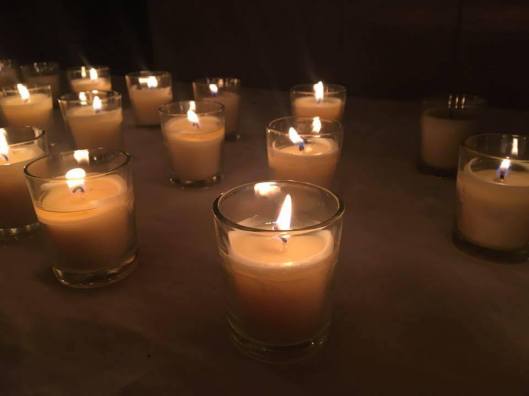
On Holy Monday, my heart was warmed that our community was gathering “virtually” to celebrate compline (evening prayers).  We have been doing it all Lent, but it was a wonderful way to close my evening in my pajamas, knowing that others were on Facebook, praying together with our Curate.  On Holy Tuesday, as I sat in the silence of our Taize service, I was watching the flames of the many lit candles flicker.  Since I knew people had lit the candles with prayer intentions, I imagined each of those flames as a prayer, symbolizing the cares and concerns of each person in the room.  As our silence extended, I imagined the flames represented the prayers and concerns around the world, remembering how our Coptic Christian brothers and sisters must be hurting this week.  It was a powerful, transfixing image.  Then last night, on Holy Wednesday, during our healing prayers, two things happened.  First, my daughter came forward for prayers by me.  Her request was humbling, and the privilege of affirming her and praying with her in that space was incredible.  Second, another local pastor laid hands on me and prayed just the prayer I needed this week.  It was all I could do to hold back the tears.

So, I do not know what the next three days, the Triduum, hold.  But I can promise you there will be many more sacred moments.  If you have a church home, I encourage you to take advantage of their offerings for the rest of the week.  If you do not have a church home, and live in the Williamsburg area, know that you are most welcome.  You can find all our information on our website.  A continued blessed Holy Week for you.  As you ponder your own connection to church, I offer you this video as inspiration for your Holy Week pilgrimage to Lent.  Peace!

On Remembering Roots…

Tags

, , , , , , , , , , , ,

842x347-WELS-CampusMinistry

Photo credit:  https://wels.net/serving-you/christian-life/campus-ministry/

Last night, as a member of our Diocesan College Ministry Commission, I visited Canterbury at William & Mary.  We had some time with both the students involved in the Episcopal Campus ministry and with the Campus Minister.  It is a vibrant ministry, with a lot of passion and enthusiasm around service, worship, and discipleship.  Canterbury is a place where they can ask questions of their faith, become leaders, serve their community, and forge deep friendships.  They are doing the work began in their baptism, continued in their confirmation, and now affirmed as adults.

As I listened to the students and Campus Minister, I was flooded with a host of memories from my own experience in Campus Ministry at Duke.  Although I was involved in the Wesley Fellowship, the models are quite similar.  Wesley was the place where I came into my own faith, where I engaged my intellect in partnership with professors at the Divinity School, where I first discovered the power of mission trips, and ultimately, where I began to feel a sense of call to ordained ministry.  Wesley created disciples – encouraging us to find a local church community, fostering a personal spirituality, developing deep Christian friendships, and exploring the implications of my faith.  Most of my friends from Wesley took a year or more to volunteer or live in intentional Christian community.  Today, most of the alumni I know are clergy, lay leaders, non-profit workers, social services providers, and are raising up a new generation of faithful disciples.

When I was in college, I thought Wesley was doing something revolutionary.  The community certainly articulated its faith a little differently than my home churches had.  But more than that, we created an intimate, trusting, challenging space that fed me and informed my life path.  As I thought about that experience and the experience of the Canterbury students at Williams & Mary, campus ministry does exactly what Church does – or should do.  We are forming people into faithful disciples, who want to learn and grow in their faith, who want to find ways to serve God and live out their baptismal covenant, who want to develop the deep bonds of Christian community, and who want to have some fun while they are at it!

As a pastor, I often get caught up in the programmatic and administrative work of Church.  I want to create a community that offers the things necessary to produce faithful disciples.  What last night reminded me of is that I need to remember to look around and enjoy what we are creating too.  If you have been looking for a community that can help you find meaning and purpose, can help you grow in unexpected ways, can help you connect with others on the spiritual journey, and can embolden you to live a life full of the love of Christ, come join us at Hickory Neck.  And if you are already a member, invite a friend into this rich experience.  There is good news to share!

Sermon – John 9.1-41, I Samuel 16.1-13, L4, YA, March 26, 2017

Tags

, , , , , , , , , , , , , , , , , , , ,

In a lot of ways, Lent is about being stuck.  Many of us sit down before Lent and take stock of our lives, discerning where we are stuck, and commit to working on getting unstuck.  Some of us are not that organized, and only discover how stuck we are as we enter into the penitential season, letting the prayers, scriptural lessons, and liturgies work on us.  And some of us cannot even claim to have done that work.  We only discover when we are stuck when someone metaphorically or literally smacks us against the head and tells us to shake off whatever is getting in our way, and get back in the game.

Two characters in our scripture readings today are similarly stuck.  The first is Samuel.  If you remember, Samuel is the prophet who anoints the first king of Israel – Saul.  But eventually Saul falls out of grace with God, and although Samuel delivers God’s judgment, Samuel grieves.  We are not really sure why Samuel grieves – if Samuel was really rooting for Saul and is disappointed in Saul’s failure[i]; if Samuel is lost in Saul’s failure and is scared of what is to come for Israel; or if Samuel is worried about himself.  After all, Samuel was intimately involved in helping Israel find a king – something God did not want for Israel in the first place.  Regardless of the “Why?” of Samuel’s grief, we do know that God is unhappy with Samuel’s continued grief.  God clearly thinks Samuel is stuck in grief.  “How long will you grieve over Saul?  I have rejected him from being king of Israel.  Fill your horn with oil and set out…”

Samuel is not the only character in our scripture today who is stuck.  In John’s gospel, we find a blind man healed by Jesus on the Sabbath.  But Jesus’ actions are not the center of the story.  Twenty-six verses – or 63% of the text we heard –  is about the Pharisees being stuck in their own understanding of who, how, and when a person can heal another.  For twenty-six verses they try to figure out who Jesus is, confident that he must be a sinner if he is healing on the Sabbath.  They barrage both the formerly-blind man and his parents about the incident – bringing in the healed man twice.  The banter goes on and on and finally, the healed man says exasperatedly, “I do not know whether he is a sinner.  One thing I do know, that though I was blind, now I see.”

In both Samuel and the Pharisees, we see God’s people, God’s leaders even, so stuck in their spiritual journeys that they are unable to see the work of God among them.  In both cases, neither party is doing something wrong – grief is an appropriate response from Samuel.  Samuel has invested a lot in Saul and has tried to mentor him on the right path for years.  And if we are honest, there is probably a bit of self-pity in his grief, as God’s being done with Saul means Samuel is in for a rocky road, seditiously anointing another as king before Saul has abdicated or been removed from his seat of power.[ii]  Likewise, the Pharisees are dutifully following the law of the Lord.  They have been taught for generations to honor the Sabbath and keep it holy.  We even prayed those very words last week, when we prayed the Decalogue together.  The Pharisees’ confusion is about a man acting in contradiction to everything they have ever been taught.

I wonder how often we find ourselves similarly stuck in our journey with God.  I cannot tell you the number of times someone in the midst of grief or discernment has said to me, “But this is not what was supposed to happen!”  We never plan for divorces, unexpected deaths, layoffs, addictions, betrayals, or illness.  We cannot anticipate the ways that tragedy or surprising life-changes will shake us to the core and sometimes paralyze us into inaction.  Sometimes we do not even realize we are stuck.  We get so caught up in our way of coping with life or simply surviving, that we do not realize how we deafen ourselves to the voice of God, speaking new and fresh revelation to us.

The good news for us, and for Samuel and the Pharisees, is that there is room for redemption and repentance.  God finally speaks directly and plainly to Samuel.  When Samuel has wallowed enough in his grief, God basically says, “Enough.  You have had plenty of time to grieve.  You have work to do, so get up and go.”  God even has a plan for Samuel’s safety when he protests about that.  “No more excuses.  I have you covered.  Go.”  The healed man does a similar thing for the Pharisees.  As they barrage him with question after question, he finally slows down and says, “Argue all you want!  Your confusion does not change the fact that I was blind and now I see.  Deal with it!”  Of course, the Pharisees do not accept the invitation to repentance – to change their minds.  But the healed man gives them more than enough direction toward truth and change.

The same is true for us.  There are all kinds of opportunities for us to get unstuck this Lenten season.  Many of you have already told me how the change in our liturgical pattern was just enough of a change to unsettle and reorient your senses in our worship of God.  Our bible studies have offered multiple opportunities to review the saving acts of God in history.  Our ecumenical services have given us ample occasions to see and hear God in fresh ways – whether through a different preaching style, music that touches us in new ways, or liturgical differences that shake up our senses.  I know we had a long conversation at our house about why the wine was so different at the other churches!  And I suspect our Quiet Day this coming Saturday may just be what some of us need help us hear God saying, “Enough.  Get going!”

But even in this season of repentance, of orienting ourselves back to God, the church gives us a Sunday of renewal – what the Episcopal Church calls, “Rose Sunday,” “Mothering Sunday,” or in the Latin, “Laetare Sunday.”  On this fourth Sunday in Lent, we take a break.  Virgil Michel said about this Sunday, “A Christian Lent can never be entirely sad.  With the fourth Sunday the pent up spiritual joy in the true member of Christ bursts forth in anticipation of the Easter joy to come…This was the day when the catechumens were decked with roses and when roses were mutually exchanged.  Thence comes the custom of the rose vestment.”[iii]  Our custom on this Refreshment Sunday is to wear rose-colored clothes and eat simnel cake as a way of honoring this day of refreshment.  We all need those reminders to listen to God, to be more open to revelation, to get ourselves unstuck.  But we also need those days when we say as a community, “Getting unstuck is hard work.  That you are trying is blessing enough today.  Take in a breath of God’s sweet mercy, and fill up that horn of oil tomorrow.  There is time to get up and get going.”

So breathe in the refreshment today.  Take courage that you are in good company in your need for renewal and redirection – both in the person sitting near you today and in our biblical ancestors.  Honor this Sabbath that is meant for rest for your wearied souls.  Do all those things; because tomorrow, you will indeed need to recommit to that work of getting unstuck.  You will need to pick up that horn and go do the work God has given you to do.  You will need to work on your hearing and eyesight, as God sprinkles wisdom all around for you to see and hear.  But today, fully take this Sabbath.  The good news is God will empower you to do all those other things you need to do tomorrow.  Amen.

[i] Carol A. Newsom, “Exegetical Perspective,” Feasting on the Word, Yr. A, Vol. 2 (Louisville:  Westminster John Knox Press, 2010), 101.

[ii] Newsom, 101.

[iii] Virgil Michel, The Liturgy of the Church, quoted in A Lent Sourcebook:  The Forty Days, J. Robert Baker, Evelyn Kaehler, and Peter Mazar, ed. (Chicago:  Liturgical Training Publications, 1990), 51.

On control and other myths…

Tags

, , , , , , , , ,

control

Photo credit:  nordicapis.com/should-you-control-how-your-public-api-is-used/

Nine years ago, Oscar-nominated film, The Curious Case of Benjamin Button, debuted.  The story was certainly curious.  The main character was born as an elderly person and then aged in reverse over the duration of the movie.  When he was biologically still a child, he looked like a senior citizen, and by the time he was a senior citizen, he looked like a teenager.  He came into the world unable to control his body, and as he aged/became younger, he died as an infant, unable to control his body again.  Although the process was reversed, the stages of life are not all that dissimilar to the stages we face – dependency, increased control over the self, and, if we live long enough, increased dependency as we age.

I have had many conversations with parishioners about this process.  “Getting old is for the birds!” they often tell me.  Once you have lived the majority of your life in relative independence, wrapping up your life with a return to dependency is a scary, frustrating, sometimes mentally debilitating process.  In my conversations with parishioners, the common thread seems to be about the mental, emotional, and spiritual anguish created by the lack of control that illness and aging creates.

I have realized recently though how the aging process does not create a lack of control.  The aging process simply highlights the reality of life all along – that we are not in control.  We like to create illusions of control throughout life – how we spend money, what jobs we take, what we eat and wear, and whom we love.  But the reality is that our jobs are highly informed by our vocations – that calling that God enables each of us to do through our gifts and talents.  Our money is all a gift from God – a trust we are given of which we are to be faithful stewards.  What we eat and wear is highly correlated to circumstances out of our control – class, race, and nationality.  Even who we love depends greatly on the paths we take – what geographic radius we live our lives in and who God brings into those paths.

Of course, all of that does not ignore the agency God gives us and the work we do in gratitude for our many blessings.  We are to be good stewards.  But our reminder, especially in Lent, is that we are just that:  stewards, not creators.  Our collect this Sunday was a tremendous reminder of that:  Almighty God, you know that we have no power in ourselves to help ourselves: Keep us both outwardly in our bodies and inwardly in our souls, that we may be defended from all adversities which may happen to the body, and from all evil thoughts which may assault and hurt the soul; through Jesus Christ our Lord, who lives and reigns with you and the Holy Spirit, one God, for ever and ever. Amen.  (BCP, 218)  What might you change this week, or what might you do differently in prayerful recognition of from where our control, care, and defense comes?  I look forward to hearing your reflections!

Sermon John 4.5-42, L3, YA, March 19, 2017

Tags

, , , , , , , , , , , , , , , , ,

This past week I was invited to attend a conversation and action meeting with local clergy.  I was not looking forward to the meeting.  In fact, I almost did not go to the meeting.  We were going to be talking about a controversial topic, and based on the invitation, I knew I would be on the opposing side.  What I did not know was whether I would be the only voice of opposition, which made the meeting all the more scary.  The thing is, I have been in those types of conversations before – where two interpretations of Holy Scripture seem diametrically opposed, and one or both parties feel so passionate about their understanding that they say really nasty, awful things to one another.  The very validity of one’s faith can even be questioned.

So I began to do what we always do in those situations.  First, I thought I could just send an email.  Then I thought that maybe I could just not attend the meeting, and engage in oppositional advocacy instead.  I even thought not going might be a valid form of protest.  But the Holy Spirit, and a few good friends, had other things to say.  They were not going to let me skip this meeting.  And so I went, rehearsing in my head the biblical roots and theology behind my positions.  I put on my New York tough exterior, bracing myself for whatever was thrown at me.  And just in case, I made sure to wear my best outfit and a smile so as to throw people off their game.  But my stomach was still in knots as I opened the door – full of what-ifs, worrying about consequences, and feeling extremely vulnerable.

A little over two thousand years ago, a woman – an outcast among her own people, getting water alone at midday, encounters a man at Jacob’s well.  He, a Jew with sociopolitical power, asks her for water.  She has a choice.  She can walk away.  But she engages in a conversation between unequals.  At first, Jesus tells her some extraordinary things – about thirst and living water, about his own powers, about his identity.  But then the conversation shifts.  Jesus exposes her vulnerability to its core.  Not only is this a woman with power differential, this woman is an outcast in her culture.  She is a double outsider, having had five husbands and living with a man who is not her husband.  Now, Jesus does not point out this reality as a way of telling her she is sinful – in fact, Jesus says nothing about sin.[i]  Scholars seem to think her marital history would have nothing to do with her sinfulness either.  It could have been that she was a multiple-time widow, passed down through levirate marriage, or it could be that she was barren, and multiple husbands abandoned her.[ii]  We do not know.  But we do know how we feel when someone exposes our deepest places of insecurity and self-doubt.  And this is the woman’s second opportunity to walk away.

But she stays.  I imagine she squares her shoulders, swallows a hard gulp, takes in a deep breath, and keeps talking.  And so does Jesus.  Ever so gently, they engage in a pretty hefty conversation, about prophesy, proper worship, the Messiah, and identity.  Not bad for a Jewish male and a Samaritan woman in broad daylight, for everyone to see.

At my meeting this week, a curious thing happened.  We read scripture together.  We prayed together.  And we talked – sharing openly about our own theologies and biblical interpretations.  But also, we listened – listened for commonality, listened for God’s guidance, and listened in respectful disagreement.  The conversation did not go at all how I expected.  The responses were not what I expected.  My own spirit was not at all in the place I expected my spirit to be in the end.

There is a lot going on in the story between Jesus and the Samaritan woman – probably enough for multiple sermons.  But today, in light of my experience this week, and in light of our country’s currently political climate, I am mostly drawn to the power of conversation.  Biblical scholar Karoline Lewis argues, “…frequently overlooked is that this interaction is a conversation.  Jesus suggests that conversation matters for theology.  That conversation is essential for faith.”  She goes on to say, “The church can be the place that shows society what theological conversation can sound like. The church can be the place that demonstrates how dialogue about faith and the Bible might result in religious respect and tolerance.”[iii]

So how do we do that?  Lewis proposes a method based on the interaction between Jesus and the Samaritan woman.  She gleans five key elements of holy conversation.  First, holy conversations begin with mutual vulnerability.  Jesus is thirsty, and the Samaritan woman needs the living water he provides.  Truthful conversations begin with reciprocal vulnerability because that is at the heart of God.  Second, questions are critical to holy conversations.  Of course, these cannot be questions for which we already have answers – these are true, curious questions.  The woman’s questions lead Jesus to reveal his identity.  God wants us to ask questions because they strengthen relationship.  Third, holy conversations involving intentional, genuine interest in the other take time.  The sheer length of the gospel text today tells you that this was not a quick conversation on the way to coffee hour.  But over the course of the long conversation, misunderstandings are clarified, lives reformed, and God’s abundant love is revealed.  Fourth, when we are talking about conversations with Jesus, be prepared to be surprised.  The woman at the well receives the first I AM statement in John’s gospel – Jesus reveals himself not to an insider, but to an outsider!  Finally, expect to be changed in holy conversations.  As Lewis says, “The woman at the well goes from shamed to witness.  From dismissed to disciple.  From alone to being a sheep of Jesus’ own fold.”[iv]  So holy conversations involve mutual vulnerability, questions, time, surprise, and change.

This week, no one gathered changed their minds on the presenting issue.  I doubt we ever will.  But something else did happen.  Through our conversation, something holy emerged.  Two groups, opposed to each other, were able to stay in the room, were able to articulate their own theologies, and were able to see Christ in the other.  What I took from that meeting was that maybe, just maybe, there is hope for us after all.  Maybe the church can do what the church has needed to do for some time – model what holy, Christ-like conversations look like for the good of the community.  Now, that does not mean holy conversations are easy.  Though I stayed in my seat, there were certainly times I wanted to get up and leave.  Though they were subtle, there were several clear digs at my ability to interpret scripture and the will of God.  There were several arguments that I disagreed with and had to bite my tongue to maintain the openness of the conversation.  But as I left the meeting, I knew something holy had happened.  Glimpses of the kingdom of God were breaking into that room.

Our invitation this week is to look around our own lives and examine where we have been avoiding holy conversations:  those times when we have run when someone pointed out the brokenness of our lives; when we have made quick judgments and assumptions about others without ever taking the time to ask the curious questions; when we have cut off opportunities for connection without remembering the surprise and change at the end.  The promises are tremendous.  Look at the healing the woman at the well receives – not just the lifting of societal shaming, but a position of power as a witness and disciple of Christ.  Look at the affirmation the woman receives – not only does Jesus validate her through an engaging, respectful conversation, the whole town responds to her without question.  Look at how the commitment to stay in the conversation leads the woman to a place of deep transformation and change.  But also look at how Jesus is changed too – he finds a surprisingly worthy partner in ministry, to whom he can confess his deepest identity.  I am not saying holy conversations will ever be easy.  In fact, sometimes the rejection we experience from attempts at those conversations will linger for a long time.  But when we keep putting ourselves out there, keep listening for those opportunities for holy conversation, the rewards are tremendously life giving.  The well is waiting for you!  Amen.

[i] Karoline Lewis, “Exegetical Perspective,” Feasting on the Word, Yr. A, Vol. 2 (Louisville:  Westminster John Knox Press, 2010), 95.

[ii] Osvaldo Vena, “Commentary on John 4:5-42” March 19, 2017, as found at http://www.workingpreacher.org/preaching.aspx?commentary_id=3189 on March 16, 2017.

[iii] Karoline Lewis, “Holy Conversations,” March 12, 2017, as found at http://www.workingpreacher.org/craft.aspx?post=4839#comments on March 15, 2017.

[iv]Lewis, “Holy Conversations.”

On Disagreement and Hope…

Tags

, , , , , , , , , , , , , , ,

hope (1)

Photo credit:  www.gwinnettpl.org/nine-books-on-hope-in-troubled-times/

Last week, I received an email directed to local pastors from a fellow pastor.  He wanted to draw our attention to the fact that the local elementary schools would be hosting an author whose most recent book features a family with two gay dads.  He was upset that the author had been invited and upset that the school board and principals had not been more upfront about the invitation to the author to parents and the community.  His email was an invitation for the clergy to come together to discuss what we might be able to do to voice our protest.

There were several things that alarmed me in the communication.  First, as a pastor and parent, not only am I not opposed to the author coming, I am quite pleased that a non-heteronormative story is being featured in our schools.  Second, and more importantly, I was concerned about a group of clergy gathering to present to the community the voice of the clergy – as though we are all of one mind.  At first I thought I would email the pastor, and then I thought I should email the schools and board.  But then I realized, no email or letter could fully express my concerns, and that kind of one-sided communication often leads to misunderstanding and assumptions.  And so, I decided to go.

I did not make that decision lightly.  I have many friends and family members who have a very different interpretation of the Bible and the issue of sexuality than me.  I have engaged in some deeply hurtful conversations around those topics, and knew I could be walking into a lion’s den going to the meeting.  But I kept thinking of my goddaughter, raised by two incredibly loving men, who have created a home that is a shining example of Christ’s commandment to love God and neighbor.  And so, I went.

I suspected we were heading for trouble as I listened to people talking before the meeting about how Christian morals are being corrupted by the world.  But when the meeting started, things shifted.  The inviting pastor opened with scripture, and then asked us to pray for God’s guidance and for each member of the School Board.  Out of those prayers came the same words I always use when talking about the wideness of God’s love:  inclusivity, love, transformation, loving neighbor as self, being a witness to Christ’s love.  I was fascinated to see how two opposing opinions could be rooted in the same biblical text and the witness of Christ Jesus.  After our enlightening time of prayer, people began to speak.  Some of the concerns were quite legitimate:  a lack of transparency from the schools and board, a lack of intentional engagement with the parents around the choice of the author, and a lack of clarity around why the decision was made.

Of course, where we differed was in the result we desired.  I braced myself and shared with the group why I was there.  Much to my surprise, no one freaked out, no one condemned me for my different perspective, and no one shut down.  Most of the other pastors and lay leaders were quite clear that they believe that scripture should be interpreted differently than I do, but there was no hate or malice.  We even learned that another pastor in the room shared my viewpoint.

What I came away with from the meeting was a sense of hope.  I have never seen such civility, such Christ-like conversation, as I saw that day.  I have rarely seen people of radically different opinions be able to stay at the table without walking away.  We did not change each other’s minds, but we also did not denigrate or disrespect one another.  Suddenly it hit me:  if we could take that kind of civil, Christ-like engagement out into the world, that would be a much more powerful witness of Christ’s love than pastors simply telling people to love each other without actually doing it.  I could even envision the two groups peacefully gathered at a School Board meeting, calmly presenting our opposing views; not witnesses to whether or not an author should be invited into the schools, but witnesses to what holy conflict and conversation look like.  It was a beautiful image, and a wonderful counter to our current political climate.

Now, I do not know if that image will ever come to fruition.  I do not know if the relationship-building we discussed will ever materialize.  But if nothing else, the meeting taught me that there is hope.  There is hope that God can work in the midst of conflict and disagreement and transform it into something sacred.  There is hope that we as a people can engage with one another respectfully despite our differences.  There is hope that Christ can do infinitely more than we can ask or imagine.

Sermon – Jonah 3.1-10, Psalm 51.11-18, and Luke 11.29-32, Ecumenical Lenten Worship Series, March 8, 2017

Tags

, , , , , , , , , , , , , , , , , , ,

I have always loved Jonah’s story.  He is probably one of the most juvenile characters in the Hebrew Scriptures.  When God tells him to go to Nineveh, he runs in the opposite direction.  Only when God makes the seas roar, and he is swallowed by a fish, does Jonah call out for God’s mercy.  Jonah finally submits to God and goes to Nineveh as he is told, but then he throws a temper tantrum at God when God forgives Nineveh.  He is angry God doesn’t punish the city, and so he storms off to pout.  When a bush giving him shade withers, he ramps up his tirade.  God asks if Jonah has any right to be angry, and Jonah, in classic toddler style, whines, “Yes! Angry enough to die!”  You can almost imagine him stamping his foot, pouting his lower lip, and furrowing his brow.

Jonah is easy to make fun of because his behavior is so incredibly immature and self-centered.  We laugh at his adult-sized temper tantrum because we all know adults are too old for that sort of behavior.  But that is what is tricky about Jonah too.  Deep down, in places we do not like to talk about, we know Jonah’s experience all too well.  When we are really honest, we can confess that may or may not have thrown an epic temper tantrum in our adult lives too.  Whether over the reoccurrence of an illness, the death of a loved one, a lost cause, the job we did not get, or the love that was not returned, we have all had our Jonah moments.  Though we publicly all can say, “Silly Jonah, when will he learn?!?”, privately, we all think, “That sounds uncomfortably familiar.  I hope no one noticed my temper tantrum!”

Of course, at the end of the day, Jonah does what he is told – witnesses to the people of Nineveh, as God requests.  But in the drama of Jonah’s story, we often forget one minor, and yet central component of Jonah’s story.  Nineveh is the Rockstar of this story.  Nineveh, for all its sinfulness and shame, has no problem admitting Nineveh is wrong.  When Jonah tells Nineveh the city will be overthrown if Nineveh does not repent and change its ways, the people immediately believe God.  They proclaim a fast, and everyone – adults, elders, and children, put on sackcloth.  Even the king of Nineveh immediately rises from his throne, puts on sackcloth and sits in ashes.  He decrees that everyone in the city – humans and animals – will fast, be covered in sackcloth, and cry out their repentance to God.  He declares, “All shall turn form their evil ways and from the violence that is in their hands.  Who knows?  God may relent and change God’s mind; God may turn from God’s fierce anger, so that we do not perish.”

The king of Nineveh and the people of Nineveh are quite unlike most modern recipients of judgment.  In Nineveh, no one holds a press conference to defend their motives and actions.  No one holds a counter-protest to the judgment.  No one even argues with Jonah or asks, “Are you sure?”  Nineveh is told a cold, hard, ugly truth that exposes their deep sinfulness and grievances, and instead of getting defensive, Nineveh drops everything.  They stop in their tracks and change their ways.  They take the judgment with sobriety and honesty, and they make a change.  Though we like to give Jonah the attention, the real heroes in this story are the king and people of Nineveh.

When Jesus talks about repentance in Luke’s gospel today, and when the Church talks about repentance in the season of Lent, this is the kind of repentance we are talking about.  Jesus basically shares that he is to the people of Israel as Jonah was to the people of Nineveh.  He is their sign that repentance is needed.  The people of God are to use Nineveh as their guide for what true repentance looks like.  Jesus’ instruction and Nineveh’s example come at an opportune time for us.  We have managed to work ourselves into a time of finger pointing and name calling.  Our division is found on the political scene, between denominations of churches, and even in our families.  We have presumed that we are Jonahs and everyone else is Nineveh.  The reality, though, is much scarier.  We are not Jonahs.  We are Ninevehs.  Jesus is the Jonah of our time, calling us into repentance and renewal.  We can follow the model that Nineveh set for us, dropping everything to evaluate our sinfulness and changing our behavior immediately.  We can sit in sackcloth and work to deeply understand the role we play in sinful behaviors.  We can invite our neighbors to sit with us as we both work toward repentance.  That is what Lent is all about.

So how do we repent?  How do we take this time of Lent as a time for intentional, dramatic, meaningful change in our lives?  The psalm appointed for today gives us a few clues.  “Create in me a clean heart, O God, and renew a right spirit within me.  Cast me not away from your presence and take not your holy Spirit from me.  Give me the joy of your saving help again and sustain me with your bountiful Spirit.”  First, we ask God for help.  We ask God for help, because we know our God will enable us to do the work God has given us to do.  The psalm also tells us to bring others into our journey, “I shall teach your ways to the wicked, and sinners shall return to you.”  We not only bring our broken, sinful, hurtful selves to God, we witness our work to others, using our own vulnerability and humility as an entry to shared journey.  And then we sing.  “Deliver me from death, O God, and my tongue shall sing of your righteousness, O God of my salvation.  Open my lips, O Lord, and my mouth shall proclaim your praise.”  We use our mouths to praise our God – a God who can change course, who can see the repentance of God’s people and take away the horror of judgment.

That’s why I am grateful that we are together tonight.  We come to God across denominational differences and we sit together in worship.  We hear the witness of Nineveh tonight, and then we start the work of emulating Nineveh.  First, we hear Jonah and Jesus’ word of judgment, letting God create in us clean hearts and renewing right spirits in us.  Then, we turn to our neighbor, and work on creating a community of repentance, working to love the Lord our God and our neighbor as ourselves.  Finally, we turn to those not gathered here tonight – those who may not have a church home, and we share our witness.  We share our witness of how we have been a people of sin, and how we are hoping to change our ways.  And we ask if they might help us on that journey – not taking the judgment of Jonah out into the world, but taking the repentance of Nineveh out into the world.  Listening to our neighbors, working together for meaningful change, and creating a city that is humble enough to know that God may relent and not let us perish.  God will renew a right spirit within you, will give you the joy of God’s saving help again, and will sustain you with God’s bountiful Spirit.  Thanks be to God!  Amen.