Speaking my Language

Tags

, , , , , , , , , , ,

Pentecost Sunday

Photo credit:  stbarts.org/worship/pentecost-languages/

As many of you know, I was raised in the South.  My San Diego-native husband tells me that when he met me in high school, I had an endearing North Carolina accent.  But after going to college with people from all over the country and living in Delaware, I found that my accent faded.  I tended to pick up phrases and patterns of speech from those around me.  Of course, one call from my Alabama-native mother, and all bets were off.  But about four years ago, my family moved to Long Island with our then two-year-old.  Surrounded by Long Islanders, she quickly started pronouncing vowels differently and dropping r’s.  I am not sure how much of the dialect I assimilated, but my ears certainly adjusted.

What I came to finally understand about all these dialects is that much more important than the sound of words are the culturally different ways people communicate with one another in different regions of the country.  My experience on Long Island was that people were very direct and incisive with their words.  Being from the South, this was more of a shock than the dialect.  In the South, people are indirect and subtle with their language.  Though I was raised to interpret conversations in the South, if I am honest, I found the Long Island way of communicating refreshing.  Although I sometimes felt like I was being slapped in the face by the brutal honesty of another person, when I went home, I knew where I stood.  That was not always the case in the South.  People are almost always polite, but hidden in the politeness are sometimes feeling of resentment or hurt, which cannot be addressed if you do not know how to hear the subtlety.

This Sunday, the Church is celebrating Pentecost.  If you remember the story from Acts, those gathered begin speaking in tongues.  The miracle was not in the speaking of tongues, but in the understanding of tongues by everyone gathered.  Each heard their own language and the message was clearly understood by all.  Having recently returned to the South, I find myself wondering in what ways the Church could be speaking more clearly.  I am not suggesting that one region of the country has the market on clear speech.  What I am suggesting is that as a Church, we are not always great at communicating the power of Christ in our lives.  We either get lost in “church speak,” or we try to academically explain matters of the heart, or, out of fear or discomfort, we do not speak at all.  As we honor the miracle of the work of the Holy Spirit over two thousand years ago, our invitation at Pentecost is to honor the ways in which the Holy Spirit can continue to enliven the church to speak understandably to a new generation.

Sermon – Acts 16.16-34, E7, YC, May 8, 2016

Tags

, , , , , , , , , , , , , , , ,

Thousands of years ago, our people were enslaved.  Once-friendly Egypt got a new pharaoh who saw the sheer number of us, and out of fear, enslaved us.  We lost our freedom, and labored under a brutal new regime.  We longed for better days.  We longed for a return to our homeland, even though our homeland could not have sustained us because of the famine years before.  Every night, our cries went out to God.  One day, God heard us.  God sent us a man by the name of Moses, who dramatically managed to convince Pharaoh to let us go back home.  So we quickly packed our things and ran.  Pharaoh changed his mind and sent his armies after us.  But when we crossed the Sea of Reeds, and Pharaoh’s army drowned, we celebrated.  We were free.

Not long after, the rejoicing stopped.  Freedom did not look like what we thought freedom would look like.  Freedom was hard.  When we were enslaved, we always knew from where our next meal would come.  We knew where we would lay our heads at night.  We knew the routine.  With Moses, we were constantly wandering in the wilderness, wondering where our next meal would come from, searching for water, unsure of what would happen.  Nothing in our journey unfolded as we imagined.  We thought freedom would mean being able to do whatever we wanted, being free of obligation, and not being constrained by anyone or thing other than ourselves.  Pharaoh was admittedly awful, but better the devil you know, right?

Being from a country whose primary value is freedom, sometimes I think we get as confused as our ancestors about what freedom means in the context of being people of faith.  Take our lesson from the Acts of the Apostles today.  There are both people who are free and people who are not.  Those who own the slave-girl are free to collect money for someone else’s performance, and they are free to get someone thrown in jail.  The judges who throw Paul and Silas into jail are also free – free to choose who is punished and who is not.  Finally, we might put the jailer into the free category as well.  He is a man with a steady, respectable job, who has power over those in prison.

Meanwhile, our story has those who are lacking freedom.  The first character we hear about is a slave-girl.  In some ways, this nameless slave is a double slave – a slave to her owners who use her for money and a slave to the spirit of divination inside her.  Paul and Silas also lose their freedom.  They are thrown into jail midway through our story, which clearly puts them in the not-free category.  Plus, the slave-girl calls them “slaves of the Most High God.”

Looking at the characters in Acts, we can see how confusing the definition of freedom can be.  If freedom is a value in and of itself, then the heroes of our story are the slave owners, magistrates, and the jailer.  The owners of the slave girl obviously have social capital and an income source.  They have influence and power, and up until Paul and Silas come along, they have the comforts of wealth.  The judges also have a great deal of respect and power in the community.  They are charged with keeping order in the community and protecting the community’s way of life.  Even the jailer has a clear sense of identity and purpose.  He may not have wealth and prestige, but he has a secure job and a sense of clear identity in the community.

Consciously, we know that we should not identify with these three entities.  But subconsciously, and in a country that does not distinguish between freedom and freedom in Christ, we find ourselves much more aligned with and, quite frankly, longing for the kind of freedom that these three parties have.  Meanwhile, the slave-girl is nothing like what we hope for ourselves.  Being possessed by a spirit and being owned by another individual do not usually make the top of our lists for happiness and fulfillment.  And in no way do we want to be like Paul and Silas, who not only seem to be homeless rebel-rousers, they also are physically brutalized and imprisoned.  We are faithful followers of Christ, but I doubt many of us would take that commitment all the way to jail.

Last week, a friend of mine had that very debate.  She is a priest in North Carolina, and she decided to join the weekly protests that has become known as Moral Mondays.  Moral Mondays have been happening since 2013, as religious leaders and followers across North Carolina have gathered in peaceful protest of the laws being passed that promote unfair treatment, discrimination, and oppression.  Bishop Michael Curry was a frequent protestor and speaker at Moral Mondays before being elected Presiding Bishop.  Last week, my friend decided that she needed to join fellow Christians in protest, but she was uncertain about the possibility of being arrested.  She knew what was happening in the legislature was unjust, but she also had a family and job to think about.  She was unsure about how she could best be of use – by staying long enough to be escorted to jail, or whether her presence at the protest would be enough.

What my friend was on the cusp of understanding is what Paul, Silas, and the slave-girl already know.  The slave-girl already knows the truth that no one else can see – that Jesus is the way to salvation.  And when she shouts that long and loudly enough, she is not only freed of her possession, she is free of the bondage of slavery – because her owners can no longer use her as they did before.  Even Paul and Silas, who are locked in jail, are more free than they seem at first glance.  What person, after being brutally whipped and thrown into a cold cell, can be found praying and singing praises to God in the middle of the night?  Only someone who is so free of the bondage of this world can be able to praise God in the midst of earthly suffering.

If Paul, Silas, and the slave-girl are free, guess who the real enslaved ones in our story are.  Those owners, who seem to have the earthly freedom of wealth, have actually become slaves to their wealth.  They are so enslaved to that wealth that when their source of income is freed, they lash out, bringing pain and suffering down upon others.  They cannot see the gift of freedom and health for the slave-girl; they only see the consequences for themselves.  The magistrates are no freer than the owners.  They are so enslaved to their rigid rules that they cannot see the inherent injustice that the slave-girl has faced for so many years.  Even the jailer is not truly free.  He is so caught up in his identity as a jailer that he is willing to take his life for his job.  He is ready to kill himself for what he thinks is a failure on his part than to see how this job has taken over his sense of identity.[i]

So how do we avoid living like the complaining Israelites, who were physically free, but not yet spiritually free to live as the Lord our God invited them to live?  How do we, in a nation that reveres freedom, avoid being enslaved by the wealth, power, and identity that comes from being free?  The jailer asks the same question to Paul and Silas when he asks, “What must I do to be saved?”  In the paraphrase of our text, Paul’s answer is simple:  Put your entire trust in the Master Jesus. Then you’ll live as you were meant to live.[ii]  Paul and Silas could have easily fled that jail when the earthquake happened.  They could have sped past the jailer, and been focused solely on their own self-preservation.  But we see that there is a peace in Paul and Silas that comes from true freedom – of living how we are meant to live.  Instead of weeping and plotting in that cell, they sing and pray to God.  Instead of running when the doors fling open, they ensure that the jailer is okay.  Instead of demonizing the jailer, they offer him baptism.  This is what true freedom looks like.[iii]

In our freedom, we have become enslaved – in varied and sundry ways, but we are all enslaved by something.[iv]  Paul, Silas, and the slave-girl invite us into another way.  They invite us to live as liberated people who trust in our Lord Jesus Christ.  That true freedom may mean we find ourselves shouting out truth in a peaceful rally.  That true freedom may mean that we find ourselves praising God when no one else is, sacrificing our own comfort so that someone might find theirs.  That true freedom might mean trusting God is acting when we feel like God left the building long ago.  When we claim that freedom, then finally, finally, we will begin living as we were meant to live.  Amen.

[i] David G. Forney, “Pastoral Perspective,” Feasting on the Word, Yr. C, Vol. 2 (Louisville: Westminster John Knox Press, 2009), 526.

[ii] Eugene Patterson, The Message, as found at https://www.biblegateway.com/passage/?search=Acts+16%3A16-34&version=MSG on May 6, 2016.

[iii] L. Gregory Jones, “Come, Lord Jesus,” Christian Century, vol. 109, no. 16, May 6, 1992, 485.

[iv] Ronald Cole-Turner, “Theological Perspective,” Feasting on the Word, Yr. C, Vol. 2 (Louisville: Westminster John Knox Press, 2009), 524.


In it Together…

Tags

, , , , , , , , , , , ,

Hands-together

Photo credit:  indianapublicmedia.org/harmonia/offering-hand/

This week I attended our Spring Clergy Day.  Our presenters for the day talked to us about addictions and their impact on families and communities.  As part of our work, we eventually began to talk about how we honor those in our midst who are struggling with the disease of addiction while staying true to ourselves.  One specific issue at hand was how to make room for alcoholics in a Church that serves wine as the blood of Christ.  Although our Bishop was pretty clear that he did not want us to step outside of the rubrics (i.e. using grape juice instead of wine/non-alcoholic wine), several clergy members shared practices they had adopted to make parishioners struggling with alcoholism feel incorporated into the community.  Ultimately, what we decided was that each parish was different, and the important point was that we talked about the issue, especially soliciting the opinions of those who suffer from the disease.

Meanwhile, this Sunday is Mother’s Day.  I have come to dread Mother’s Day because of the many pastoral implications (see my posts here and here).  However, I am in a new parish that longs to honor those mothers and mothering-types who have made a healthy impact in their lives.  I realized the dilemma of trying to honor mothers while honoring those for whom Mother’s Day is a hard day is not unlike the dilemma of trying to honor years of tradition in the Anglican Church and the pastoral sensitivities needed of a modern priest.

In both of these instances, I find myself mostly concerned about making room for both joy and compassion.  How do we honor the struggle of the alcoholic while also honoring the power the taste and tradition of wine has on our spirituality?  How do we honor the amazing mother we have in our lives while also honoring the fact that not everyone is so lucky?  How do we celebrate the pregnancy or birth of a child in our parish while also honoring how difficult hearing about pregnancy is for someone struggling with infertility?

I am hopeful that we can do both.  This Sunday, my parish is going to try to do just that.  We had several parishioners who really wanted to honor the mothers in our midst.  Holding on to that inner tension, we agreed that every female would be offered a flower and a poem that named the inherent challenge of honoring the amazing mothers in our lives and the ways that this day is hard for many of us.  Our hope is that by doing both, we have the opportunity to give thanks and rejoice while also leaving room for grief and intercession.  We know there is no perfect way to do both – but we also know that in doing nothing, we sever any opportunity for joy by simply attending to grief.  Instead, we are electing to go with the both-and instead of the either-or.  Prayers for all of you as you navigate the both-and of this world!

Sermon – Acts 16.9-15, E6, YC, May 1, 2016

Tags

, , , , , , , , , , , , , , , ,

One of the things that the Search Committee, Vestry, and I all talked about during our time of discernment was church growth.  Now church growth is a loaded topic because inherent in the conversation are a lot of assumptions.  One assumption is that we can talk about church growth without talking about change.  Many churches say they want to grow, but what they mean is that they want to find fresh meat for volunteer positions and new pledgers for the budget.  But inherent in church growth are not just bodies to fill out needs:  church growth means incorporating new people who will have new ideas, new dreams, and new ways of doing things.  The second assumption when we talk about church growth is that we can go about church growth passively.  In other words, as long as we have a good website, we have good programs, a shiny new Rector, and we are nice to people once they arrive, we will grow.  While those things are important and necessary, those things do not fully address how we get people to step on our property, how we encourage people to come back after a first visit, or how we incorporate newcomers fully into the life and ministry of the church.  The final, and my personal favorite, assumption is that church growth is done by the Rector.  The Rector can certainly help lay the foundation of a strong system of invitation, welcome, and incorporation.  But the primary way that church growth happens is through Church members inviting others to church.

All that is to say that my response to the Search Committee and Vestry went a little like this:  I am more than happy to give Hickory Neck all of the infrastructure Hickory Neck needs to grow; but Hickory Neck is going to have to work, be open to change, and get real comfortable with talking about their faith in the neighborhood.  Now I know many of you may be sitting here right now, cursing the Search Committee and Vestry for signing you up for some hard, scary work ahead.  But let me let you in on a little secret:  church growth (or evangelism, if we are feeling really sassy) is not that hard or scary.  That is the great thing about the readings from the Acts of the Apostles during Eastertide:  they are all about the growth of the church.  Last week we heard about how Peter began to understand that God was calling him to share the Good News with the gentiles.  Today, we hear about how Paul is diverted to Europe to share the Good News with the people of Macedonia.

Many of us get a little uncomfortable talking about apostles spreading the Good News because the stories about Peter and Paul seem strange and foreign.  They involve dreams or visions in which God tells them what to do.  They involve going to foreign lands to talk with strangers.  And they sometimes involve, as we will hear next week, getting arrested and sent to jail.  Most of us hear these familiar stories and assume that the stories do not really apply to us because they are historical, ancient stories.  But after the drama of being diverted to a foreign land and searching for a place to join with sympathetic people, what happens to Paul in our text today is not actually all that foreign or unrelatable.  The story tells us that on the Sabbath day, Paul and his companions go find where faithful people are gathered and simply start talking.  The text does not say that Paul gives a presentation about the merits of converting to Christianity.  The text does not say that Paul leads a worship service, with music and the holy meal.  The text simply says that Paul sits down among those gathered, and starts talking.  While Paul is talking, a woman in the group, Lydia, who we understand from the text is an independent woman of wealth[i], overhears what Paul is saying and is so compelled by what Paul says that she and her household are not only baptized, but insist that Paul and his companions come stay with her during their stay in Philippi.

Soon after I became a rector for the first time, I realized I had a lot to learn about church growth.  I read books, poured through research, and talked with experts in the field.  One of my favorite conversations about church growth was with a friend who does church consulting on growth.  In her formation, she had a professor who insisted as part of her training that she needed to go out into town and just start talking to people about Jesus.  She was terrified.  For the first few weeks of class, my friend, now a priest, lied to her professor.  Each week he would ask her how the project was going, and she would tell him that the project was going well.  Finally, the professor called her bluff and insisted that she immediately go somewhere and do her assignment.  So my friend went to a coffee shop, wrote on a piece of paper, “Talk to me about Jesus and I will buy you a cup of coffee,” and then set up her laptop in the hopes that no one would take her up on the offer.  Much to her chagrin, a patron came up to her and said, “I’ll talk to you about Jesus, but I’ll buy the coffee.”  The conversation that ensued was full of the stranger’s story – about how she used to go to church, how she still believes, how the church hurt her, but how she still misses having a church community.  My friend listened to the story, honored the stranger by acknowledging how hard her journey had been, and then did the one thing that is key when talking about church growth.  My friend acknowledged where she saw the presence of God in this stranger’s journey.  And, for good measure, my friend told her that if she ever wanted to try church again, she knew a great place that might just work.

That is the funny thing about church growth.  Church growth happens through real people having real conversations in real time.  Paul sits down with a bunch of women and starts talking.  My friend sat down with a stranger and listened and reflected back on the stranger’s journey.  That is the same invitation that I will be giving us to do over and over again in my time here at Hickory Neck:  that we start having real conversations with real people in real time.  Now I know what some of you may be thinking.  First, you may be thinking, “I cannot believe the Search Committee and Vestry decided to hire this priest who is going to make me do this!”  Second, you may be thinking, “I have no idea how to have real conversations with real people in real time!  What does she expect me to do?  Start talking to strangers at the coffee shop, on the golf course, and at the Little League game?”

Before you get too anxious, I want to give you a little piece of comfort from scripture.  In Peter’s story last week, in Paul’s story today, and in the texts coming up next week and at Pentecost, we learn that all of these encounters happen with the Holy Spirit going before, making a way for the encounter to happen.  In today’s story, Paul has no intention of going to Macedonia.  In fact, in the verses we did not read today, Paul and his crew actually had plans and made attempts to go to other places, but their plans were thwarted by the Holy Spirit.  Finally, Paul has a vision that he was supposed to go to Macedonia.[ii]  Once he and the group decide to follow that vision, everything becomes smooth.  Their travel is not thwarted, they easily find their way to Philippi, they stumble onto a group of women who are believers, and out of nowhere, just through conversations about faith, Lydia steps up and not only desires baptism, she demands that Paul and his company accept her hospitality.  That is the reality about growth:  yes, growth involves putting ourselves out there to have hard conversations, and yes, growth involves being vulnerable and uncomfortable, and yes, growth will even involve change to us personally and to our community as a whole.  But God shows us through the story of scripture, that the Holy Spirit is ever before us, making the way smooth.  When our intentions are simply to share our story, to listen to the stories of others, and to honor the ways in which God is already active and blessing us, then the rest flows smoothly.

We are probably going to be talking about church growth a lot in the years to come.  We will talk about how to grow, we will make changes that will create a strong foundation for invitation, welcome, and incorporation, and we will get out there and talk to our neighbors.  But at the heart of all that work is the promise that the Holy Spirit is ever before us, making the way smooth, calming our nerves so that God can work in spite of us, and showing us how our holy conversations will be a source of blessing to us as much as those conversations are a blessing to others.[iii]  We will do this work together:  you, me, and the Holy Spirit.  The work will be hard, scary, and beautiful.  The work will be a blessing to us all and allow us to be a blessing to this community.  We can do this work together, because the Holy Spirit goes before us.  Amen.

[i] David G. Forney, “Pastoral Perspective,” Feasting on the Word, Year C, Vol. 2 (Louisville:  Westminster John Knox Press, 2009), 476.

[ii] Brian Peterson, “Commentary on Acts 16:9-15,” May 5, 2013, as found at http://www.workingpreacher.org/preaching.aspx?commentary_id=1627 on April 27, 2016.

[iii] Peterson.

You’re Invited!

Tags

, , , , , , , ,

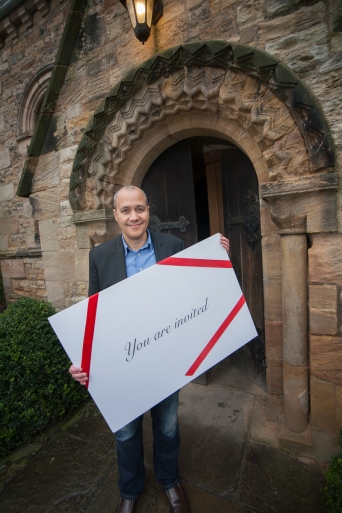
One of the things that has been fun about living in a new community is being able to operate under the radar for a little while.  I had not started my job yet when my oldest child began her first week in her new school.  That meant I was able to go to the bus stop in plain clothes – where my collar did not cue in the other parents as to what my occupation is.  It was a wonderful experiment because I was able to quickly see how or whether people talk about their faith in this new community.

By the second day, one of the moms introduced herself to me.  She was incredibly friendly and helpful, trying to ascertain how much we had begun to integrate ourselves into the neighborhood.  Within five minutes, she mentioned how I might enjoy bringing the kids to vacation bible school at her church this summer.  She followed up that invitation by asking if I had started looking for a church home.  At that point in the conversation, the cat was out of the bag.  Not only did I have a church home, I was that church’s new pastor.  As I walked home that day I was impressed by her natural and quick ability to do the simple and powerful:  invite me to church.

There is a duo that I have come to love called the Skit Guys.  They do funny skits that poke fun at us church-going people while also exposing, challenging, and encouraging us in our weaknesses.  Some of my favorite skits, like this one, challenge why people do not ever think to invite others to church.   They make the invitation part seem so simple.  At the new bus stop, I realized how right they are.

You are Invited

Photo credit:  www.christiantoday.com/article/church.asks.too.much.of.us.thats.why.we.dont.invite.our.friends/47064.htm

So, this week, I invite you to do the same.  Maybe your child has been at the bus stop all year, but you never broached the “religion” topic with another parent.  Maybe you had a casual chat with someone at the hair salon or barber shop, but you did not think to mention your church.  Maybe you were at a bar or a restaurant and were talking politics and religion, but never asked if they have a good church home.  This week, I invite you to go for it.  Perhaps the person already has a church home and you will hear about some cool ministries they are doing.  Perhaps the person was scorned by the church and you can be a pastoral ear, sharing the times when church has been both hard to be a part of and times when church has been a blessing for you.  Or perhaps the person has been waiting to be asked.  I’m sure you will have a great story to tell if that is the case!  Good luck!

Sermon – John 13.31-35, E5, YC, April 24, 2016

Tags

, , , , , , , , , , , , , , , ,

A few years ago, some friends of mine engaged in the elevator speech challenge.  The idea was simple.  If you were stuck in an elevator with someone for thirty seconds and were asked to tell them about your faith, what would you say?  The challenge was to explain to someone your faith in Jesus Christ in thirty seconds or less.  I remember when my friends started sharing their elevator speeches, I was totally intimidated.  First, I knew that if someone actually asked me to do this in an elevator, I would probably stutter through some answer, mostly filled with “ums” and “you knows,” and not much of substance.  But more importantly, even when I tried to sit down and give myself way more than thirty seconds to formulate my thirty-second speech, I could not do it.  I could not figure out how to distill everything that had happened to me in my faith journey, why I still believe and am so devoted to church, and who I believe the three persons of the Godhead to be.

The last night in the upper room that we hear about in our gospel lesson today is a little like Jesus’ elevator speech.  Although the disciples did not fully grasp the importance of that night, Jesus certainly did.  If you remember, back on Maundy Thursday, we joined Jesus and the disciples on this night.  Jesus tells the disciples many things.  He teaches them about the importance of servitude as he washes their feet.  He teaches them how to celebrate the Lord’s Supper.  But when Judas leaves at the beginning of our reading today, Jesus knows he is out of time.  The end is coming and he desperately wants to leave the disciples with a few words of wisdom.  Knowing his time is up, Jesus does not tell anymore parables or give them any convoluted metaphors.  He keeps his words simple and direct.[i]  “Love one another,” he tells them.  “Love one another as I have loved you.”  That is all he gives them.

His words are simple, perfect, and beautiful.  I am sure those words were in many of the elevator speeches I read.  God is love.  Our call is to love as Jesus loved us.  That is how others will know us to be Christians – through our love.  The problem is this:  though “love one another” sounds simple, perfect, and beautiful, loving one another is really hard work.  Think about that one family member who is so difficult – the sibling who always tries to start a fight, the family member who always has some story about why they need to borrow money from you, or that aunt who is just plain mean.  Jesus says we must love them.  Or think about that classmate who started a nasty rumor about you, the coworker who took credit for your idea, or that friend who shared your confidence with someone else.  Jesus says we must love them too.  Or think about that political candidate that you cannot stand, that religious leader who constantly says offensive things, or that homeless person you tried to help who was completely ungrateful.  Jesus says we must love them too.  Jesus words, “Love one another,” are simple, perfect, and beautiful.  But Jesus’ words are also hard, frustrating, and sometimes seemingly impossible.  Loving one another is at times the most wonderful, rewarding thing we do in this life, and at times is one of the most challenging, difficult things we do in this life.  But we love because that is what Jesus taught us to do.

Today we will baptize a child into the family of God.  Baptism is our sacred initiation rite.  During any initiation rite, we normally summarize what is most important to us so that the newly initiated person knows what we expect from her.  In this case, the parents and Godparents will be reminded of our ultimate priorities so that they can teach her in the years to come.  Most of those promises and priorities come in the baptismal covenant.  We ask five questions:  Will you continue in the apostles’ teaching and fellowship, in the breaking of the bread, and in the prayers?  Will you persevere in resisting evil, and, whenever you fall into sin, repent and return to the Lord?  Will you proclaim by word and example the Good News of God in Christ?  Will you seek and serve Christ in all persons, loving your neighbor as yourself?  Will you strive for justice and peace among all people, and respect the dignity of every human being?   The questions are big questions – the guiding principles of our faith.  But most of the questions boil down to that night in the upper room:  love one another.

As we think about baptizing Elaina today, and teaching her to love, some of us may feel overwhelmed.  We know how hard loving is.  Elaina will even teach her parents and godparents how difficult loving is:  when she learns and uses the word “no!”, when she throws her first epic temper tantrum, or when she first utters those dreaded words, “I hate you!”  But Elaina will also teach the parents and godparents how wonderful love is:  when she first calls you by name, when you first see her helping someone or tenderly comforting a crying friend, or when she finally learns those wonderful words, “I love you!”  Everyday her parents and godparents will have the chance to teach her about what her baptism means by showing her how to love.  They may not have a patented elevator speech, but Elaina will understand what her Christians identity means when she sees what “love one another” really means.

But today is not just about Elaina, her parents, and her godparents.  Today is for all of us.  Today is a day when we too can take stock of how well we are living into our own identity as baptized children of God.  Every day we can take a moment to remember where we have failed to show love and where we have excelled in showing love.[ii]  The moments will be small and sometimes seemingly inconsequential.  But all those tiny moments add up to a lifetime of loving one another.  And today we will promise to, with God’s help, keep trying to be a people who love another.  Loving one another may not be a fancy elevator speech.  But loving one another might be much more powerful in the long run than any fancy words we can assemble – because Jesus’ commandment today is not so much about what we believe, but about how we live.[iii]  Jesus did not tell us to love one another because he knew loving one another would be easy.  But Jesus did tell us to love one another because he knows that we can.  He has seen each one of us do that simple, perfect, and beautiful act.  Today, he invites us to keep up the good work.  Amen.

[i] Gary D. Jones, “Pastoral Perspective,” Feasting on the Word, Year C, Vol. 2 (Louisville:  Westminster John Knox Press, 2009), 468, 470.

[ii] David Lose, “On Loving – and Not Loving – One Another,” April 21, 2013, as found at https://www.workingpreacher.org/craft.aspx?post=2542 on April 20, 2016.

[iii] Jones, 470.

On change…

Tags

, , , , , , , , ,

A baby crying it out.

Photo credit:  www.slate.com/articles/double_x/the_kids/2013/07/clinical_lactation_jumps_on_the_dr_sears_bandwagon_to_say_sleep_training.html

Once upon a time, I had a parishioner complain to me, “I knew you were going to change things.  I just didn’t know it was going to be all at once!”  At the time, her complaint seemed unwarranted to me.  I did not feel that the changes were all at once at all.  In fact, I was careful not to change things all at once, but made changes slowly and methodically.  Though we talked through her concerns, I remember thinking flippantly that no one really likes change and perhaps that was the real source of her complaint.

This week, I have a lot more sympathy for that parishioner.  My family’s life has been upended by change.  Most of the change has been good – new jobs, new schools, and a new home.  There has been a flurry of activity, and the excitement of a move has carried us through.  Of course, I had forgotten how hard and time-consuming unpacking can be.  I also totally forgot that our young children would be having their own reactions to the move.  But we hit a breaking point Sunday night.  Our two-year-old decided it would be a great time to finally figure out how to get out of her crib.  So for about two hours we went back and forth trying to figure out ways to cajole her into going to sleep.  Of course, the developmental milestone of getting out of one’s crib was to be expected.  But that change on top of everything else made me want to cry, “I knew things were going to change.  But does it have to be all at once?!?”

The truth is, I do not think that the pace of change really matters.  I think what really matters is who gets to make the decision about the change.  When we are making changes ourselves or when we have control over the decision among a group, change does not feel so unsettling.  By having decision-making authority, we feel some modicum of control over the situation.  But when someone else is making decisions that impact us and that change what we are used to, we feel powerless, even if the change is for the better.

Having had the experience with my two-year-old, I am reminded of my need to be sensitive to others’ feelings about change and control as I begin a new pastoral relationship at Hickory Neck Episcopal Church.  Knowing how it feels to have everything changing at once, I will try to be more intentional about communicating, educating, and getting buy-in.  Change is most certainly coming – for me and for the community.  My hope is that we can love one another through the change and trust God and one another in the process.  There will be times when change feels like it is happening all at once.  But there will also be moments when we look back and say, “I guess that wasn’t so bad!  In fact, it was really good.”  Here’s to an exciting, supportive, and encouraging journey!

Sermon – Acts 9.36-43, E4, YC, April 17, 2016

Tags

, , , , , , , , , , , , , , , , ,

This morning I want start with some thanksgiving.  I would like to thank the members of the Search Committee and the Vestry for being so faithful in prayerful discernment with me and the other candidates for Rector of Hickory Neck Episcopal Church.  My interactions with them gave me a sense of hope and joy about what lies ahead for us as a community of faith.  Though I know he has moved on to his next cure, I would also like to thank Henry for being such a faithful shepherd among us, especially during a time of transition and upheaval while still being new to the priesthood.  He paved the way for us to be ready for this next phase of ministry.  And finally, I would like to thank each one of you.  You have put a tremendous amount of prayer and trust into this process, and I am grateful for your support of this parish.  I am looking forward to learning about your ministries in this place and helping bolster your good work in the world.

The people of Hickory Neck are in good company today.  In our reading from Acts this morning, we hear about another faithful servant of God.  Tabitha, also known in her community by the name Dorcas, is a disciple renowned for her good works and acts of charity.  We know that she is an adept seamstress, who uses her sewing prowess to clothe the needy in her community.  We know that her witness and work are so powerful that the widows who benefit from her charity are found weeping by her deathbed.  We know that her discipleship is so profound that two men journey to a nearby town to find Peter in the hopes that he might be able to do something miraculous for the woman who was a miracle for so many others.[i]

As I prayed with Tabitha this week, I realized how many similarities her witness shares with Hickory Neck’s witness and ministry.  One of the reasons I was attracted to Hickory Neck during the discernment process was the vibrancy of ministry and the health of the congregation.  I was impressed to learn that thousands of dollars raised by your annual Fall Festival go directly to supporting local outreach ministries.  I have enjoyed hearing stories about making meals, visiting prisoners, and collecting goods for our neighbors in need.  But even more impressive to me is the desire among parishioners to do more:  to dream bigger dreams about how not only we can use our hands to more directly serve the poor, but also how we might use the gift of this property more creatively to be a living witness of the love of Jesus in our community.  What I saw in the discernment process was a church who is healthy and vibrant and who is poised for new and exciting work.

Now what is funny about all those good vibrations is that juxtaposed with that percolating vision is a community who has been treading water.  After the decline of your last rector, a shortened interim period, and making due with only an assistant, many of you have also shared with me your sense that these last few years have also been a time of getting by, but maybe not necessarily thriving.  I would never suggest that these last years have been like a death – but maybe like a time of hibernation.  Like an animal who lives off their stored up energy and fat over the winter, Hickory Neck has been getting by with the things that she learned long ago:  good worship and music, solid pastoral care and welcome, and powerful outreach ministries and educational opportunities.

Now Tabitha is not hibernating.  According to Luke’s writing in Acts, Tabitha is not just sleeping.  She becomes quite ill and dies.  Truthfully, if Tabitha had been in a deep sleep, her story might be a little easier to believe.  I do not know about you, but miracle stories like Tabitha’s are always a little strange to me.  Whether the story is the one from First Kings, where Elijah brings the son of the widow back to life after a strange ritual of laying himself over the dead boy’s body three times[ii]; or whether the story is of Jesus raising his friend Lazarus from the dead after four days in the tomb[iii]; or whether the story is this strange one where Peter prays over a dead disciple and simply says, “Tabitha, get up,” and she does, these stories always seem strange to me.  One, I do not really understand the mechanics of raising someone from the dead.  Having never seen such a miracle myself, I cannot imagine how or why such a thing happens.  Perhaps I am too jaded by modern science, but part of me just does not understand raising people from the dead.  Two, I do not understand why people are raised from the dead.  The idea sounds great in principle.  I am sure the mourning families and friends are incredibly relieved.  But, with the exception of Jesus, all of the people who are raised from the dead must have to die again eventually.  I’m not sure why people even bother.  Finally, what I really do not understand about these stories is what they mean for us today.  Though we love these biblical stories, I know plenty of people who would like to see their loved ones raised from the dead.  Many of them might even have a case based on the good works they have done, like Tabitha.  Surely people like Tabitha deserve another chance to keep making a difference in the world!

Regardless of the fact that the text does not tell us how, or why, or even why not someone else, what the text does tell us is that Tabitha is in fact dead, Peter in fact raises her from the dead, and then the alive Tabitha is presented to her people, presumably to get back to doing all the good works and charity she had been doing before – or perhaps even better works of charity.  Implicit in Peter’s words, “Tabitha, get up,” is the notion that Tabitha’s work is not done yet.  In fact, Tabitha must have even greater works to do.  God is not done with Tabitha yet.

That is what I love about this story for Hickory Neck.  God is not done with us yet either.  As I was reading up about hibernation, one of the things I learned is that some species, like polar bears, hibernate while gestating their young.  I was blown away by that realization.  Pregnancy is that time when the host is usually taking on more calories, building up muscles to prepare for the birth, and dealing with the activity of a developing fetus – especially once the kicking begins.  I cannot imagine sleeping through that whole process or storing up enough sustenance to help both bodies grow and thrive during hibernation.

But the more I thought about the hibernating polar bear, the more I realized that is exactly what has been happening with Hickory Neck.  Perhaps these last couple of years have felt like a hibernation period – a time of lower energy and output.  But I wonder if Hickory Neck is not unlike a hibernating mama polar bear.  Though we have been keeping things steady, we have also been working hard on nurturing and producing new life.  We have not been sleeping to survive a cold spell.  We have been resting to cultivate and grow new life – a new life which is about to be born.

Today, Peter’s words and actions are for us too.  The text tells us that when Peter arrives he sends everyone outside, kneels down, and prays.  We have been praying too.  We have been praying that God guide us through a time of turbulence and transition, we have been praying that Jesus nurture us during our time of hibernating, and we have been praying that the Holy Spirit help us explode with renewed energy and life.  After Peter prays, his words to Tabitha are simple, “Tabitha, get up.”  Hickory Neck has received a similar charge.  When the Holy Spirit led us to one another, we heard the same words.  “Hickory Neck, get up.”  God is not done with us yet either.  That new life we have been gestating is eager to be born in and through us.  Finally, one more thing happens in our text.  The text says, “Peter gave Tabitha his hand and helped her up.”  Though Peter’s words are unambiguous to Tabitha, Peter does not expect Tabitha to get up and get to work alone.  He offers her a hand.  The same is true for us.  Though we are charged to get up and start caring for this new life we have been nurturing, we do not do the work alone.  The Holy Spirit is reaching out to us to help guide us to our feet.  I will be reaching out my hand to each of you, but I will also need you to reach your hand out to me.  And, more importantly, we will also need to reach out our hands to those not yet in our midst, who will be a part of the new life we have been gestating.  I do not know about you, but I cannot wait to see what our new growing family looks like.  So, Hickory Neck, get up!  Amen.

[i] Stephen D. Jones, “Homiletical Perspective,” Feasting on the Word, Year C, Vol. 2 (Louisville:  Westminster John Knox Press, 2009), 429.

[ii] 1 Kings 17.17-24

[iii] John 11.1-44

On hollowness and hallowedness…

Tags

, , , , , , , , , , , , ,

Empty-Property

Photo credit:  https://www.nationalpropertytrade.co.uk/dealing-with-empty-property/

As I mentioned recently, I have moved a lot in my lifetime.  If my calculations are correct, I have moved about 15 times (and that’s only counting college once, despite the fact that I moved to a different dorm every year, and twice my junior year).  As you might imagine, the moves have occurred over a lifetime – from as young as one-year old to this move in my late thirties.

At some point over the years of moving I developed a tradition.  When the whole house is empty, the truck fully loaded, and the cars ready to pull out, I quietly slip back into the house and walk through every room.  There is something about the hollowness of an empty home that you have lived in:  the echo of your feet as you walk through the house, the lingering hints of artwork once hung, and even the scents of people or food.  There is an ache that the emptiness causes – a finality like none other.  But there is also the rush of memories:  the child you brought home from the hospital, the sleepless nights as the toddler transitioned to a “big girl bed,” the parties and family celebrations, and the countless visitors.  In the silence of the empty house you can hear the hint of years of laughter, remember the nights of tears shed, feel the warmth of a child rocked to sleep, and see the shadows left by the lamp as you wrote by night.  Though the house is empty, the house has been your home, steeped in love for however long you have been there.  The hollowness reveals the hallowedness of the space.

This week I continued the tradition.  Though I have given myself little time to grieve the phase of my life’s journey, tonight I realized how sad I am to close this chapter.  God has been so very good to us here – four years of marriage and children and work and play is a lot.  We have been blessed by new friends and experiences.  We have grown and changed for the better.  In the quiet of the house, I am deeply grateful for the abundance God has shown us.  God is good.  All the time.

Reconciling Preparedness and Blessedness

Tags

, , , , , , , , , ,

MovingDay_081415_main

Photo credit:  www.bestofboston.com/best-of-boston-all-stars-liberty-hotel/

For those of you who know me well, you know that I am not the friend you want nearby in case of an emergency.  I’m not the quickest thinker on my feet.  I could tell you of countless stories involving blood and fire at construction sites to prove my point.  Knowing that weakness, I tend to compensate through preparation.  I will plan, think through various contingencies, and consult experts to make sure that if an emergency comes up, I do not have to think on my feet as much – I’ve already figured out various scenarios.

So for a consummate planner and preparer, you can imagine how this move has put me over the edge.  I, perhaps crazily, decided that my last Sunday at my current parish would be Easter Sunday.  The movers would come later in the week, and then we would head out by week’s end.  I had a plan.  But then I forgot how busy Lent and Holy Week are.  I forgot how challenging dealing with children who are on break can be.  I forgot how many logistics would be necessary for buying a new home, starting new schools, and starting a new job.  I forgot how much time I would need to commit to spending time pastorally with the parishioners who had been in my care for the last four-plus years.  Consequently, when the packers arrived today, I was nowhere near as prepared for them as I had planned.

Now that may not sound like a big deal, but as someone who is a crazy planner and as someone who has moved more times than I can count, this a grave disappointment.  By Wednesday night I was in a panic about how little was done.  I was aghast at my lack of preparation.  All that purging, all that organizing, all those donations, all that cleaning I had planned went mostly undone.  For someone like me, this is the ultimate anxiety-inducing experience.

So this morning, as I sit with packers in a flurry around me, I am working on breathing.  I am working on accepting I have done what I can do.  Despite my inner criticism, I am working on listening to the reassuring voice of God telling me, “Well done, good and faithful servant.”  Instead of concentrating on the list of incomplete things, I am reflecting on all the good and wonderful things of these last weeks:  heartfelt goodbyes, beautiful liturgies, yummy food, laughter and tears, and hugs and kisses.  I am recalling all the blessings of these years with St. Margaret’s and the community of Plainview.  And I am overwhelmed with gratitude for the ways that God has been with me in the midst of it all.  I am gloriously unprepared today – but that lack of preparation has opened a window for the goodness of God to take over.  Thanks be to God!!