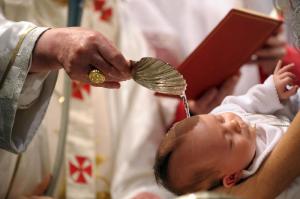
Always go to the baptism…

Tags

, , , , , , , , ,

At St. Margaret’s we are in the middle of two big weeks.  This past Sunday we baptized twin girls and this coming Sunday we are baptizing another baby girl.  It is fairly rare for our parish to have back-to-back baptisms.  For the Altar Guild, that has meant that the same paraments can stay on the altar, the Pascal Candle can stay in the sanctuary, and flowers will be equally festive.  For the liturgical leaders it means that the occasionally used service is much more familiar as we head into this weekend – we should not need as much preparation and should be primed for who is holding what and when (it turns out there is a lot of choreography when it comes to liturgy!).  And for the parish, the liturgy will be very familiar and they will be ready for their big line, “We will!” when it is their turn to affirm that they will do all in their power to support these persons in their life in Christ.

But just because this coming Sunday feels familiar or even repetitive, nothing about it is rote.  That is the thing about baptisms:  although everything surrounding the day is the same, the experience is totally unique.  In the Episcopal Church, we only baptize once.  A baptism is a once-in-a-lifetime experience, something that is tremendously significant and special.  Nothing can invalidate our baptism.  Once we are welcomed into the household of God, nothing the person does can take away that status.  Baptism is a big deal.

I have often heard it said that you should never miss a funeral.  A funeral only happens once, and is something you can never recreate.  Though many of us fear what to say or do or how to approach the family, just being there becomes a blessing to the bereaved and to you.  It is a practice many have come to value:  always go to the funeral.  In fact, I began to embrace that mantra fully after seeing this story.

I think the same can be said of a baptism.  Though the liturgy is always the same, the liturgy says and does something very important.  It is not about the pretty dresses or handsome outfits.  It is about a sacred thing that happens.  It is about committing to a way of life – declaring the importance of faith in one’s life and agreeing to live in a certain way.  It is about renewing our own commitment to our baptismal covenant – something that, if done regularly, could probably help us change the world.  And it is about standing tall as a community, and taking ownership for the ways in which we form one another.  When we jubilantly say, “We will!”, our commitment is to being a community that lives life in a radically different way – in seeking Jesus, in serving Jesus, and in sharing Jesus.  When we stand at the font as a community we are claiming a radical identity that changes everything in our lives.  Something bold, invigorating, and life-giving happens at baptism.  You may think that if you have seen one baptism, you have seen them all.  On the contrary, I suggest that each one has a unique way of transforming us in Christ.  For the health of ourselves, the community, and the newly baptized, we need to be at the baptism as much as the family wants us to be there.  Always go to the baptism.  It will change your life.

Sermon – Mark 5.21-43, P8, YB, June 28, 2015

Tags

, , , , , , , , , , , , , , ,

Today we are surrounded by some powerful women.  Many of you do not know Charlotte and Piper, who we are baptizing today, but they came into the world fighting.  While they were in the womb, their lives were threatened.  Doctors were able to operate in the womb at twenty-one weeks to ensure their survival.  Despite that help, they were born early and very tiny, but amazingly, had to have very little medical support.  Once they gained weight, they were able to come home and enjoy a healthy infancy.  My guess is that the strength these two children of God harnessed is what has pulled them through – a strength that their parents might regret when they hit their teenage years!

When we baptize Charlotte and Piper, we will baptize them into a communion full of strong saints – women who have paved the road before them, who have shown great faithfulness and strength, and who will serve as mentors and guides in their earthly pilgrimage.  We meet a couple of those women today.  First we meet Jairus’ daughter through her father.  Now, we might not think of her as a strong woman, since she is near death, but this young woman was powerful nonetheless.  She evokes such devotion in her father that he, a synagogue leader, is willing to bow down to the controversial Jesus and beg for healing for his dying daughter.  Jairus’ love for this powerful young woman made him willing to cross boundaries, to show vulnerability, and put great faith in Jesus.  We also know that Jairus’ daughter is twelve, about the age that women start menstruating, making them capable of producing life – one of the most powerful gifts of nature.  Though she is at death’s door, her power as a woman and as an individual bring people like Jesus to her, so that she might be restored to wholeness of life.

Of course, we also meet another strong woman today.  By all accounts, this woman should not have been strong.  In those days, menstruation alone meant that women had to be separated from the community for a period of time for ritual impurity.  But to have been bleeding for twelve years means that this woman has been ostracized from others for as long as Jairus’ daughter has been alive.  Furthermore, she spent all her money trying to obtain healing from doctors.  Her poverty and her impurity make her a double outcast.[i]  But this woman will not quit.  She boldly steps into a crowd (likely touching many people that she ritually should not) and she grabs on to Jesus’ clothing, knowing that simply by touching Jesus she can be healed.  She does not ask Jesus to heal her or mildly whisper among the crowds, “Excuse me Jesus, could you please heal me?”  No, she takes matters into her own hands, and though Jesus demands to speak with her, her own determination and faith make her whole.

In many ways, the baptism that we witness today is a same expression of strength and faith.  When we are baptized, we (or in the case of infants our parents and godparents) boldly claim the life of faith.  We renounce the forces of evil and we rejoice in the goodness of God.  We promise to live our life seeking and serving Christ, honoring dignity in others, and sharing Christ in the world.  This action is not a meek or mild one.  This action is an action of boldness – one in which we stand before the waters of baptism, and stake our claim in resurrection life.

Now, here’s the good news:  even though we are surrounded by powerful women today and we are doing and saying powerful things, we do not always have to be strong.  All the women we honor today are strong – but they have moments of weakness too.[ii]  I am sure over the course of twelve years, the hemorrhaging woman has doubts.  As bold as she is today, I am sure there are moments when she fears – maybe even that day – whether she could really reach out and claim Jesus’ power as her own.  And as Jairus’ daughter feels the life fade from her, I am sure she doubts.  I am sure she wonders whether she will ever be able to claim the life-force that is budding inside of her or to live a long life honoring her parents.  And though Charlotte and Piper have been warriors thus far in life, they will both have their own doubts and weaknesses.  In fact, that is why we as a congregation today promise that we will do all in our power to support them in their life in Christ.  That is why her parents and godparents promise by their prayers and witness to help them grow into the full stature of Christ.  That is the good news today.  For all the moments of strength that we honor in one another, we also honor the doubts, fears, and weaknesses.  God is with us then too, and gives us the community of faith to keep us stable until we can be strong witnesses again.  Amen.

[i] Mark D. W. Edington, “Theological Perspective,” Feasting on the Word, Yr. B, Vol. 2 (Louisville:  Westminster John Knox Press, 2009), 190.

[ii] David Lose, “Come As You Are,” June 24, 2012 at https://www.workingpreacher.org/craft.aspx?post=1493 found on June 25, 2015.

Seeing dignity…

Tags

, , , , , , , , ,

This weekend I finally saw The Intouchables, a 2011 film based on the true story of a French, wealthy quadriplegic who hires a man convicted of petty theft to be his caregiver.  The quadriplegic, Philippe, has been through many caregivers.  He is a widower who lost the use of most of his body in a paragliding accident.  He is bitter and does not like the way that most highly-skilled caregivers treat him more like a patient than a person.  Meanwhile, Driss applies for the job simply to obtain governmental unemployment benefits, assuming that Philippe will never hire him.  Philippe is intrigued by this man who shows him little respect, and hires Driss.  The two begin a relationship that is different than any either of them had known.  Philippe is finally able to rediscover a joy for life and reimagine what his life can be.  Meanwhile, Driss begins to see that he can have value too – that perhaps he can start anew with life, providing for his family and having a new sense of self-worth.

What I loved about this film was two-fold.  First, I had anticipated this being a sober, but triumphal movie.  Instead, I found myself laughing throughout the film – not at a slapstick humor, but at the kind of humor one develops when things get so bad that laughter is both the inappropriate and most appropriate thing to do.  It is an irreverent humor that only two characters who have been pushed to the margins can deeply enjoy, and yet, those outcasts invite us in to our own darkness and bring us out with laughter.  The second thing I loved about this movie is the way in which each character was able to see humanity in one who had been stripped of their humanity.  For Philippe, his physical disability had taken away his ability to full participate in society.  Society struggled to see any value in him beyond his money – which is not a value for which anyone wants to be known.  For Driss, he was a criminal who was unable to hold down a job and be a responsible citizen.  Society struggled to see any value in him, leaving him limited options.  And yet, in Philippe, Driss was able to unearth an adventurous, funny, sarcastic man of compassion and fortitude.  And in Driss, Philippe was able to unearth a sympathetic, strong, talented man of wisdom and grace.  In essence, they could see the humanity in one another.

When we reaffirm our baptismal covenant, one of the promises we make is to respect the dignity of every human being.  Over and over we make that promise, and yet I think it is one of the hardest things we promise to do.  It is very difficult to respect the dignity of the guy who cuts you off in traffic.  It is very difficult to respect the dignity of your family member who constantly puts you down.  It is very difficult to respect the dignity of the man who kills nine Christians in a church because of their race.  This past Sunday, as we were editing the Prayers of the People, I found I had no problem listing the names of the deceased from Charleston.  Where I struggled was adding the killer’s name to our list too.  That action went against every instinct in my body, and yet, some small ache made me feel like I had to add him too.

Respecting the dignity of every human being is not a one-time action.  It takes a lifetime of practice.  We fail at it all the time, but we keep recommitting to the work because we promised we would at our baptism.  What encouraged me about that work this week, was the relationship between Philippe and Driss.  Watching two men, so dramatically different, and yet similar in the way that society treated them as outcasts, heartily laugh from the depths of their souls gave me hope.  They gave me hope that I might see the dignity of others through my own brokenness.  The promise for my work is that I too would find the joy that only hearty, full-bodied laughter can bring.

Sermon – Mark 4.35-41, P7, YB, June 21, 2015

Tags

, , , , , , , , , , , , , , , , , , , , ,

A long time ago, we got on a boat.  We were not really sure what was going to happen while we were out to sea, but we got on the boat because we were curious.  We had an experience, or maybe multiple experiences with a man named Jesus, and something about those experiences compelled us to get on the boat.  Maybe the experience happened as early as Sunday School, maybe the experience happened when we were confirmed, or maybe the experience happened as an adult.  We may not even be able to articulate the reason why we got on the boat.  But all of us, at some point, step onto the boat, however tentatively or boldly, and we sail with Jesus to the other side.

The disciples have that same experience in today’s gospel lesson from Mark.  After a long day of preaching and teaching, during which Jesus pulls them aside and explains parables to them, Jesus says, “Let us go across to the other side.”  Now if the disciples had been smart, they would have asked some questions: “What is on the other side?  What if a storm comes?  Can’t we just stay here and get a good night’s rest?  This place is familiar and comfortable.”  And they should have asked questions.  The “other side” of that body of water is exactly that – other.  The other side is Gentile territory, the land of the Gerasenes.  Jesus is taking his first journey into what might be considered dangerous, and even inappropriate.  Jesus is beginning a ministry beyond just the Jews.[i]  “Let us go across to the other side,” is no “Hey, let’s mix things up this year and go to Cabo.”  Yes, the disciples should have asked a lot more questions.[ii]

But they do not.  Something about this Jesus compels them forward, stepping on and manning that boat without question.  That’s the funny thing about Jesus.  We too got on a boat because of him, probably having no idea what we were getting into.  Suddenly we find ourselves cooking casseroles, watering gardens, and bringing in men’s undergarments for our needy neighbors.  Suddenly we find ourselves getting asked by the Rector to serve on some committee.  Suddenly we find the news of the day is not so simple when we remember all those words we said in our baptismal covenant about seeking and serving Christ, loving our neighbor as ourselves, and sharing the Good News.  We really should have asked more questions before we got on that boat to follow Jesus.

I have been thinking about that boat a lot this week.  You see, some of our fellow disciples were murdered this week – nine to be exact, in Charleston, South Carolina.  They were praying and reading Holy Scripture – just like we do every Thursday.  They even welcomed in a stranger that night – like Jesus always tells us to do.  That very stranger turned out to be crazy, filled with racist rage, and willing to kill nine people before fleeing.  At least that was how I saw the episode at first.  At first, this was another instance of a crazy person, senselessly killing other people.  But then the prophets of our time began to speak.  The prophets reminded me that violence proliferates in our society.  The prophets reminded me that because we cannot agree on a reasonable gun policy, more and more people die in our backyards.  The prophets reminded me that our African-American brothers and sisters in this country experience very fragile and virtually non-existent safety – they cannot even be safe in church.  There was a part of me that wanted to stay on the shore this week and say, “Oh, Jesus, that was just an isolated event by a crazy kid with extremist views.”  But I had already gotten on the boat.  It was too late.  And a storm began to rage.

That storm for me was the storm of our time:  a storm of violence, racism, and suffering.  No longer could I contain each story:  Trayvon Martin, Ferguson, Sandy Hook, Baltimore, Columbine, Selma, Charleston.  One story bled into another, and as I was reminded of each one, I felt the buckets of water dousing my face.  As I thought about every conversation I have had about how racism is not dead, I felt the water creeping up to my waist.  As I thought about the historical shadow of the oppression of others in our country, I wanted to cry out to God.  And all I could think about was Jesus on that stupid boat, asleep on a cushion in the stern.  Who can sleep at a time like this?  Doesn’t Jesus care about us at all?  Why couldn’t we have just stayed on the shore in that comfortable, familiar place instead of getting on the God-forsaken boat with a man who does not seem in the least bit bothered by our suffering?

The disciples know that feeling.  They are experienced at life on a boat.  At least when they get on the boat, they knew how to manage a boat.  They know the dangers and the perils, and have learned to navigate them for the necessity of survival.  But even these experienced fishermen are scared.  They have tried to control the boat, they have scooped out as much water as they can, and they know they have met their match.  And so they go to their last resort.  They wake up Jesus and shout, “Teacher, do you not care that we are perishing?!?”  When they got on that boat, this is not what they were expecting.  They were expecting the fulfillment of a promise – the fulfillment of a different life and a different world:  the kingdom of God here on earth.  Instead they were going down fast with a man who could not even stay awake and fight the good fight with them.

I shouted those words this week too.  Teacher, do you not care that we are perishing?  Maybe we brought all this violence on ourselves, but surely you care?  Surely you did not lure me onto this boat – into this relationship with you – only to watch us perish?  Though I wanted more than anything to think this was an isolated event of a crazy person doing something ungodly, I could not ignore the storm swirling around.

I struggled to find hope today in our gospel lesson.  All I saw was Jesus scolding the disciples for their fear and their lack of faith.  And then I saw disciples even more afraid than before – which is saying something given the awfulness of that storm.  Straining for some strand of hope – some glimmer of redemption – I came back to that invitation from Jesus, “Let us go across to the other side.”  Jesus does not tell the disciples to go to the other side alone.  Jesus does not say, “Go to the other side without me.”  Jesus says, “Let us go to the other side.”[iii]  Whether the disciples felt like Jesus was with them during that storm or not, Jesus was with them.  That may not seem like much, but that may be the biggest miracle of all in this story.  As one scholar writes, “God’s power isn’t in the control of creation or of people, but in being in covenant and relationship with them.  [God’s power] isn’t in imposing the divine will or insisting on its own way but in sojourning with us as we fumble around and make our way in the world.  God’s power is not in miraculous interventions, pre-emptive strikes in the cosmic war against suffering and evil, but in inviting us to build a kingdom out of love, peace, and justice with God.  God’s power is not in the obliterating of what is bad in the world, but in empowering us to build something good in this world.”[iv]

A long time ago, we got on a boat.  We did not know where we were going, what we would see, or who we would encounter.  All we knew was that Jesus was inviting us into a different life, and we felt compelled by this passionate, nonsensical man.  Oh, we had clues.  We knew that the “other side,” was not a place we wanted to go.  We knew that going there might change us, and change our entire worldview.  We knew that getting on that boat would mean stepping away from the familiar, comfortable coastline, and sailing into something different and scary.[v]  But Jesus said he would go with us.  Jesus invited us on a journey with him and something deep inside us, despite the little devil on our shoulder telling us to stay put, told us to step onto that boat.

I am still scared of the storm.  In fact, I am a little afraid of Jesus too.  But what brings me comfort this week is that Jesus is with us.  Jesus does not invite us onto a boat and let us sail alone.  And though Jesus may have an ability to sleep through a storm, with complete confidence in the direction of God, I also know that Jesus will wake up and respond to me when I call out his name.  He may not say what I want to hear.  He may leave me feeling more uncomfortable than getting soaked in a storm.  But he is here.  Jesus is here on our boat, and can make things right.  We just have to be prepared to go to the other side.  Amen.

[i] Beverly Zink-Sawyer, “Homiletical Perspective,” Feasting on the Word, Yr. B, Vol. 2 (Louisville:  Westminster John Knox Press, 2009), 165.

[ii] This train of thought comes from Karoline Lewis’ writing “The Other Side,” June 14, 2015 as found at https://www.workingpreacher.org/craft.aspx?post=3645 on June 18, 2015.

[iii] Lewis.

[iv] David R. Henson, “When God Sleeps through Storms (Lectionary Reflection for Mark 4:35-41),” June 15, 2015 as found at http://www.patheos.com/blogs/davidhenson/2015/06/1804/ on June 18, 2015.

[v] Lewis.

On Father’s Day…

Tags

, , , , , , , , , ,

In general, I am opposed to “Hallmark Holidays.”  I learned a long time ago on Valentine’s Day how consumerism fueled by one stationery company (and let’s be honest, the restaurant industry, floral industry, chocolate industry, jewelry industry…) could make a person feel invalidated, lonely, or dissatisfied.  As with any consumerism, there really is no one thing that we purchase that can fill a void in our egos and hearts.  And so I stopped wanting an amazing Valentine’s Day and started trying to affirm my loved ones as often as possible on the other days.

The same is true for Mother’s and Father’s Day.  An industry has told us how and when we should specifically honor our mothers and fathers and any resistance makes one seem ungrateful and disrespectful.  Like with Valentine’s Day, I would much rather work intentionally on showing gratitude towards my parents as often as possible – and as a parent myself, I find that my gratitude is much easier to give now that I understand the fullness of their sacrifices, challenges, and struggles to love me in the best ways they knew and know how.

That being said, what really burdens me about Mother’s and Father’s Day is the ways in which they are fraught with emotion.  Not everyone has positive relationships with their parents.  Not everyone has two active parents in their lives.  Not everyone has living parents.  And some of us experience extremes in those areas – parents who were hurtful, abusive, or absent.  But what I had forgotten about until this week is that there are also men who want to be fathers and cannot.  Women are not the only victims of infertility, miscarriage, and infant loss.  So are men.  For those men who have longed to cradle a baby in their arms, to throw a baseball in the front yard with their child, or have a meaningful relationship with their child, Father’s Day is an equally painful day.  And because of the way that we socialize most men, there is rarely a forum for such a vulnerable conversation.  I was humbled by that realization when I read this poem this week:  http://projectpomegranate.org/2015/faith-hope-and-love/.  It gives more voice to that pain than I ever could.

Once again, I am conflicted about Father’s Day.  For the wonderful father and step-father I have been blessed with and the amazing husband and father who is helping me raise our girls, I am eternally grateful.  For all the men who have been mentors and companions on my journey, and for those who are amazing dads to their children, I am equally grateful.  I am also mournful for all those who suffer because of the fraught relationships they have had with their fathers.  I grieve with all those men who want to be fathers and have not been able to conceive.  And I stand with all those fathers who recognize their faults and failures and long to be better versions of themselves.  Father’s Day is a complicated mess.  And so this year, I hold all of us in prayer, as we sort through the complicatedness of life, honor the good, recognize the bad, and celebrate our God who can redeem us all.

Sermon – 1 Samuel 15.34-16.13, P6, YB, June 14, 2015

Tags

, , , , , , , , , , , , , ,

Talking about politics in the pulpit is always dangerous business.  I rarely do because I know that one mention of something political can be so distracting that I lose your attention for the rest of the sermon.  So I am going to ask you to hang in there with me because I think our secular world can teach us something about our sacred world today.  Back in 2008, a young man named Barack Obama was running for president.  Though many of us had no interest in his candidacy, some people saw a sense of hope and the possibility of a change that might bring about a new era of progress.  He even won a Nobel Peace Prize before completing one year in office.  But as time rolled on, many of his enthusiastic supporters began to be frustrated.  The hope they had seen seemed to fade away.  I remember I spoke with someone about this sense of lost hope, and the person confessed, “The problem is that people were treating Obama like he was the next Messiah.  He’s not.  No one is.  We have one Messiah, and we killed him on a cross many years ago.”

In our scripture lessons last week, God warned the people of Israel through Samuel that electing a king would involve such a challenge.  A human king could never give them all that they dreamed about having.  A human could never be God.  Having been fairly warned, the people insisted on having king anyway, and were given Saul.  For a while, things were okay.  Saul seemed to thrive and make progress for the people.  But Saul got cocky.  He overstepped his bounds, and he stopped following God’s instructions.  Finally, Saul made one fatal mistake that cost him his anointed kingship.  He had been instructed to completely destroy the Amalekites and all that they had.  But Saul saved some of the best of the spoils of war – animals, valuable trinkets, even the rival king.  This was the last straw for God, and Saul’s rule was over in God’s eyes.  In today’s lesson we find Samuel grieving over Saul and God being sorry that God had made Saul king of Israel.

We are no stranger to this sort of grieving in the church.  We have watched bishops leave the Episcopal Church in protest of decisions made at General Convention – taking many priests and parishioners with them.  We have watched priests who were seemingly amazing leaders ruin careers and parishes with romantic affairs or financial indiscretions.  Even in our own parish, less than ten years ago, we went through a period of grief when our relationship with our priest required us to dissolve the pastoral relationship, ending for some what had been a meaningful relationship, and for others had been a fraught relationship.  Like Samuel, we grieved that relationship – in fact, many of us still do.  I have heard story after story of grief and guilt about that time.  Some members of the Search Committee who helped select that priest feel as though they did a faithful job in selecting the priest for this parish; but in hindsight, they wonder.  Some leaders of our Vestry feel as though they bent over backwards to accommodate and help our priest thrive as much as possible, but they mourn the way history unfolded and they still feel the scars of that turbulent time.  And some leaders in our parish were so upset by the final decision that their grief drove them out of the church, never to return.

Although Samuel grieves Saul’s demise, God does not allow that grief to be the end of the story.[i]  God sees hope and promise in a way that Samuel cannot.  Seeing that Samuel is not going to be able to move on and do the work God needs Samuel to do, God steps in and guides Samuel into a new future.  Samuel struggles to take those first steps.  When God tells Samuel to get up and go to anoint another king, Samuel is terrified.  He knows that Saul is a vicious king, and will kill Samuel if he finds out.  But God makes a way, creating a “cover story” of sorts to encourage Samuel.  Later, when Samuel meets the eldest son of Jesse, Samuel is certain the eldest will be the next king.  But God has to keep guiding Samuel to the true king – the unexpected youngest son, David.  When Samuel is weak, God is strong – nudging and guiding Samuel into new life.

What I love about this part of Samuel’s story is the way that the story reminds us that God does not call people and merely wish them well and send them on their way.  God empowers those who are called to accomplish what they are called to do.  God walks with them, corrects them, forgives them, protects them, and keeps directing them to see what God sees.[ii]  God is not a passive god, but a “passionate, fully engaged deity, willing to take risks and even expose vulnerability in order to continue the relationship with the people.”[iii]  We see that reality with Samuel, and later we will see that reality with David – who, if you remember, is no saint himself.  Though David becomes the ancestor of the Messiah, David has his flaws that God will journey through as well.

God has been journeying with St. Margaret’s in a similar way.  In our grief from a troubled relationship with our priest, God stepped in and pushed us forward.  God sent us other priests, but more importantly, God sent us new life.  New parishioners joined us, new ministries unfolded, and new life emerged.  God did not allow grief to have the final word.  God knew that there was life beyond our grief – and that life has been born in each of us, and has been renewed by each new person who has joined us in our journey since then.

I have heard this story from First Samuel many times.  Every time I read verse 16, when God says, “How long will you grieve over Saul?” I thought God was scolding Samuel.  I could almost imagine God rolling God’s eyes at Samuel, God’s tone being one of annoyance and exhaustion from Samuel’s lingering grief.  But as I read God’s words this week, and I thought about St. Margaret’s, I heard them with a bit more tenderness.[iv]  I think of the young teen looking over love letters and trinkets, mourning the loss of a romantic relationship.  I think of the man who visits the grave of his wife every week, wondering what is left of life.  I think of the mom whose fingers still rub the ultrasound picture of the baby who did not survive.  God knows the depths of that grief and, even in our passage today, we see that God grieves too.  But, when the time is right, God also saddles in beside us, and whispers ever so gently and kindly, “How long will you grieve?”  The question is not one of rebuke, but one of encouragement.  The question is followed up with some sort of promise for tomorrow.  For Samuel, God promised a new leader and a plan for how to find that leader.  For us, God promises something new too.  God asks us too, “How long will you grieve?  Because when you are ready, I have something tremendous in store.”

Our invitation this week is to ponder anew what that promise is for us.  Grief always has a  place – whether grief over the failure of a leader in our lives or the loss of something or someone dearly loved.  But God will not let grief have the last word.  When we are ready, God stands waiting – not only with new direction, but with a plan to help us.  Our task is to listen.  Our task is to discern the movement of the Spirit already alive and active in us, gently pulling us from our grieving rooms.  Our task is to acknowledge our fear and resistance, and to allow God to guide us anyway.  Grief will not have the last word.  A new promise awaits.  Amen.

[i] Cynthia L. Rigby “Theological Perspective,” Feasting on the Word, Supplemental Essays, Yr. B, Proper 6 (Louisville:  Westminster John Knox Press, 2012), 1.

[ii] Rigby, 5.

[iii] Charles L. Aaron, Jr., “Exegetical Perspective,” Feasting on the Word, Supplemental Essays, Yr. B, Proper 6 (Louisville:  Westminster John Knox Press, 2012), 2.

[iv] The various ways of hearing God’s words were introduced to me by Roger Nam, “Commentary on 1 Samuel 15:34-16:13,” June 14, 2015, found at http://www.workingpreacher.org/preaching.aspx?commentary_id=2473 on June 11, 2015.

Sermon – 1 Samuel 8.4-20, 11.14-15, P5, YB, June 7, 2015

Tags

, , , , , , , , , , , ,

One of the movies I enjoyed growing up was called Freaky Friday.  The movie debuted in the seventies starring a young Jodie Foster, but they remade the movie in 2003 with Jamie Lee Curtis and Lindsay Lohan.  The premise of the movie is a mother and her teenage daughter are at each other’s throats.  They are constantly fighting, arguing that the other person cannot possible understand the difficulties she is facing.  On one fateful Friday morning, the two make a flippant wish.  With great gusto and anger they both say, “I wish you could live in my shoes for just one day!”  Of course the two get their wish, and spend a crazy day trapped in the body of the other.  There are fun mishaps like the under-aged daughter trying to figure out how to drive a car and spending lots of mom’s money which is suddenly at her disposal.  There are also those stressful moments as the mom tries to take a high school test on material she has long since forgotten or trying to navigate being teased at school.  By the end of the movie, both mother and daughter are frazzled by the demands on them, overwhelmingly regretful of their wish, and just want to go back to life the way it was.  They have to work together to figure out how to reverse the wish, which basically includes coming to a point of fully appreciating the difficulties each of them faces in life and loving each other deeply.

Unfortunately, there was no Freaky Friday for the people of Israel in Samuel’s time.  Samuel had been a great prophet for the people, teaching them the ways of God.  But Samuel was aging, and his sons were proving they would not be able to fill Samuel’s shoes, as they were corrupt and abusive.  Normally, the people of Israel would have been on their own until God decided to elect another prophet for them.  But the people of Israel felt threatened.  There were great powers all around them, many of which were battling for power and control.  The Israelites looked to those nations and noticed one major difference between themselves and the other countries – kings!  And so, with great gusto they had Samuel ask God to give them a king.  Now, we have to understand how petulant the Israelites sound.  In their immaturity, they whine, “We want a king!  All the other kids have kings, and we need one too.  Then we will be guaranteed to be protected!”  Samuel is outraged on God’s behalf.  Asking for a king is tantamount to admitting that the people of God do not trust God to protect them.  They are basically asking to totally change their centuries-old relationship with God – no longer being governed by God, but being governed by a human being.  God agrees to grant their wish, but advises Samuel first to warn them about what they are asking.  Samuel does – like a parent, he rips into them about what they can expect – to give up their young men to fight in wars, to give up their young women for service to the empire, for their livestock and best fields to be taken by the king.  And when they begin to sense the injustice of the king, God will not answer their cries.  And of course, like a petulant child, the people demand their king anyway.

Who among us has not similarly negotiated with God?  We take the higher paying job even though something in our gut tells us we should not.  Years later we find ourselves unhappy and unfulfilled.  We stay in romantic relationships that are not life-giving because we are more afraid of being alone than we are of being in an unsatisfying relationship.  We spend more and more money trying to fill a void in ourselves, even though we know the void never goes away.  Like the people of Israel we turn away from God, trying to control and protect our lives, while God longs for us to instead turn toward God.

Here is what I love about this story though:  God actually had a fair amount of choices in this story.  God could have smote the people for their disloyalty.  God could have simply refused and told them to get on with life.  God could have negotiated or come up with a compromise.  Instead, God respects the people’s free-will.  God presents the disadvantages of taking on a human king; but then God lets the people choose – even choose the wrong choice.  I find God’s action encouraging because God’s action tells us a lot about our relationship with God.  God actions show us that our free-will is so important to God, that God will not rule over us like a dictator, but will let us make our own decisions – even when our decisions are not very good ones.  That kind of relationship between us teaches us that God respects us, empowers us to make decisions, and let’s us have a fair amount of control in our lives.

But even more encouraging than God respecting our free will is that fact that God can make everything good anyway.  The people of Israel did in fact make a poor choice that they paid for dearly – all that Samuel predicted came true in the person of King Solomon.  But God also made their poor decision great “in the form of a Davidic dynasty with a historical significance beyond measure.”[i]  The human choice of an Israelite king would later be redeemed through the coming of Jesus of Nazareth – descended from that same line.[ii]  If God can redeem a centuries old poor decision, surely God can redeem the many poor decisions we make in life.  And that is good news!  Amen.

[i] Roger Nam, “Commentary on 1 Samuel 8:4-11 [12-15] 16-20 [11:14-15]” as found at http://www.workingpreacher.org/preaching.aspx?commentary_id=2472 on June 3, 2015.

[ii] Patrick J. Willson, “Homiletical Perspective,” Feasting on the Word, Supplemental Essays, Yr. B, Proper 5 (Louisville:  Westminster John Knox Press, 2012), 6

Embracing joy…

Tags

, , , , , , , , , ,

Our Vestry and Parish just completed a Mutual Ministry Review – a time to reflect on the health of our congregation and to strategize about how to move toward greater health and wholeness.  There was a lot of positive feedback in the survey indicating the ways in which we have grown and changed for the better in the last three years of ministry together.  And of course, there was plenty of constructive criticism about what we can do to make our ministry together better.  Some of the feedback included things we could do quite easily, and some of the feedback will take longer to address.  But the Vestry was energized to make those changes and move toward wholeness.

Like with any feedback though, we quickly lost sight of all that is going well.  We lingered only for a moment on the good and positive work God is fostering among us, and we immediately dug in with the work we needed to do to improve.  Although I am super proud of our Vestry’s desire to dig in and do some of the dirty work of improvement, I want to take a moment to remind our whole parish of the need to prayerfully lift up the goodness in our midst.  Without being rooted in gratitude for all the goodness God has brought us, my fear is that we will be overwhelmed by the burden of improvement and not steadied by the encouragement of the Holy Spirit.

I was reminded of that lesson this Sunday.  This Sunday the Vestry started working on prioritizing our improvement work and making goals and deadlines for ourselves.  The work is important and necessary, but I must admit our spirits were a bit heavy.  But just thirty minutes before our meeting, in the context of worship, we honored all of our children and teachers who had participated in Sunday School, Rite 13, and Adult Formation this program year.  The transept was overflowing with people.  Because we use a rotation model for Sunday School, we had over 10 teachers and shepherds this year.  We had three teachers for Rite 13, and five teachers for adult formation.  For a parish with a relatively small average Sunday attendance, those numbers are tremendous.  And that does not include all the children who were present!  It was a glorious sight and a testimony to the good work we are doing to form us into a community that is seeking Christ.  Well done, good and faithful servants!!

My encouragement to all of us this week is to hold on to that moment.  Hold on to that image of a full transept of people who have spent the last year deepening their relationship with Christ, and marvel at the good work that the Spirit is doing at St. Margaret’s.  And give yourselves a pat on the back for the ways in which you have committed yourselves to being faithful builders of the Kingdom of God.  There will always be work to do, but my hope is that we can see the joy behind the work we do.  Because there is a lot to be joyful about!

Sermon – Isaiah 6.1-8, TS, YB, May 31, 2015

Tags

, , , , , , , , , , , , ,

“God sat Sunday in her Adirondack deck chair, reading the New York Times and sipping strawberry lemonade, her pink robe flowing down to the ground.  The garment hem was fluff and frill, and it spilled holiness down into the sanctuary, into the cup and the nostrils of the singing people.  One thread trickled loveliness into a funeral rite, as the mourners looked in the face of death, and heard the story of a life truer than goodness.  A torn piece of the robe’s edge flopped onto a war in southern Sudan and caused heartbeats to skip and soldiers looked into themselves deeply.  One threadbare strand of the divine belt almost knocked over a polar bear floating on a loose berg in the warming sea.  One silky string wove its way through Jesus’ cross, and tied itself to desert-parched immigrants with swollen tongues, and a woman with ovarian cancer and two young sons.  You won’t believe this, but a single hair-thin fiber floated onto the yacht of a rich man and he gasped when he saw everything as it really was.  The hem fell to and fro across the universe, filling space and time and gaps between the sub-atomic world, with the effervescent presence of the one who is the is.  And even in the slight space between lovers in bed, the holiness flows and wakes up the body to feel beyond the feeling and know beyond the knowing…”[i]

I stumbled on Michael Coffey’s poem as I struggled with the idea of how to preach about the Holy Trinity on this Trinity Sunday.  And then I realized something:  we understand theology much more through experience than through reading some heady fourth-century theologian.  The concept of the Trinity is not an easy one to understand.  In fact, the concept is so complicated that most of us try not to think about the Trinity at all.  We simply know the Father, the Son, and the Holy Spirit as truth, and do not worry too much about the details.  That approach is probably fine most of the time – until you have to explain the concept of the Trinity to a child or non-believer.  Trying to explain how God, Jesus, and the Holy Spirit are all the same and yet all distinctly separate is not as simple as it sounds.  Then try to explain how all three are co-eternal and I promise you, you will get looks of confusion.  The questions about how Jesus can be born in a particular time and place and yet be co-eternal with the Holy Spirit and God will make anyone stutter.

I have begun to wonder then if part of why we do not often spend time working through the theology of the Trinity is because we do not necessarily need to think about the Trinity – we simply need to have an experience of the Trinity.  That realization became clearest to me this week as I thought about our lesson from Isaiah.  Now you may be wondering how I found an experience of the Trinity in the Old Testament.  Certainly, we need the fullness of the New Testament to really understand the Trinity.  But we have to remember that the Trinity has always been – remember that word “co-eternal”?  Now I must admit, this notion makes me uncomfortable too – reading a New Testament theology into the Hebrew Scriptures is what a lot of purists call anachronistic – a chronological inconsistency where we juxtapose two different time periods incorrectly.  But given our theological understanding of the Trinity as being co-eternal, many theologians argue that seeing the Trinity in our Isaiah text today is not, in fact, anachronistic.[ii]  If you buy that logic, the song the seraphs sing, “Holy, holy, holy is the Lord of hosts…” reminds us of the old hymn, “Holy, Holy, Holy” which contains the line, “God in three persons, blessed Trinity.”  The seraphs’ song hints at the three persons of the Godhead.  And when God wonders what prophet God will send to the sinful people, God says, “Whom shall I send, and who will go for us?”  That “us,” by many scholars, is considered yet another precursor to the concept of the Trinity.[iii]

But all of that is academic to me.  We can certainly debate whether or not the Trinity is hinted at in the Isaiah reading today.  But what is more important to me is that we get a better understanding of the experience of the Trinity through the Isaiah story.  The story starts with Isaiah seeing the Lord sitting on a throne, with that hem that Michael Coffey describes so vividly in his poem.  The text says the hem of God’s robe fills the temple.  Imagine, as Coffey does, the hem of that robe filling this entire church.  Imagine fabric billowing over the pews, draping over the altar rail, spilling out the front door.  Imagine us stumbling over the enormity of that fabric, getting tangled up in the hem’s folds.  And all of that fabric swirling around us is only the hem of the robe – not the whole robe, but the hem of the robe.  Isaiah’s description is of a God that is larger than life, that is incomprehensible in size and vastness.  Just the tip of God’s garment is larger than the greatest Cathedral and certainly overwhelming in a space like our intimate church.

In fact, the experience of God is so overwhelming, that Isaiah is brought down to his knees in fear – not a simple fear of God, but fear because Isaiah realizes he is woefully sinful and unworthy of being in God’s presence.  He even shouts among the folds of fabric that entangle him, “Woe is me!  I am lost, for I am a man of unclean lips…”  That is the second experiential understanding of the Triune God.  First we are overwhelmed by the Trinity’s vast, mysterious incomprehensibility, and second, we are crippled by the shame of our sinfulness in response.  But then, another profound realization happens.  When Isaiah confesses his sinfulness, the seraph simply touches his mouth with a hot altar coal and Isaiah’s sin is blotted out.  That is the third thing we discover about the Trinity.  Father, Son, and Holy Spirit are quick to forgive a repentant heart.  No Hail Mary’s are necessary.  No Our Fathers.  Forgiveness is swift and full – much unlike human capacity for forgiveness.  Finally, we learn yet another interesting thing about the Trinity.  God-in-three-persons needs us.  The Lord says, “Whom shall I send, and who will go for us?”  There is not strategic plan; there is no preordained conception of who should go.  God does not say, “Isaiah, you shall go and be my prophet,” which is unusual because in most of the call stories we hear, God does call people by name.  But not with Isaiah.[iv]  Here, the Trinitarian Godhead is wondering who in the world will go and be the prophet.  That is what we finally see about the Trinity.  The Trinity openly invites – and according to Isaiah’s response, “Here am I: send me!” we learn that the Trinity inspires people to recklessly volunteer for things they probably shouldn’t.

Of course, when we really think about what we learn about the Trinity in Isaiah: that God is vastly other, inspires repentance, readily gives forgiveness, and causes wanton willingness to serve the Lord, then we begin to see that all of those insights are part and parcel of our own experience of the Trinity every week in worship.[v]  Every week, we start our worship in praise.  We praise God in word, song, and prayer.  We marvel at the vastness of God’s hem as we read and reflect on God’s Word.  We profess our Trinitarian faith in the Creed and then we confess.  Like Isaiah, all that praise, wonder, and realization of God’s enormity pulls us down to our knees as each one of us confesses our unworthiness aloud.  A chorus of voices comes together as we each confess our faults and failings over the past week.  And then, just like a snap, the priest delivers God’s forgiveness.  We are offered the Eucharistic meal, which, like the coal on Isaiah’s lips, wets our lips with forgiveness.[vi]  And when the priest tells us to go out into the world rejoicing in the power of the Spirit, we find ourselves overwhelmed with the words, “Here am I; send me!”  We find ourselves jettisoning ourselves into the world, longing to serve the God whose robe knocks us over and whose meal sets us free.

Michael Coffey’s poem brings us full circle to our Trinity Sunday ponderings.  About God’s robe, Coffey concludes, “…And even as we monotheize and trinitize, and speculate and doubt even our doubting, the threads of holiness trickle into our lives.  And the seraphim keep singing “holy, holy, holy”, and flapping their wings like baby birds, and God says: give it a rest a while.  And God takes another sip of her summertime drink, and smiles at the way you are reading this filament now, and hums: It’s a good day to be God.”[vii]  Amen.

[i] Michael Coffey, “God’s Bathrobe,” as posted on May 31, 2012 at http://mccoffey.blogspot.com/2012/05/gods-bathrobe.html as found on May 27, 2015.  Punctuation and formation changed for ease of preaching.  Original structure found on website.

[ii] Donald K. McKim, “Theological Perspective,” Feasting on the Word, Yr. B, vol. 3 (Louisville:  Westminster John Knox Press, 2009), 30.

[iii] McKim, 28.

[iv] Patricia Tull, “Commentary on Isaiah 6.1-8,” found at https://www.workingpreacher.org/preaching.aspx?commentary_id=2458, May 31, 2015, as found on May 27, 2015.

[v] Kristin Emery Saldine, “Pastoral Perspective,” Feasting on the Word, Yr. B, vol. 3 (Louisville:  Westminster John Knox Press, 2009), 28, 30.

[vi] Melinda Quivik, “Commentary on Isaiah 6.1-8,” found at https://www.workingpreacher.org/preaching.aspx?commentary_id=1284, June 3, 2012, as found on May 27, 2015.

[vii] Coffey.

Evangelism joy…

Tags

, , , , , , ,

This Monday our parish walked in our local Memorial Day Parade.  I did a lot of cajoling to get our parishioners out among the community that day.  But I must admit, that morning all I wanted to do was stay in bed.  I had experienced some sleepless nights with the little one, Monday is normally my day off and walking in the parade would mean losing not just my day off but a holiday too, and it is a rare weekday that I get to have my whole family together.  So despite all my haranguing about our need to evangelize, all I wanted to do was stay in bed (or at least stay in my pajamas, since little ones do not believe in sleeping in around our house).

But as soon as the crowds began to gather, I realized how good God is.  While walking to the parade, we ran into one of my daughter’s friends from kindergarten.  Later, we ran into the clergy and staff of our neighboring Lutheran church and preschool, who had not seen our youngest child since our preschooler graduated last spring.  I found myself introducing St. Margaret’s parishioners to non-church friends.  We managed to gather the largest number of parishioners to ever walk the parade.  And, quite honestly, I had fun.

That’s the funny thing about evangelism.  We get all nervous about what will happen.  We wonder what we will say.  We fret about how people will react when we talk about church.  We worry it will be awkward.  But Monday gave me a renewed spirit for sharing the Good News.  Sharing your joy about church isn’t really all that awkward.  In fact, it tends to segue into other conversations, because joy is contagious.  Thanks for reminding me about my joy, St. Margaret’s!  Let’s do it again soon!