On the Business of Church…

Tags

, , , , , , , , , , , , , ,

Photo credit: https://episcopalnewsservice.org/2020/11/20/80th-general-convention-postponed-to-july-2022-as-pandemic-disrupts-planning-of-triennial-gathering/

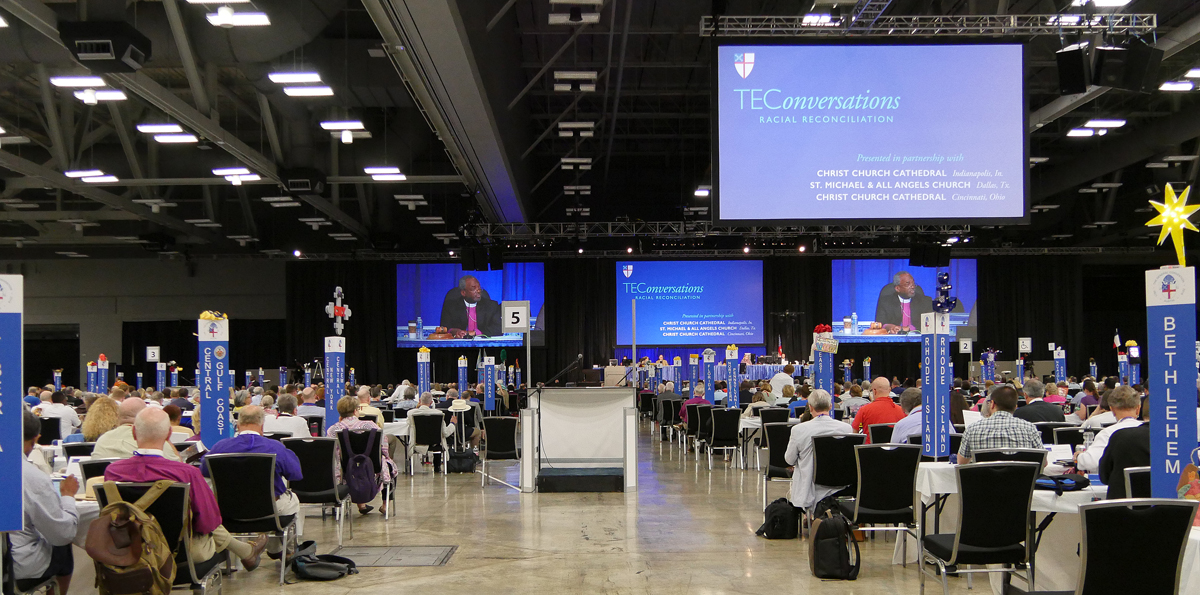
This weekend, Episcopalians will descend upon Louisville, Kentucky, for our General Convention.  The General Convention is the governing body of The Episcopal Church.  Every three years (or in this case, two years, due to a delayed GC during COVID), General Convention meets as a bicameral legislature that includes the House of Deputies and the House of Bishops, composed of deputies and bishops from each diocese.  In the House of Deputies, which includes elected lay and ordained deputies and alternates, over 1000 people will gather, and about 140 bishops will gather in the House of Bishops.  This year, we have a shortened Convention of six days of legislative sessions, covering everything from governance, justice issues, ecumenical and interfaith issues, evangelism and church vitality, liturgy, stewardship, formation, and mission.  In those six days, we will review over 275 pieces of legislation. 

Of course, General Convention is not all business.  It is a place of innovation and collaboration.  An exhibit hall of vendors is place of ideas, resources, and connection.  The legislative halls and common spaces are places of reunion with former seminary classmates, dioceses where one has served or worshiped before, and friends from professional connections.  It may be a chance to meet people in person that you have only known online, people you have admired the work of from afar, or a place to make new friends.  And then there are the opportunities to gather in worship in unfamiliar and familiar styles, the deep conversations and sharing of best practices, and the inspiration that can come from being steeped in the wideness of God’s church.

Ultimately, General Convention can be a place of great tension:  of trying to accomplish a great deal of business while honoring and developing relationships across difference, of challenging and trying to correct the failings of the Episcopal Church while learning and being inspired to renew our ministries, of taking a step back to clarify mission, purpose, and priorities while narrowing in and aligning decisions with that clarity.  Add in doing all that with over 1100 people, and that we get anything accomplished is a minor miracle.

Knowing all that, I invite your prayers for the Church as we gather:  that we root ourselves in God’s grace and power, that we ground ourselves in the love of Jesus and serve as faithful disciples, and that we undergird our work with the creative, life-giving, wise movement of the Holy Spirit.  And then ultimately, I invite your prayers that our work will mean something:  to the country church in rural America, to the beleaguered inner city church, to the bustling suburban church, and to churches whose primary languages are not English; to the churches who are shrinking and the churches who are thriving; to the person who is struggling with their faith, the person excited about a new ministry, to the person who is worried about the future of the church, and the person who is entirely unchurched.  We bring each of you with us in our prayers as we gather.  I hope you will surround us in prayer as well – that God is working for good in all of it.     

Sermon – Mark 4.26-32, P6, YB, June 16, 2024

Tags

, , , , , , , , , , , , , , , , ,

Many of you know that I grew up in the United Methodist Church.  Growing up in the Methodist Church meant that I was steeped a particular set of hymns, many written by John and Charles Wesley themselves – John being attributed with the founding of the Methodist movement.  I can be at a retirement community or an ecumenical service and one of those songs will come up, and I am instantly transported back to the old country church where my dad was the pastor.  There is something about that music that almost feels like the music is a part of my DNA.  So, imagine my surprise when I found out in seminary that much of the music settings for those old timey hymns I love were actually pub songs – tunes that anyone who had spent time at the pub would know, just set to new words about Jesus.  Charles and John did that because they knew it would make the songs deeply familiar, while becoming teaching tools for the church.  No wonder those hymns are so catchy!

In some ways, parables from Jesus are similar.  Jesus uses story to teach truth.  Teaching through parables makes the teaching engaging, accessible, and memorable.  I bet that even today, two thousand years later, when we heard Mark’s gospel today, we probably thought, “Oh yeah!  The one about the mustard seed.  That’s about just having a little faith is all you need!”  And in part, you would be right.  But as catchy as pub songs are and parables seem, unfortunately, Jesus’ parables, while memorable, are not always simple in meaning. 

Our trouble starts with the fact that we have two parables together today – not just the one about the mustard seed.  In the first one, Jesus says the kingdom is like a guy who scatters some seed and then does literally almost nothing – he does not even know how the growing of seeds into plants works.  And then he just goes out to harvest.  So, that’s parable number one.  Parable number two compares the kingdom of God to a tiny little mustard seed that, when planted, grows into a huge bush big enough where birds can make nests.  So, this is not exactly a set of stories about just having a little bit of faith.  And quite frankly, if you take these two together, they seem to be saying that basically we do not really have much of a hand in the fruitfulness of the kingdom – that maybe we do not even understand the kingdom.  So, is that the message?  Just sit back because God does all the work to bring about the kingdom – oh, and the kingdom will be really big?

As much as I would like to send you all home today thinking you can just kick up your feet and sit back while God does the heavy lifting, especially as summer gets into full swing, unfortunately, we have summertime work to do.  You see, in both of these parables, while the miracle of growth happens through God, the planting in both stories has to be done by a person – by us, namely.  Scholar Amy-Jill Levine explains that in these parables, the seed still has to be planted.  She confesses that certainly some things need to be left alone – notice the man in the first parable.  And sometimes we need to get out of the way – notice the planter in the second parable.  But most importantly, Levine argues “The kingdom is present when humanity and nature work together, and we do what we were put here to do – to go out on a limb and provide for others, and ourselves as well.”[i]

That doing something, that lack of passivity in the bringing about of the kingdom, is what we are talking about when we talk about stewardship.  Often when we talk about stewardship, we think of that as the church’s codeword for our money.  But we were made stewards long before there was a church.  Even in the moment of creation way back in the book of Genesis, God created us to steward God’s creation – to tend to the blessings given to us.  Now that may feel daunting – as if not only are we to tend to this church but now we must tend to the whole world! 

But before you panic, let’s go back to that mustard seed parable.  I do not know how many of you have actually been around mustard plants, but mustard plants are a lot like kudzu – they tend to take over an area where they are germinated.  Jesus is telling us all we do is plant one of those teeny-tiny seeds, and suddenly we will have kudzu spreading everywhere.  In other words, our work of stewardship is like kudzu[ii] – we invest our time, our talent, and our treasure here in this place – and the results will spread like wildfire.  Suddenly, we have whole hillsides full the love of Christ, spilling over into the neighbor’s yard, draping everything in goodness.  We do not have to micromanage the growth – we do the planting, and God partners with us to bring the growth – even growth we sometimes do not understand.  Our job is simply to plant.

Our invitation today, then is to ponder what seeds we can plant here at Hickory Neck.  What gift of time can you place here that can spread to your fellow parishioner?  What gift of your unique talent can you plant here that can grow into powerful ministry?  What gift of your financial resources can you gift here that reach beyond these walls to share and spread God’s love?  Jesus’ familiar story reminds us that whatever we give, our giving allows us to participate with God in helping manifest the kingdom of God.[iii]  And God will spread our gifts like kudzu!  Amen.


[i] Amy-Jill Levine, Short Stories by Jesus:  The Enigmatic Parables of a Controversial Rabbi (New York:  Harper One, 2014), 182.

[ii] Ronald J. Allen, “Considering the Text: Week Two, Fourth Sunday After Pentecost, 16 June 2024,” Center for Faith and Giving, 11, as found at centerforfaithandgiving.org, 2.

[iii] Allen, 13.

Sermon – 1 Samuel 8.4-20, 11.14-15, Mark 3.20-35, P5, YB, June 9, 2024

Tags

, , , , , , , , , , ,

This morning, we get two powerful stories from scripture.  In our story from first Samuel, we hear the story of how the people of Israel come to demand a king to rule over them instead of God and God’s appointed judges and prophets.  They figure if they have a king like the other nations, then they’ll never have to worry about their safety and security.  A king will defend them in a way that looks familiar – like the other nations – than a way that feels like trusting a God you cannot see.  Of course, Samuel warns them – you pick a king and the king will take your daughters and sons into his service, will steal your land and produce as his own, will take your property and use it to his own benefit, will basically enslave you (not unlike the days in Egypt).  But the people insist none of that matters – as long as they have a king like everyone else.

Meanwhile, in Mark’s gospel, Jesus has been healing people, driving out demons, saying some things, and generally making a raucous.  Here, two groups insert themselves – the scribes, who try to claim Jesus is possessed by a demon himself, and his family, who are concerned he has lost his mind and want to restrain him.  Jesus is so frustrated by their behavior, especially of his mother and brothers that he loudly states, “Who are my mother and my brother?”  In other words, he denies his very own family because they cannot see the truth in what he is doing.  In these two stories – of the Israelites wanting a king and of Jesus’ family demanding he behave in a certain way, we have people thinking they know better than God – taking matters into their own hands thinking they know how things should be.

I was talking to another parent recently about how parenting is probably the hardest job of all the vocations I have – particularly as a person who likes to imagine she has a modicum of control in her life.  In the beginning, although parenting is physically exhausting, parenting is also manageable in a way that is not so obvious.  For those infants and young children, you have a lot of control – what the child will eat and drink, what the child will wear, when the child will rest, where the child can go.  But as the child ages, they make more and more of the decisions – what they will wear, where they will go, with whom they will spend time.  This is, of course, how parenting should be – the raising up of an independent child.  But the more your child becomes independent the more you realize how the younger years were the “good ol’ days” – the days where you felt like you were in control (or at least convinced yourself you had more control than you probably did).  Parenting feels like the ultimate test for those of us who like a sense of control.

But the truth is, the ultimate test for those of us who like a sense of control is being a person of faith – following a God whose logic sometimes feels illogical, following a savior who says and does things that really push our buttons, and following a Spirit who takes us places we really do not want to go.  And so, we find ourselves, much like the Israelites, accepting slavery, abuse, and the loss of freedom just to get those things we think will make us happy and whole.  We find ourselves, like Mary and Jesus’ brothers, bossing around God, insisting God behave in ways that make us feel comfortable.  Instead, God tells them and us to trust – to trust that God will provide leaders who will guide us in the ways of justice and truth; to trust that even the things we cannot understand will lead to good; to trust that even though we cannot know what God knows, our wholehearted trust in the will of God is all that matters.

So how do we do that?  How do we, people of free will, in a country of democracy where “we the people” make decisions, in a time when choices are boundless and we must make them, how do we become people of trust – people of faith?  Well, I like to go back to that story of Jesus in a crowded room from Mark’s Gospel today.  Scholar Debie Thomas says, “…I can’t help but imagine what it must have felt like to be inside the house with Jesus that day.  I know intimately and well, as perhaps you do, the hunger to belong, to have someone safe and loving to belong to.  Regardless of our circumstances, we all know what it’s like to yearn for someone who can hold all of who we are, and love us still, without flinching.  That’s exactly what Jesus does for the crowds that day. He invites them in, he asks them to stay, and he makes them family. 

Yes, Jesus divides the house, and that process hurts.  But he doesn’t divide [the house] to make us homeless.  He divides [the house] to rebuild it.  To make [the house] more spacious, more welcoming, and more beautiful.  The Spirit of God is neither insane nor evil; the Spirit completes the good work he begins.  His will be a house of healing for the whole world.”[i]

Holy Scripture today is not inviting us to become some mindless, fluff who walk around without aim or purpose just “trusting that God will work everything out.”  God did give us freewill, and God does want us to use that freewill for good.  But what the Holy Spirit is trying to remind us of is that we do not have the whole story.  We cannot see the way in which Jesus is rebuilding the house.  We cannot fully know the feeling of being inside that home where true healing may be.  We cannot understand the fullness of the implications of our desires – which seem reasonable and justified to us.  But what we can see and know and understand is that Jesus is building a house of healing for the whole world.  And if we can stop trying to parent God, we can start beginning to see that God is constantly doing a new thing and inviting us into the family.  We just do not get to be the parent in that family.  And that is a very good thing indeed.  Amen.


[i] Debie Thomas, “A House Divided,” June 3, 2018, as found at https://www.journeywithjesus.net/essays/1805-a-house-divided on June 5, 2024.

On the Blessing of No…

Tags

, , , , , , , , , , , , , ,

Photo credit: https://toledoparent.com/online-exclusives/learning-to-say-no/

For weeks my fourth grader has been talking about running for Student Body President.  I was admittedly proud of her gumption, but also wildly (and quietly) nervous on her behalf.  She is a genial, vibrant, beloved individual and I feared what losing an election at her age might do to her self-esteem.  But even with gentle warning, she was determined.  So, we worked on her speech and filled out the paperwork.  The “primary” involved whittling down a group of 12 students to three – no speeches or posters, just a raw “popularity contest” among the fourth graders.  Last night she returned home only a little disappointed that she had not been elected to the final ballot. 

I do not know why I doubted her capacity to maintain her self-confidence in the face of such a loss.  I have been modeling the same for her for years – sometimes you win and sometimes you lose.  Sometimes you get a yes, and sometimes you get a no.  These lessons have certainly happened verbally and in low-risk ways, like in card games.  But the lesson has been learned in big ways too – like a lost bishop’s election.  Though I loathed the very public nature of a bishop’s search, I do not think I fully understood the power of letting my girls watch me not only be nominated, but make very public presentations, and then not be elected.

Without realizing it, I have been teaching my girls the power of a good “no.”  Almost all the good things that have happened to me – jobs, schools, auditions – were preceded by a solid no.  The student government election I did not win, the audition where I did not make the cut, the job I really wanted and did not get.  Every single one of those no’s profoundly taught me something about myself I did not know, and every single one of those no’s led to another opportunity that could only open up because of the no that happened first. 

The experience of no’s can be brutal to the ego.  But I wouldn’t be the spouse, mother, priest, or human that I am today without all those no’s.  And now I know that learning was not just for me – it was for my children too.  And maybe those no’s have been for some of you as well.  I wonder what no’s you are facing these days.  I wonder what you have learned from the times you received a no.  I suspect the Holy Spirit has been transforming you so that when you get a yes, you come to that yes as your most powerful self – the self that was made in God’s image and is beautiful and beloved.

On Seeking and Seeing Sacred Ground…

Tags

, , , , , , , , , , , , , , ,

Photo credit: https://medium.com/koinonia/dont-wait-for-a-burning-bush-f8c7435489ae

One of my fitness routines includes attending “barre” – a class that combines yoga, Pilates, and ballet.  When you enter the studio, you remove your shoes and put on special socks to prevent slipping during the class.  You then enter the actual classroom and procure any fitness aides required for the class, such as hand weights, bands, or balls, and proceed to setup up your space at the barre.  I tend to take classes in the 5:30 am hour, so most of the time I am pretty groggy and operating on auto pilot as I prepare my space for class. 

Knowing my routine for class, imagine my surprise the other day when, as I somewhat sleepily entered the classroom, I found myself bowing.  I was immediately shocked and a little embarrassed by my body’s instinctual movement.  As a priest, I bow all the time – as I reverence at the altar, as the processional cross passes me, at certain points in the Creed, or at the name of Jesus in the liturgy.  But I have never reverenced an exercise classroom.

The strange appearance of such an out-of-context movement got me thinking about Holy Scripture.  In Exodus, we hear how Moses receives his call at the site of a burning bush.  When God calls out to Moses amid the flames, God says, “Come no closer!  Remove the sandals from your feet, for the place on which you are standing is holy ground.”[i]  Now I am not sure I would call the barre classroom sacred ground – though the Lord’s name is often called upon, especially during long plank series.  But something about that room made my body respond to its holiness the same way I respond to the holiness of Church.  So how exactly do we define a holy place – or sacred ground?

In the instance of barre class, perhaps what my body was responding to was the way I do find holiness – in the care and compassion of teachers, in the camaraderie of classmates on a shared journey of health and wholeness, in the individual experience at the barre when you feel like you cannot go on and something or someone pulls you through doubt.  Though I think the sacred ground of worship space is unrivaled as a place of encounter with God, the community of Jesus, and the movement of the Spirit, I certainly have found other sacred places – the mountain community where my family gathered every summer with the wider church; the edge of crashing waves, where the vastness of the Creator is palpable; the coffee shop where someone pours out their heart’s burdens to another and blessing is proclaimed.  Perhaps regularly attending Church, with its preserved sacred ground, is what allows us to see and hear God on the sites of sacred ground all around us.  Where are you finding unexpected sacred ground these days?  Where is God inviting you to take off your shoes and give reverence to the mightiness of our God?


[i] Exodus 3.5

Sermon – Acts 1.1-11, AS, YB, May 12, 2024

Tags

, , , , , , , , , , , , , ,

Our Stewardship Team gathered throughout the winter and spring and had some meaningful conversations about how we measure what matters in life.  We talked about how stewardship is more than money.  Stewardship is a lifestyle based on a relationship with Jesus Christ and fulfilling our baptismal covenant to provide and participate in the mission and ministry of Hickory Neck Episcopal Church to proclaim the Gospel in word and deed in order to change the world in which we live.  But we also talked about how things can get in the way of our faith journey:  our allegiances, our faith, our compassion, our use of money, our generosity, and our belief that God provides what is necessary for living out our lives.  And so, we agreed.  In order to help us navigate how to be faithful stewards, we would begin a preaching series over the next several months – looking at those challenges to our faith journey and what scripture has to say about them.  Today, the Stewardship team teed me up on this Ascension Sunday to talk about allegiances.

Now I do not know about you, but when I read the text about the Ascension from Acts, I did not really hear anything about stewardship.  Jesus did not lean over his shoulder as he was ascending to heaven and shout, “Don’t forget to tithe 10% to the Church!” So, what does the Ascension have to do with faithful living – with stewardship?  Well, to understand that notion, we have to take a big step back from the event of the Ascension.  You see, the Ascension is sort of a pivot moment in our lives.  Luke, the author of both the gospel of Luke and the Acts of the Apostles, understood history to be “divided into two ages:  the broken old world marked by Satan, idolatry, sin, injustice, exploitation, fractiousness, scarcity, enmity with nature, violence, and death.”  The renewed world where God restores all things to God’s purposes is “marked by true worship, forgiveness, justice, mutuality, community, abundance, blessing between nature and humankind, shalom, and life.”[i]  Jesus’ life and ministry was in witness against the broken world and a shepherding in of the renewed world.  In the process of ascending Jesus gives authority to the disciples to continue the work of the renewed world.  That’s why the whole rest of the book of the Acts of the Apostles will be about how the community of Jesus – the Church – will live:  sharing resources, supporting those in need, living as a community of abundance, mutuality, and justice.

This past Thursday’s Discovery Class was the session where the attendees teach the rest of class on given topics.  One set of our class members focused on the history of the early church in America.  They talked about how the church in the 1600s and 1700s was the governing body of the region – using their resources to care for widows and orphans, tending to those who fell on hard times, basically serving as the social services agency of the region.  Now, they also had clergy appointed by the governor and charged local residents a mandatory levy to help the Church pay for those expenses (an idea I imagine a certain treasurer of ours probably wouldn’t mind) – but for all intents and purposes, the early church of the Americas operated just like the early church in the Acts of the Apostles – living as a community sharing resources, supporting those in need, embracing abundance, mutuality, and justice.  In essence, a community who understood their allegiance to be to the kingdom of God and not to the kingdom of brokenness:  a community of faithful stewardship.

We are told in our reading from the Acts of the Apostles that as the disciples watch Jesus ascend to the heavens they stand there for a moment – frozen in time as their scrambled brains try to figure out what has just happened and what Jesus’ ascension means.  While they are standing there, looking at heaven, two men in white robes appear and ask them a simple question, “Why do you stand looking up toward heaven?”  In other words, God uses these men in white to tell the disciples, “Don’t just stand there – go be the church!  Jesus showed you the way to abundant, faithful stewardship.  Now go bring kingdom living to life!”

That is our invitation today too.  Now you may be thinking, “Yeah, but the Church has changed so much.  We are not the primary social services agency in town – we are not the place responsible for people’s physical, emotional, and spiritual well-being!”  But Jesus tells us today that we are.  That every single member of this community has a part to play – can contribute your financial resources, the gift of your skills and expertise, the offering of your time to make this church a modern expression of the kingdom of God here in Upper James City County.  On this Ascension Sunday, we can choose to carry on the work of Christ, to do our part to turn away from brokenness and be agents of healing and wholeness.  Where will we find the capacity to enliven that abundant life?  In our Eucharistic Prayer today we will pray, “And, that we might live no longer for ourselves, but for him who died and rose for us, he sent the Holy Spirit, his own first gift for those who believe, to complete his work in the world, and to bring to fulfillment the sanctification of all.”[ii]  Not only did Jesus give us the mission, Jesus also gives us the Holy Spirit – that gift we will celebrate next week – so that we might be the faithful stewards of God’s abundance, declaring our allegiance to living in the light – to being the agents of abundance God knows we can be.  Our invitation is stop looking up, and start looking around at the kingdom God has gifted us to tend.  Amen.


[i] Ronald J. Allen, “Considering the Text: Week One, Ascension Sunday, 12 May 2024”  Center for Faith and Giving, as found at centerforfaithandgiving.org, 2.

[ii] BCP, 374.

On Pastoring and Motherhood…

Tags

, , , , , , , , , , , , ,

Photo credit: https://community.thriveglobal.com/remembering-mom-hands-on-mothers-day-loss-support-memories-inspire/

One of the deepest privileges of being a pastor is being gifted with people’s stories.  Sometimes those are stories of great joy:  of new love leading to marriage, of the gift of children, of the excitement of a new vocation.  And sometimes those are stories of deep pain and grief:  of life lost, of hurts deeply experienced, of dreams deflated.  The sum of those stories is uncountable – they are words and emotions that drift in and out of the pastor’s consciousness – the vessel for all that needs to be said and released.  It means that even in the pastor’s moments of greatest joys, there is, at the subconscious level, the treasuring and honoring of deepest pain and suffering.

Normally, I find I am able to hold that reality with tenderness and grace.  But nothing challenges that ability more than holidays that desire to create a forced, well-intentioned experience.  Secular ones, like the approaching Mother’s Day this weekend, are the worst offenders.  On the surface there is nothing wrong with Mother’s Day.  I know countless people who have been tremendous mothers in my life and in the lives of others, who rarely get a thank you, let alone a day of honor.  There is nothing wrong with honoring the mothers in our lives.  The challenge is the sea of complicated feelings that come along with such an effort:  the grief over mothers we have lost, the suffering caused by mothers who were abusive or absent, the pain of those women who wanted to be a mother and never could or who were mothers and who lost their pregnancies or their children, and for the hurt of those relationships between children and mothers that is estranged.  Our much-deserved celebration of mothering is always tainted with the very messy reality of mothering.

For that reason, you will not find me liturgically celebrating Mother’s Day at church.  Instead, I invite you to put on your pastor shoes this Mother’s Day and hold in tension the beloved and the painful this day.  Reach out to friends who have struggled with infertility, lost a pregnancy, or grieve the loss of a child or a relationship with their child.  Reach out to those who had beautiful, healthy relationships with their mothers and now grieve their death every day.  Reach out to those who are mothering figures in your life, even if they never birthed you and give them thanks.  At our church, we quietly offer resources for the complicated nature of the day.  You can find them here, here, and here.  But whatever you do, use this Mother’s Day to “mother in” the love of Jesus, who could see mothers everywhere and honored all of them. 

Sermon – John 15.9-17, Acts 10.44-48, E6, YB, May 5, 2024

Tags

, , , , , , , , , , , , ,

When I was curate, I served with two other full-time priests.  That meant after about two years, I got used to our very different styles of preaching, but also some of the themes of our preaching.  I remember at one point, my Rector was preaching and I had the distinct thought, “Here we go again.  Another sermon about love!  Ugh!”  I remember being almost irritated thinking, surely there were other topics to preach about.

Sometimes I think we experience John’s gospel in the same way.  John’s gospel is repetitive and circular from the very beginning, “In the beginning was the Word, and the Word was with God, and the Word was God.  He was in the beginning with God.  All things came into being through him, and without him not one thing came into being.”[i]  But John is not the only one who is repetitive and circular – Jesus in John’s gospel is repetitive and circular too.  In the first five verses of John’s gospel today we heard the word “love” eight times.  “As the Father has loved me, so I have loved you; abide in my love.  If you keep my commandments, you will abide in my love, just as I have kept my Father’s commandments and abide in his love.”[ii]  And the funny thing about the gospel today is this is not the first time Jesus talks about love.  As I was reading verse 12, which says, “This is my commandment, that you love one another as I have loved you,” I immediately thought, “Oh, we must be reading the same text we read on Maundy Thursday!”  But you know what?  On Maundy Thursday, we read a passage from two chapters before what we heard today.  The words there are strikingly similar though.  On that night of washing feet, Jesus says, “I give you a new commandment, that you love one another.  Just as I have loved you, you also should love one another.”[iii]

So what is the deal with Jesus talking about love over and over again?  Scholar Karoline Lewis argues that you cannot summarize Jesus in one sentence, so of course we have lots of sentences – even if they are repetitive.[iv]  But I think there is something deeper here.  I think Jesus knew that we, as humans, easily distracted.  “Yeah, yeah, yeah Jesus, I got it.  Love my neighbor! Oh look at that shiny thing over there!”  But even more importantly, I think Jesus knew that love – loving neighbor, loving self, loving God, loving others as Jesus loved is not easy.  Loving as Jesus loves means loving people that others (and even sometimes ourselves) would rather hate.  Loving as Jesus loves means mingling with people that society calls unlovable, difficult, and even evil.  Loving as Jesus loves means seeing dignity and worth in every human being – even when they hurt us, say awful things, or are just so different that they make us uncomfortable.  All we have to do is think about what we have been hearing in the lessons from Acts last week and this week to know that loving means letting people into your circle that you had no intention of letting in – breaking those boundaries that Father Charles talked about last week.  For Peter and the early disciples, that meant Jesus was not just for the Jews, but for Jew and Gentile alike.  And not just as charity, but as a way that transformed the entire community of Jesus followers – such that we find Peter dining and staying with Gentiles – who definitely are not kosher and might even be holding fast to other gods while committing to Jesus. 

So how are we supposed to do this really hard work?  How are we supposed to pull together the strength to love as Jesus loves?  I found comfort in words from scholar Debie Thomas this week.  If you remember, last week we heard the verses from John right before our Gospel lesson today, where Jesus declares he is the vine and we are the branches – he is the vine that we are to abide in.  Debie Thomas says, “My problem is that I often treat Jesus as a role model, and then despair when I can’t live up to his high standards.  But abiding in something is not the same as emulating it.  In the vine-and-branches metaphor, Jesus’s love is not our example; it’s our source.  It’s where our love originates and deepens.  Where it replenishes itself.  In other words, if we don’t abide, we can’t love.  Jesus’s commandment to us is not that we wear ourselves out, trying to conjure love from our own easily depleted resources.  Rather, it’s that we abide in the holy place where divine love becomes possible.  That we make our home in Jesus’s love — the most abundant and inexhaustible love in existence.”[v]

Yes, we will continue to hear about loving others because love is the most important message of Jesus.  And yes, loving will feel nearly impossible at times.  But as Thomas reminds us, “As is so often the case in our lives as Christians, Jesus’s commandment leads us straight to paradox: we are called to action via rest.  Called to become love as we abide in love.  In other words, we will become what we attend to; we will give away what we take in.  The commandment — or better yet, the invitation — is to drink our fill of the Source, which is Christ, spill over to bless the world, and then return to the Source for a fresh in-filling.  This is our movement, our rhythm, our dance.  Over and over again.  This is where we begin and end and begin again.  ‘Love one another as I have loved you.’ ‘Abide in my love.’  These are finally not two separate actions.  They are one and the same.  One ‘impossible’ commandment to save the world.  It’s all about love.”[vi] 

That is our invitation today – to become love and to abide in love.  Perhaps in reverse order:  maybe we need to abide in Jesus’ love in order to know how to love.  But either way, we repetitively and circularly are invited to love – to love as Christ has loved.  Loving will be hard, loving will be messy, loving will be wearying.  But loving will also be beautiful, loving will life-giving, loving will be transformative – certainly of the other, but mostly of ourselves.  We can do that hard, messy, beautiful, sacred work by returning to the source of love and strength.  We can love as Jesus loves because Jesus first loved us.  Amen.


[i] John 1.1-3.

[ii] John 15.9-10.

[iii] John 13.34.

[iv] Karoline Lewis, as explained in the podcast “#963: Sixth Sunday of Easter – May 5, 2024” Sermon Brainwave, April 28, 2024, as found at https://www.workingpreacher.org/podcasts/963-sixth-sunday-of-easter-may-5-2024 on May 2, 2024

[v] Debie Thomas, “It’s All About Love,” May 2, 2021, as found at https://www.journeywithjesus.net/essays/3003-it-s-all-about-love on May 3, 2024.

[vi] Thomas.

On Ferry Rides and God…

Tags

, , , , , , , , , , , , , ,

Photo credit: https://www.vdot.virginia.gov/about/our-system/ferries/

Yesterday I attended a meeting that requires riding a ferry to attend.  I have always found the ferry a bit of a nuisance.  If timed incorrectly, one can spend almost thirty minutes just waiting to board the ferry.  But even timed correctly, once upon ferry, one must sit for the twenty-minute ride – certainly progressing toward the destination, but not nearly as quickly as it feels when driving.  Something about the taking the ferry feels like a mandatory suspension of time and progress. 

Knowing that reality, I try to plan ahead – with a call to make, emails to read, or a podcast to finish.  I talked to a fellow traveler who has young children at home who used the twenty minutes for a coveted power nap.  And certainly, when I have traveled with my own children, one has the opportunity to go to the upper deck and take in the wonder of creation – an imposed moment of awe and wonder.

Thinking about the various ways one occupies oneself on the ferry had me thinking about the gift of time.  My method of busying myself on the ferry is certainly one of attempting to master control of the uncontrollable.  That mother of young children saw the gift of time as just that – a blessed gift she had not realized she needed.  And my children remind me that every moment is ours to steward – that productivity might include making room for the sacred too – that the sacred might feed my moments of productivity just as much as powering through times of tangible productivity.

I wonder what moments God is gifting you today.  Sometimes our schedules are so full, we may believe that there is no room for a “God moment.”  But that is the funny thing about God.  God permeates all our moments – being there when we are hustling to make a deadline, there when our child is seeking care and compassion – or even just a ride from practice, there when the aging customer in front of us needs a little assistance, and there when a blue bird flutters by seeking the creation we rarely notice.  How might you adjust your senses today to acknowledge the sacred all around you?  How might you give thanks and gratitude for God’s blessings so easily unnoticed?  My prayer is for your awakened senses to the blessing of God’s presence today.

Sermon – John 10.11-18, E4, YB, April 21, 2024

Tags

, , , , , , , , , , ,

In a few moments, we will baptize Abby and Laela, sisters who are ages 6 and 7 respectively.  What’s interesting about a baptism for candidates who are not infants is there is much more cognition, curiosity, and craving.  In a sense, Abby and Laela understand more profoundly that their baptism is a sacrament of belonging – a welcoming into full membership in the body of Christ.  One of Hickory Neck’s strongest gifts is the powerful gift of welcome.  You talk to any newer or longer-term member, and they will likely tell you that Hickory Neck’s warm welcome was what drew them in and made them linger.  There was a sense of inclusion and care that made them want to stay.

For a community so skilled in welcoming and especially as a community who will be welcoming Abby and Laela today, we hear a powerful word from John’s gospel about life with the Good Shepherd.  For people familiar with the lectionary, the fourth Sunday of Easter, affectionally known as Good Shepherd Sunday, is a favorite Sunday.  Every year on this Sunday we hear about Jesus’ proclamation of being the Good Shepherd.  This year’s text from John tells us how Jesus the Good Shepherd lays down his life for the sheep; how Jesus will protect the sheep; how he knows the sheep and the sheep know him; and that there are other sheep that do not even belong to the fold that Jesus will bring into the beloved fold.  When we hear a text like this, we get a warm-fuzzy feeling[i] – the kind of feeling of protected belonging that we want Abby and Laela to always feel with Jesus and the church community.  That feeling of care and belonging has inspired artwork, song, liturgies, and sermon alike.  This Good Shepherd Sunday reminds all of us of what inspired us to keep coming back to this modern incarnation of the Good Shepherd’s fold here at Hickory Neck.

The challenge about the warm-fuzzies that come with belonging is that chasing a sense of belonging can become consumeristic:  a pursuing of a feeling that is received without any expectation of reciprocity.  The pursuit of belonging makes sense.  As one scholar suggests, “Forming authentic and holistic community is hard work – we dole out parts of ourselves in stingy bits and pieces, avoid being vulnerable with each other, hold back our feelings and thoughts, are afraid to confront each other, judge each other without mercy, hold grudges, set impossibly high standards for ourselves and each other…We have a difficult time trusting each other,” making real and life-giving community hard.[ii]  But belonging with Jesus and within the faith community is not something that is just received.  Belonging comes with obligation.  No longer are we individuals feeling alone – now we are a part of a larger whole.  Though beautiful, that whole does not work without each of its members.  Receiving the warm-fuzzy feeling of belonging results in the action of giving:  of contributing in your own right to the community.[iii]    

The good news is that although we use language about welcome at Hickory Neck, we actually mean belonging.  Yes, we were likely greeted warmly, maybe given a welcome gift or sent a greeting by mail soon after our first visit, and often we were recognized and engaged after the service or at Coffee Hour.  But I cannot tell you the number of people at Hickory Neck who have also told me about how accessible involvement and even leadership are here.  From stories of being recruited to lead Fall Festivals within the first year of membership, to hopping in as an usher or reader, to being invited to a Bible Study, service opportunity, or a Foyer Group, to becoming a financial supporter of programming:  you are not just welcomed here – you are invited into belonging here.  Though we may not use the strong word of “obligation” or “responsibility,” we teach through our behavior that warm welcome means full membership in the body of Christ.  We join in not because we have to, but because the warmth of the Good Shepherd’s inclusion of all overwhelms us into wanting to give back – both here inside these walls and outside these walls in the wider community.

And that is what we have been teaching Abby and Laela about baptism.  Today, as the water is poured over their heads and the oil rubbed into their foreheads, they will be welcomed into full membership in the body of Christ.  And even though age six and seven might seem too young for the “obligations of membership in the body,” we need their gifts just as much as they need the gift of belonging.  So, when they bring forward the communion elements, or participate in Godly Play, or join in singing and song, they make our community complete.  They remind us of the broadness of God’s inclusion, the power of being known, and the resultant discipleship that springs out of all of us – no matter size, age, or ability.  Today, the Good Shepherd welcomes Abby and Laela into the fold – into the body of Christ.  Today, Abby and Laela invite us to renew our sense of belonging in that same fold and all that belonging entails.  And for that, we give thanks to God.  Amen.


[i] As described by Matt Skinner, on the Sermon Brainwave podcast, “#961: Fourth Sunday of Easter – April 21, 2024,” April 14, 2024, as found at https://www.workingpreacher.org/podcasts/961-fourth-sunday-of-easter-april-21-2024 on April 18, 2024.

[ii] Barbara J. Essex, “Homiletical Perspective,” Feasting on the Word, Year B, Vol. 2 (Louisville:  Westminster John Knox Press, 2008), 451.

[iii] As described by Karoline Lewis, on the Sermon Brainwave podcast, “#961: Fourth Sunday of Easter – April 21, 2024,” April 14, 2024, as found at https://www.workingpreacher.org/podcasts/961-fourth-sunday-of-easter-april-21-2024 on April 18, 2024.