• About

Seeking and Serving

~ seek and serve Christ in all persons

Seeking and Serving

Tag Archives: call

Sermon – John 1.6-8, 19-28, A3, YB, December 17, 2023

03 Wednesday Jan 2024

Posted by jandrewsweckerly in Sermons

≈ Leave a comment

Tags

Advent, call, discernment, Episcopal, evangelism, identity, Jesus, John, nervous, Sermon, vocation, witness

Episcopalians are a funny crew.  I can claim that description honestly because I actively chose the Episcopal Church, having been raised in another denomination.  But what continues to humor me all these many years later is the almost universal look of panic Episcopalians get in their eyes when you start talking about evangelism.  I can already feel the nervous shifting in the room, so know that you are not alone.  The problem is the concept of evangelism brings up all sorts of images:  the guy on the street corner with a megaphone talking about the end being near; people knocking on your door with tracks about Jesus; the person asking you directly if you have been saved; or maybe even some more personally deeply damaging memories from so-called evangelicals.  And so, Episcopalians either:  just don’t do evangelism (entirely faithful but absolutely unwilling to talk to people about their faith life or Jesus); or they might be willing to share something vaguely about their church, but couldn’t imagine uttering the name Jesus; or they’ll do my favorite thing, which is quote St. Francis who is quoted as saying, “Preach the gospel at all times and if necessary, use words.” – and use that as the ultimate excuse to never actually have to use words.

For all of us squeamish Episcopalians, scripture gives us John today.  Now, in Mark’s gospel, John is called “John the baptizer.”  In Matthew’s gospel, he is called “John the Baptist.”  In Luke’s gospel, he is called, “John, the son of Zechariah, in the wilderness.”  But in John’s gospel that we read today, our beloved John is “John the Witness.”[i]   In fact, John’s gospel doesn’t have any narratives about John leaping in the womb, John dressed in funny clothes, or even John baptizing Jesus.  Instead, John’s gospel is the one that starts with that flowery poetry, “In the beginning was the Word, and the Word was with God, and the Word was God.”  Into this beautifully convoluted prologue comes John, who comes as a witness – whose entire job is to point to Jesus. 

I am not suggesting that your whole life needs to be a self-emptying, agency-free pointing to Jesus.  I had a dear friend whose response to every compliment was, “It’s not me.  It’s all Jesus working in me.”  This is a wonderfully humble way to live, but also a completely irritatingly sanctimonious way to live.  Instead, what John’s gospel today is inviting us to do today is to be entire clear about who we are in relation to Jesus.  Four times John the Witness is asked about his identity, “Who are you?” they ask.  “Are you Elijah?  Are you the prophet?  Who are you?”  And John the Witness says over and over again, “I am not.  I am not.  No, I am not.”  Even the prologue in the gospel tells us, “[John] came as a witness to testify to the light…He himself was not the light, but he came to testify to the light…”[ii]  In the verses following what we read, we’ll find John the Witness shouting to crowds about Jesus, “There he is!”  John is crystal clear about who is he and his role in honoring Jesus the Messiah.  His whole purpose is to be a witness.

Now, I know I might have painted this Advent as a time of sacred silence, a time of quiet preparation.  We even spent last week letting the words of Advent lap over us like cool refreshing water.  But this week, our quiet work is not passive.  Our invitation today is to get real clear on who we are.  Those questions for John are questions for each of us as well.  Who are you?  What then?  Who are you?  We have talked countless times about the work of discernment about our call – our vocation in the world.  Our work of being faithful followers of Christ is constantly checking that we know who we are and what we are called to be doing.  This is ongoing work that does not end – even in the midst of crazy Christmas preparations, we are to ask, “Who am I?” – what is God calling me to do?

This work of discernment does not excuse us nervous Episcopalians from evangelism.  I can imagine the math you were all just doing:  If John the Witness’s answers to “Who am I?” was that he was a witness, maybe my “Who am I?” will be something else – something less evangelical.  But the entire reason we do the work of answering the barrage of questions about who we are is so that we can prepare ourselves for active encounters with others about who they are – what they long for – how the coming Jesus has blessed us, and how our Church has helped us answer “Who are you?”  John is not the only Witness today in our gospel lesson.  John is simply pointing the way for our own witness too.  Amen.


[i] Gary W. Charles, “Exegetical Perspective,” Feasting on the Word, Yr. B, Vol. 1 (Louisville: Westminster John Knox Press, 2008), 71.

[ii] John 1.7-8.
Sermon – Matthew 25.14-30, P28, YA, November 19, 2023

29 Wednesday Nov 2023

Posted by jandrewsweckerly in Sermons

≈ 1 Comment

Tags

call, distort, exchatological, fear, gifts, God, Jesus, motivation, parable, real, risk, Sermon, vocation

One of the beloved pastors in my life I met in college.  She led me on my first international mission trip, opening my eyes to the realities of ethical living and our responsibilities to what scripture would define as the “least of these.”  She introduced me to the Episcopal Church in a subtle way that left me intrigued and wanting to know more.  She taught me about radical hospitality, as her family of five were constantly welcoming wandering students into their home.  And she introduced me to the Cathedral where I would ultimately experience a call to ordained ministry.  To say she played a formative role in my faith journey is an understatement.

What I knew as a loving pastor, a model Christian, and an inspiring mentor, though, had another side.  After college, I decided to volunteer for a year:  a noble endeavor, to be sure, but also an endeavor that left me with very little to spend on housing.  This pastor offered to let me live in the guest quarters of the Episcopal Center on campus in exchange for being the building’s caretaker:  cleaning it weekly, making sure the building was shut down and locked after group use, being on hand with any repairmen or women who needed access to the building.  It was a dream job, but it came with a cost.  No longer was my pastor my pastor – she was my boss.  And my pastor as a boss had a very different way of being than my pastor as a pastor.  She was firm, curt, and had little tolerance for anything other than excellence.  Gone were the niceties and loving nature, and in their place was an all-business task master.  It took me several weeks to figure out how to switch hats with her:  when to know we could be loving and playful and when to know we were being focused and task-oriented. 

The contrast between my mentor and pastor reminds me of the contrast we have seen in Jesus in these last several weeks of Matthew’s gospel.  First, we got the wedding host who seemed to be generously welcoming all to the party, only to cast someone out who wore the wrong clothing.  Then we got the feuding bridesmaids who refuse to care for one another, and the bridegroom who has no patience for a lack of preparedness.  And then we get today’s parable with the affirming, encouraging landowner and his harsh treatment of the tentative servant with his one talent.  If we simply had just today’s instance of God’s harshness or unjust judgment, we could say the parable is an anomaly, a strange outlier.  But given the repeated telling of scary-ending stories, we are cued into the idea that something else is going on in Matthew’s gospel.  Indeed, all these unsettling parables are what we call eschatological parables – stories about the end times.[i]  At this point in Matthew’s gospel, Jesus is approaching the end of his life.  Instead of continuing to heal, preach, and lovingly teach his disciples, he starts getting real.   I am reminded of one of the first reality television shows that ever aired, MTV’s The Real World.  MTV would pair seven very different individuals and make them live together for a few months.  The tagline of the show was, “This is what happens when people stop being polite and start getting real.” 

Understanding that Jesus is facing his immanent death is critical to understanding what is going on with Jesus in these parables.  Any of us who has journeyed with someone who is dying knows that at some point, they stop being polite and start getting real.  This is their last chance to tell others the essentials:  the life lessons learned, the love they want to share, and the stern encouragement they want to give.  Although this landowner seems harsh or even irrationally mean, what he is doing is communicating ultimate significance. 

Let’s go back to that third servant in today’s parable.  We know what the third servant does is not all that bad.  He does not squander the entrusted wealth, or act rashly.  He is conservatively prudent and, perhaps based on his skill level, wise to restrain himself.  But ultimately, the landowner is not upset about what the servant does.  The landowner is upset about the servant’s motivation:  fear.[ii] 

Now fear can be a very healthy thing, indeed.  Healthy doses of fear can secure survival and safety.  But fear can also be dangerous.  Fear can distort every good thing about our nature.  Fear can cut off creativity.  When we are overcome with fear, we cannot be imaginative and playful, coming to new solutions and ways of being.  Fear can mess with our sense of trust.  When we are overcome with fear, we forget the goodness of others, our previous examples of how things have gone well, or even the bold support of our God.  Fear can diminish our confidence.  When we are overcome with fear, all the good, powerful, and holy parts of us get riddled with self-doubt and inaction.  And finally, fear hinders with our willingness to take risks.  When we are overcome with fear, we cannot do the things that will lead to great payoff. 

Fear in the abstract is a normal reaction in life.  But we have to remember what Jesus is talking about in this parable to understand why the landowner is so harsh about fear.  You see, talents are not just metaphors for the thing things we are good at or even for the money we have in life.  Talents are metaphors for the vocations we each have.[iii]  Each person in this room has a calling.  Some of us are called to particular jobs or courses of study.  Some of us are called to particular roles within families or groups.  Some of us are called to use our gifts in particular ways.  We all have a call, a vocation in life.  And our vocation is affirmed by the skills or materials we are given to live out that call.  The problem with the third servant is that he is given what he needs in abundance – that single talent represents about twenty years of pay![iv]  The landowner affirms him, trusts him, and gives him space and time to live out his vocation.  But the third servant allows himself to be so overcome with fear that he does not live out his vocation.  He shuts down creativity, trust, confidence, and risk-taking all because he is afraid.  And that is the ultimate sin for God. 

What this parable invites us to do today is not to see this landowner – this stand-in for God – as a mean, cruel, reactive God that punishes.  Quite the opposite, the parable today invites us to remember that our God is trusting, discerning about our gifts, confident in our abilities, and joyful in our obedience.  God gives each person in this room a vocation, a purpose, in this world, gives us the gifts and encouragement we need to fulfill that vocation, and, ultimately, expects us to go out into the world and boldly take the risk of doing what God has already enabled us to do.  No one likes being thrust out of the nest, having to use our wings to sustain us.  But our parable reminds us we can do what we need to do.  We have beautiful wings and our flying will help others, will bring blessing to the world, and will bring us great joy.  Getting scared when God stops being polite and starts getting real is normal.  But letting fear overpower our beauty is not what God desires for us – because God knows you can do it.  God knows your willingness to live out your vocation means great things for the world.  You can do it – and you will, because the world needs you.  Amen.


[i] Mark Douglas, “Theological Perspective,” Feasting on the Word, Yr. A, Vol. 4 (Louisville:  Westminster John Knox Press, 2011), 308

[ii] Douglas, 312.

[iii] Idea presented by Matthew Skinner in the podcast, “SB570 – Twenty-fourth Sunday after Pentecost (Ord. 33)” November 11, 2017, as found at http://www.workingpreacher.org/brainwave.aspx?podcast_id=948 on November 17, 2017.

[iv] Debie Thomas, “The Good Kind of Worthless,” November 8, 2020, as found at https://www.journeywithjesus.net/essays/2814-the-good-kind-of-worthless on November 17, 2023.

To Everything There is a Season…

25 Wednesday Aug 2021

Posted by jandrewsweckerly in reflection

≈ Leave a comment

Tags

call, church, discernment, God, Jesus, love, season, vulnerable

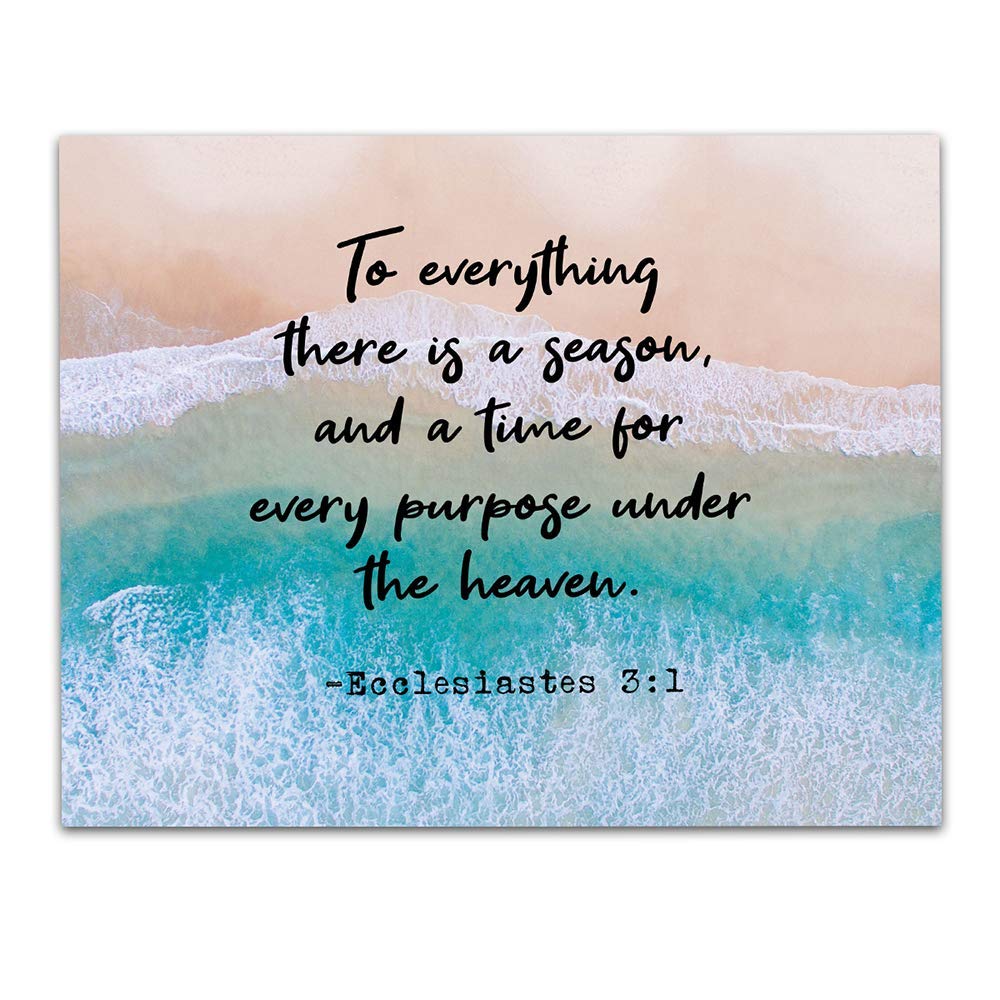
Photo credit: https://www.amazon.com/Ecclesiastes-Everything-Season-Unframed-Inspirational/dp/B08FMDFBTK

Having finally sat down to write a blog post, I was shocked to realize it had been two months since my last post.  Writing has always been a source of pleasure, joy, and learning for me – a way to reflect on the happenings of life in light of my faith and Holy Scripture.  Blogging for me is akin to preaching and spiritual direction:  an exercise in translating our daily, seemingly secular life into the sacred.  Nearly weekly postings for most of my ministry has been an outlet for me and a ministry to many others.

As I contemplated why there was such a big gap this summer, two theories percolated.  One was the more obvious.  I took some time for vacation, we were searching for and then training a new staff member, I was a part of a bishop’s search (which some argue is like a second full-time job), I was tending my family in a pandemic, I was investing time in continuing education, and I was trying to serve my beloved parish.  My plate was quite obviously full. 

But the second, perhaps more revealing reason came to me through scripture.  I was reminding of that familiar passage from Ecclesiastes, chapter 3:  For everything there is a season.[i]  Honestly, I think more people are familiar with this passage through The Byrd’s song “Turn! Turn! Turn!”  This summer has felt like a different season for me.  Instead of writing about life around us and interpreting it in light of our faith, I spent the summer doing that work orally with two faith communities – talking through what God is doing in the Church, what God has done through us in this time of pandemic, where the Church is going, and who Jesus is calling all of us to be.  In some ways those conversations have been very similar in content to what I write.  But experientially, it was significantly more vulnerable.  Instead of hiding behind the written word, I was engaging in deep, hard, thoughtful conversations in real time, being probed, questioned, and challenged – and all of that experience being broadcast in recorded and live videos for anyone and everyone to see.  I described it to a dear friend as a time of feeling naked before the world.

This summer has been a season for discernment, for deep reflection, for vulnerable pondering.  And just like the scripture writer says, for everything there is a season:  a time to plant, a time to break down, a time to laugh and dance, a time to embrace, a time to seek and a time to lose, a time to speak, and a time to love.  Now, I enter into another season:  a time to reconnect with the Hickory Neck community that loved me through this process – even though it was difficult for them.  A time to write again:  about where we see God in the midst of this season of pandemic that we wish were over.  A time to dream and a time to innovate:  about where God is calling us now.  A time to laugh, dance, and embrace:  even if we have to go back to doing that all virtually.  No matter what the season, God is with us.  I’m honored to journey in this season with you.


[i] Ecclesiastes 3.1-8 reads:  For everything there is a season, and a time for every matter under heaven:  a time to be born, and a time to die; a time to plant, and a time to pluck up what is planted; a time to kill, and a time to heal; a time to break down, and a time to build up; a time to weep, and a time to laugh; a time to mourn, and a time to dance; a time to throw away stones, and a time to gather stones together; a time to embrace, and a time to refrain from embracing; a time to seek, and a time to lose; a time to keep, and a time to throw away; a time to tear, and a time to sew; a time to keep silence, and a time to speak; a time to love, and a time to hate; a time for war, and a time for peace.

Sermon – Ephesians 4.1-16, P13, YB, August 1, 2021

25 Wednesday Aug 2021

Posted by jandrewsweckerly in Sermons

≈ Leave a comment

Tags

bishop, call, community, discernment, equip, exceptional, fear, gifts, God, good, ministry, Peter, preach, Sermon

In your senior year of seminary, you are given the privilege of preaching for the entire community.  I remember the week I was to preach, I was sitting at lunch with some classmates and a professor and I confessed to the table that I was a little nervous.  There is little worse than preaching to a room full of preachers; we tend to be a tough crowd.  But I will never forget what my professor said in response to my anxiety.  “Just remember what that old hymn says, Jennifer.  ‘If you cannot preach like Peter, if you cannot pray like Paul, you can tell the love of Jesus and say, “He died for all.”’”  At the time, I remember thinking how reassuring his words were – all that mattered was I preached the gospel. 

But sometime later, as I thought back to his comments, I had the distinct thought, “Wait a minute.  Was he saying I was not going to be as good a preacher as Peter?”  Suddenly I was confused by my professor’s words – was he trying to center me for preaching, or just trying to gently tell me not being a good preacher was okay.  I felt the emotional whiplash that seems to be a unique gift of Southerners – a little akin to a solid, “Bless your heart.”

What the words of that professor unearthed in me was a fear we all experience.  Our society tells us we need to be good at all the things – at being exceptional in our workplaces while also being an exceptional parent and spouse; at being a high-performing student and accomplished athlete (and musician, performer, and artist); at volunteering in so many places in retirement that we are working harder than we were working for compensation! 

But that is not what Paul, or the person writing in the name of Paul,[i] tells the Christian community.  Our epistle writer says, “The gifts he gave were that some would be apostles, some prophets, some evangelists, some pastors and teachers, to equip the saints for the work of ministry, for building up the body of Christ, until all of us come to the unity of the faith and of the knowledge of the Son of God, to maturity, to the measure of the full stature of Christ.”[ii]  Paul argues that mature Christians understand that they have been equipped with gifts for ministry.  However, as scholar Clark-Soles says, Christians “do not need to imagine themselves as pan-gifted, and there is no reason to compete with one another.  Our job is simply to recognize our particular gifts and use them for the development and augmentation of the body.”[iii] 

Nine months ago, I began to sense God was asking me to live into the maturity of my gifts – perhaps being called to serve as a bishop in the church in a land called Iowa.  The decision to be open to that process was not an easy one because my gifts have also been very much affirmed in this slice of heaven here called Hickory Neck.  A day after the election, with the news that I will in fact not be serving as a bishop, I find myself singing that old tune again, “If you cannot preach like Peter, if you cannot pray like Paul…” 

But this time, the recollection of that hymn does not sting in the same way the song stung in seminary.  Former bishop Porter Taylor says, “while the passage [in Ephesians] affirms the diversity of individual gifts, it asserts that these are always to be used for the good for the whole, ‘to equip the saints for ministry.’…To grow in one’s ministry, therefore, is to align oneself with God’s intentions, both individually and corporately…”[iv]  What Bishop Porter, the epistle to the Ephesians, and even the election yesterday remind us all of is that God equips each one of us here to the work of ministry – sometimes as preachers, sometimes as evangelists, sometimes as pastors, sometimes as teachers, sometimes as bishops – but always for the good of the whole and of the greater community.  Even though I was not elected yesterday, my hope is that the process was a good reminder for all of us that our work is to constantly be assessing what gifts God is giving us, how those gifts are evolving over time, and how we can use them for good.  Our one baptism is an invitation, whether we are Peters or Pauls, to share the love of Jesus.  The rest is in God’s hands.  Amen.


[i] Paul V. Marshall, “Pastoral Perspective,” Feasting on the Word, Year B, Vol. 3 (Louisville: Westminster John Knox Press, 2009), 304.

[ii] Ephesians 4.11-13.

[iii] Jaime Clark-Soles, “Exegetical Perspective,” Feasting on the Word, Year B, Vol. 3 (Louisville: Westminster John Knox Press, 2009), 305.

[iv] G. Porter Taylor, “Theological Perspective,” Feasting on the Word, Year B, Vol. 3 (Louisville: Westminster John Knox Press, 2009), 304.

Sermon – Isaiah 6.1-8, TS, YB, May 30, 2021

03 Thursday Jun 2021

Posted by jandrewsweckerly in Sermons

≈ Leave a comment

Tags

call, doctrine, God, Here am I, holy, Holy Spirit, Isaiah, Jesus, send, Sermon, Trinity, Trinity Sunday, vocation

To understand the lessons we have heard today, we have to look at where we have been over the last liturgical year.  We started in Advent, anticipating the birth of the Messiah.  Then we journeyed through the actual birth narrative at Christmas, and continued to celebrate Christ’s identity as the Messiah throughout the season of Epiphany.  In Lent, we journeyed through the temptation of Christ, and narrated the reason for our need for a Messiah.  That journey continued through Holy Week as we walked through the crucifixion and death of Jesus, remembering how the story of Jesus is rooted in the historical salvation narrative from the beginning of creation, ending on the joyous resurrection of Jesus and the seven weeks of celebrating what the resurrection and ascension means for our everyday lives.  Last week, we welcomed the manifestation of the Holy Spirit among the disciples of Christ, that joyous, cacophonous celebration.  Finally, after that long journey we arrive at today, Trinity Sunday.

For many Trinity Sunday is one of the weirder Sundays of the Church.  Trinity Sunday is the only Sunday in our calendar year dedicated to a theological concept.  Furthermore, the theological concept is one of the hardest in our faith.  Whole gatherings, like the one in Nicea, have happened just to hash out what having a triune God means, people have been labeled as heretics when they do not get it quite right, and authors have spent myriad pages trying to explain a concept that sometimes feels beyond words.  And that does not even include the number of parents and Sunday School teachers who have tried to make the concept of the trinity understandable to our youngest members – because, quite frankly, the concept is hard even for us adults!  And yet, at the conclusion of the long journey in the liturgical calendar – from Advent and Christmas, Epiphany and Lent, all the way to Easter and Pentecost – the church stops today and designates a day to celebrate the triune nature of God.  

Part of why we honor the Trinity this day is to give meaning to this seven-month journey – to answer the “so what?” of all we have learned.  Into that question, we read Isaiah’s call narrative from chapter six of Isaiah.  Now some scholars argue we hear Isaiah’s call story today because this passage was used in the early Church’s development of the doctrine of the Trinity.[i]  For me, that is not the most important reason we hear this lesson today.  Certainly, I want us as faithful disciples to understand the doctrine of the Trinity because the doctrine is unique among other faiths to our understanding of God.  But I am always more concerned about what you do with understanding than that you simply attain the understanding.  That is why I like this very human story about a reaction to God.  In Isaiah’s story, he is confronted with appearance of God – the majesty of God alone would be enough, but the appearance of seraphs, these winged snake-like figures – and the earth-shattering noise[ii] of their “Qadosh, qadosh, qadosh…Holy, holy, holy,” and the appearance and smell of smoke leave Isaiah utterly awestruck and keenly aware of his unworthiness.  Into that posture, and into Isaiah’s forgiveness, Isaiah has no other response when God asks, “whom shall I send to go out for us?”  The answer is simple.  Send me.

That is the “so what?” of Trinity Sunday.  Telling Isaiah’s story today helps us see the cosmically important reason why our own call or vocation is so important – not just that we have a job or purpose – but that our job or purpose is in response to the awesomeness of the Holy, Undivided Trinity – the fearsome, incarnate, mysterious revelation of the Godhead – three in one and one in three.  Every Sunday we send each person here and those gathered around the world through their screens out into the world to do the work God has given us to do.  That instruction is a commissioning and a blessing.  But today, we also honor how that work is a response to the awesomeness of our God.  We take all those powerful, sacred, quiet ah-ha moments we have had with God, and we take all those proddings from the Holy Spirit when we have felt like our gifts can and are being used for a great purpose, and we respond in the words of that old hymn, “Holy, holy, holy!  Lord God Almighty!  God in three persons, blessed Trinity,” and we have no other words but, “Here am I; send me.”  Amen.


[i] Donald K. McKim, “Theological Perspective,” Feasting on the Word, Year B, Vol. 3 (Louisville: Westminster John Knox Press, 2009), 28.

[ii] Rolf Jacobson explains this understanding of the Hebrew words in the podcast, “SB607 – Holy Trinity,” May 19, 2018, found at https://www.workingpreacher.org/podcasts/sb607-holy-trinity, as found on May 27, 2021.

On Nudges and the Holy Spirit…

12 Wednesday May 2021

Posted by jandrewsweckerly in reflection

≈ Leave a comment

Tags

Bible, call, church, discernment, follow, God, Holy Spirit, Jesus, journey, life, ministry, vocation

Photo credit: https://www.ibelieve.com/faith/what-is-discernment-ways-grow-more-discerning.html

Discernment is a topic we talk a lot about in church.  Some of our most beloved biblical stories, often called “call narratives,” are about discernment.  They all have a pattern:  God calls the individual to some bold action, the person resists (sometimes repeatedly and comically), but when the person eventually acquiesces, God equips the individual for the work. 

I love these call narratives mostly because they are so human and relatable.  But I sometimes wonder if the dramatically entertaining nature of these stories makes us think “calls” are something that only happens to certain, singled-out people.  In truth, that is why we talk about discernment so much in the life of the church:  because we want people to know that discernment is not just about major life transitions.  Discernment happens repeatedly throughout life – sometimes at expected moments, like a school graduation, in response to a spouse’s new job, or even retirement.  But discernment also happens in the times when we are plugging away at the calls we have already discerned:  when a volunteer opportunity stirs something in us; when a friend makes an off-handed comment about a gift we should be honoring; or when we just feel a little discomforted but do not know why (as a spoiler, that discomfort is usually the Holy Spirit!).

In my ministry setting, we talk about discernment a lot.  It is the topic of one of the six sessions in our Discovery Class (a newcomer/confirmation class).  We talk about discernment from the pulpit – even when there is not some big call narrative in the lectionary.  We talk about discernment in Bible study, in pastoral visits, and even over coffee.  We have come to understand that “call” is not static, and that even within a call, or vocation, the Holy Spirit continues to move and nudge us in ways that enrich our own journey and the journey of those around us.  Following Jesus means just that – continuing to follow wherever he may lead.

This week, I announced to my parish that the Spirit had been nudging me too.  In this unique situation, it may be a nudge that does not come to fruition.  Even in those cases, God is doing something too.  But it may also lead to something new and different.  That is the risk we take when we listen to the Holy Spirit.  I cannot authentically encourage my community into constant discernment if I am closed to the possibilities of the Spirit – especially when I would be perfectly happy to stay right where I am.  And so, this week I join you in that gloriously off-centered life that is the life of following Jesus.  I do not know where it will lead, but I am grateful for a community who journeys with me!

Sermon – Jonah 3:1-5, 10, Mark 1:14-20, E3, YB, January 24, 2021

03 Wednesday Feb 2021

Posted by jandrewsweckerly in Sermons

≈ Leave a comment

Tags

act, action, call, calling, faithfulness, God, Jesus, Jonah, light, Nineveh, pandemic, Sermon

We are in a season of call narratives in our lectionary cycle.  Last week, we heard Samuel’s dramatic call story – how the sleepy, confused Samuel keeps trying to be faithful, but needs Eli to help him realize God is the one speaking.  This morning we get two sets of stories.  First is Jonah, perhaps Scripture’s worst follower of God’s call – who runs in the opposite direction God sends him, almost drowns a crew of shipmates and is swallowed by a large fish, who offers the weakest possible sermon of all time to the Ninevites, and then gets angry when God changes God’s mind.  In fact, the Ninevites answer God’s call to repent immediately – they are the exact opposite of Jonah.  Meanwhile, our gospel lesson today follows two sets of brothers who leave their family and livelihood in a lurch to immediately follow Jesus.  Even our collect today, that opening prayer we say together says, “Give us grace, O Lord, to answer readily the call of our Savior Jesus Christ and proclaim to all people the Good News of his salvation…”[i]

In some ways, this time of year is a perfect time to be thinking about our call.  We have all just celebrated the New Year, with the usual practices of setting New Year’s Resolutions.  We just elected a new Vestry last weekend.  Even Poet Laureate Amanda Gorman challenged us this week with her stunning inaugural poem, saying “There is always light, if only we’re brave enough to see it.  If only we are brave enough to be it.”  The invitation is everywhere around us, just waiting for us to answer God’s call. 

But despite the fact that motivation is all around us – from scripture, to secular practices, to inspirational events – few of us are feeling like we have the energy or even the emotional capacity to think about call right now.  Many of our parishioners are living out inspirational calls – from the medical profession, to teaching, to civil service.  But these are the very people are being pushed to capacity, who have had an exhausting year, and although they put on a good face, are just trying to put one foot in front of the other.  Many of our parishioners have answered the call of parenthood, and most days can tell you about the joys of parenthood.  But after almost a year of home and virtual schooling, and all the challenges being with your family 24-7 can bring, are lately wondering where God is in those relationships.  And several of our more seasoned parishioners have told me that although they appreciate all the church is doing to help them feel connected, ten months of social isolation have left them feeling like they should be doing something more meaningful, but they just do not know how.  When we are really honest, the last thing we feel like talking about is call – surely that is a conversation for when we are “back to normal.”

That is why I am so glad the Ninevites are in our call narratives today.  Nineveh is a brutal power in Jonah’s day.[ii]  They are known for their vicious treatment of the people of Israel.  They are the enemy.  But when the residents of Nineveh hear the judgment of the LORD – Jonah’s brief, half-hearted one – they immediately respond.[iii]  All the people put on sackcloth, even the king and the animals; they take up a fast, sit in ashes, and turn from their violent ways.  Talk about a 180!  The Ninevites may not be ideal citizens.  They might not even understand what a calling is.  But they do act.  And as one scholar points out, “Apparently God’s purposes can be accomplished with a minimum of faithfulness; and such faithfulness turns out to be a matter of not merely what one feels, but what one does.”[iv]

That is what all our call narrative actors do:  act.  Samuel, without fully understanding, does when he says, “Speak, Lord, for your servant is listening.”  Acting is what Jonah begrudgingly does and the Ninevites immediately do.  Taking action is what brothers Simon and Andrew and brothers John and James do – against all logic of leaving home and security to follow a man they barely know.  Our invitation this week is do the same – find ways to act.  For some of us, that action is going to be to keep showing up:  for your kids, for your clients, for the needy.  For some of us, that action is going to mean taking those feelings of isolation and doing something:  finally taking up that Connection Challenge and calling, emailing, or sending cards to fellow parishioners (who feel the same way, by the way!).  For others of us, we may need to channel all those feelings into different action:  whether we write to our local representatives to advocate for the disadvantaged, whether we finally call that nonprofit we have been admiring and offer our services, even if they have to be offered from home, or whether we ask God in prayer what acts we are being called to do for others.  We do not have to feel like being the light this week.  We simply are invited to be brave enough to be the light.  God will do the rest.  Amen.         


[i] BCP, 215.

[ii] Callie Plunket-Brewton, “Commentary on Jonah 3.1-5, 10” January 21, 2012, found at http://www.workingpreacher.org/preaching.aspx?commentary_id=1214 on January 22, 2021.

[iii] Joseph L. Price, “Theological Perspective,” Feasting on the Word, Yr. B, Vol. 1 (Louisville: Westminster John Knox Press, 2008), 270.

[iv] Lawrence Wood, “Homiletical Perspective,” Feasting on the Word, Yr. B, Vol. 1 (Louisville: Westminster John Knox Press, 2008), 269.  Emphasis added.

The Pilgrim’s Way…Day 2

08 Saturday Feb 2020

Posted by jandrewsweckerly in Uncategorized

≈ Leave a comment

Tags

call, Cathedral, Edith Cavell, faithful, God, Julian of Norwich, pilgrimage, witness, women

85013051_2883674765022098_7674431015430914048_n

Photo credit:  Jennifer Andrews-Weckerly; reuse with permission only

Sixteen pilgrims from Hickory Neck Church traveled to England for 8 days of pilgrimage.  Our focus was on choral music, hearing Evensong or Choral Mass at a Cathedral, Minster, or college everyday.  This is the second entry, initially posted on our church Facebook page.  For those of you who do not follow us on Facebook, I am repeating the journey’s daily entries here.  Enjoy!

Norwich

Today I was struck by the witness of women in the church. First, was Julian of Norwich (1300’s), the first woman to write a book in English, whose spiritual counsel and writing have inspired generations. Then, Edith Cavell, a nurse in WWI, who helped free around 200 allied soldiers before being martyred for her work. Then, seeing the female dean of Norwich Cathedral, bringing the Cathedral community out into the streets in the 21st Century.

I confess, when I saw the Passion of Edith Cavell, my sacrilege antennae went up. But what I began to see as I stared at those paintings was that no matter your gender, no matter your era, no matter your gifts (Julian likely had to learn to write before writing her book), God can, and will, so powerful things through each of us, when we let God. We may not be a Julian or an Edith, but we will be a Sarah, a Lisa, a Lorna, and maybe even a Jennifer. I can’t wait to see you embrace your call and see how your faithful living in the world inspires others. 

84986335_2883674775022097_6091739990671228928_n

Photo credit:  Jennifer Andrews-Weckerly; reuse with permission only

Sermon – 1 Kings 19.1-15a, Luke 8.26-39, P7, YC, June 23, 2019

26 Wednesday Jun 2019

Posted by jandrewsweckerly in Sermons, Uncategorized

≈ Leave a comment

Tags

call, demons, faith, fear, God, goodness, grace, love, paralysis, release, scary, Sermon, trust

I remember when I was discerning one of my first calls to a parish, I heard a distinct word of encouragement from God that made me confident I should accept the call.  Or at least I thought I heard a distinct word from God.  Moments and days later, I began to doubt myself.  Maybe the words I heard in my head were my own.  Maybe I imagined the whole thing or, in hoping from a word of clarity, I made up the words myself.  And as soon as I began questioning what I heard, I started questioning the guidance of the words.  Either I was boldly following God’s distinct word to me or I was misguidedly making decisions based on an imagined experience.  Saying yes in that fog of doubt became one of the scariest experiences I have had.

That’s the funny thing about our relationship with God.  Most of the time when we talk about our relationship with God, we talk about the God of love.  But real, vulnerable, authentic experiences with God are scary too.  Whether we are trusting God through a major life crisis, we are taking a new path we are not certain is the right one, or someone challenges our life choices, following God in everyday life is scary.

We see that reality in two of our scripture readings today.  To understand why Jezebel wants to kill the prophet Elijah, we have to recall what happened in the previous chapters.  In an effort to proclaim the supremacy of Yahweh, Elijah challenges the god of Jezebel’s prophets to a duel of sorts.  All day long the prophets of Baal cry out to Baal to reign down fire on a sacrifice and are unable.  Elijah, fully confident in the power of Yahweh, immediately calls down fire, victorious over the prophets of Baal, and then proceeds to slaughter the whole lot.  But Jezebel’s answering threat on Elijah’s life sends him running.  No longer full of prophetic nerve[i], he runs to the wilderness, and asks God to take away his life.  Once so confident in the power of God, Elijah would rather cower in a corner and die.  Even when God’s voice come to him in a word of encouragement, Elijah can only see what is in front of him; in fact, he can only see the limited view he has, not the wider, sweeping view of God’s power to save.   Fear leads Elijah to paralysis.

Meanwhile the Gerasenes are equally scared.  They have developed a system for dealing with the possessed man of their village.  They know when to bind him and when to abandon him.  They know he is dangerous, and unclean, but they have figured out how to keep the town safe.  He is the identified patient of the town – the one who has the “real” problems.  By identifying the demoniac as the patient, no one else has to look at their own demons – the ways in which each of them are “vulnerable to forces that seek to take [them] over, to bind [their] mouths, to take away [their] true names, and to separate [them] from God and from each other.”[ii]  So, when Jesus casts out the impossible demons, and sends them to their death through their herd of swine, and the townspeople find the demoniac healed, clothed, and sitting in his right mind at the feet of Jesus, they do not celebrate or thank God for healing.  Instead they stand afraid of the power of God.  Now the demoniac is healed, they are afraid this Jesus will see their demons or challenge their feigned health.  In response, they do not ask for an explanation, but ask Jesus to leave.  Their fear leads to paralysis too.

To be fair, fear is a natural and sometimes necessary emotion.  Fear helps us develop a healthy sense of preservation.  Fear allows us to make necessarily cautious decisions.  Fear can keep us safe.  But fear can also lead to paralysis, and perhaps more importantly, to a lack of trust.  And when we are talking about God, a lack of trust evolving from fear gets us into trouble.  We start doubting the graciousness we know God intends for us.  We start avoiding the very work that will give us joy and fulfillment.  We start losing our sense of connection to God – who happily emboldens us when we allow God to do so.

We see in Elijah and the Gerasenes’ story the goodness that can happen when we work through our fear.  For Elijah, despite the fact he is terrified and despondent, convinced he would be better off dead, God provides food for him the wilderness – twice!  The angel of God feeds him with food so sustaining Elijah is able to make a forty-day journey.  And despite the fact that Elijah is so afraid he becomes convinced he is all alone in God’s work, God not only speaks to him, but opens up a vision of God’s work that is bigger than Elijah and extends well beyond his lifetime.[iii]  As Elijah slowly loosens his grip on fear, he opens himself up again to God’s guidance, protection, and confidence – even though the guidance, protection, and confidence had been present all along, hidden in the presence of gripping fear, but there nonetheless.

The same is true for the Gerasenes.  Despite the fact the townspeople are fearful of Jesus’ power, Jesus brings about healing anyway.  And knowing the people of Gerasene may continue to be fearful, Jesus has the former demoniac stay behind so he can testify to the salvific work of God.  As scholar Debie Thomas points out, “The story ends with Jesus commissioning the healed man to stay where he is and serve as the first missionary to his townspeople — the same townspeople who feared, shunned, trapped, and shackled him for years.”[iv]  Jesus does not scold, shun, or shame when he is asked to leave.  Jesus keeps holding out hope in the face of fear – Jesus holds hope that the townspeople might be healed like the demoniac is healed.  Jesus loves graciously and expects transformation in the face of hopeless fear.

One of the main tenants of practicing yoga is while you are practicing, you are to clear you mind of thoughts.  I am pretty sure every yoga instructor knows this is an impossible goal, because the other thing one learns in yoga is how to clear your mind once your mind becomes distracted – not if your mind becomes distracted.  There are all sorts of methods, but the primary instruction is to acknowledge the thought and then let the thought go.  In other words, when you catch yourself on the fifth thing on your to do list, you stop yourself by acknowledging you got off track, let the failure go, and try to clear you mind again.  There is no need for judgment, just acknowledgment and release.

That is our invitation today too.  Fear will always be with us.  No matter how strong we are in our faith life, we will sometimes be paralyzed by fear.  But if we can take a cue from yoga by pausing, taking a deep breath, acknowledging our failure in the face of fear, and trying again, perhaps we will be able to release the paralysis fear causes and step boldly back into the path God establishes for us.  Today’s lessons remind us there is encouragement for this work all around us.  There are angels that feed us when we want to give up the fight.  God speaks to us, reminding us how God is working at a much higher level, supporting us in ways we do not even realize we need.  God sends healed messengers to testify to us, to remind us of the ways in which we need healing more than those we have labeled as sick.  In breathing and letting go, we open our eyes in fresh ways to see God all around us acting for good.  And with each breath, and with each relaxing of our grip on fear, God washes over us with grace, kindness, compassion, and love.  Yes, letting go is scary.  But God shows us over and over again how when we let go of our fear, God is there with abundant, wonderful, powerful love.  Amen.

[i] Trevor Eppehimer, “Theological Perspective,” Feasting on the Word, Yr. C, Vol. 3 (Louisville: Westminster John Knox Press, 2010), 148.

[ii] Debie Thomas, “Legion,” June 16, 2019, as found at https://www.journeywithjesus.net/lectionary-essays/current-essay, on June 19, 2019.

[iii] Kathleen A. Robertson Farmer, “Theological Perspective,” Feasting on the Word, Yr. C, Vol. 3 (Louisville: Westminster John Knox Press, 2010), 151.

[iv] Thomas.

Sermon – Luke 4.7-18, A3, YC, December 16, 2018

19 Wednesday Dec 2018

Posted by jandrewsweckerly in Sermons, Uncategorized

≈ Leave a comment

Tags

asking, bully, call, calling, church, clergy, fair, God, John the Baptist, light, love, loving kindness, share, simple, spiritual gifts, unique, vocation

Today we are honoring the beginning of Bob Gay’s diaconal ministry with Hickory Neck.  We do not arrive at this day lightly.  Bob and his family had to discern if coming out of retirement was what God was calling him to do.  Bob had to confirm that call with church leaders, church members, and Diocesan staff.  Bob had to prayerfully consider what a diaconal ministry at Hickory Neck would look like and how that ministry might be different than at other churches.  And today, Bob and our community make commitments to not only support his call, but also recommit to our own senses of call.  Though our celebration of Bob’s ministry may feel brief in relation to all we do today, the gravity of what we do in and through Bob is serious.

Although I am thrilled to honor Bob’s new ministry among us, sometimes these types of days can leave us with the impression that “calling,” is something that happens to those with collars – people are called to be priests, deacons, and bishops.  Sometimes we are willing to expand the notion of calling to certain helping professionals – people are called to be nurses, social workers, fire fighters, and teachers.  But we get a little tripped up imagining being called to be other things – a lawyer, an engineer, a stay-at-home parent, an investment banker, or a business owner.  And when we are younger, we almost never hear people saying we are called to be a student, a babysitter, a friend, or a sibling.  We might think we are good at some of those things, or we enjoy those jobs or roles, but we do not always say we are “called” to do them.

I met a retired priest once, and he said his greatest joy in retirement was in helping parishioners experience God on Mondays.  In partnership with the clergy of his church, his “calling” in retirement was to set up what he called “Sunday-Monday Appointments” with church members.  He would go visit members of Church on Mondays in their places of employment and talk about where they see God in their everyday life – how they make the connection between what they do on Sundays and what they do on Mondays.  Those conversations are meant to help the parishioners name how they experience “calling” in their work place.  For some parishioners, that conversation is quite easy.  But for others, that conversation is much more difficult.  Many of them have never had a priest visit them at work, and they have certainly never prayed aloud at the end of a meeting at work.  When the retired priest asks them about their Sunday-Monday connection, sometimes he finds parishioners do not really have a connection.  Those two days feel very separate in their minds.

Part of what is challenging in claiming that we are “called” to a role outside of church is we feel intimidated declaring what God would want us to do outside of church.  We imagine something a bit like what happened to those around John the Baptist in our gospel lesson today.  We do not like the idea of being called a “brood of vipers.”  We do not like the idea of being told our ancestry does not matter – that being a descendant of Abraham does not hold sway with God.  We do not like hearing about repentance, or axes lying at the root of trees who do not bear fruit.  Perhaps if we had been one of those gathered around John the Baptist, we might have simply concluded that the whole baptism thing was not for us.  Baptized living sounds hard as John describes baptism.

But before we get too far down the path of defeatism, something interesting happens in our gospel story.  Instead of walking away with their heads hung low when John starts calling them broods of vipers, the crowd asks a question, “What then should we do?”  After being called broods of vipers, you might expect the eccentric John to tell them to sell all their possessions, eat insects, and live in rags.  Instead, John says something quite simple, “Whoever has two coats must share with anyone who has none; and whoever has food must do likewise.”  Basically, John says, share your stuff when you have more than you need.  That is all:  share your stuff.  We can tell John’s answer is pretty benign because the tax collectors jump in, “Teacher, what should we do?”  They ask because although the others get off pretty easy, the tax collectors know they are in a bit of hot water, resembling broods of vipers more than they might like to admit.  But John is mild again, “Collect no more than the amount prescribed for you.”  In other words, John says, “Just do your job fairly.”  The soldiers are emboldened now too, asking, “And we, what should we do?”  John gives them an easy out too, “Do not extort money from anyone by threats or false accusation, and be satisfied with your wages.”  That one is pretty basic too:  appreciate what you have, and don’t be a bully.

What scholar David Lose appreciates “is how mundane, if not downright obvious, John’s admonition proves.  I mean, this is not rocket-science; indeed, [John’s admonition] is the logic of the classroom and playground most of us first heard in kindergarten: share, be fair, don’t bully.  But if somewhat obvious, [John’s admonition] is at least also within their reach.  John does not tell the crowds to join him out in the wilderness, he does not ask the tax-collectors to abandon or betray Rome, and he does not urge soldiers to a life of pacifism.  Instead, he points them to the very places in which they already live and work, love and laugh, struggle and strive, and suggests that these places are precisely where God calls them to be, where God is at work in them and through them for the sake of the world.”[i]

This month in our Sunday Forum series we are talking about our spiritual gifts.  We are hearing diverse voices talk about what gifts each of us have and how we can use those gifts in our various callings.  The idea is not simply to discover what gifts we have so that we can use them in the world; the idea is also to name how we are already using our gifts in the world, and to understand the use of those gifts out in the world and within this community as our calling.  You know as well as I do that some of us are called to teach children, some to read scripture in worship, some to advise the church about financial decisions, some to plan parties, and others to find and stop leaks in water pipes.  And some of us are not called to do any of those things.  But each of us has spiritual gifts unique to ourselves, and each of us are invited to use those gifts in the church and the world.  Those spiritual gifts can be as simple as the fidelity of a parent or spouse, the attentiveness of a friend, the hard work of an employee, the honesty of an employer, the steadfastness of a volunteer, the generosity of participating in an outreach ministry, or the compassion of visiting the sick or homebound.[ii]

What Bob’s new ministry and John’s invitation in our gospel lesson today do is not send us home thinking we must be ordained or be some crazy wilderness prophet to be faithful to God and live out our calling.  What we do liturgically and hear scripturally today is remember that the connection from Sunday to Monday matters.  The things we do in our everyday lives are opportunities to stop seeing work, home, school, and community as simply work, home, school, and community, but instead as our mission field – as the places where we live out the calling we discern here on Sundays.  And if we are not certain what that calling is, the crowd surrounding John encourage us to ask the same question they ask, “And me, what should I do?”  I promise the answer will not be overwhelming.  The answer will be simple:  show God’s loving-kindness in the workplace, at home, at school, and in the community; be Christ’s light in the grocery store, on the playground, with your loved one, and with the stranger; share the Holy Spirit’s love while driving, while emailing, while eating, and while playing on a team.  Our job each Sunday is to keep asking, “And me, what should I do?” and then trust on Monday the answer will be unique to our gifts, within our reach, and fulfilling beyond measure.  Amen.

[i] David Lose, “Advent 3C:  Beyond Scolding,” December 11, 2018, as found at http://www.davidlose.net/2018/12/advent-3-c-beyond-scolding/ on December 14, 2018.

[ii] Lose.

← Older posts

Recent Posts

  • On the Myth and Magic of Advent…
  • On Risking Failure and Facing Fear…
  • Sermon – Luke 23.33-43, P29, YC, November 23, 2025
  • On Inhabiting Gratitude…
  • Sermon – Luke 20.27-38, P27, YC, November 9, 2025

Archives

  • December 2025
  • November 2025
  • October 2025
  • September 2025
  • August 2025
  • July 2025
  • June 2025
  • March 2025
  • February 2025
  • December 2024
  • November 2024
  • October 2024
  • September 2024
  • August 2024
  • July 2024
  • June 2024
  • May 2024
  • March 2024
  • February 2024
  • January 2024
  • December 2023
  • November 2023
  • October 2023
  • September 2023
  • August 2023
  • July 2023
  • June 2023
  • May 2023
  • March 2023
  • February 2023
  • January 2023
  • December 2022
  • November 2022
  • October 2022
  • June 2022
  • May 2022
  • January 2022
  • December 2021
  • November 2021
  • October 2021
  • September 2021
  • August 2021
  • June 2021
  • May 2021
  • April 2021
  • March 2021
  • February 2021
  • January 2021
  • December 2020
  • November 2020
  • October 2020
  • September 2020
  • August 2020
  • July 2020
  • June 2020
  • May 2020
  • April 2020
  • March 2020
  • February 2020
  • January 2020
  • December 2019
  • November 2019
  • October 2019
  • September 2019
  • August 2019
  • July 2019
  • June 2019
  • May 2019
  • April 2019
  • March 2019
  • February 2019
  • January 2019
  • December 2018
  • November 2018
  • October 2018
  • September 2018
  • August 2018
  • July 2018
  • June 2018
  • May 2018
  • April 2018
  • March 2018
  • February 2018
  • January 2018
  • December 2017
  • November 2017
  • October 2017
  • September 2017
  • August 2017
  • July 2017
  • June 2017
  • May 2017
  • April 2017
  • March 2017
  • February 2017
  • January 2017
  • December 2016
  • November 2016
  • October 2016
  • September 2016
  • August 2016
  • July 2016
  • June 2016
  • May 2016
  • April 2016
  • March 2016
  • February 2016
  • January 2016
  • December 2015
  • November 2015
  • October 2015
  • September 2015
  • August 2015
  • July 2015
  • June 2015
  • May 2015
  • April 2015
  • March 2015
  • February 2015
  • January 2015
  • December 2014
  • November 2014
  • October 2014
  • September 2014
  • August 2014
  • July 2014
  • June 2014
  • April 2014
  • March 2014
  • February 2014
  • January 2014
  • December 2013
  • November 2013
  • October 2013
  • September 2013
  • August 2013
  • July 2013
  • June 2013
  • May 2013
  • April 2013
  • March 2013
  • February 2013
  • January 2013
  • December 2012
  • November 2012
  • October 2012
  • September 2012

Categories

  • reflection
  • Sermons
  • Uncategorized

Meta

  • Create account
  • Log in
  • Entries feed
  • Comments feed
  • WordPress.com

Blog at WordPress.com.

  • Subscribe Subscribed
    • Seeking and Serving
    • Join 394 other subscribers
    • Already have a WordPress.com account? Log in now.
    • Seeking and Serving
    • Subscribe Subscribed
    • Sign up
    • Log in
    • Report this content
    • View site in Reader
    • Manage subscriptions
    • Collapse this bar
 

Loading Comments...