• About

Seeking and Serving

~ seek and serve Christ in all persons

Seeking and Serving

Tag Archives: church

On Baptisms, Community, and Belonging…

04 Wednesday Sep 2024

Posted by jandrewsweckerly in reflection

≈ Leave a comment

Tags

baptism, beauty, belonging, beloved, challenge, child of God, Christ, church, God, image of God, love

Photo credit: https://www.sacredheartcalgary.ca/sacraments/baptism-2/baptism/

One of the challenges of a church with multiple service times is the inevitable formation of multiple smaller communities within a larger community.  Between different attendees and different worship styles, each service begins to take on its own personality.  I have had families with young children show up at our early service, and had to be sure to let them know that the later service might be much more familiar and comfortable than the meditative feel of the early service.  Or I have had folks who grew up in an Anglo-Catholic tradition show up at our later service, and had to be sure to let them know they might find the more formal liturgy of the early service more heart-warming.  The trick is figuring out how to create a sense of “home” in each worship service while also providing opportunities for cross-pollination across services.

I think that is why I am so excited for a baptism at my church this weekend at the early service.  We almost never have children at that service (I know very few parents of littles who can get their families at church by 8:00 am), and we do not have music (for those littles to join in the joyful noise making), and the pews in the historic chapel are way less accommodating than the movable chairs in our newer chapel.  But the mother of the baptized grew up in that space and wants her child to experience the centuries of prayer found there.  And although there may not be other children there, she will tell her son of the days when she used to sit in the window wells or babies crawled under the pews.  And when she sees parishioners the age of her son’s grandparents in worship, she will be able to tell her son about the fellowship of saints, and maybe even let parishioners take a turn rocking her son if he becomes fussy.

That is the true beauty of the kind of community church creates.  No matter which service you choose, there is a child whose grandparent may live far away, a grandparent who hasn’t seen his children in months or a year, and a parent who just needs a place who gets how hard parenting is.  And those three groups come together as a fluid organism, with all their everyday human stuff, laying their troubles before God, praising God for their blessings – even when it is sometimes hard to see them, and breaking bread together, recognizing the beauty of a diverse room of people reflecting the image of God. 

That is what this Sunday’s baptism is all about:  bringing another human being into to the strange, mysterious, beauty of Church; helping him know that he is a child of God and is marked as Christ’s own forever; teaching him that he will now belong to a community that will both love him unconditionally and challenge him to live into his vocation and calling – whatever it may be.  We baptize that little one to tell him all that.  But we also baptize that little one to remind ourselves of that reality:  to remember how we too are beloved children of God with a commission to love and serve the Lord in the world.  No matter what service you choose, we all need that message.   

Sermon – Mark 7.1-8, 14-15, 21-23, P17, YB, September 1, 2024

04 Wednesday Sep 2024

Posted by jandrewsweckerly in Sermons

≈ Leave a comment

Tags

body, church, disciples, Episcopal Church, faith, identity, Jesus, member, membership, Sermon, serve, work

Before I became a priest, I served as a Director of Volunteer services at a Habitat for Humanity affiliate.  In my training as a volunteer manager, I learned that one of the most important things about recruiting someone to a volunteer position was clarity about what one was asking from a volunteer.  If they were going to serve on a committee, how long was the commitment, how frequently would they meet, what work would be expected, and how was leadership structured were all details they should have.  If they were going to work on site, what training was expected or would be provided, what age restrictions existed, what risks would they undertake, and how their day would be structured were important details before a workday.  If they had a group event, they needed to know how many volunteers could be on site, what hours they needed to commit to, and what happened in inclement weather.  By the end of my tenure, every volunteer position had a position description outlining expectations, qualifications, and rewards.

So, imagine my transition to the priesthood and realizing how poorly the Episcopal Church had defined membership.  The very first time someone asked me (and every time since then), I dread the question, “So what do I need to do to become a member of this church?”  The Episcopal Church does a notoriously poor job of defining membership.  Our commitment to professing “All are welcome!” seems to translate into no defining characteristics of membership.  “How do I join your church?” should be one of the easiest questions there is.  And yet, when I talk to new members, the answer has to be two-fold:  the technical answer (as long as you attend three services a year and are a financial contributor, you’re considered a member – the answer from the wider Episcopal Church which I loathe!), and the more practical answer we have crafted here at Hickory Neck:  you fill out a form, you commit to supporting the church financially, you commit to feeding yourself (through study, prayer, regular worship), and you commit to feeding others (through giving your time to the church and to the wider community on behalf of the church). 

Our gospel lesson today seems to be wading through a similar lack of clarity.  The Pharisees and scribes are totally perplexed by how some of Jesus’ disciples are not washing their hands before eating – a totally valid concern in these days of post-pandemic!  But handwashing was not just about hygiene.  The ritual washing of hands was about identity, or “membership” as we understand membership today.  The Jews of this time are in an “oppressed minority, living in an occupied land.”  Their question is asked with the backdrop of colonialism, cultural and religious diversity, and competing claims on identity.[i]    Their question is both simple and complex:  why aren’t the disciples living like members of our community? 

For many a reader of this text, all sorts of erroneous conclusions have been drawn – primarily the anti-Semitic understanding that the laws of the Jews are superseded by laws of Jesus.[ii]  But that is not what is happening in this text.  Jesus does not have any issue with ritual cleansing:  he of all people understands the expectations of following God.  But Jesus is saying something more nuanced about identity and membership.  Jesus is saying that no matter how we traditionally mark ourselves as “other,” even if something is “the way we’ve always done it,” what is more important is how we live our faith.  So, if we are doing all the right things:  washing our hands the right way, bowing or genuflecting at all the right times, crossing ourselves when we’re supposed to, saying “Amen” during the sermon – or avoiding saying “Amen” during the sermon – none of that matters if our insides are defiled.  As Jesus quotes from Isaiah, “This people honors me with their lips, but their hearts are far from me…”[iii] 

Today’s invitation is to ponder what membership in this body of faith means.  Are we honoring Jesus with our lips, but our hearts are far from Jesus?  Are we following the external “rules” but fostering evil intentions in our heart?  Have we filled out the membership form but neglected our work of feeding ourselves and feeding others?  Our work this week is making sure that when we go out into the world to love and serve the Lord – the dismissal that the we agree to every week – that we love and serve the Lord in ways that show people Christ through our words and actions; that as the political season ramps up, we ensure we are not defiling the dignity of any human being with our lips; and that when we talk about how much we love this church on the hill, we do so in a way that does not mask our individual struggles with avarice, deceit, slander, pride, and folly.  Telling the world you are a proud member of Hickory Neck Episcopal Church is just fine – and something I hope you do on a regular basis.  But our invitation from scripture today is to be clear with others that, as that old tune says, “He’s still working on me,” is also a part of membership in the body of Christ – perhaps the most appealing one that draws others into a desire for membership too.  Amen. 


[i] Debie Thomas, “True Religion,” August 22, 2021, as found at https://www.journeywithjesus.net/lectionary-essays/current-essay?id=2944 on August 30, 2024.

[ii] Idea suggested by Matt Skinner on the Sermon Brainwave podcast, “#799: 14th Sunday after Pentecost (Ord. 22B) – Aug. 29, 2021,” August 22, 2021, as found at https://www.workingpreacher.org/podcasts/799-14th-sunday-after-pentecost-ord-22b-aug-29-2021 on August 28, 2024.

[iii] Mark 7.6b.

Sermon – John 6.35, 41-51, P14, YB, August 11, 2024

28 Wednesday Aug 2024

Posted by jandrewsweckerly in Sermons

≈ Leave a comment

Tags

bread, Bread of Life, change, church, communion, feed, food, God, hierarchy of needs, Jesus, manna, needs, purpose, relationship, security, Sermon, share, tend

One of the components of our leadership training in Vestry is to talk about Maslow’s hierarchy of needs.  If you’re not familiar with his model, Maslow presents a pyramid of needs.  At the bottom are the physiological needs:  food, water, shelter, etc.  The next level of need is safety or security:  this would include health, employment, and social support.  The third level up the pyramid is love and belonging:  this entails friendship, family, intimacy, connection.  The fourth level is self-esteem:  including confidence, achievement, and respect.  And the final level, the tip of that pyramid is self-actualization:  creativity, a sense of purpose and meaning, and acceptance happen here.  The idea is, you cannot work on someone’s sense of purpose or meaning – the top of the pyramid, or even their sense of achievement and confidence without first meeting their basic needs at the base of the pyramid.  The same is true in the church.[i]  If we want to have excellent programming and ministry, where people are successfully naming and living into their vocations, we first have to make sure that we are a church who is in accordance with the canons of the Episcopal Church, that our property is safely maintained, that people feel welcome and cared for, before we think about people feeling proud about their church and helping their church thrive.  For Vestry members, when we are initiating change, we must be sure the hierarchy of needs has been met before we act.

Neal Mitchell tells a story of church who struggled with that sense of pacing with change.  There was a pastor who decided that the piano was not in the ultimate location in the sanctuary, so one week, he just moved it to the other side.  You would have thought he sacrificed a baby on the altar for the blowback he got.  He stirred such a commotion with his unilateral change that he eventually left the church and took another job.  Years and years later, that same pastor came back to the church for an anniversary celebration.  When he walked in the sanctuary, he immediately saw that the piano was in the location he always wanted but the church had refused to allow in his tenure.  After the worship service, he quietly asked the current pastor, “How in the world did you get them to move the piano over to that side of the worship space?!?”  The newer pastor said, “Oh, that.  Yeah, I just moved the piano an inch at a time.  No one even balked with the piano landed in the current position.”[ii] 

In John’s gospel today, Jesus in right in the middle of a lesson about Maslow’s hierarchy of needs.  We are in the third week of what is called the Bread of Life Discourse.  To the casual reader, you may be thinking, “Didn’t we just talk about the bread of life last week?”  And you wouldn’t be wrong.  We are in the middle of talking about the bread of life for five weeks.  But the text may not be as repetitive as the text feels.  You see, Jesus has been walking us through a hierarchy of needs.  First, we had that feeding of the five thousand.  Jesus starts by attending to the people’s immediate need – food.  You can’t share the love of Christ if your belly is growling with hunger.  Next, the conversation goes back to their history – when God provided manna in the wilderness – in other words, when God didn’t just tend today’s hunger, but worked on the need of security – of daily bread.  There God tended to the second level of need.  Today, Jesus is talking not about today’s bread, or even daily bread.  Jesus is talking about the bread of life – the bread that will sustain us for eternity – the feeding of our souls, not just our bodies.  This kind of bread means relationship, intimacy, care, and empowerment.[iii]  

This week, I experienced another week of Vacation Bible School – this time through one of our ecumenical partners in town.  Over the course of two weeks of VBS, one of the common conversations I have had with church members here, there, and with the other Williamsburg Episcopal Churches was a reflection about how although families find their way to church through a program like VBS, the next step of coming to church regularly is more difficult to inspire.  Now there is a lot wrapped up in that pondering, but at the heart of that reflection, particularly by longtime churchgoers is an understanding that they have found something deeply meaningful and lifegiving at church and they want to share that soul sustenance – that bread of life – with folks who do not have that same sustenance. 

I think that is what Jesus is trying to help us see today.  We are certainly called to be a community of food.  Lord knows Jesus did that all the time – feeding masses of people, tending to their health needs, helping lift up the poor.  And, Jesus was also about feeding souls – helping people find relationship, belonging, soul-nourishing, and that sense of purpose in the kingdom.  We consume the bread of life here every week not because the bread tastes all that particularly good or because that bread fills our stomachs (certainly not like Coffee Hour does).  We consume that bread of life because that taste, that lingering feeling of a melting wafer moving down our throats, is a balm of belonging, of purpose, of entrance into the eternal.  We are very good at describing our welcoming community here at Hickory Neck or our awesome children’s formation program or our incredible service to the community.  But what Jesus is inviting us into this week is vulnerable conversations with others about our deep-soul needs that God fills every week in this place.  Those kinds of conversations are tricky while standing at the bus stop with our kids, or while waiting in line at the grocery story, or while running into someone at the gas station.  But those are the conversations that move pianos and move hearts – conversations that name the deep, hidden longing for the eternal that we all have.  Jesus invites us to feed others today, to tend to others’ daily bread, and to share the bread of life:  to share the deepest gift of the Church with a hungry world.  Amen. 


[i] Idea explored by Matt Skinner in Sermon Brainwave Podcast, “#977: Twelfth Sunday after Pentecost (Ord. 19B) – Aug. 11, 2024,” August 4, 2024, as found at https://www.workingpreacher.org/podcasts/977-twelfth-sunday-after-pentecost-ord-19b-aug-11-2024 on August 7, 2024.

[ii] Neal O. Michell, How to Hit the Ground Running (New York:  Church Publishing, 2005), 51-58.

[iii] Idea explored by Karoline Lewis in aforementioned podcast.

Sermon – John 6.1-21, P12, YB, July 28, 2024

28 Wednesday Aug 2024

Posted by jandrewsweckerly in Sermons

≈ Leave a comment

Tags

abundance, abundant, bread, church, fear, feeding, God, Jesus, scarcity

This spring and summer your Vestry has been reading Mark Elsdon’s book We Aren’t Broke:  Uncovering Hidden Resources for Mission and Ministry.  Elsdon’s primary argument is that churches and faith communities have more resources than they realize and often neglect to utilize those latent resources as alternative sources of revenue and mission.  In his own setting, a campus ministry in the Midwest that no longer had students, they converted the parking lot of their worship space to a high-rise apartment building for students, with designated intentional communities for students.  The rental income from the apartments became a revenue stream that supported both the housing ministry and the worshiping community that emerged.  Whether churches repurpose their existing buildings for coworking space, redesignate green space for affordable housing, or simply rent their land for use by a business like a childcare center, Elsdon’s argument is that churches have an abundance at their fingertips that they rarely recognize or utilize.

As our Vestry has been dreaming about abundance and creative repurposing of resources, I have been seeing a lot of parallels from Elsdon’s vision and today’s gospel lesson.  Because every gospel has a version of the Jesus’ miracle of feeding a mass of people, and because this story is beloved, we sometimes gloss over this story without really hearing the story.  As scholar Karoline Lewis argues, “…a comparison of John and the Synoptic Gospels yields important differences and underscores particular theological themes in the Gospel of John.  The setting has a specific detail unique to John:  that of much grass (6:10).  This description alludes to and foreshadows the presentation of Jesus as the Good Shepherd in chapter 10.  The pasture for the sheep signals provision and abundance of life and this abundance is clearly present in the feeding of the five thousand.”[i]  In a place where there is abundant space, where an enormously abundant amount of people gets to eat until they are full, and there is an abundance of leftovers – twelve whole baskets to be exact – Jesus gives us insight into the abundant life that is found in him. 

But abundant thinking is not how most of us are hardwired.  As one pastor describes, “Much of the time our faith mirrors that of Philip and Andrew, who could not see past the six months’ wages or the meager five loaves and two fish.  We tend to base our living on our own scarcity or even on our own fears of insufficiency.  So we hoard and save and worry and end up living life in small and safe measures.  We pull back when we should push forward.  We give in to our fear of a shortfall rather than exercising faith in God’s abundance.  But Christians are constantly on call to go places where we have never been, to do things that we have never attempted, and to be things we have never envisioned.”[ii]

For those of you who have been around the Episcopal Church very long, you may know that we have something called “the reserve sacrament” – a fancy phrase for leftover communion.  When we celebrate the Great Thanksgiving, if any wine or bread is leftover, we set the elements aside in a safe place – in the New Chapel, we use the aumbry.  We then use the reserve sacrament the next week, or when your clergy take communion out to our homebound members.  But the holy meal we consume each week rarely needs that reserve.  I remember distinctly being asked once to come and deliver communion to a dying parishioner.  I came with a few reserve wafers in my kit and my flask of reserve wine.  But when I arrived, there were probably ten to twelve people in the room.  And although I expected some of them to say, “Oh, no thanks – no communion for me,” they all wanted to consume.  And so, I found myself making tiny wafers even tinier so that everyone might share the sacred meal with their grandma one last time.

Now, I am not suggesting Jesus gave super tiny bites to everyone on that huge area of “much grass.”  In fact, John’s gospel says they don’t just get what they need, they get as much bread and fish as they want – and there are still leftovers!  What I am saying is, Jesus is inviting us today to see with eyes of abundance.  To look at a room full of grieving people and figure out a way to make much bread out of little.  To talk to a business owner who serves our community and see what creative ways we can use our blessings to bless others.  To know that there is a shortage of housing for the workforce in our community and imagine if some of our property might be the solution.  I have been to enough potluck dinners at churches in my lifetime that we almost never finish every morsel of food – in fact, usually we are all taking at least a portion or two home of what we brought.  Jesus is inviting us into being a potluck community:  to see the abundance all around us, to remember where that abundance comes from, and to live and love abundantly in ministry without fear of scarcity.  As one scholar says, Jesus “…gives bread because he is Bread.  He makes possible the gathering of the body so that we might become his body, the church.”[iii]  Our invitation is to honor his generous, abundant legacy in the way we live, move, and have our being – as His Church in the world.  Amen.


[i] Karoline Lewis, John: Fortress Biblical Preaching Commentaries (Minneapolis:  Fortress Press, 2014), 83.

[ii] Charles Hoffman, “More than Enough,” Christian Century, July 25, 2006, vol. 123, no. 15, 18.

[iii] Debie Thomas, “The Miracle of Gathering,” July 18, 2021, as found at https://www.journeywithjesus.net/essays/3081-the-miracle-of-gathering on July 26, 2024.

On Seeking and Seeing Sacred Ground…

29 Wednesday May 2024

Posted by jandrewsweckerly in reflection

≈ Leave a comment

Tags

barre class, Bible, burning bush, Christianity, church, faith, God, holiness, holy, Jesus, Moses, reverence, sacred, sacred ground, shoes, Spirit

Photo credit: https://medium.com/koinonia/dont-wait-for-a-burning-bush-f8c7435489ae

One of my fitness routines includes attending “barre” – a class that combines yoga, Pilates, and ballet.  When you enter the studio, you remove your shoes and put on special socks to prevent slipping during the class.  You then enter the actual classroom and procure any fitness aides required for the class, such as hand weights, bands, or balls, and proceed to setup up your space at the barre.  I tend to take classes in the 5:30 am hour, so most of the time I am pretty groggy and operating on auto pilot as I prepare my space for class. 

Knowing my routine for class, imagine my surprise the other day when, as I somewhat sleepily entered the classroom, I found myself bowing.  I was immediately shocked and a little embarrassed by my body’s instinctual movement.  As a priest, I bow all the time – as I reverence at the altar, as the processional cross passes me, at certain points in the Creed, or at the name of Jesus in the liturgy.  But I have never reverenced an exercise classroom.

The strange appearance of such an out-of-context movement got me thinking about Holy Scripture.  In Exodus, we hear how Moses receives his call at the site of a burning bush.  When God calls out to Moses amid the flames, God says, “Come no closer!  Remove the sandals from your feet, for the place on which you are standing is holy ground.”[i]  Now I am not sure I would call the barre classroom sacred ground – though the Lord’s name is often called upon, especially during long plank series.  But something about that room made my body respond to its holiness the same way I respond to the holiness of Church.  So how exactly do we define a holy place – or sacred ground?

In the instance of barre class, perhaps what my body was responding to was the way I do find holiness – in the care and compassion of teachers, in the camaraderie of classmates on a shared journey of health and wholeness, in the individual experience at the barre when you feel like you cannot go on and something or someone pulls you through doubt.  Though I think the sacred ground of worship space is unrivaled as a place of encounter with God, the community of Jesus, and the movement of the Spirit, I certainly have found other sacred places – the mountain community where my family gathered every summer with the wider church; the edge of crashing waves, where the vastness of the Creator is palpable; the coffee shop where someone pours out their heart’s burdens to another and blessing is proclaimed.  Perhaps regularly attending Church, with its preserved sacred ground, is what allows us to see and hear God on the sites of sacred ground all around us.  Where are you finding unexpected sacred ground these days?  Where is God inviting you to take off your shoes and give reverence to the mightiness of our God?


[i] Exodus 3.5

Sermon – Acts 1.1-11, AS, YB, May 12, 2024

29 Wednesday May 2024

Posted by jandrewsweckerly in Sermons

≈ Leave a comment

Tags

Ascension, brokenness, church, community, healing, Holy Spirit, Jesus, kingdom of God, lifestyle, money, pivot, relationship, Sermon, sharing, stewardship

Our Stewardship Team gathered throughout the winter and spring and had some meaningful conversations about how we measure what matters in life.  We talked about how stewardship is more than money.  Stewardship is a lifestyle based on a relationship with Jesus Christ and fulfilling our baptismal covenant to provide and participate in the mission and ministry of Hickory Neck Episcopal Church to proclaim the Gospel in word and deed in order to change the world in which we live.  But we also talked about how things can get in the way of our faith journey:  our allegiances, our faith, our compassion, our use of money, our generosity, and our belief that God provides what is necessary for living out our lives.  And so, we agreed.  In order to help us navigate how to be faithful stewards, we would begin a preaching series over the next several months – looking at those challenges to our faith journey and what scripture has to say about them.  Today, the Stewardship team teed me up on this Ascension Sunday to talk about allegiances.

Now I do not know about you, but when I read the text about the Ascension from Acts, I did not really hear anything about stewardship.  Jesus did not lean over his shoulder as he was ascending to heaven and shout, “Don’t forget to tithe 10% to the Church!” So, what does the Ascension have to do with faithful living – with stewardship?  Well, to understand that notion, we have to take a big step back from the event of the Ascension.  You see, the Ascension is sort of a pivot moment in our lives.  Luke, the author of both the gospel of Luke and the Acts of the Apostles, understood history to be “divided into two ages:  the broken old world marked by Satan, idolatry, sin, injustice, exploitation, fractiousness, scarcity, enmity with nature, violence, and death.”  The renewed world where God restores all things to God’s purposes is “marked by true worship, forgiveness, justice, mutuality, community, abundance, blessing between nature and humankind, shalom, and life.”[i]  Jesus’ life and ministry was in witness against the broken world and a shepherding in of the renewed world.  In the process of ascending Jesus gives authority to the disciples to continue the work of the renewed world.  That’s why the whole rest of the book of the Acts of the Apostles will be about how the community of Jesus – the Church – will live:  sharing resources, supporting those in need, living as a community of abundance, mutuality, and justice.

This past Thursday’s Discovery Class was the session where the attendees teach the rest of class on given topics.  One set of our class members focused on the history of the early church in America.  They talked about how the church in the 1600s and 1700s was the governing body of the region – using their resources to care for widows and orphans, tending to those who fell on hard times, basically serving as the social services agency of the region.  Now, they also had clergy appointed by the governor and charged local residents a mandatory levy to help the Church pay for those expenses (an idea I imagine a certain treasurer of ours probably wouldn’t mind) – but for all intents and purposes, the early church of the Americas operated just like the early church in the Acts of the Apostles – living as a community sharing resources, supporting those in need, embracing abundance, mutuality, and justice.  In essence, a community who understood their allegiance to be to the kingdom of God and not to the kingdom of brokenness:  a community of faithful stewardship.

We are told in our reading from the Acts of the Apostles that as the disciples watch Jesus ascend to the heavens they stand there for a moment – frozen in time as their scrambled brains try to figure out what has just happened and what Jesus’ ascension means.  While they are standing there, looking at heaven, two men in white robes appear and ask them a simple question, “Why do you stand looking up toward heaven?”  In other words, God uses these men in white to tell the disciples, “Don’t just stand there – go be the church!  Jesus showed you the way to abundant, faithful stewardship.  Now go bring kingdom living to life!”

That is our invitation today too.  Now you may be thinking, “Yeah, but the Church has changed so much.  We are not the primary social services agency in town – we are not the place responsible for people’s physical, emotional, and spiritual well-being!”  But Jesus tells us today that we are.  That every single member of this community has a part to play – can contribute your financial resources, the gift of your skills and expertise, the offering of your time to make this church a modern expression of the kingdom of God here in Upper James City County.  On this Ascension Sunday, we can choose to carry on the work of Christ, to do our part to turn away from brokenness and be agents of healing and wholeness.  Where will we find the capacity to enliven that abundant life?  In our Eucharistic Prayer today we will pray, “And, that we might live no longer for ourselves, but for him who died and rose for us, he sent the Holy Spirit, his own first gift for those who believe, to complete his work in the world, and to bring to fulfillment the sanctification of all.”[ii]  Not only did Jesus give us the mission, Jesus also gives us the Holy Spirit – that gift we will celebrate next week – so that we might be the faithful stewards of God’s abundance, declaring our allegiance to living in the light – to being the agents of abundance God knows we can be.  Our invitation is stop looking up, and start looking around at the kingdom God has gifted us to tend.  Amen.


[i] Ronald J. Allen, “Considering the Text: Week One, Ascension Sunday, 12 May 2024”  Center for Faith and Giving, as found at centerforfaithandgiving.org, 2.

[ii] BCP, 374.

On the Busyness of Holy Week…

27 Wednesday Mar 2024

Posted by jandrewsweckerly in reflection

≈ Leave a comment

Tags

church, death, faith, God, hear, Holy Week, Jesus, liturgy, love, resurrection, see, smell, taste, touch

Photo credit: https://www.redletterchristians.org/why-we-want-to-skip-holy-week/

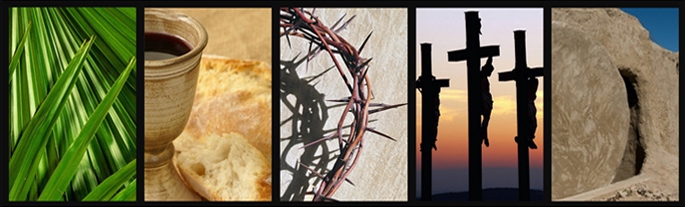
Holy Week is a funny time for liturgical churches.  Growing up in the United Methodist Church, I remember one Sunday (Palm Sunday), we put nails in the cross, and the next Sunday (Easter Sunday), we would put flowers in the same holes where those nails had been.  But services between the two Sundays were rare, if not nonexistent.  Once I became an Episcopalian, a whole world of liturgical wonders opened up.  Each church did Holy Week a little differently, but invariably, there was some kind of worship every night of Holy Week.  There were the traditional Triduum services:  Maundy Thursday, Good Friday, and Easter Vigil.  But then there were a whole variety of others things:  Taizé worship, Compline, Evensong, Healing Services, Tenebrae, Lessons and Carols, Vespers, and even special concerts. 

Among ecumenical clergy, I often get looks of skepticism, as if they wonder why we do that to ourselves (i.e. work so many nights in a row).  They are not wrong (it is certainly taxing), and I also do not promote the kind of martyred attitude many clergy assume while doing it.  For most of us though, there is something deeper happening.  Fellow clergyman Tim Schneck said it best in a recent post, “When you hear clergy strongly encouraging you to attend the services of Holy Week, especially the Great Three Days (Maundy Thursday, Good Friday, the Easter Vigil), it’s not just because they like to see more people in the pews, or it’s good for their egos, or they want parishioners to see how much effort goes into these liturgies.  It’s because they believe in the death and resurrection of Jesus Christ and the transforming power of the Christian faith.  It’s because they love you and want nothing more than for you to have such a moving encounter with our Lord, that it will change your life.  It’s an invitation rooted in profound love, and a recognition that there is literally nothing more important in the entire world than to participate fully as we collectively journey from the Upper Room to Calvary to the Empty Tomb.” 

I know life is full and stressful.  I know in my area, many families are rapidly approaching Spring Break and have a load of things to do to prepare.  But as a pastor – maybe your pastor – I want to gift you this most sacred week for your spiritual journey.  Whether you tune in online or join us in person at my church, let yourself be stirred by liturgies you do not often see, by actions you rarely do, and by music your rarely hear.  In what can easily feel like just another week, make a point to find yourself a church that can stir your curiosity about faith or your longing for meaningful connection or a sense of belonging.  But mostly, know that whatever you can do – even if it’s just Easter, know that there is a place where everyday this week, you can be reminded that you are loved – deeply, profoundly, and unconditionally.  And if you want to hear, taste, smell, see, and touch that love, the Church is waiting for you. 

On Letting the Dust Settle…

21 Wednesday Feb 2024

Posted by jandrewsweckerly in reflection

≈ Leave a comment

Tags

buzz, church, comsume, details, dust, God, journey, Lent, neighbor, rejoice, repair, repent, self

Photo credit: https://ymi.today/2015/04/when-dust-settles-in-the-sunlight/

Oftentimes, I think are two version of church:  the version that is consumed and the version that is fully knowledgeable of all the details and intricacies that it takes to create the consumable experience.  In the former, one comes to church, prays prayers, sings beautifully written songs, hears scripture, engages with a sermon, consumes communion, and is commissioned to go out and live the Gospel.  Of course, there may also be the juggling of children, the scramble to get there on time, and the focus needed to fully engage all that is “church,” and not be distracted by life whispering in the background. 

For the latter – the version of church that is fully knowledgeable, the experience of church happens through a filter.  In that experience, you are juggling the personnel details (did the lector show up, how the procession should line up based on who is serving, whether a choir member is late and didn’t get to rehearse fully), you are painfully aware of the hours of planning that went into the bulletin (the liturgical and musical decisions that were made to create a seamless experience), and you are mindful of all the administrative details (did the altar book get marked, which cruet has wine and which has water, do we have enough wafers for the number of people in church, did we remember all the announcements, and on and on).  People in both categories consume church in equal amounts, but the buzz behind the experiences may be different.

As someone who falls in that latter category, I have been especially grateful for Lent this year.  Our staff worked really hard to have all the liturgy planning completed early this year.  That is a fantastic feat, but it also means this winter has been extremely busy and detail-filled.  Even the start of Lent was chaotic.  On Shrove Tuesday, you are eating and merrymaking, and less than 24 hours later, you are spreading ash on people’s foreheads and making sure they have a meaningful Ash Wednesday.  By that Sunday, you are chanting or saying the very long Great Litany on the first Sunday of Lent, and by that Monday, you take a gulp of air once you realize you have done it – Lent has begun.

What all that preplanning has meant for me this year is that gulp of air is an invitation to trust the planning and to now live into Lent.  Instead of my head being abuzz with details, now I can sit down and clear out space to be with God – to do a meaningful assessment of my relationships with God, self, and neighbor, and see what invitations arise about what in those relationships needs repentance, repair, or rejoicing.  In essence, I suppose I shift now to being a consumer of church for a time.  I get to do the prayer, fasting, and alms giving that Lent invites without all the intricacies that began the season.

I wonder where you are finding yourself at the beginning of this second week in Lent.  How are you creating spaces where the buzz of life, the swirl of life’s details, and the burdens of the everyday can be set aside to connect with God, self, and neighbor?  How are you finding meaningful ways to repent, repair, and rejoice?  I cannot wait to hear how this Lent is reigniting your faith journey!

Sermon – Mt. 6.1-6, 16-21, AW, YB, February 14, 2024

21 Wednesday Feb 2024

Posted by jandrewsweckerly in Sermons

≈ Leave a comment

Tags

alms giving, Ash Wednesday, church, corrupt, death, fasting, God, Jesus, Lent, life, love, prayer, reconnect, relationship, repentence, Sermon, Valentine's Day

This morning, I got a fun text from a friend.  “Happy Ash Valentine’s Day!” she exclaimed.  I have seen all sorts of humor about the confluence of Valentine’s Day and Ash Wednesday this year.  From questions about whether the clergy might be making the sign of a heart instead of the sign of a cross with our ashes tonight (sorry to disappoint those of you who were hoping that wasn’t just a rumor); to a meme from the National Church that says  “You can’t have VaLENTines with the LENT”; to actual candy conversation hearts that say “U R Dust,” “Ashes 2 Ashes,” or “Repent” instead of the traditional “Be Mine,” “True Love,” or “Kiss Me.”  Even my own daughter petulantly asked me, “Do we always have to celebrate Ash Wednesday on Valentine’s Day??”

Though the humor has been fun, what lurks under the surface is a discomfort with talking about death – especially on a day meant to be for celebrating the happiness of love.  But part of my job as a priest is to bring a certain sobriety about death to the world – no matter the day.  That is not to say that I am a party pooper or that I don’t like a good box of chocolates myself, but my role as a priest is to name the truth about what happens in death – earthly death and reunion with our Lord in eternal life.  In fact, the Church is one of the few places left in the world that openly and regularly talks about death.  In a world that encourages anti-aging treatments, who has desensitized us to death as we have moved away from an agrarian lifestyle, and whose medical advances have extended life much longer than before, we learn that death can be conquered and should be fought at all costs.

Pushing against this secular understanding of death, the Church gives us Ash Wednesday – even on Valentine’s Day.  The Church looks at our flailing efforts to preserve life and as we humbly come to the altar rail, rubs gritty ash on our heads and says, “Remember you are dust and to dust you shall return.”  There is no, “Don’t worry about death; you’ll be fine!”  Instead, those grave words, “Remember you are dust and to dust you shall return,” echo in our heads, haunting our thoughts.  Every year the Church reminds us of the finite amount of time we have on this earth – even on a day seems like we should be talking about love and life.

This is why I love Lent so much.  The Church dedicates forty days to a time where we cut to the chase and honestly assess our relationship with God.  We take a sobering look at our lives, a sobering look that could be reserved only for the time of death, and we discern what manifestation of sinfulness has pulled us away from God.  Our Prayer Book defines sin as “the seeking of our own will instead of the will of God, thus distorting our relationship with God, with other people, and with all creation.”[i]  Lent is the season when we focus on repentance from our sin – not just a feeling guilty about our sinfulness, but eagerly seeking ways to amend those relationships and turn back toward resurrection living.  What most people get only at the time of death, we are given every year at the time of Lent:  a time of sobering realignment. 

This is why we get Matthew’s gospel lesson on Ash Wednesday.  As we begin our sobering Lenten journey, the gospel lesson names disciplines and practices that can help us along the way.  Jesus names those ancient practices that have brought people back to God for ages – giving alms, praying, and fasting.  Each one of these practices has ways of bringing us closer to God by shaking up our normal routines.  Of course, any Lenten practice can have the same effect.  Giving up caffeine, reading a daily devotional, or reconnecting with nature are equally valid ways to shake up our routines enough to notice the ways in which we have become more self-centered than God-centered.  Although Jesus names the disciplines of alms giving, prayer, and fasting, the actual discipline itself is not the issue for Jesus.  The issue is our intentions in our practice. 

This is why we hear Jesus labeling so many people as hypocrites in our gospel lesson today.  Jesus is less concerned about what disciplines we assume and is more concerned about the authenticity behind those disciplines.  Jesus is not arguing that private acts are authentic and public ones are inauthentic by nature.  What matters is the desire and motivation behind these practices.  We have all seen this in action.  One of my favorite comediennes jokes about this very behavior in one of her shows.  She talks about how people sometimes use prayer requests as a means of gossip.  In one of her jokes, she has the gossiper of the church inviting people into a prayer circle so that they can pray for someone in the church who just got pregnant, even though the news was supposed to be private.  We all know the kind of hypocritical behavior Jesus is addressing.  This kind of behavior will never get us to the sobriety we need to right our relationship with God and others.

Of course, any kind of practice we take up this Lent can be corrupted.  The giving up of a particular kind of food can be more for weight loss than a connection to God.  The taking up of a volunteer activity can be to fulfill a requirement for something else.  Whatever we do this Lent, that deprivation or incorporation is meant to help us restore our relationship with God, other people, and all creation.  So, when we give up a food, instead of glorying in the fact that we lost a few pounds, we can see how that food has become an emotional crutch that keeps us from leaning on God and others.  When we take on a new prayer routine, we slowly begin to see how little time we give to God in our daily lives.  Whatever our practice, Jesus is concerned that authenticity be at the heart, so that we can more readily prepare for Good Friday and Easter.[ii] 

And so, in order to shake us out of our self-centered, sinful, distant ways, especially on a day for love, Ash Wednesday gives us death.  Ash Wednesday grittily, messily, publicly reminds us of our death, and then leaves us marked so that we can humbly enter a Lenten reconnection with God.  Ash Wednesday throws death in our faces so that we can wake up in a world that would have us keep striving for longevity of earthly life or superficial happiness instead of striving for intimacy with God here and now.  This Ash Wednesday, our ashes are the outward reminder of the sobering journey we now begin, because only when we consider our own death can we begin to see the resurrection glory that awaits us at Easter.  My prayer is that our journey this Lent is not one of painful guilt or loveless deprivation, but instead one of glorious reconnection with our creator, redeemer, and sustainer.  Amen.      


[i] BCP, 848.

[ii] Lori Brandt Hale, “Theological Perspective,” Feasting on the Word, Yr. C, Vol. 2 (Louisville: Westminster John Knox Press, 2009), 24.

On Ashes, Valentines, and Ultimate Things…

14 Wednesday Feb 2024

Posted by jandrewsweckerly in reflection

≈ Leave a comment

Tags

Ash Wednesday, church, death, God, love, neighbor, relationship, self, ultimate significance, Valentine's Day

Photo credit: https://abidingpresence.net/newsfeed/2018/2/8/holiday-mashup

“Happy Ash Valentine’s Day!” my friend wrote this morning.  At first the greeting made me chuckle, especially given the number of grimaces and eye rolls I have received this year about how the Church has to celebrate Ash Wednesday on a day that is supposed to be about love.  Truth be told, I am not even sure how many faithful will even come to church tonight instead of going out to dinner or staying in for a cozy night with loved ones. 

But what I loved about that greeting today was how it married the two notions:  that you can celebrate love and death all at the same time.  In the same way that the Church soberly says, “Remember you are dust and to dust you shall return,” the secular world, despite the obvious consumerism of the day, uses this day to soberly say, “No really.  I love you:  I love you my friend, I love you my co-worker, I love you my classmate, and I love you, my beloved.”  These two days, at their root, are meant to talk about ultimate things:  love and death.  And as a priest, when I walk individuals and families toward death, there is nothing but love hovering around.

I wonder if the confluence of Ash Valentine’s Day might be an invitation for us this Lent.  How might you use these next forty day to meditate and act on those things of ultimate significance?  How are tending your relationship with God in a way that acknowledges that relationship’s ultimate significance?  How are you loving your neighbor in a way that honors the ultimate significance of their dignity?  How are you caring for yourself in a way that shows the ultimate significance of your identity as a child of God?  I don’t know if you need some silly candy conversation hearts that remind you that you are dust – or if you need ones that remind you that you are truly loved.  Either way, I hope this Ash Valentine’s Day is a day you can enter into Lent with significance, remembering you are loved. 

← Older posts
Newer posts →

Recent Posts

  • On Redefining Community…
  • On Parenting, Milestones, and Community…
  • Sermon – Acts 2.42-47, E4, YA, April 26, 2026
  • On Seasons of Discernment…
  • Sermon – Luke 24.13-35, E3, YA, April 19, 2026

Archives

  • May 2026
  • April 2026
  • February 2026
  • January 2026
  • December 2025
  • November 2025
  • October 2025
  • September 2025
  • August 2025
  • July 2025
  • June 2025
  • March 2025
  • February 2025
  • December 2024
  • November 2024
  • October 2024
  • September 2024
  • August 2024
  • July 2024
  • June 2024
  • May 2024
  • March 2024
  • February 2024
  • January 2024
  • December 2023
  • November 2023
  • October 2023
  • September 2023
  • August 2023
  • July 2023
  • June 2023
  • May 2023
  • March 2023
  • February 2023
  • January 2023
  • December 2022
  • November 2022
  • October 2022
  • June 2022
  • May 2022
  • January 2022
  • December 2021
  • November 2021
  • October 2021
  • September 2021
  • August 2021
  • June 2021
  • May 2021
  • April 2021
  • March 2021
  • February 2021
  • January 2021
  • December 2020
  • November 2020
  • October 2020
  • September 2020
  • August 2020
  • July 2020
  • June 2020
  • May 2020
  • April 2020
  • March 2020
  • February 2020
  • January 2020
  • December 2019
  • November 2019
  • October 2019
  • September 2019
  • August 2019
  • July 2019
  • June 2019
  • May 2019
  • April 2019
  • March 2019
  • February 2019
  • January 2019
  • December 2018
  • November 2018
  • October 2018
  • September 2018
  • August 2018
  • July 2018
  • June 2018
  • May 2018
  • April 2018
  • March 2018
  • February 2018
  • January 2018
  • December 2017
  • November 2017
  • October 2017
  • September 2017
  • August 2017
  • July 2017
  • June 2017
  • May 2017
  • April 2017
  • March 2017
  • February 2017
  • January 2017
  • December 2016
  • November 2016
  • October 2016
  • September 2016
  • August 2016
  • July 2016
  • June 2016
  • May 2016
  • April 2016
  • March 2016
  • February 2016
  • January 2016
  • December 2015
  • November 2015
  • October 2015
  • September 2015
  • August 2015
  • July 2015
  • June 2015
  • May 2015
  • April 2015
  • March 2015
  • February 2015
  • January 2015
  • December 2014
  • November 2014
  • October 2014
  • September 2014
  • August 2014
  • July 2014
  • June 2014
  • April 2014
  • March 2014
  • February 2014
  • January 2014
  • December 2013
  • November 2013
  • October 2013
  • September 2013
  • August 2013
  • July 2013
  • June 2013
  • May 2013
  • April 2013
  • March 2013
  • February 2013
  • January 2013
  • December 2012
  • November 2012
  • October 2012
  • September 2012

Categories

  • reflection
  • Sermons
  • Uncategorized

Meta

  • Create account
  • Log in
  • Entries feed
  • Comments feed
  • WordPress.com

Blog at WordPress.com.

  • Subscribe Subscribed
    • Seeking and Serving
    • Join 391 other subscribers
    • Already have a WordPress.com account? Log in now.
    • Seeking and Serving
    • Subscribe Subscribed
    • Sign up
    • Log in
    • Report this content
    • View site in Reader
    • Manage subscriptions
    • Collapse this bar

Loading Comments...