• About

Seeking and Serving

~ seek and serve Christ in all persons

Seeking and Serving

Tag Archives: church

Sermon – Job 14.1-14, HS, YB, April 3, 2021

28 Wednesday Apr 2021

Posted by jandrewsweckerly in Sermons

≈ Leave a comment

Tags

Christian, church, community, disciples, drama, faith, Holy Saturday, hope, Jesus, Job, liturgy, pandemic, preparation, quiet, redemption, Savior, Sermon, silence, sorrow

Up until last year, I had not remembered that there was a liturgy in our Prayer Book for Holy Saturday.  I had always thought it was Maundy Thursday, Good Friday, Easter Vigil on Saturday night (which is basically just Easter), and then Easter Sunday.  But when the pandemic hit last year, we realized doing a virtual Easter Vigil just would not work – there is so much reading, singing, doing things by candlelight, and the drama of being huddled together that we had to let the Liturgy wait until we could gather again.  So instead, we turned to this tiny liturgy, whose entire content is listed on one page of the Book of Prayer Book.

Still in a pandemic a year later, I found myself curious about this liturgy we are entering once again.  The truth is, the earliest accounts of Holy Week observances had no liturgies for Holy Saturday, with the exception of private use of the daily office.[i]  Instead, this day has simply been known as the “quietest day of the Christian year.”[ii]  That the church has not always gathered on Holy Saturday and that Christians might see this day as a day of quiet makes a lot of sense.  The Church says so much this week – from our waving of palms last Sunday, to our gathering around the upper room table to wash feet and share bread, to devastating betrayals of Jesus, to the vivid walk toward the cross, to the finality of the closed tomb.  We almost need a day of quiet to let the drama sink in and wrap our heads around what this week means.

But I suspect if your life is anything like mine or most Americans, we are not sitting quietly in our homes from 3:00 pm on Friday until Easter morning.  Instead, we are filling the time with preparations – tending to all the things we did not do while we were attending church this week:  dying eggs, entertaining children, stuffing Easter baskets, prepping Easter day meals, cleaning the house, or just having fun.  There is nothing inherently wrong about those things, but this year, of all years, I am grateful for a Holy Saturday liturgy.  With this last year of suffering through a pandemic and reflecting on our broken humanity’s inability to eliminate racism or mend civil discourse, even with the rise of vaccines, I find our country is in a Holy Saturday kind of time.  We have been through a tumultuous experience and are not yet healed. 

That is why I like having Job as a companion today.  Job’s words are stark.  As Job sits in the ashes of his sorrows, having lost his children, his livelihood, and his support system, he describes the brutality of life.  He talks about how trees have hope – even when cut down, they can sprout again, and new life can be born out of death.  But not so with humans, he argues.  No, when their bodies lay in the ground, there is nothing but death.  Job captures the essence of this day.  There is a similar finality at the door of Jesus’ tomb this day.  All the hopes and dreams, all the joys and blessings, all the promises of new life are sealed away in a tomb.  And after such a violent death and the threat for those who followed Jesus, there is no wonder why the Church has considered this a quiet day.  Unlike the quiet waiting of Advent, when the church is brimming with expectation and bustling around in preparation for Christ’s birth, today is a day of silence devoid of restorative peacefulness.  As one scholar says, “The waiting of Advent is like having warm bread in the oven.  By contrast, the air of Holy Saturday smells more like stale smoke, as though something essential was burned the day before.”[iii]  As our lives are not yet pandemic free, and as threats of spikes in cases emerge, we know that kind of waiting all too well.

And yet, in the very last verse of today’s reading, the despondent Job says something totally counter to everything else he has said.  “If mortals die, will they live again?” Job asks.  For someone who has boldly proclaimed the finality of human death, his question is a question that only a person of faith can ask – a question that reveals the tiniest bit of hope still left in Job.  Job communicates in this question a truth we people of faith hold dear:  no matter how bad the suffering, no matter how prevalent the experience of dread and doom, no matter how deep the failures of humanity seem to run, there is always hope.  The disciples and community surrounding Jesus Christ do not know that hope yet.  But as followers of Christ 2000 years later, we now stake our entire identity on the risen savior. 

So yes, receive the gift of stale smoke this day.  Sit in ashes with Job and mourn all in your life that feels dead.  Take time in this busyness of life for some uneasy silence.  Name all those who have been lost due to disease and violence.  But keep asking the questions.  Hold on to the hope, however infinitesimally small that God can indeed redeem us – us as individuals, us as country, us as Church.  Holding the two in tension is difficult – we want to rush to Easter and forget all that has happened.  But letting the power of all that has happened speak to us today will allow us to know the astounding power of resurrection much more deeply tomorrow.  Job, Jesus, and this faith community here will pull up a chair and sit with you by the ashes until we can reap with tears of joy tomorrow.  Amen.


[i] William Joseph Danaher, Jr., “Theological Perspective,” Feasting on the Word, Yr. B, Vol. 2 (Louisville:  Westminster John Knox Press, 2008), 310.

[ii] Christina Braudaway-Bauman, “Pastoral Perspective,” Feasting on the Word, Yr. B, Vol. 2 (Louisville:  Westminster John Knox Press, 2008), 312.

[iii] Braudaway-Bauman, 312

Sermon – John 13:1-17, 31b-35, MT, YB, April 1, 2021

28 Wednesday Apr 2021

Posted by jandrewsweckerly in Sermons

≈ Leave a comment

Tags

absence, church, digital, dignity, evensong, experts, grief, Holy Week, Jesus, love, Maundy Thursday, pandemic, serve, service, tension

One of the things I have learned over the years is the mixed blessing of offering pastoral care from personal experience.  The mother who lost an adult child both feels gratified to help someone else going through the same situation and angry that she is now an expert in grieving the loss of an adult child.  The man who has been through addiction is honored to help someone else through addition – and yet wishes he were not so personally knowledgeable.  The divorcee talking to a dear friend whose marriage has recently crumbled shares, “Welcome to the club you never wanted to belong to.”

As we started thinking about how to honor Maundy Thursday in a pandemic when many of the things we would normally do on this night are forbidden, we thought the same:  we already know how to do this.  We learned last year that when we cannot experience the intimacy of footwashing, the grief of the last holy meal before Easter, the dimming of the lights, the stripping of the altar, and walking out of this space in silence, turning to a totally different liturgy can create another kind of comfort.  We turn to Evensong in the hopes that another ancient tradition, one the Church celebrates almost everyday in the Cathedrals, Minsters, and colleges of the Mother Church in England, will ease the mourning of yet another loss during this time of pandemic.

But being experts in how to cope in a pandemic – either liturgically, emotionally, or spiritually – does not make the grief any easier.  We still feel the absence of what has been – almost as much as we feel the pending absence of Jesus when we will lay him in a tomb tomorrow.  Having figured out how connect with our community digitally, enjoying seeing people’s names pop up on Facebook, and loving hearing the sounds of our Choral Scholars coming through our TVs and laptops on YouTube, certainly has sufficed in these days – and in fact has brought many people into Hickory Neck who had never experienced Hickory Neck before.  But all of that does not negate our grief that a year later we are still in this liminal time of “not yet.”

So, what do we do with this internal tension that we are not yet where we are going, and certainly not fully who we have been?  I like to look at Jesus in our gospel lesson tonight.  Jesus knew what was coming on this night too.  He knew Judas, his beloved companion on his pilgrimage, was going to betray him.  He knew great tragedy was coming, abandonment by the other disciples would happen, and humiliation, pain, and death were inevitable.  Sitting in the upper room, in the tension of no longer being just a rabbi and not yet the risen Messiah, Jesus could have easily wallowed in grief.  Instead, in that overcrowded, tense upper room, Jesus gets up, takes off his outer robe, and ties a towel around his waist.  In the face of pending doom and tremendous transformation, Jesus bends down, and washes feet.  When the world is in chaos, Jesus does the work of humble service, of respecting the dignity of others, of an everyday deed of loving his neighbor.

We cannot possibly know when church will begin to feel familiar and comfortable.  We do not know which changes we have experienced in the last year will become permanent.  We cannot know the lasting impact of this pandemic on the fabric of our lives.  But we do know what Jesus says tonight.  In the face of the unknown, Jesus says to do two things:  to serve others as he served his disciples and to love one another.  Jesus makes everything quite simple tonight.  In the face of disorienting new realities Jesus says: serve and love. That is our invitation in this most sacred week – when our grief and frustration are sometimes paralyzing, engaging in the work of serving and loving are the actions that will give us strength for the days and weeks ahead.  Amen.

Sermon – Mark 6:1-6, 16-21, Isaiah 58:1-12, AW, YB, February 17, 2021

24 Wednesday Feb 2021

Posted by jandrewsweckerly in Sermons

≈ Leave a comment

Tags

Ash Wednesday, ashes, church, fasting, God, holy, invitation, Lent, mirror, pandemic, Sermon, spiritual practices, struggle

I have always thought the Ash Wednesday liturgy offers a strange contrast.  We engage in the very visible sign of having ashes spread across our foreheads.  And yet, our gospel lesson this day speaks very clearly of not showing your piety publicly.  But this year, the contrast of Ash Wednesday feels even more pointed.  Typically on this day, we talk about giving things up for Lent, fasting, and entering into a season of contemplation about not just our mortality, but the sinfulness that separates us from God.  But we have spent the last eleven months fasting – fasting from social gatherings, fasting from touch and uncovered faces, even fasting from receiving the sacred meal.  And for a large portion of those months, we have been in deep contemplation about the exponentially rising death all around us, the brokenness of our common life, the sin of oppression and racism.  The last thing I want to hear from the church today is how I need to give up more.

I think that is why I love the text from Isaiah this year so much.  God offers a mirror to God’s people.  On first glance, God’s people are certainly doing the things that are expected – in fact, the “things” that are often of Lent.  They are fasting and lying in sackcloth and ashes.  They are doing the work of penitence.  But the acts are not the problem – the motivation of the acts are the problem.  They are doing acts of contrition as sort of an exchange:  fasting so that God will give them favor; Sure, their behavior may end in the oppression of others, but they are doing the manual action called for in this moment. 

But God is having nothing of hollow spiritual practices.  If those practices are not leading to the loosening of the bonds of injustice, or the undoing of the thongs of the yoke, or the freeing of the oppressed, they are meaningless.  If the people of God are not sharing their bread with the hungry, bringing the homeless poor into their homes, covering the naked, and caring for their own kin, then fasting is little more than act in futility, an action done without reflection, intention, or love of neighbor. 

So what do the words of Isaiah have to do with living in month eleven of a pandemic?  I am going to say something that might be a little controversial, but here you go:  the church is not asking you to fast this Lent.  Now, in a few moments, I am going to say these very words, “I invite you, therefore, in the name of the Church, to the observance of a holy Lent, …by…fasting, and self-denial…”  But you have already fasted for a whole year.  You have already been in a season of self-denial.  The ashes you will impose on your head later are not a reminder that you are dust and to dust you shall return.  You know that reality all too well now.  Instead, we are going to take a cue from Isaiah tonight.  You have already done the manual acts of Lent.  Now your invitation is the “so that” part of the action.  Our work this Lent is to reflect upon what has been a most difficult year and to ponder together what this past year of fasting is inviting us into.  How has this season of fasting, this season of struggle, this season of brutality transformed our sense of purpose and identity – a people focused on God’s work loosening the bonds of injustice, freeing the oppressed, and sharing our bread?  How has the sobering nature of death, grittily rubbed onto our foreheads tonight, changing our resolve to lean into God, lean into this Christian community, lean into the work of sharing God’s love with those who do not know that love?

The rest of the invitation I will read in a moment says this, “I invite you, therefore, in the name of the Church, to the observance of a holy Lent, by self-examination and repentance; by prayer…and by reading and meditating on God’s holy Word.”  You have done the rituals of fasting and self-denial long enough.  As we look forward to these next forty days together, our work is to spend time with God, scripture, and one another and answer the question, “So what?”  What are we going to do now?  What are we going to claim and what are we going to let go?  How is the grit of ash this year not the sensation of defeat, but of invitation.  I invite you, therefore, in the name of the Church, to the observance of a holy Lent.  Amen.

Sermon – Isaiah 9.2-7, Blue Christmas, December 21, 2020

06 Wednesday Jan 2021

Posted by jandrewsweckerly in Sermons

≈ Leave a comment

Tags

Blue Christmas, Christ Child, Christmas, church, darkness, God, joy, light, mourn, night, painful, pandemic, Sermon, strength, suffering

Blue Christmas is a service we offer every year.  This service is not always mainstream.  For many, Christmas is a season of uncomplicated joy.  But for others, Christmas can be a painful experience:  we mourn the memories of those who are no longer with us, the darkness of shorter days weighs on our mental health, or the unbounded exuberance of others creates a chasm between their happiness and our loneliness, sorrow, or pain.  And that does not account for the grief we may be experiencing otherwise – broken relationships, dissatisfaction with or lost employment, an unexpected medical diagnosis, or a dream unfulfilled.  And because Christmas cheer is all around us, we feel even more isolated in our sadness – as if we are alone in our feelings.  Only in services like these do we feel seen.

That is the experience of a “normal” Christmas.  This year, we have added nine months of a pandemic, a tumultuous political year, and civil unrest.  Suddenly, those of us who struggle with finding joy this Christmas find ourselves in a rising majority, not the minority.  I watched this year as hundreds of people decorated for Christmas in mid-November, in an effort to demand the experience of joy from a year that has been short on joy.  I can see the desperate need of a suffering people to find light somewhere, anywhere, during this holiday season.

Fortunately for us, the church is not silent on this experience.  The text we heard from Isaiah earlier says, “The people who walked in darkness have seen a great light; those who lived in a land of deep darkness–on them light has shined. You have multiplied the nation, you have increased its joy; they rejoice before you as with joy at the harvest, as people exult when dividing plunder. For the yoke of their burden, and the bar across their shoulders, the rod of their oppressor, you have broken as on the day of Midian.”  The prophet says all of this light and joy is possible for one reason:  “For a child has been born for us, a son given to us.”  Scripture tonight honors that there are seasons of darkness.  There are times when we live in deep darkness, devoid of joy.  There are times when burdens feel like weights on our shoulders, where oppressors keep us in positions of suffering.  Sometimes those times of darkness happen around holidays, and sometimes the memory of those dark moments invade our holidays.  To that experience, the prophet says, God brings us light.  God lifts burdens, God helps us recall joy, God strengthens us.  And perhaps, most importantly, God gives us the Christ Child – the only true source of light that can lighten the darkness.

I have always loved that the Christ Child was born in literal darkness.  The delivery of the Christ Child at night reminds us that even in the rustic setting of being outcast, joy comes to Mary and Joseph.  The delivery of the Christ Child at night reminds us that even in the mundane, lonely, and exhausting work of tending sheep through the night, unbounded joy can break forth in the form of angels with heavenly news.  The delivery of the Christ Child at night reminds us that even in the darkness of night, whispered conversations between strangers can bring joy to kindle and ponder in our hearts.

Tonight, by the manager, God sees your darkness, your suffering, your hurt.  The removal of that darkness, suffering, and hurt may not be possible in these next few days.  But in that darkness, God promises you the tiniest sliver of light.  Whether you find that light by seeing you are not alone in the darkness tonight, whether you find that light through the stories of others, or whether you find that light gazing on the miracle of the Christ Child, the light, however faint, is there, waiting for you, warming you ever so slightly, and starting the long, hard work of lifting your heavy burden.  And until you are ready to receive that light, the Church sits with you in the darkness tonight.  Amen.

On Things Ludicrous and Holy…

17 Thursday Dec 2020

Posted by jandrewsweckerly in Uncategorized

≈ Leave a comment

Tags

best, Christmas, church, division, humble, indignation, joy, light, love, pandemic, praise, resurrection, separation

Photo credit: https://loe.org/shows/segments.html?programID=18-P13-00051&segmentID=1

My children are preparing for their winter socially distanced holiday recital, and we have been flooded with a flurry of details, items to purchase, things to organize.  One of the flyers that came this week was for a t-shirt they could buy promoting the recital and the cause that will benefit from the proceeds.  The shirt says, “Best Christmas Ever.”

I was glad my children were not around when I saw the flyer because my immediate response was to scoff – out loud, in my house, looking at a piece of paper with indignation.  Best Christmas Ever?!?  Had the dance studio lost their minds?  What about this Christmas could possibly be the “best”?  Families are separated, some of whom have not seen each other in over a year.  The Coronavirus is rapidly spreading, with the death toll in the United States now over 300,000.  And despite a transition in political power, we remain as divided as ever, struggling to find peace among our brothers and sisters. 

After recovering from self-righteous indignation, I began to think about the approaching Christmas season, and what the Church, and I as her priest, have invited people to do.  We are still inviting our parishioners, friends, and neighbors to join the Holy Family on Christmas Eve and sing songs of praise and thanksgiving.  Although we honor grief and suffering at our Blue Christmas service on December 21, we are still making a claim for hope, for light, and for love.  Even with our church buildings closed again, we are still encouraging the church to gather in their cars for a drive-thru, or by their hearths with their devices to join with the shepherds as we go to see this thing that has come to pass.  Perhaps to an outsider, the work of the Church this next week seems as ludicrous as claiming this Christmas is the Best Christmas Ever.

This week, I find myself humbled.  I know the Church is going to ask a lot of you over this next week.  You may not feel like singing carols, or hearing the familiar story, or watching candles flicker as we pray.  And that’s okay.  But, if it is alright with you, we are going to keep doing it anyway.  The Church has always been full of resurrection people.  We cannot help ourselves once we know the Risen Lord.  And so, when the Christ Child comes next week, we will keep holding on to light, to joy, and to love.  We will keep holding on to the promise that Christ is with us always, even to the end of the age.  We will keep shining the light of the Christ Child, reflecting his light to all.  And we will keep believing and trusting for you until you can come to the place where you can believe and trust yourself.  You do not need to rush.  We will keep holding the light until you are ready to take it up yourself.

On Rituals, Church, and Candy…

05 Thursday Nov 2020

Posted by jandrewsweckerly in Uncategorized

≈ 1 Comment

Tags

children, church, community, connection, creativity, grace, Halloween, incarnational, innocence, Jesus, joy, neighbor, normalcy, pandemic, ritual, safety, trick-or-treat

Photo Credit: https://www.hauntedwisconsin.com/things-to-do/kids-family/trick-or-treat/

Last weekend, I took my younger daughter trick-or-treating.  We spent a long time as parents debating whether we should take our children.  We read scientific articles, talked to other parents, and spent time in long conversations.  Ultimately, we decided to go ahead, making sure we donned our masks, only traveled as a family, and sanitized our hands frequently between houses.  We also talked to our child about how although she may want to greet friends with warm hugs, that night was a night for verbal greetings instead of physical.  Our child did not argue with the restrictions and was simply happy to be going at all.

We embarked at the designated time not knowing what to expect – whether other families with children would be out safely, whether homeowners would respect social distancing and mask wearing, or whether the entire evening would need to be abandoned.  Much to my surprise, the evening went better than I could have hoped.  The number of trick-or-treaters was cut in half, and people mostly respected safe distancing.  Homes distributing candy were also at about fifty percent, and many of those who distributed exhibited tons of creativity:  from baskets of candy lowered from outdoor balconies, to candy “kabobs” planted in yards, to zipline delivery mechanisms, to clotheslines of candy. Many homeowners bagged candy to reduce touching and many seemed to have read the best practices about how to hand out candy.  I was blown away by our neighbors’ thoughtfulness, creativity, and grace.

But what struck me the most was a truth emerging from the whole evening.  If you had asked me or any of my neighbors before Halloween why we were participating in the ritual of trick-or-treating, we probably all would have said we were doing it for the kids:  to give them some sort of normalcy in this crazy, abnormal time.  But as I tucked my child in that night, and thought about all our experiences, I realized a deeper truth.  I think all of us adults participated in the ritual not just because the children needed it; we participated because we needed it.  We needed just one thing to be semi-normal in this super stressful, topsy-turvy world.  And we took our precautions and stretched our creativity, but we participated in a ritual that reminded us of joy, innocence, and community.

In many ways, that is what we are trying to do every week in churches too.  The very essence of Church is incarnational – from how we gather (in large groups), how we worship (using our all our senses, including touch), how we participate in ritual (often kneeling shoulder to shoulder, receiving communion from common dishes, and laying on of hands), to how we interact (from children’s programming and play to Coffee Hours).  With this pandemic, our incarnational essence just is not possible in the same way.  And so, we are worshiping online, we are offering socially distant worship services, and we are gathering on Zoom for pretty much everything – from formation, to fellowship, to learning, and even play.  I know Church right now is not the same, but if Halloween offers any lessons, perhaps it is that participating in the ritual – even an amended and altered ritual – is important for our spiritual, emotional, and physical health.  If you have taken a break from the ritual of Church because it just is not the same (and you are right, it is not), please know that Hickory Neck is here to help you reclaim some of that ritual.  It may be awkward or push your technological abilities.  But I promise, even those unusual connections might just offer the ritual you need to stay healthy and whole!

On the Awkward and the Sacred…

14 Wednesday Oct 2020

Posted by jandrewsweckerly in Uncategorized

≈ Leave a comment

Tags

awkward, church, creative, gratitude, Holy Spirit, human, new, open, pandemic, sacred, tradition, virtual, worship, Zoom

Phot Credit: Jennifer Andrews-Weckerly; permission to reuse required

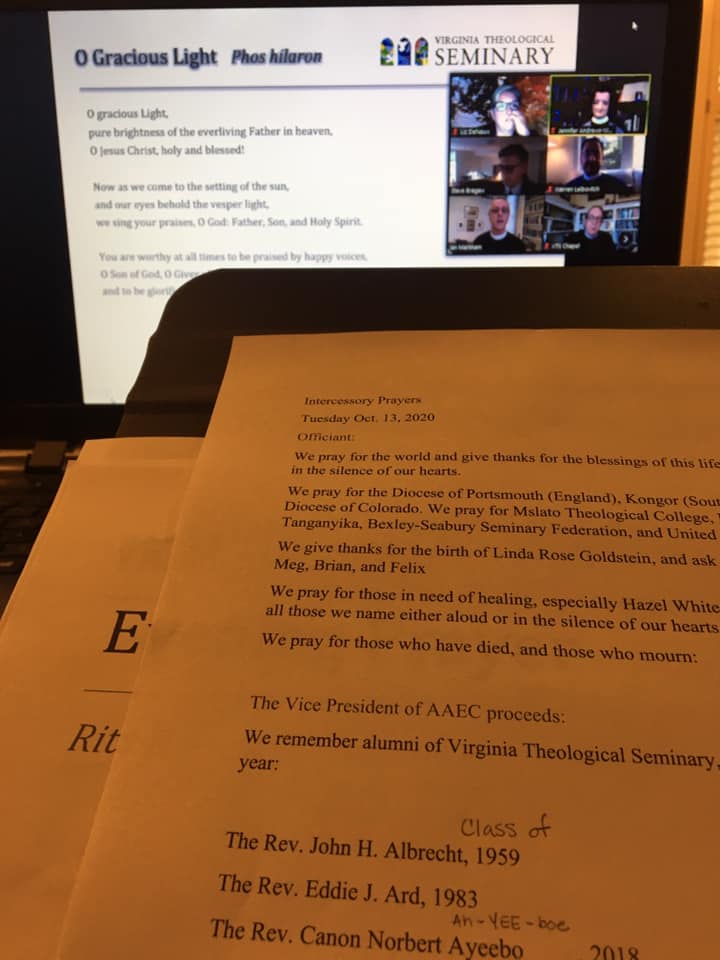
One of the disadvantages of leading virtual worship is that you do not get to participate in worship.  Of course, I can always go back and watch later, but I never get the “live” experience of watching prayers.  That all changed this week.  My seminary held their annual Convocation yesterday.  It was entirely virtual, with webinars, Zoom meetings, breakout rooms, and Zoom worship.  Our worship at Hickory Neck Church is via Facebook Live, so this was my first time worshiping with a community via Zoom, and I was curious to see how it would feel.

My initial response was dissatisfaction.  Although I could see there were about 50 people gathered, once slides were used on the shared screen, I could only see six people without constantly scrolling.  Although the sermon was close to my normal experiences with preaching, watching faces that seemed spaced out was a bit odd (Do the faces look that spaced out when I preach??).  And of course, when I joined in speaking the italicized words (those words “the people” are supposed to say), because we were all on mute, I felt like only the officiant and I were participating.

But that was just the initial reaction.  As I said more and more of the unison readings, I felt less and less awkward.  And even though I could only see a few faces, I loved knowing I was not alone in the worship experience.  And as I became less paranoid about what my own video screen was showing, I was able to relax into my chair, and transport myself to an imaginary pew.  The worship experience was not the same – but it was also familiar, human, holy, and lovely.

Looking back on that experience, I want to offer major kudos to all who are “making it work” with virtual church.  I know it is not the same.  I know it is hard staying positive when all you want is something more familiar.  I am so grateful for all of you who are sticking with it, making the awkward become sacred.  I hope that you are having moments of grace and blessing.  And I also hope you are noticing all the names (and faces if you’re Zooming) you do not recognize:  those folks who find it harder to harken the doors of the church than to hop on Facebook for worship – whether when you are live, or at 10:00 pm, as you watch the archived video while you ease off to sleep.   This may not be church as we have always known it.  But we are also fashioning something new, flexible, and creative, while rooting ourselves in the traditions we know and love that ground us.  This week, you have my gratitude for all the ways you are staying open to the Holy Spirit.  And if you have not found a place to experience the Spirit, I’ve got just the place for you!!

On Hope and Confidence…

22 Wednesday Jul 2020

Posted by jandrewsweckerly in Uncategorized

≈ Leave a comment

Tags

church, college, confidence, decline, Episcopal Church, future, hope, Jesus, leadership, living, mainline church, youth

hook-hope

Photo credit:  https://www.cmalliance.org/hope/

One of the things I have loved about my church has been the Choral Scholars we employ at our 11:15 am service on Sundays.  The eight singers are college students from William & Mary.  They come from all sorts of backgrounds – some grew up singing in their hometown Episcopal Churches, some are Southern Baptists, and a few have even been Jewish.  I have always enjoyed watching their journey through college, but I especially became appreciative of that relationship when this pandemic shut down our church.  Two Choral Scholars immediately became part of our four-person team livestreaming services every week, helping keep music at the center of our digital worship.

I was not sure what to expect, however, once the semester was over in June.  We managed to recruit two other students:  one, an out-of-state college student who grew up in our church and is home for the summer, and another who is also from William & Mary, but has never sung with our Scholars.  As each week has passed, I have slowly learned about their faith journeys and experiences.  And this Sunday, when our Music Director was on vacation, the substitute she procured is an organ student from William & Mary who sings at another local church during the school year, and who led a choral evensong with a campus group at our church last year.

As we sang and played together on Sunday, I had an epiphany.  I realized I was the oldest person in the room by several years.  After years and years of talking about the so-called decline of the mainline church, hearing myriad, often contradictory, reasons why the next generation is not coming to church (for more about this topic, check out this video by Dean Ian Markham), here I was a part of a worship leadership team primarily led by people in their very early twenties.  And they were not just playing supporting roles, like greeting people at the door or handing out bulletins.  They were in charge of the entire musical offering.  They were equals in leadership, and they were doing it with confidence and beauty.

In a few months, one of the high school students I mentored in my curacy will be ordained a priest.  Listening to her hopes for the ways the Episcopal Church can speak afresh to this world, wondering about the future lay leadership of our pre-med summer singer, and imagining the bi-vocational life our substitute organist who hopes to play on Sundays after college graduation while having a weekday career, gives me hope for the future of our Church.  Yes, our Church will continue to evolve and change, living online, living in cafes and bars, living in soup kitchens and childcare centers – but living and thriving.  Our Episcopal liturgies, our openness to the intellect, and our graceful blessing of all walks of life are the things that attract the young (and more seasoned!) people who are leading us today, and they are the strengths that give me hope for the Church of the future.  I have often resisted the doom and gloom of the predictions of the decline of the Church, but have been unsure how to legitimize my hunch.  This week I am grateful for the young people in my life who have given me some language and some confidence that Jesus is not done with us yet.  I hope you can feel that hope today too.

Sermon – John 10.1-10, Acts 2.42-47, E4, YA, May 3, 2020

07 Thursday May 2020

Posted by jandrewsweckerly in Sermons, Uncategorized

≈ Leave a comment

Tags

abundant, church, community, Coronavirus, emotion, filter, Good Shepherd, grief, Jesus, life, pandemic, pastor, protection, redeeming, resentment, restorative, Sermon

It could be that having been ordered to stay in our homes for almost two months, with no real end in sight, has made me a bit cranky.  It could be that the tidal wave of illness, death, and suffering bearing down on us has birthed rising anxiety and fear.  It could be the slow realization that having lived in this “new normal” will mean our old “normal” will be forever tainted and will never fully be restored has brought a sense of grief or despair.  Whatever the feelings and emotional responses we are having to this pandemic, they are creating a lens or a filter through which we interpret everything – including Holy Scripture.

For me, the initial lens or filter through which I have been reading Holy Scripture has been one of bitterness, resentment, and grief.  Take today’s lessons.  This Sunday, the Fourth Sunday of Easter, is colloquially known as Good Shepherd Sunday.  The lessons on this Sunday every year give us images of pasture, protection, and pastoring.  And yet, this year, my initial response to the readings were resistance.  I am not emotionally ready to be cradled in the arms of a Good Shepherd.  I am not mentally ready to hear that Jesus wants us to have life, and have life abundantly.  I am not spiritually ready to hear about the post-Pentecost community gathered, breaking bread, spending time together in person in the temple and in homes, growing in numbers day by day.  I am not emotionally, mentally, or spiritually ready because hearing those wonderfully affirming things makes me realize how far from reality those things feel right now.

Of course, Church has not always been that way.  In fact, Church used to be exactly those things.  Throughout my life, Church has been the place where the Good Shepherd, where Jesus, has been the comforting figure who brings me into the fold, who knows me by name, whose voice brings assurance and confidence.  Church has been the place where I have found a community of people who make my life whole – a people who teach me about love, about calling, and about what family really looks like.  A little over a week ago, when over thirty of us gathered around our cars, seeing each other’s faces for the first time in months, as we prepared to drive to parishioners’ homes to sing Happy Birthday wishes, I was stunned at how powerful the feelings were of just seeing those beautiful faces, of having a glimpse of why this community has been so incredibly meaningful in my life, of remembering the comfort of being together.  The experience was a shock of love, care, and affection that opened up the gaping hole in my life I had so carefully covered up to protect myself from thinking about what I was missing in this pandemic.

So, does Scripture have any chance with us to be redeeming, restorative, and refreshing when our emotions are so raw?  Is there Good News today?  I have begun to realize in order to allow Scripture to have that power for me, I have needed to switch glasses.  On the Fourth Sunday of Easter in almost every year in memory, this Sunday has been about rose-colored glasses.  We talk about the Good Shepherd romantically and abundance superficially, we sing our favorite psalm, and we gather round and cozy up together.  But today, I hear Jesus inviting us to take off those rose-colored glasses (which he would have hated anyway), and slip on some clear glasses.  In those clear glasses, we can look at the community gathered in Acts and not imagine a loving community gathered and growing and peacefully breaking bread together.  Instead, scholars remind us the post-Pentecost community represents “different regions, speaking different dialects.  Some may not have shared the native languages of others, in spite of a shared Jewish faith.  There would have been distinct food preferences and different levels of financial security.  There would have been different prejudices to navigate, different interpretations of Torah and different political proclivities.”  And for those in charge of making the bread, those numbers growing day by day represented increased stress and strain, not jubilant joy.[i]  I imagine the chaos of that time was not unlike the chaos of sheep gathered into a fold – a noisy, messy, resistant bunch that the loving Shepherd had to prod, yank, and shove into said fold.

With new glasses, we no longer look with jealousy on that early gathered Christian community or that chaotic, smelly sheep fold, but instead begin to see commonality.  Just like the early Christian community trying to make her way through the chaos, we too are making our way through chaos.  We are overcoming technological hurdles, welcoming strangers from all over the community and the globe in our worship, and finding community even in our isolation.  Our gathering now is weird and awkward and frustrating.  But our gathering is also encouraging and life-giving and hope-making.  And as we watch people’s names pop up on the screen and as we see comments of reassurance, we see beauty in this particular community, we see hope percolating up despite us, and we see that even as life feels stripped of all goodness, the Good Shepherd is indeed offering us life in abundance.  This week, the Good Shepherd is not some picture-perfect stained-glass version of a Shepherd with a lamb gently hanging over his shoulder.  This week, the Good Shepherd is standing beside us, his arm cocked over our shoulder, shaking his head with us at the immensity of this crazy reality, and simply giving us a reassuring, unspoken smile, and a nudge into some abundant life this week.  Thanks be to God.

[i] Jerusha Matsen Neal, “Commentary on Acts 2:42-47,” May 3, 2020, as found at http://www.workingpreacher.org/preaching.aspx?commentary_id=4443 on May 1, 2020.

Sermon – Luke 24.13-35, Acts 2.14a, 36-41, E3, YA, April 26, 2020

30 Thursday Apr 2020

Posted by jandrewsweckerly in Sermons, Uncategorized

≈ Leave a comment

Tags

church, crisis, disciples, Easter, Emmaus, faith, hope, human, Jesus, lost, love, pandemic, resurrection, Sermon, vulnerable, weakness

To say we have been operating in crisis mode here at Hickory Neck would be an understatement.  We went from normal operations, to heavy restrictions for gathering and receiving communion, to entirely closing our buildings, to moving all worship online, to virtual learning, fellowship, and pastoral care.  All of those changes happened rapidly, and with an eye to whatever was next.  Once we figured out some semblance of a new rhythm and “normal,” Holy Week came, and we had to figure out how to make our most sacred week of the Church Year meaningful despite our inability to gather physically.  Baptisms and confirmations have been postponed, our Bishop’s visit has been delayed, and farewells and celebrations have been canceled.  And yet, here we are, about half-way through a stay-at-home order, with infection and death rates at astronomical levels, and the Church finds herself in the third week of Easter, still proclaiming her alleluias.

I am not sure I could pull myself together and proclaim those alleluias without the lessons from Holy Scripture we have been journeying with these last Sundays.  In a normal Eastertide, we are more carefree, reveling in Easter joy, making bold proclamations about resurrection and eternal life, and listening to the early Easter stories like the walk to Emmaus with a sense of endearment – as if saying, “Bless their hearts!” as the early Christians try to figure out what in the world is going on after Jesus’ resurrection.  But this is not a normal Eastertide.  In fact, Biblical scholar Matt Skinner refers to this time as “Pandemic Easter.”[i]  For the first time in perhaps most of our lives, we can more deeply empathize with the disciples during these early days of resurrection.  The modern Church has used Eastertide as a bold proclamation of the meaning of Jesus’ death and resurrection.  But the first disciples of Christ are not boldly doing anything.  In fact, they are bereft, confused, scared, given glimpses of hope followed by bouts of despair and doubt.  They are not sure what to believe, even having seen the risen Jesus themselves.  Even those who receive the teaching from the disciples in our Acts lesson are overcome with emotion and can only ask, “Brothers, what should we do?”

Somehow, living in Pandemic Easter has made our Eastertide lessons much more powerfully relatable.  I do not know if I am ready to boldly proclaim, “The Lord is Risen Indeed.”  But I am willing to say to fellow Christians, and to God, “What should we do?”  I am willing to talk with a fellow person of faith, or even a person of no faith, walking with them (either metaphorically or at least at a distance of six feet) as we make our way through this mess.  Those disciples on the walk to Emmaus look different to me this year.  Those two people who thought they knew what they believed, who are confused by testimony of Jesus’ resurrection, who walk away from the protective hideout with fellow disciples, are trying to make sense of life, death, and Jesus.  They are not people to be pitied or seen as adorably unsure of their faith.  They are us.  They are people in a life-altering crisis, trying to make sense of death and defeat, wondering where hope may be, and a bit lost.

And here comes the best part.  Now, I have always thought the best parts of this story are where Jesus teaches the disciples unawares, shares a meal with them, or their hearts becoming strangely warmed, allowing them to become the second set of witnesses after the women at the tomb.  But in Pandemic Easter, the best part of this story might just be what happens on the walk to Emmaus.  Jesus invites these two followers to talk about what has happened to them.  He literally walks with them as they share their shock, their grief, their sadness.  Perhaps in Easters past, I thought Jesus was being coy or trying to trick the disciples in some way.  But in Pandemic Easter, I think Jesus is doing what we all need:  Jesus listens, he lets the disciples share their reality, he makes space for the human response to a new normal.    Jesus makes space for questions like, “What should we do?”

I don’t know about you, but the very real, vulnerable, human interactions between Jesus and the disciples in Scripture today has been a tremendous balm to me.  More than perhaps any year, the Church is not telling us how to embrace and proclaim a certain and sure faith.  Today the Church is simply inviting us to hover in the actual experience of Easter – days of confusion, sadness, fear, and grief.  We are able to tarry there because Scripture reminds us today that Jesus walks with us.  When we cannot yet understand, when we perhaps cannot even believe, Jesus walks with us on the journey.  Jesus listens to our real human response to crisis and walks with us.  Someday – maybe today, maybe in a week or month, or maybe in a year, we will be able to hear Jesus’ teaching and understand, and our hearts will be strangely warmed with conviction.  Until then, Jesus walks with us where we are, acknowledging the fullness of our weakness, and staying with us and loving us through it all.  Thanks be to God.

[i] Matt Skinner, “The Road to Emmaus Feels Longer This Year,” April 19, 2020, as found at http://www.workingpreacher.org/craft.aspx?post=5428 on April 24, 2020.

← Older posts
Newer posts →

Recent Posts

  • On Redefining Community…
  • On Parenting, Milestones, and Community…
  • Sermon – Acts 2.42-47, E4, YA, April 26, 2026
  • On Seasons of Discernment…
  • Sermon – Luke 24.13-35, E3, YA, April 19, 2026

Archives

  • May 2026
  • April 2026
  • February 2026
  • January 2026
  • December 2025
  • November 2025
  • October 2025
  • September 2025
  • August 2025
  • July 2025
  • June 2025
  • March 2025
  • February 2025
  • December 2024
  • November 2024
  • October 2024
  • September 2024
  • August 2024
  • July 2024
  • June 2024
  • May 2024
  • March 2024
  • February 2024
  • January 2024
  • December 2023
  • November 2023
  • October 2023
  • September 2023
  • August 2023
  • July 2023
  • June 2023
  • May 2023
  • March 2023
  • February 2023
  • January 2023
  • December 2022
  • November 2022
  • October 2022
  • June 2022
  • May 2022
  • January 2022
  • December 2021
  • November 2021
  • October 2021
  • September 2021
  • August 2021
  • June 2021
  • May 2021
  • April 2021
  • March 2021
  • February 2021
  • January 2021
  • December 2020
  • November 2020
  • October 2020
  • September 2020
  • August 2020
  • July 2020
  • June 2020
  • May 2020
  • April 2020
  • March 2020
  • February 2020
  • January 2020
  • December 2019
  • November 2019
  • October 2019
  • September 2019
  • August 2019
  • July 2019
  • June 2019
  • May 2019
  • April 2019
  • March 2019
  • February 2019
  • January 2019
  • December 2018
  • November 2018
  • October 2018
  • September 2018
  • August 2018
  • July 2018
  • June 2018
  • May 2018
  • April 2018
  • March 2018
  • February 2018
  • January 2018
  • December 2017
  • November 2017
  • October 2017
  • September 2017
  • August 2017
  • July 2017
  • June 2017
  • May 2017
  • April 2017
  • March 2017
  • February 2017
  • January 2017
  • December 2016
  • November 2016
  • October 2016
  • September 2016
  • August 2016
  • July 2016
  • June 2016
  • May 2016
  • April 2016
  • March 2016
  • February 2016
  • January 2016
  • December 2015
  • November 2015
  • October 2015
  • September 2015
  • August 2015
  • July 2015
  • June 2015
  • May 2015
  • April 2015
  • March 2015
  • February 2015
  • January 2015
  • December 2014
  • November 2014
  • October 2014
  • September 2014
  • August 2014
  • July 2014
  • June 2014
  • April 2014
  • March 2014
  • February 2014
  • January 2014
  • December 2013
  • November 2013
  • October 2013
  • September 2013
  • August 2013
  • July 2013
  • June 2013
  • May 2013
  • April 2013
  • March 2013
  • February 2013
  • January 2013
  • December 2012
  • November 2012
  • October 2012
  • September 2012

Categories

  • reflection
  • Sermons
  • Uncategorized

Meta

  • Create account
  • Log in
  • Entries feed
  • Comments feed
  • WordPress.com

Blog at WordPress.com.

  • Subscribe Subscribed
    • Seeking and Serving
    • Join 391 other subscribers
    • Already have a WordPress.com account? Log in now.
    • Seeking and Serving
    • Subscribe Subscribed
    • Sign up
    • Log in
    • Report this content
    • View site in Reader
    • Manage subscriptions
    • Collapse this bar

Loading Comments...