• About

Seeking and Serving

~ seek and serve Christ in all persons

Seeking and Serving

Tag Archives: church

Sermon – Jeremiah 36.27-37.2, VTS Convocation Evensong, October 11, 2022

19 Wednesday Oct 2022

Posted by jandrewsweckerly in Sermons

≈ Leave a comment

Tags

church, God, how, Jeremiah, kingdom of God, love, normalcy, pandemic, poll, prophet, repeat, repent, rest, salvation narrative, Sermon, values, why

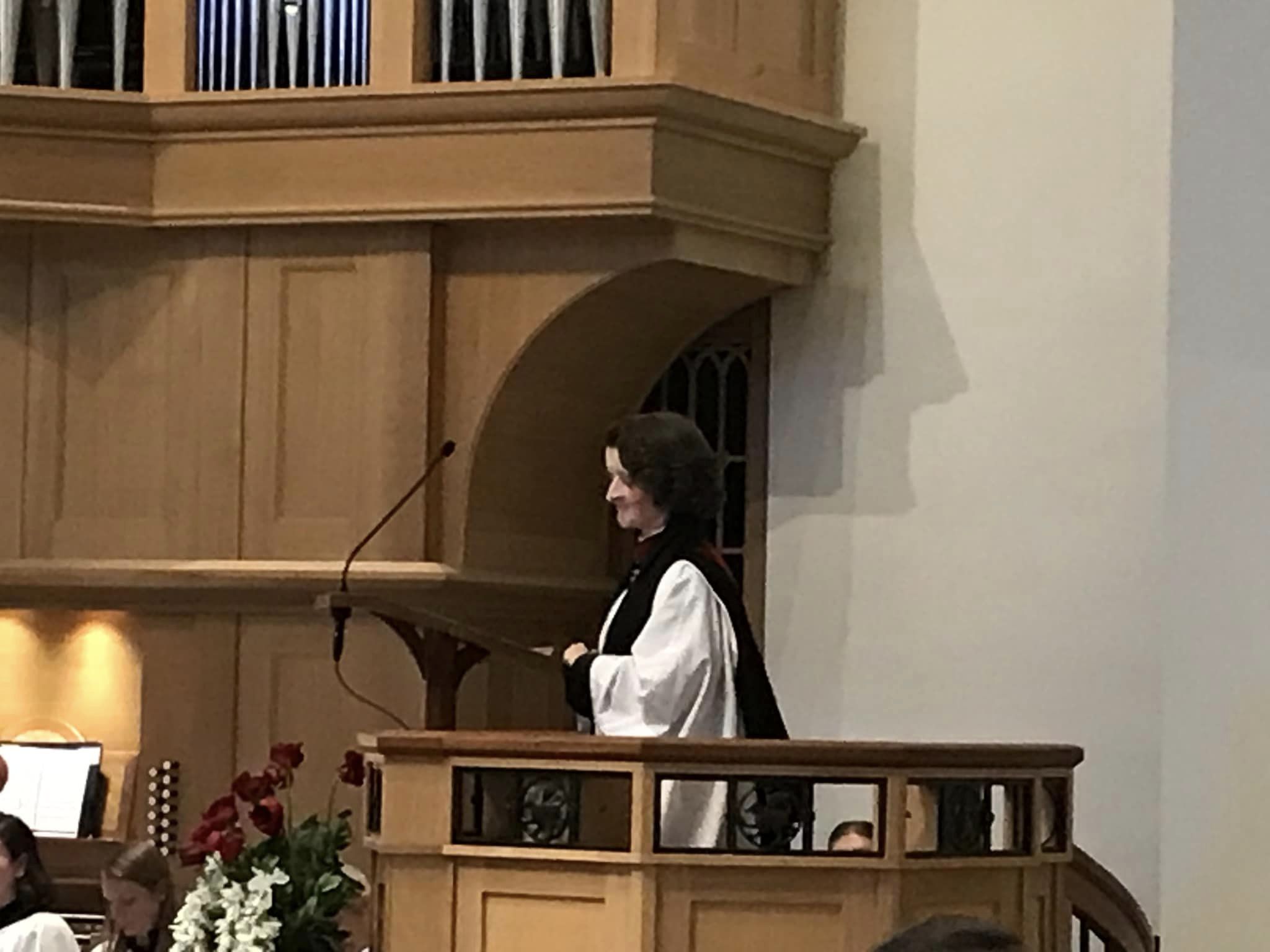
This sermon was delivered to Virginia Theological Seminary on the occasion of our annual Convocation for alumni, faculty and staff, and seminarians.

Photo credit: The Rev. Matthew Tucker

I live in a pretty “purple” district in Southern Virginia.  My Congressman represents a different party than my own, but I make a point to stay on his mailing list as a way to remind him that he represents a politically diverse district.  Every month he sends out polls, and I dutifully respond to them.  But with every survey I find myself frustrated.  My Congressman either has never taken a class in crafting an unbiased survey or he is simply not interested in different opinions.  The questions are always phrased something like, “In your opinion, how bad of a job is our president doing:  terrible, really bad, pretty bad, or I’m not sure.”  Or without any nuance or explanation about the background of the issue, the poll will ask something like, “The Congress wants to pay illegal immigrants who knowingly broke the law hundreds of thousands of dollars.  Should we pay these illegal immigrant criminals, yes or no?”  Or, one of my favorites, “Which of these issues should be the priority of Congress?” (PS, none of the options listed talk about caring for the poor or our neighbor, and there definitely isn’t an “other” category).  But I dutifully take the surveys, hoping my voice is part of my representative’s decision making.

I have been pondering the ministry of Jeremiah and thinking his prophetic ministry is a bit like trying to engage my Congressman.  For those of us not taking Old Testament this semester, Jeremiah is prophesying in a time of political decline.  The northern kingdom, Israel fell to Assyria nearly a hundred years before, and Judah remains in a tenuous situation.  The Assyrians are still in control, but in the course of the book of Jeremiah, Babylon defeats Assyria and takes control of Judah.  There are rebellions against Babylon, in particular by King Jehoiakim who we hear about today, but they are eventually unsuccessful.[i]  Like any good prophet, Jeremiah is attempting to get the people and king to repent and return to the Lord.  And like all people of all time, the people refuse to listen to God.  King Jehoiakim is particularly egregious in this refusal.  In fact, just verses before our reading, the King has his attendant read Jeremiah’s prophetic scroll three or four columns at a time, then cuts those columns off the scroll and throws them in a fire.  King Jehoiakim is not alarmed by the prophecy, and certainly not repentant. 

But here’s the funny part.  In the verses we read today, the Lord tells Jeremiah to rewrite the entire scroll and add in a little final judgment.  Like me, sitting down with yet another poll from my Congressman, he sits down and does the same thing over again.  I have been of two minds about this passage.  On the one hand, and no offense toward the Lord’s prophetic practices and policies, but how many times are we to keep doing the same thing and expecting different results.  As if King Jehoiakim is going to receive the second scroll and say, “Oh, a second scroll?  Okay, I guess I won’t burn this one and will change my ways!”  If this pandemic has taught us anything this pandemic has taught us we cannot keep doing Church the way we always have and expect the Church to thrive (or in biblical terms, to repent and return to the Lord).  This pandemic has made us nimble, agile, creative, and versatile.  This pandemic made us stop thinking about hybrid ministries and digital relevance and demanded we start doing and being those things.  And God help us if our churches just want to “return to normal” after the pandemic – if we just want to write another scroll. 

But as I mentioned, I am of two minds on this passage.  On the other hand, despite what seems like poor strategy on the Lord’s part, God’s covenantal relationship with us has never really made sense.  The entire salvation narrative is about failure after failure on our part as the people of God to listen and respond to the Lord.  Promise after promise, covenant after covenant, even the sending of God’s Son has meant the Lord’s corporate strategy is a case study in what not to do to thrive in business.  But that’s what we love about the Lord, right?  God keeps writing another scroll, God keeps giving another chance, God keeps holding out hope and promise because God’s love is not meted out in a logical, economical way.  Despite all of the innovation which has been entirely life giving during this pandemic, in some ways, what we have offered to a hurting world is the same as what we have always offered:  a community of faith, redeemed by God’s grace, commissioned to love God, self, and neighbor.  Perhaps that is why I am of two minds about this text.  Although this pandemic has not changed who we are and what we offer a broken world, this pandemic has changed how we are.  Our core values as the Episcopal Church have not changed.  But throughout this pandemic we have learned that how we go about living into those core values certainly can, should, and hopefully has changed.  And, as the Genesis writer would say, “…it was very good.”

In this particular season of the Church, many of us are feeling a longing for rest, for relief from constant pivoting, for a sense of normalcy.  Many of us would like to sit down and just write the same scroll over again.  In Jeremiah’s day that second scroll meant suffering and exile, and there would be more than twenty years before the people of God would see God’s promise of restoration realized.[ii]  But I do not think that is the invitation from scripture today.  I do not think the Lord is inviting the Church to write another scroll or fill out another poll.  We have a whole Bible full of examples of how doing the same thing over and over does not lead to the fulfillment of the kingdom of God.  Instead, the invitation from scripture today is to see the patterns of the resistance to love, and find a new way to love.  God is not inviting us to change our “who” or our “what,” but to change our “how.”  Your “how” might be different from mine.  But Jeremiah shows us time and again that the same repeated “how” does not turn hearts.  Our work in this season is to listen to what new “hows” the Holy Spirit is showing us, and then be willing to be vulnerable enough to try them.  Because, Lord knows, we do not need another scroll.  Amen. 


[i] Josey Bridges Synder, “Jeremiah,” The CEB Women’s Bible, (Nashville:  Common English Bible, 2016), 953.

[ii] 953.

Sermon – Isaiah 58.9b-14, P16, YC, August 21, 2022

05 Wednesday Oct 2022

Posted by jandrewsweckerly in Sermons

≈ Leave a comment

Tags

baptism, church, community, darkness, Episcopal Church, faith, Jesus, journey, light, messy, salvation, Sermon, water

Last night, we baptized Becky Breshears in the waters of the Chickahominy River.  When most of us think of baptism, we imagine the baptism of an infant or child, someone for whom godparents make promises to raise in the life of the faith, much like we did with baby Olivia a few weeks ago.  The sacrament of baptism for a child is certainly considered being fully initiated into the family of Christ, but we make pronouncements and promises on behalf of the baptized.  And as the baptized grows up, we continue to shepherd and guide her, answer her questions, and help her claim her faith as her own.  There is an endearing, almost romantic, notion to baptism, full of idealism and hope. 

At least, that seems to be true in Episcopal Churches, where we quite primly and gently pour water from beautiful fonts over the heads of babies – the messiest part being if the water accidently runs into the baby’s eyes.  Of course, adult baptism is totally normal in our tradition too, we just do not do adult baptism as frequently.  When we do adult baptism, we become much more like other denominations, who have always understood baptism to be a mature proclamation of one’s own faith.  In some ways an adult baptism is more exciting because an adult baptism is not about something we hope and pray will develop into a faithful life, but adult baptism is the fully developed proclamation now – a set of pronouncements and promises on one’s own behalf.  An adult baptism is bold, dramatic, and, especially in instances like last night, much messier!

But adult baptism, especially in the Episcopal Church, are not about proclaiming one has her faith life all figured out – that she has some sense of earned clarity and certainty that has led her to baptism, as if baptism is the end of a journey of discernment.  Quite the opposite; baptism is a beginning for Episcopalians.  The baptized does not proclaim she knows all there is to know about faith and salvation.  Instead, the baptized claims that she is starting a new journey with Jesus, with a community of faith who walks with her.  And part of the act of baptism is giving the newly baptized tools to walk that journey.

That’s why I love the lesson from Isaiah today.  Instead of scripture capturing a moment (like a baptism), scripture today tells us what the baptized journey will be like.  Isaiah describes five things that are critical to the life of baptism.  First, the faithful will “remove the yoke from among you” – or in modern language, be an agent of economic liberation for the oppressed, not taking advantage of others.  Second, the faithful will refrain from “pointing the finger,” or take responsibility for one’s own actions, not accusing others but acting to change the self.  Third, the faithful will “refrain from speaking evil,” because “speech, when it is careless or deceitful, can be destructive and injurious.”[i]  Our words have power and are to be used for good.  Fourth, the faithful are to “offer food to the hungry.”  The life of the faithful is a life of self-sacrifice and sharing what we have learned to call our own.  And finally, we are to “satisfy the needs of the afflicted” – not just helping others or solving their problems but letting the disadvantaged “define their own needs and letting them set the criteria for deciding whether our help is effective.”[ii]

What the prophet Isaiah tells us is that as the faithful, we structure our lives differently than the secular, self-interested world might have us live.  That includes honoring even the sabbath – this holy day, not as just a day to go to church (though I hope you all will regularly – either in person or online), but also to be a day of honoring God through letting go of the self and focusing on the Lord and on the cares of those in need.   That’s why in our gospel lesson Jesus’ actions of healing others on the sabbath is so controversial – because Jesus reminds us the sabbath is a day of selflessness, healing, and giving glory to God.

Last night, Becky committed herself to that life, and we, as fellow baptized recommit ourselves this very day, to a life lived differently – a life lived in the light of Christ.  The prophet Isaiah tells us that when we live faithful lives, our light shall rise in the darkness, the Lord will guide us continually, will satisfy our needs in parched places, make our bones strong, and we shall be like a watered garden – a spring – whose waters never fail.  We shall be repairers of the breach, restorers of the streets to live in. 

Earlier I used the language of self-sacrifice.  What the Holy Spirit does in baptism and what the Church tries to continue to do on every sabbath is relocate the self from the center of our universe and place us firmly within a community of faith who cares for one another while placing God in the center of our universe.  When we take that step in baptism or renew the step our parents took for us, and in gathering in weekly worship (whether gathering in person or gathering virtually), we commit not to having this faith thing figured out – but just that we want to live a life where our parched places are always quenched through the living waters of baptism, and where our lives become bigger than they have ever been – where our lives shine the light of Christ in the darkness.  Amen.


[i] Jon L. Berquist, “Exegetical Perspective,” Feasting on the Word, Yr. C, Vol. 3, Supplement for P16 (Louisville: Westminster John Knox Press, 2010), 4.

[ii] Berquist, 4.

The Grace of Seasons…

01 Wednesday Jun 2022

Posted by jandrewsweckerly in reflection

≈ Leave a comment

Tags

church, faith, God, grief, journey, joy, life, naming, prayer, scripture, season, stability, thanks

Photo credit: Jennifer Andrews-Weckerly. Reuse with permission.

I have been working on some continuing education classes for about a year and a half.  I just had a three week break and during that time was able to quickly read three fluffy novels.  The funny thing is, during that same time, I kept watching friends talk about the most recent book they were reading and feeling jealous, thinking, “I never have time to read!”  But I realized during this break between semesters that I will eventually have time and I do still love to read; this is just a season of life when my reading is a little limited to the academic variety. 

That realization got me thinking about seasons of life.  I remember a season with newborns when I did a ton of reading because I was hooked up to a breast pump for about 2 hours a day.  I remember a season before COVID when I traveled distances for meetings and was able to catch up on podcasts and phone calls, feeling more knowledgeable and caught up on the day’s news.  I remember multiple seasons of parenthood when I thought I would never survive something, only to look fondly upon that season later. 

Our faith journey can be a lot like that too.  We all have seasons – seasons when we feel a bit too busy for regular church attendance (thank goodness for those recorded livestreams!); seasons when everything is clicking and some piece of scripture we read totally connects with something happening in our life; and seasons when we are too angry, sad, or unsure to even engage God in prayer.  The nice thing is when we can recognize that we are in a season, we can remember the hard stuff will not last forever, and good stuff will change and shift into new and different good stuff. 

I do not know what kind of season you are in right now.  Maybe you are in a season of grief, of feeling a lack of control, or in a rut of what feels like failures.  Maybe you are in a season of new life, of exciting possibilities, of new opportunities.  Maybe you are in a season of stability and are hoping nothing rocks the boat.  I invite you to talk about that season with God.  Whether you need to curse the season, give thanks for the season, or plead for a new season, somehow just naming the experience of the season is enough to lift its power and help you see grace in it.  That is my prayer for you today.

Sermon – Luke 24.1-12, EV/ED, YC, April 16, 2022

25 Wednesday May 2022

Posted by jandrewsweckerly in Sermons

≈ Leave a comment

Tags

alleluia, church, Easter, God, Good News, Jesus, joy, normal, pandemic, resurrection, Sermon, tentative

For anyone who has grown up where there is significant snow or ice, you learn a new way of walking during wintery weather.  You cannot just boldly and carefreely step out of the house or car.  You learn a technique that admittedly looks silly from afar but can save many a bruised bottom.  You sort of extend your leg and toe and test out the asphalt.  If that feels steady, you put more of your weight on the foot.  If you are not entirely sure, you can lean back a bit to keep search for an ice-free zone.  Like I said, the technique looks a bit ridiculous, but saves you more often than not.

I have been entering into this new era of pandemic in the same tentative way.  Much of our life has begun to resemble what we remember as “normal”:  no masks required in most places, the elimination of social distancing, the occasional handshake or hug – even the church has reintroduced the common communion cup.  But even with all the changes, I still feel a deep-seeded hesitancy in my being.  I thought when all these things changed, I would want to party and celebrate.  Instead, I find myself leaning back and tipping my toe into the new normal.  My body has been on a rollercoaster for far too long to trust this new, exciting time.

A similar thing seems to be happening in our Easter story today.  The women are initially terrified about the news of the empty tomb.  As they remember Jesus’ foretelling of the event, they excitedly embrace the resurrection – only to have the disciples not believe them.  Peter must go see the empty tomb for himself before he will believe the women.  But his response to the empty tomb is to go home – amazed, certainly – but quietly returning home.  They are not singing the alleluias like we do today.  They are not running around town sharing the Good News.  The are gingerly dipping their toes into Christ’s resurrection, still not sure they can trust the joy of Easter.

Sometimes we are like that.  Last night, we spent an hour retelling the salvation narrative of God – story after story of God’s faithfulness and commitment to save the people, no matter how grave their sinfulness or disloyalty.  Last night, we reaffirmed all the good things about our baptism – the very things that make us faithful Christians – even though we struggle everyday to live into our Christian identity.  Today we are saying countless alleluias, proclaiming the tremendous news of the empty tomb, despite the fact we have sometimes felt far away from God during these last two years.  We are in this sacred place together with people who believe, or want to believe, maybe in new garb, maybe with festive meals waiting for us, and yet there is a hesitancy deep inside us – an unwillingness to fully let go of the weight of all that has been in our lives and believe the alleluias our liturgy has us say.

For us, today, the promise is we are in good company.  What God does in the resurrection of Jesus is unfathomable in Jesus’ day – of course the disciples thought the women were telling an idle tale (and their doubt was not just because they kept forgetting Jesus treated women as equal leaders).  When you have watched your whole life crumble, every dream of what you thought life with Jesus would be disintegrate in 24 hours, pivoting to news this tremendously good is not easy.  And besides, there is a lot more to happen – appearances by Jesus, more teaching, and finally the empowerment to share the Good News from the Holy Spirit.  The toe dipping into Easter joy today is totally reasonable and human.

So is your toe dipping today.  If you are not ready to throw off your outer garment and shout at the mountaintops, “Jesus is Risen!  All is well in the world!” that is totally reasonable and human.  The Church is here to keep telling you the story, to send women with a fantastic tale, to remind you hope is still possible, and joy is inevitable.  But the Church is also here to sit with you in quiet rooms, holding your hand, and whispering Good News until you are ready to step firmly onto the ground without hesitation.  Spring has melted the ice, Easter has brought promise, and Jesus lives.  We are here to take the first steps together.  Amen.

Sermon – Matthew 6.1-6, 16-21, AW, YC, March 2, 2022

25 Wednesday May 2022

Posted by jandrewsweckerly in Sermons

≈ Leave a comment

Tags

Ash Wednesday, church, disciple, disciplines, honesty, humility, invitation, Jesus, Lent, normal, pandemic, Sermon, vulnerability

For those of you who have known me for some time, you know that Lent has always been my favorite liturgical season.  Lent is a season marked by profound honesty about the brokenness and sinfulness of our lives, the confessing of the darkness of our souls, and the desperate searching for a way back to the unimaginable grace and love that God shows us undeservedly.  Perhaps that description sounds a bit morbid and unappealing, but I find the raw truth of Lent to be refreshing in a world that brushes over and hides imperfection.

Despite my love of the sobering ritual of Lent though, the last two years Lent has felt like too much of a burden to bear.  Being in a pandemic, wading through political divisions, and our country’s institutional racism being exposed felt like too much.  We have been lonely, scared, angry, and, at times, lost.  Both of the last two Lent’s have felt like the “Lentiest Lents we have ever Lented.”  And as your clergy, and as a fellow disciple of Christ, I felt like asking us to waltz into the dance of Lent was just all too much. 

But this year feels different.  I would not say we are on the other side of this pandemic, and I would certainly not say we are back to “normal” – though I am not sure we will ever go back to the old normal.  Instead, I rather feel like we are standing on a board, balanced on a fulcrum.  We are not still climbing our way over this pandemic, and we are also not coming down from the apex of this pandemic.  Instead, we are balancing a foot on each side of the board – steady, but using every muscle in our body to keep balance, wanting to breathe a sigh of relief being at the peak, but not yet able to relax on solid ground.

That is why I am so very grateful for our text from Matthew this Ash Wednesday.  In years past, I always found this text rather sanctimonious.  Here we are at a service where we will spread ashes on our forehead – a very public sign of our faith – listening to a text telling us not to be pious before others, not to give alms in a showy way, and not to pray so as to draw attention to our holiness.  The contradiction between written word and physical act have never felt more at odds than on Ash Wednesday.

But I think I had Matthew’s gospel all wrong before this year.  This text is not really about shaming self-righteous behavior.  This text is about honesty, vulnerability, and humility.  If we are showy with our piety, alms giving, prayer, and fasting, our discipleship becomes about dishonesty.  Instead, Matthew is simply asking us to be real:  real with others, real with ourselves, real with God. 

That is the invitation this Lent.  Not to take on some pious Biblical study (though we will offer that this year on Sunday mornings), not to brag about Lenten disciplines (though we will encourage you into a little light competition this year), and not to commit to something that is so unreachable that you quit within the first two weeks.  Instead, this Lent is about honestly claiming the hurt of these last two years:  of confessing our isolation and the ways that isolation has hurt (perhaps by finding one of the planned opportunities for connection), of facing the mental health strain this pandemic has created and seeking companions on the journey (whether in an upcoming support group or through a new Stephen Minister), of confessing that we are not fine (and coming to church to find those who are also not fine).  Those Lenten disciplines will give us some stability on that wobbly board of pandemic life and may give us the assurance of the presence of God in the midst of life we need to come down the peak of this pandemic.

However you enter this Lent, whatever practices you take up or give up, however you engage in the offerings of formation this Lent, the Church invites you this year to be honest:  be honest in the struggle, be honest in the failings, be honest in the hope.  Your being real this year may just allow someone to experience the realness of Jesus in their own lives.  And we could all use a little more Jesus this year.  Amen.

Sermon – Luke 2.1-20, CE, YC, December 24, 2021

12 Wednesday Jan 2022

Posted by jandrewsweckerly in Sermons

≈ Leave a comment

Tags

appearance, Christmas, Christmas Eve, church, connection, earth, Good News, heaven, Jesus, Joseph, light, love, Mary, miracle, neighbors, ordinary, Sermon

Church on Christmas Eve is always a funny thing.  For years, I scoured the stores for matching dresses for our girls.  I served in churches where people would sport tuxedos and fur coats for the night’s services.  Family pictures were regularly taken by the Christmas tree – either at home or at church.  Quite frankly, I was a little relieved when I became a priest and never had to worry about a new outfit because no one would see the outfit under my vestments anyway.  And then the pandemic hit.  Last year, we had to watch Christmas from home – maybe in matching pajamas, but more likely just in a pair of jeans or sweats.  A year later, we are all out of the habit of dressing for public, and, if you are here at Hickory Neck, you know jeans are just as acceptable as that fancy dress or jacket in the back of your closet or that some of you are fabulously sporting tonight. 

I am not really sure where the notion of dressing up for Christmas came from, except maybe an older tradition of always dressing up for church.  But nothing about our Christmas story screams high fashion.  Mary and Joseph are traveling to Bethlehem under order of the oppressive government and are likely in traveling clothes, dirty and weary from the road.  Mary also gives birth this night, so her body is likely sweaty and soiled.  Meanwhile, her child is not in a matching layette, but in bands of cloth.  Both are likely an exhausted mess.  And the shepherds who later come visit are likely not to fresh-smelling themselves, probably in their most utilitarian clothing for tending to sheep in the dark cold of night.

And yet, in these most basic settings, the privilege of the miraculous happens.  Mary births not just an ordinary baby, but the Christ Child – the Messiah – as Isaiah says, the “Wonderful Counselor, Mighty God, Everlasting Father, Prince of Peace.”  Meanwhile, not only does an angel appear in the blinding glory of God, but also a whole multitude of the heavenly host shows up.  All to ordinary people, dressed in ordinary garb, going about doing ordinary things.  But as scholar Sarah Henrich says, “Heaven and earth meet in obscure places, not in the halls of power.”[i] 

This week I read about such a meeting of the heavenly and earthly in the Washington Post.  In November 2020, Kim Morton was sitting at home with her daughter watching a movie in Baltimore County, Maryland, when her neighbor sent her text telling her to look outside.  Her neighbor, Matt Riggs, had hung a string of Christmas lights all the way across the street from his house to hers, as he explained, to brighten Kim’s world and to show her that they were always connected, despite the isolation the pandemic had created.  Kim had been struggling with anxiety and depression, had lost a loved one, had a lot of work stress, and had started experiencing panic attacks.  Matt knew her pain himself, and so decided they both needed a reminder that they are not alone in their pain. 

But here’s the funny thing about Matt and Kim’s story.  The neighbors saw what Matt did, and they wanted in too.  Neighbors across the street from one another started talking and said, “Let’s do it too!”  Slowly, but surely, neighbors started reaching out to one another with expressions of connection, love, and quite literally, light.  By the time Christmas arrived, 75% of the neighbors had joined in with strings of light crossing the entire drive.  And this year, in November 2021, the whole neighborhood held a house-to-house light hanging party.  Kim, the initial recipient of the lights said, “It made me look up, literally and figuratively, above all the things that were dragging me down.  It was light, pushing back the darkness.”[ii]

Matt and Kim’s story did not happen in Jerusalem, Bethlehem, or even New York City.  Their story happened in a little neighborhood, outside of Baltimore, that no one had heard of until the Washington Post came along.  And although Matt and Kim never mention Jesus, the truth is that heaven and earth met in an obscure place, shining connection, love, and light.  This Christmas, the ordinary, earthy setting of Bethlehem and the shepherd fields are reminders – reminders that we can have all the fancy bow ties and heels we want, but more often, we will see and experience the sacred in the ordinary moments where Jesus shows up and offers us love.  The birth of the Christ Child tonight is a reminder that we, like ordinary shepherds can be used to be sharers of the Good News in tiny, ordinary ways – ways that show Christ’s love and light, and in ways that help us experience sacred connection with our neighbors.  Amen.


[i] Sarah Henrich, “Commentary on Luke 2:1-14 [15-20],” December 24, 2021, as found at https://www.workingpreacher.org/commentaries/revised-common-lectionary/christmas-eve-nativity-of-our-lord/commentary-on-luke-21-14-15-20-20 on December 22, 2021. 

[ii] Sydney Page, “A man strung Christmas lights from his home to his neighbor’s to support her. The whole community followed,” Washington Post, December 21, 2021.

Sermon – John 18.33-37, P29, YB, November 21, 2021

01 Wednesday Dec 2021

Posted by jandrewsweckerly in Sermons

≈ Leave a comment

Tags

authority, Christ the King, church, Jesus, king, love, mercy, peace, power, Sermon

When I say the word “king,” the words that usually pop in our minds include:  ruler, power, authoritative, supreme, distant, dictator, or my personal favorite, Elvis.  Kings are a mixed bag for us, since Hickory Neck closed for over a hundred years after supporting one.  Equally messy was the king before the Revolutionary War who had a lot of impact in our lives – King Henry VIII.  If you remember, King Henry was the king who wanted to divorce his wife so that he could remarry.  When the Pope refused the King’s request, King Henry not only divorced his wife anyway, but he also started a revolution that led to the Anglican Church – our mother Church as Episcopalians.  If that is not power, I do not know what is!

Today, the Church celebrates Christ the King Sunday.  You would think on such a day, we would be hearing a text that glorifies Jesus, or that marks Jesus’ victory – such as the triumphal Palm Sunday lesson or an Easter or Ascension text.  Instead, we get the story of Jesus on trial with Pilate.  Jesus does not really look victorious in this passage – he has been humiliated, beaten, and is now being mocked by Pilate.  This is not exactly the image of Christ we may have had for Christ the King Sunday.  In fact, between Jesus and Pilate, Pilate plays the more stereotypical role of king.  Pilate uses power and authority for selfish ends with no concern for building community.  He hoards power and lords his power over people even to the point of destroying them, on a cross or otherwise.  Meanwhile, Jesus empowers others and uses his authority to wash the feet of those he leads.  He spends his life on them, and he gives his life to bring life.  Pilate’s rule brings about terror, even in the midst of calm.  Meanwhile, Jesus’ rule brings peace, even in the midst of terror.  Pilate’s followers imitate him by using violence to conquer and divide people by race, ethnicity, and nations.  Jesus’ followers put away the sword in order to invite and unify people.  Pilate’s authority originates from the will of Caesar and is always tenuous.  Meanwhile, Jesus’ authority originates from doing the will of God, and is eternal.[i]

So, if Jesus as a king is so different from any kings that we know, and our relationships with kings is tenuous at best, why do we celebrate Christ as King?  Christ the King Sunday is not that ancient of a concept in Church history.  In 1925, in the face of growing nationalism and secularism following World War I, Pope Pius XI established the feast of Christ the King.  The feast was meant to be a way of declaring where allegiances should be – not to a country, but to God.  Our allegiance should be to Jesus – our only ruler and power.  In a time of national pride, the Church boldly proclaimed, “We have no king but Jesus.”  Proclaiming Jesus as King is a fascinating reappropriation of the title “King.”  When the Church invites us to proclaim Christ as King, not only does the Church ask us to put Christ above any earthly ruler, the Church also asks us to redefine the concept of a king.  Jesus is a king who lays down his life for the sake of others; who endures humiliation and death for the salvation of people; who humbly cares for the poor, oppressed, imprisoned, and suffering.  This image does not sound anything like Henry VIII or even modern day presidents; and yet, this is what we proclaim today. 

So what does proclaiming Christ as King really look like today?  If Christ is King, then we are Christ’s people.  Those who have been baptized into Christ Jesus are, as the psalmist says, the people of his pasture and the sheep of his hand.  “Christ has made of us a people with his kingship.  And that kingship is unique, unlike any earthly kingship that is bound by geographic borders…  All are welcome, especially the chronically unwelcome ones.”[ii]  When we say that we are Christ’s people, we do not imply that we elected Jesus or that we hired Jesus as CEO.  We belong to Christ as his subjects – sharing the Eucharistic meal, sharing our lives, serving Christ as one, and resting our hopes in Christ.  Being the people of Christ impacts how we treat one another in this place, how we treat others outside of this place, and how we treat ourselves.    

At the end of another Church year, having lived through another cycle of hearing the stories of Jesus’ life, of being taught again through his miracles and parables, we come together to proclaim the truth of Christ’s kingship.  After another year of living our own lives – burying our loved ones, baptizing our children, celebrating marriage, mourning broken relationships, welcoming new families and ministries, struggling and thriving, surviving a pandemic – we bring all of our own experiences to the climax of this day as well.  We lay down all of this past year at the feet of the crucified, enthroned Christ, and we give thanks.[iii]  We are blessed to be a people ruled by a king who rules with love and mercy.  Being so blessed, we extend that kingly love and mercy to each other, to our neighbors, and to ourselves.  Amen. 


[i] Jaime Clark-Soles, as found on http://www.workingpreacher.org/preaching_print.aspx?commentary_id=1490 on November 23, 2012. 

[ii] Mary W. Anderson, “Royal Treatment,” Christian Century, vol. 120, no. 23, November 15, 2003, 18.

[iii] Anderson, 18.

On the Power of Every Perfect Gift…

06 Wednesday Oct 2021

Posted by jandrewsweckerly in reflection

≈ Leave a comment

Tags

blessing, church, every perfect gift, gift, giving, God, gratitude, stewardship, talent, team, time, treasure

Photo credit: https://www.tens.org/

Ministry is a funny endeavor because you can have a to-do list planned for any given day, but between drop-ins, unexpected calls, or pastoral events, your to-do list gets completely set aside.  Yesterday I had one of those days where I left the office thinking, “Man!  I only got a couple of things done today!  I’m so frustrated!”  But then I remembered that even though I personally only got a couple of things done, my staff picked up a lot of the floating to-do items and together, we actually got a lot of things done.  Suddenly a seemingly wasted day felt like a day of accomplishment.

The last two years have been years of transition for our staff.  A full-time priest left the staff right as COVID hit and was not replaced.  This past summer, we had an administrative staffing gap.  Suddenly, if things were getting done, they really were dependent upon my personally accomplishing them – which is never a sustainable model.  It was not until yesterday that a wave of gratitude overwhelmed me as I realized how much can be achieved when you are a part of team.

This week, we will kick off our stewardship season at Hickory Neck Episcopal Church, whose theme is Every Perfect Gift.  My experience this week made me remember how even our giving to church is a team effort.  We work hard to do our part – giving a tithe or other generous financial gift, our time, and our talent.  But our part does not sustain the work of ministry.  In order to reflect the fullness of the body of Christ, each of us needs to give Every Perfect Gift – those parts that make the whole better. 

As you think about your giving to the church, maybe your finances are making it such that you cannot give as much as you would like.  Or maybe you are giving in earnest, but feel like you are pulling more weight than others.  Or maybe you are taking a hard look at your budget and time and are considering how you can do more this year.  Just remember two things:  1) your gift is perfect and is a reflection of your gratitude to God for your many blessings – making your giving sacred; and 2) you are a part of a community where everyone does their part – where we all make an impact on our community because when we all share our every perfect gift, our collective effort is stunning.  You are in my prayers this year as you consider how you might share your perfect gifts with Hickory Neck!

Sermon – Mark 7.1-8, 14-15, 21-23, P17, YB, August 29, 2021

08 Wednesday Sep 2021

Posted by jandrewsweckerly in Sermons

≈ Leave a comment

Tags

actions, church, community, disciples, faith, identity, Jesus, membership, ritual, Sermon, words

My mom and stepdad have been longtime members of what many of us would call a megachurch – a very large United Methodist Church in Alabama. Having worshiped with them many times, the church truly is “mega”:  multiple services of varying styles, a professional band, a TV production company, a large youth center, an indoor playground, a coffee shop, a gym with fitness classes, and a big campus.  But the thing that impresses me most about their church is their clear sense of identity.  When my family started attending regularly, two people came to visit them in their home, and they had a very frank conversation about expectations for membership.  At that meeting my mom and her husband were asked to commit to at least one ministry each, were asked about what kind of education they wanted to join, and they were asked to tithe – to make a commitment to give 10% of their earnings to the church, as is the Biblical tradition. 

I remember when my mom told me this story having a visceral reaction:  that would have felt WAY to “pressure-y” for most Episcopalians.  But as time has passed, I have come to admire their church’s clarity.  The Episcopal Church does a poor job of defining membership.  Our commitment to professing “All are welcome!” seems to translate into no defining characteristics of membership.  In fact, as a priest, one of the questions I dread the most is “How do I join your church?”  That should be a very easy question, and yet when I talk to new members, the answer has to be two-fold:  the technical answer (as long as you attend three services a year and are a financial contributor, you’re considered a member – the answer from the wider Episcopal Church which I loathe!), and the more practical answer we have crafted here at Hickory Neck:  you fill out a form, you commit to supporting the church financially, you commit to feeding yourself (through study, prayer, regular worship), and you commit to feeding others (through giving your time to the church and to the wider community on behalf of the church). 

Our gospel lesson today seems to be wading through a similar debate.  The Pharisees and scribes are totally perplexed by how some of Jesus’ disciples are not washing their hands before eating – a totally valid concern in these days of COVID!  But handwashing was not just about hygiene.  The ritual washing of hands was about identity, or “membership” as we understand it today.  The Jews of this time are in an “oppressed minority, living in an occupied land.”  Their question is asked with the backdrop of colonialism, cultural and religious diversity, and competing claims on identity.[i]    Their question is both simple and complex:  why aren’t the disciples living like members of our community? 

For many a reader of this text, all sorts of erroneous conclusions have been drawn – primarily the antisemitic understanding that the laws of the Jews are superseded by laws of Jesus.[ii]  But that is not what is happening in this text.  Jesus does not have any issue with ritual cleansing:  he of all people understands the consequences of following God.  But Jesus is saying something more nuanced about identity and membership.  Jesus is saying that no matter how we traditionally mark ourselves as “other,” even if something is “the way we’ve always done it,” what is more important is how we live our faith.  So, if we are doing all the right things:  washing our hands the right way, bowing at all the right times, crossing ourselves when we’re supposed to, saying “Amen” during the sermon – or avoiding saying “Amen” during the sermon – none of that matters if our insides are defiled.  As Jesus quotes from Isaiah, “This people honors me with their lips, but their hearts are far from me…”[iii] 

Today’s invitation is to ponder what membership in this body of faith means.  Are we honoring Jesus with our lips, but our hearts are far from Jesus?  Are we following the external “rules” but fostering evil intentions in our heart?  Our work this week is making sure that when we go out into the world to love and serve the Lord, we love and serve the Lord in ways that show people Christ through our words and actions; that when we wash our hands, we do not wash them simply to keep ourselves safe, but to keep our neighbors safe; and that when we talk about how much we love this church on the hill, we do so in a way that does not show mask our individual struggles with avarice, deceit, slander, pride, and folly.  Telling the world you are a proud member of Hickory Neck Episcopal Church is just fine; but our invitation is to be clear with others that, as that old tune says, “He’s still working on me,” is also a part of membership in the body of Christ.  Amen. 


[i] Debie Thomas, “True Religion,” August 22, 2021, as found at https://www.journeywithjesus.net/lectionary-essays/current-essay?id=2944 on August 27, 2201.

[ii] Idea suggested by Matt Skinner on the Sermon Brainwave podcast, “#799: 14th Sunday after Pentecost (Ord. 22B) – Aug. 29, 2021,” August 22, 2021, as found at https://www.workingpreacher.org/podcasts/799-14th-sunday-after-pentecost-ord-22b-aug-29-2021 on August 25, 2021.

[iii] Mark 7.6b.

To Everything There is a Season…

25 Wednesday Aug 2021

Posted by jandrewsweckerly in reflection

≈ Leave a comment

Tags

call, church, discernment, God, Jesus, love, season, vulnerable

Photo credit: https://www.amazon.com/Ecclesiastes-Everything-Season-Unframed-Inspirational/dp/B08FMDFBTK

Having finally sat down to write a blog post, I was shocked to realize it had been two months since my last post.  Writing has always been a source of pleasure, joy, and learning for me – a way to reflect on the happenings of life in light of my faith and Holy Scripture.  Blogging for me is akin to preaching and spiritual direction:  an exercise in translating our daily, seemingly secular life into the sacred.  Nearly weekly postings for most of my ministry has been an outlet for me and a ministry to many others.

As I contemplated why there was such a big gap this summer, two theories percolated.  One was the more obvious.  I took some time for vacation, we were searching for and then training a new staff member, I was a part of a bishop’s search (which some argue is like a second full-time job), I was tending my family in a pandemic, I was investing time in continuing education, and I was trying to serve my beloved parish.  My plate was quite obviously full. 

But the second, perhaps more revealing reason came to me through scripture.  I was reminding of that familiar passage from Ecclesiastes, chapter 3:  For everything there is a season.[i]  Honestly, I think more people are familiar with this passage through The Byrd’s song “Turn! Turn! Turn!”  This summer has felt like a different season for me.  Instead of writing about life around us and interpreting it in light of our faith, I spent the summer doing that work orally with two faith communities – talking through what God is doing in the Church, what God has done through us in this time of pandemic, where the Church is going, and who Jesus is calling all of us to be.  In some ways those conversations have been very similar in content to what I write.  But experientially, it was significantly more vulnerable.  Instead of hiding behind the written word, I was engaging in deep, hard, thoughtful conversations in real time, being probed, questioned, and challenged – and all of that experience being broadcast in recorded and live videos for anyone and everyone to see.  I described it to a dear friend as a time of feeling naked before the world.

This summer has been a season for discernment, for deep reflection, for vulnerable pondering.  And just like the scripture writer says, for everything there is a season:  a time to plant, a time to break down, a time to laugh and dance, a time to embrace, a time to seek and a time to lose, a time to speak, and a time to love.  Now, I enter into another season:  a time to reconnect with the Hickory Neck community that loved me through this process – even though it was difficult for them.  A time to write again:  about where we see God in the midst of this season of pandemic that we wish were over.  A time to dream and a time to innovate:  about where God is calling us now.  A time to laugh, dance, and embrace:  even if we have to go back to doing that all virtually.  No matter what the season, God is with us.  I’m honored to journey in this season with you.


[i] Ecclesiastes 3.1-8 reads:  For everything there is a season, and a time for every matter under heaven:  a time to be born, and a time to die; a time to plant, and a time to pluck up what is planted; a time to kill, and a time to heal; a time to break down, and a time to build up; a time to weep, and a time to laugh; a time to mourn, and a time to dance; a time to throw away stones, and a time to gather stones together; a time to embrace, and a time to refrain from embracing; a time to seek, and a time to lose; a time to keep, and a time to throw away; a time to tear, and a time to sew; a time to keep silence, and a time to speak; a time to love, and a time to hate; a time for war, and a time for peace.

← Older posts
Newer posts →

Recent Posts

  • On Getting It Right…
  • Sermon – Matthew 9.9-13, 18-26, P5, YA, June 7, 2026
  • On God, Grace, and Letting Go…
  • On Spiritual Check-Ins…
  • Sermon – Acts 1.6-14, E7, YA, May 17, 2026

Archives

  • June 2026
  • May 2026
  • April 2026
  • February 2026
  • January 2026
  • December 2025
  • November 2025
  • October 2025
  • September 2025
  • August 2025
  • July 2025
  • June 2025
  • March 2025
  • February 2025
  • December 2024
  • November 2024
  • October 2024
  • September 2024
  • August 2024
  • July 2024
  • June 2024
  • May 2024
  • March 2024
  • February 2024
  • January 2024
  • December 2023
  • November 2023
  • October 2023
  • September 2023
  • August 2023
  • July 2023
  • June 2023
  • May 2023
  • March 2023
  • February 2023
  • January 2023
  • December 2022
  • November 2022
  • October 2022
  • June 2022
  • May 2022
  • January 2022
  • December 2021
  • November 2021
  • October 2021
  • September 2021
  • August 2021
  • June 2021
  • May 2021
  • April 2021
  • March 2021
  • February 2021
  • January 2021
  • December 2020
  • November 2020
  • October 2020
  • September 2020
  • August 2020
  • July 2020
  • June 2020
  • May 2020
  • April 2020
  • March 2020
  • February 2020
  • January 2020
  • December 2019
  • November 2019
  • October 2019
  • September 2019
  • August 2019
  • July 2019
  • June 2019
  • May 2019
  • April 2019
  • March 2019
  • February 2019
  • January 2019
  • December 2018
  • November 2018
  • October 2018
  • September 2018
  • August 2018
  • July 2018
  • June 2018
  • May 2018
  • April 2018
  • March 2018
  • February 2018
  • January 2018
  • December 2017
  • November 2017
  • October 2017
  • September 2017
  • August 2017
  • July 2017
  • June 2017
  • May 2017
  • April 2017
  • March 2017
  • February 2017
  • January 2017
  • December 2016
  • November 2016
  • October 2016
  • September 2016
  • August 2016
  • July 2016
  • June 2016
  • May 2016
  • April 2016
  • March 2016
  • February 2016
  • January 2016
  • December 2015
  • November 2015
  • October 2015
  • September 2015
  • August 2015
  • July 2015
  • June 2015
  • May 2015
  • April 2015
  • March 2015
  • February 2015
  • January 2015
  • December 2014
  • November 2014
  • October 2014
  • September 2014
  • August 2014
  • July 2014
  • June 2014
  • April 2014
  • March 2014
  • February 2014
  • January 2014
  • December 2013
  • November 2013
  • October 2013
  • September 2013
  • August 2013
  • July 2013
  • June 2013
  • May 2013
  • April 2013
  • March 2013
  • February 2013
  • January 2013
  • December 2012
  • November 2012
  • October 2012
  • September 2012

Categories

  • reflection
  • Sermons
  • Uncategorized

Meta

  • Create account
  • Log in
  • Entries feed
  • Comments feed
  • WordPress.com

Blog at WordPress.com.

  • Subscribe Subscribed
    • Seeking and Serving
    • Join 391 other subscribers
    • Already have a WordPress.com account? Log in now.
    • Seeking and Serving
    • Subscribe Subscribed
    • Sign up
    • Log in
    • Report this content
    • View site in Reader
    • Manage subscriptions
    • Collapse this bar

Loading Comments...