• About

Seeking and Serving

~ seek and serve Christ in all persons

Seeking and Serving

Tag Archives: Episcopal Church

Sermon – Mark 7.1-8, 14-15, 21-23, P17, YB, September 1, 2024

04 Wednesday Sep 2024

Posted by jandrewsweckerly in Sermons

≈ Leave a comment

Tags

body, church, disciples, Episcopal Church, faith, identity, Jesus, member, membership, Sermon, serve, work

Before I became a priest, I served as a Director of Volunteer services at a Habitat for Humanity affiliate.  In my training as a volunteer manager, I learned that one of the most important things about recruiting someone to a volunteer position was clarity about what one was asking from a volunteer.  If they were going to serve on a committee, how long was the commitment, how frequently would they meet, what work would be expected, and how was leadership structured were all details they should have.  If they were going to work on site, what training was expected or would be provided, what age restrictions existed, what risks would they undertake, and how their day would be structured were important details before a workday.  If they had a group event, they needed to know how many volunteers could be on site, what hours they needed to commit to, and what happened in inclement weather.  By the end of my tenure, every volunteer position had a position description outlining expectations, qualifications, and rewards.

So, imagine my transition to the priesthood and realizing how poorly the Episcopal Church had defined membership.  The very first time someone asked me (and every time since then), I dread the question, “So what do I need to do to become a member of this church?”  The Episcopal Church does a notoriously poor job of defining membership.  Our commitment to professing “All are welcome!” seems to translate into no defining characteristics of membership.  “How do I join your church?” should be one of the easiest questions there is.  And yet, when I talk to new members, the answer has to be two-fold:  the technical answer (as long as you attend three services a year and are a financial contributor, you’re considered a member – the answer from the wider Episcopal Church which I loathe!), and the more practical answer we have crafted here at Hickory Neck:  you fill out a form, you commit to supporting the church financially, you commit to feeding yourself (through study, prayer, regular worship), and you commit to feeding others (through giving your time to the church and to the wider community on behalf of the church). 

Our gospel lesson today seems to be wading through a similar lack of clarity.  The Pharisees and scribes are totally perplexed by how some of Jesus’ disciples are not washing their hands before eating – a totally valid concern in these days of post-pandemic!  But handwashing was not just about hygiene.  The ritual washing of hands was about identity, or “membership” as we understand membership today.  The Jews of this time are in an “oppressed minority, living in an occupied land.”  Their question is asked with the backdrop of colonialism, cultural and religious diversity, and competing claims on identity.[i]    Their question is both simple and complex:  why aren’t the disciples living like members of our community? 

For many a reader of this text, all sorts of erroneous conclusions have been drawn – primarily the anti-Semitic understanding that the laws of the Jews are superseded by laws of Jesus.[ii]  But that is not what is happening in this text.  Jesus does not have any issue with ritual cleansing:  he of all people understands the expectations of following God.  But Jesus is saying something more nuanced about identity and membership.  Jesus is saying that no matter how we traditionally mark ourselves as “other,” even if something is “the way we’ve always done it,” what is more important is how we live our faith.  So, if we are doing all the right things:  washing our hands the right way, bowing or genuflecting at all the right times, crossing ourselves when we’re supposed to, saying “Amen” during the sermon – or avoiding saying “Amen” during the sermon – none of that matters if our insides are defiled.  As Jesus quotes from Isaiah, “This people honors me with their lips, but their hearts are far from me…”[iii] 

Today’s invitation is to ponder what membership in this body of faith means.  Are we honoring Jesus with our lips, but our hearts are far from Jesus?  Are we following the external “rules” but fostering evil intentions in our heart?  Have we filled out the membership form but neglected our work of feeding ourselves and feeding others?  Our work this week is making sure that when we go out into the world to love and serve the Lord – the dismissal that the we agree to every week – that we love and serve the Lord in ways that show people Christ through our words and actions; that as the political season ramps up, we ensure we are not defiling the dignity of any human being with our lips; and that when we talk about how much we love this church on the hill, we do so in a way that does not mask our individual struggles with avarice, deceit, slander, pride, and folly.  Telling the world you are a proud member of Hickory Neck Episcopal Church is just fine – and something I hope you do on a regular basis.  But our invitation from scripture today is to be clear with others that, as that old tune says, “He’s still working on me,” is also a part of membership in the body of Christ – perhaps the most appealing one that draws others into a desire for membership too.  Amen. 


[i] Debie Thomas, “True Religion,” August 22, 2021, as found at https://www.journeywithjesus.net/lectionary-essays/current-essay?id=2944 on August 30, 2024.

[ii] Idea suggested by Matt Skinner on the Sermon Brainwave podcast, “#799: 14th Sunday after Pentecost (Ord. 22B) – Aug. 29, 2021,” August 22, 2021, as found at https://www.workingpreacher.org/podcasts/799-14th-sunday-after-pentecost-ord-22b-aug-29-2021 on August 28, 2024.

[iii] Mark 7.6b.
Sermon – Mark 6.1-13, P9, YB, July 7, 2024

17 Wednesday Jul 2024

Posted by jandrewsweckerly in Sermons

≈ Leave a comment

Tags

change, control, Episcopal Church, fresh, God, growth, Holy Spirit, Jesus, lane, limit, movement, new, Philadelphia Eleven, Sermon, uncomfortable

I realized recently that one of things I often say when I am asked how my family is doing is to offer a halfhearted compliment, “Everyone is staying in their lane.”   I think I started adopting that minimum standard, “staying in your lane,” because I have learned over the years how little control I have as a parent.  I may not be able to control what things my kids are interested in, I may not be able to control how well they perform in school, and I may not be able to control how they handle interpersonal relationships.  But if each family member is “staying in their lane,” then that means I have at least controlled their meddling with one another, their active misbehavior, or their making a scene anywhere else. 

That is what seems to be bothering the folks in Jesus’ hometown of Nazareth – Jesus is not staying in his lane.  At the beginning, there seems to be a modicum of respect for what Jesus is teaching in the synagogue – they compliment the wisdom he seems to have gained and the healing acts he has performed.  But the compliments end there.  Then the questions begin.  Where did he get this wisdom?  Isn’t he the carpenter’s son?  Isn’t he the son of Mary – a question dripping with criticism, as you would usually only refer to someone’s parentage through the father, not the mother.[i]  In other words, the people of Jesus’ hometown are basically saying, “Stay in your lane, Jesus!”

Passages like this can be so tempting for us.  We read about Jesus’ hometown and think, “Those silly folks from Nazareth!  They cannot see what God is doing right in front of them!”  As if “those” people and finger pointing is what the gospel calls for.  But when we start wagging our fingers at “those” people, we forget one kernel of truth about scripture:  we are always “those” people.”  Anytime something someone does in scripture makes us uncomfortable or sanctimonious, scripture is speaking straight to “us” not “those people.”  So, the people of Nazareth aren’t the only ones telling Jesus to stay in his lane.  We tell that to Jesus all the time.  When the Holy Spirit is calling us try a new ministry that feels daunting, we are tempted to tell Jesus to stay in his lane and let us do things our way.  When Jesus puts people in our lives that push us out of our comfort zones, we grumble to Jesus to stay in his lane and stop sending us prophets – I mean, annoying people.  When we hear that still, quiet voice speaking truth to us in places we like to keep in a box, we cut Jesus some nasty side-eye and tell Jesus to stay in his lane.

But as scholar Debie Thomas says, “The call of the Gospel is not a call to stand still.  It is a call to choose movement over stasis, change over security, growth over decay.”[ii]  Just last Sunday, we started a movie series about changemakers.  Last week, the film was The Philadelphia Eleven, the story of the unsanctioned ordination of the first eleven women in the Episcopal Church.  The vitriol of the bishops, clergy, and lay people who were opposed to those women’s ordination was shocking to the ears.  From the clergy person who stated with confidence, “Women can be anything they want – except a priest in God’s holy church.”  From the woman who lamented the ways those women had violated what God calls women to be and do in the world.  To the bishops held a public, scathing trial of the three male bishops who dared to ordain the first eleven.  The Philadelphia Eleven had waited time after time for the Episcopal Church to change – to chose growth, change, and movement instead of decay, security, and stasis.  And when the church refused to let these women out of their lane, the stepped out of their lane anyway.

Scholar Thomas concludes, “The scandal of the Incarnation is precisely that Jesus doesn’t stay in his lane.  God doesn’t limit God’s self to our small and stingy notions of the sacred.  God exceeds, God abounds, God transgresses, God transcends.  The lowly carpenter reveals himself as Lord.  The guy with the tainted birth story offers us salvation.  The hometown prophet tells us truths we’d rather not hear… [Jesus] will call out to us, nevertheless, daring us always to see and experience him anew.”[iii]  Our invitation today is let Jesus out of his lane in our life:  to not hold his lane as sacred, and to open ourselves to the ways his transgression of lanes is helping us to experience Jesus in new and fresh ways.  Maybe we do that in weekly worship, opening ourselves through song, prayer, and scripture to fresh experiences of God.  Maybe we come to the film series or Bible study this summer to see where God is exceeding, abounding, transgressing, and transcending.  Or maybe we let go of whatever boundary we are holding here at Hickory Neck to see what happens when we ask Jesus to please cross out of his lane.  The promise for us is a fresh experience of Jesus in our own day, time, and place.  Amen.


[i] Efrain Agosto, “Exegetical Perspective,” Feasting on the Word, Year B, Vol. 3 (Louisville:  Westminster John Knox Press, 2009), 215.

[ii] Debie Thomas, “Hometown Prophets,” June 27, 2021, as found at https://www.journeywithjesus.net/essays/3058-hometown-prophets on July 5, 2024.

[iii] Thomas.

On the Road to Getting It Right…

03 Wednesday Jul 2024

Posted by jandrewsweckerly in reflection

≈ Leave a comment

Tags

Communion Table, Episcopal Church, exclusion, faith, Holy Spirit, love, ministry, ordination, Philadelphia 11, Philadelphia Eleven, priesthood, question, women

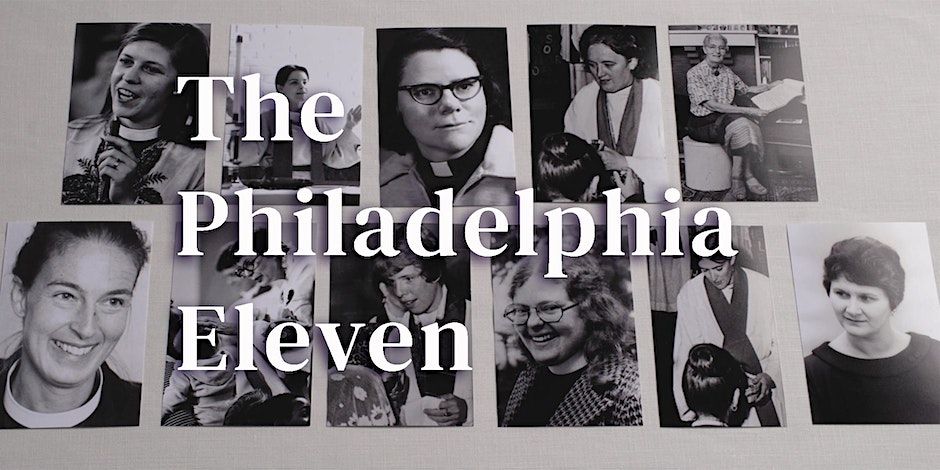
Photo credit: https://azdiocese.org/2023/11/the-philadelphia-eleven-screenings-in-arizona/

This past Sunday, the local Episcopal parishes in my town gathered to watch the documentary, The Philadelphia Eleven.  The film details the history of women’s ordination in the Episcopal Church, and the first eleven women who were “irregularly ordained” in 1974 (i.e. ordained by Episcopal Bishops, but without the church’s General Convention sanctioning the ordination of women).  The question of women’s ordination had come before General Convention many times before, but was always defeated.  So, fifty years ago, a handful of women, along with male allies, decided they could not wait any longer.  The film tells the story of the outrage the eleven women created, the abuse and death threats they faced, and the way that their diverse ministries led to the sanctioning of women’s ordination by General Convention in 1976. 

I came into the Episcopal Church later in life.  Although deeply involved in the United Methodist campus ministry at my college, an ecumenical trip with the Episcopal campus minister was my first real exposure to the liturgy and polity of the Episcopal Church.  That campus minister was a woman, and at that point in my development, that did not seem abnormal.  Then, a couple of years after college, I stumbled into the Episcopal Cathedral, whose dean was a woman.  One of her assisting priests was also a woman.  Those early mentors did not just normalize women’s ordination – it never occurred to me that there was a time when women were not priests.  In fact, I remember an occasion when one of my own daughters as a young child asked me, “Can boys be priests?”

At this year’s General Convention of the Episcopal Church, we took the first steps to authorize the honoring of the Philadelphia Eleven in our set of honored saints we celebrate at weekday Eucharists.  In the same city, where 51 years earlier the General Convention had denied women’s right to ordination, we agreed to honor the saints who pushed us to be better versions of the Church.  All female clergy in the room were invited to stand to a roar of applause.  I looked at the other women, many of whom I know and love, and I looked at the male clergy and laity whose eyes and smiles were full of admiration and respect, and I realized a couple of things.  One, it is always a joy to celebrate when the Church gets something right – even if it takes a long time for the Church to get there.  And two, I can be in ministry as my most authentic self is due to the suffering and courage of men and women I may never meet. 

I share all this not to brag on the Episcopal Church – in fact, we still have a long way to go.  Income disparity between male and female clergy is still a problem, as well as access to comparable positions.  I have been the first female rector both times I have served as rector, and both times, people left the church when a woman was hired.  But I share this story more because I wonder who else have we excluded from the Table.  I share this story because I found myself wondering whether I would have risked being one of the Philadelphia Eleven, knowing the suffering that would come.  I share this story because as someone who really appreciates rules and boundaries, I wonder which of those rules and boundaries the Holy Spirt keeps bumping against.  While these may seem like big questions, or super-Church-nerdy questions, I think these questions are for all of us – an invitation to wonder who we have excluded in the communities of faith we love so much.  The Philadelphia Eleven seem to be still asking us these questions fifty years later.    

On the Business of Church…

19 Wednesday Jun 2024

Posted by jandrewsweckerly in reflection

≈ Leave a comment

Tags

business, Episcopal Church, General Convention, God, good, governance, grace, Holy Spirit, Jesus, legislation, love, mission, prayer, purpose, vision

Photo credit: https://episcopalnewsservice.org/2020/11/20/80th-general-convention-postponed-to-july-2022-as-pandemic-disrupts-planning-of-triennial-gathering/

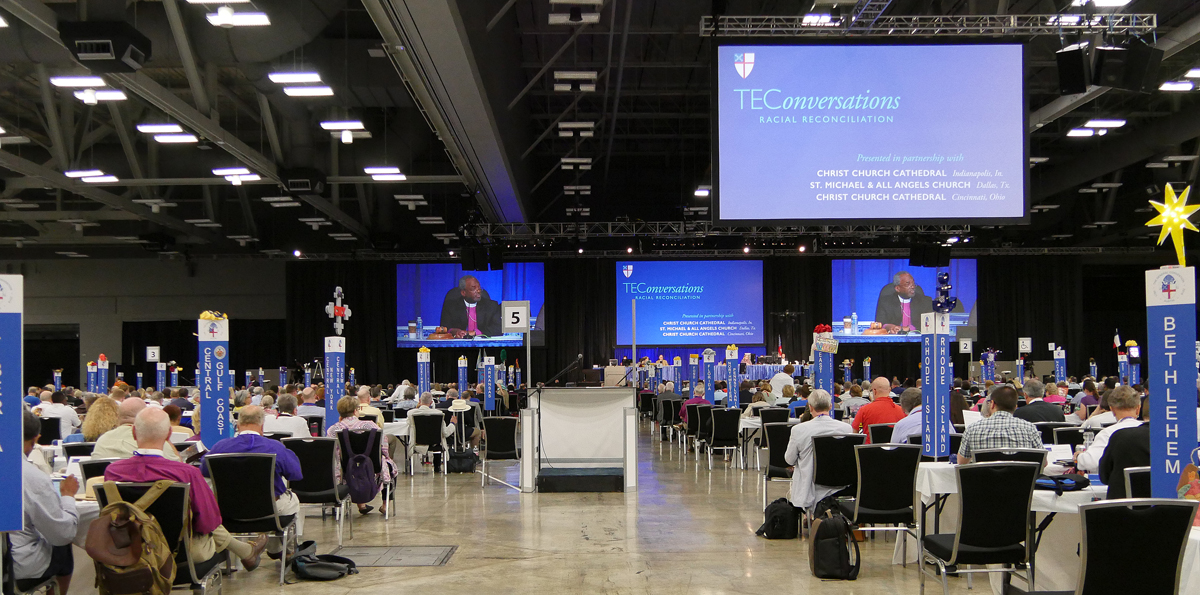
This weekend, Episcopalians will descend upon Louisville, Kentucky, for our General Convention.  The General Convention is the governing body of The Episcopal Church.  Every three years (or in this case, two years, due to a delayed GC during COVID), General Convention meets as a bicameral legislature that includes the House of Deputies and the House of Bishops, composed of deputies and bishops from each diocese.  In the House of Deputies, which includes elected lay and ordained deputies and alternates, over 1000 people will gather, and about 140 bishops will gather in the House of Bishops.  This year, we have a shortened Convention of six days of legislative sessions, covering everything from governance, justice issues, ecumenical and interfaith issues, evangelism and church vitality, liturgy, stewardship, formation, and mission.  In those six days, we will review over 275 pieces of legislation. 

Of course, General Convention is not all business.  It is a place of innovation and collaboration.  An exhibit hall of vendors is place of ideas, resources, and connection.  The legislative halls and common spaces are places of reunion with former seminary classmates, dioceses where one has served or worshiped before, and friends from professional connections.  It may be a chance to meet people in person that you have only known online, people you have admired the work of from afar, or a place to make new friends.  And then there are the opportunities to gather in worship in unfamiliar and familiar styles, the deep conversations and sharing of best practices, and the inspiration that can come from being steeped in the wideness of God’s church.

Ultimately, General Convention can be a place of great tension:  of trying to accomplish a great deal of business while honoring and developing relationships across difference, of challenging and trying to correct the failings of the Episcopal Church while learning and being inspired to renew our ministries, of taking a step back to clarify mission, purpose, and priorities while narrowing in and aligning decisions with that clarity.  Add in doing all that with over 1100 people, and that we get anything accomplished is a minor miracle.

Knowing all that, I invite your prayers for the Church as we gather:  that we root ourselves in God’s grace and power, that we ground ourselves in the love of Jesus and serve as faithful disciples, and that we undergird our work with the creative, life-giving, wise movement of the Holy Spirit.  And then ultimately, I invite your prayers that our work will mean something:  to the country church in rural America, to the beleaguered inner city church, to the bustling suburban church, and to churches whose primary languages are not English; to the churches who are shrinking and the churches who are thriving; to the person who is struggling with their faith, the person excited about a new ministry, to the person who is worried about the future of the church, and the person who is entirely unchurched.  We bring each of you with us in our prayers as we gather.  I hope you will surround us in prayer as well – that God is working for good in all of it.     

On Looking Back to Look Forward…

20 Friday Oct 2023

Posted by jandrewsweckerly in reflection

≈ Leave a comment

Tags

church, Episcopal Church, formation, God, gospel, history, impact, seminary, stewardship

Font at Virginia Theological Seminary

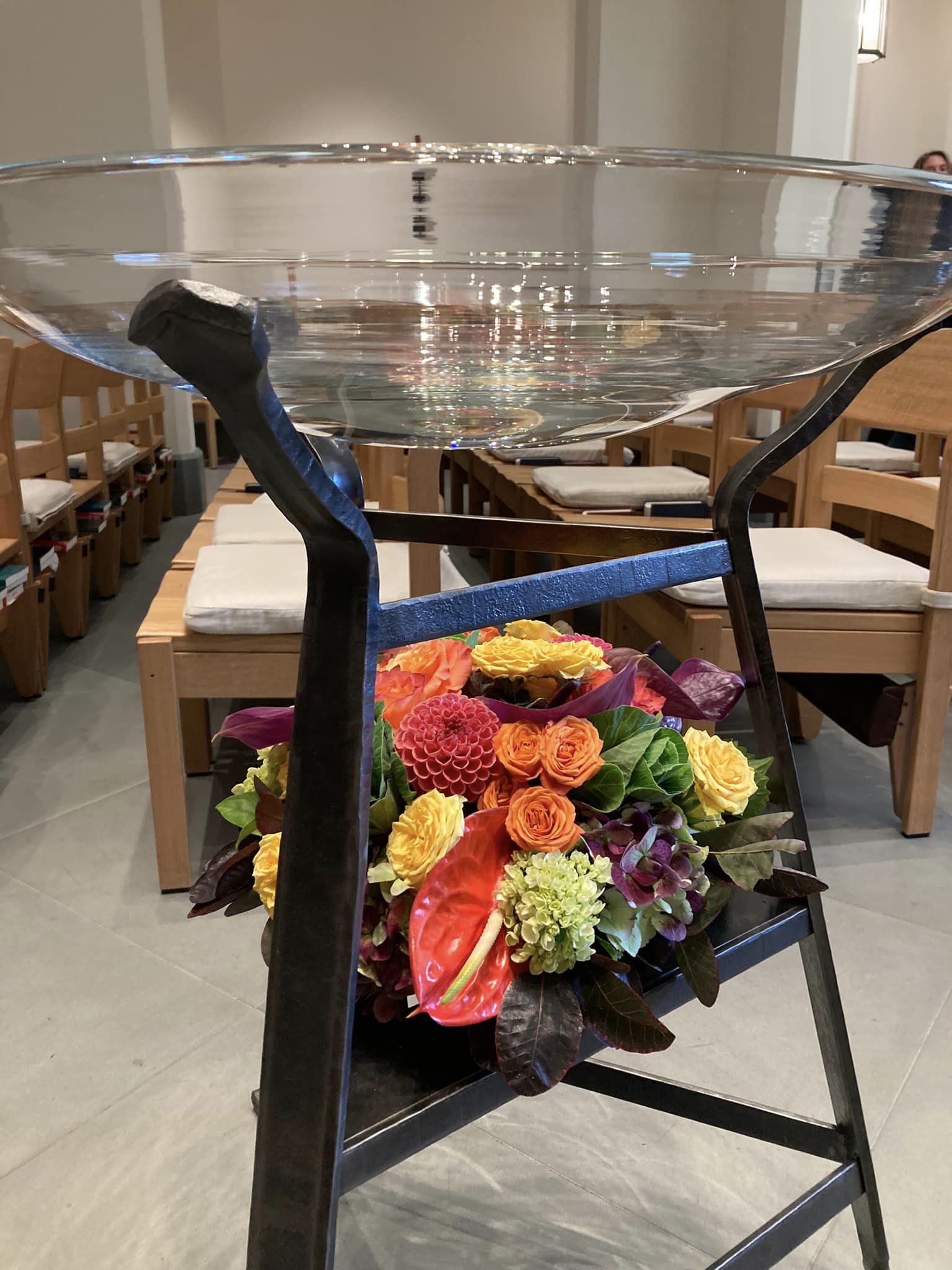
I remember when I was a seminarian, sitting in daily worship, my eyes and mind would sometimes wander.  In particular, I was fascinated by the names or other small mementos carved into the old pews.  I always wondered who the mystery person was who left their mark, how long ago they carved it, and how they managed not to get caught.  What I loved about those small little marks was how they made me feel connected – connected to a long line of priests and lay leaders shaped by the seminary, all with varying gifts and talents, serving God in God’s church around the world.

Last week, my seminary honored 200 years of forming priests in the Episcopal Church.  Though those pews from the old chapel were lost in a fire, what struck me was the massive changes the seminary has seen.  From slaves who helped build and then worked on the property, wars that shaped the context for ministry dramatically for generations, fiduciary decisions that impacted the viability and structure of the seminary, the growing diversity of the student body as the Episcopal Church’s understanding of who can be called to ministry has expanded, and an evolving physical plant that has shifted what the school on the holy hill looks like – all of that change has made for a rich and layered history, of which I am a small part. 

But perhaps what speaks to me most about Virginia Theological Seminary is the ways that it also has a microcosmic impact on the church – namely, the ministry of every graduate from the seminary.  My time at VTS shaped and formed me into the priest I am today – from academic formation to liturgical formation, from learnings on leadership to the development of relationships, from shaping my spirituality to shaping my sense of the wider church.  And for every graduate like me, VTS has shaped thousands of others who go out into the world to preach the gospel.  That reality is what inspires my financial support every year – knowing the future generations I can support.

As my church journeys into stewardship season, a time of discernment about how we will support our church financially and with our time, I am reminded of how we all come to think about the stewardship of our resources.  Supporting my seminary and my church financially are ways I say to those institutions and my community that these institutions are important to me:  they have made an impact in my life, and have inspired me to make an impact on the them.  I would not be the priest, mother, or wife that I am without either my seminary or Hickory Neck Church.  What about you?  How has our church shaped your life?  What stories are the stories that make you eager to be a part of financially supporting ministries of impact?  I can’t wait to hear what inspires your giving!

On Celebrating Life, Death, and Movies…

04 Wednesday Oct 2023

Posted by jandrewsweckerly in reflection

≈ Leave a comment

Tags

bless, celebration, change, community, death, end, Episcopal Church, eternal life, finality, grace, growth, Holy Spirit, Jesus, joy, life, ministry, movies, new, past

Photo credit: https://www.cnn.com/2023/09/28/tech/netflix-dvd-rental-movies-ending/index.html

Well, it finally happened.  Netflix’s DVD business closed last Friday.  Now I recognize that acknowledging I still received DVDs from Netflix may make me seem old-fashioned.  Even a contemporary exclaimed recently, “Do people even have the equipment to play DVDs anymore?!?”  I took a good ribbing, but the truth is I love movies, and Netflix’s DVD business allowed me to watch movies that were not available via streaming services.  I was constantly finding new gems, and still had over 100 movies in my queue that I hoped to watch some day.

For those of us old-timers still watching DVDs, the closing of Netflix’s DVD branch has been tinged with nostalgia and a tiny bit of grief.  Over the course of 18 years, I watched 667 films, each story sparking my imagination, eliciting pleasure, sorrow, excitement, indignation, laughter, and hope.  Obviously there will be other ways for me to revel in the artistry of filmmaking, but there is a certain finality to the closing of this chapter. 

Despite my wistfulness, I commend Netflix for the way they have handled this change.  Instead of wallowing in grief, or attempting to apologize for market changes beyond their control, instead, they have handled this “death” with grace and joy.  Knowing the closing was coming, this year they used their iconic mailing envelopes to feature celebratory artwork honoring how a whole generation has been shaped by their service.  On the week of their closure, the sent a “gift” to every member – a summary of the highlights of our membership – what movies we had watched each year, milestones in our membership, and even the list of movies in our queue in case we want to find another way to see them.  Instead of a death, it has felt like a celebration of life.

In a lot of ways, it has reminded me of the ways the Episcopal Church approaches death.  When someone we love passes, we use the burial office to celebrate life – certainly the life of the one who has died, but especially the promise of eternal life promised in Jesus Christ.  But I’ve been thinking about it over this last week, and the Church honors “mini-deaths” all the time:  the ending of a ministry that is no longer needed or effectively utilized, the retirement of a ministry leader after a successful tenure, or the blessing of a parishioner or staff member who moves away from the community.  All those transitions can be hard because they make us remember fondly the ways ministry blessed us in the past.  But those transitions are also often the source of new life:  a new ministry we could never have imagined five years ago, a new leader whose fresh ideas opens up new opportunities, and new members who shape and mold us into a new community.

I wonder what things feel like they are dying in your life right now – what things you thought would always be there are undergoing change.  Where might the Holy Spirit be inviting you to see new shoots of growth in the midst of something withering on the vine?  How might those “mini-deaths,” be tremendous gifts to you or your community?  How might we take a cue from Netflix, and find ways to celebrate those endings with dignity and joy?  I am grateful for the ways a secular business is helping me see the sacred in our own life cycles.  Let’s celebrate together!

Sermon – Isaiah 58.9b-14, P16, YC, August 21, 2022

05 Wednesday Oct 2022

Posted by jandrewsweckerly in Sermons

≈ Leave a comment

Tags

baptism, church, community, darkness, Episcopal Church, faith, Jesus, journey, light, messy, salvation, Sermon, water

Last night, we baptized Becky Breshears in the waters of the Chickahominy River.  When most of us think of baptism, we imagine the baptism of an infant or child, someone for whom godparents make promises to raise in the life of the faith, much like we did with baby Olivia a few weeks ago.  The sacrament of baptism for a child is certainly considered being fully initiated into the family of Christ, but we make pronouncements and promises on behalf of the baptized.  And as the baptized grows up, we continue to shepherd and guide her, answer her questions, and help her claim her faith as her own.  There is an endearing, almost romantic, notion to baptism, full of idealism and hope. 

At least, that seems to be true in Episcopal Churches, where we quite primly and gently pour water from beautiful fonts over the heads of babies – the messiest part being if the water accidently runs into the baby’s eyes.  Of course, adult baptism is totally normal in our tradition too, we just do not do adult baptism as frequently.  When we do adult baptism, we become much more like other denominations, who have always understood baptism to be a mature proclamation of one’s own faith.  In some ways an adult baptism is more exciting because an adult baptism is not about something we hope and pray will develop into a faithful life, but adult baptism is the fully developed proclamation now – a set of pronouncements and promises on one’s own behalf.  An adult baptism is bold, dramatic, and, especially in instances like last night, much messier!

But adult baptism, especially in the Episcopal Church, are not about proclaiming one has her faith life all figured out – that she has some sense of earned clarity and certainty that has led her to baptism, as if baptism is the end of a journey of discernment.  Quite the opposite; baptism is a beginning for Episcopalians.  The baptized does not proclaim she knows all there is to know about faith and salvation.  Instead, the baptized claims that she is starting a new journey with Jesus, with a community of faith who walks with her.  And part of the act of baptism is giving the newly baptized tools to walk that journey.

That’s why I love the lesson from Isaiah today.  Instead of scripture capturing a moment (like a baptism), scripture today tells us what the baptized journey will be like.  Isaiah describes five things that are critical to the life of baptism.  First, the faithful will “remove the yoke from among you” – or in modern language, be an agent of economic liberation for the oppressed, not taking advantage of others.  Second, the faithful will refrain from “pointing the finger,” or take responsibility for one’s own actions, not accusing others but acting to change the self.  Third, the faithful will “refrain from speaking evil,” because “speech, when it is careless or deceitful, can be destructive and injurious.”[i]  Our words have power and are to be used for good.  Fourth, the faithful are to “offer food to the hungry.”  The life of the faithful is a life of self-sacrifice and sharing what we have learned to call our own.  And finally, we are to “satisfy the needs of the afflicted” – not just helping others or solving their problems but letting the disadvantaged “define their own needs and letting them set the criteria for deciding whether our help is effective.”[ii]

What the prophet Isaiah tells us is that as the faithful, we structure our lives differently than the secular, self-interested world might have us live.  That includes honoring even the sabbath – this holy day, not as just a day to go to church (though I hope you all will regularly – either in person or online), but also to be a day of honoring God through letting go of the self and focusing on the Lord and on the cares of those in need.   That’s why in our gospel lesson Jesus’ actions of healing others on the sabbath is so controversial – because Jesus reminds us the sabbath is a day of selflessness, healing, and giving glory to God.

Last night, Becky committed herself to that life, and we, as fellow baptized recommit ourselves this very day, to a life lived differently – a life lived in the light of Christ.  The prophet Isaiah tells us that when we live faithful lives, our light shall rise in the darkness, the Lord will guide us continually, will satisfy our needs in parched places, make our bones strong, and we shall be like a watered garden – a spring – whose waters never fail.  We shall be repairers of the breach, restorers of the streets to live in. 

Earlier I used the language of self-sacrifice.  What the Holy Spirit does in baptism and what the Church tries to continue to do on every sabbath is relocate the self from the center of our universe and place us firmly within a community of faith who cares for one another while placing God in the center of our universe.  When we take that step in baptism or renew the step our parents took for us, and in gathering in weekly worship (whether gathering in person or gathering virtually), we commit not to having this faith thing figured out – but just that we want to live a life where our parched places are always quenched through the living waters of baptism, and where our lives become bigger than they have ever been – where our lives shine the light of Christ in the darkness.  Amen.


[i] Jon L. Berquist, “Exegetical Perspective,” Feasting on the Word, Yr. C, Vol. 3, Supplement for P16 (Louisville: Westminster John Knox Press, 2010), 4.

[ii] Berquist, 4.

Sermon – John 13.31-35, Acts 11.1-18, E5, YC, May 15, 2022

25 Wednesday May 2022

Posted by jandrewsweckerly in Sermons

≈ Leave a comment

Tags

baptism, belonging, challenging, Christian, communion, Episcopal Church, evangelism, General Convention, Holy Eucharist, Holy Spirit, hospitality, identity, Jesus, love, membership, Peter

Every three years, the entire Episcopal Church gathers for what is called General Convention.  Eight lay and ordained people from every diocese in the Episcopal Church and all the bishops gather in two houses to pass legislation that will govern the whole of the church.  Issues range widely, from authorizing new liturgies, to promoting social justice issues, to human resources issues for clergy and lay staff, to who will guide and govern the church.  One topic that is coming around again this year is whether the Episcopal Church should remove the baptism requirement for the reception of Holy Eucharist.  Even though practices range pretty widely, technically the canons of the Episcopal Church reserve communion for those who have been baptized.  The issue is highly contested, has been written about widely, and I could spend a whole hour teaching on this topic.  At the heart of the debate are issues of belonging, identity, hospitality, and evangelism.

 As I have watched some of the initial debate heat up in the Episcopal Church, I marvel at how, as much as the Church has changed over the years, much remains the same.  After Jesus’ ascension, and as the disciples and apostles began to spread the Good News far and wide, Peter and the other disciples begin to debate the issue of membership – whether uncircumcised Gentiles could become full members of the body of Christ without being circumcised.  In our reading from the Acts of the Apostles, we hear the story of how the apostles call Peter in and question his fellowship with uncircumcised Gentiles.  Peter launches into a story about a vision he had and what God said to him about “membership” in the body of Christ.  After hearing Peter’s testimony, there is silence.  The weight of such a change hovers in the silence – issues of belonging, identity, hospitality, and evangelism hanging in the air.

So much about this story today is human.  Time and time again, from the beginning of time, we have debated who is in and who is out.  There are benign ways and malicious ways of defining those boundaries, but ultimately those boundaries help us know who we are so we understand who we are not.  We agree to a set of behaviors and activities every time we reaffirm our baptisms.  Clubs and civic groups have criteria for admitting members.  Colleges have criteria for who can be a student, and what can get you expelled.  Even retirement communities have rules about what age you can be before you can move into the community.  But the malicious ones are trickier.  Redlining is a practice that has kept people of certain races and ethnicities from owning homes in certain areas.  Women are unable to serve as ministers in certain faith traditions.  LGBTQ identifying individuals were denied the same spousal rights and parenting rights as straight individuals.  The question becomes how do we define who we are and what we are about without harming or maligning others?

Some have argued Jesus gives us the answer in John’s gospel today.  Jesus says, “I give you a new commandment, that you love one another.  Just as I have loved you, you also should love one another.  By this everyone will know that you are my disciples, if you have love for one another.”  The instructions sound simple enough.  Our Presiding Bishop preaches nothing but the gospel of love.  But the instruction to love one another so people will know we are disciples does not make the issue of membership simple.  I love my Jewish and Muslim brothers and sisters but that does not make them Christian any more than their love of me makes me Jewish or Muslim.  I remember in seminary an interfaith dialogue between our Episcopal Dean and a Muslim leader in the community.  When they were establishing the ground rules for the conversation, the Muslim leader said, “We both enter into this conversation with deep respect for one another.  But for either of us to say that we are not trying to recruit the other would be a lie.  Of course I want you to become a Muslim:  I would not be a good Muslim if I did not think being a Muslim was the right path.  The same is true for you.  If you are not trying to convert me, I would wonder about the ferocity of your faith.”

What the texts do today is invite us into a challenging space.  By telling us to love one another, Jesus is not telling us that love denies who we are.  Likewise, by the disciples arguing about who can be Christians and who cannot, and coming to a conclusion that the Holy Spirit is doing something new does not mean that the disciples are diminishing their identity or the identity of the community.  Peter does not water down the gospel.  He simply invites the disciples to reconsider who could ascribe to that gospel.  What these two texts do together is remind us that loving one another means both holding fast to the gospel, while trusting the Holy Spirit enlivens the gospel.  The two texts together remind us that loving one another means we can be both generous and orthodox.  The two texts together remind us that loving one another means we can say yes and no, and find a gracious gray area where love abides.  What Jesus simply asks is that in the silence of the question – the silence that stood between Peter and the disciples before they made a decision – we allow love to do love’s work, so that our discernment of the Spirit can flourish.  Amen.

On Hope and Confidence…

22 Wednesday Jul 2020

Posted by jandrewsweckerly in Uncategorized

≈ Leave a comment

Tags

church, college, confidence, decline, Episcopal Church, future, hope, Jesus, leadership, living, mainline church, youth

hook-hope

Photo credit:  https://www.cmalliance.org/hope/

One of the things I have loved about my church has been the Choral Scholars we employ at our 11:15 am service on Sundays.  The eight singers are college students from William & Mary.  They come from all sorts of backgrounds – some grew up singing in their hometown Episcopal Churches, some are Southern Baptists, and a few have even been Jewish.  I have always enjoyed watching their journey through college, but I especially became appreciative of that relationship when this pandemic shut down our church.  Two Choral Scholars immediately became part of our four-person team livestreaming services every week, helping keep music at the center of our digital worship.

I was not sure what to expect, however, once the semester was over in June.  We managed to recruit two other students:  one, an out-of-state college student who grew up in our church and is home for the summer, and another who is also from William & Mary, but has never sung with our Scholars.  As each week has passed, I have slowly learned about their faith journeys and experiences.  And this Sunday, when our Music Director was on vacation, the substitute she procured is an organ student from William & Mary who sings at another local church during the school year, and who led a choral evensong with a campus group at our church last year.

As we sang and played together on Sunday, I had an epiphany.  I realized I was the oldest person in the room by several years.  After years and years of talking about the so-called decline of the mainline church, hearing myriad, often contradictory, reasons why the next generation is not coming to church (for more about this topic, check out this video by Dean Ian Markham), here I was a part of a worship leadership team primarily led by people in their very early twenties.  And they were not just playing supporting roles, like greeting people at the door or handing out bulletins.  They were in charge of the entire musical offering.  They were equals in leadership, and they were doing it with confidence and beauty.

In a few months, one of the high school students I mentored in my curacy will be ordained a priest.  Listening to her hopes for the ways the Episcopal Church can speak afresh to this world, wondering about the future lay leadership of our pre-med summer singer, and imagining the bi-vocational life our substitute organist who hopes to play on Sundays after college graduation while having a weekday career, gives me hope for the future of our Church.  Yes, our Church will continue to evolve and change, living online, living in cafes and bars, living in soup kitchens and childcare centers – but living and thriving.  Our Episcopal liturgies, our openness to the intellect, and our graceful blessing of all walks of life are the things that attract the young (and more seasoned!) people who are leading us today, and they are the strengths that give me hope for the Church of the future.  I have often resisted the doom and gloom of the predictions of the decline of the Church, but have been unsure how to legitimize my hunch.  This week I am grateful for the young people in my life who have given me some language and some confidence that Jesus is not done with us yet.  I hope you can feel that hope today too.

Sermon – Lk. 16.1-13, P20, YC, September 22, 2019

25 Wednesday Sep 2019

Posted by jandrewsweckerly in Sermons, Uncategorized

≈ Leave a comment

Tags

ambiguity, black and white, dishonest, Episcopal Church, glorify, God, gray, Jesus, money, place, power, relationship, Sermon, via media, wealth

In seminary I took a class about Reconciliation, and one of the requirements of the class was to lead a Bible Study at the local jail.  Our team of four Episcopalians waltzed into the jail, prepared with study notes, a lesson plan, and as much of an air of confidence as we could muster.  Not very long into the Bible Study, though, we realized we were in trouble.  You see, many of us had been drawn to the Episcopal Church because the Episcopal Church embraces the via media, or the middle way; we are a church that affirms the sacredness of the gray over the black and white.  But an inmate has no time for gray.  Their whole lives are governed by black and white, right and wrong.  The rigidity of life in jail is applied to Holy Scripture as well.  Most of the inmates were either perplexed by our suggestion of any ambiguity or gray in Scripture, or simply thought we were wrong.  Fortunately, our professor had come along.  After about forty-five minutes of debate and disagreement, our professor quietly spoke.  He invited the men to reflect on life where they were from, the complexities of the street, racism, and poverty.  If life at home was so layered, ambiguous, and complicated, surely Scripture could be too.  I am not saying my professor made any great strides in the debate around the literal interpretation of Scripture, but I believe he may have opened a window for some of the inmates.

I think today’s Scripture lesson is a bit like that jail classroom.  At first glance, this could be considered a text that is black and white.  The final verse of our gospel says, “No slave can serve two masters; for a slave will either hate the one and love the other, or be devoted to the one and despise the other. You cannot serve God and wealth.”  There is no gray in Jesus’ words.  Either we choose God or we choose money.  And based on the fact God is one of our two options, there is no ambiguity about which of these options we should choose.  But here is the problem with trying to assert this passage of scripture is black and white.  Whereas as the end of the passage Jesus seems to be saying we must choose God or money, in the parable, Jesus seems to be saying something else.

If you recall, in the parable, we have a poorly-behaving manager.  The manager has squandered away the master’s money.  When he is caught, the manager takes a good look at himself and admits some honest truths – he is not capable of doing manual labor and he is too embarrassed to beg for money.  Having been honest about who he is, he connives his way into a solution:  he will engender goodwill among his neighbors by doing financial favors for each of them – forgiving portions of their debts in the hopes that they will sometime very soon return the favor.  Both the master and Jesus recognize the shrewdness or wisdom in the manager’s behavior because the manager uses his wits to get out of a devastating position.  In verse nine, the text says, “I tell you, make friends for yourselves by means of dishonest wealth so that when it is gone, they may welcome you into the eternal homes.”

This is where things get confusing.  At first, Jesus seemed to be clearly saying money is evil and we must choose God over money.  But when Jesus says to “make friends for yourselves by means of dishonest wealth,” Jesus seems to be claiming money can sometimes be one of those gray areas of life; in fact, money can be used as a means to an end.  Now, we all have varying philosophies about money.  Some of us manage to care very little about money, with money holding very little power over us.  Some of us struggle with money, sometimes remembering how money can be used for good, but most times feeling like money creates stress and anxiety in our lives that we cannot seem to shake.  And others of us become narrowly focused on money – either in how we can acquire more or what ways we can spend and enjoy money more.  What Jesus knows we often forget is money is inherently “dishonest.”  Money creates systems of injustice and hierarchies of power; money can destroy marriages and friendships; and money can be the ruin of many a person.  So when Jesus says to make friends through dishonest wealth, he does not mean to become a dishonest people; he means money inherently lures us into dishonesty, and we can either throw our hands up in the air in resignation and a refusal to be associated with that dishonesty, or we can use that dishonest wealth as a means to something much more important – relationship with others.

One of the things I like to do when I am struggling with a challenging Biblical text is to look at other translations to see if I can make more sense of Jesus’ words.  This week, I found the most help from a translation called, The Message.  Now as ample warning, The Message is a very contemporary paraphrase of the Bible, which takes a lot of theological liberties that I am often uncomfortable with; however, I also find that the language from the paraphrase opens up the biblical text enough for me to start seeing the text with fresh eyes.  The Message translates Jesus words in this way:  “Now here’s a surprise:  The master praised the crooked manager!  And why?  Because he knew how to look after himself.  Streetwise people are smarter in this regard than law-abiding citizens.  They are on constant alert, looking for angles, surviving by their wits.  I want you to be smart in the same way—but for what is right—using every adversity to stimulate you to creative survival, to concentrate your attention on the bare essentials, so you’ll live, really live, and not complacently just get by on good behavior.”

What Jesus is trying to say to us today is layered, and very much lives in the gray of life.  First, money has a corrupting force in our lives.  As I mentioned a couple of weeks ago, Jesus talks about money incessantly in scripture, from telling people to give away all their money, to scolding people about storing up their money in larger barns, to reminding people not to stress about money, to this odd text about money.  As Luke concludes today, Jesus tells us that we cannot serve God and money, because of the all-consuming way money can corrode our relationship with God.

Second, we cannot escape money.  Money is a part of our everyday lives, and as we all know is necessary for functioning – for food, for shelter, for clothing, for comfort, for ministry.  Even those monks and nuns who take on a vow of poverty still rely on the money of others for support.  Money, with all its potential for corruption, is inescapable in our lives.

Finally, once we understand the power and place of money in our lives, Jesus reminds us that when we are wise, keeping God at the center, we can use money as a means to goodness in our relationship with God and with one another.  The manager “transforms a bad situation into one that benefits him and others.  By reducing other people’s debts, he creates a new set of relationships based not on the vertical relationship between lenders and debtors (rooted in monetary exchange) but on something more like the reciprocal and egalitarian relationship of friends.”[i]   This kind of work is not about charity per se, but about making friends.[ii]

Many years ago, there was a commercial circulating around the internet.   In the video, a boy is caught red-handed trying to steal a bottle of medicine and a soda.  A woman is berating him in front of a marketplace, wanting to know why he would take these things.  He confesses that the items are for his mother.  A local merchant steps forward, and hands the woman a handful of money to cover the cost of the stolen items.  The man then quietly asks the boy if his mother is sick.  When the boy nods yes, the merchant has his daughter also bring a container of vegetable broth and other items, and sends the boy on his way.  The next clip of the commercial shows the merchant thirty years later, still working in his shop.  He collapses and is taken to the hospital.  The daughter becomes completely overwhelmed as the medical bills add up, even selling the shop they had once run together.  As she is found crying near her father’s bedside, she finds a revised copy of their medical bill.  The amount due is zero.  We find out through the video that the doctor who forgives the bill is that same boy who stole medicine thirty years ago.  He writes at the bottom of the bill, “All expenses paid thirty years ago with three packs of painkillers and a bag of veggie soup.”[iii]

Jesus knows how money corrupts our world.  To be sure there is no ambiguity about the place money takes when talking about God.  We are to choose God.  But Jesus also knows that we can shrewdly utilize our money as a tool to create relationships that glorify God.  This is Jesus’ invitation for us today:  to examine how our relationship with dishonest wealth can be used for goodness.  Jesus affirms for us this week that the way into the black and white, the right and wrong of life, might just be through the path of gray.  Amen.

[i] Lois Malcolm, “Commentary on Luke 16.1-13,” as found on http://www.workingpreacher.org/preaching.aspx? commentary _id= 1783 on September 18, 2013.

[ii] Thomas G. Long, “Making Friends,” Journal for Preachers, vol. 30, no. 4, Pentecost 2007, 55.

[iii] As found at https://www.youtube.com/watch?v=XADBJjiAO_0 on September 20, 2019.

← Older posts

Recent Posts

  • On the Myth and Magic of Advent…
  • On Risking Failure and Facing Fear…
  • Sermon – Luke 23.33-43, P29, YC, November 23, 2025
  • On Inhabiting Gratitude…
  • Sermon – Luke 20.27-38, P27, YC, November 9, 2025

Archives

  • December 2025
  • November 2025
  • October 2025
  • September 2025
  • August 2025
  • July 2025
  • June 2025
  • March 2025
  • February 2025
  • December 2024
  • November 2024
  • October 2024
  • September 2024
  • August 2024
  • July 2024
  • June 2024
  • May 2024
  • March 2024
  • February 2024
  • January 2024
  • December 2023
  • November 2023
  • October 2023
  • September 2023
  • August 2023
  • July 2023
  • June 2023
  • May 2023
  • March 2023
  • February 2023
  • January 2023
  • December 2022
  • November 2022
  • October 2022
  • June 2022
  • May 2022
  • January 2022
  • December 2021
  • November 2021
  • October 2021
  • September 2021
  • August 2021
  • June 2021
  • May 2021
  • April 2021
  • March 2021
  • February 2021
  • January 2021
  • December 2020
  • November 2020
  • October 2020
  • September 2020
  • August 2020
  • July 2020
  • June 2020
  • May 2020
  • April 2020
  • March 2020
  • February 2020
  • January 2020
  • December 2019
  • November 2019
  • October 2019
  • September 2019
  • August 2019
  • July 2019
  • June 2019
  • May 2019
  • April 2019
  • March 2019
  • February 2019
  • January 2019
  • December 2018
  • November 2018
  • October 2018
  • September 2018
  • August 2018
  • July 2018
  • June 2018
  • May 2018
  • April 2018
  • March 2018
  • February 2018
  • January 2018
  • December 2017
  • November 2017
  • October 2017
  • September 2017
  • August 2017
  • July 2017
  • June 2017
  • May 2017
  • April 2017
  • March 2017
  • February 2017
  • January 2017
  • December 2016
  • November 2016
  • October 2016
  • September 2016
  • August 2016
  • July 2016
  • June 2016
  • May 2016
  • April 2016
  • March 2016
  • February 2016
  • January 2016
  • December 2015
  • November 2015
  • October 2015
  • September 2015
  • August 2015
  • July 2015
  • June 2015
  • May 2015
  • April 2015
  • March 2015
  • February 2015
  • January 2015
  • December 2014
  • November 2014
  • October 2014
  • September 2014
  • August 2014
  • July 2014
  • June 2014
  • April 2014
  • March 2014
  • February 2014
  • January 2014
  • December 2013
  • November 2013
  • October 2013
  • September 2013
  • August 2013
  • July 2013
  • June 2013
  • May 2013
  • April 2013
  • March 2013
  • February 2013
  • January 2013
  • December 2012
  • November 2012
  • October 2012
  • September 2012

Categories

  • reflection
  • Sermons
  • Uncategorized

Meta

  • Create account
  • Log in
  • Entries feed
  • Comments feed
  • WordPress.com

Blog at WordPress.com.

  • Subscribe Subscribed
    • Seeking and Serving
    • Join 394 other subscribers
    • Already have a WordPress.com account? Log in now.
    • Seeking and Serving
    • Subscribe Subscribed
    • Sign up
    • Log in
    • Report this content
    • View site in Reader
    • Manage subscriptions
    • Collapse this bar
 

Loading Comments...