• About

Seeking and Serving

~ seek and serve Christ in all persons

Seeking and Serving

Tag Archives: family

Sermon – Luke 2.1-20, CE, YC, December 24, 2015

05 Tuesday Jan 2016

Posted by jandrewsweckerly in Uncategorized

≈ Leave a comment

Tags

agricultural, celebrate, Christmas, civic, extraordinary, family, gift, God, holiness, Jesus, Joseph, life, Mary, ordinary, Sermon, shepherds

In many ways, the story that we tell tonight is rather ordinary.  As the story begins, the government is doing what the government does – finding ways to tax the people.  And so the people without influence are herded – herded back to their hometowns to be registered so that the Emperor can be certain he is getting all he is owed.  But anytime you move masses of people, you get overcrowding.  That is what happens in Bethlehem this night.  Though Joseph’s extended family is expecting him, they run out of space.  Though the story says there is no room in the inn, the more likely scenario is that the family guest room was already full.[i]  So Joseph and his pregnant fiancé get the leftovers – the area of the home meant for the animals.  We’ve had those moments – when your delinquent uncle or your slacker friend shows up unexpected.  You grab a pillow and a blanket and offer space on the couch – or the floor if the couch is already taken.  This is just an ordinary night of making the space work.

Of course, no woman would want to give birth under these conditions, but that is the funny thing about birth – births happen all the time, whether people are ready or not.  Though every time a baby is born we marvel at the miracle of life, births are really much more commonplace that we give them credit for being.  Just like any other birth, Mary finds a place to lay the baby, and just like any other mother, Mary finds a way to swaddle the baby so that he can ease off to sleep.  And so in the messiness of managing civic life and familial life, here our story has us working through the ordinary mess of reproductive life.

And in case we were to get too excited about our story, God decides to reveal the occurrences of that night to even more ordinary people.  Enter the shepherds.  These are ordinary men, doing the necessary work of shepherding.  In fact, these men are so ordinary, they are almost invisible to the outside world.  They are not busy heading to their home town to be counted because according to the day, they are not worth counting.[ii]  They are the migrant workers that do the work no one else wants to do.  So while everyone is sleeping, or eating, or enjoying the warmth of a fire, the shepherds are out tending their flocks, focused on the ordinariness of agricultural life.

Of course, the story becomes interesting when we hear about all of the extraordinary parts of this story.  Yes, there is the same greedy government, the same crowded family, the same new parents, and the same business of farm life.  But something extraordinary breaks into the ordinary this night.  In the midst of everyday lives, God breaks in through the ordinary and proclaims good news of great joy.  The Messiah has been born – the long awaited Savior who will change everything.  In fact, the angels are so blown away by this extraordinary moment in time that they break into song, praising God.  That is what we do when faced with the extraordinary.  We praise God for God’s goodness and mercy and grace.  God takes on human flesh for us, and the angels do the only thing they can – they praise God in gratitude.

The shepherds’ initial reaction to the same news is quite ordinary – they go and talk to the family.  They tell Mary and Joseph what they saw.  Again, the scene is quite ordinary – a travel-worn family making due in rustic quarters having a conversation with equally worn shepherds.  No one is out of place in this scene – everyone is equally ordinary.  And yet, the extraordinary lights up the room.  So extraordinary is the night that the shepherds leave, glorifying and praising God.  They echo the response of the angels, expressing their overwhelming gratitude in the only way they know how – praising and thanking God.  Mary too knows how extraordinary this night is.  She treasures this extraordinary moment in her heart, left pondering what new thing God is doing.

That is what we love about this story:  the juxtaposition of the ordinary with the extraordinary.  The ordinary part we know intimately.  We too find ourselves living ordinary lives.  We work, we play, we laugh, we cry.  We pay our taxes, we deal with family, we go through labor pains.  We come to church, we pray together, we read scripture together, and we feast on the holy meal.  With the exception of a few fun vacations, nights out on the town, or the wedding of a friend, our lives are relatively ordinary.  I am pretty sure most of us have not witnessed a heavenly host bringing us good tidings of great joy.

We do not get the extraordinary most days:  except, of course, when we do.  Even in our ordinary lives, God breaks in with the extraordinary.  Just a couple of weeks ago a parishioner was telling me about how our conversations at church had finally worn him down.  When he ran into a homeless person on his walk in the City, he decided to finally give him some money – a practice that he never endorses.  Something about his experience with God was softening his resolve and he was able, in a moment of clarity, to see the humanity of the man.  Or the other week, I was talking to a teacher about the profound things her children sometimes say.  They sometimes say things that stop her in her tracks and make her reevaluate her way of being.  Or a few months ago I was talking to another person of faith about her prayer life.  She confessed rather sheepishly that sometimes in her prayers, especially when she makes room to listen to God, hears a response back.  She felt like she could not really explain the phenomenon well, but she knew the voice must be from God because the words rang so true and were nothing she would have come to on her own.

That is what happens in our ordinary lives – God breaks through again and again, overwhelming us with the extraordinary.  Those moments are gifts that we celebrate an honor, because they are just that – gifts.  That is the same reason we celebrate tonight.  We honor the gift that God gives us in Christ Jesus.  For all intents and purposes, Jesus is just another baby born under ordinary circumstances.  But we know that he is so much more:  God Incarnate, Wonderful Counselor, Mighty God, Everlasting Father, Prince of Peace.  Tonight is about honoring the extraordinary in the midst of the ordinary.  Tonight is about claiming the joy that can only come from extraordinary acts of God.  But tonight is also about claiming the joy of a community that invites us to praise – to glorify God as we go our own ways this night.  We are blessed over and over.  In the trials and tribulations of ordinary life, we are so blessed by our extraordinary God and the community of faith that gathers with us.  In fact, the extraordinary nature of God hallows our ordinary lives, making them anything but ordinary.  Tonight, I invite you to embrace the extraordinary in our midst, to honor the holiness of the ordinary, and to find ways to share that extraordinary in our ordinary lives tomorrow.  Amen.

[i] Richard Swanson, “Commentary on Luke 2:[1-7] 8-20,” December 25, 2013, as found at https://www.workingpreacher.org/preaching.aspx?commentary_id=1880 on December 22, 2015.

[ii] Michael S. Bennett, “Pastoral Perspective,” Feasting on the Word, Yr. C, vol. 1 (Louisville:  Westminster John Knox Press, 2009), 118.

Sermon – Philippians 1.3-11, A2, YC, December 6, 2015

11 Friday Dec 2015

Posted by jandrewsweckerly in Uncategorized

≈ Leave a comment

Tags

action, affirmation, community, faith, family, God, Good News, Jesus, letter, love, mission, overflow, Paul, Philippians, seeking, Sermon, serving, sharing

This sermon was given on the occasion of our Annual Meeting.

My dearest St. Margaret’s, “I thank my God every time I remember you, constantly praying with joy in every one of my prayers for all of you, because of your sharing in the gospel from the first day until now.  I am confident of this, that the one who began a good work among you will bring it to completion by the day of Jesus Christ.  It is right for me to think this way about all of you, because you hold me in your heart, for all of you share in God’s grace with me…For God is my witness, how I long for all of you with the compassion of Christ Jesus.”

If ever I were to write a love letter to St. Margaret’s, I would steal these words from Paul to the Philippians.  You see, Paul saw in the Philippians what I see in you:  a community of faith alive with the Holy Spirit, sharing the Good News of Christ Jesus in our community.  A little over four years ago, I became your rector.  You were bruised and battered, having not only survived a tumultuous relationship with your last rector, but also a strained relationship with an interim, as well as the absence of consistent leadership for over two years through the limits of a supply priest.  Having had years of struggle, I quickly came to realize that St. Margaret’s had some baggage.  But St. Margaret’s also had a sense of tenacity, determination, and a deep-rooted joy that could not be stifled.  You see, as Paul writes, I could see that over fifty years ago, “the one who began a good work among you [would] bring [that good work] to completion by the day of Jesus Christ.”  I knew God was not done with us yet.

And so, over time, I came to love each of you:  not the dreamy romantic love of love birds, but the kind of love that family has for each other.  That is what people usually describe as being so wonderful about St. Margaret’s:  that we are like family.  Now when I first heard that description, I got a little nervous.  I have served at too many funerals and weddings to know that every family has some drama.  Every family has a loud Uncle Carl, crazy Aunt Bessie, or overbearing Grandma Jones.  Every family has experienced sibling drama or tensions between parent and child.  Describing St. Margaret’s as being like a family made me wary.  I began to wonder who the loud uncle, the crazy aunt, or the overbearing grandma were in this community.  But over the years, I began to understand more fully why the description of St. Margaret’s as family works so well.  Don’t get me wrong, we have our loud uncles, crazy aunts, and overbearing grandmas – though I will never tell you who they are!  But like a family, we know each other.  We know each other’s foibles, quirks, and tendencies.  We know each other’s hurts, failures, and embarrassing moments.  We even know how to predict the reactions of each other to any given situation.  But also like family, we love each other anyway.  We love each other in the way that loving mothers, protective fathers, supporting sisters, and encouraging brothers can.  We love each other not despite our weaknesses but because of those weaknesses.  In fact, no matter how much we might annoy each other at times, those foibles, quirks, and tendencies are what we have come to love about one another.  In essence, we have come to see each other with the loving eyes that Christ has for each of us.  We have come to love like Paul.[i]  Somewhere deep in our hearts, we too pray, “I thank my God every time I remember you, constantly praying with joy in every one of my prayers for all of you.”

Paul gushes about the Philippians today:  about how much he loves them, how proud he is of their work to spread the Good News, and how he sees Christ moving and acting among them for good.  But Paul’s letter is not simply a letter of affirmation – a love letter for the Philippians to put under their pillows and pull out when they are feeling low.  Paul’s letter is more.  Paul’s letter comes with a charge.  “And this is my prayer, that your love may overflow more and more with knowledge and full insight to help you to determine what is best, so that in the day of Christ you may be pure and blameless, having produced the harvest of righteousness that comes through Jesus Christ for the glory and praise of God.”  Paul does not want the Philippians to keep this love to themselves.  He wants them to let their love overflow into action.[ii]

The more and more I read Paul’s charge this week, the more and more I began to see the mission of St. Margaret’s in his words.[iii]  Several years ago, St. Margaret’s took up a mantra.  We want to be a community of faith seeking Christ, serving Christ, and sharing Christ in our community and beyond.  First, we want to be a community seeking Christ – a community committed to learning more about this God we follow, and deepening our journey with Christ.  As Paul says, we want to build up knowledge and full insight to help us determine what is best.  And so that is a part of our work here.  We are teaching our children how to walk in the way of Christ.  We are studying God’s word and challenging one another to grow through prayer, reading, and reflection.  We are engaging in meaningful worship that inspires and delights us, and helps us to connect with our God.  We are a community of faith seeking Christ.

We are also a community of faith serving Christ.  As Paul says, we are letting our love overflow.  St. Margaret’s is a community that cares about others – not just those inside the doors, but outside the doors too.  I see that love in the ways that wallets open as soon as we learn of a need in our community.  I see that love when you think of others when grocery shopping for yourselves, adding in a few extra cans or boxes for people you have never met.  I see that love when we spread peanut butter and scoop jelly, praying that the recipient of that sandwich might know the love of Christ that you have known and be encouraged in their struggle.  Our love overflows into vegetable gardens, into grief support groups, and into the hearts and minds of those who long for love.  We are a community of faith serving Christ.

We are also a community of faith sharing Christ.  As Paul says, we are to let our love overflow so that it might produce a harvest.  What I have loved about this community is that although we are nervous about sharing the Good News – of evangelizing – we share the Good News anyway.  When you gush with friends about the meaningful thing that happened at church, when you tell a stranger about how your church is doing good work, or when you serve as an example of Christ-like love in the world, you are sharing the Good News.  We do that when we walk in the parade, we do that when we put our name on baseball jerseys, and we do that when we wear our St. Margaret’s shirts to the gym, grocery store, or shopping mall.  We are a community of faith sharing Christ.

We are a community of faith seeking Christ, serving Christ, and sharing Christ because the love, joy, and acceptance we have found inside these walls is not just for us.  Fifty-two years ago, God began a good work in us.  God planted the seeds of righteousness in this community, and today we are invited to harvest that work.  And Paul assures us, as he assured the Philippians years ago, that God will bring to completion the good work began in us.  All we have to do is let our love overflow – overflow from us, overflow from our beautiful, complicated relationships with one another, and overflow from our community out into the world.  So tuck that love letter under your pillow when you need affirmation and a reminder that you are doing the good work that God calls you to do.  But also pull out that love letter when you feel weary – when you need to be inspired to get back out there, to seek Christ, serve Christ, and share Christ.  God loves you with a deep affection; and God wants your love to overflow to others more and more.  Amen.

[i] Leander E. Keck, ed., New Interpreter’s Bible, vol. 11 (Nashville: Abingdon Press, 2000), 484.

[ii] Philip E. Campbell, “Exegetical Perspective,” Feasting on the Word, Yr. C, vol. 1 (Louisville:  Westminster John Knox Press, 2009), 39.

[iii] Edward Pillar, “Commentary on Philippians 1.3-11,” December 6, 2015 as found at  http://www.workingpreacher.org/preaching.aspx?commentary_id=2695 on December 3, 2015.

Thanksgiving…

26 Wednesday Nov 2014

Posted by jandrewsweckerly in Uncategorized

≈ Leave a comment

Tags

conflict, family, God, grace, love, Thanksgiving

My oldest daughter is precocious.  She is five and she comes from a long line of very head-strong women – at least three generations, but I never really knew the women in the generations above that.  So with two ladies in the house who have strong opinions and strong wills, you can imagine that there tends to be a decent amount of conflict in our house.  Truthfully, I would not have it any other way.  I am happy that my daughter already has a strong sense of self, knows how to articulate her wants and needs, and takes on leadership whenever she can.  Despite that realization, there are moments each day where I just feel exasperated by the struggle, and wish we could just have an easy conflict-free relationship.  I have even wondered at times whether my daughter might be equally frustrated with me, already dreaming of adulthood, when she can be her own woman.

The thing that holds us together is the little moments of grace.  I have taken on the daily habit of whispering a secret to my daughter, “I love you.”  I try to say it at different times, and I especially try to say it after we have had a difficult patch.  Sometimes she guesses the secret before I say it.  Sometimes she rolls her eyes.  But every time, she smiles and the tension breaks.  Lately, I have noticed her doing the same for me.  Not actually saying the words, but giving me small gestures of love.  Just yesterday, we had a parent/child project at school.  We were busy working on it, and I was both trying to complete the project with her and keep her focused.  As we were wrapping up, and she seemed to be off to the next thing, she ran back to me and threw her arms around me for an extended hug.  She did not say anything.  But she didn’t have to.

I have often wondered whether the parent-child relationship is a bit like my relationship with God.  I too long for independence and sense of control, and I certainly have conflict with God from time to time.  But we also have these tender moments where we both express love for one another.  Actually, I think God probably expresses love for me all the time – I just am too hard-headed to hear it.  But it is those tender moments where I acknowledge God’s love for me and I express my love for God that sustain me.

Courtesy of http://oneperfectpie.wordpress.com/tag/fall-pie/

Courtesy of http://oneperfectpie.wordpress.com/tag/fall-pie/

As we celebrate Thanksgiving tomorrow, you may be approaching time with your family or friends who are like family.  And with family can also come conflict.  My prayer for you is that your day might be dotted with those little moments of grace and love:  whether it is an inside joke, a shared moment in the kitchen or while watching the parade, or just a simple wordless hug.  May love, grace, and gratitude outshine all else tomorrow – or at least help you get through the day!  Happy Thanksgiving!

A child of God…

02 Wednesday Jul 2014

Posted by jandrewsweckerly in Uncategorized

≈ 1 Comment

Tags

children, church, family, God, parent, priest

I am a regular advocate for children in Church.  I think the practice shapes children at a young age and enlivens worship for the community.  Though distracting to some, the noise of children makes me feel like the church is alive and joyful.  That is why I always encourage parents with young children, because I know from experience that the noises of your own child sound ten times louder than they do to anyone else.  I also know that wrangling little ones can be frustrating some days and other days down-right impossible.  Many a parent has expressed to me that they are glad the sermons are posted online, since they often do not hear it when their little ones are particularly active.  I encourage parents to persevere and even make sure that Sunday School does not bleed into worship time so that our children can be present as gifts to the rest of the congregation.

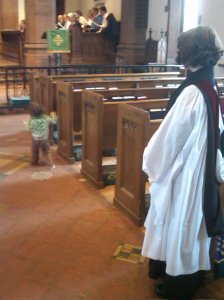
But every once in a while, my own daughter reminds me how my principles do not always coincide with the realities of experience.  This past Sunday, as we were serving communion, my daughter managed to sneak away from her dad, and kneeled next to another parishioner.  When I reverently offered her the host, she abruptly grabbed it from my hand and shoved it enthusiastically into her mouth.  As her parent, my immediate reaction was to be a little embarrassed and to wonder what the other parishioners must think of my parenting skills.  Despite a couple of chuckles, I squashed my embarrassment, and moved on to the next person at the rail.  Later that morning, during the final hymn, my daughter joined me in the aisle as I sang and waited to deliver the morning’s announcements.  As the hymn was wrapping up, she dropped my hand and started shaking her hips in the center aisle, dancing to the hymn with reckless abandon.  Again, my initial instinct was to fret over what parishioners might think about the kind of dancing I was teaching at home.

Later, as I was thinking about the two incidents, several things came to me.  One, I was once again reminded how hard it is to manage children in the context of formal worship.  I am so grateful to the parents who do it every week and who allow us to be blessed by their children.  Two, I realized how hyper aware I am of my role within the church and how that role has some serious implications for my family.  In my ordination vows, the bishop asked me, “Will you do your best to pattern your life and the life of your family in accordance with the teachings of Christ, so that you may be a wholesome example to your people?”  Sometimes, I think that question makes priests and their families feel like they have to be perfect – including in the pew on Sundays.  But what I realized was that my daughter was not shattering our “perfect” image.  She was inviting me to let go of pretenses and be real with our parish.  Being a parent, in fact being a human, is messy, and I do not need to pretend that I somehow have a better hold on being “not messy” simply because I am a priest.

Finally, what I realized on Sunday is that being a “wholesome example” means loving my child in the way that I love all our children at church.  When I could step back from the fact that my child was greedily grabbing Eucharist and dancing a little “inappropriately” in church, I could see the incidents totally differently.  When I could see my child as a child of God, I could see someone who was demonstrating how eager we all should be to receive Christ’s body at the table:  how our longing for Jesus sometimes is downright greedy and aggressive, and grabbing for the bread is a physical way of showing a passionate longing for Christ.  When I could see my child as a child of God, I could see someone who was moved by the Holy Spirit to joyfully dance before the Lord, not unlike David so many years before[i]:  someone who was actually inspired by the music being sung and played, not just dutifully and dispassionately singing the words.  I thought about how her body is a gift from God and how wonderful it was that she was using her body to praise God, even if my uptight-self resisted it.

One of the greatest reasons having children among our midst in church is because they help us get out of ourselves and our need to keep up appearances, and they help us to see the holy in new, exciting, and fresh ways.  So, please keep bringing those little ones.  We all need them to show us the face of Christ.  And for our parents, occasionally they might remind you how they are children of God as much as they are your children as well.

[i] 2 Samuel 6.16

Sermon – Luke 12.49-56, P15, YC, August 18, 2013

18 Sunday Aug 2013

Posted by jandrewsweckerly in Uncategorized

≈ Leave a comment

Tags

baptism, chaos, church, conflict, division, family, Jesus, journey, peace, Sermon

Once upon a time, I lived in a world where there was such a thing as a “normal family.”  These were the families who could sit around a dinner table and have a pleasant conversation, who never had a disagreement, who never had to deal with passive aggressive behavior, and whose dealings could be taken at face value without any hints of ulterior motives.  In this world, people were happy, holidays were perfect, siblings loved each other, and marriages were unbreakable.  Laughter was pervasive, love overflowed, and peace ruled the day in this world.  And since my life did not resemble this world, surely I would find a life partner whose world was like this.  Surely there would be a way to escape my own reality to find that world where the “normal family” existed.

Of course, once that notion crumbled, I created a new one.  Then I lived in a world where there was such a thing as a “conflict-free church.”  This church was one where people welcomed others warmly, where the love of God poured out of every parishioner, where every meeting unfolded in a peaceful, consensual manner, and where everyone felt at home.  In this church, the people all lived Christ-like lives, and they were so focused on serving others that they never fell into serving themselves.  In this church there was no judgment, no division, and no central source of power.  At this church, people were happy, worship was beautiful, and money was never a concern.  Surely such a church existed, and so if my church was not this way, I would find that “conflict-free church” somewhere.

Jesus takes a blowtorch to these make-believe worlds I envisioned in today’s gospel.  Jesus says, “I came to bring fire to the earth, and how I wish it were already kindled…Do you think that I have come to bring peace to the earth?  No, I tell you, but rather division!”  “Whoa, whoa, whoa, Jesus,” many of us may want to say today.  I thought Jesus was the Prince of Peace – in fact the same person whose name we invoke when we greet one another with, “The peace of the Lord be with you.”  Today’s Jesus is not the sweet, peaceful Jesus in a manger.  Jesus denies peace altogether today and instead rolls out a campaign of conflict.  There is no peace-loving church today.  In fact, Jesus even goes on to say how he will be turning family members against one another.  Father against son, mother against daughter, in-laws against in-laws:  families will be divided against one another.  Not only do we lose the dream of a “conflict-free church” today, any hope of a “normal family” without pain or strife is obliterated today too.

Of course, what is most painful about this gospel lesson today is that we already know the gospel to be true.  What person here today has not faced conflict within their family?  For the lucky among us, that conflict may eventually pass and familial love is relatively easy.  But for pretty much anyone who has had an honest and frank conversation with me, I do not know one single family who has not been touched by divorce, pain, cutoff, abuse, rivalry, anger, manipulation, or division.  Conflict is not the anomaly – conflict is the norm in our families.  And if church is anything like a family, we have known bitter conflict in church too.  Some of us have left churches because of conflict, pain, or suffering.  Most of us have known conflict here in this place – and if we have not yet, we will.  Why this gospel lesson is so hard today is because this gospel holds up a mirror – a mirror to our broken lives, our broken world, and our broken church.  And quite frankly, most of us do not come to church to look in a mirror; or if we do imagine church as a mirror, we hope the mirror is like one of those carnival mirrors that can distort our broken worlds and reflect something much more beautiful or hopeful than the reality we know.

Despite all the seemingly bad news in today’s gospel, some of Jesus’ words reach out to us in hope:  “I have a baptism with which to be baptized, and what stress I am under until it is completed.”  The idea of Jesus’ baptism not being completed has been bouncing around in my head all week.  In the early days of the church, fonts were not the pretty, upright fonts we see now that hold a beautiful bowl of baptismal water.  Fonts were more like pools, with steps leading down and steps leading up on the other side.  The person to be baptized would walk down those steps, be fully immersed in the water, and the come up for air again as they emerged from the water and walked up the exit steps.  The symbolism was rich – baptism looked like the emergence from the watery birth canal, and baptism rightly lived into the name “new birth.”  But also weaved into the symbolism is journey – a journey from a former life, into a watery chaos (not unlike the chaos from which God created the earth), and emerging a new creation and a transformed person.

The idea that Jesus’ baptism is not yet complete somehow makes sense when we think of baptism as a journey.  In the midst of all this talk about conflict and division, Jesus is giving us a picture of what living a baptized life is like.  At our baptism, we make promises – to turn away from sin time and again – and to turn into the way of baptized life – seeking and serving Christ, loving neighbor as self, and striving for justice and peace.  The image of Jesus’ baptism not being complete gives some grounding to what all this conflict and division is all about.  The conflict and division is a necessary component to completely live into our baptismal covenant.  We say that when we fall into sin – not if we fall into sin – we will turn back toward the Lord.  The journey of baptism promises then that we will not have a peaceful, conflict-free road and that our baptism in not a once and for all activity.  Baptism is a journey, of fully living into those baptismal promises, in which the challenging stuff will shape and mold us into better disciples and better servants of Christ.  Jesus knows that our baptism journey will never be one of peace – at least not the superficial peace we long to have.  Our baptism journey will be one of division.  That division will not only be because conflict is a necessary part of life, but because the radical way of Jesus can only be achieved by walking through the watery chaos of baptism – a chaos full of conflict and division – but a journey in which we emerge transformed and renewed.

Once upon a time, I encountered a world where conflict was not a curse word.  In this world, conflict was not an uncomfortable experience to be avoided, but a challenging experience that led to new growth and new life.  In this world, everyone was not happy in a superficial, cheerleader kind of way.  But people were happy in a much deeper, rooted kind of way.  In this world, families still fought, but the fighting led them somewhere new and life-giving.  In this world, parishioners grew to expect conflict – but also grew to expect transformation.  In this world, conflict was not the end of relationship, but instead the tool that drug people through rough times into times of unknown joy and peace.  This is the world that I long to inhabit.  This is the world that gives us life.  This is the world that leads to new birth.  Our invitation today is to step into the watery chaos of division and conflict, so that we might emerge a faith community on the baptism journey.  Amen.

We are Family

03 Wednesday Oct 2012

Posted by jandrewsweckerly in Uncategorized

≈ 1 Comment

Tags

church, community, family, love

One of the most common ways that St. Margaret’s parishioners describe ourselves is that we are a family.  When parishioners say that, I think they mean it in a good way.  But “family” is a loaded word to me.  When you hear the word “family” you might think of a Norman Rockwell painting where everyone is happily and peaceably eating a family meal – maybe even a meal on Sunday afternoon, like the good ol’ days.  You may imagine happy times with your biological family – times of laughter, playing games, celebrating life milestones, and times of love and support.  Family can be a place where you are truly yourself and accepted fully.

For others, though, “family” brings up other reactions.  All of our families have some level of dysfunction.  We have had bitter fights over the years, times of alienation, and periods of estrangement.  Families somehow have a way of bringing out the worst in us, as if we automatically regress to our immature teenage selves.  If you have ever spent a holiday with a friend’s family, you may have seen your best friend transform into a different version of herself.  If you are married, you may have found some comfort in the fact that your family is no more dysfunctional than your spouse’s.

As I have been integrated into the St. Margaret’s community, I have begun to see that we are in many ways like a family – in the best and worst ways.  We seem to know each others “buttons,” and at times push them when we should not.  We know each other well enough that we let go of pretenses – and yes, we have been known to snap at each other in an impatient moment.  But we also have grown to love one another, to appreciate the funny quirks of each person, to laugh with and at one another, and we certainly have learned to celebrate life together.  We love each other the way that we love our family – in the blessed ways and the challenging ways.

As we celebrated our 15th Annual Fall Festival this past weekend, I was ever aware of all the ways that we were embodying family.  As I watched you help one another, laugh together, and enjoy yourselves, I realized that I too have come to see St. Margaret’s as my family.  I love our quirks, the ways that we tease one another, and the ways we welcome others into our crazy family.  I looked around last Saturday, and I was quite proud to be not only your rector, but also your family member.  As we continue to spread the word about the good work that Christ is doing in our community, I hope we can embrace that word, “family,” fully.  Come to St. Margaret’s.  We are a family – a fun-loving, Spirit-filled, flawed family.  Your fun-loving, Spirit-filled, flawed self is welcome!

Newer posts →

Recent Posts

  • On the Myth and Magic of Advent…
  • On Risking Failure and Facing Fear…
  • Sermon – Luke 23.33-43, P29, YC, November 23, 2025
  • On Inhabiting Gratitude…
  • Sermon – Luke 20.27-38, P27, YC, November 9, 2025

Archives

  • December 2025
  • November 2025
  • October 2025
  • September 2025
  • August 2025
  • July 2025
  • June 2025
  • March 2025
  • February 2025
  • December 2024
  • November 2024
  • October 2024
  • September 2024
  • August 2024
  • July 2024
  • June 2024
  • May 2024
  • March 2024
  • February 2024
  • January 2024
  • December 2023
  • November 2023
  • October 2023
  • September 2023
  • August 2023
  • July 2023
  • June 2023
  • May 2023
  • March 2023
  • February 2023
  • January 2023
  • December 2022
  • November 2022
  • October 2022
  • June 2022
  • May 2022
  • January 2022
  • December 2021
  • November 2021
  • October 2021
  • September 2021
  • August 2021
  • June 2021
  • May 2021
  • April 2021
  • March 2021
  • February 2021
  • January 2021
  • December 2020
  • November 2020
  • October 2020
  • September 2020
  • August 2020
  • July 2020
  • June 2020
  • May 2020
  • April 2020
  • March 2020
  • February 2020
  • January 2020
  • December 2019
  • November 2019
  • October 2019
  • September 2019
  • August 2019
  • July 2019
  • June 2019
  • May 2019
  • April 2019
  • March 2019
  • February 2019
  • January 2019
  • December 2018
  • November 2018
  • October 2018
  • September 2018
  • August 2018
  • July 2018
  • June 2018
  • May 2018
  • April 2018
  • March 2018
  • February 2018
  • January 2018
  • December 2017
  • November 2017
  • October 2017
  • September 2017
  • August 2017
  • July 2017
  • June 2017
  • May 2017
  • April 2017
  • March 2017
  • February 2017
  • January 2017
  • December 2016
  • November 2016
  • October 2016
  • September 2016
  • August 2016
  • July 2016
  • June 2016
  • May 2016
  • April 2016
  • March 2016
  • February 2016
  • January 2016
  • December 2015
  • November 2015
  • October 2015
  • September 2015
  • August 2015
  • July 2015
  • June 2015
  • May 2015
  • April 2015
  • March 2015
  • February 2015
  • January 2015
  • December 2014
  • November 2014
  • October 2014
  • September 2014
  • August 2014
  • July 2014
  • June 2014
  • April 2014
  • March 2014
  • February 2014
  • January 2014
  • December 2013
  • November 2013
  • October 2013
  • September 2013
  • August 2013
  • July 2013
  • June 2013
  • May 2013
  • April 2013
  • March 2013
  • February 2013
  • January 2013
  • December 2012
  • November 2012
  • October 2012
  • September 2012

Categories

  • reflection
  • Sermons
  • Uncategorized

Meta

  • Create account
  • Log in
  • Entries feed
  • Comments feed
  • WordPress.com

Blog at WordPress.com.

  • Subscribe Subscribed
    • Seeking and Serving
    • Join 394 other subscribers
    • Already have a WordPress.com account? Log in now.
    • Seeking and Serving
    • Subscribe Subscribed
    • Sign up
    • Log in
    • Report this content
    • View site in Reader
    • Manage subscriptions
    • Collapse this bar
 

Loading Comments...