• About

Seeking and Serving

~ seek and serve Christ in all persons

Seeking and Serving

Tag Archives: God

On Nudges and the Holy Spirit…

12 Wednesday May 2021

Posted by jandrewsweckerly in reflection

≈ Leave a comment

Tags

Bible, call, church, discernment, follow, God, Holy Spirit, Jesus, journey, life, ministry, vocation

Photo credit: https://www.ibelieve.com/faith/what-is-discernment-ways-grow-more-discerning.html

Discernment is a topic we talk a lot about in church.  Some of our most beloved biblical stories, often called “call narratives,” are about discernment.  They all have a pattern:  God calls the individual to some bold action, the person resists (sometimes repeatedly and comically), but when the person eventually acquiesces, God equips the individual for the work. 

I love these call narratives mostly because they are so human and relatable.  But I sometimes wonder if the dramatically entertaining nature of these stories makes us think “calls” are something that only happens to certain, singled-out people.  In truth, that is why we talk about discernment so much in the life of the church:  because we want people to know that discernment is not just about major life transitions.  Discernment happens repeatedly throughout life – sometimes at expected moments, like a school graduation, in response to a spouse’s new job, or even retirement.  But discernment also happens in the times when we are plugging away at the calls we have already discerned:  when a volunteer opportunity stirs something in us; when a friend makes an off-handed comment about a gift we should be honoring; or when we just feel a little discomforted but do not know why (as a spoiler, that discomfort is usually the Holy Spirit!).

In my ministry setting, we talk about discernment a lot.  It is the topic of one of the six sessions in our Discovery Class (a newcomer/confirmation class).  We talk about discernment from the pulpit – even when there is not some big call narrative in the lectionary.  We talk about discernment in Bible study, in pastoral visits, and even over coffee.  We have come to understand that “call” is not static, and that even within a call, or vocation, the Holy Spirit continues to move and nudge us in ways that enrich our own journey and the journey of those around us.  Following Jesus means just that – continuing to follow wherever he may lead.

This week, I announced to my parish that the Spirit had been nudging me too.  In this unique situation, it may be a nudge that does not come to fruition.  Even in those cases, God is doing something too.  But it may also lead to something new and different.  That is the risk we take when we listen to the Holy Spirit.  I cannot authentically encourage my community into constant discernment if I am closed to the possibilities of the Spirit – especially when I would be perfectly happy to stay right where I am.  And so, this week I join you in that gloriously off-centered life that is the life of following Jesus.  I do not know where it will lead, but I am grateful for a community who journeys with me!

On Barriers and Saying Yes…

05 Wednesday May 2021

Posted by jandrewsweckerly in reflection

≈ Leave a comment

Tags

abundance, baptism, connection, curiosity, discipleship, evangelism, faith, God, godparents, grace, Holy Spirit, Jesus, limits, liturgy, longing, sacred

Photo credit: https://aleteia.org/2020/03/30/how-laypeople-can-baptize-in-an-emergency/

On Sunday, we heard the story of the Philip and the Ethiopian eunuch.[i]  At one point in the story, the eunuch says, “What is to prevent me from being baptized?”  The question is simultaneously wonderful – how amazing to hear someone so inspired by the witness of Jesus that they want to baptized right away – and anxiety-making.  Episcopalians are very clear about our identity and our liturgical ways of doing things.  So certain is our identity, that I could imagine an Episcopalian responding to the eunuch, “Well, we need to sign you up for baptism class, and then find out when the next best baptismal feast day is on the liturgical calendar.  Once we get everything lined up, we’d be thrilled to schedule your baptism!”  Somehow, that response from Philip would not have made for such an enticing story about the power of evangelism and discipleship.

The eunuch’s words were ringing in my ears when I received a similar request recently.  One of our young parishioners lost her godfather to an unexpected death during COVID.  We were all devastated and grieved together.  But a few weeks ago, the family contacted me with a request.  They had already talked as a family about how her godfather would always be her godfather, even from heaven.  But they also wanted to appoint a new earthly godfather who could help their daughter grow in the life of faith.  And so, their question was, “Is there a way you can do that liturgically by Zoom?”

One answer could have been no; we do not have such a liturgy in our Prayer Book.  But the request was so pure and Spirit-led that I knew even a Prayer Book would not want to limit such grace and abundance.  And so, in consultation with some fellow clergy and liturgical resources, including the Book of Common Prayer, we cobbled together a beautiful liturgy.  We prayed for the godfather who had passed and the ways in which he would always be with us.  The godchild formally asked the godfather if he would be willing to be her earthly godfather.  We asked the normal questions we ask in a baptismal liturgy of the godfather, and then we all reaffirmed our Baptismal Covenant and prayed over the new “family” we had created – all via Zoom.  And although we were not in our beloved chapel, we created a profound, intimately sacred space together, where the Holy Spirit blessed us as a community.

When I think about those questions, “What is to prevent me from being baptized?” and “Can we designate a new godparent?” these are questions of curiosity and longing.  These are questions inspired by those seeking Christ and wanting a deeper connection to God.  If this pandemic has taught us anything, we have learned the ways in which the Holy Spirit is unbounded and can act – whether in a building, alongside a road, or online.  This week, I invite you to ponder what limits you have placed around your own connection to God – what barriers or rules have hindered your connection to the sacred.  How might you begin lessening your grip to allow room for encounters with the sacred?


[i] Acts 8.26-40

Sermon – Acts 8.26-40, E5, YB, May 2, 2021

05 Wednesday May 2021

Posted by jandrewsweckerly in Sermons

≈ Leave a comment

Tags

baptism, Ethiopian eunuch, God, Good News, guide, Holy Spirit, listen, patience, Philip, posture, proclaim, pursuit, question, response, Sermon

As we continue our journey of Eastertide, we continue to explore the consequences of the resurrection on our daily living.  This week, we turn to the Acts of the Apostles, and the vivid story between Philip and the Ethiopian eunuch.  What seems like a simple witness story, the apostle Philip teaching and converting the foreign eunuch, is not simple at all.  In fact, we learn from both characters, in very different ways, what posture toward God we should assume, what our responsibility to each other and the community of faith is, and what our response to the resurrection and one another can be.

Our first lesson from these two characters is what posture toward God we can assume.  Philip shows us the posture of responding to God, no matter what the instruction.  Philip is told by an angel of the Lord to go south.  There is no explanation about why he should go or what the itinerary will be, or why he should take the dangerous wilderness road.  Later, the Holy Spirit tells Philip to approach a quickly-moving chariot, containing a person of influence, who may reject this disheveled disciple.  Both times, Philip responds immediately, sprinting to follow the Spirit.  We see in Philip no complaining or whining to God.  Philip hears God’s word of instruction and Philip responds, no questions asked.

We also learn from the eunuch’s posture toward God.  The eunuch is a man of color, looking distinctly different from any Jew from Israel; he is a court official, a man of importance and wealth[i]; his sexual status has been altered, making him barred from the temple.[ii]  So this man, this unnamed eunuch, has both power and a lack of power.  But despite his exclusion from the temple, he is pursuing God.  And, despite his half-fulfilled experience in Jerusalem, he will not be deterred from seeking God.  This outsider by all other standards shows us the posture of constant, undeterred pursuit of God. 

After Philip and the eunuch teach us about the appropriate postures toward God, the pair teaches us about our responsibilities to one another and to the community of faith.  Philip teaches us of our responsibility to serve as guides to one another.[iii]  Imagine for a moment the best teacher you ever had.  Usually our best teachers are not didactic, but are more guides who are in the learning journey with us.  That is exactly what Philip offers when he sits beside the eunuch in the chariot.  He sits beside the foreign, castrated man, and treats him like an equal in the pursuit of following Jesus.  Philip teaches us that our work is to be guides with one another in this journey of growing to know God.

The eunuch teaches us a lot about our responsibilities toward one another too.  As a person of influence and power, the eunuch could have easily brushed off Philip, telling this dirty disciple to get away from his pristine chariot.  But instead, the eunuch is completely unafraid to ask questions.  He willingly admits he needs a guide, he wants to know how to interpret scripture, and he wants to know if he too can be baptized.  His willingness to question reveals a sense of humility and engagement, and a willingness to trust someone in the community to teach him.

After teaching us about the appropriate posture toward God, the responsibilities to one another and the community of faith, Philip and the eunuch finally teach us about what our work or response to God and one another can be.  Philip responds to God by proclaiming the good news.  This step is often the hardest for us.  When the time for proclaiming the gospel comes, we clam up, fear we are not qualified, or are afraid to come off as pushy or sanctimonious.  But Philip shares the good news by telling the eunuch about Jesus, sharing stories of Jesus’ historical ministry, his love for the poor, his death and resurrection, and then finally, how Jesus’ life can be seen in the whole of the salvation narrative.  Sharing the good news is simply a matter of telling a good story. 

Finally, the eunuch shows us the other requirement of faithful living – responding to the good news.  For the eunuch, he hears the good news, and he immediately responds by asking for baptism.  Our liturgy invites us into the same response every week.  We come together as a community; we hear the word of God – those stories that make up the whole of the good news; and we are sent out into the community – to love and serve the Lord.  Church is not just a place to come and feel good.  Church is also a place to be so filled that your enthusiasm for the good news that sends you out into the world with the work God has given you to do. 

This week, I invite you to take Philip and the Ethiopian eunuch with you out into the world.  Perhaps you will work on your willingness to be open to the voice of the Holy Spirit; perhaps you will allow yourself to say aloud those questions that you hide in the depths of your heart; perhaps you will share the holy stories of the faith with another; or perhaps you will patiently sit with someone who is struggling with their faith this week.  Like Philip and the eunuch, who boldly go down to those baptismal waters, we too hold one another’s hands as we leave this space, facing the challenges of this world together.  Amen.


[i] Paul W. Walaskay, “Exegetical Perspective,” Feasting on the Word, Year B, Vol. 2 (Louisville: Westminster John Knox Press, 2008), 457.

[ii] Walaskay, 457.

[iii] William Brosend, “Unless Someone Guides Me,” Christian Century, vol. 117, no. 15, May 10, 2000, 535.

Sermon – Mark 16.1-8, ED, YB, April 4, 2021

28 Wednesday Apr 2021

Posted by jandrewsweckerly in Sermons

≈ Leave a comment

Tags

alleluia, brief, Easter, God, Good News, Jesus, journey, Mark, pandemic, promise, resurrection, Sermon, spectacular, story, tension

You know how when a group of friends go out for an adventure, and when they come back and try to share the story with you, but you can never quite get “THE story”?  Someone will remember the night happening one way, someone else will add another detail, another person will contradict or question that detail or embellish the story.  You get the gist of what happened, but the exact details may be a bit fuzzy.  

 On Easter Sunday, that is kind of what happens to us.  Each Gospeller – Matthew, Mark, Luke, and John – tells “THE Easter story” a little differently – different characters doing different things.  We know the basics:  the tomb is empty and Jesus is risen from the dead.  But the details make the story different and fresh every year. 

This year, we get Mark’s version.  In that group of friends trying to tell the same story, Mark would be the one known for brevity.  His version would be something like this, “The women went to anoint Jesus in the tomb, like we always do with the dead.  But when they got there, the big rock was already moved, and Jesus was gone.  Some guy was there and said Jesus has been raised.  It was terrifying.”  There are no embellishments to the story – no running around, no pronouncements of the Good News, no disciples doubting women, no victorious preaching.  Just a stunning revelation and news so shocking it leaves people afraid. 

This may not be “THE Easter Story,” as you remember.  But Mark’s version of the Easter story may be exactly the Easter story we need this year.  I do not know about you, but Easter is usually this spectacular day for me.  We journey through Lent, reflecting on our relationship with God.  We trudge through the drama and emotional labor of Holy Week.  Then, on Easter, the alleluias feel well deserved and the joy is hard to contain.  But this Easter, I am not totally there.  This pandemic is still hanging over our heads, our worship is wonderful but not all we know Easter worship to be, and our lives are still in a holding pattern as we work toward herd immunity and even hear talk of cases spiking.  I know this is a day for rejoicing, but there is still so much grief all around us, I am having a hard time fully embracing the alleluias this year.

That emotional tension is why I love Mark’s gospel this year.  The women at the tomb are coming out of a deep grief too.  The only reason they are at the tomb this morning is to do the work grieving people do – tend to the body, handle the practical details, do the things that begin the journey of healing.  So, although the news from the man in white is incredible, the news is unsettling, confusing, and a bit scary.  The women are going to need time to process this mind-blowingly good news before they can rejoice, before they give thanks to God, before they can muster up the nerve to say the good news aloud. 

What I hear in Mark’s gospel are two words of promise for us today.  First, no matter how we receive the Good News of Jesus Christ’s resurrection and triumph over death, the good news is there for us and for all anyway.  Our reaction to the news does not negate the goodness or the radical love and redemption of the resurrection.  Second, the man in white says something seemingly inconsequential that means the world.  He says, “…go, tell his disciples and Peter that he is going ahead of you to Galilee; there you will see him, just as he told you.”  If you remember, Peter denied Christ when Christ needed him most.  But today, the resurrection promise is specific:  go tell his disciples AND PETER…and you will see him.”  No matter if we have been faithful, no matter if we have actively denied Jesus, no matter if we cannot muster a joyful response to the resurrection, we will see Jesus.  The Good News of Jesus is not just for the faithful – the good news of Jesus’ resurrection is for the broken, the sinful, the despondent, and the fearful alike.  And on a day when you may or may not be feeling our alleluias 100%, the Good News is God is with you anyway, loving you and promising to carry you until you are 100%.  Thanks be to God!  Alleluia. 

Sermon – Jeremiah 31.31-34, L5, YB, March 21, 2021

24 Wednesday Mar 2021

Posted by jandrewsweckerly in Sermons

≈ Leave a comment

Tags

abundant, comfort, covenant, exile, faith, God, hope, Jeremiah, Jesus, Lent, love, lovingkindness, pandemic, ruin, Sermon

I do not know about you, but I entered Lent this year already done.  We talked about this reality five weeks ago, back on Ash Wednesday, when I told you that it was okay if you did not give up something this Lent – because we have already given up so much in the last year.  We have already fasted what feels like twenty Lents during this pandemic.  And then this week happened.  We started out with the words of the Vatican, declaring that although our LGBTQ brothers and sisters were still to be loved and welcomed in Church, their “sinfulness” would not be blessed within the covenant of marriage by the Roman Catholic Church.  I cannot tell you the pain and suffering those words created this week for so many who live in faithful, loving relationships and marriages.  Then, just a few days ago, a man in Atlanta murdered people of Asian descent, sparking off conversations about the rise of hate crimes against Asian Americans since this pandemic began.  Our own Sacred Ground circle, the group studying the institution of racism in our country – not just towards blacks, but towards indigenous Americans, Latinos, and Asians – just finished its ten weeks of work; and yet within the same week we are talking about racism yet again.  And then this week, as administered vaccines slowly rise in James City County, I see people becoming lax about masking and social distancing, some folks in public spaces barely covering their faces.  Even the test positivity rate – the one whose decrease has allowed us to enact regathering plans – is creeping slowly toward the numbers that will shut us back down again. 

That is why I found myself gravitating to Jeremiah this week.  Part of the attraction is the good news of the text, but a larger part of my attraction is empathizing with the Israelites.  Jeremiah writes in a time of desperation for the people of God. The Babylonians have razed the temple and carried King Zedekiah off in chains.  Effectively, the Babylonians have “destroyed the twin symbols of God’s covenantal fidelity.”[i]  Sometimes we talk about the exile so much that I think we forget the heart-wrenching experience of exile.  Being taken from homes and forced to live in a foreign land is certainly awful enough.  But the things that were taken – the land of promise, the temple for God’s dwelling, the king offered for comfort to God’s people – are all taken, leaving not just lives in ruin, but faith in question. 

But today, in the midst of the physical, emotional, and spiritual devastation, Jeremiah says God will make a new covenant.  God knows the people cannot stop breaking the old covenant, and so God promises to “forgive their iniquity and remember their sin no more.”  Instead of making the people responsible for the maintenance of the covenant, God goes a step further and writes the law in their hearts, embodies God’s way within the people.  The words of Jeremiah in the section called “the Book of Comfort,”[ii] and this new covenant by God, show a God whose abundance knows no limits.  God offers this new covenant to a people who surely do not deserve another covenant.  God has offered prophets and sages, has called the people to repentance, has threatened and cajoled, and yet still the people cannot keep the basic tenants of the covenant established in those ten commandments.  But instead of abandoning the people to exile, God offers reconciliation and restoration yet again.  And because God knows we have no power in ourselves to help ourselves, God basically says, “Here.  Let me help you.  Let me write these laws in your hearts so that you do not have to achieve your way into favor with me, but you will simply live faithfully, living the covenant with your bodies and minds.”  And when even that does not seem to work, God sends God’s only son.  God never gives up on us or our relationship with God.  Even all these years after Christ’s resurrection, God is still finding new ways to make our covenant work.  

That is where I find hope this week.  Despite how broken we may feel because of this pandemic, despite how our nation seems incapable of not harming one another due to the color of our skin, despite the ways we seek to limit God’s love and abundance, God is relentless with God’s lovingkindness.  In Jeremiah’s text, when the Israelites have hit rock bottom, God turns not to vengeance or even a notion of just desserts.  God picks up the covenant of love, not relying on our hard work to be faithful, but declaring how God will simply put God’s law within us, will write God’s law of love on our hearts, will be our God and we will be God’s people.  In essence, nothing we can do will drive God from us.  And that, my friends, is good news indeed.  God sees us in all our fullness – light and shadow alike – and loves us anyway.  In this continued time of strain and strife, in this long night of COVID, God gives us good news.  As one scholar affirms, “God will bring newness out of destruction.  God will bring hope where there is no hope.  God will bring life out of death.  God will make a way where there is no way.”[iii]  Thanks be to God!


[i] Richard Floyd, “Pastoral Perspective,” Feasting on the Word, Year B, Vol. 2 (Louisville:  Westminster John Knox Press, 2008), 122.

[ii] Jon L. Berquist, “Exegetical Perspective,” Feasting on the Word, Year B, Vol. 2 (Louisville:  Westminster John Knox Press, 2008), 123.

[iii] Floyd, 124.

Sermon – John 3.14-21, Numbers 21.4-9, L4, YB, March 14, 2021

17 Wednesday Mar 2021

Posted by jandrewsweckerly in Sermons

≈ Leave a comment

Tags

belief, choice, cross, glory, God, grace, Israel, Jesus, Lent, light, Moses, salvation, Sermon, serpent, sin, transform

Our scripture lessons today offer two contrasts:  a story from the Hebrew Scriptures which might be unfamiliar to you or at least may seem wildly strange, and a story from John’s gospel that is so familiar, you can probably quote a portion of the text if I simply tell you the citation, “John 3.16.”  What is strange about this combination is the unknown, uncomfortable story is a window into the overly familiar, commonplace story.  If we have any hope of understanding either of them, we need to dive into both.

At the point where we join the story from Numbers, God has been infinitely patient with God’s people.  Some might argue too patient.  God has saved God’s people time and again, wresting them from brutal slavery, miraculously helping them flee through the Sea of Reeds, helping sweeten bitter drinking water when they murmured, granting them manna when they complained of being hungry, giving them water out of a rock when they grumbled about being thirsty, offering them birds to eat when they whined of manna-fatigue.  Grace and patience abound with God.  Until this day.  The Israelites throw yet another fit, and God snaps.  This time, God sends poisonous serpents among the people, and many of them die.  When the people beg for help to Moses, God instructs Moses to put a bronze serpent on a pole; if people gaze upon the serpent, they will live.  For a God who asks the people have no idols or gods before God, a serpent on a pole is, quite frankly, just weird.

Meanwhile, we have a super familiar text from John.  “For God so love the world that he gave his only Son.”  We love this verse because the verse reminds of our abundant, loving, graceful God.  Of course, we sometimes gloss over the rest of the troublesome parts of this text.  The rest talks about how Jesus saves the world – as long as the world believes.  Here is where the questions start to pile up for us.  Do we really believe that some people are condemned?  Is God’s love conditional?  What happens if we doubt?  Does that count as not believing?  Can eternal life be given and taken away based on the seesaw of my behavior?  The trouble is if we focus on God’s grace, we can make salvation seem arbitrary, with no essential place for human response.  But if we focus on human faith, we may be in danger of making salvation a human accomplishment, restricting God’s initiative universally.[i]  The only thing that seems to be clear is that God gives us a choice.  When we commit evil deeds, when we deny God through our behavior, when we linger in the darkness, we are making a choice.  And the text tells us today that the consequence of that choice is condemnation.

The answer to so much in these texts seems to lie in verse fourteen of John.  Jesus says, “Just as Moses lifted up the serpent in the wilderness, so must the Son of Man be lifted up, that whoever believes in him may have eternal life.”  As scholar Debie Thomas writes, “In the Old Testament story, God requires the Israelites to look up.  To gaze without flinching at the monstrous thing their sin has conjured.  It’s the thing they have wrought, the thing they fear most, the thing that will surely kill them if God in God’s mercy doesn’t intervene and transform the instrument of pain and death into an instrument of healing and life.  In order to be saved, the people have to confront the serpent — they have to look hard at what harms, poisons, breaks, and kills them.”[ii]  The same seems to happen with Jesus on a cross.  Thomas goes on to say, “In the cross, we are forced to see what our refusal to love, our indifference to suffering, our craving for violence, our resistance to change, our hatred of difference, our addiction to judgment, and our fear of the Other must wreak.  When the Son of Man is lifted up, we see with chilling and desperate clarity our need for a God who will take our most horrific instruments of death, and transform them, at great cost, for the purposes of resurrection.”[iii]

The truth is, I am not sure either of these texts answer some of our basic questions, especially around those of belief.  But tying them together today, we do find an invitation – to change our gaze away from the judgment of others, the wondering about who is in and out, the questions about God’s retribution, and gaze on the cross – the body that reminds us of the goodness of God in spite of our sinfulness, that reminds us of God’s grace in spite of our lack of deserving, that reminds us of God’s unconditional love despite our inability to keep failing.  Our invitation is to take seriously the words of that old hymn, “Turn your eyes upon Jesus, Look full in His wonderful face, And the things of earth will grow strangely dim, In the light of His glory and grace.”  As we continue on the path of Lent toward the cross, today’s texts remind us of where we are going and why.  Our invitation is to look up at the horrible, wonderful truth of what Jesus does in the cross, and stand in the light of his glory and grace.  Amen.


[i] Joseph D. Small, “Theological Perspective,” Feasting on the Word, Year B, Vol. 2 (Louisville: Westminster John Knox Press, 2008), 118.

[ii] Debie Thomas, “Looking Up,” March 7, 2021, as found at https://www.journeywithjesus.net/essays/2944-looking-up, on March 12, 2021. 

[iii] Thomas.

On Finding Blessings among the Curses…

10 Wednesday Mar 2021

Posted by jandrewsweckerly in reflection

≈ Leave a comment

Tags

blessing, connection, curse, God, grace, gratitude, Myanmar, pandemic, technology

Photo credit: Troy Mendez

Last week, a seminary classmate sent an email to a group of six of us who had travelled to Myanmar on a mission trip while in seminary.  The trip was a powerful, multiple week trip – for us as individuals, for us as a team (one of our members passed away a couple of years after seminary), and, when we returned, for our relationships with the Burmese students at the seminary.  The experience of that trip forever changed the dynamics between us – there are inside jokes that lead to ribbing; we know each other in ways that only fellow travelers can, leading to belly-laughs and understanding sighs too deep for words; and our connection to the Anglican Church in Myanmar and our spiritual experiences there created a brotherhood and sisterhood that is difficult to articulate. 

So, when the toughly-won democracy crumbled a few weeks ago in Myanmar, we all watched in horror.  The call to gather from my classmate was certainly an opportunity for us to catch up, but more importantly for us to pray – to pray for our Burmese classmates, the brothers and sisters in Christ we met there, and the countless people who simply want to live their lives free of the brutality of a military junta.  Over the course of this year, I have complained more times than I can count about the amount of time I spent on Zoom.  But as the six of us gathered virtually from around the country to tell stories, to laugh, to mourn, and to pray, I confess to you, I have never been more grateful for a technological tool.  Even in that virtual space, we were able to find the rhythm of a group established fourteen years ago, and slow down enough to put the needs of Myanmar above our own.

As we work to vaccinate our country and as churches begin to regather again, I find myself once again grateful for the ways God has made a way in the wilderness.  And although I will be thrilled to see people in person again, I am glad we will still have technological advances available to us – to facilitate community, care, and compassion.  Not once in the years since we left seminary has our mission team managed to get together in person.  But with technology, we were able to create a virtual space of real connection between us, and, perhaps more importantly, a place where God could move among us and beyond us.  I would never wish this pandemic on any of us, but I remain astounded at the way God has used the gifts God has given us to facilitate the spreading of the Good News. 

One year into this pandemic, I give thanks for the ways in which technology has facilitated fellowship, formation, worship, and pastoral care.  I wonder what graces this pandemic has gifted you over this last year.  What ways has necessity inspired blessedness?  As you reflect this week, I invite you to join me in offering gratitude for God’s grace in the midst of a very dark year. 

Please continue to keep Myanmar in your prayers as they struggle for the restoration of democracy, for the safety of innocent people being brutalized and disappeared, and for the encouragement and protection to keep fighting for justice.

On Glimpses of Togetherness…

03 Wednesday Mar 2021

Posted by jandrewsweckerly in reflection

≈ Leave a comment

Tags

absent, community, ecumenical, God, Holy Spirit, Jesus, Lent, pandemic, present, worship

Photo credit: Jennifer Andrews-Weckerly; reuse with permission only

This evening, we are gathering with our local ecumenical brothers and sisters in worship.  These Lenten gatherings happen every year, usually preceded by a simple supper before worshiping together.  One of the eight churches hosts and a preacher from another church offers the sermon.  The freewill offering supports a local nonprofit.  The evenings allow us to see the broader movement of Christ in our community, remind ourselves of the wideness of God’s mercy, and inspire a sense of community and fellowship.

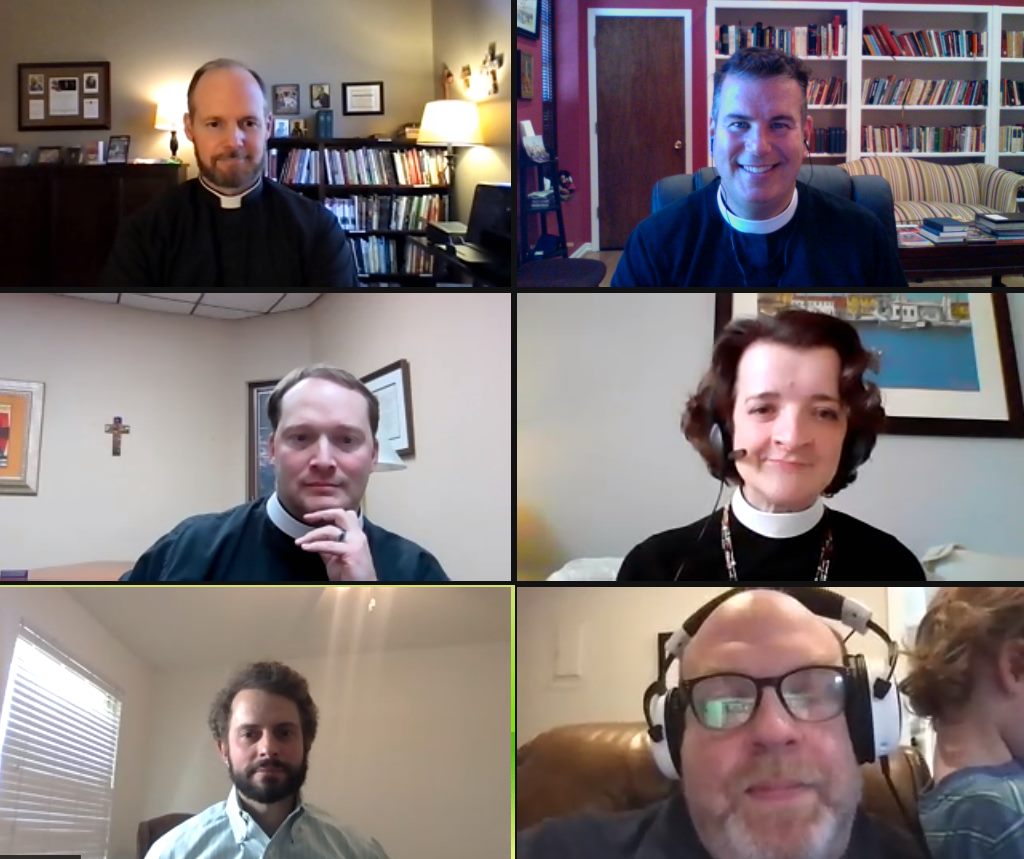
Of course, in the midst of a pandemic, things look a little different.  Instead of seeing each other’s worship spaces, we are getting to see each other’s virtual worship spaces (Zoom, Facebook, YouTube, etc.).  Instead of seeing faces over a meal, we are feasting strictly on the Word of God.  In some ways, we could see the gatherings as “less than,” lacking all the things we love about community.  But for me, it has been a tremendous blessing to see how we are all in this together – all finding our own ways through technology, all seeking to be closer to Christ in the midst of this chaotic time.  Tonight, I am “preaching,” though technically, I prerecorded my sermon last week.  Our time of recording – with just three of us in the room, and two others on Zoom – was a tender invitation into the space where their community has been making it work for months. 

If you do not have plans tonight, or for the next several Wednesdays through Holy Week, consider yourself invited to virtual worship with the Upper James City County Ministerium.  On a basic level, it will give you a chance to pray, worship, and hear a good word each Wednesday.  On a deeper level, it may help you get out of your comfort zone with an unfamiliar style of worship or a theologically different perspective on scripture.  But on an even deeper level, it will remind you of how widely we are all connected during this strange, seemingly disconnected time.  It is my hope that you experience a glimpse into the magnitude of how the Holy Spirit is doing some incredible work during this time that can often feel absent of God.  You are invited to come and see a different perspective!

On Being Apart While Together…

24 Wednesday Feb 2021

Posted by jandrewsweckerly in reflection

≈ Leave a comment

Tags

alone, apart, Ash Wednesday, beautiful, dichotomy, experiment, God, Holy Spirit, Lent, lonely, pandemic, separated, together

Photo credit: https://www.indiatvnews.com/lifestyle/news-living-apart-together-the-new-relationship-trend-in-town-for-older-adults-380624

As a priest, especially a priest in a pandemic, you do not always know how the things you plan are going to go.  Most of the liturgical things we do are about 90 degrees off from what we “normally” do, and we just keep hoping they capture the spirit of the original liturgies.  I am blessed to serve an awesome congregation whose DNA is wired to be creative, playful, and experimental, so I always feel like we are in this together.  But I still find myself holding my breath a bit each time we try something unusual.

Ash Wednesday was no different.  We did our due diligence, made ample opportunity for parishioners and neighbors to get ashes for home use, and we figured out how to synchronize our ashes through livestreaming.  What I did not anticipate was what it would feel like to put ashes on my own head.  Even when I was a solo clergy person, I always had a parishioner put ashes on me after I put ashes on them.  But putting ashes on my own head felt very solitary – suddenly I was very aware of how separated we all are from one another – and how lonely that sometimes feels.

I pondered that reality for a few days before I remembered something else from Ash Wednesday.  We decided in the pandemic to still offer Ashes to Go – a drive through experience at our location.  As we distributed containers of ash, we gave people three options – “ash” themselves as we pray with them, take the ashes home and say a set of prayers we gave them, or take them home and watch our livestream and “ash” with us.  One family drove through and I gave the mom the three options.  She decided I should go ahead and pray as she put ashes on the foreheads of her two preschool children.  As I watched her work – this mom whose story I could all too easily imagine – the stress of parenting for almost a year in a pandemic, making hard decisions about childcare, juggling work, children, and family, trying to precariously hold it together.  Here she was, taking on the work of the spiritual nourishment of her kids too. 

And that is when I realized the truth.  We are very separated, often alone, and sometimes lonely in this pandemic.  But we are all feeling those things together.  When we gather online together, we are together in our apart-ness.  When we swing by the property for drive-through experiences, we are acknowledging our togetherness in our apart-ness.  When things remind us of our apart-ness, we are collectively reminded together.  It is a beautiful, awful dichotomy, only made better by the fact that we are, in fact, together in this.  This Lent, I invite you to pause to look around, and observe the small, sometimes tiny, reminders that we are in this together.  Even in our apart-ness, we are with each other in Spirit.  And the Spirit is enough to hold us together while apart until we can be physically together some day.

Sermon – Mark 6:1-6, 16-21, Isaiah 58:1-12, AW, YB, February 17, 2021

24 Wednesday Feb 2021

Posted by jandrewsweckerly in Sermons

≈ Leave a comment

Tags

Ash Wednesday, ashes, church, fasting, God, holy, invitation, Lent, mirror, pandemic, Sermon, spiritual practices, struggle

I have always thought the Ash Wednesday liturgy offers a strange contrast.  We engage in the very visible sign of having ashes spread across our foreheads.  And yet, our gospel lesson this day speaks very clearly of not showing your piety publicly.  But this year, the contrast of Ash Wednesday feels even more pointed.  Typically on this day, we talk about giving things up for Lent, fasting, and entering into a season of contemplation about not just our mortality, but the sinfulness that separates us from God.  But we have spent the last eleven months fasting – fasting from social gatherings, fasting from touch and uncovered faces, even fasting from receiving the sacred meal.  And for a large portion of those months, we have been in deep contemplation about the exponentially rising death all around us, the brokenness of our common life, the sin of oppression and racism.  The last thing I want to hear from the church today is how I need to give up more.

I think that is why I love the text from Isaiah this year so much.  God offers a mirror to God’s people.  On first glance, God’s people are certainly doing the things that are expected – in fact, the “things” that are often of Lent.  They are fasting and lying in sackcloth and ashes.  They are doing the work of penitence.  But the acts are not the problem – the motivation of the acts are the problem.  They are doing acts of contrition as sort of an exchange:  fasting so that God will give them favor; Sure, their behavior may end in the oppression of others, but they are doing the manual action called for in this moment. 

But God is having nothing of hollow spiritual practices.  If those practices are not leading to the loosening of the bonds of injustice, or the undoing of the thongs of the yoke, or the freeing of the oppressed, they are meaningless.  If the people of God are not sharing their bread with the hungry, bringing the homeless poor into their homes, covering the naked, and caring for their own kin, then fasting is little more than act in futility, an action done without reflection, intention, or love of neighbor. 

So what do the words of Isaiah have to do with living in month eleven of a pandemic?  I am going to say something that might be a little controversial, but here you go:  the church is not asking you to fast this Lent.  Now, in a few moments, I am going to say these very words, “I invite you, therefore, in the name of the Church, to the observance of a holy Lent, …by…fasting, and self-denial…”  But you have already fasted for a whole year.  You have already been in a season of self-denial.  The ashes you will impose on your head later are not a reminder that you are dust and to dust you shall return.  You know that reality all too well now.  Instead, we are going to take a cue from Isaiah tonight.  You have already done the manual acts of Lent.  Now your invitation is the “so that” part of the action.  Our work this Lent is to reflect upon what has been a most difficult year and to ponder together what this past year of fasting is inviting us into.  How has this season of fasting, this season of struggle, this season of brutality transformed our sense of purpose and identity – a people focused on God’s work loosening the bonds of injustice, freeing the oppressed, and sharing our bread?  How has the sobering nature of death, grittily rubbed onto our foreheads tonight, changing our resolve to lean into God, lean into this Christian community, lean into the work of sharing God’s love with those who do not know that love?

The rest of the invitation I will read in a moment says this, “I invite you, therefore, in the name of the Church, to the observance of a holy Lent, by self-examination and repentance; by prayer…and by reading and meditating on God’s holy Word.”  You have done the rituals of fasting and self-denial long enough.  As we look forward to these next forty days together, our work is to spend time with God, scripture, and one another and answer the question, “So what?”  What are we going to do now?  What are we going to claim and what are we going to let go?  How is the grit of ash this year not the sensation of defeat, but of invitation.  I invite you, therefore, in the name of the Church, to the observance of a holy Lent.  Amen.

← Older posts
Newer posts →

Recent Posts

  • On Politics, Football, and Love…
  • On Sharing the Love…
  • Sermon – Micah 6.1-8, Matthew 5.1-12, EP4, YA, January 30, 2026
  • On Justice, Kindness, Humility, and the Messy Middle…
  • Feast of the Rev. Dr. Martin Luther King, Jr., January 18, 2026

Archives

  • February 2026
  • January 2026
  • December 2025
  • November 2025
  • October 2025
  • September 2025
  • August 2025
  • July 2025
  • June 2025
  • March 2025
  • February 2025
  • December 2024
  • November 2024
  • October 2024
  • September 2024
  • August 2024
  • July 2024
  • June 2024
  • May 2024
  • March 2024
  • February 2024
  • January 2024
  • December 2023
  • November 2023
  • October 2023
  • September 2023
  • August 2023
  • July 2023
  • June 2023
  • May 2023
  • March 2023
  • February 2023
  • January 2023
  • December 2022
  • November 2022
  • October 2022
  • June 2022
  • May 2022
  • January 2022
  • December 2021
  • November 2021
  • October 2021
  • September 2021
  • August 2021
  • June 2021
  • May 2021
  • April 2021
  • March 2021
  • February 2021
  • January 2021
  • December 2020
  • November 2020
  • October 2020
  • September 2020
  • August 2020
  • July 2020
  • June 2020
  • May 2020
  • April 2020
  • March 2020
  • February 2020
  • January 2020
  • December 2019
  • November 2019
  • October 2019
  • September 2019
  • August 2019
  • July 2019
  • June 2019
  • May 2019
  • April 2019
  • March 2019
  • February 2019
  • January 2019
  • December 2018
  • November 2018
  • October 2018
  • September 2018
  • August 2018
  • July 2018
  • June 2018
  • May 2018
  • April 2018
  • March 2018
  • February 2018
  • January 2018
  • December 2017
  • November 2017
  • October 2017
  • September 2017
  • August 2017
  • July 2017
  • June 2017
  • May 2017
  • April 2017
  • March 2017
  • February 2017
  • January 2017
  • December 2016
  • November 2016
  • October 2016
  • September 2016
  • August 2016
  • July 2016
  • June 2016
  • May 2016
  • April 2016
  • March 2016
  • February 2016
  • January 2016
  • December 2015
  • November 2015
  • October 2015
  • September 2015
  • August 2015
  • July 2015
  • June 2015
  • May 2015
  • April 2015
  • March 2015
  • February 2015
  • January 2015
  • December 2014
  • November 2014
  • October 2014
  • September 2014
  • August 2014
  • July 2014
  • June 2014
  • April 2014
  • March 2014
  • February 2014
  • January 2014
  • December 2013
  • November 2013
  • October 2013
  • September 2013
  • August 2013
  • July 2013
  • June 2013
  • May 2013
  • April 2013
  • March 2013
  • February 2013
  • January 2013
  • December 2012
  • November 2012
  • October 2012
  • September 2012

Categories

  • reflection
  • Sermons
  • Uncategorized

Meta

  • Create account
  • Log in
  • Entries feed
  • Comments feed
  • WordPress.com

Blog at WordPress.com.

  • Subscribe Subscribed
    • Seeking and Serving
    • Join 395 other subscribers
    • Already have a WordPress.com account? Log in now.
    • Seeking and Serving
    • Subscribe Subscribed
    • Sign up
    • Log in
    • Report this content
    • View site in Reader
    • Manage subscriptions
    • Collapse this bar
 

Loading Comments...