• About

Seeking and Serving

~ seek and serve Christ in all persons

Seeking and Serving

Tag Archives: identity

Sermon – Ephesians 4.25-5.2, P14, YB, August 12, 2018

22 Wednesday Aug 2018

Posted by jandrewsweckerly in Sermons, Uncategorized

≈ Leave a comment

Tags

baptism, children, Christ, Christian, Ephesians, faith, formation, God, identity, imitators, improve, love, offering, Paul, Sermon, systems, vacation bible school

I used to LOVE Vacation Bible School when I was growing up.  As a preacher’s kid, of course that meant I went to VBS at my dad’s church.  But I loved Vacation Bible School more than that.  I would sign up for VBS at the Baptist Church, the Presbyterian Church, and the Lutheran Church, and would beg, “Can I go? Can I go?”  I have always joked that what I really like about VBS was the crafts.  But as I watched our own children in Vacation Bible School this week at Hickory Neck, I began to wonder if my crafts assessment was entirely true.  I liked the songs too.  And the snacks.  And the storytelling.  I liked the instant comradery and the games and laughter.  I liked the feeling of being loved by people who did not even know me.  VBS was the first – and probably only since I did not go to church with many Baptists – place where I was asked if I had accepted Jesus as my Lord and Savior; and if I had not, I could ask Jesus to come to me in that moment.  My eight-year-old self was not sure what the pastor meant, but I did know a strange warming of my heart that night.

On those hot, humid summer nights, with the cicadas chirping and the lightning bugs flashing, VBS accomplished for me what I talked about with the Baptismal family last weekend.  When we prepare a child and their family for baptism, we talk about how their primary role is to raise the child up in the faith – get them to church, talk about Jesus at home, pray together, and read the Bible stories.  The parents and godparents are not flying solo with the task of raising the child in the faith – we as a community pledged just last week that we would be active in raising Dallas up in the faith.

As I watched our children at Vacation Bible School this past week, I slowly began to realize that we were doing just that – raising children up in the faith.  We were teaching them to pray, to sing, to learn, to tactilely use their bodies to engage Jesus.  And sure, there were games and snacks and laughter and silliness.  But there were also children who walked over to their neighbor’s houses and delivered VBS registration forms, inviting them into Jesus’ love too.  There were children who remembered their neighbors with pets and tentatively rang doorbells to deliver pet treats they had made with their own hands.  There were children whose joyous songs in the Public Library later that day brought hope to a man who had lost hope.  When I was a child, I was lured by crafts and snacks and potato sack races; but I left with love, and hope, and mercy.  I left knowing deep in my soul who Jesus was and what being a Christian meant.

This week I have begun to wonder if we might need an adult version of VBS; if we might need a week of evenings where we just spend some time with Jesus among the community of the faithful.  Bishop Curry would call that a revival, and Episcopal Churches are doing revivals all around the country.  I am not sure what we call that week matters, but I am beginning to wonder if we need those summer nights because we have fallen away from the practices Paul articulates today in his epistle to the Ephesians.  Paul is quite clear.  If we are going to claim the moniker of Christian, then our lives need to be signposts.  We need to speak truth to one another.  We need to not let anger rule our lives.  We need to make new ways for thieves and sinners to not only repent, but be fully restored into the world as those who not only contribute their labor, but who are freed to give their money to the poor.  We need to take on kindness, tenderness, forgiveness.  We need to be imitators of God, beloved children of God, living in love.

We hear Paul’s words today and say to ourselves, “Yes, yes, the world needs more of that.”  But what we really mean is, “Yes, that lady two rows over needs to start doing that,” or “Yes, that guy on my committee needs to be that.”  But Paul is not talking to our neighbor.  He is talking to us.  He is talking each person in this room saying, “You…I need you to live in the life of love, to be an imitator of God, to be…to be a Christian.”  And that is where the squirming begins.  I hear Paul’s words about not letting the sun go down on your anger and I can tell you there have been many a night when I was just not done with my anger – I needed to let my anger burn off before I could speak a word of forgiveness or, more importantly, a word or apology.  I hear Paul’s words about thieves and I am not worried about thieves being gainfully employed so they can make charitable contributions – I need them to punished for what they took from me.  I hear Paul’s words telling me to imitate God and I am incredulous that I could ever achieve such holiness – I need to worry about all those other people who are not imitating God towards me!

This week, I attended a conference called the Global Leadership Summit.  Founded over 25 years ago, the conference is for all people, regardless of industry or position at work or home, looking to hone their leadership skills, to learn new techniques, and to refresh old learnings.  The Conference is held in Chicago, but through technology is live broadcasted all over the world, even to Williamsburg.  One of the things I took from the Summit was that my leadership improvement work was primarily about improving myself.  Craig Groeschel reminded us, “When the leader gets better, everyone gets better.”  His message is the same message we teach congregations and families through family systems work.  The only person you can improve in a system is yourself – even though you know for certain your brother Bob is the real problem.  System experts live by this understanding though because they have witnessed time and again when one person in the system gets better, he or she creates a ripple in the system – and almost magically, everyone else starts getting better.

The reason why we send our children to VBS or Sunday School or Children’s Chapel is because we want them to know, and love, and embody Christ.  We want them to be imitators of God, beloved children, who live in love, as Christ loved us.  But what we sometimes forget in helping our children grow in Christ is that we adults need to grow in Christ too – to become those imitators of God, beloved children, who live in love, as Christ loved us.  We like to bemoan the state of the world today – to look at how we are so divided and cannot seem to come together and we want to just give up on the world, or worse yet, we want to bury our heads in the sand and not come back up until things magically get better.  But what Paul says to us today is not to worry about everyone else.  Start working on yourself.  Now whether that means you need to go to a Leadership Summit, or join a Bible Study, or commit to coming to Church regularly, or maybe agree to help with VBS so you can absorb some of that joyful goodness – do something for your faith formation today.  Systems work teaches us that the only person we can change in a dysfunctional system is ourselves.  Paul looking at Ephesians or the United States in 2018 would same the same – work on yourself, imitate God, live in love, make your life like Christ’s – or as Paul says, “a fragrant offering and sacrifice to God.”

I know that Episcopalians are pretty divided about the use of incense.  I have always loved incense.  The parish I served in Alexandria used incense every Sunday.  I loved how the scent lingered in my hair and on my clothes after church.  Sometimes, I would bring my alb home, and when I opened the bag, the fragrance of incense wafted into the room.  Years later, on the occasions my other parishes used incense, I found the scent had a calming effect on my body.  That fragrance was my physical, tangible way of remembering that I was in the presence of God.

When Paul invites us to be a fragrant offering, he is inviting us to be that tangible reminder of God that lingers behind.  When we respect the dignity of every human being, our Christian fragrant offering lingers behind.  When we are kind, tenderhearted, and forgiving, our fragrant offering lingers behind.  When we seek to imitate God in our lives, even as others see us fail and try again and again, our fragrant offering lingers behind.  I am not saying our work on ourselves will be perfect right away – or even ever help us achieve that true fragrant offering.  But what Paul encourages us to do is try.  To put ourselves in places where we can grow in faith and love and mercy so that we can become those fragrant offerings that linger with others.  And Paul knows we can do that work because God is with us to enable us.  Our invitation today is to accept the challenge:  to not leave behind the foul odors of anger, judgment, and malice, but through our baptismal-life striving through our faithful work on ourselves, to leave behind the fragrant scent of God.  What happens after that is God’s work.  Amen.
On Discipleship and Decisions…

04 Wednesday Jul 2018

Posted by jandrewsweckerly in Uncategorized

≈ 1 Comment

Tags

decisions, disciple, discipleship, Episcopal, Episcopal Church, General Convention, identity, Jesus, prayer

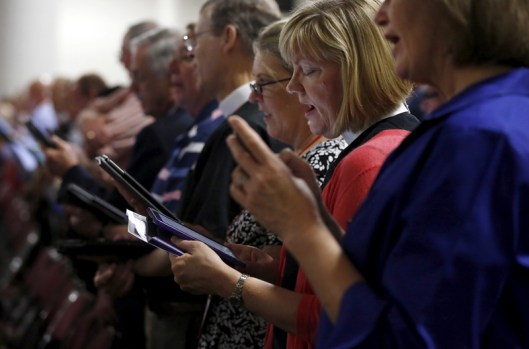
Members sing during a church service during the General Convention of the Episcopal Church in Salt Lake City

Photo credit:  https://religionnews.com/2015/07/02/episcopal-church-expansive-inclusive-thanks-gay-marriage-votes-commentary/

Today, I am traveling to Austin for the General Convention of the Episcopal Church.  General Convention meets every three years and is a bicameral legislature that includes the House of Deputies and the House of Bishops, composed of deputies and bishops from each diocese. During General Convention, deputies and bishops consider a wide range of important matters facing the Church.  Some years the issues have a huge impact (examples include the ordination of women and members of the LGBTQ community, as well as same-sex marriage).  Other years, General Convention works on important issues that are less flashy.  Regardless of the news cycle, the work of General Convention is about continuing to define who and whose we are, and making sure our work reflects our identity.

I am attending this year as an alternate clergy deputy for the Diocese of Southern Virginia.  My work is to support the eight clergy and lay deputies and our bishops, helping them make important decisions, and filling in when breaks are needed.  The official meetings take place July 5-13, but there are already many committee meetings happening.

In talking to a clergy colleague about my participation in General Convention he asked me, “Why in the world did you volunteer?”  I have been thinking (and laughing) about that question, and after reflection, I realized why I was so interested in serving.  One of the things I preach about a lot is about identity – understanding it, naming it, living into it.  In the current climate of the United States, our identity as disciples of Jesus is an anchor.  But just saying we are disciples without critically examining our lives through that lens does little good.  For me, being a part of General Convention is a way of participating in the work of honing our identity as Episcopalians, and where applicable, helping us to better live into that identity.

I look forward to serving the broader church, our Diocese, and ultimately my parish through this work.  This kind of work creates the space for making us all better, and I am hopeful about what the week can bring.  I ask your prayers for the General Convention over the next many days.  Like any family, parish, Diocese, or church who tries to come to consensus across differences, we will need your prayers to listen deeply, speak intentionally, and make decisions thoughtfully and prayerfully.  I look forward to sharing this experience with you!

On Holiness and Heroes…

27 Wednesday Jun 2018

Posted by jandrewsweckerly in Uncategorized

≈ Leave a comment

Tags

baptism, Christ, discern, disciple, Episcopalian, ethics, fantasy, foundational, God, identity, Jesus, morals, purpose, superheroes

Wonder Woman

Photo credit:  https://www.themarysue.com/no-boys-allowed/

This Sunday we begin our summer film series at Hickory Neck called “Faith and Film.”  When I announced to our parish that this year’s theme would be superheroes, I got some raised eyebrows.  My suspicion is that for those of our parish who have not already blocked out the next five Sunday evenings, their raised eyebrows are because superhero movies may seem frivolous, superficial, or even violent.  On the surface, I can understand the suspicions.  For a long time, I though superhero films dabbled a little too much in escapism and fantasy.  And there is certainly some of that component to the films – who doesn’t enjoy what filmmakers can do with computer graphics these days?!

But at the heart of these films is something much more significant.  Each film seems to asks deep, defining questions.  What kind of person are you going to be?  What morals or ethics will rule your life?   What things are of ultimate significance in your life?  What responsibility do you have for the world and people around you?  These questions are not frivolous questions.  When someone dons a Captain America hat or a Wonder Woman shirt, they are not just celebrating a fun, fictional hero – they are also celebrating a moral way of life.

I cannot imagine anything more relevant to a disciple of Jesus than discerning and making decisions about your life that reflect your morals and ethics.  As Episcopalians, we look to our baptismal covenant for that definition.  It defines five core elements:  1) continuing in the apostles’ teaching and fellowship, the breaking of the bread, and the prayers, 2) resisting evil, and, whenever we fall into sin, repenting and returning to the Lord, 3) proclaiming by word and example the Good News of God in Christ, 4) seeking and serving Christ in all persons, loving our neighbor as ourselves, and 5) striving for justice and peace among all people, and respecting the dignity of every human being.[i]

These days, as our current political climate challenges us on more and more specific issues, I cannot imagine a better topic than to talk about what defines us and our behavior, and then recommitting to that identity and purpose.  The good news is that if you are able to make it to all five movies, the following Sunday (August 5), we will be renewing our baptismal covenants as we baptize a child of God – an event where we all commit to being superheroes in the life of Christ.  I hope you will join us for this fun, sometimes frivolous, but mostly foundational journey.

[i] Book of Common Prayer, 304-304.

Sermon – 1 Samuel 17.1a, 4-11, 19-23, 32-49, P7, YB, June 24, 2018

27 Wednesday Jun 2018

Posted by jandrewsweckerly in Sermons, Uncategorized

≈ Leave a comment

Tags

armor, bold, Christ, confident, cynical, David, disciple, dispassionate, Eucharist, faith, faithfulness, fear, God, Goliath, identity, love, politics, Sermon, skeptical, table, trust, underdog, vulnerable

This summer, our Faith and Film series is all about superheroes.  I was never a huge fan of superheroes growing up.  I liked Superman and Batman nominally, sported a pair of Wonder Woman Underoos as a kid, but in general wasn’t really into superheroes and certainly not into comic books.  But a few years ago, I stumbled into the film, The Avengers, and found myself curious about the back stories of all these superheroes.  That began a deep dive into multiple films, many of which you can see this summer.  The first one, Captain America, is a classic story of the little guy overcoming.  Steve Rogers, a literal little guy with a bad case of asthma, wants to enlist in the US Army during World War II so badly, but his health and height disqualify him.  Impressed by his tenacity, Steve gets recruited into an experimental program to be medically turned into a Super Soldier.  There begins his journey of the little man taking on the big man of Nazi Germany.

Most of us enjoy a good story of the little man overcoming.  That’s why the story of David and Goliath is so epic in our memory.  This little kid, totally untrained, completely unarmed (with the exception of some rocks and a sling), and certainly the underdog to the 9 feet 6 inches[i] of Goliath, David is the prototypical little man.  And yet, with the entire Philistine army staring them down, with a giant taunting them for forty days, and with the ominous threat of defeat, no one else is willing to step forward.  The giant, covered in over 126 pounds of armor, and holding huge weapons like the spear whose iron head weighs fifteen pounds[ii], utilizes his own brand of psychological warfare.[iii]  In the end, that dry river bed between the two armies is not just a valley of separation, but a “chasm of fear.”[iv]  And yet, somehow, the teenage shepherd boy steps forward to fight – the little man, the underdog, makes his move.

But unlike a typical underdog, David does not need science, or a lucky break, or some trick.  What David needs has nothing to do with him.  Instead, what he needs is God.  No one in the Israeli camp has mentioned God at this point in the story.  Saul has tried to overcome the chasm of fear with the promise of riches and even his own daughter’s hand in marriage.  And yet, the entire army of Israel can only see how mismatched they would be against the ultimate warrior.  But David sees things differently.  Having fought lions and bears to save his sheep, David knows he can fight Goliath too.  But not because he is a mighty warrior – but because Yahweh delivered David then too.  Even Saul, God’s formerly appointed king, has forgotten God.  But not David.  David is first to speak Yahweh’s name in almost forty verses of text.[v]  When David faces Goliath, he invokes God’s name, recalling with the name the entire memory of Yahweh’s deliverances of Israel in the past.  David knows that he does not need the conventions of human warfare, but only the God of Israel.[vi]

This week, I have been thinking what a ridiculous sermon that is:  all we need is God.  If all we needed was God, we wouldn’t be in such a political mess, totally unable to compromise, hear each other, and work for the common good.  If all we needed was God, that cancer diagnosis, that lost job, that lost pregnancy, or that lost relationship would not have felt so devastating.  If all we needed was God, we would have figured out a way to both secure our borders and humanely treat those fleeing injustice and seeking asylum.  In saying all we need is God, we sound like a bunch of hippies singing the great Beatles song, “All You Need is Love.”  As modern pragmatists, we know better – we know letting go and letting God is what you say – but not what you do.

So how do we turn ourselves from being skeptics, cynics, and dispassionates to seeing all we need is God?  Well, first we have to define a few things.  What is happening in David’s story should not be a surprise.  If you remember a few weeks ago, when the people broke their longstanding covenant with God, asking for a king like the other nations, God gave them Saul.  And Saul was just that – like the other nations, fighting battles with weapons of other nations.  So when David offers to fight, Saul does what a conventional leader would do – arm David with the conventions of war.  He tries to weigh down David with his armor, hoping against hope that there might be a modicum of protection against the Philistine.  Saul is a ruler like the other nations have.  The contrast between Saul and David then becomes a contrast between trusting conventional means and the means of God.[vii]  Saul has become ruled by fear instead of faith.

The way we pull ourselves out of being skeptical, cynical, or dispassionate is not by rallying behind the idea that we are the little man – the underdog David or Captain America, just waiting to be empowered by God.  The way we put to bed our skepticism, cynical thoughts, or dispassionate feelings about all the things in life overwhelming us is to recall the faithfulness of God.  When David says, “All you need is love,” he does not mean all you need is people giving hugs to one another.  What he means is, all you need is to remember the faithfulness of God – especially when we are not faithful at all!  In his speeches to Saul and Goliath, David is recalling the salvation narrative – the stories of God’s faithfulness for generations.  His trust is actually pretty bold too, considering the current king Saul’s appointment represents the breaking of covenant between God and the people.  But David trusts even a broken covenant can be overcome.  David claims his identity as a child of God and knows his identity is all he needs to fight the worst this world has to offer.

This past week, as politics and religion got dragged together in front of camera crews, I slowly began to realize that we are in a David moment.  We can keep doing what we have been doing – keeping our faith out of politics, putting politics in a box that we especially do not open on Sundays, or we can start realizing that we can never put our faith in a box.  The bond that we have as Episcopalians and especially within the hugely politically diverse community that is Hickory Neck is extremely fragile.  Our fragility is why I rarely talk about politics among the community.  I value our ability to come to the Eucharistic Table in spite of our difference over just about anything else.  But that high value on the common table can come at a cost – the cost is never talking about what being a people of God means – what being a disciple of Christ and being an American means.  In order to protect that common table, I have put on 126 pounds of brass armor, and taken up a spear whose head weighs fifteen pounds.  Instead, today David invites us to shed the ill-fitting armor, and just walk in the clothes God gave us (and maybe a few stones).

I am not saying once we shed man-made armor we will suddenly know what immigration policies are the best.  But what I am saying is until we take on God’s armor, until we recall all those times when God has delivered us, when God has turned chasms of fear into paths of faithfulness, until we remember that we have a distinct identity as children of God and disciples of Christ, we will not be able to take on the Goliath issues of our day.  Stripping down to David-like clothing, we are able sit down comfortably, to see each other more honestly, to be in relationship more authentically, to gather at this table – not just trying to avoid banging our heavy armor into each other, barely able to make eye contact because of our heavy helmets, but actually brushing the skin of elbows with one another, looking deeply into the eyes of the chalice bearer serving you Christ’s blood, and offering the hand of Christian friendship as we rise from the altar rail together.  We can do all those things because God is faithful.  We can do all those things because God has delivered us before.  We can do all those things because we are Christ’s disciples – and that is what we do through God.  We may be underdogs, and we may be vulnerable in a world that is happy to deploy psychological warfare, but we are united and empowered by the love of God.  Our invitation is to step trustingly, boldly, confidently into that love.  Amen.

[i] William P. Brown, “Exegetical Perspective,” Feasting on the Word, Supplemental Essays for Year B, Batch 2 (Louisville:  Westminster John Knox Press, 2012), 4.

[ii] Richard F. Ward, “Homiletical Perspective,” Feasting on the Word, Supplemental Essays for Year B, Batch 2 (Louisville:  Westminster John Knox Press, 2012), 4.

[iii] Walter Brueggemann, Interpretation:  A Biblical Commentary for Teaching and Preach, First and Second Samuel (Louisville:  John Knox Press, 1990), 131.

[iv] Ward, 2.

[v] Brueggemann, 130.

[vi] Brueggemann, 132.

[vii] Brueggemann, 131.

On Bringing the Church and World Together…

02 Wednesday May 2018

Posted by jandrewsweckerly in Uncategorized

≈ Leave a comment

Tags

bless, church, community, fellowship, holy, identity, rogation, sacred, service, welcome, world

img_0160

Photo credit:  http://stas.org/en/media/photos/rogation-days-2016-15612

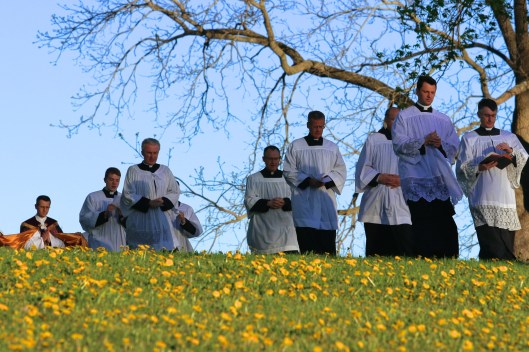
This coming Sunday at Hickory Neck, we will be adding a procession and blessing before our service begins in honor of Rogation Days.  Traditionally, Rogation Days are the three days before Ascension Day during which the litany is said as an act of intercession. In England, Rogation Days were associated with the blessing of the fields at planting, and in the United States they have been associated with rural life, agriculture and fishing, commerce and industry, and the stewardship of creation.[i]  For Hickory Neck, we are using this year’s Rogation Days to give thanks for rainwater collection barrels built for our Community Garden by a Boy Scout in our parish.  We will also bless the Garden, praying for a fruitful harvest for our parishioners and neighbors who use the gardens this year.

What I love about this upcoming event is that it represents a confluence of everything about which the church should be.  Our Community Garden has long been an example of using our property as a way to bless and welcome others.  At the garden, I see strangers become friends, people planting and tending in sacred silence, and the fruits of labor shared with one another.  Meanwhile, it has been a joy to watch our parishioner take leadership of an Eagle Scout project that benefits the church, the community, and his troop.  Watching our parishioner bring his faith community and his service community together has been a tremendous witness to each of us about how to make connections between the various parts of our lives.  And marking Rogation Days with liturgy is the church’s way of making the everyday parts of our lives sacred.  We take the labor of our hands, the fellowship of friends and strangers, the bounty of creation, and we name it all as holy.

Often when people think about church, they think about the building and the people who regularly attend worship services on Sundays.  But the church is much more about what the faith community does outside of the walls of the building, and how the community uses the blessing of its property to bless others.  This Sunday, we celebrate the ways in which we are living into the fullness of our identity, while also challenging ourselves to ever be outwardly-minded in our ministry.  I hope you will join us, but mostly, I hope you will invite a friend as we celebrate the ways in which the blessing of our community flows out into the world!

21463342_1589859034403684_3079109709240303206_n

Rainwater Collection Barrels Installation.  Photo credit:  Paula Simmons.  Permission required for reuse.


[i] Donald S. Armentrout and Robert Boak Slocum, eds., An Episcopal Dictionary of the Church:  A User-Friendly Reference for Episcopalians, “Rogation Days,” as found at https://www.episcopalchurch.org/library/glossary/rogation-days on May 1, 2018.

On Resurrection Living…

19 Thursday Apr 2018

Posted by jandrewsweckerly in Uncategorized

≈ 1 Comment

Tags

afraid, Christ, church, death, Easter, Eastertide, eternal life, free, identity, Jesus, life, resurrection, transformation

I have been thinking a lot about death lately.  That probably sounds a bit morbid, but given my profession, should not be much of a surprise.  I think death has been on my mind for lots of reasons:  we celebrated the death of an incredible woman at our parish last week, our Adult Forum series during Eastertide is about death (end of life care, wills, legacy giving, funeral planning), and this Sunday’s lessons, although beloved, are quite common readings for funerals.  Everywhere I turn seems to offer reminders of death, and yet here we are in the season of Easter – a time to honor resurrection – to honor Christ’s victory over death!

One of the reasons we are freed up to talk about death in Eastertide is because death is changed through the resurrection of Christ.  In light of the resurrection, we see our life and death differently.  We proclaim that difference in the Book of Common Prayer at funerals.  “Life is changed, not ended,” we say in the burial office.  Whereas the secular world would have us consume life to its fullest, ignoring the inevitability of death; would have us preserve our bodies and make ourselves look younger to ignore our natural aging; would have us avoid conversations with our loved ones and community about death, the Church says something different.

The Church says Christ’s resurrection changes life so much, talking about death is no longer morbid.  The Church says, the promise of eternal life allows us make those funeral plans with a spirit of joy, not a spirit of dread.  The Church says that our time among the living is meant to bless and honor others, so making that will and designating those legacy gifts to a church are in great congruence with our understanding of resurrection living.  An Adult Forum series on death (or Resurrection Living, as we have called it) or reading lessons from funerals during Eastertide makes perfect sense.  Those exercises free us from seeing death as final, encouraging instead a life of resurrection hope and joy – a life lived in the light of eternal life.  I hope you will join us this week at Hickory Neck as we dive into that new identity and welcome the transformation of life in the light of the resurrection.

RLM_about

Photo credit:  http://www.rlmonline.com/about-rlm/


Sermon – Luke 24.36b-48, E3, YB, April 15, 2018

19 Thursday Apr 2018

Posted by jandrewsweckerly in Sermons, Uncategorized

≈ Leave a comment

Tags

afraid, Christian, disciples, God, hiding, identity, Jesus, judge, Sermon, witness, world

Last month I was talking to Pastor Alex from Stonehouse Presbyterian.  We were walking toward our cars and he complimented my license plate, noting how fun spotting my plate around town has been.  I chuckled and told him the plate had been both a blessing and a curse.  He asked me what I meant, and I explained.  You see, I love the plate for the very reason he mentioned – that I run into people who recognize my plate, that people connect who I am with what I do, that people ask me about my vocation and about Hickory Neck.  But the plate is also a bit of a curse.  If I had to choose any place to be a witness for Christ, I am not sure the car is the best location.  You see, the car is where I leave prayer books, post-its about phone calls, gum wrappers, and coffee cups.  The car is where I cart around children – sometimes singing at the tops of our lungs to a favorite song, and sometimes scowling after an argument about behavior.  The car is where I find a moment to getaway before picking up children, and the car is where I sometimes reveal that I once lived in a region of the country that is known for impatient, sometimes foul-mouthed drivers.  The car is not really home to my best witness for loving Christ.  And yet, there is where a big plate – on both the front and the back – witnesses to the world who and whose I am.

That is what I find so funny about the disciples this week.  Here they are in Luke’s gospel, not unlike what we heard in John’s gospel last week, hiding in a room, afraid, disbelieving, and wondering what to make of all that has happened.  To be fair, life has gotten a bit chaotic of late.  Their whole world has gotten turned upside down since that beautiful, sacred night when Jesus washed their feet.  They had ideas about what was coming in their life, what was going to happen to Jesus, and how the world would be changed.  But Jesus dies, they are outcasts, and God seems to have closed a door – a tomb door.  Then, just days later, their world gets upended again.  The disciples learn from the women that the same closed tomb door is now open.  Two of the disciples have an encounter with the risen Christ on the road to Emmaus.  And as if all of that is not enough, today, Jesus shows up – very much alive, proving his corporality, teaching them, and reminding them they are witnesses.

The disciples certainly have our sympathy and concern.  And yet, the disciples remain holed up in a room – as if they can hide.  As if they can integrate back into the world, with no one realizing who and whose they are.  As if no one will notice the license plate on their car that says, “Jesus’ disciple.”  The disciples are hiding, acting as though no one is watching, no one is making conclusions about them based on their behavior, no one is making conclusions about Christ.  Their hiding is just as much of a witness as going out into the community.  Perhaps they feel being in that room is giving them a break from being witnesses – that no one sees them.  But we know better.  And so does Jesus.  “You are witnesses of these things,” says Jesus.

Sometimes we do the exact same thing.  We too can start to believe that we have hiding places in our lives – places where we do not have to be witnesses.  Maybe yours is a car.  Maybe yours is at work or school because those places seem more removed from what we do here on Sundays.  Maybe yours is at home, on vacation, or when surrounded by friends.  Like the disciples, we too have that same longing to “turn off” our witness.  Maybe we are just tired and feel like being a witness for Christ is exhausting.  Maybe we are upset with or disappointed in God and are not sure communicating those feelings helps our witness of Christ.  Or maybe we are just afraid – that people will notice that we do not live lives that reflect who and whose we are.

But “turning off” our identity as people of faith is not really an option.  Sooner or later we will get caught.  Sometimes being caught can be a very positive thing.  An acquaintance who knows you go to church may ask you to add them to your church’s prayer list because they or their child just received a horrible diagnosis.  But sometimes being caught can be less flattering.  At our Adult Forum series on evangelism this fall, we watched a video about how not to invite people to church.  The video features two neighbors, one who is out gardening in the yard and the other who is clearly just coming home from church.  The neighbor who is out gardening wonders to himself, “I wonder why he never invites me to his church.  I would go if he asked me.”  But sometimes being caught can be even worse.  I had a friend who waited tables during college.  She always moaned when she got her work schedule and discovered she was assigned a Sunday.  I finally asked her why she hated Sundays so much.  She said, “Because that’s when all the churchgoers go out to eat – and they are the worst tippers!”  Somehow, in all her long hours of trying to make a few bucks to pay for books and school fees she had gotten the message that people of faith did not value her.

We know from experience that hiding as a Christian is really an illusion.  Wherever we are, whenever we are, with whomever we are, our identity is always there.  Jesus confirms that today.  As biblical scholar Karoline Lewis says, “Jesus’ address to the disciples is not, ‘you will be witnesses.’ Not, ‘please be witnesses.’ Not, ‘consider being witnesses if you have time.’ No, [Jesus says] ‘you are witnesses of these things.’ We are witnesses.  As it turns out, witnessing is not voluntary, but a state of being.”[i]  Lewis goes on to add, “‘We are witnesses’ does not depend on our acceptance or agreement or approval. ‘We are witnesses’ does not depend on our readiness or recognition or responsiveness. ‘We are witnesses’ just is.”[ii]  The disciples learn that today.  When Jesus says, you are witnesses, he empowers a very scared, uncertain, fearful group of followers to remember who and whose they are.

The good news is that Jesus does not judge the disciples today.  Jesus meets the disciples where they are.[iii]  Jesus’ first words are words of encouragement.  “Peace be with you,” he says.  Then, ever the tender pastor, Jesus asks the question in verse 38, “Why are you frightened, and why do doubts arise in your heart?”  Knowing their confusion, Jesus eats with them to assure them he is really there, not just some ghost or figment of their imagination.  He sits down and teaches them once again, taking them back to their roots, reminding them of how the prophets have taught them all they need to know.  And then, come those fateful words in verse 48, “you are witnesses of these things.”  Jesus meets them where they are, offering comfort, assurance, and affirmation.  But Jesus also encourages them to move beyond where they are.

After September 11th, there were two widows featured on the news.  “Grateful for the outpouring of support they received, they started thinking about the women in Afghanistan who, when widowed, lose status in that society and therefore find their already difficult lives even harder.  They raised money and formed a foundation called Beyond the 11th to support Afghani widows, and even made visits to Afghanistan to meet the widows they were helping.”[iv]  Those widows had lot of options – fear, anger, vengeance, or isolation.  But instead, they remembered how Jesus encourages us to remember our identity as witnesses and to move beyond where we are.  Our invitation today is to reclaim that same identity.  Now I do not know if that means you go put a Hickory Neck bumper sticker on your car, or you start wearing that cross necklace again, or you start tangibly connecting your words and actions to your identity as a witness.  Only you can know the shape your witness will take.  But today Jesus invites us to let go of our hiding places, realizing that even when we think we are hiding, we are still witnessing.  Our invitation is to own who we are, so that others might see the beauty of who and whose we are.  Amen.

[i] Karoline Lewis, “We Are Witnesses,” April 9, 2018, as found at http://www.workingpreacher.org/craft.aspx?post=5126 on April 12, 2018.

[ii] Lewis.

[iii] Nancy R. Blakely, “Pastoral Perspective,” Feasting on the Word, Year B, Vol. 2 (Louisville:  Westminster John Knox Press, 2008), 424.

[iv] Blakely, 428.

On Being Called by Name…

14 Wednesday Mar 2018

Posted by jandrewsweckerly in Uncategorized

≈ Leave a comment

Tags

affirmed, baptism, call, church, Episcopal, God, identity, known, loved, name, nickname, pastor, priest, relatedness, role, tension

nametag

Photo credit:  blog.sweetcareersconsulting.com/2015/10/what-name-should-you-use-on-linkedin.html

In my line of work, my female colleagues are widely divided on what we should be called.  You see, for years in the Episcopal Church, the male priests were “Father so-and-so.”  In formal writing, it was “the Rev. so-and-so.”  But in the Episcopal Church, priests are not called “Rev. so-and-so” because the word reverend is an adjective, not a noun, and most Episcopalians cannot stand by grammatical errors.  Episcopalians also do not often use “Pastor so-and-so,” as it is considered too protestant.  So, that leaves Episcopalians in a bit of mess with titles for female priests.  Many have taken to calling women “Mother so-and-so,” to create a sense of parity between male and female priests.  But some women despise that address.  And so, female priests tend to be all over the map about what they prefer – from no title at all (simply using their name given at baptism) to Mother, to Reverend (conceding to the grammatical error for the sake of convenience), to Pastor.

So, when I was asked at my local yoga studio what I was called professionally, I had to chuckle.  I told them when I use a title, I prefer Mother Jennifer.  But that I answer to almost anything – Mother Jennifer, Rev. Jen, Pastor Jennifer, or just Jennifer.  But this past week, I added some new favorites.  A toddler in our parish was watching on online broadcast from church.  When her dad asked, “Do you know who that is?” she replied, “That’s Mama Church.”  Just last week, as our ecumenical brothers and sisters helped us host a winter shelter for the homeless in our community, a Roman Catholic volunteer was talking to my husband.  When she realized who he was she said, “Oh, your wife is that little spitfire thing!”

The funny thing is that despite our baptized names, I think we are all living into identities throughout life.  Sometimes we will only be known as our child’s parent – “Simone’s Mom.”  Sometimes we are known by our profession title – Doctor Smith, Nurse Johnson, Professor Green, Colonel Davis.  Sometimes we take on a funny nickname from a particular stage of life – I’ll let your memories recall a few of your own.  What we are called creates meaning, purpose, and identity throughout life.  And sometimes we have nicknames that we do not even know about – whether it’s “spitfire” or something else.

One of the things I love about church is that we work hard to know each other’s names:  sometimes the ones we are baptized with, but sometimes the funny, the serious, and the beloved names.  Those names can make us feel known, loved, and affirmed.  But mostly those names in church remind us that we are known by name by someone else:  our God.  I like to think God is able to hold all our names in tension:  the funny, yet embarrassing ones; the honorific ones; the ones that remind us of our call; the ones that reveal our relatedness.  God knows us better than any one name can contain, and yet I imagine loves every little nuance of our names.  I wonder what names in your life could stand to be let go, and which names invite you to be someone powerful and life-changing.

On Dancing and Identity…

24 Wednesday May 2017

Posted by jandrewsweckerly in Uncategorized

≈ Leave a comment

Tags

Christ, church, covenant, disciples, dreamy, everyday, identity, life, moments, mundance, ordinary, romantic, wedding

First Dance

Photo credit:  https://apracitcalwedding.com/first-dance-wedding-songs/

This week I was visiting a parishioner at a retirement facility.   I was waiting in the lobby to meet the parishioner when I suddenly realized they were playing Glenn Miller’s Moonlight Serenade on the speakers.  I was catapulted to another time and place as I listened.  You see, Moonlight Serenade was the first song my husband and I danced to when we were married.  It had been the same song his grandparents had danced to when they were married 55 years earlier.  Not long after we started dancing, they joined us on the dance floor.  I remember catching a glimpse of them together as I danced with my husband, hoping we could enjoy such longevity and happiness in marriage.

Of course, little of our everyday lives are that dreamy.  We spend much of our marriage tending to the “stuff” of life – juggling work and family time; shuttling children to school, activities, and parties; tending to household duties; and trying to squeeze in sleep now and then.  There are certainly great moments – watching my husband engage our children, listening intently as he passionately talks about his vocation, and laughing heartily as he jokes about things only we get.  We are piecing together a life full of wonderful memories and chapters, but that life is also full of the mundane, everyday, ordinary stuff too.

I think that is why I was so grateful to hear that song this week.  That song reminded me of my identity – a moment in which I covenanted to live in a certain way with a certain person.  Though our dance together was just one part of that day, the song is a tangible reminder of identity.

After my visit and quick note to my husband about “our song,” I found myself wondering what other markers of identity we experience.  In the Episcopal Church, I would argue the sacraments are our biggest ones – the weekly celebration of Holy Eucharist, and the periodic celebration of Baptism.  In fact, Church is all about helping us define our identity as disciples of Christ – reminding us who and whose we are.  But I wonder, in your mundane, everyday, ordinary lives, what moments or events remind you of that identity?  What are those moments that halt you in your steps in a lobby and make you feel affirmed, rooted, loved, and empowered?

Sermon – John 20.1-18, ED, YA, April 16, 2017

27 Thursday Apr 2017

Posted by jandrewsweckerly in Sermons, Uncategorized

≈ Leave a comment

Tags

affirmation, belonging, call, church, clarity, despair, Easter, Good Shepherd, grief, identity, Jesus, love, Mary, name, purpose, Sermon

Every generation has a baby name that is popular.  In my generation, that name was Jennifer.  As I was growing up, every grade had tons of Jennifers.  I became quite accustomed to the experience of eagerly looking up when someone called my name, only to be disappointed to see they were calling out to someone else.  The name was so common that by the time I got to college, I learned to ignore people calling out my name because more likely than not, they were not actually calling me.  They were calling one of the other twenty Jennifers nearby.  Although the practice helped me save face, the practice was a bit of a hindrance when someone actually was trying to get my attention.

The solution, of course, was a nickname – something to distinguish me from the sea of other Jennifers.  So in college, most of my buddies just started calling me “Andrews.”  It may sound silly, but having a name that was distinct, that when called, I knew I could answer, gave me a sense of belonging and identity.  When someone shouted, “Andrews” across the quad, I knew a friendly face would be looking for me when I raised my eyes.  Though seemingly simple, that nickname made me feel known, especially at a time when everyone is trying to figure out their new identity, where they belong, and who they will be.

I suspect that Mary was the common name in Jesus’ generation.  All we need to do is read through the New Testament to know that there are more Marys than we can count.  Sometimes I even have to look back when I come across a Mary to be sure I am thinking of the right one.  So when Jesus calls Mary Magdalene by name, I imagine there must have been some way she knows not only that this is Jesus, but also that he is talking to her.

Easter morning has been a rough morning for Mary.  She comes in the tomb before the first light of dawn has broken.  She is probably still a bit bleary eyed – that kind of haze one has in the days after a death of a beloved one.  She comes to halt before she gets all the way to the tomb though.  The stone that is supposed to be covering the tomb, protecting Jesus’ body, is gone.  Before even going in to assess the situation, Mary runs – runs hard to find the disciples, demanding that they get up and help her.  Two of them, the beloved disciple and Peter, sprint ahead of Mary.  She is too tired from her first run to keep up.  By the time she reaches the tomb, the two disciples are already stepping out of the tomb, Peter looking perplexed and the other disciple with an enigmatic smile.  And without so much as a word to her, they leave – just like they left Jesus on that fateful day.[i]  Mary, overcome with the memories of Jesus’ crucifixion and the continued emotion of this morning, breaks into tears.  When she finally checks inside the tomb herself, she not only sees two angels, she also has an encounter with a supposed gardener.  Frustrated by their insensitive questions, she exasperatedly asks the gardener to just tell her where the body is.

That is when the big news today happens.  The supposed gardener calls her by name.  Not the common name that everyone has.  The supposed gardener calls her by the name that only Jesus calls her.  The haze dissipates.  The tears halt.  The cloud of despair vanishes.  And she calls Jesus by the name that only a few call him, “Rabbouni!”  This is a tremendous moment in our text today.  In the flurry of running, and confusion, and questions, and tears, and despair, two people see each other crystal clearly.  Mary is called by her name – Jesus communicates to Mary that she is known, the she is beloved, that she has an identity and a purpose unique to her.  She is his sheep who knows and recognizes the voice of the shepherd – the Good Shepherd.[ii]  Her relief is palpable.  The return of her confidence is immediate.  Her sense of celebration is ready to explode!

When I was in high school, I had a summer where I attended both a short conference and then a long summer program.  Both were residential.  The conference was the Hugh O’Brian Youth Leadership conference, or HOBY for short.  I made a few fast friends, but was there just a few days.  A week or so later, I was off to a six-week residential program.  It was my first time staying away from home that long, and I was admittedly a bit nervous since no one else from my high school was going.  After I unloaded my bags, and was getting ready to say goodbye to my parents, someone behind my shouted, “Hey, HOBY!”  Without even looking at who it was, I knew I did not need to worry about belonging.  I was already known here.  I had a place here.  I could have a purpose for those six weeks.

We have all had those moments of clarity around identity, belonging, and purpose.  Whether we are returning to our home town after a long time away, whether we develop good friends at school or in a civic group, and whether that happens at a reunion, we all know the deep, profoundly affirming feeling that comes from being known.  For those of you with a church home, and especially for those of you who have found a home here at Hickory Neck, you most likely found that feeling here.  Perhaps the liturgy was what brought you a sense of identity – either the liturgy reminded you of a practice from your earlier life, or the liturgy offered something to you that you did not even know you were missing.  Perhaps a ministry at church brought you a sense of identity – those little sacred moments that come when you realize that you are actually really good at inspiring people to serve the world, making beautiful music, or teaching children about the love of God.  Or perhaps the community brought you a sense of identity – that first time when someone remembered your name or a part of your story, when someone came to you for expert advice, or when someone knew just by looking at you that you were hurting – and then offered to take you to lunch or coffee.  The church is a place where both Christ and the community call you by name.

Now I would love to tell you that the wonderfully affirming and life-giving feeling of being known is an end unto itself.  I would love to send you home on this beautiful Easter Day with simply a sense of love and affirmation.  And that is certainly part of the gift I am giving you today – to tell you that you can be known and loved here.  But something else happens to Mary at that tomb.  After that profound moment of affirmation, Jesus tells her to go and be a witness to the disciples.  Jesus always gives his beloved homework.  He is that teacher that even on a Friday will give you an assignment for the weekend!  But Mary does not see this as a burden.  Even though Jesus will not let her cling to him – cling to the way things used to be, Jesus’ affirmation this day propels her to go out and share the good news of the risen Lord with the disciples.  In this way, Jesus not only recognizes and honors her identity; Jesus also gives her purpose – a call.

That is your homework on this Easter Sunday.  I know you want to go eat those big Easter meals ,go find those Easter eggs, and find what Easter chocolate awaits at home.  But remember that while this place is a place that calls you by name and affirms your beautiful identity, this is also a place that commissions you to go out and share the good news.  That wonderful sense of affirmation is not for you to bottle up and keep for yourself.  That sense of affirmation is meant to embolden you to share that affirmation with others – to meet people where they are, to hear their stories, and to share how this day of resurrection, love, and affirmation is for them too.  In the same way that you have a vocation, a call on your life, you also are to affirm vocation and call in others.  So this week, as you bask in the warmth and beauty of this day, go out and share that good news with others.  Someone may be waiting for you to call them by name.  Amen.

[i] Richard B. Hays, “Do Not Cling to Me,” Christian Century, vol. 109, no. 10, March 18-25, 1992, 299.

[ii] Karoline M. Lewis, John:  Fortress Biblical Preaching Commentaries (Minneapolis:  Fortress Press, 2014), 241.

← Older posts
Newer posts →

Recent Posts

  • On the Myth and Magic of Advent…
  • On Risking Failure and Facing Fear…
  • Sermon – Luke 23.33-43, P29, YC, November 23, 2025
  • On Inhabiting Gratitude…
  • Sermon – Luke 20.27-38, P27, YC, November 9, 2025

Archives

  • December 2025
  • November 2025
  • October 2025
  • September 2025
  • August 2025
  • July 2025
  • June 2025
  • March 2025
  • February 2025
  • December 2024
  • November 2024
  • October 2024
  • September 2024
  • August 2024
  • July 2024
  • June 2024
  • May 2024
  • March 2024
  • February 2024
  • January 2024
  • December 2023
  • November 2023
  • October 2023
  • September 2023
  • August 2023
  • July 2023
  • June 2023
  • May 2023
  • March 2023
  • February 2023
  • January 2023
  • December 2022
  • November 2022
  • October 2022
  • June 2022
  • May 2022
  • January 2022
  • December 2021
  • November 2021
  • October 2021
  • September 2021
  • August 2021
  • June 2021
  • May 2021
  • April 2021
  • March 2021
  • February 2021
  • January 2021
  • December 2020
  • November 2020
  • October 2020
  • September 2020
  • August 2020
  • July 2020
  • June 2020
  • May 2020
  • April 2020
  • March 2020
  • February 2020
  • January 2020
  • December 2019
  • November 2019
  • October 2019
  • September 2019
  • August 2019
  • July 2019
  • June 2019
  • May 2019
  • April 2019
  • March 2019
  • February 2019
  • January 2019
  • December 2018
  • November 2018
  • October 2018
  • September 2018
  • August 2018
  • July 2018
  • June 2018
  • May 2018
  • April 2018
  • March 2018
  • February 2018
  • January 2018
  • December 2017
  • November 2017
  • October 2017
  • September 2017
  • August 2017
  • July 2017
  • June 2017
  • May 2017
  • April 2017
  • March 2017
  • February 2017
  • January 2017
  • December 2016
  • November 2016
  • October 2016
  • September 2016
  • August 2016
  • July 2016
  • June 2016
  • May 2016
  • April 2016
  • March 2016
  • February 2016
  • January 2016
  • December 2015
  • November 2015
  • October 2015
  • September 2015
  • August 2015
  • July 2015
  • June 2015
  • May 2015
  • April 2015
  • March 2015
  • February 2015
  • January 2015
  • December 2014
  • November 2014
  • October 2014
  • September 2014
  • August 2014
  • July 2014
  • June 2014
  • April 2014
  • March 2014
  • February 2014
  • January 2014
  • December 2013
  • November 2013
  • October 2013
  • September 2013
  • August 2013
  • July 2013
  • June 2013
  • May 2013
  • April 2013
  • March 2013
  • February 2013
  • January 2013
  • December 2012
  • November 2012
  • October 2012
  • September 2012

Categories

  • reflection
  • Sermons
  • Uncategorized

Meta

  • Create account
  • Log in
  • Entries feed
  • Comments feed
  • WordPress.com

Blog at WordPress.com.

  • Subscribe Subscribed
    • Seeking and Serving
    • Join 394 other subscribers
    • Already have a WordPress.com account? Log in now.
    • Seeking and Serving
    • Subscribe Subscribed
    • Sign up
    • Log in
    • Report this content
    • View site in Reader
    • Manage subscriptions
    • Collapse this bar
 

Loading Comments...