• About

Seeking and Serving

~ seek and serve Christ in all persons

Seeking and Serving

Tag Archives: identity

Sermon – John 20.1-18, ED, YA, April 16, 2017

27 Thursday Apr 2017

Posted by jandrewsweckerly in Sermons, Uncategorized

≈ Leave a comment

Tags

affirmation, belonging, call, church, clarity, despair, Easter, Good Shepherd, grief, identity, Jesus, love, Mary, name, purpose, Sermon

Every generation has a baby name that is popular.  In my generation, that name was Jennifer.  As I was growing up, every grade had tons of Jennifers.  I became quite accustomed to the experience of eagerly looking up when someone called my name, only to be disappointed to see they were calling out to someone else.  The name was so common that by the time I got to college, I learned to ignore people calling out my name because more likely than not, they were not actually calling me.  They were calling one of the other twenty Jennifers nearby.  Although the practice helped me save face, the practice was a bit of a hindrance when someone actually was trying to get my attention.

The solution, of course, was a nickname – something to distinguish me from the sea of other Jennifers.  So in college, most of my buddies just started calling me “Andrews.”  It may sound silly, but having a name that was distinct, that when called, I knew I could answer, gave me a sense of belonging and identity.  When someone shouted, “Andrews” across the quad, I knew a friendly face would be looking for me when I raised my eyes.  Though seemingly simple, that nickname made me feel known, especially at a time when everyone is trying to figure out their new identity, where they belong, and who they will be.

I suspect that Mary was the common name in Jesus’ generation.  All we need to do is read through the New Testament to know that there are more Marys than we can count.  Sometimes I even have to look back when I come across a Mary to be sure I am thinking of the right one.  So when Jesus calls Mary Magdalene by name, I imagine there must have been some way she knows not only that this is Jesus, but also that he is talking to her.

Easter morning has been a rough morning for Mary.  She comes in the tomb before the first light of dawn has broken.  She is probably still a bit bleary eyed – that kind of haze one has in the days after a death of a beloved one.  She comes to halt before she gets all the way to the tomb though.  The stone that is supposed to be covering the tomb, protecting Jesus’ body, is gone.  Before even going in to assess the situation, Mary runs – runs hard to find the disciples, demanding that they get up and help her.  Two of them, the beloved disciple and Peter, sprint ahead of Mary.  She is too tired from her first run to keep up.  By the time she reaches the tomb, the two disciples are already stepping out of the tomb, Peter looking perplexed and the other disciple with an enigmatic smile.  And without so much as a word to her, they leave – just like they left Jesus on that fateful day.[i]  Mary, overcome with the memories of Jesus’ crucifixion and the continued emotion of this morning, breaks into tears.  When she finally checks inside the tomb herself, she not only sees two angels, she also has an encounter with a supposed gardener.  Frustrated by their insensitive questions, she exasperatedly asks the gardener to just tell her where the body is.

That is when the big news today happens.  The supposed gardener calls her by name.  Not the common name that everyone has.  The supposed gardener calls her by the name that only Jesus calls her.  The haze dissipates.  The tears halt.  The cloud of despair vanishes.  And she calls Jesus by the name that only a few call him, “Rabbouni!”  This is a tremendous moment in our text today.  In the flurry of running, and confusion, and questions, and tears, and despair, two people see each other crystal clearly.  Mary is called by her name – Jesus communicates to Mary that she is known, the she is beloved, that she has an identity and a purpose unique to her.  She is his sheep who knows and recognizes the voice of the shepherd – the Good Shepherd.[ii]  Her relief is palpable.  The return of her confidence is immediate.  Her sense of celebration is ready to explode!

When I was in high school, I had a summer where I attended both a short conference and then a long summer program.  Both were residential.  The conference was the Hugh O’Brian Youth Leadership conference, or HOBY for short.  I made a few fast friends, but was there just a few days.  A week or so later, I was off to a six-week residential program.  It was my first time staying away from home that long, and I was admittedly a bit nervous since no one else from my high school was going.  After I unloaded my bags, and was getting ready to say goodbye to my parents, someone behind my shouted, “Hey, HOBY!”  Without even looking at who it was, I knew I did not need to worry about belonging.  I was already known here.  I had a place here.  I could have a purpose for those six weeks.

We have all had those moments of clarity around identity, belonging, and purpose.  Whether we are returning to our home town after a long time away, whether we develop good friends at school or in a civic group, and whether that happens at a reunion, we all know the deep, profoundly affirming feeling that comes from being known.  For those of you with a church home, and especially for those of you who have found a home here at Hickory Neck, you most likely found that feeling here.  Perhaps the liturgy was what brought you a sense of identity – either the liturgy reminded you of a practice from your earlier life, or the liturgy offered something to you that you did not even know you were missing.  Perhaps a ministry at church brought you a sense of identity – those little sacred moments that come when you realize that you are actually really good at inspiring people to serve the world, making beautiful music, or teaching children about the love of God.  Or perhaps the community brought you a sense of identity – that first time when someone remembered your name or a part of your story, when someone came to you for expert advice, or when someone knew just by looking at you that you were hurting – and then offered to take you to lunch or coffee.  The church is a place where both Christ and the community call you by name.

Now I would love to tell you that the wonderfully affirming and life-giving feeling of being known is an end unto itself.  I would love to send you home on this beautiful Easter Day with simply a sense of love and affirmation.  And that is certainly part of the gift I am giving you today – to tell you that you can be known and loved here.  But something else happens to Mary at that tomb.  After that profound moment of affirmation, Jesus tells her to go and be a witness to the disciples.  Jesus always gives his beloved homework.  He is that teacher that even on a Friday will give you an assignment for the weekend!  But Mary does not see this as a burden.  Even though Jesus will not let her cling to him – cling to the way things used to be, Jesus’ affirmation this day propels her to go out and share the good news of the risen Lord with the disciples.  In this way, Jesus not only recognizes and honors her identity; Jesus also gives her purpose – a call.

That is your homework on this Easter Sunday.  I know you want to go eat those big Easter meals ,go find those Easter eggs, and find what Easter chocolate awaits at home.  But remember that while this place is a place that calls you by name and affirms your beautiful identity, this is also a place that commissions you to go out and share the good news.  That wonderful sense of affirmation is not for you to bottle up and keep for yourself.  That sense of affirmation is meant to embolden you to share that affirmation with others – to meet people where they are, to hear their stories, and to share how this day of resurrection, love, and affirmation is for them too.  In the same way that you have a vocation, a call on your life, you also are to affirm vocation and call in others.  So this week, as you bask in the warmth and beauty of this day, go out and share that good news with others.  Someone may be waiting for you to call them by name.  Amen.

[i] Richard B. Hays, “Do Not Cling to Me,” Christian Century, vol. 109, no. 10, March 18-25, 1992, 299.

[ii] Karoline M. Lewis, John:  Fortress Biblical Preaching Commentaries (Minneapolis:  Fortress Press, 2014), 241.
Sermon – Matthew 4.1-11, Genesis 2.15-17, 3.1-7, L1, YA, March 5, 2017

08 Wednesday Mar 2017

Posted by jandrewsweckerly in Sermons, Uncategorized

≈ Leave a comment

Tags

church, corrupt, disciplines, doubt, evil, God, goodness, identity, insecurity, Jesus, Lent, question, relationship, repentance, Satan, Sermon, sin, temptation, trust

On this first Sunday in Lent, I usually like to talk about Lenten disciplines.  The season of Lent is one of the few times in the Church that we take a hard look at our faith life and then actually commit to doing something tangible to strengthen our walk with Christ.  When I hear about your disciplines, I get some clue as to what feeds each of you spiritually – whether you long to connect with Holy Scripture, or hope to deepen your prayer life; whether you know that denial of certain parts of your life will create a needed discomfort or disruption, or instead find taking up something to create needed transformation; whether you are motivated by something fun and engaging (like Lent Madness), or you prefer something more philosophical (like our Lenten study group focusing on the spirituality of the Eucharist).  Lenten disciplines also give me a tiny clue about what sinful behaviors have been pulling you away from God.  As we prayed the Great Litany today, there were countless options:  pride, vainglory, hypocrisy, envy, hatred, malice, desires of the flesh, and hardness of heart.  Or, perhaps you are inspired to help one of those we prayed for in the Litany:  the lonely, the sick, the homeless, the imprisoned, broken families, the oppressed, or those suffering injustice.  There really is no wrong way to approach Lenten disciplines – that we are taking them on demonstrates a commitment to enriching our faith and growing closer to God.

Given the beginning of those practices, the text of Jesus’ temptation every year on this first Sunday in Lent has always seemed most appropriate.  How better to encourage us to engage in repentance and reformation than to remember that Jesus too was tempted – tempted to ease the discomfort of hunger, tempted to test God’s loyalty and support, and tempted to take on power – even if ill-gotten – for the greater good?  And even better that this year in Lent, we get that powerful lesson from Hebrew Scriptures of Adam and Eve’s temptation – the temptation to eat beautiful fruit, to learn what God knows but won’t tell us, to take control of our destiny.  And all of those temptations would be plenty.  But what has been striking me more powerfully this year has been what is at the root of the temptations of Satan.  You see, in all of those tests for Jesus, and even in the simple offering of forbidden fruit, Satan does something even more insidious.  Through his temptations, Satan works to undermine our relationship with God – to sow the seed of mistrust that promises to unravel the very foundation of our faith.

We can talk all we want about deepening our faith, working on our sinful behaviors, or becoming better Christians in Lent.  But much scarier to talk about is the power of evil to undo our faith altogether.  Many of us know the darkness of this power from Satan.  If we have not had a spiritual identity crisis in our lives, someone we know has.  Enough people around us die, enough suffering happens in the world, enough pain comes our way that slowly we begin to wonder if God cares at all.  We watch what Christians do to one another or how they fail to care for one another, we see the misdeeds of the Church, or the Church’s clergy disappoint us, and slowly, slowly, we begin to doubt God is even present.  As I have been watching the news, as our country becomes more deeply divided, as suffering seems to be epidemic, and as we dehumanize one another, sometimes institutionalizing that dehumanization, I see the power of evil planting seed after seed of mistrust.  Who hasn’t asked, “Where is God?” in the last year?  Who hasn’t thought, “Maybe I should stop trusting God, and start taking care of things myself.”?  Who hasn’t wondered if God is slipping into irrelevance as the world falls apart around us?

As I have pondered the temptations of Adam, Eve, and Jesus, the power of evil to corrupt has been much more powerful, potent, and pressing this year.  The “crafts and assaults of the devil” and the desire to “beat down Satan under our feet”[i] we heard in the Great Litany are much more powerful in our current climate.  I am much less worried about Adam and Eve’s original sin than I am worried about their original insecurity.  The serpent comes along and sews mistrust among Adam and Eve.  He starts out with a simple question, “Did God really say…”  And so begins the serpent’s assault on their relationship with God – misrepresenting and undermining God’s instructions, suggesting God is keeping something from them.  And as scholar David Lose suggests, once this primary relationship is undermined, Adam and Eve are “susceptible to the temptation to forge their identity on their own, independent on their relationship with God, and so take and eat the forbidden fruit… [They] forget whose they are and so lose themselves in the temptation to secure their identity on their own.”[ii]  Though Adam and Eve’s sin is grave, how the serpent gets them there is much scarier to me.

Satan attempts to do the very same thing with Jesus.  “The devil also tries to undermine Jesus’ relationship with God by suggesting [the relationship] is not secure, that he should test [the relationship] by throwing himself off the mountain, or that he should go his own way by creating food for himself, or that he should seek the protection and patronage of the devil rather than trust God’s provision.”[iii]  Satan is good!  He even tries to twist Jesus’ use of scripture to convince Jesus of God’s unworthiness of trust.  What is frightening about Satan’s tactics is that he is not just about tempting us to do bad things.  He is meddling in our relationship with God, sewing distrust, confusion, questioning our identity as beloved children of God.  And that kind of meddling leads to much worse problems than poor behavior.  Satan tries to upend who we are.

Last week, we baptized two members into the household of faith.  We talked about how baptism marks for us who and whose we are.  We gave thanks for the reminder and celebrated as a community.  We were not unlike Adam and Eve, who upon their creation, God says it is very good.  We were not unlike Jesus, who at his own baptism, which occurs immediately before his temptation today, God says, “This is my beloved, with whom I am well pleased.”  But Satan takes goodness and blessedness, and tries to taint that goodness and blessedness with doubt, mistrust, and insecurity.  He tries to confuse us, making us forget who and whose we are.

Several years ago, the movie The Help debuted.  In the film, there is a maid who cares for a child who gets a lot of verbal abuse from her mother.  In several key scenes, the maid takes the child aside and teaches the child a mantra of sorts.  In her rough grammar, she reminds the child, “You is smart, you is kind, you is important.”  Eventually the maid is fired, and the audience is left hoping that the mantra she taught the child will remind her that no matter what verbal abuse she receives, she can remember who she is – smart, kind, and important.

We do not always have caretakers in our lives who will instill in us a mantra that holds us in the face of adversity.  But we do have a church.  We have a church that will tell us we are made in the image of God, that our very creation is rooted in goodness, and that we are beloved children of God.  When we begin to be assaulted by the power of evil, which would rather us question our identity, the church reminds of us of our baptismal covenant, our identity-making set of promises, which tells us we are enough, there is plenty to go around, and we need not live in fear.  While the forces of evil will try to isolate us and send us into questions of identity, the church comes together every week to remind us that we are beloved children of God – a people of value, worth, and purpose.[iv]

I do not know what spiritual discipline you are taking up for Lent this year.  But if you do nothing else this Lent, come to church.  Come gather with the community that reminds you who and whose you are.  Come be with a people who are also assaulted by the doubts, questions, and fears of the day, but who ground themselves in their identity, and find meaning, encouragement, and purpose in this place.  Come.  Together, we will stamp down Satan under our feet as we shine light on our God who redeems, reveres, and renews us.  Amen.

[i] BCP, 151-152.

[ii] David Lose, “Lent 1A:  Identity as Gift and Promise,” February 28, 2017, as found at http://www.davidlose.net/2017/02/lent-1-a-identity-as-gift-and-promise/ on March 2, 2017.

[iii] Lose.

[iv] Lose.

Homily – Matthew 17.1-9, LEP, YA, February 26, 2017

01 Wednesday Mar 2017

Posted by jandrewsweckerly in Sermons, Uncategorized

≈ Leave a comment

Tags

baptism, baptismal covenant, clarity, faith, homily, identity, Jesus, journey, promises, Transfiguration, transformation

Today we celebrate two major events – the Transfiguration of Jesus and the baptism of Levi and Owen at our 9:00 am service.  I have been thinking all week about what a strange, and quite frankly, difficult combination those two events are.  For well over a month, I have been looking forward to being able to tell a child-friendly story about Jesus and baptism – until I realized we were hearing about the Transfiguration.  The Transfiguration is one of those major ah-ha moments in Jesus’ story.  Jesus had been trying to communicate his identity even before he could communicate – first with his miracle birth and the multiple witnesses to his birth.  Later, at his baptism, the voice from Heaven says, “This is my Son, the beloved, with whom I am well pleased.”[i]  Even six days before the story we hear today, Peter proclaims that Jesus is the Messiah – but then he quickly gets confused, and Jesus is telling him, “Get behind me Satan”[ii]  So, to help everyone avoid confusion about Jesus’ identity, Jesus, Peter, James, and John go up a mountain and everything becomes crystal clear.

Except, nothing about the Transfiguration is crystal clear.  Why is Jesus all of a sudden dazzling white?  Why are Moses and Elijah there?  Why is Peter babbling about making three dwelling places?  Why are the disciples terrified?  And what in the world does this have to do with baptism?  Of course, there are answers to each of those questions – what we know happens when people encounter God directly, how Moses and Elijah’s presence signify the completion of the Law and the Prophets in Jesus[iii], how dwelling places are a reference to the feast of Tabernacles[iv], and how theophanies are always terrifying.  But the last question – what the Transfiguration has to do with baptism – is the one that has been intriguing me this week.

The more I thought about the Transfiguration, the more I was grateful that Levi and Owen will have this lesson to remember their baptism.  You see, today, their parents and godparents make some promises on their behalf.  They promise to raise these two boys up in the life of faith.  Now that promise may sound simple – years from now, Levi and Owen’s godparents may be calling to say, “Have you been to church lately?”  But the promise is not that simple.  The promise is about not just bringing them to Church, but helping them engage in their faith life.  At first, engaging in their faith life will mean asking about what happened in Sunday School, or talking about something in the church service.  But as they get older, their promise will mean answering fun questions like, “Why was Jesus so shiny, and why were his clothes sparkling?”  As the boys mature, their promise will mean being role models for living a godly life – and talking about how hard that really is, how much we fail at it, and how we keep repenting and returning to the Lord.  Their promise means being willing to go to hard, vulnerable places and encouraging the boys to listen for God’s voice.

So what does the Transfiguration have to do with those promises?  I like that we get this particular lesson because this lesson is a bit of a metaphor for all of our spiritual journeys.  Throughout our spiritual journey we all have mountaintop experiences.  We have these amazing moments of clarity, of wonder, of mystery, of profound insight, and of transformation.  Those moments help define who and whose we are and how we are going to live our lives.  But just like the disciples, we also find ourselves at times, confused and certainly full of fear on that journey.  To the disciples, Jesus places his hand on them and says, “Get up and do not be afraid.”  We are given those gifts too – sometimes the power of God is so close that the power feels like a hand on us; but most times, the hand is from another pilgrim on the faith journey, encouraging us to get up and telling us not to be afraid.[v]  In many ways, our baptism is our great moment of clarity.  Our baptism is so important and so defining that every time we witness a baptism, the Church invites all of us to reaffirm our baptismal covenant – to remember that profound moment and to recommit ourselves to bringing our lives in line with the vows we took – or someone took on our behalf.

In that way, I am deeply grateful that we get this wonderful story of transformation today.  As we remember this moment of clarity, confusion, companionship, and grace, we engage in another story of transformation – the story of Levi and Owen’s transformation into full members in the body of Christ.  Today, their parents, godparents, and each one of us commit ourselves to being agents of transformation in Levi and Owen’s lives, reminding them who and whose they are as we remind ourselves of who and whose we are.  In that way, Levi and Owen give us a gift too – they gift us with the reminder of our own transformation, and encourage us to renew our faith journey.  And if we especially need it today, they too place their small hands on our shoulders and say to us, “Get up and do not be afraid.”  Because God has work for us to do!  Amen.

[i] Mt. 3.17

[ii] Mt. 16.23

[iii] Robert A. Bryant, “Exegetical Perspective,” Feasting on the Word, Yr. A, Vol. 1 (Louisville:  Westminster John Knox Press, 2010), 455.

[iv] Bryant, 457.

[v] Patrick J. Willson, “Homiletical Perspective,” Feasting on the Word, Yr. A, Vol. 1 (Louisville:  Westminster John Knox Press, 2010), 457.

On hitting our stride…

08 Wednesday Feb 2017

Posted by jandrewsweckerly in Uncategorized

≈ Leave a comment

Tags

blessing, dream, God, identity, life, ministry, retreat, Vestry

family-service-1This weekend, our Vestry gathered for a retreat.  Only a few things were on the agenda:  getting to know each other better (nothing like filling out some Lent Madness brackets to help you get to know someone!), defining who we are as a community, and looking forward to where we are going.  The weekend was a wonderful combination of laughter, reflection, quiet, conversation, dreaming, and planning.  I am reminded once again how blessed we are by the diverse, talented group of leaders who are helping guide our parish into its next phase of life.

One of the things we did on our retreat was to watch a video about Hickory Neck from 2004.  As a relative newcomer to Hickory Neck, it was fascinating to see so many familiar faces (don’t worry – you all still look fabulous!), to hear what was energizing the community back then, and to see what the goals and dreams were.  The video was produced to prepare Hickory Neck for a capital campaign which would support the construction of our New Chapel.  Despite the intent to raise funds, you still could hear clearly what Hickory Neck was about, and where it was going.

What I loved about watching the video was seeing how much things have changed, and how some things have not changed at all.  We are still a community of hope, joy, and belonging.  We still love to worship the Lord in the beauty of holiness, we are still journeying toward deeper relationship with God and our neighbor, and we still want to be beacon of light to our neighbors in need.  And yet, since the video was created, the economy has changed, technology has changed, and demographics have changed.  Our work now is listening to the new ways God is calling us to be faithful disciples to a world in need of redemption.

This is an exciting time for Hickory Neck.  These last ten months, we have been alternately jogging, sprinting, and trying to match each other’s pace.  As we wrap up this first year together, we are hitting a rhythmic stride together.  We have learned a lot more about each other, figured out how to adjust for each other’s gifts and talents, and are now getting ready to take off.  It’s an exciting time and the fun is just beginning.  If you haven’t met Hickory Neck yet, I would encourage you to come on over and check us out.  You won’t be disappointed!  And if you have been around a bit, I think you are going to be pleased to be a part of this next phase of life and ministry together.  God has great things in store!

On Traditions and Routine…

08 Thursday Dec 2016

Posted by jandrewsweckerly in Uncategorized

≈ Leave a comment

Tags

Advent, church, comfort, identity, liturgy, power, routine, tradition

1st-candle

Photo credit:  https://scpeanutgallery.com/2013/12/01/1st-sunday-in-advent-isaiah-21-5-psalm-122-romans-1311-14-matthew-2436-44-suddenly-out-of-zion/

As I began personal preparations for Advent this year, I began to wonder if a change was in order.  The last few years, our family has used the same Advent calendar.  It has wonderful daily devotions, and fun, pop-out depictions to coordinate with each day.  It has suggested ways to pray as a family and how to make Advent through Epiphany Day meaningful.  But I wondered if my family was boring of the same old tradition, so I started to think about alternatives.  Right as I prepared to place my order, I mentioned something about the order to my husband.  My seven-year old immediately chimed in, “We’re getting the same calendar, right?!?  I want to do the devotions.”  Shocked by her commitment, I went back to the old order, and ordered a new calendar right away.

Just this past weekend we purchased our annual live tree.  Though I knew I had a day or two to let the tree settle, my husband was anxious for me to get the lights and ornaments on and to unpack our Christmas decorations.  I, on the other hand, was not as enthusiastic about the work it would entail.  As soon as my daughter heard that I would be unpacking ornaments, she begged to help, even though it was a school night.  So, we turned on the Christmas music and got to work.  Her enthusiasm was contagious.  As she unpacked various ornaments, she would declare, with glee, “I remember this one!!!”  She eagerly reminded me of how we strategically place delicate ornaments up high, out of reach of her younger sister.  She also worked to place all the ornaments that make noise down low so her sister could enjoy them too.  As I watched her revel in reliving Christmases of years past, I was flooded with memories of a similar routine with my own mother.

My interactions with my daughter this year have reminded me of why being a part of a liturgical church is so special.  Though “routine,” or tradition, may sound boring to some, the routine of liturgy is a tremendous source of comfort and belonging to those who participate.  Every Advent we hear of Isaiah, John the Baptist, and Mary the Mother of God.  Every Christmas we retell the Lukan nativity narrative.  Year after year, the pattern of the liturgical calendar, the repeating of holy scripture, and the weekly practice of Eucharist are our routine – our tradition.  Though we always want to keep church fresh and relevant, the routine is what grounds us.  The routine brings us comfort.  The routine gives us a sense of identity.

I am especially grateful for that grounding in identity this year.  In a year of political upheaval, of community and country divisions, and of raised awareness to the phobias and “isms” of our time, I am grateful for a liturgical pattern that reminds me of who I am, what is important, and what brings us peace.  Though I am always excited to try new experiments, I am reminded this Advent of the power of tradition – and it is anything but routine!

Sermon – Luke 17.5-10, 2 Timothy 1.1-14, P22, YC, October 2, 2016

05 Wednesday Oct 2016

Posted by jandrewsweckerly in Sermons, Uncategorized

≈ Leave a comment

Tags

apostles, belief, Episcopal, faith, God, head, heart, heritage, identity, increase, Jesus, mothers, pastoral, Sermon, struggle, Timothy, work

One of the funny things about wearing a priestly collar in public is that people tend to tell you way more about their lives than perhaps they should.  As soon as a person realizes you are a priest, the flood gates open and all of a sudden you are the guest on the “Everything You Always Wanted to Know about Church But Were Afraid to Ask!” Show.  I get questions about how one becomes a priest, what being an Episcopalian means, and what kind of Christian I am.  But mostly I get confessions.  People will confess they used to go to church, but once they became an adult, they had a hard time believing everything the church taught them as a child.  People will confess that they were raised in the church, but when a terrible tragedy hit, they felt abandoned by God and could never go back.  People will confess that they miss going to church, but that they always feel like they do not belong when the go to church – that everyone in the church seems to have their lives figured out except them.

What is interesting to me about those conversations with non-church goers or lapsed Christians is that they seem to think that their struggles with faith make them ineligible for church membership.  Perhaps that is true in some denominations in our country.  But one of the primary reason I became an Episcopalian was because the Episcopal Church not only made room for faith struggles, but expected those struggles.  Almost every time I have raised a question about a Biblical text in Bible Study, instead of someone explaining the answer to me, the response is almost always, “Yeah, that is a hard piece of scripture.”  Almost every time I have been with a grieving family who is on the brink of questioning their faith, no one in the room challenges them.  Usually someone says, “I could totally see how you would be doubting God right now.”  And almost every time I have been in a class about theology, the creeds, confirmation, or baptism, someone has asked, “What if I can’t believe that part.”  Never once has that person been told they do not belong if they cannot believe – in fact, usually the person is praised for naming the lack of faith we have all have had at some point in our spiritual journey.

I think that is why today’s Gospel lesson feels so real.  The disciples and apostles have been following Jesus for weeks, and Jesus has been handing them a lot of heavy stuff.  Jesus has told them to give up their possessions, to forgive those who wrong them, to take up their cross.  I cannot imagine anyone looking at the stark life Jesus describes and not calling out, “Increase our faith!”  How else can we be all Jesus wants us to be without increasing our faith?  Surely we have all had those trough moments – in the face of our mortality, at the betrayal of a friend or spouse, in the midst of anxiety and stress – when we too cry out to God, “Increase our faith!”

What might be helpful to do is talk a little about what we mean when we say faith.  Marcus Borg talks about two different kinds of faith:  faith of the head and faith of the heart.  Faith of the head is claiming something about God or the human condition.  This kind of faith is more about what we believe.  When someone says they have lost their faith, they have often lost this faith of the head.  They no longer believe something taught by holy scripture or the church.  In the Episcopal Church, we do not get too upset about this kind of faith struggle.  Instead, we see faith as ever evolving and growing.  Questions are at the root of a deep, mature faith.  Borg would argue that God cares very little about what beliefs are in our heads – if we believe the right things.  Borg knows that you can believe all the right things and still be in bondage, because, “Believing a set of claims to be true has very little transforming power.”[i]

Unlike faith of the head, faith of the heart is a little different, according to Borg.  Faith of the heart is characterized by three things:  trust, fidelity, and vision.  To have faith of the heart is to put a radical trust in God – to rely on God for grounding and safety.  Faith of the heart is also characterized by fidelity – an understanding that we will be faithful in our relationship with God and God with us.  Faith of the heart is finally characterized by vision – a belief that reality is life-giving and nourishing instead of threatening or hostile.  “To live in faith requires ‘a radical centering (of our lives) in God that leads to a deepening trust that transforms the way we see and live our lives.’”[ii]  So when the disciples ask Jesus to increase their faith, they are not necessarily asking Jesus to help them believe certain statements about God to be true (that faith of the head).  Instead, they are asking for faith of the heart – to get help in trusting God, remaining faithful in their relationship with God, and seeing life as God-given and gracious.

Now one would hope that Jesus would hear this request from the disciples and come back with a loving response – a pastoral word of encouragement that makes them feel affirmed in their fears and doubts.  Unfortunately, that is not what Jesus does at all today.  Instead he tells an abrasive story about masters and servants, which is basically Jesus’ way of saying, “You want your faith to increase?  Then get out there and do the work you have been given to do.”  Instead of assuring and coddling the disciples, Jesus sounds more like that old Nike ad that says, “Just do it!”

I do not know about you, but Jesus’ words are not all that comforting today.  I have sat with someone who is overwhelmed by the disappointments of life, and never once did it occur to me to tell them to just go out there and do the work they have been given to do.  I have counseled people who are facing death, divorce, job loss, or shame, and I have not told a single one of them to stop complaining and just get back out in the world doing what God has called them to do.  I myself have had moments when God felt absent, and I probably would have deemed any counsel to “Just do it!” as insensitive or unfair – to just trust that God is there anyway and get back to work.  Where are we supposed to find the strength to be faithful – to trust, to be loyal, to hold on to the vision of God’s goodness – when we feel completely unable to “Just do it!”?

As I struggled with Jesus’ harshness today, I remembered Paul’s second letter to Timothy.  Paul says to Timothy, “I am reminded of your sincere faith, a faith that lived first in your grandmother Lois and your mother Eunice and now, I am sure, lives in you.”  Paul’s words this week help me see how we get back to the work Jesus wants us to do.  In Paul’s encouragement, he is confident that Timothy can “Just do it!” because he knows Timothy’s identity.  Timothy is the grandson of Lois and the son of Eunice.  These women have taught him everything he knows about Jesus.  They have been through the depths of despair themselves, and yet they are faithful witnesses of God.  Timothy is not just a man fighting for faith – Timothy is known by God, and comes from a long line of people who have walked with God.  Timothy’s heritage is a heritage of people who have gone before, who have shown him the way through their lives, and who have encouraged him.  Now, you may be thinking, “Yeah, except my Grandma was a Southern Baptist who disagrees with what I believe, or my Mom stopped going to church ages ago.”  Whether biological or not, we all have grandmothers and mothers of our faith.   Maybe they are friends or fellow parishioners.  Or maybe those mothers and grandmothers are the matriarchs of our faith.  Regardless, we are all rooted in something bigger than us – something with much deeper roots that can ground us when we feel like we are flailing in our faith.

When I first read our gospel lesson this week, I thought we had been cursed with the wrong lessons – especially for those of you who brought friends today.  But the more the lessons unfolded, the more I realized they might be the perfect lessons.  We all struggle with faith – certainly of the head, but more importantly of the heart.  But as Paul reminds us, we come from a long line of people who have gone before who have struggled as we do, and who leaned into their identity as beloved children of God in order to keep putting one foot in front of the other.  We are encouraged today because we have seen the fruit of “Just doing it!”  We have prayed for someone struggling this week.  We have called or visited a friend who needed encouragement this week.  We stood up to a bully this week.   We gave money to support ministry this week.  We did something seemingly inconsequential, but those small, everyday acts of faith are powerful, and they are how we answer Jesus’ call to “Just do it!” – even when we did not think we could.[iii]  Paul and the Church remind us that we can – we can do those acts of faith because we are surrounded by matriarchs and patriarchs who encourage us along the way.  We all have those moments when we just want Jesus to increase our faith.  Today we are encouraged by doing – and eventually our faith increases in spite of us.  Amen.

[i] Marcus Borg, The Heart of Christianity, 30.  Argument about Borg presented by Br. David Vryhof, “Lord, Increase our Faith!” October 7, 2007, as found at http://ssje.org/ssje/2007/10/07/lord-increase-our-faith/ on September 28, 2016.

[ii] Vryhof.

[iii] David Lose, “Pentecost 20C:  Everyday Acts of Faith,” September 26, 2016, as found at http://www.davidlose.net/2016/09/pentecost-20-c-every-day-acts-of-faith/ on September 28, 2016.

Discovering Home…

21 Wednesday Sep 2016

Posted by jandrewsweckerly in Uncategorized

≈ Leave a comment

Tags

church, church home, discovery, Episcopal, home, identity, invitation, Jesus, spiritual journey, transformation

dscf1749_edited-1

Photo credit:  John Rothnie, http://www.hickoryneck.org

When my husband and I were engaged, we relocated to Delaware.  One of the first things on our priority list was finding a church home – partly because we missed church back in North Carolina, but also because we were hoping to make some new friends in our new town.  “Church shopping” was hard – nothing felt quite right, and our old standbys were not working.  I was born and raised in the United Methodist Church, and my husband had nominally been raised in the Presbyterian Church.  After months of frustration, and the recommendation of a friend, we tentatively tried out the Cathedral in Delaware.  My husband was sold on the first Sunday; I took some time to come around.  For a long time, I thought that we were just United Methodists who happened to worship in an Episcopal Church.  But what I did not realize was that a transformation was taking place – I was discovering the Church home I didn’t know I was missing.

Every person who walks in the door of a church has a similar story.  Sometimes a person is what we call a “cradle Episcopalian” – born, raised, and stayed in the Episcopal Church.  Sometimes a couple or family is looking for a compromise in faith traditions.  Sometimes people leave their denomination out of frustration and are looking for something that feels closer to the Gospel as they experience it.  And sometimes a person has never before stepped a foot in a church.  That’s part of the beauty of the Episcopal Church – our members come from a diverse set of experiences, all of which feed our mutual ministry.

That is why we are kicking off a class called “Discovery Class” this week at Hickory Neck.  Whether you are new to Hickory Neck, the Episcopal Church, or you have been around forever, I find it is always helpful to review our roots.  No matter how many times I teach this class, I find that people learn something new, feel inspired to deepen their faith, or find themselves reenergized about their Episcopal identity.  The class also gives us a chance to reflect on and celebrate the unique way that our Episcopal identity is incarnate at Hickory Neck.

I hope you will take some time this week to reflect on your own spiritual journey.  Think back to the times when you felt inspired, fed, and reinvigorated in your faith.  Recall the way you felt when you knew, or suspected, that your current faith community began to feel like a spiritual home.  And if you cannot join us at Hickory Neck, share some of those stories with your neighbors – and invite them into the wonderful work Jesus is doing in your church home!

Is this me?

20 Wednesday Jul 2016

Posted by jandrewsweckerly in Uncategorized

≈ Leave a comment

Tags

adventure, bold, challenge, change, comfort zone, confidence, creativity, fashion, God, goodness, identity, ministry, new, trust

Changing room

Photo credit:  www.womansday.com/style/fashion/a6531/dressing-room-tips/

Those of you who know me well know that I am not a fashionista.  Though I manage to look pulled-together, that comes with a lot of help – mostly from my patient, much more fashionable husband.  I am constantly asking if things match, if certain shoes go with a particular outfit, or if certain accessories are right.  Over the years, my husband has learned to push me out of my comfort zone (as much as I will allow).  But in trying new looks or styles, invariably the question arises, “Is this me?”

As I have gotten older, I have begun to realize that I am the only one who can answer that question, “Is this me?”  Sometimes the answer is an obvious, “No!”  If I do not like the message the outfit sends, or if I know I will be fidgeting from discomfort, then I will never be confident in the look.  But sometimes the answer is, “It could be – if you want it to be.”  An outfit that obviously fits into your comfort zone does not need analyzing.  It is safe.  But one that is neither safely in the comfort zone nor way out of the comfort zone is in that sweet spot where you have to decide how bold and creative you want to be.  Because sometimes those new shoes bring out something adventurous in you.  Sometimes that new dress makes you a bit more self-assured.  And sometimes that accessory pulls out something inside of you that you did not realize was there.

That question, “Is this me?” is the same question Hickory Neck has been asking in these last months.  We have been through a pretty tremendous transition in leadership and identity.  When I started in April, many of you wondered what having a female rector with young children would look like.  Holding on to the memories of our two most recent rectors, and looking at this new rector, many of us wondered, “Is this me?”  And, then, just this past Sunday, we tried on something else – a Curate.  Now, Hickory Neck has been a two-clergy parish for many years in its past.  But the financial strain of transition and the uncertainty about identity has caused many to wonder if being a two-clergy parish is who we are now.

As our new curate has been settling into his office, I have been thinking that sometimes, the only way to answer the question, “Is this me?” is to just go for it.  Part of the equation will necessitate us being bold enough to live into a new identity under new leadership.  Like with a bold new outfit, we have to put our minds to living fully into the path we have chosen for our future.  But the other part of the equation is remembering how, like putting on a bold new outfit, sometimes our confidence will rise in spite of ourselves.  Just by living into our new identity, our sense of adventure, creativity, and confidence will grow.  Change is hard, and I know many of us this week may be wondering, “Is this me?”  For those of you asking that question, I encourage you to trust that God is at work for goodness among us – pushing us into that sweet spot where tremendous ministry can happen.  I don’t know about you, but I am pretty excited to live into our new look!

On Big Changes…

08 Wednesday Jun 2016

Posted by jandrewsweckerly in Uncategorized

≈ Leave a comment

Tags

baptism, being, celebrate, change, church, Holy Spirit, identity, nature, ontological change, ordination

4792_115739632564_7119988_n

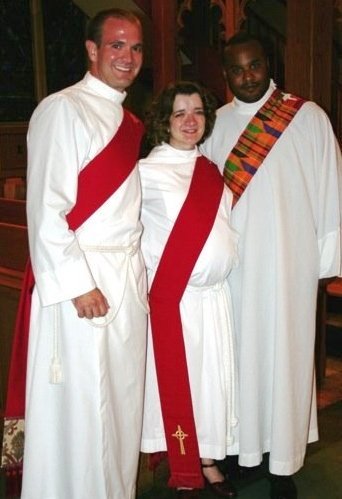
The Reverands Jody Burnett, Jennifer Andrews-Weckerly, and Charles Fischer III, Cathedral Church of St. John, June 24, 2009

Later this month I will celebrate the seven-year anniversary of my ordination.  What most people remember about that day was that I was very pregnant.  I confess that my large belly in an alb and a stole were rather extraordinary.  But what I remember about that day was a brief, but profound encounter.  I had gotten to the Cathedral early to make sure everything was in place and everyone knew where to go.  I was bustling around, managing logistics, when I ran into my boss, who was the rector of the church where I was serving.  She saw that I had my clergy shirt on but that I had not yet put on my collar.  You see, although you are not technically ordained until midway through the liturgy, you put your collar on before the liturgy starts.  The idea seemed strange to me to put it on before the bishop laid hands on me.  And if I am really being honest, I was really nervous about the whole endeavor.  My rector put her hands on my shoulders, looked me square in the eye, and said, “Jennifer, it’s time.  Go put on your collar.”

When we talk about ordination, we talk about the newly ordained experiencing an ontological change – a change in who the person is and in the nature of her existence.  It sounds rather dramatic because the change is dramatic.  When we ordain someone, we forever set them apart for a specific role in the church.

This Saturday, we will join our new curate, Charlie Bauer, as he is ordained to the transitional diaconate.  Charlie will be facing a similar ontological change – committing the rest of his life to this new way of being in and for the church.  Ordained persons do not simply start a new job.  Their whole person and existence is changed.  That is why an ordination is so special – because it is a day set apart for honoring this tremendous change.

Of course, all people in the church have access to ontological change.  Both baptism and confirmation are considered similar ontological changes – something profound happens in those moments, moments that only happen once in a lifetime.  We are marked as something different, and the way that we live our lives changes forever.  Because that change for all of us is so profound, the church sets apart days that we reaffirm our baptismal covenant and ordination vows.  We want to remember those tremendous moments when we put on a collar or stole, when water was poured over our heads, when a bishop placed heavy hands on our heads, and when we felt the Holy Spirit whisk through the room.  I hope you will join us as we celebrate this ontological change with Charlie.  But I especially hope you will take a moment to remember your own change and how the Spirit invites you to reclaim your changed identity.


Sermon – John 13.31-35, E5, YC, April 24, 2016

27 Wednesday Apr 2016

Posted by jandrewsweckerly in Sermons

≈ Leave a comment

Tags

baptism, child, Christian, command, covenant, God, hard, identity, Jesus, live, love, neighbor, parent, Sermon, simple, speech, work

A few years ago, some friends of mine engaged in the elevator speech challenge.  The idea was simple.  If you were stuck in an elevator with someone for thirty seconds and were asked to tell them about your faith, what would you say?  The challenge was to explain to someone your faith in Jesus Christ in thirty seconds or less.  I remember when my friends started sharing their elevator speeches, I was totally intimidated.  First, I knew that if someone actually asked me to do this in an elevator, I would probably stutter through some answer, mostly filled with “ums” and “you knows,” and not much of substance.  But more importantly, even when I tried to sit down and give myself way more than thirty seconds to formulate my thirty-second speech, I could not do it.  I could not figure out how to distill everything that had happened to me in my faith journey, why I still believe and am so devoted to church, and who I believe the three persons of the Godhead to be.

The last night in the upper room that we hear about in our gospel lesson today is a little like Jesus’ elevator speech.  Although the disciples did not fully grasp the importance of that night, Jesus certainly did.  If you remember, back on Maundy Thursday, we joined Jesus and the disciples on this night.  Jesus tells the disciples many things.  He teaches them about the importance of servitude as he washes their feet.  He teaches them how to celebrate the Lord’s Supper.  But when Judas leaves at the beginning of our reading today, Jesus knows he is out of time.  The end is coming and he desperately wants to leave the disciples with a few words of wisdom.  Knowing his time is up, Jesus does not tell anymore parables or give them any convoluted metaphors.  He keeps his words simple and direct.[i]  “Love one another,” he tells them.  “Love one another as I have loved you.”  That is all he gives them.

His words are simple, perfect, and beautiful.  I am sure those words were in many of the elevator speeches I read.  God is love.  Our call is to love as Jesus loved us.  That is how others will know us to be Christians – through our love.  The problem is this:  though “love one another” sounds simple, perfect, and beautiful, loving one another is really hard work.  Think about that one family member who is so difficult – the sibling who always tries to start a fight, the family member who always has some story about why they need to borrow money from you, or that aunt who is just plain mean.  Jesus says we must love them.  Or think about that classmate who started a nasty rumor about you, the coworker who took credit for your idea, or that friend who shared your confidence with someone else.  Jesus says we must love them too.  Or think about that political candidate that you cannot stand, that religious leader who constantly says offensive things, or that homeless person you tried to help who was completely ungrateful.  Jesus says we must love them too.  Jesus words, “Love one another,” are simple, perfect, and beautiful.  But Jesus’ words are also hard, frustrating, and sometimes seemingly impossible.  Loving one another is at times the most wonderful, rewarding thing we do in this life, and at times is one of the most challenging, difficult things we do in this life.  But we love because that is what Jesus taught us to do.

Today we will baptize a child into the family of God.  Baptism is our sacred initiation rite.  During any initiation rite, we normally summarize what is most important to us so that the newly initiated person knows what we expect from her.  In this case, the parents and Godparents will be reminded of our ultimate priorities so that they can teach her in the years to come.  Most of those promises and priorities come in the baptismal covenant.  We ask five questions:  Will you continue in the apostles’ teaching and fellowship, in the breaking of the bread, and in the prayers?  Will you persevere in resisting evil, and, whenever you fall into sin, repent and return to the Lord?  Will you proclaim by word and example the Good News of God in Christ?  Will you seek and serve Christ in all persons, loving your neighbor as yourself?  Will you strive for justice and peace among all people, and respect the dignity of every human being?   The questions are big questions – the guiding principles of our faith.  But most of the questions boil down to that night in the upper room:  love one another.

As we think about baptizing Elaina today, and teaching her to love, some of us may feel overwhelmed.  We know how hard loving is.  Elaina will even teach her parents and godparents how difficult loving is:  when she learns and uses the word “no!”, when she throws her first epic temper tantrum, or when she first utters those dreaded words, “I hate you!”  But Elaina will also teach the parents and godparents how wonderful love is:  when she first calls you by name, when you first see her helping someone or tenderly comforting a crying friend, or when she finally learns those wonderful words, “I love you!”  Everyday her parents and godparents will have the chance to teach her about what her baptism means by showing her how to love.  They may not have a patented elevator speech, but Elaina will understand what her Christians identity means when she sees what “love one another” really means.

But today is not just about Elaina, her parents, and her godparents.  Today is for all of us.  Today is a day when we too can take stock of how well we are living into our own identity as baptized children of God.  Every day we can take a moment to remember where we have failed to show love and where we have excelled in showing love.[ii]  The moments will be small and sometimes seemingly inconsequential.  But all those tiny moments add up to a lifetime of loving one another.  And today we will promise to, with God’s help, keep trying to be a people who love another.  Loving one another may not be a fancy elevator speech.  But loving one another might be much more powerful in the long run than any fancy words we can assemble – because Jesus’ commandment today is not so much about what we believe, but about how we live.[iii]  Jesus did not tell us to love one another because he knew loving one another would be easy.  But Jesus did tell us to love one another because he knows that we can.  He has seen each one of us do that simple, perfect, and beautiful act.  Today, he invites us to keep up the good work.  Amen.

[i] Gary D. Jones, “Pastoral Perspective,” Feasting on the Word, Year C, Vol. 2 (Louisville:  Westminster John Knox Press, 2009), 468, 470.

[ii] David Lose, “On Loving – and Not Loving – One Another,” April 21, 2013, as found at https://www.workingpreacher.org/craft.aspx?post=2542 on April 20, 2016.

[iii] Jones, 470.

← Older posts
Newer posts →

Recent Posts

  • On Change and Bread…
  • Sermon – Exodus 14.19-31, P19, YA, September 13, 2026
  • On Realizing Dreams…
  • On Seeing the Kingdom…
  • Sermon – Exodus 3.1-15, P17, YA, August 30, 2026

Archives

  • September 2026
  • August 2026
  • July 2026
  • June 2026
  • May 2026
  • April 2026
  • February 2026
  • January 2026
  • December 2025
  • November 2025
  • October 2025
  • September 2025
  • August 2025
  • July 2025
  • June 2025
  • March 2025
  • February 2025
  • December 2024
  • November 2024
  • October 2024
  • September 2024
  • August 2024
  • July 2024
  • June 2024
  • May 2024
  • March 2024
  • February 2024
  • January 2024
  • December 2023
  • November 2023
  • October 2023
  • September 2023
  • August 2023
  • July 2023
  • June 2023
  • May 2023
  • March 2023
  • February 2023
  • January 2023
  • December 2022
  • November 2022
  • October 2022
  • June 2022
  • May 2022
  • January 2022
  • December 2021
  • November 2021
  • October 2021
  • September 2021
  • August 2021
  • June 2021
  • May 2021
  • April 2021
  • March 2021
  • February 2021
  • January 2021
  • December 2020
  • November 2020
  • October 2020
  • September 2020
  • August 2020
  • July 2020
  • June 2020
  • May 2020
  • April 2020
  • March 2020
  • February 2020
  • January 2020
  • December 2019
  • November 2019
  • October 2019
  • September 2019
  • August 2019
  • July 2019
  • June 2019
  • May 2019
  • April 2019
  • March 2019
  • February 2019
  • January 2019
  • December 2018
  • November 2018
  • October 2018
  • September 2018
  • August 2018
  • July 2018
  • June 2018
  • May 2018
  • April 2018
  • March 2018
  • February 2018
  • January 2018
  • December 2017
  • November 2017
  • October 2017
  • September 2017
  • August 2017
  • July 2017
  • June 2017
  • May 2017
  • April 2017
  • March 2017
  • February 2017
  • January 2017
  • December 2016
  • November 2016
  • October 2016
  • September 2016
  • August 2016
  • July 2016
  • June 2016
  • May 2016
  • April 2016
  • March 2016
  • February 2016
  • January 2016
  • December 2015
  • November 2015
  • October 2015
  • September 2015
  • August 2015
  • July 2015
  • June 2015
  • May 2015
  • April 2015
  • March 2015
  • February 2015
  • January 2015
  • December 2014
  • November 2014
  • October 2014
  • September 2014
  • August 2014
  • July 2014
  • June 2014
  • April 2014
  • March 2014
  • February 2014
  • January 2014
  • December 2013
  • November 2013
  • October 2013
  • September 2013
  • August 2013
  • July 2013
  • June 2013
  • May 2013
  • April 2013
  • March 2013
  • February 2013
  • January 2013
  • December 2012
  • November 2012
  • October 2012
  • September 2012

Categories

  • reflection
  • Sermons
  • Uncategorized

Meta

  • Create account
  • Log in
  • Entries feed
  • Comments feed
  • WordPress.com

Blog at WordPress.com.

  • Subscribe Subscribed
    Seeking and Serving
    Join 397 other subscribers

    Have a WordPress.com account? Log in now.

  • Seeking and Serving
    View site in Reader
    Manage subscriptionsSign upLog in
    Report this content
    Collapse this bar
Loading Comments...