• About

Seeking and Serving

~ seek and serve Christ in all persons

Seeking and Serving

Tag Archives: love

Homily – Mt. 11.25-30, St. Francis Feast, YB, October 21, 2018

24 Wednesday Oct 2018

Posted by jandrewsweckerly in Sermons, Uncategorized

≈ Leave a comment

Tags

blessing, easy, healing, homily, hurt, Jesus Christ, light, love, pets, reconciliation, relationship, rest, sabbath, Sermon, St. Francis, village, wolf, yoke

FrancisOfAssisi

Photo credit:  http://thewildreed.blogspot.com/2007/10/st-francis-of-assisi-dancer-rebel.html

Today we honor the life of St. Francis of Assisi.  Francis is one of the most popular and admired saints of all time.  Most of us know the highlights of his story: born the son of a wealthy man in 1182; had a conversion experience and devoted his life to Lady Poverty; shaped monastic and lay devotion; was a friend to all God’s creatures – being known to have preached to the birds.  But the story I like most is the story about St. Francis and the Wolf.

According to legend, there was a wolf that was terrorizing a nearby town, killing and eating animals and people.  The villagers tried to fight back, but they too died at the jaws of the wolf.  Francis had pity on the people and went out to meet the wolf.  When Francis found the wolf, he made the sign of the cross, and said, “Come to me, Brother Wolf.  In the name of Christ, I order you not to hurt anyone.”  The wolf calmly laid down at Francis’ feet.  Francis then went on to explain to the wolf how the wolf was terrorizing the people and other animals – all who were made in the image of God.  The wolf and Francis then made a pact that the wolf would no longer harm the town and the town would no longer try to hurt the wolf.  The two traveled into town to explain the pact they had formed.  The people were amazed as Francis and the wolf walked side-by-side into town.  Francis made the people pledge to feed the wolf and the wolf pledge not to harm anyone else.  From that day on, the wolf went door to door for food.  The wolf hurt no one and no one hurt the wolf; even the dogs did not bark at the wolf.[i]

What I love about this story of St. Francis is that the story is about reconciliation and relationship.  At the beginning of the story the town and the wolf are at an impasse – the wolf is hungry and getting attacked; the people are afraid and are lashing out.  What Francis does for both parties is shock them out of the comfortable.  For the wolf, no one has addressed the wolf kindly – they have either shut the wolf out or actively tried to kill the wolf.  For the people, the wolf has not asked for help – he has simply and violently taken what he needed and wanted.  Francis manages to shock the wolf first – not through violence or force, but with the power of love and blessing.  By giving a blessing in the name of God, Francis is then able to implore the wolf to reciprocate with love.  Francis also manages to shock the village – not with a violent victory, but with a humble display of forgiveness and trust.  By walking into town with a tamed wolf at his side, Francis is able to encourage the town to embrace, forgive, and care for the wolf.  Francis’ actions remind both parties that unless their relationships are reconciled, unrest and division will be the norm.

The funny thing about this story is that the story is pretty ridiculous.  I mean, how many of us go around talking to wild animals, blessing them with the sign of the cross, expecting anything other than being attacked?  We will never really know whether the story is true.  But like any good Biblical story, or even any good midrash, whether the story is true is hardly the point: the point is that the stories point toward “Truth” with a capital “T.”  What this story teaches is that peace and reconciliation only happen through meeting others where they are.  We cannot expect great change unless we are willing to get down in the trenches – to go out and meet that destructive wolf face-to-face.  The other thing this story teaches is relationships are at the heart of reconciliation.  Only when the wolf and the town began to get to know each other and began to form a relationship with one another could they move forward.

This is the way life is under Jesus Christ.  In our gospel lesson today, Jesus says, “Come to me, all you that are weary and are carrying heavy burdens, and I will give you rest.  Take my yoke upon you, and learn from me; for I am gentle and humble in heart, and you will find rest for your souls.  For my yoke is easy, and my burden is light.”  Jesus’ words have layered meaning.  The first meaning we all catch is that Jesus offers us rest and refreshment.  Jesus encourages us to come to him, to cast our burdens and cares upon him, and to take rest, to take Sabbath in Christ.  Our souls will find peace in Christ Jesus.  The second meaning is that peace in Christ Jesus is not without work.  Jesus does not say come unto me and relax forever in happy retirement.  Jesus says we will still have to take on a yoke – the burden of disciple living.  But luckily, that burden of being Christ’s disciple will not be burdensome – it will be light.  Finally, not only will Jesus make the workload “light,” as in not heavy:  Jesus will also make us “light” – as in lights that shine into the darkness and refuse to allow the shadow to overwhelm[ii]; as in lights that shine on this very Holy Hill where Hickory Neck rests.  We become the light when we work for reconciliation in our relationships with others.

That is why we do so many special things today.  Today, we ask for prayers and then exchange signs of peace – that God might help us reconcile the relationships in our life that need healing.  Today, at our 9:00 am service, we ask for blessing on our animals – that God might help our relationship with our pet be one of blessing and light.  Today, we come to Jesus for Sabbath rest – that God might renew us on this Sabbath day, use the rest to fill us with light, and renew our commitment to be agents of reconciliation, gladly putting on Christ’s yoke.  Amen.

[i] John Feister, “Stories about St. Francis and the Animals,” October 4,2005, as found at https://faith32.livejournal.com/61897.html on October 18, 2018.

[ii] Mel Williams, “Let it go…and rest” Faith and Leadership, July 6, 2014 as found at http://www.faithandleadership.com/sermons/mel-williams-let-it-go%E2%80%A6and-rest  on October 18, 2018.

Sermon – Ephesians 4.25-5.2, P14, YB, August 12, 2018

22 Wednesday Aug 2018

Posted by jandrewsweckerly in Sermons, Uncategorized

≈ Leave a comment

Tags

baptism, children, Christ, Christian, Ephesians, faith, formation, God, identity, imitators, improve, love, offering, Paul, Sermon, systems, vacation bible school

I used to LOVE Vacation Bible School when I was growing up.  As a preacher’s kid, of course that meant I went to VBS at my dad’s church.  But I loved Vacation Bible School more than that.  I would sign up for VBS at the Baptist Church, the Presbyterian Church, and the Lutheran Church, and would beg, “Can I go? Can I go?”  I have always joked that what I really like about VBS was the crafts.  But as I watched our own children in Vacation Bible School this week at Hickory Neck, I began to wonder if my crafts assessment was entirely true.  I liked the songs too.  And the snacks.  And the storytelling.  I liked the instant comradery and the games and laughter.  I liked the feeling of being loved by people who did not even know me.  VBS was the first – and probably only since I did not go to church with many Baptists – place where I was asked if I had accepted Jesus as my Lord and Savior; and if I had not, I could ask Jesus to come to me in that moment.  My eight-year-old self was not sure what the pastor meant, but I did know a strange warming of my heart that night.

On those hot, humid summer nights, with the cicadas chirping and the lightning bugs flashing, VBS accomplished for me what I talked about with the Baptismal family last weekend.  When we prepare a child and their family for baptism, we talk about how their primary role is to raise the child up in the faith – get them to church, talk about Jesus at home, pray together, and read the Bible stories.  The parents and godparents are not flying solo with the task of raising the child in the faith – we as a community pledged just last week that we would be active in raising Dallas up in the faith.

As I watched our children at Vacation Bible School this past week, I slowly began to realize that we were doing just that – raising children up in the faith.  We were teaching them to pray, to sing, to learn, to tactilely use their bodies to engage Jesus.  And sure, there were games and snacks and laughter and silliness.  But there were also children who walked over to their neighbor’s houses and delivered VBS registration forms, inviting them into Jesus’ love too.  There were children who remembered their neighbors with pets and tentatively rang doorbells to deliver pet treats they had made with their own hands.  There were children whose joyous songs in the Public Library later that day brought hope to a man who had lost hope.  When I was a child, I was lured by crafts and snacks and potato sack races; but I left with love, and hope, and mercy.  I left knowing deep in my soul who Jesus was and what being a Christian meant.

This week I have begun to wonder if we might need an adult version of VBS; if we might need a week of evenings where we just spend some time with Jesus among the community of the faithful.  Bishop Curry would call that a revival, and Episcopal Churches are doing revivals all around the country.  I am not sure what we call that week matters, but I am beginning to wonder if we need those summer nights because we have fallen away from the practices Paul articulates today in his epistle to the Ephesians.  Paul is quite clear.  If we are going to claim the moniker of Christian, then our lives need to be signposts.  We need to speak truth to one another.  We need to not let anger rule our lives.  We need to make new ways for thieves and sinners to not only repent, but be fully restored into the world as those who not only contribute their labor, but who are freed to give their money to the poor.  We need to take on kindness, tenderness, forgiveness.  We need to be imitators of God, beloved children of God, living in love.

We hear Paul’s words today and say to ourselves, “Yes, yes, the world needs more of that.”  But what we really mean is, “Yes, that lady two rows over needs to start doing that,” or “Yes, that guy on my committee needs to be that.”  But Paul is not talking to our neighbor.  He is talking to us.  He is talking each person in this room saying, “You…I need you to live in the life of love, to be an imitator of God, to be…to be a Christian.”  And that is where the squirming begins.  I hear Paul’s words about not letting the sun go down on your anger and I can tell you there have been many a night when I was just not done with my anger – I needed to let my anger burn off before I could speak a word of forgiveness or, more importantly, a word or apology.  I hear Paul’s words about thieves and I am not worried about thieves being gainfully employed so they can make charitable contributions – I need them to punished for what they took from me.  I hear Paul’s words telling me to imitate God and I am incredulous that I could ever achieve such holiness – I need to worry about all those other people who are not imitating God towards me!

This week, I attended a conference called the Global Leadership Summit.  Founded over 25 years ago, the conference is for all people, regardless of industry or position at work or home, looking to hone their leadership skills, to learn new techniques, and to refresh old learnings.  The Conference is held in Chicago, but through technology is live broadcasted all over the world, even to Williamsburg.  One of the things I took from the Summit was that my leadership improvement work was primarily about improving myself.  Craig Groeschel reminded us, “When the leader gets better, everyone gets better.”  His message is the same message we teach congregations and families through family systems work.  The only person you can improve in a system is yourself – even though you know for certain your brother Bob is the real problem.  System experts live by this understanding though because they have witnessed time and again when one person in the system gets better, he or she creates a ripple in the system – and almost magically, everyone else starts getting better.

The reason why we send our children to VBS or Sunday School or Children’s Chapel is because we want them to know, and love, and embody Christ.  We want them to be imitators of God, beloved children, who live in love, as Christ loved us.  But what we sometimes forget in helping our children grow in Christ is that we adults need to grow in Christ too – to become those imitators of God, beloved children, who live in love, as Christ loved us.  We like to bemoan the state of the world today – to look at how we are so divided and cannot seem to come together and we want to just give up on the world, or worse yet, we want to bury our heads in the sand and not come back up until things magically get better.  But what Paul says to us today is not to worry about everyone else.  Start working on yourself.  Now whether that means you need to go to a Leadership Summit, or join a Bible Study, or commit to coming to Church regularly, or maybe agree to help with VBS so you can absorb some of that joyful goodness – do something for your faith formation today.  Systems work teaches us that the only person we can change in a dysfunctional system is ourselves.  Paul looking at Ephesians or the United States in 2018 would same the same – work on yourself, imitate God, live in love, make your life like Christ’s – or as Paul says, “a fragrant offering and sacrifice to God.”

I know that Episcopalians are pretty divided about the use of incense.  I have always loved incense.  The parish I served in Alexandria used incense every Sunday.  I loved how the scent lingered in my hair and on my clothes after church.  Sometimes, I would bring my alb home, and when I opened the bag, the fragrance of incense wafted into the room.  Years later, on the occasions my other parishes used incense, I found the scent had a calming effect on my body.  That fragrance was my physical, tangible way of remembering that I was in the presence of God.

When Paul invites us to be a fragrant offering, he is inviting us to be that tangible reminder of God that lingers behind.  When we respect the dignity of every human being, our Christian fragrant offering lingers behind.  When we are kind, tenderhearted, and forgiving, our fragrant offering lingers behind.  When we seek to imitate God in our lives, even as others see us fail and try again and again, our fragrant offering lingers behind.  I am not saying our work on ourselves will be perfect right away – or even ever help us achieve that true fragrant offering.  But what Paul encourages us to do is try.  To put ourselves in places where we can grow in faith and love and mercy so that we can become those fragrant offerings that linger with others.  And Paul knows we can do that work because God is with us to enable us.  Our invitation today is to accept the challenge:  to not leave behind the foul odors of anger, judgment, and malice, but through our baptismal-life striving through our faithful work on ourselves, to leave behind the fragrant scent of God.  What happens after that is God’s work.  Amen.

GC79: On Needing Revival…

18 Wednesday Jul 2018

Posted by jandrewsweckerly in Uncategorized

≈ Leave a comment

Tags

Bible, Bishop Curry, church, Episcopal Church, General Convention, God, God's word, Holy Spirit, interpretation, liberation, love, ordination, protest, revival, role, scripture, women

This week, I continue with more reflections from the General Convention of the Episcopal Church.  Look for posts in the days to come that give some insight into the experiences of the week, the take-home lessons, the pondering questions still ruminating in me.  Thanks for following along!

On Saturday evening of General Convention, we were invited to a revival at a local church.  The revival was powerful and clearly moving to many in the crowd.  Of particular note was the Spanish translator hired to translate for Bishop Curry.  She was poised, animated, and seemed to feed off Bishop Curry’s energy.  I do not know how she did it, but the two of them really seemed to be preaching together – to be dancing in God’s word as they preached a message of love and life.  Even for someone whose Spanish is minimal, I found her translation and presence really made Bishop Curry’s sermon come alive in a new way.

But what has been staying with me about that evening was the protest outside the church.  Members of Westboro Baptist Church gathered to protest what the Episcopal Church has been doing; from their signs, I understand they are mostly upset about the ordination of women, and our inclusion of the LGBTQ community in ordained and married life.  In the course of my life, I have had many conversations about both of those issues, including people confronting me about my own ordination and my theological understanding about the expansiveness of God’s love for all.  Those conversations have sometimes been hard, hurtful, and even anger-inducing.  But ultimately, they were always conversations – things said to my face, debates had between people, disagreements had within the context of relationship.

So the sentiments of the protestors was not new to me (although some of the language used against female pastors would have made many clutch their pearls).  What was heartbreaking was seeing a preteen standing next to her mother with a sign that read, “No Women Preachers – 1 Tim. 2.12.”  I went back and reread 1 Timothy 12, and I confess, a good portion of the chapter is about wives submitting to their husbands, keeping silent, allowing their husbands to lead.  We’ll talk about that in another blog post.  But as I looked at the young girl, I remembered all the times I started asking hard questions about things I had read in the Bible that did not seem to make sense – that did not seem to jive with the wide embrace of God’s love.  I remembered the Sunday School teacher who encouraged us to read the Bible literally, condemning her own current marriage because she had once been divorced.  I remember feeling a sense of discomfort until I found liberation in the Episcopal Church – a church that taught me to ask hard questions, to be uncomfortable in the ambiguity, to be released from the bonds of literal biblical interpretation, and to read the Bible in a new way.

Holding all that in my mind, I grieved for this young woman.  I sorrowed for the mother standing next to her, teaching her to keep silent, and to disrespect every woman who believes God is empowering us with God’s word.  I lamented the hate being inculcated into this young girl.  I mourned the light being limited in her life.  As female preachers poured out of buses for the revival, I found myself wanting to whisper into her ear, “God’s love is bigger than the words in 1 Timothy.”  Holy Scripture has been used time and again to limit God’s love, grace, and mercy.  I am sure I am guilty of a similar sin in one way or another; perhaps even this blog post is an exercise in sinful presumption.  My prayer for all of us is that we have people whispering in our ears words of truth, reconciliation, and peace.  Let not the work of the Holy Spirit be extinguished in us.

IMG_1755

Photo credit:  Jennifer Andrews-Weckerly (permission needed for reuse)

Sermon – 1 Samuel 17.1a, 4-11, 19-23, 32-49, P7, YB, June 24, 2018

27 Wednesday Jun 2018

Posted by jandrewsweckerly in Sermons, Uncategorized

≈ Leave a comment

Tags

armor, bold, Christ, confident, cynical, David, disciple, dispassionate, Eucharist, faith, faithfulness, fear, God, Goliath, identity, love, politics, Sermon, skeptical, table, trust, underdog, vulnerable

This summer, our Faith and Film series is all about superheroes.  I was never a huge fan of superheroes growing up.  I liked Superman and Batman nominally, sported a pair of Wonder Woman Underoos as a kid, but in general wasn’t really into superheroes and certainly not into comic books.  But a few years ago, I stumbled into the film, The Avengers, and found myself curious about the back stories of all these superheroes.  That began a deep dive into multiple films, many of which you can see this summer.  The first one, Captain America, is a classic story of the little guy overcoming.  Steve Rogers, a literal little guy with a bad case of asthma, wants to enlist in the US Army during World War II so badly, but his health and height disqualify him.  Impressed by his tenacity, Steve gets recruited into an experimental program to be medically turned into a Super Soldier.  There begins his journey of the little man taking on the big man of Nazi Germany.

Most of us enjoy a good story of the little man overcoming.  That’s why the story of David and Goliath is so epic in our memory.  This little kid, totally untrained, completely unarmed (with the exception of some rocks and a sling), and certainly the underdog to the 9 feet 6 inches[i] of Goliath, David is the prototypical little man.  And yet, with the entire Philistine army staring them down, with a giant taunting them for forty days, and with the ominous threat of defeat, no one else is willing to step forward.  The giant, covered in over 126 pounds of armor, and holding huge weapons like the spear whose iron head weighs fifteen pounds[ii], utilizes his own brand of psychological warfare.[iii]  In the end, that dry river bed between the two armies is not just a valley of separation, but a “chasm of fear.”[iv]  And yet, somehow, the teenage shepherd boy steps forward to fight – the little man, the underdog, makes his move.

But unlike a typical underdog, David does not need science, or a lucky break, or some trick.  What David needs has nothing to do with him.  Instead, what he needs is God.  No one in the Israeli camp has mentioned God at this point in the story.  Saul has tried to overcome the chasm of fear with the promise of riches and even his own daughter’s hand in marriage.  And yet, the entire army of Israel can only see how mismatched they would be against the ultimate warrior.  But David sees things differently.  Having fought lions and bears to save his sheep, David knows he can fight Goliath too.  But not because he is a mighty warrior – but because Yahweh delivered David then too.  Even Saul, God’s formerly appointed king, has forgotten God.  But not David.  David is first to speak Yahweh’s name in almost forty verses of text.[v]  When David faces Goliath, he invokes God’s name, recalling with the name the entire memory of Yahweh’s deliverances of Israel in the past.  David knows that he does not need the conventions of human warfare, but only the God of Israel.[vi]

This week, I have been thinking what a ridiculous sermon that is:  all we need is God.  If all we needed was God, we wouldn’t be in such a political mess, totally unable to compromise, hear each other, and work for the common good.  If all we needed was God, that cancer diagnosis, that lost job, that lost pregnancy, or that lost relationship would not have felt so devastating.  If all we needed was God, we would have figured out a way to both secure our borders and humanely treat those fleeing injustice and seeking asylum.  In saying all we need is God, we sound like a bunch of hippies singing the great Beatles song, “All You Need is Love.”  As modern pragmatists, we know better – we know letting go and letting God is what you say – but not what you do.

So how do we turn ourselves from being skeptics, cynics, and dispassionates to seeing all we need is God?  Well, first we have to define a few things.  What is happening in David’s story should not be a surprise.  If you remember a few weeks ago, when the people broke their longstanding covenant with God, asking for a king like the other nations, God gave them Saul.  And Saul was just that – like the other nations, fighting battles with weapons of other nations.  So when David offers to fight, Saul does what a conventional leader would do – arm David with the conventions of war.  He tries to weigh down David with his armor, hoping against hope that there might be a modicum of protection against the Philistine.  Saul is a ruler like the other nations have.  The contrast between Saul and David then becomes a contrast between trusting conventional means and the means of God.[vii]  Saul has become ruled by fear instead of faith.

The way we pull ourselves out of being skeptical, cynical, or dispassionate is not by rallying behind the idea that we are the little man – the underdog David or Captain America, just waiting to be empowered by God.  The way we put to bed our skepticism, cynical thoughts, or dispassionate feelings about all the things in life overwhelming us is to recall the faithfulness of God.  When David says, “All you need is love,” he does not mean all you need is people giving hugs to one another.  What he means is, all you need is to remember the faithfulness of God – especially when we are not faithful at all!  In his speeches to Saul and Goliath, David is recalling the salvation narrative – the stories of God’s faithfulness for generations.  His trust is actually pretty bold too, considering the current king Saul’s appointment represents the breaking of covenant between God and the people.  But David trusts even a broken covenant can be overcome.  David claims his identity as a child of God and knows his identity is all he needs to fight the worst this world has to offer.

This past week, as politics and religion got dragged together in front of camera crews, I slowly began to realize that we are in a David moment.  We can keep doing what we have been doing – keeping our faith out of politics, putting politics in a box that we especially do not open on Sundays, or we can start realizing that we can never put our faith in a box.  The bond that we have as Episcopalians and especially within the hugely politically diverse community that is Hickory Neck is extremely fragile.  Our fragility is why I rarely talk about politics among the community.  I value our ability to come to the Eucharistic Table in spite of our difference over just about anything else.  But that high value on the common table can come at a cost – the cost is never talking about what being a people of God means – what being a disciple of Christ and being an American means.  In order to protect that common table, I have put on 126 pounds of brass armor, and taken up a spear whose head weighs fifteen pounds.  Instead, today David invites us to shed the ill-fitting armor, and just walk in the clothes God gave us (and maybe a few stones).

I am not saying once we shed man-made armor we will suddenly know what immigration policies are the best.  But what I am saying is until we take on God’s armor, until we recall all those times when God has delivered us, when God has turned chasms of fear into paths of faithfulness, until we remember that we have a distinct identity as children of God and disciples of Christ, we will not be able to take on the Goliath issues of our day.  Stripping down to David-like clothing, we are able sit down comfortably, to see each other more honestly, to be in relationship more authentically, to gather at this table – not just trying to avoid banging our heavy armor into each other, barely able to make eye contact because of our heavy helmets, but actually brushing the skin of elbows with one another, looking deeply into the eyes of the chalice bearer serving you Christ’s blood, and offering the hand of Christian friendship as we rise from the altar rail together.  We can do all those things because God is faithful.  We can do all those things because God has delivered us before.  We can do all those things because we are Christ’s disciples – and that is what we do through God.  We may be underdogs, and we may be vulnerable in a world that is happy to deploy psychological warfare, but we are united and empowered by the love of God.  Our invitation is to step trustingly, boldly, confidently into that love.  Amen.

[i] William P. Brown, “Exegetical Perspective,” Feasting on the Word, Supplemental Essays for Year B, Batch 2 (Louisville:  Westminster John Knox Press, 2012), 4.

[ii] Richard F. Ward, “Homiletical Perspective,” Feasting on the Word, Supplemental Essays for Year B, Batch 2 (Louisville:  Westminster John Knox Press, 2012), 4.

[iii] Walter Brueggemann, Interpretation:  A Biblical Commentary for Teaching and Preach, First and Second Samuel (Louisville:  John Knox Press, 1990), 131.

[iv] Ward, 2.

[v] Brueggemann, 130.

[vi] Brueggemann, 132.

[vii] Brueggemann, 131.

On Politics at the Table…

30 Wednesday May 2018

Posted by jandrewsweckerly in Uncategorized

≈ Leave a comment

Tags

Bishop Curry, church, Eucharistic Table, God, gospel, hope, Jesus, love, politics, Reclaiming Jesus, table, transformative, truth

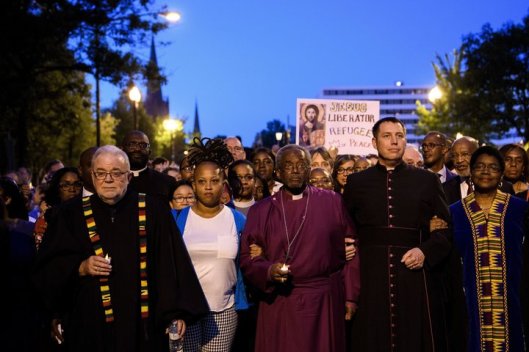
Last week I talked about Presiding Bishop Michael Curry’s sermon at the Royal Wedding.  His sermon on the transformative power of love created shock waves – one, because most people weren’t expecting such a powerful sermon on a royal wedding day; but two, because his words resonated so deeply with people.  He created a spark of hope, a sense of clarity of purpose, and a renewed passion for justice and compassion.   The message was not new:  he simply preached the gospel of Jesus, a two-thousand-year old message.  And yet, the gospel, like it does for every generation, spoke a word of truth.

But after appearances on the Today Show, Good Morning America, The View, and countless other programs, it would be easy to soften Bishop Curry’s message, to say, “Yes!  Love is the answer!” and walk away with a warm fuzzy feeling.  The trouble is, Bishop Curry’s sermon was not just about the easy parts of love.  Bishop Curry preached about the action of love.  If we find the message of love compelling, then we have to start living lives of love.  And that is where his powerful message starts getting uncomfortable.

5b0830721a00002700cdfc6f

Photo credit:  https://www.huffingtonpost.com/entry/bishop-michael-curry-joins-christian-march-to-white-house-to-reclaim-jesus_us_5b07261ae4b0fdb2aa51b060

Less than a week after his historic sermon, Bishop Curry joined prominent faith leaders from all over the country in a movement called, “Reclaiming Jesus.”  A video explaining the movement can be found here.  Now if you have spent any time with me, you know that I am very hesitant to talk politics in the pulpit or even publicly.  I have always served in churches that were a wonderfully complicated mixture of political opinions.  The Eucharistic Table is the thing that brings us together, kneeling before God, shoulder to shoulder with fellow church members whose bumper stickers promote the exact opposite opinion of our own.

But just because I do not believe Jesus was a Democrat or a Republican, does not mean that I do no think Jesus and the Gospel are not political.  In fact, Jesus’ very life was ended because he was too “political” – because his message of love made people uncomfortable.  That is what the Reclaiming Jesus movement is about – reminding us that the Church still has a message of love – and that message is not passive or polite but is quite active and alarming.

This week, I am taking the warm, encouraging feelings I had from Bishop Curry’s sermon and listening once again to his words about what love in the world means.  I invite you to join me.  Join me in hearing what in the Reclaiming Jesus message makes you uncomfortable.  Join me in pondering how both political parties get it a little bit wrong and a little bit right.  Join me in remembering that Jesus’ message of love is not the same as an invitation to “avoid politics.”  The question is how we can do politics better.  How can we be an example of what it means to don different bumper stickers and work together for justice, peace, and love?  What Bishop Curry preached at the Royal Wedding sounded beautiful – just like Jesus’ own words.  But what Bishop Curry and Jesus called for was not just beautiful.  It is hard, confusing, challenging work – and even harder to do when we disagree so deeply.  Thank God for the Eucharistic Table!  It is the only promise to me that we can do this – that we can be political agents of love together.  I hope you will join me!

chalice-emhc

Photo credit:  http://www.freerepublic.com/focus/religion/3163266/posts

On Peter, Paul, and Michael…

23 Wednesday May 2018

Posted by jandrewsweckerly in Uncategorized

≈ 1 Comment

Tags

church, disciple, Episcopal, Good News, Jesus, Jesus Movement, love, power, Presiding Bishop Michael Curry, Royal Wedding, Sermon

In seminary, each third-year student preaches a “senior sermon” in front of the entire seminary.  It’s a bit nerve-wracking because seminarians and priests are a pretty tough crowd.  Add that on top of professors who have molded you for three years, and the pressure is pretty intense.  I remember talking to a professor about my nerves and he assured me, “Well, you know what the old hymn says:  If you cannot preach like Peter, if you cannot pray like Paul, you can tell the love of Jesus and say, ‘He died for all.’”

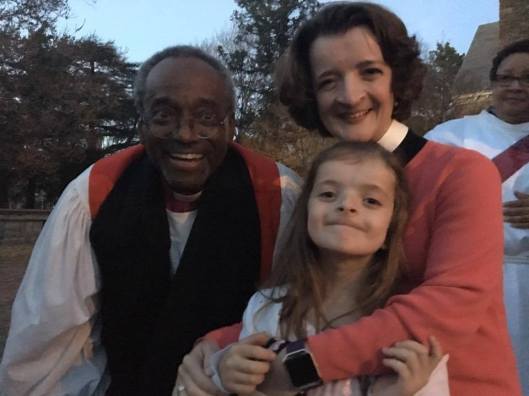
That hymn to which he was referring is, “There is a Balm in Gilead,” which is the same hymn that Presiding Bishop Michael Curry quoted in his sermon at the Royal Wedding.  Of course, preaching after Bishop Curry the next day felt equally daunting.  Lord knows, I cannot preach like Peter, and I certainly cannot preach like Bishop Curry.  But as I was thinking about it, I think what people have loved so much about Bishop Curry’s preaching at the Royal Wedding is:  1) he was authentically himself (which is obviously a bit different culturally from those gathered in the royal family, but his authenticity was infectious), 2) he was passionate about the love of Jesus and its ability to change the world, and 3) he gave the world a glimpse of what is so awesome about the Episcopal Church – a Church who understands the radical power of love and brings together people from all walks of life to thoughtfully, willfully, beautifully engage in doing powerful work in the world through love.

What has been fascinating to me about Bishop Curry’s sermon and the way it has been described as “stealing the show,” is that Bishop Curry was just doing what the Episcopal Church does every Sunday, at every wedding, and at every funeral – we worship God in the beauty of holiness, we teach those gathered, and we equip them to go out into the world sharing the good news of God in Jesus Christ.  What Bishop Curry’s success does is embolden us to live into our identity as disciples of Christ and members of the Episcopal Church.  I suspect you have talked to someone about Bishop Curry’s sermon in the last few days.  How about instead of just marveling about Bishop Curry’s talent as a preacher, you use this event to talk to someone about how you are inspired to be a follower of Jesus?  Keep it authentic:  “He was awesome, wasn’t he?  He reminds me of my church and the amazing things we are doing to harness the power of love.  I’d love to show you!”

What Bishop Curry did on Saturday at the Royal Wedding was be himself – a member of the Jesus Movement, sharing the Good News of God in Christ.  Your invitation is to be yourself and do the same.  You may not preach like Peter, and you may not pray like Paul.  But you can tell the love of Jesus, and say, “He died for all.”  I can’t wait to hear about your adventures!!

17426137_10155645675302565_2278358373496741633_n

With Presiding Bishop Curry in 2017, Photo credit:  Jennifer Andrews-Weckerly (use only with permission)


Homily – Acts 2.1-21, Pentecost, YB, May 20, 2018

23 Wednesday May 2018

Posted by jandrewsweckerly in Sermons, Uncategorized

≈ Leave a comment

Tags

baptism, baptismal covenant, cacophony, chaos, church, community, God, Jesus, languages, love, Pentecost, Sermon

33092215_1843823495673902_5618488268858327040_o

Photo credit:  John Rothnie (permission to reuse required)

I have been looking forward to this baptism for months.  Olive is one of four babies born at Hickory Neck within a month of each other, and one of five within a five-month period.  Not only did I enjoy watching Olive grow in her mom’s belly, I knew how fun welcoming her to the community would be, and especially how special her baptism would be.  So when the Bauer Family finally settled on Pentecost, I was thrilled – baptizing a baby on feast day adds excitement to an already festive day.

But as the liturgy planning staff met about a month ago, I realized we may have made a huge mistake.  We were talking about the needs for today, and remembered we needed to recruit all our foreign language speakers because Pentecost is the one feast of the year where we really try to simulate the experience of the historically significant day in the life of the faith.  And as we were talking about rotas, translations, and participants, a sudden sense of dread hit me.  “Um, Charlie?” I said.  “Are you sure you want to baptize Olive on Pentecost?  I mean, I love Pentecost, but, especially for strangers to our community, Pentecost is a little weird.  Do you want us to just skip the whole languages part?”  To his credit, Charlie didn’t hesitate.  “What better day to baptize?!?” he said, as though my question were silly.

I have been encouraged by Charlie’s enthusiasm, but the more I thought about his response, the more I questioned his logic.  Don’t get me wrong – I love what we do at Pentecost.  Pentecost is one of the few days of the liturgical year that our scripture really comes to life.  Hearing the cacophony of languages helps you to really imagine yourself there.  But this is the kind of service that I would also say to first-time visitor, “Just so you know, we don’t always do this!”  Because, although I love the cacophony, I wouldn’t want anyone to think today is the norm – that we always break into tongues in the service or that we always like to shock your senses.  Surely if we were going to baptize Olive, we should find a tamer way to welcome her to the community, and not freak out her family and friends from all the ends of the country.

We do this all the time with Church.  If we get the nerve up to ask a friend to Church, and they take us up on the offer, we want them to experience the best of Hickory Neck:  a welcoming environment, beautiful liturgy, a sense of belonging, and a deep connection to the immanent and transcendent God.  But just like when you introduce a new romantic interest to your family, you don’t have them meet everyone in the family at the beginning.  You save crazy Uncle Joe until at least the second or third Christmas, when you know your boy or girlfriend is already in love with you enough to make allowances for the crazy in your family.  The same is true for church – we would much rather you see the beauty of Hickory Neck on a regular Sunday or even on a day like Easter.  There is no need for us to show you some of the really weird parts of our faith, like Pentecost, until you have at least been here for a while.

So why was Charlie so enthusiastic about bringing his extended family to celebrate baptism on this one, crazy, bizarre day in the life of the church?  Was he not thinking this through?  Or was he secretly hoping to ensure his family never comes back?  I started working through why this might be the perfect day for a baptism, thinking through what we learn about the church and membership within.  First, we learn the power of the gospel, of the good news of God in Christ, to reach all peoples, no matter who they are.  Although practically speaking, today’s multilingual reading sounds jarring, what we know about this piece of scripture is that despite the din of noise, everyone heard the good news in their own language.  The gospel is not limited to one group of people or to one tribe or nation; the gospel speak truth to all.  Second, we learn that Jesus’ story is not just for us – Jesus’ story is for all.  Up until this point in our story, Jesus has been keeping his resurrection and ascension to a limited group of people.  But today, that norm implodes.  Jesus’ story is no longer for those nearest and dearest to Jesus – Jesus’ story is for everyone.  Third, we are reminded of our commission from Jesus – to go out into all the world, sharing the good news of God in Christ.  Not just the English-speaking places, not just the places where people look and act like us, not just the places that make us comfortable.  And finally, Pentecost affirms the ways in which God loves us, no matter what.  No matter how loud, crazy, or chaotic our lives become, God is with us, breaking through the din of noise we create and making that noise holy.

Perhaps instead of finding the most proper, polished day to baptize a child of God, today may be the perfect day to teach us all what the life of faith is about.  We all know that when our romantic interest or dear friend finally meets Crazy Uncle Joe, or finally sees us when we are sick or not looking our best, or finally realizes we have some pretty awful flaws, and LOVES US ANYWAY – those are the people we want to keep around.  The same is true for those new to the church or those being initiated into the community of faith – we want you to see us on our craziest days so that you know, no matter what God loves you anyway.  God sees your craziness, your chaos, those parts of yourself that you hide from others, and God not only loves you, God commissions you and makes a way you share that love to the ends of the earth.

That is what we affirm today in our baptismal covenant.  Given the promise of unconditional love from God, we promise in return to live a life in accordance with that unconditional love.  To seek and serve all persons, to strive for justice, to respect the dignity of every human being, to proclaim by word and example the good news of God in Christ, to resist evil and repent, and to keep coming back to the community, breaking bread and joining in the prayers.  The chaos of today, the beauty of baptism today, the reminder of God’s love today are all meant to build us up so that we can get back out into the world.  What better day than today to baptize?!?  Amen.

Sermon – John 15.9-17, E6, YB, May 6, 2018

09 Wednesday May 2018

Posted by jandrewsweckerly in Sermons, Uncategorized

≈ Leave a comment

Tags

Christ, church, fail, forgive, God, hurt, Jesus, life, love, pain, pretty, profound, redefine, Sermon, share

Jesus’ words today from John’s gospel have been beckoning me all week.  “As the Father has loved me, so I have loved you; abide in my love…I have said these things to you so that my joy may be in you, and that your joy may be complete…You are my friends…You did not choose me but I chose you.”  These are words that our weary souls need to hear.  We long for the wide, open embrace of God, the unconditional acceptance, the assurance that everything will be okay.  Jesus’ words today are a warm blanket we crawl into and wrap around ourselves, draping over our feelings of sadness, loneliness, doubt, insecurity, and uncertainty.  Jesus’ invitation to abide in his love is the fulfillment of every longing, aching need in our lives, and today Jesus offers that love freely, abundantly, joyfully, completely.

For some of here today, that is your sermon:  Jesus loves you, chooses you, befriends you, and completes your joy.  The humbling, overwhelming love of God invites you into that warm blanket, and you do not need to speak – just accept the gift and abide with God this week.[i]

For others of us, we may be a little too hardened to fully receive the invitation to abide in God’s love.  I used to serve with a priest whose main sermon, no matter what the text, was God loves us.  She said those words so often I remember I would sometimes stop listening.  My cynical self would start the diatribe, “Yeah, yeah, yeah.  God is love.”  The problem for many of us is love has failed us.  We have been in love, been loved by family or friends, or even have felt God’s love.  But we have also been hurt, rejected, or felt abandoned by all those parties.  And if we feel the failure of love too often, “Abide in my love,” sounds too shallow to have meaning, too romantic to last, too wonderful to be sustained.

For those of us who might roll our eyes at the saccharine nature of love we have experienced in the world, we may need a different sermon today.   Part of our challenge is we have defined love in such a way that we will be disappointed every time.  We watch movies, read books, even gaze at couples in those first dreamy weeks of new love, and think we know what love is.  Love becomes two people who agree all the time, who are always able to look lovingly at another never noticing imperfections, who never experience conflict, and who are always happy.  And if that is our expectation of love, we will always be disappointed.  For those of us in this camp, our sermon today is to redefine love.

A few years ago, Paul and Lucy were such a couple.  They had a romantic beginning – meeting in medical school, Paul was funny, smart, and playful.  As they built a life together, they began to dream and to plan.  When Paul finished his 90-hour workweek rotations, and life got back to normal, they would try to have a baby.  Everything was perfect – at least everything was perfect if you did not look too closely.  And then Paul got the diagnosis – a cancer that would give him two more years of life.  And suddenly everything changed.  Lucy’s life began to become about taking care of Paul, walking him through treatments, holding him in pain.  And Paul’s life became about making sure Lucy could enjoy life beyond him.  At one point, Paul assured Lucy he wanted her to remarry after he died.  The two even agreed to have that baby they had been planning.  Lucy worried having a child would make dying worse for Paul.  “Don’t you think that saying goodbye to a child would make your death more painful?” she asked Paul.  He replied, “Wouldn’t it be great if it did?”[ii]

What Paul and Lucy show us is love is not some sappy, sentimentalized emotion best captured by a romantic comedy with a great soundtrack.  Love is beautiful not because love is perfect, pretty, polished.  Love is beautiful because love is “all in,” ready for the ugliness of life, willing to take on pain and suffering and see that pain as a blessing.  Of course, Jesus describes love in the same way in today’s gospel lesson if we are paying attention.  We find ourselves so tarrying in the comforting love language and we sometimes miss the other love language in the text.  “Keep my commandments…love one another as I have loved you…lay down one’s life for one’s friends…go and bear fruit, fruit that will last.”  Jesus shows us what love looks like throughout his life.  He kneels down and tenderly washes the dirty, worn feet of his companions.  He accepts and welcomes adulterers, oppressors, and outcasts of every kind.  He loves and forgives, even when betrayed by his closest friends.  He gives up his life in the most gruesome, humiliating way.  Jesus’ love is not pretty or polished.  But Jesus’ love is profound.

That kind of love is the kind of love that drove most of us to Hickory Neck.  Maybe we came thinking we wanted a perfect, polished, pretty loving community that would make us feel loved too.  And many times, Hickory Neck is just that.  But other times we find a different kind of love at Hickory Neck – a love that stands by us when spouses die, when marriages fail, and when children stumble into dark places; a love that stands by us when diagnoses come, when tragedy strikes, and when sinfulness overcomes us; a love that stands by us when we disagree, when we hurt one another, and when we fail to meet each other’s expectations.  That kind of love sits next to us when we cry, even when no words are exchanged; that kind of love receives awful news and is able to simply say, “this is awful,”; that kind of love prays for us even when we do not realize we are receiving or need prayer.  The love we often find at Hickory Neck may seem to others to be messy, imperfect, and even difficult.  But the love we find at Hickory Neck is much more akin to the kind of love that mimics God’s love for us, that lays down our lives for one another.

The challenge for us today is in four tiny words from Jesus, “Go and bear fruit.”  Both the unconditional blanket of Christ’s love and the messy, ugly, beautiful love of Christ are for us today.  But that gift of love becomes fullest when shared.  We practice that sharing of love every week here at Hickory Neck – with the people we like, and even the people we may not like as much.  But our practicing is preparation for sharing that love beyond these walls – with the family member who drives us crazy, with the neighbor whose annoying habits reveal a lack of love, with the stranger who makes us uncomfortable.  Now, you may go home today and start thinking to yourself, or your friend might say to you, or even Satan himself may start asking you, “Yeah, but won’t that kind of love hurt?  Won’t you be risking pain and hurt by giving that kind of love?”  Today, Jesus invites you to say, “Wouldn’t it be great if it did?”  Amen.

[i] Karoline Lewis, “Abide in my Love,” April 29, 2018, as found at http://www.workingpreacher.org/craft.aspx?post=5142 on May 2, 2018.

[ii] David Greene, “Inside A Doctor’s Mind At The End Of His Life,” February 12, 2016, as found at https://www.npr.org/templates/transcript/transcript.php?storyId=466189316 on May 3, 2018.

Homily – Mark 11.1-11, 14.1-15.47, PS, YB, March 25, 2018

28 Wednesday Mar 2018

Posted by jandrewsweckerly in Sermons, Uncategorized

≈ Leave a comment

Tags

complicit, God, Holy Week, homily, Jesus, love, Mary, Palm Sunday, participate, physicality, relationship, senses, Sermon, silence, sin, tomb, uncomfortable, visceral

When I did my AmeriCorps year of service at a food bank in North Carolina, the warehouse manager was from Liberia.  Eugene and I talked about a lot of things, but one favorite topic was the church.  When Holy Week rolled around, I remember Eugene telling me about Good Friday in Liberia.  On the way to church on Good Friday in Liberia, the children lead a procession.  The children carry an effigy of Jesus, and all the children take turns flogging the effigy of Jesus all the way to the church.  I remember being mortified when I learned about this tradition, wondering who in their right mind would invite children to participate in worship in such a gruesome, grotesque way.

The weird thing is, this mortifying tradition is not all that dissimilar to the physicality of our own worship today.  Today, we invite everyone to vigorously wave palms hailing Jesus Christ the king; then we have voices from our parishioners narrate the text, sometimes taking roles of people like Judas, Pilate, or denying Peter; and if that were not bad enough, then we put the words, “Crucify him!” in bold in our bulletins, reminding everyone to shout the words together.  The practice is so visceral that I often notice many people resist participating.  I cannot tell you how many photos I had to scroll through to find a good Hickory Neck Palm Sunday processional photo this year.  In what is supposed to be replica of joyously welcoming the Messiah, Hickory Neck-ers rarely take more than one palm, we hold them upright so as not to seem too zealous, and forget about a smile or look of excited victory.  I do not know if we feel silly or if we know all too well what comes next so we resist, but we struggle to engage in even the joyful part of today’s liturgy.

And I have rarely found an Episcopal Church anywhere who wholeheartedly joins in the chant, “Crucify him!”  We are so uncomfortable with that part of the liturgy.  More often people do not say the words at all, or they embarrassingly mumble the words.  Sometimes I see people tense up if those beside them enthusiastically participate too much.

Our resistance is futile though.  As if we hesitantly wave palms, or if we stay silent while the crowd demands we crucify Christ, we somehow avoid complicity with this humiliating atrocity.  But we are complicit with sin every day, in the most heinous ways.  We are complicit as our neighbors decide between housing, health care, and child care costs.  We are complicit as racism creates separate, unequal experiences for our citizens.  We are complicit as our God invites into a new way and we say “no.”

That is why the church offers us this very tactile, primal service today.  We wave the palms with fervor today because we remember the ways in which we see in part – the ways in which we manage to follow Christ, even if we do not understand what Christ is doing, even if we do not catch how Jesus inverts his triumphal entry on the back of a young donkey.  We fully participate in the words of today’s passion in order to remind us to “stop abusing the image of God revealed in the dignity of every human being.”[i]  And then we let those final words soak in today, as we stand with Mary Magdalene and Mary the mother of Joses, silently at the tomb, seeing where Christ’s body is laid.

What we do in worship today is actually the perfect entry into this most Holy Week in Church.  Now some priests will tell you that we combine the liturgy of the palms with the passion narrative today because the designers of the Prayer Book knew that many of you would come on Palm Sunday, skip the days of worship during Holy Week, and then show up on Easter Sunday without having walked from this triumphal entry into Jerusalem through the cross and tomb.  And maybe they were right (though I know most of you rearranged your schedules this week for Holy Week services).  But more importantly, even if you walk through this journey with Christ this week, the reason we pair the Palms with the Passion is that we could never go from the Palms to the Resurrection without the connection to the cross.  The triumphal entry into Jerusalem makes no sense without the cross; the irony of that festive procession only makes sense when you are standing silently and bleakly at the tomb.

I know today is uncomfortable.  I know today is confusing, and oddly visceral, and may even be a bit overwhelming.  But today, and perhaps all this week if you are able to join us, allow the senses to take over.  Allow the sights, and smells, and touches, and sounds, and tastes to overwhelm you this week.  Allow the ache of standing with Mary Magdalene and Mary the mother of Joses to sink deep into the same body that has waved palms and shouted awful things today.  Because only when our senses are that overwhelmed are we able to see that the cross is not about suffering and death, but rather is about a relationship that holds.  Only then will we find a “love stronger than death, that can withstand whatever the forces of evil do against [love], and that can hold suffering even as [love] struggles to alleviate [suffering].”[ii]  What feels like an empty, guilty ache today instead becomes a sign of how God overcomes terror, enfolds us in Life, and dwells with us forever.[iii]  But until then, stand with the Marys and with one another at the tomb in silence.

[i] Michael Battle, “Pastoral Perspective,” Feasting on the Word, Year B, Vol. 2 (Louisville:  Westminster John Knox Press, 2008), 182.

[ii] Margaret A. Farley, “Theological Perspective,” Feasting on the Word, Year B, Vol. 2 (Louisville:  Westminster John Knox Press, 2008), 182.

[iii] Farley, 184.

On the Timelessness of Scripture…

23 Friday Mar 2018

Posted by jandrewsweckerly in Uncategorized

≈ Leave a comment

Tags

#metoo, Apocrypha, Christ, Daniel, dignity, harassment, kingdom of God, love, men, power, respect, scripture, sin, Susanna, women

This reflection is from a book of devotions that our youth group at Hickory Neck created for our parish’s use this Lent.  Each day, parishioners offer their reflections on the text assigned for that day in Lent.  This is my reflection on an apocryphal writing, Susanna 1-9, 15-29, 34-62.  If it is unfamiliar to you, I highly recommend reading it first.  You can find the text here.

**********

I am struck by the timeliness of Susanna’s story.  Because Susana is a book from the Apocrypha, most Christians do not know her story.  But her story joins the chorus of the many #metoo stories of sexual assault and harassment we have discovered in the last six months.  Susanna’s story is a story of the abuse of power.  Though the two elders purport to give Susanna a choice, either choice will leave her devastated.  Though she chooses the option that feels free from sin, her choice will lead to her condemnation and death.  In truth, she has no choice – the men sinfully exert power of her.

What encourages me about Susanna’s story is that there is a man who uses his power for good.  We are told that God stirs up the holy spirit of Daniel, and Daniel (a man of power in his own right), responds, eventually proving Susanna’s innocence.  Daniel’s role in this story reminds us that God longs for us to use our power for good.  The #metoo stories of our day are not just the stories of women.  They are stories about all of us – stories of how we, men and women, are to love as Christ loves, and to respect the dignity of every human being.  How might we be agents of love, using our power today to help those without power?  How might we be agents in bringing about the kingdom of God?

← Older posts
Newer posts →

Recent Posts

  • On Politics, Football, and Love…
  • On Sharing the Love…
  • Sermon – Micah 6.1-8, Matthew 5.1-12, EP4, YA, January 30, 2026
  • On Justice, Kindness, Humility, and the Messy Middle…
  • Feast of the Rev. Dr. Martin Luther King, Jr., January 18, 2026

Archives

  • February 2026
  • January 2026
  • December 2025
  • November 2025
  • October 2025
  • September 2025
  • August 2025
  • July 2025
  • June 2025
  • March 2025
  • February 2025
  • December 2024
  • November 2024
  • October 2024
  • September 2024
  • August 2024
  • July 2024
  • June 2024
  • May 2024
  • March 2024
  • February 2024
  • January 2024
  • December 2023
  • November 2023
  • October 2023
  • September 2023
  • August 2023
  • July 2023
  • June 2023
  • May 2023
  • March 2023
  • February 2023
  • January 2023
  • December 2022
  • November 2022
  • October 2022
  • June 2022
  • May 2022
  • January 2022
  • December 2021
  • November 2021
  • October 2021
  • September 2021
  • August 2021
  • June 2021
  • May 2021
  • April 2021
  • March 2021
  • February 2021
  • January 2021
  • December 2020
  • November 2020
  • October 2020
  • September 2020
  • August 2020
  • July 2020
  • June 2020
  • May 2020
  • April 2020
  • March 2020
  • February 2020
  • January 2020
  • December 2019
  • November 2019
  • October 2019
  • September 2019
  • August 2019
  • July 2019
  • June 2019
  • May 2019
  • April 2019
  • March 2019
  • February 2019
  • January 2019
  • December 2018
  • November 2018
  • October 2018
  • September 2018
  • August 2018
  • July 2018
  • June 2018
  • May 2018
  • April 2018
  • March 2018
  • February 2018
  • January 2018
  • December 2017
  • November 2017
  • October 2017
  • September 2017
  • August 2017
  • July 2017
  • June 2017
  • May 2017
  • April 2017
  • March 2017
  • February 2017
  • January 2017
  • December 2016
  • November 2016
  • October 2016
  • September 2016
  • August 2016
  • July 2016
  • June 2016
  • May 2016
  • April 2016
  • March 2016
  • February 2016
  • January 2016
  • December 2015
  • November 2015
  • October 2015
  • September 2015
  • August 2015
  • July 2015
  • June 2015
  • May 2015
  • April 2015
  • March 2015
  • February 2015
  • January 2015
  • December 2014
  • November 2014
  • October 2014
  • September 2014
  • August 2014
  • July 2014
  • June 2014
  • April 2014
  • March 2014
  • February 2014
  • January 2014
  • December 2013
  • November 2013
  • October 2013
  • September 2013
  • August 2013
  • July 2013
  • June 2013
  • May 2013
  • April 2013
  • March 2013
  • February 2013
  • January 2013
  • December 2012
  • November 2012
  • October 2012
  • September 2012

Categories

  • reflection
  • Sermons
  • Uncategorized

Meta

  • Create account
  • Log in
  • Entries feed
  • Comments feed
  • WordPress.com

Blog at WordPress.com.

  • Subscribe Subscribed
    • Seeking and Serving
    • Join 395 other subscribers
    • Already have a WordPress.com account? Log in now.
    • Seeking and Serving
    • Subscribe Subscribed
    • Sign up
    • Log in
    • Report this content
    • View site in Reader
    • Manage subscriptions
    • Collapse this bar
 

Loading Comments...