• About

Seeking and Serving

~ seek and serve Christ in all persons

Seeking and Serving

Tag Archives: love

Homily – Ephesians 3.14-21, Phillips Brooks, January 23, 2014

12 Wednesday Feb 2014

Posted by jandrewsweckerly in Uncategorized

≈ Leave a comment

Tags

abundance, God, grace, love, others, Phillips Brooks

We all have someone in our lives who has brought us a little closer to God.  Maybe it was an outstanding preacher, who opened up a connection between your everyday life and Holy Scripture.  Maybe it was a friend who always could see God moving in the midst of everyday events.  Maybe it was a public figure who seemed to live the life of faith in ways we can only dream to do.  For me, it was my Old Testament professor in seminary.  To be honest, I never really liked the Old Testament; I found it to be full of violence, an unfamiliar God, or even just books that were hard or cumbersome to read.  But then I had this professor, who seemed to come alive with every word in the Old Testament.  She overflowed with passion, joy, insight, and light.  She opened up the Hebrew text in ways I had never understood and made me fall in love with a set of books I had written off as irrelevant.

In some ways, Phillips Brooks, who we honor today, offered that same insight to others of his time.  Born in 1835, Brooks served as a priest in Philadelphia and Boston.  He was a dynamic preacher – in fact, he is often called the greatest preacher of the century.  Though his sermons are engaging to read, many say they don’t capture the warmth and vitality of his delivery – in fact, many say that he spoke to his audience as a person might speak to a friend.  Brooks inspired men to enter the ministry, and was able to appeal to conservatives and liberals alike.  In 1891, he was elected bishop of Massachusetts.  His personality and preaching, along with his deep devotion and loyalty, gave that diocese the spiritual leadership they needed.

The joy for God that Brooks seemed to have sounds a lot like Paul in our epistle lesson today.  Paul says, “I pray that you may have the power to comprehend, with all the saints, what is the breadth and length and height and depth, and to know the love of Christ that surpasses knowledge, so that you may be filled with all the fullness of God.”  What Paul wanted for the Ephesians is the same thing that Brooks wanted for the people of Massachusetts and my seminary professor wanted for that community – a taste of the love, grace, and abundance that can be found in our God.

Perhaps you already know this experience of God.  But if you are looking to reconnect with that experience or find that kind of experience with God for the first time, I invite you to take a look at the people God has already placed around you.  One of them, maybe even a stranger for now, is present already to show you the enormity of love that comes from the Lord our God.  Amen.

Sermon – Luke 20.27-38, P27, YC, November 10, 2013

14 Thursday Nov 2013

Posted by jandrewsweckerly in Uncategorized

≈ Leave a comment

Tags

afterlife, answers, death, God, grace, heaven, Jesus, life, love, mercy, resurrection, Sadducees, Sermon

About a year ago we lost one of our parishioners after a sustained battle with illness.  If you remember, at that time we were still recovering from Hurricane Sandy.  Though many of us finally had our power back, we faced an early snow storm.  The storm delivered just enough snow to knock out power in some of the local schools and to muck up roads that were already struggling to be freed from fallen trees.  My daughter’s school was cancelled, and I had anticipated just trying to stay warm at home for the day.  But when I got the call that Mina had died – I was dumbfounded.  There was no doubt in my mind that I would go join the family for prayers, but I had no idea how to incorporate my daughter into the visit.  With the weather conditions such as they were, there was no way she could stay anywhere else.  And so began a ten minute drive during which I tried to explain to my three-year old daughter what death meant, what heaven is, and what God’s role in all of this is.  Of course, I totally forgot to factor into my explanation the fact that Mina’s body would still be present, and how her body figured into my three-year-old-appropriate explanation of heaven.  Needless to say, a year later, I am still fielding questions about death, heaven, and God.

The truth is that I think adults have as many questions about death, heaven, and God as young children do.  When we hear the complicated question of the Sadducees to Jesus about the woman with seven husbands, we find ourselves morbidly curious too.  What does happen to this woman in the afterlife?  Would she have wanted to be with one over another in heaven?  Of course her scenario makes us think of all the stories of loved ones we know – or even of ourselves.  What happens to the widow who remarries in the resurrection?  What about the couple who divorces and later remarries?  Surely they will not have to be reunited with their exes!  Or what about that abusive father, that mean uncle, or that estranged sister?  Do we face them in the afterlife?  Since we do not really have anyone to give us an insider’s perspective, these are the questions that we really wonder about.  And if we have ever held the hand of a loved one approaching death, we may have asked these questions to God, to our priest, or to a friend.  So when the Sadducees ask this question of Jesus, we perk up, hoping for some real clarity from Jesus, and secretly praying for the answer that we think is best.

The trouble with this text though is that the Sadducees are not really asking Jesus a practical question about what happens in the resurrection.  In fact, the Sadducees do not even believe in the resurrection.  If you remember, the Sadducees are the group of people who believe the Torah – those first five books of the Hebrew Scriptures – to be the only authorized scripture.  None of the other books that we know from scripture – the prophetic writings or the Psalms – are considered valid scripture by the Sadducees.  Because there is neither a doctrine of resurrection of the dead nor a belief in angels in the written Torah, the Sadducees refuse to believe that there is life after this earthly life.  The Pharisees along with Jesus and his disciples, on the other hand, believe in ongoing interpretation of Torah handed down by word of mouth, and so, they have no problem with the ideas of resurrection presented in other Hebrew scriptures.[i]

So this question by the Sadducees about the resurrection is not really a question for which the Sadducees are looking for answers.  Instead, this is a question meant to both ridicule Jesus,[ii] and to trap Jesus in an impossible question.  Though we may feel some sense of camaraderie in shared curiosity, the Sadducees are not simply a curious bunch with a heartfelt question.  They are trying to manipulate Jesus and embarrass him in front of the crowd.  Luckily for us, Jesus offers an answer anyway.  Of course the answer is not as specific as we might like, but the answer does offer hope and mercy in a roundabout way.

What Jesus basically tells the Sadducees and those gathered around him is that the resurrection is not like life here on earth.  Life after earthly life is not “Earthly Life, Part II,” where everything is the same, but better.  In the resurrection life, rules of this life – and in particular, rules that applied to Levirate marriage, like a brother taking on a widowed sister-in-law – are not the same as the rules in the afterlife.  Jesus does not explain exactly what this looks like or how this plays out, and Jesus does not fully satiate our curiosity.  But Jesus does give an answer that is full of mercy and love.  Jesus basically tells those gathered that the beauty of the resurrection is that the strictures and limitations of this life are lifted in the life to come.  Things like women being treated as property to be managed, infertility, and grief are erased in the afterlife.  Things like disappointment in marriage, pressure to be married, and even death itself are no longer present in the afterlife.  Things that define us here, limit or frustrate us, or pain us here in this life are absent in the afterlife.  Jesus will never concede to the Sadducees that resurrection life does not exist.  But Jesus does try to kindly invite the Sadducees into seeing that resurrection life is so much more than they can imagine, and so much more full of true life than this earthly life that they know.  Jesus does not answer their question fully, but Jesus does say that the Creator God of Torah is still revealing truth, and that the truth is full of mercy, grace, and love.

I am reminded of the scene from the movie The Matrix where the main character, Neo, goes to visit a woman called the Oracle to find out if he is “the one,” a messiah-like figure to save the world.  Neo goes to the Oracle with a clear-cut question, “Am I the One?”  But the conversation that ensues is complex and layered with meaning.  She seems to be telling Neo he is not the one, but we later learn in the movie that she was actually telling him that he is not the one if he will not claim his status as the One.  The scene is as complicated as my rudimentary attempts to explain the scene.  But what the scene reminds me of are our conversations with God about ultimate things.  We often come to God with basic questions and concerns that are rarely answered directly.  But that does not mean we do not get a response.  In the end, the response is loving, full of compassion, and ultimately full of truth when we are ready to understand and interpret that truth.

This is all that Jesus can offer us today.  Jesus is not offering an exclusive interview a top news source to tell us everything we want to know about resurrection life.  We will not be able to watch with bated breath as Jesus answers every question we want answered.  Instead, Jesus offers us a promise to take home.  His promise is that we have resurrection life beyond this earthly life.  His promise is that resurrection life is not some two-dimensional repeat of this life, with the limited happiness we can find here, but instead is a three-dimensional life beyond our knowing because of our limited earthly experience.  His promise is that God is ever revealing truth to us, showing us the most important truth:  that God loves us, shows us exquisite mercy, and offers us unfailing grace.  Jesus’ words today may not be the 60-Minute special we were hoping for, but Jesus’ words today give us something to hold on to in the midst of this crazy, chaotic world that is our earthly home.  Hold fast to the Lord who loves you, shows you exquisite mercy, and offers you unfailing grace.  Amen.


[i] Vernon K. Robbins, “Exegetical Perspective,” Feasting on the Word, Yr. C, vol. 4 (Louisville: Westminster John Knox Press, 2010), 285.

[ii] Eberhard Busch, “Theological Perspective,” Feasting on the Word, Yr. C, vol. 4 (Louisville: Westminster John Knox Press, 2010), 286


Homily – Luke 19.1-10, P26, YC, November 3, 2013

06 Wednesday Nov 2013

Posted by jandrewsweckerly in Uncategorized

≈ Leave a comment

Tags

blessing, church, generosity, giving, grace, gratitude, homily, Jesus, joy, justice, love, sinner, stewardship, wealth, Zacchaeus

I have always loved the story of Zacchaeus.  I am sure part of my love for Zacchaeus began when I learned that song from Sunday School:  “Zacchaeus was a wee little man, and wee little man was he…”  Perhaps I have also always loved Zacchaeus because I too am a bit “short in stature,” and so I have always felt a sense of kinship with Zacchaeus.  I can totally relate to not being able to see in a crowd.  The one time we went to the Macy’s Day Parade, I could only see the tops of floats as I strained to see on tiptoe.  What I wouldn’t have given for a sycamore tree that day!  Plus, Zacchaeus’ story ends so joyfully, that his story seems like a happy little adventure between Jesus and this eager, short man.

But the more I thought about Zacchaeus this week, the more I began to realize that Zacchaeus is not exactly a sweet, innocent, short man trying to see Jesus.  Zacchaeus is actually a pretty bad guy in the story.  Tax collectors are pretty notorious in those days.  First, they are considered traitors by most Jews because they willingly are employed by the occupying Romans.  Second, and perhaps worse, tax collectors make a great deal of money because part of the arrangement of being a tax collector is being able collect as much as they want over the Roman tax to pad their own wallets.[i]  Considering Jericho is a big city, and major center of taxation, we should not be surprised that Zacchaeus is not just doing well – he is rich.[ii]  We should also not be surprised when the people in the crowd grumble when this man, who betrays his people and extorts money from them, is welcomed so warmly by Jesus.

We know Zacchaeuses in our lives – those guys who always cheat their way to the top and seem to be rewarded for their cheating.  They do not even have to be attractive to get their way – they might even be some short guy with no physical appeal.  We much prefer stories like the man with the bigger barn who dies before he can enjoy his wealth, or the rich man who burns in hell without the help of Lazarus, because we like people to get what they deserve.  We like the stories of ultimate justice because we have some sense of justice as fairness ingrained in us.  So when someone is consistently rich, and consistently the recipient of favoritism, we sense justice is being violated.

Over the years, my understanding of wealth and what it does to people has varied over time.  In general, I think money has the potential to be corrupting, and so we all have to be careful about our relationship with wealth.  But I have also met many wealthy people who give away a LOT of money.  Whether the person is a wealthy alum from my college, a generous board member for a non-profit, or a wealthy parishioner at church, I have come to see the powerful way that the wealthy can turn their blessing into a blessing for others.  We hear in scripture all the time how hard life is for the wealthy, how money can lead to sinfulness, and how money can curse someone to suffering in the afterlife.  So we tend to prejudge the rich as being a group who has a lot of work to do – almost as if they must atone for something.  But what that kind of judgment does is allow us to judge others without seeing what in our lives is separating us from God too.  Money can certainly separate us from God and lead us to sinfulness; but so can envy, lust, jealousy, and drunkenness.

When we can see Zacchaeus as a man – not just a wee, little man or a rich, manipulative man – but simply a man who is a sinner just like each of us, then we can really begin to see the magic of Zacchaeus’ story.  The magic of Zacchaeus’ story is that despite his sinfulness, Jesus’ uncompromising love changes him.  The last part of the gospel today is where we see the magic unfold.  When Jesus shows Zacchaeus unconditional love and acceptance, Zacchaeus is entirely transformed.  Zacchaeus does not simply say he will start living his life in a different way.  Instead, Zacchaeus pledges to give half of his possessions to the poor.  Furthermore, he pledges to repay fourfold anyone whom he has defrauded – which given his position was probably quite a lot of money.  And in return for Zacchaeus’ overflowing generosity and repentance, Jesus’ love flows even more, as he declares Zacchaeus to not only be saved, but to be considered a son of Abraham – a member of the family of God!  The story almost becomes comical as Jesus and Zacchaeus try to one-up each other in showing love and grace, abundance and blessing.

For those of you who have ever given generously to church, you may have experienced this Zacchaeus phenomenon yourself.  Making a generous gift to the church actually feels really great – like you are a part of some cycle of gratitude.  When you give out of blessing and gratitude, you end up somehow receiving even more blessing and gratitude.  And somehow giving that generous amount – whether a tithe or some other amount makes you more generous in other areas too.  Somehow, that request at Christmas for needy Plainview families seems easier to accommodate; giving to charities and institutions outside of church feels like the right thing to do.  And giving your money generously makes you want to give your time generously too – because somehow in the midst of giving, you receive so much more.

This cycle of gratitude between us and Jesus is what we celebrate today.  When we bring our pledge cards forward a little later in the service, we bring them with a light heart, an overwhelming sense of blessedness, and a joy that almost makes us dance down the aisle.  This is Zacchaeus’ gift to us today – to help us reclaim the joy that only comes from generosity.  Zacchaeus’ joy can be your joy today too.  Amen.


[i] Laura S. Sugg, “Pastoral Perspective,” Feasting on the Word, Yr. C, vol. 4 (Louisville: Westminster John Knox Press, 2010), 260.

[ii] E. Elizabeth Johnson, “Exegetical Perspective,” Feasting on the Word, Yr. C, vol. 4 (Louisville: Westminster John Knox Press, 2010), 261.

Homily – 1 Peter 4.7-11, Matthew 20.1-16, Gregorio Aglipay, September 5, 2013

26 Thursday Sep 2013

Posted by jandrewsweckerly in Uncategorized

≈ Leave a comment

Tags

Gregorio Aglipay, homily, Jesus, justice, love, sacrifice

Today we honor Gregorio Aglipay, priest and founder of the Philippine Independent Church, a church in full communion with the Episcopal Church and Anglican Communion.  Gregorio was born in 1860 and orphaned at an early age.  He worked as a boy in the tobacco fields during the Spanish Occupation and bore hard feelings toward the Spanish colonists.  He was eventually ordained a Catholic priest, but eight years later the Philippine Revolution began.  At that time the church and state were deeply intertwined, so any revolutionary activity impacted both.  Gregorio sided with the Filipino nationalists and rallied fellow priests to support the revolution.  Of course, he was eventually excommunicated from the Roman Catholic Church, but Gregorio formed a new national church that eventually came into full communion with the Anglican Church.

Gregorio’s story feels very familiar to Americans.  We too have fought against our colonist roots; we too have had to sort out the complexities of church and state, especially as Anglicans; and we even know the stories of people forced to work in the fields.  But those stories are from a long time ago, and many of us distance ourselves from the nastiness of those times.  This is why I find the Epistle lesson and Gospel lesson so interesting today.  Here you have two stories:  one of loving one another and one of a sense of justice.  The two are interrelated: had the early workers seen the late workers through the lens of love, their protest would have been nonexistent.  But the kind of love the epistle asks for is hard:  being hospitable without complaining; serving one another; looking not to oneself, but to God.  This kind of love is the most difficult – something we want to do, but rarely accomplish.

Part of me wonders how much Gregorio embodied this love.  He did revolt against the colonists and Roman Catholic Church – how much love did he really have for them?  But I think where he showed love was through his self-sacrifice.  The easy way would have been not to fight.  The Roman Catholic Church even offered him a bishop’s position with enormous resources at this personal disposal.  But Gregorio understood that true love meant sacrificing himself and the easy way of life for something much harder and scarier.

This is the sacrificial, non-self-serving life Jesus invites us into today.  It will not be easy or clean.  Our only assurance is that if we are all in this loving journey together, the journey is a lot less scary.  Amen.

Welcome Back…

12 Thursday Sep 2013

Posted by jandrewsweckerly in Uncategorized

≈ Leave a comment

Tags

church, community, faith, home, hurt, Jesus, journey, love, seeker, Sunday, welcome

This coming Sunday is what we call “Welcome Back Sunday,” at St. Margaret’s.  The Welcome Back is not meant to acknowledge that parishioners have been away all summer, despite the fact that I have heard anecdotally that Robin Williams once said that Episcopalians are the only people God trusts enough to take the summers off from Church.  No, Welcome Back Sunday is a time that we are welcomed back to the program year and all the fullness that the program year offers.  For us, Welcome Back Sunday means returning from one Sunday service to two services, the return of educational and formation opportunities, more fellowship activities, and generally more life and energy around the church.


To prepare for Welcome Back Sunday, invitations have been sent out to our neighbors, our website has been redesigned, a welcome breakfast has been planned, a full line-up for the fall is all set, and in general we are hyping up parishioners to get back into the swing of the program year.  We have been sharing videos about Welcome Back Sunday – my personal favorite being this one.  But despite the fact that I am energized and excited about what this program year has to offer, I am aware that for many, Church is still an experience that many keep at arm’s length.  Perhaps you never grew up in a church setting, perhaps you began to feel unwelcome in church, or maybe the Church has actively hurt or disenfranchised you.  Whatever the reason, for many Church is seen as an irrelevant experience to your everyday lives.

For those who have been hurt, I completely understand why you keep your distance.  Having been severely judged by someone who claimed to love the Lord, I understand why you would keep up your guard and be suspicious of any church enthusiasts like myself.  But I must say, there is a part of me that aches to share the joy, love, and sense of wholeness I have found through the Church.  Yes, the Church is flawed, and full of sinful people, but at its very best, the Church is a place where people can vulnerably step forward with their struggles with God and be invited along a spiritual journey in the context of a community of seekers.  I think that is why my heart aches when I hear songs like Macklemore’s “Same Love.”  In it, he sings about the ways that Church has deeply wounded our gay and lesbian brothers and sisters.  His words make me want cry out to the world that the Church has another way of being too – a way of love.

So this week, if you find yourself without a Church home, without a place to ask the hard questions about God, or without a community who lets you be you in the journey, come to Church.  If you are in Plainview, I hope that Church will be St. Margaret’s.  But if not, I hope you will look for a Church that lives into what Jesus dreamed of for the Church – a community of faith living the way of love.  Whether it has been a week since you have been to church, years, or you have never been to church, I say to you, “Welcome Back.”

While you were sleeping…

17 Wednesday Jul 2013

Posted by jandrewsweckerly in Uncategorized

≈ Leave a comment

Tags

frustration, God, love, patience, peace, sleeping, toddler

I am in the stage of parenting where many parents with older kids look at me sympathetically and promise me that things will get better.  They lament about how it was the threes, not the twos, that were “terrible.”  They promise me that by age five, a certain shift happens.  And some days, those words are enough to help me take a deep breath as my child is screaming angrily for no apparent reason, or hitting, or kicking, or you name it.  I love my daughter dearly, but the last several months of her development have been challenging, to say the least.  And certainly, it feels like she brings out the worst in me too.  So what seems like the glorious bliss of parenthood is quite often a complicated, guilt-provoking mess.

-courtesy of http://howmanyarethere.net/how-many-hours-a-child-must-sleep-in-a-day/

courtesy of http://howmanyarethere.net/how-many-hours-a-child-must-sleep-in-a-day/

But just the other night, as my daughter “attempted,” to fall asleep, she finally asked if I would come in and rock her to sleep.  Not getting the chance to cuddle her often, I agreed.  As we were rocking, she started lightly snoring, and as I looked at her relaxed face, my perception of her totally changed.  She seemed not like a temperamental, trying toddler, but just a sweet little kid.  The lull of sleep had smoothed out the anger and frustration from her face, and made her look peaceful and lovely.  And in that moment, my love for her exploded, my forgiveness of her craziness overflowed, and my own frustration faded quickly away.

It occurred to me that my perspective in that moment must be God’s perspective of all of us.  The God who loves us all so profoundly must only be able to do that if that God can see us for who we really are – that version of ourselves when we sleep:  utterly human, vulnerable, and lovable.  The anxiety is gone from our face and all that remains are the everyday functions of being human – breathing in and out, while our body is restored to refreshment and wholeness.

Having watched the news recently, especially the Zimmerman/Martin case, I have had some pretty hostile feelings about the people involved in the case, the people reporting on the case, and even toward people whom I know who seem unconvinced of the problems in our justice system.  And everyday, I deal with family, friends, and, yes, even parishioners who frustrate me to no end.  But I have been wondering about how I might begin to think of those objects of my frustration in their sleep.  If I could see them vulnerably, peacefully sleeping, might I begin to see them with the eyes of God?  I am not suggesting that forgiveness will come easily or even soon.  But what I am wondering is whether seeing others through God’s love might at least give me the patience to try one more day of walking in God’s love too.

Sermon – Luke 10.25-37, P10, YC, July 14, 2013

17 Wednesday Jul 2013

Posted by jandrewsweckerly in Uncategorized

≈ Leave a comment

Tags

ESPN, God, Good Samaritan, Jesus, love, messy, relationship, Sermon, the other

Lisa had produced lots of stories like this over the last ten years.  They were human-interest stories for ESPN – the stories that drew people into the private pain and sacred celebrations behind their beloved sports.  Lisa loved her work, but she had never gotten as involved as she did four years ago.  In 2009 she met Leroy and Dartanyon – two high school wrestlers from a poor Cleveland school who were fighting against all odds.  Dartanyon was homeless and legally blind and Leroy had lost parts of both legs in a train accident.  Dartanyon often carried Leroy to classes up stairs, while Leroy helped Dartanyon with his homework.  Their story was so potent for Lisa that she could not walk away.  Over the course of four years, she would find herself doing everything from helping Dartanyon obtain his birth certificate, to ensuring they had food everyday; from helping them fill out financial aid forms for college, to connecting Dartanyon to a Paralympic coach.

When I saw Lisa’s story this week, I could not help but to think about the Good Samaritan from the gospel lesson today.  Most of us know this story well, and pretty much all of us want to strive to be a Good Samaritan; so much so that we spend time volunteering, we give money to aid important causes, and we even occasionally give a dollar to that guy on the corner.  But what struck me this week about the story of the Good Samaritan is that we often simplify the example of the Samaritan. We read this story and we know that we should not be like the lawyer or the priest or the Levite.  We should help others like the Samaritan.  The problem though with this simplified response to Jesus’ command to “Go and do likewise,” is that we skim over all the work the Samaritan did.  The text says the Samaritan, “went to [the victim] and bandaged his wounds, having poured oil and wine on them.  Then he put him on his own animal, brought him to an inn, and took care of him.  The next day he took out two denarii, gave them to the innkeeper, and said, ‘Take care of him; and when I come back, I will repay you whatever more you spend.’”

Several things strike me about this account.  First of all, there is a longevity to the care of the Samaritan.  The Samaritan does not simply give the man some bandages, or a cloak, or even some money, and then leave.  The Samaritan does not simply help the man to a local hospital or inn and then carry on with his life.  The Samaritan does not even care for the man overnight, and then depart, having certainly done his duty.  No, the Samaritan even pays for the man to stay and promises to return and pay for whatever else is due.  This is not a one-time exchange, or even a short-term exchange.  This exchange is a commitment to the long haul – a dedication not just to help but to be in relationship.  This is what Jesus means when he says we are to “go and do likewise.”

What is tricky about this kind of relationship is that this kind of relationship is messy.  Though there is some debate among scholars, many seem to think that the victim on the side of the road was a Jew.[i]  So not only was this victim beaten, robbed, and abandoned by those who should have cared for the victim, he was helped and tended to by a Samaritan – a man who was his enemy.  The Jews and Samaritans had a long-standing conflict.  The Jews had a very low opinion of the Samaritans.  Samaritans were seen as second-class citizens to be avoided at all costs.  So imagine when the victim woke up at that inn to find a Samaritan nursing him back to health.

Not to mention how complicated this is for the Samaritan.  He knows how most Jews feel about him.  He may have even felt the same way about the Jewish people.  But somehow, his sense of pity gets the best of him, and he finds himself not just asking if the guy is okay, but spending his time and resources on this complete stranger who is his enemy as well.  This encounter between these two men is not simply a one-way, clean exchange of helper and helped.  This is a messy encounter that leaves the two in a strange relationship that can only be possible through God’s grace.  Whatever biases the Jew had against Samaritans had to have been called into question that next morning.  Hatred of another cannot remain when one is the recipient of love as deep as the Samaritan shows.  And whatever biases the Samaritan had against Jews had to have weakened that day too.  You cannot dress a man’s wounds, care for him overnight, and return to check in on him without some of your defenses coming down.  The kind of neighborliness that Jesus is inviting people into is messy, complicated, and a bit scary.

Lisa, Leroy, and Dartanyon knew a little about this kind of messiness.  Dartanyon and Leroy not only faced the challenges of their own physical limitations, they also lived in a world of struggle.  Their school was a school marked by violence and active police presence.  Books were handed out and locked back up after each class.  Less than forty percent would ever graduate and untold numbers were left pregnant.  And white people were not necessarily seen as allies.  Meanwhile, Lisa had grown up on the other side of Cleveland.  Her parents scraped together money just so that she would not have to go to school with those her parents would call, “those people.”  Lisa and Leroy and Dartanyon grew up knowing each other as “the other,” and any attempt at a relationship brought these biases, baggage, and burdens to the foreground.

The funny thing is that when we read our gospel lesson day, we can feel that Jesus is scolding the lawyer in some way.  But I think what is actually happening here is a bit of healthy challenge.  Jesus fully admits that if the lawyer simply does what the law calls for:  to love the Lord your God with all your heart, and with all your soul, and with all your strength, and with all your mind; and your neighbor as yourself – then the lawyer will be fine.  Jesus is saying that even the slightest effort of loving God and loving neighbor is good and to be commended.  But in the story of the Good Samaritan, Jesus is hinting to the lawyer that there is a potential for more – a potential to know God more fully and to love more deeply than he could even imagine is possible.  And that kind of amped up grace and blessing can only come from messy, complicated, scary relationships with the other.

Recently, while Lisa, Leroy, and Dartanyon prepared for a follow-up story with ESPN, Dartanyon quietly asked Lisa the question that probably many others had wondered about but never asked.  “Why did you stay?”  Lisa’s response was automatic.  “I love you,” she answered.  “That’s what I thought you’d say,” he replied.  “But … why … why did you stick around and do everything you did?”  Lisa’s response was long and complicated because their relationship was messy, complicated, and at times maybe even scary.  But after much reflection, Lisa concludes, “I stayed because we can change the world only when we enter into another’s world.”[ii]  Though I have no idea whether Lisa is a person of faith, Lisa is preaching Jesus’ words today with her life.  She understands that being neighbors means not just helping people, but entering into their lives, and taking on whatever messiness that involves – because only then can we know the kind of love Jesus has for us.  In that sacred, vulnerable, tenuous reality that is relationship with the other is where we experience Jesus and the love Jesus has for all of us – even those we might label as the other.  Jesus knows how hard this will be.  But Jesus tells us to “Go and do likewise,” anyway because Jesus knows that we can.  Amen.


[i] Matthew L. Skinner, “Exegetical Perspective,” Feasting on the Word, Yr. C, Vol. 3 (Louisville: Westminster John Knox Press, 2010), 241.

[ii] Lisa M. Fenn, “‘Carry On’: Why I Stayed,” as found on http://espn.go.com/espn/otl/story/_/id/9454322/why-stayed on July 9, 2013.

Seeds of hope…

22 Wednesday May 2013

Posted by jandrewsweckerly in Uncategorized

≈ Leave a comment

Tags

change, garden, God, hope, love

Planting This weekend our parish will plant the vegetables in our Garden of Eatin’ – a Grow to Give Garden that will feed our neighbors in need.  As we prepare for the day, I am overwhelmed with emotion – pride, satisfaction, joy, and hope.  A garden to feed others may seem simple enough, but this project has been a bit of a microcosm of what our parish is facing in general.  We are a tough parish that has survived some hard times.  The tenor of our parish has been transformed in the last couple of years into a place of hopefulness and joy, but our history has not left us unscarred.  Out of our history, and perhaps with a little human nature sprinkled in, change has become something to dread rather than to eagerly anticipate.  Of course every church, and probably every individual, does not actually like change, but I believe our tenacious will to survive has resulted in a deeper desire to control, and therefore a fear of change.
From that perspective then, you can see why I am so excited about this garden.  This garden represents the best and the worst of us.  At our worst, we worry about using our property in an alternative and perhaps detrimental way.  If there is to be change, we want to make sure every single detail has been considered by every single person.  We fear the long-term impact of taking on a project that will need long-term care.  But at our best, we see the wealth of our eleven acres and want to share that wealth in a new way.  We see neighbors who need food that we can grow.  We know we will get to know each other a lot better with dirty hands and sweaty brow than we might in our Sunday best.  And we dream that our labor might be a tangible witness to the power of God’s love in our community.

So for me, digging into that dirt, and planting those seeds and seedlings this weekend, is a proclamation that we will be the best version of ourselves.  We will take the uncertain road, we will submit to change, and we will open our hands to our God who will use those hands for good.  A garden may not seem like a big deal to others, but to me, this garden is a bold statement about who we have been, who we are, and who we want to be.

Sermon – John 20.19-31, E2, YC, April 7, 2013

10 Wednesday Apr 2013

Posted by jandrewsweckerly in Uncategorized

≈ Leave a comment

Tags

afraid, ashamed, fear, forgiveness, Jesus, love, peace, resurrection, Sermon

As Christians who just celebrated Easter last week, rejoicing in Jesus’ resurrection and all that his resurrection means in our lives, you would think our gospel lesson would be a little more victorious.  You would think the next step after the angels appear saying Christ is not in the tomb but is risen would be the disciples hitting the ground running, doing the work of spreading the good news or at least throwing a raucous party.  Instead, we find the disciples huddled in a locked room, cowering in fear.  They have not taken the good news from Mary Magdalene as reason to celebrate.  Instead, they are paralyzed by fear.

I have often wondered what the disciples were afraid of.  The text says they are afraid of the Jews, perhaps afraid that the same people who killed Jesus would try to kill them too.  But I think there is more to their fear.  I think they are afraid to face others, because they feel as if they have failed.  Perhaps they believe that their pick for Messiah did not seem to be the Messiah after all.  I think they are also behind those locked doors because they are ashamed that they failed to protect Jesus, to keep him alive.[i]  Those locked doors are not just for safety – those locked doors are for hiding the shame, the disappointment, and the fear of facing others that the disciples have.

We know a little about what the disciples feel like.  We all have things about ourselves for which we are ashamed.  There are things about ourselves that we lock away, praying that no one every finds out because we are not who we fully want to be or even who we pretend to be.  Garrison Keillor once said, “We always have a backstage view of ourselves.”[ii]  Most people only see the carefully arranged stage we have assembled for others to see.  But behind the curtain, in that backstage view that only we have, there are all sorts of things hiding: old failures, hurts, guilt, and shame.  And Eastertide is one of the most difficult times for this dichotomy because we feel like we should be at our best – wearing our best clothes, coming to church as perfectly functioning families, showing forth nothing but happy alleluias.  We are working overtime to ensure that our stage is especially carefully arranged at church.

But to this frenzied, harried behavior, what does Jesus say?  Peace be with you.  Jesus comes to those fearful, ashamed, embarrassed disciples, finding them behind their locked doors of protection and offers them peace.  Jesus barges backstage and says, “I see you in your fullness, and I offer you peace.  So forgive yourselves and now go and forgive others.”  This is why Jesus died on the cross – that their sins might be forgiven.  And so, before the disciples get too mired in wallowing in fear, shame, and self-pity, Jesus demands they recognize that they are forgiven – and that they share that good news with others.  For no one should be locked inside a room of shame and fear.  The peace Jesus offers is not some “greeting-card platitude about the sun behind the clouds.  [Jesus’ peace] is the beginning of a new world, the long-awaited world of God’s shalom.  [His peace] comes with freedom from fear, sin, and death.  Jesus opens the door that the disciples had locked…and he shows the way to resurrection reality.”[iii]

This is our invitation today as well.  Our invitation is to offer the same forgiveness to one another that Christ unabashedly offers to us.  In so doing, we invite not only ourselves, but others, to take down the pretty stage trappings, and to recognize that we all have backstage versions of ourselves, which are all in need of Jesus’ love and forgiveness.  This is good news for which we can really shout alleluia.  This is the kind of good news that makes us want to be in church.  Because this sacred space is not sacred because we made our stages look sacred; this sacred space is sacred because we are fully ourselves, and fully forgiven.  Peace be with you.  Amen.


[i] M. Craig Barnes, “Crying Shame,” Christian Century, vol. 121, no. 7, April 6, 2004, 19.

[ii] Barnes, 19.

[iii] Kristen Bargeron Grant, “No Joke,” Christian Century, vol. 120, no. 9, April 19, 2003, 18.

Sermon – John 13.1-17, 31b-35, MT, YC, March 28, 2013

29 Friday Mar 2013

Posted by jandrewsweckerly in Uncategorized

≈ Leave a comment

Tags

disciples, foot washing, Jesus, love, Maundy Thursday, Sermon

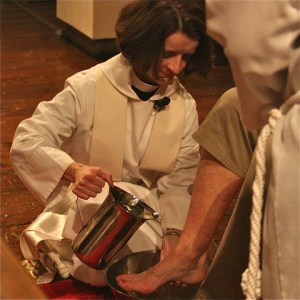
IMG_2898_2Tonight our actions mirror the actions of our gospel lesson.  Like the disciples, we gather around the table.  I imagine our potluck meal was not unlike the meal the disciples had with Jesus that night – an intimate meal with friends who feel like family, sharing stories, laughter, and woes.  We too are a ragtag team of followers, gathered at a meal, who seek to know our Savior better, and who lean on a community of faith to join us in the journey.  As the disciples did that night, we will also have our feet washed.  I imagine our discomfort in having our feet washed, and even our wondering what the foot washing means, are not that different from Peter’s struggles.  Finally, we too will come to the Eucharistic table.  This night was the night that Jesus instituted the sacrament of Eucharist.  Like Jesus shared his last meal with the disciples that night, we too receive the sacred body and blood of Christ for the last time until the Easter Vigil.

In observing the patterns of our gathering this night, we could feel pretty good about ourselves.  We could look at the synchronicity between us and the disciples that night and feel like we have joined them in a great memorial of our brothers in Christ.  But tonight is not just about imitating manual acts.  The entire point of that night – the table fellowship, the washing of feet, the sharing in Christ’s body and blood – is not about the actions themselves.  The point of that night was establishing a way of being.  Jesus establishes the way that the community will be together:  “I give you a new commandment, that you love one another.  Just as I have loved you, you also should love one another.  By this everyone will know that you are my disciples, if you have love for one another.”

This command to love one another is perhaps one of the most difficult commands of Jesus.  All we have to do is look at two people in the room that night to see what Jesus means.  Both Judas and Peter are in the room when Jesus says that they are to love one another.  That means when Judas hands Jesus over to die, and when Peter embarrasses them by three times denying the Savior he claimed to be willing to die for, that the other disciples will have to find a way to love both Judas and Peter later.

For us, that means when our family members, friends, fellow parishioners, and even strangers betray us, we too will have to love each of those individuals.  Love is not an easy act.  Love means that we have to accept the role of servant, the one who kneels down on the floor and washes the dirty feet of another, even a betrayer.  But we also have to be the person who allows him or herself to be cared for in a similar way.  Margaret Guenther once said, “If we love one another as Jesus loves us, we must be ready to put aside our grudges, hurts, and righteous anger.”  Guenther admits, “I tend to love with my fingers crossed.  I’m ready to love almost everyone, but surely I can’t be expected to love the person who has harmed me.  Or who does not wish me well.  Or who seems hopelessly wrong-headed.  Surely I am allowed one holdout, one person whom I may judge unworthy of love.  But the commandment has no loopholes; it demands that we let go of our pet hates, the ones we clutch like teddy bears.”[i]

NPR does a series called StoryCorps.  I will never forget one story I heard about a woman who befriend the boy who killed her son.  At first she was filled with anger at her son’s murderer, but then twelve years later, she went to visit the young man in prison and everything changed.  “He became human to me,” explained the woman.  They departed that day with a hug.  Twenty years after the murder of her son, the woman and the murderer now are neighbors, caring for one another like a mother and son.  She demands the same attention from him a mother would, and he always strives to care for her and earn her approval.  She plans to see him graduate from college – something her own son never got to do.  And maybe someday go to his wedding.[ii]  This is the kind of love that Jesus is talking about on this sacred night.

Luckily, the Church gives us our liturgy tonight to encourage us on the way.  If we want to love as Jesus commands, we can come forward, and be willing to be loved through the washing of our feet.  If we want to love as Jesus commands, we can earnestly confess our sins before others, recommitting ourselves to love.  If we want to love as Jesus commands, we can come to the table one more time, perhaps kneeling by someone with whom we have a grudge, and being renewed into the way of love.  And if we want to love as Jesus commands, we will take all the strength that we gain from this night, and we will walk out those doors a people transformed – transformed into beings who love with abandon, not caring on whom we waste the love or how or whether the love is returned to us.  When we love in this way, we love like Jesus – and everyone will know that we are Jesus’ disciples by our love.  Amen.


[i] Margaret Guenther, “No Exceptions Permitted,” Christian Century, vol. 112, no. 15, May 3, 1995, 479.

[ii] Story found at http://www.npr.org/2011/05/20/136463363/forgiving-her-sons-killer-not-an-easy-thing as of March 25, 2013.

← Older posts
Newer posts →

Recent Posts

  • On God, Grace, and Letting Go…
  • On Spiritual Check-Ins…
  • Sermon – Acts 1.6-14, E7, YA, May 17, 2026
  • Sermon – John 14.15-21, E6, YA, May 10, 2026
  • On Redefining Community…

Archives

  • June 2026
  • May 2026
  • April 2026
  • February 2026
  • January 2026
  • December 2025
  • November 2025
  • October 2025
  • September 2025
  • August 2025
  • July 2025
  • June 2025
  • March 2025
  • February 2025
  • December 2024
  • November 2024
  • October 2024
  • September 2024
  • August 2024
  • July 2024
  • June 2024
  • May 2024
  • March 2024
  • February 2024
  • January 2024
  • December 2023
  • November 2023
  • October 2023
  • September 2023
  • August 2023
  • July 2023
  • June 2023
  • May 2023
  • March 2023
  • February 2023
  • January 2023
  • December 2022
  • November 2022
  • October 2022
  • June 2022
  • May 2022
  • January 2022
  • December 2021
  • November 2021
  • October 2021
  • September 2021
  • August 2021
  • June 2021
  • May 2021
  • April 2021
  • March 2021
  • February 2021
  • January 2021
  • December 2020
  • November 2020
  • October 2020
  • September 2020
  • August 2020
  • July 2020
  • June 2020
  • May 2020
  • April 2020
  • March 2020
  • February 2020
  • January 2020
  • December 2019
  • November 2019
  • October 2019
  • September 2019
  • August 2019
  • July 2019
  • June 2019
  • May 2019
  • April 2019
  • March 2019
  • February 2019
  • January 2019
  • December 2018
  • November 2018
  • October 2018
  • September 2018
  • August 2018
  • July 2018
  • June 2018
  • May 2018
  • April 2018
  • March 2018
  • February 2018
  • January 2018
  • December 2017
  • November 2017
  • October 2017
  • September 2017
  • August 2017
  • July 2017
  • June 2017
  • May 2017
  • April 2017
  • March 2017
  • February 2017
  • January 2017
  • December 2016
  • November 2016
  • October 2016
  • September 2016
  • August 2016
  • July 2016
  • June 2016
  • May 2016
  • April 2016
  • March 2016
  • February 2016
  • January 2016
  • December 2015
  • November 2015
  • October 2015
  • September 2015
  • August 2015
  • July 2015
  • June 2015
  • May 2015
  • April 2015
  • March 2015
  • February 2015
  • January 2015
  • December 2014
  • November 2014
  • October 2014
  • September 2014
  • August 2014
  • July 2014
  • June 2014
  • April 2014
  • March 2014
  • February 2014
  • January 2014
  • December 2013
  • November 2013
  • October 2013
  • September 2013
  • August 2013
  • July 2013
  • June 2013
  • May 2013
  • April 2013
  • March 2013
  • February 2013
  • January 2013
  • December 2012
  • November 2012
  • October 2012
  • September 2012

Categories

  • reflection
  • Sermons
  • Uncategorized

Meta

  • Create account
  • Log in
  • Entries feed
  • Comments feed
  • WordPress.com

Blog at WordPress.com.

  • Subscribe Subscribed
    • Seeking and Serving
    • Join 391 other subscribers
    • Already have a WordPress.com account? Log in now.
    • Seeking and Serving
    • Subscribe Subscribed
    • Sign up
    • Log in
    • Report this content
    • View site in Reader
    • Manage subscriptions
    • Collapse this bar

Loading Comments...