
Tags
disciples, foot washing, Jesus, love, Maundy Thursday, Sermon
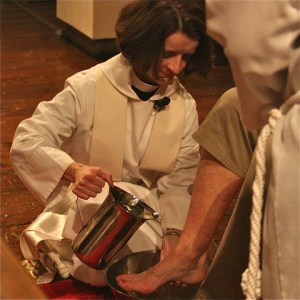 Tonight our actions mirror the actions of our gospel lesson. Like the disciples, we gather around the table. I imagine our potluck meal was not unlike the meal the disciples had with Jesus that night – an intimate meal with friends who feel like family, sharing stories, laughter, and woes. We too are a ragtag team of followers, gathered at a meal, who seek to know our Savior better, and who lean on a community of faith to join us in the journey. As the disciples did that night, we will also have our feet washed. I imagine our discomfort in having our feet washed, and even our wondering what the foot washing means, are not that different from Peter’s struggles. Finally, we too will come to the Eucharistic table. This night was the night that Jesus instituted the sacrament of Eucharist. Like Jesus shared his last meal with the disciples that night, we too receive the sacred body and blood of Christ for the last time until the Easter Vigil.
In observing the patterns of our gathering this night, we could feel pretty good about ourselves. We could look at the synchronicity between us and the disciples that night and feel like we have joined them in a great memorial of our brothers in Christ. But tonight is not just about imitating manual acts. The entire point of that night – the table fellowship, the washing of feet, the sharing in Christ’s body and blood – is not about the actions themselves. The point of that night was establishing a way of being. Jesus establishes the way that the community will be together: “I give you a new commandment, that you love one another. Just as I have loved you, you also should love one another. By this everyone will know that you are my disciples, if you have love for one another.”
This command to love one another is perhaps one of the most difficult commands of Jesus. All we have to do is look at two people in the room that night to see what Jesus means. Both Judas and Peter are in the room when Jesus says that they are to love one another. That means when Judas hands Jesus over to die, and when Peter embarrasses them by three times denying the Savior he claimed to be willing to die for, that the other disciples will have to find a way to love both Judas and Peter later.
For us, that means when our family members, friends, fellow parishioners, and even strangers betray us, we too will have to love each of those individuals. Love is not an easy act. Love means that we have to accept the role of servant, the one who kneels down on the floor and washes the dirty feet of another, even a betrayer. But we also have to be the person who allows him or herself to be cared for in a similar way. Margaret Guenther once said, “If we love one another as Jesus loves us, we must be ready to put aside our grudges, hurts, and righteous anger.” Guenther admits, “I tend to love with my fingers crossed. I’m ready to love almost everyone, but surely I can’t be expected to love the person who has harmed me. Or who does not wish me well. Or who seems hopelessly wrong-headed. Surely I am allowed one holdout, one person whom I may judge unworthy of love. But the commandment has no loopholes; it demands that we let go of our pet hates, the ones we clutch like teddy bears.”[i]
NPR does a series called StoryCorps. I will never forget one story I heard about a woman who befriend the boy who killed her son. At first she was filled with anger at her son’s murderer, but then twelve years later, she went to visit the young man in prison and everything changed. “He became human to me,” explained the woman. They departed that day with a hug. Twenty years after the murder of her son, the woman and the murderer now are neighbors, caring for one another like a mother and son. She demands the same attention from him a mother would, and he always strives to care for her and earn her approval. She plans to see him graduate from college – something her own son never got to do. And maybe someday go to his wedding.[ii] This is the kind of love that Jesus is talking about on this sacred night.
Luckily, the Church gives us our liturgy tonight to encourage us on the way. If we want to love as Jesus commands, we can come forward, and be willing to be loved through the washing of our feet. If we want to love as Jesus commands, we can earnestly confess our sins before others, recommitting ourselves to love. If we want to love as Jesus commands, we can come to the table one more time, perhaps kneeling by someone with whom we have a grudge, and being renewed into the way of love. And if we want to love as Jesus commands, we will take all the strength that we gain from this night, and we will walk out those doors a people transformed – transformed into beings who love with abandon, not caring on whom we waste the love or how or whether the love is returned to us. When we love in this way, we love like Jesus – and everyone will know that we are Jesus’ disciples by our love. Amen.
[i] Margaret Guenther, “No Exceptions Permitted,” Christian Century, vol. 112, no. 15, May 3, 1995, 479.
[ii] Story found at http://www.npr.org/2011/05/20/136463363/forgiving-her-sons-killer-not-an-easy-thing as of March 25, 2013.
 I have been pondering for the last ten days what to say about the experience of Hurricane Sandy. I think I felt overwhelmed because I knew that my experience was not as bad as thousands of others in our area. My experience felt superficial somehow, as if I did not earn enough credit to have something to say about all of this. But what I realized these last couple of days is that although I cannot speak for places that were utterly devastated by this horrible storm, I can speak for what life has been life for the rest of us, tied to those who are suffering more while suffering ourselves.
 Finally, I have been struck by the overwhelming ways in which this storm has brought out the goodness in others. My parishioners have been running extension cords across the street to share power with others. I observed all of us talking to one another more – learning more of each others’ stories – caring more about the welfare of each other. People without power themselves have bent over backwards to make sure my family was okay. Friends and parishioners have taken us in for hot meals and for washing laundry or for simple camaraderie. People long to help others even when they are suffering. There is a sense of abundance in the face of devastation. There is joy watching a toddler find creative ways to entertain herself. And the outpouring of love from all over the region is even more overwhelming. I have felt like that wall that keeps us from sharing Christ with one another has been decimated, and Christ is found all around us as we love and care for one another.
 One of the most common ways that St. Margaret’s parishioners describe ourselves is that we are a family. When parishioners say that, I think they mean it in a good way. But “family” is a loaded word to me. When you hear the word “family” you might think of a Norman Rockwell painting where everyone is happily and peaceably eating a family meal – maybe even a meal on Sunday afternoon, like the good ol’ days. You may imagine happy times with your biological family – times of laughter, playing games, celebrating life milestones, and times of love and support. Family can be a place where you are truly yourself and accepted fully.
 Seeking and Serving