• About

Seeking and Serving

~ seek and serve Christ in all persons

Seeking and Serving

Tag Archives: love

Sermon – John 14.15-21, E6, YA, May 17, 2020

20 Wednesday May 2020

Posted by jandrewsweckerly in Sermons, Uncategorized

≈ Leave a comment

Tags

accompaniment, accompany, Advocate, apology, commandment, conditional, Coronavirus, Holy Spirit, Jesus, love, obey, pandemic, Sermon

We have been spending a lot more time together as a family since this pandemic began.  All that together time has meant moments of joy and laughter; but that time together has also meant a lot of correcting of behavior.  One would think by now, we have figured out how to perfectly love one another.  Instead, we have been working on perfecting apologies.  I never knew how much of our apologizing could show so little remorse.  There have been the angry, shouted, “I’m sorry!”s, there have been the resistant, mumbled, “I’m sorry”s, there have been the sarcastic, eye-rolling, “I’m sorry.”s  And parental requests for our children to “mean it” when they say, “I’m sorry,” are almost comical.  How can anyone expect anyone else to apologize by force, command, or as a condition for something else?

I think that is what is so strange about today’s lesson from John’s gospel.  Jesus says “If you love me, you will keep my commandments,” and “They who have my commandments and keep them are those who love me.”  The commandments Jesus is talking about are those instructions to love God, love self, love neighbor.  In John’s gospel, they are the only commandments Jesus gives.[i]  And who would protest such commandments?  Of course we should all want to love God, love self, and love neighbor.  But there is something strange about the way Jesus presents his command to us – if you love me, you must do these things.  If you love me, you must obey my way.  As lovely as love sounds, there is something that harkens to those forced apologies about our text today.  I am pretty sure Jesus is not asking us to love others with a sense of bitterness, resentment, or obligation – and certainly without shouts, mumbling, and eye-rolling.

I realize many of you may be thinking, “What’s so hard about loving others?  Why would I resist that?”  One of the things I appreciated about the beginning of this pandemic was the way we all pulled together.  People immediately worried about our elders being able to safely procure food and supplies; we pitched in to make sure the hungry were fed with free school lunches and restocked food banks; we sewed face masks and donated to charities to help protect the vulnerable.  Our collaboration, care, and support of one another was a breath of fresh air.  But we have not taken long to remember our demons.  As hard decisions have arisen about reopening businesses to buttress the economy, making cuts to make ends meet, or laying off employees to help businesses survive, we have reverted to our divided, vitriolic ways from before the pandemic, not only disagreeing, but attacking the character, intelligence, and dignity of one another.  So when we ask, “What’s so hard about loving others?” my response is, “This.  This is what is hard about loving others.”  As one scholar puts it, “It is NOT sufficient (or even meaningful) to profess love for Jesus while we hold ourselves apart from our fellow human beings.  To love Jesus is to love others.  All others.  The lover, the friend, the neighbor, the companion.  But also the alien, the stranger, the misfit, and the enemy.  The ones with whom we agree, and the ones with whom we emphatically disagree.  The ones we naturally like, and the ones we don’t.”[ii]  Our love of Jesus is only as authentic as our love of all others.

So how can we possibly love that way?  The good news is Jesus says we will have help.  Just as Jesus has been an advocate for his disciples – “guiding, teaching, reminding, abiding, witnessing, interceding, comforting,” so they will have the Holy Spirit.  “What they have known in Jesus, and fear losing in Jesus’ impending absence, they will always know in the promise of the [Holy Spirit].”[iii]  What Jesus promises today is big.  Now, I know some of us get a little uncomfortable talking about the Holy Spirit – either the Spirit’s presence just seems too amorphous to be of any value, or the Spirit seems to do weird, dramatic things that scare us more than comfort us.  But Jesus is not simply saying the Holy Spirit will be ambiguously hanging around when Jesus is gone.  The Holy Spirit will be, and is, accompanying us.  As scholar Karoline Lewis says, “Accompaniment is not simply having someone beside you.  Accompaniment is not a mere ministry of presence.  Accompaniment means active and assertive abiding—an abiding that enters into places of fear and discomfort, uncertainty, and troubled hearts, and speaks the truth freely.”[iv]

Now I don’t know about you, but that sounds like some really good news.  On those days when loving seems hard, when obeying Jesus’ command to love feels impossible, the Holy Spirit is here to accompany us, to walk with us in fear, discomfort, uncertainty, trouble, and guide us into lives of love.  The Spirit is with us to enable us to be agents of love even when we doubt we can.  That promise today makes the invitation to love as Christ has loved us not only doable, but desirable.  That promise today helps us loosen our grip on resentment, anger, and fear, and open our hands to love and collaboration.  That promise today makes obedience to love feel like a gift.  Thanks be to God.

[i] Debie Thomas, “Love and Obedience,” May 10, 2020, https://www.journeywithjesus.net/lectionary-essays/current-essay?id=2640, as found on May 15, 2020.

[ii] Thomas.

[iii] Karoline Lewis, “A Time for Accompaniment,” May 10, 2020, http://www.workingpreacher.org/craft.aspx?post=5433, as found on May 15, 2020.

[iv] Lewis.

On Teachers, Nurses, and Grandmas…

07 Thursday May 2020

Posted by jandrewsweckerly in Uncategorized

≈ Leave a comment

Tags

appreciation, blessing, care, Christ, God, grandmother, gratitude, Jesus, light, love, ministry, notes, nurses, pandemic, sacred, teachers, thank you, thankful, vocation, work

thank-you-notes

Photo credit:  https://www.considerable.com/life/etiquette/bring-back-thank-you-notes/

One of the things my grandmother instilled in me from an early age was the importance of thank you notes.  She taught me how to write them, how quickly to send them, and the significance of being a person who reliably sends them.  These days I fear she would be sorely disappointed with how those carefully honed skills have deteriorated over time – not that I do not know how to write them or understand their importance, but how my overflowing plate often means the list of thank you notes to be written makes it to the bottom of my “to do” pile.

That is why I am thankful for the ways in which our country has designated this week as appreciation weeks for two powerful vocations:  teachers and nurses.  Left to my own devices, I regularly forget to show my appreciation for the teachers in our lives.  But this annual week always reminds me that for thirty-five-plus hours a week, teachers are the people who are with my children – teaching them, shaping them into thoughtful citizens, helping them grow into their unique identity, and generally helping them feel loved and valued.  I have always thought of teachers as part of our “village,” who are helping my husband and me raise our children.  And this year, more than ever, I am amazed at the ways teachers are pivoting, learning new technologies, figuring out different ways to engage children in a pandemic, and showing love to our kids while socially distanced.

Likewise, I am grateful for a week to show our gratitude toward our nurses.  My most powerful experience with a nurse was in childbirth.  I had been laboring for the better part of twelve hours when I finally elected to have an epidural.  Everyone left the room, and as I leaned forward for the anesthesiologist, I could not stop shaking – whether from exhaustion or fear, I am not sure.  But the nurse took my arms firmly, looked me right in the eyes, and instilled in me a trust so deep I can still feel it palpably ten years later.  Nurses do this every day – take our lives into their hands, guide us through healing and wellness, and comfort us in ways that build confidence, trust, and care.  And in the midst of this pandemic, they are literally putting their lives on the line to do this often-overlooked work.

I’m not sure this is enough of a thank you note to meet my grandmother’s standard.  But what I can tell you is our teachers and our nurses are doing sacred work every day of the year.  They love us, care for us, and show us the light of Christ every day.  If you have a teacher or nurse in your life, neighborhood, or circle of friends, please be sure to thank them personally for the ways in which they are changing our lives today.  I invite you to return God’s blessing they have been to you back to them.

Sermon – Luke 24.13-35, Acts 2.14a, 36-41, E3, YA, April 26, 2020

30 Thursday Apr 2020

Posted by jandrewsweckerly in Sermons, Uncategorized

≈ Leave a comment

Tags

church, crisis, disciples, Easter, Emmaus, faith, hope, human, Jesus, lost, love, pandemic, resurrection, Sermon, vulnerable, weakness

To say we have been operating in crisis mode here at Hickory Neck would be an understatement.  We went from normal operations, to heavy restrictions for gathering and receiving communion, to entirely closing our buildings, to moving all worship online, to virtual learning, fellowship, and pastoral care.  All of those changes happened rapidly, and with an eye to whatever was next.  Once we figured out some semblance of a new rhythm and “normal,” Holy Week came, and we had to figure out how to make our most sacred week of the Church Year meaningful despite our inability to gather physically.  Baptisms and confirmations have been postponed, our Bishop’s visit has been delayed, and farewells and celebrations have been canceled.  And yet, here we are, about half-way through a stay-at-home order, with infection and death rates at astronomical levels, and the Church finds herself in the third week of Easter, still proclaiming her alleluias.

I am not sure I could pull myself together and proclaim those alleluias without the lessons from Holy Scripture we have been journeying with these last Sundays.  In a normal Eastertide, we are more carefree, reveling in Easter joy, making bold proclamations about resurrection and eternal life, and listening to the early Easter stories like the walk to Emmaus with a sense of endearment – as if saying, “Bless their hearts!” as the early Christians try to figure out what in the world is going on after Jesus’ resurrection.  But this is not a normal Eastertide.  In fact, Biblical scholar Matt Skinner refers to this time as “Pandemic Easter.”[i]  For the first time in perhaps most of our lives, we can more deeply empathize with the disciples during these early days of resurrection.  The modern Church has used Eastertide as a bold proclamation of the meaning of Jesus’ death and resurrection.  But the first disciples of Christ are not boldly doing anything.  In fact, they are bereft, confused, scared, given glimpses of hope followed by bouts of despair and doubt.  They are not sure what to believe, even having seen the risen Jesus themselves.  Even those who receive the teaching from the disciples in our Acts lesson are overcome with emotion and can only ask, “Brothers, what should we do?”

Somehow, living in Pandemic Easter has made our Eastertide lessons much more powerfully relatable.  I do not know if I am ready to boldly proclaim, “The Lord is Risen Indeed.”  But I am willing to say to fellow Christians, and to God, “What should we do?”  I am willing to talk with a fellow person of faith, or even a person of no faith, walking with them (either metaphorically or at least at a distance of six feet) as we make our way through this mess.  Those disciples on the walk to Emmaus look different to me this year.  Those two people who thought they knew what they believed, who are confused by testimony of Jesus’ resurrection, who walk away from the protective hideout with fellow disciples, are trying to make sense of life, death, and Jesus.  They are not people to be pitied or seen as adorably unsure of their faith.  They are us.  They are people in a life-altering crisis, trying to make sense of death and defeat, wondering where hope may be, and a bit lost.

And here comes the best part.  Now, I have always thought the best parts of this story are where Jesus teaches the disciples unawares, shares a meal with them, or their hearts becoming strangely warmed, allowing them to become the second set of witnesses after the women at the tomb.  But in Pandemic Easter, the best part of this story might just be what happens on the walk to Emmaus.  Jesus invites these two followers to talk about what has happened to them.  He literally walks with them as they share their shock, their grief, their sadness.  Perhaps in Easters past, I thought Jesus was being coy or trying to trick the disciples in some way.  But in Pandemic Easter, I think Jesus is doing what we all need:  Jesus listens, he lets the disciples share their reality, he makes space for the human response to a new normal.    Jesus makes space for questions like, “What should we do?”

I don’t know about you, but the very real, vulnerable, human interactions between Jesus and the disciples in Scripture today has been a tremendous balm to me.  More than perhaps any year, the Church is not telling us how to embrace and proclaim a certain and sure faith.  Today the Church is simply inviting us to hover in the actual experience of Easter – days of confusion, sadness, fear, and grief.  We are able to tarry there because Scripture reminds us today that Jesus walks with us.  When we cannot yet understand, when we perhaps cannot even believe, Jesus walks with us on the journey.  Jesus listens to our real human response to crisis and walks with us.  Someday – maybe today, maybe in a week or month, or maybe in a year, we will be able to hear Jesus’ teaching and understand, and our hearts will be strangely warmed with conviction.  Until then, Jesus walks with us where we are, acknowledging the fullness of our weakness, and staying with us and loving us through it all.  Thanks be to God.

[i] Matt Skinner, “The Road to Emmaus Feels Longer This Year,” April 19, 2020, as found at http://www.workingpreacher.org/craft.aspx?post=5428 on April 24, 2020.

On Finding Family…

23 Thursday Apr 2020

Posted by jandrewsweckerly in Uncategorized

≈ Leave a comment

Tags

blessing, church, crisis, family, friends, genuine, harm, imbalance, invitation, invite, Jesus, love, rich, unconditional

Better family conversations

Photo credit:  https://www.psychologies.co.uk/five-ways-better-family-conversations

Families are a funny thing.  We are born into them, and have no choice about their makeup.  Some of us are blessed with large or small families that nurture and care for us.  Some us are born into hurtful, abusive families.  And some of us navigate our way as we age, realizing who in our immediate and extended family build us up, and who we can minimize time with or avoid altogether because they do not know how to love us.  As we age, we redefine family – perhaps with friends and lovers who love us better than the family members we were born into, or perhaps with groups of people who understand us and create a sense of “home.”

For some of us, that group is Church.  Now I know churches have been some of the worst offenders – places of pain, abuse, or just meanness.  But Church can also be the family you choose – the place where you are loved unconditionally, feel a sense of belonging, and discover a sense of purpose and meaning.  Church is the place where an unrelated elder can offer care and wisdom you have longed for, where a child teaches you what joy, laughter, and love feel like, and where a once (and maybe still) stranger can pray for you in ways that reaches your soul like never before.  The people of Church can be the vehicle through which we experience the unconditional love of Christ.

What has struck me about this time of separation is how much the separation has made it easier for us to invite people into that family of Church.  Whether a neighbor sharing about their seriously ill parent leads us to invite them to join us for online prayers; whether a friend is struggling with their children and finds our invitation to enjoy online Godly Play or accessible teaching materials; or whether someone who has not been able to step foot on a church property feels less threatened by a Sunday online worship service – we are finding invitation to be a much more organic, genuine experience – because we need that sense of family, we need that love of Christ.

But what has struck me even more deeply has been the shifting dynamic within our Church “family.”  Instead of inviting people “in” to the church, this has been a beautiful time of us being invited “out” – finding how much malleability our family has.  Invitation during this time has not simply been about inviting people into “the family” so that they can experience the blessings we have, but has also been about inviting people into the family because our family is not complete – there are people we did not even know could make us feel whole who we are meeting because Church looks so different right now.  That kind of role reversal can create a sense of imbalance and vulnerability – but it can also create a richer sense of family and loving community.  In our separation from the body of Christ, we are learning just how vast the body of Christ really is.  We may not have been looking for it, or even realized we needed it, but I am grateful for the ways this crisis is growing our family, and expanding the ways we can experience Christ’s love.

Sermon – John 13:1-17, 31b-35, MT, YA, April 9, 2020

23 Thursday Apr 2020

Posted by jandrewsweckerly in Sermons, Uncategorized

≈ Leave a comment

Tags

community, Coronavirus, disciples, grief, important, Jesus, journey, love, Maundy Thursday, pandemic, Sermon, tradition

I have been thinking about this night for a couple of weeks now.  Normally on this night, we wash each other’s feet, we share in what is a “Last Supper” for us until Easter, and then the church goes dark as the altar is stripped of every adornment.  This is a night for intimacy, vulnerability, and community.  But we are in this supremely odd moment where none of those things are allowed.  In this pandemic, we are avoiding the intimacy of touch; we are avoiding making ourselves vulnerable; we are avoiding gathering in community.  There is a way in which this very service, reminds us of the grief of this global moment.

But the more I thought about this gathering, the more I realized how well positioned we are this year to honor this night more powerfully than perhaps ever before.  In the course of just a few hours, the disciples and Jesus’ followers will be mourning the absence of his physical touch too.  Although we are not experiencing the intimacy of touch, we are experiencing the intimacy of a community gathered virtually.  Even in our homes, we are all turned to our devices, coming together from afar – creating a sense of community when we may feel like we do not have one.  And although we are not celebrating our traditional Maundy Thursday service, we are experiencing the tradition of Evensong – a service that is offered almost everyday in Cathedrals, Minsters, and colleges in the Mother Church in England.  In that way, tonight’s service brings us the comfort of a liturgical experience that has grounded the church for centuries.

If anything, living in the time of a pandemic, I believe we are beginning to find clarity about the ultimate importance of things – what really matters and what does not.  Jesus helps us see that tonight.  Strip away everything else, and Jesus concludes, “I give you a new commandment, that you love one another.  Just as I have loved you, you also should love one another.  By this everyone will know that you are my disciples, if you have love for one another.”  You may be thinking, “Great!  Another thing to do!”  But relax.  Here’s the good news tonight:  you’re already showing others you are Christ’s disciples.  I see you checking in on your neighbors and fellow parishioners.  I see you advocating for the disadvantaged and the vulnerable.  I see you supporting ministries financially in this uncertain time.  I see you praying for one another.  I see you doing your part to end the spread of this virus – whether you are a medical professional risking your own health, whether you are a healthy parishioner volunteering to get goods to those in need, or whether you are simply self-isolating.  We may be gathering virtually, but we are gathering in love, living as the faithful disciples Christ invited us to be – living as the faithful disciples you can be and are being.

As we journey further into the grief of this moment with Christ, and continue to journey into the grief of this pandemic, tonight we hold onto the life of love.  There is no better way to share intimacy, vulnerability, and community than to do exactly what we are doing in this moment.  Thanks be to God.  Amen.

On Church, Community, and Crying…

01 Wednesday Apr 2020

Posted by jandrewsweckerly in Uncategorized

≈ Leave a comment

Tags

care, children, church, close, community, Coronavirus, crying, identity, love, parade, purpose, school, tears, village

91663272_10158735760542565_2455793223893778432_n

Photo credit:  Jennifer Andrews-Weckerly; use with permission only.

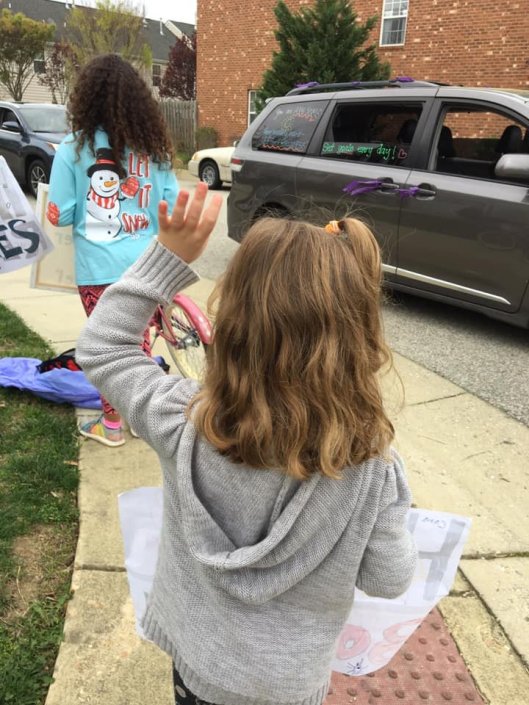
I had seen the pictures and videos in my news feed of teachers and schools “parading” in neighborhoods, saying hello to their students from their cars (keeping safe social distances).  The idea seemed nice enough, but I did not really think too much about the concept.  But when my children found out their elementary school would be doing the same, they jumped right in, making signs for their teachers.  We rearranged our daily schedule, and headed up to the now-unused bus stop in our neighborhood, and waited.

But it was not until I saw familiar face after familiar face – the principal, my fifth grader’s first, third, and current grade teachers; the art, computer, music, orchestra, librarian, and gym teachers; even the custodian – that I lost it.  Tears burst into my eyes, and although I could not stop smiling, I also could not stop crying.  The previous week, we had found out that due to the Coronavirus, our schools would be out for the remainder of the school year.  My fifth grader would not get to say goodbye to friends and one of the best teachers she has ever had, nor the community that has shaped her for the last four years.  My kindergartner would get no closure on her first year of school.  But here was that amazing community, coming to our neighborhood to say goodbye.

I think I burst into tears because I realized how very deeply important community is in our lives.  For the schools, our children are there five days a week, nine months of the year.  The school is a major part of the village that raises our children, teaches them, forms them into amazing citizens, and helps them find their sense of identity and purpose.  The staff and teachers at our school love our children and are a part of our family.  What this virus did was expose a huge part of our children’s lives and take it away from them.  The tears I could not stop that day were tears of gratitude, tears of blessing, tears of humility for the community I had not fully appreciated until that moment.

That is what has been so hard about having our church closed too.  We are making inroads for connection, surely.  But part of the reason we are doing that is because we know that Church is a vital community in our lives too.  Certainly, we are there because of our faith – or our desire to have faith.  But we are also at Church because the community feeds us, sustains us, and gives our lives a sense of purpose and identity.  When we cannot gather, we lose a huge part of our lives.  This week, it is my prayer that for those of you missing your church community, you will take advantage of the ways we are trying to maintain virtual connection during this time of disconnection.  We may not be able to exchange signs of the peace, offer hugs or high fives of affirmation, or kneel at the altar together.  But we can laugh at Virtual Coffee Hour, sing during livestream worship, and even cry during daily pop-up prayers.  Your community is still here, loving you and supporting you.  And we cannot wait to see you again!!

The Pilgrim’s Way…Day 4

10 Monday Feb 2020

Posted by jandrewsweckerly in Uncategorized

≈ Leave a comment

Tags

Christ, claim, Coventry, faith, forgive, God, inspire, love, Oxford, persecution, pilgrimage, reconciliation, witness

85028394_2887868867936021_715629181731340288_n

Photo credit:  Jennifer Andrews-Weckerly; reuse with permission only

Sixteen pilgrims from Hickory Neck Church traveled to England for 8 days of pilgrimage.  Our focus was on choral music, hearing Evensong or Choral Mass at a Cathedral, Minster, or college everyday.  This is the fourth entry, initially posted on our church Facebook page.  For those of you who do not follow us on Facebook, I am repeating the journey’s daily entries here.  Enjoy!

Coventry/Oxford

Today I was struck by the notion of our lives as “witness.” Following the bombing of the medieval Cathedral in 1940, Provost Howard had the words “Father Forgive,” inscribed on the wall behind the altar of the ruined building. Howard had many ways he could have pastored the community. But by asking God to forgive, he led his people to forgive their enemies, but also forgive themselves who were complicit in war too. His witness of forgiveness inspired a community to embrace reconciliation over retaliation, love over hate, life over death.

Meanwhile, Bishops Cranmer, Ridley, and Latimer had the option renounce their new Protestant identity and return to their Catholic roots – the only identity they had ever known. Instead, they bravely faced fire over their faith. Their witness inspired countless others to hold fast to their faith, to choose what is right, to trust God even until persecution and death.

I wonder what witness you are embracing today. How are you claiming Christ in a way that inspires others? I can’t wait to hear about it!

84686777_2887868871269354_7932178037292924928_n

Photo credit:  Jennifer Andrews-Weckerly; reuse with permission only

On Serving, Humanity, and Jesus…

29 Wednesday Jan 2020

Posted by jandrewsweckerly in Uncategorized

≈ Leave a comment

Tags

abundance, comfort, community, homeless, humanity, Jesus, light, love, poor, poverty, relationship

Christ of the Breadlines

Photo credit:  https://www.flickr.com/photos/jimforest/8367811926

This week our church is hosting our community’s winter shelter.  Every week, a different church hosts homeless community members from approximately 6:30 pm – 8:00 am, providing dinner, a place to sleep, breakfast, and a bag lunch to go.  The organization that runs the program also coordinates services like off-site showers, bus passes, referrals for services, and other necessities.  For our church, this is an all hands on deck kind of week – from checking in guests, setting up and cleaning spaces, making and serving meals, handling checkout, and doing security.  The week brings us together as a community, helps create a sense of giving back to the community, and gives us an outlet to shine Christ’s light.

But one of the things the shelter also does is forces us to look into the face of poverty.  As I talk with our parishioners, I find them surprised to know (or remember) that the homeless often have jobs, sometimes are going to school, and may have things like cars, cell phones, and laptops.  I find our parishioners reminded of our common humanity – that comfortable or poor, we all have likes, dislikes, joys, and sorrows.  I find our parishioners able to see how important community can be for support, care, and love – whether a church community, a nonprofit community, or a community of people struggling to get by who look out for each other.  I find our parishioners taking fresh new looks at their surroundings, perhaps seeing abundance for the first time in a long time.

Jesus spent a lot of time with the poor, oppressed, and marginalized.  Part of that time was certainly about relieving suffering and healing brokenness.  But I imagine part of that time was about looking into the face of poverty and seeing something one cannot see elsewhere – humanity, commonality, community, and abundance.  I think Jesus also knew how hard it is to see the realness of life when surrounded by wealth – that’s why he was always telling people to give it away!  Ultimately, Jesus cared about loving relationships, and sometimes money just gets in the way of those kind of authentic interactions.

Whether you are volunteering this week or not, I encourage you to find a way this week to step out of your comfort zone – have a conversation with someone who is suffering, look into the eyes of someone asking for help, or take a look at your own lifestyle and assess what you need less of in your life.  It is in those moments we see glimpses of where Jesus is, and it is in those moments that we shine Christ’s light for others.  I can’t wait to hear your stories!

One “Why” of Church…

22 Wednesday Jan 2020

Posted by jandrewsweckerly in Uncategorized

≈ Leave a comment

Tags

church, community, conflict, creation, faithful, gift, God, intentional, love, meaningful, relationship, sacred, scripture, why?

together-crop

Photo credit:  https://ncchagerstown.org/attendance-membership-and-belonging-at-new-creation/

A few months back, a commenter on my blog asked why people even need to go to church.  I have thought of hundreds of reasons, and could probably write a whole series of posts about that question.  But this week, one of those reasons became very clear to me.  One of reasons being a part of a church community is so important is because being a part of a church community teaches members how to be in meaningful, faithful, sacred relationships with others.

Certainly, scripture teaches us humans are made in the image of God, and that our creation was very good.  Scripture also teaches us to love God, love ourselves, and love our neighbor.  And there is much scripture that teaches us what community means, the value of every person to making the community whole, and what behaviors are needed to be loving people made in the image of God.

Now, I know the Church and her leaders have often failed at living in that specifically Christian way.  But belonging to a church means you are committing to trying to live the life of love intentionally, authentically, and humbly.  The Church is where we learn how to lovingly live through conflict.  The Church is where we learn how to kneel at the altar rail right next to someone who has hurt us, who disagrees with us, who has challenged us, and see the commonality in our outstretched arms, waiting for the healing body of Christ.  The Church is where we learn how to say, “I’m sorry,” “I was wrong,” “I messed up,” and “I forgive you.”  The Church is the place where we can hold the fragility of human experience, the sinful nature of each of us, and the beauty of God’s creation in tension, and experience the depths of love known only through the eyes of Christ.

Maybe Church is not a place like that for you.  For me, the Church makes me a better human being, and a better child of God.  The Church keeps me honest, loves me when I do not deserve it, and molds me into a servant of God who can share that same life-giving, liberating love with others.  I am so grateful to be a part of a church, so honored to be a priest in the Church, and so overwhelmed by the power of love I find powerfully within the community of the Church.  If that is a not a gift you have received, I invite you to my church, anytime.  If that is a gift you have received, I invite you to give thanks to God for God’s gift of the Church to us.  And if you are giving thanks this week for your own church experience, I encourage you to give that gift to someone else.

Sermon – Matthew 2.1-12, Isaiah 60.1-6, EP, YA, January 5, 2020

08 Wednesday Jan 2020

Posted by jandrewsweckerly in Sermons, Uncategorized

≈ Leave a comment

Tags

abundance, Bethlehem, Christ, control, Epiphany, God, grace, hide, ignore, incarnation, Jerusalem, light, love, magi, mystery, need, pageant, power, promise, Sermon

At our 9:00 am service today, we honor the feast of Epiphany with our annual Epiphany Pageant.  Every year I love watching the children and youth bring the Christmas story alive one more time.  Part of what makes the service special is hearing the story with fresh ears – not from a clergy person reading from the aisle like every other Sunday, but with a variety of voices narrating and enlivening the words, making the incarnation story more incarnate.  I love how the pageant keeps us in the Christmas moment one more week, and I love how the story brings all our Christmas characters under one roof, reminding us of the continual unfolding of the mystery of the incarnation.  Though there is something certainly endearing about the whole experience of a pageant, there is also something quite profound in a pageant too.

But what pageants can sometimes do is focus our attention so intently on the manger – on Jesus and his family – that we forget what happens outside the manger is just as important as what happens at the manger.  Even our beloved carol “We Three Kings,” draws us to the experience of the magi’s adoration in Bethlehem, without insight into what happens in Jerusalem.  This year, after hearing of registrations, of humble births, of angel choruses, of everyday shepherds spreading the Gospel, and of cosmic explanations of the incarnation, we turn our attention to Jerusalem.  Isaiah gives us some clue about where our attention is drawn.  “Arise, shine; for your light has come, and the glory of the LORD has risen upon you…Lift up your eyes and look around…”[i]  The instruction in Isaiah is not for Bethlehem, but the city of Jerusalem[ii] – the city where Jesus’ journey will end, the city for whom Jesus weeps, the city of eventual redemption and salvation.  There, Isaiah foretells of the incarnation, how the people of God are to reflect the light of Christ, and to pay attention to what is happening around them, to God incarnate.

Those words, “lift up your eyes and look around,” have been lingering with me this week.  Instead of looking deep into the scene at the manger or with the holy family, I am drawn by what is happening in Jerusalem.  Three things happen there.  One, we learn more about the magi.  The testimony of the magi is what most of us associate with Epiphany.  Foreigners set out on a quest, more attuned to the cosmic nature of the incarnation than the people of faith.  Their astrological findings do not simply fascinate them, but inspire action – a long, uncomfortable journey to see the incarnation for themselves.  As profound as their witness is, they are not able to complete the journey alone.  They stop in Jerusalem for guidance.  They know they are on the right path, they just cannot quite get to the proper place. And so, the magi stop and ask for help along the way.  They know something significant has happened, but they need guidance from people of faith to fully realize their journey.[iii]

The magi’s insightful question, “Where is the child who has been born king of the Jews?” is a question that brings in the second action.  The chief priests and scribes, the ultimate insiders of the faithful, those who hold the revelation of scripture and interpret scripture for the people of God, are given news that should be earth shattering.  When asked about the birth of the Messiah, the religious leaders recall what they know of the Messiah:  the Messiah is to be born of Bethlehem and is to shepherd and rule the people of God.  The religious leaders offer the key – the prophecy of scripture about the coming Messiah.  And yet, even though they have this scriptural foundation, they do not react to the news of the magi.  Even though these wise people profess this awaited Messiah has been born, the religious leaders do not drop everything.  They do not even ask to go with the Magi, just to check and see if this story might have something.  They may be versed in scripture, but their inaction shows that even insiders sometimes need outsiders to be faithful.[iv]

Finally, the third thing that happens are the actions of Herod.  Herod is probably the most fascinating to me.  He is wise too, even if he uses his wisdom for his own nefarious purposes.  Herod knows the announcement, even if from an outsider of a new king being born means his own kingship is threatened, and shows how fragile his rule is.[v]  But instead of acting impulsively, he manipulates those around him.  First, he calls in the religious leaders.  You see, Herod is not a Jew – in fact, he is a Roman, serving at the leisure of the kingdom.  But his subjects are Jewish, and so he is wise enough to seek their counsel on what a king, what a Messiah, might look like.  But instead of sending his religious leaders to check things out in Bethlehem, knowing they might discover a true king among them, he secretly sends the foreigners, hoping to manipulate them into doing the work of finding the king, knowing he will get news from them so he can kill this new king.  Herod is only worried about himself and his power, and he will do whatever is needed to maintain that power.

The foreign magi are so unfamiliar with the people of God, they do not initially understand the weight of their question about the new king.  The scribes and religious leaders are so buried in their scripture, and so keen to keep balance with secular power, they do not realize the messianic fulfillment right in front of them.  And Herod is so bent on keeping his power, he does not fully understand the power of God working all around him.  All three of these agents in our story need the words of Isaiah today – all three need to lift up their eyes and look around.

We are not unlike the characters in our story today.  How often are we so mired in our own power – as people of privilege and comfort, as Americans with power more globally, as members and advocates in this community – how often does a word about the movement of God, the promise of change, and the possibility of giving up some of our power to allow that fulfillment, make us just as nefarious as Herod – just as willing to manipulate the world around us?  Or how often have we steeped ourselves in scripture, scouring God’s Holy Word, longing for some sort of guidance or truth, not realizing truth is being spoken through another right to our faces?  Or how often have we been so intent on a mission, so focused on what we sense God calling us to do, we ignore the consequences of our actions, forget the power of our words?

Today’s scripture reading is certainly about the gift of the magi to us – the revelation of the incarnation, the insight of foreigners, and the abundance and homage the incarnation inspires.  But today’s scripture reading is also an invitation to consider our own response to that incarnation in the modern era, considering the ways in which we have not lifted our eyes and looked around.  Taking up Isaiah’s invitation to self-critique is important because there is also a promise in Isaiah.  You see, when we lift our eyes and look around, we acknowledge the narrowness in our lives, or we acknowledge the ways in which we are blind to our own power, or we discover the ways in which we even hide behind our faith, we are then able to see the promise in Isaiah.  Isaiah tells us to look around because glory of the LORD has risen upon us.  Isaiah says in verse five, “Nations shall come to your light, and kings to the brightness of your dawn.”  When we talk about shining our light on this holy hill here at Hickory Neck, this is what we mean.  The gift of the magi to us is not news that is frightening.  When we are not hoarding power or hiding behind our intellect or comfort zones, the news of the magi is news for rejoicing.  And that rejoicing is light that draws nations, and kings, and neighbors, and strangers, and family members, and friends.  The gift of the magi is the invitation to let go of the things that feel under our control, and embrace the thing in no way we control, but in every way brings us grace, love, and abundance.  That is the kind of living that shines light from this hill and brings others to Christ’s light.  That is the light offered to us today in the magi.  That is the kind of good news worthy of pageants and proclamation today.  Amen.

[i] Isaiah 60.1, 4a

[ii] Rolf Jacobson, “Sermon Brainwave #701 – Day of Epiphany,” December 29, 2019, as found at http://www.workingpreacher.org/brainwave.aspx?podcast_id=1216 on January 3, 2019.

[iii] R. Alan Culpepper, “Exegetical Perspective,” Feasting on the Word, Yr. A, Vol. 1 (Louisville:  Westminster John Knox Press, 2010), 217.

[iv] Culpepper, 217.

[v] Stanley Hauerwas, Matthew (Grand Rapids:  Brazos Press, 2006), 38-39.

← Older posts
Newer posts →

Recent Posts

  • On the Myth and Magic of Advent…
  • On Risking Failure and Facing Fear…
  • Sermon – Luke 23.33-43, P29, YC, November 23, 2025
  • On Inhabiting Gratitude…
  • Sermon – Luke 20.27-38, P27, YC, November 9, 2025

Archives

  • December 2025
  • November 2025
  • October 2025
  • September 2025
  • August 2025
  • July 2025
  • June 2025
  • March 2025
  • February 2025
  • December 2024
  • November 2024
  • October 2024
  • September 2024
  • August 2024
  • July 2024
  • June 2024
  • May 2024
  • March 2024
  • February 2024
  • January 2024
  • December 2023
  • November 2023
  • October 2023
  • September 2023
  • August 2023
  • July 2023
  • June 2023
  • May 2023
  • March 2023
  • February 2023
  • January 2023
  • December 2022
  • November 2022
  • October 2022
  • June 2022
  • May 2022
  • January 2022
  • December 2021
  • November 2021
  • October 2021
  • September 2021
  • August 2021
  • June 2021
  • May 2021
  • April 2021
  • March 2021
  • February 2021
  • January 2021
  • December 2020
  • November 2020
  • October 2020
  • September 2020
  • August 2020
  • July 2020
  • June 2020
  • May 2020
  • April 2020
  • March 2020
  • February 2020
  • January 2020
  • December 2019
  • November 2019
  • October 2019
  • September 2019
  • August 2019
  • July 2019
  • June 2019
  • May 2019
  • April 2019
  • March 2019
  • February 2019
  • January 2019
  • December 2018
  • November 2018
  • October 2018
  • September 2018
  • August 2018
  • July 2018
  • June 2018
  • May 2018
  • April 2018
  • March 2018
  • February 2018
  • January 2018
  • December 2017
  • November 2017
  • October 2017
  • September 2017
  • August 2017
  • July 2017
  • June 2017
  • May 2017
  • April 2017
  • March 2017
  • February 2017
  • January 2017
  • December 2016
  • November 2016
  • October 2016
  • September 2016
  • August 2016
  • July 2016
  • June 2016
  • May 2016
  • April 2016
  • March 2016
  • February 2016
  • January 2016
  • December 2015
  • November 2015
  • October 2015
  • September 2015
  • August 2015
  • July 2015
  • June 2015
  • May 2015
  • April 2015
  • March 2015
  • February 2015
  • January 2015
  • December 2014
  • November 2014
  • October 2014
  • September 2014
  • August 2014
  • July 2014
  • June 2014
  • April 2014
  • March 2014
  • February 2014
  • January 2014
  • December 2013
  • November 2013
  • October 2013
  • September 2013
  • August 2013
  • July 2013
  • June 2013
  • May 2013
  • April 2013
  • March 2013
  • February 2013
  • January 2013
  • December 2012
  • November 2012
  • October 2012
  • September 2012

Categories

  • reflection
  • Sermons
  • Uncategorized

Meta

  • Create account
  • Log in
  • Entries feed
  • Comments feed
  • WordPress.com

Blog at WordPress.com.

  • Subscribe Subscribed
    • Seeking and Serving
    • Join 394 other subscribers
    • Already have a WordPress.com account? Log in now.
    • Seeking and Serving
    • Subscribe Subscribed
    • Sign up
    • Log in
    • Report this content
    • View site in Reader
    • Manage subscriptions
    • Collapse this bar
 

Loading Comments...