• About

Seeking and Serving

~ seek and serve Christ in all persons

Seeking and Serving

Tag Archives: prayer

On Compassion, Fatigue, and Prayer…

10 Wednesday May 2017

Posted by jandrewsweckerly in Uncategorized

≈ Leave a comment

Tags

compassion, compassion fatigue, dignity, God, Jesus, ministry, overwhelmed, prayer, refugees, suffering

EMM_logo

Photo credit:  houseofdeputies.org/episcopal-migration-ministries-shares-the-journey.html

At our Clergy Day yesterday, we had a staff member from Episcopal Migration Ministries talk to us about the Episcopal Church’s work with refugees.  In what has become a heated topic in our current political climate, I was grateful for an explanation about how the process works for someone to come to our country as a refugee.  The demands and expectations were staggering, and the work to become self-sufficient seemed overwhelming and humbling.  One of the biggest take-aways from the presentation was that if we are going to make progress on this issue, we need to be in relationship with those unlike ourselves.

I left the presentation feeling a bit overwhelmed, wondering how I could invest more energy into one more of the world’s ills.  Our parish has been focusing its energy on racial reconciliation.  But we still have a long way to go.  Imagining taking on another area of reconciliation work felt like a tremendous burden.  I have talked about compassion fatigue before (see post here).  I realized today that my capacity for compassion is stretched pretty thinly these days.  Every time I turn around, the poor seemed to pushed further to the fringes, the oppressed are feeling more pressure instead of less, and we as a country seem to be failing at our commitment to respect the dignity of every human being.

Though we rarely use this language, I think Jesus often suffered from compassion fatigue too.  That is why so often we find him retreating with his disciples, longing for a place of quiet and prayer.  Knowing that Jesus suffered compassion fatigue is comforting, but it only gets me so far.  You see, when I suffer compassion fatigue, I find myself burying my head in the sand, trying to block out the news stories that serve to overwhelm instead of inform.  I find myself watching frivolous television, or escaping in a novel.  I find myself simply tired.  Of course, Jesus did not have online streaming television, but there are ways he could have diverted his mind when retreating from his compassion work.  Instead, he goes off to pray.  That is our invitation when faced with compassion fatigue – not to escape, but to retreat into the Lord, listening for God’s guidance, and praying for those suffering when there is little else we can do.  I invite your prayers for refugees – all those fleeing violence, all those who make it to makeshift homes, all those who boldly decide to make a home in a foreign land, and all those who suffer by those who wish to persecute the persecuted further.

On Sacred Snippets…

08 Wednesday Mar 2017

Posted by jandrewsweckerly in Uncategorized

≈ 1 Comment

Tags

balance, chaos, God, goodness, holy, Lent, lenten discipline, liturgy, prayer, sacred, sinfulness

lent_image

Photo credit:  https://prayerbookguide.wordpress.com/living-the-season/lent/

I know many Christians who loathe the season of Lent.  They find the season to be heavy-handed, to be too somber and full of self-loathing, and to be a bit of a downer.  I am not one of those Christians.  Lent is probably my favorite season of the Church Year.  There is an honesty about Lent that feels more authentic to me.  I feel like we do not have to pretend in Lent – pretend to be happy, pretend to have our lives together, pretend to be perfect.  Instead, Lent feels like a great equalizer – a time when we all confess our utter inability to live the lives we intend, and our utter dependence upon God.  Add on top of that intentional disciplines, liturgies that articulate the tension of our sinfulness and goodness, and additional church programming, and I come alive during Lent.

But this year, I have been struggling a bit with Lent.  I have gone through all the motions of Lent:  I am reading a book with a study group, I am playing Lent Madness with my oldest child, and I am attending a weekly ecumenical worship service and fellowship gathering.  I have also worked with our liturgical team to change up the liturgies to make them just different enough to shake up the senses.  I am helping teach a bible study in preparation for Holy Week.  I participated in the winter emergency shelter our church hosted last week.  The Lenten “wheels” are all in motion.  But I find this year that I am having a difficult time getting my Lenten grounding.

Now, it could be that my family has been in and out illness over the past month.  It could be that the church schedule has been particularly full, leaving me working most Saturdays this past month.  It could be that I’m still adjusting to my first full year at Hickory Neck, not having shaped a Lenten season here yet.  Whatever is going on, I was gently reminded by my Spiritual Director once that there is no wrong or right prayer life.  Our prayer life is a reflection of the rest of our life.  The Director told me that it was no wonder that my prayers were happening on the go much of the time – because juggling a family of four and a parish means that prayers happen with the rest of life.  In fact, it is unlikely that I will have an hour of prayer time every morning – because balance means finding varied ways to pray in various stages of life.

Remembering that instruction, I have been shifting my expectation of Lent this year.  Since there is little likelihood that Lent will slow down, I am trying to catch meaningful moments as they fly by.  Like how my seven-year old demands that she be allowed to go to Ash Wednesday services to get her ashes or how she begsto go to the winter shelter one more time.  Like how a parishioner calls between drop-offs to talk about navigating the faithful raising of children.  Like how the Great Litany shakes me to my core.  Like how a sermon I prepared speaks to me on a totally different level as I am preaching it.  Like how a conversation with a parishioner reminds me of the powerful ways we are living into God’s call to respect the dignity of every human being.  I may not be finding long periods of silence, setting apart times of dutiful Lenten practices, or mastering a Zen-like experience at church.  But holiness is happening all around me.  My hope now is to savor each moment for just a bit longer, honoring the holy moments God throws my way in the midst of a chaotic season of life.

Come and See!

11 Wednesday Jan 2017

Posted by jandrewsweckerly in Uncategorized

≈ Leave a comment

Tags

church, come, community, connection, gospel, internet, isolation, Jesus, physical, prayer, see, snow, virtual

This past weekend, Williamsburg was hit with over a foot of snow.  Living in an area without many plows, and serving in a church without a Rectory on the campus, I knew that Sunday services at Hickory Neck would be nearly impossible.  Our parking lot did not get plowed until early Monday morning, and many of our parishioners live on rural roads.  With great disappointment, I cancelled all Sunday services.  But then my husband turned to me with a twinkle in his eye and said, “You should lead Morning Prayer on Facebook Live!”

That night I put together a video to tell people what we were going to do and where they should go to join me in worship.  And on Sunday morning, at 10:00 am, I went live.  By the time we had finished, there were over 60 views.  By the time we got to the end of the day, there were over 300 views.  By Tuesday night, there were over 700 views.  The positive feedback poured in – from our parishioners, from their neighbors, and from dozens of people who were snowed in all up and down the Atlantic coast.

As I have thought about the experience, I realized what a gift technology can be.  Isolated in homes, people were able to come together and pray the same prayers, hear the same readings, confess our sins, lift up our intercessions and thanksgivings, and give glory to God.  So often we talk about the challenge of the church is being tied to the walls of the physical building, not taking the Gospel out in the world.  Our experience on Facebook felt like a little way of getting ourselves out in the world, and sharing the beauty of worship in virtual community.

Of course, I don’t think church can always be expressed in virtual ways.  Being physically present with one another allows us to engage all our senses, to read the body language of someone who is suffering or experiencing joy, and to engage in the holy meal that brings us together despite our divisions.  But the experience certainly made me realize that we can supplement that communal physical experience with communal virtual experiences.  And once you show your neighbor that cool video from your church, then, like Jesus in our Gospel lesson this coming Sunday, you can say, “Come and see!”[i]

come-see

Photo credit:  https://www.queertheology.com/john-1-29-42


[i] John 1.39.

On Snow Globes and Other Deceptions…

21 Wednesday Dec 2016

Posted by jandrewsweckerly in Uncategorized

≈ Leave a comment

Tags

blessed, deception, encounter, need, prayer, pretend, protection, reality, Savior, snow globe

snow-globe-tree-with-snow

Photo credit:  www.balsamhill.com/Christmas-Tree-Musical-Snow-Globe-p/4000824.htm

When I was growing up, we used to have a Christmas snow globe.  If you wound it up, it would play a lovely Christmas carol.  But you could also shake the large globe and snow would delicately swirl around the Christmas tree.  Something about the snow globe was mesmerizing.  I would wind up the music, shake the globe, and just stare into the glass.  There was something so peaceful about that globe – like a perfect world inviting me in to the snowy calm.

Of course, there were no snow blowers, plows, or ice melt in the snow globe.  There were no grumpy people shoveling out sidewalks and cars before the snow gets too heavy or the snow turns to a thick layer of ice.  No one was slipping on ice, sliding into a car accident, or shivering without shelter.  No, the snow globe does not invite that kind of realism.  The snow globe only captures the magical moment of freshly fallen, untouched snow, and dreamy winter.

Too often, we choose to keep gazing at snow globes, or to create our own snow globes.  We stare into snow globes because the destruction, hate, and violence of the world have caused compassion fatigue.  We create our own snow globes to insulate ourselves from the outside world so that we do not have to encounter the other.  Today our church delivered holiday gifts for seven families who live in a large public housing development.  As soon as we parked our car to drop off the gifts, I knew we were not in our snow globe anymore.  As a priest, those in need often come to me.  Today, I stepped onto their territory and it was a helpful reminder of how insulated my world can be if I create a globe around it.

The funny thing is that once I stepped out of snow globe, I did not slip on the ice.  I did not feel a sense of burden or dread.  Instead, people greeted me – making sure that I saw them.  Instead, a resident saw my colleague’s clergy collar and asked him to pray with him.  His friend said, “Well, while you’re at it, can you pray for my daughter too?”  Before I knew it, six of us were holding hands in the middle of this housing development, praying for health, wholeness, and the birth of our Savior.  I don’t know about you, but that’s better than any snow globe I can create.  What snow globes have you been looking into or what snow globes have you inadvertently created?  Join me this week as we pull our gazes away from the world of pretend protection and into the world of blessed encounter.

On Blessings and Curses, and Surviving Thanksgiving Meals

23 Wednesday Nov 2016

Posted by jandrewsweckerly in Uncategorized

≈ Leave a comment

Tags

conflict, creation, fall, family, God, gratitude, heart, leaves, mind, prayer, space, Thanksgiving, Thanksgiving Day

Colorful autumn

Photo credit:  www.fluentu.com/french/blog/french-fall-autumn-vocabulary-word-list

For those of you who know me well (or read this blog each fall), you know that I love the changing of the leaves during Fall.  Fall is my favorite season of the year – the cooler weather, the crunch of leaves, and the brilliant reds, yellows, and oranges that take your breath away.  The leaves turned later than usual this year in Virginia, so I have had time to enjoy their beautiful journey until now.  Just this week, a light wind was blowing, and a tree was raining down yellow leaves like a flower girl before the bride.  Some people like to stop and smell the roses.  I like to stop and revel in the beauty of God’s changing leaves.

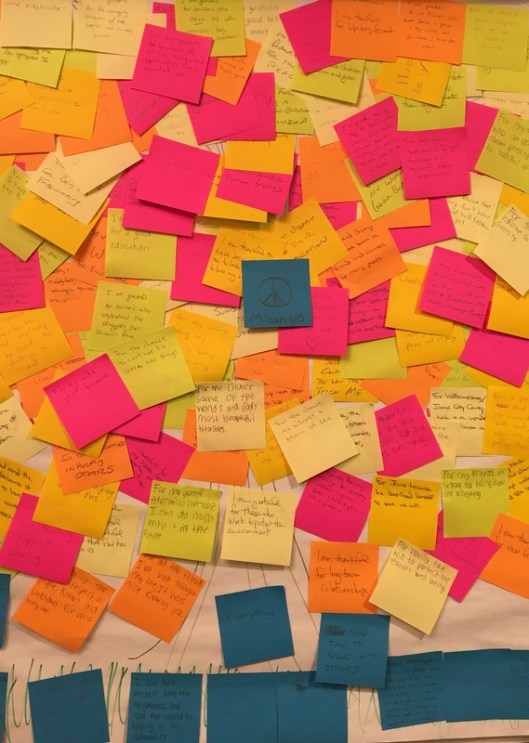
Watching and being fed spiritually by that beauty this year led us to creating a Thanksgiving Tree at Youth Group this past Sunday.  We took a poster with a bare tree, and then used our post-it notes to cover the tree with things for which we are grateful.  We had five categories, including family, relationships, creation, God, and school/work.  I challenged the group to write down three things in each category – not just a one-word response, but an explanation of their gratitude.  Perhaps 15 notes seemed like overkill to the young adults, but what I was hoping was that the more they thought about the blessings in their lives, the less space the negative would have in their hearts and minds.

That is my prayer for each of you this week as we head into Thanksgiving celebrations.  Though we may have Normal Rockwell images of Thanksgiving Day meals in our minds, and although some of you may actually get that experience, the reality of most meals, especially if spent with family, is that they will include a fair share of conflict.  If you are lucky to avoid talking about politics, some other family drama will surely emerge.  Expecting that conflict, I invite you to start praying your thanksgivings.  If your crazy family promises to bring angst, start praying now about the things that bring you joy about each member of your family.  You may have to dig deep (Lord knows your uncle’s jokes can drive you insane – but maybe you can thank God for predictability with your uncle or for the knowing glances of your cousins).  But my guess is that the more you start looking at your family or friends with the eyes of gratitude, there will be a lot more space in your heart and mind for blessings than curses.

If you can master that practice of thanksgiving prayers throughout one of the more stressful days of the year, perhaps you can carry that prayer practice through the next month.  As you hone that spiritual discipline for the next month, you may find it becomes easier to carry it into the next year.  Given our current climate, we are going to need all the space we can get for blessings. img_3401

On Collars, Conversations, and Confessions…

14 Wednesday Sep 2016

Posted by jandrewsweckerly in Uncategorized

≈ Leave a comment

Tags

Christ, clergy, collar, conversation, faith, journey, pastor, prayer, priest, stranger

Last week, I stopped by a local doughnut shop to pick up treats for some of our church volunteers.  The staff needed to make a fresh pot of coffee, so I had to wait by the counter.  After a couple of minutes, the woman who had been helping me approached me and said, “Okay, settle a bet for us.  Are you a nun or a pastor?”

anglican-collar

Photo credit:  https://blackandwhiteandlivingincolor.com/2014/01/16/coffeehouse-musings-why-i-wear-my-anglican-collar-sometimes/

I get questions about my collar all the time.  Most people are not as courageous and will simply stare – usually with a furrowed brow of confusion.  Others will only confess that they always wondered what that “thing” was I wore when we finally get around to talking about our jobs.  Sometimes people will ask if the Roman Catholic Church started ordaining women (trust me – you would know if they had!).  Of course, my favorite experiences have been when I have been both in a collar and pregnant.  That really confuses people!

Once I finally confessed I was a “pastor” to the doughnut shop, one of the women working the drive-through said, “Oh good!  Can you pray for us?”  We had a great conversation after that, and I promised to keep them in my prayers for the rest of the day as I departed.  But as I left, I realized two things.  First, being a priest in my community is a tremendous blessing.  It allows me to have deep, intimate conversations with people a lot more quickly than you would with most strangers.  It allows me to not only be a pastor with my own parishioners, but everywhere I go in my collar.  It allows me to stretch the reach of the Church beyond the walls of our church.

But what I also realized when I left that shop is that talking about the need for prayer probably would not have happened had I not had on my collar.  I am constantly inviting my parishioners to have faith conversations outside the context of our community, but that day I realized how challenging that invitation can be.  A clergy collar is like an automatic ice breaker – it is an invitation for you to say, “Oh good!  Can you pray for us?!?”  But how do we break the ice without such tools?  How can I let the grocery clerk, the delivery man, or the construction worker know that I want to pray for them too – even when I am in my sweats?  How do we get beyond the perfunctory greetings and start having real conversations?  This week, I invite us all to consider how we might start such a journey toward authentic, meaningful conversations about the intersection of our individual journeys and the presence of Christ in our lives.  Know that I will be praying for us both as we figure it out!

On Fragility…

11 Thursday Aug 2016

Posted by jandrewsweckerly in Uncategorized

≈ Leave a comment

Tags

cycle, death, fragile, God, hidden, life, loss, prayer, pregnancy, thin space

green-leaves-with-sunlight

Photo credit:  www.extremetech.com/extreme/191233-new-nanoparticles-get-us-closer-to-artificial-photosynthesis-mass-carbon-capture

I have talked before about how, as a priest, the life cycle is ever present in my work [see post here].  Simultaneously celebrating new life and honoring earthly death can sometimes happen within days or hours.  But this week I have been reminded of how sometimes we do not even see or think about that thin space between life and death because, all too often, we have the privilege of not having to think about it.

This week, one of my close friends celebrated the fifth anniversary of the birth and death of her child.  The baby died in utero around twenty weeks.  That event was formative for our entire community of friends.  Suddenly, pregnancy was no longer a happy, idyllic time, when everything always turns out okay.  We all began to see the dark side of pregnancy, and understand how much we take a “normal pregnancy” for granted.  In thinking about baby Ella this week, and the impact she had on so many of us, I find myself humbled by how much her death gave us.

And like any other cyclical week in the priesthood, what news should I learn but of a friend who was surprised to discover she is pregnant after having lost her first pregnancy over a year ago.  I was equally elated and terrified.  Elated, because I knew how much the couple hoped that maybe, just maybe, they might be blessed with a successful pregnancy and birth.  But terrified because they, and I, know how fragile these next thirty-four weeks will be.

So this week, my prayers are with all of those who walk through the journey of life, death, and pregnancy.  I especially lift them up, because all too often, their joy, grief, and anxiety are hidden.  For fear that life will not be viable, many couples elect to keep their pregnancy quiet for as long as possible.  Whether they share or not, the couple faces consequences.  When everyone knows about a pregnancy that is lost, the couple can have to retell the painful story over and over again.  When no one knows about the pregnancy, the couple can feel isolated and alone in their grief, because to share their story, they have to tell you that they were pregnant and are now no longer pregnant.  There are no easy ways forward, and so for those in our midst walking the path of longing to create new life, fearfully growing new life, birthing new life, and mourning lost life, our prayers are with you.  You live in a fragile reality that we honor and hold with love and that we lift to God.  You are not alone.

Sermon – Luke 11.1-13, P12, YC, July 24, 2016

27 Wednesday Jul 2016

Posted by jandrewsweckerly in Sermons, Uncategorized

≈ Leave a comment

Tags

action, active, disciples, God, goodness, Jesus, Lord's Prayer, Our Father, passive, pray, prayer, profound, relational, relationship, Sermon, tangible

This morning I have a little confession.  When I look at the texts for the upcoming Sunday each week, I rarely am excited about what lessons are presented.  Invariably, Jesus will say or do something controversial or, like today, the Old Testament lesson will say something super provocative that I do not want to think about addressing in the pulpit.  But this week was a bit different.  When I read today’s gospel, and heard the disciples asking Jesus to teach them how to pray, I wanted to cry, Yes, yes, Jesus!  Tell us what to do.  Teach us how to pray.  Because lately, my prayers seem hollow.  Whether I am praying about the nastiness and disrespect within this year’s political campaigns, whether I am praying about the sinfulness of racism in our country, whether I am praying about the way we dehumanize one another enough to think it is okay to shoot each other, or whether I am praying about someone who is not likely to recover from their illness and is facing the reality of mortality – I need Jesus to teach me how to pray.  I need Jesus to teach me how to pray, because I do not feel like my prayers are working.  “Lord, teach us to pray,” the disciples beg with a spirit helplessness, hopelessness, and haplessness that we can all identity with this week.

Into that sense of despair and longing, Jesus does two incredible things.  First, he gives the disciples something simple and tangible – something to cling to in the most desperate of times.  Jesus gives them what we call, “the Lord’s Prayer,” or the “Our Father.”  Luke’s version is not the version of this prayer that we are most familiar with – we know Matthew’s version much more familiarly.  In fact, even Christians who have been away from church most of their adult life can recall this one prayer.  We know the words so well that they become their own prayer beads, each word a talisman that our fingers and souls can cling to when our head and hearts are a jumbly mess.  The Lord’s Prayer is one for the ages – telling us what we know about God, what we hope for about the kingdom, and what we need as we go about our earthly lives.  Surely those words address all that we are facing right now.  Surely, when we have run out of our own words, those are words that we can mutter over and over again.  Surely those are the things we need:  God to reveal God’s self, to right the world, to sustain us, to forgive us and help us forgive others, and to protect us from ourselves and the enemy.  And on days when we do not have words, those are words that we can pray.  Jesus is very practical with his gift of a prayer for the ages.

But then Jesus does a second thing.  After giving the disciples something tangible, then he tries to teach them something much more profound.  He teaches the disciples about what prayer really is.  After giving the disciples the “Our Father,” Jesus does what Jesus always does – he sits them down for a little story.  Basically, an annoyingly persistent friend comes pounding on the door of a neighboring friend, looking for food to give to an unexpected guest. It’s midnight, and the irritated friend tells him to go home – everyone in his house has finally settled in for the night, and there is no way he is getting up.  But the friend “persists, and eventually the poor householder relents, not out of the charities of friendship but simply for the sake of his own peace and quiet.”[i]

The story is not the prettiest, but anyone who has had to put down a toddler for the fortieth time that evening knows how persistent that friend would have to be for the neighbor to risk waking up his children.  Jesus’ conclusion about the story of a persistent friend is, “Ask, and it will be given you; search, and you will find; knock, and the door will be opened for you.”  This is where Jesus’ teaching gets tricky though.  Too many of us know that there have been times when we asked and we did not find, it was not given to us, and the door was not opened.  Those words from Jesus can seem empty for those of us who have experienced the opposite.  But Jesus is not describing the economy of prayer: that you insert a request, and, with persistence, you get what you want.  What Jesus is trying to say is that prayer is about relationship.  Like the relationship that we have with the buddy who will get up in the middle of the night, our prayer life with God is a reflection of the relationship with have with God.  Our prayer life is dynamic, involves conflict, necessitates initiative, and is relational.

One of my favorite hymns growing up was “What a friend we have in Jesus.”  The hymn is a sweet, simplistic hymn that basically says that we too often try to shoulder our burdens on our own.  The hymn argues that if we take our sins and grief, our trails and temptations, our weakness and heavy laden burdens, we will find solace in God.  The hymn is comforting, and its simplicity can make us feel good.  But as I thought about that hymn this week and our text today, I realized that the hymn tempts us in the same way that this text does.  The hymn tempts us into concluding that all we have to do is ask, seek, and knock, and everything will be okay.  All we have to do is “take it to the Lord in prayer,” or even say the Lord’s prayer, and everything will be okay.

But I do not think that is what Jesus is saying today.  By talking about how prayer is relational between God and us, how prayer is a practice that resembles the relationship of friends, we can come to understand prayer a little differently.  Like any healthy relationship, our relationship to God in prayer is going to change us.  Our time in prayer with God might lead us to finding, receiving, and having doors opened.  But our time in prayer might also lead us to acting, giving, and knocking doors down.  Jesus says that the sleeping friend gets up because of his friend’s persistence.  That word “persistence” in the Greek is translated alternatively as, “shamelessness.”[ii]  In other words, our prayers to God are to be shameless:  bold, audacious, and unfailingly confident.

As we think about our prayerful relationship with God, I was struck by a reflection by David Lose.  He asks, “How might we act differently this week if our prayers were offered to God confidently, trusting that God will respond so much more generously than any earthly parent?”   Perhaps [we] wouldn’t just sit back and wait for God to answer but would start moving, get to work, actually start living into the reality of what [we have] prayed for.  So rather than pray for someone who is lonely, maybe [we’d] go visit.  Rather than pray for an end to violence, maybe [we’d] campaign against the legality of military-grade semi-automatic weapons, or protest when police use unnecessary force, or go visit the police station to tell officers that [we are] grateful for their service and pray for their safety.[iii]  In other words, what if a prayerful relationship with God is not passive, but is active and challenging?

The good news is that despite all the heaviness of the news lately, and despite all the examples of intolerance and degradation, there are also examples percolating of goodness – the fruits of shameless prayer with our God.  In Dallas, I saw protestors hugging counter-protestors.  In Kansas, I saw police officers and Black Lives Matter protestors not only holding a block party together, but also making time during the party for a real, raw question-and-answer period.  In Cleveland, I saw protestors holding hands with a police officer and offering a prayer before the day’s events began.  Now, I am not saying that shameless praying with God is going to be easy or even lead to the open doors we want or think we need.  Anyone who has long-term friendships knows that friendship is hard.  But what I am saying is that prayer is powerful and when tended to, can lead to transformation.  So if you do not know where to start this week, start with the Lord’s Prayer.  If you are too frustrated or jaded to say those words, then just show up at God’s door.  As with any good relationship, showing up is half the battle.  Wherever you are in your prayer life, know that our God is a God who will answer – and will use us for goodness.  Amen.

[i] Stephanie Frey, “On God’s Case,” Christian Century, vol. 121, no. 14, July 13, 2004, 17.

[ii] James A. Wallace, C.SS.R., “Homiletical Perspective,” Feasting on the Word, Yr. C, Vol. 3 (Louisville: Westminster John Knox Press, 2010), 291.

[iii] David J. Lose, “Pentecost 10C:  Shameless Prayer,” July 19, 2016, as found at http://www.davidlose.net/2016/07/pentecost-10-c-shameless-prayer/ on July 20, 2016.


The Sound of Silence…

07 Thursday Jul 2016

Posted by jandrewsweckerly in Uncategorized

≈ 1 Comment

Tags

brokenness, church, contemplations, Episcopal, God, listen, noise, prayer, Rite I, silence, sinfulness, worship

The-Sound-of-Silence

Photo credit:  advisoranalyst.com/glablog/s015/05/27/jeff-miller-the-sound-of-silence.html

In almost every parish I have served, there has been an 8:00 am, Rite I, spoken service.  The crowd usually is not that large.  Because the service is spoken, it tends to be very quiet and to be the shortest service of the day.  Those who are attracted to the service usually like the language (We use “thee” and “thou” language and the service has a more penitential tone.)  Others like the brevity of the service – appreciating both going to church and having the rest of the day free.  While others like the service because it feels more contemplative and centering.

Though the service is always pretty quiet in whatever Episcopal Church you choose, what I have noticed about the 8:00 am crowd at Hickory Neck is that they tend to be not just prompt, but early.  Every Sunday, at least five minutes before the service begins, everyone is seated and is silent.  Up until this past Sunday, I found the practice unsettling.  On Sundays, I am usually amped up, and ready to jump into liturgical leadership.  As an extrovert, I am chatty, and am used to some lighthearted conversation before the service starts.  So the silence immediately before the service feels discordant with my pent-up energy.

But this past Sunday, I remembered a complaint long ago from a fellow parishioner at the Cathedral where I became an Episcopalian.  She used to complain that the beginning of the service was not meant to be happy hour – she was irritated by the chatter all around her when all she wanted to do was kneel on the prayer cushion in front of her and enjoy a moment of silence before the service began.  Even the bulletin had a comment at the beginning that reminded people that we should respect others’ desire to begin our worship in quiet contemplation and centering prayer.  Though I appreciated the guidance, I never really “got” it – until this past Sunday.

The beauty of five minutes of silence before worship is that you can let go of all the stuff on your to-do list.  The beauty of the five minutes of silence before worship is that you can let go of the pain, worry, anger, or stress that is ever present and present yourself humbly before worship.  The beauty of the five minutes of silence before worship is that you can listen to God instead of talk to God.  As a celebrant, I do not know that I will ever be able to use those last five minutes to center myself (I tend to arrive much earlier at church to find that centering time).  But as one who facilitates worship, I have found myself greatly appreciating the gift of those five minutes for our parishioners.  I could use a good five minutes today to just listen.  In the noise of mass gun violence, terrorism, racism, poverty, and suffering, I am a bit out of things to say to God.  Instead I would rather kneel in silence today and give humanity’s and my own brokenness and sinfulness to God.  What might you offer to God today in that silence?  What do you imagine you might hear in that silence?

On Being Overly Generous…

01 Wednesday Jun 2016

Posted by jandrewsweckerly in Uncategorized

≈ Leave a comment

Tags

eyes, generous, God, goodness, gratitude, prayer, see, worthiness

stars

Photo credit:  https://gooddayswithkids.com/tag/sticker-charts/

In the last several weeks, our six-year old started a “star chart” for herself.  Any time she helps around the house or with her sister, she can add a sticker to the chart.  We are not really rigid about it, and we have not even designated a reward – the satisfaction of stickers alone seems to be working.  Yesterday, I overheard her talking to herself as she placed stickers on the chart.  Her list of “good deeds” seemed endless – from holding her sister’s hand across the street, to saying thank you for something, to putting clothes in the dirty pile.  As her list got longer, I thought to myself, “Well, that’s being a little overly generous.  Stickers should be for really good things, not just everyday niceties.”

But as I thought about my reaction some more, I wondered if perhaps I had missed something.  I once had a spiritual director who encouraged me to switch up my prayer life.  Instead of praying about my concerns and worries, he suggested I pray about all the things that had gone well that day.  The switch was difficult at first.  I am really good at articulating my worries and stressors.  But I am not always good at celebrating what has gone well – even the smallest things on my to-do list.  Those good things seem negligible somehow – as not being as important as the things not yet done.

I wonder if my spiritual director was trying to capture for me what my daughter has captured in her star chart.  In celebrating the small victories every day, we allow our hearts to fill with a sense of gratitude.  And, like those multiplying stickers, the more goodness we articulate, the more goodness we begin to see.  In some ways, when we begin to see all the little bits of worthiness in ourselves, I imagine we begin to get a glimpse of the way that God sees us – as beautiful creatures who mess up from time to time, but who, day in and day out, do a lot of tremendously good things – both big and small.  If you were to start a star chart with the eyes of God in mind, how might you fill up your chart this week?

← Older posts
Newer posts →

Recent Posts

  • On the Myth and Magic of Advent…
  • On Risking Failure and Facing Fear…
  • Sermon – Luke 23.33-43, P29, YC, November 23, 2025
  • On Inhabiting Gratitude…
  • Sermon – Luke 20.27-38, P27, YC, November 9, 2025

Archives

  • December 2025
  • November 2025
  • October 2025
  • September 2025
  • August 2025
  • July 2025
  • June 2025
  • March 2025
  • February 2025
  • December 2024
  • November 2024
  • October 2024
  • September 2024
  • August 2024
  • July 2024
  • June 2024
  • May 2024
  • March 2024
  • February 2024
  • January 2024
  • December 2023
  • November 2023
  • October 2023
  • September 2023
  • August 2023
  • July 2023
  • June 2023
  • May 2023
  • March 2023
  • February 2023
  • January 2023
  • December 2022
  • November 2022
  • October 2022
  • June 2022
  • May 2022
  • January 2022
  • December 2021
  • November 2021
  • October 2021
  • September 2021
  • August 2021
  • June 2021
  • May 2021
  • April 2021
  • March 2021
  • February 2021
  • January 2021
  • December 2020
  • November 2020
  • October 2020
  • September 2020
  • August 2020
  • July 2020
  • June 2020
  • May 2020
  • April 2020
  • March 2020
  • February 2020
  • January 2020
  • December 2019
  • November 2019
  • October 2019
  • September 2019
  • August 2019
  • July 2019
  • June 2019
  • May 2019
  • April 2019
  • March 2019
  • February 2019
  • January 2019
  • December 2018
  • November 2018
  • October 2018
  • September 2018
  • August 2018
  • July 2018
  • June 2018
  • May 2018
  • April 2018
  • March 2018
  • February 2018
  • January 2018
  • December 2017
  • November 2017
  • October 2017
  • September 2017
  • August 2017
  • July 2017
  • June 2017
  • May 2017
  • April 2017
  • March 2017
  • February 2017
  • January 2017
  • December 2016
  • November 2016
  • October 2016
  • September 2016
  • August 2016
  • July 2016
  • June 2016
  • May 2016
  • April 2016
  • March 2016
  • February 2016
  • January 2016
  • December 2015
  • November 2015
  • October 2015
  • September 2015
  • August 2015
  • July 2015
  • June 2015
  • May 2015
  • April 2015
  • March 2015
  • February 2015
  • January 2015
  • December 2014
  • November 2014
  • October 2014
  • September 2014
  • August 2014
  • July 2014
  • June 2014
  • April 2014
  • March 2014
  • February 2014
  • January 2014
  • December 2013
  • November 2013
  • October 2013
  • September 2013
  • August 2013
  • July 2013
  • June 2013
  • May 2013
  • April 2013
  • March 2013
  • February 2013
  • January 2013
  • December 2012
  • November 2012
  • October 2012
  • September 2012

Categories

  • reflection
  • Sermons
  • Uncategorized

Meta

  • Create account
  • Log in
  • Entries feed
  • Comments feed
  • WordPress.com

Blog at WordPress.com.

  • Subscribe Subscribed
    • Seeking and Serving
    • Join 394 other subscribers
    • Already have a WordPress.com account? Log in now.
    • Seeking and Serving
    • Subscribe Subscribed
    • Sign up
    • Log in
    • Report this content
    • View site in Reader
    • Manage subscriptions
    • Collapse this bar
 

Loading Comments...