• About

Seeking and Serving

~ seek and serve Christ in all persons

Seeking and Serving

Tag Archives: prayer

The Power of Prayer…

10 Thursday Mar 2016

Posted by jandrewsweckerly in Uncategorized

≈ Leave a comment

Tags

alone, community, faith, God, love, power, pray, prayer, saints

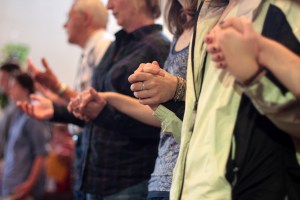
praying-hands1

Photo credit:  internationalhouseofprayernorthwest.org/event/praying-for-our-police-december-31st-200-300pm/

One of the major components of my vocation is living a life of prayer.  I am constantly offering up prayers for my parishioners, my family, and my friends.  I am regularly praying for the oppressed, the hungry, and those suffering around the world.  I pray for those in leadership in our country and around the world.  And even if the average stranger or acquaintance feels a little uncomfortable talking about religion with me, they have no issues asking me to pray for them.  Prayer is part and parcel of my life and work.

But as much as I pray, for others and even myself, I rarely ask others to pray for me.  I am not sure why really.  Maybe I feel like people are busy or God knows what I need.  Regardless, I don’t tend to solicit prayers.  But this past month has involved a lot of upheaval.  I am transitioning between jobs, and the prayer concerns seem endless.  My current parish has been sorting through their own grief and anxiety about the change.  My future parish has been preparing to receive me and handling logistics on their end.  And my family is juggling everything:  from the emotional toll of the transition, to buying our first home, to finding a new job for my husband, and finding new schools and childcare for our children.

So this week, I finally asked for prayer.  I asked a colleague group of mine and some close friends to pray.  The response was immediate and overwhelming.  Sharing the burden seemed to lessen the burden.  Feeling connected to a community of support gave me comfort and strength.  And thinking about their prayers made me realize there are other people praying too.  My current parish has a prayer group that is praying for us.  My future parish has a weekly prayer they are offering for me, my family, and for them.  Even my mom’s Bible Study group is praying for us.  And that probably does not even count the myriad other people who are praying for me without me realizing it.

As I marveled in the community of saints lifting me up in prayer this week, I realized maybe that is part of the power of prayer:  prayer reminds us that we are not alone.  When we join in prayer with others, we remember that we are not on our own in this life.  The vast web of prayer gives us a tiny glimpse into the enormous love of our God for us.  This week I am grateful for the reminder of the power of a prayerful community.  I encourage you to reach out to your own communities if you are in need of prayer.  And if you are feeling less needy this week, then reach out to someone else who might need your prayers.  We are not alone and we need each other.

On Fault and Forgiveness…

12 Friday Feb 2016

Posted by jandrewsweckerly in Uncategorized

≈ Leave a comment

Tags

accident, blame, brokenness, fair, fault, forgiveness, heal, journey, Lent, Lord's Prayer, mend, prayer, relationship, work

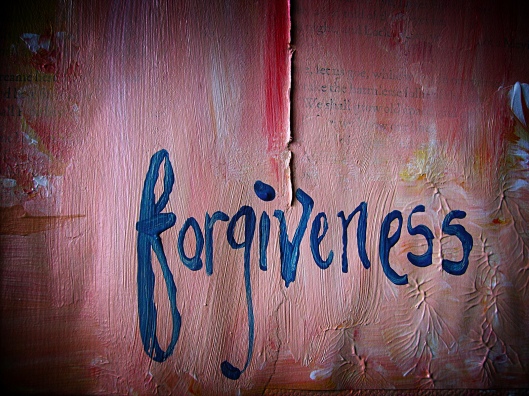
forgiveness

Photo credit:  http://strocel.com/a-word-for-2014-forgiveness/

Several weeks ago I had a conversation with a friend about an automobile accident in which she was involved.  The accident was not her fault – in fact the other driver was being oblivious to those around him and plowed right into her.  My friend and the other driver waited for the police to arrive to complete a report.  That was when she learned about a law in New York of which neither of us were aware.  In New York, even if the accident is clearly one driver’s fault, both drivers are expected to contribute to a portion of the costs of repairs.  The non-fault driver must pay a small percentage even though the accident was in no way her fault.

As we talked about this law, we were initially outraged.  The law hardly seemed fair.  If someone side-swipes you, runs a stop sign, or hits you while distracted, why should you be responsible for someone else’s fault.  We hypothesized about whether there might have been some way for her to give the driver a wider berth to avoid the accident – basically being a better defensive driver.  But we both could imagine situations in which there is no way to see an accident coming.  To us, the law just did not seem fair.

Today, as I was thinking about Lent and forgiveness, I was reminded of my friend’s accident.  The more I thought about New York’s rule, the more I realized that New York may be on to something.  You see, whenever we talk about forgiveness, we often think of ourselves needing to forgive someone else for something they have done to us.  Letting go of anger is an important step toward meaningful forgiveness.  But solely focusing on the actions of the other lets us off the hook from thinking about the ways we may have contributed to problem that needs forgiving.  I am not suggesting that the blame is 50-50.  But the blame might be 90-10 or even 80-20.  Anyone who has been married or who has navigated close friendships or family relationships knows that even when we are totally in the right, there is always a little blame to be shared by all.

As we start our Lenten journey, I invite you to consider taking an inventory of those relationships in your life that need mending or healing.  As you prayerfully consider those relationships, review the ways in which you have participated in the relationship and what ways you might hold some of the fault for the brokenness of the relationship.  The work will not be easy – we like being right so much that we may not be able to really consider mending those relationships.  But as you journey through the complicated web of fault and forgiveness, consider praying the Lord’s Prayer again:  forgive us our trespasses as we forgive those who trespass against us.  My prayers are with you on the journey.

Finding Grace in the Routine…

06 Wednesday Jan 2016

Posted by jandrewsweckerly in Uncategorized

≈ Leave a comment

Tags

adults, children, church, God, life, patterns, prayer, relationship, routine, rule, serving, study, vacation

Photo credit:  http://www.generationy.com/why-routine-is-important/

Photo credit: http://www.generationy.com/why-routine-is-important/

One of the early parenting lessons I learned is routines are lifesavers.  Whether it was trying to create a predictable bedtime routine, figuring out how often the child needed to eat to prevent meltdowns, or simply helping the child live into the routine of childcare and school, routines almost always meant that everyone was happier – the child and the parents.  As the second child has come along, I have certainly become more flexible, but the rule of routine still proves useful to us as a family.

So after ten days of vacation at home with our extended family, you can imagine how happy I was that the children would be returning to their routines.  We had a lovely time off and even the adults got regular naps, but there were also a lot of time-outs due to poor behavior.  The lack of a routine was making the kids a little out of sorts.  So by Tuesday of this week, I was so relieved to see the return of my lovely, beautiful six-year old.  I knew she was in there somewhere!

Though I single out kids, the truth is adults benefit from routine as much as children.  One of the consistent conversations I have with recent retirees is their struggle with the loss of a routine.  What at first feels like freedom can instead feel like a sense of loss.  Once they figure out a volunteer routine, a regular schedule of lunches with friends, or even plan periodic trips to look forward to, the retirees find a sense of calm and purpose.

Our relationship with God is like that too.  When we fall out of the routine of prayer, we find connecting with God more difficult.  When we fall out of the habit of going to church, we find our weekends are missing something valuable.  When we fall out of the pattern of regular learning and serving, we find our relationship with God is not as deep as might like.  As we begin a new year, I invite you back into the comfort of routine.  I invite you to consider what you might like to change in your everyday routine that might enrich your relationship with God.  It may be that you want to sit down and consider a rule of life you want to follow.  Or it may be as simple as deciding you want to do one thing – go to church more regularly, pray each night, or read devotionally.  Whatever the routine you take up might be, my guess is that God will be happy to see the return of your lovely and beautiful self!

Sermon – 1 Samuel 1.4-20, 2.1-10, P28, YB, November 15, 2015

19 Thursday Nov 2015

Posted by jandrewsweckerly in Uncategorized

≈ Leave a comment

Tags

anger, God, Hannah, honest, intercession, intimacy, praise, pray, prayer, relationship, Sermon, Thanksgiving, vulnerable

At some point in life, most of us have the experience of having a best friend.  Perhaps we met the person on the playground as a child; maybe we met him in college or at work; perhaps our best friend is a cousin or sibling; or maybe our best friend is our spouse or partner.  Regardless of how we met her, that best friend has seen the best and worst of us.  He has congratulated us when we got a part in the play, when we got a promotion, or when we found new love.  She has consoled us when we failed a test, when our heart was broken, or when a family member died.  He has seen us laugh so hard that we snort or pee in our pants, and he has seen us sob so hard that snot runs down our faces.  She has seen us dressed to the nines, and she has seen us in our stained, ill-fitting sweats.  And our best friend has taken the best and the worst from us too:  we have danced together, yelled at each other, confessed our darkest secrets to each other, and, yes, we have even hated each other at times.  Despite having experienced the very best and very worst of us, we know that she loves us deeply, he always forgives us, and she is always there for us.  The relationship is far from perfect, but the relationship is beautiful.

In many ways, the relationship we have with our best friend is similar to the relationship we have with God.  On our good days, we come to God with our thanksgivings and praise, offering our adoration and humility to God.  On our bad days, we are angry and curse God.  We confess things to God that we confess to no one else:  both those things done and left undone, but also those deep longings and desires that we do not admit to others.  We have cried a thousand tears with God and we have laughed with great mirth.  Although our best friend knows us better than any other human being, God knows even the stuff we are embarrassed or afraid to share with that best friend.  And since our Lord is not human, God’s forgiveness does not know the limits of human forgiveness.  Through the life, death, and resurrection of Jesus Christ, our relationship with other human beings will never quite equal our relationship with God.

Given that intimacy, I am often surprised when people ask me about prayer.  Throughout my ministry I have had people ask me how they should pray, what they should say, or when or where is the best time and place to pray.  I think the challenge is that most of us have some notion of what prayer should look like.  We imagine the pinnacle of brayer being the Zen-like posture of monks in silent prayer.  Or when someone offers a prayer, we assume we should bow our heads, fold our hands, and shush others into silence.  Or when someone asks us to offer the prayer, we scramble to remember common prayer phrases like, “Holy God…Bless us, we pray…you alone are worthy…”  Our prayers sound very little like our everyday speech.  Sometimes, if we are feeling especially uncomfortable, we peek around the room to see what everyone else is doing.  People often ask me how to pray because they do not feel like they are doing it “right,” because their usual method of prayer has become stale or dissatisfying, or because when they pray, God seems far away or even like a stranger.  Or sometimes people come to me about prayer because they are overwhelmed with the suffering of the world:  the poverty, the gun violence, the terror that keeps striking in places like Paris.  How do we pray to God when suffering seems like an endless abyss?

In scripture today, we see Hannah pray twice.  In the first occurrence, Hannah looks nothing like our notions of prayer.  She has been emotionally tortured by Elkanah’s second wife, Peninnah – just like Peninnah does every year when they travel to make their annual sacrifice.  Peninnah is ever fertile and Hannah is barren.  And, probably because Elkanah loves Hannah more, Peninnah throws Hannah’s infertility in her face whenever she can.  Meanwhile, Elkanah is acting like a wounded puppy.  He does not understand why Hannah is so upset – isn’t he enough?  So Hannah escapes to the Temple to pray.  Her prayer is unlikely offered from a pew, while she delicately flips through a prayer book to find some pre-written prayers.  Her prayer is not said reverentially, with a bowed head.  In fact, she does not quietly whisper prayers to God with her eyes closed.  No, when Eli, the temple priest, sees Hannah praying, he accuses Hannah of being drunk in the Temple.  Now I do not know if you have ever been in the presence of a drunken person, but people who are drunk are rarely still and reserved.  No, I imagine Hannah was pacing.  Maybe she was waving her fists at God as the tears spilled down her cheeks.  Maybe there was rage and devastation in her eyes.  The text says that she is silent, but that her lips are moving.  I imagine she was giving God a piece of her mind.  And in fact, the text tells us that she even resorts to bargaining with God – promising to commit his life to the Temple if God gives her a male child.  If Eli thought Hannah looked drunk, the scene could not have been pretty!

The second occurrence of Hannah praying today is found in the Song of Hannah from first Samuel.  Here we see a very different posture of prayer from Hannah.  Instead of ranting and raving in the temple, here we see Hannah giving praise to God for the deliverance of a child.  Hannah is full of gratitude for her own good fortune.  But Hannah’s prayer is bigger than herself too.  She proclaims the Lord to be a liberator – one who frees the oppressed, brings low the privileged, honors the faithful, and cuts off the wicked.  In Hannah’s personal experience with God, she is given a glimpse into the global nature of God.[i]  Hers is revolutionary song because God has heard her prayer and answered her.  We see a very different form of prayer from Hannah the second time than we do from Hannah the first time.

For those of you reading along with A.J. Jacobs’ The Year of Living Biblically, prayer is common topic from the author.  Not a believer himself, Jacobs struggles with prayer.  He does not know what to do or say.  But he feels compelled by the Bible to be in prayer.  One of his spiritual guides suggests that there are four types of prayer – Adoration, Confession, Thanksgiving, and Supplication.[ii]  Jacobs latches on to Thanksgiving at first.  He starts by thanking God for the food that has been prepared, in its many stages.  As he thinks about all the stages – the earth, the farmer, the packager, the person who puts on labels, the grocery stockers, the cashier – his prayer lengthens.  Jacobs also takes on intercessory prayer as a form of prayer – praying strictly for the needs of others.  Jacobs confesses, “It’s ten minutes where it’s impossible to be self-centered.  Ten minutes where I can’t think about my career, my Amazon.com ranking, or that a blog in San Francisco made snarky comments about my latest Esquire article.”[iii]  Slowly, Jacobs’ ideas about and experiences of prayer become transformed.  Prayer is not like what he thought prayer would be like.

That’s the great thing about prayer.  Hannah’s first “drunken” prayer of desperation and self-pity, her second prayer of adoration and revolution, and Jacobs’ ten minutes of intercessions that keep him from being self-centered are totally different.  My prayers in the car on the way to pick up the kids are very different from the prayers our Contemplative Prayer Group offers on Friday nights.  And the prayers of an evangelical pastor, which are accompanied by the creative tinkling of the keyboardist to emphasize and dramatize the preacher’s prayers, are totally different from the chanted prayers of the officiant of Evensong.  There is no single wrong or right way to pray.  And the same person who offers eloquent, beautiful prayers in the day can be the same person who rages against God in the night.

When we allow prayer to be what prayer needs to be, we let go.  Then our prayers become not some preconceived notion of what we think they should be, but become a real conversation between us and the living God.  Whether we are wrapped up in our own suffering, totally ceding our worries to God, or railing at God for the injustice and the inhumanity in this world, something powerful happens in prayer.  Where else can we stomp our feet at God, looking like a drunkard, except at the feet of God?  Ultimately, that is what is most important in our prayer life – being our honest, vulnerable, mercurial selves.  As one priest explains, “…The relationship we’re offered with God is a real one.  A genuine relationship.  The God who made the heavens and the earth wants to know us, and wants us to know [God].  And when we’re excited, we’re to gush out like Hannah breaking out into song.  And when things are falling apart, we’re to gush out like Hannah at Shiloh.”[iv]  God does not care what our prayers look like or even what we say.  God is just glad we show up.  Our invitation this week is to show up.  Amen.

[i] Kate Foster Connors, “Pastoral Perspective,” Feasting on the Word, Yr. B, Vol. 4 (Louisville: Westminster John Knox Press, 2009), 298, 300.

[ii] A. J. Jacobs, The Year of Living Biblically (London:  Arrow Books, 2009), 95.

[iii] Jacobs, 128.

[iv] Rick Morley, “Pouring Out Our Souls – A Reflection on 1 Samuel 1.4-20 & 2.1-10,” November 8, 2012, as found at http://www.rickmorley.com/archives/2052 on November 12, 2015.


Gratitude and Giving

23 Friday Oct 2015

Posted by jandrewsweckerly in Uncategorized

≈ Leave a comment

Tags

church, community, encouragement, faith, giving, God, gratitude, pledging, prayer, spiritual, stewardship, upheaval

This week we begin a series of guest blog posts by parishioners at the Episcopal Church of St. Margaret in Plainview, NY.  They are reflecting on what stewardship means to them, and how God the Giver has been a part of their lives.  Our first guest post is from parishioner Phil Russo.

I am grateful for many blessings in my life but most recently I find my gratitude rooted in the support my family has received during times of adversity.  Over the course of the past two years I have encountered two sudden and unexpected upheavals.  The first involved my mom suddenly falling ill, resulting in a long hospital stay, with series of setback after setback.  As we began to grasp the reality and gravity of the situation, my family and I founds ourselves sitting in a hospice facility knowing that the end was near.

Photo credit:  http://newmanec.com/parish/prayers/

Photo credit: http://newmanec.com/parish/prayers/

The second upheaval was even more unexpected and impactful, as my wife Nancy fell seriously ill.  It turned our life upside down as we faced surgery, treatments, and adjusting to a new normal striving to get our lives back.  During both of these ordeals, I found myself praying more often, asking God for help.  At times I labored in trying to understand why these things were happening to me and my family.  As many of you know, these kinds of things can test your faith.  One constant source of support and comfort was knowing that we had a church family at St. Margaret’s praying for us, pulling for us and reaching out with words of encouragement.

St. Margaret’s for me has always been a kind of spiritual anchor, a kind of home base for me and my family in our faith journey.  It made us feel good to be part such a caring church community.  It also underlined the importance of having a spiritual support base to lean on in time of need.  I am grateful and blessed to be part of the St. Margaret’s family.  It just seems logical for me to start from a place of gratitude when I consider my thoughts about Stewardship and pledging financial support.

I am also grateful that I have gotten involved in some of the business aspects that go into keeping St. Margaret’s running.  Unfortunately, St. Margaret’s pledges do not cover expenses and we operate at a loss.  This is not sustainable.  This is an inconvenient truth that many do not realize or may choose to treat with indifference or leave to others to deal with.  It will eventually cause us to make difficult decisions and possibly cut programs near and dear to many.  Therefore, I find it helpful to keep these facts in mind as I consider my annual pledge.  It always starts with gratitude but it is also grounded in an understanding of the financial side of St. Margaret’s.

Submitted by Phil Russo.

Sermon – Mark 9.38-50, P21, YB, September 27, 2015

30 Wednesday Sep 2015

Posted by jandrewsweckerly in Uncategorized

≈ Leave a comment

Tags

barrier, boundaries, call, church, division, Episcopal, exclusivity, God, hospital, in, Jesus, out, prayer, priest, Roman Catholic, rules, sent, Sermon

“Are you the priest they sent?”  That was the question he asked me.  I was confused at first, but realized one of the nurses must have called an on-call priest.  I also knew from experience that if he was looking for the “priest they sent” he was not looking for me.  You see, I’m a priest, but I’m also a woman.  When people at hospitals are looking for priests, the majority of the time they mean a Roman Catholic priest.  But he seemed desperate, so I delicately said “No, I’m actually here to see a parishioner.”  But I stayed and talked to him a bit more about what was going on and whether the chaplain’s office had been called.  His wife joined us as we talked.  Then the inevitable question came.  She asked what church affiliation I had.  I told them I was a priest in the Episcopal Church, and that they were welcome to wait for a Catholic priest.  She insisted it didn’t matter – they just wanted a priest to say prayers.

Honestly, I was floored.  That had never happened to me.  Usually when I tell a Roman Catholic person that I am not a Roman Catholic priest, they reveal (subtly or not so subtly) that I am not the kind of priest they want.  And truthfully, I am totally fine with that.  I totally understand and would never assert any differently, especially to someone in crisis at the hospital.  We ended the conversation with the agreement that we would go to our separate rooms.  When I was done, if they still didn’t have their Roman Catholic priest, I would be happy to say prayers.  I went on to my visit, fully anticipating the “real” priest to show up for them while I was elsewhere.

That division among the Church, among the faithful of God, is not unique to Roman Catholics.  We all make boundaries and distinctions about who is in and who is out.  Episcopalians are only in full communion with the Evangelical Lutheran Church of America.  So if I ever wanted to have a United Methodist Minister or Presbyterian pastor celebrate Eucharist, I would not be allowed.  We also make rules around the communion rail.  Most Episcopal Churches say that all baptized Christians are welcome to the table – meaning if you have not been baptized, you should not receive.  Even to serve on Vestry we have boundaries.  All Vestry members have to be financial supporters of the parish, are expected to be present regularly in worship and parish events, and are asked to contribute to at least one ministry of the church.  If the Vestry member is unwilling to make those commitments, they cannot serve on Vestry.  We often think of Roman Catholics as having lots of boundaries – from no women at the altar, to no married clergy, to no communion unless you are Roman Catholic.  But the reality is that, as Episcopalians, we have an equal number of boundaries that keep people in and out of our community.

The good news is that we come by our exclusivity honestly.  In our gospel lesson from Mark today, we are told about an encounter between the disciples and Jesus.  John comes up to Jesus and says, “Teacher, we saw someone casting out demons in your name, and we tried to stop him, because he was not following us.”  John is so confident of his authority that he almost sounds like he is boasting to Jesus.  “Hey, Jesus, there’s some dude who is trying to do our work and he keeps using your name.  But don’t worry – we shut him down.”  You can almost imagine John expecting Jesus to give him a chug on the shoulder and say, “Good work, John!”  But that is not how the story unfolds.  Instead, Jesus says the total opposite, “Do not stop him; for no one who does a deed of power in my name will be able soon afterward to speak evil of me.  Whoever is not against us is for us.”  You can imagine the disciples’ confusion.  Jesus is constantly pulling them aside and only telling them how to interpret his parables.  When Jesus commissions people, he commissions the disciples, and no one else.  And although people are often following Jesus in droves, his crew, or his posse, is made up of the disciples.  In the disciples’ minds, Jesus is implicitly telling them that they are the insiders, with special privileges, and everyone else is an outsider.  The disciples are in; everyone else is out.  And anyone who tries to break those boundaries is going against the will of Jesus – and, ergo, the will of God.

Despite the fact that Jesus shuts down the notion of insiders and outsiders, the Christian community has been struggling with boundaries since Jesus’ death.  Who is a Christian?  Who can have communion?  What are the rules and what are the consequences of breaking the rules?  Now, boundaries are not necessarily bad.  Boundaries help us define who we are and what behavior is acceptable.  Boundaries help us uphold values and create meaning.  Boundaries can even help us make an informed choice about belonging to a community.[i]  Clearly Jesus created some boundaries.  When he says, “Whoever is not against us is for us,” he implies that there are people who are in fact against them.  Jesus himself creates a group of insiders and outsiders.  What Jesus is trying to communicate is not that boundaries are bad.  What Jesus is trying to communicate is that we are capable of getting so wrapped up in our boundaries that we exclude people from the love of Christ.  And nothing could be more harmful, or even sinful, than making someone feel that they are cut off from the love of Christ.

I had a friend who started going to therapy to help him cope with a spouse suffering from depression.  He imagined that the therapist would share her knowledge of persons suffering from depression and teach him some coping skills.  But after a lengthy explanation about what was wrong with his spouse, the first question the therapist asked was about him.  The therapist wanted to know what his issues were.  My friend interrupted, “No, no, no, I’m not here for me, I’m here to learn more about dealing with my spouse.”  The therapist wisely said, “Yes.  But before we get to your spouse, let’s talk about you.”  That therapist did what Jesus does with the disciples.  Jesus redirects the disciples concern about others by telling them to worry about their own problems – those hands, feet, and eyes that cause them to sin.  You see, Jesus is very clever.  What he realizes is that when the disciples start sorting through their own sinfulness, their own “stuff,” they do not have time to worry about boundaries and rules and barriers.[ii]  And when they let go of those boundaries, rules, and barriers, something incredible can happen – the love of God and the fellowship of Christ can grow and thrive.

By the time I finished my visit with my parishioner, the Catholic on-call priest had still not arrived.  I went into the room of the family and realized they needed more than a prayer.  They were going to be removing life support and wanted someone to offer the patient Last Rites.  I again reminded them that I was an Episcopal Priest.  The wife of the couple said, “It’s still Last Rites though, right?”  “Yes,” I replied.  “Okay, then.”  That was all.  Here I was bringing up boundaries again and again, and this person, who normally has even more boundaries than I do, insisted that I let go of my boundaries and help her family have an experience with God.  The first words the husband had asked me were, “Are you the priest they sent?”  My first answer was correct.  I was not.  But my answer was not complete.  I was not the priest that “they” sent.  But I was the priest that God sent.  You see, God has a call on me – and in fact God has a call on each person here.  God sends us everyday – to our workplaces, to our schools, to our friends, and to strangers.  Everyday we have the choice to get tangled up in boundaries and rules and limitations.  But we also have the choice to remember the ways that Jesus wants us to love God and love our neighbors.  Those are the only two boundaries Jesus really cares about anyway.

That is our invitation this week:  to consider how God is calling you and also to consider how you are getting in the way of God’s call.  The boundaries and the rules really are not as complicated as they sound.  If the Pope can say, “Who am I to judge?” surely we can start letting go and embracing love.  Then, the next time someone asks you, “Are you the person that was sent?” you can reply, “Yes.  Yes, I am.”  Amen.

[i] Harry B. Adams, “Pastoral Perspective,” Feasting on the Word, Yr. B, vol. 4 (Louisville:  Westminster John Knox Press, 2009), 116, 118.

[ii] Amy Oden, “Commentary on Mark 9.38-50,” September 30, 2012, as found at http://www.workingpreacher.org/preaching.aspx?commentary_id=1357 on September 25, 2015.

On being wonderfully made…

09 Wednesday Sep 2015

Posted by jandrewsweckerly in Uncategorized

≈ Leave a comment

Tags

awesomely, celebrate, eyes, failures, fearfully, flaws, glory, God, goodness, positive, prayer, Psalm 139, version, wonderfully

This is a big week for our family.  Both of my girls are moving up in school.  The youngest is moving from the infant room to the toddler room.  The oldest is starting first grade.  It has been a big week, and I am certainly having some feelings.  Mostly, as I look at both of them, boldly tromping into their new rooms and onto the bus, I am in awe.  I marvel at how big they have gotten.  I marvel at how beautiful they each are in their own unique ways.  I marvel at their awesome personalities and the joy that they bring to others.  I know I am biased as a parent, and I also recognize all the days when my children are not awesome, but today I am profoundly moved by how awesomely and wonderfully made they are.

Photo credit:  http://jennawaters.com/fruitful-fearful-wonderful/

Photo credit: http://jennawaters.com/fruitful-fearful-wonderful/

As I thought about each of them today, I was reminded of that verse from Psalm 139, “I praise You, for I am awesomely, wondrously made; Your work is wonderful; I know it very well.” (Ps. 139.14, Tanakh translation)  Today, I felt like I received a small glimpse into the ways that God must look at each of us.  So often, we look at our flaws and failures.  Even our prayer time can be filled with regrets and apologies to God.  We know that we fall short of the goodness God wants for us.  But that is not how God sees us.  God sees the wonderful and awesome creature that God has made and God is greatly pleased with us.  Perhaps there are days when we greive God through sin and violence to ourselves, to one another, and to God.  But God has a tremendous way of cutting through all that sinfulness and seeing goodness in us.  God sees how we are awesomely and wondrously made.

This week, I invite you to connect with God’s version of you.  I invite you in your prayer time to let go of the flaws and failures and to instead celebrate the goodness of each day.  Maybe you will have to reach really far into your reflection to find something positive.  But my guess is that you do something each day that pleases God – however big or small.  Meditate on that goodness and give glory to God!

Saintly Shout Out

05 Wednesday Aug 2015

Posted by jandrewsweckerly in Uncategorized

≈ Leave a comment

Tags

God, gratitude, humility, important, lost, prayer, saints, St. Anthony

Yesterday I lost something very dear to me.  Normally, I am not that passionate about material possessions.  I try to stay detached so that I don’t get fixed on the “stuff” of life.  But there are a few things that mean a great deal to me, and this was one of them.  There was a lot of weeping and gnashing of teeth yesterday (literally!), and ultimately, I remembered one of my favorite saints – St. Anthony.

Photo credit:  http://www.stanthonyoakley.com/our-patron-saint.html

Photo credit: http://www.stanthonyoakley.com/our-patron-saint.html

I know a lot of you are not familiar with or even in favor of praying with saints.  It was a practice I discovered in college.  Not having grown up in a tradition that prays with saints, it seemed mildly like praying to idols.  But once someone explained to me that the saints are more like companions in our prayer life – much like a dear friend who you ask to pray for you – I was able to ease my way into praying with saints.  I still think there is a bit of superstition to some of the saints.  St. Anthony is a classic example – he’s the patron saint of lost things.  I mean, it seems a little fishy to expect a saint to magically make your stuff appear.  But when you are desperate, you will try anything.  Hence, the prayers to St. Anthony last night and this morning.

The truth is, I am not sure praying with St. Anthony really helps you find things.  What I do know is that St. Anthony reminds you to pray – which is always a good thing.  If nothing else, when we slow down enough to pray, we find a sense of peace, and are reminded that God is with us, even when we are devastated and may never find the lost things that belong to us.  That prayer time also brings perspective about what is important in life, makes us question why we had not tended to prayer life in so long, and reconnects us with a real sense of gratitude – even in the midst of loss.  And my prayer time with St. Anthony also reminded me of how he might be helpful the next time I lose more important things – “things of the spirit,” as you will see in the prayer below.

The good news is that the item reappeared today and all the angst I felt is gone.  Now, I don’t know if St. Anthony helped.  All I know is that my gratitude is deeper and more humble today, and that I am grateful for a God who sits with me in the ashes.  Whether you pray with saints, with friends, or you just pray the old fashioned way, know that God longs to be in conversation with you.  Slow down, pull up a chair, and draw nearer to your God.

O blessed St. Anthony, the grace of God has made you a powerful advocate in all our needs and the patron for the restoring of things lost or stolen.  I turn to you today with childlike love and deep confidence.  You have helped countless children of God to find the things they have lost, material things, and, more importantly, the things of the spirit: faith, hope, and love.  I come to you with confidence; help me in my present need.  I recommend what I have lost to your care, in the hope that God will restore it to me, if it is His holy Will.  Amen.[i]

[i] http://www.catholicdoors.com/prayers/english/p00557.htm

On prayer and listening…

01 Friday May 2015

Posted by jandrewsweckerly in Uncategorized

≈ Leave a comment

Tags

authenticity, Baltimore, God, humility, listen, oppression, prayer, privilege, race

As Christians, there are many things we say out of habit.  We say, “God bless you,” when someone sneezes, even if we do not actually mean to invoke a blessing on the person.  We say, “Peace be with you,” in church without necessarily thinking about what offering the peace really means for our relationship with the other person.  And we regularly say, “I’ll keep you in my prayers,” even if we do not really keep a practice of diligent prayers.

And yet, as I have thought about the chaos that has erupted in Baltimore this past week, the only thing I can say with confidence is that I am holding Baltimore in my prayers.  Everything else I have tried to say has been muddled mess.  If I talk too long about my sorrow around the violence, I find that I too easily slip into blaming – a slippery slope at best.  If I try to talk about race, I find myself getting tangled up in the ways that race is invariably tied to socio-economic status and the inability I have as a white person to speak authority on the experience of my minority brothers and sisters.  No matter what philosophical argument I try to make, I find myself entangled in a very complicated system of oppression and favor.

And so although “I am holding Baltimore in prayer,” sounds like what a person of faith says as a throw-away statement, I really mean it.  I mean it because that is all I feel like I can do with authenticity and humility.  I mean it because it feels like something I can actively do when I feel powerless in so many ways.  And I mean it because what I know in the depths of my heart is that the situation in Baltimore is making me more upset about my own privilege and power than anything.  And I can only work that out through prayer.  God and I need to talk – and I need to listen.

Photo credit:  https://listeningprayer.wordpress.com/

Photo credit: https://listeningprayer.wordpress.com/

My hope is that prayer will open up a listening heart not just for God’s word, but also a listening heart to my brothers and sisters.  When prayer is at its best, it is an exercise in listening – and if anything, I am acutely aware of how much listening we need to do right now.  The listening this week started for me with this article.  After it brought me to my knees in prayer, I stumbled on this article about what Martin Luther King, Jr. once said about riots.  These pieces and many more have reminded me once again of my obligation as a person of privilege to shut my mouth, and open my eyes and ears.  Though a posture of prayer does not excuse us from action, as Desmond Tutu once said, we cannot accomplish much without it.

God and cell phones…

03 Wednesday Dec 2014

Posted by jandrewsweckerly in Uncategorized

≈ Leave a comment

Tags

Advent, connection, disconnected, God, prayer, relationship, technology

To see me now, you might not guess the initial reluctance I experienced with using a cell phone.  My progress was slow from owning one at all, to learning to text, to using a smart phone, to now using my agile phone.  Part of my reluctance was what such usage would mean – being able to be reached at all times; work emails invading “down time,” making me feel like I am never truly off; decreased patience with others who are not as technologically savvy; and constant usage for everyday needs.  I still try to resist looking at my phone constantly – I put it down during dinner time, I try not to respond to emails on my day off, I sometimes wait to look up something until I am at my computer.  But I still have those moments when my daughter impatiently waits while I finish one quick text or email to someone.  Though I ask her to hold on while I finish, I worry that I am becoming what I feared.

But there are also days when I am really grateful for my phone.  I currently have a parishioner who in the last stages of life.  The family and I know that the parishioner could go at any time, and so we are keep watch, spending time together, and holding each other in prayer.  I am keeping my phone especially close, checking for texted updates or for the dreaded call.  I even keep my phone on my nightstand in case I need to run to the hospital overnight.  That may sound unpleasant to some, but what I have come to see these last few weeks is that my phone is becoming not just a tool for pastoral care (a way for parishioners to reach me for emergencies), but it is also becoming a tool for my prayer life.  When I check my phone and there are no messages about this parishioner, I use the moment as a reminder to pray – pray for the parishioner, the parishioner’s family, and talk with God about the hard stuff of life.  Who would have thought that this little phone – a thing which I had once associated with menace, annoyance, and disconnectedness – could also be a tool for deep connection, prayer, and blessing?

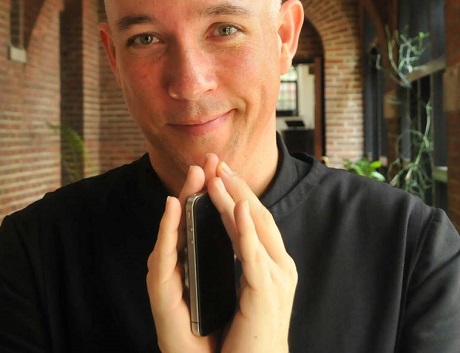
Courtesy of http://episcopaldigitalnetwork.com/ens/2014/11/12/anglicans-invited-to-celebrate-advent-using-your-camera-phones/

Courtesy of http://episcopaldigitalnetwork.com/ens/2014/11/12/anglicans-invited-to-celebrate-advent-using-your-camera-phones/ Check out their website for a concrete way of using technology this Advent!

What I love about this tiny revelation is that it points to a larger truth.  God is constantly working through us in the current age.  It may sound silly, but I think God can work through our technology – through my little cell phone – for good, inviting me back into relationship with God, and working through it to connect us to one another.  The trick is keeping a watchful eye for God when it could otherwise be easy to miss God.  Of course, that is not a new problem.  God has been inviting God’s people into relationship from the beginning of time – and we have regularly been resistant.  The trick for staying connected is finding those things that help us return to the LORD:  whether it is a cell phone, a strategically placed Prayer Book that reminds us to pray, a set of prayer beads that you keep in your pocket, or a regular commitment to church attendance.  I wonder what things in your life might be repurposed to help you reconnect with the holy this week.


← Older posts
Newer posts →

Recent Posts

  • On the Myth and Magic of Advent…
  • On Risking Failure and Facing Fear…
  • Sermon – Luke 23.33-43, P29, YC, November 23, 2025
  • On Inhabiting Gratitude…
  • Sermon – Luke 20.27-38, P27, YC, November 9, 2025

Archives

  • December 2025
  • November 2025
  • October 2025
  • September 2025
  • August 2025
  • July 2025
  • June 2025
  • March 2025
  • February 2025
  • December 2024
  • November 2024
  • October 2024
  • September 2024
  • August 2024
  • July 2024
  • June 2024
  • May 2024
  • March 2024
  • February 2024
  • January 2024
  • December 2023
  • November 2023
  • October 2023
  • September 2023
  • August 2023
  • July 2023
  • June 2023
  • May 2023
  • March 2023
  • February 2023
  • January 2023
  • December 2022
  • November 2022
  • October 2022
  • June 2022
  • May 2022
  • January 2022
  • December 2021
  • November 2021
  • October 2021
  • September 2021
  • August 2021
  • June 2021
  • May 2021
  • April 2021
  • March 2021
  • February 2021
  • January 2021
  • December 2020
  • November 2020
  • October 2020
  • September 2020
  • August 2020
  • July 2020
  • June 2020
  • May 2020
  • April 2020
  • March 2020
  • February 2020
  • January 2020
  • December 2019
  • November 2019
  • October 2019
  • September 2019
  • August 2019
  • July 2019
  • June 2019
  • May 2019
  • April 2019
  • March 2019
  • February 2019
  • January 2019
  • December 2018
  • November 2018
  • October 2018
  • September 2018
  • August 2018
  • July 2018
  • June 2018
  • May 2018
  • April 2018
  • March 2018
  • February 2018
  • January 2018
  • December 2017
  • November 2017
  • October 2017
  • September 2017
  • August 2017
  • July 2017
  • June 2017
  • May 2017
  • April 2017
  • March 2017
  • February 2017
  • January 2017
  • December 2016
  • November 2016
  • October 2016
  • September 2016
  • August 2016
  • July 2016
  • June 2016
  • May 2016
  • April 2016
  • March 2016
  • February 2016
  • January 2016
  • December 2015
  • November 2015
  • October 2015
  • September 2015
  • August 2015
  • July 2015
  • June 2015
  • May 2015
  • April 2015
  • March 2015
  • February 2015
  • January 2015
  • December 2014
  • November 2014
  • October 2014
  • September 2014
  • August 2014
  • July 2014
  • June 2014
  • April 2014
  • March 2014
  • February 2014
  • January 2014
  • December 2013
  • November 2013
  • October 2013
  • September 2013
  • August 2013
  • July 2013
  • June 2013
  • May 2013
  • April 2013
  • March 2013
  • February 2013
  • January 2013
  • December 2012
  • November 2012
  • October 2012
  • September 2012

Categories

  • reflection
  • Sermons
  • Uncategorized

Meta

  • Create account
  • Log in
  • Entries feed
  • Comments feed
  • WordPress.com

Blog at WordPress.com.

  • Subscribe Subscribed
    • Seeking and Serving
    • Join 394 other subscribers
    • Already have a WordPress.com account? Log in now.
    • Seeking and Serving
    • Subscribe Subscribed
    • Sign up
    • Log in
    • Report this content
    • View site in Reader
    • Manage subscriptions
    • Collapse this bar
 

Loading Comments...