• About

Seeking and Serving

~ seek and serve Christ in all persons

Seeking and Serving

Tag Archives: silence

Sermon – Mark 12.28-34, Deuteronomy 6.1-9, P26, YB, October 31, 2021

17 Wednesday Nov 2021

Posted by jandrewsweckerly in Sermons

≈ Leave a comment

Tags

commandments, discomfort, gift, God, grace, Jesus, love, neighbor, perfect, radical, responsive, self, Sermon, shema, silence

In preparation for a mission trip to Honduras, we did a lot of study on the history, politics, and economic development of the country.  Part of that preparation included reading Don’t Be Afraid, Gringo, the story of Honduran woman Eliva Alvarado.  Her story is the story of all campesinos – the poor and oppressed in her country.  Her story is the kind of story that stirs up righteous indignation and makes you want to hop on a plane to go fight for justice.  But in the conclusion of her story, she says to the reader that her ultimate desire is for us to stay where we are.  She does not want her story to inspire us to come there and “fix” things.  Instead, she implores us to fix ourselves – explore our own country’s policies and practices that abet the oppression by the privileged in her country. 

I remember when we got to her conclusion, the team sat in silence for a long time.  You could see the wheels churning in each of our minds – surely, we know what is best, surely we can fix things if we can just get there, surely there is a way around the way this woman has made us feel impotent.  And yet, there was profound truth in her words, and an understanding that to not listen to her final request would be worse than to have not read her words at all.  And so, we sat in pained silence, letting her charge sit uncomfortably with us.

Jesus creates a similar silence at the end of our gospel lesson today.  Jesus has been poked and prodded by one group after another at this point in Mark’s gospel.  In chapter 11, the chief priests, scribes, and elders question Jesus’ authority.  Early in chapter 12, the Pharisees and some Herodians try to trap Jesus with a question.  Finally, some Sadducees question Jesus about a theological issue.  Then today, a scribe asks a “palpably disarming” question – not one to test Jesus, but as one scholar says, an “invitation to the table of theological discourse.”[i]  The conversation today is about the greatest of the commandments. 

Jesus’ response is not new.  In fact, Jesus quotes the shema, the classic text we heard just this morning from Deuteronomy, “Hear, O Israel: The Lord is our God, the Lord alone. You shall love the Lord your God with all your heart, and with all your soul, and with all your might.”  This is a text the Israelites have emblazoned in the minds of their children, and repeated for generations, “Shema Yisrael, Adonai eloheinu, Adonai echad.”  “Hear, O Israel, The Lord is our God, the Lord alone (or the Lord is one).”  Jesus tweaks the answer only slightly from the original shema, adding that we should love the Lord our God with all our mind in addition to all our heart, soul, and strength.  And he adds that we should love our neighbor as ourselves.  But that notion is true to the original commandments as well.  When the scribe agrees with Jesus, saying loving God and neighbor as self is more important than any other ritual of the faith, the crowd falls silent, and we are told “no one dared to ask him any question.”  In other words, “Jesus’ critics were silenced and the effect was momentarily deafening.”[ii] 

So why is the crowd suddenly and dramatically silenced?  What’s the big deal about loving God and neighbor as self?  We talk about these commands all the time.  I mean, Bishop Curry has preached these words more times than I can count.  So why do Jesus’ words shock the room into silence?  One scholar suggests that the silence is so deafening because those gathered understood something about the reality of love that we modern Americans sometimes neglect.  As one scholar explains, “…sometimes — especially in western Christianity — we focus so hard on the emotive and affective aspects of love that we forget its rigor, its robustness, its discomfort.  We assume that loving God and our neighbors means expressing friendly sentiments to God in Sunday worship, and exchanging warm pleasantries with the people who live near us during the week.  We forget that in the scriptures, the call to love is a call to vulnerability, sacrifice, and suffering.  It’s a call to bear a cross and lay down our lives.  Biblical love is not an emotion we feel, it’s a path we travel.  As the children of God, we are called to walk in love. Think aerobic activity, not Hallmark sentiment.”[iii]  An invitation into that kind of radical love – the love of neighbors we would rather not love, the love that is as powerful as the natural, preserving love of self[iv], the love that is a response to the overwhelming love of God for us – that kind of invitation is sobering. 

I remember having read Elvia’s disinvitation to come to Honduras and “fix” things felt like a disempowering, painful rebuffing of love.  But I think I felt that way because we do not get to dictate what love of neighbor looks like.  True love of neighbor is not self-designed but is responsive – responsive to our love of God, and respectfully responsive to the self-articulation of needs by others.  Elvia’s self-articulation was deafeningly silencing the way Jesus’ invitation is too.  As scholar Debie Thomas explains, “Silence is the appropriate first response to the radical love we’re called to.  We dare not speak of [love] glibly.  We dare not cheapen [love] with shallow sentiment or piety.  Rather, [we] ask for the grace to receive [love] as the wise scribe received [love].  In awed and grateful silence.”[v]  Only when we have sat in the uncomfortable silence that recognizes the true love of God and neighbor as self are we ready to take up every perfect gift God has given us and travel the path of love.  Amen.


[i] Cynthia A. Jarvis, “Pastoral Perspective,” Feasting on the Word, Year B, Vol. 4 (Louisville: Westminster John Knox Press, 2009), 262.

[ii] Jarvis, 364.

[iii] Debie Thomas, “Walk in Love,” October 24, 2021, as found at https://www.journeywithjesus.net/lectionary-essays/current-essay?id=2944 on October 29, 2021.

[iv] Victor McCracken, “Theological Perspective,” Feasting on the Word, Year B, Vol. 4 (Louisville: Westminster John Knox Press, 2009), 262.

[v] Thomas.
Sermon – Job 14.1-14, HS, YB, April 3, 2021

28 Wednesday Apr 2021

Posted by jandrewsweckerly in Sermons

≈ Leave a comment

Tags

Christian, church, community, disciples, drama, faith, Holy Saturday, hope, Jesus, Job, liturgy, pandemic, preparation, quiet, redemption, Savior, Sermon, silence, sorrow

Up until last year, I had not remembered that there was a liturgy in our Prayer Book for Holy Saturday.  I had always thought it was Maundy Thursday, Good Friday, Easter Vigil on Saturday night (which is basically just Easter), and then Easter Sunday.  But when the pandemic hit last year, we realized doing a virtual Easter Vigil just would not work – there is so much reading, singing, doing things by candlelight, and the drama of being huddled together that we had to let the Liturgy wait until we could gather again.  So instead, we turned to this tiny liturgy, whose entire content is listed on one page of the Book of Prayer Book.

Still in a pandemic a year later, I found myself curious about this liturgy we are entering once again.  The truth is, the earliest accounts of Holy Week observances had no liturgies for Holy Saturday, with the exception of private use of the daily office.[i]  Instead, this day has simply been known as the “quietest day of the Christian year.”[ii]  That the church has not always gathered on Holy Saturday and that Christians might see this day as a day of quiet makes a lot of sense.  The Church says so much this week – from our waving of palms last Sunday, to our gathering around the upper room table to wash feet and share bread, to devastating betrayals of Jesus, to the vivid walk toward the cross, to the finality of the closed tomb.  We almost need a day of quiet to let the drama sink in and wrap our heads around what this week means.

But I suspect if your life is anything like mine or most Americans, we are not sitting quietly in our homes from 3:00 pm on Friday until Easter morning.  Instead, we are filling the time with preparations – tending to all the things we did not do while we were attending church this week:  dying eggs, entertaining children, stuffing Easter baskets, prepping Easter day meals, cleaning the house, or just having fun.  There is nothing inherently wrong about those things, but this year, of all years, I am grateful for a Holy Saturday liturgy.  With this last year of suffering through a pandemic and reflecting on our broken humanity’s inability to eliminate racism or mend civil discourse, even with the rise of vaccines, I find our country is in a Holy Saturday kind of time.  We have been through a tumultuous experience and are not yet healed. 

That is why I like having Job as a companion today.  Job’s words are stark.  As Job sits in the ashes of his sorrows, having lost his children, his livelihood, and his support system, he describes the brutality of life.  He talks about how trees have hope – even when cut down, they can sprout again, and new life can be born out of death.  But not so with humans, he argues.  No, when their bodies lay in the ground, there is nothing but death.  Job captures the essence of this day.  There is a similar finality at the door of Jesus’ tomb this day.  All the hopes and dreams, all the joys and blessings, all the promises of new life are sealed away in a tomb.  And after such a violent death and the threat for those who followed Jesus, there is no wonder why the Church has considered this a quiet day.  Unlike the quiet waiting of Advent, when the church is brimming with expectation and bustling around in preparation for Christ’s birth, today is a day of silence devoid of restorative peacefulness.  As one scholar says, “The waiting of Advent is like having warm bread in the oven.  By contrast, the air of Holy Saturday smells more like stale smoke, as though something essential was burned the day before.”[iii]  As our lives are not yet pandemic free, and as threats of spikes in cases emerge, we know that kind of waiting all too well.

And yet, in the very last verse of today’s reading, the despondent Job says something totally counter to everything else he has said.  “If mortals die, will they live again?” Job asks.  For someone who has boldly proclaimed the finality of human death, his question is a question that only a person of faith can ask – a question that reveals the tiniest bit of hope still left in Job.  Job communicates in this question a truth we people of faith hold dear:  no matter how bad the suffering, no matter how prevalent the experience of dread and doom, no matter how deep the failures of humanity seem to run, there is always hope.  The disciples and community surrounding Jesus Christ do not know that hope yet.  But as followers of Christ 2000 years later, we now stake our entire identity on the risen savior. 

So yes, receive the gift of stale smoke this day.  Sit in ashes with Job and mourn all in your life that feels dead.  Take time in this busyness of life for some uneasy silence.  Name all those who have been lost due to disease and violence.  But keep asking the questions.  Hold on to the hope, however infinitesimally small that God can indeed redeem us – us as individuals, us as country, us as Church.  Holding the two in tension is difficult – we want to rush to Easter and forget all that has happened.  But letting the power of all that has happened speak to us today will allow us to know the astounding power of resurrection much more deeply tomorrow.  Job, Jesus, and this faith community here will pull up a chair and sit with you by the ashes until we can reap with tears of joy tomorrow.  Amen.


[i] William Joseph Danaher, Jr., “Theological Perspective,” Feasting on the Word, Yr. B, Vol. 2 (Louisville:  Westminster John Knox Press, 2008), 310.

[ii] Christina Braudaway-Bauman, “Pastoral Perspective,” Feasting on the Word, Yr. B, Vol. 2 (Louisville:  Westminster John Knox Press, 2008), 312.

[iii] Braudaway-Bauman, 312

Sermon – 1 Kings 19.9-18, P14, YA, August 9, 2020

19 Wednesday Aug 2020

Posted by jandrewsweckerly in Sermons, Uncategorized

≈ Leave a comment

Tags

Elijah, encouragement, faithfulness, God, listen, quiet, Sermon, silence, sound, speaking

Today’s sermon is offered as the height of irony.  The art of preaching is based on the spoken word.  Fortunately for you, we are Episcopalians, so our sermons are usually under fifteen minutes – and in the times of livestreaming, we shorten them down to less than ten.  In other traditions, the spoken word of the sermon can last thirty minutes to an hour.  In fact, I used to worship at a church where scheduling lunches after worship was nearly impossible because depending on how much the preacher got going, lunch could be a noon, at one, or even approaching two in the afternoon.

I say this is the height of irony because our scripture lessons today seem to point to one instruction:  to stop talking.  Poor Elijah has sunken into a funk.  He shuts down the prophets of Baal in a dramatic, showy display of confidence and trust in God.  But as soon as Queen Jezebel threatens to retaliate by taking Elijah’s life, Elijah flees and becomes so despondent in the wilderness, he would rather the Lord take his life.  Though God shows infinite compassion, tending to Elijah’s needs for food and shelter, when Elijah dejectedly goes all the way to Mt. Sinai, God finally asks a loaded question, “What are you doing here, Elijah?”  Elijah’s response is to start talking – a lot.  He goes on and on, justifying what a great prophet and servant he has been, how he has defended God’s honor, and punished sinners.  Then he complains about how despite his valiant work, his life is threatened, and he is the only one left defending God.

As if to demonstrate how Elijah needs to stop talking and start listening, God makes a dramatic point.  A great wind passes by Elijah’s cave, then an earthquake, and even a fire.  But not until there is the sound of sheer silence does God appear.  Once again, God, in the sound of sheer silence asks, “What are you doing here, Elijah?”  Now this is the point at which Elijah should have gotten the hint:  answers are not in the noise of wind, earthquakes, and fire – not even in endless talking.  Answers are found in the profound silence of God.  But Elijah does not get the hint, and proceeds to answer God with the exact same verbose explanation.

With the exception of those who live in religious orders, most of us struggle with the sheer silence of God.  Our prayers to God are full of words – petitions for loved ones, diatribes of lament over our fractured political state, or words of anger at God when we feel abandoned, anxious, or overwhelmed.  Even our own liturgical tradition is rooted in words.  We are quite good at talking to God.  Our challenge is not in finding words; our challenge in relationship with God is in not using words – in making room for the sound of sheer silence.  Anyone who has been to a Taizé worship service knows that in the long periods of silence – three to five minutes even – the first couple of minutes are filled with the shuffling discomfort of those gathered.  In our resistance to silence is a resistance to God:  perhaps a fear that we will not be able to hear God, or worse, a fear of what we will hear from God.

Professor Christopher Davis says, “One of the hardest lessons we have to learn is that God is in the quiet, the gentle influences that are ever around us, working with us, for us, and on us, without any visible or audible indicators of activity.  We must learn to listen for the God who is quiet and gentle.”[i]  In Elijah’s story, God makes this point dramatically – offering some of the loudest acts of nature to contrast the sound of sheer silence.  Now the good news is God does not see Elijah’s inability to stop talking as justification to abandon Elijah.  In fact, not only does God quietly tell Elijah he is not alone – there are still seven thousand in Israel who are as faithful as Elijah.  But God also provides a solution for Elijah – kings and a prophetic successor, Elisha, who will take up the mantle when Elijah can no longer keep going.

The promise is the same for us.  Even if we are unable to stop talking at God – Lord knows in the middle of this pandemic, with what feels like the world crumbling around us, we have a lot to say to God.  Our invitation though, is to take a pause, maybe even a deep breath, and listen for the sound of sheer silence.  In that silence, God is finally able to speak to us, showing us the signs of encouragement all around us, pointing us to signs of God’s faithfulness in what can feel like abandonment, and helping us physically turn to God when our bodies are much more trained to stay in tense resistance in some attempt to control the chaos all around us.  This week, the Lord reminds us that we cannot always talk our way out of the cacophony of life.  Sometimes only the sheer silence of God’s presence can speak to us.  When God asks us this week, “what are you doing here?” our invitation is not to justify ourselves with words, but to ponder anew with God in the silence.  Whether we speak or manage to stay silent, God is there:  but today, God offers us the gentle reminder that we will find hearing God a whole lot easier if we can simply stand with God in the sheer sound of silence.  Amen.


[i] Christopher Davis, “Commentary on 1 Kings 19:9-18,” August 9, 2020, as found at http://www.workingpreacher.org/preaching.aspx?commentary_id=4556 on August 7, 2020.

The Pilgrim’s Way…Day 1

07 Friday Feb 2020

Posted by jandrewsweckerly in Uncategorized

≈ Leave a comment

Tags

busy, God, invitation, pilgrimage, refocus, silence, stillness, Yorkminster

84910813_2881483135241261_3943470612764164096_n

Photo credit:  Jennifer Andrews-Weckerly; reuse with permission only

Sixteen pilgrims from Hickory Neck Church traveled to England for 8 days of pilgrimage.  Our focus was on choral music, hearing Evensong or Choral Mass at a Cathedral, Minster, or college everyday.  This is the first entry, initially posted on our church Facebook page.  For those of you who do not follow us on Facebook, I am repeating the journey’s daily entries here.  Enjoy!

Yorkminster

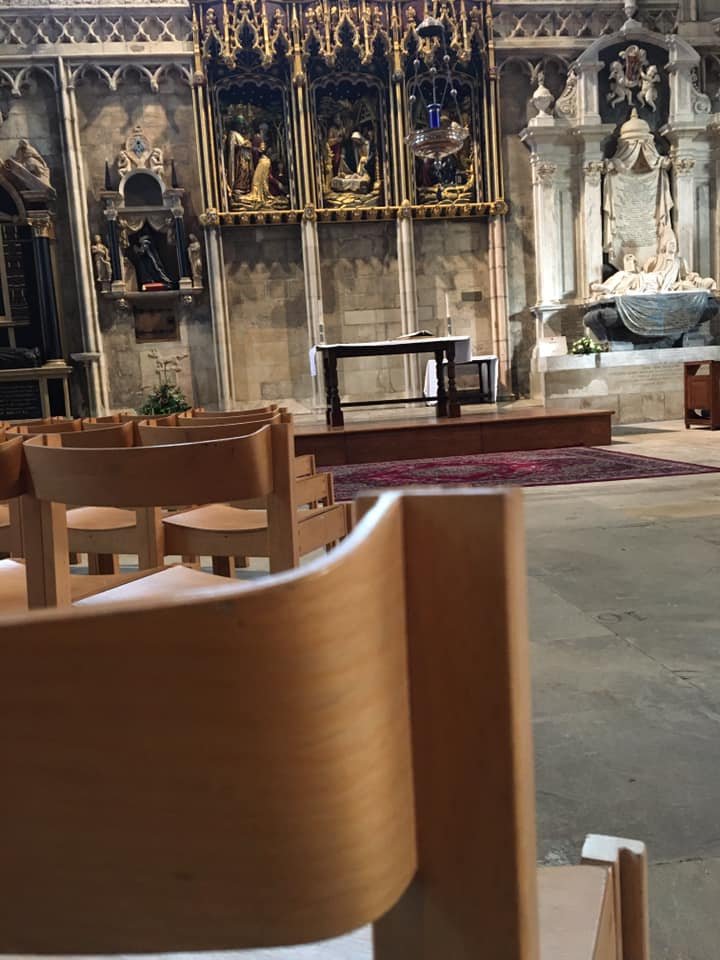
Besides a stunning Evensong, one of my favorite moments on pilgrimage was the invitation to stillness for pilgrims. After explaining why the silence was so important for those making pilgrimage, the entire Minster stopped. In this massive Minster, with hundreds of guests, you could hear a pin drop.

It made me wonder, how often in everyday life do we accept God’s invitation to stillness? How often, in our busyness, do we forget to take one minute – one minute – to relax our minds enough to give our entire focus to God. The gesture is so simple and yet can be so profound. This week, we invite you moments of silence. In our earthly pilgrimage, we all need moments to refocus.

We look forward to seeing you at this page tomorrow!!

Sermon – Luke 2.1-20, CD, YA, December 25, 2019

08 Wednesday Jan 2020

Posted by jandrewsweckerly in Sermons, Uncategorized

≈ Leave a comment

Tags

amazing, Christ Child, Christmas, Christmas Eve, church, glorify, God, love, new, noise, praise, quiet, Sermon, silence, Silent Night, story

This past year I have been learning a lot about Godly Play, the program we use with our smallest children in Sunday School, and more recently, the program we use with the Kensington School too.  At first blush, the program is pretty simple:  we tell Bible stories, using simple props to engage the children visually, we let the children play with the story, and then we wonder about the story along the way.  But when we are telling the story with the Kensington School, we have about fifteen kids, ages two-and-a-half to five years old.  I do not know how much time you have spent with that age group recently, but what that means is working super hard to hold their attention.  Being the loud extrovert that I am, I assumed holding their attention would mean using a loud, commanding voice.  But I have discovered from our seasoned teachers that the opposite is true.  They lower their voices to a slow-paced, almost whisper, and they manage to keep the children on the edges of their seats – as if something amazing is going to happen if they listen really hard.

Oftentimes, when we think of Christmas, we imagine a similar pattern.  When we gather on Christmas Eve, we look forward to savoring the familiar story, imagining being able to hear a pin drop as the beloved story is told again.  Our favorite song on Christmas Eve is usually Silent Night.  The song lulls us to imagining Mary and Joseph blissfully enjoying a silent night of wonder.  But that holy night, and most Christmas Eve services, are anything but quiet.  Bethlehem is inundated with people coming in for the registration.  The fact that there is no room for Joseph and Mary tells us how crowded Bethlehem is.  But Mary and Joseph not only have to tend with homecoming revelers, they also have to contend with the animals over whose abode they have taken.  Add into the mix a screaming newborn, and the idea of a silent night is almost comical.

But Mary and Joseph get even more noise than that.  You see, nearby shepherds hear a cacophony of praise from the heavenly hosts in the middle of the night.  Their night has been anything but quiet too.  Instead of trying to get the animals and themselves back to sleep, they decide to go into town and see this thing which has come to pass.  And so, they spend the night, talking to Mary and Joseph, maybe taking turns trying to soothe the baby Jesus.  When they leave those rudimentary quarters, they leave town praising and glorifying God.  This is no silent night for the shepherds either.

I think that is why I enjoy our celebration on Christmas Day so much.  Silence is in short supply on Christmas Eve.  We sing carols, we hear the giddy laughter of children awaiting gifts, stockings, and cookies, and we chant the mass, singing our traditionally spoken words.  For those of us with small children, even the wee hours of the morning on Christmas Day are loud – filled with cries of elation, joy, and battery-operated toys.  But on Christmas Day, after a noisy night and morning, we make our way to church and find, perhaps for the first time, the silence for which we have been looking.  We do not sing carols.  We do not have to speak over the hubbub of full pews.  Instead we gather in relative quiet, and tell the old story again – but this time with a softness that cannot be found on Christmas Eve.

What I love about finding true silence on Christmas Day is that our morning is structured a lot like I imagine that first holy morning being structured.  Christmas Eve is full of noise – of animals, shepherds, angels, and crying babies.  But that next morning, the dust has settled.  Gone are the shepherds and angels.  The animals have calmed down after too many midnight guests.  I even imagine baby Jesus has given in to sleep, since most newborns get their nights and days reversed for the first few weeks.  Into this relative quiet is when I imagine Mary treasuring all those words and pondering them in her heart.  The night before is just too loud.  The exhausted, travel-weary, physically and emotionally spent Mary gets a moment in the morning to begin to process what God has done in and through her.  After the break of dawn, as the sun rises and the loud revelers and news deliverers have gone, she can have a quiet moment as she rocks or feeds baby Jesus and ponder in her heart this child at her breast.

I do not think that night is silent.  But I understand why our hymnodists would want to talk about silence.  I think that is why I prefer the hymn, “Let all mortal flesh keep silence.”  Instead of depicting a silent night, that hymn invites us to keep silence as a form of reverence.  The first verse says, “Let all mortal flesh keep silence, and with fear and trembling stand; ponder nothing earthly minded, for with blessing in his hand, Christ our God to earth descendeth, our full homage to demand.”  I like the hymn because that is the kind of pondering I imagine Mary does in her heart this morning.  Unlike most new mothers, I do not think she is worried about the impact of birth on her body or even about her humble surroundings.  I imagine her thoughts that morning are consumed with nothing earthly minded.  Instead, I imagine her heart is pondering the blessing of Christ our God descending on earth through her – and the enormity of the event drives her to pay silent homage as she gazes on Jesus’ precious face.

That is what the church invites us to do today as well.  We structure a morning for worship.  The dust of gift wrap, eggnog, and stocking stuffers is settling.  The noise of carols, singing choirs and priests, and antsy children in pews is fading.  The anxiety of preparing for the big event of this day is easing.  And all that is left is a moment to let our mortal flesh keep silent before the Christ Child.  This morning we take a moment to ponder nothing earthly minded, and instead join Mary as she ponders all that has happened in her heart.  We come to church on this holy morning to ponder the miracle of the Christ Child.  We honor the way in which God is ever trying to honor the covenant God has made with us – willing to go to the extreme of taking on human form to care for and preserve us.  Our God’s love knows no bounds.  Humbled by that knowledge, we come to pay God homage.

The question for us in our pondering is what we will do with that love.  Though we make space this morning for silence, we do not remain here all day.  Like any other Sunday, the clergy will dismiss us to go in peace, and serve the Lord.  Anytime we feast at Christ’s table, that is our charge:  to take whatever sustenance we have gained and to go out into the world to do the work that Christ has given us to do.  Certainly that may involve cooking, travel, or more gift giving.  But the news we ponder in our hearts today is much bigger than today.  Today we are commissioned to consider the impact of the birth of the Christ Child on our lives, what our response will be to the God who is so faithful to God’s covenant with us that God would take on human flesh to redeem us.  As our talented Godly Play teachers might pose, I wonder what new work God is crafting in our hearts.  Perhaps this morning, or for at least the next few minutes, you can let your mortal flesh keep silence and ponder with Mary.  And then go out with the shepherds, glorifying and praising God in your work.  Amen.


On Discernment…

25 Wednesday Sep 2019

Posted by jandrewsweckerly in Uncategorized

≈ Leave a comment

Tags

bishop, choose, Diocese, discernment, Episcopal, God, Holy Spirit, identity, politics, prayer, silence, space, trust

70764-shoes-direction-arrows-road-gettyimages-11361.1200w.tn

Photo credit:  https://www.ibelieve.com/faith/what-is-discernment-ways-grow-more-discerning.html

This past weekend, our Diocese elected its next bishop.  Having never served in a diocese that was electing a bishop, I was not entirely sure what to expect.  I had heard stories of clergy politicking for particular candidates, trying to sway their colleagues to vote a particular way.  I knew we have a diversity of perspectives in our Diocese and coming to consensus may be difficult.  And although I had spoken to many clergy colleagues about their discernment for the best bishop, I did not know nearly as many laity and what their discernment had been like.  By the time we gathered for the election, I felt anxious, hoping we could be civil, but dreading what might be a contentious process.

Instead, I found something quite different.  Some of the difference may have been the result of careful crafting.  We were seated in an auditorium, with a long center row.  Try as one might, getting up and down to talk to others between votes was not exactly easy.  Instead, many of us were left to pray on our own or consult the limited people around us.  Likewise, once the polling was closed, we were required to wait for the candidates to be notified of the results before we were; once the results were announced though, the leadership immediately had us vote again.  We had little ability to process the results of one ballot with others before voting again.  Further, before each vote, our chaplain read a prayer from the Book of Common Prayer.  And finally, there was absolutely no internet or WiFi in the room, forcing us away from technology and into a real sense of presence in the room.

Perhaps it was the rigid structure that guided our behavior, making the election different than I expected.  But I also suspect those gathered last weekend consciously chose a different path.  Instead of dividing into camps behind one of the six candidates, our laity and clergy seemed to embrace the election as a matter of prayerful discernment, not premeditated politicking.  Limited by the confines of the room, you could sense the powerful prayers emanating from each delegate – desperately trying to discern the Holy Spirit’s will.  The pacing of the ballots did two things.  One, there was ample time to prayerfully consider the name one just submitted electronically, before knowing what everyone else had just done; and two, there was a mandate to keep moving, to keep faithfully and rapidly calling on God for answers.  Even our chaplain seemed to root us in tradition.  By using the BCP instead of extemporaneous prayer, she minimized her and our influence on one another – instead, calling us back to the book the is such a marker of our identity.

You may already know about the dramatic turn of events toward the end of our election.  I suspect the prayerful process of discernment in which we were engaged in that space was also shared among the candidates, helping them to faithfully discern what they should do too.  Having walked through that experience so prayerfully, I wonder if there is not something for us all to learn from about the hard decisions of everyday life.  Perhaps we too could stand to:  root ourselves in prayer, trust those around us to be praying too, create environments around our discernment where are weakness are less able to thrive, return again and again to the beautiful words of prayer book, make space for silence when you do not know all there is to know, and, perhaps most importantly, trust the Holy Spirit to do great things in spite of us.  If you are in discernment about something in your life, know that you have my prayers.  I would love to hear your stories of how the Spirit is moving in your life too!

Homily – Mark 11.1-11, 14.1-15.47, PS, YB, March 25, 2018

28 Wednesday Mar 2018

Posted by jandrewsweckerly in Sermons, Uncategorized

≈ Leave a comment

Tags

complicit, God, Holy Week, homily, Jesus, love, Mary, Palm Sunday, participate, physicality, relationship, senses, Sermon, silence, sin, tomb, uncomfortable, visceral

When I did my AmeriCorps year of service at a food bank in North Carolina, the warehouse manager was from Liberia.  Eugene and I talked about a lot of things, but one favorite topic was the church.  When Holy Week rolled around, I remember Eugene telling me about Good Friday in Liberia.  On the way to church on Good Friday in Liberia, the children lead a procession.  The children carry an effigy of Jesus, and all the children take turns flogging the effigy of Jesus all the way to the church.  I remember being mortified when I learned about this tradition, wondering who in their right mind would invite children to participate in worship in such a gruesome, grotesque way.

The weird thing is, this mortifying tradition is not all that dissimilar to the physicality of our own worship today.  Today, we invite everyone to vigorously wave palms hailing Jesus Christ the king; then we have voices from our parishioners narrate the text, sometimes taking roles of people like Judas, Pilate, or denying Peter; and if that were not bad enough, then we put the words, “Crucify him!” in bold in our bulletins, reminding everyone to shout the words together.  The practice is so visceral that I often notice many people resist participating.  I cannot tell you how many photos I had to scroll through to find a good Hickory Neck Palm Sunday processional photo this year.  In what is supposed to be replica of joyously welcoming the Messiah, Hickory Neck-ers rarely take more than one palm, we hold them upright so as not to seem too zealous, and forget about a smile or look of excited victory.  I do not know if we feel silly or if we know all too well what comes next so we resist, but we struggle to engage in even the joyful part of today’s liturgy.

And I have rarely found an Episcopal Church anywhere who wholeheartedly joins in the chant, “Crucify him!”  We are so uncomfortable with that part of the liturgy.  More often people do not say the words at all, or they embarrassingly mumble the words.  Sometimes I see people tense up if those beside them enthusiastically participate too much.

Our resistance is futile though.  As if we hesitantly wave palms, or if we stay silent while the crowd demands we crucify Christ, we somehow avoid complicity with this humiliating atrocity.  But we are complicit with sin every day, in the most heinous ways.  We are complicit as our neighbors decide between housing, health care, and child care costs.  We are complicit as racism creates separate, unequal experiences for our citizens.  We are complicit as our God invites into a new way and we say “no.”

That is why the church offers us this very tactile, primal service today.  We wave the palms with fervor today because we remember the ways in which we see in part – the ways in which we manage to follow Christ, even if we do not understand what Christ is doing, even if we do not catch how Jesus inverts his triumphal entry on the back of a young donkey.  We fully participate in the words of today’s passion in order to remind us to “stop abusing the image of God revealed in the dignity of every human being.”[i]  And then we let those final words soak in today, as we stand with Mary Magdalene and Mary the mother of Joses, silently at the tomb, seeing where Christ’s body is laid.

What we do in worship today is actually the perfect entry into this most Holy Week in Church.  Now some priests will tell you that we combine the liturgy of the palms with the passion narrative today because the designers of the Prayer Book knew that many of you would come on Palm Sunday, skip the days of worship during Holy Week, and then show up on Easter Sunday without having walked from this triumphal entry into Jerusalem through the cross and tomb.  And maybe they were right (though I know most of you rearranged your schedules this week for Holy Week services).  But more importantly, even if you walk through this journey with Christ this week, the reason we pair the Palms with the Passion is that we could never go from the Palms to the Resurrection without the connection to the cross.  The triumphal entry into Jerusalem makes no sense without the cross; the irony of that festive procession only makes sense when you are standing silently and bleakly at the tomb.

I know today is uncomfortable.  I know today is confusing, and oddly visceral, and may even be a bit overwhelming.  But today, and perhaps all this week if you are able to join us, allow the senses to take over.  Allow the sights, and smells, and touches, and sounds, and tastes to overwhelm you this week.  Allow the ache of standing with Mary Magdalene and Mary the mother of Joses to sink deep into the same body that has waved palms and shouted awful things today.  Because only when our senses are that overwhelmed are we able to see that the cross is not about suffering and death, but rather is about a relationship that holds.  Only then will we find a “love stronger than death, that can withstand whatever the forces of evil do against [love], and that can hold suffering even as [love] struggles to alleviate [suffering].”[ii]  What feels like an empty, guilty ache today instead becomes a sign of how God overcomes terror, enfolds us in Life, and dwells with us forever.[iii]  But until then, stand with the Marys and with one another at the tomb in silence.

[i] Michael Battle, “Pastoral Perspective,” Feasting on the Word, Year B, Vol. 2 (Louisville:  Westminster John Knox Press, 2008), 182.

[ii] Margaret A. Farley, “Theological Perspective,” Feasting on the Word, Year B, Vol. 2 (Louisville:  Westminster John Knox Press, 2008), 182.

[iii] Farley, 184.

Sermon – Luke 2.8-20, CD, YB, December 25, 2017

10 Wednesday Jan 2018

Posted by jandrewsweckerly in Sermons, Uncategorized

≈ Leave a comment

Tags

birth, Christ, Christmas, contemplate, God, incarnate, Mary, miracle, ponder, quiet, sacred, Sermon, silence, wonder

Eight years ago, while serving as a curate in my first position out of seminary, I experienced Christmas Day worship for the first time.  Though I had often gone to Christmas Eve services before ordination, I suppose it never occurred to me to go to church on Christmas Day.  I was probably still in my pajamas or on the road to see family.  So imagine my surprise when the Rector told me there would be no music at the Christmas Day service.  I was shocked!  After all this time, patiently waiting through Advent music, on the actual day of Christmas, we were not going to hear any music?!?  I threw what some might consider a bit of a temper tantrum, and was told I should talk to the people who normally go to Christmas Day services.

Of course, my Rector knew what she was talking about.  As I talked to Christmas Day attendees, I discovered one universal truth:  they loved the spoken Christmas Day service.  First, they all went to a Christmas Eve service, so they got their carols fix the night before.  Second, they loved the quiet respite in an otherwise chaotic day.  A quiet service on Christmas Day was a godsend.  And third, they loved the Christmas Day service because it was a small, intimate service of what they called the “faithful;” much like what happens when you throw a party at your home and everyone but your close friends go home at the end of the night.  You kick off your shoes, find a warm beverage, and enter into quiet, meaningful conversation with your friends.  Music, in those parishioners’ minds, would have hindered the intimate, contemplative, peaceful vibe they loved.

In a lot of ways, having a quiet Christmas Day service is like taking a cue from Mary in our gospel lesson today.  After the chaos of travel and birthing a child in less than ideal accommodations, after shepherds have seen blinding lights and hear the triumphant chorus of the multitude of heavenly host, when everything quietens down, all that is left is a mother, father, and child, and some shepherds who seem like old friends.  I have always imagined the shepherds bursting through the doors, talking on top of each other to tell the story of the angels.  But I wonder if perhaps the scene was a little different.  Knowing full well the baby has arrived in less than ideal circumstances, and that babies are notorious for crying when disturbed, maybe the shepherds were whispering their intimate tale to the holy family.  Maybe they were those gathered at the end of the party, sharing in quiet, meaningful conversation.

I wonder if this might be true because we get one short line about Mary at the end of our text today, “But Mary treasured all these words and pondered them in her heart.”  Exhausted, fatigued, weary Mary takes the enormity of what has happened:  to her, when Gabriel came to her; with Elizabeth, who further revealed the angel’s proclamation; with Joseph, as he shared his own angelic story; and now with the shepherds who tell of yet another angelic encounter.  Mary takes all the bits of information – all the encounters she is privy to – and ponders them.  She takes a personal moment to sit quietly in the enormity of it all to ponder.  In some ways, she is a mother like anyone else – one who has carried a child in her womb with all the normal doubts and concerns that come from every ache, pain, and discomfort.  But in other ways, she is nothing like other mothers.  She is an instrument – pregnant without her own doing, carrying a child who will be bigger than anything before, and mothering someone who will never fully belong to her, but to the greater world he will soon save.

The funny thing is, pondering is an activity that would hardly ever make an appearance on our Christmas to-do lists.  We have been scurrying about this past month:  decorating homes, sending cards, attending parties, planning liturgies, hosting guests or finding hostess gifts.  We have either been caught up in the joy of the season, reveling in the 24-7 Christmas radio stations, or maybe we have been lost in our grief of all that is not this Christmas season.  Regardless of whether you are off to a Christmas celebration with twenty or more people, or having a quiet day alone or with one other, there is likely to be little true quiet:  our minds are way too noisy for quiet today.

And yet, quiet pondering is exactly what Mary does today.  She takes all the noise and chaos – both outward and inward – and she pauses for pondering.  She hits the pause button on the movie called life, takes a deep breath, and drinks in the miracle of Christ’s birth.  She stops talking, turns off her internal conversation, and listens.  She makes room for God in that rustic, foreign room, with people who are not her own, letting her body and soul contemplate the enormity of the nativity:  God incarnate; Messiah arrived; Eternal life made possible.  The wonder of that moment is enough to silence Mary, giving her much to ponder.

That is our invitation today too.  I know today is the least likely day for a moment of wonder, pondering, and contemplation.  But you are here.  You took a moment away from whatever today will be to sit at the manger with Mary and ponder.  Drink in the miracle of Christ’s birth, the gift of God incarnate.  Stand before our God in holy quiet and reverence as we pray and eat a different meal.  Remember “how God became one of us, remember how Christ still joins us at the Table, remember how we are fed by him in order that we might live as his body in the world.”[i]  These kinds of sacred moments are so rare in life.  Receive the gift of pondering at the manger with Mary today, and take that quiet out into the world with you, giving your heart the gift of true celebration and joy.  Amen.

[i] Kimberly Bracken Long, “Homiletical Perspective,” Feasting on the Word, Yr. B, Vol. 1 (Louisville:  Westminster John Knox Press, 2008), 121.

The Sound of Silence…

07 Thursday Jul 2016

Posted by jandrewsweckerly in Uncategorized

≈ 1 Comment

Tags

brokenness, church, contemplations, Episcopal, God, listen, noise, prayer, Rite I, silence, sinfulness, worship

The-Sound-of-Silence

Photo credit:  advisoranalyst.com/glablog/s015/05/27/jeff-miller-the-sound-of-silence.html

In almost every parish I have served, there has been an 8:00 am, Rite I, spoken service.  The crowd usually is not that large.  Because the service is spoken, it tends to be very quiet and to be the shortest service of the day.  Those who are attracted to the service usually like the language (We use “thee” and “thou” language and the service has a more penitential tone.)  Others like the brevity of the service – appreciating both going to church and having the rest of the day free.  While others like the service because it feels more contemplative and centering.

Though the service is always pretty quiet in whatever Episcopal Church you choose, what I have noticed about the 8:00 am crowd at Hickory Neck is that they tend to be not just prompt, but early.  Every Sunday, at least five minutes before the service begins, everyone is seated and is silent.  Up until this past Sunday, I found the practice unsettling.  On Sundays, I am usually amped up, and ready to jump into liturgical leadership.  As an extrovert, I am chatty, and am used to some lighthearted conversation before the service starts.  So the silence immediately before the service feels discordant with my pent-up energy.

But this past Sunday, I remembered a complaint long ago from a fellow parishioner at the Cathedral where I became an Episcopalian.  She used to complain that the beginning of the service was not meant to be happy hour – she was irritated by the chatter all around her when all she wanted to do was kneel on the prayer cushion in front of her and enjoy a moment of silence before the service began.  Even the bulletin had a comment at the beginning that reminded people that we should respect others’ desire to begin our worship in quiet contemplation and centering prayer.  Though I appreciated the guidance, I never really “got” it – until this past Sunday.

The beauty of five minutes of silence before worship is that you can let go of all the stuff on your to-do list.  The beauty of the five minutes of silence before worship is that you can let go of the pain, worry, anger, or stress that is ever present and present yourself humbly before worship.  The beauty of the five minutes of silence before worship is that you can listen to God instead of talk to God.  As a celebrant, I do not know that I will ever be able to use those last five minutes to center myself (I tend to arrive much earlier at church to find that centering time).  But as one who facilitates worship, I have found myself greatly appreciating the gift of those five minutes for our parishioners.  I could use a good five minutes today to just listen.  In the noise of mass gun violence, terrorism, racism, poverty, and suffering, I am a bit out of things to say to God.  Instead I would rather kneel in silence today and give humanity’s and my own brokenness and sinfulness to God.  What might you offer to God today in that silence?  What do you imagine you might hear in that silence?

Sermon – Luke 2.1-20, CD, YC, December 25, 2015

06 Wednesday Jan 2016

Posted by jandrewsweckerly in Uncategorized

≈ Leave a comment

Tags

Christmas, Jesus, love, noise, ponder, quiet, reverence, Sermon, silence, story

One of the things I have always found funny about Christmas is the number of hymns that talk about silence.  Our favorite is usually Silent Night.  When we sing the song on Christmas Eve, we dim the lights and enjoy a quiet moment of reflection.  But that holy night was anything but quiet.  Bethlehem is inundated with people coming in for the registration.  The fact that there is no room for Joseph and Mary tells us how crowded Bethlehem is.  But Mary and Joseph not only have to tend with homecoming revelers, they also have to contend with the animals over whose abode they have taken.  Add into the mix a screaming newborn, and the idea of a silent night is almost comical.

But Mary and Joseph get even more noise than that.  You see, nearby shepherds hear a cacophony of praise from the heavenly hosts in the middle of the night.  Their night has been anything but quiet too.  Instead of trying to get the animals and themselves back to sleep, they decide to go into town and see this thing which has come to pass.  And so, they spend the night, talking to Mary and Joseph, maybe taking turns trying to soothe baby Jesus.  When they leave those rudimentary quarters, they leave town praising and glorifying God.  Yes, this is no silent night for the shepherds either.

I think that is why I enjoy our Christmas Day celebration.  Silence is in short supply on Christmas Eve.  We sing carols, we hear the giddy laughter of children awaiting gifts, stockings, and cookies, and we chant the mass, singing our traditionally spoken words.  For those of us with small children, even the wee hours of the morning of Christmas Day are loud – filled with cries of elation, joy, and battery-operated toys.  But on Christmas Day, after a noisy night and morning, we make our way to church and find, perhaps for the first time, the silence for which we have been looking.  We do not sing carols.  We do not have to speak over the hubbub of full pews.  Instead we gather in relative quiet, and tell the old story again – but this time with a softness that cannot be found on Christmas Eve.

What I love about finding true silence on Christmas Day is that our morning is structured a lot like I imagine that first holy morning being structured.  Christmas Eve was full of noise – of animals, shepherds, angels, and crying babies.  But that next morning, the dust has settled.  Gone are the shepherds and angels.  The animals have calmed down after too many midnight guests.  I even imagine baby Jesus has given in to sleep, since most newborns get their nights and days reversed for the first few weeks.  Into this relative quiet is when I imagine Mary treasuring all those words and pondering them in her heart.  The night before was just too loud.  The exhausted, travel-weary, physically and emotionally spent Mary gets a moment in the morning to begin to process what God has done in and through her.  After the break of dawn, as the sun rises and the loud revelers and news deliverers have gone, she can have a quiet moment as she rocks or feeds baby Jesus and ponder in her heart this child at her breast.

I do not think that night was silent.  But I understand why our hymnodists would want to talk about silence.  I think that is why I prefer the hymn, “Let all mortal flesh keep silence.”  Instead of depicting a silent night, that hymn invites us to keep silence as a form of reverence.  The first verse says, “Let all mortal flesh keep silence, and with fear and trembling stand; ponder nothing earthly minded, for with blessing in his hand, Christ our God to earth descendeth, our full homage to demand.”  I like the hymn because that is the kind of pondering I imagine Mary does in her heart this morning.  Unlike most new mothers, I do not think she is worried about the impact of birth on her body or even about her humble surroundings.  I imagine her thoughts that morning are consumed with nothing earthly minded.  Instead, I imagine her heart is pondering the blessing of Christ our God descending on earth through her – and the enormity of the event drives her to pay silent homage as she gazes on Jesus’ precious face.

That is what the church invites us to do today as well.  We structure a morning for worship.  The dust of gift wrap, egg nog, and stocking stuffers has settled.  The noise of carols, singing choirs and priests, and antsy children in pews has faded.  The anxiety of preparing for the big event of this day has eased.  And all that is left is a moment to let our mortal flesh keep silent before the Christ Child.  This morning we take a moment to ponder nothing earthly minded, and instead join Mary as she ponders all that has happened in her heart.  We come to church on this holy morning to ponder the miracle of the Christ Child.  We honor the way in which God is ever trying to honor the covenant God has made with us – willing to go to the extreme of taking on human form to care for and preserve us.  Our God’s love knows no bounds.  Humbled by that knowledge, we come to pay God homage.

The question for us in our pondering is what we will do with that love.  Though we make space this morning for silence, we do not remain here all day.  Like any other Sunday, the priest will dismiss us to go in peace, and serve the Lord.  Anytime we feast at Christ’s table, that is our charge:  to take whatever sustenance we have gained and to go out into the world to do the work that Christ has given us to do.  Certainly that may involve cooking, travel, or more gift giving.  But the news we ponder in our hearts today is much bigger than today.  Today we are commissioned to consider the impact of the birth of the Christ Child on our lives.  What will our response be to the God who is so faithful to God’s covenant with us that God would take on human flesh to redeem us?  We may need still need to ponder in our hearts what that response will be.  I cannot imagine a better day than today to keep pondering what new work God is crafting in our hearts.  Amen.

Recent Posts

  • On the Myth and Magic of Advent…
  • On Risking Failure and Facing Fear…
  • Sermon – Luke 23.33-43, P29, YC, November 23, 2025
  • On Inhabiting Gratitude…
  • Sermon – Luke 20.27-38, P27, YC, November 9, 2025

Archives

  • December 2025
  • November 2025
  • October 2025
  • September 2025
  • August 2025
  • July 2025
  • June 2025
  • March 2025
  • February 2025
  • December 2024
  • November 2024
  • October 2024
  • September 2024
  • August 2024
  • July 2024
  • June 2024
  • May 2024
  • March 2024
  • February 2024
  • January 2024
  • December 2023
  • November 2023
  • October 2023
  • September 2023
  • August 2023
  • July 2023
  • June 2023
  • May 2023
  • March 2023
  • February 2023
  • January 2023
  • December 2022
  • November 2022
  • October 2022
  • June 2022
  • May 2022
  • January 2022
  • December 2021
  • November 2021
  • October 2021
  • September 2021
  • August 2021
  • June 2021
  • May 2021
  • April 2021
  • March 2021
  • February 2021
  • January 2021
  • December 2020
  • November 2020
  • October 2020
  • September 2020
  • August 2020
  • July 2020
  • June 2020
  • May 2020
  • April 2020
  • March 2020
  • February 2020
  • January 2020
  • December 2019
  • November 2019
  • October 2019
  • September 2019
  • August 2019
  • July 2019
  • June 2019
  • May 2019
  • April 2019
  • March 2019
  • February 2019
  • January 2019
  • December 2018
  • November 2018
  • October 2018
  • September 2018
  • August 2018
  • July 2018
  • June 2018
  • May 2018
  • April 2018
  • March 2018
  • February 2018
  • January 2018
  • December 2017
  • November 2017
  • October 2017
  • September 2017
  • August 2017
  • July 2017
  • June 2017
  • May 2017
  • April 2017
  • March 2017
  • February 2017
  • January 2017
  • December 2016
  • November 2016
  • October 2016
  • September 2016
  • August 2016
  • July 2016
  • June 2016
  • May 2016
  • April 2016
  • March 2016
  • February 2016
  • January 2016
  • December 2015
  • November 2015
  • October 2015
  • September 2015
  • August 2015
  • July 2015
  • June 2015
  • May 2015
  • April 2015
  • March 2015
  • February 2015
  • January 2015
  • December 2014
  • November 2014
  • October 2014
  • September 2014
  • August 2014
  • July 2014
  • June 2014
  • April 2014
  • March 2014
  • February 2014
  • January 2014
  • December 2013
  • November 2013
  • October 2013
  • September 2013
  • August 2013
  • July 2013
  • June 2013
  • May 2013
  • April 2013
  • March 2013
  • February 2013
  • January 2013
  • December 2012
  • November 2012
  • October 2012
  • September 2012

Categories

  • reflection
  • Sermons
  • Uncategorized

Meta

  • Create account
  • Log in
  • Entries feed
  • Comments feed
  • WordPress.com

Blog at WordPress.com.

  • Subscribe Subscribed
    • Seeking and Serving
    • Join 394 other subscribers
    • Already have a WordPress.com account? Log in now.
    • Seeking and Serving
    • Subscribe Subscribed
    • Sign up
    • Log in
    • Report this content
    • View site in Reader
    • Manage subscriptions
    • Collapse this bar
 

Loading Comments...