• About

Seeking and Serving

~ seek and serve Christ in all persons

Seeking and Serving

Tag Archives: vulnerable

Sermon – Matthew 6.1-6, 16-21, AW, YC, March 5, 2025

18 Wednesday Jun 2025

Posted by jandrewsweckerly in Sermons

≈ Leave a comment

Tags

alms, Ash Wednesday, both-and, community, confess, fasting, honest, Jesus, Lent, prayer, real, reconciliation, redemption, reflection, repentance, Sermon, sin, solo, vulnerable

If I were to say to you that there are two services that attract the most non-members each year, which two services would you guess?  Christmas and Easter?  In part, you could be right – there are definitely a lot of guests at Christmas and Easter.  But proportionately, when talking members and non-members, I notice we get more guests at Blue Christmas and Ash Wednesday – especially if we include Ashes to Go in our Ash Wednesday count. 

So what about Blue Christmas or Ash Wednesday is so appealing to someone who doesn’t regularly attend church?  Having just been a part of Ashes to Go in our parking lot with lots of guests, I think there is something very real, honest, and vulnerable about services on Ash Wednesday that do not always happen on a Sunday or especially on festivals like Christmas and Easter.  On Ash Wednesday, the church gives us permission to bring our real, broken, hurting, mortal selves to a space, to acknowledge our fragility and hurt, and to bless the fullness of our selves – the good, the bad, and the ugly. 

Now to some, this may feel a little too self-centered.  As we impose ashes, the choir will chant from Psalm 51 tonight:  “Wash me through and through from my wickedness and cleanse me from my sin.  For I know my transgressions, and my sin is ever before me.  Against you only have I sinned and done what is evil in your sight.  And so you are justified when you speak and upright in your judgment.”  Perhaps that is the appeal of this day – the opportunity to take a moment for the self and really ponder where we are with God and this life.  Those ashes will be grittily spread on my forehead, the penitence and fasting are my work to do, and death is mine alone to face.  Everything about today is about my own journey with God.

Stephen and I were just debating about this reality for Lent in general.  We are making plans for Holy Week and we have a service with gospel songs and meditations.  I was excited about the possibility of the service and Stephen quipped, “It’s a little self-centered, don’t you think?  What about worrying about others and the rest of the world?!?”  The truth is, the season of Lent that we start today and end on Good Friday is sort of a both-and experience.  This is a season we are called into self-examination and repentance.  AND, this is also a season where we examine the sinfulness in the world in which we are complicit.

That both-and experience is what Jesus was worried about in our gospel lesson today.  Jesus talks a great deal about personal piety and not showing off in front of others – to not to let others seeing you give alms, pray, or fast.  But as I studied Matthew again this year, I reread something that brought me up short.  All those warnings Jesus makes, “Beware of practicing your piety before others…whenever you give alms, do not sound a trumpet…when you pray, do not be like the hypocrites…whenever you fast, do not look dismal…”, all of those warnings are not in the singular.  They are actually in the plural.[i]  So the words are more like, beware of practicing you all’s piety.  Or maybe in southern speak, “when all ya’ll pray…” Jesus is not criticizing or singling out you or you or me.  Jesus is singling out the community of the faithful.

That may sound like semantics, but there is something quite dramatic about Jesus speaking in the plural versus the singular.  Every week in Sunday services, we confess our sins.  But we confess them communally.  Communal confession is an extraordinary event.  While we may feel lost or despondent about our inability to live in the light of Christ as individuals, when we communally confess, a room of voices is saying with you, “Me too!”

One of the things I grieved during the pandemic was our inability to gather in person.  I loved that we had and continue to have an online community – especially for our homebound, our busy members, or for those meeting Hickory Neck for the first time.  But our necessary isolation during the pandemic naturally led to a pattern of looking inward – sometimes so much so that we forgot we are not alone – that there is a whole community of faith who is walking this journey with us and struggling just as we are.  There is something quite powerful about listening to the voices of the 7-year-old next to the 77-year-old – the person who looks so put together next to the person who is clearly struggling – the dad with children next to the widow – all confessing together.  Week in and week out, those myriad voices remind us we are not alone.

Tonight’s service very much calls us into reflection and repentance.  But our invitation tonight as we enter Lent is to remember that the act of reconciliation and redemption does not only happen alone.  We all are invited into a holy Lent.  We all are invited into prayer, fasting, and alms giving.  We all are invited to remember we are dust.  In person, online, and hybrid together, we are not only invited into solo, parallel journeys.  But also, our journeys are strengthened and made possible through the companionship of community.  You are not alone.  We are in this together – all y’all.  And Jesus lights the way for us all.  Amen.


[i] Karoline Lewis, as described on the podcast, “Sermon Brainwave:  #889: Ash Wednesday –Rebroadcast from February 22, 2023,” February 25, 2025, as found at https://www.workingpreacher.org/podcasts/889-ash-wednesday-rebroadcast-from-february-22-2023 on March 4, 2025.


Sermon – Luke 6.17-26, Jeremiah 15.5-10, EP6, YC, February 16, 2025

05 Wednesday Mar 2025

Posted by jandrewsweckerly in Sermons

≈ Leave a comment

Tags

blessed, blessing, curse, discipleship, God, Jesus, politics, Sermon, Sermon on the Plain, status quo, trust, vulnerable, woe

One of the things I love about the diversity of parish like Hickory Neck is that I often get to see the fullness of life in just a matter of days – or even hours.  Whether I am talking to a retiree dealing with new health issue, an adult dealing with rigors of parenting, or a kid dealing with the everyday challenges to their identity, the breath of life is ever before me.  But these last weeks have brought a new rawness that I have not seen in a while.  The philosophical arguments of an election year have birthed a new praxis that has everyone on edge – from deep divides about economic and ethical policies, to the questions of how we bound we are to care for our neighbors, to whole livelihoods and vocations coming into question.  We are swimming in a sea of defensiveness, of vulnerability, of righteous indignation – no matter where you find yourself on the political spectrum. 

Into that volatile atmosphere, we get some scripture today that cuts to the bone and leaves all of us standing vulnerably before God who is calling us to task.  The bite starts in Jesus’ Sermon on the Plain in Luke’s gospel.  The blessings alone should bring us up short:  blessed are you who are poor (not poor in Spirit like Matthew says, but the literal poor), who are hungry, who weep, who are reviled.  Jesus’ blessings should be enough to bring us up short about how we are treating the poor, hungry, and oppressed.  But Jesus does not stop there.  Then he begins with the “woes.”  The word “woe” in Greek is translated literally as “woe” – like the sound woe makes as woe comes out of your mouth – like a sigh of “oh man!”  As New Testament scholar Matt Skinner says, that sound is not necessarily a sign of disappointment, but as if Jesus is explaining, “Your vision is so small, so limited,” like Jesus is just giving a “deep sigh.”[i] And all of this blessing and woe would be hard enough in normal times, but the truth is, as many of our own find ourselves in economic insecurity – whether layoffs are coming, or social security may be cut, or loan payments may increase – we’re not even sure which category we are in anymore.

In looking at Luke’s Gospel, professor Mary Hinkle Shore explains, “The difficulty in…this text in a 21st-century American, mainline Christian context is that most of us who will hear this word are not inclined to trust it…  We aim to be rich, full, laughing, and respected.  Hearing the beatitudes from Jesus, we may be tempted to think, ‘I’ll take my chances with the status quo.’   This reaction may be why Jesus adds woes here after his blessings.  No matter how hopeful his words are, some in the crowd have placed their trust elsewhere, and the choices they have made are working for them.  For these, the woes are not curses, but warnings.  It is as if Jesus said, ‘Certain things are worthy of your trust, and other things are sure to betray it.’  When those objects of misplaced loyalty do betray your trust—Lord, have mercy.”[ii]

I think that is why the designers of the lectionary chose Jermiah today.  Jeremiah features blessings and curses too.  But these blessings and curses are almost harder because they are not about economic categories but about our very relationship with God.  Jeremiah pronounces in the text today, “Cursed are those who trust in mere mortals and make mere flesh their strength, whose hearts turn away from the Lord.  They shall be like a shrub in the desert, and shall not see when relief comes.  They shall live in the parched places of the wilderness, in an uninhabited salt land.”  In contrast, Jeremiah goes on to say, “Blessed are those who trust in the Lord, whose trust is the Lord.  They shall be like a tree planted by water, sending out its roots by the stream.”  All of holy scripture seems to be pushing us to deeply examine where we are putting our trust these days.

As many of you know I have been working the last few months on a charity event to raise money for two amazing non-profits in our community – a little event called Dancing with the Williamsburg Stars.  I thought the dance lessons would be fun, and as someone who has danced in the past, I thought I would have a somewhat easier go of things.  And I loved the idea of representing Hickory Neck in such a fun-loving way.  But here’s the funny thing about ballroom dancing – dancing with a partner requires a level of trust I never experienced when dancing in an ensemble.  A few weeks ago, we were practicing a move where I basically lean backwards, held up by my partner.  I thought I was doing a great job until we watched video replays.  I was barely dipping my head back at all.  My partner had to show me where his arms were placed to catch me and how little I was leaning into them.  Then just this week, we were working on another move were I basically fall forward with an extended arm behind me.  My partner explained that if I try to catch myself in the fall, I will make him fall.  I must trust that his hold is steady enough that I won’t slam face-forward to the ground.  And then, just to show me how I still wasn’t fully trusting him, he showed me how even in the turn out from that fall, I was muscling my arm to get up, instead of trusting him to pull me up. 

We are in intricate dance with God right now.  We are vulnerable, on stage, and not at all in control.  Our natural inclination is going to be to muscle our way through, to fight for some modicum of control, to determine what we want (to be rich, full, laughing, and respected) and trusting that that fullness is the ultimate end game.  Into that battle of wills, Jesus sighs a big “woe.”  As we stare out into the audience of that dance, I love what Debie Thomas sees in this text.  When thinking about her relationship with trust and God, Thomas confesses, “I might begin by admitting that Jesus is right.  I might come clean about the fact that most of the time, I am not desperate for God.  I am not keenly aware of God’s active, daily intervention in my life.  I am not on my knees with need, ache, sorrow, longing, gratitude, or love.  After all, why would I be?  I have plenty to eat.  I live in a comfortable home.  My family is safe.  I’m not in dire need of anything.  In short, there isn’t much in my circumstances that leads me to a sense of urgency about ultimate things.  I can go for days without talking to God…Most of the time, it just plain doesn’t occur to me that I would be lost — utterly and wholly lost — without the grace that sustains me.”

Thomas goes on to conclude, “I think what Jesus is saying in this Gospel is that I have something to learn about discipleship that my life circumstances will not teach me.  Something to grasp about the beauty, glory, and freedom of the Christian life that I will never grasp until God becomes my everything, my all, my starting place, and my ending place.”[iii]  In other words, until I let God take the lead, and actually follow, my dance through this life is going to echo the woe’s I have been sighing for the last several weeks.  Blessing comes in placing trust not in earthly things or earthly policies, but in the Lord.  Then, as Jeremiah reminds us, we will be like trees planted by water, roots going down by the stream, and leaves that stay green, not ceasing to bear fruit.  When we are so rooted, growing, and producing, then we can share our fruit, our shade, our refreshment.  God needs us so rooted so that we can stop sighing woes and start being blessings.  Amen.


[i] Matt Skinner, “Sermon Brainwave Podcast:  #1008: Sixth Sunday after Epiphany (C) – Feb. 16, 2025,” February 6, 2025, as found at https://www.workingpreacher.org/podcasts/1008-sixth-sunday-after-epiphany-c-feb-16-2025 on February 12, 2025.

[ii] Mary Hinkle Shore, “Commentary on Luke 6:17-26,” February 16, 2025, as found at https://www.workingpreacher.org/commentaries/revised-common-lectionary/sixth-sunday-after-epiphany-3/commentary-on-luke-617-26-3 on February 14, 2025.

[iii] Debie Thomas, “Leveled,” February 6, 2022, as found at https://www.journeywithjesus.net/essays/3319-leveled on February 14, 2025.

Sermon – John 13.1-17, 31b-35, MT, YB, March 28, 2024

01 Wednesday May 2024

Posted by jandrewsweckerly in Sermons

≈ Leave a comment

Tags

disciples, footwashing, humbling, Jesus, love, Maundy Thursday, messy, Sermon, vulnerable, wash

Photo credit: https://lighthousesouthbay.org/resources/stories/maundy-thursday-family-worship-footwashing/

In my first year of seminary, we traveled to Burma for an Anglican Communion learning trip.  For a portion of the trip, we led an educational component for the theological students, which closed with a foot washing experience.  In my mind, the foot washing experience was so authentic:  those with empirically more power serving those with less; the leaders becoming servants; and certainly, the tangible re-creation of Jesus’ experience, since in Burma everyone wears those plastic flip flops, so their feet really are dusty in the ways that I imagine those disciples’ feet were.  The seven us of seminarians were feeling pretty good about ourselves – we were embodying the kind of love Jesus always talks about. 

But then something unexpected happened.  When we finished the last student, several students grabbed the arms of each us, and almost forcefully put us in the very chairs where we had been washing their feet – all with very little English to navigate the turning of the tables.  The role reversal felt all wrong – we were the ones who should be washing them, not them washing us.  Suddenly we were asked to be vulnerably touched, to humbly receive, and to ultimately right the balance of power between us.  The unplanned reversal left us shaken and uncomfortable, and a whole less sure of ourselves.

As I have been thinking about this Maundy Thursday service this week, that’s kind of what this service is:  messy.  Jesus, the one with power, lowers himself to the floor and washes the disciples’ feet – something not even servants would normally do, as they would simply provide the water for you to do the work yourself.  There are a few occasions where women might do this work, but certainly Jesus shouldn’t be stooping to women’s work.[i]  There is all kinds of messiness about the appropriateness of Jesus’ humble act that makes the disciples feel quite vulnerable.  But then there is the fact not only does Jesus do this humble, vulnerable act on his hands and knees, but also he does this for everyone, including Judas – his soon-to-be betrayer – and Peter – his soon-to-be denier.  Jesus washes the feet of the faithful follower and stumbling follower alike.  On the one hand, we can conceptualize how to humbly serve others – I imagine it gives us great satisfaction like we seminarians had in Burma.  But humbly serving those who literally betray you and shun you – that’s something else altogether.  All we have to do is imagine the politician who makes us the most angry, indignant, and rightly willing to protest.  And then imagine kneeling down and washing his or her feet – humbling yourself before them, willing yourself to tenderly touch the very human skin of your so-called enemy.

And so, by the end of this passage – where Jesus has argued his way through this lesson of foot washing, and as the verses that were edited out of our passage tonight would have told us, Judas leaves to betray Jesus, we are told a major kernel of truth – a command that this whole night is named for (Maundy literally means in Latin “command” or “mandate.”[ii]).  Jesus says, “I give you a new commandment, that you love one another.  Just as I have loved you, you also should love one another.  By this everyone will know that you are my disciples, if you have love for one another.”  Now we all LOVE to talk about this new commandment – we love to talk about love.  But those six words are the scary part of this commandment:  Just as I have loved you.  So that person who betrays us, denies us, works against goodness, who hurts us, who angers us – we are to love them just as much as the people we actually like.  Jesus is asking a lot tonight, folks. 

And so, in this service, in just a few minutes, we are going to do some messy things.  We are going to literally wash each other’s feet.  No matter how embarrassed we are by our imperfect feet, no matter how little we like being the recipient of care, no matter how much we might like the people in this room but we are not prepared to be really vulnerable with them – we will have the opportunity to both serve and be served tonight.  Then we will gather around the altar rail – with people we like and maybe people who frustrate us, with people who agree with our political opinions and people who really do not, with people we may not even really know all that well – and we will receive the blessed sacrament, elbow to elbow with everyone.  And then finally, we will watch as everything is taken away – the dishes from our feast, the adornments we love, the familiar things of comfort, even the light itself.  And the priest will scrub down the altar, with a sound that sounds like the scrubbing away of everything familiar and comforting. 

We do all these messy things because what Jesus asks of us is nothing short of messy.  “Just as I have loved you, you also should love one another.”  That is what we leave here tonight – on this Commandment Thursday – to go out in the world to do.  To love – to messily, vulnerably, frustratingly, painfully do.  To love – just as Jesus has messily, vulnerably, frustratingly, painfully loved us.  That command is what we hold on tomorrow as we allow Jesus to walk to the cross.  That command is what we hold on to through Saturday as he sits in tomb.  That command is what we hold onto when we mourn the entirety of his life – “the whole witness of the Word made flesh.”[iii]  That command is what we hold onto even when we joyously and fearfully celebrate what happens on Easter.  But that command is especially what we hold on to in the days and weeks to come – in this year of 2024 as we try to love – just as Jesus has loved us.  Jesus knows loving will be messy.  But Jesus gives us the messy gifts tonight to help us love anyway.  Amen.


[i] Mary Lousie Bringle, “Homiletical Perspective,” Feasting on the Word, Year B, Vol. 2 (Louisville: Westminster John Knox Press, 2008), 279.

[ii] James E. Lamkin, “Pastoral Perspective,” Feasting on the Word, Year B, Vol. 2 (Louisville: Westminster John Knox Press, 2008), 280.

[iii] Karoline M. Lewis, John:  Fortress Biblical Preaching Commentaries (Minneapolis:  Fortress Press, 2014), 179.

Sermon – Lk 11.1-13, P12, YC, July 24, 2010

05 Wednesday Oct 2022

Posted by jandrewsweckerly in Sermons

≈ Leave a comment

Tags

abundance, accountability, disciples, God, how, Jesus, Lord's Prayer, mutual, pray, Sermon, vulnerable

The single most common topic I have been asked about in the course of my ministry, year in and year out, through crisis, through joys, through transitions, and change, young and old have approached me asking for one thing:  teach me how to pray.  The request is simple, yet complicated all at the same time.  You see, when someone asks me how they can pray a reel begins in my mind, flashing all the experiences of prayer I have seen in my lifetime:  the healing prayers that splayed someone to the ground in the Pentecostal church of my early childhood; the United Methodist prayers spoken extemporaneously from the heart; the hippy campus minister who always started prayer with silence so long you wondered if he had fallen asleep; the prayers written to accompany the prayer beads my fingers strung together; the stiff Episcopal collects that seem at the same time formulaic and beautiful; saying the Lord’s Prayer in Spanish, trying to keep up with the native speakers; silent prayers in the middle of the night as I seethed in my anger at God, with no words left; praying into a telephone that doubled as a speaker in the retirement home’s dining room; resorting to digital Pop-Up Prayers when a pandemic forced us into isolation.  When asked, “teach me to pray,” where can I possibly begin?!?

When the disciples ask Jesus to teach them how to pray, Jesus’ mind seems to be all over the place too.  Jesus begins his lesson with the actual text of the Lord’s Prayer.  Jesus says, “When you pray, say this…”  But Jesus does not stop his lesson there.  Jesus goes on to teach the disciples through three small vignettes. 

In the first vignette, the disciples hear about the man who refuses his friend bread in the middle of the night because he has already gone to bed.  The disciples learn through this funny battle of wills that their posture in prayer is to be persistently inquiring.  In fact, the word used in our translation today for “persistent” is also translated by some scholars as “shamelessness.” [i]  In the second vignette, the disciples are told in the instruction to ask, seek, and knock that God responds to their inquiries.  They learn here that their posture in prayer is a posture of action.  Prayer is to express their need to God, to search out God when they feel abandoned, and to cry out to God with a loud knock.  The final vignette compares the care of a parent with the care of God for the disciples.  The disciples learn that God’s love for them is greater than the instinctual, caring love of a parent for a child.  The disciples experience that abundance when they enter into a prayerful relationship with God. 

A vulnerable, active, abundant relationship with God sounds wonderful and easy enough.  The problem is the relationship Jesus describes is not easy.  We find it difficult to be continuously vulnerable, active, and overwhelmed by God in prayer.  In fact, we find simply remaining in prayer with God difficult.  When I was in seminary, I had a group of lay persons from my field education parish who met with me once a month to help me reflect on my ministry at the church.  One of my committee members, Joe, was notorious for keeping me on the spot in these meetings.  “So, Jennifer, how is your prayer life?” Joe would always ask me.  The first time he asked me that question, I stammered through some sort of reply about corporate and individual prayer.  But Joe wanted to know the specifics of what my prayer life entailed.  Joe’s monthly prodding was the first real experience I had with accountability in my prayer life.  Finally, after about a year of asking me about my prayer life, I asked Joe about his prayer life.  Joe explained that the reason he always asked me about my prayer life was because he struggled with his own prayer life.  His pushing me was a way of also pushing himself.  He knew that if I struggled to keep an engaged prayer life, he could gain some camaraderie in his own struggle; and if I was feeling particularly connected to God in prayer, he would be challenged to engage God with more intentionality.

The mutual support that Joe was unknowingly creating is the promise of our Gospel lesson today.  First Jesus gives the disciples words:  the Lord’s Prayer.  Once they own those words, they have an assuring entry into dialogue with God.  And once the disciples have that entry, they are assured of God’s presence in the prayer relationship.  God is the faithful friend, who gets up in the middle of the night to answer prayer.  God is the responding God who will answer, be present, and open doors through the prayer relationship.  God is the parent that our parents can never fully be because God’s love is more abundant than the disciples, as humans, can ever be.  Jesus does not promise that God will respond to the disciples’ prayers in a particular or specific way.  The disciples are not promised riches or earthly gain through a life in prayer.  But Jesus does promise that God will respond, will stay present with the disciples, and will love the disciples abundantly. 

Despite all the modes of prayer I have witnessed over time, perhaps the best advice is to start where Jesus does with the words of the Lord’s Prayer.  Jesus affirms for us today that if all you can pray is the Lord’s Prayer, then pray the Lord’s Prayer.  The vehicle of the Lord’s Prayer has the power to take us to that point of vulnerability with God.  The vehicle of the Lord’s Prayer has the power to push us to action, seeking God by asking for those basic needs, knowing that God provides beyond those needs.  The vehicle of the Lord’s Prayer has the power to remind us of the abundance we already experience – of daily food, of forgiveness of sins, of salvation.  Jesus’ words for you today are words of encouragement.  Your relationship through prayer with God is going to require you to be vulnerable and to engage, but your relationship through prayer with God will be marked with abundance.  And if you feel overwhelmed by that promise, then start today with these words, “Our Father, hallowed be your name…”  Amen.


[i] James A. Wallace, “Homiletical Perspective,” Feasting on the Word, Yr C, Vol. 3 (Louisville: Westminster John Knox Press, 2010), 291.

On Feeling the Love…

12 Wednesday Jan 2022

Posted by jandrewsweckerly in reflection

≈ Leave a comment

Tags

affirming, baptism, God, I love you, intentional, intimate, Jesus, love, relationship, vulnerable

Photo credit: https://www.irishtimes.com/life-and-style/people/valentine-s-day-the-politics-of-saying-i-love-you-1.3777525

I grew up in a loving household, so I am not really sure where I picked up this particular sentiment.  But for as long as I can remember, I have not really been comfortable saying the words “I love you,” to just anybody.  I would sign cards, “Love,” or “Much Love,” or maybe throw around the casual, “Love ya!”  But somehow those three words seemed big and perhaps reserved only very special people.  There is an intentionality in those three words that made me feel uncomfortable or even too vulnerable.  As someone who can be a little emotionally guarded because of my profession, those three words evoke an intimacy that sends off warning bells.  And I am not sure I am alone in this sentiment.  There was even a movie called, I Love You, Man!  As if adding the word “man” qualifies the three words enough to not make them too intimate. 

But in the last couple of years, and certainly during this pandemic, this sentiment has started to shift.  I found after a long, hard phone call, where a friend and I bore our souls about how hard this pandemic has been, the words just came out of my mouth.  My immediate instinct was a little panic about how vulnerable those words felt.  But when the friend said the words back, a shift began.  The lesson was reiterated in a pastoral visit with an aging parishioner who was approaching the end of life.  After a long talk, I allowed the three words to escape my mouth again.  The returning “I love you too,” made me realize skirting around the words, “I love you,” has been an unnecessary, and perhaps false, act of denying the truth of our relationships.  No matter how much I try to protect myself, the very act of being a pastor means entering into, and sometimes offering one-sided, relationships of love.  The acts of Jesus were often shocking because he vulnerably offered love to all.

This Sunday, we will celebrate two baptisms at church.  It will be a day full of love, even in these restricted times when most of our parishioners will have to join online.  But as I prepare for Sunday, I am especially struck by our lesson from Isaiah,[i] which offers words of consolation to a suffering people.  In verse four, God says to God’s people, “…you are precious in my sight, and honored, and I love you.” We have lots of images of God rolling around in our minds and hearts, but these are some of the most intimate, affirming ones I have read of late.  And I really needed to hear them.  Perhaps you need them today too.  If so, they are my gift to you.  And if you need to hear them aloud, join us on Sunday for online worship.  There will be plenty of love to go around!


[i] Isaiah 43.1-7

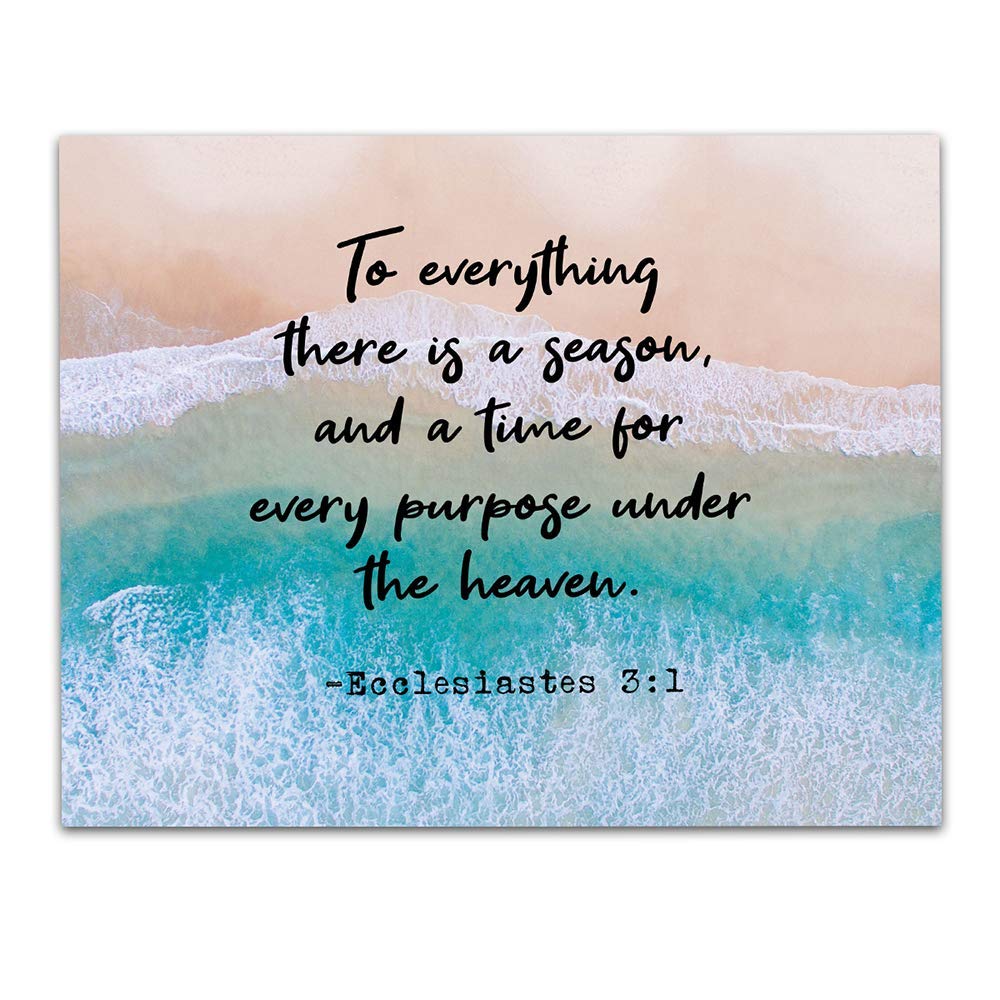
To Everything There is a Season…

25 Wednesday Aug 2021

Posted by jandrewsweckerly in reflection

≈ Leave a comment

Tags

call, church, discernment, God, Jesus, love, season, vulnerable

Photo credit: https://www.amazon.com/Ecclesiastes-Everything-Season-Unframed-Inspirational/dp/B08FMDFBTK

Having finally sat down to write a blog post, I was shocked to realize it had been two months since my last post.  Writing has always been a source of pleasure, joy, and learning for me – a way to reflect on the happenings of life in light of my faith and Holy Scripture.  Blogging for me is akin to preaching and spiritual direction:  an exercise in translating our daily, seemingly secular life into the sacred.  Nearly weekly postings for most of my ministry has been an outlet for me and a ministry to many others.

As I contemplated why there was such a big gap this summer, two theories percolated.  One was the more obvious.  I took some time for vacation, we were searching for and then training a new staff member, I was a part of a bishop’s search (which some argue is like a second full-time job), I was tending my family in a pandemic, I was investing time in continuing education, and I was trying to serve my beloved parish.  My plate was quite obviously full. 

But the second, perhaps more revealing reason came to me through scripture.  I was reminding of that familiar passage from Ecclesiastes, chapter 3:  For everything there is a season.[i]  Honestly, I think more people are familiar with this passage through The Byrd’s song “Turn! Turn! Turn!”  This summer has felt like a different season for me.  Instead of writing about life around us and interpreting it in light of our faith, I spent the summer doing that work orally with two faith communities – talking through what God is doing in the Church, what God has done through us in this time of pandemic, where the Church is going, and who Jesus is calling all of us to be.  In some ways those conversations have been very similar in content to what I write.  But experientially, it was significantly more vulnerable.  Instead of hiding behind the written word, I was engaging in deep, hard, thoughtful conversations in real time, being probed, questioned, and challenged – and all of that experience being broadcast in recorded and live videos for anyone and everyone to see.  I described it to a dear friend as a time of feeling naked before the world.

This summer has been a season for discernment, for deep reflection, for vulnerable pondering.  And just like the scripture writer says, for everything there is a season:  a time to plant, a time to break down, a time to laugh and dance, a time to embrace, a time to seek and a time to lose, a time to speak, and a time to love.  Now, I enter into another season:  a time to reconnect with the Hickory Neck community that loved me through this process – even though it was difficult for them.  A time to write again:  about where we see God in the midst of this season of pandemic that we wish were over.  A time to dream and a time to innovate:  about where God is calling us now.  A time to laugh, dance, and embrace:  even if we have to go back to doing that all virtually.  No matter what the season, God is with us.  I’m honored to journey in this season with you.


[i] Ecclesiastes 3.1-8 reads:  For everything there is a season, and a time for every matter under heaven:  a time to be born, and a time to die; a time to plant, and a time to pluck up what is planted; a time to kill, and a time to heal; a time to break down, and a time to build up; a time to weep, and a time to laugh; a time to mourn, and a time to dance; a time to throw away stones, and a time to gather stones together; a time to embrace, and a time to refrain from embracing; a time to seek, and a time to lose; a time to keep, and a time to throw away; a time to tear, and a time to sew; a time to keep silence, and a time to speak; a time to love, and a time to hate; a time for war, and a time for peace.

Sermon – John 10.11-18, Psalm 23, E4, YB, April 25, 2021

28 Wednesday Apr 2021

Posted by jandrewsweckerly in Sermons

≈ Leave a comment

Tags

belonging, children, control, Good Shepherd, intimacy, Jesus, love, mutuality, parent, relationship, respect, Sermon, sheep, shepherd, vulnerable

As a new parent, I struggled during the toddler years – those years when the child is first asserting their will, realizing they want to be in control too.  And so, after trying calm coaxing and verbal reasoning, I eventually honed the art of muscling:  I realized I was stronger than my toddler, so I could just sweep them up and carry on doing what I knew we needed to do anyway.  Sometimes the swooping was playful, swinging the child around or letting them hang upside-down.  But more often, it was just a strong, steady sweep – getting us out of the grocery store during a meltdown, getting us out of the house and into the car for an appointment, getting us away from the television.  But that kind of parenting only works for so long – approximately as long as you can physically lift a flailing child, which for me, was not that long.  That is when parenting gets real.

I have been thinking a lot about the Good Shepherd this week, and the similarities between shepherding and parenting.  As children, or more aptly, as sheep, we want a shepherd who will take care of us.  The words from today’s psalm and John’s gospel lay out the idealized caregiver:  The Lord is my shepherd; I shall not be in want[i]; the good shepherd lays down his life for the sheep.[ii]  When we think about what we want from God, especially after a long year-plus of a pandemic, of political divisiveness, of struggling with the institution of racism, we want a God who will cradle us in, and love and protect us unconditionally.  I suspect that is why so many churches have paintings, stained glass windows, and statues of Jesus carrying a perfectly clean, cute little lamb on his shoulder.

I confess, I do not know enough about shepherding, but even from watching the lambs in Colonial Williamsburg, I can assure you, those lambs are not perfectly clean and well-behaved.  There is something about our saccharine-filled images of the Good Shepherd that feel unrealistic to me.  As much as I want to crawl in the lap of a loving, protective Jesus, something about our images of the Good Shepherd does not quite capture reality.  This week, I watched a YouTube video of a man trying to rescue a sheep.  There was this long narrow ditch alongside a road, and the sheep’s hind end was hanging out of the ditch.  A man, carefully using his strength, managed to grasp the sheep’s legs and pull the sheep free.  The freed sheep bounded away from him, bouncing gracefully toward freedom – of course until he bounded back over the ditch toward the other side of the road, jumping head-first, right back into the ditch.  In your imagination, you can almost hear the deep, audible sigh of frustration by the man who had just helped him.

I think that is why I like verse 14 of John’s gospel so much, “I am the good shepherd.  I know my own and my own know me.”  The shepherd knows how to love unconditionally; but the shepherd also knows all our “conditions”:  the times when we stubbornly do things our way, the times when we refuse wisdom and jump right back into trouble, the times when we project our anger and frustration on others.  And the sheep know the shepherd:  the times when the shepherd will try to reason with us instead of muscling us to do the shepherd’s will, the times when the shepherd forgives us when we confess our sins, the times when the shepherd sighs deeply in disappointment at our refusal to lie down in green pastures.  There is an intimacy to that relationship, as one scholar describes, a “mutual recognition and a mutual belonging together.”[iii] 

Our invitation this week is an invitation into that mutuality and intimacy.  The invitation is not an invitation into a snowy-white, paternalistic, cradling love.  The invitation is into a messy, complicated, but respectfully intimate relationship where we are known, and we know our shepherd.  Through this real, honest, vulnerable place we find strength to then go back out into the world, allowing “the Shepherd’s voice to speak through us as we reach out to the lost and hurting we encounter on the way,”[iv] sharing the love of the risen, shepherding Jesus that has saved us from many a ditch!  Amen.


[i] Psalm 23.1

[ii] John 10.11

[iii] Stephen A. Cooper, “Theological Perspective,” Feasting on the Word, Yr. B, Vol. 2 (Louisville:  Westminster John Knox Press, 2008), 448.

[iv] Nancy R. Blakely, “Pastoral Perspective,” Feasting on the Word, Yr. B, Vol. 2 (Louisville:  Westminster John Knox Press, 2008), 452.

Sermon – Luke 24.13-35, Acts 2.14a, 36-41, E3, YA, April 26, 2020

30 Thursday Apr 2020

Posted by jandrewsweckerly in Sermons, Uncategorized

≈ Leave a comment

Tags

church, crisis, disciples, Easter, Emmaus, faith, hope, human, Jesus, lost, love, pandemic, resurrection, Sermon, vulnerable, weakness

To say we have been operating in crisis mode here at Hickory Neck would be an understatement.  We went from normal operations, to heavy restrictions for gathering and receiving communion, to entirely closing our buildings, to moving all worship online, to virtual learning, fellowship, and pastoral care.  All of those changes happened rapidly, and with an eye to whatever was next.  Once we figured out some semblance of a new rhythm and “normal,” Holy Week came, and we had to figure out how to make our most sacred week of the Church Year meaningful despite our inability to gather physically.  Baptisms and confirmations have been postponed, our Bishop’s visit has been delayed, and farewells and celebrations have been canceled.  And yet, here we are, about half-way through a stay-at-home order, with infection and death rates at astronomical levels, and the Church finds herself in the third week of Easter, still proclaiming her alleluias.

I am not sure I could pull myself together and proclaim those alleluias without the lessons from Holy Scripture we have been journeying with these last Sundays.  In a normal Eastertide, we are more carefree, reveling in Easter joy, making bold proclamations about resurrection and eternal life, and listening to the early Easter stories like the walk to Emmaus with a sense of endearment – as if saying, “Bless their hearts!” as the early Christians try to figure out what in the world is going on after Jesus’ resurrection.  But this is not a normal Eastertide.  In fact, Biblical scholar Matt Skinner refers to this time as “Pandemic Easter.”[i]  For the first time in perhaps most of our lives, we can more deeply empathize with the disciples during these early days of resurrection.  The modern Church has used Eastertide as a bold proclamation of the meaning of Jesus’ death and resurrection.  But the first disciples of Christ are not boldly doing anything.  In fact, they are bereft, confused, scared, given glimpses of hope followed by bouts of despair and doubt.  They are not sure what to believe, even having seen the risen Jesus themselves.  Even those who receive the teaching from the disciples in our Acts lesson are overcome with emotion and can only ask, “Brothers, what should we do?”

Somehow, living in Pandemic Easter has made our Eastertide lessons much more powerfully relatable.  I do not know if I am ready to boldly proclaim, “The Lord is Risen Indeed.”  But I am willing to say to fellow Christians, and to God, “What should we do?”  I am willing to talk with a fellow person of faith, or even a person of no faith, walking with them (either metaphorically or at least at a distance of six feet) as we make our way through this mess.  Those disciples on the walk to Emmaus look different to me this year.  Those two people who thought they knew what they believed, who are confused by testimony of Jesus’ resurrection, who walk away from the protective hideout with fellow disciples, are trying to make sense of life, death, and Jesus.  They are not people to be pitied or seen as adorably unsure of their faith.  They are us.  They are people in a life-altering crisis, trying to make sense of death and defeat, wondering where hope may be, and a bit lost.

And here comes the best part.  Now, I have always thought the best parts of this story are where Jesus teaches the disciples unawares, shares a meal with them, or their hearts becoming strangely warmed, allowing them to become the second set of witnesses after the women at the tomb.  But in Pandemic Easter, the best part of this story might just be what happens on the walk to Emmaus.  Jesus invites these two followers to talk about what has happened to them.  He literally walks with them as they share their shock, their grief, their sadness.  Perhaps in Easters past, I thought Jesus was being coy or trying to trick the disciples in some way.  But in Pandemic Easter, I think Jesus is doing what we all need:  Jesus listens, he lets the disciples share their reality, he makes space for the human response to a new normal.    Jesus makes space for questions like, “What should we do?”

I don’t know about you, but the very real, vulnerable, human interactions between Jesus and the disciples in Scripture today has been a tremendous balm to me.  More than perhaps any year, the Church is not telling us how to embrace and proclaim a certain and sure faith.  Today the Church is simply inviting us to hover in the actual experience of Easter – days of confusion, sadness, fear, and grief.  We are able to tarry there because Scripture reminds us today that Jesus walks with us.  When we cannot yet understand, when we perhaps cannot even believe, Jesus walks with us on the journey.  Jesus listens to our real human response to crisis and walks with us.  Someday – maybe today, maybe in a week or month, or maybe in a year, we will be able to hear Jesus’ teaching and understand, and our hearts will be strangely warmed with conviction.  Until then, Jesus walks with us where we are, acknowledging the fullness of our weakness, and staying with us and loving us through it all.  Thanks be to God.

[i] Matt Skinner, “The Road to Emmaus Feels Longer This Year,” April 19, 2020, as found at http://www.workingpreacher.org/craft.aspx?post=5428 on April 24, 2020.

Sermon – John 4.5-42, L3, YA, March 15, 2020

19 Thursday Mar 2020

Posted by jandrewsweckerly in Sermons, Uncategorized

≈ Leave a comment

Tags

anxiety, Caronavirus, flesh, God, human, incarnate, incarnation, intimate, Jesus, Messiah, relationship, Samaritan, Sermon, vulnerable, well, woman

Today’s gospel lesson is one of those lessons that can be so full of intrigue that we miss what is happening in the text.  Most of us have heard this lesson hundreds of times, and have probably lingered on the part of the conversation where Jesus calls out the woman for living with someone who is not her husband, after already having had five husbands.  The conversation sounds straight out of Jerry Springer or Dr. Phil, where in the next scene we expect the other husbands to arrive, and a fight to break loose.

The problem with that kind of reading is we have the tone all wrong.  By narrowing in on what sounds like a “gotcha!” statement from Jesus right in the middle of about 40 verses, we forget all of the words and actions surrounding this event in the middle.  We have clues all along in the reading:  Jesus going through Samaria (when most Jews avoid Samaria); a woman appearing at a well at noon (when most of the woman have come and gone); Jesus (a Jew) talking to a Samaritan woman in broad daylight (a triple no-no); disciples appearing and engaging in conversation that sounds like The Three Stooges; talk of prophets, messiahs, disciples, and evangelism.

When we step back and take the broad view of this lesson, we are able to not be distracted by the sweep of the narrative, the scandalous and the absurd details, and the confusing stream of thought.  When seen broadly, we find a story that illuminates what having an incarnate God really looks like.  Too often, when we talk of the incarnation, we think of the baby Jesus, or the bodily, gruesome crucifixion.  But we sometimes forget the everydayness of the incarnation:  the fact that Jesus is thirsty and needs something from another, namely this Samaritan woman; the fact that Jesus initiates an intimate relationship, where two people can talk about the pain, suffering, and societal rejection of a widow and/or divorcee, who is simply trying to get by in a community that ostracizes her, even from drawing water from the well in the cool of morning; the fact that Jesus understands barrenness and empowers her to instead birth new believers.[i]  As Karoline Lewis says, says, “To take the incarnation seriously, to give it the fullest extent and expression, demands that no aspect of what it means to be human be overlooked.  To do so would truncate the principal theological claim of [John’s] Gospel.  At stake for the fourth evangelist is that Jesus is truly God in the flesh and every aspect of what humanity entails God now knows.”[ii]

I find this reading immensely meaningful today, because we are living in a moment when being flesh and bone is particularly precarious and unnerving.  A pandemic has gone all over the world and landed in our schools, our churches, our gathering places, and our homes.  Our lives have been upended by the threat of the Coronavirus, knowing the vulnerability of some in our community, and understanding suddenly how intricately intwined our lives are, even at a time when we have opined about how socially distanced we are.  This is a time when we feel very fleshy and vulnerable and here is Jesus talking to a vulnerable woman about his own fleshiness.

I don’t know about you, but I find this strange, circuitous conversation very comforting today.  In a time of anxiety, fear, and upheaval, Jesus is right there, in the midst of everyday messiness, and saying, “I feel you.  I understand.  I, your God, am incarnate, and I see and know you.”  And in response, the woman who is seen, known, and heard in turn goes to her community and becomes Jesus for others.  As Lewis says, “The woman at the well is not only a witness.  She is Jesus, the ‘I AM’ in the world, for her people.”[iii]

This is our invitation today too.  In the midst of upheaval, of disorientation, of anxiety, we are invited to be fully enfleshed Jesuses for others – to see their pain, their suffering, their uncertainty, and offer solidarity, comfort, and encouragement.  Even in a time of physical separation, we are invited into intimate relationship with one another, into relationships that honor the holy in one another, and help us all move forward.  This is what the Messiah does for us.  This is what we can do for one another.  Amen.

[i] Karoline M. Lewis, John:  Fortress Biblical Preaching Commentaries (Minneapolis: Fortress Press, 2014), 64.

[ii] Lewis, 55.

[iii] Lewis, 65.

Sermon – Luke 11.1-13, P12, YC, July 28, 2019

31 Wednesday Jul 2019

Posted by jandrewsweckerly in Sermons, Uncategorized

≈ Leave a comment

Tags

authentic, disciples, God, honest, Jesus, language, Lord's Prayer, power, pray, prayer, real, relationship, Sermon, teach, vulnerable

One of the practices highly recommended to clergy is having a spiritual director.  My director is a professor I had in seminary.  He is wise and insightful, and always helps me not only see the bigger picture, but also see goodness in what sometimes feels like darkness.  But perhaps my favorite thing about him is the way he prays.  You would think with such a spiritual, learned man, his prayers would be profound and flowery – worthy of the kind of prayers we find in our own Prayer Book.  But instead, his prayers are the opposite.  They are awkward and fumbling.  You can hear long pauses in them as he struggles to articulate what he wants to say to God.  He uses everyday language, rarely capturing the phrases we normally hear in prayers.  The first several times I heard him pray, I was admittedly a little disappointed and, when I’m really being honest, a bit judgmental.  But in time, I began to see his prayers differently.  His prayers may not be artfully constructed or perfectly paced, but his prayers are never canned or artificial.  His prayers may not be theologically intricate, but his prayers are honest, vulnerable, and capture the deep profundity of whatever you have just shared.  His prayers are not pretty, but they are real and raw – more real than most prayers I have heard.

Of course, I am not the first person to wonder, worry, or wander through prayers.  Today, the disciples ask a simple favor of Jesus, “Lord, teach us to pray.”  The disciples at this point have seen Jesus pray many times.  They see how good he is and they see how important prayer is in his life.  In fact, in Luke’s gospel, Jesus is regularly found in prayer.[i]  They watch Jesus enter into prayer with God for months, and they long to be able to do that too.  And so they come to Jesus, and they vulnerably submit their request:  teach us to pray.

Their request is full of implications.  First is the admission that they do not have the first idea about what they are doing.  Maybe they learned some prayers in temple, or maybe their parents prayed with them.  But they realize in watching Jesus that they do not actually know how to pray themselves.  Not really.  Second, they see a real connection between Jesus and God that somehow is revealed in Jesus’ prayer life.  Perhaps they see how prayer strengthens him in his weakness and how he is more vulnerable with God than even with them.  They long for that kind of connection with God too, but still, they are not sure how the whole thing works.  Finally, a deeper implication is at hand in the disciples’ request.  Perhaps they are not only asking Jesus how to pray, but also wanting to know what is actually happening in prayer.  Perhaps they have tried praying on their own – for an illness, for a new job, for a broken relationship – but the prayer did not work.  They want Jesus to teach them the right way to pray so that the results they desire are fulfilled.

And so, Jesus responds.  Jesus gives them the ultimate prayer – the prayer we call The Lord’s Prayer.  The prayer Jesus gives them is so beautiful and powerful, that two thousand years later, people who never go to church seem to know this prayer.  This is the prayer we pray when we pray the rosary, when we end our days, and at the end of every Eucharistic Prayer.  This is the prayer we pray when we have no other words.  This is the prayer we teach our children to pray and we sing in our own unique Hickory Neck way.

But if you look at Luke’s version of this prayer, the prayer sounds a little more like one of the prayers my spiritual director might pray.  As one scholar says, “Pious convention has conditioned most of us to repeat this prayer so quietly and reverentially that we fail to recognize how we are risking an aggressiveness incommensurate with bourgeois manners.”[ii]  In other words, the Lord’s Prayer is kind of pushy.  There is no flowery language or even polite deference or usage of the word “please.”  Instead, Jesus just tells us to ask for a bunch of stuff:  give us, forgive us, lead us, deliver us.  And every week or even every day, we say the same words – give us, forgive us, lead us, deliver us.  And if we keep reading Luke’s gospel, after the prayer, we hear Jesus saying that our prayerful life with God is akin to being a pushy friend who through their shameless relentlessness[iii] is able to get a friend up out of bed in the middle of the night.

So why in the world do we teach our children this prayer when the prayer is so flagrantly pushy?  Next week Ella and Charlie will be receiving their First Holy Communion.  First Communion is not really the norm in the Episcopal Church.  As a priest, I first encountered First Holy Communion on Long Island, where the Episcopal Church was highly influenced by the Roman Catholic tradition.  Though the Episcopal Church’s theology is that any baptized person can receive communion, some families prefer their children to understand what Holy Communion means before receiving instead of learning to understand communion through experience.  There really is no wrong way to approach Eucharist, but if we are to do a First Holy Communion, one of the things we require candidates to do is learn the Lord’s Prayer.  In part we do that so that there is at least one part of the Eucharistic service they have memorized and in which they can fully participate.

But there is another reason we have candidates learn the Lord’s Prayer.  We want candidates to learn the Lord’s Prayer because the Lord’s Prayer teaches us about what our relationship with God is like.  Our relationship with God is not flowery or picture perfect.  We  may have moments of poetic beauty with God, but when our relationship with God is at its deepest, we cry ugly, full-bodied tears, we rage about injustice – both personal and in the world, we confess our shame and sorrow for the awful things we sometimes do, and we laugh and rejoice with the kind of dancing we would only do in the confines of our homes.  We do not use language with God containing the formality of language we use with strangers; we use language with God we would use with a friend who knows all our foibles and loves us anyway.  All of that is not to say the poignant prayers of the Prayer Book cannot inspire faithfulness; they can and do.  But we teach the Lord’s Prayer to our children so they know we can say unsure, vulnerable, real words to God.

That is what Jesus is really teaching the disciples.  Jesus does not tell the disciples to “ask, and it will be given you; search, and you will find; knock, and the door will be opened for you,” because he is saying prayer is a vending machine for our every wish.  Jesus tells us to ask, search, and knock, because prayer and our relationship with God is active and relational.  As one scholar asserts, Jesus teaches us the Lord’s Prayer because he wants his disciples to know, “prayer is not a meek, contrived, and merely ‘religious’ act; [prayer] is the act of human beings who know how hard it is to be human.  Real prayer cannot be faked.  [Real prayer’s] only prerequisites are sufficient self-knowledge to recognize the depths of our need, and enough humility to ask for help.”[iv]

This week, I invite you to take a cue from Jesus’ own relationship with God.  Maybe you will start with a prayer like my spiritual director’s – one that does not lead with preplanned words, but instead tries to authentically say the words on your heart; not a structured collect, but a raw conversation with God.  Jesus gives you permission to ask for those things you need, the forgiveness you desire, the protection you long for, and the deliverance you seek.  Jesus invites you to just be you – to be a human with the God who loves you and made you in God’s image.  And if all that fails, then you can say the Lord’s Prayer.  You can rest in the assurance that although Jesus’ prayer sure sounds pretty, his prayer is one of the most honest ones you can offer – the small step you can take in connecting back to your Lord and your God.  Amen.


[i] James A. Wallace, “Homiletical Perspective,” Feasting on the Word, Yr. C, Vol. 3 (Louisville: Westminster John Knox Press, 2010), 289.

[ii] Douglas John Hall, “Theological Perspective,” Feasting on the Word, Yr. C, Vol. 3 (Louisville: Westminster John Knox Press, 2010), 288, 290.

[iii] Wallace, 291.

[iv] Hall, 290.

← Older posts

Recent Posts

  • On the Myth and Magic of Advent…
  • On Risking Failure and Facing Fear…
  • Sermon – Luke 23.33-43, P29, YC, November 23, 2025
  • On Inhabiting Gratitude…
  • Sermon – Luke 20.27-38, P27, YC, November 9, 2025

Archives

  • December 2025
  • November 2025
  • October 2025
  • September 2025
  • August 2025
  • July 2025
  • June 2025
  • March 2025
  • February 2025
  • December 2024
  • November 2024
  • October 2024
  • September 2024
  • August 2024
  • July 2024
  • June 2024
  • May 2024
  • March 2024
  • February 2024
  • January 2024
  • December 2023
  • November 2023
  • October 2023
  • September 2023
  • August 2023
  • July 2023
  • June 2023
  • May 2023
  • March 2023
  • February 2023
  • January 2023
  • December 2022
  • November 2022
  • October 2022
  • June 2022
  • May 2022
  • January 2022
  • December 2021
  • November 2021
  • October 2021
  • September 2021
  • August 2021
  • June 2021
  • May 2021
  • April 2021
  • March 2021
  • February 2021
  • January 2021
  • December 2020
  • November 2020
  • October 2020
  • September 2020
  • August 2020
  • July 2020
  • June 2020
  • May 2020
  • April 2020
  • March 2020
  • February 2020
  • January 2020
  • December 2019
  • November 2019
  • October 2019
  • September 2019
  • August 2019
  • July 2019
  • June 2019
  • May 2019
  • April 2019
  • March 2019
  • February 2019
  • January 2019
  • December 2018
  • November 2018
  • October 2018
  • September 2018
  • August 2018
  • July 2018
  • June 2018
  • May 2018
  • April 2018
  • March 2018
  • February 2018
  • January 2018
  • December 2017
  • November 2017
  • October 2017
  • September 2017
  • August 2017
  • July 2017
  • June 2017
  • May 2017
  • April 2017
  • March 2017
  • February 2017
  • January 2017
  • December 2016
  • November 2016
  • October 2016
  • September 2016
  • August 2016
  • July 2016
  • June 2016
  • May 2016
  • April 2016
  • March 2016
  • February 2016
  • January 2016
  • December 2015
  • November 2015
  • October 2015
  • September 2015
  • August 2015
  • July 2015
  • June 2015
  • May 2015
  • April 2015
  • March 2015
  • February 2015
  • January 2015
  • December 2014
  • November 2014
  • October 2014
  • September 2014
  • August 2014
  • July 2014
  • June 2014
  • April 2014
  • March 2014
  • February 2014
  • January 2014
  • December 2013
  • November 2013
  • October 2013
  • September 2013
  • August 2013
  • July 2013
  • June 2013
  • May 2013
  • April 2013
  • March 2013
  • February 2013
  • January 2013
  • December 2012
  • November 2012
  • October 2012
  • September 2012

Categories

  • reflection
  • Sermons
  • Uncategorized

Meta

  • Create account
  • Log in
  • Entries feed
  • Comments feed
  • WordPress.com

Blog at WordPress.com.

  • Subscribe Subscribed
    • Seeking and Serving
    • Join 394 other subscribers
    • Already have a WordPress.com account? Log in now.
    • Seeking and Serving
    • Subscribe Subscribed
    • Sign up
    • Log in
    • Report this content
    • View site in Reader
    • Manage subscriptions
    • Collapse this bar
 

Loading Comments...