• About

Seeking and Serving

~ seek and serve Christ in all persons

Seeking and Serving

Tag Archives: witness

GC79: Compassionate Compromise

19 Thursday Jul 2018

Posted by jandrewsweckerly in Uncategorized

≈ Leave a comment

Tags

Christ, compromise, Episcopal Church, General Convention, LGBTQ, marriage rites, protest, theology, traditional, witness

IMG_1818

Photo Credit:  Jennifer Andrews-Weckerly (reuse with permission)

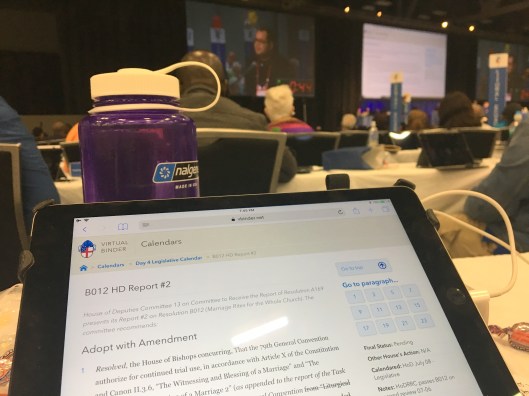
As an alternate to General Convention, I stood ready to fill in when deputies needed a break from the floor.  On the two sessions where I was able to serve as a Deputy, I was able to participate in the debate, revision, and voting on B012, entitled Marriage Rites for the Whole Church.  This resolution came to be because although we authorized marriage rites for same sex couples at the 78th General Convention, there was a provision that allowed bishops who hold a theological position that does not embrace marriage for same-sex couples to forbid his or her priests from conducting such rites.  This left the LGBTQ community in those dioceses unable to be married in their home parishes by their home priests, despite a change in the legal ability to do so.  This was deemed a compromise that could keep everyone at the table despite our theological differences.

However, given the protests of the LGBTQ community and their supporters, B012 proposed an option for priests and their parishes who wanted to conduct marriages for all despite their bishop’s protest to seek the oversight of another bishop in the Episcopal Church.  The resolution allowed for bishops and protesting churches and clergy to hold their ground, while also allowing dissenting clergy and parishes to minister to their community fully.  I talked about the testimonies and debate about this issue earlier.  The resolution was heavily edited as a result of that that testimony, and what came before the House of Deputies seemed like a well-crafted compromise.  But the debate on the floor indicated something quite different.  Our more traditional brothers and sisters felt their theology was being compromised, and many diocese in Province IX, including churches in foreign countries where same-sex marriage is still illegal, were threatening to break from the church.  It was a heart-wrenching debate, and our own deputation was even divided on what to do.

When the vote finally came, we voted by orders – so that the entire house could see how the lay and ordained voted.  As the minutes ticked by, my stomach turned.  I honestly did not know what would be the best outcome, and I feared for our path forward.  When the votes came in, they were overwhelmingly in favor of B012.  I am not sure what changed people’s minds, and I am not sure how people came to see that this was a good compromise.  My only reflection was that everyone was a bit unhappy, not fully getting what they wanted – which is the definition of a good compromise, if you ask me.

I do not know if the passage of B012 will have any negative impact in the future.  What I do know is that the process seemed to model something we have a hard time doing in the United States – compromise.  I have always said that if the Episcopal Church cannot model compromise, respect, and dignity, we cannot expect the world outside to do so.  The passage of B012 in both Houses made me feel like there might be hope for all of us to witness compassionate compromise through Christ to others.

Sermon – Luke 24.36b-48, E3, YB, April 15, 2018

19 Thursday Apr 2018

Posted by jandrewsweckerly in Sermons, Uncategorized

≈ Leave a comment

Tags

afraid, Christian, disciples, God, hiding, identity, Jesus, judge, Sermon, witness, world

Last month I was talking to Pastor Alex from Stonehouse Presbyterian.  We were walking toward our cars and he complimented my license plate, noting how fun spotting my plate around town has been.  I chuckled and told him the plate had been both a blessing and a curse.  He asked me what I meant, and I explained.  You see, I love the plate for the very reason he mentioned – that I run into people who recognize my plate, that people connect who I am with what I do, that people ask me about my vocation and about Hickory Neck.  But the plate is also a bit of a curse.  If I had to choose any place to be a witness for Christ, I am not sure the car is the best location.  You see, the car is where I leave prayer books, post-its about phone calls, gum wrappers, and coffee cups.  The car is where I cart around children – sometimes singing at the tops of our lungs to a favorite song, and sometimes scowling after an argument about behavior.  The car is where I find a moment to getaway before picking up children, and the car is where I sometimes reveal that I once lived in a region of the country that is known for impatient, sometimes foul-mouthed drivers.  The car is not really home to my best witness for loving Christ.  And yet, there is where a big plate – on both the front and the back – witnesses to the world who and whose I am.

That is what I find so funny about the disciples this week.  Here they are in Luke’s gospel, not unlike what we heard in John’s gospel last week, hiding in a room, afraid, disbelieving, and wondering what to make of all that has happened.  To be fair, life has gotten a bit chaotic of late.  Their whole world has gotten turned upside down since that beautiful, sacred night when Jesus washed their feet.  They had ideas about what was coming in their life, what was going to happen to Jesus, and how the world would be changed.  But Jesus dies, they are outcasts, and God seems to have closed a door – a tomb door.  Then, just days later, their world gets upended again.  The disciples learn from the women that the same closed tomb door is now open.  Two of the disciples have an encounter with the risen Christ on the road to Emmaus.  And as if all of that is not enough, today, Jesus shows up – very much alive, proving his corporality, teaching them, and reminding them they are witnesses.

The disciples certainly have our sympathy and concern.  And yet, the disciples remain holed up in a room – as if they can hide.  As if they can integrate back into the world, with no one realizing who and whose they are.  As if no one will notice the license plate on their car that says, “Jesus’ disciple.”  The disciples are hiding, acting as though no one is watching, no one is making conclusions about them based on their behavior, no one is making conclusions about Christ.  Their hiding is just as much of a witness as going out into the community.  Perhaps they feel being in that room is giving them a break from being witnesses – that no one sees them.  But we know better.  And so does Jesus.  “You are witnesses of these things,” says Jesus.

Sometimes we do the exact same thing.  We too can start to believe that we have hiding places in our lives – places where we do not have to be witnesses.  Maybe yours is a car.  Maybe yours is at work or school because those places seem more removed from what we do here on Sundays.  Maybe yours is at home, on vacation, or when surrounded by friends.  Like the disciples, we too have that same longing to “turn off” our witness.  Maybe we are just tired and feel like being a witness for Christ is exhausting.  Maybe we are upset with or disappointed in God and are not sure communicating those feelings helps our witness of Christ.  Or maybe we are just afraid – that people will notice that we do not live lives that reflect who and whose we are.

But “turning off” our identity as people of faith is not really an option.  Sooner or later we will get caught.  Sometimes being caught can be a very positive thing.  An acquaintance who knows you go to church may ask you to add them to your church’s prayer list because they or their child just received a horrible diagnosis.  But sometimes being caught can be less flattering.  At our Adult Forum series on evangelism this fall, we watched a video about how not to invite people to church.  The video features two neighbors, one who is out gardening in the yard and the other who is clearly just coming home from church.  The neighbor who is out gardening wonders to himself, “I wonder why he never invites me to his church.  I would go if he asked me.”  But sometimes being caught can be even worse.  I had a friend who waited tables during college.  She always moaned when she got her work schedule and discovered she was assigned a Sunday.  I finally asked her why she hated Sundays so much.  She said, “Because that’s when all the churchgoers go out to eat – and they are the worst tippers!”  Somehow, in all her long hours of trying to make a few bucks to pay for books and school fees she had gotten the message that people of faith did not value her.

We know from experience that hiding as a Christian is really an illusion.  Wherever we are, whenever we are, with whomever we are, our identity is always there.  Jesus confirms that today.  As biblical scholar Karoline Lewis says, “Jesus’ address to the disciples is not, ‘you will be witnesses.’ Not, ‘please be witnesses.’ Not, ‘consider being witnesses if you have time.’ No, [Jesus says] ‘you are witnesses of these things.’ We are witnesses.  As it turns out, witnessing is not voluntary, but a state of being.”[i]  Lewis goes on to add, “‘We are witnesses’ does not depend on our acceptance or agreement or approval. ‘We are witnesses’ does not depend on our readiness or recognition or responsiveness. ‘We are witnesses’ just is.”[ii]  The disciples learn that today.  When Jesus says, you are witnesses, he empowers a very scared, uncertain, fearful group of followers to remember who and whose they are.

The good news is that Jesus does not judge the disciples today.  Jesus meets the disciples where they are.[iii]  Jesus’ first words are words of encouragement.  “Peace be with you,” he says.  Then, ever the tender pastor, Jesus asks the question in verse 38, “Why are you frightened, and why do doubts arise in your heart?”  Knowing their confusion, Jesus eats with them to assure them he is really there, not just some ghost or figment of their imagination.  He sits down and teaches them once again, taking them back to their roots, reminding them of how the prophets have taught them all they need to know.  And then, come those fateful words in verse 48, “you are witnesses of these things.”  Jesus meets them where they are, offering comfort, assurance, and affirmation.  But Jesus also encourages them to move beyond where they are.

After September 11th, there were two widows featured on the news.  “Grateful for the outpouring of support they received, they started thinking about the women in Afghanistan who, when widowed, lose status in that society and therefore find their already difficult lives even harder.  They raised money and formed a foundation called Beyond the 11th to support Afghani widows, and even made visits to Afghanistan to meet the widows they were helping.”[iv]  Those widows had lot of options – fear, anger, vengeance, or isolation.  But instead, they remembered how Jesus encourages us to remember our identity as witnesses and to move beyond where we are.  Our invitation today is to reclaim that same identity.  Now I do not know if that means you go put a Hickory Neck bumper sticker on your car, or you start wearing that cross necklace again, or you start tangibly connecting your words and actions to your identity as a witness.  Only you can know the shape your witness will take.  But today Jesus invites us to let go of our hiding places, realizing that even when we think we are hiding, we are still witnessing.  Our invitation is to own who we are, so that others might see the beauty of who and whose we are.  Amen.

[i] Karoline Lewis, “We Are Witnesses,” April 9, 2018, as found at http://www.workingpreacher.org/craft.aspx?post=5126 on April 12, 2018.

[ii] Lewis.

[iii] Nancy R. Blakely, “Pastoral Perspective,” Feasting on the Word, Year B, Vol. 2 (Louisville:  Westminster John Knox Press, 2008), 424.

[iv] Blakely, 428.

Sermon – John 1.6-8, 19-28, A3, YB, December 17, 2017

20 Wednesday Dec 2017

Posted by jandrewsweckerly in Sermons, Uncategorized

≈ Leave a comment

Tags

Advent, delight, evangelism, Jesus, John, John the Baptist, light, listen, point, Sermon, voice, witness

I have been thinking a lot this week about the faith witnesses in my life.  There have been dozens of them: some who were in my life for a short while, and some who still serve as a witness to me today; some who flipped my world upside down by a single observation; and some whose entire life journey has served as a witness.  One who stands out for me was a mentor I met as I came into adulthood.  She was not particularly flashy or dramatic, but her entire life became a living witness to me.  Her witness started in the context of talking about Jesus.  There were things she said that had never occurred to me, and yet made a great deal of sense.  She slowly awakened in me a passion for justice:  teaching me about our country’s impact on the world’s poor; asking hard questions, such as where my clothes were made and what my clothing said about my concern for the least of these; helping me see how incredibly privileged I was even when I did not feel privileged compared to others.  I watched her risk arrest through political protest.  I saw her offer up the spare room in her house time and again to those in transition and trying to find their way.  She even revealed to me at some point that instead of accepting an engagement ring from her husband, they had agreed a more appropriate sign of their commitment to one another would be exchanging rocking chairs – so that they could grow old together in them.

What was telling about my experience with her witness was I knew she would never have wanted me to say, “I want to be just like her.”  In fact, with all my revelatory interactions with her, I was not in awe of her; I was in awe of her attempt to live a life in line with the gospel – to live a life that reflected the light of Jesus.  Her words, our conversations, her decisions were ways of pointing me back to a living relationship with Christ.  Her witness to me was not unlike John’s witness in our gospel lesson today.  Now, if you were here last week, you may be wondering, “Didn’t we just hear this story about John the Baptist last week?”  The answer is yes; and no.  Last week we read Mark’s account of John the Baptist.  Typical of Mark, the text we heard was short, and jam-packed with action.  John the Baptist is preaching a baptism of repentance, people are flocking to him, he wears weird clothes, and he tells everyone someone more powerful is coming.  But that is pretty much all Mark gives us.

This week, we read the gospel of John’s account of John.  We know right away John’s gospel is different because he does not call John, “John the Baptist.”  In fact, some scholars say John’s version of John the Baptist would be called, “John the Witness,” or “John the Voice.”  John’s gospel tells us that John the Witness is just that:  a living witness to the light of Christ.  John’s gospel slows us down so we can talk about who this John the Witness really is.  Temple leaders come to John asking him all sorts of questions:  who he is, whether he is a prophet, under what authority he is baptizing people.  John’s gospel slows us down because the gospeller wants to be very clear who John the Witness is and who he is not.  In these thirteen verses, John the Witness uses ten negatives to distinguish himself from Jesus; ten “nots,” “neithers,” and “noes.”[i]  You see, the religious leaders come to John the Witness because he is showing himself to be a compelling leader.[ii]  But what the religious leaders have missed is John is not trying to attract people to himself; hence all the “not me” language.  John is simply preparing the way – pointing people toward someone even more compelling.

I do not know about you, but there is some small part of me that has always been a tad annoyed that the majority of Advent is spent talking about John.  Even though I am on board with not singing Christmas carols or hearing the birth narratives until Christmas Eve, I have often secretly wanted more of a preview in the weeks preceding Christmas than we get.  I have wondered why we cannot spend all four weeks on the more dramatic pregnancy stories:  Mary’s annunciation, Joseph’s interaction with the angel, the Elizabeth and Mary encounter, and the Magnificat.  Spending two weeks on the crazy cousin who eats locusts and wild honey feels tangential to what is coming, and hardly gets me in the mood for singing Away in a Manger.

But this year, something shifted for me.  John the Baptist, or the Witness, or the Voice, or whatever we are going to call him became more compelling for me this Advent.  If you remember, John had a miracle beginning too.  His mother had been long barren, and when the news came to his father that his wife would bear a son, his disbelief meant that he was struck with the inability to speak for nine months until the baby came.  Then, while John was still in the womb, he leapt inside Elizabeth’s womb when Elizabeth came near Jesus in Mary’s womb.  He clearly had the gift of discernment from before birth.  But what strikes me most is his clarity in identity and purpose.  Despite his miraculous and impressive beginnings, he always understands his giftedness is not about him.  His giftedness is in pointing people to God.  He is not lured in by fame or followers; he is not caught up in the hype; he is not even tempted to claim the authority of someone like Elijah.  He is single-minded in his purpose and vocation, and longs to help people find their way to God.  His delight is in helping people find their delight in Christ.

That is one of our invitations today:  to recall someone who has helped you find your delight in Jesus.  Maybe you will adopt someone new like John the witness today.  Maybe his story and his single-mindedness about purpose and vocation is an inspiration.  But maybe you are recalling someone else in your life who did that for you.  Maybe the person was a relative, a mentor, a friend, or a historical figure.  Recall how that person pointed you to Jesus time and again; how he or she awakened in you a longing for a similar single-mindedness about Jesus.  Remember his or her words or actions, giving thanks today for their inspiration and witness in your life.  Meditate with the baptizer, witness, or voice in your life as we journey in these last days of Advent.

But do not stop there.  John’s witness today is not just for you, meant to help you center your own life.[iii]  John’s witness today offers you a second invitation:   to be a baptizer, a witness, a voice for others.  For some of you, the invitation to be a witness may sound overwhelming.  How can we possibly inspire others in the powerful ways others have witnessed to us?  The main way we serve as witnesses is to listen.  David Gortner talks about evangelism not as being about preaching from a street corner, but as being about meeting people where they are – in the grocery store line, at the coffee shop, at a community event – and listening to their story.  The first step in witnessing is not about telling someone how to live their life, but listening to their life stories.  The next step is where witnessing happens.  After hearing someone’s life story – whether a friend, an acquaintance, or even a stranger – we prayerfully reflect back where we hear the Holy Spirit in their story.  We name where we hear and see God in their daily journey.  We point to Jesus in the conversation.[iv]

One of my favorite stories of Habitat for Humanity founder Miller Fuller was a story of a retiree who was busy volunteering on a roof.  He was the kind of person who liked to work alone, mostly so that he could monitor and maintain quality control.  But on this particular day, a kid kept bothering the volunteer.  He wanted to help, and the man kept suggesting he find someone else.  The kid kept appearing throughout the day, bringing tools, bringing snacks, or just hanging nearby to talk.  Despite his efforts to shoo away the boy, he kept finding him underfoot.  By the afternoon, the volunteer gave up and allowed the boy to help him – under strictest supervision, of course.  Much to his surprise, the boy was quite good.  By the end of the day, they were laughing and finishing most of the work.  As they were leaving, the volunteer apologized for his brusqueness and asked the boy his name.  “My name is Jesus,” said the boy.

Jesus is all around us, all the time.  But most of us struggle to see him or name him because we either do not have a witness nearby or we have not honed our witnessing skills.  John the witness invites us to reclaim our witness today; to listen for the movement of Jesus in others’ lives and to be the witness who points to Jesus.  We are not the light; we are not the Messiah; we are not the prophet.  But we do come to testify to the light – to point others toward the goodness, the holy, the Jesus in their life, and invite them to the light.  God has given you witnesses to shape your journey.   And God enables you to share the gift of witness with others.  Our job is to simply listen and point.  Amen.

[i] Barbara Brown Taylor, “Homiletical Perspective,” Feasting on the Word, Yr. B, Vol. 1 (Louisville:  Westminster John Knox Press, 2008), 71.

[ii] David Lose, “Advent 3 B:  Sacred Leadership,” December 15, 2017, as found at http://www.davidlose.net/2017/12/advent-3-b-sacred-leadership/ on December 15, 2017.

[iii] David L. Bartlett, “Pastoral Perspective,” Feasting on the Word, Yr. B, Vol. 1 (Louisville:  Westminster John Knox Press, 2008), 68, 70.

[iv] David Gortner, Transforming Evangelism (New York:  Church Publishing, 2008).

On Seeing Sacred Moments…

18 Wednesday Oct 2017

Posted by jandrewsweckerly in Uncategorized

≈ Leave a comment

Tags

blessing, church, compassion, fellowship, God, holy, laughter, light, love, moment, outreach, sacred, support, witness, work

In general, my children are pretty typical in many ways – they have their good days and their bad days.  They tattle on each other, try to sneak in a hit or shove, and one will occasionally shout how she “hates her life.”  But then, every once in a while, totally unprompted and seemingly “out of sight,” I will overhear the love, care, and affection they have for one another.  One child will walk over the other who is crying, and she will give a hug and offer reassuring words.  Or the two children will gleefully play with one another without arguing or fussing.  Or best of all, I will hear them laughing pure, innocent laughs together.  In these holy moments, they show me the light of God’s presence, and reveal their best qualities – that they are individuals full of love and compassion.

These last few weeks at our church, I feel like I have been able to see similar holy moments.  We are preparing for our Annual Fall Festival, from which all the proceeds go to support local ministries.  As we lead up to the event, I have seen countless tasks being done by parishioners:  from making up food order forms and staffing tables for pre-orders, from cleaning out closets to pricing and sorting donations, from recruiting donations from local businesses to developing the silent auction booklet, from breaking down our worship space to setting up parking space.  As the weeks and days have gotten closer to our festival, I have seen hard work, commitments of time, generosity of spirit, and joy in participation.  Most of the work could go unnoticed; even those of us who volunteer do not always see all the other work that is happening somewhere else.

But today, I want to say, “I see you.”  I see you, Hickory Neck, giving your cherished time to support the church.  I see you, sharing in fellowship as you work together on projects.  I see you, passionate about your neighbors in need and working a little bit harder.  I see you in holy moments, individually and collectively, and I am so proud of you.  Your laughter together is a sweet, sacred sound.  Your labor is a witness to me and to our community of God’s abundant love for all.  Well done, good and faithful servants!  You are a blessing!!

laughter_625x350_41474366938

Photo credit:  food.ndtv.com/health/10-surprising-health-benefits-of-laughter-1464095

Sermon – Matthew 18.15-20, P18, YA, September 10, 2017

13 Wednesday Sep 2017

Posted by jandrewsweckerly in Sermons, Uncategorized

≈ Leave a comment

Tags

avoidance, church, community, conflict, dignity, family, gift, healthy, Jesus, love, manage, reconciliation, relationship, Sermon, truth, witness

I have been looking forward to this Sunday for weeks!  After taking successive vacations at the end of the summer, all of our staff are finally back in town.  Many of you have been traveling, spending time away with friends, or simply taking a break to enjoy the last bits of summer.  Our musicians and liturgy team have been planning our return to three services.  Our Stewardship Committee has been organizing our new Discipleship Fair.  Our Parish Life Committee has been organizing our Parish Picnic.  Church members have been inviting friends to join them for church, or maybe you yourself decided today was the day to search for a new church home.  I have felt the anticipation building as this has day approached.

I have been so excited to kick off a new program year, to invite people to engage in their faith journey, and to share an invitation to others to discover the beauty of this vibrant community, and what does the gospel lesson from Matthew offer us?  A text about fighting within the church.  Jesus does not just admit that sometimes, every once in a while, people in the church might experience conflict.  No, Jesus goes into great detail about what to do when you face conflict in the church:  embrace conflict directly, repeatedly, and publicly.  To those of us who were raised in the South, or at least to those of us who were raised in conflict-avoidant families, this text is our worst nightmare!  And this is certainly not the joyful text I was looking for when anticipating this festive day.

Part of what bothers us about this text from Holy Scripture is many of us come to church looking for a break from the conflict that surrounds our everyday life.  Whether we experience conflict in our families, conflict in our workplaces, schools, or service organizations, or conflict in our political lives, the last thing we want to do when we come to church on Sundays is deal with more conflict.  A friend of mine once confessed to me that he was thinking about leaving his current church home over a conflict within the church.  We were both young adults, on our own for the first time since college, and we had images in our minds about what church should be and what we wanted from our church communities.  But instead of bucolic communities of peace, harmony, and justice, we were both finding churches riddled with conflict and disunity.  As we were talking about his frustration, my friend finally confessed, “When I go to church, I just want everyone to get along.  I go to church to escape what is going on in my everyday life, not relive it!”

Now, I could spend the next hour deconstructing his complaint, but there is something powerful at the heart of his complaint, and perhaps at the heart of our own experience of church.  When we talk about church as being like a family, or being like home, what we really mean is we want a place that is a bit unlike our families or homes.  We want a place that is always happy, loving, nurturing, sometimes challenging, but more often comforting.  When we think about the warm, fuzzy feeling we have, the feeling we find at a place like Hickory Neck, the last thing we think is, “Man, I love the way we handle conflict at church!”

Unfortunately, that is exactly what our text is inviting us to do – to celebrate the way that the church teaches us to fight – or to phrase it a little differently, how the church teaches us to deal with conflict in healthy ways.  In order to get to the point where we can see the gift of healthy conflict resolution as a good thing, we need to do a few things.  First, we need to get to the point where we can embrace the inevitability of conflict in the church community.  For some of us, that is not a big hurdle.  For others of us, the assumption of conflict is difficult.  Perhaps you were raised in a family who treated conflict as something to be avoided at all costs.  Or perhaps you grew up in an environment where conflict was so aggressive you created patterns of conflict-avoidance later in life.  Regardless, if we have come to see conflict as the enemy, accepting the inevitability of conflict is going to be our first task.  In Matthew’s gospel today, Jesus says, “For where two or three are gathered in my name, I am there among them.”  But what he implies is that when two are three are gathered in his name, there will be conflict.  Jesus himself was so sure there would be conflict that he developed a whole conflict management plan.  So take a deep breath, let the breath out, and repeat after me, “Conflict is unavoidable in church.”

Now that you are breathing calmly, and accepting the unavoidable, the next thing we need to do is honor the gift of conflict management Jesus gives us in scripture today.  For those of us who are conflict avoidant, Jesus’ conflict management plan is going to seem daunting.  The good news is scholars agree with you.  Many of the scholars who have written about this text say the step-by-step instructions do not necessarily need to be read as a step-by-step guide to solving conflict within a church.[i]  What is most important is what the instructions convey:  conflict in the church is not to be ignored, hidden, or buried.  Theologian Stanley Hauerwas has this to say about conflict, “[Jesus] assumes that conflict is not to be ignored or denied, but rather conflict, which may involve sins, is to be forced into the open.  Christian discipleship requires confrontation because the peace that Jesus has established is not simply the absence of violence.  The peace of Christ is nonviolent precisely because it is based on truth and truth-telling.  Just as love without truth cannot help but be accursed, so peace between the brothers and sisters of Jesus must be without illusion.”[ii]

As Christians, Jesus wants us to behave differently.  Jesus wants us to be truthful with one another.  Jesus wants us to deal with one another face-to-face instead of talking behind each other’s backs.  Jesus wants us to work on reconciliation of relationships instead of letting hurt and pain fester and erode relationships.  For Jesus, being right or wrong is much less important than being in relationship.  Being in right relationship, keeping the family together is much more important.[iii]  Jesus wants us to take a breath in, let the breath out, and repeat after him, “Conflict is not the enemy.  Letting conflict ruin relationships is the enemy.”

Finally, once we have accepted the inevitability of conflict, and once we have agreed to value relationships over the avoidance of discomfort, we are ready to embrace the gift of our gospel lesson today – and perhaps even claim that this might be the perfect lesson for a Rally Sunday.  If you came to church to escape conflict or enter some bubble of blissfully ignorant happiness, Hickory Neck is probably not the right place for you.  But, if you came to Hickory Neck to learn how to transform conflict into something holy, they you may have just found a real home – not a home based on illusion, but a home based on truth, dignity, and respect.  When you accept the inevitability of conflict and the value of meaningful relationship, you receive the tools to work through conflict and land in the reality of reconciliation.

But here is the best part of Jesus’ Conflict Resolution Class today.  If we can stay on the journey through conflict to reconciliation, gaining the tools that this community has to offer us, then we as a community create something much more powerful than can be contained in these walls.  We create a witness for our community.  We create disciples capable of not only working through conflict within the community, but also capable of modeling reconciliation beyond our community.  Anyone who has read a headline in our country in the last year knows that our country needs more models for healthy conflict engagement.  That is what Jesus offers us today:  tools to work on our own issues around conflict, tools to become a loving, honest, and reconciling community, and tools to teach reconciliation beyond these walls.  Jesus has promised to be with us as we do our work.  In fact, Jesus is here with us now as we anxiously try to step on that path toward reconciliation.  So take a deep breath, let the breath out, and repeat after me, “Conflict is a blessing my church teaches me to embrace.  Thank you, Jesus, for the blessing of conflict and the promise of reconciliation.  Help me to share that gift with others.”  Amen.

[i] David Lose, “Pentecost 14 A – Christian Community,” September 6, 2017, as found at http://www.davidlose.net/2017/09/pentecost-14-a-christian-community/ on September 7, 2017.

[ii] Stanley Hauerwas, Matthew:  Brazos Theological Commentary on the Bible (Grand Rapids:  Brazos Press, 2006), 165-166.

[iii] Barbara Brown Taylor, The Seeds of Heaven: Sermons on the Gospel of Matthew (Louisville:  Westminster John Knox Press, 2004), 88-89.

On the Power of Hospitality…

02 Wednesday Aug 2017

Posted by jandrewsweckerly in Uncategorized

≈ 1 Comment

Tags

church, community, disciple, Episcopal, faith, gift, hospitality, invite, kingdom of God, powerful, radical, share, welcome, witness

Hospitality

Photo credit:  www.riversouthbay.org/my-river/opportunities/hospitality-team

As a priest, it is pretty rare that I get to sit in the pew, let alone worship in or experience another church’s community.  But last week I had the opportunity to do that in two very different, but blessed ways.  The first was taking my children to Vacation Bible School (VBS) at a local Disciples of Christ church.  The church is one of our ecumenical partners, and I had preached there during a pulpit exchange last Lent.  Our children had requested attending VBS, but our shared Episcopal offering was at a time we could not do.  So off to the Disciples of Christ church we went.  As we ate dinner each night, and as the kids ran off to crafts, music, teaching, and play, and as I sat in on the adult class, I felt like a guest in a wonderful house of hospitality.  I watched as within just a week, the church members fell in love with our children, giving them hugs and high fives, teaching them powerful lessons about how they are made for a purpose and that God is always in their corner.  It was a wonderful gift to be welcomed as strangers and sent off as fellow disciples in Christ.

The other experience was quite different.  A gentleman who had worked for the cleaning company we use at our church passed away unexpectedly a few weeks ago.  His church hosted the funeral, and I attended the service on Sunday.  The funeral was admittedly a difficult one.  Lonnie had experienced a rough road in life – from the loss of family, addictions, homelessness, imprisonment, recovery, and new life.  I only knew his story superficially, having been introduced to him through one of our parishioners who was a mentor of his.  But what I witnessed was a community of faith who completely embraced Lonnie in every way – loving him fully, accepting him as he was, incorporating him into the life of the church, welcoming him into their homes, and being active agents of his recovery and faith life.  They offered me a powerful witness about what Christ-like relationship looks like.

I come out of those experiences with two distinct conclusions.  First, I have a renewed appreciation for my own faith community.  Though I learned powerful lessons last week, I also developed a renewed love for Hickory Neck and our distinct work in furthering the kingdom in the greater Williamsburg area.  My experience reminded me of what radical hospitality can feel like as a recipient and made me want to offer it more.

Second, I am impressed with the broad range of expressions of faith in Williamsburg, and I am grateful that there is a place where anyone can find a church home.  The witness for Jesus is strong in this community.  I suspect that the more we appreciate our collective witness, the stronger our individual witness will become.  If you have not invited a friend or acquaintance to church lately, I encourage you to do so.  Experiencing the gift of Christian hospitality, community, and formation at Hickory Neck is not a gift to keep to ourselves.  That gift can be life changing!

On Honoring Christ in Others…

28 Wednesday Jun 2017

Posted by jandrewsweckerly in Uncategorized

≈ Leave a comment

Tags

Christ, differences, faith, honor, light, love, others, respect, witness, yoga

Hungry

Photo credit:  https://www.shutterstock.com/video/clip-7207990-stock-footage-shaking-hand-begging-for-spare-change-giving-money-to-beggar.html

At my local yoga studio, the teachers share a common practice.  At the end of every session, they say, “The love and light in me honors and respects the love and light in each of you.  Namaste.”  The repetition of the refrain every class, by every teacher, makes the end of our class feel like a liturgy – as though the teacher is sending us out into the world with a blessing.  But what I also love about the words is that I can easily substitute Christian language into their words without feeling like I change their meaning that much.  I have talked about a priest-yoga instructor once before here.  Based on his teachings, I always hear, “The Christ in me honors and respects the Christ in each of you.  Peace.”

With that transformed refrain, I find myself each week wondering how I take that mantra out into the world.  Am I honoring and respecting the Christ in each and every person I encounter?  Am I honoring and respecting the Christ in myself?  Those two simple questions are actually really difficult outside of the yoga studio.  In the yoga studio, we are people who are fairly similar – people of privilege who have the time and money to tend to their physical, mental, and spiritual well-being.  But out in the world, we encounter a much wider diversity of people – people of all types of socio-economic, gender, racial, ethnic, and sexual-orientation backgrounds.  Is the Christ in me honoring and respecting the Christ in others when I listen to political rhetoric, when I’m driving around town, or when I make financial decisions?

The last couple of days I have noticed a few more community members pan handling near stop lights.  I am not sure why there has been an increase, but it has been noticeable.  I usually carry small bags of supplies in my car for homeless individuals, but I recently cleared out my car and they are sitting in my garage.  So yesterday, knowing I was empty handed, I sat at the stoplight, intentionally not making eye contact with a particular panhandler.  But as we drove by, my youngest daughter waved and shouted, “Hi!”

Clearly my daughter has mastered the art of honoring and respecting the Christ in others.  She did not see class, status, or dirt.  She saw a person whom she would honor like anyone else.  That’s the wonderful thing about being a part of a faith community.  When we are struggling with our Christian witness – with truly allowing the Christ in us to honor and respect the Christ in others – other faithful witnesses will model that behavior for us.  Who are your faith models?  How might you engage more faithfully in honoring and respecting the Christ in others – especially those in whom you struggle to see Christ?

On Learning Love…

14 Wednesday Jun 2017

Posted by jandrewsweckerly in Uncategorized

≈ 1 Comment

Tags

care, church, community, hatred, Jesus, learning, LGBTQ, love, love is love, pride, witness

19060191_10155029443210379_5630596855440230652_nThis past weekend, our family was invited to meet up in DC with some friends from California.  They were attending the pride parade that afternoon, so we decided to meet them for a late lunch and then join them for as much of the parade as our little ones could handle.  We did not tell the children much about the visit – just that we would have lunch with friends and watch a parade.  Our oldest had already been a part of a pride parade with my husband’s work last year.  But everything would be new for our youngest.  It would also be my first pride parade.

What struck me about DC that day was the prevalence of invitations to love.  That may sound simple, obvious, or overused.  Perhaps we have become desensitized now that “Love is love,” has become a motto of sorts.  But as I watched all those gathered that day, I was overwhelmed by the outpouring of love.  This is a community which has every reason to embrace defensiveness, anger, and a sense of righteous indignation.  The LGBTQ community has been the victim of judgment, oppression, prejudice, violence, anger, ostracization, and emotional abuse.  They have been the victims of laws that limited their ability to not only be in relationship, but even to be in committed, monogamous, legal marriages.  They have been denied jobs, housing, adoptive rights, and patient rights.  They have every reason to be a community that reflects the hatred they have experienced.

And yet, I felt nothing but love that day.  I felt nothing but a celebration of love, care, and community.  And I cannot tell you how powerful it is to have your children surrounded by strangers who exude that kind of love.  My heart was warmed and I felt humbled by the community’s ability to show love in the face of hate.  As a person of faith, and as a pastor, I was hoping to see the church out, making the LGBTQ community feel welcome.  But after our day together, I wondered if the movement perhaps needed to be in reverse.  Perhaps the Church needs to be inviting the LGBTQ community in to teach us more about the love Christ talks about.  The love I felt that day was nothing short of the kind of love Jesus teaches throughout his ministry.  I was grateful for the wonderful witness of the LGBTQ community.  I just hope the Church can catch up and follow their example.

On Disagreement and Hope…

15 Wednesday Mar 2017

Posted by jandrewsweckerly in Uncategorized

≈ Leave a comment

Tags

Bible, Christian, clergy, community, conversation, disagreement, God, hope, interpretation, Jesus, love, protest, relationship, scripture, sexuality, witness

hope (1)

Photo credit:  www.gwinnettpl.org/nine-books-on-hope-in-troubled-times/

Last week, I received an email directed to local pastors from a fellow pastor.  He wanted to draw our attention to the fact that the local elementary schools would be hosting an author whose most recent book features a family with two gay dads.  He was upset that the author had been invited and upset that the school board and principals had not been more upfront about the invitation to the author to parents and the community.  His email was an invitation for the clergy to come together to discuss what we might be able to do to voice our protest.

There were several things that alarmed me in the communication.  First, as a pastor and parent, not only am I not opposed to the author coming, I am quite pleased that a non-heteronormative story is being featured in our schools.  Second, and more importantly, I was concerned about a group of clergy gathering to present to the community the voice of the clergy – as though we are all of one mind.  At first I thought I would email the pastor, and then I thought I should email the schools and board.  But then I realized, no email or letter could fully express my concerns, and that kind of one-sided communication often leads to misunderstanding and assumptions.  And so, I decided to go.

I did not make that decision lightly.  I have many friends and family members who have a very different interpretation of the Bible and the issue of sexuality than me.  I have engaged in some deeply hurtful conversations around those topics, and knew I could be walking into a lion’s den going to the meeting.  But I kept thinking of my goddaughter, raised by two incredibly loving men, who have created a home that is a shining example of Christ’s commandment to love God and neighbor.  And so, I went.

I suspected we were heading for trouble as I listened to people talking before the meeting about how Christian morals are being corrupted by the world.  But when the meeting started, things shifted.  The inviting pastor opened with scripture, and then asked us to pray for God’s guidance and for each member of the School Board.  Out of those prayers came the same words I always use when talking about the wideness of God’s love:  inclusivity, love, transformation, loving neighbor as self, being a witness to Christ’s love.  I was fascinated to see how two opposing opinions could be rooted in the same biblical text and the witness of Christ Jesus.  After our enlightening time of prayer, people began to speak.  Some of the concerns were quite legitimate:  a lack of transparency from the schools and board, a lack of intentional engagement with the parents around the choice of the author, and a lack of clarity around why the decision was made.

Of course, where we differed was in the result we desired.  I braced myself and shared with the group why I was there.  Much to my surprise, no one freaked out, no one condemned me for my different perspective, and no one shut down.  Most of the other pastors and lay leaders were quite clear that they believe that scripture should be interpreted differently than I do, but there was no hate or malice.  We even learned that another pastor in the room shared my viewpoint.

What I came away with from the meeting was a sense of hope.  I have never seen such civility, such Christ-like conversation, as I saw that day.  I have rarely seen people of radically different opinions be able to stay at the table without walking away.  We did not change each other’s minds, but we also did not denigrate or disrespect one another.  Suddenly it hit me:  if we could take that kind of civil, Christ-like engagement out into the world, that would be a much more powerful witness of Christ’s love than pastors simply telling people to love each other without actually doing it.  I could even envision the two groups peacefully gathered at a School Board meeting, calmly presenting our opposing views; not witnesses to whether or not an author should be invited into the schools, but witnesses to what holy conflict and conversation look like.  It was a beautiful image, and a wonderful counter to our current political climate.

Now, I do not know if that image will ever come to fruition.  I do not know if the relationship-building we discussed will ever materialize.  But if nothing else, the meeting taught me that there is hope.  There is hope that God can work in the midst of conflict and disagreement and transform it into something sacred.  There is hope that we as a people can engage with one another respectfully despite our differences.  There is hope that Christ can do infinitely more than we can ask or imagine.

Sermon – Jonah 3.1-10, Psalm 51.11-18, and Luke 11.29-32, Ecumenical Lenten Worship Series, March 8, 2017

15 Wednesday Mar 2017

Posted by jandrewsweckerly in Sermons, Uncategorized

≈ Leave a comment

Tags

change, ecumenical, God, hero, immature, Jonah, journey, judgment, Lent, listen, neighbor, Nineveh, renewal, repent, repentance, Sermon, sin, temper tantrum, together, witness

I have always loved Jonah’s story.  He is probably one of the most juvenile characters in the Hebrew Scriptures.  When God tells him to go to Nineveh, he runs in the opposite direction.  Only when God makes the seas roar, and he is swallowed by a fish, does Jonah call out for God’s mercy.  Jonah finally submits to God and goes to Nineveh as he is told, but then he throws a temper tantrum at God when God forgives Nineveh.  He is angry God doesn’t punish the city, and so he storms off to pout.  When a bush giving him shade withers, he ramps up his tirade.  God asks if Jonah has any right to be angry, and Jonah, in classic toddler style, whines, “Yes! Angry enough to die!”  You can almost imagine him stamping his foot, pouting his lower lip, and furrowing his brow.

Jonah is easy to make fun of because his behavior is so incredibly immature and self-centered.  We laugh at his adult-sized temper tantrum because we all know adults are too old for that sort of behavior.  But that is what is tricky about Jonah too.  Deep down, in places we do not like to talk about, we know Jonah’s experience all too well.  When we are really honest, we can confess that may or may not have thrown an epic temper tantrum in our adult lives too.  Whether over the reoccurrence of an illness, the death of a loved one, a lost cause, the job we did not get, or the love that was not returned, we have all had our Jonah moments.  Though we publicly all can say, “Silly Jonah, when will he learn?!?”, privately, we all think, “That sounds uncomfortably familiar.  I hope no one noticed my temper tantrum!”

Of course, at the end of the day, Jonah does what he is told – witnesses to the people of Nineveh, as God requests.  But in the drama of Jonah’s story, we often forget one minor, and yet central component of Jonah’s story.  Nineveh is the Rockstar of this story.  Nineveh, for all its sinfulness and shame, has no problem admitting Nineveh is wrong.  When Jonah tells Nineveh the city will be overthrown if Nineveh does not repent and change its ways, the people immediately believe God.  They proclaim a fast, and everyone – adults, elders, and children, put on sackcloth.  Even the king of Nineveh immediately rises from his throne, puts on sackcloth and sits in ashes.  He decrees that everyone in the city – humans and animals – will fast, be covered in sackcloth, and cry out their repentance to God.  He declares, “All shall turn form their evil ways and from the violence that is in their hands.  Who knows?  God may relent and change God’s mind; God may turn from God’s fierce anger, so that we do not perish.”

The king of Nineveh and the people of Nineveh are quite unlike most modern recipients of judgment.  In Nineveh, no one holds a press conference to defend their motives and actions.  No one holds a counter-protest to the judgment.  No one even argues with Jonah or asks, “Are you sure?”  Nineveh is told a cold, hard, ugly truth that exposes their deep sinfulness and grievances, and instead of getting defensive, Nineveh drops everything.  They stop in their tracks and change their ways.  They take the judgment with sobriety and honesty, and they make a change.  Though we like to give Jonah the attention, the real heroes in this story are the king and people of Nineveh.

When Jesus talks about repentance in Luke’s gospel today, and when the Church talks about repentance in the season of Lent, this is the kind of repentance we are talking about.  Jesus basically shares that he is to the people of Israel as Jonah was to the people of Nineveh.  He is their sign that repentance is needed.  The people of God are to use Nineveh as their guide for what true repentance looks like.  Jesus’ instruction and Nineveh’s example come at an opportune time for us.  We have managed to work ourselves into a time of finger pointing and name calling.  Our division is found on the political scene, between denominations of churches, and even in our families.  We have presumed that we are Jonahs and everyone else is Nineveh.  The reality, though, is much scarier.  We are not Jonahs.  We are Ninevehs.  Jesus is the Jonah of our time, calling us into repentance and renewal.  We can follow the model that Nineveh set for us, dropping everything to evaluate our sinfulness and changing our behavior immediately.  We can sit in sackcloth and work to deeply understand the role we play in sinful behaviors.  We can invite our neighbors to sit with us as we both work toward repentance.  That is what Lent is all about.

So how do we repent?  How do we take this time of Lent as a time for intentional, dramatic, meaningful change in our lives?  The psalm appointed for today gives us a few clues.  “Create in me a clean heart, O God, and renew a right spirit within me.  Cast me not away from your presence and take not your holy Spirit from me.  Give me the joy of your saving help again and sustain me with your bountiful Spirit.”  First, we ask God for help.  We ask God for help, because we know our God will enable us to do the work God has given us to do.  The psalm also tells us to bring others into our journey, “I shall teach your ways to the wicked, and sinners shall return to you.”  We not only bring our broken, sinful, hurtful selves to God, we witness our work to others, using our own vulnerability and humility as an entry to shared journey.  And then we sing.  “Deliver me from death, O God, and my tongue shall sing of your righteousness, O God of my salvation.  Open my lips, O Lord, and my mouth shall proclaim your praise.”  We use our mouths to praise our God – a God who can change course, who can see the repentance of God’s people and take away the horror of judgment.

That’s why I am grateful that we are together tonight.  We come to God across denominational differences and we sit together in worship.  We hear the witness of Nineveh tonight, and then we start the work of emulating Nineveh.  First, we hear Jonah and Jesus’ word of judgment, letting God create in us clean hearts and renewing right spirits in us.  Then, we turn to our neighbor, and work on creating a community of repentance, working to love the Lord our God and our neighbor as ourselves.  Finally, we turn to those not gathered here tonight – those who may not have a church home, and we share our witness.  We share our witness of how we have been a people of sin, and how we are hoping to change our ways.  And we ask if they might help us on that journey – not taking the judgment of Jonah out into the world, but taking the repentance of Nineveh out into the world.  Listening to our neighbors, working together for meaningful change, and creating a city that is humble enough to know that God may relent and not let us perish.  God will renew a right spirit within you, will give you the joy of God’s saving help again, and will sustain you with God’s bountiful Spirit.  Thanks be to God!  Amen.

← Older posts
Newer posts →

Recent Posts

  • On the Myth and Magic of Advent…
  • On Risking Failure and Facing Fear…
  • Sermon – Luke 23.33-43, P29, YC, November 23, 2025
  • On Inhabiting Gratitude…
  • Sermon – Luke 20.27-38, P27, YC, November 9, 2025

Archives

  • December 2025
  • November 2025
  • October 2025
  • September 2025
  • August 2025
  • July 2025
  • June 2025
  • March 2025
  • February 2025
  • December 2024
  • November 2024
  • October 2024
  • September 2024
  • August 2024
  • July 2024
  • June 2024
  • May 2024
  • March 2024
  • February 2024
  • January 2024
  • December 2023
  • November 2023
  • October 2023
  • September 2023
  • August 2023
  • July 2023
  • June 2023
  • May 2023
  • March 2023
  • February 2023
  • January 2023
  • December 2022
  • November 2022
  • October 2022
  • June 2022
  • May 2022
  • January 2022
  • December 2021
  • November 2021
  • October 2021
  • September 2021
  • August 2021
  • June 2021
  • May 2021
  • April 2021
  • March 2021
  • February 2021
  • January 2021
  • December 2020
  • November 2020
  • October 2020
  • September 2020
  • August 2020
  • July 2020
  • June 2020
  • May 2020
  • April 2020
  • March 2020
  • February 2020
  • January 2020
  • December 2019
  • November 2019
  • October 2019
  • September 2019
  • August 2019
  • July 2019
  • June 2019
  • May 2019
  • April 2019
  • March 2019
  • February 2019
  • January 2019
  • December 2018
  • November 2018
  • October 2018
  • September 2018
  • August 2018
  • July 2018
  • June 2018
  • May 2018
  • April 2018
  • March 2018
  • February 2018
  • January 2018
  • December 2017
  • November 2017
  • October 2017
  • September 2017
  • August 2017
  • July 2017
  • June 2017
  • May 2017
  • April 2017
  • March 2017
  • February 2017
  • January 2017
  • December 2016
  • November 2016
  • October 2016
  • September 2016
  • August 2016
  • July 2016
  • June 2016
  • May 2016
  • April 2016
  • March 2016
  • February 2016
  • January 2016
  • December 2015
  • November 2015
  • October 2015
  • September 2015
  • August 2015
  • July 2015
  • June 2015
  • May 2015
  • April 2015
  • March 2015
  • February 2015
  • January 2015
  • December 2014
  • November 2014
  • October 2014
  • September 2014
  • August 2014
  • July 2014
  • June 2014
  • April 2014
  • March 2014
  • February 2014
  • January 2014
  • December 2013
  • November 2013
  • October 2013
  • September 2013
  • August 2013
  • July 2013
  • June 2013
  • May 2013
  • April 2013
  • March 2013
  • February 2013
  • January 2013
  • December 2012
  • November 2012
  • October 2012
  • September 2012

Categories

  • reflection
  • Sermons
  • Uncategorized

Meta

  • Create account
  • Log in
  • Entries feed
  • Comments feed
  • WordPress.com

Blog at WordPress.com.

  • Subscribe Subscribed
    • Seeking and Serving
    • Join 394 other subscribers
    • Already have a WordPress.com account? Log in now.
    • Seeking and Serving
    • Subscribe Subscribed
    • Sign up
    • Log in
    • Report this content
    • View site in Reader
    • Manage subscriptions
    • Collapse this bar
 

Loading Comments...