• About

Seeking and Serving

~ seek and serve Christ in all persons

Seeking and Serving

Author Archives: jandrewsweckerly

On Finding Family…

23 Thursday Apr 2020

Posted by jandrewsweckerly in Uncategorized

≈ Leave a comment

Tags

blessing, church, crisis, family, friends, genuine, harm, imbalance, invitation, invite, Jesus, love, rich, unconditional

Better family conversations

Photo credit:  https://www.psychologies.co.uk/five-ways-better-family-conversations

Families are a funny thing.  We are born into them, and have no choice about their makeup.  Some of us are blessed with large or small families that nurture and care for us.  Some us are born into hurtful, abusive families.  And some of us navigate our way as we age, realizing who in our immediate and extended family build us up, and who we can minimize time with or avoid altogether because they do not know how to love us.  As we age, we redefine family – perhaps with friends and lovers who love us better than the family members we were born into, or perhaps with groups of people who understand us and create a sense of “home.”

For some of us, that group is Church.  Now I know churches have been some of the worst offenders – places of pain, abuse, or just meanness.  But Church can also be the family you choose – the place where you are loved unconditionally, feel a sense of belonging, and discover a sense of purpose and meaning.  Church is the place where an unrelated elder can offer care and wisdom you have longed for, where a child teaches you what joy, laughter, and love feel like, and where a once (and maybe still) stranger can pray for you in ways that reaches your soul like never before.  The people of Church can be the vehicle through which we experience the unconditional love of Christ.

What has struck me about this time of separation is how much the separation has made it easier for us to invite people into that family of Church.  Whether a neighbor sharing about their seriously ill parent leads us to invite them to join us for online prayers; whether a friend is struggling with their children and finds our invitation to enjoy online Godly Play or accessible teaching materials; or whether someone who has not been able to step foot on a church property feels less threatened by a Sunday online worship service – we are finding invitation to be a much more organic, genuine experience – because we need that sense of family, we need that love of Christ.

But what has struck me even more deeply has been the shifting dynamic within our Church “family.”  Instead of inviting people “in” to the church, this has been a beautiful time of us being invited “out” – finding how much malleability our family has.  Invitation during this time has not simply been about inviting people into “the family” so that they can experience the blessings we have, but has also been about inviting people into the family because our family is not complete – there are people we did not even know could make us feel whole who we are meeting because Church looks so different right now.  That kind of role reversal can create a sense of imbalance and vulnerability – but it can also create a richer sense of family and loving community.  In our separation from the body of Christ, we are learning just how vast the body of Christ really is.  We may not have been looking for it, or even realized we needed it, but I am grateful for the ways this crisis is growing our family, and expanding the ways we can experience Christ’s love.

Sermon – John 20.1-18, ED, YA, April 12, 2020

23 Thursday Apr 2020

Posted by jandrewsweckerly in Sermons, Uncategorized

≈ Leave a comment

Tags

alleluia, Coronavirus, death, disciples, dread, Easter, eternal life, hope, Jesus, promise, Sermon, worship

I have to confess to you, I have been dreading preaching this Easter.  My dread has not been because I do not think we need some joy.  Lord knows, we could use all the joy we can get!  But there is something that feels off or forced about saying, “The Lord is risen indeed!” or singing “The strife is oe’r” or even, “Jesus Christ is risen today!” because, well, the strife is not over.  Death rates are on the rise, cases of Coronavirus are expected to surge here soon, our overburdened medical professionals and essential works are already strained with anxiety, and we have at least two more months to go in our stay-at-home order in the Commonwealth.  This strife is far from over.

Knowing how hard this day would be, and longing to be authentic about where we are, I went back to where we always go – back to the text – back to Holy Scripture.  Songs and Prayer Book aside, John’s gospel has been especially comforting to me this year. The comfort from John has not been because John’s gospel demonstrates a people ready to celebrate today.  Quite the opposite, three of Jesus’ closest disciples – Mary Magdalene, Peter, and the beloved disciple – have encounters with the risen Lord that are almost comically human.  On the promise of good news, Peter and the beloved disciples race, one beating the other but not going fully in the empty tomb; the other going in but not saying anything; neither understanding what is going on; and both just leaving – just going home without a word to one another or to Mary Magdalene.   Then there is Mary Magdalene, who in shock, runs to the disciples; when left alone a second time, she weeps; angels try to comfort her; Jesus himself speaks to her and she does not immediately recognize him; when she does finally recognize her beloved teacher, she is not allowed to touch him; and finally, finally, she shares her testimony – not what it all means (because I am not sure she knows) – but what she saw.   Nowhere in John’s gospel does Jesus say, “The strife is over” or “Alleluia, the Lord is risen indeed!”  Instead, Jesus seems to be saying, “Hey…calm down…relax…I know you – you are mine.  This is a good thing.   I cannot comfort you in the way you want, because I am not done yet, and some even more amazing things are coming.”

Today’s message from Jesus is certainly good news – but mostly Jesus is promising good news still coming – the promise of eternal life once Christ ascends to the Father in fifty days from now.  Somehow, all of that “stuff” today in our gospel lesson has been oddly comforting.  Disciples running around, not understanding what is happening, going back home without a word, desperate attempts to control the situation, and soothing, knowing words from Jesus despite our lack of understanding has been supremely comforting to me today.  John’s gospel today is not a fait accompli.  John’s gospel is a promise:  a promise of hope that everything will be okay.  And like every promise in a crisis – whether a crisis of health or a crisis of faith – the promise is not the announcement of something being done or accomplished, but a gift of hope that goodness is coming.

And for me, that is what I need today.  Not a worship service that declaratively says, “The strife is oe’r,” but one that gently and comfortingly says, “The strife will be oe’r.”  Not a worship service that says, “The Lord is risen indeed,” but “The Lord’s rising today is a promise for you going forward.”  Our service today is not a service trying to force you to put on fancy clothes (because I imagine some of you are still in pajamas watching from home) or trying to force you into some false happiness.  Our service today is about hope, a quiet confidence, a gentle reminder as Christ calls you by name, that death does not have the final say; that Christ is walking with us through this pandemic, and will be with us to restore us when we emerge on the other end.  We do not know what that other end looks like; but we hear today that Jesus is with us in the midst of this, calling us by name, giving us hope for tomorrow.  The return of our alleluias today is not a naïve proclamation that everything will be okay.  The return of our alleluias today is an invitation to reclaim the hope that can only come from the risen Lord, that can sustain us in our grief, hold us in our confusion and doubt, and embolden us to honestly witness even in our uncertainty.  The church says with us or for us today, “The Lord is risen indeed,” until we can believe those words with conviction for ourselves.  Thanks be to God.

Sermon – John 13:1-17, 31b-35, MT, YA, April 9, 2020

23 Thursday Apr 2020

Posted by jandrewsweckerly in Sermons, Uncategorized

≈ Leave a comment

Tags

community, Coronavirus, disciples, grief, important, Jesus, journey, love, Maundy Thursday, pandemic, Sermon, tradition

I have been thinking about this night for a couple of weeks now.  Normally on this night, we wash each other’s feet, we share in what is a “Last Supper” for us until Easter, and then the church goes dark as the altar is stripped of every adornment.  This is a night for intimacy, vulnerability, and community.  But we are in this supremely odd moment where none of those things are allowed.  In this pandemic, we are avoiding the intimacy of touch; we are avoiding making ourselves vulnerable; we are avoiding gathering in community.  There is a way in which this very service, reminds us of the grief of this global moment.

But the more I thought about this gathering, the more I realized how well positioned we are this year to honor this night more powerfully than perhaps ever before.  In the course of just a few hours, the disciples and Jesus’ followers will be mourning the absence of his physical touch too.  Although we are not experiencing the intimacy of touch, we are experiencing the intimacy of a community gathered virtually.  Even in our homes, we are all turned to our devices, coming together from afar – creating a sense of community when we may feel like we do not have one.  And although we are not celebrating our traditional Maundy Thursday service, we are experiencing the tradition of Evensong – a service that is offered almost everyday in Cathedrals, Minsters, and colleges in the Mother Church in England.  In that way, tonight’s service brings us the comfort of a liturgical experience that has grounded the church for centuries.

If anything, living in the time of a pandemic, I believe we are beginning to find clarity about the ultimate importance of things – what really matters and what does not.  Jesus helps us see that tonight.  Strip away everything else, and Jesus concludes, “I give you a new commandment, that you love one another.  Just as I have loved you, you also should love one another.  By this everyone will know that you are my disciples, if you have love for one another.”  You may be thinking, “Great!  Another thing to do!”  But relax.  Here’s the good news tonight:  you’re already showing others you are Christ’s disciples.  I see you checking in on your neighbors and fellow parishioners.  I see you advocating for the disadvantaged and the vulnerable.  I see you supporting ministries financially in this uncertain time.  I see you praying for one another.  I see you doing your part to end the spread of this virus – whether you are a medical professional risking your own health, whether you are a healthy parishioner volunteering to get goods to those in need, or whether you are simply self-isolating.  We may be gathering virtually, but we are gathering in love, living as the faithful disciples Christ invited us to be – living as the faithful disciples you can be and are being.

As we journey further into the grief of this moment with Christ, and continue to journey into the grief of this pandemic, tonight we hold onto the life of love.  There is no better way to share intimacy, vulnerability, and community than to do exactly what we are doing in this moment.  Thanks be to God.  Amen.

On Holy Week, Distance, and Hope…

08 Wednesday Apr 2020

Posted by jandrewsweckerly in Uncategorized

≈ Leave a comment

Tags

church, community, Coronavirus, creativity, different, digital, grace, grief, Holy Spirit, Holy Week, hope, intimate, physical, sacrament, technology, tradition

Digital Holy Week

Photo credit:  https://www.brownsvilleherald.com/news/business/the-latest-holy-week-ceremonies-closed-to-public-over-virus/image_b2f632ed-6243-5410-accd-34ccf4865671.html

I remember the first time I was a Rector and planning Holy Week.  I was debating about whether to use the reserve sacrament on Good Friday or not.  I spoke to a priest colleague, and he shared the philosophy of the Rector under which he was serving:  on Good Friday, not even the consolation of the Holy Meal is available to us.

When our staff at Hickory Neck first started talking about Holy Week, we were faced with a stark reality:  there was no way for us to celebrate Holy Week the way we traditionally do.  Sure, we could use technology, and sure, we could try to do parts of what we normally do, but so much of Holy Week is physical and intimate – from waving palms, to washing feet, to kissing crosses, to huddling together around a fire, to having water sprinkled around, to gathering close in the dark, to finally gathering in a huge celebration with large crowds, Easter egg hunts, pictures with friends, and brass instruments.  There just is not a way to create that same feel digitally.  And so, Holy Week would need to be different.

For those of you who know me, you know Holy Week is superlatively special to me – it is my favorite week of the year.  So, for a moment, I grieved that loss, adding it to the long list of things I am grieving during this pandemic.  But then I took a deep breath, made room for Holy Spirit as I relaxed my grip on what I falsely imagined was under my control, and let the creativity flow.  Before I knew it, we were trying evensong for Maundy Thursday – a service we experienced daily on a recent pilgrimage in England.  We were creating a simple, powerful Good Friday liturgy.  And, I was trying for the first time a liturgy I had barely noticed in the Prayer Book – a Holy Saturday liturgy.

Holy Week and Easter will not be the same this year.  But, in all honesty, nothing is the same in this season of life.  If our lives are so distinctly different these days, it makes sense that our liturgies would be different too, as liturgies reflect the life of the people.  Somehow, creating this alternative Holy Week has felt like the Church settling in alongside the community and walking in step with them (from a safe distance, of course!).  Somehow, recognizing grief, discomfort, and sadness has made room for creativity, hope, and grace.  Somehow, experiencing a daily life much more in line with the journey of Holy Week is making Holy Week viscerally palpable, and ultimately healing, life-giving, and strengthening.  We still have a long way to go with this virus and its impact, but I am especially grateful for the gift of Holy Week this year.

Sermon – Matthew 26.14- 27.66, PS, YA, April 5, 2020

08 Wednesday Apr 2020

Posted by jandrewsweckerly in Sermons, Uncategorized

≈ Leave a comment

Tags

afraid, angry, anxious, change, Coronavirus, disciples, God, grief, hope, Jesus, Lent, Lord, Palm Sunday, promise, rollercoaster, Sermon, turbulent, victory, walk

There is a meme that has been circulating that reads, “This Lent is the Lent-iest Lent I’ve ever Lented.”  Of course, the grammar is intentionally ridiculous, but the meme had the effect of making me want to laugh and cry all at the same time.  Lent is usually when we craft a time of sacrifice and abstinence – a time of purposeful withdrawal from comfort to help us ascetically come closer to God.  But this Lent, we have not needed to craft anything.  Comfort has been ripped away from us, our footing has been upended, and a sense of being bereft has swept over us as our governments have attempted to force us to respect the dignity of every human being through stay at home orders with punitive consequences.  In other words, that daily devotional I started reading in the first week of Lent is buried under a pile of crisis management paperwork.

Because this has been a “Lent-y” Lent, the emotional rollercoaster of Palm Sunday is much more relatable than in most years.  We started out our service singing loud hosanas, feeling the high of the promise of the arrival of a savior-king, and we end with a reading where disciples have deserted and betrayed, the faithful have condemned out of fear and resentment, the leadership have mocked and brutalized, the Chosen One of Israel lies dead in a tomb while the remaining faithful women linger at a distance, fearfully mourning Christ’s death.  In this “Lent-iest Lent we’ve ever Lented,” we are no stranger to the feeling of going from confident security and relative prosperity, to sober, fearful waiting and looking at the tomb that is sealed with finality.  As death and the threat of infection hang around us, we do not need to contrive a sense of deep mournfulness and communal culpability.  We do not need to imagine the feeling of Christ’s death.  From singing hosanas to shouting “Let him be crucified,” we are living the narrative of Palm Sunday today.

Though I would never wish our current reality on us, and though I wish we were having a more man-made experience of Lent, I must confess the confluence of this time with this virus feels appropriate.  We do not have to imagine the grief of sitting by the cross mourning the reality of death – we are already sitting by the cross mourning.  We do not have to imagine being forced from the crowd to take up a stranger’s cross in a violent, turbulent moment – we are already in a turbulent moment in the company of strangers.  We do not have to imagine what feels like the extinguishing of hope and victory – we are already in the midst of clouded hope and unseen victory.

I suppose that is where I find hope today.  We do not need to imagine today.  We are the disciples, afraid and unworthy.  We are the mourning women, anxious and bereft.  We are the religious leaders, angry and discouraged.  None of that may sound hopeful.  But I see hope all around.  I see hope in governor’s wives who can see and speak to truth, warning us and helping us see.  I see hope in disciples who can see their own unfaithfulness and mourn with honesty.  I see hope in Jews who risk reputation and sacrifice personal wealth to properly bury the Christ.  I see hope in a Messiah who wanted to escape certain and necessary death, but dies with dignity and faithfulness to save us.  Though today is a sober day, today is also a day of promise.  The hosannas we say are not in vain.  The songs we sing are not in vain.  The prayers we pray are not in vain.  I have hope that we will come through this unique Lent a changed people – a people more humble about our frailty, a people more sober about the importance of community, a people more astounded by the blessing of a savior.  Even in our physical separation, we walk this holiest of weeks together, we mourn and comfort together, and we hold out hope together.  Today, we walk in the light of the Lord.  Amen.

On Church, Community, and Crying…

01 Wednesday Apr 2020

Posted by jandrewsweckerly in Uncategorized

≈ Leave a comment

Tags

care, children, church, close, community, Coronavirus, crying, identity, love, parade, purpose, school, tears, village

91663272_10158735760542565_2455793223893778432_n

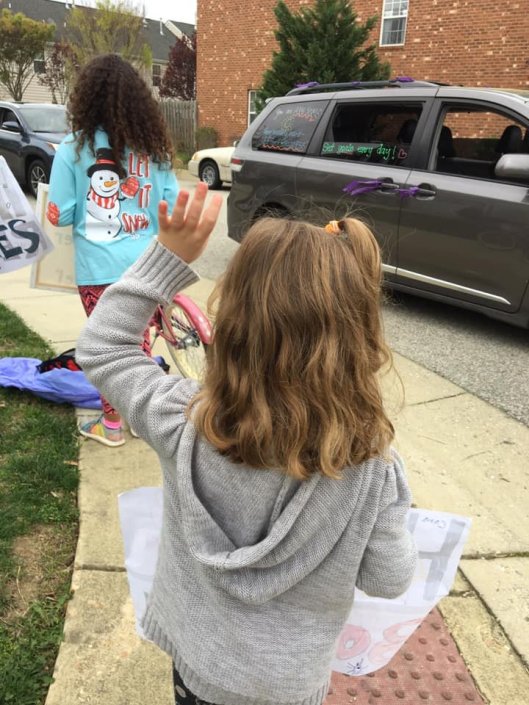
Photo credit:  Jennifer Andrews-Weckerly; use with permission only.

I had seen the pictures and videos in my news feed of teachers and schools “parading” in neighborhoods, saying hello to their students from their cars (keeping safe social distances).  The idea seemed nice enough, but I did not really think too much about the concept.  But when my children found out their elementary school would be doing the same, they jumped right in, making signs for their teachers.  We rearranged our daily schedule, and headed up to the now-unused bus stop in our neighborhood, and waited.

But it was not until I saw familiar face after familiar face – the principal, my fifth grader’s first, third, and current grade teachers; the art, computer, music, orchestra, librarian, and gym teachers; even the custodian – that I lost it.  Tears burst into my eyes, and although I could not stop smiling, I also could not stop crying.  The previous week, we had found out that due to the Coronavirus, our schools would be out for the remainder of the school year.  My fifth grader would not get to say goodbye to friends and one of the best teachers she has ever had, nor the community that has shaped her for the last four years.  My kindergartner would get no closure on her first year of school.  But here was that amazing community, coming to our neighborhood to say goodbye.

I think I burst into tears because I realized how very deeply important community is in our lives.  For the schools, our children are there five days a week, nine months of the year.  The school is a major part of the village that raises our children, teaches them, forms them into amazing citizens, and helps them find their sense of identity and purpose.  The staff and teachers at our school love our children and are a part of our family.  What this virus did was expose a huge part of our children’s lives and take it away from them.  The tears I could not stop that day were tears of gratitude, tears of blessing, tears of humility for the community I had not fully appreciated until that moment.

That is what has been so hard about having our church closed too.  We are making inroads for connection, surely.  But part of the reason we are doing that is because we know that Church is a vital community in our lives too.  Certainly, we are there because of our faith – or our desire to have faith.  But we are also at Church because the community feeds us, sustains us, and gives our lives a sense of purpose and identity.  When we cannot gather, we lose a huge part of our lives.  This week, it is my prayer that for those of you missing your church community, you will take advantage of the ways we are trying to maintain virtual connection during this time of disconnection.  We may not be able to exchange signs of the peace, offer hugs or high fives of affirmation, or kneel at the altar together.  But we can laugh at Virtual Coffee Hour, sing during livestream worship, and even cry during daily pop-up prayers.  Your community is still here, loving you and supporting you.  And we cannot wait to see you again!!

Sermon – Ezekiel 37.1-14, John 11.1-45, L5, YA, March 29, 2020

01 Wednesday Apr 2020

Posted by jandrewsweckerly in Sermons, Uncategorized

≈ Leave a comment

Tags

change, Christ, Coronavirus, death, dry bones, exile, God, health, hope, Israel, Jesus, journey, Lazarus, life, normal, restoration, resurrection, Sermon, suffering

Today would be an easy day to skim the lessons and declare a victory.  We come to these texts today with cases of Coronavirus rising, deaths increasing, schools closing, jobs ending, and life stopping.  A simple drive down Richmond Road, and the restaurants and tourist stops whose parking lots are usually filled reveal a ghost town.  Even when we do venture out to grab necessities, the faces of people in stores are filled with anxiety, and bodies tense when spacing gets a little too close with others.  In this bizarre reality, we want nothing more than a breath of fresh air, a promise of hope and resurrection.

In many ways, that is exactly what we get in our lessons today.  Ezekiel shares a vision of resurrection and restoration.  The valley full of dry bones – presumably representing the people of Israel in exile in Babylon[i] – are brought back to life.  Through Ezekiel’s prophesying, God’s breath is breathed into the bones.  Bones reassemble, sinews and flesh come upon them, and even breath fills their lungs.  Reassembled, the bodies feel bereft in a strange land, but the Lord our God promises them they will be returned to Israel – to their land.  The same can be said of John’s gospel.  Lazarus is dead.  Four days dead.  The common Jewish understanding of the time was that the soul hovered near the body for three days, hoping to return; but after those three days, the soul departed for good.[ii]  There is no hope for Lazarus.  And yet, in Jesus’ deep love for this man, he weeps.  And then he raises Lazarus from the dead.  Into the next chapter, we even find Lazarus reclining on Jesus – not just alive, but living a life of abundance.

These are texts we want to hear today.  We want Holy Scripture to say, “Everything will be okay.  Everything will go back to normal.  You’re okay.”  And in some ways, that is what the texts seem to say.  The exiled people of Israel will be returned to their land.  The lost brother of Martha and Mary is returned to them in health and vigor.  Suffering is ended for both.  Life is restored for both.  We get to go back to normal.

And yet, I am not sure our texts today are saying things quite that simply.  For the people of God in exile, Ezekiel’s words are a bit more complex.  The breath God breathes into them helps them remember that even in exile, God is with them.  God is animating them in a foreign land.  Yes, there is a promise to return to the Promised Land.  But we know that any great journey into suffering means that even when we return to “normal,” we are not “normal.”  We are changed.  Health may be restored, land may be restored; but we are forever changed.  The news for Lazarus is a bit more complex too.  Although Jesus brings Lazarus back from the dead, to live an abundant life in the here and now, Lazarus’ resurrection is not forever.  Someday, Lazarus will return to the ground.  We know, like the people in exile, Lazarus’ life after the tomb will not be like his life before.  And we also see in Jesus’ conversation with Martha that Lazarus’ death not just about Lazarus.  Lazarus’ death is merely a foretaste of the resurrection of Jesus.  This return to life is limited to one person.  Jesus’ return to life will change a people.

All of this is to say that today’s good news is good news indeed.  There will be life after this virus.  There will be restored health and community after this virus.  There will be renewed strength and vitality after this virus.  But we will also be forever changed by this virus.  We will see life and the gift of life differently than before.  We will come back to our life rhythms and routines a changed people.  We will understand the gift of resurrection in new and deeply moving ways.  The promise of these passages in not simply a return to normal.  The promise of these passages is a journey that will change us all – of valleys with dry bones, of weeping by bedsides, of crying out to Jesus.  The promise of these passages is the destination of Easter.  Not a return to normal, but a new, profound understanding of resurrection in Christ.  In the meantime, Jesus weeps with us.  God is breathing life into us.  And soon, we will know the depths of resurrection life like never before.  Amen.

[i] Kelton Cobb, “Theological Perspective,” Feasting on the Word, Yr. A, Vol. 2 (Louisville:  Westminster John Knox Press, 2010), 122.

[ii] Leander E. Keck, ed., The New Interpreters Bible, vol. ix (Nashville: Abingdon Press, 1995), 687.

On Singing in a Strange Land…

27 Friday Mar 2020

Posted by jandrewsweckerly in Uncategorized

≈ Leave a comment

Tags

bless, community, Coronavirus, God, Lord, Lord's song, prayer, psalms, reality, refugee, Rivers of Babylon, singing, strange, upheaval, virtual

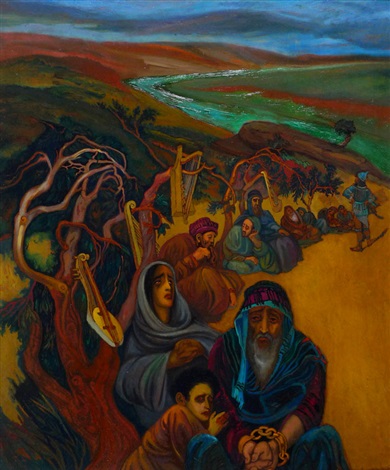
saul-raskin-on-the-rivers-of-babylon

Paul Raskin, “On the rivers of Babylon.”  Photo credit:  http://www.artnet.com/artists/saul-raskin/on-the-rivers-of-babylon-CQj4JGZtS9eQctXb-beJg2

In some ways, I suppose I could have predicted it.  We spent hours luxuriously debating how to safely distribute communion, being able to consider every detail:  imagining how hard this new reality would be for our parish, who is a loving, “touchy-feely” parish; researching burgeoning new practices in other parishes and dioceses; and prayerfully considering how to model safe behavior.  And in the end, our parish engaged beautifully, the pain of their sacrifices obvious on their faces, but also the determination to protect and care for one another equally obvious on their faces.

But then the bottom dropped out.  It was two weeks ago, and I was in the family surgical waiting room, already letting my wardens know I would have to miss a Vestry meeting because my daughter’s surgery had been more complicated than expected, and I had yet to see her.  But just as the nurse was telling us our daughter had been moved to recovery and we could go back soon, our Bishop sent out a communication, cancelling all church campus activities, including worship – including that Vestry Meeting we had planned to hold.  The next several days were a blur – sleep in three-hour bursts as I tended my daughter; texts, emails, and calls to figure out how to still hold worship virtually; pastoral letters to be written to the parish explaining what was happening and how this would all work; and the reality of this even newer normal sinking in slowly.

I have never had a long conversation with a refugee, but I have watched enough news coverage, read enough human-interest stories, and seen enough movies about refugees to have a tiny inkling of how upending, world-changing, and scary it must be to be a refugee.  I would never argue my life in the midst of the Coronavirus is as brutal or devastating as a refugee, but there do seem to be some parallels.  Within moments, our world has been upended.  We went from being totally free to do whatever we desire, to being confined to our homes, having our jobs be totally changed (or sometimes ended), having the schooling of our children and the social support system schooling represents stripped away, worrying about the scarcity of necessities and the wisdom of going out to obtain what we could find, feeling the anxiety of financial insecurity, and losing the comfort of physical touch and community.  As a parent and priest, it has meant taking on the impossibility of two full-time jobs, knowing everyday you could do more, and yet being limited to the constraints of 24 hours a day.  And none of that even touches the emotional, psychological, and spiritual weight of upheaval that our bodies are processing, whether we try to stifle it or not.

Unlike most refugees, I know this new normal for us is relatively temporary.  Someday, we will be able to go back to some modification of the old normal.  But for now, this new reality is foreign, disorienting, and unnerving.  I was just yesterday reminded of that song “Rivers of Babylon,” which pulls from Psalm 137 and 19.  The echo of the verse, “How can we sing the Lord’s song in a strange land?” has been lingering with me.  And yet, that seems to be the only thing holding me together these days – singing the Lord’s song in a strange land.  For all the upheaval, all the disorder, all the anxiety and confusion, rooting myself in daily prayer – having people join in watching on Facebook Live, leaving their comments or greetings, or just seeing their names pop up, has felt like a balm to my heart.  I have not been able to bless or consume the holy meal, I have not been able to embrace my beloved parishioners, and I have not been able exchange physical signs of the peace.  But I have been able to hear the prayers of not only our parish’s heart, but also the hearts of our neighbors, friends, and even strangers.  I have not been able to gather physically with our community, but I have felt the connection of virtual community so palpably, I thought I would cry.  I do not know how long this new reality will last, but I am grateful for the opportunity to sing the Lord’s song in this strange land.  You are most welcome to join me in this singing.  And if you do not know the song, I’m happy to teach you or sing it for you for a while.  May God bless you all, and I’ll see you sometime today as we gather virtually to sing the Lord’s song!

Sermon – John 9.1-41, L4, YA, March 22, 2020

27 Friday Mar 2020

Posted by jandrewsweckerly in Sermons, Uncategorized

≈ Leave a comment

Tags

blind man, cause and effect, comfort, Coronavirus, faith, God, good, grace, hope, Jesus, journey, light, questions, see, Sermon, sight, sin, suffering, theology

I must confess to you:  I have been dreading talking to you about this text all week.  The presence of cause and effect in this text is overwhelming.  The text says multiple times that the reason the blind man is blind from birth is because he sinned (and since it was from birth, there is the implication his parents sinned, and the blind man is being doubly punished and exists in double sin).  Those gathered insist that Jesus must be sinful too because he does not follow the law – he heals on the Sabbath, and he cannot possibly speak for or act for God as a sinner.  Jesus also says those gathered are sinners for they cannot see God.  Even at the beginning of John’s story, even Jesus says, “Neither this man nor his parents sinned; he was born blind so that God’s works might be revealed in him.”

I have not wanted to preach this text today because I do not at feel comfortable with the cause and effect nature of this text, especially what that cause and effect nature seems to imply about suffering.  Can Jesus really be saying this man was made blind so that God could be revealed?  Is this text saying God causes suffering – pain, disability, ostracizing from community, poverty so deep that only begging will ensure survival?  That concept is a huge hurdle for me because that is not at all my theology of suffering.  And I especially do not like hearing that theology of suffering this week – a week when we are watching the cases of Coronavirus creep up in our country and double in our county and have begun asking the same sorts of questions the people in this passage are asking:  Where is God in this?  Why is God allowing not only this terrible virus to happen, but the accompanying societal upheaval?  Is God causing this suffering for some greater good?  This kind of health crisis pulls at all of us and in our innermost, private places, and makes us wonder, even if we cannot say the words aloud, “Did God have something to do with this virus?”  Or sometimes we find ourselves not embarrassingly asking the question, but boldly shouting at God, “What in the world are you doing?  Why aren’t you here fixing this?  How could you do this?!?”  The absolute LAST passage I want to hear when we are asking these bone-deep theological, desperate questions is a text that seems to imply God causes suffering for God’s own glory.

That is why I am especially grateful for biblical scholars who can journey with us in interpreting scripture.  Biblical Scholar Rolf Jacobson took a look at that same verse that has been nagging me all week, “Neither this man nor his parents sinned; he was born blind so that God’s works might be revealed in him.”  Luckily Jacobson is better at Greek than me.  He explains that the writers of the New Revised Standard Version inserted text into the English translation that simply is just not there.  In the original Greek, the words “he was born blind,” are not there.  Instead of the text saying, “Neither this man nor his parents sinned; he was born blind so that God’s works might be revealed in him,” the text actually says, “Neither this man nor his parents sinned [period].  In order that God’s works might be revealed in him, we must work the works of him who sent me…”  According to Jacobson, Jesus is not saying the man was blind so God could be revealed.  Jesus is saying no one sinned.  But given the situation, God has given his disciples the opportunity to do something good to reveal God’s goodness.[i]  In other words, God does not cause suffering.  But God can use us in the midst of suffering for good.

I don’t know about you, but that has shifted my understanding of this text completely.  All of the arguing about who sinned, what laws you must follow to be holy, and who should be in or out are a distraction.  The same can be true of us.  When we start trying to logic our way through fault, or sin, or blame – even blame on God, we lose our way; we become blind like those gathered and arguing in our text today.  Instead, this text is inviting us to ask different questions.  Instead of whose sin caused this virus, we can ask, “How can I be a force for good in the midst of this virus?”  Instead of why God is doing this or allowing this to happen, we can ask, “Where are the opportunities to see God acting for good in the midst of suffering?”  Instead of where is God in this, we can ask, “Where am I finding moments of God’s grace in this?”  I am not arguing our questions and demands of God are not valid at this time.  In fact, I think our quiet doubt of and our raging anger at God are perfectly normal – and maybe even necessary for honest relationship with God.  What I am arguing is this text is not a reinforcement of our sense of darkness, but instead an invitation into light – an invitation to seeing when we may feel blinded.  My prayer this week is that we stumble into those moments of light this week – that we find those moments of grace upon grace that give us renewed comfort, hope, and faith.  May God bless you in the journey toward the light.  Amen.

[i] Rolf Jacobson, “Sermon Brainwave #713 – Fourth Sunday in Lent,” March 14, 2020, as found at http://www.workingpreacher.org/brainwave.aspx?podcast_id=1240, on March 19, 2020.

On Suffering, Strangers, Jesus, and Viruses…

19 Thursday Mar 2020

Posted by jandrewsweckerly in Uncategorized

≈ Leave a comment

Tags

Caronavirus, Christ, exhausted, flesh, hope, Jesus, present, Simon of Cyrene, Stations of the Cross, stranger, suffering

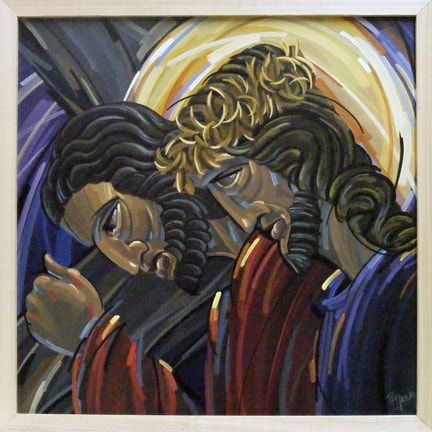
Simon of Cyrene

Photo credit:  http://www.vibrantlives.net/blog/simon-of-cyrene

This week, I was scheduled to gather with my ecumenical brothers and sisters and preach about Simon of Cyrene.  I had initially been very excited about the assignment.  During Lent, we were all assigned people to preach about who are associated with the Stations of the Cross, and Simon has always fascinated me.  But it was not until I started preparing to preach that I realized why I had found his story so intriguing.  After having looked and looked, each of the synoptic gospels gives Simon of Cyrene one verse of text.  One verse.  That is all.  We have this dramatic event that occurs as Jesus struggles to carry his cross, so dramatic that a whole station of the cross is dedicated to him.  And yet, everything we know about him is encapsulated in one verse.

Now, we do know some details.  He is from Cyrene, which means he was likely in Jerusalem on a trip there for religious devotion.  We know he is a father.  And we know he did not volunteer or chose to help Jesus.  He was made to help Jesus.  That is all we know.  Anything else we want to know – whether he connected with Jesus powerfully in that moment; whether he helped Jesus begrudgingly, out of fear, or with compassion; whether his life was changed by the moment or he never thought of the moment again.  We simply do not know.

Instead, what we really learn about in this moment is not about the psyche or spiritual development of Simon.  Instead, what we really learn about is Jesus.  This past Sunday, I talked in my homily about how what is most powerful about the story of Jesus and the woman at the well is not the scandalous, but the ordinariness of Jesus – the fleshiness of the incarnation.  That is what I think Simon does for us in this one verse.  Simon reminds us of how very human Jesus was – so physically exhausted, he needed help.  So very abandoned, his own loved ones or disciples did not step forward to help him.  So very humiliated, a stranger was forced to see his humiliation up close.

As we are in the midst of a pandemic that affects the body, I am feeling very grateful this week of the reminders of Jesus’ fleshiness on this earth.  I am reminded that no matter how alone we feel, no matter how exhausted we are, no matter how much we hate to ask for help (especially from a stranger), our neediness right now is akin to the experiences Jesus had in his life.  In essence, Christ is in our suffering because he suffered too.  Of course, that does not solve this virus or change our reality much.  But I am deeply comforted knowing that Jesus is standing with us as we work our way through this virus.  I hope you can feel that same hope too.

← Older posts
Newer posts →

Recent Posts

  • On New Clothes and Neighbors…
  • Sermon – Matthew 20.1-16, P20, YA, September 20, 2026
  • On Change and Bread…
  • Sermon – Exodus 14.19-31, P19, YA, September 13, 2026
  • On Realizing Dreams…

Archives

  • September 2026
  • August 2026
  • July 2026
  • June 2026
  • May 2026
  • April 2026
  • February 2026
  • January 2026
  • December 2025
  • November 2025
  • October 2025
  • September 2025
  • August 2025
  • July 2025
  • June 2025
  • March 2025
  • February 2025
  • December 2024
  • November 2024
  • October 2024
  • September 2024
  • August 2024
  • July 2024
  • June 2024
  • May 2024
  • March 2024
  • February 2024
  • January 2024
  • December 2023
  • November 2023
  • October 2023
  • September 2023
  • August 2023
  • July 2023
  • June 2023
  • May 2023
  • March 2023
  • February 2023
  • January 2023
  • December 2022
  • November 2022
  • October 2022
  • June 2022
  • May 2022
  • January 2022
  • December 2021
  • November 2021
  • October 2021
  • September 2021
  • August 2021
  • June 2021
  • May 2021
  • April 2021
  • March 2021
  • February 2021
  • January 2021
  • December 2020
  • November 2020
  • October 2020
  • September 2020
  • August 2020
  • July 2020
  • June 2020
  • May 2020
  • April 2020
  • March 2020
  • February 2020
  • January 2020
  • December 2019
  • November 2019
  • October 2019
  • September 2019
  • August 2019
  • July 2019
  • June 2019
  • May 2019
  • April 2019
  • March 2019
  • February 2019
  • January 2019
  • December 2018
  • November 2018
  • October 2018
  • September 2018
  • August 2018
  • July 2018
  • June 2018
  • May 2018
  • April 2018
  • March 2018
  • February 2018
  • January 2018
  • December 2017
  • November 2017
  • October 2017
  • September 2017
  • August 2017
  • July 2017
  • June 2017
  • May 2017
  • April 2017
  • March 2017
  • February 2017
  • January 2017
  • December 2016
  • November 2016
  • October 2016
  • September 2016
  • August 2016
  • July 2016
  • June 2016
  • May 2016
  • April 2016
  • March 2016
  • February 2016
  • January 2016
  • December 2015
  • November 2015
  • October 2015
  • September 2015
  • August 2015
  • July 2015
  • June 2015
  • May 2015
  • April 2015
  • March 2015
  • February 2015
  • January 2015
  • December 2014
  • November 2014
  • October 2014
  • September 2014
  • August 2014
  • July 2014
  • June 2014
  • April 2014
  • March 2014
  • February 2014
  • January 2014
  • December 2013
  • November 2013
  • October 2013
  • September 2013
  • August 2013
  • July 2013
  • June 2013
  • May 2013
  • April 2013
  • March 2013
  • February 2013
  • January 2013
  • December 2012
  • November 2012
  • October 2012
  • September 2012

Categories

  • reflection
  • Sermons
  • Uncategorized

Meta

  • Create account
  • Log in
  • Entries feed
  • Comments feed
  • WordPress.com

Blog at WordPress.com.

  • Subscribe Subscribed
    Seeking and Serving
    Join 397 other subscribers

    Have a WordPress.com account? Log in now.

  • Seeking and Serving
    View site in Reader
    Manage subscriptionsSign upLog in
    Report this content
    Collapse this bar
Loading Comments...