• About

Seeking and Serving

~ seek and serve Christ in all persons

Seeking and Serving

Tag Archives: change

GC79: Reconciliation in Real Time

20 Friday Jul 2018

Posted by jandrewsweckerly in Uncategorized

≈ Leave a comment

Tags

anxiety, bishops, change, cheer, concern, Cuba, Episcopal Church, family, General Convention, God, home, House of Bishops, humbling, mercy, reconciliation, right, wrong

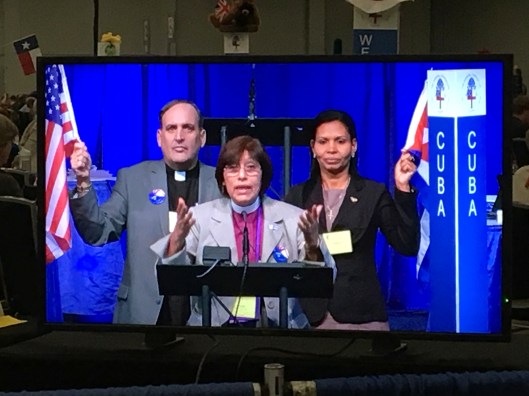
IMG_1927In 1966, in light of the Cuban Revolution and the political response of the United States, the House of Bishops voted to separate from the Diocese of Cuba from the Episcopal Church, leaving it an autonomous diocese without a provincial home.  The clergy scattered, some returning or immigrating to the US, but some who remained in Cuba were imprisoned, executed, or disappeared; priests lost their pensions, and they operated in isolation from the Church.  Cuba officially requested to be reaffiliated with the Episcopal Church and was given a list of requirements before admission.  As of GC79, all of those conditions had been met.  However, leading up to the resolution coming to the floor of both the Deputies and Bishops, there was controversy on what it would mean, how this admission might impact the admission of other Dioceses (or their exit), how to affirm already elected bishops (assuming they had not followed the current practices of approval for bishops in the Episcopal Church), among other concerns.  In other words, there was a desire to right the wrong done 52 years ago, but some anxiety about the implications of the decision.

As an alternate deputy, I had the leisure of observing either House.  On Tuesday, I happened to be observing the House of Bishops when resolution A238 came to the floor.  Each testimony pleaded for righting the wrong done by the House of Bishops in 1966.  Retired bishop Leo Frade from the Diocese of Southeast Florida spoke passionately about the resolution.  As a Cuban American who had been a part of the Church in Cuba, he got quite emotional in his plea for the bishops to do the right thing.  When it came time for the vote, the vote was a unanimous approval for readmittance.  The entire house – bishops and visitors – exploded.  Cheers and clapping filled the room, and the standing ovation lasted several minutes.  Unbeknownst to me, the Bishop of Cuba was present and was invited to approach the platform to address the House.  Bishop Curry embraced her.  The House broke into singing the Doxology.

Bishop Griselda Delgado’s speech was the most humbling.  Despite every reason to feel resentful or hurt, Bishop Delgado communicated nothing but forgiveness and reconciliation.  “We are family,” she insisted.  And although we severed the relationship so many years ago, she insisted, “Cuba never left.”  Her sentiments struck me as the exact way that God sees us.  When we reject God, God never leaves us.  When we abandon God, we do not abandon our familial ties with God.  Bishop Delgado’s profound sense of right relationship, reconciliation, and forgiveness brought the House to tears.  We did not deserve her mercy, and yet there she was, offering mercy.  When Bishop Delgado said, “The Holy Spirit is here,” I knew she was right.  In response, Presiding Bishop Curry said, “The Bishop may take her seat at Table 7.”  Those words were words of righting a wrong – fully, completely, unconditionally.

The experience the next day was equally powerful in the House of Deputies.  They too needed to approve the resolution, and it also passed unanimously.  Bishop Delgado spoke there too, but equally powerful was the triangular sign with the word, “Cuba” written on it.  It was processed to a table, and the deputies from Cuba were seated in the House of Deputies.  “Welcome home,” pronounced President Jennings.

What I loved about the approval of this resolution was seeing how legislation can powerfully effect change.  Sometimes, in the weeds of parliamentary procedure, and canonical revisions, one can wonder if all we are doing is navel gazing.  But on these days, we watched first-hand the commitment to change, the willingness to boldly repent, and the receiving of mercy.  Surely the presence of this Lord has been in this place!

Getting on the Ride…

10 Wednesday Jan 2018

Posted by jandrewsweckerly in Uncategorized

≈ Leave a comment

Tags

adventure, change, community, dream, excitement, exciting, fear, God, Holy Spirit, inviting, ministry, new, ride, rollercoaster, thrill

the-dragon

Photo credit:  https://www.legoland.com/california/legoland-california/rides-and-attractions/park-areas/castle-hill/rides/the-dragon/

On our family vacation last week, we visited an amusement park.  My eight-year old was finally at the age where she could try some more ambitious, if not scary, rides.  Watching her experiment with her fear and curiosity was fascinating.  Before most rides, she was completely enthusiastic and daring.  But waiting in line seemed to rattle her confidence.  Several times, we almost bailed completely.  In fact, one of my favorite pictures of her was taken right before she boarded a particularly scary ride (one even I was too scared to try!).  In the picture, her eyes are like saucers and her eyebrows are raised as she clutches her father’s hand.  But for the rest of the trip, she raved about that particular ride and almost cried when she realized she could not ride the rollercoaster one more time.

I was thinking this week that adults are not that dissimilar from my daughter when it comes to something new and exciting.  There is a part of us that cannot wait to try something new, and there is a part of us that is terrified about the experience, imagining in our minds the countless things that could go wrong or that might happen.  As with any change, we have the option to get on the ride and experience the thrill of something new, or we have the option to play things safe, and step out of line.  I suspect there are times when getting out of the line is the best option.  But more often, I suspect we miss out on adventure and new life when we don’t just step onto the ride.  Too often we forget that we can get on the ride and still say, “I am glad I tried it.  And now I will never do that again!”

Last night, the James City County Board of Supervisors approved a special use permit for the Kensington School to put a second location on the property of Hickory Neck Episcopal Church.  Hickory Neck has been dreaming about creating a school on our property for about ten years.  We kept deferring the dream because we were not sure we could both build and run a school.  But this past year, the Holy Spirit intervened, and we discovered that the Kensington School was looking to open a second location in our neighborhood.  God seemed to be inviting us to finally step onto a thrilling, albeit a bit scary, ride.  We have been standing in line for a while, getting more and more excited about what God can do through Hickory Neck.  Last night, the Board’s approval was our last step before boarding the ride.

Like with any change, this new phase of ministry will be full of exciting, wonderful things we never expected, and some challenging, hard things we never expected.  Part of our work is trusting the same Holy Spirit that has been guiding us thus far will continue to guide and lighten our path.  Some of us may be wide-eyed, with eyebrows raised about what is coming next.  But I suspect in a year or so, most of us will be thrilled that we said yes to the Holy Spirit, and agreed to try to be a force for change for our community.  I am here, with you, Hickory Neck – holding your hand and ready for the adventure!

Sermon – Isaiah 40.1-11, Mark 1.1-8, A2, YB, December 10, 2017

13 Wednesday Dec 2017

Posted by jandrewsweckerly in Sermons, Uncategorized

≈ Leave a comment

Tags

Advent, busyness, change, God, Good News, Isaiah, Jesus, John the Baptist, manger, prepare, prophecy, repent, repentance, Sermon, way

This Advent, I have been sensing in myself a need to prepare for the Christ Child a little differently.  The busyness of life has me longing for a season of quiet reflection, of anti-consumerism, of less…well…busyness.  In some ways, the church has made accommodations for that desire.  The music in Advent is a bit more muted and quietly beautiful.  The offerings of yoga or even the Blue Christmas service make room for quiet meditation and reflection.  Even my Advent devotion this year of taking daily photos based on a provided word has forced me to look around more intentionally at life.  When I heard Isaiah’s words this week, “Prepare the way of the Lord,” my spirit had been hoping Isaiah’s preparation meant slowing down and creating an inner openness to the Holy Spirit.

Although I am sure Jesus would be all too happy to have me slow down a bit, my Advent longings may be a bit too passive for what Isaiah and John the Baptist are trying to accomplish.[i]  Of course, you can see where I may have gone astray.  Isaiah is speaking to a people in exile:  far from their homeland, oppressed by a foreign power, being forced to assume a foreign culture, God finally speaks a word of comfort to God’s people.  “Comfort, O Comfort my people,” says the Lord to Isaiah.  They are soothing words to a downtrodden people.  They are words of affection to an affection-starved nation.  They are healing words to a broken group of followers.  But those words of comfort are not followed by a cozy bed of meditation and contemplation.  Instead, those comforting words are followed by a call to action, “In the wilderness prepare the way of the Lord, make straight in the desert a highway for our God.”  God is about to do a new thing, but in order to do that new thing, the people of God must prepare the way through repentance.  Now I know we usually reserve repentance talk for Lent, but in this season of preparing for a new thing – of preparing for the Christ Child – the prophet tells the people of God they need repentant hearts.

One of the courses of study for parish priests and counselors is called family systems.  The study of family systems looks at human behavior through the lens of behavior within families, looking at ways families handle conflict, how they engage one another, and how they solve problems.  Patterns we learn in our families are taken into other systems.  One of the main lessons we learn from family systems is that you cannot change the behavior of others; you can only change your own behavior.  But changing your own behavior is not as easy as the change sounds.  Any of us who saw our mother behave like her mother, only to one day see that same behavior in ourselves realizes how hard changing our patterns can be.

When we talk about repentance, that is the kind of deep change we are talking about.  Repentance is not wallowing in guilt, feeling badly about something we said or did (or keep saying or doing).  Repentance is acknowledging our sinfulness and working to change our behavior.  The word “repent,” actually means to turn around; to turn away from sinful behavior and walk another way.  So when John the Baptist recalls Isaiah’s words, saying, “Prepare the way of the Lord,” he’s not saying, unpack your creches, put up the greens, and buy some presents.  Prepare the way of the Lord means making sure your heart is ready for the coming of the Christ Child – a feat you cannot accomplish if your heart is heavy with sin and regret.[ii]

Now do not get me wrong – I have pulled down the boxes of Christmas decorations, hung a wreath, and have purchased some gifts.  Those are honored traditions that bring us great joy, and I believe God wants us to be a people of joy.  But I suspect that if your heart is heavy-laden with the sins of life, or if you are so busy with the busyness of life that you have disconnected from God, your joy this year at the arrival of the Holy Child will not be as deep as your joy could be.

I have met many a church member who loathes the season of Lent for the focus on repentance.  I am sure they would be cringing today by the ways I am squashing Advent too.  But here is the reason why we have to talk about repentance today.  The gospel lesson we read from Mark contains the very first eight verses of Mark.  Mark introduces his gospel with these words, “The beginning of the good news of Jesus Christ, the Son of God.”  The reason John the Baptist is so excited, and is quoting Isaiah in our text today is that he knows what is coming is good news.  And so, when John quotes Isaiah with the words, “Prepare the way of the Lord,” he really means two things.  First, he means do the active work of preparing your heart for the Lord.  Not just the awesome, touchy-feely stuff of centering yourself or finding a quiet space, but the hard stuff of repentance.  And second, John means do the work of sharing the good news.  The work of Advent and the joy of Christmas is not just for us.  When your heart is bursting on Christmas Eve with joy because you did the tough work or repenting and returning to the Lord, don’t you want someone with which to share your joy?   One of the ways we prepare the way of the Lord is to share the good news of God in Christ with others.[iii]

Now I know what you are going to say, “Here she goes again, talking about inviting people to church.”  Or maybe you are thinking, “Yeah, but people who come on Christmas Eve usually only come once a year, so why bother?”  The good news about spreading the good news is that you are likely going to spread that good news in spite of yourself.  You see, when we do the work of repentance, of changing our hearts, minds, and hands to doing the work of God, a renewed spirit is kindled in us, and a deep joy burns in us.  The work of repentance creates in us a clean heart, and renews a right spirit within us.  And when we feel the love of God overwhelming us, we cannot help but let slip to our neighbor, “I know you have a church home, but I just want to share how awesome my experience at church has been lately.  If you ever want to come with me, I would be happy to bring you.”  Or when your friend is expressing his deep sadness and sense of loneliness, you find yourself saying, “I have been there.  But I have to tell you, every time I leave church, something about my encounter with God and community makes me feel less alone.”  Or when a stranger is ranting about how awful the church and Christians have been lately (which, we know some awful things are happening in the name of Christ lately), you find yourself saying, “I totally agree.  That is why I love my church so much – because they show me another way of witnessing to Christ.  I would love to show you sometime!”

I realize you may have been hoping for a word of comfort and permission to quietly prepare your heart for the Christ Child today.  Lord knows I have been longing for that this week too.  But turning my busyness into purposeful preparation:  for repentance and sharing the good news sounds much more fulfilling and life-giving.  The coming of the Christ Child, the fulfillment of the prophecy of Isaiah, is a life-altering event.  Today, the church prepares us for not arriving at the manger with check-lists done, gifts in hand, and arms full of stuff.  Instead, the church prepares us for arrive at the manger with open arms, free of the burdens that are weighing our spirits down, surrounded by others who have similarly prepared, and those who heard a good word from you, and wanted to drop their baggage at the manger too.  Come, prepare the way of the Lord.  Amen.

[i] Karoline Lewis, “Wilderness Preaching,” December 3, 2017, as found at http://www.workingpreacher.org/craft.aspx?post=5018 on December 6, 2017.

[ii] Martin B. Copenhaver, “Homiletical Perspective,” Feasting on the Word, Yr. B, Vol. 1 (Louisville:  Westminster John Knox Press, 2008), 47.

[iii] Richard F. Ward, “Homiletical Perspective,” Feasting on the Word, Yr. B, Vol. 1 (Louisville:  Westminster John Knox Press, 2008), 31.

On Cars and Change…

27 Wednesday Sep 2017

Posted by jandrewsweckerly in Uncategorized

≈ Leave a comment

Tags

car, change, God, grief, Holy Spirit, ideas, life, new, old, relationship with God, sad, season, time

to-everything-there-is-a-season-orlando-espinosa

Photo credit:  https://orlandoespinosa.wordpress.com/2015/12/09/to-everything/

This weekend we got a new car and traded in my old car.  My old car was fifteen years old and had almost 180,000 miles.  We would have kept the car longer, but there were too many expensive fixes to make repairing the car worth the car’s value.  Normally, people get pretty excited about a new car – all the old dents and scratches are gone, and in my case, I can now be certain I won’t be break down on the highway.  But mostly I have been a bit sad about having to get rid of the old car.  That car helped us get through three rounds of graduate school, four moves, multiple jobs, the birth of two children, and was only six months younger than our marriage.  The car survived endless road trips, commutes to work, and at one point was our shared car until we got a second car.  Although the car had started making me anxious with all its repair needs, I felt like I was saying goodbye to a good, faithful friend.

As I have been reflecting on that experience, I have been thinking my experience with my old and new car is similar to how we all experience change.  Most of us know that change in inevitable, and yet most of us do not like change.  Even if the thing we are changing from is good for us, we miss the old quirks, patterns, and sense of regularity.  And the further out of the familiar we get, the more epic the memory of what once was becomes.  This is often the point at which people begin to refer to the “good ol’ days,” or “the way things used to be.”  Whatever the new change is will rarely seem as good as the old standard.

I have been feeling that way about my new car.  Sure, it is more reliable, it has fewer things peeling, sagging, or just broken, and it is more sporty, shiny, and colorful.  But I am finding I am not yet sold.  The new car just does not feel like it fits yet.  Observing my feelings about my car has been especially helpful for me as I think about all the times I have introduced change at church.  Sure, whatever changes I have introduced are usually for the good, and most often, become the new “way we have always done it.”  But falling in love with the new change takes time.  It does not happen overnight.

Perhaps this may be a good way we can approach our relationship with God.  The Holy Spirit is God’s agent of change.  She is always whispering new ideas, blowing new people into our lives, and breathing life into our imaginations.  Listening to the movement of the Holy Spirit is exciting, fun, and invigorating.  But boldly following the Holy Spirit also needs to involve tending to the grief of letting go of the what the Spirit was doing before.  The writer of Ecclesiastes says, “For everything there is a season, and a time for every matter under heaven.”  I wonder what seasons are passing away in your life, and what new times are arriving for you.  My prayer for you is that you be able to appreciate the season you are in, let go of the seasons that have passed, and embrace the seasons that are yet to come.  I know the Holy Spirit is doing good things in you.  I cannot wait to walk with you in the twists and turns!

On the Legacies we Leave…

26 Wednesday Jul 2017

Posted by jandrewsweckerly in Uncategorized

≈ Leave a comment

Tags

action, change, dignity, immorality, indignation, legacy, Monticello, righteous, sin, slavery, Thomas Jefferson

IMG_5640This past weekend, my husband and I took a trip to Monticello.  Before I tell you much about my experience, I must confess that I am not a Thomas Jefferson scholar by any means.  I knew his role as a founding father, how revered he is – especially in this part of the country, and more recently, that he was likely the father of several children through a slave he owned.  Though my knowledge was admittedly superficial, that combination of information left me wanting to know more about this prominent man in American history.

Knowing the role Jefferson played in history and his relationship to Sally Hemings, I was surprised to learn Jefferson had written quite a bit about the immorality of slavery.  He found the practice of slavery and the slave trade to be an abomination; and yet, he also found extracting himself from the institution to be insurmountable in his generation.  As I listened to Jefferson’s revolutionary words, I felt myself becoming angry.  If Jefferson was so incensed by the system, feeling morally convicted, why didn’t he do something about it?  Why didn’t he work for change?

Now, I know the counterarguments.  Of slave owners, Jefferson was one of the less brutal ones.  Jefferson was a product of his day – an entire nation and economy caught up in and dependent upon the institution of slavery.  But despite those acknowledgments, I felt frustrated.  Of all the amazing legacies Jefferson left, and with the brilliant mind he had, why not more action against slavery?  And if he could not affect systemic change, why not at least change the system at Monticello, freeing and hiring the slaves he owned?

Luckily, my righteous indignation only lasted a few minutes.  In the midst of my anger at Jefferson, a deeper truth hit me like a ton of bricks.  I realized I am leaving a legacy around the issue of race too.  When relatives look back at my life hundreds of years from now, what will they say about my inaction around racial reconciliation?  Will they look at the violence against and degradation of African-Americans in the twenty-first century and say, “Why didn’t she do more?  If she believed in the dignity of every human being, why didn’t affect change?”  It would be easy to leave Monticello or any discussion about slavery feeling a sense of moral superiority.  Instead, I invite you to join me in reflecting upon our complicity with the sin of racism in our own day, considering how we might change our own legacy.

Sermon John 4.5-42, L3, YA, March 19, 2017

22 Wednesday Mar 2017

Posted by jandrewsweckerly in Sermons, Uncategorized

≈ Leave a comment

Tags

brokennes, change, conflict, conversation, disagreement, holy, holy conversation, Jesus, judgment, Kingdom, questions, Samaritan woman, Sermon, surprise, time, transformation, vulnerable, well

This past week I was invited to attend a conversation and action meeting with local clergy.  I was not looking forward to the meeting.  In fact, I almost did not go to the meeting.  We were going to be talking about a controversial topic, and based on the invitation, I knew I would be on the opposing side.  What I did not know was whether I would be the only voice of opposition, which made the meeting all the more scary.  The thing is, I have been in those types of conversations before – where two interpretations of Holy Scripture seem diametrically opposed, and one or both parties feel so passionate about their understanding that they say really nasty, awful things to one another.  The very validity of one’s faith can even be questioned.

So I began to do what we always do in those situations.  First, I thought I could just send an email.  Then I thought that maybe I could just not attend the meeting, and engage in oppositional advocacy instead.  I even thought not going might be a valid form of protest.  But the Holy Spirit, and a few good friends, had other things to say.  They were not going to let me skip this meeting.  And so I went, rehearsing in my head the biblical roots and theology behind my positions.  I put on my New York tough exterior, bracing myself for whatever was thrown at me.  And just in case, I made sure to wear my best outfit and a smile so as to throw people off their game.  But my stomach was still in knots as I opened the door – full of what-ifs, worrying about consequences, and feeling extremely vulnerable.

A little over two thousand years ago, a woman – an outcast among her own people, getting water alone at midday, encounters a man at Jacob’s well.  He, a Jew with sociopolitical power, asks her for water.  She has a choice.  She can walk away.  But she engages in a conversation between unequals.  At first, Jesus tells her some extraordinary things – about thirst and living water, about his own powers, about his identity.  But then the conversation shifts.  Jesus exposes her vulnerability to its core.  Not only is this a woman with power differential, this woman is an outcast in her culture.  She is a double outsider, having had five husbands and living with a man who is not her husband.  Now, Jesus does not point out this reality as a way of telling her she is sinful – in fact, Jesus says nothing about sin.[i]  Scholars seem to think her marital history would have nothing to do with her sinfulness either.  It could have been that she was a multiple-time widow, passed down through levirate marriage, or it could be that she was barren, and multiple husbands abandoned her.[ii]  We do not know.  But we do know how we feel when someone exposes our deepest places of insecurity and self-doubt.  And this is the woman’s second opportunity to walk away.

But she stays.  I imagine she squares her shoulders, swallows a hard gulp, takes in a deep breath, and keeps talking.  And so does Jesus.  Ever so gently, they engage in a pretty hefty conversation, about prophesy, proper worship, the Messiah, and identity.  Not bad for a Jewish male and a Samaritan woman in broad daylight, for everyone to see.

At my meeting this week, a curious thing happened.  We read scripture together.  We prayed together.  And we talked – sharing openly about our own theologies and biblical interpretations.  But also, we listened – listened for commonality, listened for God’s guidance, and listened in respectful disagreement.  The conversation did not go at all how I expected.  The responses were not what I expected.  My own spirit was not at all in the place I expected my spirit to be in the end.

There is a lot going on in the story between Jesus and the Samaritan woman – probably enough for multiple sermons.  But today, in light of my experience this week, and in light of our country’s currently political climate, I am mostly drawn to the power of conversation.  Biblical scholar Karoline Lewis argues, “…frequently overlooked is that this interaction is a conversation.  Jesus suggests that conversation matters for theology.  That conversation is essential for faith.”  She goes on to say, “The church can be the place that shows society what theological conversation can sound like. The church can be the place that demonstrates how dialogue about faith and the Bible might result in religious respect and tolerance.”[iii]

So how do we do that?  Lewis proposes a method based on the interaction between Jesus and the Samaritan woman.  She gleans five key elements of holy conversation.  First, holy conversations begin with mutual vulnerability.  Jesus is thirsty, and the Samaritan woman needs the living water he provides.  Truthful conversations begin with reciprocal vulnerability because that is at the heart of God.  Second, questions are critical to holy conversations.  Of course, these cannot be questions for which we already have answers – these are true, curious questions.  The woman’s questions lead Jesus to reveal his identity.  God wants us to ask questions because they strengthen relationship.  Third, holy conversations involving intentional, genuine interest in the other take time.  The sheer length of the gospel text today tells you that this was not a quick conversation on the way to coffee hour.  But over the course of the long conversation, misunderstandings are clarified, lives reformed, and God’s abundant love is revealed.  Fourth, when we are talking about conversations with Jesus, be prepared to be surprised.  The woman at the well receives the first I AM statement in John’s gospel – Jesus reveals himself not to an insider, but to an outsider!  Finally, expect to be changed in holy conversations.  As Lewis says, “The woman at the well goes from shamed to witness.  From dismissed to disciple.  From alone to being a sheep of Jesus’ own fold.”[iv]  So holy conversations involve mutual vulnerability, questions, time, surprise, and change.

This week, no one gathered changed their minds on the presenting issue.  I doubt we ever will.  But something else did happen.  Through our conversation, something holy emerged.  Two groups, opposed to each other, were able to stay in the room, were able to articulate their own theologies, and were able to see Christ in the other.  What I took from that meeting was that maybe, just maybe, there is hope for us after all.  Maybe the church can do what the church has needed to do for some time – model what holy, Christ-like conversations look like for the good of the community.  Now, that does not mean holy conversations are easy.  Though I stayed in my seat, there were certainly times I wanted to get up and leave.  Though they were subtle, there were several clear digs at my ability to interpret scripture and the will of God.  There were several arguments that I disagreed with and had to bite my tongue to maintain the openness of the conversation.  But as I left the meeting, I knew something holy had happened.  Glimpses of the kingdom of God were breaking into that room.

Our invitation this week is to look around our own lives and examine where we have been avoiding holy conversations:  those times when we have run when someone pointed out the brokenness of our lives; when we have made quick judgments and assumptions about others without ever taking the time to ask the curious questions; when we have cut off opportunities for connection without remembering the surprise and change at the end.  The promises are tremendous.  Look at the healing the woman at the well receives – not just the lifting of societal shaming, but a position of power as a witness and disciple of Christ.  Look at the affirmation the woman receives – not only does Jesus validate her through an engaging, respectful conversation, the whole town responds to her without question.  Look at how the commitment to stay in the conversation leads the woman to a place of deep transformation and change.  But also look at how Jesus is changed too – he finds a surprisingly worthy partner in ministry, to whom he can confess his deepest identity.  I am not saying holy conversations will ever be easy.  In fact, sometimes the rejection we experience from attempts at those conversations will linger for a long time.  But when we keep putting ourselves out there, keep listening for those opportunities for holy conversation, the rewards are tremendously life giving.  The well is waiting for you!  Amen.

[i] Karoline Lewis, “Exegetical Perspective,” Feasting on the Word, Yr. A, Vol. 2 (Louisville:  Westminster John Knox Press, 2010), 95.

[ii] Osvaldo Vena, “Commentary on John 4:5-42” March 19, 2017, as found at http://www.workingpreacher.org/preaching.aspx?commentary_id=3189 on March 16, 2017.

[iii] Karoline Lewis, “Holy Conversations,” March 12, 2017, as found at http://www.workingpreacher.org/craft.aspx?post=4839#comments on March 15, 2017.

[iv]Lewis, “Holy Conversations.”

Sermon – Jonah 3.1-10, Psalm 51.11-18, and Luke 11.29-32, Ecumenical Lenten Worship Series, March 8, 2017

15 Wednesday Mar 2017

Posted by jandrewsweckerly in Sermons, Uncategorized

≈ Leave a comment

Tags

change, ecumenical, God, hero, immature, Jonah, journey, judgment, Lent, listen, neighbor, Nineveh, renewal, repent, repentance, Sermon, sin, temper tantrum, together, witness

I have always loved Jonah’s story.  He is probably one of the most juvenile characters in the Hebrew Scriptures.  When God tells him to go to Nineveh, he runs in the opposite direction.  Only when God makes the seas roar, and he is swallowed by a fish, does Jonah call out for God’s mercy.  Jonah finally submits to God and goes to Nineveh as he is told, but then he throws a temper tantrum at God when God forgives Nineveh.  He is angry God doesn’t punish the city, and so he storms off to pout.  When a bush giving him shade withers, he ramps up his tirade.  God asks if Jonah has any right to be angry, and Jonah, in classic toddler style, whines, “Yes! Angry enough to die!”  You can almost imagine him stamping his foot, pouting his lower lip, and furrowing his brow.

Jonah is easy to make fun of because his behavior is so incredibly immature and self-centered.  We laugh at his adult-sized temper tantrum because we all know adults are too old for that sort of behavior.  But that is what is tricky about Jonah too.  Deep down, in places we do not like to talk about, we know Jonah’s experience all too well.  When we are really honest, we can confess that may or may not have thrown an epic temper tantrum in our adult lives too.  Whether over the reoccurrence of an illness, the death of a loved one, a lost cause, the job we did not get, or the love that was not returned, we have all had our Jonah moments.  Though we publicly all can say, “Silly Jonah, when will he learn?!?”, privately, we all think, “That sounds uncomfortably familiar.  I hope no one noticed my temper tantrum!”

Of course, at the end of the day, Jonah does what he is told – witnesses to the people of Nineveh, as God requests.  But in the drama of Jonah’s story, we often forget one minor, and yet central component of Jonah’s story.  Nineveh is the Rockstar of this story.  Nineveh, for all its sinfulness and shame, has no problem admitting Nineveh is wrong.  When Jonah tells Nineveh the city will be overthrown if Nineveh does not repent and change its ways, the people immediately believe God.  They proclaim a fast, and everyone – adults, elders, and children, put on sackcloth.  Even the king of Nineveh immediately rises from his throne, puts on sackcloth and sits in ashes.  He decrees that everyone in the city – humans and animals – will fast, be covered in sackcloth, and cry out their repentance to God.  He declares, “All shall turn form their evil ways and from the violence that is in their hands.  Who knows?  God may relent and change God’s mind; God may turn from God’s fierce anger, so that we do not perish.”

The king of Nineveh and the people of Nineveh are quite unlike most modern recipients of judgment.  In Nineveh, no one holds a press conference to defend their motives and actions.  No one holds a counter-protest to the judgment.  No one even argues with Jonah or asks, “Are you sure?”  Nineveh is told a cold, hard, ugly truth that exposes their deep sinfulness and grievances, and instead of getting defensive, Nineveh drops everything.  They stop in their tracks and change their ways.  They take the judgment with sobriety and honesty, and they make a change.  Though we like to give Jonah the attention, the real heroes in this story are the king and people of Nineveh.

When Jesus talks about repentance in Luke’s gospel today, and when the Church talks about repentance in the season of Lent, this is the kind of repentance we are talking about.  Jesus basically shares that he is to the people of Israel as Jonah was to the people of Nineveh.  He is their sign that repentance is needed.  The people of God are to use Nineveh as their guide for what true repentance looks like.  Jesus’ instruction and Nineveh’s example come at an opportune time for us.  We have managed to work ourselves into a time of finger pointing and name calling.  Our division is found on the political scene, between denominations of churches, and even in our families.  We have presumed that we are Jonahs and everyone else is Nineveh.  The reality, though, is much scarier.  We are not Jonahs.  We are Ninevehs.  Jesus is the Jonah of our time, calling us into repentance and renewal.  We can follow the model that Nineveh set for us, dropping everything to evaluate our sinfulness and changing our behavior immediately.  We can sit in sackcloth and work to deeply understand the role we play in sinful behaviors.  We can invite our neighbors to sit with us as we both work toward repentance.  That is what Lent is all about.

So how do we repent?  How do we take this time of Lent as a time for intentional, dramatic, meaningful change in our lives?  The psalm appointed for today gives us a few clues.  “Create in me a clean heart, O God, and renew a right spirit within me.  Cast me not away from your presence and take not your holy Spirit from me.  Give me the joy of your saving help again and sustain me with your bountiful Spirit.”  First, we ask God for help.  We ask God for help, because we know our God will enable us to do the work God has given us to do.  The psalm also tells us to bring others into our journey, “I shall teach your ways to the wicked, and sinners shall return to you.”  We not only bring our broken, sinful, hurtful selves to God, we witness our work to others, using our own vulnerability and humility as an entry to shared journey.  And then we sing.  “Deliver me from death, O God, and my tongue shall sing of your righteousness, O God of my salvation.  Open my lips, O Lord, and my mouth shall proclaim your praise.”  We use our mouths to praise our God – a God who can change course, who can see the repentance of God’s people and take away the horror of judgment.

That’s why I am grateful that we are together tonight.  We come to God across denominational differences and we sit together in worship.  We hear the witness of Nineveh tonight, and then we start the work of emulating Nineveh.  First, we hear Jonah and Jesus’ word of judgment, letting God create in us clean hearts and renewing right spirits in us.  Then, we turn to our neighbor, and work on creating a community of repentance, working to love the Lord our God and our neighbor as ourselves.  Finally, we turn to those not gathered here tonight – those who may not have a church home, and we share our witness.  We share our witness of how we have been a people of sin, and how we are hoping to change our ways.  And we ask if they might help us on that journey – not taking the judgment of Jonah out into the world, but taking the repentance of Nineveh out into the world.  Listening to our neighbors, working together for meaningful change, and creating a city that is humble enough to know that God may relent and not let us perish.  God will renew a right spirit within you, will give you the joy of God’s saving help again, and will sustain you with God’s bountiful Spirit.  Thanks be to God!  Amen.

Is this me?

20 Wednesday Jul 2016

Posted by jandrewsweckerly in Uncategorized

≈ Leave a comment

Tags

adventure, bold, challenge, change, comfort zone, confidence, creativity, fashion, God, goodness, identity, ministry, new, trust

Changing room

Photo credit:  www.womansday.com/style/fashion/a6531/dressing-room-tips/

Those of you who know me well know that I am not a fashionista.  Though I manage to look pulled-together, that comes with a lot of help – mostly from my patient, much more fashionable husband.  I am constantly asking if things match, if certain shoes go with a particular outfit, or if certain accessories are right.  Over the years, my husband has learned to push me out of my comfort zone (as much as I will allow).  But in trying new looks or styles, invariably the question arises, “Is this me?”

As I have gotten older, I have begun to realize that I am the only one who can answer that question, “Is this me?”  Sometimes the answer is an obvious, “No!”  If I do not like the message the outfit sends, or if I know I will be fidgeting from discomfort, then I will never be confident in the look.  But sometimes the answer is, “It could be – if you want it to be.”  An outfit that obviously fits into your comfort zone does not need analyzing.  It is safe.  But one that is neither safely in the comfort zone nor way out of the comfort zone is in that sweet spot where you have to decide how bold and creative you want to be.  Because sometimes those new shoes bring out something adventurous in you.  Sometimes that new dress makes you a bit more self-assured.  And sometimes that accessory pulls out something inside of you that you did not realize was there.

That question, “Is this me?” is the same question Hickory Neck has been asking in these last months.  We have been through a pretty tremendous transition in leadership and identity.  When I started in April, many of you wondered what having a female rector with young children would look like.  Holding on to the memories of our two most recent rectors, and looking at this new rector, many of us wondered, “Is this me?”  And, then, just this past Sunday, we tried on something else – a Curate.  Now, Hickory Neck has been a two-clergy parish for many years in its past.  But the financial strain of transition and the uncertainty about identity has caused many to wonder if being a two-clergy parish is who we are now.

As our new curate has been settling into his office, I have been thinking that sometimes, the only way to answer the question, “Is this me?” is to just go for it.  Part of the equation will necessitate us being bold enough to live into a new identity under new leadership.  Like with a bold new outfit, we have to put our minds to living fully into the path we have chosen for our future.  But the other part of the equation is remembering how, like putting on a bold new outfit, sometimes our confidence will rise in spite of ourselves.  Just by living into our new identity, our sense of adventure, creativity, and confidence will grow.  Change is hard, and I know many of us this week may be wondering, “Is this me?”  For those of you asking that question, I encourage you to trust that God is at work for goodness among us – pushing us into that sweet spot where tremendous ministry can happen.  I don’t know about you, but I am pretty excited to live into our new look!

On Big Changes…

08 Wednesday Jun 2016

Posted by jandrewsweckerly in Uncategorized

≈ Leave a comment

Tags

baptism, being, celebrate, change, church, Holy Spirit, identity, nature, ontological change, ordination

4792_115739632564_7119988_n

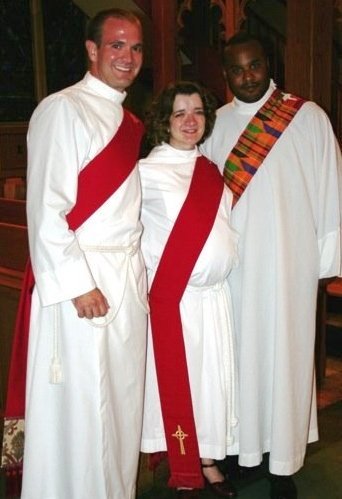
The Reverands Jody Burnett, Jennifer Andrews-Weckerly, and Charles Fischer III, Cathedral Church of St. John, June 24, 2009

Later this month I will celebrate the seven-year anniversary of my ordination.  What most people remember about that day was that I was very pregnant.  I confess that my large belly in an alb and a stole were rather extraordinary.  But what I remember about that day was a brief, but profound encounter.  I had gotten to the Cathedral early to make sure everything was in place and everyone knew where to go.  I was bustling around, managing logistics, when I ran into my boss, who was the rector of the church where I was serving.  She saw that I had my clergy shirt on but that I had not yet put on my collar.  You see, although you are not technically ordained until midway through the liturgy, you put your collar on before the liturgy starts.  The idea seemed strange to me to put it on before the bishop laid hands on me.  And if I am really being honest, I was really nervous about the whole endeavor.  My rector put her hands on my shoulders, looked me square in the eye, and said, “Jennifer, it’s time.  Go put on your collar.”

When we talk about ordination, we talk about the newly ordained experiencing an ontological change – a change in who the person is and in the nature of her existence.  It sounds rather dramatic because the change is dramatic.  When we ordain someone, we forever set them apart for a specific role in the church.

This Saturday, we will join our new curate, Charlie Bauer, as he is ordained to the transitional diaconate.  Charlie will be facing a similar ontological change – committing the rest of his life to this new way of being in and for the church.  Ordained persons do not simply start a new job.  Their whole person and existence is changed.  That is why an ordination is so special – because it is a day set apart for honoring this tremendous change.

Of course, all people in the church have access to ontological change.  Both baptism and confirmation are considered similar ontological changes – something profound happens in those moments, moments that only happen once in a lifetime.  We are marked as something different, and the way that we live our lives changes forever.  Because that change for all of us is so profound, the church sets apart days that we reaffirm our baptismal covenant and ordination vows.  We want to remember those tremendous moments when we put on a collar or stole, when water was poured over our heads, when a bishop placed heavy hands on our heads, and when we felt the Holy Spirit whisk through the room.  I hope you will join us as we celebrate this ontological change with Charlie.  But I especially hope you will take a moment to remember your own change and how the Spirit invites you to reclaim your changed identity.


Sermon – Acts 16.9-15, E6, YC, May 1, 2016

06 Friday May 2016

Posted by jandrewsweckerly in Sermons, Uncategorized

≈ Leave a comment

Tags

blessing, change, church, community, conversation, evangelism, God, growth, hear, Holy Spirit, listen, new, Paul, prepare, Sermon, together, work

One of the things that the Search Committee, Vestry, and I all talked about during our time of discernment was church growth.  Now church growth is a loaded topic because inherent in the conversation are a lot of assumptions.  One assumption is that we can talk about church growth without talking about change.  Many churches say they want to grow, but what they mean is that they want to find fresh meat for volunteer positions and new pledgers for the budget.  But inherent in church growth are not just bodies to fill out needs:  church growth means incorporating new people who will have new ideas, new dreams, and new ways of doing things.  The second assumption when we talk about church growth is that we can go about church growth passively.  In other words, as long as we have a good website, we have good programs, a shiny new Rector, and we are nice to people once they arrive, we will grow.  While those things are important and necessary, those things do not fully address how we get people to step on our property, how we encourage people to come back after a first visit, or how we incorporate newcomers fully into the life and ministry of the church.  The final, and my personal favorite, assumption is that church growth is done by the Rector.  The Rector can certainly help lay the foundation of a strong system of invitation, welcome, and incorporation.  But the primary way that church growth happens is through Church members inviting others to church.

All that is to say that my response to the Search Committee and Vestry went a little like this:  I am more than happy to give Hickory Neck all of the infrastructure Hickory Neck needs to grow; but Hickory Neck is going to have to work, be open to change, and get real comfortable with talking about their faith in the neighborhood.  Now I know many of you may be sitting here right now, cursing the Search Committee and Vestry for signing you up for some hard, scary work ahead.  But let me let you in on a little secret:  church growth (or evangelism, if we are feeling really sassy) is not that hard or scary.  That is the great thing about the readings from the Acts of the Apostles during Eastertide:  they are all about the growth of the church.  Last week we heard about how Peter began to understand that God was calling him to share the Good News with the gentiles.  Today, we hear about how Paul is diverted to Europe to share the Good News with the people of Macedonia.

Many of us get a little uncomfortable talking about apostles spreading the Good News because the stories about Peter and Paul seem strange and foreign.  They involve dreams or visions in which God tells them what to do.  They involve going to foreign lands to talk with strangers.  And they sometimes involve, as we will hear next week, getting arrested and sent to jail.  Most of us hear these familiar stories and assume that the stories do not really apply to us because they are historical, ancient stories.  But after the drama of being diverted to a foreign land and searching for a place to join with sympathetic people, what happens to Paul in our text today is not actually all that foreign or unrelatable.  The story tells us that on the Sabbath day, Paul and his companions go find where faithful people are gathered and simply start talking.  The text does not say that Paul gives a presentation about the merits of converting to Christianity.  The text does not say that Paul leads a worship service, with music and the holy meal.  The text simply says that Paul sits down among those gathered, and starts talking.  While Paul is talking, a woman in the group, Lydia, who we understand from the text is an independent woman of wealth[i], overhears what Paul is saying and is so compelled by what Paul says that she and her household are not only baptized, but insist that Paul and his companions come stay with her during their stay in Philippi.

Soon after I became a rector for the first time, I realized I had a lot to learn about church growth.  I read books, poured through research, and talked with experts in the field.  One of my favorite conversations about church growth was with a friend who does church consulting on growth.  In her formation, she had a professor who insisted as part of her training that she needed to go out into town and just start talking to people about Jesus.  She was terrified.  For the first few weeks of class, my friend, now a priest, lied to her professor.  Each week he would ask her how the project was going, and she would tell him that the project was going well.  Finally, the professor called her bluff and insisted that she immediately go somewhere and do her assignment.  So my friend went to a coffee shop, wrote on a piece of paper, “Talk to me about Jesus and I will buy you a cup of coffee,” and then set up her laptop in the hopes that no one would take her up on the offer.  Much to her chagrin, a patron came up to her and said, “I’ll talk to you about Jesus, but I’ll buy the coffee.”  The conversation that ensued was full of the stranger’s story – about how she used to go to church, how she still believes, how the church hurt her, but how she still misses having a church community.  My friend listened to the story, honored the stranger by acknowledging how hard her journey had been, and then did the one thing that is key when talking about church growth.  My friend acknowledged where she saw the presence of God in this stranger’s journey.  And, for good measure, my friend told her that if she ever wanted to try church again, she knew a great place that might just work.

That is the funny thing about church growth.  Church growth happens through real people having real conversations in real time.  Paul sits down with a bunch of women and starts talking.  My friend sat down with a stranger and listened and reflected back on the stranger’s journey.  That is the same invitation that I will be giving us to do over and over again in my time here at Hickory Neck:  that we start having real conversations with real people in real time.  Now I know what some of you may be thinking.  First, you may be thinking, “I cannot believe the Search Committee and Vestry decided to hire this priest who is going to make me do this!”  Second, you may be thinking, “I have no idea how to have real conversations with real people in real time!  What does she expect me to do?  Start talking to strangers at the coffee shop, on the golf course, and at the Little League game?”

Before you get too anxious, I want to give you a little piece of comfort from scripture.  In Peter’s story last week, in Paul’s story today, and in the texts coming up next week and at Pentecost, we learn that all of these encounters happen with the Holy Spirit going before, making a way for the encounter to happen.  In today’s story, Paul has no intention of going to Macedonia.  In fact, in the verses we did not read today, Paul and his crew actually had plans and made attempts to go to other places, but their plans were thwarted by the Holy Spirit.  Finally, Paul has a vision that he was supposed to go to Macedonia.[ii]  Once he and the group decide to follow that vision, everything becomes smooth.  Their travel is not thwarted, they easily find their way to Philippi, they stumble onto a group of women who are believers, and out of nowhere, just through conversations about faith, Lydia steps up and not only desires baptism, she demands that Paul and his company accept her hospitality.  That is the reality about growth:  yes, growth involves putting ourselves out there to have hard conversations, and yes, growth involves being vulnerable and uncomfortable, and yes, growth will even involve change to us personally and to our community as a whole.  But God shows us through the story of scripture, that the Holy Spirit is ever before us, making the way smooth.  When our intentions are simply to share our story, to listen to the stories of others, and to honor the ways in which God is already active and blessing us, then the rest flows smoothly.

We are probably going to be talking about church growth a lot in the years to come.  We will talk about how to grow, we will make changes that will create a strong foundation for invitation, welcome, and incorporation, and we will get out there and talk to our neighbors.  But at the heart of all that work is the promise that the Holy Spirit is ever before us, making the way smooth, calming our nerves so that God can work in spite of us, and showing us how our holy conversations will be a source of blessing to us as much as those conversations are a blessing to others.[iii]  We will do this work together:  you, me, and the Holy Spirit.  The work will be hard, scary, and beautiful.  The work will be a blessing to us all and allow us to be a blessing to this community.  We can do this work together, because the Holy Spirit goes before us.  Amen.

[i] David G. Forney, “Pastoral Perspective,” Feasting on the Word, Year C, Vol. 2 (Louisville:  Westminster John Knox Press, 2009), 476.

[ii] Brian Peterson, “Commentary on Acts 16:9-15,” May 5, 2013, as found at http://www.workingpreacher.org/preaching.aspx?commentary_id=1627 on April 27, 2016.

[iii] Peterson.

← Older posts
Newer posts →

Recent Posts

  • On Politics, Football, and Love…
  • On Sharing the Love…
  • Sermon – Micah 6.1-8, Matthew 5.1-12, EP4, YA, January 30, 2026
  • On Justice, Kindness, Humility, and the Messy Middle…
  • Feast of the Rev. Dr. Martin Luther King, Jr., January 18, 2026

Archives

  • February 2026
  • January 2026
  • December 2025
  • November 2025
  • October 2025
  • September 2025
  • August 2025
  • July 2025
  • June 2025
  • March 2025
  • February 2025
  • December 2024
  • November 2024
  • October 2024
  • September 2024
  • August 2024
  • July 2024
  • June 2024
  • May 2024
  • March 2024
  • February 2024
  • January 2024
  • December 2023
  • November 2023
  • October 2023
  • September 2023
  • August 2023
  • July 2023
  • June 2023
  • May 2023
  • March 2023
  • February 2023
  • January 2023
  • December 2022
  • November 2022
  • October 2022
  • June 2022
  • May 2022
  • January 2022
  • December 2021
  • November 2021
  • October 2021
  • September 2021
  • August 2021
  • June 2021
  • May 2021
  • April 2021
  • March 2021
  • February 2021
  • January 2021
  • December 2020
  • November 2020
  • October 2020
  • September 2020
  • August 2020
  • July 2020
  • June 2020
  • May 2020
  • April 2020
  • March 2020
  • February 2020
  • January 2020
  • December 2019
  • November 2019
  • October 2019
  • September 2019
  • August 2019
  • July 2019
  • June 2019
  • May 2019
  • April 2019
  • March 2019
  • February 2019
  • January 2019
  • December 2018
  • November 2018
  • October 2018
  • September 2018
  • August 2018
  • July 2018
  • June 2018
  • May 2018
  • April 2018
  • March 2018
  • February 2018
  • January 2018
  • December 2017
  • November 2017
  • October 2017
  • September 2017
  • August 2017
  • July 2017
  • June 2017
  • May 2017
  • April 2017
  • March 2017
  • February 2017
  • January 2017
  • December 2016
  • November 2016
  • October 2016
  • September 2016
  • August 2016
  • July 2016
  • June 2016
  • May 2016
  • April 2016
  • March 2016
  • February 2016
  • January 2016
  • December 2015
  • November 2015
  • October 2015
  • September 2015
  • August 2015
  • July 2015
  • June 2015
  • May 2015
  • April 2015
  • March 2015
  • February 2015
  • January 2015
  • December 2014
  • November 2014
  • October 2014
  • September 2014
  • August 2014
  • July 2014
  • June 2014
  • April 2014
  • March 2014
  • February 2014
  • January 2014
  • December 2013
  • November 2013
  • October 2013
  • September 2013
  • August 2013
  • July 2013
  • June 2013
  • May 2013
  • April 2013
  • March 2013
  • February 2013
  • January 2013
  • December 2012
  • November 2012
  • October 2012
  • September 2012

Categories

  • reflection
  • Sermons
  • Uncategorized

Meta

  • Create account
  • Log in
  • Entries feed
  • Comments feed
  • WordPress.com

Blog at WordPress.com.

  • Subscribe Subscribed
    • Seeking and Serving
    • Join 395 other subscribers
    • Already have a WordPress.com account? Log in now.
    • Seeking and Serving
    • Subscribe Subscribed
    • Sign up
    • Log in
    • Report this content
    • View site in Reader
    • Manage subscriptions
    • Collapse this bar
 

Loading Comments...