• About

Seeking and Serving

~ seek and serve Christ in all persons

Seeking and Serving

Tag Archives: hope

Sermon – John 9.1-41, L4, YA, March 22, 2020

27 Friday Mar 2020

Posted by jandrewsweckerly in Sermons, Uncategorized

≈ Leave a comment

Tags

blind man, cause and effect, comfort, Coronavirus, faith, God, good, grace, hope, Jesus, journey, light, questions, see, Sermon, sight, sin, suffering, theology

I must confess to you:  I have been dreading talking to you about this text all week.  The presence of cause and effect in this text is overwhelming.  The text says multiple times that the reason the blind man is blind from birth is because he sinned (and since it was from birth, there is the implication his parents sinned, and the blind man is being doubly punished and exists in double sin).  Those gathered insist that Jesus must be sinful too because he does not follow the law – he heals on the Sabbath, and he cannot possibly speak for or act for God as a sinner.  Jesus also says those gathered are sinners for they cannot see God.  Even at the beginning of John’s story, even Jesus says, “Neither this man nor his parents sinned; he was born blind so that God’s works might be revealed in him.”

I have not wanted to preach this text today because I do not at feel comfortable with the cause and effect nature of this text, especially what that cause and effect nature seems to imply about suffering.  Can Jesus really be saying this man was made blind so that God could be revealed?  Is this text saying God causes suffering – pain, disability, ostracizing from community, poverty so deep that only begging will ensure survival?  That concept is a huge hurdle for me because that is not at all my theology of suffering.  And I especially do not like hearing that theology of suffering this week – a week when we are watching the cases of Coronavirus creep up in our country and double in our county and have begun asking the same sorts of questions the people in this passage are asking:  Where is God in this?  Why is God allowing not only this terrible virus to happen, but the accompanying societal upheaval?  Is God causing this suffering for some greater good?  This kind of health crisis pulls at all of us and in our innermost, private places, and makes us wonder, even if we cannot say the words aloud, “Did God have something to do with this virus?”  Or sometimes we find ourselves not embarrassingly asking the question, but boldly shouting at God, “What in the world are you doing?  Why aren’t you here fixing this?  How could you do this?!?”  The absolute LAST passage I want to hear when we are asking these bone-deep theological, desperate questions is a text that seems to imply God causes suffering for God’s own glory.

That is why I am especially grateful for biblical scholars who can journey with us in interpreting scripture.  Biblical Scholar Rolf Jacobson took a look at that same verse that has been nagging me all week, “Neither this man nor his parents sinned; he was born blind so that God’s works might be revealed in him.”  Luckily Jacobson is better at Greek than me.  He explains that the writers of the New Revised Standard Version inserted text into the English translation that simply is just not there.  In the original Greek, the words “he was born blind,” are not there.  Instead of the text saying, “Neither this man nor his parents sinned; he was born blind so that God’s works might be revealed in him,” the text actually says, “Neither this man nor his parents sinned [period].  In order that God’s works might be revealed in him, we must work the works of him who sent me…”  According to Jacobson, Jesus is not saying the man was blind so God could be revealed.  Jesus is saying no one sinned.  But given the situation, God has given his disciples the opportunity to do something good to reveal God’s goodness.[i]  In other words, God does not cause suffering.  But God can use us in the midst of suffering for good.

I don’t know about you, but that has shifted my understanding of this text completely.  All of the arguing about who sinned, what laws you must follow to be holy, and who should be in or out are a distraction.  The same can be true of us.  When we start trying to logic our way through fault, or sin, or blame – even blame on God, we lose our way; we become blind like those gathered and arguing in our text today.  Instead, this text is inviting us to ask different questions.  Instead of whose sin caused this virus, we can ask, “How can I be a force for good in the midst of this virus?”  Instead of why God is doing this or allowing this to happen, we can ask, “Where are the opportunities to see God acting for good in the midst of suffering?”  Instead of where is God in this, we can ask, “Where am I finding moments of God’s grace in this?”  I am not arguing our questions and demands of God are not valid at this time.  In fact, I think our quiet doubt of and our raging anger at God are perfectly normal – and maybe even necessary for honest relationship with God.  What I am arguing is this text is not a reinforcement of our sense of darkness, but instead an invitation into light – an invitation to seeing when we may feel blinded.  My prayer this week is that we stumble into those moments of light this week – that we find those moments of grace upon grace that give us renewed comfort, hope, and faith.  May God bless you in the journey toward the light.  Amen.

[i] Rolf Jacobson, “Sermon Brainwave #713 – Fourth Sunday in Lent,” March 14, 2020, as found at http://www.workingpreacher.org/brainwave.aspx?podcast_id=1240, on March 19, 2020.

On Suffering, Strangers, Jesus, and Viruses…

19 Thursday Mar 2020

Posted by jandrewsweckerly in Uncategorized

≈ Leave a comment

Tags

Caronavirus, Christ, exhausted, flesh, hope, Jesus, present, Simon of Cyrene, Stations of the Cross, stranger, suffering

Simon of Cyrene

Photo credit:  http://www.vibrantlives.net/blog/simon-of-cyrene

This week, I was scheduled to gather with my ecumenical brothers and sisters and preach about Simon of Cyrene.  I had initially been very excited about the assignment.  During Lent, we were all assigned people to preach about who are associated with the Stations of the Cross, and Simon has always fascinated me.  But it was not until I started preparing to preach that I realized why I had found his story so intriguing.  After having looked and looked, each of the synoptic gospels gives Simon of Cyrene one verse of text.  One verse.  That is all.  We have this dramatic event that occurs as Jesus struggles to carry his cross, so dramatic that a whole station of the cross is dedicated to him.  And yet, everything we know about him is encapsulated in one verse.

Now, we do know some details.  He is from Cyrene, which means he was likely in Jerusalem on a trip there for religious devotion.  We know he is a father.  And we know he did not volunteer or chose to help Jesus.  He was made to help Jesus.  That is all we know.  Anything else we want to know – whether he connected with Jesus powerfully in that moment; whether he helped Jesus begrudgingly, out of fear, or with compassion; whether his life was changed by the moment or he never thought of the moment again.  We simply do not know.

Instead, what we really learn about in this moment is not about the psyche or spiritual development of Simon.  Instead, what we really learn about is Jesus.  This past Sunday, I talked in my homily about how what is most powerful about the story of Jesus and the woman at the well is not the scandalous, but the ordinariness of Jesus – the fleshiness of the incarnation.  That is what I think Simon does for us in this one verse.  Simon reminds us of how very human Jesus was – so physically exhausted, he needed help.  So very abandoned, his own loved ones or disciples did not step forward to help him.  So very humiliated, a stranger was forced to see his humiliation up close.

As we are in the midst of a pandemic that affects the body, I am feeling very grateful this week of the reminders of Jesus’ fleshiness on this earth.  I am reminded that no matter how alone we feel, no matter how exhausted we are, no matter how much we hate to ask for help (especially from a stranger), our neediness right now is akin to the experiences Jesus had in his life.  In essence, Christ is in our suffering because he suffered too.  Of course, that does not solve this virus or change our reality much.  But I am deeply comforted knowing that Jesus is standing with us as we work our way through this virus.  I hope you can feel that same hope too.

On the Why of Church…

04 Wednesday Sep 2019

Posted by jandrewsweckerly in Uncategorized

≈ 5 Comments

Tags

attend, belonging, church, community, God, habit, hope, invite, Jesus, journey, love, meaning, purpose, worship

67066969_10157939010987565_1287447765877522432_n

Photo:  Hickory Neck Episcopal Church; reuse with permission only

I spent the last almost three weeks on vacation.  It was a time relaxation, refreshment, and restoration.  It was a time of unplugging, unwinding, and uninterrupted space.  It was a time of sabbath.  And because most Sundays I am in church, I experienced not going to church.  On Sundays, it turns out lots of people are eating brunch, exercising, spending time with their families, enjoying nature, working, or just enjoying a good read.  And for a couple of weeks, I did just that.

The weeks away got me thinking:  why do we go to church on Sundays, when there are so many other things we could be doing?  As I contrasted the time of not going to church with my years of going to church, I realized I go to church for so many reasons – some big and some small.  The big ones may be obvious.  I want to connect with, learn about, and feel loved by God.  I want a sense of community, where I belong and am known.  I want a sense of purpose rooted in Jesus’ command to love God, self, and neighbor.

The small ones are less obvious.  I love the beauty of the people in church:  the elders laughing heartily, children and their looks of wonder and their awesome questions, people caring for the needs of others when they think no one is looking.  I love the power of music:  from the familiar song that takes me back to fond place, to the unfamiliar song with a lyric that blows my mind, to the transcendent way harmonizing voices can bring me to tears for some unknown reason.  I love the little moments:  when an invitation to prayer reminds me of a hurting loved one, when sharing the peace with someone with whom I have had hard feelings dissolves all tension, when the burn of the communion wine down my throat lingers for several minutes – as if Christ is not ready to leave me yet, when the light shines just so on the cross, reminding me once again of the big stuff of Church.

Going to Church every week gives me a sense of belonging – to God and to other people, gives me a sense of meaning in a world that is often confounding, and gives me a sense of hope.  Maybe you have gotten out of the habit of going to Church, for a hundred little and good reasons.  If so, I invite you to shake things up this week and try Church again.  Maybe you left the Church in hurt or never really were introduced to Church.  If so, I invite you to consider stepping in the doors and giving the Church a chance to share Christ’s love with you.  Or maybe you go to Church every Sunday, but things have begun to feel stale.  If so, I invite you to take a deep breath, sit in a different place, or simply allow yourself to be surprised by the Holy Spirit.  I invite you to my Church this week – for some of the reasons here, for your own reasons, or for reasons unknown to you.  I will be there with open arms, ready to introduce you to a group of awesome people, on the same journey to know our awesome God.

Homily – Luke 22.14-23.56, PS, YC, April 14, 2019

17 Wednesday Apr 2019

Posted by jandrewsweckerly in Sermons, Uncategorized

≈ Leave a comment

Tags

church, death, faithfulness, hope, hopelessness, Jesus, life, Palm Sunday, Sermon, sinfulness, tension

Several years ago, I was visiting a parishioner on her deathbed in the hospital.  We were talking about the things you talk about at the end of life:  the blessings, the memories, the unexpected turns of life.  Whatever fears about death that had been present were long gone.  All that was left was a sense of peace, and a certainty about the eternal life waiting for her on the other side.  I found myself wistful and a little sad, knowing there was nothing I or the doctors could do at that point.  Death was coming.  In the midst of this sacred, serious moment of inevitability, we heard a tinkling noise in the hallway.  Having had a child in a hospital, I knew what the tinkling noise was:  the tinkling sound was the announcement of a new baby being born.  As I explained the noise, the parishioner and I sat in awe – the closeness of life and death were all around us.  We did not have much to say at that point.  The sound of that tinkling just lingered in the room, long after the sound was gone.

I was thinking this week how similar the experience of Palm Sunday is to that hospital room.  We hold in tension so many things today.  We certainly hold life and death in tension:  the joyful celebration of Jesus with palms, and the wailing sorrow of death at the cross of Jesus.  We hold hope and hopelessness in tension too:  the promise of a new king, entering triumphantly, and the despair and finality of Christ on the cross.  We hold faithfulness and sinfulness in tension today:  the bold proclamation of the king who has come in the Name of the Lord, and the shouts of “crucify, crucify him,” just moments later.  Though we might prefer to claim life, hope, and faithfulness, today we must claim death, hopelessness, and sinfulness too.  They are as intertwined as life and death in a hospital.

In some ways, the tension of this day is just what we need in a culture that might like us to jump from the palms to the risen, triumphant Lord.  I am reading Brené Brown’s Dare to Lead this Lent, and one of the hazards to leadership she articulates is numbing.  Numbing can happen in all kinds of ways – through food, work, social media, shopping, television, video games, or alcohol.  The problem with numbing is that we cannot selectively numb emotions.  As Brown says, “if we numb the dark, we numb the light.  If we take the edge off pain and discomfort, we are, by default, taking the edge off joy, love, belonging, and the other emotions that give meaning to our lives.”[i]  When we numb our way through life, we not only suppress the bad stuff; we never get to fully enjoy the good stuff of life.

Today, the Church refuses to allow us to numb.  The Church has us wave palms and sing loudly and smell the sweet smell of victory, with a grin from ear to ear.  And the Church has us listen to the devastation of betrayal, hear the voices of contempt and hatred, and shout for Christ’s death.  Our hearts feel heavy as our minds try to justify all the times we too have betrayed Christ.  We feast as the disciples did on Christ’s body and blood, and we leave in silence as his disciples did from the cross.  Today we feel everything:  life, death; victory, failure; joy, and devastation.  In letting go of our tendency to numb, we open ourselves to the fullness of all that happens on this day.  Only then can embrace the Easter message of resurrection that is to come.  Only when we are fully broken, fully vulnerable, fully present in the tension of this day can we receive the fullness of joy that comes next week.  Only when we are looking into the doorway to death can we understand the depth of joy that comes from the tinkling sound of new life.  So, stay awake with us for just a little while longer.

[i] Brené Brown, Dare to Lead (New York:  Random House, 2018), 85.

Hope in the New Year…

02 Wednesday Jan 2019

Posted by jandrewsweckerly in Uncategorized

≈ Leave a comment

Tags

calendar, change, God, Holy Spirit, hope, Jesus, New Year, possibility, resolution

hopearmsraisedskycreditShutterstockcom

Photo credit:  https://www.beliefnet.com/inspiration/articles/god-can-turn-your-hurt-into-hope.aspx

I am not really a New Year’s resolution kind of person.  I am not really sure why.  Part of my resistance may be observing how fleeting the resolutions are for most people.  Part of my resistance may also be that the New Year happens so close after Christmas, a season where I am usually wiped out from an intense month of church work, with little creativity or energy for a new routine.  Or maybe my resistance is related to how cold it is in January, leaving me wanting to stay home and nest as opposed to getting out to try something new.

Truthfully, I am much more motivated by Lent to make significant changes in my life.  I like that Lenten disciplines are more spiritual in nature.  I like that Lenten disciplines are done in community, so I find much more accountability in my church community for whatever discipline I have assumed.  And I also like Lenten disciplines because they are for a contained amount of time – forty days always seems more tenable than a whole year!

But this year, something about the calendar year changing has been more motivating.  Opening up a new calendar feels quite freeing – as if there are twelve months of a clean slate for me to write the story of this year.  There are new adventures to be had, new relationships to build, new experiences to savor.  Somehow, 2019 seems full of possibility in a way that I have not felt before this year.  Perhaps having a restful Christmastide helped, or maybe visiting with family has opened my eyes to the many blessings in my life.  Regardless, despite all that is wrong in the world these days, I am feeling full of hope for all that can be for 2019.  I have a sneaking suspicion that God is up to something new for us and I cannot wait to see what it is!

What about you?  How are you entering this new year?  How are these 364 days in the new year speaking to you?  Where do you hear the Holy Spirit speaking hope to you?  I cannot wait to hear what new things God is doing in your life, what ways to Spirit is whispering light in your ear. Share with me or with a friend what glimmers of hope you are experiencing this year, and then let that hope start to burn in your heart.  Nothing is more powerful than our hope in Christ Jesus!

Homily – Luke 2.8-20, Blue Christmas, December 21, 2018

02 Wednesday Jan 2019

Posted by jandrewsweckerly in Sermons

≈ Leave a comment

Tags

angels, Blue Christmas, Christmas, hope, Jesus, joy, life, light, Mary, peace, rest, sad, Sermon, shepherds, slow, weary

One of the Christmas songs we do not sing tonight is “It Came Upon a Midnight Clear.”  Up until this year, I was mostly familiar with the first verse, which says, “Peace on the earth, good will to men,” and “The world in solemn stillness lay to hear the angels sing.”  Those words have always felt more like an aspiration than my reality.  I do not know about you, but the holidays are rarely a time of stillness and peace for me.

But this year, I stumbled on a verse of this song that is not in our hymnal.  The verse says, “And you, beneath life’s crushing load, whose forms are bending low, who toil along the climbing way with painful steps and slow; look now, for glad and golden hours come swiftly on the wing; oh, rest beside the weary road and hear the angels sing!”

One of the challenges about Christmas is that we can sometimes lose our place.  When we listen to the old carols, we either hear songs of peaceful silence or we hear songs of beautiful, glorious praise.  The same is true of our secular experiences of Christmas.  We are filled with retouched nostalgic memories, with songs that tell us we should be rockin’ around Christmas trees, or cozying up with loved ones.  But sometimes Christmas is none of those things.  Instead Christmas is a time when the gap between our reality and the projection of all the things we should be feeling grows ever wider.

I think that is why I was captivated by this extra verse of “It Came Upon a Midnight Clear.”  “And you, beneath life’s crushing load, whose forms are bending low, who toil along the climbing way with painful steps and slow; look now, for glad and golden hours come swiftly on the wing; oh, rest beside the weary road and hear the angels sing!”  Suddenly, the otherworldliness of the angels are there for us too.  Whether life feels like a crushing load, whether your daily toil is bringing you down, or whether you are just weary, the song invites us rest by the weary road – because the angels have a song for us too.

I used to serve at a church where Christmas was the pinnacle of events.  Families would wear evening gowns and tuxedos to church, they would send their servants to reserve rows of seats, and the coat rack was full of fur coats.  Christmas was another soiree in their perfectly formed lives, and church was host of their glamorous party.  But what always amused me about that experience was the contrast between their polished, perfect lives, and the rustic, imperfect story of the angels and shepherds.  I wondered if they understood the ironic contrast of their experience and scripture’s experience.  What did they know of being crushed beneath life’s load, the toil of taking painful, slow steps, and the weary road?

Not until many years later did I realize that the weariness of life can infect anyone.  Those in tuxedos and evening gowns were struggling with broken marriages, estranged family members, and the grief of death as much as someone gathered in a candlelit historic chapel.  Those whose servants went to reserve a seat in church were just as lonely, unfulfilled, and afraid as those who are servants.  Those whose fur coats lined the coat racks were experiencing a sense of failure, a lack of fulfillment, and a longing for meaning as much as someone slipping quietly into a service like tonight.  Weariness affects the donkey who carries a pregnant Mary; the shepherds who keep watch all night; the innkeeper who feels pulled in many directions with no vacancies to accommodate need; with Josephs who are on a path they did not choose, but who feel obligated to be faithful; and with Marys who say yes and hold hope, even though the dread of impending suffering is almost palpable.[i]

You see the angels came not to a perfect world, to a perfect people, delivering perfectly good news.  The angles came to a weary world, with weary people, delivering good news that would not dismiss our weariness, but relieve our weariness.  That is why I love this service so much.  I love our Blue Christmas service because Christmas is all about a wearied people, with a crushing load, with painful steps, welcoming a savior who gives us hope that we will not be weary forever, that God will walk our weary roads alongside us.

On this night, I share this blessing for all of us:  “May the world slow down enough this season for you to catch a glimpse of a star in the sky and a light on the horizon.  May the earth pause enough for you to catch the faint sound of a baby’s cry on the wind and the song of the angels through the trees.  May the slow time of Christmas night bring joy to you, and hope, and light, and more than anything else, rest to your waiting spirit.  All you, beneath life’s crushing load, whose forms are bending low, who toil along the climbing way with painful steps and slow; look now, for glad and golden hours come swiftly on the wing; oh, rest beside the weary road and hear the angels sing!”[ii]  Amen.

[i] Melissa Bills, “All This Weary World,” December 18, 2018, as found at https://youngclergywomen.org/all-this-weary-world/ on December 18, 2018.

[ii] Bills.

On Dreams, Change, and Gratitude…

05 Wednesday Sep 2018

Posted by jandrewsweckerly in Uncategorized

≈ Leave a comment

Tags

baptismal covenant, change, church, community, courage, deferred, dreams, faithfully, Holy Spirit, hope, humility, investment, Jesus, kingdom of God, need, proud, tenacity, Thanksgiving, work

Safe in each others' hands

Photo credit:  http://debragaz.com/2016/10/17/we-can-walk-together/

This week, as the buzz of insects filled the air, the heat reflected off the pavement as the sun rose, and the smell of blooming flowers lingered nearby, I greeted families and watched an age-old tradition of parents dropping off children at school.  Some of the families were rushed, the parents trying to get off to work.  Some families took things more slowly, savoring the goodbye of the day.  Some families were worn down by anxiety and tears – of children and adults.  In the hubbub of greeting these families, reality hit me:  Hickory Neck did it!

You see, over ten years ago, the community of Hickory Neck Episcopal Church had a dream – to turn the blessing of property into a blessing for the community:  meeting a desperate need for childcare in our part of our county.  Countless hours were spent by many church members planning, calculating, and organizing.  It would take a tremendous investment to create a school from scratch, but the passion and vision were there.  Unfortunately, the preparation was complete right before the economic recession hit.  And the dream was deferred.

But the needs did not change – in fact they grew as the presence of young families, especially those transplanted away from extended family, grew in our neighborhood.  Hickory Neck’s dream was what a Search Committee invited me to participate in:  to help them take the dream off the shelf, and live out their baptismal covenant more fully in their particular context.  And so, the work began again.  After months of discernment and honest conversations, we realized Hickory Neck’s dream could still meet the needs of the community.

A year later, on a steamy September morning, I was struck with a sense of awe by the Hickory Neck community.  I have been a part of many congregations, and one thing I have learned is most communities resist change.  They might need change; they might want change; they might even say they are ready for change.  But in the deep recesses of their minds and hearts, they do not really want change.  Change is scary and could disrupt what drew them there in the beginning.  But Hickory Neck is different.  Hickory Neck is a community who has been fluid and flexible, who even when her dream began to morph and change, did not dig in her feet, but instead stepped out into the unknown and said yes to the Holy Spirit.  The humility, boldness, courageousness, creativity, and gumption of Hickory Neck brought me to my knees this week.

I am so proud of our community for trying a brave new way of ministry – one that comes from the congregation, will be nurtured by the congregation, and will eventually feed the congregation.  Though I have helped navigate logistics behind the scenes, the truth is, I feel so incredibly privileged to simply accompany Hickory Neck in the fulfillment of her dream.  In these last two and half years, Hickory Neck has given me hope in the future of the church universal.  If communities of faith can cast a vision that betters the surrounding community, journey through adversity to achieve that dream, and then actually live into that dream faithfully, then I think there is hope beyond measure for the kingdom of God.

A few weeks ago, a county official said to me, “You must be so proud of yourself for doing such good work at Hickory Neck.”  But I shared with him, “No, I’m so proud of Hickory Neck.  They are an inspiration to me every day.”  Today, I thank you, Hickory Neck.  I thank you for your witness of bravery, passion, and hard work.  I thank you for inspiring me to be a better priest.  I thank you for letting me be a part of this fantastic journey, in this fantastic community, doing the fantastic work of Jesus.  I am so proud of what Hickory Neck has already accomplished.  I cannot wait to see where we go next!  Oh, and if you are not already connected to Hickory Neck, I encourage you to stop by.  You are in for an incredible treat.  Don’t worry:  we’ve already saved you a seat!

GC79: Kingdom Work

26 Thursday Jul 2018

Posted by jandrewsweckerly in Uncategorized

≈ Leave a comment

Tags

Episcopal Church, General Convention, God, heaven, hope, Jesus Christ, Kingdom, liberating, life-giving, loving, people

IMG_5342

Photo credit:  Ruth Beresford (reuse only with permission)

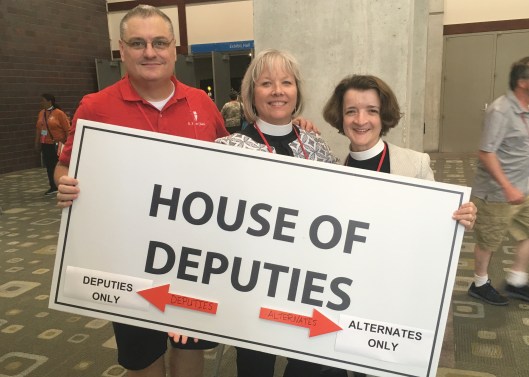
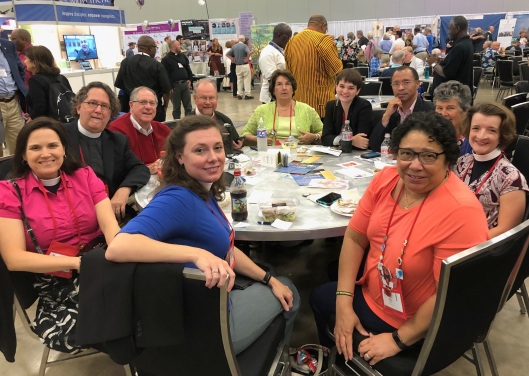
One of the questions I have received about General Convention is what it is like.  What you notice right away is General Convention’s impressive scale.  Every one of the 110 dioceses of the Episcopal Church is able to bring four clergy and four lay deputies.  They may also bring four alternate clergy and four alternate lay deputies.   In total, that’s over 800 people on the floor of the House of Deputies.  All bishops are also present, meeting in the House of Bishops.  Each diocese can have 1 – 3 bishops in place (Diocesan, Suffragan, and Assisting/Assistant).  Visitors from near and far can also attend, as well as media from dioceses, youth observers, and distinguished guests.  The Exhibit Hall also has an extraordinary number of staff and volunteers, and in addition to booths, the seminaries regularly bring in staff or faculty for seminary reunions.  Meanwhile, the entire Convention Center is run by massive amounts of volunteers – covering everything from check-in, monitoring the floor, helping with worship, to the exhibits.  Meanwhile, the ECW holds its annual triennium at the same time, which involves representatives, organizers, and volunteers.  Needless to say, Episcopalians take over the host city (this year coined as the Episcapocalypse).  Even Austin, Texas, which prides itself in being “weird,” I think was a little overwhelmed by our numbers.

IMG_1950

Photo credit:  Chris Girata (reuse only with permission)

What I particularly enjoyed was getting a taste of what it might be like to enter God’s heavenly kingdom.  People from all walks of my life were present at Convention.  There were people from my time in undergraduate campus ministry, my time working as a lay person, my time in seminary, my time as a curate, my first time as a rector, and my current position.  The joy of greeting one longtime friend or colleague after another was heartwarming.  It also reminded me of how incredibly blessed my life has been to be full of incredible people who have shaped, influenced, and sometimes directed my faith life.  God’s abundance was all around me in the faces of God’s children.

IMG_1885

Photo credit:  Hickman Alexandre (reuse only with permission)

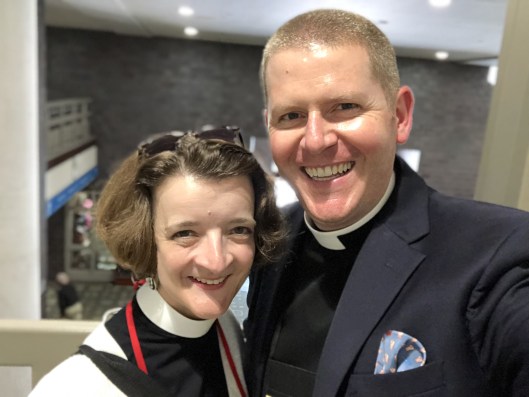
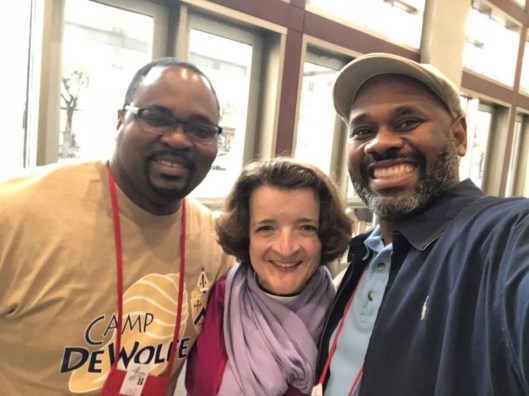
But you could not be at General Convention without meeting other people.  A conversation about something mundane would lead to the realization that we had friends in common.  Waiting in line for something would lead to a conversation about a shared passion.  People you have “met” online through vocational networking you could finally meet in person.  Suddenly, you realized you were making connections from all over the world.  The family of the Episcopal Church is deep and wide.  I leave General Convention feeling hopeful for the future of the Episcopal Church, knowing that it is full of passionate people, doing their part to create a loving, liberating, life-giving world through Jesus Christ.  Thanks be to God!

IMG_1749

Photo credit:  Ann Turner (reuse only with permission)

On Searching for Hope…

06 Wednesday Jun 2018

Posted by jandrewsweckerly in Uncategorized

≈ Leave a comment

Tags

Christ, church, division, God, hope, politics, reconciliation, redemption, scripture, sustain, today, walk

e4c08c2a8201dc34bbae76b2c5b2a0b3_how-to-break-sunlight-through-the-clouds-sun-rays-through-clouds-drawing_1450-1024

Photo credit:  https://clipartxtras.com/categories/view/8acee3134d57ecf959eedd985d89984fd9af8e11/sun-rays-through-clouds-drawing.html

One of my favorite podcasts has become “Stayed Tuned with Preet,” a podcast hosted by Preet Bharara, former U.S. Attorney, that addresses issues of justice and fairness.  The topics vary pretty widely – from law enforcement, to the psychology of leadership, to the opioid crisis, to gun control, to the #metoo movement.  What I appreciate about his podcast is he breaks down a lot of the complicated legal matters in the news into terms I can understand, he shares his passion for justice, and he tries to frame a current specific issue in the broader context of justice in society.  Admittedly, there are times when I listen to Preet’s podcast and begin to wonder if there is any hope.  But what Preet always does at the end of his podcast is tell a story of hope – sometimes entirely unrelated to the current episode, but always life-giving.

What Preet does is what I try to do in preaching.  I am always looking for the problem in the scriptural text assigned for the day (and the related problem in our modern lives), and the hope in the text (and the related hope in our everyday lives).  Sometimes finding the hope is harder than others.  This Sunday, we get the text from I Samuel where the people finally ask God for a king.  That may not sound like an unreasonable request, but you have to remember that God just spent a generation’s lifetime liberating the people from an overlord – from Pharaoh.  And despite God’s faithfulness, and the warning God’s prophet gives them about what life will be like under a king (spoiler alert:  it’s not good!), the people stubbornly demand a king anyway.  In Samuel’s warning, he says, “And in that day you will cry out because of your king, whom you have chosen for yourselves; but the Lord will not answer you in that day.”  As I have been praying on this text this week, I have been wondering where the hope is.

Last night, I sat in on a conversation on racial reconciliation, and we wondered the same thing too.  As we look at the world around us, and see the deep divisions among us (on every issue!), and see the ongoing prejudice among us, many of us found ourselves wondering where the hope is.  We spent time talking openly and vulnerably about where our hope is being dashed and the moments that seem irredeemable in life.  But after some time, our conversation shifted – from the moments that were irredeemable to the ones that were redemptive.  We began to talk about how and where we find hope.  And each bit of hope shared brought more hope into the room.  Though we all come from different backgrounds, we seemed to conclude the night convinced that God, through the instrument of the Church, was going to be the source of hopeful change in the world.

I am wondering where you are finding hope today.  Whatever is going on your life, whatever is dragging you down today, what are the glimmers of hope that are sustaining you?  I could preach to you about how God is always our source of “big picture” hope, but I think more often God provides us with little glimmers of hope that leads us on the path to that big picture hope.  Those glimmers are our food for the daily walk with Christ that nourish our souls and keep us out of the dark and searching for the light.  If you have not found the hope today, keep looking.  And if you get to the close of the day and are still not convinced, reach out for support.  You are not alone.

On Politics at the Table…

30 Wednesday May 2018

Posted by jandrewsweckerly in Uncategorized

≈ Leave a comment

Tags

Bishop Curry, church, Eucharistic Table, God, gospel, hope, Jesus, love, politics, Reclaiming Jesus, table, transformative, truth

Last week I talked about Presiding Bishop Michael Curry’s sermon at the Royal Wedding.  His sermon on the transformative power of love created shock waves – one, because most people weren’t expecting such a powerful sermon on a royal wedding day; but two, because his words resonated so deeply with people.  He created a spark of hope, a sense of clarity of purpose, and a renewed passion for justice and compassion.   The message was not new:  he simply preached the gospel of Jesus, a two-thousand-year old message.  And yet, the gospel, like it does for every generation, spoke a word of truth.

But after appearances on the Today Show, Good Morning America, The View, and countless other programs, it would be easy to soften Bishop Curry’s message, to say, “Yes!  Love is the answer!” and walk away with a warm fuzzy feeling.  The trouble is, Bishop Curry’s sermon was not just about the easy parts of love.  Bishop Curry preached about the action of love.  If we find the message of love compelling, then we have to start living lives of love.  And that is where his powerful message starts getting uncomfortable.

5b0830721a00002700cdfc6f

Photo credit:  https://www.huffingtonpost.com/entry/bishop-michael-curry-joins-christian-march-to-white-house-to-reclaim-jesus_us_5b07261ae4b0fdb2aa51b060

Less than a week after his historic sermon, Bishop Curry joined prominent faith leaders from all over the country in a movement called, “Reclaiming Jesus.”  A video explaining the movement can be found here.  Now if you have spent any time with me, you know that I am very hesitant to talk politics in the pulpit or even publicly.  I have always served in churches that were a wonderfully complicated mixture of political opinions.  The Eucharistic Table is the thing that brings us together, kneeling before God, shoulder to shoulder with fellow church members whose bumper stickers promote the exact opposite opinion of our own.

But just because I do not believe Jesus was a Democrat or a Republican, does not mean that I do no think Jesus and the Gospel are not political.  In fact, Jesus’ very life was ended because he was too “political” – because his message of love made people uncomfortable.  That is what the Reclaiming Jesus movement is about – reminding us that the Church still has a message of love – and that message is not passive or polite but is quite active and alarming.

This week, I am taking the warm, encouraging feelings I had from Bishop Curry’s sermon and listening once again to his words about what love in the world means.  I invite you to join me.  Join me in hearing what in the Reclaiming Jesus message makes you uncomfortable.  Join me in pondering how both political parties get it a little bit wrong and a little bit right.  Join me in remembering that Jesus’ message of love is not the same as an invitation to “avoid politics.”  The question is how we can do politics better.  How can we be an example of what it means to don different bumper stickers and work together for justice, peace, and love?  What Bishop Curry preached at the Royal Wedding sounded beautiful – just like Jesus’ own words.  But what Bishop Curry and Jesus called for was not just beautiful.  It is hard, confusing, challenging work – and even harder to do when we disagree so deeply.  Thank God for the Eucharistic Table!  It is the only promise to me that we can do this – that we can be political agents of love together.  I hope you will join me!

chalice-emhc

Photo credit:  http://www.freerepublic.com/focus/religion/3163266/posts

← Older posts
Newer posts →

Recent Posts

  • On Redefining Community…
  • On Parenting, Milestones, and Community…
  • Sermon – Acts 2.42-47, E4, YA, April 26, 2026
  • On Seasons of Discernment…
  • Sermon – Luke 24.13-35, E3, YA, April 19, 2026

Archives

  • May 2026
  • April 2026
  • February 2026
  • January 2026
  • December 2025
  • November 2025
  • October 2025
  • September 2025
  • August 2025
  • July 2025
  • June 2025
  • March 2025
  • February 2025
  • December 2024
  • November 2024
  • October 2024
  • September 2024
  • August 2024
  • July 2024
  • June 2024
  • May 2024
  • March 2024
  • February 2024
  • January 2024
  • December 2023
  • November 2023
  • October 2023
  • September 2023
  • August 2023
  • July 2023
  • June 2023
  • May 2023
  • March 2023
  • February 2023
  • January 2023
  • December 2022
  • November 2022
  • October 2022
  • June 2022
  • May 2022
  • January 2022
  • December 2021
  • November 2021
  • October 2021
  • September 2021
  • August 2021
  • June 2021
  • May 2021
  • April 2021
  • March 2021
  • February 2021
  • January 2021
  • December 2020
  • November 2020
  • October 2020
  • September 2020
  • August 2020
  • July 2020
  • June 2020
  • May 2020
  • April 2020
  • March 2020
  • February 2020
  • January 2020
  • December 2019
  • November 2019
  • October 2019
  • September 2019
  • August 2019
  • July 2019
  • June 2019
  • May 2019
  • April 2019
  • March 2019
  • February 2019
  • January 2019
  • December 2018
  • November 2018
  • October 2018
  • September 2018
  • August 2018
  • July 2018
  • June 2018
  • May 2018
  • April 2018
  • March 2018
  • February 2018
  • January 2018
  • December 2017
  • November 2017
  • October 2017
  • September 2017
  • August 2017
  • July 2017
  • June 2017
  • May 2017
  • April 2017
  • March 2017
  • February 2017
  • January 2017
  • December 2016
  • November 2016
  • October 2016
  • September 2016
  • August 2016
  • July 2016
  • June 2016
  • May 2016
  • April 2016
  • March 2016
  • February 2016
  • January 2016
  • December 2015
  • November 2015
  • October 2015
  • September 2015
  • August 2015
  • July 2015
  • June 2015
  • May 2015
  • April 2015
  • March 2015
  • February 2015
  • January 2015
  • December 2014
  • November 2014
  • October 2014
  • September 2014
  • August 2014
  • July 2014
  • June 2014
  • April 2014
  • March 2014
  • February 2014
  • January 2014
  • December 2013
  • November 2013
  • October 2013
  • September 2013
  • August 2013
  • July 2013
  • June 2013
  • May 2013
  • April 2013
  • March 2013
  • February 2013
  • January 2013
  • December 2012
  • November 2012
  • October 2012
  • September 2012

Categories

  • reflection
  • Sermons
  • Uncategorized

Meta

  • Create account
  • Log in
  • Entries feed
  • Comments feed
  • WordPress.com

Blog at WordPress.com.

  • Subscribe Subscribed
    • Seeking and Serving
    • Join 391 other subscribers
    • Already have a WordPress.com account? Log in now.
    • Seeking and Serving
    • Subscribe Subscribed
    • Sign up
    • Log in
    • Report this content
    • View site in Reader
    • Manage subscriptions
    • Collapse this bar

Loading Comments...