• About

Seeking and Serving

~ seek and serve Christ in all persons

Seeking and Serving

Tag Archives: Lent

Sermon – Matthew 4.1-11, L1, YA, March 1, 2020

04 Wednesday Mar 2020

Posted by jandrewsweckerly in Sermons, Uncategorized

≈ Leave a comment

Tags

cosmic, devil, evil, good, immature, Jesus, journey, Lent, mature, practice, Sermon, spiritual discipline, temptation

There is an ongoing debate among people who have way to much time on their hands about  the efficacy of most spiritual disciplines during Lent:  whether we are giving up chocolate, alcohol, or swear words; whether we are taking up health improvements, like getting more sleep, walking daily, or practicing yoga; or whether we are committing to something more traditional like fasting, daily prayer, or the reading of scripture.  The argument is that these disciplines domesticate Lent, making Lent akin to New Year’s resolutions instead of the sacred practices the ancient church intended.  There’s even a book entitled, A Grown-up Lent: When Giving Up Chocolate Isn’t Enough, whose title alone insinuates that most of our disciplines are immature, are not “grown-up” enough to be considered worthy of Lent.

Now there are myriad articulations about why our practices are not enough, but one of the reasons articulated uses today’s gospel lesson as their defense.  In today’s gospel, we hear Matthew’s version of Jesus’ temptation in the wilderness.  On the surface, Matthew describes three temptations:  the temptation to satiate a physical need (after forty days, Jesus is hungry and could turn stones to bread to satisfy this physical hunger), the temptation to prove God loves us (Jesus might want to know that God has his back before he takes on this whole savior role), and the temptation to gain political power (any messiah might assume their cause is always better aided by powerful force).  By reading about Jesus’ temptation today, we might easily deduce the reason we assume Lenten disciplines is because we are mimicking Jesus’ temptation for these next forty days.  Like Jesus was tempted by hunger, a desire for comfort, and a desire for power, our disciplines highlight our daily temptations and our desire to not submit to the forces of evil.

But this gets to the heart of why so many are critiquing our spiritual disciplines during Lent.  Theologian Stanley Hauerwas argues, “…the temptation Jesus endures is unlike the temptation we endure, for the devil knows this is the very Son of God, who has come to reverse the history initiated by Adam and Eve’s sin in the garden and continued in the history of revolt by the people whom God loves as his own, namely, Israel.”[i]  In other words, although we are surely tempted by Satan in our own time, today’s temptation of Jesus is about a cosmic battle – the very battle between good and evil, the very evil that is wreaking havoc on the civility and humanity of our country today, making us turn against one another and abandon our baptismal promises to respect the dignity of every human being.  Some would argue that our giving up chocolate, or our eating fish on Fridays in Lent does not get us any closer to routing out the evil seeking to destroy the fabric of our church, our community, and our country; our focusing on physical health does not battle the things we confessed in the Great Litany today:  pride, vainglory, hypocrisy, deceits of the flesh, and dying suddenly and unprepared.

Now, while I get the academic protest about the simplistic nature of our disciplines, here is what I know.  A week ago, after a wonderful celebration of the end of Epiphany, and after a glorious honoring of the spirituals of our religious tradition, I lost my voice.  Despite my croaking despair with my doctor, he told me, rather unsympathetically, no matter what my job was, no matter if a big event, like, say Ash Wednesday with its three services, one ecumenical potluck, and Ashes to Go, were on my agenda, in no way was I to use my voice.  In essence, I was forced into silence on a week where I needed to lead.  Or, I suppose put more spiritually, I was gifted the opportunity to truly embrace the classic invitation of Lent: fasting (in this case from speaking) and meditating on God’s holy word (since I certainly could not speak God’s word).  The irony of this gift was not lost on me – an extrovert prone to powering through any challenge being forced to slow down and keep quiet is what Lenten disciplines are all about, right?  Take our biggest spiritual struggles, and then use disciplines to help ourselves correct behavior and get right with God – this is classic Lenten stuff!

I can tell you, this past week has been a profound week of learning.  All of those things we confessed in the Great Litany were in my face this week.  Nothing attacks one’s pride, vanity, and envy like watching other people do the job I was made to do but could not do in my weakness.  And while I was able to patiently be silent, working alone from my home office on the day before Ash Wednesday, I realized about half-way through Ash Wednesday my vocal chords were hurting not from physically trying to speak, but from tensing them in the desire to speak – my longing to speak manifested itself in a anticipatory tension of use, which became dangerously close to having the same effect of actually using my voice.  When I finally realized what was happening, why I was feeling worse, I had to mentally force my throat to relax, my shoulders to release their tension, and my mind to accept I could not simply do everything I normally do, simply removing one minor part – that of speaking.  No, being mute on Ash Wednesday would mean taking on another way of being.

I tell you all this not because Lent is all about me and my laryngitis.  I tell you all this because although I understand the academic critique of Lenten disciplines, I also see with fresh eyes the very blessing of Lenten disciplines.  Perhaps the critique is true that giving up meat, or taking up Pilates, or even reading a devotion is not going to help us battle the spiritual forces of evil; but taking on those practices will shake up our senses in really meaningful ways.  Daily resisting of patterns, or daily assumptions of new patterns, creates in us a retraining of our bodies so we can begin to see, hear, taste, smell, and touch God in new ways.  And that shaking – whether big or small – shakes up other things in our lives.  We begin to see more clearly where we have had a blindness of heart; where we have delighted in inordinate and sinful affections; where we have hardened our hearts again our black, Latino, young, old, Republican, and Democrat neighbors; where we have even held in contempt God’s word and commandments.  These disciplines are not juvenile – these disciplines, when embraced and practiced open up renewed relationship with Christ, with ourselves, and with our neighbor.

In essence, what spiritual disciplines do is help us fight the devil.  Now I know that might sound extreme, but stick with me a bit.  Hauerwas argues, “The devil is but another name for our impatience.  We want bread, we want to force God’s hand to rescue us, we want peace – and we want all this now.  But Jesus is our bread, he is our salvation, and he is our peace.  That he is so requires that we learn to wait with him in a world of hunger, idolatry, and war to witness to the kingdom that is God’s patience.  The Father will have the kingdom present one small act at a time.  That is what it means for us to be an apocalyptic people, that is, a people who believe that Jesus’ refusal to accept the devil’s terms for the world’s salvation has made it possible for a people to exist that offers an alternative time to a world that believes we have no time to be just.”[ii]

So, I say, give up chocolate.  Read your devotional.  Play Lent Madness.  Pray before the kids or pets wake up or after they go to sleep.  Commit daily acts of kindness.  Take that daily walk.  You may feel like you are doing something simple.  But in our simplicity, we are participating in the cosmic work of Christ.  In bringing intentionality into those things we can control, we bring intentional focus on those things we cannot control – those things only God can fight for us.  Our forty-day journey is not the same as Christ’s.  But taking this journey aligns us with the work of Christ, and helps us claim the light in a world overwhelmed by darkness.  May God bless our Lent, and make our Lent holy.  Amen.

[i] Stanley Hauerwas, Matthew (Grand Rapids:  Brazos Press, 2006), 51.

[ii] Hauerwas, 55.

On Signs and Listening…

26 Wednesday Feb 2020

Posted by jandrewsweckerly in Uncategorized

≈ Leave a comment

Tags

faith, God, Jesus, journey, Lent, listening, preaching, sign, truth

hearing

Photo credit:  http://www.charismamag.com/life/women/34343-learning-to-listen-large-when-god-speaks-small

Every once in a while, someone will ask me to whom my sermon was directed.  I think most folks who ask this think I somehow got into their minds and was preaching about them.  But I always assure people that the primary person I am preaching to is myself, something on which I need work.  I share my struggle because I often hear echoes of my struggle in others’ struggles as well.

Well, this past Sunday I preached a sermon directed at myself, without even realizing it!  On Sunday we celebrated Transfiguration Sunday, this year using Matthew’s Gospel[i].  In Matthew’s Gospel, God says, “This is my Son, the Beloved; with him I am well pleased; listen to him!”  In my sermon, I talked about one of the things we all need to do this Lent is listen to Jesus.  Sunday night, by the time three services and one concert was over, my voice was gone.  By Monday, I was diagnosed with laryngitis.

Now, we can all get a laugh about how the preacher who reminded us all to listen is now mute and forced to listen to Jesus.  But I must be hardheaded, because I think Jesus was already asking me to listen just a few days before.  The week prior to my sermon, I had just returned from a pilgrimage, and was frantically trying to meet deadlines, follow up on pastoral care, and catch up on emails.  But we got a snow on Thursday night that cancelled school on Friday, and I had to clear my entire calendar so I could be at home with my kids.  Instead of making all my appointments, I sat down and did other things from my home office that were also being neglected.  I am convinced the snow day was God’s way of trying to get me to slow down, and listen to Jesus.  Apparently, I need more than one sign from God before I listen!

I wonder what signs you are finding in your faith journey?  Where are you having ah-ha moments of God speaking truth that finally click?  I believe God is speaking to us all the time:  sometimes in words directly to us, sometimes through the words and actions of others, and maybe even sometimes through creation!  As we take our ashes today, and as we begin a season of intentional relationship with God, I invite you to take time this Lent to listen.  I cannot wait to hear what God is saying to you!

[i] Matthew 17.1-9.

Sermon – Matthew 17.1-9, LE, YA, February 23, 2020

26 Wednesday Feb 2020

Posted by jandrewsweckerly in Sermons, Uncategorized

≈ Leave a comment

Tags

action, Calvary, emotion, God, Jesus, Lent, listen, mountain, mountaintop experiences, rollercoaster, touch, Transfiguration

On this last day of Epiphany, as we prepare to enter into Lent this week, we are given the text of Jesus’ transfiguration.  The text in and of itself is mesmerizing:  Jesus and three disciples go up a mountain, which is a hint to all of us that something dramatic is about to happen; Jesus is transfigured, his face shining like the sun and his clothes turning dazzling white; Moses and Elijah appear, two giant figures in our tradition – so giant we heard about Moses’ mountaintop experience today too; a cloud comes down around them and God speaks; and when the experience is all over, Jesus gently touches the disciples and says, “Get up and do not be afraid.”  We could easily get lost in this spellbinding moment, longing to stay on the mountaintop this morning.

But as many scholars point out[i], this mountaintop story, situated at the end of the Epiphany season, is not told in isolation.  Because we tell this story when we do, we have to take a wider view today.  The end of this season is bookended by the end of the season we are about to enter:  Lent.  That season ends on a mountain, of sorts, too – the hill of Calvary, where we see a very different kind of scene.  In this Sunday of transition, we hold the two mountains in tension together.  As scholar N.T. Wright reminds us, on Transfiguration Sunday, “…on a mountain, is Jesus, revealed in glory; there, on a hill outside Jerusalem, is Jesus, revealed in shame.  Here his clothes are shining white; there, they have been stripped off, and soldiers have gambled for them.  Here he is flanked by Moses and Elijah, two of Israel’s greatest heroes, representing the law and the prophets; there, he is flanked by two brigands, representing the level to which Israel had sunk in rebellion against God.  Here, a bright cloud overshadows the scene; there, darkness comes upon the land.  Here Peter blurts out how wonderful it all is; there, he is hiding in shame after denying he even knows Jesus.  Here a voice from God himself declares that this is his wonderful son; there, a pagan soldier declares, in surprise, that this really was God’s son.”[ii]

Looking at the transfiguration of Jesus in that way as opposed to a momentous, isolated event feels like riding a rollercoaster – seeing the glorious and the disastrous all in once glance, feeling the high of sweet affirmation and comfort and the low of betrayal all in one breath, knowing the promise of victory and reality of failure all in one moment.  When you take the expanse of the mountaintop transfiguration, the journey through Lent, the culmination on the hill of Calvary, you can almost feel dizzy from the range of emotions.

In some ways, that sensation of being on a rollercoaster of emotions has not been dissimilar to the experience of emotions lately at Hickory Neck.  In the course of one week recently, we said goodbye to a beloved curate, labored intensively with our homeless neighbors, and then had the Presiding Bishop rock this very Nave.  In the course of these next months, we live into the reality of switching from a staff with two full-time priests, to one full-time priest, and will discover how that will shape and shift not only our experience with our staff, but our experience with caring for one another.  In the course of these next forty-plus days, we will go from the high of pancakes and talent shows, to ashes and repentance, back to alleluias, butterflies, and Easter eggs.  I can feel viscerally that rollercoaster of Transfiguration to Calvary right here in the life and ministry of Hickory Neck.

But that is why I am also deeply grateful for Matthew’s transfiguration text today.  We get two instructions today – one from God and one from Jesus.  God speaks first, with words we heard earlier at Jesus’ baptism.  “This is my Son, the Beloved; with him I am well pleased.”  Those words are another declaration and reminder of Jesus’ identity.  But God adds something else today.  “Listen to him!” God says.  In those three words, God tells us what to do when caught in the whirlwind of life and transition:  listen to Jesus.  For a people who live in a culture marked by the spirit self-determination and can-do attitude, we are not necessarily the best at listening to Jesus.  Listening takes time and patience and discernment, and we just want to get on with the “doing.”  But today, God’s words are for us.  Listen to Jesus.

I used to be a part of a group who opened our gatherings with prayer.  One particular leader had a unique method of prayer.  He would introduce the prayer normally, saying, “Let us pray.”  But then he would say nothing.  For a long time.  So long was the silence, that the first time I experienced his prayer method, I kept discretely peeking through my eyelashes to make sure nothing was wrong.  I wondered if something had happened, or if he was struggling for words, or maybe even if he had fallen asleep.  But he remained sitting in a serene body posture, in silence as we waited.  When I finally conceded he must be doing this on purpose, I tried to relax and just sit in the silence.  Eventually his spoken prayer began and was lovely.  But I needed several more times praying with him before I could settle into the silence he created.  In that silence I began to stop talking in my head, and began to do what God commands today.  Listen to Jesus.  That is one of our invitations as we enter this Lent, and as we settle into this liminal time of transition at Hickory Neck.  We are to listen to Jesus.  Listening will not feel like doing.  Listening will sometimes be frustrating.  But in listening, we will be equipped to hear Jesus speaking to us and guiding us.

The other words spoken today are by Jesus.  Actually, Jesus does something powerful before he speaks.  He touches the disciples.  Jesus’ touch reminded me of a story from a priest friend of mine.  The priest was at his Diocesan Council a few years ago, an event at which he rarely speaks.  But an important issue arose, and he felt as though he could not avoid speaking.  He stood up, argued his case, and faced a heated confrontation.  In the end, the assembly agreed with him and his opinion won over.  As he sat back at his table, a friend quietly whispered in his ear, “You’re shaking.  I’m going to touch you for a little bit.”  As the friend laid his hand upon his shoulder, my friend could feel his blood pressure lowering and the tension releasing from his body.[iii]  In a world that has become extremely and wisely cautious about touch, we sometimes forget the power of touch.  We all have had powerful experiences with touch:  whether we received a similar hand on the should as reassurance that all would be well; whether we received a hug that was just slightly longer than normal, but much needed, after confessing some bad news; or whether someone just held our hand for a while, as a silent, encouraging gesture.  That is the kind of touch Jesus offers today.

But then, Jesus speaks.  Jesus says, “Get up and do not be afraid.”  For those of us who are doers, these words are anchoring today.  God tells us to listen to Jesus, Jesus gives us a reassuring touch, and then Jesus tells us to get up and not be afraid.  In other words, Jesus is speaking to us, Jesus is reassuring us, and then Jesus is telling us to get up and get going.  I hear in Jesus’ words today more modern words for Hickory Neck, “You’ve got this!”  As we enter into the season of Lent, we commit to what we always do in this season – to returning and repenting, to listening and discerning, to seeking comfort and renewal, and then getting back in there.  In what can feel like a rollercoaster of emotions, today’s lesson offers us grounding, comfort, and encouragement.  In a season of journeying from one mountain to another, we have the promise of a comforting hand, soothing words, and inspiring action.  We are not off the rollercoaster yet, but we have each other, and the promise of those unknown to us who join us in this journey.  As we stand here on our hill in Toano, I am grateful for good companions on what promises to be an awesome ride.  Amen.

[i] Thomas G. Long, Matthew (Louisville:  Westminster John Knox Pres, 1997), 194; also, Rolf Jacobson, Sermon Brainwave podcast, “#708 – Transfiguration Sunday,” February 15, 2020,  http://www.workingpreacher.org/brainwave.aspx?podcast_id=1232, as found on February 20, 2020.

[ii] N.T. Wright, Matthew for Everyone, Part 2 (Louisville:  Westminster John Knox Press, 2004), 14.

[iii] Steve Pankey, “The Power of Touch,” as found at http://draughtingtheology.wordpress.com/2014/02/27/the-power-of-touch/ on February 27, 2014.

On Race, Lent, and Children…

10 Wednesday Apr 2019

Posted by jandrewsweckerly in Uncategorized

≈ Leave a comment

Tags

America, brokenness, children, Civil Rights, confess, Jesus, Lent, prayer, race, racism, repentance, shame, sin, unite

IMG_7640

Photo credit:  Jennifer Andrews-Weckerly; reuse only with permission

This past week, our family traveled to Mississippi to visit friends.  On the trip we were able to see both the Mississippi Civil Rights Museum in Jackson, and the National Civil Rights Museum in Memphis, Tennessee.  While the museums were appropriate for our older child, who has been studying the Civil War and Reconstruction in her Social Studies Class, our younger child was a bit mystified by the museums.  She struggled with understanding the concept of history versus modern day, but she especially struggled with why people were hurting and killing each other.  She clearly made the connection that Caucasians (or “peach-skinned” people as she called them) were being mean to African-Americans (or “brown-skinned” people), but she could not fathom why.  With every video or picture, I was barraged with questions about why people were doing what they were doing, or why someone would kill someone like Martin Luther King, Jr.

Explaining the atrocities of American racial history to a five-year old is one of the most gut-wrenching experiences I have had.  I already struggle with the shame of our history and my participation in racism.  But to expose my child to the sinfulness and brokenness of our country made the shame deeper.  As the museum bombarded me with statistics around racial disparities, as prerecorded voices shouted out awful words that were once shouted out to people of color, and as “Precious Lord,” or “We Shall Overcome,” played overhead, I was reminded of all that we have been through as a country, and how much further we have to go.

In Lent, we do a lot of confessing of our sinfulness and working on repentance.  On Ash Wednesday, we confessed our exploitation of other people, our blindness to human need and suffering, and for “all false judgments, for uncharitable thoughts toward our neighbors, and for our prejudice and contempt toward those who differ from us.”[i]  In the Great Litany this Lent, we prayed, “From all blindness of heart; from pride, vainglory, and hypocrisy; from envy, hatred, and malice; and from all want of charity, Good Lord, deliver us.”[ii]  In the Exhortation in the Penitential Order, the priest asked us to “Examine your lives and conduct by the rule of God’s commandments, that you may perceive wherein you have offended in what you have done or left undone, whether in thought, word, or deed. And acknowledge your sins before Almighty God, with full purpose of amendment of life, being ready to make restitution for all injuries and wrongs done by you to others; and also being ready to forgive those who have offended you, in order that you yourselves may be forgiven.  And then, being reconciled with one another, come to the banquet of that most heavenly Food.”[iii]

As we finish these last days of Lent, as we hear the passion narrative on Sunday, and as we walk the days of Holy Week next week, I am reminded of how much work we still have to do.  For me, I will be contemplating the ways in which I participate in the systems and practices of racism in our community, working to not only be better, but to teach my children to be better.  And knowing our work of repentance is on-going, I look forward to our Eastertide book study that will allow us to delve into these issues even more.  This week I pray for the whole human family:

O God, you made us in your own image and redeemed us through Jesus your Son: Look with compassion on the whole human family; take away the arrogance and hatred which infect our hearts; break down the walls that separate us; unite us in bonds of love; and work through our struggle and confusion to accomplish your purposes on earth; that, in your good time, all nations and races may serve you in harmony around your heavenly throne; through Jesus Christ our Lord.  Amen.[iv]

IMG_7644 (1)

Photo credit:  Jennifer Andrews-Weckerly; reuse only with permission

[i] Book of Common Prayer (BCP), 268.

[ii] BCP, 149.

[iii] BCP, 317.

[iv] BCP, 815.

On the Work of Kindness…

27 Wednesday Mar 2019

Posted by jandrewsweckerly in Uncategorized

≈ Leave a comment

Tags

Acts, challenge, embody, faith, God, intentionality, Jesus, kindness, Lent, radical, time, uncomfortable, work

53283460_2247971941925720_5352232032019677184_o

Photo credit:  Hickory Neck Episcopal Church; reuse with permission 

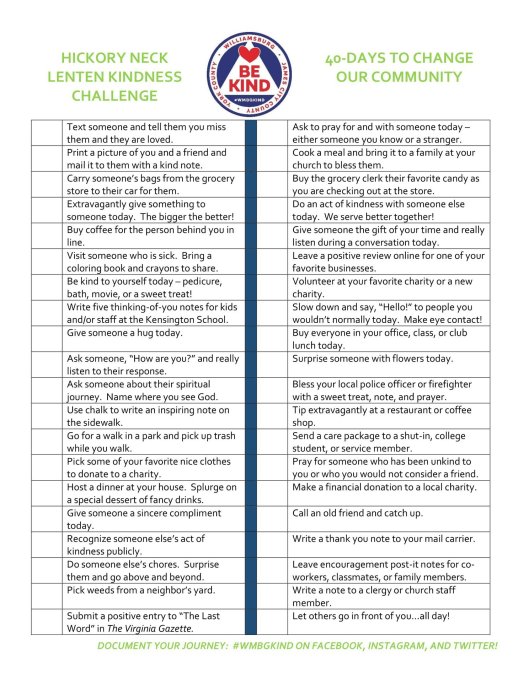
This Lent I decided to join my church in taking up our Lenten Kindness Challenge.  There are forty acts of kindness for the forty days of Lent.  The challenge itself is laid out like a checklist, but we were told we could either do the tasks in order, or pick and choose which acts fit our schedule on a particular day.  I elected to do the latter.  I confess, the kindness challenge began somewhat easily for me.  You see many of the acts of kindness are part and parcel of my job as a priest.  I have visited the sick more times than I can count this Lent.  I have hosted people in my home as part of our new Rector’s Receptions.  I regularly ask people about their faith journey and ask people if I can pray for them.  In some ways, by virtue of my job, I have felt like I am coasting through this kindness challenge.

But about halfway through Lent, I have passed all the “easy” acts, and am now facing all the acts of kindness I skipped because they will take more time or intentionality.  Midway through Lent, this kindness challenge is starting to feel like work – work that will require my time and attention.  On the one hand, I am already dreading the work, trying to figure out when I will have time to write extra notes, or do tasks that are outside of my everyday routine.  On the other hand, I am glad I have hit this point in the kindness challenge.  The work being demanded of me now reminds me that kindness is not just the kindness that we naturally do day in and day out.  Kindness requires something more of us – our time, our forethought, our work.  If it were easy, everyone would be doing it!

This is why I think focusing on kindness is so important for people of faith.  You see, being kind can reference the superficial, polite, everyday way of being that is common for all people – a great thing to be celebrated, but not necessarily the behavior in life that motivates and inspires.  But the kindness people of faith are invited to claim is the kind of kindness we see modeled through God – the kind of kindness we as people of faith embody so that others might see Christ in us.  Jesus was not venerated because he was simply polite – a good Southerner, if you will.  Christ was venerated because he healed the sick, listened to the isolated, and ate meals with the disenfranchised.  The kindness of Jesus was the kind of kindness that made people uncomfortable – that crossed barriers, that pushed people out of comfort zones, and that placed little value on societal norms.  Christ’s kindness was a radical kind of kindness.

I wonder what ways you are being challenged to get a little more radically kind this Lent.  What are things that you can be doing that require more of you than simply being polite?  What are the acts of kindness you can do that will take more time, that will inconvenience you, that might even make you a little uncomfortable?  Perhaps you have already notated which of those challenges are going to be hard for you this Lent.  Or perhaps there are different challenges that are not on our Lenten Kindness Challenge, but are the actions you need take to embody Christ today.  I cannot wait to hear how you are challenging yourself during this second half of Lent!

Sermon – Luke 4.1-13, L1, YC, March 10, 2019

13 Wednesday Mar 2019

Posted by jandrewsweckerly in Sermons, Uncategorized

≈ Leave a comment

Tags

beloved, children of God, devil, disciplines, doubt, God, identity, Jesus, Lent, reclaim, relatable, Sermon, temptation, trust

After Ash Wednesday services this week, Father Charlie caught me in my office eating a peanut butter and jelly sandwich.  “Guess we’re not observing that whole fasting thing, huh?” he joked with me.  We then talked about how both of us struggle with fasting.  Prone to being what some call “hangry,” or in my case of low-blood sugar, even faint, neither of us is particularly good at fasting.  When I was finally diagnosed with having low-blood sugar many years ago, a great mystery was solved.  Upon hearing the news, all of my friends would, with relief, say, “Oh!  That explains soooo much!”  Only then did I discover my friends had been involved in a huge coping conspiracy.  Jennifer is acting weird or annoying or cranky – who has food?  I may even be the inspiration behind those Snickers commercials where cranky people are suddenly transformed back to their lovely selves as soon as they get the candy bar.

The trouble with people like me, or maybe even most of us, is that we hear the temptations of Jesus today and we immediately see ourselves in them.  We think about the times we have been hangry or desperate for food, and we know the difficulty of the devil’s temptation to turn stones into bread.  Or maybe we relate more to the temptation of the ego to be all powerful, or to temptation to test God, just to be sure we are secure in God’s protection.  Because the temptations in the gospel lesson are so relatable, we can almost too easily see ourselves in them and miss the point.  You see, the temptations of Jesus aren’t really about bread, power, and safety.  Just like the Lenten disciplines we take up are not really about chocolate, scripture reading, or prayer.  The temptations of Jesus are about something much deeper:  they are about identity.

In Luke’s gospel, Luke has already described Jesus’ baptism by John, when God declares, “You are my Son, the beloved; with you I am well pleased.”  Then, just before this passage, Luke articulates the genealogy of Christ, emphasizing the importance of who Jesus is based on his ancestors.  So, when Jesus goes into the wilderness, the devil is not actually trying to tempt Jesus with bread, power, and safety.  No, Jesus is being tempted to deny his identity.  As Karoline Lewis says, “the identity test for Jesus is not so much a test of who he is, but how he will live out his identity as Son of God.  The devil knows perfectly well who Jesus is.  The devil does not question who Jesus is, but tries to get Jesus to question who he is…”[i]

And that is a temptation we understand all too well.  “…temptation is not so often temptation toward something – usually portrayed as doing something you shouldn’t – but rather is usually the temptation away from something – namely, our relationship with God and the identity we receive in and through that relationship.  Too often Christians have focused on all the things we shouldn’t do, instead of pointing us to the gift and grace of our identity as children of God.”[ii]  In the end, the temptations Jesus faces could be anything.  They could certainly be “Bread, power, and safety.  But [the temptations] just as well might have been youth, beauty, and wealth.  Or confidence, fame, and security.”  The devil does not care about the content of the temptation.  The devil seeks “to shift our allegiance, trust, and confidence away from God and toward some substitute that promises a more secure identity.”[iii]

In part, that is why we take on disciplines during Lent.  We fast, pray, and study Scripture not because we need to imitate Jesus’ temptation.  We give up chocolate, coffee, or wine, or we take up kindness, fitness, or quiet not to simply push ourselves into new patterns.  We take on disciplines in Lent because we need to remind ourselves of our genealogy – to remind ourselves that we too are beloved children of God.  We know that when we claim that blessed status as beloved children of God, the devil will try to make us doubt the abundant, enduring, graceful love of God for each of us.  Because only when we doubt or forget our identity do we really fall into the temptations of this world.

No matter what our spiritual discipline, our invitation this Lent is to reclaim our identity.  Our invitation is to use these forty days to reaffirm, to recover, to reassert we are beloved children of God.  In yoga speak, when we have distracting thoughts, we are encouraged to acknowledge the thought, and then let the thought go.  Our invitation is to do the same this Lent.  As the devil puts distracting thoughts of inadequacy, unworthiness, and insecurity in our minds, we acknowledge them for what they are, and let them go.  Because we are beloved children of God.  Because when we boldly remind the devil that we are beloved children of God, we are empowered to remind others they are beloved too.  Together, affirmed in our identity, renewed in Christ’s love and light, we can do the real work of Lent – not just showing the world we are beloved children of God, but transforming that same world through our beloved status.  Amen.

[i] Karoline Lewis, “Identity Test,” March 3, 2019, as found at http://www.workingpreacher.org/craft.aspx?m=4377&post=5294 on March 7, 2019.

[ii] David Lose, “Lent 1C:  Identity Theft,” March 7, 2019, as found at http://www.davidlose.net/2019/03/lent-1-c-identity-theft/ on March 7, 2019.

[iii] Lose.

Holding on to Joy in Lent…

06 Wednesday Mar 2019

Posted by jandrewsweckerly in Uncategorized

≈ Leave a comment

Tags

Ash Wednesday, Christ, discipline, earthy, holy, identity, joy, kindness, Lent, life, light, love, repent, virtue

IMG_6748

Photo credit:  Jennifer Andrews-Weckerly; reuse only with permission

Last night I had one of the most fun Shrove Tuesday/Mardi Gras celebrations I have ever had.  We had a great crowd, there was a spirit of joy and celebration, the Kensington School hosted an awesome kids’ corner with fun activities, and best of all was the Hickory Neck Talent Show.  I have not laughed so hard and smiled so much in a long time.  I even woke up this morning with an uplifted spirit, the smile still lingering on my face.

While I am so grateful for that blessing, as a priest, it does make entering into Ash Wednesday a bit tricky.  Here I am still coming down from the high of last night, and now I need to enter into a worship service where I tell people to fast, to repent, and to remember their mortality.  It almost feels like emotional or spiritual whip-lash, and I have been struggling this morning to know how to help others with that same abrupt shift.

Where I have landed is that I think the best way to enter into Ash Wednesday and the season of Lent is with that same lingering sense of celebration.  You see, when you have experienced the highs of life, talking about the “lows” of life seems a bit more bearable.  Yes, we are mortal, and yes, we will return to the dust.  But while we are still mortal, we can make this life here on earth one of great joy and love – one of laughter, of community, of togetherness.

I wonder if this might be a way to enter Lent in a healthier way.  Instead of lamenting our sinful nature (and believe me, we do need to lament our sins), perhaps our Ashes today might remind of us the earthy nature of being humans and encourage us to strive for the ways we might live that earthy life in a more holy way.  I plan to do that today by entering into a season of kindness.  I am taking the joy from my community of faith last night and channeling it into forty days of kindness – where my repentance becomes a practice of demonstrating my identity – of living more faithfully the virtue of kindness.  What Lenten discipline are you taking up?  What might be a way for you to joyfully grasp onto this fleeting life and make it a witness to Christ’s light and love?  I can’t wait to hear all about it!!

Ash-Wednesday-1

Photo credit:  https://saintvincents.org/2019/02/25/ash-wednesday-march-6/

Sermon – Jeremiah 31.31-34, Psalm 51.1-13, L5, YB, March 18, 2018

21 Wednesday Mar 2018

Posted by jandrewsweckerly in Sermons, Uncategorized

≈ Leave a comment

Tags

clean, comfort, communion, covenant, exile, God, heart, Lent, persistence, Psalm, relationship, repentance, Sermon, sin, sinfulness, ten commandments

As we heard our psalm today, you may have thought the psalm sounded familiar.  And you would be right.  Just under five weeks ago, we said this exact same psalm on Ash Wednesday.  After we were invited into a holy Lent – one of fasting, self-examination, and repentance, and ashes were spread across our foreheads, we said this psalm.  “Have mercy on me, O God…For I know my transgressions, and my sin is ever before me…[I have] done evil in your sight…” we confessed.  We begged God to create in us a clean heart and renew a right spirit within us.  I wonder how saying these words again, just several weeks later, feels today.  Perhaps after weeks of following your Lenten discipline, you feel closer to that clean heart and renewed spirit.  Maybe you are making your way out of Lent and the repetition of Psalm 51 feels unnecessary because you have completed your repentance work.  But maybe Psalm 51 feels unattainable, because your sinfulness feels like something you cannot shake.

If you are in the latter category, and if, in fact, you are beginning to wonder if you will ever master this sinfulness thing, take heart.  I actually say verse eleven of this psalm every time I celebrate the Eucharist.  Week in and week out, whether we are in Lent, Eastertide, or Ordinary time, even after I have prayed and confessed with the community, before I approach the altar to celebrate holy communion, I say these same words, “Create in me a clean heart, O God, and renew a right spirit within me.”  Whether in a season of penitence or not, whether I have already celebrated Eucharist two times earlier in the morning, I still pray Psalm 51.11, longing for the God of mercy and hesed, or loving-kindness, to create in me a clean heart.

That is why I think the beginning of our liturgy was so hard today.  As part of the penitential order, we prayed the decalogue, or the ten commandments.  With each commandment, we responded, “Amen. Lord have mercy.”  Reading the decalogue in scripture, as we did just a few weeks ago in Lent is a bit different – somehow having them in paragraph form makes them more palatable – with only certain commandments jumping out at us as areas of improvement.  But praying them is more difficult.  With each commandment receiving a closing petition, the idea is hammered home – we struggle with every last one of these commandments.  Now I can imagine what you are thinking – but I have never murdered.  While that may be true, the poor and the oppressed die every day because no one cares enough to change policy or ensure each person gets help.  Or maybe you are muttering that you have never put any gods before our God.  But we commit idolatry every day when we believe money or even we ourselves are in control instead of our God.  Each petition we pray in the decalogue reminds of how deep and diverse our sinfulness is.

But here’s the funny thing about those commandments – the Israelites could not follow them either.  The Israelites had been rescued from slavery and protected relentlessly.  Once the Israelites were finally in safety and heading to the Promised Land, God created a new covenant with the people.  God sent Moses up the mountaintop and had Moses write the law on tablets – the law that would guide the people into faithful, covenantal living.  But before Moses could even get down the mountain and deliver the covenant to the people, they had already created the golden calf – an idol in the place of God.  They people would struggle so much with the ten commandments that a whole generation of God’s covenantal people would not be allowed into the Promised Land – not even Moses himself.  Although God intended for the decalogue to shape the lives of the people and to create the boundaries for the covenant, and although none of the petitions are all that unreasonable, yet still the people would break their covenant with God time and again.

We are just like our ancestors.  I was just retelling a parishioner this week about my Lenten discipline in college.  You see, in college I picked up a bit of a potty mouth.  It got so bad that my freshman year, I decided to charge myself a quarter for every curse word I uttered, with the plan of giving the proceeds to church on Easter.  By the end of week two in Lent, I had to reduce the fee to a nickel because I could not afford the fee!  And the funny thing was that every year in college was the same.  “This year!  This year I will master my filthy mouth.”  And every year I would have to reduce the fees.  We are creatures of habit, masters of repeated sinfulness, just like our ancestors.

That is why reading Jeremiah is so powerful today.  Jeremiah writes in a time of desperation for the people of God. The Babylonians have razed the temple and carried King Zedekiah off in chains.  Effectively, the Babylonians have “destroyed the twin symbols of God’s covenantal fidelity.”[i]  Sometimes we talk about the exile so much that I think we forget the heart-wrenching experience of exile.  Being taken from homes and forced to live in a foreign land is certainly awful enough.  But the things that were taken – the land of promise, the temple for God’s dwelling, the king offered for comfort to God’s people – are all taken, leaving not just lives in ruin, but faith in question.  But today, in the midst of the physical, emotional, and spiritual devastation, Jeremiah’s reading says God will make a new covenant.  God knows the people cannot stop breaking the old covenant, and so God promises to “forgive their iniquity and remember their sin no more.”  Instead of making the people responsible for the maintenance of the covenant, God goes a step further and writes the law in their hearts, embodies God’s way within the people.

The words of Jeremiah in the section called “the Book of Comfort,”[ii] and this new covenant by God, show a God whose abundance knows no limits.  God offers this new covenant to a people who surely do not deserve another covenant.  God has offered prophets and sages, has called the people to repentance, has threatened and cajoled, and yet still the people could not keep the basic tenants of the covenant established in those ten commandments.  But instead of abandoning the people to exile, God offers reconciliation and restoration yet again.  And because God knows we have no power in ourselves to help ourselves, God basically says, “Here.  Let me help you.  Let me write these laws in your hearts so that you do not have to achieve your way into favor with me, but you will simply live faithfully, living the covenant with your bodies and minds.”  And when even that does not seem to work, God sends God’s only son.  God never gives up on us or our relationship with God.  Even all these years after Christ’s resurrection, God is still finding new ways to make our covenant work.

I have had parishioners attend two services in one day – maybe they were a speaker at two services or maybe they sang in two different choirs.  Invariably, one of these multi-service attendees will ask me, “Should I take communion again?  I shouldn’t, right?”  I always chuckle because I have to remind them that I take communion three times every Sunday – sometimes four or five if I take communion to someone homebound on a Sunday.  I confess all those times, I pray all those times, I say those words of Psalm 51 all those times, “Create in me a clean heart, O God, and renew a right spirit within me.” Lent is the same way – sometimes we are confessing multiple times in one day.  Sometimes we need to say the decalogue, and we need to confess our sins, and we need to hear Psalm 51.  And before we go to bed, we may need to confess to God again.  We do all those things with confidence because our God is a god of mercy, hesed, and restoration, always looking for ways to renew God’s covenant with us.  God’s persistence with us is what inspires our work this Lent.  So yes, create in us clean hearts, O God, and renew a right spirit within us – every week, every day, every hour.  Amen.

[i] Richard Floyd, “Pastoral Perspective,” Feasting on the Word, Year B, Vol. 2 (Louisville:  Westminster John Knox Press, 2008), 122.

[ii] Jon L. Berquist, “Exegetical Perspective,” Feasting on the Word, Year B, Vol. 2 (Louisville:  Westminster John Knox Press, 2008), 123.

Sermon – John 2.13-22, Exodus 20.1-17, L3, YB, March 4, 2018

07 Wednesday Mar 2018

Posted by jandrewsweckerly in Sermons, Uncategorized

≈ Leave a comment

Tags

beautiful, bless, body, flesh, God, good, honor, incarnation, Jesus, Lent, ministry, repentance, righteous anger, sacred, Sermon, sinful, temple

Today’s gospel lesson is one of those lessons in Scripture that is so vivid we find looking away difficult.  All four of the gospels have this story, and three of the gospels use this story to convey Jesus’ righteous anger about how the practice around temple worship and obligatory sacrifice has led to monetary abuses.  Matthew and Luke even have Jesus calling the whole enterprise a den of robbers.  The story evokes images of Jesus flipping tables, or in today’s version, swinging around a whip like Indiana Jones.  We often recall this text when looking for evidence of Jesus’ righteous anger at injustice.  We are so familiar with this text we can almost hear the sermon about a call to justice in our heads.

But this week, the gospel has been speaking a different sermon to me.  You see, John’s version of this story is a bit different from the other three gospels.  First, John places this story in a very different place in his narrative.[i]  Unlike the other gospels who place this story toward the end of Jesus’ earthly ministry, John places this incident in the second chapter, right after the miracle in Cana.  And in John’s version, Jesus does not lay into the moneychangers in quite the same way.  Instead of financial injustice, Jesus seems more concerned that those gathered have missed something critical – in the obligatory administering of sacrifices at the physical temple, they have missed the fact that God is no longer tied to the location of the temple – and instead is found in the temple of Jesus’ body.  For John, the incarnation, the word becoming flesh and dwelling among us, is central to the entirety of the good news and in this story specifically.

I realized this week that when I think about the Incarnation, I immediately think of the baby Jesus.  Somehow, like a child you do not see for a few years, my image of Jesus incarnate gets stuck in the manger.  And because the adult Jesus sometimes feels so superhuman, I forget about the earthy, gritty flesh of his body – the body that touches to heal, stoops down to wash feet, eats and drinks with others, cries wet tears, and breathes a last breath of the cross.  In coming to know the Messiah who heals, teaches, brings about justice, and is transfigured before the disciples, I forget the enfleshed Jesus – the human body in which God dwells – the only temple we need to draw nearer to our God.

We are in a season of flesh.  Lent is that season when we experience Jesus in deeply enfleshed ways.  What our disciplines or our practices do for us in Lent is help us remember that we are a people of flesh and our God was willing to take on that flesh to transform our lives.  We do not often talk about the profound reality of an enfleshed God, but I stumbled on a hymn this week that opened up the reality.  Brian Wren’s hymn Good is the Flesh says, “Good is the flesh that the Word has become, good is the birthing, the milk in the breast, good is the feeding, caressing and rest, good is the body for knowing the world, Good is the flesh that the Word has become.”  The hymn goes on to say, “Good is the body, from cradle to grave, growing and aging, arousing, impaired, happy in clothing, or lovingly bared, good is the pleasure of God in our flesh, Good is the flesh that the Word has become.”[ii]  Now I do not know about your own spiritual journey, but I do not think I have ever heard Jesus’ flesh being described so vividly.  The closest I have come has been in imagining the vulnerability of that enfleshed body in the cradle.  But capturing what being enfleshed means for all of life – from cradle to grave – somehow opened up John’s words about the temple of Jesus’ body.  God takes something we often associate with sinfulness – and transforms that flesh into something good.  “Good is the pleasure of God in our flesh,” are powerful words that shift how we experience the fullness of Christ’s humanity.

Once we reconnect with the goodness of God’s flesh – the incarnation of Christ – then we begin to see all of Jesus’ ministry not stuck in a manger but immersed in the flesh of life.  Karoline Lewis reminds us Jesus’ fleshy life was important, “Because a woman at a well, whose body was rejected for the barren body it was, experiences the truth of neither on this mountain nor in Jerusalem; because a man ill for 38 years, his entire life to be exact, whose body has only known life on the ground, is now able to imagine his ascended life; because a man born blind, is then able to see, and to see himself as a sheep of Jesus’ own fold; because Lazarus, whose body was dead and starting to decay, found himself reclining on Jesus, eating and drinking, and with his sisters, sharing a meal once again.”[iii]  Not only is Jesus’ incarnation good, making flesh good, Jesus’ ministry is about blessing, healing, and restoring physical bodies.

Once we connect with the goodness of God’s flesh, and the power of Jesus’ fleshy ministry, we are forced to see something we do not always feel comfortable with – the goodness of our own flesh.  Now I do not know about you, but my experience in church has not been one in which the church tells me how good my body is.  In fact, today’s inclusion of the ten commandments usually reminds me of the opposite – of the myriad ways my body is sinful:  from the words that come out of my mouth, to the ways in which I hurt others and take things with my body, to the ways in which I covet things and other bodies.  And those sins do not even touch the ways in which I learn the message that my body is imperfect – how my body is not the right height or shape or gender, how my body is not fit or strong enough, how my skin color, hair, or nails are not quite the ideal.  But if God takes on flesh and says, “Good is the flesh,” and if that enfleshed God engages in a ministry of blessing flesh, then surely part of what we remember today is how good and blessed our own flesh is – how God made our flesh for good.

Now, here comes the tricky part.  Once we realize “Good is the flesh,” that ministered to the flesh, that our flesh is beautiful and revered, then we are forced to make yet another leap – that the flesh of others is also beautiful.  Those bodies we would like to subjugate, regulate, and decimate are no longer able to be separated from the goodness of God’s flesh or our own flesh.  Barbara Brown Taylor argues in An Altar in the World, “‘One of the truer things about bodies is that it is just about impossible to increase the reverence I show mine without also increasing the reverence I show yours.’  In other words, once I value my own body as God’s temple, as a site of God’s pleasure, delight, and grace, how can I stand by while other bodies suffer exploitation, poverty, discrimination, or abuse?”[iv]

This week, we enter that kind of work.  As we welcome guests through the Winter Shelter, we affirm the goodness of all flesh – of God’s flesh, of our flesh, and especially the flesh of those who have no shelter, who work hard all day but cannot secure housing, who live lives of uncertainty, of insecurity, of scarcity.  Once we recall the incarnation of Christ, the dignity of our own incarnation, our work immediately becomes to honor the incarnation of others.  We certainly accomplish the work of honoring flesh this week through the Winter Shelter.  But as we keep walking our Lenten journey, we will struggle with our bodies.  Even our collect today says, “we have no power in ourselves to help ourselves: Keep us both outwardly in our bodies and inwardly in our souls, that we may be defended from all adversities which may happen to the body, and from all evil thoughts which may assault and hurt the soul.”  But our invitation this Lent is to also struggle with claiming our body as good – and using the goodness of the flesh to bless other flesh.  Our repentance this week is not just of the sinfulness of the flesh, but we repent this week of the ways in which we do not honor how “Good is the flesh that the Word has become.”  Amen.


[i] Joseph D. Small, “Theological Perspective,” Feasting on the Word, Year B, Vol. 2 (Louisville:  Westminster John Knox Press, 2008), 92.

[ii] I found this hymn in the commentary by Debie Thomas, “The Temple of His Body” February 28, 2018, https://www.journeywithjesus.net/lectionary-essays/current-essay?id=1675 as found on March 1, 2018.

[iii] Karoline Lewis, “Body Zeal,” February 26, 2018, http://www.workingpreacher.org/craft.aspx?post=5071 as found on March 1, 2018.

[iv] Thomas.

On Finding the Holy…

28 Wednesday Feb 2018

Posted by jandrewsweckerly in Uncategorized

≈ Leave a comment

Tags

Christ, devotion, discipline, disorder, God, habit, holy, Lent, repentance, rhythm, room, routine, sacred, sinfulness

IMG_9874

“Jesus is Taken Down from the Cross,” by G. Roland Biermann.  Photo taken by Jennifer Andrews-Weckerly at Trinity Episcopal Church, Wall Street.

It was a pretty simple question.  “How is your Lent going?”  What was not simple was my answer.  As a priest, I feel like my answer should have been, “It’s going really well,” followed by a list of things I am appreciating about the season.  But this year, I have been having a hard time finding my Lenten rhythm.  Part of the reason is that I scheduled a brief vacation right at the beginning of Lent, experiencing a powerful Ash Wednesday, but missing the first Sunday in Lent, the beginning of our digital Compline offering, and our first Wednesday night of worship.  Being away also meant that I got off-schedule with our family devotional time at breakfast.  Meanwhile, the book I planned to read with a book group for Lent got lost in the mail and had to be reordered while my fellow readers got ahead of me.  I had expected to re-center at our Lenten Quiet Day, but that had to be cancelled.  And so there I was on Sunday, left with this question about Lent, feeling like my Lent was not really off to a good start.

Part of the challenge for me is that I am a creature of habit.  I like routine and order.  I am able to focus more clearly when life is ordered in a regular pattern.  I think that is why I like Lent so much.  Lent encourages us to find a regular pattern – whether we have given up something daily, we are reading something devotionally each day, or we are praying at a particular time.  Regular services are added, or maybe we just commit to not missing any of the Sundays in Lent.  Regardless of our practice, the whole purpose of Lent is to create a rhythm for six weeks that deepens our relationship with Christ, and draws us out of sinfulness and into repentance and renewal of life.

But the more I thought about the question about how my Lent was going, I realized that perhaps the disorder of my Lent is forcing me to find the holy outside of the construct of patterns.  So, yes, the book I wanted to read did not arrive on time; but its delay meant that I more fully enjoyed my vacation and was not distracted during my “away” time.  Yes, I missed several routine things in the first week of Lent, but I also got to experience some incredible things while away – seeing the Cathedral Church of St. John the Divine for the first time, stumbling into a city-wide Stations of the Cross designed by artists in New York City, finding beautiful religious artwork in churches and art museums, and even unexpectedly enjoying a midday Eucharist with my husband – something that never happens in my normal routine.

This year, I am beginning to think my new Lenten discipline might be finding the holy in the disordered chaos of life.  It means I have to pay attention to the little moments of life where God is trying to break in:  the blessing of a glass of wine with friends, the pure joy of a three-year old laughing, the sacred experience of holding a newborn baby, the power of a hug as someone’s eyes well up with emotions of fear or grief, the sacred invitation into pain as someone texts, calls, or emails what is on their mind.  It is possible that I will regain some semblance of Lenten order as Lent goes on.  But if not, I am feeling especially grateful for the ways in which God is present every day, even when I do not feel like I am making room for God.  So, I suppose my new answer is that my Lent is going really well.  How is your Lent going?

← Older posts
Newer posts →

Recent Posts

  • On Change and Bread…
  • Sermon – Exodus 14.19-31, P19, YA, September 13, 2026
  • On Realizing Dreams…
  • On Seeing the Kingdom…
  • Sermon – Exodus 3.1-15, P17, YA, August 30, 2026

Archives

  • September 2026
  • August 2026
  • July 2026
  • June 2026
  • May 2026
  • April 2026
  • February 2026
  • January 2026
  • December 2025
  • November 2025
  • October 2025
  • September 2025
  • August 2025
  • July 2025
  • June 2025
  • March 2025
  • February 2025
  • December 2024
  • November 2024
  • October 2024
  • September 2024
  • August 2024
  • July 2024
  • June 2024
  • May 2024
  • March 2024
  • February 2024
  • January 2024
  • December 2023
  • November 2023
  • October 2023
  • September 2023
  • August 2023
  • July 2023
  • June 2023
  • May 2023
  • March 2023
  • February 2023
  • January 2023
  • December 2022
  • November 2022
  • October 2022
  • June 2022
  • May 2022
  • January 2022
  • December 2021
  • November 2021
  • October 2021
  • September 2021
  • August 2021
  • June 2021
  • May 2021
  • April 2021
  • March 2021
  • February 2021
  • January 2021
  • December 2020
  • November 2020
  • October 2020
  • September 2020
  • August 2020
  • July 2020
  • June 2020
  • May 2020
  • April 2020
  • March 2020
  • February 2020
  • January 2020
  • December 2019
  • November 2019
  • October 2019
  • September 2019
  • August 2019
  • July 2019
  • June 2019
  • May 2019
  • April 2019
  • March 2019
  • February 2019
  • January 2019
  • December 2018
  • November 2018
  • October 2018
  • September 2018
  • August 2018
  • July 2018
  • June 2018
  • May 2018
  • April 2018
  • March 2018
  • February 2018
  • January 2018
  • December 2017
  • November 2017
  • October 2017
  • September 2017
  • August 2017
  • July 2017
  • June 2017
  • May 2017
  • April 2017
  • March 2017
  • February 2017
  • January 2017
  • December 2016
  • November 2016
  • October 2016
  • September 2016
  • August 2016
  • July 2016
  • June 2016
  • May 2016
  • April 2016
  • March 2016
  • February 2016
  • January 2016
  • December 2015
  • November 2015
  • October 2015
  • September 2015
  • August 2015
  • July 2015
  • June 2015
  • May 2015
  • April 2015
  • March 2015
  • February 2015
  • January 2015
  • December 2014
  • November 2014
  • October 2014
  • September 2014
  • August 2014
  • July 2014
  • June 2014
  • April 2014
  • March 2014
  • February 2014
  • January 2014
  • December 2013
  • November 2013
  • October 2013
  • September 2013
  • August 2013
  • July 2013
  • June 2013
  • May 2013
  • April 2013
  • March 2013
  • February 2013
  • January 2013
  • December 2012
  • November 2012
  • October 2012
  • September 2012

Categories

  • reflection
  • Sermons
  • Uncategorized

Meta

  • Create account
  • Log in
  • Entries feed
  • Comments feed
  • WordPress.com

Blog at WordPress.com.

  • Subscribe Subscribed
    Seeking and Serving
    Join 397 other subscribers

    Have a WordPress.com account? Log in now.

  • Seeking and Serving
    View site in Reader
    Manage subscriptionsSign upLog in
    Report this content
    Collapse this bar
Loading Comments...