• About

Seeking and Serving

~ seek and serve Christ in all persons

Seeking and Serving

Tag Archives: God

Sermon – Mark 4.26-32, P6, YB, June 16, 2024

19 Wednesday Jun 2024

Posted by jandrewsweckerly in Sermons

≈ Leave a comment

Tags

care, familiar, gift, God, Jesus, kingdom of God, memorable, mustard seed, parable, plant, seed, Sermon, steward, stewardship, talent, time, treasure, work

Many of you know that I grew up in the United Methodist Church.  Growing up in the Methodist Church meant that I was steeped a particular set of hymns, many written by John and Charles Wesley themselves – John being attributed with the founding of the Methodist movement.  I can be at a retirement community or an ecumenical service and one of those songs will come up, and I am instantly transported back to the old country church where my dad was the pastor.  There is something about that music that almost feels like the music is a part of my DNA.  So, imagine my surprise when I found out in seminary that much of the music settings for those old timey hymns I love were actually pub songs – tunes that anyone who had spent time at the pub would know, just set to new words about Jesus.  Charles and John did that because they knew it would make the songs deeply familiar, while becoming teaching tools for the church.  No wonder those hymns are so catchy!

In some ways, parables from Jesus are similar.  Jesus uses story to teach truth.  Teaching through parables makes the teaching engaging, accessible, and memorable.  I bet that even today, two thousand years later, when we heard Mark’s gospel today, we probably thought, “Oh yeah!  The one about the mustard seed.  That’s about just having a little faith is all you need!”  And in part, you would be right.  But as catchy as pub songs are and parables seem, unfortunately, Jesus’ parables, while memorable, are not always simple in meaning. 

Our trouble starts with the fact that we have two parables together today – not just the one about the mustard seed.  In the first one, Jesus says the kingdom is like a guy who scatters some seed and then does literally almost nothing – he does not even know how the growing of seeds into plants works.  And then he just goes out to harvest.  So, that’s parable number one.  Parable number two compares the kingdom of God to a tiny little mustard seed that, when planted, grows into a huge bush big enough where birds can make nests.  So, this is not exactly a set of stories about just having a little bit of faith.  And quite frankly, if you take these two together, they seem to be saying that basically we do not really have much of a hand in the fruitfulness of the kingdom – that maybe we do not even understand the kingdom.  So, is that the message?  Just sit back because God does all the work to bring about the kingdom – oh, and the kingdom will be really big?

As much as I would like to send you all home today thinking you can just kick up your feet and sit back while God does the heavy lifting, especially as summer gets into full swing, unfortunately, we have summertime work to do.  You see, in both of these parables, while the miracle of growth happens through God, the planting in both stories has to be done by a person – by us, namely.  Scholar Amy-Jill Levine explains that in these parables, the seed still has to be planted.  She confesses that certainly some things need to be left alone – notice the man in the first parable.  And sometimes we need to get out of the way – notice the planter in the second parable.  But most importantly, Levine argues “The kingdom is present when humanity and nature work together, and we do what we were put here to do – to go out on a limb and provide for others, and ourselves as well.”[i]

That doing something, that lack of passivity in the bringing about of the kingdom, is what we are talking about when we talk about stewardship.  Often when we talk about stewardship, we think of that as the church’s codeword for our money.  But we were made stewards long before there was a church.  Even in the moment of creation way back in the book of Genesis, God created us to steward God’s creation – to tend to the blessings given to us.  Now that may feel daunting – as if not only are we to tend to this church but now we must tend to the whole world! 

But before you panic, let’s go back to that mustard seed parable.  I do not know how many of you have actually been around mustard plants, but mustard plants are a lot like kudzu – they tend to take over an area where they are germinated.  Jesus is telling us all we do is plant one of those teeny-tiny seeds, and suddenly we will have kudzu spreading everywhere.  In other words, our work of stewardship is like kudzu[ii] – we invest our time, our talent, and our treasure here in this place – and the results will spread like wildfire.  Suddenly, we have whole hillsides full the love of Christ, spilling over into the neighbor’s yard, draping everything in goodness.  We do not have to micromanage the growth – we do the planting, and God partners with us to bring the growth – even growth we sometimes do not understand.  Our job is simply to plant.

Our invitation today, then is to ponder what seeds we can plant here at Hickory Neck.  What gift of time can you place here that can spread to your fellow parishioner?  What gift of your unique talent can you plant here that can grow into powerful ministry?  What gift of your financial resources can you gift here that reach beyond these walls to share and spread God’s love?  Jesus’ familiar story reminds us that whatever we give, our giving allows us to participate with God in helping manifest the kingdom of God.[iii]  And God will spread our gifts like kudzu!  Amen.


[i] Amy-Jill Levine, Short Stories by Jesus:  The Enigmatic Parables of a Controversial Rabbi (New York:  Harper One, 2014), 182.

[ii] Ronald J. Allen, “Considering the Text: Week Two, Fourth Sunday After Pentecost, 16 June 2024,” Center for Faith and Giving, 11, as found at centerforfaithandgiving.org, 2.

[iii] Allen, 13.

Sermon – 1 Samuel 8.4-20, 11.14-15, Mark 3.20-35, P5, YB, June 9, 2024

19 Wednesday Jun 2024

Posted by jandrewsweckerly in Sermons

≈ Leave a comment

Tags

control, faith, family, God, Holy Spirit, invite, Jesus, king, love, parent, Sermon, trust

This morning, we get two powerful stories from scripture.  In our story from first Samuel, we hear the story of how the people of Israel come to demand a king to rule over them instead of God and God’s appointed judges and prophets.  They figure if they have a king like the other nations, then they’ll never have to worry about their safety and security.  A king will defend them in a way that looks familiar – like the other nations – than a way that feels like trusting a God you cannot see.  Of course, Samuel warns them – you pick a king and the king will take your daughters and sons into his service, will steal your land and produce as his own, will take your property and use it to his own benefit, will basically enslave you (not unlike the days in Egypt).  But the people insist none of that matters – as long as they have a king like everyone else.

Meanwhile, in Mark’s gospel, Jesus has been healing people, driving out demons, saying some things, and generally making a raucous.  Here, two groups insert themselves – the scribes, who try to claim Jesus is possessed by a demon himself, and his family, who are concerned he has lost his mind and want to restrain him.  Jesus is so frustrated by their behavior, especially of his mother and brothers that he loudly states, “Who are my mother and my brother?”  In other words, he denies his very own family because they cannot see the truth in what he is doing.  In these two stories – of the Israelites wanting a king and of Jesus’ family demanding he behave in a certain way, we have people thinking they know better than God – taking matters into their own hands thinking they know how things should be.

I was talking to another parent recently about how parenting is probably the hardest job of all the vocations I have – particularly as a person who likes to imagine she has a modicum of control in her life.  In the beginning, although parenting is physically exhausting, parenting is also manageable in a way that is not so obvious.  For those infants and young children, you have a lot of control – what the child will eat and drink, what the child will wear, when the child will rest, where the child can go.  But as the child ages, they make more and more of the decisions – what they will wear, where they will go, with whom they will spend time.  This is, of course, how parenting should be – the raising up of an independent child.  But the more your child becomes independent the more you realize how the younger years were the “good ol’ days” – the days where you felt like you were in control (or at least convinced yourself you had more control than you probably did).  Parenting feels like the ultimate test for those of us who like a sense of control.

But the truth is, the ultimate test for those of us who like a sense of control is being a person of faith – following a God whose logic sometimes feels illogical, following a savior who says and does things that really push our buttons, and following a Spirit who takes us places we really do not want to go.  And so, we find ourselves, much like the Israelites, accepting slavery, abuse, and the loss of freedom just to get those things we think will make us happy and whole.  We find ourselves, like Mary and Jesus’ brothers, bossing around God, insisting God behave in ways that make us feel comfortable.  Instead, God tells them and us to trust – to trust that God will provide leaders who will guide us in the ways of justice and truth; to trust that even the things we cannot understand will lead to good; to trust that even though we cannot know what God knows, our wholehearted trust in the will of God is all that matters.

So how do we do that?  How do we, people of free will, in a country of democracy where “we the people” make decisions, in a time when choices are boundless and we must make them, how do we become people of trust – people of faith?  Well, I like to go back to that story of Jesus in a crowded room from Mark’s Gospel today.  Scholar Debie Thomas says, “…I can’t help but imagine what it must have felt like to be inside the house with Jesus that day.  I know intimately and well, as perhaps you do, the hunger to belong, to have someone safe and loving to belong to.  Regardless of our circumstances, we all know what it’s like to yearn for someone who can hold all of who we are, and love us still, without flinching.  That’s exactly what Jesus does for the crowds that day. He invites them in, he asks them to stay, and he makes them family. 

Yes, Jesus divides the house, and that process hurts.  But he doesn’t divide [the house] to make us homeless.  He divides [the house] to rebuild it.  To make [the house] more spacious, more welcoming, and more beautiful.  The Spirit of God is neither insane nor evil; the Spirit completes the good work he begins.  His will be a house of healing for the whole world.”[i]

Holy Scripture today is not inviting us to become some mindless, fluff who walk around without aim or purpose just “trusting that God will work everything out.”  God did give us freewill, and God does want us to use that freewill for good.  But what the Holy Spirit is trying to remind us of is that we do not have the whole story.  We cannot see the way in which Jesus is rebuilding the house.  We cannot fully know the feeling of being inside that home where true healing may be.  We cannot understand the fullness of the implications of our desires – which seem reasonable and justified to us.  But what we can see and know and understand is that Jesus is building a house of healing for the whole world.  And if we can stop trying to parent God, we can start beginning to see that God is constantly doing a new thing and inviting us into the family.  We just do not get to be the parent in that family.  And that is a very good thing indeed.  Amen.


[i] Debie Thomas, “A House Divided,” June 3, 2018, as found at https://www.journeywithjesus.net/essays/1805-a-house-divided on June 5, 2024.

On Seeking and Seeing Sacred Ground…

29 Wednesday May 2024

Posted by jandrewsweckerly in reflection

≈ Leave a comment

Tags

barre class, Bible, burning bush, Christianity, church, faith, God, holiness, holy, Jesus, Moses, reverence, sacred, sacred ground, shoes, Spirit

Photo credit: https://medium.com/koinonia/dont-wait-for-a-burning-bush-f8c7435489ae

One of my fitness routines includes attending “barre” – a class that combines yoga, Pilates, and ballet.  When you enter the studio, you remove your shoes and put on special socks to prevent slipping during the class.  You then enter the actual classroom and procure any fitness aides required for the class, such as hand weights, bands, or balls, and proceed to setup up your space at the barre.  I tend to take classes in the 5:30 am hour, so most of the time I am pretty groggy and operating on auto pilot as I prepare my space for class. 

Knowing my routine for class, imagine my surprise the other day when, as I somewhat sleepily entered the classroom, I found myself bowing.  I was immediately shocked and a little embarrassed by my body’s instinctual movement.  As a priest, I bow all the time – as I reverence at the altar, as the processional cross passes me, at certain points in the Creed, or at the name of Jesus in the liturgy.  But I have never reverenced an exercise classroom.

The strange appearance of such an out-of-context movement got me thinking about Holy Scripture.  In Exodus, we hear how Moses receives his call at the site of a burning bush.  When God calls out to Moses amid the flames, God says, “Come no closer!  Remove the sandals from your feet, for the place on which you are standing is holy ground.”[i]  Now I am not sure I would call the barre classroom sacred ground – though the Lord’s name is often called upon, especially during long plank series.  But something about that room made my body respond to its holiness the same way I respond to the holiness of Church.  So how exactly do we define a holy place – or sacred ground?

In the instance of barre class, perhaps what my body was responding to was the way I do find holiness – in the care and compassion of teachers, in the camaraderie of classmates on a shared journey of health and wholeness, in the individual experience at the barre when you feel like you cannot go on and something or someone pulls you through doubt.  Though I think the sacred ground of worship space is unrivaled as a place of encounter with God, the community of Jesus, and the movement of the Spirit, I certainly have found other sacred places – the mountain community where my family gathered every summer with the wider church; the edge of crashing waves, where the vastness of the Creator is palpable; the coffee shop where someone pours out their heart’s burdens to another and blessing is proclaimed.  Perhaps regularly attending Church, with its preserved sacred ground, is what allows us to see and hear God on the sites of sacred ground all around us.  Where are you finding unexpected sacred ground these days?  Where is God inviting you to take off your shoes and give reverence to the mightiness of our God?


[i] Exodus 3.5

On Ferry Rides and God…

01 Wednesday May 2024

Posted by jandrewsweckerly in reflection

≈ Leave a comment

Tags

control, ferries, ferry, gift, God, gratitude, Jesus, moment, presence, productive, sacred, senses, thanks, time, travel

Photo credit: https://www.vdot.virginia.gov/about/our-system/ferries/

Yesterday I attended a meeting that requires riding a ferry to attend.  I have always found the ferry a bit of a nuisance.  If timed incorrectly, one can spend almost thirty minutes just waiting to board the ferry.  But even timed correctly, once upon ferry, one must sit for the twenty-minute ride – certainly progressing toward the destination, but not nearly as quickly as it feels when driving.  Something about the taking the ferry feels like a mandatory suspension of time and progress. 

Knowing that reality, I try to plan ahead – with a call to make, emails to read, or a podcast to finish.  I talked to a fellow traveler who has young children at home who used the twenty minutes for a coveted power nap.  And certainly, when I have traveled with my own children, one has the opportunity to go to the upper deck and take in the wonder of creation – an imposed moment of awe and wonder.

Thinking about the various ways one occupies oneself on the ferry had me thinking about the gift of time.  My method of busying myself on the ferry is certainly one of attempting to master control of the uncontrollable.  That mother of young children saw the gift of time as just that – a blessed gift she had not realized she needed.  And my children remind me that every moment is ours to steward – that productivity might include making room for the sacred too – that the sacred might feed my moments of productivity just as much as powering through times of tangible productivity.

I wonder what moments God is gifting you today.  Sometimes our schedules are so full, we may believe that there is no room for a “God moment.”  But that is the funny thing about God.  God permeates all our moments – being there when we are hustling to make a deadline, there when our child is seeking care and compassion – or even just a ride from practice, there when the aging customer in front of us needs a little assistance, and there when a blue bird flutters by seeking the creation we rarely notice.  How might you adjust your senses today to acknowledge the sacred all around you?  How might you give thanks and gratitude for God’s blessings so easily unnoticed?  My prayer is for your awakened senses to the blessing of God’s presence today.

Sermon – John 10.11-18, E4, YB, April 21, 2024

01 Wednesday May 2024

Posted by jandrewsweckerly in Sermons

≈ Leave a comment

Tags

baptism, belonging, body of Christ, Christ, community, God, Good Shepherd, inclusion, Jesus, membership, obligation, Sermon

In a few moments, we will baptize Abby and Laela, sisters who are ages 6 and 7 respectively.  What’s interesting about a baptism for candidates who are not infants is there is much more cognition, curiosity, and craving.  In a sense, Abby and Laela understand more profoundly that their baptism is a sacrament of belonging – a welcoming into full membership in the body of Christ.  One of Hickory Neck’s strongest gifts is the powerful gift of welcome.  You talk to any newer or longer-term member, and they will likely tell you that Hickory Neck’s warm welcome was what drew them in and made them linger.  There was a sense of inclusion and care that made them want to stay.

For a community so skilled in welcoming and especially as a community who will be welcoming Abby and Laela today, we hear a powerful word from John’s gospel about life with the Good Shepherd.  For people familiar with the lectionary, the fourth Sunday of Easter, affectionally known as Good Shepherd Sunday, is a favorite Sunday.  Every year on this Sunday we hear about Jesus’ proclamation of being the Good Shepherd.  This year’s text from John tells us how Jesus the Good Shepherd lays down his life for the sheep; how Jesus will protect the sheep; how he knows the sheep and the sheep know him; and that there are other sheep that do not even belong to the fold that Jesus will bring into the beloved fold.  When we hear a text like this, we get a warm-fuzzy feeling[i] – the kind of feeling of protected belonging that we want Abby and Laela to always feel with Jesus and the church community.  That feeling of care and belonging has inspired artwork, song, liturgies, and sermon alike.  This Good Shepherd Sunday reminds all of us of what inspired us to keep coming back to this modern incarnation of the Good Shepherd’s fold here at Hickory Neck.

The challenge about the warm-fuzzies that come with belonging is that chasing a sense of belonging can become consumeristic:  a pursuing of a feeling that is received without any expectation of reciprocity.  The pursuit of belonging makes sense.  As one scholar suggests, “Forming authentic and holistic community is hard work – we dole out parts of ourselves in stingy bits and pieces, avoid being vulnerable with each other, hold back our feelings and thoughts, are afraid to confront each other, judge each other without mercy, hold grudges, set impossibly high standards for ourselves and each other…We have a difficult time trusting each other,” making real and life-giving community hard.[ii]  But belonging with Jesus and within the faith community is not something that is just received.  Belonging comes with obligation.  No longer are we individuals feeling alone – now we are a part of a larger whole.  Though beautiful, that whole does not work without each of its members.  Receiving the warm-fuzzy feeling of belonging results in the action of giving:  of contributing in your own right to the community.[iii]    

The good news is that although we use language about welcome at Hickory Neck, we actually mean belonging.  Yes, we were likely greeted warmly, maybe given a welcome gift or sent a greeting by mail soon after our first visit, and often we were recognized and engaged after the service or at Coffee Hour.  But I cannot tell you the number of people at Hickory Neck who have also told me about how accessible involvement and even leadership are here.  From stories of being recruited to lead Fall Festivals within the first year of membership, to hopping in as an usher or reader, to being invited to a Bible Study, service opportunity, or a Foyer Group, to becoming a financial supporter of programming:  you are not just welcomed here – you are invited into belonging here.  Though we may not use the strong word of “obligation” or “responsibility,” we teach through our behavior that warm welcome means full membership in the body of Christ.  We join in not because we have to, but because the warmth of the Good Shepherd’s inclusion of all overwhelms us into wanting to give back – both here inside these walls and outside these walls in the wider community.

And that is what we have been teaching Abby and Laela about baptism.  Today, as the water is poured over their heads and the oil rubbed into their foreheads, they will be welcomed into full membership in the body of Christ.  And even though age six and seven might seem too young for the “obligations of membership in the body,” we need their gifts just as much as they need the gift of belonging.  So, when they bring forward the communion elements, or participate in Godly Play, or join in singing and song, they make our community complete.  They remind us of the broadness of God’s inclusion, the power of being known, and the resultant discipleship that springs out of all of us – no matter size, age, or ability.  Today, the Good Shepherd welcomes Abby and Laela into the fold – into the body of Christ.  Today, Abby and Laela invite us to renew our sense of belonging in that same fold and all that belonging entails.  And for that, we give thanks to God.  Amen.


[i] As described by Matt Skinner, on the Sermon Brainwave podcast, “#961: Fourth Sunday of Easter – April 21, 2024,” April 14, 2024, as found at https://www.workingpreacher.org/podcasts/961-fourth-sunday-of-easter-april-21-2024 on April 18, 2024.

[ii] Barbara J. Essex, “Homiletical Perspective,” Feasting on the Word, Year B, Vol. 2 (Louisville:  Westminster John Knox Press, 2008), 451.

[iii] As described by Karoline Lewis, on the Sermon Brainwave podcast, “#961: Fourth Sunday of Easter – April 21, 2024,” April 14, 2024, as found at https://www.workingpreacher.org/podcasts/961-fourth-sunday-of-easter-april-21-2024 on April 18, 2024.

Sermon – John 20.19-31, E2, YB, April 7, 2024

01 Wednesday May 2024

Posted by jandrewsweckerly in Sermons

≈ Leave a comment

Tags

baptism, belief, community, doubt, Doubting Thomas, Eastertide, faith, fear, God, incarnation, intimacy, Jesus, relationship, Sermon

Photo credit: Hickory Neck Episcopal Church. Reuse with permission only.

For those of you who have worked with me for a while now, you know that I am easily excited by new ideas.  So, when Ed and Tyler suggested the Sunday after Easter for Quinton’s baptism, I excitedly said, “Yes!”  I knew we would be still experiencing the high of Holy Week and Easter from last week, I knew that baptisms are traditionally celebrated throughout Eastertide, and I knew having another reason to celebrate this Sunday would be fun.  What I failed to double-check was the lectionary.  As soon as I saw the gospel for today, I groaned.  Who wants to talk about Doubting Thomas when we are performing a sacrament of belief and belonging?!?

At first glance, John’s Gospel text today, is in fact, a terrible text for baptism.  First of all, the disciples are making a very poor showing about what the community of faith is supposed to look like.  You would think after seeing the empty tomb and hearing Mary Magdalene’s testimony, “I have seen the Lord,” the disciples would be hitting the ground running, doing the work of spreading the good news, or at least throwing a raucous party.  Instead, we find the disciples huddled in a locked room, cowering in fear.  The text says they are afraid of the Jewish leaders, perhaps afraid the same people who killed Jesus would try to kill them too.  But I think there is more to their fear.  I think they are afraid to face others, because they feel they have failed.  Perhaps they believe their pick for Messiah did not seem to be the Messiah after all.  I think they are also behind those locked doors because they are ashamed that they failed to protect Jesus, to keep him alive.[i]   Those locked doors are not just for safety – those locked doors are for hiding the shame, the disappointment, and the fear of facing others that the disciples have. 

And then we have the famous Doubting Thomas.  That we even call him “Doubting Thomas” is indication enough of the communal disapproval of his behavior.  Why couldn’t he just believe?  If not Mary Magdalene, at least his fellow disciples, who use the same words as Mary’s own testimony, “We have seen the Lord.”[ii]  Even Jesus seems to disapprove when he asks, “Have you believed because you have seen me?  Blessed are those who have not seen and yet have come to believe.”[iii]  We do not exactly seem to be setting the stage well for little Quinton, or anyone new to the Church today.

But the more I thought about this text, and the more I read, the more I realized this is actually the perfect text for someone new to the community of faith.  As little Quinton grows up, I do not want him to think that faith is about perfectly believing, perfectly behaving Christians, who perfectly go to Church.  And although I want Quinton to know about doubt and to have a super healthy sense of curiosity and questioning, the truth is our labeling of Thomas as “Doubting Thomas,” gets in the way of what John is trying to teach new believers.  Instead, New Testament scholar Karoline Lewis explains, “The primary definition of the term doubt, however, has to do with uncertainty.  Uncertainty, as a category of belief, does not really exist in the Fourth Gospel.  One is either certain or not certain; in the light or in the dark.  Jesus invites Thomas to move from darkness to light, from lack of relationship to intimacy.  There is no middle ground with it comes to believing in Jesus.”[iv] 

Now, stay with me on this, because I realize that dichotomy sounds even worse than doubting.  Instead, what John’s gospel is doing is not about exclusion, but about radical inclusion.  John is not conveying something about belief but about incarnation:  “to be incarnated demands relationship.  As a result, you are either in one community or another, but you cannot be not in community.  Life, especially abundant life, is dependent on the reality of multiple expressions of connectivity and belonging, whether that be on-on-one or in various sizes of communities…Even God was not alone in the beginning…”  So, when Thomas says, “My Lord and my God,” he is not talking about his own belief or even an individualized theology, but rather “the intimacy this Gospel imagines between believer and Jesus…”  As Lewis goes on to say, “To give witness to a personal relationship with Jesus is immediately to enter into a community of intimacy between Jesus, God, the Paraclete (a fancy word for Holy Spirit[v]), and the believer and between the believer and the new community, the flock, that Jesus as the Word made flesh has made possible for the world.”[vi]

One this day, when Thomas the Twin teaches us all about what belief really means – that is, incarnate, intimate relationship with God and with one another – I cannot imagine a better word for us today.  When we baptize Quinton today, we invite him into the relationships already present in this community – the real ones that sometimes cower in shame and doubt – but also the ones that lead to abundant life and blessing.  When we pour water over his head and rub oil on his forehead and commit to supporting him and one another in this journey of faith, we are claiming him not as someone who will always have things figured out – because we do not always have things figured out.  But we do commit to the intimacy of relationship:  with the three persons of the Godhead, with one another, and with the community of faith.  I cannot think of a better reminder on this second Sunday in Easter as we deepen our own intimacy with the risen Lord than to baptize and reaffirm our baptisms – as we acclaim today, “I will! (with God’s help).”  Amen.


[i] M. Craig Barnes, “Crying Shame,” Christian Century, vol. 121, no. 7, April 6, 2004, 19. 

[ii] Karoline M. Lewis, John:  Fortress Biblical Preaching Commentaries (Minneapolis:  Fortress Press, 2014), 248.

[iii] John 20.29.

[iv] Lewis, 249.

[v] My words, not Lewis’ words.

[vi] Lewis, 250.

On the Busyness of Holy Week…

27 Wednesday Mar 2024

Posted by jandrewsweckerly in reflection

≈ Leave a comment

Tags

church, death, faith, God, hear, Holy Week, Jesus, liturgy, love, resurrection, see, smell, taste, touch

Photo credit: https://www.redletterchristians.org/why-we-want-to-skip-holy-week/

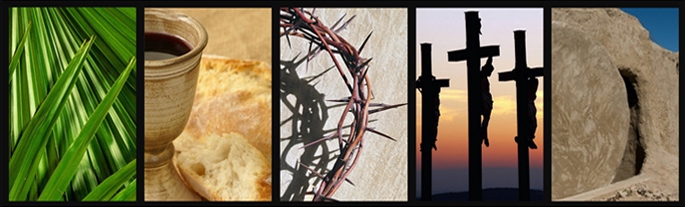
Holy Week is a funny time for liturgical churches.  Growing up in the United Methodist Church, I remember one Sunday (Palm Sunday), we put nails in the cross, and the next Sunday (Easter Sunday), we would put flowers in the same holes where those nails had been.  But services between the two Sundays were rare, if not nonexistent.  Once I became an Episcopalian, a whole world of liturgical wonders opened up.  Each church did Holy Week a little differently, but invariably, there was some kind of worship every night of Holy Week.  There were the traditional Triduum services:  Maundy Thursday, Good Friday, and Easter Vigil.  But then there were a whole variety of others things:  Taizé worship, Compline, Evensong, Healing Services, Tenebrae, Lessons and Carols, Vespers, and even special concerts. 

Among ecumenical clergy, I often get looks of skepticism, as if they wonder why we do that to ourselves (i.e. work so many nights in a row).  They are not wrong (it is certainly taxing), and I also do not promote the kind of martyred attitude many clergy assume while doing it.  For most of us though, there is something deeper happening.  Fellow clergyman Tim Schneck said it best in a recent post, “When you hear clergy strongly encouraging you to attend the services of Holy Week, especially the Great Three Days (Maundy Thursday, Good Friday, the Easter Vigil), it’s not just because they like to see more people in the pews, or it’s good for their egos, or they want parishioners to see how much effort goes into these liturgies.  It’s because they believe in the death and resurrection of Jesus Christ and the transforming power of the Christian faith.  It’s because they love you and want nothing more than for you to have such a moving encounter with our Lord, that it will change your life.  It’s an invitation rooted in profound love, and a recognition that there is literally nothing more important in the entire world than to participate fully as we collectively journey from the Upper Room to Calvary to the Empty Tomb.” 

I know life is full and stressful.  I know in my area, many families are rapidly approaching Spring Break and have a load of things to do to prepare.  But as a pastor – maybe your pastor – I want to gift you this most sacred week for your spiritual journey.  Whether you tune in online or join us in person at my church, let yourself be stirred by liturgies you do not often see, by actions you rarely do, and by music your rarely hear.  In what can easily feel like just another week, make a point to find yourself a church that can stir your curiosity about faith or your longing for meaningful connection or a sense of belonging.  But mostly, know that whatever you can do – even if it’s just Easter, know that there is a place where everyday this week, you can be reminded that you are loved – deeply, profoundly, and unconditionally.  And if you want to hear, taste, smell, see, and touch that love, the Church is waiting for you. 

Sermon – Mark 11.1-11, Mark 14.1-15.47, PS, YB, March 24, 2024

27 Wednesday Mar 2024

Posted by jandrewsweckerly in Sermons

≈ Leave a comment

Tags

God, Great Litany, Hosanna, Jesus, messiness, Palm Sunday, palms, passion, right, save, Sermon, sins

I don’t know if you remember, but back on the first Sunday of Lent about six weeks ago, we said a very long series of prayers at the beginning of the service called the Great Litany – or as my younger daughter calls them, “That time where you talked [sang] a really long time.”  Though I heard a few groans that morning when folks realized we would be praying for a long time, what I love about that Great Litany is that the litany somehow manages to encapsulate every single flaw in the human condition and the way those flaws pull us out of right relationship with God:  pride, hypocrisy, hatred, and envy; hardness of heart and sinful affections; oppression, violence, and war; and maybe the worst – dying suddenly and unprepared.

The list goes on and on, but what really gets me is how everything we started praying about in the beginning of Lent comes to the fore today in our liturgies.  I have always thought what the people do in the palm procession is where the people get things right and everything after in the Passion Narrative is where the people mess up.  But even in the Palm Narrative we mess up:  from pride in what feels like the Messiah coming to take down the powers that be, to a murderous desire to put down the oppressors that they assume Jesus will do when they shout, “Hosanna,” or “Save us,” as “Hosanna” is translated.[i]  And then we hear how the rest goes:  betrayal by loyal followers, to disciples too sleepy to keep vigil and pray, to abandoning Jesus, to mockery and violence, to conflict avoidance, hatred, and definitely a lot of hardness of heart. 

At the end of the Palm Narrative today, we are told that after the procession, Jesus goes into the temple in Jerusalem, and Jesus looks around at everything.  This may seem like a throwaway comment or a passing glance, but scholar Matt Skinner argues this is not a casual looking around at Jerusalem.  He says, “There is power in that glare.”  Jesus is setting his eyes and his heart to the work of provoking that he is about to do and he knows will lead to his death.[ii]  He is preparing for the holy, sacred work of resistance that will lead to both his demise, and ultimately to our redemption – our actual saving.  Maybe not the kind of saving we want, but the saving we need.

And that’s what brings me back to that long Great Litany from six weeks ago.  We did indeed confess a whole bunch of sins.  But you know what we also did?  We asked God to right things.  We prayed for grace to hear and receive God’s word, that God might empower us to go out in the world and share the Good News, that we might – in our several callings – serve the common good, that God might heal the brokenness in all of us and in the world.  This journey of Holy Week is not just about the despair and awfulness of our condition and the condition of the world.  This week, shockingly enough, is also about hope.  Frederick Buechner said of this day, “Despair and hope.  They travel the road to Jerusalem together, as together they travel every road we take — despair at what in our madness we are bringing down on our own heads and hope in him who travels the road with us and for us and who is the only one of us all who is not mad.”[iii] 

That is the messiness of us and of this most sacred week we now enter.  As scholar Debie Thomas writes, “I am known and held by a God who is too big for thin, one-dimensional truths — even my own, most cherished, one-dimensional truths.  I am held by a God who sticks with me even when I won’t stick with God.  A God who accepts my worship even when it is mingy, half-baked, and selfish.  A God who knows all the reasons my heart cries, ‘Save now!’ and carries those broken, strangled cries to the cross on my behalf. 

“Welcome to Holy Week.  Here we are, and here is our God.  Here are our hosannas, broken and earnest, hopeful and hungry.  Here is all that is unbearable, and all that promises to end in light brighter than we can imagine.  Blessed is the One who comes to die so that we will live.”[iv]  That journey starts today.  Your invitation is to join us everyday until we can shout our Easter praises.  Amen.       


[i]  John R. Donahue and Daniel J. Harrington, The Gospel of Mark:  Sacra Pagina (Collegeville, MN:  Liturgical Press, 2002), 322.

[ii]  Matt Skinner, as discussed in the podcast, “Sermon Brainwave:  #954: Palm/Passion Sunday – Mar. 24, 2024,” March 17, 2024, as found at https://www.workingpreacher.org/podcasts/954-palm-passion-sunday-mar-24-2024 on March 20, 2024.

[iii] As quoted by Debie Thomas, “Save Us, We Pray,” March 21, 2021, as found at https://www.journeywithjesus.net/essays/2958-save-us-we-pray on March 22, 2024.

[iv] Thomas.

Sermon – Jeremiah 31.31-34, Psalm 51.1-13, L5, YB, March 17, 2024

27 Wednesday Mar 2024

Posted by jandrewsweckerly in Sermons

≈ Leave a comment

Tags

blessing, covenant, Easter Vigil, failing, God, heart, Jeremiah, Lent, lovingkindness, salvation narrative, Sermon, share

In just a couple of weeks, Hickory Neck will gather for what is my favorite service of the entire year:  the Easter Vigil.  Now I know, you may be thinking, “But what about Easter Sunday?” or even “But Christmas Eve is the best!”  For me, the very best of the Episcopal Church happens at the Easter Vigil.  The lights are turned down low, a fire erupts as we sing the haunting Exultet, we read stories from scripture that feel like the ones you would tell around a campfire, we baptize new Christians, and then, with bells and singing, the lights come up as we ring in Easter.  The rest of the service feels like celebrating Eucharist for the first time – with the news of the empty tomb and feasting at the family table.

Part of why I love the service so much is those stories we hear by the fire:  what we often refer to as the salvation narrative.  In these stories we hear how we were created in God’s image and made for goodness, and then we hear how time and again we fail to live up to that goodness, but time and again, God meets us where we are, renewing God’s covenantal relationship with us, forgiving us, and getting us back on our feet to serve the world in God’s name.  The repetition of God extending that grace again and again and again, no matter how grave our failings, can make any participant begin to think that maybe, just maybe, we stand invited to receive that hesed or as we translate the Hebrew, that lovingkindness, of God.

Although we do not hear the text from Jeremiah on Easter Vigil night, today, on this fifth Sunday in Lent, just a week before we start the descent into the cross and the grave of Holy Week, we get one last reminder of the kind of redemption that waits on the other side of Easter.  I do not how recently you’ve been reading Jeremiah in your spare time, but just as a refresher, Jeremiah is one of those books that is generally filled with bad news.  Israel disobeyed the law of God, and, as a consequence, they are overthrown by outside forces, the walls of Jerusalem fall, the temple is destroyed, and the Israelites themselves are banished to Babylon.  The situation is bleak, and the prophet Jeremiah has a lot to say in judgment of the people.[i] 

But today, all the way in chapter 31, we get what is called “The Book of Comfort,”[ii] in Jeremiah where, after much shame and judgment, the people are promised a new day where there will be a new covenant between God and the people.  This time, they won’t have to wait for teaching, and they won’t have to store the commandments in a holy place.  The holy word of God will be written on their hearts – able to go with them anywhere, to be not just in their minds or in their temple, but on their very souls – they will be God’s and God’s will be theirs.  For a people utterly destroyed, who have lost their spiritual home in addition to their literal home, this is good news indeed.

When I was in seminary, we went to Chapel everyday – sometimes multiple times a day.  The rhythm of regular worship meant that not only did the liturgy get written into your body, so did the space.  You began to know the particulars of certain seats – which ones experienced more of a draft and which pew had someone’s initials carved in and aged over.  You knew how certain steps would creak when someone would ascend the lectern and you have seen the pulpit sway with a particularly vigorous preacher.  But mostly, you had stared, for years at a time, at the window behind the altar, around which were painted the words, “Go ye into all the world and preach the gospel.”  Consciously and maybe more subconsciously, those words became ingrained in our minds seeing them every day. 

A year and a half after I graduated, that chapel burned down, along with that wall that had been seared into my mind.  I remember feeling bereft – like a part of me had died with the loss of that building.  Even today, when I visit the campus, worshiping in the beautiful new chapel, I still grieve when I see the preserved ruins where an outdoor altar remains.  It took me a long time to realize that although my heart ached for the physical space, those words – those words that Jesus spoke, “Go ye into all the world and preach the gospel,” were gone from the world – but not from my heart.  Though I might miss the building – in the same way so many of us missed the buildings of this campus in those early years of the pandemic, the experience of God is written in my heart.

As we walk this last week of Lent, and as we begin next week to walk steadily through Holy Week, perhaps with sins weighing on our hearts, or feelings of being a failure at faith or at life in general, or even just the restlessness that can come when we find ourselves disconnected from any kind of relationship with God, our worship today is all about renewing that covenantal relationship with God.  Even in our psalm today, we prayed, “Create in me a clean heart, O God, and renew a right spirit within me.” – those same words a priest prays before she consecrates the sacred meal.  The psalm tells us the very nature of our God is “steadfast love and abundant mercy, a God who is eternally ‘for us’ with the endless love of a mother for her child.  The God who is everlasting love will never abandon us, no matter what our guilt says.  Steadfast love and abundant mercy heal us not only of the stain of sin, but also of the lie of our worthlessness.”[iii]  So likewise, Jeremiah confirms that encouragement.  As one scholar explains, “God will write the capacity for keeping the covenant on the inward hearts of the people.  Hope for such transformed wills will lie with God’s grace, not in any hope for human perfection.”[iv]

Your promise today is blessing upon blessing – blessing of belonging, of permanence, of mercy and lovingkindness.  The invitation today is then up to you.  What will you do with that renewed covenantal relationship?  How will walk differently this week with the covenant of God written on your heart?  How will you treat your neighbors differently, yourself differently, and your God differently?  The blessing is yours to keep deep in your soul.  And the blessing is also yours to share with a world that needs that blessing so very deeply.  Your work this week is to find your unique place to share that blessing.  Amen.


[i] Woody Bartlett, “Homiletical Perspective,” Feasting on the Word, Year B, Vol. 2 (Louisville: Westminster John Knox Press, 2008), 123.

[ii] Jon L. Berquist, “Exegetical Perspective,” Feasting on the Word, Year B, Vol. 2 (Louisville: Westminster John Knox Press, 2008), 123.

[iii] Elizabeth Webb, “Commentary on Psalm 51:1-12,” March 17, 2024, as found at https://www.workingpreacher.org/commentaries/revised-common-lectionary/fifth-sunday-in-lent-2/commentary-on-psalm-511-12-6 on March 14, 2024.

[iv] Samuel K. Roberts, “Theological Perspective,” Feasting on the Word, Year B, Vol. 2 (Louisville: Westminster John Knox Press, 2008), 126.

Of the Mind and of the Heart…

15 Friday Mar 2024

Posted by jandrewsweckerly in reflection

≈ Leave a comment

Tags

academic, change, children, emotional, faith, family, God, head, heart, Jesus, journey, joy, know, Lent, live, parenthood, prayer, sadness

Photo credit: https://www.everypixel.com/image-8567765057447502976

A couple of weekends ago, my husband and I found ourselves kids-free, walking the local downtown area.  As we strolled along, we observed other families – parents pushing strollers, parents supervising kids learning to ride their bicycles, parents pausing family walking for educational moments.  Watching the other families brought back a flood of memories of those stages of our lives – the fond, endearing moments as well as those moments when we felt like we might crack.  But what was not familiar was what we were experiencing that day:  the children having plans of their own, making choices to be with friends over being with their parents.

My husband and I used to work with families at our church who were going through those very changes:  the phase of life where the children’s primary influence shifts from parents to peers.  It is a good and natural phase, but one we observed was much harder for parents than for the children.  But teaching and knowing something is quite different from experiencing something – from watching your own children do the very thing you have taught other parents about.  That moment is the clarity that comes from taking an academic subject and having it become a very real, emotional subject.  Suddenly, I could see the future of the relationships with our children in a much more tangible way.  And there was some sadness, some joy, and lots of somethings in between.

As we make our way past the halfway mark of Lent and we see the approaching journey of Holy Week, I have been thinking a lot about the learned experience of faith and the felt experience of faith.  Often we Episcopalians are creatures of the mind – studying repentance and forgiveness, participating in liturgies that shape the penitential nature of Lent, and even talking to others to learn about their Lenten experiences.  But knowing about Lent can be quite different from living Lent – facing all those things we preferred to keep in the “academic” box and instead having to move them into the “lived” box. 

My prayer for you as your Lenten journey approaches the climax of Holy Week and Easter is that you let yourself feel all of it.  My prayer is that you allow that much more vulnerable version of yourself to gather next to Jesus and keep walking forward – as the imperfect person you are, accompanied by the perfection of the Savior who makes this journey possible.  I look forward to hearing how letting down those walls of self-protection and letting in the grace, love, and forgiveness of God shapes these last days of Lent.  Know that I walk with you!

← Older posts
Newer posts →

Recent Posts

  • On Sharing the Love…
  • Sermon – Micah 6.1-8, Matthew 5.1-12, EP4, YA, January 30, 2026
  • On Justice, Kindness, Humility, and the Messy Middle…
  • Feast of the Rev. Dr. Martin Luther King, Jr., January 18, 2026
  • On Peace, Love, and Conduits…

Archives

  • February 2026
  • January 2026
  • December 2025
  • November 2025
  • October 2025
  • September 2025
  • August 2025
  • July 2025
  • June 2025
  • March 2025
  • February 2025
  • December 2024
  • November 2024
  • October 2024
  • September 2024
  • August 2024
  • July 2024
  • June 2024
  • May 2024
  • March 2024
  • February 2024
  • January 2024
  • December 2023
  • November 2023
  • October 2023
  • September 2023
  • August 2023
  • July 2023
  • June 2023
  • May 2023
  • March 2023
  • February 2023
  • January 2023
  • December 2022
  • November 2022
  • October 2022
  • June 2022
  • May 2022
  • January 2022
  • December 2021
  • November 2021
  • October 2021
  • September 2021
  • August 2021
  • June 2021
  • May 2021
  • April 2021
  • March 2021
  • February 2021
  • January 2021
  • December 2020
  • November 2020
  • October 2020
  • September 2020
  • August 2020
  • July 2020
  • June 2020
  • May 2020
  • April 2020
  • March 2020
  • February 2020
  • January 2020
  • December 2019
  • November 2019
  • October 2019
  • September 2019
  • August 2019
  • July 2019
  • June 2019
  • May 2019
  • April 2019
  • March 2019
  • February 2019
  • January 2019
  • December 2018
  • November 2018
  • October 2018
  • September 2018
  • August 2018
  • July 2018
  • June 2018
  • May 2018
  • April 2018
  • March 2018
  • February 2018
  • January 2018
  • December 2017
  • November 2017
  • October 2017
  • September 2017
  • August 2017
  • July 2017
  • June 2017
  • May 2017
  • April 2017
  • March 2017
  • February 2017
  • January 2017
  • December 2016
  • November 2016
  • October 2016
  • September 2016
  • August 2016
  • July 2016
  • June 2016
  • May 2016
  • April 2016
  • March 2016
  • February 2016
  • January 2016
  • December 2015
  • November 2015
  • October 2015
  • September 2015
  • August 2015
  • July 2015
  • June 2015
  • May 2015
  • April 2015
  • March 2015
  • February 2015
  • January 2015
  • December 2014
  • November 2014
  • October 2014
  • September 2014
  • August 2014
  • July 2014
  • June 2014
  • April 2014
  • March 2014
  • February 2014
  • January 2014
  • December 2013
  • November 2013
  • October 2013
  • September 2013
  • August 2013
  • July 2013
  • June 2013
  • May 2013
  • April 2013
  • March 2013
  • February 2013
  • January 2013
  • December 2012
  • November 2012
  • October 2012
  • September 2012

Categories

  • reflection
  • Sermons
  • Uncategorized

Meta

  • Create account
  • Log in
  • Entries feed
  • Comments feed
  • WordPress.com

Blog at WordPress.com.

  • Subscribe Subscribed
    • Seeking and Serving
    • Join 395 other subscribers
    • Already have a WordPress.com account? Log in now.
    • Seeking and Serving
    • Subscribe Subscribed
    • Sign up
    • Log in
    • Report this content
    • View site in Reader
    • Manage subscriptions
    • Collapse this bar
 

Loading Comments...