• About

Seeking and Serving

~ seek and serve Christ in all persons

Seeking and Serving

Tag Archives: goodness

On Blooms of Hope…

13 Wednesday Nov 2024

Posted by jandrewsweckerly in reflection

≈ Leave a comment

Tags

blooms, comfort, generosity, God, good, goodness, growth, hope, plants, suffice, thriving

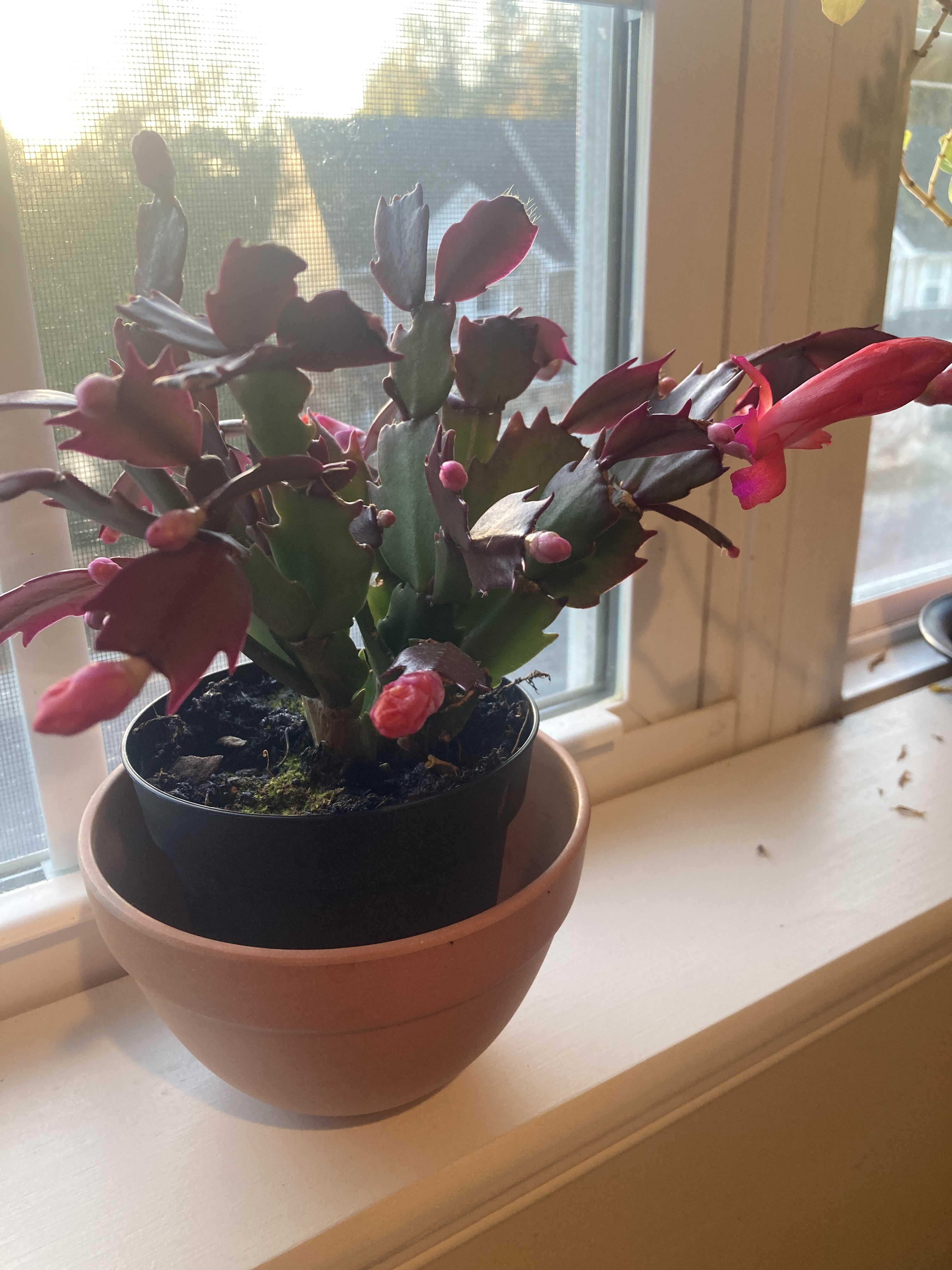
Photo credit: Jennifer Andrews-Weckerly; permission required for reuse

I have written before about how I am not good with plants.  If the term “brown thumb” was invented for anyone, it was likely me.  I have been known to even kill a cactus.  I am so resigned to this reality that when someone gifts me a potted plant, even one with blooms already on it, my immediate reaction is guilt about how short a life the plant can expect in my care.

So, imagine my surprise when a similar gift from last Christmas, a Christmas cactus, began blooming today.  I was so shocked, that I went online to learn about the plant’s blooming practices.  It was in this research that I learned I have been doing everything wrong.  The research says the plant should never be in direct light (it is sitting in the full blast of the sunrise every morning); it says you should only water the plant when the top two inches are dry (I am pretty sure I water it weekly no matter what); and it says the plant should be kept in a cool, humid space (nope, and nope).  So, despite all my mistakes, despite how this plant should likely be dead by now, here this cute plant is blooming for the first time. 

That plant has reminded me of two things today.  First, that plant has reminded me of the ways that God can work for good despite me.  I do not have the gifts, interest, or time to lovingly help plants thrive.  But God has taken my measly offerings – the occasional remembrance to water the plant without any recollection how long ago I watered it last, the guilt that has kept me from throwing the plant away before now, and the half-hearted attempt to at least give the plant sunlight – God has taken these offerings and transformed them not just to survival, but to thriving.  I am humbled by a God who can produce good despite me.

Two, I am also struck by the fact that this plant is just one tiny example of the small goodness that surrounds us all the time.  The last week has been a rough one, especially in a congregation and a community that is very “purple” politically.  Though we are quite civil with one another, emotions have been all over the spectrum and I have been struggling to see where the hope is.  But the truth is hope and goodness have been around me this whole time.  I certainly see hope in this plant who is thriving despite me – and looking quite beautiful, indeed.  I see hope in the ways people are caring for one another – asking how people are really doing, and finding ways to offer solidarity and comfort where possible.  And I see hope as parishioners increase their giving to the church in a time when budgets are stretched and prices are rising.  We could find counter arguments for all those instances – reasons to be wary or suspicious or doubtful.  Or we can choose to notice the blooms opening slowly all around us.  I am not entirely sure what God is doing these days, but I have to tell you, I feel confident that God is here, bringing us comfort and signs of hope.  And that will suffice for today.

On Practicing Daily Love…

15 Wednesday Feb 2023

Posted by jandrewsweckerly in reflection

≈ Leave a comment

Tags

daily, eyesight, fault, generous, God, goodness, kindness, love, thoughtful, Valentine's Day

Photo credit: https://www.foodandwine.com/news/most-popular-valentines-day-candy-every-state-2022

As our girls age, they take on more independence.  Recently, that took the form of preparing Valentines to exchange with classmates.  Our younger daughter had already done this for years, so she knew the drill.  In fact, I came downstairs to find her packaging the Valentines kits we had procured.  As she wrapped up, she explained to me she was leaving one Valentine undone for the new kid in her class.  “I don’t know him well enough yet.”  I asked her why that would prevent her from addressing a Valentine to him, and she explained how each person was receiving a personalized note from her.  “Dear X, You are kind.  Happy Valentine’s Day.”  Or, “Dear Y, I like your laugh.”  And another, “Dear Z, You are fun to play with.” 

Yesterday, as she packaged up the completed Valentines, I asked her what she wrote for the new student.  She settled on, “Dear W, I like how calm you are.”  I sent her off to school in awe, wishing I could claim credit for the thoughtful, generous kid she has become, but knowing I could not claim credit for her Valentine kindness.

The more I thought about her notes, the more I thought how my daughter has internalized the loving eyes of God.  Thinking of faults in others is easy.  Somedays we can think of nothing but those faults.  But thinking of goodness in each person is actually harder than it seems – especially for that coworker whose moods drive you crazy, that committee member who always stirs the pot in meetings, or that family member who is always criticizing you or your choices.  I can attest to the fact that as lovely as my daughter’s notes were, she has registered complaints about almost every classmate of hers at some point in the school year.

Instead of dwelling on the glory (or lack) of romantic love in your life this February, I invite you instead to adopt the practice of daily love.  Maybe you start with the people in your life who bring you joy.  Let them know which of their attributes you really appreciate.  But then try daily love with the hard ones in your life:  the curmudgeon, the nagger, the expert in passive aggression.  Even if you cannot immediately say the words aloud, challenge yourself to think of one lovely thing about that person.  When you finally gain the courage, then find a way to share that loving regard – maybe aloud, maybe in a quick email or text, maybe in an old-fashioned card.  I can’t wait to hear how the practice of daily loves starts shifting your eyesight!

Sermon – Luke 17.11-19, P23, YC, October 9, 2022

19 Wednesday Oct 2022

Posted by jandrewsweckerly in Sermons

≈ Leave a comment

Tags

blessing, bountiful, faith, goodness, grateful, gratitude, healing, health, Jesus, praise, Sermon, stewardship, talent, thanks, time, treasure, wholeness

Every once in a while, when we are having a particularly whiny, complaining, cranky evening at the Andrews-Weckerly household, I will break out the old, “So, what are you grateful for today?” question.  I cannot claim that our family has mastered some Zen-like practice of gratitude.  In fact, we still have to regularly remind each other simply to say, “Thank you!”  And if I am being honest, my question about what we are grateful for is a question based out frustration not out of a sense of habituated thankfulness.

I think that is why today’s Gospel lesson from Luke makes me so uncomfortable today.  Jesus graciously heals ten lepers at once with barely a word or flourish.  One of them, a Samaritan to be clear, returns, praising God in a loud voice, prostrating himself at Jesus’ feet, and thanking Jesus.  But Jesus’ response is where my guilt resides. “Were not ten made clean?  But the other nine, where are they?  Was none of them found to return and give praise to God except this foreigner?” Jesus asks.  How many times have I been one of the nine?  How many times have I experienced blessing, only to focus on another ill in my life?  How many times have I been surrounded by bountiful abundance only to be able to talk about scarcity?

For Jesus, this is unfathomable.  For Jesus, faith and gratitude go hand in hand.  Scholar Kimberly Long describes the issue thus, “…to ‘have faith’ is to live it, and to live [faith] is to give thanks.  It is living a life of gratitude that constitutes living a life of faith…One might almost say, in fact, that ‘faith’ and ‘gratitude’ are two words for the same thing:  to practice gratitude is to practice faith.”[i]  Some of you may be thinking, “Oh, to be faithful I just have to be thankful?  That’s not so hard!”  But how many of us have started a gratitude journal only to get out of the habit?  How many of us have engaged in the Ignatian practice of closing the day with enumerating the blessings of the day, giving thanks to God, only to slip into watching one more episode of your favorite show or reading one more chapter of a book, only to slip off to sleep before remembering to give thanks?  How many of us have had New Year’s resolutions or Lenten disciplines about gratitude only to drop them after a few weeks?

But here is why gratitude and faith are so intimately connected.  Jesus says at the end of this passage today, “…your faith has made you well.”  Now if we understand faith and gratitude as being synonymous, then Jesus does not mean because the Samaritan believes something he is healed.  He means because the Samaritan has embodied gratitude he has been made well.  But Jesus is not simply referring to being healed of leprosy.  The Samaritan’s life of gratitude has made him whole – has made him “truly and deeply well.”[ii]  C.S. Lewis perhaps captured the relationship of gratitude and wholeness most clearly.  He said, “I noticed how the humblest and at the same time most balanced minds praised most:  while the cranks, misfits, and malcontents praised least.  Praise almost seems to be inner health made audible.”[iii] 

Of course, this should not be news to us.  Luke’s gospel is always featuring praising.  As one professor explains, “Praising/thanking/blessing/glorifying God is a recurring theme in [Luke’s] writings – from the shepherds in the fields (2.20), to Simeon and Anna at the presentation in the temple (2.28, 38), to witnesses of Jesus’ miracles (5.25, 7.16, 18.43, etc.), to the centurion at the foot of the cross (23.47), and to both Jews and Gentiles who witness the growth of the church in Acts (4.21, 11.18, 13.48, etc.).  It seems, therefore, that Luke recounts this story not to distinguish one leper from the others but to emphasize the proper response to any act of grace:  thanks and praise to God.”[iv]

Luckily for you, Hickory Neck actually grounds you in praise every Sunday.  When we celebrate the Eucharistic feast, the celebrant says, “Let us give thanks to the Lord our God,” and you respond, “It is right to give him thanks and praise.” [or in the case of Rite I, we say, It is meet and right so to do.]  And then the celebrant affirms your words, saying, “It is right, and a good and joyful thing, always and everywhere to give thanks to you, Father Almighty, Creator of heaven and earth.”[v]  [“It is very meet, right, and our bounden duty, that we should at all times, and in all places, give thanks unto thee, O Lord, holy Father, almighty, everlasting God.]   In fact, the entire Eucharist Prayer is also referred to as the “Great Thanksgiving.” Our whole purpose of gathering on Sundays is to enter into praise of God – and as Luke tells us, we do that to make our beings whole – to make our beings truly and deeply well. 

And because we know doing something out of habit can make us forget why we are doing what we are doing, this month we enter into what we call stewardship season – or perhaps what should be called gratitude season.  This month we will be talking about the bountiful goodness we all experience in this community – the ways in which Hickory Neck is a blessing to us, the ways in which Hickory Neck feeds and shapes our faith lives, and the ways in which Hickory Neck helps us be a blessing to others.  In this month of praise and thanksgiving, we will be talking about how to make our praise tangible:  how the gift of our time, the offering of our talents, and the presentation of our financial giving might be acts of praise and gratitude.  This community has been a place where most of us have experienced transformative healing and wholeness.  Our invitation is to follow the example of the Samaritan and let our acts of gratitude become reflections of how Hickory Neck is helping us be truly and deeply well.  Amen.    


[i] Kimberly Bracken Long, “Pastoral Perspective,” Feasting on the Word, Yr. C, Vol. 4 (Louisville:  Westminster John Knox Press, 2010), 166.

[ii] Long, 166.

[iii] As quoted by John M. Buchanan, “Homiletical Perspective,” Feasting on the Word, Yr. C, Vol. 4 (Louisville:  Westminster John Knox Press, 2010), 165.

[iv] Oliver Larry Yarbrough, “Exegetical Perspective,” Feasting on the Word, Yr. C, Vol. 4 (Louisville:  Westminster John Knox Press, 2010), 169.

[v] BCP, 361.

Sermon – Luke 8.26-39, P7, YC, June 19, 2022

05 Wednesday Oct 2022

Posted by jandrewsweckerly in Sermons

≈ Leave a comment

Tags

caring, companions, demoniac, fear, Gerasenes, God, goodness, healing, hope, Jesus, love, Sermon, Stephen Ministry

Today we will be commissioning five of our members into a new program at Hickory Neck called Stephen Ministry.  These individuals have gone through six months of training, with over 50 hours of class time, homework, and practice preparing for this new role.  Stephen Ministry uses the tagline, “Christ caring for people through people.” The idea is that a parishioner going through crisis or a major transition can be assigned a trained Stephen Minister, a person who will meet with them regularly for a season to offer support, care, and listening ear.  The Stephen Minister does not solve issues, but is a companion on the journey.  Care receivers may be looking for this confidential support through an illness, the death of a loved one, divorce or a job loss, or any number of painful life experiences.  The Stephen Minister walks with us, prays with us, listens and hears us, reminding us that we are all broken, and through Jesus we can be made whole.

I think that is why I love that we get the wonderfully bizarre story of the Gerasenes today.  The Gerasenes have become care providers of sorts, but in today’s lesson we learn they are scared.  They have developed a system for dealing with the possessed man of their village.  They know when to bind him and when to abandon him.  They know he is dangerous, and unclean, but they have figured out how to keep the town safe.  He is the identified patient of the town – the one who has the “real” problems.  By identifying the demoniac as the patient, no one else has to look at their own demons – the ways in which each of them are “vulnerable to forces that seek to take [them] over, to bind [their] mouths, to take away [their] true names, and to separate [them] from God and from each other.”[i]  So, when Jesus casts out the impossible demons, and sends them to their death through their herd of swine, and the townspeople find the demoniac healed, clothed, and sitting in his right mind at the feet of Jesus, they do not celebrate or thank God for healing.  Instead, they stand afraid of the power of God.  Now that the demoniac is healed, they are afraid this Jesus will see their demons or challenge their feigned health.  In response, they do not ask for an explanation, but ask Jesus to leave.  Their fear leads to paralysis.

To be fair, fear is a natural and sometimes necessary emotion.  Fear helps us develop a healthy sense of preservation.  Fear allows us to make necessarily cautious decisions.  Fear can keep us safe.  But fear can also lead to paralysis, and perhaps more importantly, to a lack of trust.  And when we are talking about God, a lack of trust evolving from fear gets us into trouble.  We start doubting the graciousness we know God intends for us.  We start avoiding the very work that will give us joy and fulfillment.  We start losing our sense of connection to God – who happily emboldens us when we allow God to do so. 

We see in the Gerasenes’ story the goodness that can happen when we work through our fear.  Despite the fact the townspeople are fearful of Jesus’ power, Jesus brings about healing anyway.  And knowing the people of Gerasene may continue to be fearful, Jesus has the former demoniac stay behind so he can testify to the salvific work of God.  As one scholar points out, “The story ends with Jesus commissioning the healed man to stay where he is and serve as the first missionary to his townspeople — the same townspeople who feared, shunned, trapped, and shackled him for years.”[ii]  Jesus does not scold, shun, or shame when he is asked to leave.  Jesus keeps holding out hope in the face of fear – Jesus holds hope that the townspeople might be healed like the demoniac is healed.  Jesus loves graciously and expects transformation in the face of hopeless fear.      

We commission lay ministers today who are more like the healed demoniac than the Gerasenes.  They have experienced brokenness and pain in their lives, and they stand in the light of Christ’s healing, ready to walk with us Gerasenes in our fear.  Maybe our fear is in acknowledging our brokenness, when we would much rather just ask Jesus to leave.  Maybe our fear is sharing our vulnerability, especially when we feel like we are coping “just fine, thank you very much.”  Or maybe our fear is the unknown path of what we may need to go through to get to healing, health, and wholeness.  If a man possessed with legions of demons can come out the other side whole and healed, sitting at the feet of Jesus, surely Jesus stands ready to handle whatever demons we have.  Whether we take a Stephen Minister along that journey with us, or we simply hear God longs to wash us with grace, kindness, compassion, and love, our invitation today is let go of all the scary brokenness around and in us.  Yes, letting go is scary.  But God shows us over and over again how when we let go of our fear, God is there with abundant, wonderful, powerful love.  And just in case we doubt that love, God offers us companions on the journey.  Amen.


[i] Debie Thomas, “Legion,” June 16, 2019, as found at https://www.journeywithjesus.net/essays/2259-legion, on June 18, 2022.

[ii] Thomas.

On Shielding and Sharing Joy…

17 Wednesday Nov 2021

Posted by jandrewsweckerly in reflection

≈ Leave a comment

Tags

complain, compline, God, goodness, grateful, gratitude, imperfection, joy, joyous, perfection, prayer, shield, Thanksgiving

Photo credit: https://www.facebook.com/episcopalian/photos/keep-watch-dear-lord-with-those-who-work-or-watch-or-weep-this-night-and-give-yo/10155444636122925/

This month at Youth Group, before we began our closing prayer, the leader asked us each to name one good thing that had happened in the last week.  Immediately, the brows of each person in the room (adults included) furrowed as we tried to think back about something good in a sea of busyness.  Some of us struggled to remember anything good.  Others immediately burst forth with a fun thing they had gotten to do.  Some shyly shared an accomplishment for which they were proud.  And some were more abstract, like the beauty of the fall foliage.

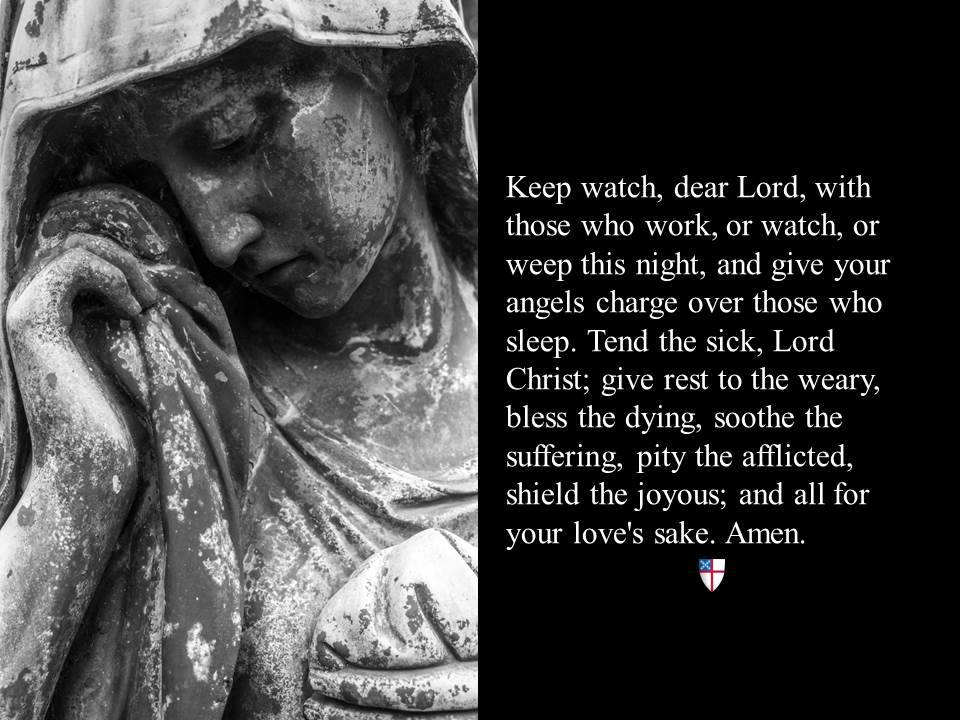
I was struck by how each one of us in the room had to think quite hard about something good happening in our lives. I do not think we struggled because there is nothing good.  I think we struggled because our brains, or maybe our culture, has wired us to do the opposite – to complain about all the things going wrong, to see only the imperfections in life or in ourselves, to be discouraged by all that could be better in our circles.  A heart of gratitude or joy takes work.  Some of us come by gratitude and joy naturally, but most of us have been enculturated to see where there is want.  That’s why one of our favorite prayers from Compline has a line in its petitions to God for God to “shield the joyous.”[i] 

As we approach Thanksgiving Day next week, I wonder if this year you are still struggling to find the joy.  Maybe you still cannot gather safely with family, maybe you are worried about the safety of the children or the vulnerable in your family, or maybe you are just weary from this time of pandemic.  I suspect many of us are feeling critical of the imperfect and are having a hard time holding on to the perfect(ly good enough). 

My prayer for you this week is that God shields your joy.  But I invite you to consider partnering with God in this endeavor.  Each day until Thanksgiving Day, before you drift off to sleep, think back to one thing for which you grateful, that gave you joy, or was just a good moment.  The goodness does not have to be big or creative.  Start with something basic.  While you engage in this prayerful practice, I will be praying that God shields your joy, and I hope you will share your joy with someone else – so they can be shielded by God too. 


[i] Book of Common Prayer, 134.

Sermon – Genesis 3.8-15, Mark 3.20-35, P5, YB, June 6, 2021

16 Wednesday Jun 2021

Posted by jandrewsweckerly in Sermons

≈ Leave a comment

Tags

anxiety, belonging, discomfort, evil, God, goodness, Holy Spirit, Jesus, listen, relationship, relax, restless, Sermon, sinfulness, summer, The Fall

Last week we talked about the long journey we had made in the liturgical year that helped us get to Trinity Sunday.  After Trinity Sunday, we enter into the next long journey of what we call “ordinary time,” that time that stretches through summer and the fall when we settle into the stories about the life and ministry of Jesus.  In some ways, what happens in the Church is like what happens in the summer – we kick off our shoes, pull up a refreshing beverage, and settle into a good summer read.  The shift should be a palpable sigh of relief as we ease into the familiar stories we love.

Except, nothing about scripture lessons today is remotely relaxing – in fact, our Old Testament and Gospel texts do quite the opposite, making us tense with discomfort and anxiety.  We start with the story in Genesis, traditionally call the story of the fall.  Adam and Eve have already consumed the fruit from the forbidden tree, and today we hear the story of their being “caught.”  Right away, God knows something is amiss, and how do Adam and Eve respond?  In a comical exercise of finger pointing.  Adam blames both Eve and God:  Eve because she “made” Adam eat the fruit and God because God gave Eve to him in the first place.  Eve blames the serpent, recognizing she was tricked.  The curses from God fly:  on the serpent, on the land, and later in Genesis, on the man and woman and their habitation.  Historically, this text has been used to subjugate women, but most theologians know this story impacts all kinds of theological concepts – from our sinful nature, free will, promises of salvation, and the covenant.[i]  But you do not have to be a theologian to read this text and know that the finger pointing of humans when caught in sinfulness is not going to lead to goodness.

Then we get this strange story about Jesus in Mark’s gospel.  Jesus is simply sitting among the people and his disciples when things go crazy.  The scribes come and begin to proclaim that Jesus is possessed by Satan, and anything seemingly good Jesus is doing is rooted in evil.  Then Jesus’ own family assume he has had a mental breakdown and they come to restrain Jesus.  The people who should know and love Jesus best and the people who should be able to recognize the power of the Holy Spirit try to cast him out.  In response, Jesus rejects them all.  Instead, he professes to have no family except those who gather around him and do the will of God.  Jesus does not actually define what the will of God is, so we should be careful not to project our own notions of doing justice or serving those in need.  For now, being a part of the family of Jesus seems to involve sitting around.  As scholar Matt Skinner says, “The way into kinship—belonging—with Jesus is sticking around. It’s to acknowledge that you’ve been caught up into a new reality—this transformational alternate reality called ‘the kingdom of God’—and to hold on for the ride. That’s probably not the entirety of what it means to do or to accomplish or to commit to ‘the will of God,’ but it seems to be the biggest part, as far as Mark is concerned.”[ii]

Perhaps that is our invitation this summer too.  We are still invited to kick off our shoes, sit at Jesus’ feet, and pull up a good book.  But instead of rereading a comforting story, this may need to be a summer of reading the stories that ask us hard questions: of whether we are in right relationship with God or hiding who we really are; whether we are insisting on our own will or way instead of the way of Jesus; whether we are too restless to slow down and simply sit with the Holy Spirit.  In the flurry of regathering, of finally getting to experience some familiar practices like sitting in chairs [pews] we have missed, using our voices to sing [speak] among others, and seeing familiar friends and meeting new ones, we can miss why we love this community so much in the first place.  We can forget that Hickory Neck is a place we like to come because we are a community who does not let each other hide, who challenges one another to follow the way of love, who will remind us to slow down and listen for the soft voice of God.  Who we are and what this community does is the reason why we will continue to livestream services – so those who still need to be at home can be a part of us too, so those who are tending to life’s daily commitments can come back to the video for a good word, and so those who are longing for something more in life can get to know this Jesus – who redefines who is in and out – and sit at his feet with us.  Our experience this summer might not be one you were hoping for after a long, hard fifteen months – but I suspect this summer will be even better than you could have imagined.  Amen.


[i][i] James O. Duke, “Theological Perspective,” Feasting on the Word, Year B, Vol. 3 (Louisville: Westminster John Knox Press, 2009), 98.

[ii] Matt Skinner, “Stick Around,” May 30, 2021, as found at https://www.workingpreacher.org/dear-working-preacher/stick-around on June 4, 2021.

On Being Normal and Other Longings…

03 Thursday Jun 2021

Posted by jandrewsweckerly in reflection

≈ Leave a comment

Tags

church, community, connection, core, discipleship, God, goodness, happy, normal, pandemic, restrictions

Photo credit: https://avalonassnmgmt.com/2020/11/23/normal-is-overrated-for-now/

This Sunday, our parish is introducing two in-person worship services for the first time in fifteen months.  There is a lot about which to be excited!  We will be able to worship in our beloved Historic Chapel, which was not able to be used during most of the pandemic due to structural restrictions.  We will be able to sing congregationally, even if we have to keep our masks on for a little while longer.  We will be able to skip registration and check-in, we can sit wherever we want (you have no idea how hard such a simple thing has been for some of our parishioners!), and we can receive communion sitting right next to other people – some people we have loved and missed for a long time and some people who are completely new to us!  There are a few restrictions remaining, like masking, avoiding touch, and not being able to share a common cup, but we are okay with incremental change and so very happy for what we will get to experience this Sunday.

All that being said, you may have noticed I am being very careful to not say we are “going back to normal.”  Partially that is because we are not yet fully engaging in church as we once were.  And in some ways, there are permanent additions, such as livestreaming, that we never experienced pre-pandemic, that will be mainstays for us now. 

But the real reason I have avoided using the term “normal,” is because I don’t want us to go back to normal.  “Normal” in March 2020 meant a country deeply divided politically; neglecting, or downright oppressing, immigrants, the impoverished, women, and the LGBTQ community; and a deep unwillingness to talk about systemic racism.  Even our church was unwilling to fully embrace digital discipleship and evangelism.  I am not interested in returning to that kind of “normal.”

And so, although it may seem like semantics, we are introducing worship in a new way.  We are modeling all the goodness of things we once knew, and hopefully letting go of some of the things that needed to be let go.  We are holding fast to the things we loved during this pandemic – connecting to people who are far away, helping the less mobile feel a part of the community, and encouraging connection, even when the service times do not match your schedule.  And we are coming out on the other end as something different – with the same core values and passions – but expressed in a different way.  And for now, that, as God said in creation, is very good!

Sermon – Acts 1.15-17, 21-26, E7, YB, May 16, 2021

26 Wednesday May 2021

Posted by jandrewsweckerly in Sermons

≈ Leave a comment

Tags

apostles, bishop, discernment, disciples, election, Episcopal, God, goodness, grace, Holy Spirit, Jesus, prayer, Sermon, trust, will

I have sometimes daydreamed about the experience of liturgical freedom:  picking and choosing the scripture for a given Sunday (particularly when I need to address a specific issue), praying an extemporaneous prayer on a Sunday to address a certain topic in the church, or drafting our own liturgical experience to address a particular need.  However, as crazy as the idea may sound, I more often find freedom within our Episcopal constraints than within the endless possibilities of what could be. 

This past week was a classic example.  Last Sunday, totally unaware of the announcement I would be making on Tuesday, Bob preached about the invitation of the Resurrection being an invitation into discernment – discernment about what each of us needs to do to bring about the kingdom here on earth.  On Tuesday night, our regularly scheduled Discover Class topic, which was scheduled months ago, was focused on the structure and leadership model of the Episcopal Church, including who bishops are and how they are elected.  Then today, we get this lesson from the Acts of the Apostles in which Peter and the other apostles are attempting to replace the twelfth spot Judas left open through his death.  All that daydreaming about constructing our spiritual experiences went out the window this week when I remembered the Holy Spirit does a much better job at constructing those experiences than I ever could!

To say that this portion of the Acts of the Apostles is a divine gift is not necessarily because we happen to be talking about a bishop’s election this week just as the apostles are talking about an election of sorts.  In fact, what the apostles are doing is the opposite of an election.  No one asks Matthias or Justus to go through an interview process or offer their vision of leadership for the next decade.  Instead, their criteria are pretty simple.  First, the replacement should be someone who knows Jesus personally.  Second, they want to honor their ancestral roots in the twelve tribes of Israel – eleven apostles will not suffice.[i]  Third, their decision is rooted in prayer.  And finally, their decision is based on trust in the will of God.  Nowadays, we might think the casting of lots is a little too random and could lead to a poor appointment of leadership – I mean when was the last time we selected a Rector, Warden, or Committee Chair by flipping a coin?  But according to New Testament scholar Kathy Grieb, the casting of lots is “an ancient biblical practice for determining God’s will…”[ii]

Hearing about all the coincidences in our last week, from talking about discernment, to the structure of the Episcopal Church, to the selection of the last apostle, may be intriguing or even amusing, but may also leave you asking, “So, what?  What does all of this have to do with me or my experience of Hickory Neck, or even more broadly, with Jesus?”  As I have reflected on these coincidences – or as Carl Jung referred to them as instances of “synchronicity” or “meaningful coincidence”[iii] – I see an invitation for all of us from Peter.  First is an invitation to recall our identity.  We are a community whose historic identity has been about weathering change – whether it was the identity crisis created by the Revolutionary War, the replacement of a faith community by schools and hospitals for over a century, to reclaiming and expanding our land to become a church again, to surviving a global pandemic.  The possibility of a change in clergy – a very small possibility at that – does not alter the fact that we are a community rooted in Jesus’ love, shining our light on this Holy Hill for almost three centuries.  Second is an invitation into prayer:  prayer for the Hickory Neck Community, prayer for your Rector, and prayer for the Diocese of Iowa and the other candidates.  Our hurt, our frustration, our fear, and our joy can be left at the feet of Christ in prayer.  When given the space, prayer can do much more than we can imagine.  And finally, our invitation this week is to trust in God.  We may not always like what God does – I am pretty sure the apostles would much rather have not been trying to figure out a leadership model in Jesus’ absence.  But we do know that God is faithful, and, in time, God leads us to goodness and grace.  I do not know where the next couple of months will lead us.  But I do know if we can stay rooted in our identity, in prayer, and in our faith in God, we will come out stronger disciples for Jesus, strengthened to take on whatever “meaningful coincidences” the Holy Spirit throws our way.  Amen.


[i] Noel Leo Erskine, “Theological Perspective,” Feasting on the Word, Year B, Vol. 2 (Louisville: Westminster John Knox Press, 2008), 528.

[ii] A. Katherine Grieb, “Exegetical Perspective,” Feasting on the Word, Year B, Vol. 2 (Louisville: Westminster John Knox Press, 2008), 531.

[iii] Carl G. Jung, Synchronicity: An Acausal Connecting Principle (Princeton:  Princeton University Press, 2012), 44, as cited at https://artsofthought.com/2020/05/30/carl-jung-synchronicity/ on May 14, 2021.

On New Year Hope…

06 Wednesday Jan 2021

Posted by jandrewsweckerly in Uncategorized

≈ Leave a comment

Tags

breathe, change, community, fortitude, goodness, Holy Spirit, hope, invitation, New Year, pandemic

Photo credit: https://www.health.harvard.edu/blog/hope-and-caution-during-infertility-treatment-2019102818130

I remember when the year 1999 rolled over into 2000.  It was a time a great hubbub.  There was a sense of enormity about the transition.  Prince’s song 1999 experienced a revival, most of the world was worried about the ability of our technology to transition to Y2K, and many feared there would be some sort of cosmological event.  As the minutes rolled down to seconds, there was a collective intake of breath that we held until the clocks moved to midnight.  In the end, the transition was fairly uneventful.  Technology kept functioning, no big events happened, and most of us realized it was just another New Year’s. 

I have felt a similar incongruence this New Year’s.  Having had such a tumultuous year – between the pandemic, civil unrest, and political upheaval – I think many of us had begun to believe that once we turned the calendar from 2020 to 2021, things would be better.  The virus spread would slow as vaccines were promisingly being rolled out and we would finally be able to turn our energy from crisis mode to dealing with long-term issues like race.  And we might even begin to see some political stability.  If we could just get 2020 to close, all would be well. 

But these first days of 2021 have felt a little like the first days of 2000.  Not much has changed.  Instead of feeling like the change in calendar year has made everything better, we are left with the reality that we are still in the same situation.  In fact, things are going to get worse before they get better, which is almost incomprehensible.    

As that reality has sunken in these last few days, I see two invitations before us.  The first invitation is to take a deep, steadying breath.  This is not a loud, exasperated sigh, but a calming, strengthening breath – a breathing in of the Holy Spirit as we face the continuation of this season.  The second invitation is to take a moment to reflect on all the coping mechanisms we have developed in these last ten months – whether it has been operating in a new way (like livestreaming worship, zooming formation, or drive-thru connection events), whether it has been making space for community when we feel isolated (like sending mail, emails, and texts to fellow parishioners, hosting far-flung friends on Zoom calls just for fun, or taking socially distanced walks with others), or whether it has been discovering pleasant surprises (like the new people who have connected to your community even when your doors are closed, the hilarity that can ensue with virtual Epiphany pageants, or the blessings of a property that can lead to things like an outdoor labyrinth).  I know these last months have felt overwhelmingly disastrous at times.  But taking some breaths and looking at the goodness that has happened in the mess is what is giving me hope and fortitude for this next year.  My prayer is that you might find that same hope today too!

On Shifting Sands and Drishtis…

19 Thursday Nov 2020

Posted by jandrewsweckerly in Uncategorized

≈ Leave a comment

Tags

balance, control, family, focus, God, goodness, grace, imbalance, Jesus, love, pandemic, parenting, power, sand, weary, yoga

Photo credit: https://www.yogajournal.com/yoga-101/pillars-of-power-yoga-using-drishti-on-and-off-the-mat

When you are doing balancing postures during yoga, one of the skills you learn early on is developing a drishti, or a focal point.  The idea is the more you focus your gaze on one fixed object, the more your body steadies itself.  I am not entirely sure why or how finding a drishti works, but I know from experience that a very wobbly body in a balancing posture is quickly steadied once focused on a drishti.  It is a strange sensation, but when the drishti is engaged, the gaze of the eyes has complete power over the entire body, creating a sense of self-possession, control, and power.

I was talking to a fellow parent this past week and when we talked about parenting during a pandemic, I told her I felt like I was standing on shifting sand.  Just when I would start to figure out a rhythm or start to feel like I had some modicum of control over family life, things would change – whether the formal arrangement with hybrid learning, the changing of teachers mid-quarter, or even my own child’s changing ability to adapt and thrive.  Just when I feel like our family is finding our balance, something makes us wobbly all over again.  That kind of uncontrolled imbalance, of attempting to stand on shifting sand leaves the body weary and fatigued.

But as I have been thinking about pandemic parenting and my learning in yoga, I’ve begun to wonder if what this wobbly parent might need is a pandemic drishti.  For some parents that might mean focusing on the blessing of your children – so that no matter what tempter tantrum they are throwing today, what argument you are having as a family, or what door they have slammed, you focus not on the anger and frustration of the scene immediately in front of you, but on the love you have for your child (even if it’s only the love you see when they are fast asleep).  For me, my drishti is the love of God surrounding us on every side:  the one who loves me when I fail as a parent, the one who loves my child as they receive another setback in expectations, the one who loves each of us when all we can see is the heat of anger and frustration in one another.  Once I focus on God’s love of us, slowly my demeanor starts to shift, my balance starts to return, and my steadiness strengthens.

This week, I encourage you to claim your pandemic drishti.  Whether you focus on God’s lovingkindness, the grace of our Lord Jesus Christ, or the ever-present blessing of the Holy Spirit, take whatever time you need to shift your gaze on God.  My guess is the more you practice steading your gaze on the goodness of God, the more your wobbling, weary body will feel grounded in goodness too.  We cannot control the shifting sand of these times.  But we can control our steady gaze in the face of a storm.

← Older posts

Recent Posts

  • On the Myth and Magic of Advent…
  • On Risking Failure and Facing Fear…
  • Sermon – Luke 23.33-43, P29, YC, November 23, 2025
  • On Inhabiting Gratitude…
  • Sermon – Luke 20.27-38, P27, YC, November 9, 2025

Archives

  • December 2025
  • November 2025
  • October 2025
  • September 2025
  • August 2025
  • July 2025
  • June 2025
  • March 2025
  • February 2025
  • December 2024
  • November 2024
  • October 2024
  • September 2024
  • August 2024
  • July 2024
  • June 2024
  • May 2024
  • March 2024
  • February 2024
  • January 2024
  • December 2023
  • November 2023
  • October 2023
  • September 2023
  • August 2023
  • July 2023
  • June 2023
  • May 2023
  • March 2023
  • February 2023
  • January 2023
  • December 2022
  • November 2022
  • October 2022
  • June 2022
  • May 2022
  • January 2022
  • December 2021
  • November 2021
  • October 2021
  • September 2021
  • August 2021
  • June 2021
  • May 2021
  • April 2021
  • March 2021
  • February 2021
  • January 2021
  • December 2020
  • November 2020
  • October 2020
  • September 2020
  • August 2020
  • July 2020
  • June 2020
  • May 2020
  • April 2020
  • March 2020
  • February 2020
  • January 2020
  • December 2019
  • November 2019
  • October 2019
  • September 2019
  • August 2019
  • July 2019
  • June 2019
  • May 2019
  • April 2019
  • March 2019
  • February 2019
  • January 2019
  • December 2018
  • November 2018
  • October 2018
  • September 2018
  • August 2018
  • July 2018
  • June 2018
  • May 2018
  • April 2018
  • March 2018
  • February 2018
  • January 2018
  • December 2017
  • November 2017
  • October 2017
  • September 2017
  • August 2017
  • July 2017
  • June 2017
  • May 2017
  • April 2017
  • March 2017
  • February 2017
  • January 2017
  • December 2016
  • November 2016
  • October 2016
  • September 2016
  • August 2016
  • July 2016
  • June 2016
  • May 2016
  • April 2016
  • March 2016
  • February 2016
  • January 2016
  • December 2015
  • November 2015
  • October 2015
  • September 2015
  • August 2015
  • July 2015
  • June 2015
  • May 2015
  • April 2015
  • March 2015
  • February 2015
  • January 2015
  • December 2014
  • November 2014
  • October 2014
  • September 2014
  • August 2014
  • July 2014
  • June 2014
  • April 2014
  • March 2014
  • February 2014
  • January 2014
  • December 2013
  • November 2013
  • October 2013
  • September 2013
  • August 2013
  • July 2013
  • June 2013
  • May 2013
  • April 2013
  • March 2013
  • February 2013
  • January 2013
  • December 2012
  • November 2012
  • October 2012
  • September 2012

Categories

  • reflection
  • Sermons
  • Uncategorized

Meta

  • Create account
  • Log in
  • Entries feed
  • Comments feed
  • WordPress.com

Blog at WordPress.com.

  • Subscribe Subscribed
    • Seeking and Serving
    • Join 394 other subscribers
    • Already have a WordPress.com account? Log in now.
    • Seeking and Serving
    • Subscribe Subscribed
    • Sign up
    • Log in
    • Report this content
    • View site in Reader
    • Manage subscriptions
    • Collapse this bar
 

Loading Comments...