Embracing joy…

Tags

, , , , , , , , , ,

Our Vestry and Parish just completed a Mutual Ministry Review – a time to reflect on the health of our congregation and to strategize about how to move toward greater health and wholeness.  There was a lot of positive feedback in the survey indicating the ways in which we have grown and changed for the better in the last three years of ministry together.  And of course, there was plenty of constructive criticism about what we can do to make our ministry together better.  Some of the feedback included things we could do quite easily, and some of the feedback will take longer to address.  But the Vestry was energized to make those changes and move toward wholeness.

Like with any feedback though, we quickly lost sight of all that is going well.  We lingered only for a moment on the good and positive work God is fostering among us, and we immediately dug in with the work we needed to do to improve.  Although I am super proud of our Vestry’s desire to dig in and do some of the dirty work of improvement, I want to take a moment to remind our whole parish of the need to prayerfully lift up the goodness in our midst.  Without being rooted in gratitude for all the goodness God has brought us, my fear is that we will be overwhelmed by the burden of improvement and not steadied by the encouragement of the Holy Spirit.

I was reminded of that lesson this Sunday.  This Sunday the Vestry started working on prioritizing our improvement work and making goals and deadlines for ourselves.  The work is important and necessary, but I must admit our spirits were a bit heavy.  But just thirty minutes before our meeting, in the context of worship, we honored all of our children and teachers who had participated in Sunday School, Rite 13, and Adult Formation this program year.  The transept was overflowing with people.  Because we use a rotation model for Sunday School, we had over 10 teachers and shepherds this year.  We had three teachers for Rite 13, and five teachers for adult formation.  For a parish with a relatively small average Sunday attendance, those numbers are tremendous.  And that does not include all the children who were present!  It was a glorious sight and a testimony to the good work we are doing to form us into a community that is seeking Christ.  Well done, good and faithful servants!!

My encouragement to all of us this week is to hold on to that moment.  Hold on to that image of a full transept of people who have spent the last year deepening their relationship with Christ, and marvel at the good work that the Spirit is doing at St. Margaret’s.  And give yourselves a pat on the back for the ways in which you have committed yourselves to being faithful builders of the Kingdom of God.  There will always be work to do, but my hope is that we can see the joy behind the work we do.  Because there is a lot to be joyful about!

Sermon – Isaiah 6.1-8, TS, YB, May 31, 2015

Tags

, , , , , , , , , , , , ,

“God sat Sunday in her Adirondack deck chair, reading the New York Times and sipping strawberry lemonade, her pink robe flowing down to the ground.  The garment hem was fluff and frill, and it spilled holiness down into the sanctuary, into the cup and the nostrils of the singing people.  One thread trickled loveliness into a funeral rite, as the mourners looked in the face of death, and heard the story of a life truer than goodness.  A torn piece of the robe’s edge flopped onto a war in southern Sudan and caused heartbeats to skip and soldiers looked into themselves deeply.  One threadbare strand of the divine belt almost knocked over a polar bear floating on a loose berg in the warming sea.  One silky string wove its way through Jesus’ cross, and tied itself to desert-parched immigrants with swollen tongues, and a woman with ovarian cancer and two young sons.  You won’t believe this, but a single hair-thin fiber floated onto the yacht of a rich man and he gasped when he saw everything as it really was.  The hem fell to and fro across the universe, filling space and time and gaps between the sub-atomic world, with the effervescent presence of the one who is the is.  And even in the slight space between lovers in bed, the holiness flows and wakes up the body to feel beyond the feeling and know beyond the knowing…”[i]

I stumbled on Michael Coffey’s poem as I struggled with the idea of how to preach about the Holy Trinity on this Trinity Sunday.  And then I realized something:  we understand theology much more through experience than through reading some heady fourth-century theologian.  The concept of the Trinity is not an easy one to understand.  In fact, the concept is so complicated that most of us try not to think about the Trinity at all.  We simply know the Father, the Son, and the Holy Spirit as truth, and do not worry too much about the details.  That approach is probably fine most of the time – until you have to explain the concept of the Trinity to a child or non-believer.  Trying to explain how God, Jesus, and the Holy Spirit are all the same and yet all distinctly separate is not as simple as it sounds.  Then try to explain how all three are co-eternal and I promise you, you will get looks of confusion.  The questions about how Jesus can be born in a particular time and place and yet be co-eternal with the Holy Spirit and God will make anyone stutter.

I have begun to wonder then if part of why we do not often spend time working through the theology of the Trinity is because we do not necessarily need to think about the Trinity – we simply need to have an experience of the Trinity.  That realization became clearest to me this week as I thought about our lesson from Isaiah.  Now you may be wondering how I found an experience of the Trinity in the Old Testament.  Certainly, we need the fullness of the New Testament to really understand the Trinity.  But we have to remember that the Trinity has always been – remember that word “co-eternal”?  Now I must admit, this notion makes me uncomfortable too – reading a New Testament theology into the Hebrew Scriptures is what a lot of purists call anachronistic – a chronological inconsistency where we juxtapose two different time periods incorrectly.  But given our theological understanding of the Trinity as being co-eternal, many theologians argue that seeing the Trinity in our Isaiah text today is not, in fact, anachronistic.[ii]  If you buy that logic, the song the seraphs sing, “Holy, holy, holy is the Lord of hosts…” reminds us of the old hymn, “Holy, Holy, Holy” which contains the line, “God in three persons, blessed Trinity.”  The seraphs’ song hints at the three persons of the Godhead.  And when God wonders what prophet God will send to the sinful people, God says, “Whom shall I send, and who will go for us?”  That “us,” by many scholars, is considered yet another precursor to the concept of the Trinity.[iii]

But all of that is academic to me.  We can certainly debate whether or not the Trinity is hinted at in the Isaiah reading today.  But what is more important to me is that we get a better understanding of the experience of the Trinity through the Isaiah story.  The story starts with Isaiah seeing the Lord sitting on a throne, with that hem that Michael Coffey describes so vividly in his poem.  The text says the hem of God’s robe fills the temple.  Imagine, as Coffey does, the hem of that robe filling this entire church.  Imagine fabric billowing over the pews, draping over the altar rail, spilling out the front door.  Imagine us stumbling over the enormity of that fabric, getting tangled up in the hem’s folds.  And all of that fabric swirling around us is only the hem of the robe – not the whole robe, but the hem of the robe.  Isaiah’s description is of a God that is larger than life, that is incomprehensible in size and vastness.  Just the tip of God’s garment is larger than the greatest Cathedral and certainly overwhelming in a space like our intimate church.

In fact, the experience of God is so overwhelming, that Isaiah is brought down to his knees in fear – not a simple fear of God, but fear because Isaiah realizes he is woefully sinful and unworthy of being in God’s presence.  He even shouts among the folds of fabric that entangle him, “Woe is me!  I am lost, for I am a man of unclean lips…”  That is the second experiential understanding of the Triune God.  First we are overwhelmed by the Trinity’s vast, mysterious incomprehensibility, and second, we are crippled by the shame of our sinfulness in response.  But then, another profound realization happens.  When Isaiah confesses his sinfulness, the seraph simply touches his mouth with a hot altar coal and Isaiah’s sin is blotted out.  That is the third thing we discover about the Trinity.  Father, Son, and Holy Spirit are quick to forgive a repentant heart.  No Hail Mary’s are necessary.  No Our Fathers.  Forgiveness is swift and full – much unlike human capacity for forgiveness.  Finally, we learn yet another interesting thing about the Trinity.  God-in-three-persons needs us.  The Lord says, “Whom shall I send, and who will go for us?”  There is not strategic plan; there is no preordained conception of who should go.  God does not say, “Isaiah, you shall go and be my prophet,” which is unusual because in most of the call stories we hear, God does call people by name.  But not with Isaiah.[iv]  Here, the Trinitarian Godhead is wondering who in the world will go and be the prophet.  That is what we finally see about the Trinity.  The Trinity openly invites – and according to Isaiah’s response, “Here am I: send me!” we learn that the Trinity inspires people to recklessly volunteer for things they probably shouldn’t.

Of course, when we really think about what we learn about the Trinity in Isaiah: that God is vastly other, inspires repentance, readily gives forgiveness, and causes wanton willingness to serve the Lord, then we begin to see that all of those insights are part and parcel of our own experience of the Trinity every week in worship.[v]  Every week, we start our worship in praise.  We praise God in word, song, and prayer.  We marvel at the vastness of God’s hem as we read and reflect on God’s Word.  We profess our Trinitarian faith in the Creed and then we confess.  Like Isaiah, all that praise, wonder, and realization of God’s enormity pulls us down to our knees as each one of us confesses our unworthiness aloud.  A chorus of voices comes together as we each confess our faults and failings over the past week.  And then, just like a snap, the priest delivers God’s forgiveness.  We are offered the Eucharistic meal, which, like the coal on Isaiah’s lips, wets our lips with forgiveness.[vi]  And when the priest tells us to go out into the world rejoicing in the power of the Spirit, we find ourselves overwhelmed with the words, “Here am I; send me!”  We find ourselves jettisoning ourselves into the world, longing to serve the God whose robe knocks us over and whose meal sets us free.

Michael Coffey’s poem brings us full circle to our Trinity Sunday ponderings.  About God’s robe, Coffey concludes, “…And even as we monotheize and trinitize, and speculate and doubt even our doubting, the threads of holiness trickle into our lives.  And the seraphim keep singing “holy, holy, holy”, and flapping their wings like baby birds, and God says: give it a rest a while.  And God takes another sip of her summertime drink, and smiles at the way you are reading this filament now, and hums: It’s a good day to be God.”[vii]  Amen.

[i] Michael Coffey, “God’s Bathrobe,” as posted on May 31, 2012 at http://mccoffey.blogspot.com/2012/05/gods-bathrobe.html as found on May 27, 2015.  Punctuation and formation changed for ease of preaching.  Original structure found on website.

[ii] Donald K. McKim, “Theological Perspective,” Feasting on the Word, Yr. B, vol. 3 (Louisville:  Westminster John Knox Press, 2009), 30.

[iii] McKim, 28.

[iv] Patricia Tull, “Commentary on Isaiah 6.1-8,” found at https://www.workingpreacher.org/preaching.aspx?commentary_id=2458, May 31, 2015, as found on May 27, 2015.

[v] Kristin Emery Saldine, “Pastoral Perspective,” Feasting on the Word, Yr. B, vol. 3 (Louisville:  Westminster John Knox Press, 2009), 28, 30.

[vi] Melinda Quivik, “Commentary on Isaiah 6.1-8,” found at https://www.workingpreacher.org/preaching.aspx?commentary_id=1284, June 3, 2012, as found on May 27, 2015.

[vii] Coffey.

Evangelism joy…

Tags

, , , , , , ,

This Monday our parish walked in our local Memorial Day Parade.  I did a lot of cajoling to get our parishioners out among the community that day.  But I must admit, that morning all I wanted to do was stay in bed.  I had experienced some sleepless nights with the little one, Monday is normally my day off and walking in the parade would mean losing not just my day off but a holiday too, and it is a rare weekday that I get to have my whole family together.  So despite all my haranguing about our need to evangelize, all I wanted to do was stay in bed (or at least stay in my pajamas, since little ones do not believe in sleeping in around our house).

But as soon as the crowds began to gather, I realized how good God is.  While walking to the parade, we ran into one of my daughter’s friends from kindergarten.  Later, we ran into the clergy and staff of our neighboring Lutheran church and preschool, who had not seen our youngest child since our preschooler graduated last spring.  I found myself introducing St. Margaret’s parishioners to non-church friends.  We managed to gather the largest number of parishioners to ever walk the parade.  And, quite honestly, I had fun.

That’s the funny thing about evangelism.  We get all nervous about what will happen.  We wonder what we will say.  We fret about how people will react when we talk about church.  We worry it will be awkward.  But Monday gave me a renewed spirit for sharing the Good News.  Sharing your joy about church isn’t really all that awkward.  In fact, it tends to segue into other conversations, because joy is contagious.  Thanks for reminding me about my joy, St. Margaret’s!  Let’s do it again soon!

Sermon – Acts 2.1-21, PT, YB, May 24, 2015

Tags

, , , , , , , , , , , , , ,

There is something quite comforting about coming into the doors of a church.  There is a peace that comes over us when we enter the doors.  Despite the fact that a wooden bench would not be all that comfortable any other time, the sleek, hard pews give us a sense of stability and security.  The familiar motions of the liturgy give us just enough variety to keep us engaged, but enough similarity to give us a sense of comfort.  The distinct texture and taste of the bread and wine in our mouths somehow fill our entire bodies with tranquility.  When those doors close behind us, we feel protected from the outside world – a world that is noisy, harsh, and sometimes cruel.  Inside the doors we find warmth, calm, and serenity.  Slipping into the church is like slipping under a soft blanket that envelops us in security.

We are not unlike those disciples on Pentecost day.  The disciples had made a habit of retreating indoors ever since Jesus died.  Even though the miracle of Easter had happened, almost every time Jesus makes a resurrection appearance, the disciples are behind closed doors.  In fact, on the feast of Pentecost, the disciples were supposed be having a party with the rest of the community to celebrate the giving of God’s law.  But instead, we find them cowering once again in one room behind a bolted door.[i]  I suppose we cannot be too judgmental.  They saw firsthand what happened to Jesus.  Though his ministry had been revolutionary, he was tortured and killed like a common criminal.  Surely anyone associated with him or promoting his ministry and witness would receive similar treatment.  And we cannot forget their shame.  Though they had vied to be at his right and left hand during his ministry, and though they fawned over him when he was making an impact, when push came to shove, they all abandoned him.  And Peter was the worst.  Though he did not betray Jesus like Judas, he basically did the same thing.  In fact, his betrayal may have been worse because he vowed – swore to Jesus and everyone – that he would never, ever betray Jesus.  But he did betray him.  Over and over he denied he even knew the man who was an intimate friend and mentor.  We would probably be hiding behind closed doors too, trying to cover our shame.  Even with all the promises Jesus makes, and the ways he keeps appearing to the disciples, they just cannot seem to get over that hurdle of their shame and fear to step out into the light.

Maybe that is what the community of Christ would have been – a community that gathers in the shadows – had Pentecost not happened.  In the comfort of closed rooms that envelop like a warm blanket, they would whisper stories from the good ol’ days.  They could even develop some rituals just for their members – Jesus had taught them about washing feet and eating the Eucharistic meal.  In fact, maybe they could use that as a recruiting technique.  If word gets whispered around that they are gathering in the quiet, then maybe others will seek them out and ask to join them.  Maybe they do not need to go out like Jesus said and share the good news.  Maybe people will come to them.  They could even figure out a symbol – like a red door – to let everyone know how to find them.

Ah, but you see, God had other things in mind for those disciples.  I wonder sometimes how God ever puts up with us.  God tried for the longest to be in covenant with God’s people.  Over and over again God delivered them from peril.  Over and over again, God renewed God’s covenant with the people, even though they kept breaking that covenant.  Over and over again God chased after the people, longing to gather them like a mother hen.  God even went so far as to send Jesus, to be present among the people in flesh form, and died on a cross to redeem God’s people.  Even after the miracle of the resurrection, after destroying death forever, God’s people still sit hovered in fear, having forgotten all the ways that Jesus wanted them to live boldly.[ii]

And so, on this day, because they clearly could not muster that boldness themselves, something – or someone – breaks down the door – breaks down the walls – and explodes inside the disciples.  A violent, rushing wind fills the room and bursts the doors open.  Different languages – languages they had never spoken before – erupt out of their mouths.  The text says that the people are bewildered, amazed, astonished, and perplexed.  But the Greek text is much more vivid.  The original text says they are “confused, in an uproar, beside themselves, undone, blown away, thoroughly disoriented, completely uncomprehending.”  [You can imagine the chaos from just hearing the chaos of our reading today.]  No longer do the disciples hover in a darkened room.  They are loudly, boldly in the public square talking nonsense – and yet sounding perfectly clear to those gathered.  Even Peter, the one with the most to be ashamed of, the one who probably feels like the deepest failure, on this day manages to become all that Jesus intended for him to be.  When the disciples meet resistance and sneering, Peter stands up and does what he was meant to do all along.  He testifies.  He testifies in public, in the midst of scary chaos, and says the words that have been on his heart since Jesus died.  He proclaims hope, and promise, and fulfillment.  He steps out of the shadows and steps into the light.

How do they do it?  How do the disciples manage to get over their fear and shame and go out into the public square?  Well, they certainly do not do it alone.  The only way they are able to conquer their fear and shame and step boldly into the public square with their testimony is through the Holy Spirit.  Most of us do not really feel comfortable with the Holy Spirit.  We use words like the “Advocate” or the “Comforter” to describe the Holy Spirit.  We think of the Holy Spirit as the one who remains with us after Jesus is gone.  But in our text today, the Holy Spirit is not comforting.  In fact, the Holy Spirit is disturbing, disruptive, and life-changing.  As one scholar says, “The Holy Spirit is as much agitator as advocate, as much provocateur as comforter.”[iii]  In fact, the word in Greek for the Holy Spirit is Paraclete.  That word may be our best way to understand how this all words.  Paraclete is a compound Greek word that literally means, “to come alongside another.”  “In this sense, the Paraclete can be an advocate – to come along side to defend and counsel – or comforter – to come along side to provide comfort and encouragement.  But the one who comes along side might also do so to strengthen you for work, or to muster your courage, or to prompt or even provoke you to action.”[iv]

Last weekend at the Vestry Retreat, our facilitator gave us a challenge at lunch.  She gave us all an assignment.  We had to go up to a stranger in Panera and ask them whether they knew of an Episcopal Church in Plainview.  You should have seen the furrowed brows and the shifting in our chairs most of us did.  You should have heard the bargaining many of us did, promising to do it another day.  We’re not alone in our discomfort.  Tomorrow, you all have been invited to walk with us in the POB Memorial Day Parade to promote St. Margaret’s in the community.  Many of us have valid excuses for not going – the walk is rather long and some of us are out of town for the holiday.  But many of us just do not feel comfortable being the face of the church – giving witness to total strangers.  And that is not the only challenge before us.  Just this week, we posted the baseball schedule for the Little League team we are sponsoring.  The idea is for us not just to have our name in print on a big sign in the outfield.  The idea is also that we meet people where they are – at a baseball field at the POB Community Park on a Saturday afternoon – and just say hi.  We listen to their stories and we share ours.  I know that most of us will not get up the nerve to go sit with a bunch of strangers.  In fact, when we decided to sponsor the team and invite parishioners to go to games, one parishioner told me explicitly, “Oh, St. Margaret’s parishioners won’t go to a game.  They just won’t.”

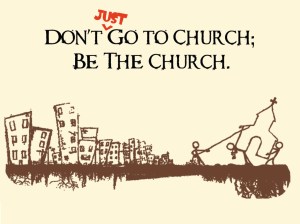
Today we sit inside, huddled together in a place of comfort and familiarity.  We even painted our doors red and we hope people will find their way to us so that they might enjoy the beauty of St. Margaret’s as we do.  But our church is inviting us again and again to get out of that nostalgic pew, to go out in public, and proclaim the good news.  How in the world will we do it?  Amen.

[i] William H. Willimon, “Taking It to the Streets,” Christian Century, vol. 108, no. 15, May 1, 1991, 483.

[ii] Rob Merola, “Radical Reliance,” Christian Century, vol. 123, no. 11, May 30, 2006, 22.

[iii] David Lose, “Pentecost B: Come Alongside, Holy Spirit!” May 18, 2015, as found on May 20, 2015 at http://www.davidlose.net/2015/05/pentecost-b-come-alongside-holy-spirit/.

[iv] Lose.

On beauty…

Tags

, , , , , ,

I was visiting a neighboring parish recently and was admiring their beautiful landscaping.  A dogwood was blooming in delicate pink.  There were pockets of flowers in red and purple.  As I was surveying the beauty, I noticed one, brilliantly yellow tulip standing on its own near the dogwood.  It was surrounded by mulch and little else.  And yet my eyes were drawn to the single flower more strongly than the rest of the carefully planned landscaping.  When I mentioned the little flower to someone on campus, they said that sometimes flowers “volunteer” like that.  They self-pollinate and just show up where they like.

The image was a striking one:  something so out of place, and yet so beautiful.  By “volunteering” and just standing boldly where it was, this tulip was a reminder of how beauty cannot always be managed.  Sometimes beauty is beautiful because it was not managed.

Thinking back on that tulip, I found myself wondering whether I was willing to be so bold – whether I was comfortable volunteering to be wherever God planted me.  Jesus talks to the disciples in Matthew about being a light for the world.  He says in Matthew 5.16, “…let your light shine before others, so that they may see your good works and give glory to your Father in heaven.”  Jesus’ words sound simple, but I think we do not really feel comfortable living out his instructions.  We might consider letting our light shine…as long as we are surrounded by others doing the same.  We don’t mind being a brilliantly yellow tulip…as long as we can be beautiful with others.  But ask us to go at it alone – to let our light shine by ourselves so that others might see our individual good works and give glory to God – well, that is another story.  What if I am not bright or beautiful enough?  What if my works aren’t good enough and people judge me instead of giving glory to God?

The trick is remembering that little tulip.  I saw lots of flowers that day that looked beautiful.  But it was the one solo flower that made me stop, that made me linger nearby.  That tulip had power simply by being willing to be where it was, and to be there in its fullness.  Our invitation is to do likewise.  My guess is that even if we cannot see our own beauty or our own light, others will – and they will give glory to God.

Sermon – John 15.9-17, E6, YB, May 10, 2015

Tags

, , , , , , , , , , ,

One of my favorite television shows was a show called Gilmore Girls.  Gilmore Girls captured the story of the quirky relationship between a single-mom and her teenage daughter, and the funny adventures that happened to them in their small town.  One of my favorite scenes from that show was an episode in which the daughter was celebrating her birthday.  First thing that morning, the mother tiptoed into her daughter’s room, snuggled in her bed, and began her yearly ritual of retelling her birth story.  “Once upon a time, a long time ago, a scared, pregnant woman entered the hospital with contractions.”  Based on the way the story begins and the tone in the mom’s voice, the viewers all think this is going to be a tender moment between mother and child, where the mom will describe the way her heart filled with joy when she looked into her daughter’s eyes.  Instead, the mother proceeds to tell the gory, painful story in graphic detail, basically intimating that the daughter should feel indebted to her mother for the great burden of her birth, and every year the child should celebrate the work her mother did to birth her, instead of the mother needing to joyfully celebrate the daughter.

The audience chuckles at the scene because we all know that mother.  This is the mother who says, “I was in labor for 60 hours with you…the least you could do is…”  Or the mother who says, “Oh you think that is hard?  Try giving birth naturally to a nine-pound baby and then tell me what hard is!!”  This kind of guilt-based love never really feels like love.  The response guilt-based love gets is something done out of obligation, not out of joy or devotion.

The funny thing is that in many ways, that guilt-based love is what we hear from Jesus in our gospel lesson today.  Jesus says, “This is my commandment, that you love one another as I have loved you.  No one has greater love than this, to lay down one’s life for one’s friends.”  When I think about Jesus, I do not think of him as a coercive parent.  And yet, his language, especially about his death and resurrection can sound exactly like that.  You can almost hear the nagging parent, “I hung on a cross until midday and died for your sins.  The least you could do is love one another as I loved you!!”  And what is so frustrating is that there is no comeback line to that logic.  There is no way for us to come back to Jesus and argue, “Well, that was a different time period.  If you had lived today, that would not have happened.”  Or, “But your death wasn’t all that bad, and you did rise again, so really, we don’t need to feel that guilty because your death was a necessary evil.”  Those whining excuses do not hold water, and we are left manipulated into a sense of obligation, because, really, who can argue with Jesus?  He did die for our sins, and there is no way to repay him.

When we think about our faith, more often than not the lessons we learn are guilt-based.  Even our most basic “Golden Rule:  Do unto others as you would have them do unto you,” is a lesson based on guilt.  When we are reminded of that rule, and we think about how we feel when someone hurts us, we guiltily stop our negative behavior.  But the guilt is not limited to our faith.  Our behavior in friendships is often dictated by guilt and obligation.  She always buys me a gift for Christmas, so I should buy her a gift too – even when we know neither of us needs gifts.  They had us over for dinner and served nice wine, so now we need to invite them to our place and pick up a similar vintage.  He gave party favors at his party, so we need to give party favors at our party too.  We get so caught up in the obligations of life that we lose touch with joy – the joy of our faith, of our friends, of our life.

Here’s the problem with guilt:  guilt creates a false sense of agency.  In other words, after we experience guilt, we come to believe that we have the power, and in the case of guilt, the need, to work harder to achieve something better.  When we first read our gospel lesson, the lesson seems laced with guilt.  Upon first glance, Jesus seems to be telling us over and over all the things we need to do to be better – to love better.  But that assumption could not be farther from the truth.  Jesus says three things that show us how his love is not a manipulative, guilt-inducing love, but a freely given and freeing love.  First, Jesus explains that he wants the disciples to abide in his love and to love others because he wants his joy to be in them, so that their joy may be complete.  I hear Jesus’ words this way, “Don’t love because you feel like you have to or because you feel like you should.  Love because loving will give you joy.  This joy is no ordinary ‘happiness’[i] – a fleeting feeling like the one you get from a great piece of chocolate.  This joy runs deep and can be a well that you can keep drawing from, even after happiness is long gone.  I know because I have this joy – and I want to give that joy to you.”  Jesus does not guilt us into a particular behavior because we should behave that way.  He wants us to know and feel the deep joy he has and he knows the way to get there – through love.

Second, Jesus renames the disciples as friends.  He says, “I do not call you servants any longer, because the servant does not know what the master is doing; but I have called you friends, because I have made known to you everything that I have heard from my Father.”  As one scholar explains, in Jesus’ day, “to be called a ‘slave’ of a good master was not denigrating, and it could even be a title of respect.  But still a ‘slave’ was not on the same level as a friend.  A slave’s status obligated him to support a master through difficult times, but a friend would do it freely, for reasons of mutual commitment and affection.”[ii]  Jesus is not offering a promotion in order to garner favor with the disciples.  Jesus is pointing to a reality that has already occurred, and that reality shifts the motivation behind all that they do.  The love Jesus talks about giving is not out of a sense of obligation due to an unequal relationship, but out of a sense of abundance that comes from intimate, loving equality and mutuality.

Finally, Jesus reminds the disciples that the love they experience in him is not out of a sense of obligation because of their relationship, or even because the disciples must do something to receive that love.  No, Jesus says, “you did not choose me but I chose you.”  This is different from the love of a mother or father for a child.  A child never chooses their parents, but parents also do not get to choose their children.  But here, Jesus chooses the disciples.  Jesus sees their inadequacies, their weaknesses, their imperfections, and he chooses them anyway.  They do not earn his love; they do not even earn their discipleship.  Jesus chooses them.  Jesus loves them first.  They do not earn that love or owe anything for that love.  Jesus chooses them – again and again.

When we hear Jesus’ words more clearly – when we hear the great abundance behind his words, suddenly our sense of guilt disappears.  When we understand that we are Jesus’ friends, that we are chosen by Jesus, and that Jesus simply wants us to know the same joy that he knows, all those commandments – which basically boil down to love anyway – are not burdens or actions done out of guilt.[iii]  Those commandments are what we do because we are so overwhelmed by how we are loved that the love spills out of us helping us to extend Christ-like friendship, love, and joy to others.  That behavior is not something we choose.  We do not choose to love our cranky neighbor.  We do not choose to love that parishioner who always seems to know how to irritate and downright anger us sometimes.  We do not choose to love that homeless person on the street.  We could not fake that kind of love if we were guilted or even if we wanted to give that love.  We can only approach that kind of love because when we know Christ – as his friend – the friend who chooses us before we ever choose him – the friend who longs for us to know deep, abiding joy – when we know that Christ, the love we need oozes out of us despite ourselves.  We find ourselves doing ridiculous things like taking that cranky neighbor a bowl of soup when we hear about their cancer treatments.  We do silly things like hug that frustrating parishioner really hard at the peace.  We do crazy things like giving our full wallet’s contents to the homeless person because suddenly how responsible they are with the money just doesn’t even matter anymore.  We cannot stop that love.  We cannot control that love.  We cannot even use that love judiciously.  That kind of love comes from a place in us unlike any other we know – a place free from guilt, obligation, and coercion.  Because although you were birthed through the waters of baptism, that birth will never be a reason for you to be guilted into anything.  Amen.

[i] Karoline Lewis, “Choose Joy,” May 3, 2015 as found at http://www.workingpreacher.org/craft.aspx?post=3608 on May 8, 2015.

[ii] Thomas H. Troeger, “Homiletical Perspective,” Feasting on the Word, Yr. B, vol. 2 (Louisville:  Westminster John Knox Press, 2008), 499.

[iii] Lawrence Wood, “Labors of Love,” Christian Century, vol. 120, no. 10, May 17, 2003.

On Mother’s Day…

Tags

, , , , , ,

As Mother’s Day approaches, I face it with my usual dread.  Though there are so many mothers that we can and should honor (I love you, Mom!!), there are so many people for whom this is a hard day.  I am at the stage in life when many of my friends are having children.  There are the sonogram picture announcements about the pregnancies, the gender-reveal parties, the showers, and, of course, the onslaught of beautiful baby pictures.  It is a time of great joy and most of the time it feels like a gift, especially to be a part of it all when friends live far away.

But then I remember all of those friends who want to be pregnant, but struggle with infertility.  Each pregnancy announcement is bittersweet.  And I remember all of those friends who have lost a pregnancy.  Those sonogram pictures bring up fresh rounds of grief.  And I remember those friends who have lost children after birth.  Those pictures of swaddled babies bring back the muscle memory of empty arms.

Of course, that does not even include all the other ways that Mother’s Day can be difficult:  the mothers we have lost, the mothers who have been abusive, the mothers who are estranged from their children.  The list goes on and on.  And so, each year, my Mother’s Day tradition has been to reread this wonderful ode to “The Wide Spectrum of Mothering,” by Amy Young.  May you bless and be blessed this Mother’s Day, affirming all the women in your life.

Sermon – Acts 8.26-40, E5, YB, May 3, 2015

Tags

, , , , , , , , , , , , , , ,

Have you ever heard a story so many times that you feel like you could recite it from memory?  There was a time in my life when I read the book Good Night Moon so many nights in a row that I could probably have told the story without even turning the pages.  But rereading books is not just a habit of young readers.  Adults do the same thing – we love a book so much that we may read the book again and again.  The familiarity of a story and knowing how the story will end can be quite comforting.  The same could be said of Bible stories too.  Though the Bible is a huge book with tons of stories, we tend to have our favorites that we read again and again.  We read and reread them because they give us a sense of comfort and they steady us in a world of chaos.

The challenge with a familiar story is that we sometimes get so used to hearing the story over and over that we stop really listening to the details.  That is especially true in our story from Acts today.  Philip, the educated evangelist graciously approaches the foreign, outcast eunuch and asks if he needs help interpreting scripture.  He then teaches the eunuch about Jesus, and graciously accepts him into the community of faith by baptizing in a nearby body of water.  In essence, this is a story about how the Jewish followers of Christ graciously open up the community to those who have traditionally been seen as outcasts.

At least that is how the story goes in my memory.  But as I reread the story this week, I began to realize that the comforting tale I had memorized is not quite as simple as I had remembered.  I had always thought of Philip as one of the educated disciples who graciously takes in the eunuch.  But Philip is actually an outsider in this story.  The Philip in our story is not the Philip from Bethsaida, one of the twelve disciples of Jesus.  This Philip is a Greek in Jerusalem, who is one of the seven appointed by the disciples to run the food pantry, the clinic, and the hospice program in Jerusalem so that the Twelve did not need to do that work.[i]  He is not necessarily well-educated, and in fact, is probably pretty disheveled and unseemly, given the relief work he has been doing with the outcasts of society.  The Ethiopian eunuch is an outsider too – in fact he is a double outsider of sorts because of his race and his sexuality.[ii]  Because of his dark skin and the fact that he is a eunuch means he would not have been allowed into the temple.  But this is no ordinary foreigner.  Yes, he is a double outsider, but he is also a highly educated, wealthy, powerful man.  He is in charge of the Queen mother’s treasury, he is prominent enough to ride in a chariot, and he is wealthy enough to own a scroll.[iii]  And although he is not allowed into the temple, he is returning from a time of worship in Jerusalem – so in some ways he is both a double outsider and a faithful follower.  When the eunuch invites Philip into his chariot, Philip is not the one being gracious – the eunuch is the one graciously allowing this disheveled man of faith into his pristine chariot.

Not only is there more complexity to the socio-economic status of these two men, there is also more to the interaction between the two men.  In my mind, Philip was the gracious imparter of wisdom in this story.  But in fact, the Ethiopian does not ask Philip to teach him – as if acknowledging that the two men are unequals.  The Ethiopian asks Philip to guide him – in other words, to journey with him into the Scriptures, and even eventually into baptism, as the two men go down into the water together.[iv]  These two strangers sit side-by-side and together read scripture and talk about what that scripture means.  Philip is on as much of a spiritual journey as the Ethiopian.  This is not a story about a well-educated follower of Christ taking in a marginalized outsider and converting him to Christ.  This is a story about two outsiders, unlikely to ever be sitting together, pondering the word of God together, and finding new life in Christ.

That’s the funny thing about stories – if we do not really pay attention and listen, we tend to fill in the blanks ourselves, often missing the big details.  As I have been watching the riots and racial unrest in Baltimore this week, I keep returning to that theme – that perhaps this is one of those instances where we have not done a very good job of listening.  I suppose I should not be surprised that we are not very good at listening.  We are a culture that talks over each other, that tries to force our version of truth upon one another.  I have listened to countless reporters this week argue with Baltimore residents and protests about their experiences.  I have read countless Facebook posts expressing anger and frustration about the civil unrest.  This whole week has felt like people are competing to have their own version of the truth being seen as the “Truth,” with a capital “T.”  In fact, just the mention of Baltimore probably has you thinking about your own feelings on the subject, mentally blocking any other narratives from your mind

When I lived in Delaware many years ago, I joined a group run through the YWCA that was meant to help foster healthy conversations about race.  One of the main rules of the group was that when an individual shared their story, we were not supposed to be in true conversation.  Each of us was to take turns telling our truths – without interruption or questions.  And the others in the group were to listen.  The method was so counterintuitive that the facilitator’s main job was to enforce the speaking and listening rules.  Although I struggled with the method, I must admit that I learned more in that group than I ever could have imagined.  When I listened – truly listened without assuming I knew how the story would end – I learned things about the experiences of black Americans that I had never known, and had certainly never experienced myself.  Truth unfolded for me like a blooming flower.

Those groups, and my experience this week of trying to prayerfully listen to the oppressed in Baltimore, reminded me of the interaction between Philip and the eunuch.  Back then, God’s chosen people and foreign, black, castrated men did not sit together and study scripture.  God’s chosen people were not accustomed to guiding people instead of teaching them.  God’s chosen people were not only not used to be called to accountability, they were also not likely to accept the criticism and change.  And yet, that is what these two men do.  And the only way any of this story happens is because both men listen – really listen to one another.

This winter I read a book called Toxic Charity.  The premise of the book is that much of the charity work that churches and communities do is flawed because that work is posed as work we do for others as opposed to with others.  The author criticizes communities that enter into impoverished areas, assuming they know what is best for the community.  Instead, the author suggests that those who want to help do so under the direction of those in need.  The main role of those who want to help is to assist the community in articulating their needs, and then empowering the community to make the systemic changes needed for long-term, sustainable change.  That kind of shift in charity work involves a lot more listening, humility, and a willingness to follow instead of lead.

In the case of Baltimore, in the case of Plainview, and really in the case of all Christianity, today’s story reminds us that there may not be simple answers to the world’s ills.  We cannot always fix what is wrong in our society – and in fact, perhaps we can never fix the wrongs without first being prayerful listeners.  As soon as we assume we know someone else’s story, or we know all there is to know about an issue, we have already shut down the movement of the Spirit.  And that is what this story is really all about.  This is not a story about how Philip converted a eunuch.  This is a story about how the Holy Spirit moved among strangers who had nothing in common and created commonality, love, and faith.[v]  The amazing work of Philip and the eunuch journeying to the baptismal waters together is only possible because both agree to vulnerably, honestly, prayerfully listen to one another, to learn together, and to be converted together.[vi]  Their story today invites us to go and do likewise.  Amen.

[i] William Brosend, “Unless Someone Guides Me,” Christian Century, vol. 117, no. 15, May 10, 2000, 535.

[ii] Barbara Brown Taylor, “Homilietical Perspective,” Feasting on the Word, Yr. B, vol. 2 (Louisville:  Westminster John Knox Press, 2008), 457.

[iii] Paul W. Walaskay, “Exegetical Perspective, Feasting on the Word, Yr. B, vol. 2 (Louisville:  Westminster John Knox Press, 2008), 457.

[iv] Brosend, 535.

[v] Taylor, 459.

[vi] Nadia Bolz-Weber, “The Conversion of the Ethiopian Eunuch,” April 20, 2012 as found at http://thq.wearesparkhouse.org/yearb/easter5nt-2/ on April 29, 2015.

On prayer and listening…

Tags

, , , , , , , ,

As Christians, there are many things we say out of habit.  We say, “God bless you,” when someone sneezes, even if we do not actually mean to invoke a blessing on the person.  We say, “Peace be with you,” in church without necessarily thinking about what offering the peace really means for our relationship with the other person.  And we regularly say, “I’ll keep you in my prayers,” even if we do not really keep a practice of diligent prayers.

And yet, as I have thought about the chaos that has erupted in Baltimore this past week, the only thing I can say with confidence is that I am holding Baltimore in my prayers.  Everything else I have tried to say has been muddled mess.  If I talk too long about my sorrow around the violence, I find that I too easily slip into blaming – a slippery slope at best.  If I try to talk about race, I find myself getting tangled up in the ways that race is invariably tied to socio-economic status and the inability I have as a white person to speak authority on the experience of my minority brothers and sisters.  No matter what philosophical argument I try to make, I find myself entangled in a very complicated system of oppression and favor.

And so although “I am holding Baltimore in prayer,” sounds like what a person of faith says as a throw-away statement, I really mean it.  I mean it because that is all I feel like I can do with authenticity and humility.  I mean it because it feels like something I can actively do when I feel powerless in so many ways.  And I mean it because what I know in the depths of my heart is that the situation in Baltimore is making me more upset about my own privilege and power than anything.  And I can only work that out through prayer.  God and I need to talk – and I need to listen.

My hope is that prayer will open up a listening heart not just for God’s word, but also a listening heart to my brothers and sisters.  When prayer is at its best, it is an exercise in listening – and if anything, I am acutely aware of how much listening we need to do right now.  The listening this week started for me with this article.  After it brought me to my knees in prayer, I stumbled on this article about what Martin Luther King, Jr. once said about riots.  These pieces and many more have reminded me once again of my obligation as a person of privilege to shut my mouth, and open my eyes and ears.  Though a posture of prayer does not excuse us from action, as Desmond Tutu once said, we cannot accomplish much without it.

Sermon – 1 John 3.16-24, E4, YB, April 26, 2015

Tags

, , , , , , , ,

This Sunday, informally touted as “Good Shepherd Sunday,” is a favorite of many churchgoers.  The words of the 23rd Psalm remind us of the many times we have turned to God for comfort – whether at a loved one’s bedside, at a funeral, or in our own desperate prayers.  Or maybe we associate the image of Jesus as the Good Shepherd with our gospel lesson today.  Jesus says, “I am the good shepherd.  I know my own and my own know me…”  As we hear Jesus declare how he lays down his life for his sheep, perhaps we imagine the various artistic depictions of Jesus – with a staff in his hand or with a lamb draped over his shoulders.  Many churches love the image so much that they even use this image as their namesake – much like our partner in ministry, Good Shepherd Lutheran here in Plainview.  Imagining our Lord as the Good Shepherd is one of the more comforting, assuring, life-giving experiences of our faith.

Despite the ways this Sunday is meant to be a Sunday of assurance and affirmation, I find myself a bit unsettled.  Though our psalm and gospel lesson offer us comfort, our epistle lesson does not let us stay there long.  After telling us that Jesus lays down his life for us, the very next line in the epistle reminds us that the Good Shepherd’s actions have consequences.  “…and we ought to lay down our lives for one another,” says First John.  “How does God’s love abide in anyone who has the world’s goods and sees a brother or sister in need and yet refuses help?  Little children, let us love, not in word or speech, but in truth and action.”

Instead of being comforting, these words have been discomforting me all week.  Every sentence leaves me feeling more and more convicted.  Yes, the Lord is your shepherd who lays down his life.  Now go and do likewise.  Yes, God’s love abides in you and blesses you with more goods than most of the world has.  Now go and help your brother and sister in need – do not refuse to help anyone that you see.  And certainly the Lord your shepherd is proud when you speak or sing about loving your neighbor.  Now stop talking about love and go do loving things.  Be love to your neighbor.  If the gospel and psalm today are about comforting images of a loving Shepherd, our epistle lesson reminds us that our Good Shepherd loves us, but loves us so that we can similarly be a loving shepherd to others in the world.

In 2011, Egypt erupted in what we have now come to call the Arab Spring.  Hundreds of people died and thousands were injured when protestors took to the streets to protest the corruption of President Mubarak’s regime.  Though the protestors tried to be peaceful, calling for justice, freedom, and governmental reform, they were met with brute force.  One of the most striking images to me from this time was a picture of Egyptian Christians, surrounding a group of fellow Muslim protestors as they prayed.  As the Muslim protestors knelt down in prayer, the Christians protestors held hands, creating a human wall of protection around those in prayer.[i]  When I saw that image four years ago, my immediate thought was, “That is what laying down one’s life looks like.”  The Christian protestors knew how vulnerable their Muslim brothers and sisters would be if they knelt down in prayer in the public square.  The brutal police force would take advantage of any vulnerability they could find.  The Christians became like the Good Shepherd, risking their lives because they saw their neighbors in need.  Their actions showed their love better than any words could have.

That is what love looks like.  We can talk about love in sermons or in Sunday School.  We can sing about love in our hymns and make speeches in the square.  We can write an op-ed or a letter to our congressman expressing our concerns for our neighbors in need.  But today, our epistle lesson does not let us rest there.  Our epistle says that our love must be shown in truth and action.  We must lay down our lives for one another like the Good Shepherd does.

That charge today may seem hard, or even impractical and imprudent.  Many of us cannot even imagine an opportunity to lay down our lives for someone else.  And yet, that is the instruction for us in our epistle – not just to talk about injustice, but to love so greatly, to care so deeply for other children of God that we are willing to put ourselves aside in love and care for the other.  I do not know what that looks like for each one of us here.  But here is what I can tell you.  In 2011, those Christians in Egypt surrounded Muslims in prayer, willing to give their lives for their Muslim brothers and sisters.  In 2013, two years later, Muslims in Pakistan returned the favor.  When a Christian church in Peshawar was attacked, and over 100 Christians were killed, over 200 Muslims formed a human chain around the church to enable the Christians to celebrate Mass in a show of unity and love.[ii]  Just two years later, in 2015, after terrorist attacks in Copenhagen, Muslims stood up for their Jewish brothers and sisters, forming a human ring around the perimeter of the synagogue to protect them while they prayed.  The teenager who organized the ring called for 30 volunteers – and at least 630 showed up in an act of love and peace.[iii]

This is why Jesus laid down his life for us – to show us the life giving force of love.  When the Good Shepherd laid down his life for us, the disciples spread that love over the entire world.  When we show love to others, that love keeps moving beyond us in ways that we will likely never know.  That is the beauty of our God.  God loved us so much that God sent God’s Son.  God’s Son loved us so much that he laid down his life.  And we love others because we have known the love of the Good Shepherd.[iv]  The action of our love – not just the words and speeches – but the action of our love can transform the world.  When we love in action and truth, we continue the work begun in the Good Shepherd – and we give others their own loving image to hold on to and to harness for change in the world.  Amen.

[i] Daily Mail Reporter, “Images of solidarity as Christians join hands to protect Muslims as they pray during Cairo protests,” February 3, 2011, as found at http://www.dailymail.co.uk/news/article-1353330/Egypt-protests-Christians-join-hands-protect-Muslims-pray-Cairo-protests.html on April 24, 2015.

[ii] Aroosa Shaukat, “Pakistani Muslims Form Human Chain To Protect Christians During Mass,” October 8, 2013, as found at http://www.huffingtonpost.com/2013/10/08/muslims-form-human-chain-pakistan_n_4057381.html on April 24, 2015.

[iii] Hana Levi Julian, “Young Muslims to Protect Oslo Synagogue as Jews Pray in Norway,” February 18, 2015, as found at http://www.jewishpress.com/news/breaking-news/young-muslims-organize-to-protect-oslo-synagogue-as-jews-pray-in-norway/2015/02/18/ on April 24, 2015.

[iv] Ronald Cole-Turner, “Theological Perspective,” Feasting on the Word, Yr. B, vol. 2 (Louisville:  Westminster John Knox Press, 2008), 442.