• About

Seeking and Serving

~ seek and serve Christ in all persons

Seeking and Serving

Tag Archives: church

On Learning Love…

14 Wednesday Jun 2017

Posted by jandrewsweckerly in Uncategorized

≈ 1 Comment

Tags

care, church, community, hatred, Jesus, learning, LGBTQ, love, love is love, pride, witness

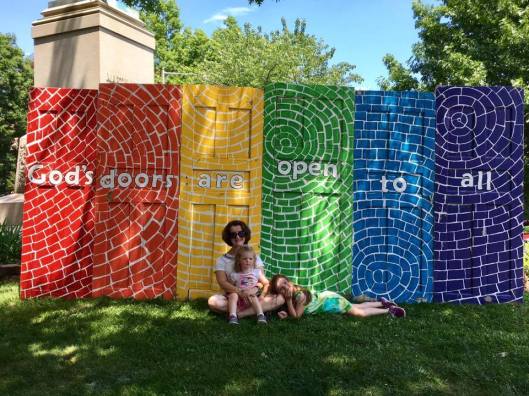
19060191_10155029443210379_5630596855440230652_nThis past weekend, our family was invited to meet up in DC with some friends from California.  They were attending the pride parade that afternoon, so we decided to meet them for a late lunch and then join them for as much of the parade as our little ones could handle.  We did not tell the children much about the visit – just that we would have lunch with friends and watch a parade.  Our oldest had already been a part of a pride parade with my husband’s work last year.  But everything would be new for our youngest.  It would also be my first pride parade.

What struck me about DC that day was the prevalence of invitations to love.  That may sound simple, obvious, or overused.  Perhaps we have become desensitized now that “Love is love,” has become a motto of sorts.  But as I watched all those gathered that day, I was overwhelmed by the outpouring of love.  This is a community which has every reason to embrace defensiveness, anger, and a sense of righteous indignation.  The LGBTQ community has been the victim of judgment, oppression, prejudice, violence, anger, ostracization, and emotional abuse.  They have been the victims of laws that limited their ability to not only be in relationship, but even to be in committed, monogamous, legal marriages.  They have been denied jobs, housing, adoptive rights, and patient rights.  They have every reason to be a community that reflects the hatred they have experienced.

And yet, I felt nothing but love that day.  I felt nothing but a celebration of love, care, and community.  And I cannot tell you how powerful it is to have your children surrounded by strangers who exude that kind of love.  My heart was warmed and I felt humbled by the community’s ability to show love in the face of hate.  As a person of faith, and as a pastor, I was hoping to see the church out, making the LGBTQ community feel welcome.  But after our day together, I wondered if the movement perhaps needed to be in reverse.  Perhaps the Church needs to be inviting the LGBTQ community in to teach us more about the love Christ talks about.  The love I felt that day was nothing short of the kind of love Jesus teaches throughout his ministry.  I was grateful for the wonderful witness of the LGBTQ community.  I just hope the Church can catch up and follow their example.

Sermon – Acts 1.6-14, E7, YA, May 28, 2017

31 Wednesday May 2017

Posted by jandrewsweckerly in Sermons, Uncategorized

≈ 2 Comments

Tags

ambiguity, Ascension, church, community, disciples, discomfort, God, Jesus, Kingdom, liminal, Pentecost, pray, promise, Sermon, Spirit, together, wait, waiting

We do it all the time:  waiting.  Waiting is perhaps one of the cruelest experiences of life.  Waiting for the test results that will tell us whether or not we have cancer.  Waiting for a call back after interviewing for our dream job.  Waiting all summer long after graduating high school before we can start new life in college.  The trouble with waiting is that we can feel lost – we are between two realities – the one we know and the one that is to come.  In some ways, simply by finding out we need the test, by applying for the job, or by making the deposit at college, life can never be the same.  Something is changed in our lives by stepping into the unknown.  And yet, we do not have the answer, we have not started the job, and school has not begun.  We are not the new person we know we will be.  We are in-between, in limbo, in no-man’s land.

Scholars call this in-between time liminal time.[i]  Liminal time is the time in which we are in the middle of a transition.  Native cultures experienced liminal time most famously in the journey to adulthood.  When young men or young women reached a certain age and maturity, they were sent away from their families and out into the wilderness for a time.  When their time in the wilderness was done, they returned with full adult status, respect, and responsibility.  They leave a child and return a man or a woman.  Liminal time is that time in the wilderness – where they are no longer children, and not yet adults.  Their identity is in flux, their purpose is ambiguous, and their life is on pause.  Liminal time is a time fraught with anxiety, frustration, and confusion.  Liminal time is a time when things are happening to you, and you have no agency.  Moments of liminality are some of the hardest moments in life.  The comfort of what has been and promise of what is to come is rarely soothing.  All that is left is ambiguity.

That kind of transition is where we find our disciples today.  They have spent forty glorious days feeling the victory of Christ’s resurrection, being blessed with further teachings, and being comforted by Christ’s presence.  They are ready.  They confidently ask Jesus today, “Lord, is this the time when you will restore the kingdom to Israel?”  This has to finally be the time!  Jesus’ answer is anything but satisfying.  Jesus makes a promise – that they will receive power when the Holy Spirit comes upon them, and they will be empowered to do their work of witnessing.  But for now, at this moment of climax, confidence, and courage, Jesus says, quite simply, “Wait.”

The trouble is that when the disciples ask that final question to Jesus, expecting to hear when Jesus will restore the kingdom of Israel, and effectively assume his place on the earthly throne, initiating the reign of the kingdom of God, the answer they get is a bit different.  As N.T. Wright explains, they are asking when “Israel will be exalted as the top nation, with the nations of the world being subject to God through his vindicated people.”  In one sense, that vindication already happened in the death and resurrection of Jesus.  In another sense, we are still waiting for the “time when the whole world is visibly and clearly living under God’s just and healing rule.”  Jesus is not a future king, but the one who has already been appointed and enthroned.  What the disciples are waiting for now is the empowering of the Spirit to go witness this reality.[ii]  The disciples find they are going to have to wait, but what they are waiting for has shifted dramatically.  Their waiting will be fraught with even more ambiguity than expected.

That’s the funny thing about waiting.  Not only do you find all the discomfort that comes from liminal time – the stripping of identity which leaves you naked for a time before you don your new armor.  But also, we all know that in waiting unexpected things happen.  Like the disciples who may have expected one thing to come at the end of their waiting, only to realize something quite different is coming, we too learn that reality shifts while waiting.  Things we thought would matter when we were done waiting stop mattering.  Truths we held to be unshakeable get shaken up while waiting.  Once unappreciated certainties and clarity become longed for realities when we wait.

So what are we to do?  What are we to do in our periods of waiting, in our liminal times?  Karl Barth called the waiting between the Ascension and Pentecost, the days we are experiencing now, the “significant pause…a pause in which the church’s task is to wait and pray.”[iii]  Now, I know what you are thinking.  That’s all you’ve got?  I should wait and pray?  Telling us to wait and pray seems like a classic platitude, what we say to someone who is hurting in ambiguity, and we have no real solace to offer.  Will Willimon explains, “Waiting, an onerous burden for us computerized and technically impatient moderns who live in an age of instant everything, is one of the tough tasks of the church.  Our waiting implies that the things which need doing in the world are beyond our ability to accomplish solely by our own effort, our programs and crusades.  Some other empowerment is needed, therefore the church waits and prays.”[iv]  For the disciples, their waiting is not empty-handed.  Though Jesus has left them, Jesus has left them to sit at the right hand of God.  There is confidence in that knowledge about Jesus.  And though they are facing the “significant pause,” the promise of the empowering Spirit is a promise of hope, empowerment, and companionship.  So their waiting and prayer is not for personal comfort during this time of ambiguity, but for empowerment to be obedient.  They are praying because they know that the coming work of witnessing will be hard work.  Instead of praying out of self-pity, they are praying out of determined expectation.

Perhaps that is why they stay together and pray.  By going to that upper room together, the disciples teach us that community is central to the life of the church and to the practice of prayer – is central to helping us get through those times of waiting.  Like the disciples, “we need each other’s witness and support, challenge and care, in order to live into the possibilities and expectations of God’s realm.”[v]  Now for those of you who have waited for the diagnosis, call back from the potential employer, or start date of college, you know that waiting and praying in community can be hard.  Answering for the fortieth time, “Any news yet?” can be as torturous as your own longing for answers or change.  Perhaps that is why some cultures spend their liminal time alone – so they can avoid all of that communal pressure.  But that is not what the disciples do.  They see this liminal time as a time for all of them – not even just the eleven left, but also the women and others gathered.  If they are going to have to face this significant pause, full of uncertainty and change, they will pray and wait together.

That is our invitation today too – to pray and wait together.  You may not be facing an obvious period of liminal time.  You may not even feel as though you are waiting for something.  But the reality is that we are all waiting.  As David Lose reminds us, “We have no idea of what the remainder of 2017 will bring, let alone 2018.  There will be accomplishments and setbacks, victories and defeats, joys and sorrows, triumphs and tragedies on a personal, communal, national, and global scale.  And in all these things, God will be with us, comforting, celebrating with, strengthening, and accompanying us in and amid whatever may come.  And God will also be preparing us, preparing us to be God’s emissaries of good news, preparing us to comfort others, preparing us to work for peace, preparing us to live with less fear and more generosity, preparing us to look out for the rights of others, preparing us to strive for a more just community and world.”[vi]  I do not know about you, but I would much rather face that ambiguity with a community who can remind me of God’s promise and helping me see the work of the Spirit.  That is what we do when we pray and wait together.  Our invitation is accept the gift of this community, and to wait and pray with together.

[i] Liminal time is a concept that has been developed by many scholars.  Arnold van Gennep, Victor W. Turner, and Gordon Lathrop all developed the idea of incorporating liminal time into liturgical practice.

[ii] N.T. Wright, Acts for Everyone, Part 1 (Louisville: Westminster John Knox Press, 2008), 9-10.

[iii] William H. Willimon, Acts, Interpretation:  A Bible Commentary for Teaching and Preaching (Atlanta:  John Knox Press, 1988), 20.

[iv] Willimon, 21.

[v] Randle R. Mixon, “Pastoral Perspective,” Feasting on the Word, Yr. A, Vol. 2 (Louisville:  Westminster John Knox Press, 2010), 524.

[vi] David Lose, “Easter 7A:  Important Interludes,” May 25, 2017, as found at http://www.davidlose.net/2017/05/easter-7-a-important-interludes/ on May 26, 2017.

On Dancing and Identity…

24 Wednesday May 2017

Posted by jandrewsweckerly in Uncategorized

≈ Leave a comment

Tags

Christ, church, covenant, disciples, dreamy, everyday, identity, life, moments, mundance, ordinary, romantic, wedding

First Dance

Photo credit:  https://apracitcalwedding.com/first-dance-wedding-songs/

This week I was visiting a parishioner at a retirement facility.   I was waiting in the lobby to meet the parishioner when I suddenly realized they were playing Glenn Miller’s Moonlight Serenade on the speakers.  I was catapulted to another time and place as I listened.  You see, Moonlight Serenade was the first song my husband and I danced to when we were married.  It had been the same song his grandparents had danced to when they were married 55 years earlier.  Not long after we started dancing, they joined us on the dance floor.  I remember catching a glimpse of them together as I danced with my husband, hoping we could enjoy such longevity and happiness in marriage.

Of course, little of our everyday lives are that dreamy.  We spend much of our marriage tending to the “stuff” of life – juggling work and family time; shuttling children to school, activities, and parties; tending to household duties; and trying to squeeze in sleep now and then.  There are certainly great moments – watching my husband engage our children, listening intently as he passionately talks about his vocation, and laughing heartily as he jokes about things only we get.  We are piecing together a life full of wonderful memories and chapters, but that life is also full of the mundane, everyday, ordinary stuff too.

I think that is why I was so grateful to hear that song this week.  That song reminded me of my identity – a moment in which I covenanted to live in a certain way with a certain person.  Though our dance together was just one part of that day, the song is a tangible reminder of identity.

After my visit and quick note to my husband about “our song,” I found myself wondering what other markers of identity we experience.  In the Episcopal Church, I would argue the sacraments are our biggest ones – the weekly celebration of Holy Eucharist, and the periodic celebration of Baptism.  In fact, Church is all about helping us define our identity as disciples of Christ – reminding us who and whose we are.  But I wonder, in your mundane, everyday, ordinary lives, what moments or events remind you of that identity?  What are those moments that halt you in your steps in a lobby and make you feel affirmed, rooted, loved, and empowered?

Sermon – Acts 2.42-47, John 10.1-10, E4, YA, May 7, 2017

10 Wednesday May 2017

Posted by jandrewsweckerly in Sermons, Uncategorized

≈ Leave a comment

Tags

abundance, abundant, baptismal covenant, Christian community, church, communal, community, confirmation, disciples, early, Jesus, life, reception, resurrection, Sermon, uncomfortable

These last weeks since Easter Day, we have been telling the story of what happened after Jesus’ crucifixion.  We heard the wonderful stories of discovery on Easter Day, the news from Mary Magdalene that Christ is risen.  We heard that familiar story of Thomas and the other disciples who were able to see and touch Jesus’ risen body.  We heard that beloved story of the walk to Emmaus, where two disciples were able to walk and talk with Jesus, and were reminded that Jesus is still with them.  And then today, we hear in the Acts story what has happened to the disciples.  They have gathered a community of believers who are growing every day.  People are sharing the holy meal, praying together, living in community, and praising God in the temple.  They are seeing signs and wonders, they are being generous with one another, and they have even sold their possessions like Jesus told them to, and are sharing their resources.  Today’s reading from Acts takes all of good stuff from Jesus’ ministry, all the heartache of Holy Week, and all of the joy of Eastertide, and basically concludes, “And they all lived happily ever after!”

In some ways, I cannot imagine a better text for today.  At our later service, we will be confirming and receiving nine parishioners in the church.  These are parishioners who have been studying Holy Scripture, Church History, the sacraments, Church polity, spirituality, and vocation.  Some are teenagers and some have grandchildren.  Some have spent a lifetime in other Christian traditions, and others were born and raised in the Episcopal Church.  And all of them feel called at this point in their spiritual journey to claim their faith as their own and begin a new phase of their walk with Christ at Hickory Neck.  What better thing than for these reinvigorated Christians to hear than a text about what their life will now look like?  They will be sharing in communion, worshiping God in God’s temple, praying together, living generous lives, and sharing their resources communally.  Is that not the image you have of Hickory Neck?

Well….  Okay, so maybe Hickory Neck does not look exactly like that early Christian community.  We certainly have some things down.  We baptize, are generous with one another, share the Holy meal, and praise God in worship.  But as far as I know, we have yet to enter a relationship with one another where we have sold everything we have and are living communally.  I suspect there would be a stack of cots at the back of the church today since we would all need a place to sleep.  I suspect we would have a roster to indicate who was cooking us lunch after services today and who was on clean-up duty.  I suspect we might have a line of zip cars and bike shares in the parking lot every day for those who work further away from church.  I suspect that our retirees here would be responsible for the children while their parents are out working.  Though Hickory Neck has certainly gotten close to the early Church community, we have a long way to go.

Now some of you may be rolling your eyes right now – wondering if Holy Scripture is trying to make the case for socialism or some hippie compound.  Since you know I try to avoid politics in the pulpit, here’s what I can tell you:  there are some Christian communities that are in fact trying to get much closer to the early church than we have ever considered.  When the housing crisis hit almost ten years ago, there were stories about neighbors who made agreements.  One family would sell their house and move in with another struggling family.  The two families would double up in rooms, figure out childcare sharing, meal sharing, and payment sharing.  They found that although the home felt crowded, the home also felt like a place of support, security, and serenity.[i]  And of course, there are what are called, “intentional Christian communities” all over the country.  I had multiple friends from college who volunteered or took nonprofit jobs out of college and lived in these intentional communities.  They shared rooms in a house, took turns with the household duties, gathered for communal dinners every night, and shared in worship a few times a week.

But I think we all know that this lifestyle is not “normal.”  We are not raised nowadays to live communally with other Christians, sharing our possessions and life.  In fact, when we hear Jesus say today that he came that we might have life and have it abundantly, we often think that means that Jesus came so that we might experience financial stability, good health, and happiness.  We confuse our American sensibilities of achievement and accumulation of wealth, with the kind of abundance that Jesus is talking about.[ii]  The truth is, those crazy hippies in the early church were on to something.  They did have an abundance – but they had the abundance because they shared.  And they were able to share because they listened to the teachings of Jesus through his disciples, they broke break regularly, they worshiped in the temple, and they shared the good news.  Their understanding of abundance changed – not an overwhelming sense of monetary wealth, but an overwhelming sense of community, of belonging, of purpose, and of “enough.”

Now before we get too down on ourselves or start thinking about all our possession that we would need to sell, we know the story takes a twist.  Three chapters later in Acts we learn about two members of the community who keep some of their wealth back – they start hording, hoping no one will know their secret.  So, like any of us, not everyone was on board with the communal living thing.  But the majority of the community entered into a covenant about this new way of being together.

I like that we get this text today because I like how the text makes us all ever so slightly uncomfortable.  I like that our new confirmands and those being received are hearing this today because they will need to struggle with this notion of Christian community with each of us too.  I do not know if we will ever get to the ideal found in the early Church, but we need these days of the newly received to remind us that we are not there yet.  We have not yet lived into the abundant life that Christ intended for us.  We are still on our journey, prayerfully pondering how to open ourselves up to the invitation to live life, and live it more abundantly.

That is why at our later service we will reaffirm our baptismal covenant.  Like we do over and over again throughout the year, we remind ourselves of the promises we made in baptism and in confirmation.  To gather with the community of faith, to repent and return to the Lord when we sin, to share the good news of God in Christ, to seek and serve Christ in all persons, to strive for justice and peace.  That baptismal covenant is our touchstone – that five-part measuring stick that lets us know those areas where we are really thriving in our spiritual journey, and those areas that need some work.  On Sundays like this, we get the questions once again, “Are you all in?  Are you ready for the gift of abundant life in Christ and all of the implications that gift involves?”  That gift is both a promise and a challenge – a blessing and what sometimes feels like a curse.  But we have all seen glimpses of that abundant life, and know how the abundant life is like milk and honey.  We just sometimes need a nudge to get us back on the way.  Amen.

[i] Joanna Goddard, “Two Families Sharing a House (Would You?),” October 26, 2015, as found at https://cupofjo.com/2015/10/communal-house-cohousing-san-francisco/ on May 4, 2017.

[ii] Rolf Jacobson, Karoline Lewis, and Matt Skinner, “Sermon Brainwave Podcast:  #539 – Fourth Sunday of Easter,” April 29, 2017, as found at http://www.workingpreacher.org/brainwave.aspx?podcast_id=880 on May 3, 2017.


On the Power of Hands…

03 Wednesday May 2017

Posted by jandrewsweckerly in Uncategorized

≈ Leave a comment

Tags

bishop, blessing, church, confirmation, discernment, Episcopal, God, hands, journey, spiritual

confirmation

Photo credit:  https://www.sevenwholedays.org/2012/05/29/on-confirmation/

When I was confirmed as an Episcopalian, the decision to be in the Cathedral that day was preceded by a long journey.  I took not one, but two confirmation classes, not feeling entirely ready after the first class.  I was not only discerning whether I was called to membership in the Episcopal Church, I was also discerning a call to ordained ministry in the Church.  I had spent over a year studying, praying, talking to people about their denomination experiences, and listening for the voice of God.  I had to have conversations with people like my father, who not only was a United Methodist minister, but also was his father, his brother, his uncles, and on and on.  Needless to say, when I knelt down in front of the bishop that day, I came with the weight and conviction of that discernment process.

But something powerful happened when the Bishop put his hands on my head, and my presenters put their hands on my shoulders.  Though the weight of those hands was heavy, the weight also seemed to melt away the year of toil and angst.  The power of those hands seemed to push out of my being any doubt or sense of wandering, and instead, a wave of peace, affirmation, and purpose washed over me.  When the Dean helped me rise to my feet, I felt light and buoyant.  The imprint of those hands felt both oddly still heavily present and yet empowering.

This Sunday, we will be confirming and receiving several parishioners at our triennial bishop’s visit.  They come from all walks of life.  Some are youth who were born and raised in the Episcopal Church.  Some are adults from Baptist, United Methodist, and Roman Catholic backgrounds.  Some bring burdens from their past experiences in the church and some are deeply appreciative of their roots in another tradition.  All have spent time in study, reflection, and discernment about whether this is the right decision for them.  And all are excited about the new ways they have seen God inspiring their spiritual journey, and are hopeful about the ways that Hickory Neck will walk with them on that journey.

All of that – the preparation, the discernment, the long histories, the maturing of youth, the questions, and the affirmation all come through hands – hands that have been blessed through the centuries and consecrated to bless this new phase of journeys.  I look forward to this momentous occasion and all it brings for our confirmands and those being received.  And I can’t wait to see where the journey takes them in the years to come!

On Being Stewards of Dreams…

27 Thursday Apr 2017

Posted by jandrewsweckerly in Uncategorized

≈ Leave a comment

Tags

church, cup, dream, God, intergenerational, Lord, ministry, portion, serve, vision

portion and cup

Photo credit:  https://www.pintrest.com/pin/536632111820932245/

“O Lord, you are my portion and my cup; it is you who uphold my lot.  My boundaries enclose a pleasant land; indeed, I have a goodly heritage.”  (Psalm 16.5-6) 

At our Vestry Retreat this winter, we began to talk about the dream we have been tossing around since before my arrival.  Upon reflection of the demographics and needs in Williamsburg, the dream is that Hickory Neck offer a childcare program, adult daycare program, or a combined ministry of the two.  I have been excited about the idea ever since I first heard it articulated.

I had encountered the concept of intergenerational care online (see video here).  What I loved about the video was that the intergenerational care reminded me of what happens at church:  people from all generations finding comfort, care, and a sense of identity and purpose.  In our modern culture, intergenerational relationship is rare.  Families live far apart, people tend to be segregated by life stage, and we value self-sufficiency.  But what we forget in our modern culture is that our young and our old need each other – they teach each other, they bring each other renewed energy, and they help each other learn.  I have always loved that my children have lots of “grandmas and grandpas” at church.

If I had the option of putting my children in childcare that fosters such a rich environment, I would be thrilled.  Furthermore, I know that our geographic area could use more accessible childcare and senior daycare.  As the pieces came together, God seemed to be inviting Hickory Neck into a new phase of its ministry.  This winter, the Vestry agreed that we should start being stewards of this dream the Spirit had given us.  So, for the last month, the Vestry has been having conversations in the community.  The idea is to learn what services are already offered, whether our sense of the needs matches the actual needs, and what potential partners there may be in our community.  We are obviously in the very early stages of this walk, but it is an exciting time!

I hope you will join us this Sunday as we gather for our quarterly Rector’s Forum.  We will be talking about this vision, as well as the many other tremendous ministries of Hickory Neck.  We indeed are blessed by a goodly heritage at Hickory Neck.  I look forward to celebrating the ways that our Portion and our Cup are leading us!

Sermon – John 20.1-18, ED, YA, April 16, 2017

27 Thursday Apr 2017

Posted by jandrewsweckerly in Sermons, Uncategorized

≈ Leave a comment

Tags

affirmation, belonging, call, church, clarity, despair, Easter, Good Shepherd, grief, identity, Jesus, love, Mary, name, purpose, Sermon

Every generation has a baby name that is popular.  In my generation, that name was Jennifer.  As I was growing up, every grade had tons of Jennifers.  I became quite accustomed to the experience of eagerly looking up when someone called my name, only to be disappointed to see they were calling out to someone else.  The name was so common that by the time I got to college, I learned to ignore people calling out my name because more likely than not, they were not actually calling me.  They were calling one of the other twenty Jennifers nearby.  Although the practice helped me save face, the practice was a bit of a hindrance when someone actually was trying to get my attention.

The solution, of course, was a nickname – something to distinguish me from the sea of other Jennifers.  So in college, most of my buddies just started calling me “Andrews.”  It may sound silly, but having a name that was distinct, that when called, I knew I could answer, gave me a sense of belonging and identity.  When someone shouted, “Andrews” across the quad, I knew a friendly face would be looking for me when I raised my eyes.  Though seemingly simple, that nickname made me feel known, especially at a time when everyone is trying to figure out their new identity, where they belong, and who they will be.

I suspect that Mary was the common name in Jesus’ generation.  All we need to do is read through the New Testament to know that there are more Marys than we can count.  Sometimes I even have to look back when I come across a Mary to be sure I am thinking of the right one.  So when Jesus calls Mary Magdalene by name, I imagine there must have been some way she knows not only that this is Jesus, but also that he is talking to her.

Easter morning has been a rough morning for Mary.  She comes in the tomb before the first light of dawn has broken.  She is probably still a bit bleary eyed – that kind of haze one has in the days after a death of a beloved one.  She comes to halt before she gets all the way to the tomb though.  The stone that is supposed to be covering the tomb, protecting Jesus’ body, is gone.  Before even going in to assess the situation, Mary runs – runs hard to find the disciples, demanding that they get up and help her.  Two of them, the beloved disciple and Peter, sprint ahead of Mary.  She is too tired from her first run to keep up.  By the time she reaches the tomb, the two disciples are already stepping out of the tomb, Peter looking perplexed and the other disciple with an enigmatic smile.  And without so much as a word to her, they leave – just like they left Jesus on that fateful day.[i]  Mary, overcome with the memories of Jesus’ crucifixion and the continued emotion of this morning, breaks into tears.  When she finally checks inside the tomb herself, she not only sees two angels, she also has an encounter with a supposed gardener.  Frustrated by their insensitive questions, she exasperatedly asks the gardener to just tell her where the body is.

That is when the big news today happens.  The supposed gardener calls her by name.  Not the common name that everyone has.  The supposed gardener calls her by the name that only Jesus calls her.  The haze dissipates.  The tears halt.  The cloud of despair vanishes.  And she calls Jesus by the name that only a few call him, “Rabbouni!”  This is a tremendous moment in our text today.  In the flurry of running, and confusion, and questions, and tears, and despair, two people see each other crystal clearly.  Mary is called by her name – Jesus communicates to Mary that she is known, the she is beloved, that she has an identity and a purpose unique to her.  She is his sheep who knows and recognizes the voice of the shepherd – the Good Shepherd.[ii]  Her relief is palpable.  The return of her confidence is immediate.  Her sense of celebration is ready to explode!

When I was in high school, I had a summer where I attended both a short conference and then a long summer program.  Both were residential.  The conference was the Hugh O’Brian Youth Leadership conference, or HOBY for short.  I made a few fast friends, but was there just a few days.  A week or so later, I was off to a six-week residential program.  It was my first time staying away from home that long, and I was admittedly a bit nervous since no one else from my high school was going.  After I unloaded my bags, and was getting ready to say goodbye to my parents, someone behind my shouted, “Hey, HOBY!”  Without even looking at who it was, I knew I did not need to worry about belonging.  I was already known here.  I had a place here.  I could have a purpose for those six weeks.

We have all had those moments of clarity around identity, belonging, and purpose.  Whether we are returning to our home town after a long time away, whether we develop good friends at school or in a civic group, and whether that happens at a reunion, we all know the deep, profoundly affirming feeling that comes from being known.  For those of you with a church home, and especially for those of you who have found a home here at Hickory Neck, you most likely found that feeling here.  Perhaps the liturgy was what brought you a sense of identity – either the liturgy reminded you of a practice from your earlier life, or the liturgy offered something to you that you did not even know you were missing.  Perhaps a ministry at church brought you a sense of identity – those little sacred moments that come when you realize that you are actually really good at inspiring people to serve the world, making beautiful music, or teaching children about the love of God.  Or perhaps the community brought you a sense of identity – that first time when someone remembered your name or a part of your story, when someone came to you for expert advice, or when someone knew just by looking at you that you were hurting – and then offered to take you to lunch or coffee.  The church is a place where both Christ and the community call you by name.

Now I would love to tell you that the wonderfully affirming and life-giving feeling of being known is an end unto itself.  I would love to send you home on this beautiful Easter Day with simply a sense of love and affirmation.  And that is certainly part of the gift I am giving you today – to tell you that you can be known and loved here.  But something else happens to Mary at that tomb.  After that profound moment of affirmation, Jesus tells her to go and be a witness to the disciples.  Jesus always gives his beloved homework.  He is that teacher that even on a Friday will give you an assignment for the weekend!  But Mary does not see this as a burden.  Even though Jesus will not let her cling to him – cling to the way things used to be, Jesus’ affirmation this day propels her to go out and share the good news of the risen Lord with the disciples.  In this way, Jesus not only recognizes and honors her identity; Jesus also gives her purpose – a call.

That is your homework on this Easter Sunday.  I know you want to go eat those big Easter meals ,go find those Easter eggs, and find what Easter chocolate awaits at home.  But remember that while this place is a place that calls you by name and affirms your beautiful identity, this is also a place that commissions you to go out and share the good news.  That wonderful sense of affirmation is not for you to bottle up and keep for yourself.  That sense of affirmation is meant to embolden you to share that affirmation with others – to meet people where they are, to hear their stories, and to share how this day of resurrection, love, and affirmation is for them too.  In the same way that you have a vocation, a call on your life, you also are to affirm vocation and call in others.  So this week, as you bask in the warmth and beauty of this day, go out and share that good news with others.  Someone may be waiting for you to call them by name.  Amen.

[i] Richard B. Hays, “Do Not Cling to Me,” Christian Century, vol. 109, no. 10, March 18-25, 1992, 299.

[ii] Karoline M. Lewis, John:  Fortress Biblical Preaching Commentaries (Minneapolis:  Fortress Press, 2014), 241.

The Pilgrimage of Holy Week

13 Thursday Apr 2017

Posted by jandrewsweckerly in Uncategorized

≈ 1 Comment

Tags

Christ, church, God, Holy Week, Jesus, moments, pilgrimage, sacred, Savior, worship

17903433_10155696878822565_4685487522288081020_nIn Holy Week, I like to offer the parishes I serve a service for each night of the week.  It can be labor intensive, and people can feel overwhelmed by the idea of coming every night of a week for church (even if it is only once a year).  But, if you can make it through every night, you find yourself in the midst of a beautiful pilgrimage – an unfolding story and walk with our Savior, Jesus Christ.  This year, we are only three days in, but each night has given me little “God moments.”

On Holy Monday, my heart was warmed that our community was gathering “virtually” to celebrate compline (evening prayers).  We have been doing it all Lent, but it was a wonderful way to close my evening in my pajamas, knowing that others were on Facebook, praying together with our Curate.  On Holy Tuesday, as I sat in the silence of our Taize service, I was watching the flames of the many lit candles flicker.  Since I knew people had lit the candles with prayer intentions, I imagined each of those flames as a prayer, symbolizing the cares and concerns of each person in the room.  As our silence extended, I imagined the flames represented the prayers and concerns around the world, remembering how our Coptic Christian brothers and sisters must be hurting this week.  It was a powerful, transfixing image.  Then last night, on Holy Wednesday, during our healing prayers, two things happened.  First, my daughter came forward for prayers by me.  Her request was humbling, and the privilege of affirming her and praying with her in that space was incredible.  Second, another local pastor laid hands on me and prayed just the prayer I needed this week.  It was all I could do to hold back the tears.

So, I do not know what the next three days, the Triduum, hold.  But I can promise you there will be many more sacred moments.  If you have a church home, I encourage you to take advantage of their offerings for the rest of the week.  If you do not have a church home, and live in the Williamsburg area, know that you are most welcome.  You can find all our information on our website.  A continued blessed Holy Week for you.  As you ponder your own connection to church, I offer you this video as inspiration for your Holy Week pilgrimage to Lent.  Peace!

On Remembering Roots…

29 Wednesday Mar 2017

Posted by jandrewsweckerly in Uncategorized

≈ Leave a comment

Tags

Campus Ministry, Christ, church, college, community, disciple, discipleship, faithful, formation, fun, Jesus, leadership, love

842x347-WELS-CampusMinistry

Photo credit:  https://wels.net/serving-you/christian-life/campus-ministry/

Last night, as a member of our Diocesan College Ministry Commission, I visited Canterbury at William & Mary.  We had some time with both the students involved in the Episcopal Campus ministry and with the Campus Minister.  It is a vibrant ministry, with a lot of passion and enthusiasm around service, worship, and discipleship.  Canterbury is a place where they can ask questions of their faith, become leaders, serve their community, and forge deep friendships.  They are doing the work began in their baptism, continued in their confirmation, and now affirmed as adults.

As I listened to the students and Campus Minister, I was flooded with a host of memories from my own experience in Campus Ministry at Duke.  Although I was involved in the Wesley Fellowship, the models are quite similar.  Wesley was the place where I came into my own faith, where I engaged my intellect in partnership with professors at the Divinity School, where I first discovered the power of mission trips, and ultimately, where I began to feel a sense of call to ordained ministry.  Wesley created disciples – encouraging us to find a local church community, fostering a personal spirituality, developing deep Christian friendships, and exploring the implications of my faith.  Most of my friends from Wesley took a year or more to volunteer or live in intentional Christian community.  Today, most of the alumni I know are clergy, lay leaders, non-profit workers, social services providers, and are raising up a new generation of faithful disciples.

When I was in college, I thought Wesley was doing something revolutionary.  The community certainly articulated its faith a little differently than my home churches had.  But more than that, we created an intimate, trusting, challenging space that fed me and informed my life path.  As I thought about that experience and the experience of the Canterbury students at Williams & Mary, campus ministry does exactly what Church does – or should do.  We are forming people into faithful disciples, who want to learn and grow in their faith, who want to find ways to serve God and live out their baptismal covenant, who want to develop the deep bonds of Christian community, and who want to have some fun while they are at it!

As a pastor, I often get caught up in the programmatic and administrative work of Church.  I want to create a community that offers the things necessary to produce faithful disciples.  What last night reminded me of is that I need to remember to look around and enjoy what we are creating too.  If you have been looking for a community that can help you find meaning and purpose, can help you grow in unexpected ways, can help you connect with others on the spiritual journey, and can embolden you to live a life full of the love of Christ, come join us at Hickory Neck.  And if you are already a member, invite a friend into this rich experience.  There is good news to share!

Sermon – Matthew 4.1-11, Genesis 2.15-17, 3.1-7, L1, YA, March 5, 2017

08 Wednesday Mar 2017

Posted by jandrewsweckerly in Sermons, Uncategorized

≈ Leave a comment

Tags

church, corrupt, disciplines, doubt, evil, God, goodness, identity, insecurity, Jesus, Lent, question, relationship, repentance, Satan, Sermon, sin, temptation, trust

On this first Sunday in Lent, I usually like to talk about Lenten disciplines.  The season of Lent is one of the few times in the Church that we take a hard look at our faith life and then actually commit to doing something tangible to strengthen our walk with Christ.  When I hear about your disciplines, I get some clue as to what feeds each of you spiritually – whether you long to connect with Holy Scripture, or hope to deepen your prayer life; whether you know that denial of certain parts of your life will create a needed discomfort or disruption, or instead find taking up something to create needed transformation; whether you are motivated by something fun and engaging (like Lent Madness), or you prefer something more philosophical (like our Lenten study group focusing on the spirituality of the Eucharist).  Lenten disciplines also give me a tiny clue about what sinful behaviors have been pulling you away from God.  As we prayed the Great Litany today, there were countless options:  pride, vainglory, hypocrisy, envy, hatred, malice, desires of the flesh, and hardness of heart.  Or, perhaps you are inspired to help one of those we prayed for in the Litany:  the lonely, the sick, the homeless, the imprisoned, broken families, the oppressed, or those suffering injustice.  There really is no wrong way to approach Lenten disciplines – that we are taking them on demonstrates a commitment to enriching our faith and growing closer to God.

Given the beginning of those practices, the text of Jesus’ temptation every year on this first Sunday in Lent has always seemed most appropriate.  How better to encourage us to engage in repentance and reformation than to remember that Jesus too was tempted – tempted to ease the discomfort of hunger, tempted to test God’s loyalty and support, and tempted to take on power – even if ill-gotten – for the greater good?  And even better that this year in Lent, we get that powerful lesson from Hebrew Scriptures of Adam and Eve’s temptation – the temptation to eat beautiful fruit, to learn what God knows but won’t tell us, to take control of our destiny.  And all of those temptations would be plenty.  But what has been striking me more powerfully this year has been what is at the root of the temptations of Satan.  You see, in all of those tests for Jesus, and even in the simple offering of forbidden fruit, Satan does something even more insidious.  Through his temptations, Satan works to undermine our relationship with God – to sow the seed of mistrust that promises to unravel the very foundation of our faith.

We can talk all we want about deepening our faith, working on our sinful behaviors, or becoming better Christians in Lent.  But much scarier to talk about is the power of evil to undo our faith altogether.  Many of us know the darkness of this power from Satan.  If we have not had a spiritual identity crisis in our lives, someone we know has.  Enough people around us die, enough suffering happens in the world, enough pain comes our way that slowly we begin to wonder if God cares at all.  We watch what Christians do to one another or how they fail to care for one another, we see the misdeeds of the Church, or the Church’s clergy disappoint us, and slowly, slowly, we begin to doubt God is even present.  As I have been watching the news, as our country becomes more deeply divided, as suffering seems to be epidemic, and as we dehumanize one another, sometimes institutionalizing that dehumanization, I see the power of evil planting seed after seed of mistrust.  Who hasn’t asked, “Where is God?” in the last year?  Who hasn’t thought, “Maybe I should stop trusting God, and start taking care of things myself.”?  Who hasn’t wondered if God is slipping into irrelevance as the world falls apart around us?

As I have pondered the temptations of Adam, Eve, and Jesus, the power of evil to corrupt has been much more powerful, potent, and pressing this year.  The “crafts and assaults of the devil” and the desire to “beat down Satan under our feet”[i] we heard in the Great Litany are much more powerful in our current climate.  I am much less worried about Adam and Eve’s original sin than I am worried about their original insecurity.  The serpent comes along and sews mistrust among Adam and Eve.  He starts out with a simple question, “Did God really say…”  And so begins the serpent’s assault on their relationship with God – misrepresenting and undermining God’s instructions, suggesting God is keeping something from them.  And as scholar David Lose suggests, once this primary relationship is undermined, Adam and Eve are “susceptible to the temptation to forge their identity on their own, independent on their relationship with God, and so take and eat the forbidden fruit… [They] forget whose they are and so lose themselves in the temptation to secure their identity on their own.”[ii]  Though Adam and Eve’s sin is grave, how the serpent gets them there is much scarier to me.

Satan attempts to do the very same thing with Jesus.  “The devil also tries to undermine Jesus’ relationship with God by suggesting [the relationship] is not secure, that he should test [the relationship] by throwing himself off the mountain, or that he should go his own way by creating food for himself, or that he should seek the protection and patronage of the devil rather than trust God’s provision.”[iii]  Satan is good!  He even tries to twist Jesus’ use of scripture to convince Jesus of God’s unworthiness of trust.  What is frightening about Satan’s tactics is that he is not just about tempting us to do bad things.  He is meddling in our relationship with God, sewing distrust, confusion, questioning our identity as beloved children of God.  And that kind of meddling leads to much worse problems than poor behavior.  Satan tries to upend who we are.

Last week, we baptized two members into the household of faith.  We talked about how baptism marks for us who and whose we are.  We gave thanks for the reminder and celebrated as a community.  We were not unlike Adam and Eve, who upon their creation, God says it is very good.  We were not unlike Jesus, who at his own baptism, which occurs immediately before his temptation today, God says, “This is my beloved, with whom I am well pleased.”  But Satan takes goodness and blessedness, and tries to taint that goodness and blessedness with doubt, mistrust, and insecurity.  He tries to confuse us, making us forget who and whose we are.

Several years ago, the movie The Help debuted.  In the film, there is a maid who cares for a child who gets a lot of verbal abuse from her mother.  In several key scenes, the maid takes the child aside and teaches the child a mantra of sorts.  In her rough grammar, she reminds the child, “You is smart, you is kind, you is important.”  Eventually the maid is fired, and the audience is left hoping that the mantra she taught the child will remind her that no matter what verbal abuse she receives, she can remember who she is – smart, kind, and important.

We do not always have caretakers in our lives who will instill in us a mantra that holds us in the face of adversity.  But we do have a church.  We have a church that will tell us we are made in the image of God, that our very creation is rooted in goodness, and that we are beloved children of God.  When we begin to be assaulted by the power of evil, which would rather us question our identity, the church reminds of us of our baptismal covenant, our identity-making set of promises, which tells us we are enough, there is plenty to go around, and we need not live in fear.  While the forces of evil will try to isolate us and send us into questions of identity, the church comes together every week to remind us that we are beloved children of God – a people of value, worth, and purpose.[iv]

I do not know what spiritual discipline you are taking up for Lent this year.  But if you do nothing else this Lent, come to church.  Come gather with the community that reminds you who and whose you are.  Come be with a people who are also assaulted by the doubts, questions, and fears of the day, but who ground themselves in their identity, and find meaning, encouragement, and purpose in this place.  Come.  Together, we will stamp down Satan under our feet as we shine light on our God who redeems, reveres, and renews us.  Amen.

[i] BCP, 151-152.

[ii] David Lose, “Lent 1A:  Identity as Gift and Promise,” February 28, 2017, as found at http://www.davidlose.net/2017/02/lent-1-a-identity-as-gift-and-promise/ on March 2, 2017.

[iii] Lose.

[iv] Lose.

← Older posts
Newer posts →

Recent Posts

  • On Redefining Community…
  • On Parenting, Milestones, and Community…
  • Sermon – Acts 2.42-47, E4, YA, April 26, 2026
  • On Seasons of Discernment…
  • Sermon – Luke 24.13-35, E3, YA, April 19, 2026

Archives

  • May 2026
  • April 2026
  • February 2026
  • January 2026
  • December 2025
  • November 2025
  • October 2025
  • September 2025
  • August 2025
  • July 2025
  • June 2025
  • March 2025
  • February 2025
  • December 2024
  • November 2024
  • October 2024
  • September 2024
  • August 2024
  • July 2024
  • June 2024
  • May 2024
  • March 2024
  • February 2024
  • January 2024
  • December 2023
  • November 2023
  • October 2023
  • September 2023
  • August 2023
  • July 2023
  • June 2023
  • May 2023
  • March 2023
  • February 2023
  • January 2023
  • December 2022
  • November 2022
  • October 2022
  • June 2022
  • May 2022
  • January 2022
  • December 2021
  • November 2021
  • October 2021
  • September 2021
  • August 2021
  • June 2021
  • May 2021
  • April 2021
  • March 2021
  • February 2021
  • January 2021
  • December 2020
  • November 2020
  • October 2020
  • September 2020
  • August 2020
  • July 2020
  • June 2020
  • May 2020
  • April 2020
  • March 2020
  • February 2020
  • January 2020
  • December 2019
  • November 2019
  • October 2019
  • September 2019
  • August 2019
  • July 2019
  • June 2019
  • May 2019
  • April 2019
  • March 2019
  • February 2019
  • January 2019
  • December 2018
  • November 2018
  • October 2018
  • September 2018
  • August 2018
  • July 2018
  • June 2018
  • May 2018
  • April 2018
  • March 2018
  • February 2018
  • January 2018
  • December 2017
  • November 2017
  • October 2017
  • September 2017
  • August 2017
  • July 2017
  • June 2017
  • May 2017
  • April 2017
  • March 2017
  • February 2017
  • January 2017
  • December 2016
  • November 2016
  • October 2016
  • September 2016
  • August 2016
  • July 2016
  • June 2016
  • May 2016
  • April 2016
  • March 2016
  • February 2016
  • January 2016
  • December 2015
  • November 2015
  • October 2015
  • September 2015
  • August 2015
  • July 2015
  • June 2015
  • May 2015
  • April 2015
  • March 2015
  • February 2015
  • January 2015
  • December 2014
  • November 2014
  • October 2014
  • September 2014
  • August 2014
  • July 2014
  • June 2014
  • April 2014
  • March 2014
  • February 2014
  • January 2014
  • December 2013
  • November 2013
  • October 2013
  • September 2013
  • August 2013
  • July 2013
  • June 2013
  • May 2013
  • April 2013
  • March 2013
  • February 2013
  • January 2013
  • December 2012
  • November 2012
  • October 2012
  • September 2012

Categories

  • reflection
  • Sermons
  • Uncategorized

Meta

  • Create account
  • Log in
  • Entries feed
  • Comments feed
  • WordPress.com

Blog at WordPress.com.

  • Subscribe Subscribed
    • Seeking and Serving
    • Join 391 other subscribers
    • Already have a WordPress.com account? Log in now.
    • Seeking and Serving
    • Subscribe Subscribed
    • Sign up
    • Log in
    • Report this content
    • View site in Reader
    • Manage subscriptions
    • Collapse this bar

Loading Comments...