• About

Seeking and Serving

~ seek and serve Christ in all persons

Seeking and Serving

Tag Archives: journey

Forever empty?

25 Wednesday Feb 2015

Posted by jandrewsweckerly in Uncategorized

≈ Leave a comment

Tags

darkness, discipline, Episcopal, God, happiness, journey, Lent, light, Louis C.K., redemption, sadness, sin, technology

Photo credit:  http://www.huffingtonpost.co.uk/2013/09/23/louis-ck-texting-driving_n_3974759.html

Photo credit: http://www.huffingtonpost.co.uk/2013/09/23/louis-ck-texting-driving_n_3974759.html

I was talking to a parent recently about the challenges of raising children.  She reminded me of an awesome interview by Louis C.K. with Conan O’Brien.  The interview itself is funny and, as fair warning, quite crass (do not watch it with impressionable ears nearby – the link can be found here).  But what struck me about the interview is what I would label as pretty powerful theology by Louis C.K.  In his interview, he argues that we use technology to fill our time so that we can avoid the reality that there are parts of life that are tremendously sad and times when we feel utterly alone.  He further argues that by filling up that dark space and not allowing ourselves to fully experience that deep sadness, we never get to true happiness.

I was struck this week about how appropriate Louis C.K.’s words are for the Lenten experience.  I have a couple of parishioners who really dislike Lent and find it horribly depressing.  In some ways I agree with them.  Lent is somewhat depressing, and for some odd reason, that is what I like about Lent.  I never could fully explain that reality until I heard this interview.  What Louis C.K. points out is that sometimes we really need to go to those dark places.  Otherwise, we can never really find the true, deeply abiding happy places too.

In the Episcopal Church, The Catechism in the back of our Book of Common Prayer says this about sin:

Q:  What is sin?
A:  Sin is the seeking of our own will instead of the will of God, thus distorting our relationship with God, with other people, and with all creation.
Q:  How does sin have power over us?
A:  Sin has power over us because we lose our liberty when our relationship with God is distorted.
Q:  What is redemption?
A:  Redemption is the act of God which sets us free from the power of evil, sin, and death.
(BCP 848-849)

Lent gives us the opportunity to really examine our own sinfulness – the ways in which we have distorted our relationship with God, other people, and all creation.  Many of my friends have given up some form of technology for Lent – by not checking Facebook, taking Sabbaths from TV or the internet, or putting down their cell phones at certain points of the day.  My guess is that their discipline will create room for them to contemplate their sinfulness, or as Louis C.K. might say, their “forever empty.”  My prayer for them is that their practice leads to an ability to find their way back to God, who redeems us and helps us find that true happiness.  I am curious about how you are journeying into your own “forever empty” this Lent, and I look forward to hearing how that journey leads to the light.

Sermon – Mark 1.9-15, L1, YB, February 22, 2015

25 Wednesday Feb 2015

Posted by jandrewsweckerly in Uncategorized

≈ 1 Comment

Tags

Ash Wednesday, church, death, honesty, Jesus, journey, Lent, penitence, pilgrimage, pilgrims, Sermon, sobering, wilderness

Lent is a funny season.  Lent gives us all these seemingly horrible things and calls them gifts.  We kick things off with a bang on Ash Wednesday.  We gather in the church and kneel before God while someone tells us that we are dust and to dust we shall return.  In other words, we come to church to be reminded that death is real, death is unavoidable, and death is coming.  With the exception of people facing severe illness or people beyond a certain age, death is not typically a part of our everyday conversations.  Rarely are you drinking a latte with a friend who casually says, “So you know we are going to die, right?  Maybe today, maybe tomorrow, but we will both die.”  That is because death for us is one of those conversations that we do not really like to entertain because death brings down the mood and makes us feel sad.  And yet, that is how we kick off the season of Lent.  “Happy Lent!  We’re all going to die!”

And if that were not sobering enough, the Church takes the next forty days reminding us of our brokenness, of our sinfulness, and of our failures.  We kneel more, confess more intentionally, and pray to reconnect with God.  The season seems to gather us up, place us sackcloth, and then let us wallow in our own sense of unworthiness.  Why in the world would any of us make a commitment to come to Church in Lent with the promise of such guilt and sobriety?

Actually, I think most of us have a love-hate relationship with the wilderness we find in Lent.  We do not want to do the hard work that Lent requires, and yet we also desperately long for a place that acknowledges the reality of all that is hidden behind our perfectly constructed masks, and invites us to just be still and present with our LORD.  In a world that Photoshops, creates whole lines of anti-aging products, and fights death tooth and nail, the church creates a season where we look at ourselves without enhancements and work towards contentment, peace, and even joy.  Lent is a season of honesty, “when the church reminds us of what our culture denies – that our days are limited, and that we’ve made a mess of things.”[i]

Of course, the church did not really invent Lent per se.  The people of God have been experiencing the same concept for years, most frequently in the wilderness.  We know the stories well:  Noah completing his forty days on a ship, floating in his own, albeit probably very loud, watery wilderness; the people of Israel wandering the desert wilderness for forty years; and, as we hear on this first Sunday in Lent, Jesus, led out to the wilderness by the Spirit for forty days immediately after his life-changing baptism.  Each of those experiences are full of Lenten themes:  being taken out of the comforts of life; wondering whether there will be relief from suffering, whether there is dry land, food in the desert, or Satan himself; and glimpses of hope, whether from an olive branch, manna from heaven, or tending angels.  These wilderness experiences, or Lenten-type journeys, pave the way for renewal and reinvention.

This winter, one of our Movies with Margaret features was called The Way.  In the film, a father and his adult son have become somewhat estranged.  The son decided to travel the world to find himself, and the father scoffs.  Months into his son’s travels, the father gets a call.  His son had decided to walk the Camino – the pilgrim’s path in France and Spain that pilgrims have been walking since the ninth century.  Unfortunately the son died while walking the Camino, and the father now needed to pick up the body.  While going through his son’s hiking pack, the father replays their last conversation – about how his Dad is too rigid and never travels anymore since his wife died.  Untrained and unprepared, the father straps on his son’s pack and begins to walk.  He confesses he has no idea why he is walking, but he walks anyway.

The movie goes on to document what might be described as the father’s own wilderness journey.  He deals with getting lost, trying to sleep in noisy hostels, not being able to get rid of talkative fellow pilgrims, losing his bag briefly in a river, getting arrested, and later having his bag stolen by a gypsy.  When he gets to the end of the journey, he takes his documents to the pilgrimage office to have the paperwork authorized and get a certificate of completion.  Before the official will sign his paperwork, he asks a question that stumps the father.  “What is your reason for walking the Way?”  The father stammers.  He cannot put into words why he grabbed his son’s bag and started walking.  Recalling the last fight he had with his son, the best he can come up with is, “I thought I needed to travel more.”

Mark does not give us many details about Jesus’ journey in the wilderness.  Unlike the other gospels, we do not hear the details of his encounter with Satan.  We do not really understand what happens with those wild beasts – whether they were friends of foes.  We hear about some angels at the end, but we do not know how much they are present.  All we really know is that Jesus is in a wilderness for forty days and that those days happen after he is baptized and proclaimed the beloved and before he can begin his earthly ministry.

We too start a wilderness experience today.  At the beginning of our liturgy we confessed many things.  We confessed blindness of heart, pride, vainglory, hypocrisy, envy, hatred, and malice.  We confessed our inordinate and sinful affections and our fear of dying suddenly and unprepared.  We confessed our loneliness, our suffering, and our ignorance.  And we prayed for our enemies.  The ashes from Ash Wednesday and their message of the inevitability of death still linger in our subconscious.  Like the father in The Way, we put all of those confessions and acknowledgments in a pack, put the pack on our back, and we begin to walk.  None of us knows what will happen on this forty-day journey.  We do not know how our Lenten disciplines will shape us, or what external factors will impact our lives.  But we begin the Lenten journey anyway.

The promise for us is refreshment at the end of the journey.  For me, that refreshment is the Easter Vigil.  At Easter Vigil, I put down my pack full of my forty days’ worth of experiences.  I hear the piercing words of the Exultet and the old stories of our salvation told in the darkness.  I watch candles flicker as we sing hymns.  And then I watch the church explode with light and the sound of bells.  We say the forbidden “A-word” after a forty-day hiatus.  We feast on the Eucharistic meal after fasting from that meal since Maundy Thursday.  And we rejoice in our risen Lord.

In the movie, The Way, the father reaches the end of the pilgrimage and has a sacred moment in the church at the Pilgrim’s mass.  He decides to keep journeying further to spread his son’s ashes into the sea.  And at the end of the film, we see him traveling to other places – finally taking up his son’s challenge to see more of the world.  That’s the funny thing about journeys.  They are not the end of the story.  Our Lenten journey will be a true pilgrim’s journey.  But our journey will not end at the Vigil.  Just like Jesus’ journey did not end with angels tending to him.  As Barbara Brown Taylor says, “Even after he left the wilderness, [Jesus] carried [the wilderness] inside him, and far from fleeing [the wilderness] later in his life he sought [the wilderness] out.  Without the wilderness he might not have been the same person.  Because of the wilderness he was not afraid of anything.”[ii]  We all need the wilderness to shape us and mold us.  Our Lenten pilgrimage will change us, both as individuals and as a community, because in the church, we do not journey alone.  Your fellow pilgrims are here in the pews beside you – perhaps to annoy you, or send you on a detour – but maybe also to bail you out of jail from time to time.  Together we are pilgrims on the way, being transformed for new life beyond Lent.  Amen.

[i] Dan Clendenin, “To See Death Daily,” posted February 16, 2015 at http://www.journeywithjesus.net/Essays/20150216JJ.shtml.

[ii] Barbara Brown Taylor, “Four Stops in the Wilderness,” Journal for Preachers, vol. 24, no. 2, Lent 2001, 4.


Sermon – Matthew 5.1-12, All Saints Sunday, YA, November 2, 2014

05 Wednesday Nov 2014

Posted by jandrewsweckerly in Uncategorized

≈ Leave a comment

Tags

Beatitudes, blessed, discipleship, God, Jesus, journey, money, path, road, Sermon, stewardship, walking the way

Courtesy of http://firecatching.blogspot.com/2011_04_01_archive.html

Courtesy of http://firecatching.blogspot.com/2011_04_01_archive.html

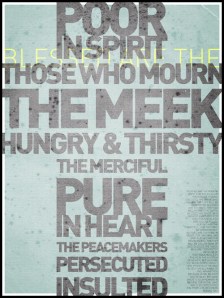
Today we hear one of the most beloved pieces of scripture.  The Beatitudes from Matthew’s gospel have been the source of inspiration for Christians for centuries, for artists and musicians, for entire ministries, and even for comedians like Monty Python.  As soon as we hear that phrase, “Blessed are…” our eyes close and we let the words flow over us.  We nod in assent, and maybe even whisper, “Yes!”  And as the preacher for In-Gathering Sunday, getting the Beatitudes in the lectionary is like being handed a silver platter.  What other inspiration can we need on a Sunday like this than to think about blessings?  That is what our Stewardship Committee has been encouraging us to do for weeks: to think about the ways that we are blessed and to return that blessing to this community through the gift of our financial resources.  That message could not be better captured than in the Beatitudes from our gospel lesson today.

Or at least that is what I thought before I started really working with the Beatitudes this week.  The more I poured over the text, the more I became confused.  Then the questions came pouring in:  What does it mean to be poor in spirit?  How do we know if we are pure in heart?  I might prefer peace, but could any of us in our everyday lives be considered peacemakers?  And those are just the surface level questions.  When we read at a deeper level, ethical questions begin to emerge.  Our news outlets have been flooded lately with people who are reviled, persecuted, and having evil uttered against them.  All we have to remember are Christians in Iraq, Palestine, or Burma whose very faith means a life of oppression and sometimes death.  Is the word for them today, “You are blessed”?  Many a liberation theologian has balked at the idea of Holy Scripture being used to keep down oppressed peoples.

Luckily, I stumbled on two things this week that opened up the Beatitudes for me in a fresh way.  First I began to look at what the word translated as “blessed” really means.  There are a couple of words in scripture that are translated in English as “blessed,” but they do not necessarily have the same meaning.  In our Beatitudes today, one scholar argues that the phrase translated as “blessed are you when…” is more rightly translated as “You are on the right road when…”  For example, “You are on the right road when you are poor in spirit.”[i]  So blessed does not really mean, “Happy are you when people persecute you,” but instead, “You are on the right road when people persecute you.”  Somehow this translation makes for a much more sober, honest rendering of Jesus’ words.  Jesus is not saying that these things are cause for happiness in a superficial way.  Jesus is saying that we are fortunate in those experiences because they point us to a deeper truth:  that we are heading in the right direction, making the right decisions, and living a meaningful life.

The other source of insight I found this week was from The Message’s translation of this text.  If you are not familiar with The Message, The Message is a paraphrase of the Bible:  not a literal translation of the Biblical language, but a modern rephrasing of the text to make the text more accessible.  Of course, biblical scholars often cringe when they hear certain paraphrases of key texts, but in the case of the Beatitudes, I found this paraphrase quite useful.

I have taken the two ideas – The Message’s paraphrase and the new introduction of “You are on the right road when…” and want to read for you my hybrid rephrasing of the Beatitudes.  Our text now goes like this:

You are on the right path when you’re at the end of your rope.  With less of you there is more of God and God’s rule.  You are on the right path when you feel you’ve lost what is most dear to you.  Only then can you be embraced by the One most dear to you.  You’re on the right path when you’re content with just who you are—no more, no less.  That’s the moment you find yourselves proud owners of everything that can’t be bought.  You’re on the right path when you’ve worked up a good appetite for God.  God’s food and drink in the best meal you’ll ever eat.  You’re on the right path when you care.  At the moment of being ‘care-full,’ you find yourselves cared for.  You’re on the right path when you get your inside world—your mind and heart—put right.  Then you can see God in the outside world.  You’re on the right path when you can show people how to cooperate instead of compete or fight.  That’s when you discover who you really are, and your place in God’s family.  You’re on the right path when your commitment to God provokes persecution.  The persecution drives you even deeper into God’s kingdom.  Not only that— You’re on the right path every time people put you down or throw you out or speak lies about you to discredit God.  What it means is that the truth is too close for comfort and they are uncomfortable.  You can be glad when that happens—give a cheer, even!—for though they don’t like it, God does!  And all heaven applauds.  And know that you are in good company.  God’s prophets and witnesses have always gotten into this kind of trouble.

This Stewardship Season, we have been talking about “Walking the Way.”  Certainly Walking the Way is a metaphor for our journey into a time of reflection about the value our money holds for us and how our relationship with that money is connected to our relationship with God.  But the Walking the Way metaphor is one that goes beyond just our money too.  Walking the Way is a metaphor for our entire journey with God – a path that is ever winding, has steep slopes at times, is sometimes full of potholes and rocks, and at other times is as smooth as a freshly paved road.  Our entire life is a journey – one in which we mature in faith from the time of our birth and baptism to the time of our old age and death.  We are constantly Walking the Way with Christ, growing, learning, messing up, and returning to a loving God.

What I like about this reworded rendition of the Beatitudes is the affirmation in them.  When we are on a journey, Walking the Way, we sometimes struggle to know whether we are on the right path.  We wonder if we are where we should be and whether God is really with us.  This rendition of the Beatitudes gives us a tiny glimpse into that affirmation:  You are on the right path when…  Of course, the description is not all roses.  Mourning, persecution, and making peace are not easy roads.  But a sign of true discipleship, of Walking the Way, are those times when the path is in fact quite rocky.  Then we know that we are on the right path, and Jesus is walking right beside us.  Amen.

[i] Earl F. Palmer, “Pastoral Perspective,” Feasting on the Word, Year A, Vol. 4 (Louisville: Westminster John Knox Press, 2011), 238.

Sermon – Genesis 12.1-4a, L2, YA, March 16, 2014

19 Wednesday Mar 2014

Posted by jandrewsweckerly in Uncategorized

≈ Leave a comment

Tags

Abram, blessing, challenge, go, God, hope, journey, Lent, pain, Sermon

I remember when I got accepted to Duke for my undergraduate education.  The invitation felt like a dream come true.  I was so ready to leave home and start my “adult” life, I was beyond thrilled to be able see Duke basketball games in person, I was eager to start my studies so that I could take on that big job, and I knew I would have a ton of fun.  As I packed my bags, I felt like the world was full of promise and hope and I just knew I was going to have an awesome college career.  And truthfully, my college experience was one of the best experience of my life on so many levels – one where I learned so much more than I expected, I made lifelong friends, I experienced my first sense of call to ministry, and I did in fact enjoy many a basketball game.  But that first year of college was nothing like the picture looking back now.  I had an awful freshman roommate, I struggled with the rigor of classes at first, I had a hard time finding a group of friends I really liked, there were multiple things I either tried out for our wanted to be invited into that I was not, and there were times that I wondered what in the world I was doing there.

As I listened to our Old Testament lesson today, I wondered how much Abram felt the same way about his own journey.  The very short passage from Genesis says, “The Lord said to Abram, ‘Go from your country and your kindred and your father’s house to the land that I will show you.  I will make of you a great nation, and I will bless you, and make your name great, so that you will be a blessing.  I will bless those who bless you, and the one who curses you I will curse; and in you all the families of the earth shall be blessed.’”  At first glance, Abram’s invitation sounds awesome!  He is invited on a journey with God and he is promised that God will bless him, will give him plenteous offspring and power, and that he will essentially be famous.  Who wouldn’t want to pack up their earthly belongings and hit the road with that kind of invitation?  The upcoming journey sounds like one full of promise, hope, and abundant joy.

Of course, there are a few slight indicators of how hard this journey might actually be.  First God tells Abram to leave his country, his kindred, and his father’s house – all without a map of where they will be going.  “In traditional societies the kin group is the source of identity, economic benefit, security, and protection.  To leave such a fundamental social network is to put a great deal at risk.”[i]  And then there is the text that we do not read today.  In the verses immediately preceding this text, we are told that Abram’s father has just died.  We all know what the death of a parent can do to a person, and can at least imagine the intense grief Abram is working under when he says yes to God.  And there is more that we do not read today.  The text immediately after where we stop also tells us that Abram is about 75 years old at this point.  So a man well beyond the prime of life, who is in the midst of grief, who has probably long sense lost hope of bearing any children should be able to guess that this journey would not be all roses and rainbows.

And in fact, we know that the journey is not as hope-filled as our lesson makes the journey out to be today.  This man whom God says will be blessed and be great hits all kinds of bumps along the way.  If you remember, Abram passes off his wife as his sister several times so as to avoid danger to himself.  When he still does not have any offspring, Sarai eventually convinces him to sleep with her handmaiden Hagar.  Though she bears him a son, Abram eventually casts Hagar and Ishmael out into the wilderness when his wife Sarai gets jealous.  And of course, we cannot forget that Abram is also forced to take his one son by Sarai, Isaac, up on a mountain to be sacrificed – believing all along that God intends for Abram to kill his only heir.  Sounds like a real journey of blessing, right?

That is the funny thing about journeys.  We are not often promised that our journeys will be blessed.  But even when we hope that they will be blessed, the blessing never comes immediately and is often masked by long intervals of pain and suffering.  We have lived that life here at St. Margaret’s.  Fifty years ago, God told the people of Plainview to, “Go.  Go from your current town, your church community, and the building you are familiar with to the land that I will show you.  I will make of you a great church, and I will bless you, and make your name great, so that you will be a blessing.”  At least, that is how the histories read about St. Margaret’s.  Full of hope and expectation, large groups of people gathered first in an American Legion Hall and then in a semi-completed church building.  It was a time of anticipation and promise, and the people went.  Of course, no one could know what the next fifty years would hold – a slew of clergy, some staying longer than others; church growth and church decline; building challenges and times of construction to fix old problems; new adventures like a church cemetery; painful arguments with severed relationships; new friendships that will last a lifetime; a young rector who is not only a woman, but who also gets pregnant while she serves.  When God said, “Go,” who would have ever guessed the journey would play out the way the journey has.

Sometimes our Lenten journeys have that same feel.  We fill ourselves with pancakes, and then the next day, kneel with resolve to take on some discipline.  We look forward to the blessings of Lent – the intimacy with God the journey will bring, the learning will we do, the peace we will gain, or even the couple of pounds we might lose.  And when we hear a story like the Old Testament lesson today, we feel pumped up and ready for an exciting journey.  We may even imagine God making similar promises to us:  You will be blessed in this Lenten journey.  And yet, if we think back to any Lent in the past, we might remember how difficult our discipline became by week four or five.  We might remember how that cool discipline we chose did not really turn out to be as great as we imagined.  And depending on how stable we were at the time, that sense of failure could have brought more of a sense of curse than blessing.

How do we know that blessing awaits and what do we do in the meantime?  What do we do when those days come – because they will – when we feel discouraged and lose that sense of promise and hope that God gives today?  If we look to Abram, we see that our only option is to go – to keep putting one foot in front of the other.  The lesson today says, “So Abram went, as the Lord had told him.”  The journey for Abram is risky, full of potholes, and ultimately full of some wild twists that might have turned Abram back at any point.  And yet, “Abram went.”  We are lucky enough to know that Abram becomes Abraham – the man that would eventually become a father of entire people – in fact of several faith traditions.  But Abraham never got to see the fullness of that blessing.  His life was more one of blessing in hindsight, not really an everyday blessing-fest.

In some ways, that is all we can do too.  God constantly calls us into a journey – whether during Lent or in whole phases of life.  God promises to bless us and love us along the way.  But we know the journey will be hard at times, and leave us feeling discouraged.  And when that happens, all we can do is put one foot in front of the other, and keep on going.  Of course, we have each other along the way, much like Abram had Lot.  In fact, the last words of today’s lesson are, “and Lot went with him.”  So whether you are in that blessed state of bliss, or you are already struggling in your steps, God still tells you to go.  Our response is difficult, intimidating, and profound, but also extremely simple.  We go, knowing God is with us.  Amen.


[i] Carol A. Newsom, “Exegetical Perspective,” Feasting on the Word, Yr. A., Vol. 2 (Louisville: Westminster John Knox Press, 2010), 53.

On being dust…

06 Thursday Mar 2014

Posted by jandrewsweckerly in Uncategorized

≈ Leave a comment

Tags

Ash Wednesday, community, death, dust, God, humble, journey, priest

One of the gifts of being a clergy person is the moments of insight, intimacy, and holiness.  That gift is probably one of the primary things that keep me going, especially in the midst of weeks when the vocation feels more full of challenge than full of blessing.  The cool thing about the gift is that it often catches me unawares – I am busy just doing my job when all of sudden, wham!, God brings me to my knees with the enormity and privilege that this vocation is.

Courtesy of http://en.wikipedia.org/wiki/Ash_Wednesday

Courtesy of http://en.wikipedia.org/wiki/Ash_Wednesday

It happened yesterday as our church celebrated Ash Wednesday.  As my mind was distracted with my sermon, the choreography of the liturgy, and the elements of the altar, I suddenly found myself at the part of the liturgy where I spread ashes on each person’s forehead.  I had forgotten how incredible that moment is.  There I am, rubbing dirty, gritty ash on person’s forehead, reminding them of their mortality.  The experience is a visceral, fleshy one.  Some foreheads are covered with hair, some are oily after a day of work or activity, and some are polished and made up.  Some foreheads are smooth and non-anxious and others are lined with the wrinkles of age or stress.

But even more profound than the tangible piece is the emotional piece of the experience.  There is the woman who just celebrated 91 years of life.  I find myself wondering how many more years we will share moments like this.  There is the parishioner with whom I have shared laughs and tears, who is the prime of their lives, and whose death I cannot fathom.  And of course there are the children.  There is something profound about reminding a five-year old that they will someday die, whether they fully understand what is happening in the liturgy or not.

After everyone had received ashes, I turned to our acolyte and asked her to give me ashes as well.  In this time of growing life inside of me – as I have frequently fretted about the viability of my child outside the womb – I was reminded that neither my coming child nor I are spared from returning to dust someday.  Though that sounds like a grim thought, where it ultimately left me was convinced that no matter what happens, God is the firm foundation that I stand firmly upon, grounding me, keeping me humble, and reminding me of what really matters.

That is the other beauty of being a clergy person.  As much as I hope liturgies are meaningful to others, I find them equally meaningful to me.  Sometimes it is harder than others to worship while leading worship.  But this Ash Wednesday, the power and wonder of the liturgy and our God did not escape me.  I am grateful today for the powerful reminder of my humanity, the collective recognition of the fragility and preciousness of this life, and the blessing of a community who always gives me a healthy dose of perspective.

Getting back in the game…

21 Friday Feb 2014

Posted by jandrewsweckerly in Uncategorized

≈ Leave a comment

Tags

Carolina, Duke, faith, God, journey, rivalry

Courtesy of http://chapelboro.com/calendars/duke-carolina-the-blue-blood-rivalry-2/

Courtesy of http://chapelboro.com/calendars/duke-carolina-the-blue-blood-rivalry-2/

I am a huge college basketball fan.  Well, actually I am a huge Duke Basketball fan, which means I tend to know more about college basketball than any other sport.  This week is the Duke-Carolina game – one of the biggest rivalries in the country and certainly one of the biggest sporting events all year in my home.  What is so great about the rivalry is that no matter what the rankings are for either team at any point in the season, and whether the game is played at Duke or at Carolina, you never know who will win.  Something about the intensity of the rivalry means that no matter how dominant one team might normally be that season, and no matter what advantages being the “home” team might bring a team, there is very little way to predict how the game will evolve.  Consequently, watching the Duke-Carolina games each season make me intensely nervous and anxious.  In fact, as I have gotten older, I have even turned the TV off when I get so stressed.

I have been thinking about that phenomenon and wondering what in our faith life is like the anomaly of the Duke-Carolina game.  Where in our lives do our normally highly functioning spiritual selves get short circuited?  I have begun to wonder whether my prayer life might be the Duke-Carolina game in my faith journey.  There are times when I feel like my prayer life is solid – I find a practice that I really love and I find that keeping the practice is easy and enriching.  But then I have weeks when I get to the end of several days and cannot remember the last time I prayed.  Or I realize that instead of sitting down in the empty church for a time of prayer each morning, I have just starting praying as I pass through, not feeling like I have the time to really stop.  Sometimes the season – in particular Lent – makes me more disciplined.  But even the steady rhythm of Lent does not guarantee that I am steadfast in my prayer life.

The truth is, whatever the Duke-Carolina hiccup is in your faith journey, I am not sure there is much you can do about it.  Much like neither team can seem to master the intensity of the rivalry, I think we will always have a flawed area in our faith life.  Perhaps knowing that fact will allow us to not be so hard on ourselves and enjoy the ride.  Certainly that does not give us permission to sit back and pretend things are out of our control.  Neither team goes into the Duke-Carolina game resigned to lose.  Our task is to keep on trying, to keep tabs on when we are getting slack, and to slap the floor, and get back in the game!

Homily – 1 John 4.7–12, Richard Meux Benson and Charles Gore, January 16, 2014

12 Wednesday Feb 2014

Posted by jandrewsweckerly in Uncategorized

≈ Leave a comment

Tags

Charles Gore, community, faith, God, journey, Richard Meux Benson

Richard Meux Benson was born in 1824, in England.  He was ordained a priest, and eventually, with two other priests, he founded the Society of St. John the Evangelist (SSJE).  SSJE was to be “a small body to realize and intensify the gifts and energies belonging to the whole church.”  SSJE became the first stable religious community for men in the Anglican Church since the Reformation. Branch houses were established in Boston, India and South Africa.  Benson wrote the original SSJE Rule and served as Superior until 1890.

Gore was born in 1853 (almost 30 years after Benson was born).  He, too, lived in England, and served as a priest and later as a bishop.  He founded the Community of the Resurrection, a community for men that sought to combine the rich traditions of religious life with a lively concern for the demands of ministry in the modern world. He was a writer and promoter of liberal Anglo-Catholicism.  He wanted to both 1) make available to the church the critical scholarship of the age, while 2) pricking the conscience of the church and pleading for a focus on the work of social justice for all.

What both Benson and Gore saw was a need for a more intentional Christian community to shape the spiritual lives of the faithful.  Though none of us live in religious orders, we understand the value of being surrounded by a faith community.  I just had a conversation last night with a parishioner about this very issue.  The parishioner ran into another parishioner who has fallen away from the church lately.  The two had a conversation about how easy getting caught up in the rush of life can be.  Finally the active parishioner asked the other, “But how do you do it? How do you encounter God without being active in the life and worship of the church?”

What this parishioner saw, or what Benson, Gore, and the writer of the First Epistle of John saw, is the value of the other in our faith journey with God.  Whether it is the call to social justice by Gore, the invitation to be formed by the faith community by Benson, or simply the reminder to the beloved to love one another, we experience faith within a community.  The community invites us into something bigger than ourselves, and it reminds us that our individual relationships with God are only enriched by partners in the journey.  That does not mean the journey will be easy – living within a community can be messy and full of its own challenges.  But the reward of our shared journey is closeness to God.  As First John says, “If we love one another, God lives in us, and his love is perfected in us.”  Our communities are never perfect, but when we steep ourselves in them, we can better see and serve God.  Amen.

Gratitude adjustment…

10 Thursday Oct 2013

Posted by jandrewsweckerly in Uncategorized

≈ Leave a comment

Tags

discipline, God, gratitude, journey, pledge, prayer, stewardship

Courtesy of http://www.budaao.com/daily-life/add-a-daily-dose-of-gratitude/

Courtesy of http://www.budaao.com/daily-life/add-a-daily-dose-of-gratitude/

This Sunday, we kick off our Stewardship Season.  Our Stewardship Committee has been working hard, reading some great work, exploring some creative ways of expressing our needs, and prayerfully taking steps toward this kickoff.  In the coming weeks, my weekly reflection will be replaced by guest posts from our parishioners, reflecting on how they hope to flourish in faith this Stewardship Season.

The more and more we have prepared for this time, the more and more I have been pondering the practice of gratitude.  I have been thinking about how dominated my prayer is by intercessions and how few thanksgivings I have been offering to God.  I have noticed how grudgingly I write that hefty pledge payment each month – praying that we can still make our other bills instead of thanking God for the gifts with which we have been blessed.  I have been listening to my responses to that age-old question, “How are you?” and been a bit disappointed about how consistently I manage to fit in some complaint about my life.  As I run from one thing to the next, I have found myself more burdened by life than rejoicing in life as a gift.

So I have decided to use Stewardship Season as a mini-Lenten experience.  As we encourage parishioners to prayerfully consider their financial giving, I will be prayerfully implementing gratitude back into my life.  I am committing myself to infusing gratitude into my relationship with God, my relationships with others, and my relationship with myself.  I figure that if I can focus on that work, the conversation I have with my family about our financial pledge might just take on a different tenor.  I am also excited to see what other surprises God has in store for my mini-Lenten Stewardship experience.  I am looking forward to the journey, and hope you will consider yourself duly invited to join me.

Welcome Back…

12 Thursday Sep 2013

Posted by jandrewsweckerly in Uncategorized

≈ Leave a comment

Tags

church, community, faith, home, hurt, Jesus, journey, love, seeker, Sunday, welcome

This coming Sunday is what we call “Welcome Back Sunday,” at St. Margaret’s.  The Welcome Back is not meant to acknowledge that parishioners have been away all summer, despite the fact that I have heard anecdotally that Robin Williams once said that Episcopalians are the only people God trusts enough to take the summers off from Church.  No, Welcome Back Sunday is a time that we are welcomed back to the program year and all the fullness that the program year offers.  For us, Welcome Back Sunday means returning from one Sunday service to two services, the return of educational and formation opportunities, more fellowship activities, and generally more life and energy around the church.

To prepare for Welcome Back Sunday, invitations have been sent out to our neighbors, our website has been redesigned, a welcome breakfast has been planned, a full line-up for the fall is all set, and in general we are hyping up parishioners to get back into the swing of the program year.  We have been sharing videos about Welcome Back Sunday – my personal favorite being this one.  But despite the fact that I am energized and excited about what this program year has to offer, I am aware that for many, Church is still an experience that many keep at arm’s length.  Perhaps you never grew up in a church setting, perhaps you began to feel unwelcome in church, or maybe the Church has actively hurt or disenfranchised you.  Whatever the reason, for many Church is seen as an irrelevant experience to your everyday lives.

For those who have been hurt, I completely understand why you keep your distance.  Having been severely judged by someone who claimed to love the Lord, I understand why you would keep up your guard and be suspicious of any church enthusiasts like myself.  But I must say, there is a part of me that aches to share the joy, love, and sense of wholeness I have found through the Church.  Yes, the Church is flawed, and full of sinful people, but at its very best, the Church is a place where people can vulnerably step forward with their struggles with God and be invited along a spiritual journey in the context of a community of seekers.  I think that is why my heart aches when I hear songs like Macklemore’s “Same Love.”  In it, he sings about the ways that Church has deeply wounded our gay and lesbian brothers and sisters.  His words make me want cry out to the world that the Church has another way of being too – a way of love.

So this week, if you find yourself without a Church home, without a place to ask the hard questions about God, or without a community who lets you be you in the journey, come to Church.  If you are in Plainview, I hope that Church will be St. Margaret’s.  But if not, I hope you will look for a Church that lives into what Jesus dreamed of for the Church – a community of faith living the way of love.  Whether it has been a week since you have been to church, years, or you have never been to church, I say to you, “Welcome Back.”

Sermon – Luke 12.49-56, P15, YC, August 18, 2013

18 Sunday Aug 2013

Posted by jandrewsweckerly in Uncategorized

≈ Leave a comment

Tags

baptism, chaos, church, conflict, division, family, Jesus, journey, peace, Sermon

Once upon a time, I lived in a world where there was such a thing as a “normal family.”  These were the families who could sit around a dinner table and have a pleasant conversation, who never had a disagreement, who never had to deal with passive aggressive behavior, and whose dealings could be taken at face value without any hints of ulterior motives.  In this world, people were happy, holidays were perfect, siblings loved each other, and marriages were unbreakable.  Laughter was pervasive, love overflowed, and peace ruled the day in this world.  And since my life did not resemble this world, surely I would find a life partner whose world was like this.  Surely there would be a way to escape my own reality to find that world where the “normal family” existed.

Of course, once that notion crumbled, I created a new one.  Then I lived in a world where there was such a thing as a “conflict-free church.”  This church was one where people welcomed others warmly, where the love of God poured out of every parishioner, where every meeting unfolded in a peaceful, consensual manner, and where everyone felt at home.  In this church, the people all lived Christ-like lives, and they were so focused on serving others that they never fell into serving themselves.  In this church there was no judgment, no division, and no central source of power.  At this church, people were happy, worship was beautiful, and money was never a concern.  Surely such a church existed, and so if my church was not this way, I would find that “conflict-free church” somewhere.

Jesus takes a blowtorch to these make-believe worlds I envisioned in today’s gospel.  Jesus says, “I came to bring fire to the earth, and how I wish it were already kindled…Do you think that I have come to bring peace to the earth?  No, I tell you, but rather division!”  “Whoa, whoa, whoa, Jesus,” many of us may want to say today.  I thought Jesus was the Prince of Peace – in fact the same person whose name we invoke when we greet one another with, “The peace of the Lord be with you.”  Today’s Jesus is not the sweet, peaceful Jesus in a manger.  Jesus denies peace altogether today and instead rolls out a campaign of conflict.  There is no peace-loving church today.  In fact, Jesus even goes on to say how he will be turning family members against one another.  Father against son, mother against daughter, in-laws against in-laws:  families will be divided against one another.  Not only do we lose the dream of a “conflict-free church” today, any hope of a “normal family” without pain or strife is obliterated today too.

Of course, what is most painful about this gospel lesson today is that we already know the gospel to be true.  What person here today has not faced conflict within their family?  For the lucky among us, that conflict may eventually pass and familial love is relatively easy.  But for pretty much anyone who has had an honest and frank conversation with me, I do not know one single family who has not been touched by divorce, pain, cutoff, abuse, rivalry, anger, manipulation, or division.  Conflict is not the anomaly – conflict is the norm in our families.  And if church is anything like a family, we have known bitter conflict in church too.  Some of us have left churches because of conflict, pain, or suffering.  Most of us have known conflict here in this place – and if we have not yet, we will.  Why this gospel lesson is so hard today is because this gospel holds up a mirror – a mirror to our broken lives, our broken world, and our broken church.  And quite frankly, most of us do not come to church to look in a mirror; or if we do imagine church as a mirror, we hope the mirror is like one of those carnival mirrors that can distort our broken worlds and reflect something much more beautiful or hopeful than the reality we know.

Despite all the seemingly bad news in today’s gospel, some of Jesus’ words reach out to us in hope:  “I have a baptism with which to be baptized, and what stress I am under until it is completed.”  The idea of Jesus’ baptism not being completed has been bouncing around in my head all week.  In the early days of the church, fonts were not the pretty, upright fonts we see now that hold a beautiful bowl of baptismal water.  Fonts were more like pools, with steps leading down and steps leading up on the other side.  The person to be baptized would walk down those steps, be fully immersed in the water, and the come up for air again as they emerged from the water and walked up the exit steps.  The symbolism was rich – baptism looked like the emergence from the watery birth canal, and baptism rightly lived into the name “new birth.”  But also weaved into the symbolism is journey – a journey from a former life, into a watery chaos (not unlike the chaos from which God created the earth), and emerging a new creation and a transformed person.

The idea that Jesus’ baptism is not yet complete somehow makes sense when we think of baptism as a journey.  In the midst of all this talk about conflict and division, Jesus is giving us a picture of what living a baptized life is like.  At our baptism, we make promises – to turn away from sin time and again – and to turn into the way of baptized life – seeking and serving Christ, loving neighbor as self, and striving for justice and peace.  The image of Jesus’ baptism not being complete gives some grounding to what all this conflict and division is all about.  The conflict and division is a necessary component to completely live into our baptismal covenant.  We say that when we fall into sin – not if we fall into sin – we will turn back toward the Lord.  The journey of baptism promises then that we will not have a peaceful, conflict-free road and that our baptism in not a once and for all activity.  Baptism is a journey, of fully living into those baptismal promises, in which the challenging stuff will shape and mold us into better disciples and better servants of Christ.  Jesus knows that our baptism journey will never be one of peace – at least not the superficial peace we long to have.  Our baptism journey will be one of division.  That division will not only be because conflict is a necessary part of life, but because the radical way of Jesus can only be achieved by walking through the watery chaos of baptism – a chaos full of conflict and division – but a journey in which we emerge transformed and renewed.

Once upon a time, I encountered a world where conflict was not a curse word.  In this world, conflict was not an uncomfortable experience to be avoided, but a challenging experience that led to new growth and new life.  In this world, everyone was not happy in a superficial, cheerleader kind of way.  But people were happy in a much deeper, rooted kind of way.  In this world, families still fought, but the fighting led them somewhere new and life-giving.  In this world, parishioners grew to expect conflict – but also grew to expect transformation.  In this world, conflict was not the end of relationship, but instead the tool that drug people through rough times into times of unknown joy and peace.  This is the world that I long to inhabit.  This is the world that gives us life.  This is the world that leads to new birth.  Our invitation today is to step into the watery chaos of division and conflict, so that we might emerge a faith community on the baptism journey.  Amen.

← Older posts
Newer posts →

Recent Posts

  • On Change and Bread…
  • Sermon – Exodus 14.19-31, P19, YA, September 13, 2026
  • On Realizing Dreams…
  • On Seeing the Kingdom…
  • Sermon – Exodus 3.1-15, P17, YA, August 30, 2026

Archives

  • September 2026
  • August 2026
  • July 2026
  • June 2026
  • May 2026
  • April 2026
  • February 2026
  • January 2026
  • December 2025
  • November 2025
  • October 2025
  • September 2025
  • August 2025
  • July 2025
  • June 2025
  • March 2025
  • February 2025
  • December 2024
  • November 2024
  • October 2024
  • September 2024
  • August 2024
  • July 2024
  • June 2024
  • May 2024
  • March 2024
  • February 2024
  • January 2024
  • December 2023
  • November 2023
  • October 2023
  • September 2023
  • August 2023
  • July 2023
  • June 2023
  • May 2023
  • March 2023
  • February 2023
  • January 2023
  • December 2022
  • November 2022
  • October 2022
  • June 2022
  • May 2022
  • January 2022
  • December 2021
  • November 2021
  • October 2021
  • September 2021
  • August 2021
  • June 2021
  • May 2021
  • April 2021
  • March 2021
  • February 2021
  • January 2021
  • December 2020
  • November 2020
  • October 2020
  • September 2020
  • August 2020
  • July 2020
  • June 2020
  • May 2020
  • April 2020
  • March 2020
  • February 2020
  • January 2020
  • December 2019
  • November 2019
  • October 2019
  • September 2019
  • August 2019
  • July 2019
  • June 2019
  • May 2019
  • April 2019
  • March 2019
  • February 2019
  • January 2019
  • December 2018
  • November 2018
  • October 2018
  • September 2018
  • August 2018
  • July 2018
  • June 2018
  • May 2018
  • April 2018
  • March 2018
  • February 2018
  • January 2018
  • December 2017
  • November 2017
  • October 2017
  • September 2017
  • August 2017
  • July 2017
  • June 2017
  • May 2017
  • April 2017
  • March 2017
  • February 2017
  • January 2017
  • December 2016
  • November 2016
  • October 2016
  • September 2016
  • August 2016
  • July 2016
  • June 2016
  • May 2016
  • April 2016
  • March 2016
  • February 2016
  • January 2016
  • December 2015
  • November 2015
  • October 2015
  • September 2015
  • August 2015
  • July 2015
  • June 2015
  • May 2015
  • April 2015
  • March 2015
  • February 2015
  • January 2015
  • December 2014
  • November 2014
  • October 2014
  • September 2014
  • August 2014
  • July 2014
  • June 2014
  • April 2014
  • March 2014
  • February 2014
  • January 2014
  • December 2013
  • November 2013
  • October 2013
  • September 2013
  • August 2013
  • July 2013
  • June 2013
  • May 2013
  • April 2013
  • March 2013
  • February 2013
  • January 2013
  • December 2012
  • November 2012
  • October 2012
  • September 2012

Categories

  • reflection
  • Sermons
  • Uncategorized

Meta

  • Create account
  • Log in
  • Entries feed
  • Comments feed
  • WordPress.com

Blog at WordPress.com.

  • Subscribe Subscribed
    Seeking and Serving
    Join 397 other subscribers

    Have a WordPress.com account? Log in now.

  • Seeking and Serving
    View site in Reader
    Manage subscriptionsSign upLog in
    Report this content
    Collapse this bar
Loading Comments...